|
abacus (άβακας,
אבקוס)
1. Latin-Greek-Hebrew. Architectural term
referring to a flat slab on top of a
capital,
i.e. the uppermost part of a column.
回
2.
Latin-Greek-Hebrew. A device for making mathematical calculations.
READ ON.
回
abat (อาบัติ)
Thai-Rajasap. Transgression of a minor precept by a
Buddhist monk. See also
sa-mee and
Buddhist precepts.
回
abayamuk (อบายมุข)
Thai. The way to hell and ruin. A term used for temptations and vices, generally
understood to be getting drunk, going out late at night, watching games,
gambling, befriend bad people and indolence or laziness.
回
Abhakara Kiartivongse (อาภากร เกียรติวงศ์)
See
Aphakon Kiatiwong.
回
abhava (अभाव)
Sanskrit. ‘Non-existence’ or ‘non-entity’.
A term used for ‘one who is never born’
and as such a title given to some Hindu gods. This could refer to those
not born of any human being or material creature, such as
Rudra, who was born from between the eyes of
Brahma,
and Brahma
himself, who is born directly from the
lotus flower that grows from the navel of
Vishnu.
The term is related to the Sanskrit words
bhava (भव) and bhaava (भाव),
meaning ‘being’ and ‘spirit’, respectively. Also transcribed abhaava.
回
abhaya
(अभय)
Sanskrit. ‘Fearless’. A
mudra
symbolizing ‘calm’,
‘reassurance’
and ‘no fear’.
READ ON.
回
Abhaya (अभय)
1. Sanskrit. ‘Unafraid, fearless’. A god that is also the
patron saint of the
Sakya clan, and to
whom the newborn
Siddhartha was
presented in the temple of the same name according to ancient tradition. See
also
abhaya.
回
2. Sanskrit. ‘Unafraid, fearless’.
Name of a son of King
Bimbisara of Rajagaha, who raised
Jivaka
as his adopted son.
回
Abhidhamma
Pali. Buddhist philosophy, which consists of
higher teachings about the
dhamma and
which has been described as an abstract and highly technical systemization of
the Buddhist doctrine, which is simultaneously a philosophy, a psychology and an
ethics, all integrated into one framework.
回
Abhimanyu (अभिमन्यु)
Sanskrit. ‘Excessive anger’. Son of
Arjuna and
Subhadra. He
was a brilliant warrior who whilst still in his mother's womb had learned the
knowledge of penetrating into the Chakravyuha, a seven-tier defensive spiral
formation, by overhearing Arjuna talking about it with his mother. However, his
mother fell asleep while she
was being explained about it and so he could not learn how to escape from it,
hence he later died in battle trying to break free from the Chakravyuha.
Shortly after his death his wife
Uttara had a miscarriage but the child named Parikshit was brought back to life
by
Krishna and
eventually succeeded Yudhishthira as king of Hastianpura.
回
Abhinavagupta (अभिनवगुप्त)
Sanskrit. Philosopher from the 10th century AD and writer
on aesthetics. One of the most influential philosophers from the Kashmir school
of
Shivaism.
回
abhisheka (अभिषेक)
1. Sanskrit. ‘Unction’ or ‘blessing’ by sprinkling water,
also the ceremonial sprinkling of images with water, milk, saffron, flower
petals or other objects, to honour or worship. The Thai word aphisek
(อภิเศก), which means ‘coronation’, derives from it.
Compare also with the Thai term
rod mon nahm.
回
2. Sanskrit. Ritual unction or anointment, as in
Abhisheka of Sri.
回
Abhisheka of Sri
Representation of the goddess
Sri (Lakshmi)
seated on a
lotus base (fig.)
and holding a
lotus (fig.),
one of her
attributes, in each hand
(fig.),
whilst being doused with water by two elephants.
READ ON.
回
Acacia (อาเคเชีย)
English-Thai. Generic name for a genus of pod-bearing trees
and shrubs in the subfamily Mimosoideae.
READ ON.
回
Acalanatha (अचलनाथ)
Sanskrit. ‘Immovable protector’. Name of a
Hindu
deity that in the late 7th century was
incorporated into esoteric Buddhism as a servant of the
Buddha.
READ ON.
回
achara (अचर)
Sanskrit. ‘Behaviour’ or ‘conduct’. The
rules for ritual practice of religions, orders and castes; ceremonial rites.
Also transcribed acara.
回
acharya (आचार्य)
Sanskrit. ‘Teacher’ or ‘guru’,
especially of
brahman,
the Universal, absolute,
eternal and pervading spirit in Hindu philosophy.
The term is often used for a group of
Vaishnava teachers
who base their teachings on
Sanskrit as well
as on Tamil scriptures. They worship the
alvars which it is
believed are
incarnations of the
attributes of
Vishnu. Acharya is
the root word for the Thai word
ajaan, meaning ‘teacher’.
See also
Brahmacharya.
回
acupressure
Therapy by using pressure and massage on
precisely determined points of the body, used in traditional Thai massage. See
also
acupuncture
and
fire cupping.
回
acupuncture
An old form of treatment that originated in
China
in which long needles of steel, silver or gold are placed in the subcutaneous
connective tissue in precisely determined spots of the body.
READ ON.
回
adi (आदि)
Sanskrit. ‘First, beginning’ or ‘chief’, as in
Adi-Buddha.
回
Adi-Buddha (आदिबुद्ध)
Sanskrit. ‘The original Buddha’. The
supreme primordial
Buddha in the
Vajrayana sect of
Mahayana
Buddhism, who created
himself from the original void. In true
essence,
this Buddha is abstract, illusionary
and inconceivable. Therefore he cannot
be represented in art,
unless in his revealed and more earthly forms such as
Vajradhara (fig.)
and
Vajrasattva (fig.), as
found in Tibetan as well as in
Khmer art, and the
various
bodhisatvas.
Vairochana is
considered
the Javan Adi-Buddha.
Usually depicted
in royal attire or in
hermaphrodite union
with a consort, a principle
in Vajrayana Buddhism known as
yabyum. The
emanations and representations of
his
five qualities are referred to
as the
Five Great Buddhas or
the
Five
Jinas,
i.e. the five
dhyani buddhas.
回
Adi-Granth (आदिग्रंथ)
Sanskrit. Holy book with more than five hundred hymns
composed by five
gurus and holy men
and written by
Arjan Dev
(1581-1606) in 1604. They are kept in the
Golden Temple in
Amritsar. Later,
hymns of the Guru Tegh
Bahadur were added to the Adi Granth and the text was affirmed its successor.
This
second rendition
is sometimes referred
to
as
Guru Granth Sahib.
The text is so sacred that it has its own bed and bedroom within the
gurudwara, i.e. a Sihk
temple, and is each morning carried to the sanctum
transported in a special
palanquin
and carried on the head, a ritual that is repeated in reverse each evening, when
the scripture is tucked back into its bed.
回
Adinatha (आदिनाथ)
Sanskrit.
‘Original lord’.
Designation of the first
Tirthankara of
Jainism, who
is also known by the name
Rishabh or
Rishabh Dev. He was a prince of the Ikshvaku
clan, born to King Nabhi
Raja and Queen Maru
Devi in
Ayodhya. He became a
Siddha, a liberated soul which has destroyed
all of its
karma. Adinatha had one hundred sons, the
firstborn being
Bharat, the second one known as
Gomateshwara or Bahubali, of which the latter
name means ‘strong-armed’. Also pronounced Adinath.
回
Aditi (अदिति)
Sanskrit. ‘Unbounded, free’. The Vedic goddess of space
and mother of all creatures and gods. Her first offspring were the
Adityas. One of
them,
Daksha, is considered
both her daughter and mother. In later mythology she appears as the wife of the
seer
Kasyapa, by whom she
became the mother of
Vishnu in his
avatar as
Vamana
(fig.),
and of
Indra.
Besides this she is the goddess of the sky, consciousness, the past, the
future and fertility. The Thai word for ‘the past’ (adit) derives from Aditi.
回
Aditya (आदित्य)
1. Sanskrit. ‘Sun’. The Thai word ‘ahtit’
(sun) is derived from it. See also
Phra Ahtit.
回
2. Sanskrit. Sons of
Aditi. Each of
them represent a certain aspect of natural phenomena. In scriptures they first
appear as just six then later seven, of whom
Varuna was the
first. They then became eight in number and eventually twelve, personifying the
sun in the twelve months of the year. They have different names, many epithets
of the sun. They represent aspects of light and are jointly identified with
Aditya, the sun. See also
Phra Ahtit.
回
adorned Buddha
A style of
Buddha image popular in the
Rattanakosin
period, in which the Buddha image is
decorated or ‘adorned’ with jewels or royal attire, and a headdress. In
Myanmar,
this jewel may be a
salwe
(fig.),
i.e. a set of chains that is worn over the
shoulders and is fastened at the chest with several ornamental plaques, in order
to indicate the
Buddha's
royal rank (map
-
fig.). In Thai,
adorned Buddha images are known as
phra song kreuang.
See also
crowned Buddha and
Jambupati Buddha image.
回
adrishti (अदृष्टि)
Sanskrit. Literally
‘no view’ or ‘no eye’. A term for ‘Evil
Eye’,
a look that is superstitiously believed to have the power to inflict harm. In
this common conviction from antiquity
it is understood that
the envy brought forth by the good luck of fortunate people, may result in their
misfortune and can be caused simply by an envious person casting a malevolent
gaze, intentionally or not.
This so-called Evil Eye can be countered by wearing
amulets in the form of
-usually blue- eyes,
that
ward off the curse
and turn the malicious
look back to the envious person. In
Hinduism,
children, who are traditionally regarded as perfect and thus prone to attracting
Evil Eye, are sometimes made less perfect by applying a spot or
tilaka
on their face or by putting black eyeliner
around the child's eyes (fig.).
With adults, Evil Eye can be removed by a ritual in which a
brahman
priest will move a
holy flame in a circular motion around a person's head, thus absorbing the evil
effects. Many boats have a pair of forward
looking, vigilant eyes painted on the prow, one on each side of the stem (fig.).
They are believed to be a kind of
amulet to protect them from misfortune
or Evil Eye.
See also
Hamsa
and
Wisdom Eyes.
回

Adsadongkot (อัสดงคต)
Thai. Another name for
Prajim.
回
Adulyadejvikrom (อดุลยเดชวิกรม)
Thai.
‘Adulyadej
The Brave’
or ‘Courageous Adulyadej’.
A title given to
Mahidol
Adulyadej (fig.),
the father of both
Ananda Mahidol
(King
Rama VIII)
and
Bhumipol Adulyadej (King
Rama IX).
The title is pronounced Adunyadetwikrom.
回
Advaita Vedanta (अद्वैत वेदान्त)
Sanskrit-Thai. School
of thought in
Hinduism that is often
attributed to the Indian Vedic scholar Adi Shankara, but the ideas existed
before him and he only propagated them. It means the ‘non-dualist (or single)
end of the
Vedas’, and means that
everyone and everything is connected by their soul, the self, known as
atman, and in
which
moksha
is attained through disconnecting from one own entity by acquiring knowledge of
one's true identity and oneness with all other beings. In this one monistic
concept, the physical equals the spiritual. There is only one universal
spiritual and physical substance, an all encompassing matter, to which everyone
and everything belongs, and which can be seen and understood through the
elimination of
maya.
Since
brahman
is the ultimate of everything, this
idea also implies that atman merges into brahman, the one eternal being,
and hence everyone and everything is god, as is clearly manifested in the Hindu
greeting
namaste, which
is said when meeting others and that can be translated as ‘I salute the divine
within you’ or ‘I bow to the divine in you’, meaning ‘the sacred in me
recognizes the sacred in you’. See also
Vedanta.
回
aeb (แอบ)
1. A
northern Thai term used alongside the word
kong khao to describe a
kratib (fig.),
a small basket used to offer or serve
sticky rice and to keep it warm,
and made from
either
bamboo or rattan, or from the leaves of a plant
from the genus Calathea, named klah (คล้า) in Thai.
回
%20kratib%20(กระติบ)%20sticky%20rice%20box_small.jpg)
2. Thai
word meaning ‘to
tuck away’,
‘to conceal’ or
‘to
hide’.
回
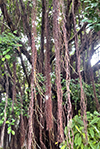
aerial root
Name for certain kinds of roots
that grow above the ground and of which there exist several types. These roots
are either growing down, such as supportive
buttress roots (fig.),
or —as with certain ficus trees— just hanging down from the main branches or
stems to take in moisture from the surrounding air which in the tropics is often
high in humidity, whilst other varieties grow
up from the soil, such as mangrove pneumatophores (fig.),
and so on.
See also TRAVEL PICTURE (1),
(2) and
(3).
回
agarwood
Name of a fragrant residue that
forms in the heartwood of Aquilaria malaccensis, a tree in the family
Thymelaeaceae, as a result of an infection by a type of mold known as
Phialophora parasitica.
READ ON.
回
Agastya (अगस्त्य)
Sanskrit. An Indian hermit or
rishi who it is
believed brought
Hinduism to South India.
He appears in the
Ramayana and is a
scholar in literature and science. In Java he appears as the
Bhattara-Guru and
is associated with the worship of
Shiva.
回
Agni (अग्नि)
Sanskrit. ‘Fire’. One of three great Vedic gods with
Indra and
Surya. He presides
over the earth and is known as the god of fire, whilst Indra presides over the
air and Surya over the sun and sky. He is the mediator between man and the gods
and thus the originator of sacrificial rites. Agni is coloured red and is one of
the eight
lokapalas
protecting the main wind directions, presiding over the Southeast. He is often
depicted with a ram, though he may also be seen riding a rhinoceros. In
Hinduism, fire is believed to purify, rather than to consume
and for this reason
Hindus burn their dead, or alternatively throw them in the purifying
Ganges. In art, he is at
times represented seated on a throne with flames (fig.)
or having three heads sprouting red flames. In Thai known as
Ahkney
or
Phra Phleung.
In some stories he is mentioned as the father of
Nilanon.
回

ahimsa (अहिंसा)
Sanskrit. The principle of non-violence in thought,
action, word and speech according to Buddhist scriptures, and a teaching from
Jainism which is often
translated as ‘respect for and non-harming towards all living creatures’.
Sometimes also avihimsa.
回
Ahkaan Benjamaraat Waranuson (อาคารเบญจมราชวรานุสรณ์)
Thai name for the Benjamaraat
Waranuson Building, an edifice at
Wat Mahathat Yuwaraja Rangsarit
(fig.)
on
Rattanakosin
Island
in
Bangkok
and whose name may also be transliterated Benchamarat Waranusorn. It was
constructed in 2011, and houses the temple's Center for International
Vipassana Meditation Study and
Practice. The building is painted in the royal yellowish colour in order to
match the then colour of the adjacent
Thawornwatthu
Building
(fig.),
which was later painted over in a reddish
rusty brown colour (fig.).
In front of it there is a bronze statue of Prince
Wajirunhit (fig.),
the first actual
Rattanakosin
Crown
Prince and successor to the throne of King
Chulalongkorn (Rama V),
but who after his premature death in 1895 at the age of sixteen was succeeded by
his thirteen year old half-brother
Wajirunhit.
The location of the Crown Prince's statue is related to the fact that the
adjacent
Thawornwatthu
Building
was initially erected to serve
as the royal crematorium for
this prince.
回
_small.jpg)
Ahkaan Rattasapha (อาคารรัฐสภา)
Thai
for ‘Parliament
Building’,
the edifice that houses the National Assembly,
i.e. the bicameral legislative branch of the government of Thailand, and which
is located along the
Chao Phraya
River (fig.)
in
Bangkok's
Dusit
District.
READ ON.
回
Ahkaht
Dam Keung Raphiphat (อากาศดำเกิง รพีพัฒน์)
Thai. Name of an early 20th century
novelist
of royal descend, who held the title of
momchao.
READ ON.
回
Ahkahttalai (อากาศตะไล)
Thai. Name of a giant or
yak
from the
Ramakien.
He has a red complexion,
tah phlohng
(fig.),
and wears a
chadah-style crown
with five bulbous peaks, i.e. a large globular point surrounded by four smaller
ones. He is an ally of
Longka
which he helps protect from
his station in the air.
回
_small.jpg)
Ahkney (อาคเนย์, อัคนี)
1. Thai. ‘Southeast’ or ‘southeastern’. The wind direction
guarded by the
lokapala Phra Ahkney,
also called
Phra Phleung and in Sanskrit known as
Agni.
See also
Udon,
Isaan,
Burapah,
Taksin,
Horadih,
Prajim
and
Phayap. Also Aknih.
回
2. Thai name for
Agni.
Also Aknih.
回
Ahporn Phimohk Prasat (อาภรณ์ภิโมกข์ปราสาท)
Thai. Name of an open-sided,
sala-style
royal pavilion, which is located within the compound of
Phra Rachawang.
READ ON.
回
Ahraya (อารย)
Thai. Another name for
Maitreya,
i.e. the
Smiling Buddha.
Often referred to as
Phra
Sri
Ahraya.
回
Ahw Krung Thep (อ่าวกรุงเทพ)
Thai name for the
Bay of Bangkok.
回
Ahw Thai (อ่าวไทย)
Thai. ‘Gulf of Thailand’. Name for
the section of the
South China Sea
that is situated
to the East of peninsular Thailand, and to the Southwest of mainland Southeast
Asia, i.e. from Kota Baru a border town with Thailand on the Malaysian coast, to
Mui (or Cape) Bai Bung, also known as Mui Ca Mau, near the city of Ca Mau in southern
Vietnam, which lies just South of the mouth of the
Mekhong
River Delta near Can Tho. The northern tip
of the gulf, at the estuary of the
Chao Phraya
River (fig.),
is known as the
Bay of Bangkok and in
Thai referred to as
Ahw Krung Thep. Also transcribed Ao Thai.
回

Ai Khai (ไอ้ไข่)
Thai. ‘Damn Egg’. Name of a young
boy, who in
iconography
is often depicted similar to and
thus reminiscent of
Kumaanthong.
READ
ON.
回
Ailanthus Silkmoth
Common name for a large moth found in
southeastern Asia and
China.
READ ON.
回
Ai-ma (ไอม่า)
Mother goddess of the earth with the
Lahu people.
MORE ON THIS.
回
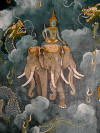
Airavata (ऐरावात)
Sanskrit. ‘Arisen from the ocean’, sometimes
translated as ‘child of the water’.
Name of the multi-headed
white elephant
divinity of Hindu-Buddhist religion, in Thailand known as
Erawan, and
produced during the churning of the
Ocean of Milk, hence his
name. He is the symbol of the clouds and the
vahana of the
deity
Indra, the Vedic
god of the heavens, weather, and war, as well as one of the
elephants that
support the four directions of the world. He generally appears with three heads
though sometimes may have 33 heads, representing the various heavenly states.
One text even mentions Erawan as a 100 headed white elephant serving as a mount
to
Narai. In
Hinduism he is
portrayed as a four-tusked elephant. The 2nd version of the
Ramakien, written by
Rama II, fully describes
Erawan when
Indrachit, one of the
demon characters disguised as Indra succeeds in fooling the monkey general
Hanuman. Sometimes
depicted with
Ganesha as its
rider (fig.).
回
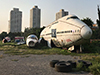
Air Diamond Café
Name of a decommissioned Airbus
A330 in
Chiang Mai's
Mae Taeng (แม่แตง) District, that has been given a new life as a café and hotel.
Besides the plane's interior, visitors can also view the airplane from elevated
platforms and the venue also features some other attractions and oddities, such as antique
aircraft and old-timer cars, and even an inverted house that
─according to its facade─ accommodates a hotel. Known officially and in full as
Air Diamond Café & Hotel.
See TRAVEL PICTURE,
PANORAMA PICTURE, and
WATCH VIDEO.
回
%201_small.jpg)
Airplane Graveyard
A former dumping field for derelict
aircraft at
Ramkhamhaeng
Road in Hua Mahk district of
Bangkok's
khet
Bangkapi, which despite its rather small number of aircraft and the limited size
of the area where they were been disposed off, it over time became increasingly
more mentioned as a highlight attraction for urban explorers of the
Big Mango.
The field was home to the remnants of an eye-catching Boeing 747, as well as
those of two McDonnell Douglas MD-82s. Surely, these large aircraft that were lying around
in tatters in a field amidst some skyscrapers (fig.) and
which are clearly visible from the road
must be have been a rather weird and unexpected sight for anyone accidentally passing by.
In 2022, however, the field was
cleared of all aircraft to make place for the construction of a condominium.
See MAP.
回
Airport Link
Elevated
train system, that connects
Suwannaphum (fig.),
i.e.
Bangkok's
International Airport,
with Phaya Thai, in Bangkok's city
center.
READ ON.
回
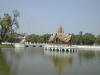
Aisawan Thipphaya Asana (ไอศวรรย์ทิพยอาสน์)
Thai. ‘Devine throne of personal freedom’. Pavilion in
Thai style at the
Bang Pa-in summer palace
in
Ayutthaya. It was built
in 1876 by order of King
Rama V and modeled after the
Ahporn Phimohk Prasat pavilion
(fig.) in the
Grand Palace in
Bangkok, built by
King
Mongkut and used to
exchange the
kakuttapan, i.e. the
Thai royal regalia, before boarding his
palanquin. The pavilion
houses a statue of Rama V in the uniform of Field Marshal, which was erected by his son
Rama VI.
It is similar to
Sala
Klahng Nahm (fig.)
in
Ramkamhaeng
University in
Bangkok. See also
asana
and
MAP.
回
aitim (ไอติม)
Thai for ‘ice-cream’.
READ ON.
回
ajaan (อาจารย์)
Thai word meaning ‘teacher’ or ‘master’ and often used in
association with the
Buddha. Sometimes
spelled ‘achan’, ‘achaan’ or ‘ajarn’, its etymology refers to the
Sanskrit term ‘acharya’,
a respectful title for teacher or spiritual leader. The word ajaan is
reminiscent of the Sanskrit word
ajaani
which means ‘having no wife’, whereas the word acharya can
be traced back to the term
Brahmacharya, meaning
‘celibacy’, a possible reference to the fact that the first teachers were
usually monks. Common Thai for teacher is
kru or
gru and is derived from
the word
guru.
回
ajaani (अजानि)
Sanskrit.
‘Having no wife’.
回
Ajanta (अजंठा)
Hindi. Name of a World Heritage site of Buddhist caves
found in West India and dating from around 200 BC to 650 AD. The 29 man-made
caves are cut into volcanic rock and contain sculptures and murals depicting the
life of the
Buddha.
回
ajirogasa (網代笠, あじろがさ)
Japanese. Name for a kind of traditional hat
made from
bamboo, often used to refer to the large woven
bamboo hats worn by monks on pilgrimage and mendicancy. Although in English
sometimes described as a ‘conical wicker hat’, most types are rounded at the
top. The large and rounded version of bamboo hat worn by Buddhist monks or
pilgrims, is also referred to as
takuhatsugasa.
To make these bamboo hats waterproof in a traditional manner, they are treated
with
persimmon
tree sap.
回
Ajita (अजित, อชิตะ)
Sanskrit-Thai. Name of
one of the Eighteen
Arahats,
who in art is depicted riding or in
companion of a
deer.
READ ON.
回
Ajnata Kaundinya (अज्ञात कौण्डिन्य)
Sanskrit. Name of
the
head of the five ascetics, known as the
panjawakkih (fig.),
to whom the
Buddha
gave his first sermon (fig.)
and who eventually became his disciples.
Ajnata Kaundinya was ordained a
bhikku
or
bhiksu
by the Buddha and hence became the first
ever monk in
Buddhism
and the seniormost member of the
Sangha.
In Thai, he is referred to as
Phra Anyah Kohnthanya.
回
Akasagarbha (आकाशगर्भ)
Sanskrit. ‘Boundless Space Treasury’. Name of the
bodhisattva
of space,
who is also one of the
Eight Great Bodhisattvas.
READ ON.
回
Akha
Hill tribe in Northern Thailand. The Akha belong to the
poorest of hill tribe people and are called
Igor by the Thai
(fig.),
a word also known in Laos and probably
derived from a word meaning ‘outcast slave’. Akha people usually live high in the
mountains where they previously cultivated
opium.
Typical to their culture is the construction of
so-called
spirit
gates, i.e. consecrated
village gates
(fig.)
erected at each end of their villages
(fig.).
Typically, these gates are fitted with human items,
in order to ward off evil spirits
(fig.),
as forest spirits are said to be afraid of anything human.
The items usually include
talaew (fig.)
and wooden effigies of naked or copulating humans
(fig.).
Other unique features of the Akha are their houses, which are built directly on the
ground
(fig.),
with a
floor of trampled earth, as well as a harvest swing (fig.),
and the helmet-like headdresses of the women (fig.),
of which some say it is Akha custom that the male buys it for his future wife
and that once she puts it on, she has to wear it for the rest of her life.
This tribe has several subgroups, including the Loimi (fig.), the U Lo (fig.),
and the
Pahmi (fig.).
The
subgroups can best be differentiated by the
women's headdress, which is unique for each group.
In
Doi Mae Salong there is an
OTOP
project (map
-
fig.)
aimed at the conservation of Akha culture.
MORE ON THIS.
回
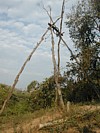
Akha swing
Swing in
Akha
villages, used during the harvest festival (fig.).
There are two commonly found types. The most frequently seen is a swing made of
four small tree trunks stripped bare and tied together at the top with a
crossbeam from which a rope is hung. At the bottom of the rope a horizontal
stick is attached on which the swinging participants will stand upright. It is
swung by one or more people on the ground, who pull a long cord attached to the
swing rope. The other type consists of a revolving vertical swing made from
wooden beams and planks, somewhat like a Ferris wheel (fig.).
It usually has four seats and can only be rotated properly when all of them are
occupied, in order to have the right balance. This makes it a bit difficult to
get on once a first person has taken a seat and is best used with people of
comparatively weight. Habitually, every Akha village has its own swing for the occasion of the harvest festival which
is also known as the swinging festival, making it an unmistakable feature to
distinguish an Akha village from other hill tribe
villages. Remarkably, a very similar swing is used by the
Hindu population of
Nepal during their festival of
Navaratri (fig.).
回
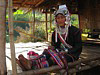
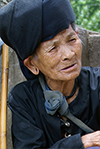
Akhu
Name of a hill tribe minority found near
Kengtung in
Myanmar's
Shan State,
and who are not to be confused with the
Akha,
of whom they are generally
considered a sub-group. Since they have evolved in small communities in an
isolated valley for generations they have developed their own unique language.
Their traditional dress is overall black while on the head they wear a black
piece of cloth that is put on somewhat like a turban. This clearly sets them
apart from the Akha, who wear much more elaborate costumes. Since many,
including the women, are famous for chain-smoking tobacco in
bamboo pipes they
are nicknamed the Bamboo Pipe People.
回
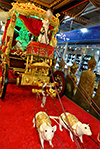
Akhuratha (आखुरथ)
Sanskrit.
Literally
‘mouse-chariot’ or
‘rat-chariot’,
but usually translated as
‘one who has a mouse as his charioteer’. The term is often used as an epithet for
Ganesha
when riding his vehicle or
vahana,
i.e. the rat, or when seated in a chariot pulled by rats (fig.). See also
ratha.
回
Akkarajaya (อัครชายา)
Thai. One of the principal consorts of a
king, sometimes translated as queen consort.
回
akshamala (अक्षमाला)
Sanskrit.
‘Garland of beads’. A string with dried
seeds, pearls, wooden beads or other objects, which is an attribute of many
Hindu gods. Though the number of beads may vary,
it generally comprises of fifty beads, corresponding to the number
of characters of the Sanskrit alphabet. In Thai known as
prakam.
回
Akshobhya (अक्षोभ्य, อักโษภยะ)
Sanskrit-Thai.
‘Immovable One’. Name of one of the five
dhyani buddhas.
He is the
buddha
of the East and he is portrayed with a blue complexion.
READ ON.
回
Alaungmintaya (အလောင်းမင်းတရား)
Another name for the Burmese King
Alaungpaya.
回
Alaungpaya (အလောင်းဘုရား)
Name of a
historically important
Burmese King, who is considered one of the three greatest kings of
Burma, along with
Bayinnaung
(fig.)
and
Anawrahta (fig.).
He was born as
Aung Zeya on 24 August 1714 AD in Moksobo, a
small village in the Mu River Valley, northwest of
Ava,
and died from illness on 11 May 1760 during his campaign in
Siam.
He was the founder of the Konbaung Dynasty (1752-1885) and in 1755 also founded
Yangon. He is accredited for unifying Burma for the third time in its history.
He is also referred to as
Alaungmintaya, and in Thai, he is known as
Phra Chao
Olong
Phaya
(พระเจ้าอลองพญา).
回
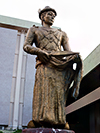
Alaungsithu (အလောင်းစည်သူ)
Burmese. Name of
the 12th Century King Sithu I of
Pagan, the
last of the three most renowned
rulers of Pagan, after King
Anawrahta (fig.)
and King Kyansittha (fig.),
to whom he was a great grandson and a grandson, respectively.
Alaungsithu is remembered as a wandering monarch, who traveled extensively
throughout his realm, built monuments, and nurtured
Theravada
Buddhism
with acts of piety. He was
born on 17 January 1090 AD and reigned from ca. 1113 until 1167 AD, when he was
assassinated by his son Narathu.
After falling ill, his son could not wait to become king and quickly
moved his father the king away from the palace to the nearby
Shwegugyi Phaya (fig.).
However, the king regained consciousness and when he latched on what
his son was up to, he became furious for having been set aside,
prompting Narathu to smother the father with his own bedclothes.
After his violent death, Alaungsithu
became the
nat
Min Sithu, who belongs to the official pantheon
of 37 spirits that are
worshipped in
Myanmar.
回

Alavaka (आलवक, อาฬาวก, အာဠာဝက)
Sanskrit-Thai-Burmese. Name of a man-eating
ogre who was subdued by the
Buddha.
Hatthaka, the son of the king who ruled over the kingdom of Alavi, liked to
hunt. One day, he got lost and wandered into the land of the
yak
Alavaka, who lived in a
banyan
tree. When
the giant was about to eat him, the king begged for his life and vowed that he
would send someone to serve the giant every day for the rest of his life. The
Buddha, who also happened to be travelling in the land of this man-eating ogre,
wanted to lower the giant's ego and subdued him by preaching him the
dhamma
(fig.),
thus saving the prince from being eaten. The prince consequently became a
disciple of the Buddha and is later described as one of his foremost lay male
adherents. See also
pahng proht Alavaka yak.
回
Alexander the Great
Macedonian king and conqueror who invaded India in 326 BC
bringing with him Greek artisans whom it is assumed influenced the first known
humanoid images of the
Buddha that later
developed into the
Gandhara style of
Buddhist art.
回
Alexandrine Parakeet
Name of a
species of large parrot named after
Alexander the Great, who
is credited with exporting this bird from the Indian Punjab into Europe and the
Mediterranean.
READ ON.
回
alidha (आलीढ)
Sanskrit.
‘Licked’
or ‘lapped’.
A kind of
asana (posture), used
in Buddhist
iconography,
especially in art of the
Vajrayana sect, to depict
wrathful deities and
in
which the figure lunges or thrusts diagonally, with one leg extended, while placing the body's weight
mainly on the other leg, which is bent at the knee. Also called the lunging warrior stance,
and
in Sanskrit also known as
pratyalidha asana (fig.).
回
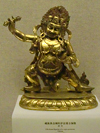
alms bowl
Contaiber used
by Buddhist monks to
collect alms, rounded in shape and usually made of metal.
READ ON.
回
Alodawpyi Phaya (အလိုတော်ပြည့်ဘုရား)
Burmese.
‘Fulfilling of Wishes Pagoda’.
Name of a Buddhist temple
in
Bagan.
READ ON.
回
Aloe vera
See
haang jorakae.
回
alvar (ஆழ்வார்கள்)
Tamil.
‘Immersed’ or ‘those immersed in god’.
Vaishnava poet
saints, who lived from the 6th to 9th century. There are believed to be ten or
twelve, and are regarded as
incarnations of the
attributes of the god
Vishnu. They are worshipped as minor gods.
回
Amadaw Mya Nan Nwe (အမတော် မြနန်းနွယ်)
Burmese. Full name of
Mya Nan Nwe (fig.).
回
amalaka (आमलक)
1. Sanskrit.
A circular decorative ribbed, almost pumpkin or
star gooseberry-like ornament at the top of a northern
style Hindu temple, usually above a flat circular stone called a
beki. Both its
name and shape are related to the
mayom.
See also
THEMATIC STREET LIGHT (1),
(2),
(3)
and
(4).
回
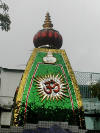
2. Sanskrit. Name of the Indian gooseberry
or emblic myrobalan, a tree and fruit associated with the Thai
mayom.
回
amara (अमर)
Sanskrit word for ‘eternal’ or
‘immortal’.
The
first -a makes it the antonym of
mara,
which in turn
derives from the
Sanskrit
root mri of the word
mriti,
meaning ‘death’, and
is related to
amrita, i.e.
[the
elixir of] ‘immortality’.
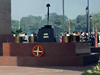
At the Eternal Flame
of the Unknown Soldier underneath the arch of
India Gate in Delhi (fig.)
is a black marble cenotaph
inscribed in gold with
the words
Amara Jawan, which translates as
‘Immortal
Warrior’. In
Thai known as
amon.
回
Amaravati (अमरावती)
1. Sanskrit.
The capital of
Indra's
Tavatimsa
heaven
situated near the mythical
Mt. Meru and
renowned for its splendor.
回
2. Sanskrit. A place in South India where a
Buddhist
school of art developed from the second to
the fourth centuries AD.
回
Amareswara (अमरेश्वर)
Sanskrit. A title given to both
Vishnu,
Indra and
Shiva, meaning
‘lord of the immortals’.
回
Amarin (อัมรินทร์)
Thai. ‘Immortal King’ or ‘Eternal
Patriarch’. A title sometimes given to
Indra, the Vedic god
of
the heavens, weather and war, as well as the king of the gods and supreme ruler
of the
Tavatimsa
Heaven. It is a
compound formed of the words
amara,
meaning ‘immortal’,
and
In, i.e. ‘Indra’, ‘Patriarch’
or ‘King’. The title is sometimes used in combination with the suffix Jom Thep (จอมเทพ),
which means ‘Supreme Angel’ or ‘Highest Deity’. Whereas Indra is usually
depicted with a green complexion (fig.),
as Amarin Jom Thep, he may in fact be depicted with a red complexion, akin to
his twin brother
Agni, the Vedic
god of fire. See also
amara,
Amaravati,
and
Amareswara.
See also TRAVEL PICTURES.
回
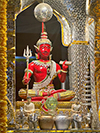
amarit (อมฤต)
Thai for
amrita. Also nahm amarit.
回
amataya (အမှတ်တရ)
Burmese.
‘Remembrance’
or ‘proof’.
A term that may be related to the name
Phaya Amat,
a Buddhist temple in
Bagan.
回
Amaterasu (天照)
Japanese. ‘Heaven
illuminated’ or ‘shining in heaven’.
The goddess of the sun and the universe in
Shinto,
the traditional
religion
in Japan, from who the emperors of Japan, are considered to be direct
descendants and derive their right to rule. Japan's
monarchy exists since 11 February 660 BC and is the
world's oldest continuous hereditary monarchy. During the inauguration rituals
when an emperor ascends the Chrysanthemum Throne, the new emperor is united to
his Imperial Ancestress, in this way emphasizing his unique share in her
divinity. See also
Kiku.
回
ambulatory
Architectural term for a walkway, especially
an aisle or vaulted corridor around the inner sanctum, i.e. the core of a temple or monastery, as at
Dhammayangyi Phaya in
Bagan
(fig.),
which interior includes two
ambulatories, that form a continuous passage way around the inner sanctum.
回
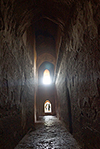
amdaeng (อำแดง)
Thai. General title for a woman equivalent to
nang. Formerly used in
formal documents but now only used facetiously or derogatorily.
回
Amida (अमिता)
1.
Name of a Buddhist
mudra,
in which the
Buddha image
is seated with the hand palms
held forward, the fingers upward and the index fingers pointing slightly towards
each other. However, there are nine grades of Amida and thus also nine hand
positions. Hence, in
iconography,
this mudra may also be depicted alternatively. Also transcribed Amita.
回
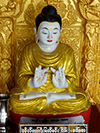
2. Another name for
Amithaba.
回
Amitabha (अमिताभ)
1. Pali-Sanskrit.
One of the five transcendental or
dhyani
buddhas
of
Mahayana
Buddhism who reigns over western paradise and
is the personification of Eternal Light.
It is believed that by calling on this
buddha
it is possible to be reborn in paradise and consequently gain enlightenment and
become a buddha in the next life, thus making him one of the most popular
jinas. His mount is a
peacock. In
China
and Japan,
he even replaced the
Sakyamuni
Buddha
in importance.
In art, he is usually depicted seated in
meditation and a celebrated Japanese
Amitabha statue is Daibutsu, i.e. the
‘Great
Buddha’
of Kamakura in Kanagawa Prefecture, a
monumental outdoor bronze statue of
which a gilded copy stands in
Myanmar's
Sagaing
region (fig.),
and which in turn is reminiscent of the
giant
Tian Tan
Buddha
near Hong Kong (fig.),
though the later is depicted with a
varada
mudra, i.e.
with the right hand raised, representing the
removal of affliction, and the left resting open on his lap in a gesture of
generosity. In Tibetan-Nepalese tradition, he is portrayed with a
red complexion and performing a
dhyana
mudra
(fig.).
In art and
iconography, it can be difficult to
differentiate the Amitabha buddha from other buddhas or the Sakyamuni Buddha, as
he possesses all the attributes of any buddha, as well as of the Sakyamuni
Buddha, but has no distinguishing marks. It is by some claimed that in
iconography the
bhumisparsa
mudra
is a pose reserved for the Sakyamuni Buddha only, though it seems that this
claim can be challenged (fig.).
The male deity
Avalokitesvara
always wears a figure of
Amithaba in his headdress, of whom he is an emanation.
Also
Amida. In Thai called Phra Amitahp Phuttachao.
回
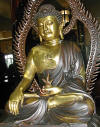
2. Pali-Sanskrit.
The historical
Buddha.
回
Amnat Charoen (อำนาจเจริญ)
Thai. ‘Power of prosperity’. Name of a small city and a
3,161 km² province (map)
in
Isaan.
READ ON.
回
Amoghasiddhi
(अमोघसिद्धि, อโมฆสิทธิ)
Sanskrit-Thai. One of the five transcendental
buddhas or
dhyani buddhas.
He is
the buddha of the North, has a green complexion (fig.),
and is seated in
a
lotus position whilst performing
an
abhaya
mudra with his right
hand. His mount is the
Garuda. On
mandalas, he is usually portrayed holding a
visvavajra, i.e. a double vajra (fig.),
but otherwise he may also be depicted with a small bowl and sometimes seated on a
multi-headed serpent (fig.), reminiscent of the
naagprok pose of the
Sakyamuni
Buddha (fig.).
回
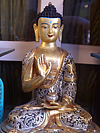
amon (อมร)
Thai term meaning ‘eternal’ or
‘immortal’,
which derives from the Sanskrit
amara.
回
amph (อัมพ-)
Thai prefix meaning ‘mango’,
as in
amphawan,
i.e. ‘mango
orchard’ or
‘mango
forest’.
Also spelled amp.
回
amphawan (อัมพวัน)
Thai term for ‘mango
orchard’ or
‘mango
forest’.
See also
wan.
回
ampheu (อำเภอ)
Thai. See
amphur.
回
amphur (อำเภอ)
Thai. ‘District’. An administrative subdivision of a
jangwat or province. The
capital city of a jangwat is referred to as amphur
meuang, e.g. amphur meuang
Chiang Mai
is the capital city of the province Chiang Mai, etc. All provincial capitals
bear the same name as the the province, preceded by the words amphur meuang,
except for
Bangkok, where the
capital city is called Phra Nakhon and is preceded by the word
khet, meaning ‘zone’ or ‘domain’.
Thailand has a total of 795 amphur of which 75 are amphur meuang, a number that
equals the total number of provinces, minus Bangkok. Pronounced ampheu. See also
king amphur.
回
amrit (अमृत)
Sanskrit. The ‘waters of immortality’ surrounding the
Golden Temple of
the
Sikhs
at
Amritsar, in the
Indian Punjab.
回
amrita (अमृता)
Sanskrit. ‘Non-death’. The
elixir of immortality
produced when the gods and demons churn the
Ocean of Milk in the
Indian
epic of the
Ramayana. The
legend also appears in the
Hindu epic poem
Mahabharata. Often
identified with
soma, a nectar of
immortality. In Thai
amarit and nahm amarit.
See also
mriti.
回
Amritsar (अमृतसर)
Hindi-Sanskrit. ‘Lake with
amrita’.
Place name of the
Golden Temple
of the
Sikh
religion located in the Indian Punjab, which
derived its name from the sacred waters surrounding the temple called
amrit,
‘waters of immortality’.
回
amulet
A charm or protective ornament believed to shield its
bearer from misfortune. Often confused with its counterpart the
talisman, an
object believed to bring good fortune rather than protection. Buddhist
devotional plaques or amulets are often worn in Thailand to
serve an apotropaic purpose, i.e. to
ward off bad luck and evil. They protect the wearer against disaster.
This
animist dimension of
Buddhism is in
defiance of Buddhist teaching, which forbids monks to transfer
saksit onto
amulets as this would be equal to showing off transcendental powers, though in
spite of this they are for sale in many a temple throughout the country to
enhance its income (fig.).
The practice has become a real cult and has taken the form of a well organized
collectors association like that seen in philately, with special literature on
the topic, as well as markets, auctions, museums, etc.
In many places in Southeast Asia,
tigers
are associated with protective
power and depictions thereof can often be seen
tattooed
on the chest, or ‒as in some villages in
Myanmar‒ erected
at doorposts or fences around countryside houses and farm yards (fig.),
in order to ward off evil. In Thai known as
phisamon. See also
miht moh,
sak,
POSTAGE STAMPS (1)
and
(2),
as well as
MORE ON THIS.
回
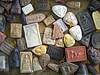
Anagami
(อนาคามี)
Pali-Sanskrit-Thai.
Name of the third of the four stages of
Enlightenment
in
Buddhism,
i.e. the stage before becoming an
Arahan, and in which the
partially enlightened person
has cut off the five chains with which the ordinary mind is bound, namely belief
in self (atman);
attachment to rites and rituals; skeptical doubt; sensuous craving;
and ill will or aversion.
The term means ‘non-returner’. The Anagami person is however not yet free from
another five higher fetters needed to become an Arahan, namely craving for
fine-material existence; craving for immaterial existence; conceit or pride;
restlessness; and ignorance. Yet, the Anagami or ‘non-returner’ is not reborn
into the human world after death, but into the heaven of the Pure Abodes, where
only non-returners reside. There, they will attain full Enlightenment. One stage
below Anagami is known as known as
Sakadagami, i.e. ‘once-returner’. In that stage the partially
enlightened person has cut off only the first three chains with which the
ordinary mind is bound. The person in the Sakadagami stage must be reborn into
the realm of the senses once more.
回
Ananda (อานันท, आनन्द)
1. Pali-Sanskrit-Thai. ‘Joy’ or ‘Bliss’.
Cousin of
Siddhartha
Gautama and chief
disciple of the
Buddha,
as well as one of the
Ten Principal Disciples. In art
he is often represented as a young monk accompanied by the elderly
Kassapa (fig.).
Ananda Phaya (fig.) in
Bagan
is often wrongly thought to be named after him. In Thai,
known as Phra Ahnan (พระอานนท์).
回
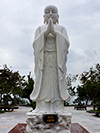
2. Pali-Sanskrit-Thai. Name of the Thai king
Rama VIII, in full known
as Ananda Mahidol, or
Anantha Mahidon in Thai
pronunciation. He reigned from 1935 to 1946. Sometimes spelt
Ananta or Anantha.
See also
list of Thai kings.
回
ananda-chakra (आनन्द चक्र)
Sanskrit.
‘Wheel of Joy’.
READ ON.
回
Ananda Mahidol (อานันทมหิดลฯ)
Name
of
Rama VIII, the eighth monarch of the
Chakri dynasty.
His name is pronounced Anantha Mahidon, and may also be transliterated as such.
He is the elder brother of
Bhumipon Adunyadet
(fig.). See also
list of Thai kings.
回
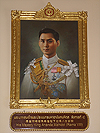
Ananda Phaya (အာနန္ဒာဘုရား)
Burmese.
‘Temple of Joy’
or
‘Pagoda
of Bliss’.
Name of a Buddhist temple in
Bagan.
READ ON.
回
Ananta (अनन्त,
อนันต)
1. Sanskrit.
‘Boundless’, ‘eternal’ and ‘infinite’. Mythical serpent with one thousand heads
on which the god
Vishnu
rests during the nights that separate two cosmic time periods. This theme, known
as
Anantasayin
(fig.),
is popular in Southeast Asian architectural decorations. He is king of the
serpents and the symbol of the cosmic waters. When the gods and demons churned
the
Ocean of Milk
to retrieve the nectar of immortality, they used him as the churning rope
(fig.).
Also known as
Shesha
or
Sesha,
and
Vasuki.
However, the latter names are often used interchangeable: whereas Shesha (Shesh-naak,
and spelt with the initial S)
is usually linked to
Shiva,
Vasuki (with initial V)
is
associated with Vishnu, yet it
is also said that the latter is the serpent that
surrounds the neck of Shiva,
and whereas
Vasuki
(spelt with the initial V of venom) is described to represent snakes with
poison, Ananta (spelt with the initial A of atoxic) is said to represent huge
snakes without poison. Ananta, who is considered to be the throne of
Narai
(fig.),
is in Thai referred to as
Phaya
Ananta
Nagaraat.
Also transliterated Anantha.
回

2.
Sanskrit.
‘Boundless’, ‘eternal’ and ‘infinite’.
An
epithet for the Hindu god
Vishnu.
回
3.
See
Anantha Mahidon.
回
Ananta Samahkom Hall
See
Phra Thihnang Anantasamahkom.
回
Anantasayin (अनन्तशायिन्)
Sanskrit. ‘Resting
on
Ananta’. Epithet used for the Hindu
god
Vishnu when
reclining on the back of the serpent Ananta during his
cosmic sleep,
when he rests during the nights that separate two cosmic time periods and which
are collectively referred to as
yuga. It is a
popular theme in Southeast Asian architectural decorations. Also known as Vishnu
Anantasayin (fig.)
and in Thai called
Narai banthom sin (fig.).
回
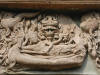
Anantayot (อนันตยศ)
Twin brother of
Mahantayot and son
of the legendary
Chamadevi of
Lopburi, queen of
the
Dvaravati kingdom
in the 7th century AD.
回
Anantha Mahidon (อานันทมหิดลฯ)
Thai. Name of King
Rama VIII.
回
Anathabinthika Setthi (อนาถบิณฑิกเศรษฐี)
Thai name for Anathapindika, a
wealthy merchant, banker, and philanthropist in
Savatti
during the era of the
Gautama
Buddha. He was born with
the name Sudatta (fig.) and is hence in Thai also known as Suthatta Setthih (สุทัตตะเศรษฐี,
สุทัตตเศรษฐี). The suffix Setthi/Setthee to his name means ‘wealthy person’ or
‘millionaire’, and he may also be referred to as
Maha
Anathapindika. A son of the wealthy merchant
Sumana, he was acknowledged as the wealthiest trader in the region
and earned recognition as the primary male supporter of the Buddha. Sudatta,
born into affluence in
Savatti,
and related to
Subhuti, a prominent disciple of the Buddha
sometimes described as his younger brother, later became renowned as Anathapindika,
signifying ‘One who provides alms to the unprotected’.
Anathapindika encountered the Buddha during a business trip to
Rajagaha. Impressed by the Buddha's
teachings, Anathapindika attained
Sotapanna, the first of the four stages of
Enlightenment.
Deeply committed to his newfound faith, Anathapindika purchased land to build
the Jetavana Monastery from the prince of
Kosala,
by covering the park grounds with coins, establishing it as a pivotal temple
during the Buddha's time. After building the monastery, Anathapindika continued
to generously support the Buddha and his monastic community throughout his life
and became known as the Buddha's greatest patron and lay benefactor along with
his female counterpart,
Visakha, who founded the
Migaramatupasada Temple. In his role as the chief patron, Anathapindika not only
sustained the Buddha and the monastic community by providing daily meals for
numerous monks, but also regularly maintained and supplied Jetavana Monastery.
He is known as the male lay disciple of the Buddha who was foremost in
generosity and he played a crucial role as one of the Buddha's primary aides in
interactions with the public.
回
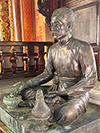
anatman (अनात्मन्)
Sanskrit. ‘Non-ego’ and ‘non-soul’. See also
anatta.
回
anatta
Pali. ‘Non-ego’ and ‘non-soul’. One of the three
characteristics of existence in Buddhist doctrine along with
dukha (suffering)
and
anicca (the
impermanence of all existence). It is one of the most fundamental points in
Buddhism which states that all existence and all worldly phenomena eventually
have no substantial reality. In Buddhism, it pleads the impermanence of all
things, it is logical to conclude that in such a temporarily existence, there
cannot exist any lasting substance. In Sanskrit
anatman.
回
Anauk Mibaya (အနောက် မိဘုရား)
Burmese.
‘Western Queen’.
One of 37
nats that
belong to the official pantheon of spirits
worshipped in
Myanmar. During her life
she was Shin Mi-Nauk, a senior
queen consort of King Minkhaung I of
Ava at the beginning of the 13th
century AD. She is said to have died of a heart attack after being shocked by
seeing the
nat
Min Kyawzwa
on a magic stallion (fig.) in a cotton field. She was the mother of King Thihathu of
Ava, who also entered the nat pantheon as
Aung Pinle Hsinbyushin,
as well as of Ava's Crown Prince Minyekyawswa, who in 1417 died of wounds
received on the battlefield and according to some became the nat
Min Kyawzwa. If so,
then Shin Mi-Nauk died of shock when seeing
her own son appear as a nat. However, the nat
Maung Minbyu is also
described as the nat representation of Crown Prince Minyekyawswa. Anauk Mibaya is usually portrayed nursing a baby,
sometimes while sitting on a
lotus-pedestal.
See also LIST OF BURMESE NATS.
回
Anaut Palei Phaya (အနောက်ပလိပ်ဘုရား)
Burmese. ‘Western Wall
Pagoda’.
Name of an ancient Buddhist temple in
Pagan,
located to the opposite of
the road of the
Phaya Amat temple (fig.),
not far from the place where formerly the western city wall, which over time was
eroded by —and eventually fell into— the nearby
Irrawaddy River
(fig.),
used to be. This brick monastery consists of two large, one-floor, square halls,
each one topped with a
bell-shaped
zedi,
which in either building is
damaged. Whereas the easternmost
building is surrounded by an outer wall the other edifice is left open.
See also
TRAVEL PICTURES
and
MAP.
回
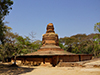
Anavatapta (अनवतप्त)
Sanskrit. ‘Heat-free’. Mythological lake in Buddhist
cosmology. It is located in the
Himalayas and is regarded
as the source of the four rivers that flow through the four territories
inhabited by lions, bulls, horses and elephants. When the earth comes to an end
it will be last lake to disappear and the first to reappear when the world is
recreated.
See also POSTAGE STAMP.
回
Anawrahta (အနော်ရထာ)
1. Burmese king who reigned from 1044 to 1077 AD, as the 42nd
ruler of the
Pagan dynasty, and
who unified the country. As a zealous convert to
Theravada Buddhism he was
responsible for the construction of many of the pagodas of Pagan, his most
famous monument being the
Shwezigon Phaya
(fig.), which is
one of four temples
entwined in a legend known as Shwe Daw Lay Su, which asserts that the
King was given some tooth relics of the
Buddha,
which were placed on the back of a
White Elephant to determine
an appropriate spot to built a pagoda to
house these relics. As legend has it, the White Elephant halted at four
different locations and the King later had stupas built at each of them (fig.),
resulting in the construction of three more pagodas, i.e.
Tantkyitaung Zedi
(fig.),
Lawkananda Zedi (fig.), and
Tuyintaung Zedi (fig.). He was also responsible for the
execution of the Taungbyon brothers
Shwe Hpyin Gyi and
Shwe Hpyin Nge
(fig.), because
they hadn't placed bricks near a pagoda, as ordered by the King. They were later
admitted in the pantheon of 37
nats.
Also transcribed Anawratha. See also
Kyaukse Sain Pwe.
回
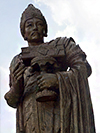
2. Burmese. The governor of Arakan and son
in law of King Minkhaung I of
Ava, as he was married to the latter's
daughter Saw Pye Chantha. Appointed governor only in 1406 AD, the newlywed
couple in November 1407 fell captive to the troops of King Razadarit of
Hongsawadih,
i.e.
Pegu,
when they captured Arakan's then capital Launggyet. They took the couple as
prisoners to Pathein, where Anawrahta was executed upon arrival and Saw Pye
Chantha passed into Razadarit's harem as a full queen. To distinguish him from
King Anawrahta, the governor is usually referred to as Anawrahta of Ava.
回
anchern jut (อัญเชิญจุติ)
Thai. ‘Invite’ (anchern) ‘to be born and die (jut)’, in
rajasap or royal
language. A scene often depicted in Buddhist murals in Thailand referring to the
invitation of the
bodhisattva who
would later become the
Buddha,
incarnated as a
buddha on
earth. This
scene occurred in
Dusit heaven, the
place where all bodhisattvas dwell in anticipation of their last
incarnation, and following up the
sawankot of King
Wetsandorn, the
tenth
Totsachat
and last
Jataka of the
Buddha.
回
Anderson's Grass Yellow
Common name for a
species of butterfly in the family Pieridae, with the Latin designation Eurema
andersonii.
It has a wingspan of between 3.6 and 4 centimeters, and has yellow wings, with
one large brown spot on the underside of the forewing and several smaller,
mostly ring-like brown patches. In Thai it is named
phi seua
naen
andersan (ผีเสื้อเณรแอนเดอร์สัน).
回
_small.jpg)
Anek Kuson Sala (อเนกกุศลศาลา)
Thai name for a Chinese-Thai museum at the compound of
Wat Yahn Sangwarahrahm Woramahawihaan
in Huay Yai district of
Chonburi
province.
READ ON.
回
Angada (अंगद)
Sanskrit name for
Ongkhot,
a monkey warrior of
Rama,
son of
Vali.
回
Angaja (อังคชะ)
Sanskrit-Thai. Name of
one of the Eighteen
Arahats,
who
according to one legend, was a
snake-catcher.
READ ON.
回
angkaab (อังกาบ)
Name for a shrub with the botanical name
Barleria Cristata,
commonly known as Bluebell Barleria,
Philippine Violet or Crested Philippine Violet.
It ranges from Southern China westward to India, and
southward to
Myanmar
and Thailand. The plant has
funnel-shaped flowers, about 5 centimeters long, with petals either in white to pinkish-white and
violet colour, or in pink to dark pink
colour. The plant is portrayed on a Thai postage stamp issued in 2002 AD with
near red flowers (fig.).
回
angkalung
(อังกะลุง)
Thai name for
a
bamboo
percussion
instrument
of Sundanese-Indonesian origin with an onomatopoeic name, and known in both
English and Indonesian as angklung.
The
instrument
comes in various types but there are two main varieties: one kind, typically
played by a single musician, consists of a number of
cylindrical sections of
bamboo
in
variable lengths that are attached to a fixed wooden frame and the tubes with a
clapper rattle in different pitches when struck, corresponding to their length;
the other kind consists of one or more bamboo tubes of a certain length that
produce a single tone. The tube or tubes are attached to a handheld wooden frame
around a stick or clapper that is made to rattle by shaking the frame. The
latter type is usually played by a group of musicians, each of whom holds one or
two angkalung in different sizes, typically one in each hand, and since each
single angkalung has a different size, tone and pitch, performers in such an
ensemble have to work together and sound their individual angkalung at the
appropriate time to produce a melody.
WATCH VIDEO.
回
_small.jpg)
angklung
See
angkalung.
回
Angkor (អង្គរ)
Khmer. ‘City’ or ‘capital’. The ancient capital of
Cambodia. It was the centre of the
Khmer empire from
802 to 1431 AD.
回
Angkorian Period
Period in Cambodia from the 9th to the 15th century AD in
which the unification of ancient
Funan and
Chenla took place,
marking the beginning of the
Angkor
civilization. During this period 28 kings ruled and a shift took place from
maritime commerce towards a rural economy, to the disadvantage of Funan. Art
from this period shows a decline in Indian influence. The period is preceded by
the pre-Angkorian period, that existed from the 1st to the 8th century AD.
回
Angkor Thom (អង្គរធំ)
Khmer. ‘Big
Angkor’. Name of a three
square kilometer walled and moated royal
Khmer
city
in
Cambodia, built in the 12th century
during the reign of King
Jayavarman
VII.
READ ON.
回
Angkor Vat (អង្គរវត្ត)
Khmer
name for
Angkor Wat.
回
Angkor Wat
The largest of the
Khmer
temples
and one of the seven Wonders of the World.
READ ON.
回
angle luffa
A species
of
luffa, known in Thai
as
buab liam
(fig.),
and commercially grown as a vegetable (fig.).
回
_small.jpg)
Anglo-Siamese Treaty
Treaty between Great Britain and the Kingdom
of Siam, which was signed on 10 March 1909, in
Bangkok,
and which is hence also referred to as the Bangkok Treaty of 1909. The treaty
established the borders between the
Kindgdom of Siam and
the then
British colony of
Malaya, which after its independence of Singapore became known as
Malaysia,
which was formed in 1963 through a
federation of the former British colonies of Malaya and Singapore, including the
East Malaysian states of Sabah and Sarawak on the northern coast of Borneo. To
indicate the political union between Malaya and Singapore, the first to letters
of Singapore were inserted into the name Malaya to form Malaysia. The borders of
the 1909 treaty still define the
border between modern
Thailand
and Malaysia today. However, the area around modern
Pattani,
Narathiwat,
Songkhla,
Satun,
and
Yala,
which have a largely
Muslim
population, with many of whom are united through both a common
religion and the language of
Yawi,
i.e. a Malay dialect, remained under Thai control, which decades later led to a
Muslim, an ethnic, and religious separatist insurgency, that is still ongoing
today.
回
angsa (อังสะ)
Thai. A
shoulder piece worn by Buddhist monks and novices. It is worn either under the
jiewon or as a replacement for the saffron robe
when working or resting within the temple compound.
回

Angthong (อ่างทอง)
1. Name of both a town and a province (map)
in Central Thailand.
READ ON.
回
2. Name of a National Marine Park in
Surat Thani
province. See
Moo Koh Angthong.
回
Angulimala (अङ्गुलिमाला, องคุลิมาล)
Sanskrit-Thai. ‘Garland of fingers’. The delinquent son of a
brahmin who entered into the service of an evil
master. He was a bandit who wore a necklace of cut-off fingers but was converted
by the Buddha in
Parileyyaka forest, in the eleventh year after
the Buddha's
Enlightenment. In Thai, the pronunciation is
Angulimaan.
回
a-ngun (องุ่น)
Thai for ‘grape’.
回
a-ngun khai
pla (องุ่นไข่ปลา)
Thai. ‘Fish egg grapes’. Name for a kind of
small round, red grape, which due to its dark colour is reminiscent of sturgeon
roe.
回
_small.jpg)
angusa (अंकुश)
Sanskrit.
‘Elephant hook’ or ‘elephant goad’. An
attribute of
Ganesha (fig.)
and
Indra, that symbolizes control or the ability
to steer someone in the right direction. In Thai
kho and
kho chang. Also transcribed ankusha
and
ankusa. Sometimes called ankus or angus.
回
Ang Wa (อังวะ)
Thai name for the Burmese former
Kingdom of
Ava, in Burmese known as
Inwa.
回
anicca (अनिच्चा)
Pali.
‘Worldliness’, ‘temporariness’ or ‘impermanence of all existence’. One of the
three characteristics of existence in Buddhist doctrine, along with
dukha (suffering)
and
anatta (non-ego).
It claims that all existence and all phenomena in this world continuously change
and don't stay the same, not even for one moment. All is perish to die at
sometime in the future and such outlook is the main cause of suffering. This
concept should however not just be understood from a pessimistic or nihilistic
view, because also progression as well as reproduction are manifestations of
this constant change.
回
aniconic
Not shaped
in human or animal form. For several years after the Buddha's death only
aniconic symbols were used to remind his followers of his teachings, such as a
footprint or
buddhapada, a wheel or
dhammachakka, a
bodhi tree, a
stupa, etc.
回
animism
Belief that
all living or animate things as well as lifeless or inanimate objects, have a
soul. Usually found amongst primitive people.
回
anitya (अनित्य)
Sanskrit.
‘Worldliness’, ‘temporariness’ or ‘impermanence of all existence’. See also
anicca.
回
Angkhirot (อังคีรส)
Thai. Name of a Buddha statue,
housed at the
ubosot
of
Wat Ratchabophit
in
Bangkok.
READ ON.
回
Anna Leonowens
An English
woman hired as a nanny by King
Mongkut to teach the princely court,
between 1862 and 1868. She
wrote her story in the book ‘Anna and the King of
Siam’, which was first made
into a musical and later into a film called ‘The King and I’. Her son, Louis
Thomas Gunnis Leonowens, grew up and worked in Siam, where he from 1881 to 1884
served as an officer with the Siamese Royal
Cavalry (fig.),
and in 1905, after entering the
teak
trade, founded a Thai
trading company with the name Louis T. Leonowens Company, Ltd. (fig.
-
map),
which up to present remains a leading exporter of Malayan hardwoods and an
importer of building materials and general merchandise.
Around Anna Leonowens'
time, it was common for royal courts in the Far East to attract western
instructors, as was also the case in
China, where between 1919 and 1924 the Scottish academic
Sir Reginald Fleming Johnston was tutor to the
Dragon-Emperor Aisin Gioro Pu Yi
(fig.)
of the Qing Dynasty, the Last Emperor of Imperial China, whilst the Beijing-born
American Isabel Ingram in 1922 was appointed tutor to his wife, the Empress Wan
Rong.
回
An Nam
See
Annam.
回
Annam
Buddhist state in northern
Vietnam conquered
by the Chinese in approximately 214 BC and made into a Chinese Protectorate. It
had a flourishing Bronze Age civilization and the Chinese called it An Nam,
‘Peaceful South’. It was been briefly threatened by the coastal state of
Champa,
which in the early 9th century was on the defensive against the encroachments of
its powerful neighbours, and between 846 and 866 AD it sustained repeated
invasions from
Nan Chao, a then major power in the affairs of northern Southeast
Asia and southern
China.
It became independent in 1428 AD and became a French protectorate in 1883. In 1887, it was a part of French Indochina, bordering
Tonkin in the north and
Cochinchina in
the south, and in
1946 it was
incorporated into
Vietnam as central Vietnam. Also spelt
An Nam. In Vietnamese known as Trung Ky (Trung Kỳ), i.e.
‘Central State’.
回
Annapurna (अन्नपूर्णा)
Sanskrit.
‘Provider of good deeds’ or ‘full of food’. Goddess of the harvest. One of the
forms of
Devi, the
shakti or consort of
Shiva, and a goddess with many forms,
both good and evil.
回
Anohdaad (อโนดาด)
Thai-Sanskrit. One of the seven lakes in the Hindu paradise.
回
antarala
1. A
corridor that connects the
garbhagrha, the inner chamber of
a
Khmer temple, with the
mandapa, the pavilion in front of the main
sanctuary.
回
2. A small
entrance hall or chamber in front of a
Hindu shrine.
回
antechamber
Front room
or waiting room.
回
antefix
1. An
upright ornament at the lower edge of a roof, projecting upwards, often from the
top of a cornice and usually as a extension of a
bai raka. On Thai temples it usually has
the shape of a
naga head (fig.),
or an ornamented tail or a flame like ornament (fig.)
called a swan's tail. In Thai the antefix is called
klieb kanun and on traditional houses it
is sometimes referred to as
ngao (hook). See also
naakbeuang
(fig.)
and
hang
hongse (fig.).
回
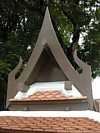
2. An
upright ornament with some
prangs (fig.)
and
gopuras (fig.)
in
Khmer style. In Thai called
klieb kanun prang (fig.).
It is usually pointing forwards and decorated with bas-relief.
回
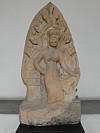
antelope
Mount of
the god
Vayu.
回
Anthem
See
Phleng Chaht Thai.
回
anticrepuscular rays
Term for an atmospheric phenomena
that may appear in the sky around sunrise or sunset, at the opposite side of the
sun. It consists of dim linear rays that emerge from the antisolar point and spread
out across the sky in a fan-shaped form, reminiscent of the spokes of half a
cart-wheel. The rays are much dimmer than crepuscular rays, i.e. the sunbeams
that appear at the solar point when the sun is just below the horizon, and may
be a mixture of blue, white, orangey to pinkish purple colours. This
meteorological phenomena is also known as antisolar rays.
See
TRAVEL PICTURE.
回
antisolar rays
See
anticrepuscular rays.
回
anubahn (อนุบาล)
Thai for
kindergarten. See
education.
回
Anuman Ratchathon (อนุมานราชธน)
Thai. Court name of Yong Sathiankoset.
READ ON.
回
Anurak Thewet (อนุรักษ์เทเวศร์)
Thai.
A nephew of King
Rama I, who
held the position of
Wang Lang,
i.e. ‘Rear Palace’, officially known as
Krom Phra Rachawang Bowon Sathaan Phimuk.
It was the last ever Rear
Palace, who ruled from 1785 to his death in 1806, after which the office went
vacant and in
1885 was abolished altogether, as was
that of
Wang Nah
i.e. the ‘Front Palace’
or
Krom Phra Rachawang Bowon Sathaan
Mongkon.
Also transcribed Anurak
Devet.
回
,%20the%20Last%20Rear%20Palace_small.jpg)
Anuruddha Thera (อนุรุทธเถระ)
Thai name for Anuruddha, the son of
Sukkhodana, i.e. the brother of King
Suddhodana,
and hence a cousin to Prince
Siddhartha.
Anuruddha frequently appears in the Jataka, such as in the
Canda Jataka (fig.),
and is in the Pali Canon depicted as an affectionate and loyal disciple of the
Buddha,
as well as a master of clairvoyance. He is
one of the
Ten Principal Disciples
(fig.).
回

Anusawarih Chai Samora Phum (อนุสาวรีย์ชัยสมรภูมิ)
Thai name
for the
Victory Monument.
回
Anusawarih Kreuang Bin Rob
(อนุสาวรีย์เครื่องบินรบ)
Thai name
for the
Jet Fighters Monument.
回
Anusawarih Phu Phitak Rab Chai Prachachon (อนุสาวรีย์ผู้พิทักษ์รับใช้ประชาชน)
Thai. ‘Statue of the Guardian Servant of the
People’ or ‘Statue of the Defender of the Public’. Official name
for a monument that is colloquially referred to as
Anusawarih Tamruat, i.e.
‘Police Statue’. It was designed by Professor
Silpa Bhirasri
(fig.),
a sculptor of the
Fine Arts Department
(fig.).
The heroic statue depicts a police officers carrying an unconscious man in his
arms whilst a naked toddler clasps to his trousers.
Originally located in front of the
Headquarters
of the
Royal Thai Police
(fig.)
in
Bangkok's
Pathumwan District, replicas can now be
found in front of many police posts and
stations throughout
Thailand.
The base of the original statue is hollow and is used to store the ashes of
police officers killed while on official duty. The original statue was
inaugurated on 13 October 1953,
i.e. on National Police Day, known in Thai as
Wan Tamruat Haeng Chaht. In 2010, the
original statue was relocated to
the Royal Police Cadet Academy (fig.)
in
Nakhon Pathom.
回
_small.jpg)
Anusawarih Prachathipatai (อนุสาวรีย์ประชาธิปไตย)
Thai name for
the
Democracy Monument.
回
Anusawarih Prahb Kabot (อนุสาวรีย์ปราบกบฏ)
Thai.
‘Monument of the Suppression of the Rebellion’.
Name of an
obelisk-like memorial
located on the Laksi Roundabout in Bang Khen
District,
Bangkok.
READ ON.
回
Anusawarih Tamruat (อนุสาวรีย์ตำรวจ)
Thai. ‘Police Statue’. Colloquial name for a
monument that is formally known as
Anusawarih Phu Phitak Rab Chai Prachachon.
回
Anuson Phuh Sia Sa-la Jangwat Tak
(อนุสรณ์ผู้เสียสละจังหวัดตาก)
Thai. ‘Tak Provincial Martyr
Memorial’. Name of a monument in Mae Sot, in the northeastern province of
Tak,
that commemorates the heroic deeds of those who sacrificed their lives in
defense of the nation, in particular the brave fighters and martyrs who in the
sixties carried out operations to suppress communist terrorism in the area and
in which 93 civilians, police and soldiers were killed. In English, it is
usually referred to as the Tak Provincial Sacrifice Memorial.
回
Anuson Sathaan Chong Khao Khahd (อนุสรณ์สถานช่องเขาขาด)
Thai for
Hellfire Pass Memorial.
回
Anuson Sathaan Haeng Chaht (อนุสรณ์สถานแห่งชาติ)
See
National Memorial.
回
Anuson Sathaan Racha Sakun
Mahidon (อนุสรณ์สถานราชสกุลมหิดล)
Thai. ‘Mahidon Family
Memorial Hall’. Name of a memorial within the compound of
Wat Pathum Wanaraam Ratchaworawihaan
(fig.),
dedicated to members of the Royal Family of
Mahidon Adunyadet
(fig.),
the Prince Father of Thailand.
See MAP.
回
Anuson Sathaan 14 Tulah (อนุสรณ์สถาน ๑๔ ตุลาฯ)
Thai. ‘October 14th Memorial’. Monument near
Democracy Monument
(fig.)
in
Bangkok
dedicated to the 77 people that lost their lives
at the hands of the security forces during the October
'73
uprising near the
Thammasat
University (fig.), in which students and other citizens alike
demanded democracy. The uprising brought about
the end of the then ruling military dictatorship and altered the Thai political
system. The memorial
consists of a tapered cube base with a cone-shaped peak, similar to the
plong shanai
(fig.)
of most
chedi.
Also transliterated Anuson Satahn.
See POSTAGE STAMP
and
MAP.
回
%20A_small.jpg)
ao dai (áo dài)
Vietnamese. ‘Long robe’. Vietnamese national dress, nowadays most commonly worn by girls
and women.
In its modern form, it consists of a log-sleeved, tight-fitting tunic, that is
ankle-long and split open on both sides from the waist down, and with a slant
row of buttons or hooks, that run from the right side of the neck to the armpit
and further down the side. The tunic is usually made from
silk, and
worn over a pair of loose trousers. The
ao dai is very feminine and flattering, and the Vietnamese say that
‘it
covers everything but hides nothing’.
Outdoors,
the ao dai is often worn with a
non la (fig.),
i.e. a traditional conical hat made from
bamboo and dried palm leaves (fig.).
On special occasions, men may wear a somewhat looser version of the ao dai,
usually made of thicker fabric and sometimes a bit shorter
(fig.).
The style of the ao dai is purportedly influenced by the longs robes that were
once worn by court officials (fig.)
and aristocrats at the imperial courts in
Vietnam and
China.
See also
ao gam.
回
ao gam (áo gấm)
Vietnamese.
‘Brocade robe’. Name of dress similar to the
ao dai (fig.),
but shorter and made of a thicker fabric. It is commonly worn by men on special occasions,
usually with
a Vietnamese turban (fig.),
which is locally known as
khan dong
(fig.).
See also
ao quan.
回
_small.jpg)
Ao Krung Thep (อ่าวกรุงเทพ)
Another spelling for
Ahw Krung Thep, i.e. the
Bay of Bangkok.
See also
Krung Thep.
回
ao ngu than (áo ngũ thân)
Vietnamese.
‘Whole body robe’. Name of a former aristocratic gown worn in
Vietnam between
the 19th and early 20th centuries, and that inspired the later
design of the
ao dai (fig.).
回
ao quan (áo
quan)
Vietnamese. ‘Chest robe’. Name
for the academic dress or ceremonial gown as worn in the past by civil mandarins
upon passing the Imperial Examinations (fig.).
It was worn together with the
mu tien si, i.e. a ‘doctoral
hat’, fashioned
after the
mu canh chuan,
i.e. the Vietnamese
equivalent of the Chinese
wu sha mao,
the black hat with two wing-like flaps of thin, oval shaped boards, worn by
feudal officials during the Ming Dynasty. See also
ao gam.
回
Ao Thai (อ่าวไทย)
See
Ahw Thai.
回
Apasmara (अपस्मार)
Sanskrit. Name of a demon-dwarf, that is
crushed by
Shiva
in his appearance as
Nataraja,
i.e. the ‘Lord of Dance’ (fig.).
The midget's name means ‘confusion of mind’, as well as ‘memory
loss’ and ‘epilepsy’, and he represents ignorance, i.e. the ignorance that makes
one lose ones balance and which is countered by Nataraja, making a
gajahasta with one of his
arms. Thus, by subduing him, Shiva allows the birth of knowledge and
reminds the people that he is their true source of wisdom. He is depicted with
the face of a demon and the body of an infant (fig.),
and is also referred to as Apasmara Purusha, with purusha meaning ‘man’,
‘person’ or ‘human’, as well as ‘soul’ or ‘spirit’.
回
apaya
Pali. The
four lower worlds as described in Buddhism, which are part of the
kamaloka, and consist of the animal kingdom,
the realm of the ghosts, the world of the demons or
asura, and the hells (niraya/naraka).
回
Aphakon Kiatiwong (อาภากร เกียรติวงศ์)
Thai. Name of the 28th child of King
Rama V.
READ ON.
回
Aphidhamma
See
Aphitam.
回
Aphinetsakrom (อภิเนษกรมณ์)
Thai term
for the
Great Renunciation of the Buddha.
回
Aphinya (อภิญญา)
Thai-Pali
term meaning ‘great knowledge’
and used especially in
Buddhism
for those who posses prowess, are good listeners, have empathy, have the ability
to remember ones previous lives or
chaht, have good insight and
wisdom in making ills disappear. Also known as
Aphiyaan.
回
Aphiyaan
(อภิญญาณ)
See
Aphinya.
回
Aphisek Dusit Throne Hall
Name of a
former palace in
Dusit
district, which nowadays has been turned into a
museum, housing an impressive collection of silver jewellery,
silk, and other Thai artifacts, under the
auspices of the queen. It was built in 1904, in a Moorish
Gingerbread-style and adjacent to
the
Vimanmek Teak Mansion.
Aphisek Dusit Throne Hall consists of a small one-storey, wooden edifice and was used exclusively for
state occasions during the
Rattanakosin
period, and underwent restoration in 1993. In Thai it is named
Phra Tihnang Aphisek (อภิเศก) Dusit. The word
aphisek means ‘coronation’ and is derived from the Sanskrit term
abhisheka, meaning ‘unction’
or ‘blessing’, usually ceremonial and often including the ritual sprinkling of
water.
See MAP.
回
_small.jpg)
Aphitam (อภิธรรม)
Pali-Thai.
One of the three books of the
Tripitaka. Also Aphidhamma. See also
Buddhist precepts.
回
aphiwaht
(อภิวาท)
Pali-Thai.
‘To prostrate (kraab)
ánd
wai’.
In
Buddhism,
when paying respect to a
Buddha image
or to a senior monk, it is common practice to perform a wai with the hands high,
intending to show
high respect, as the
more respect is given the higher the
hands are held (fig.),
and prostrate three times in repetition, in order to show respect to each aspect
of the
Triratana, i.e. the
Buddha, the
Dhamma, and the
Sangha. With
prostration in which five parts of the body, i.e. the head, hands and feet,
touch the ground, it is known as
benjahngkhapradit (fig.).
回
Apple Snail
A species
of snail with the binomial name Pomacea canaliculata. It is a commonly seen
species of snail in
Thailand
and
lays pink eggs, clung together
in clusters (fig.).
These pink, caviar-like,
clusters of eggs are typically found
near freshwater, often on poles or the stalks of plants that stand in the water,
such as
rice (fig.).
It therefore is an natural enemy of rice plants
and has several names
in Thai, including hoy cherih (หอยเชอรี่), meaning
‘cherry snail’. See
also
taak.
WATCH VIDEO.
回
%20with%20eggs_small.jpg)
Apsara (अपसरा, អប្សរ)
Sanskrit-Khmer.
The female divinities or nymphs and celestial dancers of the
Tavatimsa
Heaven.
READ
ON.
回
Apsara Dance
The
Khmer
equivalent of
Khon,
i.e. Thai Classical Dance (fig.),
in
Cambodia.
READ ON.
回
Apsarasingh
(อัปสรสิงห์)
See
Apsonsi.
回
Apsarasingha
See
Apsonsi.
回
Apson (อัปสร)
Thai-Sanskrit. Female nymphs and celestial dancers of
Tavatimsa
heaven. Also transcribed
Apsorn. See also
Apsara and
THEMATIC STREET
LIGHT.
回
Apsonsi (อัปสรสีห์)
Thai.
Creature from Thai mythology with a body that is half woman and half lion. Also
called Apsonsingh, Apsonsingha, Apsarasingha or Apsarasingh, being the compound
of an
Apsara (Apson)
and a
singha (singh),
that is a female nymph and a lion (fig.).
The combination of a male angel and a lion is called
Thepnorasi (fig.).
回
Apsonsingh
(อัปสรสิงห์)
See
Apsonsi.
回
Apsonsingha
See
Apsonsi.
回
Apsorn (อัปสร)
Thai-Sanskrit. Female nymphs and celestial dancers of
Tavatimsa
heaven. Also transcribed
Apson. See also
Apsara.
回
araam (อาราม)
Thai.
Another name for
wat, a temple or monastery.
Although it derives from the Sanskrit word
ashram,
which translates as ‘place to stay or halt’ and of which the root shram
means ‘to make efforts’, it is in Thai a synonym for
‘pleasure’, ‘delight’ and ‘happiness’, which is seemingly related to arom (อารมณ์),
a word that means ‘mood’.
回
Arabian Camel
One of the
only two remaining species within the genus Camelus still existing today.
READ ON.
回
Arada Kalapa
Sanskrit.
Brahman master whose principles thought
of the essential non-existence of all things, and to whom
Siddhartha was at first apprenticed
after the
Great Departure in
his search for the redemption of suffering, caused by the cycle of endless
rebirths. In Pali called Alara Kalama.
回
arahan (อรหันต์)
Thai-Sanskrit. An
Arahat
or Buddhist saint.
回
Arahang (อรหัง)
Thai. A
title of the
Buddha, used as an invocation by one who is at
the bedside of a dying person.
回
Arahat (อรหัต)
Pali-Thai.
‘The worthy one’, a title given to Buddhist saints. A term derived from the
Sanskrit word
Arihan, meaning ‘foe-slaying’.
READ ON.
回
arahatamak (อรหัตมรรค)
Thai-Sanskrit. The way that leads to
Enlightenment. See also
Arahat.
回
arahatapon (อรหัตผล)
Thai-Sanskrit. The
dhamma that causes the
Enlightenment of a Buddhist saint or
Arahat.
回
arahitogami (現人神)
Japanese. ‘A deity who appears as a man’.
Term for the
Shinto concept of a human who is at the same
time a god, an idea which also allowed for the Japanese Emperor to be viewed as
a god. Compare with
avatar.
回
arahtanah (อาราธนา)
Thai. The
invitation to a Buddhist monk to give a sermon or to begin a religious service.
回
aran (อรันย์)
A Pali
word, also used in Thai, and meaning ‘forest’. It equates with a certain
‘seclusion’ and in that way words such as
arahan (saint),
aranyawahsih (forest monastery),
araam (temple), etc. may be derived from it or
linguistically relate.
回
aranyawasi (อรัญวาสี)
Thai-Sanskrit. A forest monastery. A sect of monks living in the jungle. A more
popular term is
wat pah. Also
transcribed aranyawahsih. See also
Kanchana Aranyawasi.
回
Aravan
(அரவான்)
Tamil. Name of the son of
Arjuna,
the legendary hero of the Indian
epic
Mahabharata,
with the
naga
princess Uluppi (உலுப்பி). He is a village deity of Southern India
venerated as part of the Dravidian folk tradition who is believed to cure
disease and induce pregnancy in childless women. According to tradition
Krishna (fig.)
allowed Aravan to witness the entire duration of the Mahabharata War through the
eyes of his severed head, hence Aravan is worshipped in the form of his severed
head, which sometimes even has its own shrine within temples, or is placed on
the corners of temple roofs as a guardian against evil. He is also worshipped as
a patron god of transgender people throughout South Asia. Also transliterated
Airavan and Iravan, and also known as Sri Aravan, Iravat and Iravant.
WATCH VIDEO.
回
archery
See
kaan ying thanoo.
回
Ardhanari (अर्धनारी)
Sanskrit.
Hermaphrodite depiction of the Hindu god
Shiva and his consort
Uma or
Parvati reflecting a composition of male
and female energy. One side represents the god Shiva with a
jata, his typical plaited hairstyle, the other
side represents his consort wearing a crown. In
iconography, he is sometimes depicted
accompanied with their respective mounts (fig.), i.e.
the
buffalo or bull
Nondi,
vahana
of Shiva
(fig.),
and the
lion,
the personal vehicle of Uma
(fig.). In
Vajrayana
Buddhism,
this unity of feminine and masculine principle
is known as
yabyum.
There is an Ardhanari Shrine on
Sukhumvit Road
in
Bangkok (map
-
fig.),
near
Asohk
Intersection.
See also
phi seua kathoey.
回
areca palm
Ornamental
palm tree that produces green to yellow
and orange colored fruits.
Areca nuts, its
acidulous seeds, are used as an ingredient for
betel nut chewing (fig.)
and by
association, are sometimes inaccurately called betel nuts.
Also called
betel palm and in
Thai
ton mahk.
WATCH
VIDEO.
回
_small.jpg)
arhat (अर्हत्)
Sanskrit-Pali. See
Arahat.
回
Aria (อริยะ, आर्य)
Thai-Sanskrit. ‘Arian’
and ‘civilized’, as in
Sri Aria
Metrai, another name for
Maitreya. Also Ariaka.
回
Ariaka (อริยกะ)
Thai-Sanskrit. ‘Arian’
and ‘civilized’. Also Aria.
回
Arian
A
prehistoric group of white people, who migrated from Central Asia and Europe to
Persia and India during the second millennium BC, bringing their own language,
culture and religion. The name Arian means ‘noble’ and is related to the
place-name Iran, a region whose ancient civilization closely resembled that of
Vedic India. The Arians were a nomadic people, often cattle herders, that
traveled along the
historic trade routes and
first appeared in
the area of the Indus Valley in about 1500 BC, following the disappearance of
the Indus Valley Civilization, whose inhabitants had lived in the area between
2500 BC and 1800 BC. Unlike the city-dwellers of the Indus Valley, the Arians
left no permanent structures or artifacts behind, though their religious rituals
and ideas, on which their culture was based, are recorded in the
Vedas. Also spelled Aryan
and in Thai
Ariyaka.
回
Ariasat (อริยสัจ)
Thai-Pali-Sanskrit. The
Four Noble Truths of
Buddhism.
回
arihan (अरिहन्)
Sanskrit.
‘Foe-slaying’. A compound in which ari means ‘enemy’ or ‘foe’ and han means ‘to
kill’ or ‘to slay’. It is the name given to Buddhist saints, those who have
reached the highest goal in
Theravada
Buddhism, as they have slain their greed, anger and delusions, and destroyed
their
karmic residue
from previous lives. They are no longer reborn into the world of suffering, no
longer trapped in the cycle of rebirth known as
samsara. In
Mahayana Buddhism,
however, the arihan ranks below the
bodhisattva
on the chain of
Enlightenment. See also
Arahat.
回
Arishta
(อริษฏ)
Thai-Sanskrit. Demon in the appearance of an ox, sent out by Kansa to kill his
nephew
Krishna (fig.). See also
Kuvalayapida.
回
Arjuna (अर्जुन)
Sanskrit.
‘White’, ‘bright’ or ‘silver’.
Dhammaracha
and King
of the Haihayas of the
Pandava tribe, and the legendary hero of
the Indian
epic
Mahabharata, the great battle of the
Bharatas.
Pandu, his natural father, chose
Indra as his divine
and spiritual
father. Arjuna was an
excellent archer and an unrivaled warrior, and
Krishna (fig.) was his charioteer,
and together they are
considered the main heroes of Mahabharata. Arjuna riding a chariot is depicted
on a Thai postage stamp issued in 2004, from a drawing of
Hem Wetchakon
(fig.).
回
Arjan Dev
See
Arjan Dev Jee.
回
Arjan Dev Jee (ਅਰਜੁਨਦੇਵ)
Punjabi.
The fifth
guru according the chronological table
of the
Sikhs which in total has ten gurus,
beginning with guru
Nanak Dev, the founder of the Sikh religion. He
was born in 1563 in Gundwal (Amritsar)
and is the founder of
Har-Mandir Saheb, better known as the
Golden Temple in the Indian Punjab. He
is co-author of the
Adi-Granth which he composed in 1604. He
was guru from 1581 to 1606, he died a martyr at the age of 43. Briefly also
called Arjan Dev.
回
Armed Forces Development Command
Name of an operations group and department
of the
Royal Thai Armed Forces
in charge of the construction of military and rural roads, especially in more
remote areas. In Thai, it is known as nuay banchakaan thahaan phattanah
(หน่วยบัญชาการทหารพัฒนา).
回
_small.jpg "Thai Red Cross Society")
Army
See
kong thap.
回
Army Medical Department
See
krom phaet thahaan bok.
回
Army Ordnance
See
Krom Sanphawut Thahaan Bok.
回
Army Training Command
In
1895, the Training Command emerged alongside the
Saranrom
Army School, which was founded by
Rama V
on 5 August 1887,
with the goal of
training army cadets.
READ ON.
回
aromatic ginger
See
sand ginger.
回
Arowana
See
Dragonfish.
回
Arrowhead
Common
name for an aquatic plant with the botanical designation Sagittaria sagittifolia.
It has arrow-shaped leaves and edible potato-like tubers.
回
_small.jpg)
Arrow Leaf Pondweed
Common
name for a species of flowering plant in the
water hyacinth
family
Pontederiaceae and known by the botanical designation Monochoria hastata.
READ ON.
回
Art In Paradise
Name of an
interactive 3D Art Museum, in which visitors can take place on, or in front of,
a certain painting or object created in such a manner that it generates an
optical illusion and makes it appear as if one is part of the subject is a
bizarre, often funny way.
READ ON.
回
Artocarpus altilis
Latin.
Scientific name for the
breadfruit tree.
回
Artocarpus heterophyllus
Latin. Name
for a large fruit (fig.)
and its tree, belonging to the genus Artocarpus which also includes the bread
tree. In the West it is called ‘jackfruit’. The average weight of the fruit is
around sixteen kilograms but can sometimes weigh up to forty kilograms. The
flesh of the fruit (fig.)
is yellow and sweet and sits in small pockets in an enormous browngreen rind
with short, hexagonal, blunt prickles. The Thai name for the fruit is
kanun and the tree is called
ton kanun. Its fruiting season is from January
to May.
回
_small.jpg)
arun (อรุณ)
Thai.
‘Rising sun’, ‘sunrise’, ‘morning’ or ‘dawn’. See also
Arun.
回
Arun (अरुण)
Sanskrit.
Another, more modern transcription of
Aruna.
回
Aruna (अरुण)
Sanskrit.
‘Reddish brown’. Hindu god of dawn. His name refers to the colour of the sky
during sunrise. He is the charioteer who drives the sun god
Phra Ahtit across the sky (fig.)
and over the horizon, thus causing dawn. The Thai word
arun, meaning ‘morning’ or ‘dawn’ is derived
from his name. Also transcribed
Arun.
See also POSTAGE STAMP.
回
%20Hindu%20god%20of%20dawn_small.jpg)
Aryan
See
Arian.
回
Asaanha Bucha (อาสาฬหบูชา)
Thai Public holiday on the day of the full
moon in July commemorating the first sermon of the
Buddha
given to the five
panjawakkie (fig.) in
Sarnath (fig.).
It is regarded as the first day when the
Rattanatrai or
Triple Gem,
i.e. the
Buddha,
his teachings or the
Dhamma,
and the order of
monks
or
Sangha,
was attained.
Also Wan Asaanha Bucha (Asaanha Bucha Day),
Asalhapuja
and Asahara Bucha. See also
bucha and
POSTAGE STAMPS (1),
(2) and
(3).
回
asana (आसन)
Sanskrit.
‘Throne’, ‘seat’, and ‘seated position’. The different sitting positions in
yoga, and in
iconography, the position of the legs of
a god. See also
royal relaxation position
(fig.),
padmasana,
simhasana,
pratyalidha
asana
(fig.)
or
alidha asana (fig.),
vajrasana
(fig.),
virasana,
and
lalitasana
(fig.).
It appears frequently as part in names for royal palaces, halls and residences,
e.g. Chaleemongkon Asana (fig.),
Aisawan Thipphaya Asana (fig.),
etc.
回
Asaykhan Fortress
Name of a fortress on the Western bank of
the
Irrawaddy River.
READ ON.
回
ASEAN
Abbreviation of ‘Association of Southeast Asian Nations’. Established on 8
August 1967 in
Bangkok
by the five original Member Countries, i.e. Indonesia,
Malaysia,
The Philippines, Singapore, and
Thailand.
Brunei Darussalam joined on 8 January 1984,
Vietnam on 28 July 1995,
Laos
and
Myanmar (Burma)
on 23 July 1997, and
Cambodia on
30 April 1999, increasing the present member total to ten nations (fig.). The ASEAN region has a population of about 500 million, a total
area of 4.5 million square kilometers, a combined gross domestic product of
US$737 billion, and a total trade of US$ 720 billion. Its flag consists of ten
yellow stalks of paddy on a red circle with a white rim and in a blue field.
These colours represent the main colours of the crests of all the ASEAN
countries and symbolize peace and stability (blue), courage and dynamism (red),
purity (white) and prosperity (yellow). The circle represents unity and the ten
stalks of padi represent the dream of ASEAN's Founding Fathers for an ASEAN
comprising all the ten countries in Southeast Asia bound together in friendship
and solidarity. However, since November
2022 East Timor was accepted as ASEAN's eleventh member state. There is an ASEAN Cultural Center (fig.)
on
Ratchadamnoen Avenue in
Bangkok,
located within the same building of the
Ratchadamnoen Contemporary Art Center
(map
-
fig.).
See also POSTAGE STAMPS (1),
(2),
(3),
(4)
and
(5), and
TRAVEL PICTURE.
回
Ashin Nyanissara (အရှင်ဉာဏိဿရ)
Burmese. ‘Lord Nyanissara’. Another name of
Sitagu Sayadaw, a Burmese meditation teacher
and
Theravada
Buddhist scholar.
回
Ashtamangala (अष्टमंगल)
Sanskrit.
‘Eight auspicious [things]’. Eight auspicious symbols, the first four of these
being royal emblems associated with the
Shakyamuni
Buddha, the other four symbols of
Buddhist religious belief.
READ ON.
回
Ashoka
See
Asoka.
回
ashram (आश्रम)
1.
Sanskrit. ‘Place to stay or halt’. A hermitage retreat for recluses, holy men
and hermits or
rishi, in Thai tradition often a cave.
It corresponds with the stage of life known as Sannyas.
The word ashram has the root shram,
meaning ‘to make efforts’.
Compare with
araam.
回
2.
Sanskrit. ‘Stage of life’. Hindu tradition recognizes four stages or phases of
life, i.e.
Brahmacharya, the celibate stage; Gruhastha,
the married stage; Vanaprastha, the retirement stage; and Sannyas or the recluse
stage. See also
Four Stages of Life.
回
Ashwagandha (अश्वगन्ध, अश्वगंधा)
Sanskrit-Hindi. ‘Horse's smell’. Name for a plant with the scientific name
Withania somnifera, which roots, and to a lesser extent also its berries, are
widely used as herbs in
Ayurveda. The name derives from the smell of
the roots, which are said to have an odour reminiscent of that of a clammy
horse. Due to the similarity of this root with
ginseng,
which is widely used in traditional Chinese medicine, it is in Thai referred to
as sohm india or ‘Indian ginseng’, against
sohm jihn
for ‘Chinese
ginseng’. Occasionally, also transcribed Ashvagandha.
回
ashwamedha (अश्वमे)
Sanskrit.
The ‘sacrifice of a horse’ performed by Vedic kings in order to gain domination
over their enemies, to maintain supremacy, or to produce a male offspring.
回
Ashwapati (अश्वपति)
Sanskrit.
‘Lord of the horses’. See also
reusi nah mah.
回
Ashwin (अश्विन,
अश्विन)
1.
Sanskrit. Often plural. ‘Horseman/horsemen’.
Name of two Vedic deities, twin sons of the sky or the sun. They are the
personification of early morning light and said to be
the
physicians to the gods.
They are the children of a nymph
called
Ashwini,
who disguised herself in the form of a mare.
They are the twin heavenly fathers to the
youngest (twin) sons of the
Pandavas, i.e.
Nakula and
Sahadeva.
The Ashwin brothers are also referred to as Ashwini
Kumara (अश्विनीकुमार),
i.e. the ‘Princes of
Ashwini’
or the ‘Horsemen
Princes’. In the
Rigveda,
they are together
also called
Nasatya (नासत्य), which means ‘Kind’
and ‘Helpful’,
though later on, Nasatya
is the name of
one twin, while the other is then called Dasra (दस्र),
which similarly means ‘Accomplishing
Wonderful Deeds’ or ‘Giving
Marvelous Aid’.
Also
transcribed Ashvin. See also
reusi nah mah.
回
2.
Sanskrit. The twelfth month of the Hindu calendar.
回
Ashwini (अश्विनि,
अश्विनी)
Sanskrit.
‘Horse woman’. A nymph who concealed herself as a mare, mother of the two
‘horsemen’ brothers, the
Ashwin Twin(s).
回
Ashy Tailorbird
Common name a species of passerine bird in
the family Cisticolidae,
and with the
scientific name Orthotomus ruficeps.
READ ON.
回
Ashy Woodswallow
Common name a stocky, large-headed
bird, with the scientific designation Artamus
fuscus. It lives in open areas with scattered trees, where it hunts and feeds on
insects. Despite its name it is not a true swallow. Its name refers rather to
the fact that it sometimes flies in the same areas as swallows and swifts, but
it has a much thicker build, with broad-based, triangular, somewhat
starling-like, pointed wings. Its plumage is a soft gunmetal gray, with pale
greyish underparts, and a pale bluish bill. It has a body size of 16 to 18
centimeters. They are frequently seen perched on wires, often huddled in pairs
or groups. It is found from Nepal; over India, where is lives mostly in coastal
areas, to almost all of mainland Southeast Asia, but not in southern Thailand
nor further south down the peninsula. In Thai it is known as nok aen phong (นกแอ่นพง),
which freely translates as
‘undergrowth swallow’
or
‘grassy area swallow’.
See
also WILDLIFE PICTURES.
回
%201_small.jpg)
Asian Amberwing
Name of a
species of dragonfly with the scientific name Brachythemis contaminata. The male
has a olivaceous-brown to reddish-brown thorax with two reddish brown lateral
stripes on the upper side, and a bright red abdomen. The face is olivaceous, and
the compound eyes are olivaceous-brown above and greenish grey below. It has
transparent wings, with reddish venation and a broad, bright orange wing patch,
that extends from wing base to the rusty wing spot, on both the fore and hind
wings. The female has a pale olive greenish-yellow thorax, with brown and dark
stripes, and the abdomen is pale greenish with brown and narrow black stripes.
Its face is yellowish-white, and the compound eyes are pale brown above and
greenish-grey below. It has transparent wings, with pale yellowish to amber wing
spots and a yellow tinge at the base of the hind wing. It is also known as Ditch
Jewel and
Orange Skimmer.
回
%201_small.jpg)
Asian Bearcat
Name of a
semi-large, raccoon-like mammal with a thick, black fur and a long, bushy tail (fig.),
that -like most civets- belongs to the family of Viverridae. It lives in the
forest canopy of rainforests in South, East and Southeast Asia, from India and
Bangladesh in the West, to China,
Vietnam and the Philippines in the East, to
Malaysia and Indonesia in the South, including also Thailand. It has the
scientific name Arctictis binturong and is often simply referred to as Binturong
(fig.).
Among civets, the Asian Bearcat is the largest of them all, weighing up to 20
kilograms and growing up to 180 centimeters (including the tail).
回
%20Asian%20Bearcat_small.jpg)
Asian Black Bear
Common name
for a species of
bear with the scientific name Ursus thibetanus. It is also known as Tibetan
Black Bear, Himalayan Black Bear and Moon Bear, the latter referring to the
distinctive
creamy-white, crescent-shaped curve on its chest, similar to
that of the
Malayan Bear (fig.).
It is a species of bear that occurs in the forests of hilly and mountainous
areas in South, East and Southeast Asia. They are omnivores who change their
diet according to the seasons, feeding on fish and even carrion in winter, and
on insects, grasses and plants during spring and summer. Although the practice
is illegal, in
China,
South Korea and
Vietnam, Asian Black Bears are farmed –often in very poor living
conditions, including crush cages– to extract bile from their gall bladder,
which is used as an ingredient in Chinese traditional medicine. Bears used in
this illicit practice are commonly referred to as bile bears.
回
%20หมีควาย%20(หมีดำ)%202_small.jpg)
Asian Box Turtle
See
Southeast Asian Box Turtle.
回
Asian Brown Flycatcher
Common name
for a 12.5 to 13.5 centimeter small passerine bird (fig.), with the scientific
designation Muscicapa dauurica. Adults have brownish-grey upperparts and pale
underparts, with a more faint brownish-grey breast-wash (fig.), usually without
distinct streaks. It has a broad-based blackish bill with a pale based lower
mandible,
and whitish orbital rings that usually extend to the lores. Furthermore, it has
pale grey fringes on the wing coverts and tertials. The Asian Brown Flycatcher
is commonly found in open woodland and cultivated areas, and usually nests in
tree holes (fig.). It belongs to the family Muscicapidae,
and includes the subspecies
Brown-streaked Flycatcher, which is sometimes considered a seperate species,
known by the Latin name Muscicapa williamsoni. The Asian Brown Flycatcher is found throughout Asia
and winters in tropical southern
Asia, from southern India and Sri Lanka, east to Indonesia, and the most
commonly found Asian Brown Flycatcher in Thailand is the subspecies Muscicapa dauurica
siamensis, of which immature birds are somewhat browner above and show whitish fringes on
the wing coverts (fig.). In Thai, it is called nok jab
malaeng sih nahm tahn (นกจับแมลงสีน้ำตาล), which may be translated as
‘brown-coloured
insect-catching bird’.
Despite its common name, the Asian Brown Flycatcher often appears rather
dark sooty-grey
(fig.),
which may confuse correct identification, as it looks very similar (fig.)
to the
Dark-sided Flycatcher.
See also WILDLIFE PICTURES (1)
and
(2).
回
%20นกจับแมลงสีน้ำตาล%202_small.jpg)
Asian Brown Tortoise
See
Asian Forest Tortoise.
回
Asian Elephant
Common name for the largest living land
animal in Asia, with the scientific name Elephas maximus.
READ ON.
回
Asian Fairy-bluebird
Name of a
small, primarily arboreal bird with the scientific name Irena puella. Males are
black with brilliant blue upperparts. Though their tails are the other way
round, i.e. black on the upper side, often with a few blue feathers at the
topmost part, and blue on the underside. Females and immature birds are of an
uniform verdant-blue colour (fig.).
They have red eyes and a dark grey, slightly bent beak. They preferably feed on
fruit, but will also eat nectar from certain flowers and, occasionally, some
insects. They usually dwell in the dense foliage of large trees, often near
rivers. In Thai known as
nok khiao krah.
回
%20นกเขียวครา%202_small.jpg)
Asian Forest Tortoise
A giant
tortoise with the binomial names Manouria emys, found in southern Thailand,
especially in
Ranong
and
Nakhon Sri Thammarat,
as well as in
Malaysia
and
some parts of Indonesia. It is dark brownish gray with a high curved carapace,
that usually has light brown to vague yellow clouds in the centre of each scute,
which are striated. The length of its carapace is around 50 centimeters and it
may weigh as much as 20 kilograms. Its legs are grayish black with large, light
brown to vague yellow scales (fig.).
It feeds on a variety of vegetation, fruits, mushrooms and snails. Also known as
Asian Brown Tortoise and Brown Asian Giant Tortoise, and in Thai as
tao hok leuang.
回
%20เต่าหกเหลือง_small.jpg)
Asian Games
Name of a
four-yearly multi-sports event featuring disciplines and athletes from all over
Asia, and first organized in 1951 in New Delhi, India. Since then, it has been
hosted by Thailand a number of times, i.e. in 1966, 1970, 1978 and in 1998. To
mark the occasion, commemorative postage stamps were issued in 1966 (fig.),
and in 1998 (fig.).
Also known as Asiad.
回
Asian Giant Hornet
Common
name for the
largest hornet in the world, with the scientific designation
Vespa mandarinia.
It has as body length of around 5 centimeters, a wingspan of about 7.6 cm, and
carries a large stinger that contains a potent venom.
It
occurs
in temperate and tropical Eastern Asia, where its sting
regularly causes fatalities. Between
July
and October 2013, an influx in
attacks have killed well over 40 people and injured nearly
1,700 in China's Shaanxi Province alone,
where authorities have been struggling to control the attacks, which have
increased in number due to global warming.
They are
colloquially referred to as
Yak
Killer
Hornets. See also
Yellow Paper Wasp.
回
Asian Glossy Starling
Common
name for a species of passerine bird in the family Sturnidae.
READ ON.
回
Asian Golden Cat
Common name
of a medium-sized wild cat, with a mostly foxy red to golden-brown fur, though
greyish brown and occasionally even darker colour variants may also be found. In
general, the fur is plain, other than some spots on the underside and sometimes
very faint spotting on the rest of the body, though in
China there is a variety with spots like those
of a
Leopard Cat (fig.).
It occurs throughout Southeast Asia, ranging from Tibet and India, to southern
China and as far South as Indonesia. Also called Asiatic Golden Cat and
Temminck's Golden Cat. In Thailand it is called
seua fai, meaning ‘fire tiger’, after the
popular belief that burning its fur or eating its flesh, drives away tigers,
though the
Karen people
believe that merely carrying a single hair of the cat is sufficient. The name
might also be related to a local misapprehension that this cat is ferocious,
though in captivity (fig.)
it has been known to be rather docile and tranquil.
回
_small.jpg)
Asian Golden Weaver
Common name for a weaverbird with
the scientific name Ploceus hypoxanthus.
READ ON.
回
Asian Grass Frog
Common name for a small frog species in the family Dicroglossidae and native to East, South and Southeast Asia,
and which is also known commonly as Boie's Wart Frog, Indian Cricket Frog and Rice Field Frog,
amongst other names. Its Latin binomial designation is Fejervarya limnocharis.
Adults are light to dark brown with small chestnut spots, as well as small
wart-like bumps
all over the skin, and they have a pale greenish (or sometimes off-white to pale
beige) vertebral line that runs over the
entire back, from head to bottom, and which is absent in juveniles (fig.).
It is widely distributed and also occurs at high altitudes.
See also TRAVEL PICTURES.
回
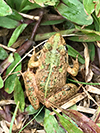
Asian Green Mussel
Common name for a bivalve mollusc in the family Mytilidae.
READ ON.
回
Asian Koel
Name for a bird
in the order of cuckoos, with the binomial name Eudynamys scolopaceus and found
in South and Southeast Asia, as well as in
China. The Asian Koel is between 40
and 44
centimeters large, and has a long tail. Males (fig.)
are glossy black with a greenish-blue shine (fig.),
a pale bill and red eyes. Females (fig.)
of the nominate race are brownish on the crown and have rufous streaks on the
head. The back, rump and wing coverts are dark brown with white and buff spots,
whilst the whitish underparts are striped, streaked, spotted or barred. Females
of other subspecies differ in size and colouration, usually with rufous or buff
markings (fig.).
Like cuckoos, the Asian Koel is a brood parasite, i.e. it lays its eggs in the
nests of other birds. In Thai, it is named
nok kah wao, with the term kah or nok kah
actually meaning ‘crow’,
whereas the word wao has no specific meaning.
See also WILDLIFE PICTURES (1)
(2).
回
%20นกกาเหว่า_small.jpg)
Asian Lady Beetle
Common name for a species of ladybug, i.e. a beetle in the family Coccinellidae,
with the scientific designation
Harmonia axyridis, and known in Thai as tao thong tua talok (เต่าทองตัวตลก). Its
pronotum and head are black with white dots, and the elytra are reddish-orange, with
a number of black spots, though its colour is variable.
回
%20China_small.jpg)
Asian Leaf Turtle
Name for a
medium sized, semi-aquatic
turtle
with the scientific name Cyclemys dentata, commonly found
throughout Southeast Asia. It is rather flat and shaped like a broad oval, with
the rear edge of the carapace strongly serrated, especially with juveniles. The
carapace is usually brown, whereas the background colour of the plastron ranges
from light yellowish-brown to almost black. When seen from above the carapace
somewhat resembles a dead leaf, an appearance that serves as camouflage, since
many leaf turtles like to dwell in dry leaves. It lives in shallow waters and
streams in mountain forests and while juveniles are highly aquatic and prefer
eating in the water, adults may spend more time on land where they also readily
eat. In Thai it is called
tao bai mai, a near translation of its English
name, meaning ‘leaf turtle’. Its appearance is reminiscent of that of the Spiny
Turtle (Heosemys spinosa), the Stripe-necked Leaf Turtle (Cyclemys tcheponensis)
and the
Giant Asian Pond Turtle (Heosemys grandis -
fig.).
回
_small.jpg)
Asian Long-horned Beetle
Common name for a species of large beetle in
the Cerambycidae family and with the scientific designation Anoplophora
glabripennis.
READ ON.
回
Asian-Oceanic Postal Union
Name of an inter-governmental organization
of 32 postal administrations of the Asian Pacific Region, with the objective to
extend, facilitate, and improve postal relations between member countries and to
promote cooperation in the field of postal services. The convention was
established on 1 April 1962, originally under the name Asian-Oceanic Postal
Convention (AOPC) and with headquarters in Manila. Later it changed its name to
Asian-Oceanic Postal Union (AOPU), and in 2002, the organization relocated its
headquarters to
Bangkok. Nowadays, it is also referred to as
Asian-Pacific Postal Union (APPU)
and for the 50th anniversary of its
founding, Thailand issued a postage stamp
with the flags of all 32 member
nations of the organization, namely
Afghanistan, Australia, Bangladesh, Bhutan, Brunei Darussalam,
Cambodia,
China,
Fiji, India, Indonesia, Iran, Japan, Korea,
Laos,
Malaysia, Mongolia, Maldives,
Myanmar, Nauru, Nepal, New Zealand, Pakistan, Papua New Guinea,
The Philippines,
Samoa, Sri Lanka, Singapore, Solomon Islands,
Thailand, Tonga, Vanuatu,
and
Vietnam (fig.).
See
more POSTAGE STAMPS (1),
(2) and
(3).
回
Asian Openbill
A species
of stork with the binomial name Anastomus oscitans.
READ ON.
回
Asian-Pacific Postal Union
See
Asian-Oceanic Postal Union
回
Asian Palm Civet
See
Common Palm Civet.
回
Asian Palm Weevil
See
duang maprao.
回
Asian Paradise Flycatcher
Common name for a medium-sized
passerine bird, with the scientific name
Terpsiphone paradisi.
Adults have a glossy black head and crown with a crest, a black sturdy bill, and
black eyes, greyish throat and underparts, and rufous on the back, though some
populations have a white plumage. Males have elongated tail feathers, that grow
around 30 centimeters long. In Thai, this species is known by the name nok saew
sawan (นกแซวสวรรค์). Both a rufous and a white morph of this bird are depicted
on a Thai postage stamp issued in 1975 as part of a set on Thai birds (fig.).
回
Asian Pied Starling
Common
designation for a species of starling, with the scientific names Sturnus contra
and Gracupica contra, and found throughout parts of South (fig.)
and Southeast Asia. It
has a black head, throat and upper breast, white cheeks and fore-crown, and the
base of the pale bill, as well as the pale facial skin around the eyes, is
orange. Its legs and feet are greyish-yellow. Though this species of passerine
bird is mainly terrestrial, it can occasionally be found perching in trees,
where it usually retreats for the night (fig.). Also known as Pied Myna,
and in
Thai called
nok ihyang dahng.
回
%20Pied%20Myna_small.jpg)
Asian Small-clawed Otter
Common name for the smallest species of all
otters.
READ ON.
回
Asian Snakehead
See
pla chon.
回
Asian Stink Bug
Common name for an insect with the scientific name
Acrosternum hilare, and also commonly known as Green Stink Bug and Green Soldier
Bug.
READ ON.
回
Asian Tapir
Another
name for the Malayan Tapir, a large mammal with the scientific name Tapirus
indicus, in itself a Latin designation that refers to the East Indies rather
than to India.
READ ON.
回
Asian Vine Snake
Another name
for the
Oriental Whip Snake (fig.).
回
Asian Water Dragon
See
Indochinese Water Dragon.
回
Asiatic Brush-tailed Porcupine
Name of a
species of porcupine (fig.)
found in Southeast Asia, from
China to Sumatra.
READ ON.
回
Asiatic Pennywort
See
bai bua bok.
回
Asiatic Soft-shell Turtle
See
taphaab.
回
Asiatique
Name of a
night bazaar located along at the
riverfront of the lower
Chao Phraya
River in
Bangkok
and situated in the former docks of the
East Asiatic Company.
READ ON.
回
Asita (असित)
Sanskrit.
The hermit living in the mountains not far
from the palace of
Suddhodana,
and who predicted that if the newborn
Siddharta were to grow up in the palace, he would
become a great king who would submit the whole world, but if he were to deny
court life to live a religious life, he would become a
buddha. Some texts mention a
reusi named
Kaladevaila.
回
Asita (अजित)
Sanskrit.
Another spelling for
Ajita.
回
Asohk (อโศก)
Thai for
Asoka. Also
spelled asohk or Asoke.
回
Asoka (अशोक)
1. Sanskrit. ‘Without sorrow’.
Indian-Mauryan Emperor, who ruled from 273 to 232 BC and unified India. During
his reign
Buddhism was adopted as the state
religion and structures inscribed with Buddhist ethics were erected throughout
his empire. He sent Buddhist missionaries to many parts of Asia, including
Southeast Asia and
Ceylon. In Thai
Asohk and in full as
Phra Chao
Asohk
Maha Raj, and
in Burmese known as
Dhammasoka. See also
Asoka Pillar
and
TRAVEL PICTURES.
回
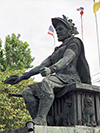
2.
Sanskrit. ‘Without sorrow’. Tree
with the Latin name Saraca indica, the best known kind of the genus Saraca, that
in total numbers 71 species of evergreen trees from tropical Southeast Asia.
They can reach a height of nine meters.
According to some sources it is the tree under which
Siddhartha was born
(fig.)
and of which
Maha Maya holds a branch, standing
during the delivery (fig.).
In Thai
asohk.
回
3.
Sanskrit. ‘Without sorrow’. Tree
with the botanical name Polyalthia longifolia. Whereas
Saraca indica qualifies as the true Asoka,
Polyalthia longifolia is often referred to as the False Asoka. It is a lofty
evergreen tree, often planted in rows, and grows to around 10 meters in height.
It has weeping pendulous branches and long narrow lanceolate leaves with
undulate margins.
回
_small.jpg)
Asohk Ra-yah (อโศกระย้า)
Thai. ‘Chandelier
Asoka’. Tropical
tree
with the botanical name Amherstia nobilis. It is native to
Myanmar, belongs to the family
Fabaceae and bears showy red flowers. It has broad, yet rater short, somewhat
scimitar-shaped seedpods. In English, it is known by the names Orchid Tree and
Pride of Burma.
回
%20Pride%20of%20Burma_small.jpg)
Asohk Leuang (อโศกเหลือง)
Thai. ‘Yellow
Asoka’. Tree
with the botanical name Saraca thaipingensis. It is native to Southeast Asia,
belongs to the family Fabaceae, and bears yellow flowers. In English, it is also
known by the common names Yellow Ashoka or Yellow Asoka, and Yellow Saraca, and
in Thai also as Sohk Leuang (โสกเหลือง) and Sri Yala (ศรียะลา).
回
%20Yellow%20Ashoka_small.jpg)
Asoka Pillar
Name of a
series of columns found throughout northern India, often in strategic sites,
such as on trade routes, but especially at locations of historical importance to
Buddhism.
READ ON.
回
Asokasundari (अशोकसुंदरी)
Sanskrit. ‘Beautiful girl without sorrow’.
Name of the daughter of the
Hindu
god
Shiva
and his consort
Parvati.
See also
Naak Galyah.
Also spelled Ashokasundari.
回
Asokaramaya (අශෝකාරාමය)
Sinhala. Name of a Buddhist Temple in the
Sinhalese capital Colombo.
READ ON.
回
asoon (อสูร)
Thai name
for
asura, when used separately. It is often used
as a prefix in front of the name of
yak, i.e. giants or demons, especially from
Himaphan Forest or
from the story of the
Ramakien.
If part of a compound name often the word
asurais used instead, similar to the
Sanskrit term. This has to do with the pronunciation of Thai consonants at the
beginning or the end of words and syllables, i.e. whereas the
‘r’
in the beginning of a word or syllable is pronounced as
‘r’,
a final
‘r’,
i.e. at the the end of a word or syllable, is pronounced
‘r’.
Hence, the different pronunciation of the names
Asurapaksi and
Asoon Paksah, in which the first name is
read as one compound name, whilst the second is read as two separate words, i.e.
a title and a name. Sometimes transcribed asun or asuhn. See also
Reua Asurapaksi.
回
Asoon Paksah (อสูรปักษา)
Thai. Name of a creature from
Himaphan Forest,
which has the upper body of a giant or
asoon and the lower body of a rooster-like
bird, i.e. from torso down. It is often depicted with a large tail represented
as a
kranok-design,
and usually holds a short mace. It is able to fly at great speed and, being
carnivorous in nature, it preys on large animals, such as
deer,
horses,
and even humans. Sometimes transcribed Asun Paksa or Asuhn Puksa.
回
Asplenium australasicum
Latin. Plant of the genus Asplenium of
which there are about 700 kinds, mostly evergreen ferns. The Asplenium
australasicum got the nickname ‘bird's nest fern’ or ‘crow's nest fern’, because
of its
fronds or
leaves,
that form a funnel shaped nest. These fern leaves can grow to 1.5
meters in length and 20 centimeters in width. They grow in humid and warm
climates on trees and rocks.
The fronds of
larger plants usually get wavy over time.
The plant closely resembles
the
Asplenium nidus, the difference
being based on their sori. The sori produce and contain
the spores and
appear as brown, fuzzy, diagonal lines, on the underside of the fronds, usually
more dense towards the end. In the
Asplenium australasicum those are half or more the distance between the
frond's midrib and margin. Besides
this,
the
fronds of the
Asplenium nidus
var. plicatum
are more convoluted. In Thai called Feun Kha Luang
(เฟินข้าหลวง).
回
Asplenium nidus
Latin. Plant of the genus Asplenium, a
specimen of mainly evergreen ferns. This fern occurs frequently in the tropics
as a guest plant on trees and rocks, thus colonizing the tropical rainforest.
The shiny green lance-like
fronds or leaves
are thin and have a dark, almost black, middle-vein. It grows circular from a
hairy crown and is, like its counterpart the
Asplenium australasicum, nicknamed
‘bird's nest fern’. It grows in a humid and warm climate.
The fronds of
larger plants are usually wavy. Although the plant
closely
resembles the Asplenium australasicum, its sori –the
spores that appear as brown, fuzzy, diagonal lines, on the
underside of the fronds-
are less wide, and the fronds of the Asplenium nidus
var. plicatum,
are more convoluted. In Thai
called Feun Kha Luang Lang Laai (เฟินข้าหลวงหลังลาย)
and the
plicatum is known as Feun Jihb
(เฟินจีบ).
回
Assamese Macaque
See
ling wok phu khao.
回
asura (असुर)
Sanskrit. Nature gods in
Hinduism,
i.e. any demi-god or demon, who represents the forces of darkness and evil. As a
group, they are constantly at war with the
devas, i.e. the gods.
They are often referred to in plural. In Thai, they are known
as asura, asoora, asun, asuhn or
asoon. In Burmese, they
are called
athura and are considered the
lowest form of demi-gods, who have pleasure half the day
and suffer the other half. Compare with
Aswang.
回
Asurapaksi (อสูรปักษี)
Thai-Pali.
A mythical half-animal half-celestial being (asura)
from
Himaphan Forest,
with the head of a
yak (giant) and
the body of a bird (paksi).
It is very similar to a creature called
Asurawayuphak and also has similar
characteristics to another creature of Himaphan Forets, i.e.
Asoon Paksah.
See also
Vayuphak and
Reua Asurapaksi.
回
%201_small.jpg)
Asuraphat (อสุรผัด)
Thai. Name of a monkey
from
the
Ramakien.
He is the son of
Hanuman
(fig.)
with the ogress
Benyagai
(fig.).
His face is that of a monkey, but his head and body are that of a
yak, i.e. an
ogre. Hence he has a white face akin to his
father and black curly hair, like that of his mother. In
khon
performances, he is depicted
by a white
khon
mask, with a golden
diadem-like crown as worn by ogres, as well as black curly hair on the head.
His body hair is described as between clear white and shine yellow.
Phiphek (fig.),
the chief astrologer of
Longka,
who was driven from the city
and became an ally of
Phra Ram
(fig.),
is his maternal grandfather, and when the latter was abducted by
Thao
Chakrawat
(fig.)
and Phainahsuriyawong (ไพนาสุริยวงศ์), Asuraphat came to see Hanuman and told
him what had happened. Consequently,
Phra Ram
ordered
Phra Phrot
and
Satrud
to assemble their troops and hunt the duo down, which led to the
second battle of
Longka, after which Phra Ram appointed Asuraphat viceroy over Longka.
回
_small.jpg)
Asuravayuphak (อสูรวายุพักทร์)
See
Asurawayuphak and
Reua Asuravayuphak.
回
Asurawayuphak (อสูรวายุพักทร์)
Thai-Pali.
Name of a mythical half-animal half-celestial being from
Himaphan Forest
with the upper body of an
asura and the
lower body of a bird (fig.). Similar to the
Asurapaksi. See also
Reua Asuravayuphak (fig.),
Vayuphak and
Asoon Paksah. Sometimes spelled
Asuravayuphak.
回
%201_small.jpg)
Asurindarahu (อสุรอินดะราหุ)
Name of a giant who wanted an audience
with the Buddha. Proud of his size he didn't want to bow before the much smaller
Buddha. Aware of the thoughts of the giant the Buddha manifested himself lying
down with an enormous body, his feet larger than the body size of this giant
(fig.).
Totally impressed Asurindarahu learned a lesson, namely that there might always
be more important or larger beings than one expects and therefore one better not
believe rumours without prior consideration. Giant
reclining Buddha
images (fig.)
often refer to this narrative. See also
pahng saiyaht.
回
Aswang
Name of an evil, demon-like creature from
Filipino folklore, that is able to assume different forms, both human and
animal, and typically harasses people at night. Like vampires, Aswang can be
ward off by using
‘salt’
or
‘garlic’,
products known in the Tagalog language of the Philippines as asin and
bawang, respectively. Hence, it is believed by some that the name Aswang has
derived from this, being a compound of both Tagalog words, though other sources
claim the name derives from
Sanskrit
words for
‘dog’
and ‘body’,
i.e. shwan (श्वन्)
and anga (अङ्ग),
respectively. Also spelled Asuang
or Asuwang. See also as
asura.
回
at (อัฐ)
Thai.
‘One-eighth’. An obsolete Thai monetary
unit equal to one-eighth of a
feuang, or a sixty-fourth part of one
baht. It is still found on old coins
and
stamps.
回
_small.jpg)
Ateji (宛字)
Japanese. ‘Phonetic character’ or ‘phonetic
equivalent’.
Term for
Kanji
used to phonetically
represent words with less regard held to the underlying meaning of the characters,
similar to the Chinese system of
Zhuyin, as well as for Kanji used semantically, without regard to the
readings. Ateji was once widely utilized to transliterate foreign names,
especially place names.
回
Atharva (अथर्व)
Sanskrit.
The last of the four
Vedas which deals with the knowledge of
science and other miscellaneous subjects. Also
Atharvaveda.
回
Atharvaveda (अथर्ववेद)
Sanskrit.
See
Atharva.
回
Athinkhaya (အသင်္ခယာ)
1. Burmese. Title for a minister, co-regent or
viceroy, in ancient
Burma, which later
on, especially in the 14th century, was also used for certain monarchs and
designated kings, such as
King
Saw Yun of
Sagaing
(fig.),
who actually started as a governor, i.e. a co-ruler. He was a nephew of
King Athinkhaya of
Myinsaing.
回
2. Burmese. Name of the oldest of
the three brothers who
in
1297 AD co-founded the
Myinsaing
Kingdom. He was born in 1261 and died in 1310.
He was an uncle of
King Athinkhaya
Saw Yun
of
Sagaing
(fig.).
回
athitahn (อธิษฐาน, อธิฎฐาน)
Thai. Term
for a vow (fig.) or a quick prayer to ask for a blessing when making a formal offering,
especially with burnt offerings such as
joss paper,
joss sticks,
candles, etc. The person offering will hold the offer and bring the hands
together in a
wai
above
the head before actually burning the
gong de, placing
the
joss
sticks in a
kratahng toob or putting the candles on a
chung thian.
回
Atlas Moth
Name of the
largest moth in
the world (with regard to the wing surface),
with a wingspan of up to 30 centimeters (12 inches). As a caterpillar it may be
up to 12 centimeters long, before it starts spinning its cocoon. It belongs to
the family of Saturniidae and has the scientific name Atlas attacus, named after
the Titan of Greek mythology for its map-like wing patterns. Atlas moths live in
the oriental tropics, in habitats ranging from lowland to upper mountain
forests. The moth's brown to ruby red wings have patterns that consist of large,
white, triangular eyespots, and strongly curved tips of the forewings,
especially in males. Adult moths do not have a mouth and therefore cannot
feed, and thus live for only a short time, generally only 5 to 7 days, during
which they must find a mate and reproduce. They live off the energy reserve that
they obtained as a caterpillar.
The females give off a strong pheromone scent which
can be detected by the sensitive, feathery antennae of the male, who may be
several kilometers away. Once together, the male and female mate, after which
the female lays up to several hundred eggs. Both adults then die a few hours
later. The eggs require eight to fourteen days to hatch, depending upon
temperature. The caterpillars are bluish green, with two ring-like dots in
shades of pink on the posterior (fig.).
They are adorned with fleshy spines along the back,
which are covered in a waxy, white substance (fig.). They do all their eating in the larva stage as adult moths have no mouth. Atlas
Moths are also referred to as
snake headed moths due to the crude resemblances
to snakes heads on their wing tips which are thought to ward off potential
predators. In Thai called
phi seua
yak,
what translates as
‘giant butterfly’. Also called Giant Moth.
See also WILDLIFE PICTURES (1)
and
(2).
回
atman (आत्म)
Sanskrit.
Term meaning ‘breath of life’ and ‘soul’. Philosophical concept of universal
soul or spirit in
Hinduism, the higher divine self of a human. It
is the eternal self that, according to the
Upanishads, is reborn in different bodies,
either on earth, in some heaven or hell, through the process of
reincarnation.
回
Atsadang Dechawut (อัษฎางค์เดชาวุธ)
Thai.
Name of a son of King
Chulalongkorn
and Queen
Saowapha,
with the title Prince of
Nakhon Ratchasima.
READ ON.
回
Atsakammalah (อัศกรรมมาลา)
Another spelling for
Atsakammara.
回
Atsakammara (อัศกรรมมารา)
Thai.
Name of a giant or
yak
character in the
Ramakien.
He has a
deep purple
complexion
and is described as having three faces and two arms. In Thai
iconography,
he is hence depicted wearing a
chadah-like
crown adorned with 3 small deep purple
faces. He is the ruler of
Meuang
Duram (ดุรัม)
and adopted
Totsakiriwan and
Totsakiriton (fig.),
the twin sons of
Totsakan (fig.),
to look after them as the latter
was at war with
Phra Ram
(fig.),
yet the twins eventually joined their father in his struggle.
When Totsakan and the twins were killed by Phra Ram,
Atsakammalah
went into battle to take revenge,
but was hit by an arrow of Phra Ram. Yet, instead of dying, he came back
doubling his body, each time he was hit.
Phiphek
(fig.)
then informed Phra Ram that this was a special gift that Atsakammalah had
received from
Idsuan
(fig.)
as a divine favour and that he could not be
killed even if he was cut into small pieces, he would still be able to
reassemble himself and raise again. The only way to kill him was to throw his
body in the water. Hence, Phra Ram
beheaded him with his
Phrommat-arrow
and dragged the giant's body away to dispose it off in the water.
In
Wat Phra Kaew,
Atsakammalah is one of the giant gatekeepers, who stands at the first of the
three western gates, together with
Chakrawat. His
name is
also spelled Asakanmara, which is
sometimes
transliterated Asakornmarsa, but he is also
known as
Thao
Atsakanmarasoon
(fig.)
and
Atsakammalah.
See LIST OF RAMAKIEN CHARACTERS
and
TRAVEL PICTURE.
回
%20Atsakammalah%20(อัศกรรมมาลา)_small.jpg)
Atsakanmarasoon (อัศกรรณมาราสูร)
Thai. Another name often used for
the giant
Atsakammara
(fig.)
and typically presceded by the title or
prefix
Thao.
See also LIST OF RAMAKIEN CHARACTERS
and
TRAVEL PICTURE.
回
_small.jpg)
Atsawin Waen Phet (อัศวินแหวนเพชร)
Thai.
‘Knights of the Diamond Ring’.
Secretive organization established by the corrupt and brutal Police General Phao
Sri Yanon (เผ่า ศรียานนท์), a former army officer, who took part in the
1947 coup d'état,
staged by
the
military
despot Field
Marshal
Phibun Songkram (fig.)
and
aimed at restoring
him back to power. The organization
consisted of an intimate circle of police officers, who resorted to
extrajudicial killing,
assassination and murder, in order to elliminate political opponents. This
period of police terror under
Phao Sri Yanon
is also known as
Yuk
Atsawin
Phayong (ยุคอัศวินผยอง),
i.e. ‘Period of the Cavorting (or Prancing) Knights’, and is sometimes
referred to as Yuk Rat Tamruat (ยุครัฐตำรวจ), which translates as ‘Period of the
Police State’.
MORE ON THIS.
回
atti (อัฐิ)
Thai. The
bones or ashes of a cremated deceased (fig.).
回
attribute
A
particular object associated with a Hindu god or goddess, in art usually clearly
depicted to identify a god. For example the attributes of
Vishnu are a
lotus, disc, conch
and a
club.
回
Atumashi Kyaung (အတုမရှိကျောင်း)
Burmese. ‘Inimitable School’ or ‘Unique
School’. Name of a
monastery in
Mandalay.
READ ON.
回
Aum (ओँ, ॐ, ओम्, ओ३म्, ओहम्)
Sanskrit. A mystical syllable, the
most sacred
mantra of the
Hindus which is placed at
the beginning of most religious texts or uttered before reading or singing them.
It is said to be the primordial sound that was present at the creation of the
Universe, and the first letter (अ)
of the word Aum (ओँ)
itself (fig.),
represents creation, making it thus a symbol of the creator god
Brahma. The anunasika or
chandrabindu (fig.),
the ‘moon-dot’ stroke (ँ) which is written
on top of the basic letters au (ओ)
is a
Devanagari sign that
emphatically
nasalizes a vowel sound. Consisting of a dot surrounded by a U, it is
reminiscent of a
third eye, as well as
of
Vishnu's
urdhva-pundra,
a U-shaped sectarian mark and kind of
tilaka
(fig.)
that he and his followers may wear on the forehead
(fig.).
The Aum sign is sometimes depicted together with three horizontal bars. These
refer to
Shiva,
the third god of the Hindu
Trimurti,
whose symbol is the
tri-pundra, a
sectarian mark consisting of
three horizontal bars
that he and his followers may wear on the forehead.
The Aum sign in combination with this
thus encompasses all three gods of the Trimurti.
It is said to be the original sound that contains all other sounds, words and
languages. In
yoga,
Ayurveda and even in
modern medicine, the vibration of the humming sound that is generated when
uttering the word Aum, is believed to bring health benefits. Sound healers
allege that the monotonous reverberation
affects the dis-rhythmic motion found in cancer cells and
that it can bring about complete calmness,
reducing stress and decreasing general physical and psychological symptoms
associated with stress. The primordial sound is
symbolized by the
Sankha, the ‘conch of victory’ (fig.).
Aum also occurs in
Jainism
and
Buddhism, and
both in Devanagari and in English it
can be written in many different ways, i.e.
Om
and
Ohm. In Chinese texts, the
sound is represented as 唵. See also
Aum mani padma hum and
THEMATIC STREET LIGHT.
回
Aum mani padma hum (ओँ मनि पद्म्
हूँ)
Sanskrit
for the Tibetan
mantra ‘Om
mani padme hum’. It originated in India but as
it became used in Tibet, the pronunciation somewhat changed, as some of the
sounds in Sanskrit were found too hard to pronounce. This six syllable
incantation is one of the most widely used of all Buddhist mantras, but cannot
easily be translated.
Aum
is a
mystical syllable which is placed at the beginning of most religious texts and
uttered before reading or singing them,
mani means ‘jewel’
or ‘gem’,
padma means ‘lotus’,
and hum is an exclamation or interjection frequently used in mantras. The mantra
might thus be translated as ‘jewel-lotus’ or ‘jewelled lotus’ and could be
interpreted as an eulogy in praise of the
lotus, a sacred flower in both
Hinduism
and
Buddhism,
and
associated with the divine birth of the
Buddha
in the latter. In its Sanskrit form it is also known
as the mantra of
Avalokitesvara. By some its is regarded as an
incantation to address a bodhisattva called Manipadma, believed to be a
corruption or mispronunciation of
Padmapani, a form of the
bodhisattva Avalokitesvara when he appears as
creator. The mantra often appears either in Tibetan and sometimes in
Indian Ranjana script, but less so in
Devanagari,
on
mani stones (fig.), mani wheels (fig.),
prayer wheels (fig.),
jewelry,
singing bowls (fig.),
etc. In Tibetan it is by some pronounced Om mani peme hung.
回
Aung
Sakkya (အောင်စကြာ)
Burmese.
‘Wheel of Triumph’ and ‘Wheel of
Sakkya’.
Name of the 69 meter tall
pagoda at the
Maha Bodhi Ta Htaung monastery in Monywa (fig.).
回
Aung Pinle Hsinbyushin (အောင်ပင်လယ်ဆင်ဖြူရှင်)
Burmese.
‘White Elephant
of Aung Pinle’. Name of a
spirit
that
belongs to the official pantheon of
37
nats worshipped in
Myanmar, who in English
is referred to as Lord of the White Elephant of Aung Pinle. He is the nat
representing King Thihathu of
Ava, who ruled
from 1422 AD until he was assassinated in 1426 AD, in an ambush by the
men of Sawbwa of Onbaung (Thibaw) at Aung Pinle near today's Amarapura. He is
usually portrayed in full regalia, sitting cross-legged on a throne on the back
of a
White Elephant,
typically with a
mahout
crouching in front and holding
an
elephant hook (fig.)
and a
balu,
i.e.
a
yak-like
ogre, sitting on the back holding a club. His mother, Queen Shin Mi-Nauk
of Ava, also entered the nat pantheon as
Anauk Mibaya.
See also LIST OF BURMESE NATS.
回
Aung San (အောင်ဆန်း)
Burmese. Name
of a revolutionary nationalist, who was influential in bringing about Burma's
independence from British colonial rule, and is regarded as the father of
modern-day
Myanmar, but was assassinated 6 months before the nation's actual
independence on 4 January 1948. On the morning of 19 July 1947, around 10.30 AM,
three gunmen sent by his political archrival U Saw, broke into the Secretariat
Building (fig.) in Yangon
and opened fire on Aung San, killing him, together with six
of his cabinet ministers, including his older brother Ba Win, as well as a
cabinet secretary and a bodyguard. U Saw was tried and hanged. A probe into the
incident soon found that several low-ranking British officers had sold weapons
to a number of Burmese politicians, including U Saw, it seems for an alleged
armed takeover. This gave rise to rumours of a conspiracy involving the British,
suggesting that U Saw may not have been acting alone and that British interest
may have been involved in the assassination of Aung San.
Aung San is
the father of the 1991 Nobel Peace Prize laureate Aung San
Suu Kyi. Aung San is usually referred to as
Bogyoke Aung San, i.e. ‘General Aung San’. His
portrait is
found nationwide
(fig.),
whilst statues of him
on horseback are
found on public squares in towns (fig.) and cities throughout Myanmar.
回
Aung
Zeya (အောင်ဇေယျ)
Birth name of the Burmese King
Alaungpaya.
回
Aungzwamagyi (အောင်စွာမကြီး)
Burmese. One of 37
nats that
belong to the official pantheon of spirits
worshipped in
Myanmar.
During his life he was Aung Zwa, a commander in the service of Crown Prince
Narapati Sithu, the brother of King Naratheinkha of
Pagan, as well as the heir
apparent and commander-in-chief of the Army. When the King took one of his
brother's consorts as his own,
Narapati Sithu
in 1174 AD
ordered
Aung Zwa to kill the King, promising him the three consorts of the King, who
were his own cousins, as a reward. Thus, Aung Zwa led a squadron of eighty
soldiers and infiltrated the palace, where he assassinated the King. However,
Narapati Sithu, now King himself, reneged on his promise and Aung Zwa refusing
to accept an alternative offer instead, swore at Narapati Sithu, who killed him
at once. Hence,
Aung Zwa became the nat Aungzwamagyi, i.e. the
‘Great Aung Zwa’.
See also LIST OF BURMESE NATS.
回
auparishtaka (औपरिष्टक)
Term used
in the
kama
sutra to describe techniques for oral sex, even stating that
eunuchs
are the chief experts in performing auparishtaka, whilst describing two kinds of
eunuchs, i.e. those who are disguised as females, and those who dress up as
males, with the latter being described as the one that is expected to give the
most perfect form of oral sex. In India, where the acts is dubbed ‘sucking the
mango’, erotic sculptures in
bas-relief
of people performing oral sex on each other are widely found in ancient temples,
including all sexes with any sex. Examples are ample in the Kajuraho Monuments (fig.)
and in the Bhoramdeva Temple in Chhapri, near Kawardha.
回
_small.jpg)
Australian Cockroach
See
malaeng saab.
回
Ava
Name of an ancient kingdom in
Myanmar, with its capital
near present-day Mandalay.
READ ON.
回
avadana (अवदान)
Sanskrit.
Buddhist narrative about the virtuous deeds of holy men.
回
Avalaka
Name of an
ogre with immense powers, who terrorized an entire city. However, this
yaksha converted to Buddhism in the seventh
year after the Buddha's
Enlightenment.
回
Avalokitesuan (อวโลกิเตศวร)
Thai for
Avalokitesvara.
回
Avalokitesvara (अवलोकितेश्वर)
Sanskrit.
‘Lord of compassion’ or ‘the one who looks down with compassion’.
A male deity and popular
bodhisatva
in
Mahayana
Buddhism (fig.). He is the
personification of compassion. He has
attained enlightenment, but postpones his buddahood in order to help others to
reach that goal. He
wears the image of
Amitabha
in his headdress and his body is sometimes covered with numerous small images of
the Buddha. This in combination with more arms spread
out fan-wise like a halo around his body, he is known as
Radiating Avalokitesvara (fig.).
He is sometimes depicted with the skin of an antelope over his left shoulder (fig.)
or a tiger skin around his waist. He may have up to 22 arms and 11 heads.
In
Khmer
art, his
attributes
are a rosary, book, flask and a
lotus, though he has many forms with different
names, and is called
Lokesvara
and
Padmapani
in Southeast Asia. In
China, he appears in a
feminine form as
Kuan Yin,
the goddess of mercy, in Japan known as
Kwannon, and in Tibet the
Daila Lama is considered an incarnation of this
bodhisatva. He is one of the
Eight Great Bodhisattvas (fig.)
and his spouse or
shakti
is known as
Tara
(fig.). Some sources describe the Tibetan wealth god
Jambhala (fig.)
as a wealth-giving form of
Avalokitesvara, while the fierce
Mahakala (fig.)
is sometimes seen as his wrathful appearance.
His
mythical dwelling place is called Mt. Potalaka,
a place said to exist in the seas south of India, and after which a number of
famous temples is named, such
as the Potalaka Temple in
Chengde
(fig.),
which itself is styled after
the Potalaka Palace, the old
sanctuary of the Dalai Lama (fig.)
in Tibet.
See also
POSTAGE STAMP,
THEMATIC STREET LIGHT
(1),
(2)
and
(3),
and
WATCH VIDEO.
回
_small.jpg)
avasa (अवस)
Pali.
‘Temple’. Origin of the Thai word
wat.
回
avasatha (अवसथ)
Sanskrit.
‘Dwelling place for students and ascetics’. Origin of the Thai word
wat.
回
avatan (อวตาร)
Thai for
avatar. Also awatan.
回
avatar (अवतार)
Sanskrit.
‘Descendant’, term used for an
‘incarnated
god’,
i.e. the descent of a Vedic deity from heaven who
incarnates on earth. Usually the term refers to
the god
Vishnu who incarnated as the fish
Matsya (fig.),
a
tortoise, a
boar or
Varaha (fig.), a man-lion or
Narasingha, a dwarf or
Vamana
(fig.),
Balarama (fig.),
Ramachandra,
Krishna (fig.)
and the
Buddha. His tenth
and future avatar is
the white horse
Kalkin, due to occur at the end of the present
time period called
Kali Yuga. Vishnu's nine past avatars are sometimes
described as a metaphor of the evolution of human life, which according to
evolutionary biologists is said to have begun in the water, hence Vishnu's first
avatar as a fish. From here, life is said to have developed onto land, here
represented by Vishnu's avatar as a tortoise, i.e. an amphibious animal that
lives both in the water and on land. These creatures over time evolved into
full-fledged mammals, symbolized by Vishnu's avatar as a boar. His incarnation
as a man-lion is furthermore said to represent the transition from animals into
humans, while his next form represents the beginning of mankind, though still in
a form yet to be further developed, hence his avatar of a dwarf. Afterward, his
avatars are all humans, whom in chronological order, are said to symbolize human
progress throughout history, starting with agriculture, represented by Balarama,
the god of ploughmen. This period is
followed by Ramachandra, a hero from
the Indian epic
Ramayana
and suggesting warfare, while Krishna
subsequently
delivers the world the
Bhagavad Gita,
i.e. a portrayal of religion, and the Buddha eventually brings
Enlightenment
in the last avatar. In Thai,
avatar is
pronounced
avatan and in Pali avatara.
The avatar is similar to the Thai concept of
plaeng kaai, as well as to the Japanese idea of
arahitogami.
回
avatara (अवतार)
Pali for
avatar.
回
Avatarana (अवतारन)
Sanskrit.
‘To descent’. The dwelling place of the nocturnal malevolent demons, who are
known as
Rakshasas.
回
avocado
Common name for the fruit of a tree with the
botanical name Persea americana. The fruit is also known as avocado pear and was
previously referred to as alligator pear, due to its pear-like shape and its
rough pebbled skin texture which makes it reminiscent of that of an alligator.
However, avocados may also be egg-shaped or spherical and the etymology behind
the name avocado may be rather surprising. It is said to derive from the Aztec-Nahuatl
Indian word ahuácatl which means ‘testicle’ (fig.).
The edible flesh of the fruit is soft to creamy and yellowish to green in colour,
and has a single, large, round seed at the center of the spherical part. The
leathery skin can vary in texture and colour from green to dark reddish brown.
The avocado fruit is commonly used in
cuisine and in
Myanmar avocado salad is a popular
seasonal dish.
回
%201_small.jpg)
awatan (อวตาร)
Thai for
avatan.
回
awejih (อเวจี)
One of
eight pits in the Buddhist hell called
narok, the
deepest abyss of hell where those with the most severe sins receive punishment.
Also awiji or awihjih.
回
Ayodhaya (अयोध्या,
อโยธยา)
1.
Sanskrit. ‘Not to be warred against’,
but also translated as ‘irresistible’, ‘not conquered’,
‘unconquerable’, or ‘undefeatable’. The capital of
Kosala governed by
Dasharatha, the father of
Rama in the Indian
epic, the
Ramayana (in the
Ramakien
this is king
Totsarot). Also spelled Ayodhya.
In Thai, this name is sometimes used as the old name for
Ayutthaya.
回
2. A town
in North India, in the country of Koshala.
回
Ayodhya (अयोध्या)
See
Ayodhaya.
回
ayonija
(अयोनिज)
Sanskrit. ‘Produced, made or born
without [the use of] a
yoni’,
i.e. not born from the womb, or a non-uterine birth. The term is used for
certain characters from
Hindu
mythology, such as
Minakshi (fig.),
an
avatar
of the goddess
Parvati; and
Prithu, an avatar
of
Vishnu.
回
Ayurveda (आयुर्वेद)
Sanskrit. ‘Knowledge of life’. A compound word consisting
of the word ayur which comes from ayu, meaning ‘life’ and
veda, meaning ‘knowledge’. It is the name for
an alternative and ancient system of health care native to the Indian
subcontinent and Sri Lanka which summarizes the Hindu art of healing and
prolonging life. It is supposedly revealed by the Hindu god
Brahma
and is based on the principles of
Vedic metaphysics. The central concept is the theory that health exists
when there is a balance between a person's physical and mental qualities. It
uses several treatments, including massage, and Ayurvedic medicines are mainly
prepared from herbs. It is sometimes regarded as a fifth Veda.
回
Ayutthaya (อยุธยา)
The capital of Ayutthaya
province (map)
situated in Central Thailand
approximately 76 kilometers North of
Bangkok.
READ ON.
回
Azure-winged Magpie
Common name for a 31 to 35 centimeter long bird in the crow family, with the
scientific name Cyanopica cyana.
READ ON.
回 |