|

|
|

|
Thai for
Thai. The lid or cover of an alms bowl. It is usually made from metal and either of a black or silver colour. 回
Thai. Name for a traditional northern-style sliding window lattice. The system consists of a series of vertical wooden planks across the window, which can be closed off by a similar set of overlapping planks in a movable frame, allowing for the window to be shut by sliding the frame in front of the openings. It is typically found on traditional wooden houses that are in general referred to as Reuan Thai (fig.), especially those built in Lan Na style in northern Thailand, even in temple buildings (fig.), as due to the cooler climate, those houses have smaller windows compared to those where the climate is warmer. The term could be translated as ‘running cover’ and may also be used to describe the act of revealing or concealing something quickly. WATCH VIDEO and VIDEO (E). 回
A glass-like material obtained by baking a fused mixture of sand and clay. The term also refers to glazed pottery and is derived from the Italian town of Faënza. Often used for coloured tile work. 回
Thai name for a sheath or case to cover the blade of a sword, knife, machete, etc. Sometimes the term is specified by adding the type of blade the sheath is used for, as an appendix, e.g. fak miht (ฝักมีด) for the case of a knife, fak daab (ฝักดาบ) for a scabbard (fig.), etc. 回
Thai name for the winter melon, a vine with the scientific binomial name Benincasa hispida and also known as white gourd or ash gourd, and sometimes nicknamed wax gourd, due to the waxy coating, i.e. the whitish powder-like substance, known as nuan in Thai, on its fruit's surface. When mature, the large fruit, which may weigh in at around a kilo per piece, is eaten as a vegetable and has a very mild flavour. It is often used in soups, but may also be stir fried or prepared in other ways - it has even been seen used it as an incense stand. 回
A Muslim who has taken a vow of poverty. In Muslim countries usually a hermit who does penance, lives from alms and chastises himself. The term is however often wrongly used for yogis who perform supernatural acts. 回 Name for a the Spiny Bitter Gourd, a Southeast Asian edible fruit that grows from a vine with the botanical name Momordica cochinchinensis. It grows to the size of an adult hand, is round or oblong, and its exterior skin is covered in small spines. Initially the thick skin is yellow, but becomes a dark orange upon ripening (fig.). On the inside, ripe fruits have dark red aril surrounding the seeds (fig.), which in Vietnam is used to prepare a dish of sticky rice known as xoi gac (xôi gấc - fig.). The word gac (gấc) means ‘fruit’ in Vietnamese, and in English the Spiny Bitter Gourd is hence sometimes referred to as the Gac fruit. The Spiny Bitter Gourd contains by far the highest content of beta-carotene of any known fruit or vegetable, and thus helps to alleviate vitamin A deficiency. It is also good for the skin and improves vision. 回
Thai. ‘Maew gourd’ or ‘Hmong gourd’. Name for the chayote (ชาโยเต้), an edible vine of which the greens, roots and gourd-like fruits are all used as vegetables in Asian cuisine. It originates from Central America and has the botanical name Sechium edule. It is grown both on the ground and as a climbing plant, and in Thailand it is cultivated mainly in the mountainous area of the North, particularly by the Hmong people, hence the name. The elongated tuber-like root of the plant is eaten like a root vegetable; the young shoots, stems and leaves are eaten stir-fried, mainly in a dish called pad yod fak maew (ผัดยอดฟักแม้ว); whereas the peer-shaped gourd is sliced and either stir-fried (fig.) or cooked, as well as used in certain soups. It has a variety of other names and in Thai, it is also known as ma-ra maew (มะระแม้ว), ma-ra wahn (มะระหวาน) and makheua khreua (มะเขือเครือ), amongst others, whereas in Vietnam it is called susu (xu-xu) and in southern India chuw chuw. On the outside, the gourd is somewhat reminiscent of the Chinese gourd (fig.), a type of bitter gourd which in Thai is called ma-ra jihn (มะระจีน). 回
Thai name for a local kind of pumpkin, usually referred to as Thai pumpkin. Thai pumpkins of the Kabocha variety have a dark green (fig.), knobby skin, orange flesh and white seeds, though there are also other varieties, that may have a white or orange skin. They are commonly used as a vegetable in soups and curries, and it is the main ingredient in a dish called fak thong phad khai, i.e. ‘stir fried pumpkin with egg’ (fig.). Pumpkins are regularly used in vegetable carving, an art known in Thai as pak kae salak. Besides being merely used as a food or decoratively, they may in Thai cuisine also have a practical use, i.e. hollowed-out and used as a bowl to serve food (fig.). 回
fak thong phad khai (ฟักทองผัดไข่) Thai. ‘Stir fried pumpkin with egg’. Name of a dish that consists of chunks of pumpkin (fak thong) which is soft-boiled and then stir fried in a wok, with some garlic and fresh eggs, and seasoned with light soy sauce, seasoning sauce and sugar. Sometimes the eggs are fried separately and only added to the mix once the dish is served. See also manao fak thong. 回
Common name for a species of anemone fish, with the scientific designation Amphiprion ocellaris. This eye-catching fish has a variable orange to brownish-orange body, with 3 white bands that are finely lined with black, at its head, trunk and tail, whilst the fins are also edged with black (fig.). This species of anemone fish occurs both in the Andaman Sea and the Gulf of Thailand, especially near Koh Lohsin (เกาะโลซิน), an island off the coast of Narathiwat, and is a popular aquarium fish. Like all other anemone fish, it dwells in and near sea anemones. It is depicted on the second of four Thai postage stamps issued in 2006 to publicize the anemone fish of Thailand (fig.). Also commonly known as Ocellaris Clownfish, Clownfish and False Percula Clownfish, due to its strong resemblance to the Orange or True Percula Clownfish (fig.). Scientifically, it is also called Amphiprion bicolor and Amphiprion melanurus. In Thai, this fish is known as pla cartoon som khao (ปลาการ์ตูนส้มขาว), i.e. ‘orange-white cartoon fish’. 回
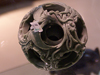
A multi-layered, sphere-shaped artifact from China, made from jade, with on the outside reliefs depicting a dragon and a phoenix, originally the symbols of the male and female aspects of imperial power, i.e. the Emperor and the Empress respectively. The ball has 12 holes, representing the 12 months of the year, and consists of between 3 to 13 independent layers, each layer representing one generation. It is carved (fig.) from a monolithic block of jade (fig.), in such a way that each layer can be moved separately, symbolizing eternal survival. It was originally found only in the Imperial Palace and in the homes of high officials, but is nowadays more widely distributed (fig.). The Family Ball is believed to bless the family with happiness, harmony and good luck, all year round. It is also referred to as Chinese Family Ball, Happiness Ball (fig.), Generation Ball (fig.), and Lucky Ball. 回
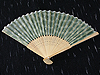
An implement used since antiquity to either induce an airflow for the purpose of cooling oneself or to ward off insects, or to conceal ones face or a weapon, to signal someone, or one specific oriental folding fan known as the tessen or iron fan, even as a weapon. There are many kinds of oriental fans such as the folding fan, the fixed leaf fan or screen fan, etc. In ancient Japan, folding fans were often made with plain paper and were used to write remarks on, as a kind of early notebook, that was carried along always and could be checked at any given time. Most fans are handheld but some may be attached to the ceiling and moved by pulling strings, others may be placed on a stick and moved by turning the stick around manually. The folding fan was invented in Japan in the 8th century and taken to China in the 9th century (fig.). In Thai, their generic name is pad and their name may be specified after the material or fabrics they are made of, e.g. pad bai laan (fig.), a fan made of the leaf (bai) of a certain species of palm (laan). But they may also be named after their purpose, e.g. pad yot (fig.), literally ‘fan of rank’, a fan used in certain religious and royal ceremonies (fig.). They can be made of silk, bamboo, palm leaves, paper (kradaat sah), feathers, etc. and are often beautifully decorated. In the past there even was a fan made of steel which was used as a weapon in ancient oriental warfare and on which a certain style of tai chi chuan (fig.) is based. Folding fans are also very popular in several oriental dances as well as in ngiw, Chinese opera. In Chinese a fan is called shàn (扇), a word that sounds the same as the Chinese word for ‘good’ or ‘merit’ (善), and is thus regarded as a symbol for perfection. Bo Sang district in the amphur San Kamphaeng of Chiang Mai province is Thailand's largest producer of traditional folding fans. See also padwaanlawichanie, talapat and pad daam jiw. 回
Thai-Pali. Name of a Luang Poo and Phra Mahathera Theravada Buddhist monk in the Thai Forest Tradition. READ ON. 回 Chinese. ‘Square hole coin’. Name for ancient Chinese coins with a round shape and a square hole in the middle. They are cast rather than stamped and made from copper, brass or iron. The shape is symbolic with the round outside representing Heaven and the square hole in the centre representing Earth or the country China, referring to guo (国), the Chinese character for ‘country’, that equally is surrounded by a square. Different kinds of this type of coin were used in China between the 2nd Century BC and 20th Century AD. The hole enables the coins to be strung together to create a higher value and for easy transportation. This practice continues still today with yasui qian (fig.), worn for protection against sickness and death. It can often be seen in iconography as an attribute of Chinese wealth gods and other deities (fig.), including the informal wealth god Liu Hai (fig.) and his personal pet, the three-legged moon toad Chanchu, which is typically depicted with such a coin in its mouth (fig.) and is a Chinese symbol for good fortune in its own right. See also yin-yang and compare with satang roo, ancient Siamese coins (fig.). 回
Name for the Chinese god of business, who is also a civilian Chinese wealth god. READ ON. 回 Descriptive umbrella term that can refer to any of several different kinds of palms in various genera, such as the Chinese Fan Palm (Livistona chinensis), the Bamboo Palm (Rhapis excelsa - fig.), the Thai Talipot Palm (Corypha lecomtei - fig.), and the Ruffled Fan Palm (Licuala grandis - fig.), among many others. They usually have almost circular or semicircular leaves that are radially formed, somewhat like an folding fan, hence the name. 回
1. Thai term for any Caucasian or white foreigner, who the local Thai people usually observe with an amused interest and tolerance. The term is derived from the Thai word farangset, meaning ‘Français’ or ‘French’ and was initially used some 400 years ago, during the Ayutthaya Period when the country -then called Siam- was first confronted with foreign explorers from Europe, many of them French. Although the term sounds rather xenophobic and is used partially due to the nationalistic mindset of the Thai people, there is in fact no insult intended, even if there are more official and refined words to describe foreigners, such as ‘khon/chao tahng chaht’ (คน/ชาวต่างชาติ) and ‘khon/chao tahng phrathet’ (คน/ชาวต่างประเทศ), words with a wider meaning as they refer to all foreign people, irrespective of race. Whereas the word ‘farang’ is commonly used for Caucasian people, the word ‘kaek’ (แขก) refers to people of Indian descent and means ‘guest’ or ‘visitor’, and the terms ‘khon piw dam’ (คนผิวดำ) and ‘khon negro’ (คนนิโกร) refer to people with a dark skin. Furthermore, the Vietnamese are referred to as Yuan (ญวน) and the Cambodians as Kmen (เขมร), the Thai pronunciation of Khmer. May also be transcribed Farang, with a capital letter or falang, with an ‘l’ - due to a mispronunciation of the ‘r’. In compound words it may also be translated as western or foreign, e.g. nok yoong farang. The usage is hence on a par with terms found in other languages and cultures to distinguish racial differences or to discern between natives and outsiders, such as Mukiwa in the Shona language of Zimbabwe, which means ‘White Boy’ and is used to refer to Caucasians in Africa; and Goyim (גויים) in Hebrew, used to refer to non-Jews. See also farang kee nok and huan. 回 2. Thai for the Psidium guajava, popularly known as guava (fig.). This is due to the fact over 400 years ago the guava was brought to Thailand, then Siam, by Portuguese traders. The fruit was thus called the farang fruit, i.e. the ‘fruit of the Caucasian foreigner’. See also farang chae buay and farang kee nok. 回
farang chae buay (ฝรั่งแช่บ๊วย) Thai. ‘Green syrup-soaked guava’. Name for a sweet and crisp fruit snack that consists of a full-sized guava which is preserved by soaking (chae) it in bright green syrup. The syrup colours the fruit bright green. Its also has a red variant which is soaked in strawberry flavoured syrup and is called farang chae strawberry (fig.), as well as a variety called farang chae krajiab which is soaked in syrup made from roselle. It is typically eaten with a fine mixture of sugar and buay powder. See also chae im. 回
farang chae krajiab (ฝรั่งแช่กระเจี๊ยบ) Thai. A guava soaked in a roselle based syrup. See also farang chae buay. 回 Thai. A variety of guava known in English as the pineapple guava or guavasteen. It is also known as feijoa, from its scientific name Feijoa sellowiana, which itself derives from João da Silva Feijó, the name of a Brazilian botanist. This ellipsoid-shaped fruit is small in size, especially if compared to the normal guava (psidium guajava). It is not much bigger than the size of a chicken egg and when ripe, it cannot be maintained in good condition for any lengthy period. Therefore and due to the fact that there isn't much flesh to it, its Thai name farang kee nok, meaning ‘bird shit guava’, indicates that the fruit is by most Thais regarded as rather worthless or unbeneficial. Because in Thai the word farang means both ‘guava’ and ‘foreigner of Caucasian origin’, the term farang kee nok over time became a slang expression, though mainly used by parasitic exploiters and profiteers, to indicate certain foreigners who are regarded as poor or stingy, i.e. of whom one cannot profit. 回 Thai term for Français or French. From which the shortened word farang is derived, a general name for Caucasian or white foreigners. 回 Name of the (type of) aircraft, i.e. a 1910 Farman bi-plane, that in January 1911 carried out the first powered flight in Thailand, operated by the Belgian pilot Charles Van den Born (fig.) at Sanam Bin Sra Pathum (fig.), located on the grounds of the Royal Bangkok Sports Club in Bangkok. The same plane was later, on the afternoon of 18 March 1911, also used to make the first powered flight in Hong Kong. The airplane is named after Henri and Maurice Farman, two brothers of French-British nationality, who besides being aviators themselves, also designed and manufactured aircraft, in their aeronautic enterprise Farman Aviation Works, which between 1908 and 1941 built more than 200 types of aircraft. 回
A fountain used for ritual ablutions in a mosque. 回 See Barking Deer. 回 See Barking Deer. 回 See farang kee nok. 回 Chinese for ‘wasp’, ‘bee’ or ‘bumblebee’. It has the same sound and tone as the word feng which means ‘abundant’ or ‘plentiful’, but is written with a different character. Hence wasps and bees are regarded a symbol for abundance. In addition, bees are well-known for their production of beeswax and honey, as well as for their role in pollination (fig.), which is crucial for the survival of many flowers, fruit trees and crop plants. Wild bees often appear in nest-like structures, i.e. a colony of large numbers of bees, crawling over each other (fig.), like a living nest (fig.). These groups of bees are usually found, hanging high-up in trees or from house roofs. They appear out of the blue and in no time form a living cluster of bees, as seen in the picture. After a while they depart, leaving behind a honeycomb, i.e. a yellowish white, wax structure, which is produced by the bee's sweat and which has the same outline as that cluster of living bees had before (fig.). Certain honeybees, such as Apis dorsata, are known to create waves on the surface of these living nests. This behaviour, known as defense waving or shimmering, is a defence against predators, such as wasps, and is created by bees in the outer layer that thrust their abdomens 90° in an upward direction and shake them in a synchronous way, often accompanied by stroking of the wings, thus creating a visible and audible ripple effect across the face of the comb that serves to confuse and repel wasps that get too close to the nest. In Thai, bees (fig.) are called pheung and wasps toh or taen, but names are often mixed up or used indiscriminate. Bees differ from wasps (fig.) by the fact that they have hair and wax producing glands, unlike wasps and hornets. Because of this, wasps either live solitary, in burrows excavated in the soil or plant stems, or in social groups. There are many kinds of bees and wasps, in a variety of colours and sizes, including a black-and-blue species, known as the Neon Cuckoo Bee (fig.) and in Thai referred to as pheung sih fah (ผึ้งสีฟ้า), i.e. ‘light blue bee’. The (Red) Dwarf Honey Bee (Apis florea) is a small and commonly found species of honey bee in South and Southeast Asia, and the Greater Banded Hornet (Vespa tropica) is the most aggressive and dangerous wasp in Asia. Stingless Bees (Trigona laeviceps), known in Thai as chanrohng, create nests from mud (fig.), making a tubular entrance to their nest (fig.), a feature somewhat reminiscent of the nests of Organ Pipe Mud Daubers. Blastophaga wasps make their nests in figs, whilst others produce paper pulp nests (fig.) from a substance primarily made from wood fibers, which they soften by chewing, mix with saliva and consequently use to make combs with cells, typically in sheltered areas (fig.). In some parts of Thailand, the larvae of bees and wasps are fried, usually when still in the honeycomb, and eaten as a delicacy (fig.). In 2000, Thailand Post issued a set of four postage stamps with different bees, featuring the species Apis cerana, Apis dorsata, Apis florea, and Apis andreniformis (fig.). In India, the Yellow Paper Wasp is responsible for a number of deaths per year, whilst in temperate and tropical Eastern Asia, the sting of the Asian Giant Hornet, the world's largest hornet, regularly causes fatalities. See also TRAVEL PICTURE. 回
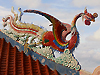
Chinese for ‘abundant’ or ‘plentiful’. See also feng. 回 Name of a place that represents You Dou (幽都), literally ‘Entirely Dark’ or ‘Entirely Quiet’, or ‒if pronounced You Du, ‘Dark Capital’, the capital of Diyu, the Underworld or Hell, i.e. the realm of the dead. It is located on Ming Mountain (fig.) on the north bank of the Yangtze River (fig.) in China. READ ON. 回 Chinese name for a kind of a mythical bird similar to a phoenix. Fenghuang is actually a compound word, comparable to kilen. The prefix feng refers to a male species whereas the suffix huang refers to the female. Both have become blurred into a single entity with no distinction of gender, having both male and female connotations. It is a composition of many birds and is often portrayed with the head of a golden pheasant, a short hooked beak like that of a parrot, the body of a mandarin duck, the legs of a crane bird, the tail of a peacock and the wings of a swallow. Fenghuang is considered an Immortal Bird and a representation of high merit and grace. It also symbolizes the union of yin and yang, and embodies the five virtues of benevolence, righteousness, propriety, wisdom, and sincerity. It is said to only feed on bamboo seeds and drink spring water, thus not harming a single insect nor a blade of grass. Depicted together with a dragon it is known as longfeng (龙凤) and is a symbol of the Emperor. In this case, the phoenix becomes entirely feminine as the Empress, and together they represent both aspects of imperial power (fig.). In Thailand it is compared to the hongse. WATCH VIDEO. 回
Chinese. ‘Wind Fire Wheel’. Name for is the vehicle of Nezha (fig.), with which he can travel freely through the sky at great speed and that is able to carry him to whichever place he wishes to go. In English, it is referred to as Wheel of Fire (fig.). 回 Chinese. ‘Wind and water’. Natural elements of wind and water used in a geomantic system which determines the orientation of dwellings, cities, and graves in order to harmonize correctly with nature. A dousing rod and astrological compass (luopan) are used for this purpose which is also practiced in contemporary oriental architecture. A typical feature of feng shui in Chinese-style architecture are the upward curved roofs of buildings, as it is believed that curved lines ward off evil spirits, whilst straight lines are said to attract evil (fig.). Besides curved roofs, also many other applications of these principles often occur in Chinese and Vietnamese architectural design, such as zigzag bridges (fig.), like the Nine-cornered Zigzag Bridge near Yu Garden (fig.) in Shanghai; circular Moon Gates (fig.); footpaths with downward curved edges (fig.), like that at the Dinh Tien Hoang Temple (fig.) at Hoa Lu in Ninh Binh; etc. See also trigram. 回 Chinese. ‘To divide a peach’. Vernacular expression for ‘gay’ or ‘homosexual’. The term originates from the story of Mizi Xia, the boyfriend of the ruler of Wei, who one day, when strolling in a peach orchard gave half of a sweet peach to his lover to enjoy. Besides this the peach is the symbol of immortality and eternal live. In Pinyin fēn táo. Other related expressions include long yang, nan feng, duan xiu and nan se. 回 Thai. An obsolete Thai monetary unit with a value equivalent to about twelve satang. It is still found on old coins and stamps. 回
Thai name for bougainville. Also ton tarut jien. 回 Thai name for a rake-like tool known as a ‘beater’, used in weaving to push the weft yarn firmly into place. It consists of a wooden frame, with a wide horizontal slat above, which might either have a separate handgrip or otherwise simultaneously serves as the handgrip, and a narrower horizontal slat or bar below. In between and all along the length of both horizontal slats is a comb-like structure of vertical strips of a rigid material, often thin wooden sticks (fig.), through which the warp threads pass. Feum sometimes display nicely carved ornaments and are occasionally used in traditional interior design as wall decoration or as a hanger to display traditional woven cloth (fig.). 回
Latin. Name for a kind of Banyan Tree, a sacred tropical tree, with many aerial roots that develop into additional trunks (fig.). In Hinduism, it is known as the tree under which the god Vishnu was born, and in Buddhism it is the tree to which the Buddha moved to stay, seven days after he had gained Enlightenment. It is therefore often confused with the bodhi tree, the tree under which the Buddha sat at the moment he gained bodhiyan (Enlightenment). Also known as Ficus indica. 回 Latin. Tree of the genus Ficus, with a thick rooted trunk. It belongs to the family of trees with the Thai name krai, and is known in Thai as hi-hee (ไฮฮี), in which the word hi (ไฮ) is an old term for Banyan Tree. 回
Latin. Scientific name for the ‘tree of knowledge’, also known as a bodhi tree due to the narrative of Siddhartha Gautama who sat beneath a Ficus religiosa in Bodh Gaya, to meditate until he gained Enlightenment or bodhiyan, and thus became the Buddha. The leaves of the Ficus religiosa resemble the shape of a lotus, a metaphor for Enlightenment and thus a clear reference. After the original tree was cut in 600 AD, cuttings were replanted wherever Theravada Buddhism was introduced and practiced. In literature often confused with the banyan tree, the tree to which the Buddha moved to stay, seven days after he had gained Enlightenment. 回
See blastophaga wasp. 回 Fine ornamental work made of metal wire, usually gold or silver. It is typically used in Burmese temple cloths, often made in relief using kapok as a filling. In Burmese, this kind of heavily embroidered appliqué tapestry is known as kalaga and shwe gyi do. 回
A department that originated from the Department of the Ten Artisan Groups and was established on 27 March 1911 by King Vajiravudh. It is responsible for the protection, conservation and stimulation of Thailand's arts and culture, in order to preserve the national identity, as well as for maintaining the practices and traditions of the royal and state ceremonies. Its duties also include the creation, transmission and spreading of the country's artistic and cultural heritage. In Thai, it is known as krom silpakon and it has closely relations with the Silpakorn University (fig.). Its offices in Bangkok are located on the grounds of the former Wang Nah, i.e. the Front Palace, adjacent to the university. Near the main entrance is a statue of Phra Itsanukam (fig.), the patron god of the arts. In 2011, on the 100th Anniversary of the Fine Arts Department, a postage stamp was issued to commemorate the centenary of its establishment (fig.). See also Royal Society and MAP. 回
See som-oh meua. 回 Architectural term for a spire, in Thai called monkut (crown), which refers to the ornament placed on top of a stupa, tower or dome. Also found on the covers of some vessels. 回 See Variable Squirrel. 回 Firearms Association of Thailand Association that imports, sells and distributes firearms and ammunition in Thailand, where private possession of handguns, i.e. pistols and revolvers, is legally permitted under license to both Thai nationals and expats living in the Kingdom. A firearm license can be obtained after the applicant, who must be at least 20 years of age, has given fingerprints, passed a background check, and has provided proof of a genuine reason to possess a firearm, such as sports shooting or starting a gun collection, while foreigners will also need to fulfill some extra requirements, such as a Thai house registration. Thailand also has a National Shooting Sport Association, which is under Royal Patronage. 回
See kong dap phleung. 回 See prathat fai. 回 Name of an acupressure technique used in traditional Chinese medicine. READ ON. 回 Common name for a species of Barbet, with the scientific name Psilopogon pyrolophus. Unlike most other species of Barbet, it is not placed in the family Megalaimidae, but in the family Ramphastidae, together with the the Brown Barbet. Adult Fire-tufted Barbet have pale green underparts, with black and yellow breast-bands, and dark green upperparts, with a brownish-maroon crown and nape, which is adorned with a diadem-like, whitish band on the fore-crown. In addition, they have grey ear-coverts with a white edge at the bottom, a thick pale yellowish-green bill, with a dark band, which in some cases might have gaps, and with several red protruding hairs between the bill and the forehead, which is referred to in its Thai name, i.e. nok phrodok nuat daeng, meaning ‘red-moustached barbet’ or ‘red-whiskered barbet’. 回
The supreme primordial Buddha in the Vajrayana sect of Mahayana Budhhism, who created himself from the original void. In true essence this Buddha is abstract, illusionary and inconceivable, and can therefore not be represented in art, unless in his revealed and more earthly forms such as Vajradhara and Vajrasattva, as found in Khmer art, and the various bodhisatvas. Vairochana is considered the Javan Adi-Buddha. Usually depicted in royal attire or in hermaphrodite unity with a consort, a principle in Vajrayana Buddhism known as yabyum. Also Adi-Buddha. 回 See dukkha and Four Noble Truths. 回 Material used to make artifacts, either carved sculptures or ground and moulded in combination with a resin. See also kaang pla thod. 回
See kaangkaeng le. 回 Common name for a medium-sized cat with the scientific names Prionailurus viverrinus and Felis viverrina. It is found from Pakistan and Nepal in the West, to Indonesia in the East, throughout mainland Southeast Asia and including Thailand, where it is called seua pla and seua phaew. Its has an olive-grey fur, with dark spots that are arranged stripe-like along the length of the body, and actually become stripes on the back towards the neck and on the head. It has a brawny tail, which is also dark spotted and about one half of its body length. Like with tigers, the back of its ears are white with a black rim (fig.). It has a pale, almost whitish chin and breast. It is somewhat similar to the Leopard Cat (fig.), but larger and usually with smaller spots and underparts that are less white. Fishing Cats (fig.) are skilled swimmers, dwelling in habitats along waterways and mangrove swamps, where they hunt for fish (fig.), their main prey, next to other aquatic animals, such as frogs, as well as small terrestrial animals, such as rodents, and birds. 回
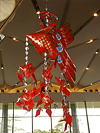
A popular hanging artwork, believed to bring prosperity and made with fish folded from palm leaves called bai lahn, from coloured or painted paper, or sometimes from real banknotes. Whereas mobiles are in Thai generally known as pratimakamjonladoonplah (ประติมากรรมจลดุลปลา), literally ‘kinetic (or trembling) balancing sculpture’, fish mobiles are usually referred to as pla taphian sahn, and those made from palm leaves as pla taphian sahn bai lahn. 回
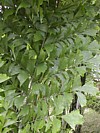
Name for a kind of ornamental palm with the Latin name Caryota mitis. Its spadix (cluster of flowers of a palm) and clusters of fruit resemble that of the areca palm. Its root is used in medicine and its soft inside is eaten, dipped in a condiment or sauce, usually nahm phrik, a sauce made of shrimp paste and chilies. Its leaves resemble a fishtail, hence its name. In Thai called tao rahng. 回
Common name for a species of butterfly in the family Papilionidae, found in South Asia and Southeast Asia. READ ON. 回 Common name for a species of butterfly in the family Nymphalidae, with the scientific designations Limenitis sulpitia and Athyma sulpitia, and also commonly known as Spotted Sergeant. On the upperside, the wings are overall blackish, with a brown tinge, and white bars and spots, with a pale bluish shine. The underside (fig.) is overall brownish-orange with white and some dark markings, most notably a series of black dots at the base of the hindwing. Though this species does occasionally occur in Thailand, it is so rare that it has purportedly been caught only once, in Nan province, and has no Thai common name. See also WILDLIFE PICTURES. 回
Five-flavoured Tea of Forgetfulness Name of a brew in Chinese-Taoist mythology, which is made from various herbs by Meng Po (fig.), the Lady of Forgetfulness, who serves in Diyu, the realm of the dead (fig.). She gives her tea to each soul that is ready to be reincarnated. It causes instant and permanent loss of memory, thus ensuring that they do not remember their previous life nor their atonement in hell. See also cha. 回
Emanations and representations of the five qualities of the Adi-Buddha. See also dhyani buddha. 回 See kwahng ha khao. 回 Common name for a tuberous climbing plant, with the botanical name Gloriosa superba. It bears attractive, solitary, greenish-yellow to orange-red flowers, with six wavy-edged petals (fig.). The plant has some medicinal value and, though described as highly toxic, the root is used to treat acute gout and some other ailments. Also commonly known as Fire Lily, Gloriosa or Glory Lily, Superb Lily, and Climbing or Creeping Lily. In Thai, it is called dong deung (ดองดึง). 回
See reusi phasom laew. 回 Common name for a species of tree in the pea family Fabaceae, with the botanical designation Delonix regia and placed in the genus Delonix. It was previously listed in a genus called Poinciana, and is hence also known as Royal Poinciana. Due to its flamboyant display of red flowers it is in addition also commonly known as Flamboyant, Flame of the Forest, and Red Flame. It is a popular ornamental tree, prized for its large, attractive flowers, which have four spreading red petals and a fifth, slightly larger upright petal, which is white with a pale yellow base and spotted with red, and somewhat reminiscent of certain orchids. The seed pods are bright green, but turn dark brown as they ripen (fig.). They grow up to 60 centimeters long and are about 5 centimeters wide, but rather thin, almost flat. The leaves are fern-like (pinnate) and bright to dark green. Although rare in the wild, it is widely cultivated and found throughout the nation, especially along the sides of highways and roads. In Thai, it is known as haang nok yoong farang or simply nok yoong farang, which translates as ‘foreign peacock tail’ and ‘foreign peacock’, respectively. The Flame Tree is the mascot of the Thammasat University. 回
1. Common name of a flowering tree in the family Bignoniaceae and with the botanical designation Spathodea campanulata, and also commonly known as the Fountain Tree, among several other names. The tree grows between 7 to 25 meters tall and bears large fluffy orange flowers that grow between 8 to 15 centimeters tall, and which are attractive to Spiderhunters, such as the Spectacled Spiderhunter (fig.) and the Grey-breasted Spiderhunter (fig.), that with their long, downward-curved bills can easily reach the nectar buried deep in these large flowers. In Thai, it is called khae saed (แคแสด). 回
2. Another name for the Tiger Claw, a tree with the botanical name Butea monosperma (fig.). 回 3. Another name for the New Guinea Creeper, a vine with the botanical name Mucuna bennetti. 回 4. Another name for the Flame Tree, a tree with the botanical name Delonix regia (fig.). 回 A species of perennial plant, with the botanical name Anthurium andraeanum. It grows to about 60 centimetres high and has large, hearth-shaped leaves. The plant produces just one to two flowers, but they bloom all year round and they are much-liked for their large colourful spathe, which is usually bright red, though other colours have been cultivated, including pink, and species with green flowers marbled with red. From the centre of the spathe, sprouts a fleshy axis, called a spadix, which contains the actual flowers, that are crowded on this spike inflorescence, and with bright red spathes they are often yellow in colour, yet −as with the spathes− their colour is variable and can be modified. This plant is also known as Flamingo Flower and Boy Flower, and in Thailand it is called nah hua (หน้าวัว), which translates as ‘cattle face’. The plant is reminiscent of certain species of Spathiphyllum, a plant in the same family which also produces flowers in a spadix, yet with a either white, yellowish, or greenish spathe, and with ovate leaves. 回
Object often found in Chinese iconography, but of which the origin is non liquet, i.e. unclear. It is often depicted with Chinese dragons, regularly in the form of two dragons that are facing one another, usually in the air, with a flaming pearl in between them (fig.). It originally was –and sometimes still is– depicted as a disc engulfed in flames (fig.), and is said by some to represent the sun, as in Chinese mythology the dragon was believed to chase the sun. The disc over time gradually changed into a red ball and later in to a flaming pearl, of which the latter became associated with a gem, especially the wishing gem or chintamani (fig.) known in Mahayana Buddhism, and is often described as one and the same thing. Since the Chinese dragon is a also the symbol of the Emperor and of imperial power (fig.), the dragons flanking the flaming pearl may symbolize either the pursue of wisdom, or Imperial protection of it, i.e. with the flame representing wisdom or Enlightenment and the dragons the might of the Emperor. The circular shape may in Buddhism additionally refer to the dhamma, as in the dhammachakka (fig.). Although originally a symbol of wealth, the wishing jewel in Buddhism usually symbolizes spiritual wealth, i.e. Enlightenment. It therefore often occurs on a lotus flower base or pedestal (fig.) and sometimes on top of three jewels, that represent the Trairat or Triple Gem (fig.). Besides this, pearls are also understood to represent wealth, good luck, and prosperity, and some scholars have suggested that the Chinese dragon with a flaming pearl might in the past have been a special indicator of imperial rank. It is said to symbolize wisdom and to have the power to multiply whatever it touches. 回
Common name for an ornamental plant with orangey to red flowers, that is commonly named for its showy bracts. It has the Latin botanical name Vriesea splendens and is in Thai known as ton dahb sethi, literally ‘millionaire's sword plant’, named for the rich colours of its exotic flowers. Since it belongs to the family Bromeliaceae, it is also called Flaming Sword Bromeliad and with the botanical designation as Bromeliad splendens. 回
Common name of a small wild cat found in parts of Southeast Asia, including the Thai-Malay Peninsula, Borneo and Sumatra, and easily distinguished by the extreme depression of the skull, which gave it its name. Above, this cat has a reddish-brown head, with rounded ears and a face that is lighter in colour than the body, whilst the muzzle, chin and underbelly are white. Two prominent whitish streaks run on either side of the nose, between the large eyes, that –compared with other cats– are unusually far forward and close together, giving the animal enhanced stereoscopic vision. The body is greyish-brown above, and the fairly short legs are of a similar background colour, but with blackish, horizontal, stripe-like marks on the upper side. The Flat-headed Cat is known by the scientific designation Prionailurus planiceps and it is listed as an endangered species, with an estimated population of less than 2,500 mature animals. As such, it occurs on a Thai postage stamp issued in 2011, as part of a set on wild cats (fig.), in an effort to promote awareness for this vulnerable animal, as well as for wildlife conservation in general. 回 Common name for kind of house gecko, with the scientific names Cosymbotus platyurus and Hemidactylus platyurus, and which is found in many subtropical and tropical places of Asia. It grows up to 12.5 centimeters long and though its colouration varies greatly, it can easily be recognized by its flattened tail, the webbing at the base of the toes, and the fringe of skin along the body. Also known as Flat-tailed House Gecko. In Thai, this species is called jingjok baan haang baen (จิ้งจกบ้านหางแบน). 回
See talaat nahm. 回 A species of hard branching coral with the scientific name Acropora aspera. READ ON. 回 See Hmong Lenh. 回 See Pahk Khlong Talaat. 回 A geometrical figure, that is composed of multiple evenly-spaced, overlapping circles of the same diameter, that are arranged in a six-fold symmetry, with the centre of each circle being on the border of six surrounding circles, creating a flower-like pattern. READ ON. 回 See pa-kahrang. 回 Name an iconographic theme of four flowers used in Oriental art, often as architectural decorations, to depict the unfolding of the four seasons through the year, as flower represents one of the four seasons, i.e. the plum or apricot blossom for winter, the orchid for spring, the lotus for summer, and the chrysanthemum for autumn. As such, they contain three of the elements of the Four Sacred Symbols, which are also referred to as the Four Seasons and Four Sacred Symbols, or vice versa, the Four Gentlemen, and the Four Noble Ones. 回 Common name for a species of small butterfly, found on the Indian subcontinent and known by a variety of scientific designations, such as Zeltus etolus, Zeltus amasa, Hypolycaena amasa, etc. The upper side of the forewings are of a blue colour that merges into dark blue, almost black, towards the apexes. The underside of the forewings are pale at the base and become gradually dark brownish to orange towards the apex, and have a black spot near the centre, as well as some broken dark lines across the wing. The colouring and pattern on the underside of the hind wings is very similar to that on the forewings, but paler pale at the base, while the upper side of the frontal hind wings is white with a bluish shine towards the apex, which is dark blue, almost black, whereas the lower part of the hind wing is mostly white. This butterfly also has two white trailers on each hind wing, i.e. a long one and a short one. 回
Fo Guang Shan Thai Hua Si (佛光山泰華寺, โฝวกวงซันไท่หัวซื่อ, ฝอกวงซันไท่หัวซื่อ) Chinese name for a Thai-Chinese Mahayana Buddhist temple in Bangkok. READ ON. 回 1. Thai. ‘Shredded gold’ or ‘fluffy gold’. Name of a kind of kanom thai sweet (fig.), also nicknamed ‘angel hair’. It can be soft or crispy, the latter being called foi thong krob (ฝอยทองกรอบ), i.e. ‘crispy angel hair’. 回 2. Thai. ‘Shredded gold’ or ‘fluffy gold’. Nickname for a parasitic creeper known by the common name Southern Asian Dodder or Giant Dodder. 回 An ornament carved or painted in a leaf design. 回 Name for a group of lichen, whose members grow in flat, two-dimensional, leaf-like lobes. Though the growth forms are grouped in nine categories, there are three main types of lichens and foliose is one of these main types, the other main two being crustose and fruticose. Whereas crustose are made up of crust-like structures that adhere tightly to a surface, fruticose have leafless branches, some of which grow like a multiple-branched tuft or as a leafless mini-shrub. 回 Thai. ‘Sword Dance’. Name of a northern style dance from Chiang Mai in which the dancer handles minimum two and often several swords simultaneously, showing the pride in the former martial art and defense of Lan Na. It is often learned from a very young age (fig.). See also TRAVEL PICTURES (1), (2) and (3). 回
Fon Nok Kingkarah (ฟ้อนนกกิ่งกะหร่า) Thai name for the northern Thai-Lan Na style Kinnari Bird Dance, which originally comes from Myanmar. Whereas Nok is Thai for ‘Bird’, Kingkarah is a Shan or Tai Yai (fig.) word for ‘Kinnari’, i.e. a mythical creature that is half-bird half-woman. The dance is sometimes incorrectly referred to as Peacock Dance. WATCH VIDEO. 回
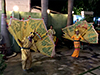
Thai. ‘Fingernail Dance’. Name of a northern style dance from Chiang Mai in which the dancers wear eight lep, aluminum finger pieces, allegedly as a replacement for the candles that are sometimes used. Sometimes these long fingernails are adorned with red pompoms, a possible representation of the flame with a candle. Sometimes transcribed Fawn Lep. 回
Thai. ‘Pararsol Dance’. Name of a traditional northern style dance in which the dancers perform while handling an umbrella or parasol. Since it originates from the northern region of Thailand that was previously known as Lan Na, this style of dance is also referred to as Fon Rom Lan Na. 回
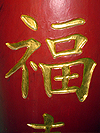
Fon Rom Lan Na (ฟ้อนร่มล้านนา) Thai. ‘Lan Na Pararsol Dance’. Name of a traditional northern style dance in which the dancers perform while handling an umbrella or parasol (fig.). It is named after the region where it originated, i.e. Lan Na. In short referred to as Fon Rom. 回 Chinese. ‘Blessing’, ‘good luck’ and ‘happiness’, especially with regards to material benefits. Foo is one of the most popular Chinese characters and is used in Chinese New Year or Trut Jihn. It regularly appears as an imprint or as an inscription on Chinese temples and in art, or as a jewel (fig.). It is often written or printed in gold on a red background, as in China the colour red itself is a symbol for good luck, as well as for health, happiness, harmony, peace and prosperity, whereas the colour gold refers to both completeness and wealth. It is also often portrayed upside-down (fig.), or posted the wrong side up on the front door of a house or an apartment. This is done to invite good luck to come, since the last two characters of dao guo lai (倒过来), which means ‘upside-down’, are the same (过来) as those used to say ‘to come over’ or ‘to come up’. This method is used in the same manner as the law of attraction, hoping that by posting it in this way, it will in fact attract good luck (fig.). Foo is also one of the Three Star Gods, Hok Lok Siw or Fu Lu Shou, and is often worshipped as an informal Chinese wealth god called Chai Sing Ihya (fig.). The word fu also has a sound loan word meaning ‘bat’, the mouse-like nocturnal flying mammal. Therefore also the bat has become a symbol for good luck and often appears in Chinese iconography (fig.) as well as in Chinese art (fig.). Also transcribed fu and in Cantonese pronounced fuk. The Chinese name of the coastal province of Fujian (福建) in eastern China begins with the character fu (foo) and translates as ‘Establishing Good Luck’ or ‘Founding Happiness’. See also sang-i, fu and bat. 回
See golden lotus. 回 The Forbidden Palace, i.e. the Chinese imperial palace of the Ming (1368–1644) and Qing (1644–1912) Dynasties in Beijing. READ ON. 回 See king kah kaew. 回 Common name for a species of small butterfly in the family Lycaenidae, i.e the so-called Blues. It is found on the Indian subcontinent, as well as in Sri Lanka, Indochina, Indonesia, and the Philippines. Above its wings are pale violet, with a bluish-silvery shine, while below the wings are a pale dull greyish-brown. On the hindwings it has a black tail tipped with some white, and small but prominent black spots on both the underside and upperside, with those of the underside being faintly edged by orange, similar to common eyespots (fig.). It has a wingspan of only 25 to 30 millimeters, and the scientific designation Catachrysops strabo. See also WILDLIFE PICTURES (1) (2). 回
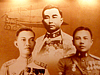
Fort Canning Park is an iconic hilltop landmark that has witnessed many of Singapore’s historical milestones. READ ON. 回 Name of a military conflict fought from 1385 to 1424 AD between the Kingdom of Ava, ruled by King Minkhaung I, and the Kingdom of Hongsawadih controlled by King Razadarit. READ ON. 回 Founding Fathers of the Royal Thai Air Force Three Thai Army officers (fig.), who took in 1912 an aviation course in France, i.e. Army Major Luang Sakdi Sanyawut (fig.), Army Captain Luang Ahwut Sikhikorn (fig.) and Army Lieutenant Thip Ketuthat (fig.). Whereas Maj. Luang Sakdi received his training at Villacoublay (fig.), a military air base near Paris, and learned to fly in a Breguet Type III biplane (fig.), both Capt. Luang Ahwut and Lt. Thip were trained at Mourmelon-le-Grand (fig.), a military airfield in northern France, flying in Nieuport 11 trainer monoplanes (fig.). Afterward, they received proper Air Force ranks and were promoted to Air Marshal and Group Captain respectively, while all were in addition bestowed with the title of Phraya. The pioneer trio is also referred to as the Parents of the Royal Thai Air Force. 回
Another name for the Flame of the Forest. 回 Name for he four powerful animals, which represent the sacred qualities and attitudes that bodhisattvas develop on the path to Enlightenment. These animals and their qualities are the Garuda, representing confidence; the sky dragon, which stands for awareness; the snowlion, that represents fearlessness; and the tiger, which symbolizes gentle power. They often adorn the corners of Buddhist prayer flags. 回
The four sights encountered by Prince Siddhartha which made him renounce his royal life and become an ascetic. In Theravada Buddhism these are an old man, a sick man, a dead body and a mendicant ascetic who went around begging without any form of attachment or hate, and with inner peace. Attracted by the qualities of this monk and the condition of the three others Siddhartha eventually exchanges his princely life for a religious one. Often depicted in temple decorations. See also samsara. Also known as Four Sights (fig.) and in Thai named thevathut sih. 回
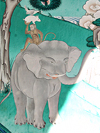
See Four Sacred Symbols. 回 Popular Tibetan folktale about an elephant, a monkey, a rabbit, and a bird (sometimes said to be a partridge), that congregated at a tree. One version relates that these four animals lived in a valley, where times had been quite turbulent, with quarrelling inhabitants that did not respect each other. The four animals then gathered at a fruit tree to decide what could be done, and concluded that a peaceful, harmonious society is one that respects its elders. It was determined that the bird was eldest, then the rabbit, followed by the monkey and that the elephant was youngest. The animals are hence portrayed supporting one another, with the eldest on top and the youngest below (fig.). Another version relates that the animals themselves actually had a discussion about who first discovered the tree. The elephant was resting in the trees shade, but it had no fruits, since the monkey already ate them. Then, the rabbit said it already knew the tree since it was just a sapling with only a few branches, but the bird interrupted and said the tree actually came forth from a seed it had spit out after eating a fruit. Hence, it was established that the bird knew the tree first, but rather than claiming the tree for one, the animals decided to share the tree together in peaceful harmony, enjoying the beauty of the tree's fragrance, the nourishment of its fruits, and the bounty of its shade. Hence, the representation of an elephant, a monkey, a rabbit and a bird on top of each other, has become the Tibetan symbol for peace and harmony, and can often be found in Tibetan iconography. In Chinese, known as Si He Xiang (四合象), which loosely translates as ‘Four-Combination-Elephant’ or ‘Four-United-Image’ (fig.). 回
See Si Tian Wang. 回 Four different animals, deemed auspicious and worshipped in Vietnam, and each representing a cardinal direction, i.e. the dragon for the East, the kilen for the West, the turtle for the North, and the phoenix for the South. In Vietnamese known as Tu Thanh Thu (Tứ Thánh Thú). They are also referred to as the Four Holy Beasts and are the Vietnamese equivalents of the Chinese Four Benevolent Animals or Four Auspicious Animals, also referred to as the Four Guardians of the Four Compass Directions and the Celestial Emblems of the Chinese Emperor, and in Chinese called Si Shou (四獸), i.e. the ‘Four Beasts’. 回
Four chief cult figures in the pantheon of guardian spirits worshipped in Vietnam, especially by the people of the Red River Delta region, and which emerged since the Le Dynasty, which was founded in 980 AD by Dai Co Viet Emperor Le Hoan (fig.). They are the child-giant Thanh Giong (fig.); Son Tinh (Sơn Tinh); the sage Chu Dong Tu (Chử Đồng Tử); and the princess Lieu Hanh (Liễu Hạnh). Together the four are known in Vietnamese as Tu Bat Tu (Tứ Bất Tử). 回 See Four Sacred Symbols. 回 The fundamentals of Buddhism as taught by the Buddha. The first noble truth is the recognition that suffering exists; secondly, that suffering is caused by the craving for and clinging to that which is pleasant; thirdly, that after discovering the origin of suffering one can put an end to it; and fourthly, that this can be done by following the Eightfold Path. 回 An iconographic theme of four botanical symbols used in Oriental art, often as architectural decorations, to depict the unfolding of the four seasons through the year, as each symbol represents one of the four different seasons, i.e. the plum or apricot blossom for winter, the orchid for spring, bamboo for summer, and the chrysanthemum for autumn. It is also referred to as the Four Seasons or as the Four Seasons and Four Sacred Symbols, or vice versa, the Four Gentlemen or the Four Noble Ones, yet should not to be confused with the Flowers of the Four Seasons. 回 An iconographic theme of four botanical symbols used in Oriental art, often as architectural decorations, to depict the unfolding of the four seasons through the year. See also Four Sacred Symbols and Flowers of the Four Seasons. 回 In ancient Hindu beliefs, the human life is divided into four stages, known as the four ashram, i.e. Brahmacharya, the celibate stage, which is spent in controlled, sober and pure contemplation under a guru, building up the intellect for the realization of truth, as well as in pursuing education in sciences, arts and the scriptures; Gruhastha or Grihastha, the married or householder's stage, in which one marries and satisfies kama, and develops a professional career; Vanaprastha, the retirement stage, with a gradual detachment from the material world, ostensibly giving over duties to one's offspring and spending more time in contemplation of the Divine; and Sannyas or Sanyasa, the recluse stage, in which one goes into seclusion to find the Divine through detachment from worldly life, and finally, peacefully sheds the body for samsara, that is the transmigration of the soul by means of reincarnation, or for nirvana, i.e. liberation. 回 Four Chinese mythological creatures, each associated with a compass direction and a seasonal division, namely the Azure Dragon of the East for Spring, the Black Tortoise of the North for Winter, the White Tiger of the West for Fall, and the Vermilion Bird of the South for Summer. Each one contains seven mansions and they together make up the Twenty-eight Lunar Mansions, i.e. the 28 constellations that are situated along the moon's path of rotation around the earth, and which are significant as divisions of the heavens and of time. See also Four Holy Animals and Four Sacred Symbols. 回 Ritual in which the outcome of certain events are interpreted by reading the bones of a fowl. READ ON. 回 Common name for an up to 10 meter tall palm tree with the botanical designation Wodyetia bifurcata. It has 2 to 3 meter long plumose leaves that resemble the tail of a fox and hence gave it its name. This palm has a grey trunk and produces large orange fruits. This tall and attractive palm is often found as an ornamental tree in parks and gardens. Its Thai name, palm hahng mah jing jok, is a translation of the English. 回
A military conflict between France and Siam, that arose when the French furthered their interests in French Indochina, especially when expanding their territory by bringing Laos under French rule. The Siamese government, who refused to give up territory East of the Mekhong River, reinforced their military presence in the region and when in September 1892 some French merchants were expelled from the area, France used it as a pretext to send their troops into the disputed region, to assert French control. When they arrived by April 1893, some small Siamese garrisons withdrew, though others resisted and when on 5 June 1893, the Siamese organized an ambush on a village in southern Laos, it resulted in the killing of a French police inspector, who was also the commander of a Vietnamese militia in Laos, of whom some 17 were killed. This incident was used as an excuse for an even stronger French intervention. Thus, the French in July 1893 ordered two their warships to sail up the Chao Phraya River towards Bangkok, without the permission of the Siamese. This led to the Paknam Incident, after which the Siamese submitted fully to the French conditions of an ultimatum that on 3 October 1893 ended the conflict with the Franco-Siamese Treaty, in which the Siamese handed over the disputed territory of the Mekhong and withdrew their troops from the area. The treaty also led to the demilitarization of the Cambodian cities Battambang and Siemreap, as well a 25 km-wide demilitarized zone on the western bank of the Mekhong River. On 26 April 1893, during the rising tensions that led to the conflict the Red Unnahlohm Society of Siam (fig.), i.e. the forerunner of the Thai Red Cross Society (fig.), was founded. It initially only dispatched medical supplies, food and clothing to the soldiers engaged in defending the country, and later in the conflict also aided to alleviate the suffering of the injured. 回 Tree with the Latin name Plumeria acutifolia, named after the seventeenth century French botanist Charles Plumier, who catalogued several tropical species. In total eight kinds are known, mostly deciduous trees and shrubs. It can grow up to nine meters high, but is usually smaller. It has a fairly bare structure and its green pointed leaves are thick, hard and glossy (fig.). Its branches contain a poisonous milky sap and they have scented, usually white or pink flowers (fig.), often with a yellowish centre (fig.), or a combination of those colours (fig.), and five petals (fig.). The flowers flourish before the leaves sprout, although some species are evergreens. Since it is often found at temples it is also called pagoda tree or temple tree (fig.). The flowers are more fragrant at night in order to lure moths to pollinate them, but since they don't produce nectar, they actually trick their pollinators. In Thai, the frangipani tree is called ton lanthom (ต้นลั่นทม) and was imported to Thailand from Cambodia, after the Siamese conquered Nakhon Thom. The name lanthom (ลั่นทม) is said to be a corruption from lanthom (ลั่นธม), a word with a slightly different spelling in Thai. It is composed of the words lan (ลั่น) and thom (ธม), with lan meaning ‘to fire’ (i.e. to pull the trigger of a firearm) and thom referring to the city (or nakhon) Thom. In the South of Thailand the tree is called ton khom (ต้นขอม), literally ‘Khmer tree’. The word lanthom however, sounds like rathom (ระทม), often pronounced lathom by the Thais and meaning to be ‘sore at heart’ or ‘heartbroken’. Hence, many superstitious people would be reluctant to plant the tree near their homes, until it was eventually nicknamed lihlahwadih (ลีลาวดี), what could be translated as ‘to proceed gracefully’. In Indian culture, the frangipani flower is said to represent loyalty and Hindu women put a flower in their hair on the day of their wedding, to express their loyalty to their husband. The frangipani flower is the national flower of Laos. 回
Mural painting in watercolor, or with earth pigments or minerals are applied onto wet lime plaster (fig.). 回 Common name of an impressive small tree, with the botanical name Barringtonia acutangula, which is native to coastal wetlands, from southern Asia to northern Australasia. Other common names include Itchytree and Mango-pine, and in Thai, it is known by a variety of names, including ton jik nahm (ต้นจิกน้ำ) and ton jik india (จิกอินเดีย). It has a low-spreading canopy that becomes covered with drooping bright red flowers growing from pendulous racemes up to 50 cm long, followed by a profusion of four-angled or winged fruits. It is mostly a shrub, but can grow into larger tree. It is mentioned in Buddhism as the tree under which the Buddha sat in deep meditation after his Enlightenment, when Muchalinda, the serpent Naga King, came to protect him against heavy rain by making a cover with its headed, whilst coiling its body under the Buddha (fig.). Therefore, at the Buddha Park in Myanmar's Dekkhinathiri Township of Nay Pyi Taw Territory, Barringtonia acutangula trees have been planted on the shores of Mucalinda Lake, to commemorate the Sixth Buddhist Synod that took place there. There is also Freshwater Mangrove planted on a small island in the lake at the Phetchabura Buddhist Park (fig.), in Phetchabun Province. However, some sources describe the tree under which the Buddha was seated during this event as a Taengwood Tree, a tree with yellow flowers in drooping branched clusters and known in Thai as Teng (เต็ง), but in Isaan as ton jik, which is similar to the Thai name for Freshwater Mangrove. See POSTAGE STAMP and WATCH VIDEO. 回
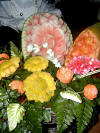
Ornamental frame or decorated strip, often an horizontal band with figures, decorative designs or a decorative pattern. 回 Common name for insects of the superfamily Cercopoidea, that belong the order Hemiptera. READ ON. 回 A species of beetle in the family Chrysomelidae and with the scientific name Sagra femorata. READ ON. 回 Pediment or gable field, like that of a gable board. 回 Concise title, as well as the name of the residence of a Siamese viceroy, fully known as Krom Phra Rachawang Bowon Sathaan Mongkon. See more under its Thai name Wang Nah. 回 A common name used for two very different flies, i.e. vinegar flies on the one hand, which are also known as wine flies or pomace flies, and picture-wing flies on the other. The first kind is the small fly that tends to linger around overripe or rotting fruit and may be found around peeled fruit, salad bars or in the compost bin, while the latter is a larger fly that infests tree fruits. Vinegar flies are mostly 2-4 millimeter small, pale yellow to reddish brown or black flies, with distinctive red eyes (fig.). Their larvae feed on the decay fungi in overripe or rotting fruit or vegetables, in which skin adult female flies lay their eggs. Vinegar flies cause no direct damage to fruit, but can be a nuisance when present in large numbers. They are also widely used in genetics research. Picture-wing flies (fig.), conversely, infest tree fruit and often cause considerable damage. They are larger, almost the size of common house flies, and are easily distinguished from other, similar flies, by the dark pattern or banding of the wings, which gave them their common name. In scientific terms the vinegar flies belong to the family Drosophilidae, whereas the larger picture-wing flies belong to the family Tephritidae. In Thai, members of the first family are referred to as malaeng wih, which means ‘buzzing insect’, whilst members of the latter group are known as malaeng wan ponlamai, which literally means ‘fruit fly’. Worldwide, there are about 1,500 pecies of Drosophilidae fruit fly and about 4,400 known species of Tephritidae fruit fly, some named after the kind of fruit they prefer to feed on. Because there are so many species, many of which are extremely similar, the identification of these fruit flies is very difficult, even for professional identifiers. 回 The art of sculpturing fruit into shapes and reliefs, usually to adorn banquets. It requires the patience and meticulous care of carvers in order to ensure the exquisite beauty of their creation. The carved fruit and vegetables also have to remain fresh and undamaged, so that they can be used as beautiful decorations on the dinner table. Thai women in the past, especially the ladies of the court, had to be trained in this kind of intricate art work. Most commonly, larger fruits are used, such as the watermelon, papaya and pomelo. In Thai, it is called is ponlamai kae salak, and if vegetables are used it is known as pak kae salak (fig.), although often one term is used to refer to both (fig.). Also called fruit sculpting. See also POSTAGE STAMPS. 回
Designation for a complex group of moths, whose members attack many kinds of fruits. They have been recorded to attack over 40 different species of tropical and subtropical fruit in the region. One of the species found in Thailand is the genus Ophiusa coronata, listed in the subfamily Calpinae and in the family Noctuidae, i.e. Owl Moths. It is a rather large species with a wingspan of about 6 centimeters. Adult moths have dark grey-brown forewings with a variety of markings on each wing, including a light or dark coloured elliptical spot near the middle of each wing (fig.), or occasionally just the faint outlines of such a spot but without any obvious colour (fig.), whilst the hindwings are of a pale to bright orange colour with double black bars. It is considered a pest for fruit, as it pierces many kinds of fruit with its proboscis to suck the juice, leaving a hole through which other insects and bacteria can enter, causing the fruit to rot. In Thai Fruit-piercing Moths are called phi seua muan waan. 回
Name for a group of lichen, whose members have leafless branches. Though the growth forms are grouped in nine categories, there are three main types of lichens and fruticose is one of these main types, the other main two being crustose and foliose. Whereas crustose are made up of crust-like structures that adhere tightly to a surface, foliose consist of flat leaf-like structures. Certain fruticose, such as Wolf Lichen (Letharia vulpina) which grows like a multiple-branched tuft or as a leafless mini-shrub, is popular in floral arrangements and is also used as a substitute for foliage and undergrowth to create miniature tree crowns, shrubs and bushes in hobby model building, where it is usually referred to as lichen moss. 回 Chinese ‘bat’. Since the word fú means both ‘bat’ (the mouse-like nocturnal flying mammal) and ‘good luck’, the bat has become a symbol for good luck and bats are thus believed to bring happiness and peace into one's life. It therefore often appears in Chinese iconography as an attribute of mythological figures such as Zhong Kui (fig.) and Hua Ha (fig.), on furniture (fig.), in architecture (fig.) and on artifacts (fig.). When five bats are displayed together they stand for fortune, longevity, good health, love and death of natural causes. See also foo and bat. 回
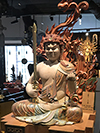
Japanese. Short name for Fudo Myoo. 回 Japanese. ‘Immovable Bright King’ or ‘Immovable Wisdom King’. Name used in Japan for Acalanatha (fig.), i.e. Budong (fig.). In Japan, Fudo Myoo is described as having 8 boy servants (fig.), and according to some sources as many as 48, though he is usually portrayed with just 2 of those boy servants in attendance (fig.), namely Kimkara or Kongara (矜羯羅 - fig.) and Cetaka or Seitaka (制吒迦 - fig.). 回
Chinese name for the Three Star Gods, who are in Thai called Hok Lok Siw (fig.) and in Vietnamese referred to as Phuc Loc Tho (fig.). 回
The oldest Indianized kingdom in Indochina. According to Chinese chronicles, it was founded in the 1st century AD, and the precursor of the Khmer polity of the Chenla Kingdom, by which it was superseded and absorbed in the 6th century AD. Hence, it was also the precursor to Cambodia and the Sailendra claimed that the Funan monarchs were their ancestors. It dominated the valley regions of the Mae Khong and Chao Phya rivers between the 2nd and 6th centuries, exerting strong cultural influences on the area around the Thai Central Plains. Artifacts from this era are on permanent display at the Angkor National Museum in Siem Reap (fig.). 回 Chinese. ‘Buddha's hand’. Name for the fingered citron (fig.), known in Thai as som-oh meua. 回 Chinese. Short for zhan chi fu tou, i.e. the name for the black hat with two short, wing-like flaps of thin, oval shaped boards, worn by feudal officials during the Ming Dynasty, and also known as wu sha mao, as well as for the zhan jiao fu tou, i.e. the black hat with two elongated, horn-like projections, one on each side, as worn by court officials in the Song Dynasty. 回 Chinese. Name of a semi-mythological Chinese emperor, often described as the first of the Three Sovereigns during the Three Sovereigns and the Five Emperors Period of ancient China. READ ON. 回 |
_small.JPG)

%20scabbard,%20knife%20case,%20machete%20sheath_small.jpg)
_small.jpg)
%20ฟักข้าว_small.jpg)
,choco,%20chayote_small.jpg)
_small.jpg)
_small.jpg)
_small.jpg)
%20fang%20kong%20qian_small.jpg)

_small.jpg)
%20green%20syrup-soaked%20guava_small.jpg)

_small.JPG)
_small.jpg)
%20feum_small.jpg)
_small.jpg)


_small.jpg)

%20นกโพระดกหนวดแดง%201_small.JPG)
%20เสือปลา%201_small.jpg)
%201_small.jpg)
%201_small.jpg)
%20Delonix%20regia%201_small.jpg)
_small.jpg)
_small.jpg)
_small.jpg)
_small.jpg)
%201_small.jpg)

%20finger-nail%20dance%20from%20Chiang%20Mai_small.jpg)
_small.jpg)
%201_small.jpg)

_small.jpg)
_small.jpg)
_small.jpg)
_small.jpg)
_small.jpg)

_small.jpg)
