|
haan (ห่าน)
Thai
for ‘goose’, the large aquatic bird with webbed feet and a broad bill with knob,
which flesh is often used as food. In Thai iconography, the mythological
swan
Hamsa,
the mount of
Brahma,
is often depicted as a sacred goose or gander (fig.),
its flight indicating the connection between the
water-world and the heavens.
See also
THEMATIC STREET LIGHT.
回
haang hod (ฮางฮด)
Thai.
Isaan name
for
an
about 6
sok
long, wooden, narrow
and open receptacle (fig.),
used to gather and pour perfumed rain water over the
head, neck and back of Buddhist monks, in a promotion ceremony, known as
kong hod. This
ceremonial,
adorned, trough-like receptacle is
typically cut from tropical hardwood and made in the
form of a
naga, the protector of both the waters and
Buddhism. The water runs through the channel of the
receptacle, from
the tail end down to the head of the naga, where the channel ends in a hole,
under which the monks take place. In the
Northeast, it is also known as
haang song nahm (ฮางสรงน้ำ),
haang lin (ฮางลิน),
and raang rod (รางรด),
and in the North it is called
hin hod nahm, or rod nahm (รดน้ำ).
回
_small.jpg)
haang hong (หางหงส์)
1. Thai for
hang hongse.
回
2. Thai.
‘Swan's tail’. An epithet for the
hibiscus schizopetalus.
回
haang jorakae (หางจระเข้)
Thai. ‘Crocodile's tail’. Thai name for a species of succulent plant with thick,
lance-shaped leaves and with the botanical names Aloe vera and Aloe barbadensis.
READ ON.
回
haang nok yoong farang (หางนกยูงฝรั่ง)
Thai. ‘Foreign peafowl tail’. A name for the
Flame Tree,
besides
nok yoong farang.
回
haan hua laai (ห่านหัวลาย)
Thai. ‘Bar-headed
Goose’.
回
Hadj (الحجّ)
Arabic.
Muslim pilgrimage to
Mecca, known as the
‘third pillar’ of
Islam, which every devout Muslim seeks to make at least once in his lifetime.
After having made this
pilgrimage, Muslim men are allowed to indicate this accomplishment by dyeing their
hair orangey-red using
henna (fig.), as Muslim men aren't allowed to dye their hair
unless they use henna, or by wearing a white
prayer cap called
taqiyah
(fig.).
回
hadsadie (หัสดี)
Thai.
‘Elephant’. See
Asian Elephant. Also
hadsadin.
回
hadsadin (หัสดิน)
Thai. Another name for
hadsadie.
回
hadtie (หัตถี)
Thai. Another word for an elephant, as in
yutthahadtie, war elephant. Compare with
hadsadie.
回
haegun (แฮกึ้น)
Chinese-Thai. Name of a Chinese snack made from pure shrimp and similar to
hoi jaw hong kong.
回
haemorrhagic fever
Name of an tropical fever, transmitted by the mosquito
Aedes aegypti, in
Thai known as
yung laai bahn,
if it is itself infected by the
dengue virus. The
disease is characterized by fever and severe headaches accompanied with a rash and
—in a progressed condition— may cause bleeding from openings in the body. Its name is derived from the Greek words haima (blood) and rhegnumi (burst), due to ruptured blood vessels. In Thai,
it is called
khai leuad awk. Also
spelled hemorrhagic fever and sometimes dengue hemorrhagic fever.
See also
malaria.
回
haew
(แห้ว)
Thai. Official
and original name for the Chinese water chestnut (fig.),
but since the name also means ‘to be disappointed’, it was almost jokingly
changed to
somwang, which literally means ‘to live up
to one's expectation’.
回
hahm samut (ห้ามสมุทร)
See
pahng hahm samut.
回
hahm yaht (ห้ามญาติ)
See
pahng hahm yaht.
回
Hai Chan Zi (海蟾子)
See
Liu Hai.
回
Haimavati (हैमवति)
Sanskrit.
‘Born from the
Himalayas’. One of the benevolent forms of
Devi,
Shiva's consort.
She is also referred to as the daughter of
Himavaan, in Thai
called
Himaphan.
回
Hairy Eggplant
See
makheua poo.
回
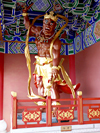
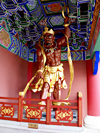
Ha Jiang
(哈将)
Chinese. ‘Yawning General’, ‘Breathing
General’ or ‘Laughing General’. Name
of a muscular, fierce-looking guardian of the Buddha, often found as a door guardian
at
Mahayana
Buddhist and
Taoist
temple entrances across Asia,
including in
China,
Japan and Korea. He is
typically paired with
Heng
Jiang (fig.),
i.e. the ‘Snorting General’,
who is usually placed to the opposite side of Ha Jiang, one facing the other.
Both are said to be manifestations of the
bodhisattva
Vajrapani (fig.).
In
iconography,
they are differentiated by the
fact that General Ha is always depicted with is mouth open, while General Heng
his mouth is closed. Together, they are in Chinese known as Heng Ha Er Jiang (哼哈二将), literally the
‘Two Generals Heng (Groaning) [and] Ha (Yawning)’, though in Japan they are
referred to by the term Ni-Ou (仁王), which is generally transliterated Nio and
translates as ‘Benevolent Rulers’.
See also TRAVEL
PICTURES.
回
Hakka (客家)
1. Hakka-Chinese.
Name of a subgroup of the Han Chinese people who live predominantly in the
Chinese provinces of Guangdong (Kwangtung - 广东 - ‘Spread East’), Jiangxi (江西 -
‘West [of the] River) and Fujian (福建 - ‘Establish
Happiness’). Thailand today has about 8.5 million
ethnic Chinese of which 16% are Hakka. Thaksin Shinawat (ทักษิณ ชินวัตร), Prime
Minister of Thailand from 2001 to 2006, as well as Abhisit Vetchachiva (อภิสิทธิ์
เวชชาชีวะ), since 2005 the leader of the Democrat Party, are both prominent
Hakka personalities. In Mandarin the Hakka are known as Ke Jia, meaning ‘Home
Visitor’ or ‘Guest’.
回
2. Hakka-Chinese.
Name of one of the main branches of the Chinese language, spoken predominantly
in southern China by the Hakka ethnic group and emigrants throughout the world,
especially in East and Southeast Asia. In Thailand this dialect is spoken by 16%
of the ethnic Chinese. In Mandarin known as Ke Jia.
回
halawa (หลวา)
Burmese-Thai.
A
Thai Yai sweet from the province of
Tak, cooked from
rice
flour, granulated sugar,
coconut milk and
tapioca, and topped with
coconut
cream. The word is derived from Burmese, which itself comes from the Arab words
halva (حلوى) and halawa
(حلاوة), meaning ‘sweet’, ‘candy’ or
‘confection’ and ‘sweet’ or ‘sweetness’
respectively, and refers to many types of dense, sweet,
either flour, nut, butter or sesame based confections, served across the Middle
East, Central and South Asia, amongst others.
回
half lotus position
Name for the
asana or
‘seated position’ in
iconography, in which the right foot rests on the left thighbone and the left foot is placed under the right thigh.
Buddha images with a
bhumisparsa
mudra in Thai style are usually seated in this pose, whilst Buddha images with the same mudra in Burmese style are usually seated in full
lotus position (fig.). Sometimes also called yoga position. See also
virasana (fig.).
回
Hall of Opium
Name
of a museum and royal project of the
Mae Fah Luang
Foundation in
Chiang Rai,
near the
Golden Triangle.
READ ON.
回
halophyte
Botanical generic term for
salt-tolerant plants that grows in soil or waters of high salinity, such as
those growing in saline or brackish environments, such as seashores, like
mangroves, for
example. The term etymologically derives
from the Greek words halas (ἅλας), meaning
‘salt’,
and phyton/futon (φυτόν), which translates
as ‘plant’.
回
Hammerhead Worm
Common generic name for a genus of
land flatworms.
READ ON.
回
hammock
See
ple yuan.
回
Hampi (ಹಂಪೆ,
हम्पी)
Kannada-Hindi. An important
Hindu centre founded in the 14th century which was for more than two hundred years the seat of the
Vijayanagara Empire. Today vast ruins are still found on the right bank of the river Tungbhadra in South India.
回
Hamsa
(हंस)
Sanskrit. A sacred swan,
goose
(haan)
or
gander (fig.), and the
vahana of the
Hindu god
Brahma, and thus often identified with
brahman,
i.e. the supreme spirit. Its flight indicates the
connection between the aquatic world and the heavens, and hence represents
perfect union, balance and life, as well as a symbol for the escape from the
cycle of
samsara, and just as the
swan lives on water without wetting its feathers, it symbolizes how one should
live in this material world full of
maya, without being spoiled by its
illusionary nature. Etymologically, when inverted the name hamsa becomes saham,
which in Sanskrit refers to the oneness of the created and the divine. The Hamsa
is said to feed on pearls and milk, the latter which it
purportedly acquires and transforms out of ordinary water. The goddess
Sarasvati is occasionally represented in the company of one
or more geese (fig.),
sometimes described to be also her mount, as well as that
of
Varuna. In Pali, it is called
hongse,
which in Thai is pronounced
hong. It is frequently seen in
Buddhist
iconography, especially in
Myanmar, where it is
known as
hintha. It is typically represented
with a
kranok-shaped
tail, from which the architectural term
haang
hong or
hang hongse
derives (fig.).
Besides a long, rather slender bill, it also has two sets of tiny fangs along
the side of the beak, one set near the base, the other located somewhere near
the middle (fig.).
See also
Hamsa and
jai, as well as
THEMATIC STREET LIGHT (1),
(2),
(3),
(4),
(5),
(6),
(7),
(8),
(9),
(10),
(11),
(12),
(13),
(14),
(15),
(16)
and
(17).
回

Hamsa (خمسة, חמסה)
Arabic-Hebrew.
Name for a symbol consisting of a hand that contains the motif of an eye which
is believed to ward off evil, or the evil eye, and used as
amulet. By
Muslims it is
also known as the hand (or eye) of Fatimah, the daughter of
Muhammad, and by Jews as the hand of
Miriam, the sister of Moses and Aaron. Some associate the meaning of the five
fingers to the five books of the Torah for Jews, or to the Five Pillars of
Islam
for Sunni Muslims (the Shi'ite sect submit to eight
precepts). See also
adrishti
and
Hamsa.
回
Handmaiden Moth
Common name for a species of
Wasp Moth (fig.), known by several
scientific designations,
including Syntomoides imaon and Sphinx imaon, whereas the true wasp moth is
known by the scientific names Syntomis huebneri and Amata huebneri
(fig.).
The Handmaiden Moth has a black and slender abdomen
with two yellowish bands (fig.) and transparent wings with thick black edges along the
veins that even fill some of the cells. There is also some yellowish colour near
the head, including the collar. Also commonly known as Tiger Grass Borer.
回
%202_small.jpg)
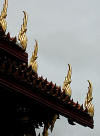
hang hongse
(หางหงส์)
Thai-Sanskrit.
‘Tail of a
hongse’ or ‘swan's tail’. The
antefix on some
Buddhist temples in Thailand generally at the lower end of a
bai raka curling upward like an ornamental tail. Most temple
roofs show a combination of a
chofa and bai raka with a hang hongse (fig.). In Thai
pronounced
haang hong.
Compare with
naakbeuang
(fig.).
回
hang pao (อั่งเปา)
Thai for
hong bao.
回
Hangshi
(行什)
Chinese. ‘Ranks tenth’. Name of a
sword-wielding, monkey-faced immortal guardian that wards off demons. He is an
additional rooftop figure added to the generally maximum nine figures that make
up the
Chinese Imperial roof decorations
(fig.)
at the Emperor's Hall of
Supreme Harmony in the
Forbidden City (fig.).
回
Ha Nhi
Name of an ethnic group of people, whose
members live in the northern Vietnamese provinces of Lai Chau and Lao Cai.
READ ON.
回
Han Hsiang Tzu
(韩湘子)
Chinese. Name
of one of the
Eight Immortals (fig.),
who was
the nephew of Han Yu, a prominent poet and statesman of the Tang dynasty whom he
tried to persuade to renounce his political career and pursue
Tao
instead. He has a
magical flute that has the ability to give life and produces music that can make
flowers bloom in the twinkling of an eye and soothe wild animals. In his effort
to convince his uncle to abandon his life of officialdom and to study Tao,
Han Hsiang Tzui
performed some miracles, such as filling a goblet with excellent wine, pouring
out cup after cup from a gourd without end, using the power of Tao, as well as
predicting events that would occur in his uncle's life, all of which would later
come true. His mount is
a
Common Crane
or sometimes a
buffalo (fig.).
He is also known as Han Xiangzi and usually referred to as the
Philosopher Han Hsiang, also transcribed
Han Xiang.
Being portrayed as a youthful boy playing a flute he is often reminiscent of
some depictions of
Krishna (fig.),
who is a master of the
bansuri, an northern Indian,
bamboo
flute. Compare
his magical flute also with that of
Phra Aphaimanih
(fig.).
回
_small.jpg)
Hani
People and highland tribe in
Yunnan, also known as
Haoni or Aini. They are related to the
Akha in Thailand
and in other parts of Southeast Asia. The Hani traditionally were semi-nomadic
and made a living from slash-and-burn agriculture, and were previously involved
in the
opium trade around the
Golden Triangle.
In
China, they live mainly
in southern Yunnan, between the Hong He and
Mae Khong Rivers.
回
Hansawati (ဟံသာဝတဳ, ဟံသာဝတီ)
Mon-Burmese name for
Hongsawadih.
回
Hanthawaddy
See
Hongsawadih.
回
Hanuman (हनुमान्,
หนุมาน)
1. Sanskrit-Thai. The son of
Vayu, the god of wind, in Thai known as Sawaha and Phra Phai.
He is the albino half-god monkey who assisted
Rama in his battle against
Ravana
in the Indian
epic
Ramayana, as well as
in the Thai
Ramakien.
He is depicted with a white complexion (fig.) and has a diamond
in the middle of his palate. He usually wears
a
golden crown, known as
kabang, except when he is
depicted as ruler and wears a
cone-shaped
crown
called
chadah
(fig.). He is the king of the monkeys and a general who has magical powers.
When performing his miraculous powers, he is depicted in khon with a mask with
four faces and referred to as
Hanuman phlaengrit (fig.).
When he is depicted with four arms, he is referred to as
Hanuman sih kon (fig.). His yawn can produce moons and stars and he is able to enlarge himself, an
ability called
Hanuman minit kaay
(fig.).
His personal weapon is a diamond trident, which he uses to combat important
adversaries, and his consort is a
mermaid
queen
named
Suphanamatcha (fig.),
with whom he begot a son called
Madchanu (fig.). In India, his weapon is a
gada (fig.).
He is also referred to as
Wayubud,
i.e. ‘Son of Vayu’.
He is the counterpart of a black monkey called Nilaphat (fig.).
See also
THEMATIC STREET LIGHT
(1) and
(2).
回
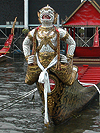
2. Sanskrit-Thai. Monkey from East India.
回
3. Thai. Name of a small, ca. 25 km long
river in eastern Thailand, that merges with the Phra Prong (พระปรง) River and
the Prajan Takhaam (ประจันตคาม) River, to form the
Prachinburi
River.
回
Hanuman minit kaay (หนุมานมินิตกาย)
Thai term for
Hanuman
(fig.),
the monkey-general, when he magically enlarges his body.
In the
Ramakien,
he does this on several occasions, most famously in an effort to protect
Phra Ram's
(fig.)
by hiding his
pavilion in his mouth, when the latter had had a bad dream in which it was
foretold that danger would come with the night, and again at the occasion when
he uses his tail to form a bridge for his army to cross a river (fig.),
during his search for the
hermit
Phra Chadil, who could show them the way to
Longka,
though in the
Reamker, i.e. the
Khmer
version of the
Ramayana,
he is portrayed using his entire body (fig.).
See also
THEMATIC STREET LIGHT.
回
_small.jpg)
Hanuman phlaengrit (หนุมานแผลงฤทธิ์)
Thai term for
Hanuman
(fig.),
the monkey-general, when he shows his
miraculous powers. In
khon (fig.),
he is then represented by a dancer
wearing a
khon mask
of Hanuman with four faces, i.e. his normal frontal face and three smaller faces
at the back of his lower head. Similar representations also exist in other art
forms, such as murals.
See also
Jaturamuk.
See also
THEMATIC STREET LIGHT.
回
_small.jpg)
Hanuman sih kon (หนุมานสี่กร)
Thai term for
Hanuman
(fig.),
the white-furred monkey-general, when he is depicted with
four arms, usually
holding a different
attribute
or weapon in each hand, often a sword, a
trident,
a
conch
and a
chakra.
In the reign of King
Rama IV (fig.),
when the predecessor of the
Royal Thai Police
was initially being established as an
organizational structure, the seal or
symbol of that initial police force featured an image of
Hanuman sih kon. Also transliterated Hanuman si gorn, Hanuman see gon, or similar.
See also
Chaturbuja.
See also
THEMATIC STREET LIGHT.
回
_small.jpg)
hao chang (เห่าช้าง)
Thai. ‘Barking
elephant’. Name for the
Rough-necked Monitor.
回
Happiness Ball
See
Family Ball.
回
Hara
(हर)
Sanskrit. A name for
Shiva.
回
Harappan
Name given to an early civilization that existed in the Indus valley between 2300 and 1750 BC, derived from its most important city Harappa
(हड़प्पा). Other important settlements were Mohenjodaro and Kalibangan. Its most significant surviving artifacts include miniature stone sculptures and numerous
terracotta
and bronze figurines.
回
harem
Women's lodgings in a
Muslim residence.
回
Hari
(हरि)
Sanskrit. A name for
Vishnu.
回
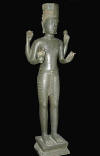
Harihara (हरिहर,
หริหระ)
Sanskrit-Thai. A Hindu deity that derives its name and characteristics from both
Vishnu (Hari) and
Shiva (Hara), and is a combination of these two gods. Usually depicted with Vishnu's crown on one side of his head and Shiva's
jata (plaited hair) on the other
(fig.). He also holds the main
attributes of both gods.
回
Haripunchai (หริภุญไชย)
1. Thai. Name of a
Mon city in northern Thailand (now
Lamphun), founded in 661 AD by Buddhist devotees. In 1281, it was conquered by King
Mengrai and incorporated into the kingdom of
Lan Na.
The term hari is in this context said to be another word for
sa-moh,
i.e. a gall-nut or cherry plum,
whereas the word punchai means kin (กิน) or the rajasap form for it, i.e. saweuy (เสวย),
meaning
‘to eat’. The name Haripunchai is
thus understood to mean: sataanthi phraputthachao song prathab saweuy
samoh (สถานที่พระพุทธเจ้าทรงประทับเสวยสมอ),
which freely translates as ‘the place where the
Buddha sat and ate a
gall-nut’, and
goes back to an episode in
the life of the Buddha.
MORE ON THIS.
回
2.
Thai.
Influential art style between the 11th and 13th centuries AD, named after the
Mon city Haripunchai in northern Thailand.
Its characteristics are simple but elegant.
回
3. Thai. Name of a
Boeing 747-400 in the fleet of
Thai Airways International, which was
given its name by King
Bhumiphon.
To mark the King's Sixth Birthday Cycle Celebrations in 2000, the aircraft had
the Golden Swan
Royal Barge,
i.e. the King's personal barge, in Thai named
Reua Phra Thihnang Suphanahong
(fig.),
painted on its body.
Like this, it appears on the third of a set of four Thai
postage stamps issued in 2010 on the occasion of the airline's 50th birthday
anniversary (fig.).
回
Har-Mandir Saheb (ਹਰਿਮੰਦਰ ਸਾਹਿਬ)
Punjabi term
for the
Golden Temple.
回
harmonium
Keyboard
instrument in which the notes are produced by air driven through metal reeds.
The organ-like instrument is widely used in southern Asia, after missionaries in
the middle of the 19th century introduced French-made hand-pumped harmoniums to
India, from where it spread to Pakistan and Afghanistan. Today, it is used in
many genres of Indian music, as well as in the
Hindu and
Sikh
religions, whose followers use it to accompany their devotional songs.
回
Hatinh Langur
Common name for a
species of Leaf Monkey with the scientific
name Trachypithecus hatinhensis.
READ
ON.
回
haveli
(हवेली)
Hindi. Term
derived from a Persian-Arabic word that means ‘enclosed place’ and which is used for a
traditional Islamic-style private mansion, with an interior garden or courtyard,
in India and Pakistan. Though in English literature, the Anglicized plural form
havelis is often used, the correct Hindi plural form is actually haveliyaan
(हवेलीयाँ). The term originated in Rajasthan, in the northern part of India, where
the havelis (haveliyaan) are renowned for their decorative
frescos, with images that depict stories from popular
history and folklore, as well as scenes from religion (fig.).
See MAP.
回
%202_small.jpg)
hawk moth
See
mot yihaw.
回
Hawksbill Sea Turtle
Common name
for a critically endangered species of sea turtle, with the scientific
designation Eretmochelys imbricata. This turtle derives its common name from its
sharply hooked, beak-like mouth (fig.), and is distinguished by its elongated, tapered
head, and flippers that have two noticeable claws. Its carapace has serrated
margins. Although this species is omnivorous, its most important food is sea
sponges. Also Hawksbill Turtle.
回
_small.jpg)
Hayagriva (हयग्रीव)
Sanskrit. ‘Horse neck’.
Name for the horse-headed Hindu god of knowledge and wisdom,
represented by a
human body with the head of a horse. Though
worshipped as a god in his own right, he is
also
considered to be an
avatar
of
Vishnu,
which is otherwise known as
Vajimukha
(fig.).
回
he (鹤)
Chinese for
crane. The word is a
homonym of he.
回
he (合)
Chinese. ‘To
combine, unite, join’ or ‘to gather’. The word is a homonym of
he.
回
hed faang (เห็ดฟาง)
Thai name for
the paddy straw mushroom, a species of edible mushroom with the scientific name
Volvariella volvacea. Its common English name drives from the fact that these
mushrooms are grown on
rice straw beds. They are cultivated throughout East and
Southeast Asia, in subtropical climates with high annual rainfall, and used
extensively in Thai cuisine. They are usually sold fresh and still immature,
before the caps have opened, looking more like little balls than mushrooms, yet,
when cut in half, one can see the mushroom-shape inside.
See also POSTAGE STAMP.
回
%20Volvariella%20volvacea_small.jpg)
hed hima (เห็ดหิมะ)
Thai. ‘Snow
fungus’. Name for a species of white mushroom in the shimeji group, i.e. a group
of edible mushrooms native to East Asia. They are also known in English as White
Beech Mushroom, Snow-white Mushroom and White Clamshell Mushroom. They were
developed in Japan from the Brown Beech Mushroom, which in Japan is known as
Buna-shimeji, and were named Bunapi-shimeji.
回
_small.jpg)
hed hom (เห็ดหอม)
Thai. ‘Fragrant mushroom’.
Name for the
shiitake
mushroom (fig.), an edible mushroom native to East Asia.
回
hed hoi nang rom khao (เห็ดหอยนางรมขาว)
Thai. ‘White shellfish oyster mushroom’.
Name for the edible White
Oyster Mushroom (Pleurotus ostreatus).
See also POSTAGE STAMP.
回
hed hoo noo (เห็ดหูหนู)
1. Thai. ‘Mouse-ear mushroom’.
Short name for a white, sponge-like mushroom, with the scientific name Tremella
fuciformis, and in full called hed hoo noo
khao,
meaning ‘white mouse-ear mushroom’. It has a structure of ear-shaped frills. It
is a type of jelly fungus and in English, it is known as Snow Fungus, White
Fungus, White Jelly Mushroom and Silver tree-ear Fungus. It is used in Chinese cuisine.
回
2. Thai. ‘Mouse-ear
mushroom’. Name for a species of fungus with a rubbery texture, commonly known
by a numbert of names, including Wood Era, Jelly Ear, Jelly Fungus, Judas's Ear
Fungus, and Jew's Ear, the latter being a translation from its scientific name Auricularia auricula-judae, which relates to the fact that it is suggestive of
a human ear and grows on dead or elder trees, which is reminiscent of the
apostle Judas, who hanged himself on an old tree.
See also POSTAGE STAMP.
回
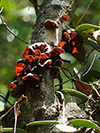
hed lin jeu daeng (เห็ดหลินจือแดง)
Thai-Chinese.
‘Red lin jeu
(lin zhi) mushroom’. Name for the reishi mushroom, a high-priced, brownish-red,
bracket fungus or shelf fungus, i.e. a
mushroom with the scientific name Ganoderma lucidum. Dried and cut into slices it is used as a herb in Chinese traditional medicine
(fig.).
People in the Orient have used it for over 2,000 years to increase longevity and
to boost the immune system, as well as for various other health stimulating
effects. It reportedly also induces a non-narcotic feeling of well-being. It is
traditionally used fresh or dried in teas and soups. The dried mushrooms are
often bean-shaped and have a
prepossessing, varnish-like appearance. Hence, they are sometimes used in dried flower and
seedpod arrangements. Its inside has a somewhat woody structure. In
China, this mushroom is
called
ling zhi, i.e. ‘mushroom of immortality’.
Reishi mushrooms are not
found in the wild in Thailand, but they somewhat similar in appearance to
Turkey Tail mushrooms (fig.).
回
hed pao heua (เห็ดเป๋าฮื้อ)
Thai. ‘Abalone mushroom’.
Name for the Abalone
Mushroom (Pleurotus cystidiosus),
which is edible and
named after a kind of mollusc.
See also POSTAGE STAMP.
回
hed pluak (เห็ดปลวก)
Thai. ‘Termite mushroom’. Common Thai name for an edible species of wild mushroom, found
near
termite mounds and with the
scientific designations Termitomyces albiceps and Termitomyces fuliginosus. It
is claimed that eating this mushroom is beneficial for the brain and memory. In
Thai, this mushroom is also known as hed kha kai (เห็ดขาไก่), due to to the fact
that it is an ingredient in the soup-like dish
tom kha kai, and as hed kohn (เห็ดโคน).
The appellation termite mushroom derives from the fact that these wild mushrooms
are a symbiotic fungi, which can only exist with the help of termites, as they
sprout from the burrows created by winged termites, known in Thai as
maeng mao
(fig.),
when they fly out to start a new colony, usually during rainfall or in
the wet season.
回
heed sib song (ฮีตสิบสอง)
See
hihd sip song.
回
Hei Bai Wu Chang (黑白无常)
Chinese.
‘Black [and]
White Impermanence’. Name of a pair of
Chinese Hell Guards.
READ ON.
回
Hei Wu Chang (黑无常)
Chinese.
‘Black
Impermanence’. Name of a
Chinese Hell Guard.
READ ON.
回
Helianthus tuberosus
See
kaen tawan.
回
heliconia
Latin-English. Tropical plant with bracts in bright exotic colours
enclosing the relatively small flowers. The bracts can be red, yellow or orange,
or scarlet red with a yellow or green rim, or with bright red or bright yellow.
The flowers occur both pendant and growing upward and the plant has long spoon
shaped leaves with a length of up to 1.8 meter.
Though many of the names and
nicknames are often used interchangeably with other genera, or as a synonym,
amongst the different species
are
Heliconia rostrata and Heliconia velutina (Fishtail
Heliconia -
fig.);
Heliconia bihai
(Large or Big Lobster
Claw), Heliconia humilis (Firebird), Heliconia caribea
and Heliconia collinsiana (Hanging Heliconia); Heliconia psittacorum (Parrot Flower), Heliconia stricta
(Small Lobster Claw - fig.); Heliconia wagneriana
(Rainbow Heliconia), etc.
回
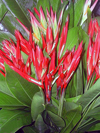
Heliotrope Moth
Common name
for a 2.5 centimeter sized tiger moth, with the scientific designation Utetheisa
pulchelloides.
READ ON.
回
hell
See
narok.
回
hell banknote
See
ming bi.
回
Hellfire Pass Interpretive Centre
Since end 2018 the official name
for the
Hellfire Pass Memorial,
in full referred to as Hellfire Pass Interpretive Centre and Memorial Walking
Trail (fig.).
In Thai, the new name is Soon Prawatisaht Chong Khao Khahd (ศูนย์ประวัติศาสตร์ช่องเขาขาด),
which translates ‘Hellfire Pass Historical Centre’.
See MAP
and
WATCH VIDEO.
回
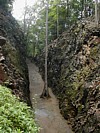
Hellfire Pass Memorial
Memorial in
Kanchanaburi built by the Australian Government's Department of Veteran's Affairs and dedicated to those Allied prisoners of war (POWs), Australian and other, as well as the Asian labourers who suffered and died in the Asia Pacific region during WW II, especially those working on the construction of the
Thailand-Burma Railway. The memorial features a museum and 4.5 kms of walking trail.
The conservation of
this historic site is the result of a proposal to the Australian Government by
Mr. Morris, a former Australian Corporal and POW who worked on the
Thailand-Burma Railway during WWII. The Hellfire Pass Memorial Museum, in
Thai known as
Anuson Sathaan Chong Khao Khahd,
was officially opened in April 1998.
The name is derived from the Konyu Cutting, a place where POWs and Asian labourers worked punishing hours well into the night cutting a pass through earth and rock; the flickering bonfire light on the withered workers gave the place its name. The museum is situated around 80 kms northwest of Kanchanaburi
town. In 2018, the museum received a complete overhaul and also the trail was
refurbished with new pebbles on the bedding where the rail track once lay and
new wide staircases and ramps that are leveled at intervals making the climb up
less demanding, while also new interpretative panels have been provided at
various locations of the walking trail. It reopened in late 2018
under the new name of
Hellfire Pass Interpretive Centre and Memorial Walking Trail.
See also
Thailand-Burma Railway Centre and
Death Railway.
See MAP
and
WATCH VIDEO.
回
hell money
See
ming bi.
回
Helmeted Hornbill
Common name for a
species of
hornbill,
with the scientific designation
Rhinoplax vigil, and in Thai known as nok chon hin (นกชนหิน). It is mostly
blackish with a white belly, and legs, while the tail feathers are white
with a black band near the tip. This species has a yellowish, rather high, but
short casque, that runs from the forehead to halfway the bill, where it ends
abruptly. It also has a bare, wrinkled throat patch, which is red in males and
blue in females. This very large bird has a total length of around 170
centimetres, and occurs in the wild on the Malay Peninsula, from southern
Thailand over mainland
Malaysia, to the
islands of Borneo (Kalimantan) and Sumatra, but is also very rare and listed as
near-threatened, as it is hunted by the native people for its casque, which is
used as a carving material referred to as hornbill
ivory,
whilst the tail feathers are used by some indigenous tribes to decorate headgear
(fig.).
This unique bird is said to show the features of some ancestral birds with
dinosaurian characteristics, not found in other living birds.
回
Hemaraat (เหมราช)
Thai-Pali name of a mythological creature from
Himaphan forest, that
has the body of a
lion
and the head of either a swan, known in Thai as
hong
and in Sanskrit as
hamsa,
or as claimed by some, the head of a
crocodile. The name Hemaraat is a
mixture of the name Hema (เหมะ) and the word
raat, the latter being a
suffix meaning ‘great’, ‘royal’, ‘regal’, ‘imperial’ and
‘kingly’, whereas Hema is said to be the name of yet another mythological
creature in its own right, but which is not clearly identified. Perhaps the name
is a corruption of Hima and short for Himaphan. If true, the name could mean
‘King of Himaphan (forest)’,
a likelihood if compared to other mythological animals that use the suffix -raat
in their names, e.g.
nagaraat,
and the fact that the lion is often considered the king of the animals.
回
hemp
See
ganchong.
回
Hem Wetchakon (เหม เวชกร)
Name of a 20th century Thai writer, painter
and illustrator, who is best known for his illustrations on the covers of cheap
pulp novels, which in turn have influenced many other Thai artists.
READ ON.
回
heng (เฮง)
Thai-Chinese. ‘(Be) fortunate, lucky’. Term to describe the custom of hitting
products or goods for sale (or sometimes other things or people) with banknotes,
usually received from the first sale of the day, known as kaai pradeum (ขายประเดิม),
literally ‘to sell to the first costumer of the day’. It is done to invoke good
luck in business and may also be performed after a very lucrative deal. It is often witnessed on markets.
回
_small.jpg)
Heng Jia (เห้งเจีย, เฮ่งเจีย)
Thai
name the Thai name for the Magic Monkey or Monkey King from the story
Journey to the West,
who is also known as Sun Ngokong (ซุนหงอคง), another Thai name that derives from
Sun Wukong, its Chinese
equivalent.
回
,%20the%20Monkey%20King%20Sun%20Ngokong%20(ซุนหงอคง)_small.jpg)
Heng
Jiang (哼将)
Chinese. ‘Groaning General’ or ‘Snorting
General’. Name of a muscular, fierce-looking guardian of the
Buddha,
often found as a door
guardian at
Mahayana
Buddhist and
Taoist
temple entrances across Asia,
including in
China,
Japan and Korea. He is
typically paired with
Ha Jiang
(fig.),
i.e. the ‘Yawning General’,
who is usually placed to the opposite side of Heng Jiang, one facing the other.
Both are said to be manifestations of the
bodhisattva
Vajrapani (fig.).
In
iconography,
they can be told apart by the
fact that General Heng is always depicted with is mouth closed, while General
Ha's mouth is open. Together, they are in Chinese known as Heng Ha Er Jiang (哼哈二将), literally the
‘Two Generals Heng (Groaning) [and] Ha (Yawning)’, though in Japan they are
referred to by the term Ni-Ou (仁王), which is generally transliterated Nio and
translates as ‘Benevolent Rulers’.
See also TRAVEL
PICTURES.
回
Heng Ko (เอ็งกอ)
Thai-Chinese
name of a Chinese performing art that came to
Thailand
about a century ago.
READ ON.
回
hen kho kai thod (เอ็นข้อไก่ทอด)
Thai. ‘Fried chicken ligaments’ or
‘fried chicken tendon’. The full name for
kho kai thod.
回
henna
Name of a flowering plant with the botanical
name Lawsonia inermis. From its tiny fruits a dye can be gained, which is also
referred to as henna.
READ ON.
回
Heortia vitessoides
Latin. Scientific designation for a moth,
which is also known as
Tyspana vitessoides.
READ ON.
回
hera
(เหรา)
Thai name for a
dragon-like (fig.)
mythological animal, which in architecture is often seen at the end of an arch. It has the body of a
naga and its teeth meet its nostrils whilst often
either another creature, a flower or flame-like motif emerges from its open mouth.
See also
Kraison Naga, a
similar creature from
Himaphan forest and
compare with certain styles of
Gajasingha (fig.).
回
he reua (เห่เรือ)
Thai. Name for
a song, which is sung while paddling a boat, in order to give rhythm to the
crew. See also
kaap he reua and
Royal Barge Procession.
回
hermit
See the Thai term
reusi,
the
Sanskrit
rishi,
the Burmese
tapathi, and the
Mon
term
ithi.
回
hermit crab
See
poo se-shuan.
回
heroines of Phuket
The sisters
Chan and
Muk
(fig.), officially known as
Thep Krasatri and
Sri Sunthon, who in 1785 safeguarded
Phuket island against a Burmese invasion. Both women were born in
Thalang as the daughters of the local governor Thongkham. When he died his post was taken by Phakphuthon, who was married to Chan and with the office of governor became a
Phraya. However, in 1785 Phakphuthon suddenly died and before
Bangkok could appoint a new governor, king Padung from
Burma sent a fleet with an army of 3,000 men commanded by Yiwun to besiege the island. Without a ruler Chan and Muk took command and protected their city. After a battle of more than a month the Burmese troops were unsuccessful in conquering Thalang and when they started running out of supplies they retreated. For their courage both heroines were bestowed with the title of
thao
by King
Rama I. According to a legend Chan and Muk ordered all women to cut their hair, dress in male clothes and make hit drums loudly, which gave Yiwun, the Burmese commander, the impression he was facing a superior number of troops and so called off the invasion.
Such a strategy is known as the Beau Geste effect, and a similar tactic is also
used by wolves to instigate uncertainty about the size of a pack.
回
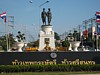
Hevajra
(เหวัชระ)
Tibetan-Thai. A protective god in Tantric Buddhism with the rank of a
buddha. He has eight heads, sixteen arms, and two or four legs, and a
third eye. In Cambodia and Thailand he is usually depicted in a dancing posture with his left leg crushing a demon and his right leg bent with the foot touching the left leg above the knee. See also
Nataraja.
回
Hexarthrius parryi deyrollei
See
duang kihm la-mang
leuang.
回
hia (เหี้ย)
Thai name for
a
monitor lizard
of the species Varanus salvator.
回
hia dam (เหี้ยดำ)
Thai.
‘Black water lizard’.
A genus of
monitor lizard
with the English name
Black Water Monitor
(fig.).
回
hibiscus
Botanical
name of
a large genus of annual and perennial herbaceous plants, woody shrubs and small
trees
with exquisite flowers. It belongs to
the family Malvaceae and is native to warm temperate, subtropical and tropical
regions throughout the world. The most commonly seen
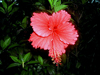
variety in Thailand is the Hibiscus rosa-sinensis or Chinese hibiscus and the Hibiscus schizopetalus or Japanese hibiscus, which is also known by its epithet Japanese lantern. A rather distinguished variety is the
Hibiscus sabdariffa or
roselle, of which a refreshing drink high in Vitamin C can be made by soaking its seed heads in boiling water. Depending on the variety it has different names in Thai, including
chaba for the rosa-sinensis which has several different varieties,
phu reua hong (พู่เรือหงส์), phu
rahong (พู่ระหง) or
haang
hong for the schizopetalus (fig.) and
krajiab daeng
for the sabdariffa
(fig.).
In the
Ayutthaya
Period any man or woman, who was caught
in acts of infidelity or adultery, both that man or woman and his or her lover
were put to shame ‘by the plough’, that is to say, both were tied to a yoke
and made to plough paddy fields for three days. In this the woman was made to
wear red hibiscus flowers behind both ears, as well as a garland of red hibiscus
flowers on her head. Malaysian Borneo has taken the hibiscus as its symbol. The
word hibiscus derives either from the Latin hibiscum or the Greek hibiskos (ιβίσκος),
meaning ‘marsh mallow’ and in English it is also
known as rose mallow.
See also POSTAGE STAMP.
回
hihd sip song (ฮีตสิบสอง)
Thai. ‘Customs
or traditions of the twelve months’. The word hihd is derived from
jarihd which means ‘custom’ or ‘tradition’, whereas sip song translates as
‘twelve’ and refers to the twelve
months of the year. It is the name used in
Isaan for
the twelve month cycle, in Thai known as
praphenih sip song
deuan, and in which traditionally a local festival or ceremony is
celebrated usually on or around the day of the full moon. In Isaan these are
boon khao kam,
boon khaw jih,
boon koon lahn,
boon phrawet,
boon song nahm,
boon bang fai,
boon sam-ha,
boon khao pansa,
boon khaw pradap din,
boon khaw sahk,
boon ouk pansa
and
boon kathin.
Also transcribed heed sib song.
回
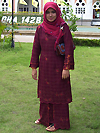
hijab (حجاب)
Arabic. Term
for a ‘cover’, its root meaning ‘to veil, cover, screen’ or ‘to shelter’, and it
refers to the covering of both the head and body of
Islamic
women. In Islamic theology however, the word is given a much
wider meaning and refers to modesty, privacy and morality, whereas the word for
headscarf or veil used in the
Koran, is
khimar
(fig.).
Some women may extend the khimar and hijab with a
niqab, a piece of cloth that also covers the
face, often in addition to wearing gloves, thus completely covering the body (fig.). See also
purdah.
回
Hijrah (هِجْرَة)
Arabic. ‘Migration’. The flight of the prophet
Muhammad
and the first
Muslim community from
Mecca to Medina in 622 AD, the year from which the Muslim calendar is dated.
Also transcribed Hijra.
回
Hill Grass Yellow
Common name
for a species of small butterfly in the family Pieridae, with the scientific
designation Eurema simulatrix tecmessa. It can best be identified by its yellow
underside, where it characteristically has –besides several brownish markings on
the hindwings– two cell spots, as well as a large, almost cleft, reddish-brown
apical spot on the forewings. In Thai, this species is known as
phi seua
naen phu khao
(ผีเสื้อเณรภูเขา).
回
Himalayan Bulbul
Common name
for a species of bulbul in the family Pycnonotidae, with the scientific
designation Pycnonotus leucogenys and found in southern Asia. It is easily
recognized by its long brownish-grey recurved crest. In addition, this
black-faced songbird has white ear-patches and a yellow vent (fig.).
Otherwise, it has ashy grey upperparts, whilst the underparts are a lighter
grey. In Thai, this bird
is known as nok parod ngon kaem khao (นกปรอดหงอนแก้มขาว), which translates as
‘white-cheeked crested bulbul’.
See also WILDLIFE PICTURES.
回
_small.jpg)
Himalayan Buzzard
See
Common Buzzard.
回
Himalayan Flameback
Common name for a species of bird with the
binomial name Dinopium shori and also commonly known as the Himalayan Goldenback.
READ ON.
回
Himalayan Goral
Common name
for a small ruminant, with the scientific name Naemorhedus goral. Both sexes
have a grey or grey-brown coat, with tan lower legs, rough hairs and
cylindrical, backward-curving horns, that can grow up to 18 centimeters in
length. In addition, males have short manes on their necks. It is closely
related to the
Mainland Serow and
has some subspecies. It was first discovered in the year 1825, in
the Himalayan mountains of Nepal, but its range once stretched far into the
foothills of the
Himalayas, with some individuals purportedly wandering as far
South as
Myanmar and
northern Thailand. In 1973, the Thai Post issued a series of postage stamps with
endangered and rare wild animals, including a stamp with illustrations of
Himalayan Gorals (fig.).
Also known as the Grey Goral.
回
Himalayan Griffon Vulture
Common name
for an Old World vulture, with the scientific name Gyps himalayensis and
belonging to the family Accipitridae.
READ ON.
回
Himalayan Striped Squirrel
Name of a
small squirrel with a body length of just 11 centimeters and an equally long
tail. It has alternating cream and dark brown stripes on its back. These stripes
are thick and bold and run from near the eye to the base of the tail, which is
narrow and short-haired. The tips of its ears are white. It has the scientific
name Tamiops macclellandi. It is also known as Burmese striped squirrel and in
Thai called ka-len khon plaai hoo san (กะเล็นขนปลายหูสั้น). It occurs from the
Himalayas through northern
Burma
and southern
China, to Thailand and Peninsular
Malaysia. In
Thailand it ranges in the West, North and South, though there is a
similar species, called ka-len khon plaai hoo yao (กะเล็นขนปลายหูยาว)
and with the Latin name Tamiops rhodophii,
which is found only in
Isaan and has a slightly broader, outer
cream stripe, on its back. Both species strongly resemble the darker and
slightly larger
Berdmore's Ground Squirrel (Menetes berdmorei), which in Thai is
called kra-john (กระจ้อน), but which lacks the white ear tips, as well as the
Northern Palm Squirrel,
which is found in India and also has no white ear tufts (fig.). Its habitat
consists of montane, forested areas usually above an altitude of 700 meters.
Almost exclusively arboreal, it prefers big forests, fruit trees and coconut
palms. Its dorsal striped pattern serves as an efficient camouflage on fissured
tree trunks (fig.). Himalayan Striped Squirrels are very popular as pets (fig.).
回
%20in%20the%20wild%201_small.jpg)
Himalayas
The mountain range of the Himalayas. They are often mentioned in
Buddhist stories as well as in the
Ramayana and other texts.
See MAP.
回
%202_small.jpg)
Himaphan (หิมพาน)
1. Thai. A mythical forest located in the
Himalayas, below the heavens of the gods. It is often mentioned in
Buddhist literature and inhabited by both real and mythical animals. Fabulous
creatures include the
Kinnara,
Geson Singh,
Sakun Kraison,
Sang Praeng,
Sing,
Sakun Kraison,
Kraison Paksah,
Singha,
Toh,
Kraison Kaawih,
Kraison Naga,
Kraison Mangkon,
Naga,
Kunchon Warih,
Warih Kunchon,
Bantu Rajasih,
and many more. Also called
Himavat (Himawat),
Himavan (Himawan),
Himavah (Himawah), Himavaat (Himawaat), and
Himavaan (Himawaan).
Occasionally, either of these are spelled with a double m.
See also
POSTAGE STAMP,
TRAVEL PICTURE,
PANORAMA PICTURE,
and
WATCH VIDEO (1)
and
(2).
回
_small.jpg)
2. Thai. Name of the Thai god of Himaphan
Forest, who is usually referred to as
Phra Himaphan.
When
Phra Narai
(fig.)
incarnated as
Phra Ram
(fig.),
Phra Himaphan took the
avatar
of
Kohmut (fig.),
in order to assist
Rama
in his
battle against
Totsakan
(fig.).
回
himaphan (หิมพานต์)
Shortened Thai name for cashew nuts and their tree of the genus
Anacardium occidentale, which in full is called
ma muang himaphan.
回
Himavah
(หิมวา)
See
Himaphan.
回
Himavaan
(หิมวาน)
See
Himaphan.
回
Himavan (หิมวัน,
หิมวันต์)
See
Himaphan.
回
Himavat (หิมวาต)
See
Himaphan.
回
Hinayana (हीनयान)
Sanskrit. ‘Lesser vehicle’. A term used for
Theravada Buddhism after the origin of
Mahayana Buddhism, the
‘greater vehicle’. The
Hinayana school of Buddhism is closest to the original teachings of the
Buddha. At some point were several different sects of Hinayana Buddhism, but today only the Theravada school remains. It is practiced in Sri Lanka and Southeast Asia, and uses
Pali as its language.
回
hin bot yah (หินบดยา)
Thai. ‘Stone to ground medicine’. A metate-like
grinding slab or
ground stone, i.e. a tool used by pharmacists and medical doctors
of the past, to pulverize medicinal
herbs. Though rare, it may still be used by
present-day pharmacists that practice
Chinese traditional medicine.
It consists of
a concave-shaped stone slab and a heavy, sometimes convex-shaped, stone roller.
It is utilized in addition to a
kreuang bot yah (fig.),
which is used to cut the herbs, and a
krok mortar and
saak
pestle (fig.),
which are used to roughly crush the herbs a first time. The grinding slab is
thus the last tool in an array of tools used to prepare herbal medicines, and is
used to pulverize already cut and ground herbs into a much finer quality and
usable size. It is sometimes found as an attribute with statues of doctors of
the past (fig.),
and in 1994 the tool was chosen to be on a set of three postage stamps
commemorating the 80th Anniversary of Pharmacy in Thailand (fig.).
回
hing hoi (หิ่งห้อย)
Thai. ‘Firefly’.
Generic name for a type of winged
beetle
in the family Lampyridae.
READ ON.
回
hing hoi chang (หิ่งห้อยช้าง)
Thai. ‘Elephant fire
beetle’. Name for the net-winged beetle, a
lightning bug of the genus Duliticola sp. and belonging to the family Lycidae.
READ
ON.
回
Hindu
1. Follower of
Hinduism.
回
2. Adjective meaning
‘of Hindus’ or ‘of Hinduism’.
回
Hinduism
The main religion and social system in India. Followers, called Hindus, share a common belief in the law of
karma, the transmigration of the soul, and the universal spirit or
brahman.
READ ON.
回
hin hod nahm
(ฮินฮดน้ำ)
Northern Thai name for
an about 6
sok
long, wooden, narrow
and open receptacle, used to
gather and pour perfumed
rain water over Buddha statues or over
the head, neck and back of Buddhist monks, in a promotion
ceremony, known as
kong hod. This
ceremonial,
adorned, trough-like receptacle is
typically cut from tropical hardwood and made in the
form of a
naga, the protector of both the waters and
Buddhism (fig.).
The water runs through the channel of the
receptacle, from
the tail end down to the head of the naga, where the channel ends in a hole,
under which a Buddha statue is placed
or a monk takes place. In
the North it is also known as rod nahm (รดน้ำ),
and in
Isaan
it is called
haang hod,
haang song nahm (ฮางสรงน้ำ),
haang lin (ฮางลิน),
and raang rod (รางรด).
WATCH VIDEO.
回
_small.jpg)
Hin Sahm Wahn (หินสามวาฬ)
Thai.
‘Three
Whales Rock’. Name of a group of three,
bare, elongated, rock edges at
Beung Kahn's
Lion Mountain that in Thai is called
Phu Singh,
which —especially when seen from above— are reminiscent of
a pod of three whales.
READ ON.
回
hin sila kohn (หินศิลาคอน)
Thai name for
a kind of rock or stone that, as rumour has it,
is found in river beds and in caves along the
Mekhong
River area. These rocks contain gemstones that are
usually semi-translucent and known as
phet phayanaag (fig.),
which
are believed to be sacred, posses mystical powers, and are said to protect their
carrier from any peril of water.
These
generally prolate rounded
gemstones are not embedded in the rocks but usually
sit rather loosely in a cavity inside the rocks and may clatter when shaken. The
naga-gems can be of any colour
and
in order to get to them
the rocks need to be
broken open with a hammer or stone pestle. When the crushed rocks are carefully
scrutinized it seems that the area where the gems were buried the colour of the
wall often differs from the rest, suggesting that the rocks have been
manipulated and the gems have been inserted manually, and then closed-off
with a different material. Some rocks also crumble so easily that it seems they
rather resemble bricks and are more likely to have been artificially made from a
material like or similar to clay.
回
_small.jpg)
hintha
(ဟင်္သာ)
1. Burmese. A mythical bird in
Myanmar, and the local equivalent of the
Hamsa. This
swan-like creature has been adopted as the symbol
of the
Mon
people, who depict it on their flag (fig.),
while
two
hintha
birds, i.e. a female atop a male,
is
the symbol of
Bago Region
(fig.)
and derives
from a Buddhist legend
in which the
Buddha
allegedly predicted the establishment of the
Hanthawaddy Kingdom after
he saw a female
hintha bird
sitting on the back of a male, some 1200 years earlier.
The hintha is also used as the figurehead of
the
Karaweik, the ceremonial Pyigyimon
royal barge (fig.),
whilst a
replica of this royal barge,
known as the
Hintha Barge (fig.), is used by the
Intha
people to transport the
Hpaung Daw U Buddhas (fig.)
during their annual procession on
Inle Lake (fig.). Nearly all
pagodas
in Myanmar have a
hintha pillar, i.e. a large freestanding column topped by a golden effigy
of a hintha ‒usually
made from gold-coloured tinplate‒ (fig.),
erected at the base and adjacent to the main
stupa.
The hintha pillar is said to publicize peace, as
this mythological bird is believed to be an
earlier incarnation of the
Buddha.
In
iconography,
the hintha is often depicted with a ball hanging from its mouth, which might be
a representation of both the sun and moon, that together
are
a symbol of
Enlightenment
(fig.);
and sometimes
with some object or some deity sitting on its back, e.g. a small
chattra,
as on the hintha pillar mentioned above; a smaller female hintha bird, as in the logo of Bago
(fig.); a
stupa, as in the shrine near the
Mahazedi
Pagoda
in Bago
(fig.);
the
Hindu
goddess
Sarasvati
(fig.),
etc. There is also a variant similar
to a
nok hadsadi (fig.),
i.e. a mythical bird
(nok) with the head of an elephant
(hadsadi),
in which a
Hintha (fig.)
is depicted with an elephant's head, and which could be referred to as
Hintha-Hadsadi (fig.).
See also
opium weight,
chintha and
TRAVEL PICTURES (1),
(2) and
(3).
回
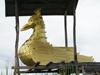
2. Burmese name for the Brahminy Duck, i.e. the
Ruddy
Shelduck (fig.).
回
Hintha Barge
Name of a
Karaweik-like
replica of a royal barge in
Myanmar, with the
figurehead of a
hintha
bird (fig.).
There are many replicas nationwide, some real boats with gold-coloured tinplate fashioned in
the form of the hintha, others
monuments made from brick or concrete (map
- fig.), as well as from (or with) gold-coloured tinplate, and used purely as iconographical objects
for cultural, religious or decorative purposes. Among the real vessels are
those used by the
Intha
people to transport the
Hpaung Daw U Buddhas (fig.)
during the annual festival and procession on Inle Lake, i.e.
four of the five
Buddha images, as one always remains at
the temple. During the festival, the barge is towed from to the villages and
towns along the shores of the lake in a clockwise fashion, similar to a
thaksinahwat.
In 1965, the original barge capsized during a storm (fig.),
causing the Buddha images to tumble into the lake. According to legend, one of the
images could not be recovered, but on return to the monastery, the missing image
was miraculously sitting in its place.
回
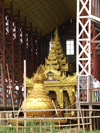
hin yam
(ဟင်း ရမ်း)
Burmese. Name of an aquatic plant, with
white cup-shaped flowers (fig.) that rise above the surface of water and elongated
green leaves that float on the surface of the water, in a way somewhat
reminiscent of
water lilies
(fig.),
and are hence sometimes referred to as
Burmese Lilies. In
Myanmar,
where this freshwater plant is endemic and found in shallow ponds and water
basins, the flowers are gathered (fig.)
and used in local cuisine.
回
%201_small.jpg)
Hiran (หิรัญ)
1. Thai. ‘Silver’, though it may in
certain contexts also mean ‘Gold’. Name of an
asoon or
asura
considered to be a guardian angel to several royals of the past, beginning with
Prince
Wachirawut
(fig.)
before he ascended the throne as
King
Rama VI, as well
as to the present Princess
Sirindhorn (fig.),
a sister of
King
Rama X.
The asure is usually referred to with the prefix
Thao, and is
also known as Thao Hiranhu (ท้าวหิรัญฮู) and Thao Hiranpanasura, pronounced
Hiranphanasoon (ท้าวหิรัญพนาสูร), and is depicted dressed in ancient robes and
carrying a long
walking stick.
Compare with
Hiranyak
and
Hiranyaksha.
See
also
TRAVEL PICTURE.
回
_small.jpg)
2. Thai. Name of an ancient
Meuang
in present-day Mae Sai District in
Chiang Rai
and
formerly known as Vieng Phaan Kham (เวียงพานคำ).
回
Hiran Ngun Yahng (หิรัญเงินยาง)
Thai. Name of an early northern Thai
Meuang
or Kingdom
in present-day
northern Thailand that
existed
from the 7th through
13th centuries AD
and which was ruled by the kings of the
Lawachakaraat
Dynasty.
It was originally
centered on
Hiran, formerly Vieng Phaan Kham (เวียงพานคำ), near today's
Mae Sai District in
Chiang Rai,
yet in the 9th reign King Lao Khiang/Khriang (ลาวเคียง/ลาวเครียง) moved the
royal court to Ngun Yahng (เงินยาง), i.e. today's
Chiang Saen,
which at that time stretched through parts of modern
Laos,
north of Luang Prabang, i.e. Luang Phabang (ຫລວງພະບາງ -
fig.),
all the way to Thaeng (แถง), i.e. modern Dien Bien Phu (Điện Biên Phủ -
fig.) in
Vietnam.
In 638 AD, Lao Chong
(ลาวจง), a tribal chief in the area, gained the support of the King of
Lavo,
and became Hiran's first king. His dynasty
ended in 1296,
when King
Mengrai (fig.),
the son of the 24th Lawachakaraat King,
Lao Meng
(fig.),
became the first ruler of the
Lan Na
Kingdom.
回
hiranyagarbha (हिरण्यगर्भ)
Sanskrit.
‘Golden embryo’, ‘golden womb’ or ‘golden egg’, i.e. the
Vedic
uncreated, principle that underlies all creation, and which came out of the
primal waters, as described in the
Rigveda.
First there was there was nothingness and darkness everywhere, and everything
was in a state of sleep. Then Svayambhu, the Self-manifested Being arose and
created the primordial waters into which he established the seed of creation.
This seed turned into a golden egg, into which Svayambhu entered, and which then
became known as
Narayana (Vishnu),
because it pervades the whole Universe. The golden egg brought all the gods as
well as sacrifice with it, and the creator gods
Vishvakarma,
Prajapati
and
Brahma became associated
with. In later myths it is also identified with
Shiwa's
cosmic dance,
known as
Nataraja (fig.)
and which symbolizes creation, preservation and destruction at the same
time. In
China,
a similar creation myth exists, featuring a black egg in which
Pan Gu slept until he was born and started creation, using a chisel
and hammer to separate the top and bottom part of the egg, thus creating
heaven and earth, as well as
yin-yang. When
Pan Gu died, his flesh became soil, his bones rock, his blood filled the rivers
and seas. his limbs and body became the five major mountains in China, his hair
became the stars, and from his sweat came the rain to nourish the land. His eyes
became the sun and the moon, whilst from small creatures on his body humans were
created. See also
Egg of Brahma.
回
Hiranyak (หิรันตยักษ์)
Thai
name for
Hiranyaksha.
回
Hiranyakashipu (हिरण्यकशिपु)
Sanskrit.
‘Golden-haired’.
Name of the brother of
Hiranyaksha (fig.), whom
was killed by the boar
Varaha (fig.),
the third
avatar
of
Vishnu, for abducting the Earth and hiding
it at the bottom of the cosmic ocean. Blaming Vishnu for his brother's death,
Hiranyakashipu not only planned revenge, but also tried to prevent his son
Prahlada, whose name means
‘joy’ or ‘happiness’, from worshipping Vishnu. However, despite several
warnings to his son, Prahlada continued his devotion to Vishnu and thus
Hiranyakashipu tried to kill his son. But, the latter survived each attempt and
was eventually saved by Vishnu, whilst Hiranyakashipu himself was killed by
Narasimha (fig.),
the fourth avatar of Vishnu, in the body of a man-lion
(fig.).
回
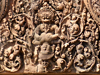
Hiranyaksha (हिरण्याक्ष)
Sanskrit.
‘Golden-eyed’.
Name of an
asura or
rakshasa, who was killed by the boar
Varaha (fig.),
the third
avatar
of
Vishnu, for abducting the Earth and hiding
it at the bottom of the cosmic ocean. Later, his brother
Hiranyakashipu (fig.)
would try to avenge him, but got
himself
killed by
Narasimha,
the fourth and next avatar of Vishnu, in the
body of a man-lion
(fig.).
In Thailand, he is known as
Hiranyak and −appearing
in the stories
that precedes the
Ramakien−
he is also depicted in the murals of
Wat Phra Kaew, the Temple
of the
Emerald Buddha,
in
Bangkok (fig.).
In the Thai dance drama named
khon,
he is depicted wearing a
khon mask
with a golden complexion (fig.).
See also
Hiran.
回
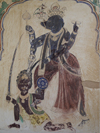
hkray bain (ခရေပင်)
Burmese designation
for the
Star Flower Tree. The term is also used for a
circular ornament with horizontal radiating beams (fig.),
which is sometimes found just underneath the
chattra or
plih, i.e. the
multi-layered royal umbrella (fig.)
atop a bell-shaped
zedi,
i.e. a
pagoda enshrining sacred
objects in
Burma. Sometimes
spelled hkray pain and also called
hkya
ra bain.
回
hkya ra bain (ချရားပင်)
Burmese. Another name for
hkray
bain. Also
transliterated hkya ra pain. See
Star Flower Tree.
回
Hmong (ม้ง)
Hill tribe people (fig.) in North Thailand (fig.), who are originally from Tibet or Mongolia and belong to the Sino-Tibetan language group of the
Miao-Yao-Pateng family, which has several dialects. They established in Thailand more than a century ago and are now around 90,000 mainly divided in Blue Hmong
(Hmong Njua
-
fig.) in the West and White Hmong
(Hmong Doew) in the East of northern Thailand,
and there
are also Hmong in
Vietnam
(fig.).
The women wear black jackets with
an embroidered collar (fig.)
and black puttees underneath a
pleated batik skirt reaching to the knees, whilst the
boys
and men wear a short black waist-deep
jacket with a double cuff, of which the outer one is usually a large embroidered
flap. Their trouser are like a black pair of culottes.
Also called
Maew
and in China (fig.)
known as Miao. In Vietnam (fig.), the main subgroups are the Black Hmong (fig.)
and
Flower Hmong (fig.),
as well as the Blue Hmong (fig.),
Green Hmong (fig.),
and some White Hmong (fig.).
MORE ON THIS.
回

Hmong Doew
Miao.
‘White Hmong’. A subgroup of the
Hmong.
There are roughly 150,000 White Hmong living in southern
China,
and another estimated 500,000 in Thailand,
Laos
and
Vietnam (fig.) combined.
In Thailand, they live in the East
of northern Thailand. They are
called White Hmong because their women traditionally wore white dresses. The
Hmong Doew are also known as Hmong Daw and Hmong Der. See also
Hmong Njua.
MORE ON THIS.
回
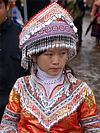
Hmong
Lenh
Miao.
‘Flower Hmong’. A subgroup of the
Hmong,
living in the northern mountainous villages of
Vietnam (fig.),
and that emigrated directly from the Chinese provinces of
Yunnan, Guizhou
and Guangxi. This group derives its name from the colourful dress worn by the
women (fig.), which is
made from a kind of fabric called flower cloth, because
the fibers for weaving
it
are produced from
plants.
MORE ON THIS.
回
%201_small.jpg)
Hmong Njua
Miao.
‘Green Hmong’. A subgroup of the
Hmong, in the West known as
‘Blue Hmong’ (fig.). They are also known as Hmong Leng. See also
Hmong Doew.
MORE ON THIS.
回
_small.jpg)
Hnamadawgyi (နှမတော်ကြီး)
Burmese.
‘Younger sister related to the older’ or ‘Great younger sister’, but usually
referred to in English as ‘Royal Sister’.
One of 37
nats that
belong to the official pantheon of spirits
worshipped in
Myanmar.
According to one legend, she was the
sister of
Maung Tint De (fig.), the
extremely strong
son of a blacksmith, whom
later became the Burmese
nat
Min Mahagiri.
The legend has it that she became a queen to
the king of Tagaung, who used her to lure and then capture her brother, out of
fear that he could usurp his throne. He was
tied to a Michelia tree and burned alive.
When she saw her brother
being burned, she leapt into the fire, but only managed to save his head and
died of her burns.
Like her brother, she is sometimes referred to as
Shwe Mje Hna,
i.e.
‘Gold
Face’. The two of
them eventually became the protector spirits of
Pagan and their
statues are enshrined at Old Bagan's
Tharabha Gate
(fig.).
See also LIST OF BURMESE NATS.
回
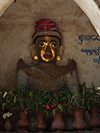
Ho (ฮ่อ)
Thai name for
Chinese tribes from southern
Yunnan
and Guangxi, who formed warrior
bandit groups, known as the Flag Gangs, that in 1865 invaded northern
Vietnam,
then known as Tonkin, and between 1865 and 1890 ravaged large areas of northern
Laos,
then a tributary state of
Siam. There
were several rivaling groups operation at the same time, each named after the
colour of their command flags, i.e. the
Yellow Flags, under the leadership
of Huang Chung-ying; the Black
Flags, consisting mainly of ethnic Zhuang
from
Guangxi and led by the
Hakka
Chinese Liu
Yung-fu; and the later formed gangs of Red Flags and
Striped Flags, that operated after 1872. In 1874, after the Flag Gangs had
seized control of much of Laos, Chao Unkham, the ruling prince of Luang Prabang,
sent urgent appeals for assistance to the Thai monarch, then
Rama V.
This resulted in the start of various Siamese military
campaigns,
commonly referred to as the Ho Wars. In the spring of 1875, Siamese forces
crossed the
Mekhong
River at
Nong
Kai, in
their first military mission, in which they advanced to capture the main Ho
base, but the expedition failed since the Ho fled and withdrew into the
mountains. When the Siamese left later that year, the Ho
bandits just
re-emerged and Laos again faced regular plundering attacks by
the Flag Gangs. Confronted with this continuous
menace, Chao Unkham in 1883, again appealed to
Bangkok for assistance, resulting
in a second Siamese military expedition. However, the expedition was
unsuccessful due to inadequate planning, an outbreak of malaria and the fact
that the dispatched army, which for the most part was composed of
Isaan
and Northern Thai
levies, was utterly incompetent. As a result, the Siamese army withdrew across
the Mekhong to Nong Kai. In February 1885, after the rainy season, a new attempt
was made with combined Siamese and Laotian
army forces,
attacking a well-defended Ho stockade. However,
despite the attacking force's courage and
almost reckless indifference to injury,
also this effort
failed and the Siamese
commander-in-chief,
Phraya
Raj, was wounded.
Although the Governor of Yunnan had initially
sent the Black Flags into Tonkin to harass the French, there was no direct
indication of official Chinese involvement with the Ho being in Laos, and in the
mid-1890s, a combination of Siamese and ultimately French pressure eventually
forced the Ho to retreat back to
China.
Also
transcribed Haw or How.
回
Hoa (Hoa)
Vietnamese. Name an ethnic
minority group in
Vietnam
of Han Chinese descent, in Chinese referred to as Hua (華),
with a total population of just under
750,000.
回
Hoa-lai
Art style from
Champa in
Vietnam, during the first half of the 9th century.
回
Hoa Lu (Hoa
Lư, 華閭)
Vietnamese-Chinese. Name of the
ancient capital, as well as the economic, political and cultural centre of
Vietnam
in the 10th and 11th centuries, then known as Dai Co Viet (Đại Cồ Việt).
It was founded by
Dinh Bo Lin, the first
emperor of Vietnam, who reigned from 968 AD until his death in 979 AD.
Hoa Lu is located south of the
Red River Delta, in present-day
Truong Yen (Trường Yên) district in Ninh Binh, a picturesque area of steep limestone
formations, which is part of the
Trang An eco-tourism area and since
2014 is listed as a UNESCO World Heritage Site (fig.)
under the name Trang An Scenic Landscape Complex, which also
includes
Tam Coc (fig.)
and
Bich Dong (fig.),
as well as Chua
Bai Dinh
(fig.).
See MAP.
回
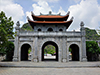
ho asaan (หออาซาน)
Thai for
minaret.
回
Ho Chatchawaan Wiangchai (หอชัชวาลเวียงชัย)
Thai. ‘Bright Victorious City Tower’. Name
of the
iconic landmark observatory on top of Khao Wang, i.e. the
‘Palace Mountain’, in
Phetchaburi,
which
is home to King
Mongkut's former summer
palace, known as
Phra Nakhon Khiri (fig.),
which loosely translates as ‘City on the Mountain’.
See also
POSTAGE STAMP
and
THEMATIC STREET LIGHT.
回
Hog Deer
Common name
for a small deer with the binomial name Axis porcinus or Cervus porcinus (fig.).
Its name is descriptive of the hog-like manner in which it runs, i.e. with its
head hung low, in order to be able to duck under obstacles, instead of leaping
over them like most other deer tend to do. When it runs, it holds its tail is
upright (fig.), showing the white underside, so that others can easily follow,
especially in the dark. Apart from the white undertail, their fur is overall
brown, with some lighter shades of sand colour on the head. Hog Deer are mainly solitary, yet come together to mate around
September-October and fawns are born about 8 months later, in the beginning of
the Rainy Season. It is found in South and Southeast Asia, as well as in
southern China. There are several subspecies including Axis porcinus annamiticus,
which is found in Thailand and Indochina. In Thai, Hog Deer are called
neua saai or simply
saai, and
tahmanae. In 1976, Hog
Deer were depicted on a Thai postage stamp, as part of a series on wild animals
(fig.).
回
%202_small.jpg)
Hog-nosed
Bat
See
kahng kahw kitti.
回
hoi (หอย)
1. Generic Thai name for
any kind of mollusk, shell, shellfish, or
gastropod, including the bivalve, clam, cockle, conch, mussel, oyster, scallop,
and the snail. The Thai Post has issued some postage stamps that portray certain
species of molluscs found in the seas around Thailand (fig.). Also transcribed hoy.
回
2.
Thai-Sanskrit term for a monkey. Also transcribed hoy.
回
hoi jaw hong kong (หอยจ้อฮ่องกง)
Chinese-Thai. Name of a Chinese snack made from a mixture of crab meat and shrimp. Similar to
haegun.
回
hoi muk (หอยมุก)
Thai name for
mother-of-pearl. See also
kreuang muk.
回
hoi nang rom (หอยนางรม)
Thai generic name for any kind of
oyster,
alternatively called hoi ih-rom (หอยอีรม).
回
hoi nguong chang (หอยงวงช้าง)
Thai. ‘Elephant-trunk
mollusk’. Name for the
Chambered Nautilus.
回
hoi thod
(หอยทอด)
Thai. ‘Fried mollusks’. Name for a typical
street food dish with egg and that originates from
China
and which in English is usually referred to as oyster omelet.
READ ON.
回
Ho Kian Phum Rot Fai (หอเกียรติภูมิรถไฟ)
Thai. ‘Hall of
credit to trains’ or ‘prestigious train hall’. A museum within
Chatuchak
Park, in
Bangkok's Chatuchak
district, housed in a former building of the
State
Railway of Thailand.
The hangar was initially built to keep King
Rama VII's royal trains and
locomotives of historical significance. Later it was renovated and converted
into the museum it is today, in order to display and preserve railway related
objects and stories. It displays steam engines, a diesel locomotive, different
train carriages, an electric tram, etc. In addition, it also houses old-timer
cars, carts and other old vehicles, including the carcass of a Japanese airplane
and an armoured patrol car from WWII, which association with trains derives from
the
Death Railway.
Besides this the museum displays one of the last steam engines produced in the
world, which was shipped to a sugar plantation in Hat Yai, but never used, due
to its unusual gauge size, which was incompatible with the local railways. Also
referred to as Train Museum, Thailand Railway Hall of Fame, Hall of Railway
Heritage and Rail Museum Bangkok.
See MAP.
回
_small.jpg)
Hokkien
(福建)
1. Hokkien-Chinese.
Name of a Southern Min Chinese dialect from China's southern Fujian (Fu-jian)
province and Taiwan, closely related to
Tae Chew
and spoken by many overseas ethnic Chinese throughout Southeast Asia, e.g.
in Indonesia, Singapore (next to Mandarin and to some extend Tae Chew) and
in Thailand (especially in
Phuket
and
Songkhla, and next to several other
Chinese dialects). Thailand today has about 8.5 million ethnic Chinese of which
7% are Hokkien. Also transcribed Hokkian and known in Mandarin as
Fujian hua (福建话),
literally a ‘dialect of Fujian’, a
coastal province in southeastern China.
回
2. Hokkien-Chinese.
Name of a group of ethnic Chinese people form southern Fujian of which there are
well over half a million living in Thailand. In Hokkien dialect they are also
called Hoklo (福佬), literally meaning a ‘man who establishes happiness’, but
usually translated as ‘Fujian man’ and written with characters that in Mandarin
are pronounced fu lao, meaning ‘good luck man’. Seventy percent of the
population in Taiwan are Hoklo, hence Taiwanese is often used interchangeably
with Hoklo.
回
hok kwai (ฮอกควาย)
Northern Thai
dialect for a wooden bell used to hang around the neck of domesticated
buffaloes, known in Thai as
kwai (fig.). The bell is cylindrical in shape, often made from
bamboo, and is flanked by two wooden clappers, attached
symmetrically on the outside. It has a warm, somewhat muffled sound. See also
pok lok.
回
%20wooden%20buffalo%20bell_small.jpg)
ho klong (หอกลอง)
Thai. The drum tower, nowadays typically in a temple or
wat, but in the past also
some towns or encampments had a drum tower.
In temples, it is sometimes in combination with a
ho rakhang (fig.)
and in religious context, the drum is used to call the monks together for prayer and -at eleven o'clock in the
morning- to indicate the beginning of the last hour in which they may have their
last meal of the day, whereas is secular context, it was used to give the time
and as an alarm and warning system for both internal threats, such as a fire or
a revolt, and external dangers, such as an enemy attack. See also
kong dap phleung
and
Rattanakosin Drum Tower.
回
Hok Lok Siw
(ฮก ลก ซิ่ว,
福禄寿)
Thai-Tae Chew. Three Chinese gods who
in art are usually depicted as a trio with long beards
(fig.). They are generally known as Hok, Lok and Siw,
Thai-Chinese names that represent Happiness, Wealth and Longevity respectively.
In Mandarin, they are named
Fu Lu
Shou (fig.),
in Vietnamese Phúc Lộc Thọ (fig.)
and in English, they are sometimes referred to as the Three Star Gods, due to their
correspondent stars in ancient Chinese astronomy. Unlike the order of their
names, the god Hok (Fu)
is traditionally placed in the centre and is easy recognizable by his
distinctive headdress. In addition, he usually holds a
ruyi
(fig.). Siw (Shou), the god of longevity always carries a staff
with a dragonhead and the
Peach of Immortality
in his hands, and has a
semi-bald, oversized, abnormally high forehead. He is sometimes shown to
carry a
nahm tao
bottle gourd. Lok (Lu) also wears a hat, but a smaller one, and carries an imperial
scroll with him. In 2010, the trio is commemorated on a set of three postage
stamps, one for each individual (fig.).
回
Holi (होली)
Sanskrit. Festival associated with the Hindu god
Krishna,
and celebrated mainly in India, but also in countries with a large Indian
population. It is also known as the Festival of Colours and participants throw
coloured powder, known as abir, and water at each other. It is celebrated at the end of winter,
on the day of the last full moon of the Indian lunar month Phalguna, usually in
February or March.
Bhang
kulfi
is said to be a must-have dish for Holi.
回
ho mok (ห่อหมก)
Thai. Name for
a dish of steamed fish
with
curry
paste, and topped with some
coconut
cream, slivers of very finely cut
makrud leaf, a small piece of parsley, and a
long thin slice of a red chili pepper. If served in the traditional way, it is
put in a
krathong, a small container made from
banana leaves.
回
%20steamed%20fish%20with%20curry%20paste_small.jpg)
hom pah (ห่มผ้า)
1. Thai. To cover the shoulder or body with a piece of cloth.
回
2. Thai. The application of a saffron cloth to
Buddha images
(fig.), trees (fig.),
phra chedi
(fig.),
or other sacred items or objects of veneration. It is usually applied to
symbolically protect the object, either from desecration or from cold, which is
why many temples will apply the cloth at the beginning of the cool season. The
term may also be specified by appending a suffix of the object the cloth is
applied to, i.e. hom pah
phra, hom pah phra chedi, etc. See also
pah phrae mongkon.
回
,%20draping%20a%20saffron%20cloth%20on%20a%20Buddha%20image_small.jpg)
hohng (โหง)
Thai. As a verb the word means ‘to die an
unnatural death’, but as noun it means ‘ghost’ or ‘spirit’, i.e. the
ghost or spirit of someone who has died an unnatural death.
Sometimes transcribed hong. See also
Hohng Phraai.
回
Hohng Phraai (โหงพราย)
Thai. Name of
a female spirit (hohng)
in the story
Khun
Chang Khun Paen, which was invoked by
Khun Paen's own ghost, a boy called
Kumaanthong. Hohng Phraai is depicted on the
third design of a set of four postage stamps (fig.)
on the story, issued in 2011 to mark
National Children's Day. Sometimes transcribed hong
phraay. See also
phi phraai.
回
ho
naligah (หอนาฬิกา)
Thai for ‘clock tower’.
See also
naligah and
Royal Clock Tower.
回
hong (หงส์)
Thai name for
a sacred swan,
goose
(haan)
or
gander (fig.),
which in
Hinduism is the
vahana of the god
Brahma, and
which in
Sanskrit
is known as
Hamsa and in
Pali
as
hongse. In
Buddhism,
the
Buddha himself was once born as a holy swan, who –while in that
chaht–
was governing 96,000
hong.
See also THEMATIC STREET LIGHT (1),
(2),
(3),
(4),
(5),
(6),
(7),
(8),
(9),
(10),
(11),
(12),
(13),
(14),
(15),
(16) and
(17).
回
%201_small.jpg)
hong bao (红包)
Chinese. ‘Red
package’. Red packages or red envelopes are traditional monetary gifts in
Chinese society which are given during festivals and on special occasions, such
as new year, weddings, etc. The red colour symbolizes good luck and sometimes the
envelopes bear the Chinese character
Sang-i,
meaning ‘double happiness’, especially if donated during weddings and usually
printed in gold (fig.). The amount of
money in the envelopes, also called
lishi, should be of even numbers, as odd
numbers are associated with cash given during funerals and considered bad luck.
However, since the Chinese word for four (sì) is a homophone for to die (sĭ),
any amount of cash with this number should also be avoided, whereas the number
eight (bā) is associated with wealth and good fortune, and is therefore commonly
found in the red envelopes. During
Chinese New Year, hong bao are customarily
given by the elderly who already have an income to the younger who don't yet
work, but in some places it are the married that give to the unmarried,
regardless of age. The tradition of the monetary envelopes goes back to when
elderly Chinese would tie coins together with a red string for protection
against sickness and injuries (fig.). These money strings, called
yasui qian,
were gradually replaced by red envelopes when printing presses became more
widespread. The hong bao are today still referred to as yasui qian. Though the
colour red symbolizes good luck, writing someone's name in red ink is considered
bad luck, as in Thailand the name of a deceased person was in the past written
in red on the coffin when it was stored -often for long periods to allow enough
time for funeral preparations and relatives to attend- before being cremated,
and in China death
notices (obituaries) are traditionally written in red ink. Thus, to write
someone's name in red indicates either that they have died or that they have
been cut out of ones life. In Thai
called
hang pao.
回

Hong Kong Butterflyfish
Common name for a species of reef fish
native to the Western Pacific Ocean and in Thailand commonly found around
Koh Tao (fig.).
It has the scientific designation Chaetodon
wiebeli and is therefore also referred to as Weibel's Butterflyfish. It grows up
to around 16 centimeters in length
and is
overall bright yellowish to orange in colour, with a broad black and a broad
white band on the caudal fin, and similar facial markings. They often occur
either in pairs and in large schools. See also
TRAVEL PICTURES.
回
_small.jpg)
Hong Men
(红门)
Chinese. ‘Red Gate’ or ‘Red Door’. Name for
the red gateway doors used in imperial
China.
READ ON.
回
Hongsawadih (หงสาวดี)
Thai name for
Pegu, i.e.
modern-day
Bago,
the capital of the
Mon before annexation by
Burma.
In Mon-Burmese, it is known
as
Hansawati, in Pali as Hamsavati, and in English it is usually referred to as Hanthawaddy. It is located in the region of
the Irrawaddy Delta, and its name is a compound that derives from the
hintha, of
which a Buddhist legend stands at its origin, and the Irrawaddy River.
According to the legend, the
Buddha
visited Lower Burma, where he saw a
female
hintha
sitting on the back of a male, and foretold that the area
would some 15 centuries later become the centre of a prosperous kingdom, a
predicition believed to have materialized when two Mon princes, i.e.
the brothers Thamala and
Wimala, in 825 AD founded
the town of
Hanthawaddy,
which derived its name from the two
hintha
birds and became the dominant kingdom that ruled Lower
Burma from the 13th to the mid 16th century. Hence, its symbol
became the
double hintha, i.e. the sacred goose
Hamsa
(fig.).
See also
Pegu Medaw
and
Forty Years' War.
回
hongse
Pali. ‘Swan’. In Thailand a mythical swan often depicted in art (fig.)
and architecture, such as in the middle of temple roofs in northern Thai style,
as well as the
antefix
on some Buddhist temples, known as the
hang hongse. In Thai
pronounced
hong, and if in
gold
hong thong.
In Sanskrit
Hamsa.
See also THEMATIC STREET LIGHT (1),
(2),
(3),
(4),
(5),
(6),
(7),
(8),
(9),
(10),
(11),
(12),
(13),
(14),
(15),
(16),
(17),
(18) and
(19).
回
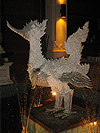
hong thong (หงส์ทอง)
Thai. ‘Golden
swan’. Another name for
Suphanahongse,
a golden
hong.
Wat Huai Leuk (วัดห้วยลึก) in
Prachuap Khirikhan's
Thap Sakae (ทับสะแก)
District, features a giant golden swan,
known in Thai as
hong thong
yak
(fig.),
that stands along the side
of the busy Phet Kasem (เพชรเกษม) Road, Thailand's longest highway that connects
the capital with the South. Akin to many hong thong statues at temples, it
reportedly initially had a bell hanging from its beak, but this was removed on
the request of the local authorities as is was deemed a hazard for —and because
of— the traffic rushing by underneath it and the aerodynamic turbulence this
causes, for fear the bell might one day be blown off and fall onto the
traffic below.
See also THEMATIC STREET LIGHT (1),
(2),
(3),
(4),
(5),
(6),
(7),
(8),
(9),
(10),
(11),
(12),
(13),
(14),
(15),
(16),
(17),
(18) and
(19).
回
hoo chalaam (หูฉลาม)
Thai term for shark fin. Although illegal in many countries it is considered a delicacy by some Chinese and can be found in a number of restaurants in
Chinatown where it is made into shark fin soup, for one. Due to its uniqueness shark fins are sold rather expensive, with prices ranging between 30,000 to 50,000
baht
for a single fin, depending
on its size and quality, or up to 100 US$ for a single bowl of soup in a Hong
Kong restaurant. The consumption of shark fin soup is however purely a fashion,
as due to the cooking processes which includes drying and bleaching, all the
taste and nutritional value is lost, so that the soup has to be flavoured
with chicken broth or some other stock. Besides this sharks are often pulled
from the water to have their fins sliced off whilst still alive and are then
thrown back into the ocean to slowly die. All this has made many countries
declare a ban on shark fins.
回
hook sword
See
gou.
回
hoo kwahng (หูกวาง)
Thai. ‘Deer ears’. Common Thai name for a
tree with the botanical name Terminalia catappa and commonly referred to in
English by a variety of names, including Sea Almond, Tropical Almond, as well as
Indian, Singapore, Bengal or Malabar Almond. The Thai common name derives from
the tree's leaves, which shape is reminiscent of the ears of
deer,
whilst the English common name derives from this tree's fruit, which resembles
an almond (fig.) and is also edible.
Fresh leaves are of a lemon green colour (fig.),
but as they mature they turn dark green and after that even red (fig.). Though its origin is uncertain, the Sea Almond and is widely found throughout
Southeast Asia. It grows to 35 metres tall,
provides plenty of shade due to its
dense foliage and the rather large leaves, and is in the wild usually found on beaches and
near fresh water, since its fruits are buoyant and dispersed by water. When
spread by humans, they are used ornamentally and can often be seen on the side
of roadways, especially in
Vietnam and in Thailand. Beside ornamental usage,
this tree's wood is described as solid and with a high water resistance, and is
reportedly used by Polynesians in the making of canoes.
回
%20ton%20hoo%20kwaang_small.jpg)
Hoolock Gibbon
A kind of
gibbon of which there
are two known species, which were initially classified as one genus, but later
placed in their own genus, i.e. the Western Hoolock Gibbon, with the scientific
name Hoolock hoolock, found in Assam, Bangladesh and western
Myanmar; and the Eastern Hoolock Gibbon,
with the scientific name Hoolock leuconedys, and found in eastern Myanmar and
southern China (Yunnan).
Nevertheless, both species are sometimes still referred to as one genus, with
the scientific name Hybolates hoolock. Males (fig.)
are mainly black, sometimes with a brown tinge, and with characteristic white
eyebrows. In contrast, females (fig.) are pale brown, with darker fur at the belly, throat and sides of the head, white eyebrows and white rings around the
eyes and around the mouth, giving them a mask-like face (fig.). They have a small
throat sac and can produce a loud call similar to that of the White-handed
Gibbon (fig.),
but every now and then followed by a loud, almost human-like euh-sound.
回
%20male%201_small.jpg)
hoo plah son (หูปลาช่อน)
Thai ‘Striped snakehead fins’. Name for a
plant with the botanical designation Acalypha wilkesiana and commonly known in
English as Painted Copperleaf, Jacob's Coat and Beefsteak Plant. This shrubby
plant with a compact foliage grows up to 5 meters tall and is typically used as
an ornamental garden plant, as well as in shared edges. It has colourful curly
leaves and small inconspicuous dark-red flowers, that are arranged in clusters
on cylindrical catkin-like racemes of between 10 and 20 centimeters in length
and partly hidden in the foliage. In Thai, it is sometimes referred to as hoo
kratai, i.e. ‘rabbit ears’.
回
%201_small.jpg)
Hoopoe
Name for a
colourful resident bird with the binomial name Upupa epops, in the family
Upupidae and with several subspecies (fig.), the one found in Southeast Asia, including
Thailand, being Upupa epops longirostris. It is ochre to orange-brown, with a
large, distinctive crest, reminiscent to that of certain woodpeckers, a slender
downward-curved bill, and a black-and-white tail and wings (fig.). They typically nest
in a hole in a tree or wall. Also known as Common Hoopoe and in Thai as
nok karaang hua khwaan. Sometimes spelled
Hoopoo.
回
_small.jpg)
ho phap
(hộ pháp)
Vietnamese term for ‘guardian’, but also
frequently used to refer to any of the
dharmapala,
as well as in front of the names of well-known protectors, such as
Wei Tuo, who in
Vietnamese is known as
Ho Phap Vi Da
(fig.).
The term also means ‘guardian of the doctrine’ and is as such used as a title
for one of the top-ranking posts of the clergy, especially in
Cao Dai, e.g.
Ho
Phap Pham Cong Tac (fig.),
which is then usually translated as ‘pope’.
Often the prefix Duc (Đức) is added to this, meaning ‘Venerable’.
回
Ho Phap Vi Da (Hộ Pháp Vi Đà)
Vietnamese. ‘Dharmapala
Vi Da’, with Vi Da being the Vietnamese name for the general-bodhisattva,
who in Chinese is known as
Wei Tuo. See also ho
phap.
回
Ho Phrathat Monthien (หอพระธาตุมณเฑียร)
Thai. Name of a group of buildings within
the inner court of the
Grand Palace
in
Bangkok, which
play an important role in royal rituals and ceremonies.
回
Horadih (หรดี)
1. Thai. ‘Southwest’ or
‘southwestern’. The wind direction guarded by the
lokapala
Nairitti. See also
Udon,
Isaan,
Burapah,
Ahkney,
Thaksin Shinawatra (丘达新),
Prajim and
Phayap.
回
2. Thai name for the southwestern wind. Also known as
phat taya.
回
ho rakhang (หอระฆัง)
Thai. The belfry in a
wat.
The bell is rang to call the monks and novices to the
ubosot. Sometimes the belfry in a
temple is combined with the
ho klong,
the drumtower (fig.).
The drum however is beaten for other reasons, that is, either to call upon the
laity to come and make merit (tamboon)
in the temple on Buddhist holy days (Wan Phra),
or in honor of the
Buddha. But if both the drum
and bell are beaten alternately, it is to tell the time. It is used in both
Theravada and
Mahayana Buddhism and can thus also
be found in Chinese temples (fig.).
The famous belfry of
Wat Phra Kaew,
i.e. the Temple of the
Emerald Buddha
(map
-
fig.),
is depicted on a postage stamp issued in 1967 (fig.).
See also
rakhang.
回
hora-phaa (โหระพา)
Thai designation for a plant with the
botanical name Ocimum basilicum var. thyrsiflora, and commonly known in English as Thai Basil.
See also
kaphrao.
回
%20Ocimum%20sanctum%20basil%202_small.jpg)
Ho Ratsadakon Phiphat (หอรัษฎากรพิพัฒน์)
Thai. ‘Hall of Fiscal Prosperity’. Name of a building within the compound of the
Grand Palace in
Bangkok, that dates back
to the early
Rattanakosin
Period and today houses the
Queen Sirikit Museum of Textiles
(fig.).
READ ON.
回
hornbill
Large bird with the scientific Latin name
Rhyticeros plicatus. Of these birds, thirteen different species live in the woods of Thailand,
i.e. the Great Hornbill (fig.),
Bushy-crested Hornbill
(fig.),
Wreathed Hornbill (fig.),
Rhinoceros Hornbill
(fig.),
Oriental Pied Hornbill (fig.),
Plain-pouched
Hornbill (fig.),
Wrinkled Hornbill
(fig.),
Rufous-necked Hornbill (fig.), Tickell's Brown Hornbill
or
Rusty-cheeked Hornbill (fig.),
the Austen's Brown Hornbill (which is sometimes listed as a subspecies of the Tickell's Brown Hornbill,
whilst both are also commonly referred to as just
Brown Hornbill),
the
White-crowned Hornbill (fig.),
Helmeted Hornbill and
Black Hornbill
(fig.). Seven species of these are listed as endangered. They get their name from the horn or
‘helmet’ on top of their beak. During the breeding season the female will stay in a nesting hole high up in a tree. The opening of the hole is largely closed with a mixture consisting of mud, food remains and droppings, with just a small opening kept to collect the food carried up by the male bird. The best place to see these birds is Khao Yai National Park. The bird can have a length of up to 130 cms and is sometimes called large hornbill, and by some
‘Buddha bird’, since its morning call will wake up the monks and gathers them for morning prayer. Its call, sounds like a repeated
‘gok, gok, gok’ followed by a scream that sounds like ‘gahang’ or ‘gawa’. In
1996, a set of four postage stamps was issued for the occasion of the Second
International Asian Hornbill Workshop, displaying four different species of male
and female hornbills (fig.). In Thai
called
nok ngeuak and
nok hang.
回
horse
See
mah.
回
Horseradish Tree
See
ma-rum.
回
Horseshoe Bat
Name for a large family of
bats, with the
scientific name Rhinolophidae. The name refers to a broad,
horseshoe-shaped anterior nose-leaf, that characterizes these bats.
Besides this they also possess a tall pointed posterior nose-leaf,
large ears, and a medium-length tail, which is fully enclosed in the
interfemoral membrane, i.e. the membrane that stretches between the
legs of bats, used for flight, and in the case of insectivorous
bats, also for catching prey. In Thai it is called
kahng kahw mongkut, meaning ‘Diadem
Bat’.
See also WILDLIFE PICTURES (1)
and
(2).
回
_small.jpg)
Horseshoe Crab
Name of a
prehistoric arthropod with a stiff pointed tail and a carapace in
the form of a horseshoe, hence its name. It belongs to the family of Limulidae
and is related to the scorpion. Horseshoe Crabs feed
mostly at night and burrow for worms and mollusks. They will, however, feed at
any time and can go a year without eating. They swim
upside down (fig.)
and can endure extreme temperatures and salinity. A
horseshoe crab has ten eyes and can see UV light.
Some extracts of its blue, copper-based blood, as well as from certain properties
of its shell, are used medicine. In Thai, it is known by the generic name
maengda
thalae and
there are worldwide just 4 genera, 2 of which are found in Thailand, i.e. the
Mangrove Horseshoe Crab (Carcinoscorpius rotundicauda) and the Indo-Pacific or
Southern Horseshoe Crab (Tachypleus gigas), and a third one in East and
Southeast Asia, i.e. the Chinese, Japanese or Tri-spine Horseshoe Crab (Tachypleus
tridentatus).
See also
THEMATIC STREET LIGHT.
回
_small.jpg)
Horse Tamarind
See
krathin.
回
Ho Hsien-ku (何仙姑)
Chinese. Name of the only female member of the
Eight Immortals (fig.),
often referred to as Immortal Woman He, a free translation of her name which may
also be transcribed
He Xiangu. She was born in Guangdong province as the daughter of a wealthy
family. At the age of fourteen she made a vow to remain a virgin and a deity
appeared to her in a dream. In order to become an immortal she was instructed to
consume very fine powdered mica, a brilliant kind of mineral. She took the
powder as ordered and gradually gave up taking ordinary food all together,
surviving solely on mica crystals. She could walk so fast, that she seemed to be
flying and often wandered in valleys to gather mountain fruits. Eventually she
ascended to heaven and became an immortal. She is usually portrayed holding a
long-stalked
lotus flower, that has the power to improve one's mental and
physical health. Her mount is
a
deer (fig.).
回
_small.jpg)
hot spring
See
nahm phu ron.
回
ho trai (หอไตร)
Thai. The library building
or scripture hall in a
wat containing the
scripture cabinets that hold palm leaf
Buddhist manuscripts called
Traipitok, which are written on fragile
bai lahn. In the past, it was generally built
from wood and on poles in a pond or water basin
(fig.), in
order to protect them against fires, as well as to prevent crawling insects
and
termites from reaching the scriptures and damaging them
(fig.).
It is then also referred to as ho trai klahng nahm (หอไตรกลางน้ำ).
Occasionally, it is also referred to as pitokkhara (ปิฏกฆร),
which could be translated as ‘basket dwelling’ i.e. ‘manuscript building’, with
the word
pitok literally meaning ‘basket’, but actually
referring to any one of three parts of the Buddhist scriptures known
collectively as
Traipitok.
Some are simple structures, others have been elaborately decorated (fig.).
Sometimes referred to as ho phra trai (หอพระไตร) and ho phra traipitok (หอพระไตรปิฏก).
See also TRAVEL PICTURES.
回
hou feng didongyi (候風地動儀)
Chinese. ‘Apparatus to watch (or inquire
after) the manner of earthquakes’. Name of the world’s first seismoscope,
invented in 132 AD by
Zhang Heng, and able to
discern the cardinal direction of an earthquake
up to
over
500 kilometers away. It consists of a
bronze, urn-shaped device with a pendulum inside, that would swing in the
direction of where an earthquake took place and in doing so triggered a
mechanism that released a bronze ball from the mouth of one of eight projections
shaped as a
dragon, dropping it
into one of the eight cups below, that were shaped as bronze frogs seated on the
floor around the urn and of which each represented a direction of an
eight-pointed compass. The mouth of the frog into which the ball fell would then
roughly indicate the direction of the earthquake and allowed for the authorities
to quickly send in aid to the region affected.
回
House
Crow
Common name for a bird in the crow family Corvidae,
with the scientific name Corvus splendens, and of Asian origin. This 40 to 43
centimeters large bird is brownish-grey, with a glossy-black forehead, crown and
throat, as well as black wings, tail and legs. There are several subspecies and
the one found in Thailand has the Latin designation Corvus splendens insolens.
It occurs in peninsular Thailand and is known in Thai as
ih-kae, which is related to
ih-kah, i.e. the Thai word for ‘crow’.
The nominate race is found in India, Nepal and Bangladesh.
See also WILDLIFE PICTURES.
回
_small.jpg)
House Gecko
See
jingjok.
回
House of Museums
Museum established by the Cultural Affairs Association to show how simple life was in days of yore. Although the edifice is not in the older style stepping inside takes you back into the past. The objects on display vary from old utensils and paraphernalia to sepia photographs and maps of Thailand from way back.
回
House of Opium
Museum
at the
infamous
Golden Triangle in
Chiang Rai,
an
area that got
its name from the cultivation of
opium.
This
small museum
has a permanent
exhibition and aims to educate about opium, portraying
many aspects of the
cultivation of
opium, as well as its
trade and use. Known in Thai as Ban
Fin.
The many objects on display include
opium scales
(fig.),
opium-sets (fig.),
opium pipes
(fig.),
opium weights (fig.),
opium
boxes (fig.),
as well as didactic
presentations
(fig.).
See MAP
and
WATCH VIDEO.
回
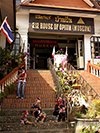
House Sparrow
Common name for a 15 centimeter tall passerine bird, with the binomial name
Passer domesticus (fig.). The subspecies that prevails in mainland Southeast Asia is
known by the scientific name Passer domesticus indicus, and occurs from
Myanmar
in the West and
Laos
in the North, to Singapore in the South.
Sparrows are social birds and for protection they often gather together in large
numbers in order to increase their chances of spotting predators early and alert
the rest of the flock. Adult
males in breeding plumage (fig.) have a grey crown and rump, grayish-buff underparts,
and white head-sides with a chestnut patch that runs from behind the eye to the
sides of the nape, as well as a large black bib, i.e. a patch on the chin and
breast. Furthermore, they have a black bill and a brown mantle, streaked with
black, white and buff. Outside the breeding season, the crown of the male is
browner, the mantle greyer, and the bill is more pale. In addition, the sides of
the nape and crown are also paler, and the sides of the bib are streaked with
white. Females (fig.) are non-descript and are overall paler, lacking the black and
chestnut colours of the breeding male. Their bill is pale and they have a
whitish supercilium (fig.). The legs and feet of both sexes are pinkish to
grayish-beige. In Thai House Sparrows are
commonly called nok krajok yai (นกกระจอกใหญ่), meaning ‘large sparrow’.
Confusingly, the Thai designation nok krajok baan (นกกระจอกบ้าน), which
literally translates as ‘house sparrow’, is used for the Eurasian
Tree Sparrow
(Passer montanus -
fig.).
See also WILDLIFE PICTURES
and
WATCH VIDEO.
回
%203_small.jpg)
howdah (หอดา)
Thai name for
the seat or saddle on an
elephant's
back (fig.),
usually made from wood and sometimes covered with a hood (fig.). The howdah of a wealthy person is often made from precious materials, such as ivory.
To cushion the weight of the howdah, prior to placing it onto the elephant's back, several layers of matting
made from the bark of a tree, locally referred to as the red tree, are laid on
first, followed by a thick
bamboo mat. The howdah is then
usually lowered onto the elephants' back from an elevated position using a
pulley,
which in Thai is called
look rok (fig.).
Howdah are commonly seen as interior decoration in e.g. hotel lobbies (fig.).
Also transcribed hohdah, hawda, hoda or hodah.
回
_small.jpg)
Ho Woht 101 (หอโหวด ๑๐๑)
Thai. ‘Roi Et
Woht
Tower’.
Name of a
101 meter high tower built in the form of a
woht
(fig.),
an
Isaan folk instrument.
It opened
in December 2020 as a new landmark in the city of
Roi Et, and
is also
known by the
names Roi Et (City View) Tower, 101 Tower, and simply Ho Woht. The
tower is highly symbolic as it combines the
province's
name in its
height, as Roi Et means ‘101’,
with its local
symbol and
OTOP
product the woht. The interior of the building is decorated with
depictions of local and contemporary stories, as well as with a
crystal Lagerstroemia macrocarpa flower, the provincial flower,
known in Thai as dok inthanin-bok (ดอกอินทนิลบก).
See also POSTAGE STAMPS
and
WATCH VIDEO (1)
and
(2).
回
_small.jpg)
Hpaung Daw U Buddhas
Name of five small, highly venerated
Buddha images located in
Myanmar's Hpaung Daw U Pagoda (fig.) in
Shan State, and that
are covered in
gold leaf to the point that their original forms can hardly be
distinguished. Although on occasion some of the gold is removed
to reduce its mass, worshippers continue to apply new gold leaves in
order to make merit, a practice reserved only for men though, as
women are not allowed to go onto the shrine's platform. Once a year,
during the Hpaung Daw U Pagoda Festival, four of the five Buddha
images (one always remains at the temple) are put on a
karawak-like
(fig.)
barge,
known as the
Hintha Barge
(fig.), in a procession around the lake (fig.), stopping at all
the main villages and towns, allowing the locals to worship and make
merit. Copies of the Hpaung Daw U Buddhas (fig.) can be found in Buddhist
temple's in Thailand's
Mae Hong Son
province, which has a large population of Shan people. Also transcribed Paung Daw Oo Buddhas.
回
%201_small.jpg)
Hpaung Daw U Pagoda
1.
Name of a
Buddhist
temple
on
Inle
Lake
in
Myanmar's
Shan State and that houses the
Hpaung Daw U Buddhas (fig.)
Also spelled Hpaung Taw Oo.
See EXPLORER'S MAP and
TRAVEL PICTURE.
回
2. Name
of a Buddhist
temple
in Mandalay, located opposite of the
western entrance corridor
of the
Mahamuni Buddha (fig.)
temple complex. Its full name in
Burmese
is
Law Ka Teu Kaung Hpaung Daw U Myat Swa Phaya,
which freely translates as ‘Head
of the World Great Buddha
Pagoda’.
Also spelled Hpaung Taw Oo.
See EXPLORER'S MAP and
TRAVEL PICTURE.
回
hsei bo lei (ဆေးပေါ့လိပ်)
Burmese name for the
cheroot-cigar.
回
hsiang chi (象棋)
See
xiang qi.
回
hsien (仙,
เซียน)
Chinese-Thai. See
xian.
回
Hsi Ling Shih (西陵氏)
See
Xi Ling
Shi.
回
hsun ok
(ဆွမ်းအုပ်)
Burmese name for a conical, usually
cone-shaped, tray-like food container with a stand (fig.), which used for offering
food, especially to Buddhist monks. Pronunciation is rather
suan
ok. In Thailand, similar food containers are
referred to as
tiab.
回
hti (ထီး)
1. Burmese. An
ornamental, ceremonial parasol
in
Myanmar,
which is used both stationary, e.g. at
Buddhist temples or festivals, and portably,
e.g. in ceremonies and parades,
and intended as an item of respect towards certain
objects, such as
Buddha images or other
religious items, as well as towards revered people, such as monks. See also
rom thong and
chattra.
回
2. Burmese. An
ornamental part in the form of a lacy umbrella crowning the spire of a Buddhist
stupa in
Myanmar,
i.e. a tiered and ornamented finial. It usually also has a
nga myat na, i.e. a flag-shaped ornament in English usually referred
to as the vane (fig.). See also
chattra and
plih.
回
_small.jpg)
3. Burmese.
Parasol which forms a part of the royal regalia of
Myanmar,
as well as a parasol designated and bestowed by the monarch on officials as
insignia of rank.
回
4. Burmese. A
miniature paper umbrellas used as offertory in
Myanmar.
The practice of using small paper parasols on offerings is also found in
northern Thailand.
回
Htibyuhsaung (ထီးဖြူဆောင်း)
Burmese.
‘Lord of the White Umbrella’.
One of 37
nats that
belong to the official pantheon of spirits
worshipped in
Myanmar. In life, this
spirit was the ca. 10-11th Century King Kunhsaw Kyaunghpyu, the father of King
Anawrahta (fig.),
the founder of the
Pagan
Empire.
Though having raised his two stepsons, Sokkate and Kyiso, as his own sons, when
they reached manhood, they forced Kunhsaw to abdicate and become a recluse, with
Kyiso taking over the throne. The deposed King Kunhsaw remained a recluse for over two
decades. Then, in 1044, Kyiso' successor Sokkate took one of Kunhsaw's former
consorts, namely the mother of Anawrahta, as his wife. This so angered Anawrahta,
that he challenged and killed Sokkate in a duel. Anwarahta offered the throne back
to Kunhsaw, but the latter refused and instead allowed Anawrahta to ascend the
throne. Kunhsaw died four years after his son Anawrahta ascended the throne, in
ca. 1048 AD. See also
Pareinma Shin Mingaung
and
LIST OF BURMESE NATS.
回
Htibyuhsaung Medaw (ထီးဖြူဆောင်း မယ်တော်)
Burmese.
‘Royal Mother of the Lord of the White
Umbrella’ or ‘Royal Mother of
Htibyuhsaung’.
Name of a female spirit that
belongs to the official pantheon of
37
nats
worshipped in
Myanmar. During her life
she was the mother of King Kunhsaw Kyaunghpyu and thus also a grandmother of
King Anawrahta, the founder of the
Pagan Empire. She reportedly
died of illness.
See also LIST OF BURMESE NATS.
回
Htilominlo (ထီးလိုမင်းလို)
Burmese.
‘Do You Want the
Hti?’
or ‘Appointed by the [Royal] Umbrella. A designation for the
Pagan
King
Zeya Theinkha Uzana,
also known as King Nadaungmya, after his father used his
chattra,
i.e. his royal umbrella,
to determine who of his five sons was to become his successor to the throne,
i.e. by holding the umbrella upright
and letting go of it, thus allowing it fall over and proclaiming the heir to the
throne to whomever the umbrella would point.
In 1218 AD, King Zeya Theinkha Uzana
had a temple constructed which is named
Htilominlo Phaya. King Htilominlo reigned from
1211 to 1235 AD, and was succeeded by his son
Kyaswa
(fig.).
回
Htilominlo Phaya (ထီးလိုမင်းလိုဘုရား)
Burmese.
‘Htilominlo
Pagoda’
or ‘Temple of the Appointment by [Royal] Umbrella’. Name of a three-storey, 46
meter high, Buddhist temple in
Bagan.
READ ON.
回
hua chai poh wahn (หัวไชโป้หวาน)
Thai. Preserved East Asian white radish
(hua chao thao),
stir fried with sugar, salt and
fish sauce.
It may be eaten as a side dish, e.g. with
khao chae (fig.),
or mixed with egg and eaten as a dish in its own right, which is referred to as
hua chai poh wahn phad khai (หัวไชโป๊หวานผัดไข่ -
fig.).
回
%20white%20radish%20stir%20fried%20with%20sugar_small.jpg)
hua chao thao (หัวไช้เท้า)
Thai name for East Asian white radish, a
vegetable with the scientific name Raphanus sativus longipinnatus and widely
used in oriental cuisine for its mild flavour (fig.). It is often referred to by its
Japanese name daikon, though it did not originate in Japan, yet it has the most
varieties. In Thailand, it is also called hua phak kaad (หัวผักกาด) and phak
kaad hua (ผักกาดหัว). In the northern Thai village of Doi Mae Salong, in
Chiang Rai
province, members of the -largely Chinese- community slice-up the
roots, hang them out to dry in the sun and wind, and then mix them
with chilies and other local spices to make a crunchy, Chinese-style snack (fig.).
See also
hua chai poh wahn.
回
%20East%20Asian%20white%20radish_small.jpg)
huad (หวด)
Thai. A basket used for steaming
foodstuffs, such as glutinous
rice, sesame, nuts, beans, etc. But more popular
than anything else it is used for steaming glutinous rice
(fig.) It is generally woven from thin
bamboo strips. Its form
is somewhat cone shaped with a tapering bottom and a wide mouth. Besides its use
in cooking it is also used to be made into
Phi Tah Khohn
masks (fig.).
回
hua daeng (วัวแดง)
Thai. Literally ‘red cattle’, i.e. ‘red
bull’ or ‘red cow’. Term used for the
Banteng.
回
hua da jie (花大姐)
An informal Chinese
term for
‘ladybug’, as well as one generic name for a kind of bug, which is found in
China and
specified as
ban yi zha chan (fig.),
with the scientific designation Lycorma delicatula.
It is also called
hua xi fu and is in English commonly referred to as Lycorma Planthopper.
回
Hua Ha (ฮั้วฮะ)
Thai-Tae
Chew name of a
statue or a portrait of a loving couple of Chinese Immortals (Xian),
in which usually the man is depicted holding a
lotus leaf and lotus flower,
whilst the girl holds a rounded
Chinese wedding box
or basket
(fig.), which sometimes is
decorated with a
stylized Chinese
bat-symbol
known as
fu
(fig.),
and which may –or may not– be depicted open to release one or more bats (fig.),
that represent good luck.
The statue is said to promote love and amicable relations, and to bring harmony
or reconciliation into households and work places, where it is erected.
Occasionally, one of the characters seems to be either an effeminate boy or a
girl, though it may also depict two male or two female figures, thus promoting
love and amicable relations between friends of the same sex (fig.).
回
_small.jpg)
Hua Hin (หัวหิน)
Thai. ‘Head of stone’ or
‘rock head’. Beach resort town in
Prachuap Khirikhan province, 220 km from
Bangkok. The town has a long white sandy beach lined with a range of accommodations, from bungalows to 5-star hotels and resorts. The beach with its tranquil atmosphere runs from a rocky headland (hua hin) which separates it from a tiny fishing pier and gently curves for some 3-4 km to the
South, where it ends at the foot of Khao Takhiap, a hill with a large standing Buddha statue. From the hilltop a birds eye view of Hua Hin can be enjoyed, a delightful view, both at night and during the day. Its places of interest include its railway station, one of the nations oldest train stations with an unique architecture
(fig.). Its most striking feature is the royal waiting room constructed in the
jaturamuk style.
Originally, during the reign of King
Rama VI,
it was part of the Sanam Chan Palace in
Nakhon Pathom province.
Later, in 1968, the
room was relocated to Hua Hin to become the royal waiting room at the local
trainstation. Another feature in Hua Hin is the Klai Kangwon Palace, the
permanent summer palace of King
Rama IX and which name in
translation means ‘far from worries’. The palace consist of three Spanish style
mansions facing the sea. It is constructed to the north of town under royal
command of King
Rama VII. Today it is the permanent summer residence of the king who often comes here to sail. It is open to the public but prior to a visit a permit must be obtained from the Royal Household Office.
See MAP and
WATCH VIDEO (1),
(2),
(3)
and
(4).
回
%201_small.jpg)
hua khon (หัวโขน)
Thai name for a kind of mask worn by
khon
dancers (fig.).
There are several types, each usually representing a certain character from the
Ramakien. They
typically cover the entire head and their
production has become an art form in its own right, resulting in the creation of detailed
miniature masks (fig.), that are
produced
solely for collecting (fig.).
They are made of wood and papier-mâché, which includes
sah-paper,
khoi-paper, and paper made from straw. The
masks are initially shaped by pressing around 15 layers of paper over a soaped
terracotta mould, sticking them together with a paste
made of
rice-flour. Then, each mask is further sculpted and covered with black
lacquer, which is applied as a primer before being painted and covered with
gold leaf. Next, each
mask is finished with decorative lines and other ornaments according to its
kind, using small pieces of coloured mirrors,
kranok
motifs,
mother-of-pearl,
cow-hide, etc.
There are two styles of eyes that are characteristic of khon characters and thus
of masks, especially with the demons or
yak: the one is known as
tah jorakae, i.e. ‘crocodile eyes’, and refers
to eyes of which the lid partly covers the pupil (fig.);
the other is known as
tah phlohng i.e. ‘wide open eyes’, and refers
to wide open eyes, with somewhat bulging eyeballs and of which the pupil is
completely visible (fig.). Khon masks are an esteemed
collector's
item and the
Kukrit Heritage Home in
Bangkok
houses a significant collection of hua khon masks
(fig.),
gathered by
Kukrit Pramoht (fig.),
a former Prime Minister of Thailand and
founder of the Khon
Thammasat
Troupe (fig.).
Khon masks have been publicized on Thai postage stamps on a number of occasions,
i.e. in 1975 (fig.),
in 1981 (fig.),
and to commemorate the
Thai Heritage Conservation Day
in 2013 (fig.).
WATCH VIDEO.
回
_small.jpg)
Hua Lampong Train Station
Name of
Bangkok's Central Station, located at the far end of
Rama IV Road in Pathum Wan
District, at the terminus of the
Bangkok Metro
(fig.).
It is operated by the State Railway of Thailand and was opened on 25 June 1916,
during the reign of
King
Vajiravudh (Rama
VI), though its construction started in 1910, at the
end of
Rama V's reign. The station is
named after a former field in this location, which had herds of cattle in it
that went about noisily, and was hence called thung hua lampong (ทุ่งวัวลำพอง),
i.e. ‘wild cattle field’. The word thung (ทุ่ง), which means ‘field’, was
dropped and the word hua (วัว) changed into hua (หัว), which means ‘head’, both
literally and figuratively. During World War II, the Allies made an attempt to
bomb the train station as it was used by the Japanese occupying forces to
transport troops and war material, but they hit a nearby hotel instead. There
have also been a number of accidents with trains jumping the tracks and crashing
onto the platform, with the latest incident as recent as August 2010. In Thai
known as satanee rot fai hua lamphong, also transcribed satanih rot fai hua
lampohng (สถานีรถไฟหัวลำโพง). See also
Ho Kian Phum Rot Fai
(fig.)
and
Wat Hua Lampong
(fig.),
as well as
POSTAGE STAMPS,
THEMATIC STREET LIGHT,
and
MAP.
回
_small.jpg)
huan (ฮวน)
Thai-Chinese. A foreign person, from the viewpoint of a Chinese. Also
huan nang.
回
Huang Di (黄帝)
Chinese name
for the
Yellow Emperor.
回
huan guan (宦官)
Chinese.
‘Imperial government official’. A term for a
court eunuch in Imperial China.
回
huan nang (ฮวนนั้ง)
See
huan.
回
Huan Xi Fo (歡喜佛)
Chinese. ‘Happy Buddha’. Popular name of a Buddhist figure who is also known by the Chinese
name
Budai (fig.). He is the interpretation of the
bodhisattva
Maitreya, the future
buddha predicted to succeed the
Sakyamuni
Buddha. He is the god of
happiness and wealth. His image is based on an unconventional Chinese
monk
who lived in the time of the Liang Dynasty and is usually depicted as a
deity of satisfaction and abundance, often holding a cloth bag full with
precious items or gold, and other attributes, such as a water jar, gold coins, a
ruyi (fig.),
a gold ingot, a
pagoda, etc. He has integrated into
Buddhist,
Taoist
and Shinto culture, and is commonly represented as an obese smiling or laughing
figure, hence his nickname. It is believed that rubbing his belly brings forth
happiness, wealth, good luck and prosperity. He is therefore often worshipped as
an informal
Chinese wealth god. Variously called
‘Laughing Buddha’, ‘Smiling Buddha’,
Mi Le Fo,
Fu Gui
Fo (富贵佛
-
fig.), and Hotei. In Thailand, he is often confused with
Phra Sangkatjaai
(fig.).
See also
Angaja and
TRAVEL
PICTURE.
回
hua plih (หัวปลี)
Thai. The
edible inflorescence of a
banana plant. This is stripped of its
purple petals and sliced or shredded and to prevent it from rapidly turning dark
it can be brushed with lemon juice. It is used to make a northern style squash
soup, as an ingredient for a kind of salad (fig.) and especially, served fresh and
sliced (fig.) with the
dish
phad thai.
They are available on many fresh markets but can also be found canned or dried.
Also called banana flower, flower-bud or
flower-head, banana blossom, banana bud and banana
inflorescence. Sometimes
transcribed hua plee and also just plih.
回
_small.jpg)
hua xi fu (花媳妇)
Chinese.
One generic name for a kind of bug, which is found in
China and
specified as
ban yi zha chan (fig.),
with the scientific designation Lycorma delicatula.
It is a
synonym for
hua da jie and is in English referred
to as Lycorma Planthopper.
回
Hue (Huế)
Vietnamese. From 1802 to
1945 AD, the political and imperial capital of the Nguyen Lords, a feudal
dynasty in
Vietnam, that since the 17th century had dominated much of southern Vietnam and
from 1802 onward, with the foundation of the Nguyen Dynasty by the Emperor Gia
Long, took control over the whole of Vietnam. It is considered one of the cultural, religious and learning
centres of Vietnam.
The city's many historical monuments, such as the
Citadel (map), still witness of this glorious past. The
Citadel consists of a large, walled area on the North side of the Perfume River
(map
- fig.)
and encloses the Imperial City which includes the Forbidden Purple City, a palace modeled along the lines of the Forbidden
City in Beijing (map
-
fig.) and once reserved for emperors, their concubines and those close
enough to be granted access, the punishment for trespassing being death.
Due to this, some of the names given to certain
buildings and gates
()
within the stronghold (map
-
fig.) are coined on
or inspired by those of it's Chinese counterpart.
According to Chinese cosmology, the colour purple was a symbol of joy
and happiness, as well as that of the polestar. The residence of the emperor,
who was regarded as a Son of Heaven, was hence a purple city at the centre of
the mortal world, and only the emperor could use the colour purple, hence the
name Forbidden Purple City, in Chinese Zi Jin Cheng (紫禁城), which may also be
interpreted as the ‘Forbidden City of the Polestar’. Within the compound of the
Citadel,
on the southeastern corner of the Imperial City, is the
Hue War
Museum (map
-
fig.). See also
Huệ and
PANORAMA PICTURE.
回
Hue (Huệ)
Vietnamese name for the
Tuberose. See
also
Huế.
回
hu lu
(葫芦)
Chinese name
for a calabash, which in Thai is known as
nahm tao.
Also transcribed hoo loo and sometimes wu lou.
回
hulusi (葫芦丝)
Chinese.
Name for the cucurbit
flute, i.e. a kind of reed (lu) wind instrument made from a gourd (hu), that
belongs to plant family Cucurbitaceae, hence the designation cucurbit.
Combined
the Chinese words
hu lu
translate as
‘calabash’, but separately they mean ‘gourd’
and
‘reed’
respectively, with the latter
referring to two or three
bamboo
pipes that are attached to the gourd, of which
one has finger holes and the other serve as drone-pipes. In addition, the
Chinese name also includes the word si (丝), which means
‘silk’
and refers to the instrument's
sound, which is described to be as smooth as silk. The hulusi is somewhat
reminiscent of the Indian
pungi
(fig.).
Also transcribed hoo loo si.
WATCH VIDEO.
回
_small.jpg)
Human Body Museum
A somewhat uneasy, disconcerting museum in
Bangkok's Pathumwan District, that exhibits several dissected human bodies, body
parts and internal organs, as well as human skeletons, from Japan. It is located
at the Faculty of Medicine within the
Chulalongkorn
University
(fig.),
and is used as a
scientific and didactic exhibition to educate medical students. The bodies and
body parts have been preserved by plastination, a technique which consists of
replacing water, fluids and fat inside the body with resin and plastic, yielding
specimens that retain most properties of the original sample, yet do not smell
or decay. The corpse is first preserved in formalin, then placed in a bath of
acetone at freezing temperatures, which draws all the water out of the body,
after which it is moved to a bath of liquid polymer, including silicon rubber,
polyester and resin epoxy. In the final phase, the curable polymer is hardened
by vulcanization, using gas, heat and UV light. The museum officially opened its
doors on 14 August 2012, and was at that time the eleventh of its kind in the
world. In Thai, its is known as
Phiphithaphan Rahngkaai Manut
(พิพิธภัณฑ์ร่างกายมนุษย์) and in English it is officially referred to as Museum
of Human Body. Its design and objectives are similar to those of
the
Congdon Anatomical Museum (fig.),
which is a section of the
Siriraj Hospital Museum.
See MAP.
回
Hummingbird Fuchsia
Common name for a perennial plant, with a
pink-and-purple hanging lantern-like flower, and with the
botanical name Fuchsia magellanica. Known to be drought
tolerant, it is also commonly known as Hardy Fuchsia.
回
%201_small.jpg)
Hummingbird Hawk Moth
Common name for a species of
moth in the family Sphingidae,
with the scientific designation Macroglossum stellatarum.
READ ON.
回
Hummingbird Tree
Common name for a small tree, with
the scientific name Sesbania grandiflora. Its white flowers, known in Thai as
dok khae,
are used in Thai and Asian cuisine, both cooked and raw. The crescent-shaped,
flat, bean-like flower buds can frequently be seen for sale at fresh markets
nationwide (fig.).
回
_small.jpg)
hundred-year egg
See
khai yiew ma.
回
Hun Jamlong Meuang Krung Thep Maha Nakhon (หุ่นจำลองเมืองกรุงเทพมหานคร)
Thai for
The Bangkok City Model.
回
hun krabok (หุ่นกระบอก)
Thai. A puppet
theatre in which the puppets are manipulated from below, rather than with a
string from above. The head and neck of the puppet is sculpted from wood, whilst
the body is made from
a short
bamboo
cylinder called
krabok, which is
covered with a shirt without sleeves and richly embroidered with
brocade, akin to the costumes
worn by dancers in
khon.
回
hun lakon lek (หุ่นละครเล็ก)
Thai. A kind
of puppet theatre usually
performing scenes from the
Ramakien
and in which the puppets are manipulated from below, rather than with a string
from above. The puppeteers are often experts in
khon, combining the artistic performance
skills of the
classical
dance theatre with the controlled moves of the puppets. This style of
traditional Thai puppetry, derived from
hun luang,
originated at the
court of Vice-king
Krom Phra Rachawang
Bowon Sathaan Mongkon
Krom Phra
Rachawang
Bowon
Wichaichaan (Phra
Ong
Chao
Yod Yingyot), and was developed on the model of
the
Ramayana by
Kru
Krae Sapthawanit (fig.), a puppeteer from
Ayutthaya, who
first performed at
Wang Woradit (fig.), the former residence of Prince
Damrong Rachanuphaap. Hun lakon lek theatre was later popularized by a puppeteer from
Nonthaburi
(fig.),
habitually referred to as
Ajaan
Sakhon Yangkhiawsot, who in 1985 founded the Joe Louis (โจหลุยส์) Puppet
Theatre, coined from his nickname Jo Liu (โจ หลิว) and supported by Princess
Galyani Watthana,
who endorsed it to achieve Royal Patronage status and changed its name to
Nataya
Sala Hun Lakon Lek
Theatre. The theatre is located at the Suan Lum Night Bazaar in
Bangkok, opposite of
Lumphini Park,
which in Thai is known as
Suan Lumphini.
Also transcribed hun lakhon lek, and since its origin in the royal palace of the
vice-king, also known as hun
Wang Nah
(หุ่นวังหน้า), literally ‘puppets of the
Front Palace’.
See also
wayang golek.
回
Hun Lek Khorat (หุ่นเหล็กโคราช)
Thai.
‘Iron
Doll(s)
Khorat’.
Name of an art factory museum in
Nakhon Ratchasima.
READ ON.
回
hun luang (หุ่นหลวง)
Thai. A kind of puppet theatre in the
Ayutthaya
Period, which usually performed during festivities and at funerals, but which
after the death of King
Rama V became obsolete. Today, only six puppets formerly
used in hun luang performances still exist and are on display in the
National
Museum in
Bangkok. It is some respect considered the predecessor
of
hun lakon lek.
回
huo long guo (火龙果)
Chinese name
for the
dragon fruit which in Thai is known as
kaew mangkon.
回
Hup Pah Tahd (หุบป่าตาด)
Thai.
Name of a gorge-like limestone mountain pass, set
in a piece of lush
jungle with abundant flora and located in the
amphur Lahn Sak (ลานสัก)
in
Uthai Thani
Province. Green palm trees are often
visible through the many cavities along its often cave-like path, creating an
image of contrasting colours.
Also transliterated Hub Pa Tad.
See also POSTAGE STAMP
and
MAP.
回
Hu Ye
(虎爷)
Chinese.
‘Tiger Grandfather’. Name of a guardian spirit in the form of a tiger, often
found at
Taoist temples and shrines. Worshipers revere the tiger spirit to
curse spiritual enemies, and rituals include beating an effigy of a spiritual
enemy in front of Hu Ye, as well as sacrificing offerings, such as meat,
jin zhi,
etc.
回
Hymenocallis caribaea
Latin name for
spider lily.
回
hypostyle hall
An architectural term used to define a columned hall. It is often the outermost and most impressive part of a temple complex. Hypostyle literally means
‘formed by (the basis of) columns’.
回 |