|

|
|

|
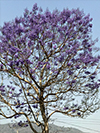
Botanical name of a genus of flowering plants in the family Bignoniaceae, of which there are several species, including both shrubs and large trees, that may grow up to 30 meters tall. As a tree, it is found scattered around Myanmar's Shan State, where the prevalent species is Jacaranda obtusifolia, which bears deep purple flowers that bloom only for a short period in March and April, and produces flat, oval seed pods. Jacaranda obtusifolia is also the species more commonly planted in Thailand. It has a tall canopy with inflorescences that are born in the axils of the branches and at the apex, while oval pods are. The other less prevalent species in Thailand is Jacaranda mimosifolia, which has an umbrella-shaped canopy, with inflorescences that are born at the top and pods that are rather spherical or round in shape. 回
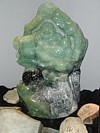
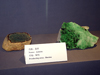
An automated loom for weaving, which was invented in 1801 by Joseph Jacquard, a French weaver, whom had earlier already designed a treadle operated loom. The loom works on punched cards and was the first machine ever to do so. However, at the time the new technology was perceived by many a French weaver as a threat to their livelihood and they tried to destroy it by throwing their wooden shoes (called sabot) at the loom, an incident that stands at the origin of the word sabotage. Today, the Jacquard Loom is still used in the Far East (fig.). 回 Chinese nephrite. A general name for greenish grey semiprecious or precious stone from which artifacts and jewels are cut. Several minerals qualify, especially jadeite, malachite (fig.), chloromelanite and nephrite, with jadeite (fig.) being the most valuable. It is believed to have the power to bring good luck and protection. The best quality is found in Burma and in popular speech jade is sometimes called Burmese gemstone. Considered imperishable, the Chinese used jade tablets as steles, to record glorious and historical events, and even made complete burial suits from jade plaques, threaded together with wire through small holes drilled at the corners of each plaque (fig.). In ancient China, high officials and members of certain dynasties were buried with a coin-shaped jade tablet known as bi placed near the stomach or chest, and sometimes with a piece of jade in their mouth, as jade is associated with immortality and is believed to have the power to purify. This practice is somewhat reminiscent of the Thai concept of ngeun pahk phi. Today, small circular jade tablets are popular pendants (fig.) and traditional jade bracelets, worn by women in China for thousands of years, are said to bring good luck and happiness with no end or beginning, just like their shape, and thus jade rings and jade bracelets are a typical Chinese wedding gift, considered more important than —and preferred over— diamonds. It is said that the clicking sound of two pieces of jade, such as jade two bracelets worn together, represents the character trade of refusal to be contaminated by evil influences. In Thai, jade is called yok and in Chinese yu. See also jade sand painting and Emerald Buddha. 回
See Yu Nu and Golden Boy and Jade Girl. 回 One among several minerals that qualify as jade. It is the most precious and sought after kind of jade in China, that imports it, mainly from Myanmar. 回
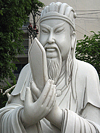
Name for a type of Chinese modern objet d'art, which is created by affixing coloured and finely granulated jade to the surface of paper in an artistic fashion. READ ON. 回 A ceremonial tablet made of jade. Jade tablets are believed to have the power to purify the environment and were used by Taoist priests and as writing tablets in ancient Chinese imperial court. In art, they are generally depicted as a diamond-shaped flat slabs (fig.), and are often carried in pair. In certain dynasties, a similar court writing tablet allowed the holder free access into throne room of the Jade Emperor. In iconography, it is hence an attribute of Yu Huang (fig.), as well as of Tsao Kuo-chiu (fig.), one of the Eight Immortals (fig.). A jade tablet was also carried by Confucius. In ancient China, high officials and members of certain dynasties were sometimes buried with a disc-like jade tablet, known as bi, and a piece of jade was sometimes placed in the mouth. Today, small circular jade tablets are commonly found popular pendants (fig.). Also referred to as a Mandarin's honorific tablet and in Chinese known as yu gui (玉圭). See also ngeun pahk phi. 回
Thai. ‘Fasting’. Term usually referring to the food eaten by the Chinese during their Lent or time of fasting, traditionally vegetarian, i.e. mangsawirat. Also spelled je. See also thetsakaan kin jae. 回 Sanskrit-Pali. ‘Mother of the world’. Title given to Parvati, the consort to Shiva. Her name is also pronounced Jaga-ambi (जगअम्बा), in Hindi she is called Jagadamba (जगदंबे), and she is sometimes referred to as Jagamata. 回 Jagamata (जगमाता) Sanskrit. ‘Mother of the world’. One of the kind forms of Devi, the consort to Shiva. See also Jagadambi. 回 Sanskrit. ‘Lord of the world’. A name for Krishna. Also Jagannath. 回 Thai name for the nipa palm. 回 Sanskrit. ‘Daughter of Jahnu’. Nickname for the Indian river Ganges. 回 A sage who, during his devotions, was once disturbed by the noise of the Ganges river and therefore drank its waters. He later regretted this and allowed the river to flow out from his ear. Thus, the Ganges got its nickname Jahnavi, ‘daughter of Jahnu’. 回 Thai. ‘Heart’. The Thai word jai is often used as a compound with other words to form powerful and complex metaphors or idioms. The Thai language has several hundreds expressions using the word jai, often to describe feelings and emotions. Besides ‘heart’ the word jai might also be translated as ‘middle’, ‘centre’, ‘essence’, ‘mind’ or ‘spirit’. Although there is some controversy about the origin of the shape of a heart (©), some believe it derives from the yoni, a Hindu object of veneration representing the female genital organ (fig.). More likely, the heart-symbol may have originated from the (negative) space seen in between the bowed necks of two courting swans (fig.), or from the shape formed by the back and wings of a dove, a traditional symbol of peace associated with Aphrodite, the ancient Greek goddess of love. See also POSTAGE STAMP (1), (2), (3) and (4). 回 Philosophical sect founded in North India by the venerated ascetic Vardhamana who became known as Mahavir, the ‘great hero’. The name comes from jina (jaina), meaning ‘victory’, i.e. victory over the passions and the self. The Jains found their entire system of ethics on ahimsa, a doctrine based on the non-harming of all living things. As in Hinduism, a belief in karma is adhered to, and like Buddhism, it originated in opposition to the Brahman principles of the sixth century BC, but never spread beyond India, in part due to the fact that its followers only walk on foot and refuse to take any means of transportation, as that may harm or even kill another living being. The two main sects are Digambara and Svetambara. See also vrata, Tirthankara, Adinatha and Gomateshwara. 回 2. Adjective meaning ‘of Jain’ or ‘of Jainism’. 回 Thai. A stringed, lute-like instrument with a long neck and a pear-shaped body, roughly resembling an Indian sitar, but smaller in size. It is played whilst seated on the floor and by way of strumming (fig.). Some are elaborately decorated (fig.). See also mahori. 回
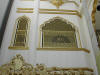
Sanskrit for ‘water’. The name of Chonburi is derived from it. Also transcribed chala and sometimes gala, but pronounced with ‘j’ or ‘ch’. 回 jali (જાળી) A term from the Indo-Aryan language Gujarati, used for a lattice or perforated pattern on a screen or window (fig.), as found in Indian buildings. Also transcribed jaali. 回
1. Thai. A fly-whisk made from the hair of a yak or of its tail. Also knonw as jamarih (จามะรี), which is often pronounced jamjurih/jamjuree. The name derives from the yak (fig.), a hairy bovine animal with the binominal designation Bos grunniens, and which in Thai is also known as jamarih (จามรี), pronounced the same, but with a slightly different spelling in Thai. It is used in various forms as a symbol of royalty or kingship, and as the attribute of several gods in Buddhism, Hinduism and Taoism, where it is said to represent purification. See also chamara. 回
2. Thai name for a large tree with the botanical name Samanea saman, but which is often placed in the genus Albizia, where it is more specifically known as Albizia saman or Albizia lebbeck. In English, it is called Rain Tree, East Indian Walnut, or Monkey Pod, and in Thai, it is also known by several other, local names, such as kahm krahm (ก้ามกราม), used in Central Thailand; kahm kung (ก้ามกุ้ง), which means ‘lobster's claws’ or ‘nippers’ and is used around Bangkok; kahm poo (ก้ามปู), which means ‘crab's claws’ and is used around the Chao Phraya River Basin, between Phitsanulok and Bangkok; cham chah (ฉำฉา), a name used in the North, besides lang (ลัง), sarasah (สารสา) and samsah (สำสา); seku (เส่คุ่) and sedu (เส่ดู่), two names used by the Karen people around Mae Hong Son; and tuttoo (ตุ๊ดตู่), the name used in the region of Trat. It belongs to the family Fabaceae and produces white and pink flowers that grow on top of the branches, similar to those of the Calliandra surinamensis, a shrub in the same family and with the same Thai name (fig.). The Rain Tree is the mascot of the Chulalongkorn University, because the king, to whom this university was named, was born on a Tuesday, the day that represents pink in the sih prajam wan-system. The province of Kanchanaburi is home to a Giant Rain Tree (fig.), which is sometimes referred to as Giant Banyan Tree. Often pronounced jamjurih (jamjuree) and to differentiate from the shrub usually the prefix ton (ต้น) is added. See also TRAVEL PICTURES. 回
3. Thai name of an up-to-three meter tall shrub in the family Fabaceae and with the botanical name Calliandra surinamensis. It is known in English as Pink Tassel-flower, due to its tassel-like flowers on top of its branches, that are white with pink. However, the name jamajurih is also used for the Rain Tree (fig.), a large tree that belongs to the same family and produces similar white and pink flowers. Thus, to differentiate between the shrub and the tree, the prefix phreuk (พฤกษ์) is usually added, whilst for the tree, the prefix ton (ต้น) is used. Also pronounced jamjurih (jamjuree). 回
Thai. Another name for jamajurih and referring to the Rain Tree, as well to the fly-whisk made of a yak's tail. 回 Thai name for the yak, i.e. the Long-haired ox with the bimomial name Bos grunniens. 回 Hindi name for wealth gods in Mahayana Buddhism. READ ON. 回 Common designation for a colourful fruit-dove with the binomial name Ptilinopus jambu. It is a resident breeder in southern Thailand, Malaysia, Brunei and the Indonesian islands of Kalimantan, Sumatra and Java. The Jambu Fruit Dove is about 26 to 27 centimeters tall and weighs about 42 grams. It is a plump, small-headed bird, with very distinctive colouring (fig.), including a white eye ring, orange bill and red legs. The adult male has a crimson face, unmarked green upperparts and white underparts, with a pink patch on the breast and a brown undertail. The female has a dull greyish purple face and green underparts with a paler vent and cinnamon undertail. The immature Jambu Fruit Dove resembles the female, but has a brownish green face. Also spelled Jambu Fruit-dove and in Thai known as nok plao nah daeng. 回
Thai-Pali name for an Indian mythological emperor, who was too proud to listen to the words of the Buddha. The Buddha then changed himself into a great and mighty emperor and invited Jambupati to visit him (fig.). This event changed Jambupati and he became perceptive to the teachings of the Buddha. This story is unknown in India and appears only in Southeast Asian literature on the Buddha's legendary life. Also pronounced Chomphupadih. See also Jambupati Buddha image. 回 An iconographical style of crowned Buddha images from Burma, founded on the story of Jambupati, whose name has become attached to these typical Buddha images. The legend tells how the Buddha changed himself into a great and mighty emperor, set in an unparalleled palace (fig.), and then had Jambupati brought before him. Witnessing the Buddha in all his majesty, Jambupati accepted the dharma and became a monk. This story, while unknown in India, seems to have been very popular in Burma, as the number of Buddha images illustrating it, is significant. Buddha images typically wear a jewel known as salwe (fig.), i.e. a set of chains that is worn over the shoulders and fastened at the chest with several ornamental plaques, in order to indicate the Buddha's royal rank (fig.). Occasionally, Jambupati Buddha images are found in Thailand (fig.). 回
1. Thai. Cone-shaped bamboo basket on a circa 1.2 meter long wooden stick, used as a holder, especially for water pots and oil lamps (fig.), but also as garden flowerpots (fig.) and nests for laying hen, in order to easily collect their eggs. These baskets exists in different sizes, depending on what they are used for. Also transcribed jampa, champa or champah. 回
2. Thai. Name for the champak, a large evergreen tree with the scientific name Michelia champaca. It is native to South and Southeast Asia, and used for its timber. It has very fragrant yellow or white flowers, and seeds that are highly attractive to birds, hence a stylized champak flower became the logo of Thai Airways International (fig.). They are also used in flower garlands called phuang malai (fig.) and stringed flower arrangements known as kreuang khwaen (fig.). In Burmese mythology, the nats Min Mahagiri (fig.) and Hnamadawgyi −or, according to another report, Shwe Nabay (fig.)− are believed to have once resided in this tree, and its flowers are today still offered to them by pilgrims at Mount Popa (fig.). According to Mahayana Buddhism, Maitreya, the future buddha will attain Enlightenment under the champak tree. In iconography, a floral design with the outline or a four-petalled flower is used to represent this. Also transcribed jampa, champa or champah, and in Thai also spelled จัมปา. 回
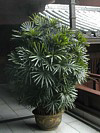
Thai. To keep the Buddhist precepts regularly; to sit still and pray. See also Buddhist precepts. 回 Name of a river in North India, i.e. the largest tributary of the Ganges and personified as a Hindu goddess riding a tortoise. The Taj Mahal is located on its banks. Also transcribed Yamuna. 回 Father of Sita in the Indian epic Ramayana. 回 Hindi name for both a sacred cord and a ceremony, which are known in Sanskrit as yajnopavitam and Upnayanam, respectively. 回 Sanskrit. Literally ‘thigh’ or ‘pillar’, and related to the word (जङ्घा), meaning ‘leg’. Yet, as an architectural term, it is also used to refer to the posts of a veranda, as well as to a sculpture in the form of a broad figurative band, found in the middle on an exterior temple wall. 回 Thai. The food or meal of a monk. 回 Thai. Name for the Broadleaf Lady Palm, Slender Lady Palm, a plant also known by the names Bamboo Palm and Reed Rhapis, with Rhapis being a Greek word that means ‘needle’ and refers to the up to 40 centimeters long, needle-like leaves of this species of fan palm. This species of palm, native to Southern China and Northern Thailand, may in Thailand be called jang chiang mai. It can grow up to 5 meters high and is often seen as ornamental plant. 回
Thai. ‘Province’. Each jangwat is named after the provincial capital, usually the
administrative and most important city in the province and in popular speech
customarily called amphur
meuang.
Each jangwat is divided into districts called
amphur
-except for
Bangkok where besides 5 amphur there are also 45 zones called
khet- sometimes with smaller sub-districts called
king amphur.
These districts are further separated into rural sub-districts which are
administered by a
kamnan and called
tambon. Those
consist of several smaller villages called
mu ban,
literally a group of houses. Thailand has a total of 76
provinces (fig.), 795 amphur,
81
king amphur, 7,255 tambon and
69,866
Thai name for the Diospyros decandra, a deciduous tree with light green foliage. Its fruit is known as Gold Apple, which in Thai is called look chan. The tree is also referred to by several other Thai names, including jan or chan (จัน), and it was therefore chosen as the provincial tree of Chanthaburi. 回
Sanskrit. ‘Repeating’ or ‘whispering’. The repetitive whispering of a mantra or prayer whilst meditating. 回 Common name for a species of oak native to Japan, Korea and China, with the botanical designation Quercus dentata and also commonly called Daimyo Oak. It grows up to 25 meters tall, though it usually grows smaller in cultivation. Its leaves have a shallowly lobed margin and are reminiscent in shape to those of the English Oak. The Japanese Emperor Oak bears pendulous flower clusters, known as catkins, and its acorns –which sit in broad, bristly cups– are mature by September. 回
Common name for a genus of hibiscus with the botanical designation Hibiscus schizopetalus, and also commonly known by the names Coral Hibiscus and Spider Hibiscus. It is grown as an ornamental shrub or small tree and bears red flowers that hang from long stems and are easily distinguished by their ruffled petals and elongated pistil. 回
Common name for a small deciduous tree, with the botanical name Acer palmatum, and native to certain parts of eastern Asia, including Japan, Korea, Mongolia and China. It grows to a height of about 10 meters and occasionally taller, and is highly sought after for ornamental use. Its attractive leaves (fig.) resemble those of hemp (fig.), i.e. cannabis (fig.). 回
See Bua Thong Flower Blooming Season. 回 Common name for a species of passerine bird in the Turdidae family, with the scientific designation Turdus cardis. It is found in parts of East and Southeast Asia, including in Japan, Korea, China, Taiwan, Laos, Thailand, and Vietnam. Adult males are black above and white with black spots bellow. The bill and legs are yellowish orange. Adult females are similar but above more greyish brown, rather than black, and with some orangey buff colouring on the flanks. Its natural habitat consists of temperate forests. 回
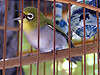
Common name of a species of prawn, that occurs naturally in warm currents of bays and seas of the Indo-West Pacific. READ ON. 回 Name of a 11 to 12 centimeters small passerine bird with the scientific name Zosterops japonica, and found in northern India (fig.), eastern China, Taiwan, Japan and the Philippines, and which winter in Southeast Asia, including Hainan Island. It has an olive green back, scapulars, rump, upper tail coverts and head, except for the chin and throat, which are yellowish (fig.). Its underparts are dull white, becoming dusky on the sides and flanks. It has a feathered white eye-ring, which in front of the eye is broken by black feathers that form a black margin along the bottom of half of the eye. Its bill is black and its legs and feet are dark grey (fig.). It is very similar to the Oriental White-eye (fig.), but is darker above, has no ventral stripe and has a defined yellow loral band. It feeds on insects, fruit and nectar. Extraordinary, Japanese white-eyes on the Japanese island of Hahajima are known to feed on tiny land snails, of which about 15% are able to survive digestion intact and are found alive in the birds' droppings, a key factor in how this species of snail spreads. This species of snail is scientifically known as Tornatellides boeningi, but has been given the epithet Japanese Flying Snails, comically with boeningi being quite reminiscent of the name Boeing. In Thai, the Japanese White-eye is named nok waen tah khao lang khiaw. See also WILDLIFE PICTURES. 回
Sanskrit. ‘Old age’. The huntsman who unwittingly killed Krishna. See also samsara. 回 Another spelling for Gia Rai. 回 Thai. Another word for praphenih, meaning ‘convention’, ‘custom’ or ‘tradition’, as used in hihd sip song. Also transcribed jareed. 回 Name for a Thai patented, long-grain variety of fragrant rice, with a nutty aroma and a subtle pandanus-like flavour, and which grains slightly cling when cooked. It is also known as Thai fragrant rice and in Thai as khao hom ma-li (ข้าวหอมมะลิ). There are two strains, i.e. khao dok ma-li 105 (ขาวดอกมะลิ ๑๐๕) or 4-2-105, on which later improvements resulted in a newer strain, officially known as go ko 15 (กข ๑๕). Both strains are officially recognized as jasmine rice. 回 Scented water used in the preparation of some traditional Thai dishes and sweets, such as nahm dokmai. It consists of pure water that is boiled and then cooled off. The cool water is then poured in a pot or jar that can be closed off with a lid. At dusk freshly picked white jasmine flower buds are cleaned and carefully put on the surface one by one and then the lid is closed. The buds are left to float several hours until the flowers open up and allowing the water to absorb their scent. The process takes place overnight and at dawn the by now open flowers are taken out of the water, which is then ready for use. In Thai this scented water is known as nahm dok ma-li (น้ำดอกมะลิ) and nahm loy dok ma-li (น้ำลอยดอกมะลิ). Since jasmine flowers are typically white, it may also be called white jasmine water. 回 Sanskrit. ‘Matted hair’. Matted chignon or braids of entangled hair (fig.), as worn by Shiva, rishi, ascetics and sadhu. It is a sign of either mourning or of an indifference towards worldly matters. In Hindu iconography and art, certain deities are depicted with a ‘crown’ (mukuta) of ‘matted hair’ (jata), known as jatamukuta (fig.). Sometimes translated as dreadlocks. 回
Sanskrit and Pali word for the Thai term chadok. It refers to each and all of the in total 550 incarnations that every soul has to take before one can be born as a buddha. Generally it stands for the 547 former life stories of the Buddha, but in Burma three extra lives were added for reasons of symmetry in mural paining. In Thai tradition the ten last incarnations of the bodhisattva who became the Buddha, prior to his final birth as prince Siddhartha, are the most important and are called Totsachat. They are often depicted in statues and murals throughout Thailand. One style of Buddha image from Burma depicts the Buddha completely covered with embossed imprints of countless smaller Buddha images (fig.), which are believed to represent his previous incarnations. 回 Sanskrit. ‘Crown of matted hair’. The matted and braided chignon of hair worn by Shiva as an ascetic. Often depicted as an elaborate headdress adorned with his cresent. The term derives from the words jata (matted hair) and mukuta (crown). 回
Thai. Derivative name of Tao Kadtukam (ท้าวขัตตุคาม), one of two guardian gods of the holy relics of the Buddha, the other one being Tao Ramathep. However, according to some the guardians are actually four in number, the other two being Tao Wirunhok (ท้าววิรุฬหก) and Tao Wirunpak (ท้าววิรุฬปักษ์), and together the four are known as Tao Jatu Maha Raj (ท้าวจาตุมหาราช). See also Jatukam-Ramathep and POSTAGE STAMPS. 回
Jatukam-Ramathep (จตุคาม-รามเทพ) Thai. Name of a large, very popular amulet in the shape of a medallion, about 6 millimeters thick and a diameter of around 5.4 centimeters. READ ON. 回 1. Thai-Pali. ‘Four keepers of the world’. The four guardians protecting the world by presiding over the four points of the compass. In Sanskrit they are called lokapalas and may vary in number, and in Burmese known as Satu Lokapala (fig.). See also lokaban. 回
2. Thai-Pali. ‘Four keepers of the world’. The chief thevada in the fourth grade heaven with four faces presiding over the four points of the compass. Compare with Phra Phrom Sih Nah. 回 1. Thai-Pali. ‘Four faces’. Name of a yak or giant, whose kala (fig.) or kirtimukha-like face (fig.) appears on the trah lohkhen tamruat, i.e. official seal of the Royal Thai Police (fig.). According to ancient customs, this yak's face was carved on the four porticos of a prasat hin, one in each direction of the compass, with the belief that it protected the palace against evil entering through the gates (fig.). Also transliterated Chaturamuk. 回 2. Thai-Pali. ‘Four faces’. An architectural style in which a building has four gable ends or four entrances, sometimes with each one pointed to a direction of the compass, like the wihaan of Wat Phumin in Nan. Here, the term jaturamuk, which is also transliterated Chaturamuk, is sometimes translated as ‘four porticos’. Also tetrahedron. 回 Thai-Pali. ‘Four-faced one’. A name of Brahma. See also Phra Phrom Sih Nah. 回 Thai-Pali. ‘Four directions’. An iconographical term used to indicate a style in which an edifice or image is built with four sides, each side facing one of the four directions of the compass, such as statues of the Satu Lokapala (fig.), i.e. the four guardians that protect the world by presiding over the four points of the compass, as well as some Buddha images, e.g. the Phra Prathaan or principal Buddha images of Wat Phumin in Nan (fig.), those of the Kyaikpun Pagoda (fig.) in Bago, in Myanmar's Mon State, as well as those of the Thambula Temple (fig.) and Ananda Phaya (fig.), both in Burma's Bagan. 回 Thai-Pali. ‘Four arms of national defense’. The four arms of an ancient army (kong thap), namely the elephants, chariots, cavalry and infantry. 回 Common name for a type of ray fish, with the scientifc designation Rhinoptera javanica. It is easily recognized by its odd-looking head, which features a double-lobed snout and indented forehead. Like most rays, it has a flattened, somewhat kite-shaped body, which is dark above and white below. It has a long, thin, whip-like tail, which is distinctly demarcated from the body and armed with one or more stings. This species is also known as the Flapnose Ray, and in Thai as Yihson (ยี่สน) or pla kra-ben jamuk hua (ปลากระเบนจมูกวัว), though the latter name is also used for the Rough Cownose Ray (Rhinoptera adspersa). A large monument with life-sized statues of these ray fish is erected in a pool at the entrance of the Bang Saen Aquarium (fig.) near Bang Saen Beach (fig.) in Chonburi. 回
Common name for a species of kingfisher in the Halcyonidae family, with the scientific name Halcyon cyanoventris, and endemic to Indonesia. It has a dark brown, almost black head, a dark blue body and pale blue wings, with black shoulders. Its bill and legs are reddish-orange. Its natural habitat consists of open spaces near to clean fresh water, in subtropical or tropical regions. Although it is a quieter bird than the Collared Kingfisher (fig.), it does posses a striking call, which can be heard sometimes. In Thai, this bird is known as nok kra-ten chawah (นกกระเต็นชวา) or nok ka-ten chawah (นกกะเต็นชวา). 回
Common designation for a species of wading bird, with the scientific name Ardeola speciosa. It is about 45 cm tall, and in the breeding season with a buffish head and neck, a cinnamon-rufous breast, a slaty mantle and scapulars, and a white belly and vent. In addition, it has a greyish-yellow bill with a black tip, yellow eyes and yellow legs. With juveniles, as well as with adults outside the mating season, the bill is more greysih-yellow with a black tip, and the birds have a brown mantle and scapulars, whilst the head, neck and breast are brown, streaked with white. This non-breeding plumage is very similar to that of the Chinese Pond Heron (fig.) and that of the Indian Pond Heron, and is virtually indistinguishable in the field, apart from the fact that in flight its wings are almost completely white, whereas that of the Chinese Pond Heron has obvious dusky tips (fig.). Also called Javanese Pond Heron and in Thai known as nok yahng krok pan chawa. 回
Common name for the Rhinoceros sondaicus, i.e. the Sunda Rhinoceros, which is also known as the Lesser One-horned Rhinoceros, and in Thai as raed chawa (แรดชวา), ra-mahd (ระมาด) and raed sundah (แรดซุนดา). Once the most widespread of Asian rhinoceroses, ranging from the islands of Indonesia, throughout Southeast Asia, into China and India, the Javan Rhinoceros is now critically endangered, with only two known populations in the wild, and none in zoos, making it one of the rarest large mammals on the planet. Their decline is attributed to loss of habitat due to war, and poaching. It is closely related and very similar to the Indian Rhinoceros (fig.), but with a smaller horn, which is rarely bigger than 15 centimeters. In 1973, the Thai Post issued a series of postage stamps with endangered and rare wild animals, including one with the depiction of the Javan Rhinoceroses (fig.). 回 Common name for a species of passerine bird in the family Estrildidae, and with the scientific name Padda oryzivora. It is also commonly known as Java Finch, Java Rice Bird and Java Sparrow, and in Thai as nok krajok chawah. Adults are about 16 centimeters tall and are overall grey, with a pinkish-buff belly, a black head and white cheeks, a pinkish-red eye-ring and bill, and pink feet and legs. The Java Rice Sparrow originates from Indonesia, but has been since long been a popular cage bird throughout Asia, and consequently occurs as a feral species in many other countries. Since it feeds mainly on grain and seeds, it often occurs in rice-producing areas, where it may become an agricultural pest. 回
Indian architectural term, also used in Islamic architecture, to indicate the duplication of buildings, which give symmetry by creating a mirror image. 回 Southern Thai term for tawak. 回 Thai. An image of the household god put up in a spirit house called sahn phra phum. Sometimes also called trawed or tawed. 回
1. Sanskrit-Khmer term for ‘victory’, in Thai known as chai, a word which in compounds is often pronounced chaiya, as in Chaiyaphum, chaiyaphreuk, etc. In Khmer, it also is the name of a prayer for victory or prosperity. 回 Sanskrit for ‘victory column’, ‘victory pillar’, or ‘victory tower’, such as the 22 meter high Jain tower in het Chittorgarh Fort in Rajasthan, India. Also called Vichaya Stambha (विजय स्तम्भ). 回 Jayavarman (जयवर्मन्, ជ័យវរ្ម័ន) Sanskrit-Khmer. Name chosen by several Khmer rulers in the pre- and Angkorian Periods, to begin with Jayavarman I in 657, originally a king of Chenla, who is considered by some to be the first king of the Khmer Empire as it evolved out of the Kamboja kingdom, and ending in 1295 when Jayavarman VIII abdicated. The name is a compound of the words jaya and varman and could be translated as ‘Victory Shield’, ‘Protected by Victory’ or ‘Glorious Victory’. 回
Name of a French bishop, who was born on 24 October 1805 in Combertault, a commune in the Côte-d'Or department in eastern France. He became the Coadjutor Vicar Apostolic of Siam from 3 June 1838 until 10 September 1841, when he became the Vicar Apostolic of Eastern Siam in succession of his predecessor Bishop Jean-Paul-Hilaire-Michel Courvezy, the former Vicar Apostolic of Siam. He remained in this position until his death at the Immaculate Conception Church on 18 June 1862, at the age of 57. He composed a French-English-Thai Dictionary, made a description of the Thai Kingdom of Siam in the Rattanakosin Period, and was highly esteemed by King Mongkut, with whom he often discussed issues. After the Monsignor's demise, King Rama IV personally assisted at his funeral by organizing a most graceful funeral procession from the Assumption Cathedral, south of Rattanakosin Island to the Immaculate Conception Church to the north of Rattanakosin Island. The King gave two royal boats to lead the burial procession that carried the casket, which was accompanied by musical boats that played Christian hymns. 回
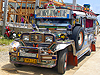
Name for a kind of share taxi in the Philippines, comparable to the Thai songthaew. They were originally built from US military jeeps that were discarded after World War II, hence their name which etymologically is believed to be a portmanteau of ‘jeep’ and ‘jitney’, the latter being an American term for a vehicle that operates somewhere between a private taxi and a conventional bus. Filipino Jeepneys are usually brightly decorated with vibrant colours and lots of chrome. 回
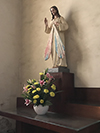
See hed hoo noo. 回 See maeng kaphrun. 回 See look niang. 回 Common name of a diurnal bird of prey, with the scientific designation Aviceda jerdoni. 回 Name of a Dutch trader who lived in ancient Ayutthaya for nine years and was director of the Dutch East India Company in Ayutthaya from 1638 to 1642. Prior to that, during the time of the Picnic Incident which he described in detail in his diary, he was the acting director of the Dutch trade post in Siam, under Joost Schouten, who was however often absent for long periods during overseas journeys. Although he was not personally involved in this incident he was later, when he was governor of Batavia, convicted of other offences, i.e. massive corruption and improper private transactions. He was born and died in Schiedam, in the Netherlands, and lived from 1602 to 1663. 回 See Jesus Christ. 回 Name of the central figure of Christianity, who is revered by most Christians as the Son and incarnation of God and part of the Trinity, that is One Being, who exists as three Persons, to be precise God the Father, God the Son and God the Holy Spirit. In other words, whilst being fully Human, Jesus is also fully God, as well as Spirit, a concept reminiscent to the avatars in Hinduism. The name Jesus derives from the Greek Iesous (Ἰησοῦς), a Hellenisation of the Hebrew-Aramaic names Yeshua (ישוע) and Yehoshua (יהושע), both meaning ‘Yahweh rescues’, whereas Christ is a title that derives from the Greek word Christos (Χριστός), meaning the ‘Anointed One’, which corresponds to the Hebrew-Aramaic word Messiah (משיחא). He is also known as Jesus of Nazareth, after his childhood home town. Judaism rejects the claim that Jesus is the Messiah and incarnate God, and Islam regards Him as a prophet. The icon of Christianity early on was a fish, usually referred to as the Ichtus symbol, which besides its reference to Jesus’ fisherman disciples, also is a Greek acronym for Iesous Khristos Theou Huios Soter (Ἰησοῦς Χριστός θεοῦ Υἱός Σωτήρ), meaning ‘Jesus Christ, Son of God, Saviour’ (fig.). See also Christmas. 回
See Jesus Christ. 回
Name of a military monument at the Royal
Thai Air Force Academy, which is located opposite of the RTAF Headquarters in
Bangkok.
It features four types of genuine jet fighter aircraft, that are erected as if
flying in formation, taking-off with a near-vertical angle. The decommissioned
aircraft are an F-16A Fighting Falcon (fig.),
a
Northrop F-5A
Freedom Fighter (fig.),
a Northrop F-5B
Freedom Fighter (fig.),
and
a North American F-86 Sabre
(fig.).
The monument was erected in 2012, the
year in which Thailand
commemorated
the 100th
Anniversary of the
Founding Fathers of the Royal Thai
Air Force (fig.
Common name for a species of insect in the family Scutelleridae. Jewel Bugs get their name from their often brilliant colouration, though they are also commonly known as Shield-backed Bugs, a name that derives from the enlargement of the last section of their thorax into a continuous shield over the abdomen and wings, a characteristic that oftentimes leads to misidentification, assuming them to be beetles rather than bugs. Closely related to stink bugs, they are also able to produce an offensive odour when disturbed. Due to this, they are in Thai called malaeng tod (แมลงตด), literally ‘farting bugs’, a term also used for bombardier beetles though. 回
Jewel Changi Airport, also known as Jewel Changi or just Jewel, is a building at Singapore's Changi Airport (fig.), that is home to the Rain Vortex, the world's tallest indoor waterfall, which falls from the ceiling of a toroid or donut-shaped dome that consists of a complex steel framework with glass panels. The water cascades 40 metres to the ground, where it disappears into a sloped oculus in the floor at up to 37,850 liters per minute. Spanning five stories and occupying some 22,000 square metres, surrounding the vortex is the Shiseido Forest Valley, which is fashioned as a tropical indoor garden that houses circa 3,000 trees and 60,000 shrubs of some 120 different species. The skytrain, that connects the airport terminals, runs straight through the Jewel from either direction, frequently crossing a bridge adjacent to the Rain Vortex. At the topmost level of Jewel, is Canopy Park, a 14,000 square metres recreation and leisure zone, with a Canopy Bridge that is located 23 metres above the ground and has a section of its floor with glass panels; Sky Nets, that include a Bouncing Net and a Walking Net; etc. WATCH VIDEO. 回
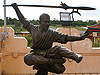
A designation used for the Siamese Fighting Fish. 回 Pali term for dhyana, i.e. Sanskrit for Zen, as well as the term used for an advanced stage of meditation. 回 Indian architectural term for a protecting canopy or baldachin over a window or doorway. It is derived from the Hindi word jhilamilee (झिलमिल), meaning ‘blind’, ‘sun blind’ or ‘shutter’. 回 1. Chinese name for a type of a lance with two points, used as a martial weapon. It typically has either one or two sickle-shaped knives (fig.), akin to those with the hook sword or gou (fig.) and the qian kun ri yue dao (fig.), which is attached either underneath its spearhead (fig.) or on both sides thereof. As a long weapon, it is sometimes found in Chinese temples and shrines, as part of the traditional long weapons rack, meant to symbolically fight off all evil (fig.). Also called ji dao. 回
2. Chinese name for a kind of a spear or lance in combination with a ge (fig.), i.e. a ‘dagger-ax’ (fig.). 回
Chinese. ‘Healty body balls’. See Chinese Massage Balls. 回 Chinese. ‘Old Grandfather Jiang’. Title given to Jiang Shang (姜尚), who is also known as Jiang Ziya (姜子牙), an astute political thinker and military strategist in ancient China. READ ON. 回 Chinese. ‘Paper cutting’. Name for the Chinese folk art of clipping paper cutouts with sharp, pointed scissors (fig.), or sometimes knives. The art first occurred in the Eastern Han Dynasty, when it was invented by a eunuch named Cai Lun (T'sai Lun), who is also accredited for improving the quality of paper used in his days, by adding essential new materials into its composition, as well as inventing a new paper making process. Between the 7th and 13th centuries, the art of paper cutting became popular, especially during holiday festivals, and later spread to the rest of the world and new skills were developed. In the eighties, the art knew a revival, resulting in the emergence of several skilled artists, such as highly acclaimed Ji Jian Ming (计建明). Nowadays, cutouts are widely used to decorate the interiors of homes, as well as doors and windows. Besides this, they are also used as patterns, especially in the making of embroidery and lacquerware. Paper cutouts are usually red, the colour believed to bring good luck, or otherwise blue. Jiang zhi are usually made in mass, by putting several layers of paper together. 回
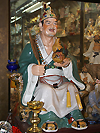
Chinese name for a form of promissory banknote which was briefly in use sometime in the [Northern and Southern] Song Dynasty (960 - 1279 AD), yet restricted in area and without standard denominations. It is by some regarded as the first paper money in history, while paper itself is also an ancient Chinese invention, traditionally attributed to Cai Lun (蔡倫), an imperial eunuch official of the [Western and Eastern] Han Dynasty (202 BC - 220 AD). 回 Chinese. ‘Sword lance’. Another name for ji (fig.). 回 Chinese. ‘Precepts scars’. Name of nine rounded scars or marks, i.e. three rows of three dots, that are burned onto the head of Shaolin monks with incense sticks. READ ON. 回 The outer robe of a Buddhist priest, also called traijiewon. See also pahkahsahwapad and angsa. 回 Chinese. ‘Honourable Ji’ or ‘Master Ji’. Name of a Buddhist monk who lived from 1130 to 1207 AD in the region of Hangzhou. Although he had a kindhearted and obliging character, he was expelled from his monastery for braking the rules of the Vinaya, by eating meat and drinking wine. However, many who observed his unconventional, yet kind and compassionate nature, began to believe that he was an incarnation of Xianglong, the Taming Dragon, one of the eighteen legendary luohan. He is posthumously worshipped as a minor Taoist deity and is usually depicted in monastic robes with a nahm tao calabash and a leaf-shaped fan which is believed to be magical. Sometimes transcribed Chi Kong or Chi Kung and also known by the names Ji Gong Huo Fo, ‘Honourable Ji, the Living Buddha’; Dao Ji Chan Shi, ‘Taoist Ji, the Meditation Master’ or ‘Taoist Ji, the Zen Buddhist Master; Li Xiu Yuan, ‘Li, the First Decorated’; Hu Yin, ‘Recluse of the Lake’; and Fang Yuan, ‘Square Circle’. 回
Thai adjective meaning ‘Chinese’ and relating to China, its language, culture or people. 回 Thai term for a Chinese sage. 回 Chinese. ‘Chicken Feet Ghost’. A Chinese-Taoist demon, with a black complexion and bulging eyes, who is often portrayed with a long protruding tongue and holding a metal chain. He has chicken-like feet (fig.) complete with spores, hence the origin of his name. He is one of the four guardians at the gate of Tian Zi Dian (天子殿), i.e. the ‘Palace of the Son of Heaven’, usually referred to in English as the ‘Emperor's Hall’ in Diyu, the Taoist Hell, the other three guardians being the Eagle General Ying Jiang (fig.), the Snake General She Jiang (fig.), and the White Impermanence Bai Wu Chang (fig.). Besides this, Ji Jiao Gui and Bai Wu Chang also appear together at Gui Men Guan, i.e. the Taoist Gate of Hell (fig.). His task is to capture the wicked and bring them away for punishment. Hence, his role is reminiscent to that of Black Impermanence Hei Wu Chang (fig.), who likewise holds a metal chain to bind the souls of the wicked dead. 回
Designer and textile trader who gave hand-woven Thai silk or Mai Thai worldwide recognition. Born in 1906 in Greenville, U.S.A., he disappeared mysteriously on 27 March 1967 during a walk in the Cameron Highlands in Malaysia. He settled in Thailand after WW II, where he was a volunteer with the American troops who were engaged in the reconstruction of Thailand and its reinstatement of independence and freedom. A former architect he built a home consisting of six teakwood buildings in traditional Thai style on the bank of a canal in Bangkok, today known as Jim Thompson's House. He was nicknamed the ‘Silk King’. 回 Name of a museum on the south bank of Khlong Saen Saeb, a city canal in Bangkok. The museum consists of six buildings made from teakwood and built in traditional Thai style (fig.), which is referred to as Reuan Thai. It was reconstructed by the American architect and King of Thai Silk Jim Thompson from existing houses and according to the authentic practice and customs of early constructors, including all prevailing and traditional religious rituals. Most houses were at least 200 years old and were dismantled upcountry and subsequently moved to their present location, sometimes from as far as Ayutthaya. Jim Thompson's House also has a beautiful garden and an extensive collection of artifacts, including benjarong, laai kraam porcelain, etc. In Thai, the museum is referred to as Ban Jim Thompsan. See MAP. 回
Sanskrit. ‘Conqueror’ or ‘victorious one’. Pronunciation jaina, and sometimes also transliterated likewise. In Buddhism the term indicates the historical Buddha or the five transcendental buddhas of the Mahayana sect, in which each jina is assigned to a specific location in Buddhist cosmology and is positioned accordingly on a mandala. In Jainism known as a Tirthanka. Pronounced jaina. See also chai and Acalanatha. 回 jing joh nahm (จิงโจ้้น้ำ, จิ้งโจ้น้ำ) Thai. ‘Water kangaroo’. Common name for the water strider, an insect that in Thailand usually belongs to the family Gerridae and which is also known as water skater, water skimmer, water skipper, etc. It has a dark brown to black body, which is short compared to its long legs, and usually corn-shaped. It is a predatory insect that has the ability to walk on the water surface of slow streams and quiet waters, such as rice paddies. It is able to do this due to surface tension and a special structure of tiny hairs on its legs, that are known as setae and similar to those on the feet of the jingjok (gecko). It feeds on aquatic insects, including mosquito larvae that rise to the surface or insects that fall into the water. It can move very quickly, skating on the water surface with speeds of up to 1.5 meters per second. The genera that occur in Thailand include the Aquarius adelaidis (Gerris adelaidis), Cylindrostethus costalis (Humpbacked Skater), Limnometra matsudai (White-lined Pond Skater), Metrocoris nigrofascioides (Banded Dwarf Skater), etc. 回
Thai name for a small, nocturnal household lizard in the family of Gekkonidae. In Thailand, two members of this family are commonly seen, i.e. the jingjok, officially known as jingjok bahn (จิ้งจกบ้าน), i.e. the ‘House Gecko’, and the larger tukkae, which is known by the scientific name Gekko gecko. Of the Jingjok, there are several species, including the Spiny-tailed House Gecko (Hemidactylus frenatus - fig.), the Flat-tailed Gecko (Cosymbotus platyurus - fig.), the Spotted House Gecko (Gekko monarchus), the Four-clawed Gecko (Gehyra mutilata), etc. An adult jingjok measures about ten centimeters, from proboscis to tail tip. They typically clamber about on walls, window panes and ceilings. To defy gravity geckos have extraordinarily feet which are covered with microscopically tiny hair-like tubular structures called ‘setae’ which have cup-like tips or pads (fig.) and which are similar to those on the legs of the jing joh nahm (water skater). It enables the gecko to effortlessly stick to almost any surface, even upside down on ceilings. Whilst walking the ‘setae’ spread out and the pads on their tips create enough surface intermolecular attraction between the ‘setae’ and the surface to support the gecko's weight. To climb rougher surfaces, these small geckos also posses claws (fig.). When hunting they can go from frozen immobility to a lightning strike to snatch their prey, which consists of insects and can include butterflies and moths, sometimes the size their own. To attract a mate they make clicking noises and slap their tails against the surface they are on. Then, they cautiously approach each other and will start to mate (fig.). Being a reptile the jingjok lies small round eggs which are usually left in dark holes or niches, waiting to hatch out. A jingjok has the ability to detach its tail to avoid capture by predators (fig.), but over time it will regenerate to its original shape. It is believed by many Thais that if a jingjok has a forked tail it will bring good luck to those seeing it, hence amulets of forked-tailed geckos have hit the market (fig.). WATCH VIDEO. 回
Thai general name for any species of skink (fig.), a lizard-like reptile, but usually without a pronounced neck and with relatively small or reduced legs, or even with no legs at all, depending on the genus. They belong to the family of Scincidae, of which its English name is derived, and are found in a variety of habitats worldwide. Southeast Asian species found also in Thailand include the Olive Tree Skink (Dasia olivacea); the Mangrove Skink (Emoia atrocostata), of which there are several kinds; the Yellow Striped Tree Skink (Lipinia vittigera); the Speckled Forest Skink (Mabuya macularia); Many-lined or Common Sun Skink (Mabuya multifasciata - fig.); the Bowring's Supple Skink (Riopa bowringii); and the Streamside (Forest) Skink (Sphenomorphus maculatus), which is recognized by a dark flank strike, and gets increasingly spotted with age, hence it is also known as Spotted Forest Skink (fig.); and the Blotched Forest Skink (Sphenomorphus praesignis), which distribution in Thailand is limited to the Southern peninsula. Though usually solitary, they can occasionally be encountered in small groups (fig.). Like many other lizards, skinks have the ability to detach their tails in order to avoid capture by predators (fig.). The detached tail will stay alive and kicking for a while; it continues to move about and thus distracts the predator's attention from the skink, allowing it to flee. Over time, the tail will regenerate to its original shape. See also jing lehn duang. 回
jing lehn duang (จิ้งเหลนด้วง) Thai. ‘Worm skink’. Generic term, i.e. a compound of the words jing lehn and duang, and used to refer to any species of glass snake or legless lizard. Despite these confusing common names, this reptile is actually recognized as a species of lizard rather than as a snake. 回
Thai for ‘cricket’, a grasshopper-like chirping insect in the family Gryllidae, with a flattened, cylindrical body, a round head, and —depending on the species— with antennae that are either long and flexible (fig.) or short and stiff (fig.). Worldwide nearly a thousand species exist, especially in the tropics and with the largest species being referred to as bull crickets. Some people, especially of Chinese origin, keep crickets as pets in small cages (fig.). They are considered to bring good luck and are liked for their chirping song, which in some species is known to go up in rate as also temperatures rise, making it possible to calculate the heat. In China, crickets are kept for their song and for companionship, and held in miniature, specially made cricket cages (fig.). Akin to beetles, the front wings of crickets have hardened into wing covers called elytra, and the chirping sound can be created by rubbing these leathery parts of these together. The cages can be simple and made from bamboo, wood or plastic (fig.), but there are also elaborate cricket cages that are made from quality materials and resemble small bird cages. Inside, the owner will place tiny vessels for food and water (fig.). According to legend, the watch towers of the Forbidden City in Beijing (fig.) are designed after the intricate cricket cage of one of the senior court eunuch-architects. In addition, crickets are used in fighting games (fig.) on which is heavily bet, and the selling price for a good fighter can become quite expensive. Fighting crickets are well looked after and are generally kept in clay pots with a lid (fig.). Those cricket pots are usually of a natural or grayish colour. Beside this, crickets are an important food source for many reptiles and birds, and are also consumed by some Thai people, especially in the North and in Isaan, where they are eaten fried (fig.). Also transcribed jing reed. 回
Chinese. ‘Manage Business, Jade Advice’. Title of a consultative book on success, written by Fan Li (范蠡), an ancient Chinese advisor in the state of Yue in the Spring and Autumn Periods, who was also a successful and rich businessman, managing a pharmacy that sold traditional Chinese medicine. His book, known in English as Golden Rules of Business Success, is considered timeless and still widely available in places like Hong Kong and Singapore, both in Chinese and in English. His advice includes 12 Golden Rules or business principles and 12 Golden Safeguards or business pitfalls. The first twelve are: be a good judge of character; be customer-oriented; be single-minded; be captivating in your sales promotion; be quick to respond; be vigilant in credit control; be selective to recruit only the best; be bold in marketing your product; be smart in product acquisition; be adept in analyzing market opportunities; be a corporate model; and be farsighted in developing a total business plan. The latter twelve are: don't be stingy; don't be feeble in quality or character; don't be ostentatious; don't be dishonest; don't be slow in debt collection; don't slash prices randomly; don't give in to herd instinct; don't work against the business cycle; don't be a unprogressive or old-fashioned; don't overbuy on credit; don't under-save (keep reserve funds strong); and don't blindly endorse a product. 回 Chinese for ‘cloisonné’, i.e. metalwork objects, usually artworks, decorated by an ancient technique (fig.) using an ornamental or preservative coating, such as enamel powder made into a paste, often of several colours, and that is inlayed in separate compartments that are created with metal wire or thin strips of metal on the metal surface of the object, which is next fired in a kiln. The term cloisonné derives from the French word cloison, which means ‘partition’ and refers to the in metal outlined compartments that are created on the surface, which remain visible in the finished work and are an actual characteristic of cloisonné. The technique, which is equally referred to as cloisonné, originally comes from the near East and later the West, from where it spread to China in the 14th century. In contrast to the West, where it was in those days mainly used for smaller objects, such as jewelry, it was in China soon used for much larger objects, such as bowls and vases. Cloisonné remains common in China to the present day and has over time developed into its own characteristic style, known as Chinese cloisonné. Similar to cloisonné is enamelled gold (fig.), which in Thai is known as thong kham long yah (ทองคําลงยา). 回
1. Ethnic minority group in China, whose members live in Xishuangbanna, in Yunnan Province. They dwell in subtropical rainforest and most of them concentrate in a series of hills, known as Jinoshan (基山), i.e. the ‘Jino Mountains’. They have a total population of around 22,000 and as such are one of the less numerous of the 56 officially recognized minorities in China. Their religion consists of a mixture of Buddhism and animism, and besides one of the Tai languages or Chinese, many also speak their own language, which is also called Jino, but which actually consists of two languages, i.e. Youle and Buyuan. 回
2. Mutual name for two oral languages, i.e. with no written form, spoken by the Jino people of Yunnan, but which are however not mutually intelligible. One is known as Youle and is spoken by about 10,000 people of the Jino minority, whereas the other is known as Buyuan and has only about 1,000 speakers. Besides this, most Jino people also speak one of the Tai languages or Chinese. 回 Chinese. ‘Golden Boy’. Name of an immortal boy, who is an apprentice and assistant of the Taoist Immortals. He has a female counterpart, known as Yu Nu, i.e. the ‘Jade Lady’ or ‘Jade Girl’ (fig.), with whom he is often depicted together (fig.). In Thai, he is known as dek thong. In addition to this and according to the Avatamsaka or ‘Flower Garland’ Sutra, Jin Tong was seeking Enlightenment and became an acolyte of the goddess Kuan Yin, the goddess of mercy. In this context, Jin Tong is called Shan Cai. See also Golden Boy and Jade Girl. 回
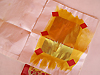
Chinese. ‘Gold paper’. Name for sheets of bamboo or rice paper with a thin piece of square foil glued to its centre (fig.) and which sometimes is endorsed with a traditional Chinese red ink seal. They are used for burning (fig.) in specially built ovens (fig.) during certain traditional Chinese ceremonies, such as funerals. Prior to burning they are sometimes folded into the shapes of flowers or other objects (fig.), comparable to origami. There are many different types for all kinds of functions, all with their own Chinese designation, sometimes including other material things made of paper. Jin zhi can also be translated as ‘money paper’ and as such it may include paper in the form of fake banknotes, otherwise known as ming bi, hell money. Before burning jin zhi the person offering it will first make a vow called athitahn, in which the hands are brought together above the head, making a wai. In English it is generally called joss paper. In Thai transcribed gim jao. See also gong de. 回
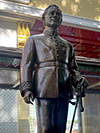
Jiraprawat Woradet (จิรประวัติวรเดช) Thai. Name of the 8th son and 18th child of King Rama V. He was born on 7 November 1876 and died on 4 February 1913. He was Minister of War and an early supporter of aviation. During a tour to Europe in 1911 to observe military affairs, he found advanced progress in aviation and realized the importance and urgent necessity to employ airplanes for national defence and security. On his return to Siam, he convinced his half-brothers, Field Marshal Prince Chakraphong Phuwanaht (fig.) and General Prince Burachat Chaiyakon (fig.), of the idea to send Thai officers to Europe on aviation course, an initiative that materialized in 1912 and resulted in the formation of the Department of Aviation under the Ministry of Defence, which in 1937 led to establishment of the Royal Thai Air Force. His name is also transcribed Chirapravati Voradej. 回
jittrakon fah phanang (จิตรกรรมฝาผนัง) Thai. ‘Mural’. A painting executed directly on a wall or ceiling. If such a painting is done in watercolour onto a fresh layer of lime plaster before it is dry, it is called a fresco, the Italian word for ‘fresh’. 回
Sanskrit-Thai. ‘Alive’ or ‘Living’. Name of one of the eighteen arahats, who is usually portrayed in a seating pose, with both his hands pulling back the lapels of his garment, thus revealing his chest with a Buddha image on it. According to legend, he was the prince of a small kingdom in India. When he became the next in line for the throne, his younger brother contested him. Jivaka however, assured his brother that he wanted to renounce the throne and become a monk instead, because he only had Buddha in his heart. To authenticate his claim, he uncovered his garments revealing the image of a Buddha on his chest. Upon seeing this, the younger brother ended his opposition and Jivaka became a monk. It is assumed by some that this monk was the learned doctor Shan Wu Wei, who in 716 AD, in the reign of Emperor Hsuan-tsung of the Tang Dynasty (618-907 AD), arrived at Chang An, coming to China from India. As such, his name perhaps refers to Jivaka Komarabhacca (fig.), the most celebrated doctor in India during the Buddha's time and eventually the Buddha's personal physician. In Chinese he is called Kai Xin (开心, or traditional Chinese: 開心), literally ‘Open Heart’, but as a compound it can also be translated as ‘To Feel Happy’. In English he is referred to as the Heart Exposing Lohan or Heart Exposing Arhat. Beside that, he is sometimes called Gobaka, which in Sanskrit is akin to the name for the bird ardea govina, a kind of heron and a symbol of circumspection, though some sources translate the name as a ‘man of heart’. In Vietnam, he may be depicted seated on a turtle and is known as Khai Tam La Han (fig.). In Thai, his name can be pronounced either Chiwaka or Chiwok. See also TRAVEL PICTURE. 回
Jivaka Komarabhacca (ชีวก โกมารภัจจ์) Thai name for the most celebrated doctor in India during the Buddha's time. He was born as the son of a courtesan at Rajagaha, who abandoned her baby near the palace gates. Prince Abhaya, a son of King Bimbisara, found the child and took it with him to be raised as his adopted son. As a young adult he set out for Taxila to study medicine, returning home after seven years, to serve as the doctor of King Bimbisara. He was hence granted many gifts, including a mango grove, where on one occasion the Buddha stayed with 1,250 monks. Later, on Vulture's Rock, Jivaka treated the Buddha when he was injured by a stone splinter from a huge stone hurled at him by Devadatta, which struck another rock and caused a splinter to wound his foot. He thus became the Buddha's personal physician. In iconography, he is typically portrayed with a white beard and white hair, and sometimes with a mortar and pestle, which he uses to prepare herbal medicines. His physical appearance is somewhat reminiscent of that of Chuchaka (fig.). See also Jivaka. 回
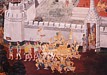
Thai name for a figure with supernatural powers in the Chinese martial arts story ‘The Legend of the Condor Heroes’, set in the Song Dynasty (960-1279) and in Thai known as the ‘Jade Dragon’ (Mangkon Yok). It was written by the novelist Jin Yong (金庸), who in Thai is called Kim Yong (กิมย้ง) and in the West known as Louis Cha. Jiw Pae Thong is the younger disciple brother of Wang Chong Yang of the Quanzhen Sect and although he was one of the oldest characters in the novel, he still behaved in a childish and mischievous manner like an immature toddler, thus earning him his nickname Lao Wan Tong (老頑童), meaning the ‘Old Imp’ or ‘Old Urchin’. Despite their large difference in age, Zhou Bo Tong became sworn brothers with Guo Jing and even taught him martial arts. He was by far the most powerful martial artist alive after the death of Wang Chong Yang. In Chinese Jiw Pae Thong is called Zhou Bo Tong. 回 Chinese. ‘Lucky, auspicious quadrupeds’ or ‘lucky, propitious beasts’. A name for Chinese Imperial roof decoration. 回 Thai name for the shifty general in the Chinese story of the Three Kingdoms. In Chinese he is referred to as Cáo Cāo (曹操). He was known for his craftiness and his name Cāo could be translated as ‘to grasp’, ‘to control’, ‘to steer’ or ‘to manage’. 回 Name of a 19th century English sea captain who served under the Siamese government during the reigns of King Rama IV (fig.) and King Rama V (fig.), and whom was bestowed with the title of Admiral of Siam, in Thai referred to as Phraya Wisut Sakhoradit (วิสูตรสาครดิฐ). He arrived in Siam as captain of a merchant ship in early 1857 and was a year later appointed as the Bangkok Harbour Master. He captained royal vessels and founded the Bangkok Dock Company, which he managed until his retirement in 1893. He died in 1905 at the age of 85 and was buried at the Bangkok Protestant Cemetery. He is remembered with a memorial at the Marine Department in Bangkok, known in Thai as Krom Chao Tha (กรมเจ้าท่า), that besides his statue also features his to former official residence, that displays original furniture, portraits of Captain John Bush throughout the years, and the framed original letter of his official appointment by King Mongkhut. WATCH VIDEO. 回
Thai. ‘Water lettuce’. Name for a free-floating aquatic plant of the genus Pistia, with just one single species, which is known by the botanical name Pistia stratiotes. It is a perennial plant with thick, soft, light green leaves, with a length of up to 15 cm and which are covered in short, water-repellent hairs. In water, these wedge-shaped leaves leaves, which form a rosette-shaped, funnel-like structure, trap air bubbles, increasing the plant's buoyancy and allowing small birds to walk over a carpet of them. Due to its cabbage-like shape it is also called water cabbage. Thai pronunciation jauk and sometimes transcribed jawk. 回
Thai. ‘Duckweed’. Name for a very small free-floating plant of the genus Lemna which grows in dense colonies on the surface of still water. Its Latin name Lemna is derived from the Greek word limne, meaning ‘stagnant pool’. There are several species but the Thai name usually refers to common or lesser duckweed (Lemna minor), a tiny seed bearing aquatic plant with a submersed multiple root structure. It's natural habitat is in fresh water ponds, streams and marshes. Rich in protein and fats many kinds of ducks consume duckweed and often transport it to other bodies of water, hence its English name. Thai pronunciation jauk haen and sometimes transcribed jawk haen. See also TRAVEL PICTURES. 回
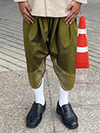
Thai. ‘Bandit Surang’. Name of the legendary British pirate who appears in the epic story Phra Aphaimanih by Sunthorn Phu. READ ON. 回 Thai. Name of a traditional, sarong-like lower garment, reminiscent to the Khmer sampot worn in Cambodia (fig.). It is worn by both men and women, and consists of a rectangular piece of cloth that is wrapped around the waist, covering the lower body. The edge of the cloth is passed between the legs and tucked in at the wearer's lower back, making its shape more like a like a pair of loose pants rather than a skirt. In the past, it was the everyday wear of the upper and middle classes. In officialdom, it is for males usually worn with a white, cream or light coloured jacket, known as seua racha pataen (fig.), and typically with white socks and black shoes. See also TRAVEL PICTURES. 回
A character from the Javanese-Thai story Inao (fig.), who fell passionately in love with Butsaba and helped defend her father's city, Krung Daha. 回 1. Thai for crocodile, also known as jorakae thong leuang. Thailand is home to three different species, i.e. the Siamese Crocodile (Crocodylus siamensis), in Thai known as jorakae beung (จระเข้บึง), jorakae nahm jeud (จระเข้นํ้าจืด) or jorakae Sayaam (จระเข้สยาม); the Large Saltwater or Estuarine Crocodile (Crocodylus porosus - fig.), in Thai called jorakae ahy kiam (จระเข้อ้ายเคี่ยม) or jorakae nahm khem (จระเข้นํ้าเค็ม); and the False Gharial (Tomistoma schlegelii) with its characteristic thin and elongated snout (fig.), also known as the Malayan Fish Crocodile, Malayan Gharial or False Gavial (fig.), and in Thai named jorakae pahk kratung hew (จระเข้ปากกระทุงเหว) or takohng (ตะโขง). Nowadays crocodiles in Thailand no longer occur in the wild, but are bred for their hide and meat (fig.) in special nurseries, called crocodile farms (fig.). The meat is frozen and exported, or used in local cuisine (fig.), whilst the hide is used to produce crocodile leather products (fig.). In South Asia however, there are still crocodiles found in the wild. Throughout the Indian subcontinent and the surrounding countries, there are wild Marsh Crocodiles (Crocodylus palustris - fig.), as well as Indian Gharials, also known as Indian Gavials (Gavialis gangeticus - fig.), and Saltwater Crocodiles. Marsh Crocodiles (fig.) are also referred to as Muggers or Mugger Crocodiles (fig.), a term that derives from the Urdu word magar and means ‘water monster’, whereas gharials get their name from the Hindi word ghara (घड़ा), i.e. a clay pot to cool drinking water, which resembles the bulbous growth on the nose of adult males. Being reptiles, crocodiles lay tough-shelled amniotic eggs (fig.). It has recently been discovered that crocodiles can sleep with one eye open, shutting down just half of their brains, keeping the other half active. In mythology, the makara is sometimes portrayed as a crocodile (fig.), while Chalawan is a prominent crocodile in the Thai love story of Kraithong. See also haang jorakae, WILDLIFE PICTURES (1) and (2), and POSTAGE STAMP. 回
2. Vahana or mount of the Vedic god Varuna. 回 jorakae thong leuang (จระเข้ท้องเหลือง) Thai. ‘Crocodile with a yellow belly’. Nickname for any of the crocodiles endemic to Thailand (fig.), except for the Malayan fish crocodile, a kind of alligator, which is known in Thai as jorakae tihn pet (fig.). 回 jorakae tihn pet (จระเข้ตีนเป็ด) Thai. ‘Duck feet crocodile’. Nickname for the Malayan fish crocodile, a kind of alligator (fig.). See also jorakae thong leuang. 回 Common name for a striking spider in the family Nephilidae, with the scientific Latin designations Nephila clavata, Nephila limbata, and Nephila obnubila, amongst others. It is found in Japan, Korea, Taiwan, and China, as well as in Myanmar (fig.). Whilst the body size of the female is around 2.5 centimeters, that of the male is no more than about 1 centimeter. It has black legs with yellow bands and a yellow body decorated with bluish-grey horizontal bars and spots, and some red colouring towards the rear of the abdomen, as well as two bright yellow spots at the rear edge of the upper body. Males are similar to females, but their yellow bodies have dark and vertical markings, as well as a series of bluish-grey spots at the rear edge of the body (fig.). The yellow threads of this species' web appear gold in the sunlight and in autumn, the smaller male joins the female in her web in order to copulate. After mating the female spins an egg sack with up to 1,500 eggs. The life cycle of the Joro Spider ends by late autumn or in early winter. This spider is similar in appearance to the Batik Golden Web Spider (fig.) and the Golden Orb-web Spider (fig.). See also WILDLIFE PICTURE. 回
Chinese Pidgin English. Term that refers to a Chinese ‘idol’ or ‘deity’. It is derived from the Javanese word dejos which itself comes from the Portuguese word deus, meaning ‘god’. Colloquially it came to mean ‘luck’. 回 Name for a kind of cored incense stick, a small wooden stick coated with a thick layer of incense that burns away together with its core. Joss sticks are burned in a special vessel called a kratahng toob (fig.) in Thai, but are usually discarded before being burned up completely (fig.). If not, they are sometimes left and piled up on top of each other to form a tower of sticks (fig.). Before burning joss sticks the person offering them will first perform an athitahn. 回
Thai. Southern Thai name for the Siam Tulip. 回 Arabic. ‘Garment’. Term for a type of long loose shirt with wide sleeves, worn by Muslim boys and men, especially in India and that –except for the hands and face– covers the body well below knee-length. It is commonly worn over a loose pair of trousers, usually of the same colour, as well as with a hat called a taqiyah, kufi or topi. It is similar to the thobe (fig.). 回
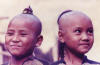
Name of a greedy old brahmin. READ ON. 回 Thai. ‘Tuft’. The growing of a topknot or tuft of hair on a child's head (fig.), with the rest of the head shaven bald, is based on a centuries old superstition and is to prevent children from becoming chronically ill. The juk is cut off during a traditional tonsure ceremony called Pittih Kohnjuk, when the child is older. Hill tribe children often have their heads shaved leaving a small lock of hair in front (fig.). The custom can be traced back to the brahmins (brahman priests), who grow a small tuft of hair at the back of their heads (fig.), in the bindu chakra (‘circle of drops’), a part where it is believed that a fluid is produced which can become either amrita, the Elixir of Immortality, or the poison of death. See also kwan, pomjuk, poi, krajuk, kle and molih, and compare with the codhumbi, worn by Brahmin priests and novices. 回
Thai. ‘Minor Era’. Name of the era officially in use before the introduction of the Buddhist Era (BE). It began on 21 March 638 A.D. Also spelled Chulasakrat, yet pronunciation is rather Junlasakraat or Chunlasakraat. See also chunla-. 回 See maengmoom kradoht. 回 Name for a species of babbler, with the scientific designation Turdoides striata and found in South Asia. It is a common resident breeding bird in most parts of the Indian Subcontinent, and although several members in the Timaliidae family are found in Thailand, this species is not. In India, these birds are nicknamed Seven Sisters, as they often appear in groups of seven. See also WILDLIFE PICTURES. 回
Common name for a species of butterfly, with the scientific designation Orsotrioena medus, and also commonly referred to a Nigger. Whilst the upper-side of the wings of the Jungle Brown is plain, dark brown, without markings, the underside has two ocelli, as well as a typifying whitish marginal line on both the fore- and hind-wings. Whereas the white line remains in the dry season, the ocelli degenerate to mere spots, and some individuals may have an additional third eyespot, which is smaller in size and located near one of the two ocelli on the hind-wing. This species of butterfly is widespread throughout Asia and prefers to dwell in shady forest, both wet and dry. 回
Name for a species of wild cat, with the scientific name Felis chaus fulvidina, and which is found in mainland Southeast Asia, including in Myanmar, Laos, Cambodia, Vietnam, Thailand, and Malaysia. Despite its name it lives in open grasslands, scrub and deciduous forests, as well as along streams. It is slightly larger than domestic cats, with males a bit larger than females. It has a relatively long legs and a short tail. Its fur is plain ashy grey to yellowish-brown, with brown stripes on the legs and tail, and whitish pale around the snout. Though not closely related to the lynxes, the Jungle Cat is also known as Swamp Lynx, which is due to the fact that the tips of its ears, like lynxes, also have black tufts. In Thai it is called maew pah (แมวป่า) or (เสือกระต่าย), meaning ‘jungle cat’ or ‘wild cat’, and ‘rabbit tiger’, respectively. See also POSTAGE STAMPS. 回
Name of a widespread Asian species of crow, with the scientific designation Corvus macrorhynchos, of which there are at least 8 subspecies, including C. m. colonorum; C. m. connectens; C. m. intermedius; C. m. japonensis; C. m. mandschuricus; C. m. osai; C. m. philippinus; C. m. tibetosinensis, besides the nominate race C. m. macrorhynchos, which is also commonly known as Large-billed Crow or Thick-billed Crow. It occurs throughout South, East and Southeast Asia. Yet another species, commonly known as the Eastern Jungle Crow and with the scientific designation Corvus levaillanti, is also sometimes listed as a subspecies of Corvus macrorhynchos with the scientific name Corvus macrorhynchos levaillantii. Corvus macrorhynchos has a noticeable large bill and has an all-black colouration, with a minor bluish shine on the plumage. The Large-billed Crow grows to well over 50 centimeters in size, with the Himalayan race being the largest subspecies, growing up to 59 centimeters (fig.). The Eastern Jungle Crow is slightly smaller. Jungle Crows live in a broad range of habitats, from woodlands and mangrove forests to open country and cities, where they benefit from human presence, but are often considered a nuisance. They are very adaptable and feed on a wide range of food sources, including other birds which they hunt and kill (fig.). Their call is a low-pitched ‘kah’, what led to their Thai name, nok kah and which translates as ‘crow’, though it is also known as nok ih-kah. In mythology it is referred to in the story of Kaaknasoon, a female giant belonging to the entourage of Totsakan, who changed herself into a large crow (fig.), and crows also appear in the story of Sangthong (fig.). See also WILDLIFE PICTURES (1) and (2), and WATCH VDO. 回
Common name for a species of starling, with the scientific designation Acridotheres fuscus and is a common resident in tropical southern Asia and southeastern Asia. It is about 23 centimeters tall and has a grey plumage, blackish head, wings and upper-tail. The under-tail is white, and in flight, the underwings display large white patches. Like the White-vented Myna (fig.), it has a crest on the forehead, but a much smaller one, and the bill and legs are yellowish-orange, as are the irises, though the southern Indian race has a blue irises. The sexes are similar, but juveniles are brownish. It is somewhat similar to the Bank Myna (fig.), but lacks the bare eye-patches. In Thai, it is known as nok ihyang kwai, i.e. ‘buffalo myna’, due to its tendency to perch on the back of buffaloes, a habit also ascribed to the White-vented Myna (fig.). Compare also with the Common Myna (fig.). See also WILDLIFE PICTURES. 回
Generic common name for a species of butterfly found in South and Southeast Asia, with the scientific name Stichophthalma louisa. READ ON. 回 |
_small.jpg)
_small.jpg)
%202_small.jpg)
_small.jpg)
%20cone-shaped%20bamboo%20basket%20on%20stick_small.jpg)
%20flowers_small.jpg)
%202_small.jpg)
_small.jpg "Hibiscus schizopetalus")
%20China_small.jpg)
%20A_small.jpg)
_small.jpg)
_small.jpg)
_small.jpg)
%204%20guardians%20of%20the%20world%20that%20preside%20over%20the%204%20points%20of%20the%20compass_small.jpg)
%202_small.jpg)
_small.jpg)
%20non-breeding%201_small.jpg)
_small.jpg)
_small.jpg)


%202_small.jpg)

%201_small.jpg)
_small.jpg)
_small.jpg)

%20จิงโจ้้น้ำ_small.jpg)
_small.jpg)
%20skink%202_small.jpg)
_small.jpg)
%202_small.jpg)
%201_small.jpg)
_small.jpg)
_small.jpg)
%20Chirapravati%20Voradej_small.jpg)
_small.jpg)
_small.jpg)


_small.jpg)
%20female%201_small.jpg)
_small.jpg)
_small.jpg)
_small.jpg)
%201_small.jpg)
%201_small.jpg)
%20นกกา_small.jpg)
%201_small.jpg)
