|
earth goddess
In
Hinduism, the goddess of the earth is
Bhumidevi, in Buddhism she is
Mae Phra Thoranee. In Buddhism she was called before the demon
Mara
to bear witness to the merit the Buddha accumulated in his previous lives. She is often depicted in Thai and Cambodian iconography wringing water from her long hair which drowns the armies of the demon Mara (fig.).
回
East Asian white radish
See
hua chao thao.
回
East Asiatic Company
Firm founded in 1897 by Hans Niels Andersen,
a Danish shipping magnate and businessman, who
in 1872 first came to
Bangkok
as a hired ship's carpenter.
After having advanced to first mate in 1873, he later on became master of a ship
owned by King
Rama V.
Though initially set up to provide freight and
passenger
shipping lines between Bangkok and Copenhagen, the East Asiatic Company (EAC),
known in Danish as Det Østasiatiske Kompagni, over time expanded its services
worldwide and eventually grew to become the largest company in Denmark,
operating from the Danish capital. With the
rise of air travel passenger operations shrank, until they were eventually
discontinued in 1969. Its former
offices in Bangkok were
located along the lower eastern bank of the
Chao Phraya
River, just downstream from the luxury Oriental Hotel, the first ever hotel in
Thailand, which was built in 1887, also by
Andersen in partnership with two
compatriots, on premises which he had bought in 1881. Its former docks are
further downstream, where today
Asiatique The
Riverfront (fig.)
is located, as well as
the
Bangkok Ferris Wheel
(fig.).
See MAP.
回
_small.jpg)
East China Yellow Lady's Slipper
Common name for a terrestrial Venus Slipper
orchid
with the botanical name
Paphiopedilum concolor (fig.).
回
Eastern & Oriental Express
Official name of the opulent train that runs between Singapore and
Bangkok, via Penang and Butterworth in
Malaysia. The luxurious dining car offers a five star menu, cooked by internationally renowned chefs. Popular name Oriental Express (fig.).
回
Eastern Courtier
Name of a species of butterfly
found in South and Southeast Asia.
READ ON.
回
Eastern White Pelican
See
White Pelican.
回
East Indian Walnut Tree
Common name for a tree in the
family Fabaceae and with the botanical designation Albizia lebbeck, that grows
to a height of up to 30 meters tall, with a trunk that grows up to circa a meter
in diameter. It has white, fragrant, tassel-like flowers with numerous 2.5 to
3.8 centimeter long stamens, whilst the fruit consists of a pod that can grow up
to 30 centimeters in length, up to 5.0 centimeters in width, and
contains six to twelve seeds. In
Buddhism, it
is considered a sacred tree, i.e. a kind of
bodhi
tree,
under which
Kakusandha,
a
buddha
of the past (fig.),
sat when he attained
Enlightenment.
See also
POSTAGE STAMPS.
回
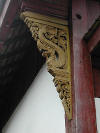
eave bracket
Architectural term for the ornament supporting the roof eaves. On Buddhist temples in Thailand they are often in the shape of a
naga
or other, usually mythological, figure. Sometimes their function is as
much decorative as supportive (fig.).
In
Nonthaburi,
the characteristic eaves brackets of
the old City Hall's balcony
(fig.)
have been made into a local emblem that has been introduced as an iconographic
symbol of the city and province.
In Thai, eaves are generally called thuay (ทวย), but the
triangular form is also referred to as thuay hoo
chang (ทวยหูช้าง),
i.e. ‘elephant's ear eaves’.
See also THEMATIC STREET LIGHT
(1),
(2),
(3),
(4),
(5),
(6),
(7)
and
(8),
as well as
TRAVEL PICTURE.
回
Ebisu (恵比須, 恵比寿)
Japanese. The
Japanese god of fishermen and one of the Seven Gods of Fortune.
READ ON.
回
E De (Ê Đê)
Vietnamese. Name of an ethnic minority
group, that lives in the Central Highlands of southern
Vietnam and that has an
estimated population of around 300,000. They live in concentration in Dak
Lak Province, as well as in western parts of Khanh Hoa and Phu Yen Provinces.
This group practices matrilineal descent, in which ancestry is traced through
the female line, i.e. children take the family name of their mother and the
right of inheritance is reserved for daughters only. Hence, all family property
is held by women, while corporate property, such as paddy land and cattle, are
held by a senior matriarch. The E De typically live in
Longhouses
(fig.),
and after marriage, the man comes to live at his wife's house.
Their language belongs to the
Malayo-Polynesian group. The E De were previously also known as Rhade or Rade,
and as De.
回
education
The Thai educational system consists of two years of kindergarten, six years of elementary or primary school, six years of high school divided into three years of junior
school and three years of senior high school, respectively.
READ ON.
回
Edwards' Pheasant
See
Vietnamese
Pheasant.
回
Egg Magnolia
Common
designation for an ornamental
flowering tree, with the botanical binomial
name
Magnolia liliifera. The tree produces fragrant, egg-shaped flowers
in white to cream
colours that grow on its terminal stems, complemented by long elliptical leaves.
Notably, in the morning, these flowers are known to emit a delightful
pineapple-like scent. In Thai, it is known as
montha
and is considered a celestial plant. According to story of the Buddha, this
plant grows only in heaven and cannot be found on earth and its flowers would
only descend to the earth during eight significant Buddha-related events,
including when the Buddha attains
nirvana.
The story then recounts that, seven days after the Buddha reached nirvana,
Maha Kassapa
and other members of the
Sangha
were en route to
Kushinara
in order
to pay their respects to the
Buddha. Before reaching Kushinara, they observed a man using an Egg Magnolia
flower as a parasol, implying and signaling them that the Buddha had indeed
already attained nirvana.
The Egg Magnolia is not native to Thailand,
and its arrival in the region remains unclear. One hypothesis suggests that it
may have originated from Java, a notion supported by information found in
literature, namely in the Thai story
Inao
(fig.),
which draws inspiration from Indonesian literature, there is a chapter that
mentions the Egg Magnolia as having originated from Java.
See POSTAGE STAMP.
回
Egg of Brahma
Name for the entire solar system, also
known as the
Surya-system.
Seen from outer space as an ovoid body of light, an egg-shaped irresolvable
nebula. This includes the entire solar world, from the very heart of the Sun to
beyond the confines of what astronomers call the farthermost planets. It is
composed of concentric spheres with at the heart of each one of them the Sun.
each one of these spheres is a cosmic world, including our Earth. See also
loka
and
Brahma.
In Sanskrit called Brahmanda. See also
hiranyagarbha.
回
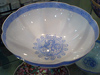
eggshell porcelain
A kind of
extremely thin
porcelain
from
China,
which is often semi-translucent (fig.) or decorated with patterns that are visible only
when held to the light, somewhat like a watermark in paper. Such decorations
were engraved before firing the porcelain, and are known as an hua (暗话) in
Chinese, which translates as
‘secret language’. The production of this
paper-thin
porcelain, in general bowls, cups and plates,
is very intricate and was introduced in the Ming
Dynasty, although hei tao (黑陶), the highly polished
‘black pottery’
of the Neolithic Long Shan (龙山) culture, has eggshell thinness and is considered
to date back some 4,000 to 5,000 years. The latter is sometimes referred to as
black eggshell pottery. Eggshell porcelain is often plain white in colour,
though it can also have a painted design, either in a variety of colours (fig.), but
frequently with a pattern in only blue.
Due to its weightlessness,
eggshell porcelain is sometimes known as bodiless chinaware, which in Chinese is
called tuo tai ci (脱胎瓷).
回
Egyptian Vulture
Common name for a diurnal bird of prey, which is found in southern Asia,
as well as in southern Europe and parts of Africa.
READ ON.
回
eight
See
ba.
回
Eighteen Arahats
See
arahat.
回
Eight Great Bodhisattvas
Term
for the main
bodhisattvas
associated with the
Shakyamuni
Buddha,
eight in total and each one representing a
personification of one of his primary qualities.
READ ON.
回
Eight Immortals
The Eight Immortals from Chinese mythology worshipped by most Chinese. They are usually depicted together on a raft crossing the ocean from their home in the
Taoist paradise to worship
Xi Wangmu, Queen Mother of the West and mother
of the
Jade Emperor, after attaining their
Enlightenment.
The mother of the supreme god is also the guardian of the
Peaches of Immortality,
an attribute often accompanying the Eight Immortals
(fig.).
The eight are known by the names:
Chung-li Chuan
(fig.),
Li Tieh-kuai
(fig.),
Lu Tong-pin
(fig.),
Chang Kuo Lao (fig.),
Ho Hsien-ku
(fig.),
Lan Tsai-ho
(fig.),
Han Hsiang Tzu
(fig.) and
Tsao Kuo-chiu
(fig.). In
iconography, they often hold an
attribute for
recognition (fig.).
Each Immortal also has his own mount, either a real, existing animal or an
etymological creature (map
- fig.). In Chinese called Ba
Xian and in Thai known
as
Pooy Sian, Pa Sian (ปาเซียน), and Paet
Sian (แปดเซียน) or Paet Thep (แปดเทพ). See also
luohan,
arahat, and
Seven Gods of Fortune.
回
Eightfold Path
The last of the
Four Noble Truths of the
Buddha's
teaching which outlines the eight steps one must follow in order to eliminate suffering and thus attain
Enlightenment or
nirvana. The eight steps are: right understanding, right thought, right speech, right action, right livelihood, right effort, right mindfulness, and right concentration. In
iconography
often portrayed by a wheel with eight spokes. See also
dhammachakka.
回
Ekajata (एकाजटा)
Sanskrit. ‘Single braid of hair’ or ‘single
chignon’. Name for the Blue
Tara and one of the most fierce
goddesses of Tibetan Buddhism, i.e. a sect of
Mahayana
Buddhism. She is the protector of the
Vajrayana sect, as well as of
secret
mantras. She comes in many forms, but is
usually depicted naked, wearing just a
tiger skin around her thighs and a
necklace of human skulls around the neck, while being surrounded by flames,
which represent wisdom. She may also sway a human body and trample on a corpse,
actions that symbolize the suppression of the ego. Besides this, she is often
depicted with a single chignon; just one tooth or a single fang which is used to
pierces through various obstacles; either one or three breasts; and with three
eyes, though two of them are always closed, whilst the open one is a vertical
third eye.
Her name is a compound of the words eka, meaning
‘one’,
and
jata, which means
‘matted hair’,
though due to the fact that she is a goddess, the female gender can be used and
she is hence also called Ekajati.
回
%202_small.jpg)
Ekalai (เอกาไลย์)
Thai. Name of one of the seven
guardian spirits that looks out for children and that are generally
known as
Mae Seua.
This
thevada guards all the children that are born on a
Saturday and is represented with either a blackish or an
orangey-yellowish human-like body with black cloud-like stripes and the head of
tiger
(seua).
回
_small.jpg)
ekamukhalinga (एकामुखलिङ्ग)
Sanskrit.
Representation of a
linga with a single face.
回
Ekatanta
(एकादन्त)
Sanskrit.
‘Single tusk’. A nickname for
Ganesha,
due to the fact that he broke off one of his tusks, which he threw at the moon
when he felt insulted by it, after the moon had laughed at him when he fell from
his mount the
rat,
although another legend says that he lost one of his tusks in a fight with
Shiva. Hence, Ganesha is often portrayed with a single
tusk, often while holding the other one in one of his hands.
回
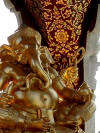
Ekathotsarot (เอกาทศรถ)
Younger brother of King
Naresuan
(fig.)
and co-ruler of the kingdom of
Ayutthaya during the latter's reign. He ascended the throne on 25 April 1605, after the death of his brother and stayed in power until his own death, which occurred sometime between October 1610 and November 1611.
See also
list of Thai Kings
and
WATCH VIDEO.
回
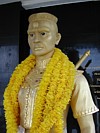
elephant
See
Asian Elephant.
回
Elephant Building
Name for a building in
Bangkok's
Chatuchak district, which has the features of an
elephant (chang). This 32 floor high-rise stands 102 meters tall and is
located in Soi 26 on Phaholyothin Road, nearby the intersection with Ratchadaphisek Road. It was designed by the award-winning architect Ongat
Satraphan (องอาจ สาตรพันธุ์), a Yale graduate, and was completed in 1997 by the
Arun Chaiseri Consulting Engineers Company (บริษัท อรุณ
ชัยเสรี คอนซัลติ้ง เอนจิเนียร์ส). The construction consists of three vertical
towers, i.e. two office towers and one residential tower, which are at the upper
floors connected by a horizontal apartment block, that houses the luxury
residential suites and some offices. The outdoor top floor has a recreation
ground, with a swimming pool and gardens. Sometimes referred to as Elephant
Tower or Chang Building, and in Thai known as
teuk chang.
See MAP.
回
%201_small.jpg)
elephant hospital
See
rohng phayaban chang khong moonlaniti pheuan chang.
回
Elephant Trunk Hill
Name of a
landmark limestone mountain located
on an island in the Li River
in Guilin, just 300 meters south of the city's
Shanhu Lake.
READ ON.
回
elephant trunk pose
Term used in
Hindu
iconography
to refer to a pose, in which
one holds one arm across the chest, with the wrist limp and the fingers pointed
downward, as with
Nataraja (fig.).
The term also occurs in
yoga,
where it used in reference to arm balance. See also
gajahasta.
回
Elephant-trunk Snake
Name of a
large, entirely aquatic, not poisonous file or wart
snake, with the scientific name Acrochordus javanicus.
READ ON.
回
Elixir of Immortality
The
amrita or elixir of immortality that arose during
‘the churning of the
Ocean of Milk’ by the gods and demons in the Indian epic the
Ramayana. The legend also occurs in the
Mahabharata, a heroic poem from
Hinduism. In
Chinese mythology, it is associated with the herbal medicine prepared by the
Jade
Rabbit that lives on the moon (fig.).
It is also often identified with
soma, the nectar of life.
Also called Elixir of Life.
回
Ellora
A World Heritage site in India with a total of 34 caves of religious significance, including
Buddhist (600-800 AD),
Hindu (600-900 AD), and
Jain (800-1100 AD). The interiors are carved with religious sculptures, architectural ornamentation, and relief panels.
回
Elongated Tortoise
A forest tortoise with an distinctly elongated carapace and the
binomial-scientific names Indotestudo elongata, Testudo elongata and Geochelone elongata. Its shell is yellow with black
striated
blotches of variable size and density, with individuals ranging from pure yellow
to predominantly black. Its forelegs are strongly scaled and its
beak is
feebly hooked.
Males become slightly larger than females and develop an plastral concavity,
whereas the plastron of females is flat. Males have a larger tail than females,
whose carapace tends to be wider and more rounded. The Elongated Tortoise is the only species in the
region with a significantly enlarged supracaudal scute, i.e. the keratinized plate above the
tail (fig.).
It is found in Southeast Asia and parts of South Asia. Also known as
Yellow Tortoise and in Thai as tao leuang (เต่าเหลือง), tao
khanaeng (เต่าแขนง), tao thian (เต่าเทียน) and tao khih pheung (เต่าขี้ผึ้ง).
回
%20เต่าเหลือง_small.jpg)
email
Glaze or glazing used to cover pottery and earthenware. Also called enamel.
回
embossed silverwork
See
kaan salak dun.
回
embroidery
The art or
handicraft of decorating cloth with finely stitched needlework. Both
China and
Vietnam have a
centuries old tradition of creating elaborate handmade embroidery, usually made
with fine silken threads and known as ci xiu (刺绣) and tranh
theu (tranh thêu), respectively.
In both countries, elaborately embroidered objects, often decorative
portraits and traditional landscapes, have long been a sign of wealth and status, and the
skills and techniques involved are usually passed from generation to
generation (fig.).
回
Emerald Buddha
1. Name of an 66 centimeter
tall, dark green,
jade-like, jasper
Buddha image
with a lap span of 48 centimeter, housed in
Wat Phra Kaew.
READ ON.
回
2. Name of a
Buddha image,
which is actually made of
crystal and located in the main
vihara
of Wat
Phreah Keo,
i.e. the ‘Temple of the
Emerald Buddha’,
which is also known as the Silver Pagoda, in Phnom Penh, the capital of
Cambodia
(fig.).
It is said to date back to the 17th century AD.
回
Emerald Dove
Name of a
widespread resident pigeon in tropical southern Asia, with the scientific name
Chalcophaps indica. It is also known by the names Green Dove and Green-winged
Pigeon and has a number of subspecies. In Thai its is called
nok khao khiao,
which likewise translates as ‘green dove’. They get their name from their back
and wings, which are bright emerald green. The head and underparts are greyish
pink and males have a white patch on the top edge of the shoulders and a grey
crown, while females tend to have a paler and more brown to buff complexion, and
the grey on the head is restricted to the eyebrows, whilst it may also have grey
marks on the shoulder (fig.). Both sexes have a brown tail, red bill, and pink legs and feet. Emerald
Doves are largely terrestrial and, except for roosting, spend little time in
trees. They feed mainly on seeds and fruit.
回
_small.jpg)
Emerald Moth
Common name used for any green moth, often
light to bluish green, in the nominate subfamilies Ennominae and
Geometrinae, both within the family Geometridae and both of which have several
tribes, species and subspecies.
回
_small.jpg)
Emerald Tree Monitor
Name of a
small to medium-sized arboreal
monitor lizard.
It is also known as green tree monitor and consists of green to turquoise
colours with dark dorsal bands. This camouflage colours can make the animal hard to detect in
its arboreal habitat. In Thai it is called
takuad
sih khiaw (ตะกวดสีเขียว)
and its scientific name is Varanus prasinus. Though closely related to the Thai
monitor lizard, this species is not endemic to Thailand, but is liked by many
for its wonderful coloration and can be seen at
Bangkok's Zoo (fig.).
回
_small.jpg)
Emperor Angelfish
Common name for a species of marine
reef-fish, with the scientific name
Pomacanthus imperator.
READ ON.
回
enamel
Another word for
email.
回
Enlightenment
The Buddhist state of true understanding or perfect knowledge
reached while still on earth. The
Buddha attained this state seated under a
bodhi tree
(fig.). Followers can attain this state and redemption of all suffering and further rebirths by following the
Four Noble Truths and the
Eightfold Path.
In
Theravada
Buddhism, there are four stages of
awakening that lead to complete Enlightenment as an
Arahat.
These stages are
Sotapanna or ‘Stream-enterer’,
Sakadagami
or ‘Once-returner’,
Anagami
or ‘Non-returner’, and
Arahat.
The Buddha refers to individuals at these stages as Ariya-puggala’,
i.e.
‘Noble People, and their community
is known as
‘Ariya-sangha’,
meaning the Noble
Sangha.
In Thai Enlightenment is
called
photiyaan,
poh
and
wipatsanah.
In
Myanmar's Buddhist
iconography,
Enlightenment is often symbolized by the representation of a
peacock and a
rabbit,
which in their own right are symbols for the sun and moon (fig.),
respectively. See also
bodhi and
nirvana.
回
en shou (円相)
Japanese. ‘Circle countenance’ or
‘circular aspect’. Term for a
Zen circle.
Also transcribed en sou.
回
epic
A series of events of an heroic nature, an heroic poem.
回
epicanthus
Specific shape of the upper eyelid, in which
the vertical fold of skin lies over the angle formed by the junction of the
eyelids, and which gives the typical slant eyed characteristic of people of the Mongoloid race, including the Chinese and Japanese.
The term is derived from the Greek word epicanthos (επίκανθός), literally
‘upon-the canthos’, with canthos (κανθός) meaning ‘the angle formed by the
junction of the eyelids’. In Thai, called tah tih (ตาตี่) and in Chinese as nei
zi zhui pi (內眥贅皮).
回
epigraph
Term for a carved inscription, from the
Greek word épigraphé (ἐπιγραφή), literally
‘upon-writing’.
回
Epipremnum pinnatum
Latin. Up to 18 meters high Southeast Asian climber, often seen around tree stems. Its green leaves, sometimes
with creamy-white to yellow-golden marbled spots, can grow up to one meter in length and 45 cms wide.
It is
known by several common names, including
dragon-tail plant and
centipede tongavine, while it similarly looking cousin with the botanical name
Epipremnum aureum, is also by a variety of common names, such as devil's ivy,
silver vine and golden pothos.
回
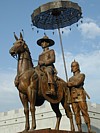
equestrian iconography
The
science of the meaning of representation of
horses as depicted in art and the illustration of horses according to this
science. Equestrian is derived from the Latin word equus, meaning ‘horse’ whereas
iconography
comes from Greek and means
‘image description’.
It consists of a set
of rules
in which the representation and the pose of the horse
and its rider are
significant. This goes especially for equestrian
statues of historical figures.
A rearing or rampant horse (fig.) in statues for example
may suggest a dynamic rider prone
to action and adventure, whereas a horse
with all four hooves on the ground (fig.) would rather indicate the steadfast
authority and power of its rider. These rules have however ramifications into
several popular
beliefs in which
the number of raised hooves of an equestrian statue connote the status of
its rider. A first such belief suggests that
if the horse has one
front or hind leg up (fig.), its rider has already died; if the horse has two legs in
the air, either rearing with both front legs up or at trot with one front leg
and one hind led up, its rider has died of causes other than natural; if the
horse has three legs off the ground, its rider has died in battle; and if all
four hooves are on the ground, the rider was still alive when the statue was
made. This belief is contradicted by another popular conception which proposes
that if the horse has one front leg up, the rider was wounded in battle or died
of wounds sustained on the battle field; if the horse is rearing, that is with
both front legs in the air, the rider died in battle; and if the horse has all
four legs are on the ground, the rider died of causes other than combat, whilst
the unlikely position of four hooves in the air probably means that the horse is
dead :). Both
beliefs are contradictory to each other and their implication, especially of the
latter, seems to be more often than not incorrect.
WATCH VIDEO.
回
era
Period or age.
回
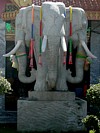
Erawan
(เอราวัณ)
The Thai name given to the multi-headed
elephant
Airavata, produced during the
Churning of the Ocean of Milk
(fig.). He is the symbol of the clouds and the mount of the deity Indra, the Vedic god of the heavens, weather and war
(fig.),
and both are depicted on the coat of arms
of
Bangkok (fig.). He is generally
depicted as a white three-headed elephant, though may sometimes be described
with more heads, e.g.
nine,
representing good luck (fig.);
or 33, representing the various heavenly states. In the Thai dance drama called
khon,
the performer playing Erawan wears a
khon mask in
the form of a elephant's head with three faces topped with a golden crown (fig.).
One text mentions Erawan as a 100-headed
White Elephant, which serves as the mount of
Phra Narai, the Thai name for Vishnu, and the second version of the
Ramakien written by
Rama II fully describes Erawan when
Indrachit, one of the demon characters disguised as Indra, succeeds in fooling the monkey general
Hanuman. Although officially the mount of the god Indra, he is in art often depicted with other riders, such as
Ganesha (fig.). Often found in art and in temples (fig.).
In
Samut Prakan
is an Erawan Museum (map
- fig.),
and in
Bangkok is the Suan Son Erawan Statue at Ramkhamhaeng Soi 60 in Bangkapi
(map
-
fig.),
which initially was in bronze (fig.), as well as the famous Erawan
Shrine, which in fact is dedicated to
Brahma, but named after the Erawan
Hotel, for which it was built as a
sahn phra phum-style
spirit house
(map
-
fig.).
Erawan
is the symbol of ancient
Siam,
and when sheltered by
a parasol
also
the Laotian royal emblem (fig.).
The
Erawan National Park
(map
- fig.)
and Erawan
Waterfall (map
-
fig.)
in
Kanchanaburi
are named after this mythological animal, since the is said that the falling
water at highest level of the Erawan Falls,
splits up over the natural obstacles while cascading
down its path thus creating shapes reminiscent of the
multiple trunks of Erawan.
See also POSTAGE STAMPS (1)
and
(2),
as well as
TRAVEL PICTURES (1),
(2),
(3) and
(4),
as well as
THEMATIC STREET LIGHT (1),
(2),
(3)
and
(4).
回
Erebus caprimulgus
Latin. Scientific name of a species of large
and robustly built moth, with a wingspan of around 12 centimeters and endemic to Southeast Asia.
READ ON.
回
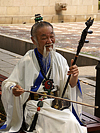
erhu
(二胡)
Chinese.
‘Two non-Han’. Two-stringed Chinese fiddle-like instrument and one of the
most popular Chinese instruments in the family of string instruments, which are
together referred to as huqin (胡琴), meaning ‘non-Han
musical instrument’. Er, the first part of
the name erhu, means ‘two’
and refers to the instrument's number of strings, whereas hu, the latter part of
the name, refers to the instrument's foreign origin, as it is said to originate
from a similar instrument used by the nomadic Mongolian Xi tribe, which was then
referred to as xiqin (奚琴). The erhu can imitate many natural sounds, such as a
chirping bird or a barking dog.
回
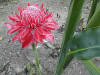
Etlingera elatior
Latin. Scarlet red flower of the genus
Etlingera of which in total some 57 species are found. The flower appears embedded in a waxy pyramid-like cone of pink-edged, bright red bracts, with a diameter up to 25 centimeters. The inflorescence is borne on a 1.5 meter high leafless stem. The approximately one meter high oblong leaves are borne on
bamboo-like stalks (fig.).
Also known by the scientific names Nicolaia elatior, Alpinia elatior and
Phaeomeria speciosa.
Its common English name is Torch Ginger and in Thai the plant is called dahlah (ดาหลา).
回
Eua Suntonsanaan (เอื้อ สุนทรสนาน)
Thai. Name of the Music Master of the
Rattanakosin
Period, who in the 1940s
founded the nation's best-known big band named Suntarapon (สุนทราภรณ์). He
learned to play the violin at a very young age and by age nine he was already
playing in an orchestra. At the age of 18 he studied
harmony and arrangement, and besides classical music, started to
focus also on Jazz. Due to the latter's greater popularity, he began reaching
larger audiences, especially when he began playing Phleng Thai Sakon (เพลงไทยสากล),
a genre that harmoniously combines Jazz and Western music with traditional Thai
classical music. He was one of the major
musical composers, musical teachers, singers, conductors and musicians of his
time, whose prolific writing
of lyrics and music resulted in around 2,000 Thai classic songs, many of them considered to be literary and musical
masterpieces. He also wrote several popular songs for the
celebration of different festivals, such as Sawatdee Pih Mai (Happy New Year)
and
Songkraan
(Thai New Year), as well as
Ram Wong
Wan
Loi Krathong.
He died of
cancer on 1 April 1981 and in 2010, the centenary year of his birth, he was
honoured by UNESCO as an Important Person of the World,
making him the first Thai musical artist who
befell this tribute.
He is often referred to as
Kruh
Eua Suntonsanaan, and his name is also transcribed
Euah Suntornsanan.
WATCH
VIDEO.
回
%201_small.jpg)
Eudocima hypermnestra
Latin-scientific name for the
Oblique Striped Fruit-Piercing Moth,
used alongside Phalaena hypermnestra.
回
Eugene Reytter
Belgian doctor of medicine, who was for 17 years the
personal physician of
King
Chulalongkorn.
READ ON.
回
eunuch
Term derived from the Greek word eunouchos (ευνούχος) and
which refers to a person who was castrated. In Imperial China, to humiliate
them, prisoners of war
were often castrated,
which included removal of the penis as well as the testicles. Afterward, they
were made slaves in the imperial service, either to perform forced labour for
projects such as the construction of the
Forbidden City (fig.),
or to
oversee the concubines in the harem of the Emperor.
Whereas adult rebels or war prisoners were usually executed, their sons, often
young boys or underage children, were castrated. After castration, it was
initially hard for the mutilated men to urinate properly and many would spill
urine on their bodies. Without the proper means to wash it off, this led to the
then common saying ‘to stink as a
eunuch’. See also
court eunuch.
回
Euphaea masoni
Scientific name for a species of
damselfly.
Though rather widespread and common year round, it has no common English name.
The male is almost completely dark greyish-black with
a bluish shine, except for the wingtips, which are transparent brown.
Females are overall greyish-blue, with transparent wings and a brownish wing
patch and nerves, whilst its greyish-blue eyes have a greenish shine. In Thai it
is called
malaeng poh
khem
nahm tok
dam (แมลงปอเข็มน้ำตกดำ), i.e. ‘black
waterfall damselfly’.
回
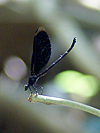
Eurasian Collared Dove
Name for a species of medium-sized dove, with the scientific
name Streptopelia decaocto. It occurs from Europe to Asia, mostly in dry open
country and lowlands. It is about 33 centimeters in length, with a pale, soft
grey forehead, and with the top of the head to the nape a greyish-brown,
suffused with pink-vinous and a typifying black collar with a grey border around
the lower neck (fig.). The upperparts are mostly mostly pale grey-brown, with darker
grey towards the wings tips, whilst the underparts are a creamy-white, variably
suffused with some vinous grey. The eye is dark reddish brown and the orbital
skin is greyish white. The bill is blackish grey, and the legs and feet are dull
purplish red to greyish pink (fig.). Also spelled Eurasian
Collared-Dove and often simply referred to as Collared Dove. It is related to
and very similar to the Ringneck Dove (Streptopelia risoria), which is believed to be a domestic form
of the Eurasian Collared Dove, and for which it can easily be mistaken. In
Thai called
nok khao khaek.
回
_small.jpg)
Eurasian Eagle-owl
Common name for a species of eagle owl, with
the scientific name Bubo bubo (fig.). It is found in much of Europe and Asia, and the
subspecies that occurs in the Southeast Asian region, especially in Southwest
Myanmar,
is known as Bubo bubo bengalensis. It has brown upperparts, buff underparts,
thick brown streaks on the breast, ear tufts,
a dark bill, orange eyes and a black border on its facial disc. It is a largely
nocturnal bird and its preferred habitat are mountains and forests, with bush
covered rocky country, cliffs and rocky areas, such as ravines.
回
%20in%20Beijing%20zoo_small.jpg)
Eurasian Jay
Common name for a semi-large, 31 to 34
centimeter tall species of bird (fig.), with the scientific name Garrulus glandarius.
It occurs over a vast region, from Europe and northern Africa to the eastern
seaboard of Asia and down into Southeast Asia, including also Thailand, where it
is known as nok pihk laai scot (นกปีกลายสก็อต), meaning ‘bird with Scottish patterned wings’. There
are several racial groups, some with very distinct forms, as well as subspecies.
Those that occur in Southeast Asia are Garrulus glandarius leucotis, G.g.
sinensis, G.g. oatesis, and Garrulus glandarius haringtoni. Sometimes simply
called Jay, without the adjective.
回
%20นกปีกลายสก็อต%201_small.jpg)
Eurasian River Otter
Common name
for the most widely distributed species of otter in the world.
READ ON.
回
Eurasian Sparrowhawk
Common name for a
small raptor, with the scientific designation
Accipiter nisus.
READ ON.
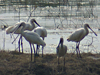
回
Eurasian Spoonbill
Common name for a
large wading bird, with the scientific designation Platalea leucorodia and
belonging to the family Threskiornithidae, which also includes the ibis. Its plumage is overall white, with
dark legs and feet, and a dark elongated spoon-shaped bill, which is broader,
round and yellow at the tip. During the breeding season, it has a yellow breast
patch and a crest. Immature birds have a pale bill and black tips to the primary
flight feathers. Eurasian Spoonbills fly with their necks outstretched (fig.). In
Thailand, where these birds are rare winter visitors, this species is known as nok pahk chon nah khao (นกปากช้อนหน้าขาว),
i.e.
‘white-faced spoonbill’
or ‘white-fronted spoonbill’.
See also WILDLIFE PICTURES.
回
Evil Eye
A term for a look that is
superstitiously believed to have the power to inflict harm. In this
common conviction from antiquity
it is
understood that the envy brought forth by the good luck of fortunate
people, may result in their misfortune and can be caused simply by an
envious person casting a malevolent gaze,
intentionally or not.
This so-called Evil Eye can be countered by wearing
amulets in the form of -usually blue-
eyes,
that
ward off the curse
and turn the
malicious look back to the envious person.
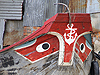
Many boats, have a pair of forward looking, vigilant eyes painted on the prow (fig.),
one on each side of the stem. They are believed to protect them from
misfortune. During antiquity, in the Mediterranean of the 5-6th
century BC, similar circular stone eyes, called ophtalmoi (ὀφθαλμοί
- ‘eyes’) in Greek, were very common on the bows of ships, affixed
with bronze nails and acting as a pair of eyes to aid navigation and
warn of dangers, i.e. to protect mariners from the Evil Eye, known
as matiasma (μάτιασμα) or baskania (βασκανία).
The practice is also common in
South Asia and Southeast Asia, and in Thailand especially on traditional wooden
rice barges (fig.),
whereas in the
Mae Khong River (fig.)
Delta (fig.)
in southern
Vietnam,
the eyes are allegedly believed to scare off
crocodiles
and other menaces, and are on traditional boats
usually not painted on the prow, but rather made from detachable wooden
blocks, that are removed and are customarily hung on a tree when the
boats go in for repairs and maintenance (fig.).
Also known as Apotropaic Eye, and in Sanskrit called
adrishti. See also
Wisdom Eyes,
Divine Eye, and
Hamsa.
回
Excise Department
Governmental department with as
mission to promote a sustainable fiscal position
for the nation, to develop a sustainable economy, society and
environment, and to create and implement an efficient standard for
tax collection. In Thai, this department is known as
krom sanphasahmit. In 2012, this
department celebrated its 80th anniversary, which was commemorated
by a Thai postage stamp issued for the occasion (fig.).
回
exposed doorway beams
Ancient system used in
China
in
which the number of exposed beams over the outer doorway of a
residence indicated the
status of the family or clan residing inside. The custom can
still be seen in traditional houses, such as in the Hutong and in
the
Forbidden City (fig.) in Beijing. The number of beams over the doorway
increases with the status of the occupants. The lowest ranking
person would have no beams and the emperor would have the maximum of
12 beams. And, the higher the number of beams was the higher also
the threshold, called
men kan
(fig.), would become
higher, as raising the foot very high in order to step
over the threshold, the knee would bend and that is symbolically the
same as kneeling to the occupant of the household. The threshold
also demands respect as when
one is stepping over it one has to look down in
order to see where to step and thus automatically bows by lowering
the head, thus showing respect to the
person whose place one enters. The custom
of the exposed doorway beams, or a
derivative thereof, can be observed in
Vietnams (fig.),
where wooden circular ornaments that are
reminiscent of the exposed
doorway beams, are placed over the doors
of traditional mansions and temples.
Chinese-style architecture also has exposed
roof support beams
(fig.),
which in general are also decorated
(fig.)
and somewhat reminiscent of the exposed doorway beams as well.
See also
Hong Men.
回

extremophile
An organism that
thrives in extreme environments, such as temperature, salinity,
acidity level, etc. For example, thermophiles, i.e. bacteria that
form on rocks near hydrothermal vents.
回
extremophyte
A plant
extremophile, i.e. an extreme
plant, that is evolutionarily adapted to thrive in environments
characterized by a high degree of abiotic stress, such as soil
nutrient limitations, drought, flooding, fire, soil toxicities,
salinity, alkalinity, temperature, etc. to which extremophytes have
evolutionarily
adapted to thrive due
to their great
tolerance of one or more of these abiotic stresses, while the
greater the number of these stresses occur simultaneously, the
greater the overall stress will be and the more extreme the plants
are.
回 |