|
Iban
1. A people
of Borneo, which are also known as the Sea Dayaks, a branch of the Dayak people.
In Malaysian Borneo, most of them are located in Sarawak, with just a small
portion living in Sabah. They are also found in Brunei and in the West
Kalimantan region of the Indonesian part of Borneo, while some of them also live
in Peninsular Malaysia. They are well-known for their hunting skills with
blowpipes (fig.) and were once infamous for
their practice of headhunting, which in the past made
them a strong and successful regional warring tribe. They live in
Longhouses (fig.)
and skulls of their beheaded enemies can still be found hanging in baskets
from the ceiling in many a Iban Longhouse (fig.).
Many adult men wear traditional tattoo designs (fig.) on their bodies
(fig.), with some men having hand tattoos,
which signifies that they have taken the head of an enemy. During special
occasions and festivities, the Iban people dress up in their traditional attire
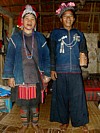
(fig.).
See also
Penan.
回
,%20Sarawak,%20Borneo_small.jpg)
2. Language
spoken by the Iban people of Borneo. See also
Penan.
回
Ice (ไอช์)
The English
word ice often occurs as a nickname for Thai people. It is given to somebody who
is supposedly jai yen (ใจเย็น), literally
‘cool heart’, i.e. cool or calm. This
should not be confused with the English term cold-hearted, i.e. lacking kindness
or sympathy. Rather, it is sometimes said to be the Thai equivalent of the
British stiff upper lip. Additionally, the final -s is in Thai not pronounced
and hence it sounds more as
‘ai’
(爱),
which is both the Chinese and Japanese word for
‘love’. However, nowadays
the term ice is also the worldwide
nickname for the illicit
drug methamphetamine hydrochloride, otherwise known as
crystal meth,
which is widely used as a
recreational
drug, especially in the gay
online dating subculture,
where it is used
to facilitate or enhance
sexual activity and referred
to
as Party and
Play. For ice, i.e. frozen water, see
nahm khaeng
and for ice-cream or water-ice, see
aitim.
回
I Ching
(易经)
1. Chinese. ‘Book
of Changes’.
Name of one of the oldest Chinese writings in recorded history, that date back
to the 3rd to the 2nd millennium BC, and which contain a divination system
comparable to
geomancy, that makes use of 64 sets of six broken or continuous
lines called hexagrams, i.e. 8 x 8 combinations, with a similar principle to the
8
trigrams
or
bagua. See
also
Flower of Life.
回
I
Ching (义净)
Chinese. Name of a Chinese monk and writer
(635–713AD), who –on his way to study at Nalanda in India in 671 and 695– made
several lengthy visits to Sumatra and visited
Chaiya in the late 7th century
AD, and testified to its religious and cultural sophistication.
I Ching was a contemporary of
Xuanzang, who was born as
Chen I (陈祎). His name is also
transcribed Yi Jing, Yiqing, and I-Tsing.
回
Ichneumon Wasp
Flying insects in the family Ichneumonidae.
READ ON.
回
icon
An image, symbol or statue of a sacred or religious object or subject, as well as the main votive image in a temple. Often confused with the Greek icon or ikon.
回
iconography
Greek.
‘Image description’. Science of the meaning of representation of persons, animals and objects as depicted in art, and the illustration of an object according to this science. In religious art every deity has his or her own iconography. Consequently every artist has to consider particular features and details when creating an image, such as anatomy, dress, pose, position of the legs (asana), and position of the hands (mudra), and certain
attributes. A knowledgeable observer will then be able to recognize the deity by the presence of such features.
Unfortunately, the sophisticated iconographic rules may not always be known or
followed by all artists, could differ from place to place and at times even
intermingle with popular beliefs. See also
equestrian iconography.
回
Icon
Siam (ไอคอนสยาม)
English-Thai. Name of
a huge
waterfront
shopping mall
with
annex
luxury
hotel and high-end residence
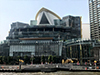
complex, as well as Thailand’s first floating museum known as the Icon Siam
Heritage Museum or River Museum
Bangkok
(fig.)
which is housed in
a traditional wooden boat called
reua sampao (fig.).
The venue also has several permanent art galleries and expositions, and
frequently hosts temporary
exhibitions.
The complex is located on the western bank of the
Chao Phraya
River (fig.)
in
Thonburi
and
officially opened on 10 November 2018. Whereas the upper floors have modern
shops, a large part of the ground and second floors is reserved for stores that
cater more traditional Thai goods and foodstuffs, and is designed to reflect the
theme of Thailand's cultural
heritage,
with sellers and staff dressed in traditional costumes and decors that mirror
the Thai way of life. On the river front, the complex also features an indoor
lightshow, as well as a riverside
park and walkway with an outdoor
musical fountain to entertain its visitors (fig.
-
map).
Another
of its landmark attractions
is the indoor Nahm Tok Alangkaan (น้ำตกอลังการ), i.e. Alangkaan Waterfall (fig.),
a 15-meter tall waterfall that flows from the ceiling as a metaphor for the rain
that blesses the land, symbolized by the lush Thai farm decorations beneath it,
complete with a stylized
water buffalo. The name Alangkaan (อลังการ),
also transliterated Alangkarn, literally means ‘To Be Attractively Decorated’,
yet is by some translated as ‘Magnificent’. The concept is reminiscent of the
Rain Vortex in Singapore's Jewel at Changi Airport.
Officially, the name is stylized IconSiam. See also
icon and
Siam,
as well as
MAP,
TRAVEL PICTURES (1),
(2),
(3),
(4),
(5),
(6),
(7),
(8),
(9)
and
(10),
POSTAGE STAMPS,
and
WATCH VIDEO (1),
(2),
(3) and
(4).
回
idgah
An open area to accommodate prayers during
Muslim festivals, usually placed to the West of a town.
回
Idsuan (อิศวร)
A Thai name for
Shiva and
Ishana.
回
Igor (อีก้อ)
Thai name for
Akha. Pronunciation Ikoh
and sometimes transcribed Ikaw.
回
ih-hen kreua (อีเห็นเครือ)
Thai name for
the
Masked Palm Civet.
回
ih-hen thammada (อีเห็นธรรมดา)
Thai name for
the
Common Palm Civet.
回
ih-joo (อีจู้)
Thai. Name for a kind of
traditional fish trap
made from woven
bamboo
strips, shaped in the form of a vase. Though
reminiscent of the
tum, the
ih-joo has a wider mouth above, whereas the tum has a rather
cone-like shape, resembling a bottle with a
narrowed neck and a bulbous middle. Despite these subtle distinctions, both
names are often used interchangeably (fig.),
while the term tum is
also used in a more
generic
manner for either type.
回
ih-kae (อีแก)
Thai for name
for the
House Crow.
回
ih-kah (อีกา)
Thai for ‘crow’.
回
ih-kooy (อีโก่ย)
Name for a kind
of wild grapes, that grow in bunches on a vine similar to other grapes, but with
brown leaves. Only the full ripen fruits can be
eaten, whereas the younger ones, which are dark brown, are not edible as they
taste very sour. In Tah Phrayah district of the province
Sa Kaeo, a herbal wine is produced from this
kind of grapes. Also transcribed i koi, ih koy, i-kohy or
similar. See also
winery.
回
ih-raeng sih
nahm-tahn himalay (อีแร้งสีน้ำตาลหิมาลัย)
Thai name for
the
Himalayan Griffon Vulture.
回
ikat
A tie dying technique in which fabrics
are given patterns by tying off and colouring different parts of the same piece of cloth
(fig.). See also
matmi.
回
Illuminated Boat Procession
Festival celebrated by the people from most northeastern provinces that border the
Mae Khong River. It is intended as a tribute to the river goddess Phra
Mae Khongkha for providing ample water, as well as in reverence of the
naga or
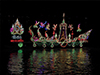
phayanaag. A procession of illuminated boats of approximately 12-meter long and in different shapes and forms takes place on the river, at night
(fig.).
Over fifty boats (fig.) may take part in the procession and their original shapes may resemble the
Garuda, a swan, a naga, etc. The festival takes place in the evening of the 15th day of the waxing moon of the 11th month.
See also POSTAGE STAMPS
(1)
and
(2),
and
WATCH VIDEO.
回
imam (إمام)
1. Arabic. Worldly and spiritual leader in the
Muslim theocratic system.
回
2. Arabic.
Muslim religious leader and head of a mosque, the minister in ritual prayers.
回
3. Arabic. Term used by the Shiite
Muslims to denote the descendants of the prophet, who they consider to be the true rulers of the Muslim community.
回
Imperial Examinations
A system of examinations in Imperial
China,
that was organized in order to select candidates for the civil service.
READ ON.
回
Imperial Guardian Lions
See
Rui Shi.
回
In (อิน)
1. Thai. Name of one of the famous
Siamese twins
born on 11 May 1811 in
Samut Songkhram,
the other one being named
Chan. They are
names that describe fruits: where ‘in’ or ‘look in’ means young green fruit,
‘chan’ or ‘look chan’ stands for matured fruit, usually recognized by its yellow
colour and sweet fragrance.
回
2. Name of one of the
eleven heroic leaders who in 1767,
at the end of the
Ayutthaya period,
fought the invading Burmese
Army whilst defending the
Bang Rajan
Fort.
回
In (อินทร์)
Thai. The name for
Indra
(fig.), sometimes
transliterated Inthara or Intra, but with this Thai spelling pronunciation is In.
It
is a synonym of
Phaya and
can in certain contexts be translated as
‘Patriarch’ or ‘King’. When referring to the Hindu deity it is
usually preceded by the title
Phra,
i.e.
Phra In.
回
Inao
(อิเหนา)
A legend and classical dance drama from
Java, written around 840 AD in
the
Sailendra
Dynasty, and introduced to Thailand around 1760 AD, near the end of the
Ayutthaya
Period.
It was later translated into Thai and rewritten as a verse drama by King
Rama II. The
legend is set in the ancient city of
Meuang Kulaypan and
relates the romance between Prince Inao,
son of King Kurepan and a heroic warrior, and the stunningly
beautiful Princess
Butsaba
(fig.) of Krung Daha (กรุงดาหา),
who ‒when disguised as a forest bandit‒ is also known as
Misara Panyi
(fig.).
Initially, Inao refused to marry her in an arranged marriage set up by the
Princess' family. This so enraged her father that he declared he would give his
daughter away to the first man who offered to marry her, and gave Butsaba to
Joraka,
a minor ruling prince. Just at that time, another ruling prince, Kamangkuning,
is waging war on the city-state of Daha. Therefore, his father orders Inao to
assist Daha in battle. Having arrived in Daha, Inao sees Butsaba for the first
time. After a series of
complex affairs and interfamily fighting, the couple eventually fell in love out
of their own will and got married all the same, but not until Inao kidnapped
Butsaba and took her to a cave, in order to prevent the wedding between Butsaba
and Joraka, after the war with Kamangkuning was over. The narrative's original name is Inu Panyee Karatapati.
In 1916, the story was hailed by the authoritative Literature Club as the
greatest of lyrics for dance plays, both in terms of content and suitability for
theatrical performance. The story has been portrayed on a set of Thai postage
stamps issued in 2012 to commemorate that year's National Children's Day (fig.),
and in 1996, a scene from the story is portrayed on one of the stamps in a set
of postage stamps on
famous
classical Thai literary works (fig.).
Sometimes transcribed Ih-nao, Enao, or Enau. See also
Egg Magnolia.
回
%202_small.jpg)
incarnation
‘Embodiment’. The personification or representation of a superior being, deity or spirit of a god in another form. In
Hinduism usually applied to the guises or transformations of
Vishnu. See also
chaht
and
avatara.
回
incense
Name for an
aromatic material which releases fragrant smoke when burned and of which
several kinds exist, such as small cones, spiral
incense coils which are found
hanging from Chinese-style temple ceilings (fig.), small spiral coils against
mosquitoes, cored and solid
incense sticks, etc. In Thai called
kreuang hom.
回
incense burner
See
kratahng toob.
回
incense coil
A kind of
incense in the form of a coil, used in the past to calculate time. The
latter spiral-shaped incense is grooved at intervals, which allows for the time to be
measured while burning. Other types of incense coils can
also be found, hanging from rafters in Chinese-style temple,
whilst yet others are used as a repellant against mosquitoes.
Incense coils in Chinese-style temples usually have an −often red− tag attached
to it, on which a prayer or wish can be written, which will ascend to heaven as long as
the coil burns (fig.).
回
_small.jpg)
incense stick
Name for both a
small wooden stick coated with a tick layer of
incense
and a solid stick completely made of incense material, without a supporting core.
READ ON.
回
Indian Blue Peafowl
See
peacock.
回
Indian Bushlark
Common name for a 15 centimeters tall bird, with the
scientific designation Mirafra erythroptera, which is mainly found on the Indian
subcontinent. It prefers bush tops and does not usually perch on trees or wires,
hence its name. The Indian Bushlark is pale buff with brown and has a heavily
streaked upper breast, head and back. It has a distinctive
cheek patch, a dark eye-stripe and a pale supercilium. It is
similar to the Bengal Bushlark
and the Jerdon's Bushlark, but differs by its longer tail, lighter belly, and a less distinct
horizontal blackish stripe below the eyes. Also spelled Indian Bush Lark
and sometimes referred to as Red-winged Bushlark or Red-winged Bush Lark.
回
%201_small.jpg)
Indian Chat
1. Another name for
the
Indian Robin
(fig.), a
passerine bird very similar to the
Brown Rock Chat
(fig.),
i.e. another species of bird within the same family Muscicapidae. However,
whereas the male Indian Robin has black underparts, it is the
female which is very similar to the female Brown Rock Chat,
but the latter has a blackish undertail,
whilst the female Indian Robin has a rufous undertail and a
different posture.
回
2. Another name for
Brown Rock Chat
(fig.).
It is very similar to the Indian Robin, another species of passerine bird within
the same family Muscicapidae. However, whereas the male Indian Robin has black underparts, the
female is very similar to the female Brown Rock Chat,
but the latter has a blackish undertail,
whilst the female Indian Robin has a
different posture and a rufous undertail.
See WILDLIFE PICTURES.
回
%201_small.jpg)
Indian Coral Tree
Common name for a deciduous tree with
vibrant red flowers and with the botanical
name Erythrina variegata. It is also commonly known as
Tiger Claw,
yet this name also used for the
Flame of the Forest,
a
similar species with
striking orange to red flowers and with
the
botanical
name Butea monosperma. In Thai, this tree has a variety of common
names, including parichaat (ปาริชาติ), after a mythological tree that is
also known as
Indra's Garden Flower,
located in the heaven of Indra, a region for the virtuous alone, with celestial
gardens called Nandana Vana (नन्दनवन), the ‘Divine Grove’, of which nandana (नन्दन)
translates literally as ‘that which gives joy’ and vana (वन) as ‘grove’. It is
occasionally regarded as one of the several
bodhi trees beneath which certain
buddhas, recognized in
Theravada
Buddhism,
attained
Enlightenment. However, this is likely
a mix-up with the
Flame of the Forest,
which besides having similar flowers, is also referred to as
Tiger Claw (fig.). See
also POSTAGE STAMPS.
回
Indian Cork Tree
Common name for a fast-growing, evergreen tree, with the
botanical designation Millingtonia hortensis, and also commonly known as
Tree Jasmine. The tree is listed in the family
Bignoniaceae, grows up to 25 meters tall and has a deeply
furrowed, corky bark. It blooms from September to January and bears many
white, slaverform flowers, some of them drooping. The flowers are fragrant and
attract many nectar-eating birds and insects, and when dried, they may be smoked
to treat asthma. The tree provides dappled shade and in some sacred scriptures
from the
Lan Na period,
it is mentioned that the Hindu god
Indra set up
his throne underneath this tree. Hence, worshippers today make garlands from its
flowers to offer to Indra. In Thai, this tree is known by the names
kasalong and
pihb.
回
%20ปีบ,%20กาสะลอง%201_small.jpg)
Indian Cormorant
Common name for a 61-68 centimeter large bird, with the binomial name Phalacrocorax fuscicollis. Non-breeding adults are mostly
blackish, with brownish scapulars, whitish chin and lower head-sides, and uneven
whitish to pale brown streak-like markings on the lower throat and breast
(fig.). Its
bill is yellowish and relatively long, with a longer upper mandible of which the
tip is bent downward. Breeding adults are overall black with a bluish gloss, silvery scapulars,
dark grey to black legs and webbed feet, and a blackish bill. They also have small silvery patches over the
eye and -in full breading season- develop a white tuft on the rear head-side. In Thai called
nok kah nahm pahk yao, literally ‘long-billed water-crow’.
See also WILDLIFE PICTURES.
回
%203_small.jpg)
Indian Darter
See
Oriental Darter.
回
Indian Gharial
See
jorakae.
回
Indian Gooseberry
See
makhaampom.
回
Indian Grey Hornbill
Common name for a species of
hornbill, with the scientific
designation Ocyceros birostris.
Both sexes are greyish-brown, with reddish-brown eyes. They have a dark bill,
with a short and upright casque, and pale yellowish edges. In males, the casque
is somewhat larger (fig.), whilst the bare skin around their eyes is dark, whereas that
of females is pale reddish. Juveniles
(fig.) are similar to females, but with a smaller casque (fig.). The
Indian Gray Hornbill does not occur in the wild in Thailand, but is commonly
found on the Indian subcontinent, especially in the North. Though the species is
mostly arboreal, it is also frequently sighted in urban areas, and often occurs
in pairs.
See also WILDLIFE PICTURES.
回
_small.jpg)
Indian Hanging Parrot
Common name for a species of small parrot with the
scientific designation Loriculus vernalis, which is found in South and Southeast
Asia. The adult male is only about 14 centimeters tall and has a rather short tail. It is
mainly bright green, with a red rump,
uppertail-coverts and bill, and a faint turquoise-blue throat patch and
undertail-feathers, whilst it legs and feet are orange.
The adult female is similar, but overall duller and has little to no turquoise-blue on the throat.
Its habitat consists of broadleaved forests and clearings. Like the
Blue-crowned Hanging Parrot, the Indian Hanging
Parrot gets its name from its peculiar sleeping habit, i.e. hanging upside-down.
This bird is also commonly known as Vernal Hanging Parrot and in Thai as
nok hok lek pahk daeng.
回
_small.jpg)
Indian Heliotrope
See
ya nguong chang.
回
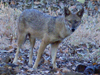
Indian Jackal
Name for a species of wolf-like mammal in the Canidae family,
endemic to the Indian subcontinent, Bangladesh, and Myanmar. It is a subspecies
of the Golden Jackal. It
lives in forested areas and usually occurs in small packs of three to five animals,
especially when hunting. It has the scientific name
Canis aureus
indicus, and is also commonly known as Himalayan Jackal.
See also WILDLIFE PICTURES.
回
Indian Leaf Butterfly
Name of a species of large nymphalid butterfly, with a wingspan of 8.5 to 11 centimeters, with the
binomial name Kallima inachus, and found in South, East and Southeast Asia.
The upperside of its wings are of a striking florescent violet-blue colour, with
a bright orange stripe halfway up the forewings and a black band with a white
spot at the top, lined all around with a light, narrow border. With its wings
closed, it is virtually invisible
and a textbook example of camouflage, as it closely resembles a dry
leaf, usually of a shade of brown with dark veins, especially at the hindwings. The Indian Leaf Butterfly is hence also known as Dead Leaf and Orange
Oakleaf, or simply Indian Leaf. In part due to its natural disguise, it is
difficult to spot in the wild. In Thai known as
phi seua
bai mai yai india (ผีเสื้อใบไม้ใหญ่อินเดีย),
i.e. ‘Indian large-leaf butterfly’.
See also WILDLIFE PICTURES.
回
_small.jpg)
Indian Mulberry
See
yo baan.
回
Indian Muntjac
See
Barking Deer.
回
Indian
Mustard
See
sarsom.
回
Indian Pied Hornbill
Common name for a species of
hornbill,
with the scientific names Anthracoceros coronatus and Anthracoceros malabaricus
leucogaster, which only occurs in North and Central India, and in
Myanmar, and which is
very similar to the
Oriental Pied Hornbill
(fig.),
which usually has less black colouring on the
casque, whereas the casque of the Indian
Pied Hornbill is often about three quarters black with only the posterior part
being pale yellowish.
The Latin word coronatus
means ‘crowned’,
whereas the word malabaricus means ‘from
Malabar’
and
refers to the place where the bird was first spotted, i.e. Malabar (today known
as Kerala in India), and the Greek term leucogaster means ‘white belly’.
The Indian Pied Hornbill is a noisy bird, with high-pitched and strident notes. Flocks of up to ten
birds will fly from tree to tree, in a follow-the-leader-style. It feeds a good
deal on the ground, picking up fallen fruits or seizing creeping prey, which
they pick up with the tip of their enormous bill, jerk into the air, catch in
the gullet and swallow. Also commonly known as Malabar Pied Hornbill.
回
_small.jpg)
Indian Pond Heron
Common name for an approximately 45 centimeter tall, wading
bird with the scientific name Ardeola grayii, which occurs from southern Iran
east to parts of Pakistan, India, Burma, Bangladesh and Sri Lanka. In winter
plumage it is light brown and streaked (fig.), with white underparts and white wings,
which
makes it almost indistinguishable from the non-breeding plumage of the Javan
and
Chinese Pond Heron (fig.).
In breeding plumage, its back becomes dark
purplish-brown and the head, neck and breast become a warm yellowish-buff.
This bird is also commonly known as Paddybird.
See also WILDLIFE PICTURES (1)
and
(2).
回
_small.jpg)
Indian Red Admiral
Common name for a butterfly, with the scientific designation Vanessa indica.
Above, the forewings are greyish-brown, reddish-orange and black, with black spots on
the orange and white spots on the black background. The hind-wings are are
brownish, with dark brown spots towards the base, and a reddish-orange band on
the outer edge, which is spotted with black and has a thin, interrupted, white
outer edge near the apex. The patterns and colours of the underwings are similar
to those of the upper-wings, but somewhat darker. The body of this butterfly is
greenish to grey-brown and it has a wingspan of 5.5 to 6 centimeters. It is
found in sunny locations in open country, especially in the higher altitude
regions of the Indian Subcontinent, including also Nepal. Also known as Asian
Admiral and in Thai called
phi seua
daeng india (ผีเสื้อแดงอินเดีย),
i.e. ‘Indian red butterfly’.
See also WILDLIFE PICTURES.
回
%201_small.jpg)
Indian Rhinoceros
Common name for the Rhinoceros unicornis, which is also known as
the Greater One-horned Rhinoceros (fig.), Asian One-horned Rhinoceros
(fig.), and
in Thai as raed india (แรดอินเดีย).
Though it is believed to once have ranged
throughout much of Northern India, all the way to Burma and possibly even
China,
it is now confined to the foothills of the
Himalayas, where it inhabits
tall grasslands and dense forests, usually in areas that have mud wallows and
water (fig.). It does not occur in Thailand, but is very similar to the
Lesser One-horned Rhinoceros or
Javan Rhinoceros, which has the scientific name Rhinoceros sondaicus. The main difference is that the Indian Rhinoceros
has a much larger horn (fig.), far exceeding that
of the Lesser
One-horned Rhinoceros, which is
rarely bigger than 15 centimeters (fig.). Both species
have three folds of
skin across the back and one horn, in contrast to the smaller Asian Two-horned Rhinoceros, with the
binomial name Dicerorhinus sumatrensis, which has two folds of
skin across the back and two horns. The Indian Rhinoceros feeds mainly on
grasses, but is known to also eat shoots, twigs, young foliage, and fallen fruit.
A species of
mango
from Thailand, known as
ma muang raed (fig.),
is named after the rhinoceros.
See also WILDLIFE PICTURES.
回
,%20Chitwan%20NP,%20Nepal%203_small.jpg)
Indian Robin
Common name for a species of bird, with the scientific
designation Saxicoloides fulicatus, which is found in the Indian Subcontinent.
There are several races, that are divided into groups according to their plumage
and geographical position, i.e. a northwestern race (S. f. cambaiensis), a
northeastern race (S. f. erythrurus), a southern race (S. fulicatus), a central
race (S. f. intermedius), and a Singhalese race (S. f. leucopterus), that is
found in Sri Lanka. The southern race (S. fulicatus) is considered the nominate
race. Males of the northern race are brownish above, while the southern
populations have black upperparts. The males have chestnut undertail coverts and
a white shoulder patch. The females are brownish above and greyish below, lack
the white shoulder patch, and the vent is a paler shade of chestnut than the of
males. Birds of the northern populations are also somewhat larger than those of
the southern races. Juveniles are similar to females but have a mottled throat.
See also
Indian Chat
(fig.).
回
%20female%201_small.jpg)
Indian Roller
Common name for a member of the roller family of birds, near
passerines related to the kingfishers and
bee-eaters
(fig.).
Its distribution is tropical, southern Asia (fig.) and is said to stretch from Iraq to
Thailand,
where it is a common resident of open dry areas throughout the country (fig.). It can
often be seen perching on bare tree branches (fig.)
or on roadside telephone wires, from where it drops to the
ground to catch lizards, frogs, etc. It is also known to catch insects in
flight. This colourful bird (fig.) has a light brown back
(fig.), a metallic
bluish-green crown,
whilst the underparts, face, wings (fig.) and tail are of a mixed bluish-grey and
amethyst colour (fig.). In Thai it is known as
nok takaab thung and its scientific name is
Coracias benghalensis. There are some subspecies, with those found in Thailand
being distinct by having a metallic greenish crown, whereas the ones that occur
in India have a bluish crown that is brownish-buff to pale in the front. It is
also commonly known as Blue Jay.
See also WILDLIFE PICTURES (1),
(2)
and
(3).
回
_small.jpg)
Indian Runner Duck
Name of a peculiar domestic breed of duck, that is native to
the Indian Sub-continent, Malaysia and the Indonesian Archipelago. It was first
found in the East Indies and –rather than waddling– it runs, hence the name.
This duck does not fly and out of the water, it stands or walks with an upright
body, which gave it the epithet Penguin Duck. Due to this, these ducks are
easily recognized when on land, though not so when in the water, as there are
many gene and colour variations, as well as cross-breads and unusual plumage
colour mutations, which may complicate correct identification somewhat. Females
have an extraordinary reputation for egg-laying, i.e. they lay a large amounts
of eggs, yet they only rarely build a nest or incubate their own eggs– instead
they drop them wherever they happen to be, as they run about. Like almost all
other domestic breeds, Indian Runner Ducks are considered descendants from
Mallard Ducks (Anas platyrhynchos -
fig.),
and are hence scientifically referred to as Anas platyrhynchos domesticus.
回
Indian Scops Owl
Common name for a 23 to 25 centimetres
large owl, with the scientific designation Otus bakkamoena, which is a
widespread resident on the Indian subcontinent, south of the
Himalayas. Adults have
greyish-brown upperparts and
greyish-buff underparts with fine black
streaks and tiny crossbars, though they are variable in colour and morphs with
more brown or more grey, as well as an intermediate morph also exist. Its
scapulars are barred with black and buff. The eyes are usually dark orange or
brown, although they may also be yellow. It is very similar to the Collared
Scops Owl (Otus lettia), but the latter has a pale yellowish-white bill without
a black tip and is more heavily streaked on the underside, with broader and
shorter streaks (fig.). Additionally, it also strongly resembles the grey and
brown-grey morphs of the Oriental Scops Owl (Otus sunia), but with a body
measurement of only 19 centimetres, the latter is somewhat smaller in size, has
more prominent, black and white scapular spots. The Oriental Scops Owl is also
more heavily marked below and above, whilst the irises are yellow.
See also WILDLIFE PICTURES.
回
%201_small.jpg)
Indian Shag
Another name for the
Indian Cormorant.
回
Indian Silverbill
Common name for
a roughly 11 centimeter small passerine bird in the
finch family, which is found in South Asia and also commonly known as
White-throated Munia. It has the scientific
designation Euodice malabarica. The sexes are similar
and are buff-brown above, with a darker tail and wings, and whitish below,
whilst the flanks are buffy. This bird
has a distinctive silver-grey bill, which is
conical in shape, with a dark curved upper mandible and a lighter lower
mandible. Indian Silverbills feed mainly on seeds, but may on occasion also eat
insects and nectar.
See also WILDLIFE PICTURES (1)
and
(2).
回
%201_small.jpg)
Indian Star Tortoise
Name of a species of tortoise with the scientific name
Geochelone elegans, found in the wild in dry areas and scrub forest, in India
and Sri Lanka. This tortoise's carapace is very convex with dorsal scutes that
often form humps and have dark triangular to diamond shaped patterns against a contrasting pale yellow background,
thus forming yellow radiating stripes that have star-like designs.
Characteristically, it has six to twelve yellow radiating stripes, different
from the
Burmese Star Tortoise (fig.),
which has only six or less yellow radiating stripes. The carapace's lateral margins are nearly
vertical, assisting the animal to return to a upright position after it has been
turned over, whilst its posterior margin is somewhat expanded and serrated.
Indian Star Tortoises are mostly herbivorous, feeding on grasses, fallen fruit,
flowers and leaves of succulent plants (fig.),
but will occasionally also eat carrion. This species is quite popular in the
exotic pet trade and is hence also found in Thailand, where it is known as
tao dao india, a literal translation of its
English designation.
回
%203_small.jpg)
Indian Tortoiseshell
Common name for a species of a butterfly, with the
scientific name Aglais kaschmirensis. It is found in southern Asia and belongs
to the family Nymphalidae. The upperside of its wings are brownish to
rusty-orange, with black and pale yellowish-white markings, somewhat similar in
pattern to those of the
Tawny Coster (fig.).
回
_small.jpg)
Indian Trumpet
Tree
Common name of a smooth, glabrous, evergreen tree, that
grows up to 15-20 meters high and bears the botanical name Oroxylum indicum. It
is found in deciduous forests and in moist areas, mostly along river banks and
hill slopes, throughout South and Southeast Asia. It has several health
benefits, including potential anti-cancer properties, and its edible seed pods
(fig.), which have
a high content of bioflavonoids, have since long been used in local traditional
folk medicine, mainly as a remedy against cough, bronchitis and wheeze, whereas
a paste made from its stem bark is applied for the cure of scabies and to treat
arthritis. Its large fruits have an average length of 70-80 centimeters and they
typically hang from separate, leafless stems, that extend well above the tree's
top and outside the main leafage. These woody seed pods are dark brown,
flattened, bent and slightly curved at the base, with a fine ridge on each side. The
flowers are maroon on the outside and creamy white on the inside, whilst their
corolla is trumped shaped, hence the tree's name. They grow in clusters near the
top of the same stem as the fruits. In Thai, this tree known as
pheh-kah, but also has many other, local names,
whilst the edible fruits are called
lin
fah, i.e. ‘sky
tongues’.
回
_small.jpg)
Indian Wild Boar
See
Wild Boar.
回
Indian Wolf
Common name for a kind of wolf endemic to the Indian
subcontinent, including also Nepal.
See also WILDLIFE PICTURES.
回
indigo
Name of a natural dye extracted
from certain plants,
such as Strobilanthes cusia (fig.)
and Indigofera tinctoria (fig.), as well as for the blue to dark blue and —with a repeated dyeing process— even
the near blackish colour that this dye can produce. See
also
krahm and
seua mo hom
(fig.).
回
Indigo Dropwing
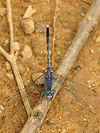
Name of a tropical Asian
dragonfly, commonly found in both lowlands and
mountainous regions. It has the scientific name Trithemis festiva and belongs to
the family Libellulidae. It prefers a habitat of streams and running waters,
rather than still waters and males can often be seen resting on rocks or
stream-side vegetation, guarding their territories. Mature males are almost
entirely of a greyish blue, overlaid with a fine whitish pruinescence, whilst
their abdomen is slender with a dark tail that sometimes ends in a pale tip.
Young males look similar to females, sporting extensive yellow patches on their
abdomen. In addition, females often have dark patches at the wing tips. When at
rest, the wings of this species drop somewhat forward. In Thai this species is
named
malaeng poh ban tai
kohn pihk dam. See also
malaeng poh.
回
Indochina Featherback
Common name for a kind of freshwater fish,
with the scientific designation
Chitala blanci,
and
which is found in Cambodia and
Thailand, where it inhabits areas with fast flowing waters, deep pools or
rapids, including in
the
Mekhong River.
It has a rather small head in contrast to its distinctive hump-like anterior
back. It has numerous small black spots in the anterior half of the body, that
merge into irregular oblique bands towards the tail, and extend on the anal and
caudal fins. This species is also commonly known as
Royal Knifefish,
and in Thai it is referred to as
pla tong laai (ปลาตองลาย).
See also POSTAGE STAMP.
回
_small.jpg)
Indochinese Cobra
See
ngu hao.
回
Indochinese Forest
Lizard
See
king kah hua sih fah.
回
Indochinese Rat Snake
A species of
snake with the
binomial name Ptyas korros. Also called Chinese Rat Snake and in Thai known as
ngu sing (งูสิง), which could be translated as ‘haunting snake’. It is also
referred to as ngu sing thammada (งูสิงธรรมดา), ngu sing
baan (งูสิงบ้าน) and ngu hao talaan (งูเห่าตะลาน). It may grow to a length of about 250 centimeters,
with the anterior half
of the body olive above and the remainder brown. The scales of the posterior half
of the body are usually feebly keeled and it has very large eyes (fig.). The Indochinese Rat Snake is non-poisonous.
It is diurnal and preys on rats, frogs and other small vertebrates. This
species' habitat consists of agricultural and forested areas.
回
%20งูสิงบ้าน,%20งูเห่าตะลาน%202_small.jpg)
Indochinese
Spitting Cobra
A medium-sized cobra with the scientific name
Naja siamensis. In Thai named
ngu hao phon phit
sayaam, i.e.
‘Siamese venom-spitting barking
snake’. It has a rather thick body with a
highly variable colour, which may be grey, olive, brown or black, with an
irregular pattern of white spots or bands, that can be so abundant that it makes
the snake predominantly white, though the head is usually dark brown or black.
Its hood mark may be U, V or H-shaped, though is often faint or absent. It may
grow to a length of up to 160 centimeters and being a spitting cobra, it is
capable to spit out its venom over a distance of about 2 meters, usually aiming
at the eyes of an aggressor. The spitting of venom is believed to be used only
as a defense and not to obtain food, though it could theoretically be discharged
to blind prey, if the venom got into the eyes. The venom is a neurotoxin and
potentially fatal to humans. The
Indochinese Spitting Cobra is found in
Southeast Asia, including in Thailand,
Cambodia,
Vietnam,
Laos
and
Myanmar.
回
%20งูเห่าพ่นพิษสยาม_small.jpg)
Indochinese
Water Dragon
Designation for a reptile with the binomial name
Physignathus cocincinus. The overall colour of its
skin ranges from light to dark green, with green or turquoise diagonal stripes
on the body and a tail which is banded with green and dark brown from the middle
to the end. Its undersides may be white, pale green and pale yellow, or a
mixture of this, whilst their roughly scaled throats, especially in males (fig.), are
often quite colourful, varying in hue from white and yellow, to orange or peach,
and sometimes with stripes. Males are distinct from females by a larger, more
triangular head, and a larger crest on its head, back and tail (fig.).
Its long tail is used for balance, as well as an aid for swimming, but can also
be used as a weapon. On top of their heads, in between their eyes,
Indochinese Water Dragons have an iridescent,
photosensitive gland, which zoologists believe is part of
their system of thermoregulation. This spot or so-called
third eye, is officially known as
the pineal gland (fig.)
and is thought to also help avoid threats from above, such as attacks from
aerial predators, as it recognizes differences in light.
The Indochinese Water Dragon is also known by the common names Chinese Water Dragon, Thai Water Dragon, Green Water Dragon
and Asian Water Dragon, and in Thai as
takong,
lang
and
king kah yak, the
latter meaning ‘giant lizard’.
回
%20ตะกอง_small.jpg)
Indo-Pacific Humpback Dolphin
Common name for the so-called Pink
Dolphin, a marine mammal in the family Delphinidae.
READ ON.
回
Indra
(इन्द्र)
Sanskrit. ‘Possessing a drop [of rain]’, composed of
the words indu, which is related to
bindu
and means
‘drop’,
and ra, meaning ‘to possess’. Vedic god of the heavens, weather and war, king of the gods and ruler of the
Tavatimsa
heaven, a place on the summit of the mythical
Mt. Meru.
He is the twin brother of
Agni, the god of fire, and is also
mentioned as an
Aditya, a son of
Aditi, as is
referred to in his name by the legendary
Sukhothai
king
Indraditya. In Thailand,
where he is known as
Phra In (fig.),
Phra Intra
or Inthara,
he is usually depicted with a green complexion (fig.) and may carry a thunderbolt, disc,
elephant goad, sword, a
trihsoon
(trident)
or an axe, and is depicted on the emblem of
Bangkok
(fig.),
as well as on the
National Stadium (fig.). Being the god
of heavens and weather,
his bow
(dhanus)
is a
rainbow (fig.),
in Sanskrit called
Indradhanus and in Thai known as
Inthanu,
meaning the bow of
Indra. In Buddhist iconography, he is frequently depicted as an attendant of
Buddha, along with
Brahma (fig.).
His consort is
Sachi, also known
as Indrani, and
his mount is the
elephant
Erawan (fig.) or
Airavata (fig.),
though he is also found riding in a golden chariot drawn by bay horses with
flowing manes, reminiscent of
Phra Ahtit, the sun god
(fig.). In Hindu cosmology, he is the
lokapala of the East. His status is considered equally important to that of
Vishnu and
Shiva,
thought in later
Hinduism,
his role somewhat diminished (fig.)
with the rise of the
Trimurti,
in which the divine triad Vishnu,
Brahma and Shiva,
replaced the Vedic triad of Agni, Indra (or
Vayu)
and
Surya.
In the
Vedas, he
is also called Shakra, which in Pali translates as
Sakka. Compare with
Thagyamin, and see also
golden parrot
and
Amarin.
回
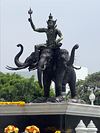
Indrachit (इन्द्रजीत,
อินทรชิต)
Sanskrit-Thai. ‘Conqueror of
Indra’. Son of
Ravana
(Totsakan) and one of the demons in the
Ramakien, who succeeds in deceiving the monkey-general
Hanuman by disguising himself as
Indra. It is also Indrachit who shot the
nagabaat or nagapasa arrow, the arrow that changed into a
naga and tied
Rama and
Lakshmana
down (fig.). However, when the
Garuda, the archenemy of the naga, accidentally flew by, the naga from fear released Rama and Lakshmana.
Like his father, he has a green complexion, though unlike Totsakan, who has
tusk-like canines, Indrachit has protruding vampire-like teeth. He
is
one of the 12 giants,
set up in 6 pairs, that guard the entrances in the enclosure of the Temple of
the
Emerald Buddha,
i.e.
Wat Phra Kaew
in
Bangkok,
where he is erected in pair with
Suriyapop (fig.).
Also spelled Indrajit and in Thai
usually pronounced Intrachit or Intarachit (fig.).
回
,%20Son%20of%20Ravana%20(Totsakan)_small.JPG)
Indradhanus (इन्द्रधनुस्)
Sanskrit. ‘The bow (dhanus)
of
Indra’, i.e. a ‘rainbow’. Indra is the
Hindu
god of
heavens and weather,
hence his bow is a
rainbow (fig.).
In Thai
Inthanu.
See also
rung.
回
Indraditya (อินทราทิตย์)
A
Poh Khun who liberated Thailand from the yoke of the
Khmer. He died in 1268 AD and is the father of
King
Ramkhamhaeng of
Sukhothai.
In Thai, fully known as
Sri Intaratit
(fig.) and also referred to by the title
Phra Ruwang.
回
Indrani
(इन्द्राणी)
Sanskrit. Consort of the Hindu god
Indra, whose is
described as beautiful and having the most beautiful eyes. She is associated
with
lions
and
elephants,
of which the latter is also the mount of Indra. Her
attributes
include a
vajra sword
and a
triangular flag with the depiction of a
chari
pot.
回
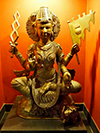
Indrapura
(इन्द्रपुर)
Sanskrit.
‘City of
Indra’. In about the tenth century AD the capital of
Champa.
It is located near the present city of Da Nang, in
Vietnam.
回
Indravarman (ឥន្រ្ទវរ្ម័ន)
Khmer.
‘Shielded by
Indra’
or ‘Protected by Indra’.
Khmer
king who reigned
between 877 to 889 AD and ruled from Hariharalaya, an ancient city and capital
of the
Khmer
Empire located near modern-day Siem Reap and named for the
Hindu deity
Harihara
(fig.). He is credited
for having initiated an extensive building campaign that set the foundations for
the future Angkorian kings to follow, including an irrigation network and large
baray.
回
Indriya
(इन्द्रिय)
Sanskrit-Pali. Term that literally means
‘belonging to
Indra’.
READ ON.
回
Industrial Ring Road Bridge
Another name
for the
Bangkok Mega-Bridge.
回
ink brush
See
mao bi.
回
ink stick
Ink made from
soot, a black powdery deposit from smoke, also known as lampblack, and binders.
The pigment is obtained by burning either pinewood or (tung) oil in earthenware. The soot is
collected, mixed with glue, perfumed and then formed in varied shapes through
wooden moulds. The solidified powder has thus become a hard stick, which allows for easier transport and preservation, and can be made liquid by
rubbing it with some water on an
inkstone (fig.),
until the right degree of density is achieved. It is used in
Chinese calligraphy (fig.)
which traditionally is written only with black ink. Chinese ink sticks are often
decorated with golden reliefs or characters. The quality of own rubbed ink from ink sticks is
superior to that of ready to use bottled ink, as those use too much water to
keep the ink from running dry. Hand-rubbed inks also give richer and finer
tones. The colour of ink sticks ranges from pure black to brown black. Ink
sticks are commonly classified according to the
type and quality
of pine-soot or oil-soot they are made from, a well-known
pine-soot type being jīn bù huàn
(金不换) or ‘no exchange even for gold’ (fig.),
a stick used by the pupils in the old-style Chinese private schools
since the 18th century. It is still the most popular ink in today's Chinese
elementary schools where calligraphy is a required course for new generations.
The design of the stick is simple, fit right for the hands of students and can
be easily stored in a pencil box. Another pine-soot stick is known by the name
Mount Yellow Pine Soot. Well-known oil-soot sticks are Thousand Year Light,
Longevity, Tessai Ink Stick, and Orchid, whereas Five Old Men is an old brand of
stick, which was made in seventies, when the Chinese Cultural Revolution ended
and the traditional brand names came back. The Chinese on this stick's face
reads ‘ink for emperor's use; five old men on the river’, and a carving on its
back is based on a painting depicting five immortals, from whom Yao, the
mythical Chinese ruler, was advised upon regulating the Yellow River.
There are two
traditional Chinese shop houses that design the traditional style ink sticks as
mentioned above, i.e. Hu Kaiwen and Cao Sugong, the latter being awarded a gold
medal at the Tokyo Exposition in 1914, for his Longevity sticks, known as one of
the best Chinese inks. These sticks carry a carving on the back based on a
Chinese painting by Qian Huian (1833-1911), named Longevity, hence the
designation for this stick. See also
wen fang si bao
(fig.).
Both in China and in
Myanmar, black ink is
also used to make
landscape drawings, sketched with the use of
razor blades (fig.).
回
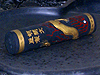
inkstone
See
yan.
回
Inle (အင်းလေး)
Burmese. Name of
a large freshwater lake in
Shan
State in central
Myanmar,
with an estimated
surface area of circa 115 square kilometers, making it the second largest lake
in the nation and one of the highest, located in the Shan Hills at an elevation
of around 880 meters above sea level. The lake is home to the indigenous
Intha
people (fig.),
who are famous for their distinctive leg-rowing style (fig.),
said
to have evolved in order to allow a good view over the many reeds on the lake
and when fishing
(fig.);
as well as for their
floating garden agriculture (fig.),
for which they dredge up (fig.)
grass-like weeds (fig.)
from the bottom of the lake, that they mix with
water hyacinths
that have natural buoyancy (fig.)
in order to create floating gardens on which they grow a variety of crops, most
commonly tomatoes.
In order to fix these
raft-like structures in place so they wouldn't drift away with the wind or
currents, the floating gardens are pinned down into the soil by long anchor
sticks. Those sticks are widely sold on local markets around the lake (fig.)
and once installed they make ideal observation posts and resting points for
local birds who commonly use them to perch on, making this area of the lake also
a good place for recreational bird watching.
The lake is also host to a unique and intriguing aquatic plant, with large
leaves that are immersed under the surface of water, and pure white flowers,
that are emersed, i.e. rise above the surface of water (fig.),
as well as to several species of snail and fish, that are found nowhere else in
the world. Attractions on and around the lake include Nga Pe Chaung, the Jumping
Cats Monastery (map
-
fig.),
Shwe Indein Zedi
(fig.), Hpaung Daw U Pagoda (map
-
fig.) with the
Hpaung Daw U Buddhas (fig.),
the village of Sagar with its Tha Kaung Buddha Images (fig.),
Thaung Tho Hilltop Temple (fig.), etc. On and around the lake there are several communities living in small groups
or villages, either located along edge of the lake, along tributary or distributary rivers (fig.),
or on stilted houses with canal-like streets (fig.) and
connected to each other with typical highly arched, covered bridges (fig.),
of which the horizontal middle
section can be dismantled (fig.) during the annual
Hpaung Daw U Buddhas
Procession, in order to allow the larger
Hintha Barge
to pass
(fig.).
A wet market is held
daily at a different location around Inle Lake, some in a rotating system and
thus returning to the same location on regular intervals, reportedly in a
—rather illogical— five day system, forcing prospective visitors to make
inquiries as to where it will be held each time. Market locations include Nyaung
Shwe, i.e. the northernmost location; Thaung Tho (fig.),
the southernmost location on the west bank of river to Sagaing; Hpaung Daw U,
centrally located around Hpaung Daw U Pagoda; Nan Pan, on the east bank of the
southern mouth of the lake; Inle Lake Floating Market, at Ywama village; Indein,
the westernmost; Than Taung Market, centrally located somewhat inland on the
west bank; and Mine Thauk Market, centrally located on the eastern edge of the
lake, just south of the Mine Thauk Pedestrian Bridge (fig.).
Sometimes transliterated Inlay. See also
Nyaung Shwe
and
MAP.
回
inside painting
See
nei hua.
回
Institute of Physical Education
Name of a school with campuses nationwide, where,
as in
Chonburi for one,
besides modern sports and gymnastics, many of the ancient and
traditional Thai sports and martial
arts (fig.),
such as
archery (fig.),
krabi krabong
(fig.) and
muay khaak cheuak (fig.),
are also on the curriculum. Also
referred to as the Physical
Education
College or Physical
Education
High School and in Thai known
as
satahban
kaan phalaseuksah (สถาบันการพลศึกษา),
whereas sports schools at
mathayom
level are known as rohng rian kilah (โรงเรียนกีฬา).
See also
kaan seuksah.
回
Intermediate Egret
Name of a
medium-sized heron, with the scientific names Mesophoyx intermedia and Ardea intermedia.
READ ON.
回
Intha (အင်းသား)
Burmese. ‘Fishery Son’. Name
of a Tibeto-Burman ethnic group of around 70,000 people, that live in the numerous villages on and
around Inle Lake
in
the southern part of
Myanmar's
Shan State. Whereas the men are referred
to as Intha, the women of this ethnic people are in fact called Inthu (fig.), though
the name Intha is usually used to refer to the entire group. Living in the Shan
State, they wear a traditional dress orangey-salmon to beige in colour and similar to
that of the Shan people, though the Intha can be differentiated by the fact that
they do not customarily wear a headdress whereas the Shan, who are also known as
Thai Yai,
do wear a turban-like piece of cloth on the head (fig.).
They mostly live in simple
bamboo
and wooden houses on stilts and are famous for
their leg-rowing style (fig.),
a distinctive rowing technique used to paddle small
reua tae-like boats, by
standing at the stern on one leg whilst wrapping the other leg around the oar (fig.).
This unique style is said to have evolved to allow a good view over the many
reeds on Inle Lake, as well as when fishing. Most Intha people are Buddhists, the
Hpaung Daw U Buddhas
(fig.)
kept in the Hpaung Daw U Pagoda (fig.)
being their most revered religious treasure, and of which four out of five are
taken around
Inle Lake in a procession (fig.)
during the annual Hpaung Daw U Pagoda Festival, stopping at all the main
villages and towns, allowing the locals to worship and make merit.
They are self-sufficient farmers, specialized in floating garden agriculture (fig.)
and besides crop growing, they also practice
fishing and some home industries, such as weaving, for which they gain thread
from the stems of
lotuses
(fig.).
回
Inthakhin Chiang Mai (อินทขิล)
Thai. ‘Indra's
pillar’. Name of
Chiang Mai's
City Pillar
(fig.).
The city's
sao inthakhin
was erected by King
Mengrai when he
founded the city on 12 April
1296 AD and initially stood at
Wat
Inthakhin
Sadeu Meuang (วัดอินทขีลสะดือเมือง), i.e. the
‘Temple of the City
Pillar [at the] City's Navel’.
In 1800 AD, the
lak meuang
was moved to its present location on the temple grounds of
Wat
Chedi Luang
Worawihaan (fig.)
by the
Lan Na
ruler
Chao Kawila (fig.).
In comparison to other city pillars
in Thailand (fig.),
Chiang Mai's version is rather small in size and has been place in front of, and
at the feet of a standing
Buddha image in the
pahng ram peung
pose.
See MAP.
回
%20at%20Wat%20Chedi%20Luang_small.jpg)
inthanin (อินทนิล)
General Thai name for the lagerstroemia or crape myrtle, a deciduous tree of which several species exist. They can grow up to ten meters and are distinguished by bulbous, capsule-like seed heads. Most varieties have pinkish flowers when blooming.
回
Inthaphlam Bai Ngun
(อินทผาลัมใบเงิน)
Thai name
for the Silver Date Palm, which is also known as the Indian Wild Date, Indian
Date or Wild Date, a palm tree with the botanical name Phoenix sylvestris, of
which Phoenix is a Latin form that derives from the Greek word Phoiniks (φοῖνιξ),
meaning ‘date palm’, whilst sylvestris, means ‘of the forest’, referring to the
fact that the tree thrives well in woodlands. It is suggested by some that the
etymology of the word Phoenix perhaps goes back to the Phoenicians, who might
have brought the palm with them on their travels, or that it could be a
reference to the colour of its dates, since the word phoiniks means ‘crimson’ as
well. In Thailand it is also known by the name Inthaphlam India (อินทผาลัมอินเดีย)
and by the local names Inthaphlam
Korat (อินทผาลัมโคราช) and Inthaphlam
Phetchaburi
(อินทผาลัมเพชรบุรี), or simply by the nickname Bai Ngun (ใบเงิน), meaning ‘silver leaf’ and referring to the silvery gloss on its feather-like leaves.
回
_small.jpg)
Inthanu (อินทรธนู)
1. Thai.
‘The bow of
Indra’, i.e. a ‘rainbow’. Indra is the
Hindu
god of
heavens and weather,
hence his bow is a
rainbow (fig.).
It is derived from the Sanskrit term
Indradhanus.
See also
rung.
回
2.
Thai name for
epaulettes,
i.e. shoulder pieces as worn on the uniforms of military personnel and civil
servants, such as police, teachers, etc., in order to indicate rank.
See also RANKS OF THAI MILITARY AND POLICE FORCE
and
POSTAGE STAMP.
回
Inthara (อินทร)
Thai for
Indra, especially
used in compound words, and also transliterated and
Intra.
回
Inthria
(อินทรีย์)
1. Thai name for the
King of Birds.
回
2.
Thai word meaning ‘organism’ or ‘organic’, i.e. living things.
回
3.
Thai for the Sanskrit-Pali term
Indriya.
回
Intra (อินทร์)
Thai. Transliteration sometimes used for
Indra,
though correct pronunciation is
In.
回
Inwa (အင်းဝ)
Burmese name for
Ava,
an ancient royal city located about 20 km southwest of Mandalay, on an island
formed by the
Irrawaddy River (fig.) in the north, the smaller Myit Nge River in the
east, and a canal that connects these two rivers and flows in an angle from the
north to the southeast, starting to the west of the Myit Nge River. Inwa
is officially known as
Rattana Pura,
and in Thai it is known as
Ang Wa.
Also transliterated Innwa.
See MAP.
回
Iron Sea
Term
for a large, ancient vessel, used in former times in the courtyards of Chinese temples and palaces,
to store large volumes of water for use in case of a fire.
READ ON.
回
Ironwood Tree
Common
name for a tree species in the family Clusiaceae (Calophyllaceae), with the
botanical designation Mesua ferrea, and also commonly referred to as Ceylon
Ironwood, Indian Rose Chestnut, and Cobra’s Saffron. The slow-growing tree is
named after the hardness and heaviness of its timber, and is cultivated in
tropical climates for its wood, form, foliage, and fragrant flowers. It is
native to tropical India, Sri Lanka,
Cambodia,
the Malay Peninsula, and Indonesia, but is also cultivated in Assam, southern
Nepal, and Indochina. It has simple, narrow, oblong, lanceolate, dark green
leaves usually between 7 to 15 centimeters in length, with a whitish underside.
Emerging young leaves are reddish to yellowish pink, and drooping. The tree
bears large, very fragrant flowers, that have a diameter of circa 4 to 7.5
centimeters, and consist of four white petals and a centre of numerous yellow
stamens. Its resin is slightly poisonous, but many parts have medicinal
properties. In
Buddhism,
the Ironwood Tree is referred to as
Naga
Tree, and whereas the Sakyamuni
Buddha
attained
Enlightenment
under the
bodhi tree,
it is prophesied in the
Maitreya
Vyakarana
Sutra
that the future
bodhisattva
will
attain Enlightenment under the Ironwood Tree.
回
Irrawaddy Bulbul
Common name for a species of Bulbul with the
scientific designation
Pycnonotus blanfordi, and
previously
considered to belong to the same species as
the
Streak-eared Bulbul (fig.), referred to as
subspecies with the
scientific names Pycnonotus blanfordi blanfordi and Pycnonotus
blanfordi conradi.
The Irrawaddy Bulbul belongs to the Pycnonotidae
family and is found in mainland Southeast Asia, especially in the region of the
Irrawaddy River
in
Myanmar.
It is nondescript, greyish
above and pale below,
with brown eyes and whitish ear-covert streaks. It differs from the Streak-eared
Bulbul by the far less olive and yellow colouring, which may be almost entirely
absent. As such, it is in fact more similar to Streak-eared Bulbul's
juveniles, which are
paler than adults and have fainter ear-covert streaks and brown eyes (fig.).
Also spelled Ayeyarwady Bulbul.
回
_small.jpg)
Irrawaddy Dolphin
Common name for a species of oceanic
dolphin, with the scientific designations Phocaena brevirostris, Orca
brevirostris, Orcaella brevirostris and Orcaella fluminalis. It is found near
sea coasts, as well as in estuaries and some rivers in Southeast Asia,
especially in parts of the Bay of Bengal and the
Irrawaddy River (fig.), where it was
first discovered, hence its name. In Thailand, it is known by the names Plah
Lohmah Irrawady (ปลาโลมาอิรวดี), i.e. ‘Irrawaddy Dolphin’, and Plah Lohmah Hua
Baat Mih Krihb Lang (ปลาโลมาหัวบาตรมีครีบหลัง), which
translates as ‘alms
bowl-headed
dolphin with a fin at the back’, which is often shortened to simply Lohmah Hua
Baat, i.e. ‘alms bowl-headed dolphin’, and derives from the fact that the blunt
head of this dolphin is somewhat reminiscent of an alms bowl, which in Thai is
called
baat (fig.).
In Thailand, the Irrawaddy Dolphin is found in the
Gulf of Thailand,
at the estuary of the
Bang Pakong
River, and has also been spotted in the
Mekhong
River and in
Songkhla Lake.
See also POSTAGE STAMP.
回
Irrawaddy River
Name of the most important waterway in
Myanmar,
that flows roughly from North to South through the country, and with a length of
about 2,170 kilometers also is the nation's longest river. The name, which is also spelled Ayeyarwaddy,
derives from
Airavata,
the multi-headed,
four-tusked (fig.),
white elephant (fig.)
of Hindu-Buddhist religion, in Thailand known as
Erawan, which is the
mount or
vahana of
Indra, the Vedic
god of the heavens, weather, and war, as well as one of the
elephants that
support the four directions of the world.
It is home to the
Irrawaddy Dolphin
and the Irrawaddy River Shark, two endangered species that got their names from
the river. It originates from the confluence of the N'mai River with the
Mali River near the Myit Sone Pagoda in Kachin State, of which the name means
‘Confluence’ or literally translated as ‘Rivers Meet’, around 40 kilometers
north of the city Myitkyina, a Burmese name that can be translated as ‘Great
River City’. On some maps the confluence is, just prior to becoming the
Irrawaddy River, for a short distance indicated by the name Malipzup. The
Irrawaddy River has has five major tributaries, i.e. the Chindwin River, Mu
River, Myitnge River, Shweli River, and the Taping River, and
eventually becomes a delta before emptying into the Andaman Sea.
With a length of 3,400 meters, the Pakokku Bridge (map
- fig.), located
about 30 kilometers northeast and upstream of Old
Bagan,
is the longest bridge across the Irrawaddy River, as well as the longest bridge
in Myanmar. The
Irrawaddy River was so conceptually important to the history of the region, that
the people in Burma would rarely talk about the country in terms of north and
south, but rather use the words for upstream and downstream.
See MAP.
回
iryapatha
(ईर्यापथ)
1. Sanskrit
term for the four bodily attitudes, or positions of the body, in which the
Buddha can be represented (fig.), according to existing
iconography, namely walking
(fig.), standing (fig.), seated (fig.) and reclining (fig.).
回
2. Sanskrit.
The observances of a religious mendicant.
回
Isaan
(อีสาน)
1. Thai.
‘Northeast Thailand’. A region with 19
jangwat or provinces. Generally understood to be the region that corresponds with the Korat plateau, rather than the East of North Thailand (province of
Nan). It is the direction of the compass guarded by the
lokapala Phra Isaan (that is
Idsuan or
Shiva).
The
amphur Pahk Chong,
in
Nakhon Ratchasima is generally considered to be
the doorway to
Isaan, which is
symbolizsed by a gate made of two giant
kaen (fig.),
i.e. the traditional Isaan instrument (map
-
fig.). See also
Taksin,
Udon,
Burapah,
Ahkney,
Horadih,
Prajim and
Phayap.
回

2. Thai name for
Isana,
Ishana,
Idsuan and
Shiva, the
lokapala or guardian of the Northeast. Also
Phra
Isaan.
回
Isana
(ईशान)
See
Ishana.
回
Ishana
(ईशान)
Sanskrit. Guardian or
lokapala of the Northeast
(fig.). Also a name for
Shiva or
Rudra. Also
spelled
Isana, and in Thai
called
Idsuan or
Phra
Isaan.
回
_small.jpg)
Ishvara
(ईश्वर)
1. Sanskrit. ‘Lord’,
‘controller’ or ‘god’. A title given to the Hindu god
Shiva,
as well as a term to designate the lordship
of any master, which is often used as a compound, as for instance in
Avalokitesvara
and
Lokesvara, i.e.
‘Lord of compassion’ and ‘Lord of the world’, respectively.
回
2. Sanskrit.
‘Lord’, ‘controller’ or ‘god’. A philosophical concept in
Hinduism.
回
Isipatana (इसिपतन)
Sanskrit. Another name for
Sarnath.
回
Islam (الإسلام)
Arabic. ‘Surrender/submission (to the will of God)’. The
Muslim religion based on the belief in one supreme God (Allah in Arabic) and on the teachings of
Muhammad, his prophet who lived in the 7th century AD. The emphasis on a monotheistic belief connects its heritage with that of Judaism and Christianity, whose prophets Muslims recognize but believe that the
Koran (recitation) is the final revelation to humankind which fulfills and completes all previous prophet's messages. Its five precepts are: profession of faith, prayer, pilgrimage (Hadj), fasting and charity. The first of these five pillars of Islam is called Shahada and states that
‘there is no God but Allah and Muhammad is the Messenger of God’. This proclamation is recited whenever Muslims perform their five obligatory daily prayers. The Islamic house of prayer is called
mosque (fig.) or
masyid, literally a
‘place of prostration’ (fig.). These all have an arched niche in one of the interior walls, called an
mihrab (fig.) and which indicates the
qibla, the direction of
Mecca, their most important place of worship situated in western Saudi Arabia and the birthplace of the prophet Muhammad. When not praying in a mosque believers usually use a prayer rug, often with a portrait Mecca (fig.). Islam was at first a religious ideology that would unite the Arab world, but later, after allowing also non-Arabs it spread rapidly in the 7th century to become the second largest religion in the world with around 1,179 million believers. An estimated 2.47 million live in Thailand, mainly in the southern provinces.
回
ithi (ဣသိ)
Mon term for
hermit (fig.), which derives from the Pali word risi, which in turn derives
from the Sanskrit word
rishi.
They typically dress in dark brown robes and wear a
distinctive hat, which is similar in shape to that of the Indian
rishi (fig.)
and the Thai
reusi (fig.).
An ithi doll made of
papier-mâché is sometimes used to perform a dance in the street in order to
attract the attention of anyone passing by, inviting those who whish to make a
donation. In return the donor in this Burmese-style form of
tamboon
will gain good
karma
(fig.).
Pronunciation Ya The.
See also
tapathi.
回
%20ascetic%20or%20hermit%20in%20Myanmar_small.jpg)
Itsarasunthon (อิศรสุนทร)
Thai-Pali.
‘Sweet Freedom’.
Birth name of
king
Rama II.
The first part of his name, itson or itsara (อิศร) as a compound, derives
from itsara (อิสระ) and means
‘freedom’ or ‘liberty’, whereas
the latter part, sunthon, is a
Pali
word that can mean ‘sweet’, ‘mellifluous’, ‘eloquent’ and ‘beautiful’.
回
Iu Mien
The official name of the
Yao
or
Dao
people, as well as for
the language they speak.
MORE ON THIS.
回
ivory
See
nga.
回
ivory wood
See
mohk man.
回
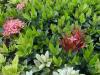
ixora
Latin-English. Compact to more open
evergreen plant or shrub, with well over 500 known species. In Thai,
it is has the generic name kem (เข็ม), which means
‘needle’.
In English, it has a variety of common names, including Cruz de Malta, Rangan,
Kheme, Jungle Flame, Jungle Geranium, and West Indian Jasmine, amongst others.
It is found all over Thailand as an ornamental shrub, often as a hedge in parks
and gardens, and typically
on roadsides
and central reservations. See also
Wan Kruh.
回
 |