kaab (กาบ)
Thai name for large, sheath-like
bracts or
spathe (fig.)
enveloping an inflorescence or drupe, as well as the husk-like outer
layers of a plant which can be pealed from its soft, herbaceous
stem, like that of the banana plant, for example. In
Loei
Province, the broad spathe
of the
coconut palm is
used in the making of
Phi Tah Khohn
masks (fig.).
回
Kaaknasoon (กากนาสูร)
Thai. Name of a character from the
Ramakien, a
female giant belonging to the entourage of
Totsakan, who instructed her to
harm a
reusi,
who lived in the forest. She changed herself
into a large
crow (fig.)
and flew to his hermitage, which she completely destroyed whilst
ferociously pecking at the hermit. The hermit then went to see
Totsarot and told him what had
happened. Totsarot then sent
Phra Ram and
Phra Lak to
help the hermit and when Kaaknasoon returned after seven days, she
was shot and killed by an arrow.
Her appearance is reminiscent of that of a European plague doctor,
who wore a leather face mask with glass eye openings and an
elongated beak-shaped nose which was filled with herbs, straw, and
other aromatic items, which not only filtered the stench of the
putrid air, but was a the time believed to also shield him from
contracting the highly contagious disease. These medieval physicians
likewise carried a stick, used to examine patients without the need
to make direct contact with them. See also
Kahkamukha.
See also
LIST OF RAMAKIEN CHARACTERS & NAMES.
回
_small.jpg)
kaam (กาม)
Thai for
kama and
Kama, meaning
‘love’ or ‘desire’
and its personification, i.e. the god of love and desire, also known
as
Phra
Kaam (fig.).
Depending on the context, the word may also be translated as
‘sexual desire’, ‘sex’,
‘sensual’, ‘sensuous’ ,‘carnal’ and ‘erotic’.
回
kaan (คาน)
See
mai kaan haab.
回
Kaanboon (การบุญ)
See
Garnboon.
回
kaanboon (การบูร)
Thai for
‘camphor’, a sticky white or transparent substance with a strong,
aromatic odour found in wood of the
ton
obcheuy
yuan (ต้นอบเชยญวน)
or ‘Annamese (Vietnamese)
cinnamon
tree’,
with the
botanical name Cinnamomum camphora and
in English known as
Camphor Laurel
or
Camphor Tree
(fig.).
It is widely used in
Hindu
religious ceremonies, as a fuel to light a holy flame. It is burned
to bring about purity and since it burns cool without leaving an ash
residue, it also symbolizes consciousness. Besides this, it is used
for its scent and as an ingredient in mainly Indian cooking.
One of
Pathum Thani's
OTOP
products is kaanboon hom,
i.e. ‘aromatic camphor’, a kind of herbal scent or perfume bag,
often sold in the form of a small cotton doll, known as
tukkatah
kaanboon hom, ‘aromatic camphor dolls’.
回
kaan borijahk lohng sop
(การบริจาคโลงศพ)
Thai for ‘coffin
donation’.
回
kaan chai thuay dood leuad
(การใช้ถ้วยดูดเลือด)
Thai. ‘To make
use of cups to suck blood’. Designation for cupping or fire cupping,
an acupressure technique used in traditional Chinese medicine and in
Mandarin known as
ba guan zi.
回
kaancheud mangkon (การเชิดมังกร)
Thai. ‘Manipulation of
the
dragon’.
Name for the Chinese Dragon Dance (fig.).
回
kaancheud seua (การเชิดเสือ)
Thai. ‘Manipulation of
the
tiger’.
Name for the Chinese Tiger Dance
(fig.).
回
kaancheud singtoh (การเชิดสิงโต)
Thai. ‘Manipulation of
the
lion’.
Name for the Chinese Lion Dance (fig.).
回
kaanchon kai (การชนไก่)
Thai. ‘Cock
fighting’. Name of a brutal blood sport that, although illegal,
banned or restricted in most countries, is still widely practiced in
Thailand, as well as in many other countries of Southeast Asia. Cock
fighting is a cruel ‘game’ in which fighting cocks, specially bred
for aggressive behavior, are pitted against each other. The fights
traditionally involve betting and often the birds are injected with
stimulants to heighten their aggression and sometimes even fitted
with metal spurs or razor-sharp blades. When a bird is down and
wounded during a fight, it is often prone to choking in its own
blood. To prevent asphyxiation its owner will suck the blood from
its wounds and throat to clear the windpipe so that the bird can be
re-pitted until it is incapable of being revived and a winner can be
declared. Cock fights are animal cruelty for the purpose of
amusement and greed, and whilst the winners scrape the pot, the
loser ends up being served in one, or more likely is tossed onto a
heap of other dead birds. Cock fights became a major concern for
authorities during the outbreak of the deadly avian flu, as the
sucking of blood from injured roosters could become a prime,
potentially lethal, gateway for the spread of the H5N1 bird flu
virus to humans. In September 2004 the virus killed at least one
eighteen year old man who raised fighting cocks outside
Bangkok. King
Naresuan was a huge
enthusiast of cock fighting and at shrines devoted to him one will
generally find stone sculptures of cocks, often placed there as
offerings (fig.).
It is believed that King Naresuan used a
Yellow
White-tail Fighting Cock (fig.),
a species known in Thai as
Kai Chon
Leuang Haang Khao and famous
for its endurance in fighting, in a cock fighting game with the
uparacha of
Burma.
WATCH VIDEO.
回
%202_small.jpg)
kaan fai fah nakhon luang
(การไฟฟ้านครหลวง)
Thai. ‘Metropolitan
Electricity Authority’. Name for the municipal electricity supply
agency for the
Bangkok
metropolitan area. Electricity
was introduced to Thailand by
Chao Phraya
Surasakmontri (สุรศักดิ์มนตรี) after this chargé d'affaires to
France returned from Paris where he had been
impressed by how the French capital was illuminated with electric
light. Upon his return he tried, yet initially failed, to convince
King
Rama V,
who had never experienced the benefits of electricity, of the
importance of this new energy for the nation. Hence, he then
persuaded the Queen to assists him and eventually
the Grand Palace
was decorated with lamps and illuminated
on the occasion of the birthday of King
Chulalongkorn,
on 20 September 1884. After this,
electricity soon became
widely used in Bangkok and in 1894 a first
electrical tramway was
established (fig.),
replacing trams drawn by horses, that were in use since 1887. The
tram business was sold and ownership transferred several times, time
and again changing its name, and eventually being named Thai
Electricity Corporation Company Limited. When in 1950 the concession
expired, the government took over operation, changed the name to
Bangkok Electricity Authority, and placed it under the control of
the Ministry of the Interior. On 1 August 1958, the current
Metropolitan Electricity Authority (MEA) was established, which
gradually evolved from its many predecessors, while on 28 September
1960 the Provincial Electricity Authority (PEA),
known in Thai as
kaan fai fah suan phumiphaak
(fig.),
was established as the government department responsible for
providing electricity (fig.)
in 74 of the 77 provinces in Thailand, i.e. all except Bangkok,
Samut Prakan
and
Nonthaburi.
The
emblem
of the
MEA is orange and consists of a circle with the silhouette of
Phra Thihnang Anantasamahkom,
i.e.
the
Ananta
Samahkom Throne Hall
(fig.),
a landmark building in the capital, and four lightning bolts.
See also POSTAGE STAMP
and
MAP.
回

kaan fai fah suan phumiphaak
(การไฟฟ้าส่วนภูมิภาค)
Thai. ‘Provincial
Electricity Authority’. Government department responsible for
providing electricity in 74 of the 77 provinces in Thailand (fig.),
i.e. all except
Bangkok,
Samut Prakan
and
Nonthaburi,
which are served by the Metropolitan Electricity Authority, known in
Thai as
kaan fai fah nakhon luang.
See also POSTAGE STAMP
and
MAP.
回
kaang ha sih (ค่างห้าสี)
See
Red-shanked Douc Langur.
回
kaangkaeng le (กางเกงเล)
Thai. ‘Sea trousers’. Name for the
traditional Thai fisherman pants worn by the
Chao Le, a
lightweight and oversized pair of trousers, somewhere between a
sarong
and a pair of culottes.
They are made very spacious and need to be wrapped around the waist
and then tied with a string from the back, to form a belt. They are
popular as casual wear at home and on the beach, and are usually
made from cotton or rayon, one size fits all. Due to its wide
trousers legs sometimes referred to as elephant leg pants. This kind
of
long baggy pants are
also commonly worn
in
Myanmar,
where they are
known as
Shan baun-bi,
i.e. ‘Shan
trousers’ (fig.).
回
_small.jpg)
kaangkok (คางคก)
Thai for ‘toad’.
回
kaangkok ban (คางคกบ้าน)
Thai. ‘House toad’. Name for
the
Common Asian Toad
(fig.).
Also transcribed kahngkok bahn and kaangkok baan.
回
kaangkok sawan (คางคกสวรรค์)
Thai. ‘Heavenly toad’. Name
of an auspicious animal from Chinese mythology.
READ ON.
回
kaang ngok (ค่างหงอก)
Thai. ‘Grey
Langur’. A name for the
Silvered
Leaf Monkey, used alongside
kaang thao.
回
kaang pla thod (ก้างปลาทอด)
Thai. ‘Fried
fishbone’.
Name for a snack
consisting of deep fried fish bones, which can be dipped in either a
sweet-and-sour
nahm phrik
sauce or a spicy
nahm jim kai
sauce. See also
nang pla thod krob
(fig.).
It
is a specialty from
Ayutthaya.
回
kaang sahm sih
(ค่างสามสี)
See
Black-shanked Douc Langur.
回
kaang thao (ค่างเทา)
Thai. ‘Grey
Langur’. A name for the
Silvered
Leaf Monkey, in addition to
kaang ngok.
回
kaang waen thin neua
(ค่างแว่นถิ่นเหนือ)
Thai. ‘Northern
Spectacled Langur’. Designation for the
Phayre's Leaf Monkey.
回
kaang waen thin tai (ค่างแว่นถิ่นใต้)
Thai. ‘Southern
Spectacled Langur’. Name for the
Dusky Leaf Monkey.
回
kaanhaam (คานหาม)
Thai. Name for a sedan chair or litter (fig.).
Kaan means ‘to carry something (with both hands)’ and haam means
‘sedan chair’. Also
saliang. See also
palanquin,
yahnamaht and
yahnumaht.
回
kaan jad dokmai (การจัดดอกไม้)
Thai. ‘Flower arrangement’. This art form is very traditional,
especially in the making of
phuang malai,
flower garlands (fig.)
made from
jasmine
and other colorful
flowers, including
orchids.
These are thread on a wire with a long needle. Also the arrangement
of bouquets using tropical species is very popular. See also
Pahk Khlong Talaat
(fig.),
fruit carving
and
kaan roy phuang malai.
回
kaan koh kong hin (การก่อกองหิน)
Thai term meaning
‘construction of rock piles’, which refers to the making of cairns (fig.).
See
kong hin.
回
kaan loh (การหล่อ)
Thai. ‘Casting’. A manufacturing process in which a metal, often a
precious metal such as bronze or gold, is liquefied, cast into a
mold and solidified again.
回
%20casting_small.jpg)
kaan loh phra (การหล่อพระ)
Thai. ‘Casting of
Buddha images’.
A
manufacturing process in which liquid bronze is cast into a mold (fig.)
and solidified into a Buddha image. First hot wax is poured into a
mold, creating a wax image of the desired shape which, once dry and
solid, is taken from the mold; then, some nails are inserted at
certain points around the wax image, which is then covered with a
mixture made of plaster, sand and water, and tied with a metal wire
(fig.);
this is done a second time and then the image is put into a kiln, in
order to make the wax melt and create a hollow cavity of the desired
shape, a technique known as
lost wax;
next, hot liquid bronze is cast into the cavity, replacing the wax;
once solidified, the covering is smashed, revealing the bronze
statue; the image is then polished and decorated, and lacquer is
applied as a base colour, which is rubbed with sand paper to
smoothen it; then it is painted with black lacquer and covered with
gold leaf; finally it
is polished one more last time. See also
Buranathai
Buddha Image Foundry
(map
-
fig.).
WATCH VIDEO.
回
%209_small.jpg)
kaan prakuat (การประกวด)
Thai for ‘competition’ or ‘contest’, usually referring to a beauty
contest, with or without a catwalk. The word derives from
prakuat,
meaning ‘to compete’ or ‘to contend’. Vanity is a not insignificant
facet of Thai youth culture and beauty contests are thus very
popular, both with male, female and
kathoey
participants, though
most foreign visitors would consider Thai beauty contests rather
long-winded and boring. Participants usually compete for money
prizes and are judged by a panel, though members of the audience
most often also have a say. They can support their favourite
candidate by buying him or her flowers. The more flowers a candidate
receives, the more votes or points he or she will get from the panel
in that particular category of the contest. Since there is no limit
on the flowers one is allowed to buy or receive, participants will
try to get as many supporters as possible to come and cheer on them.
回
_small.jpg)
kaan roy phuang malai
(การร้อยพวงมาลัย)
Thai. ‘To string
[flowers into] garlands’. Term for making flower garlands,
a popular form of
kaan jad dokmai,
i.e.
‘flower arranging’. They are usually made from
jasmine
and other
colorful flowers, including
orchids.
See also POSTAGE STAMPS.
回
kaan sadaeng khuang fai
(การแสดงควงไฟ)
Thai. ‘Fire spinning show’. Term for fire performances in which fire
poi, a fire stick or a fire rope, i.e. a baton or stick, or a rope,
usually with a handle on one end and a kind of weighted torch-like
canister with a wicking material at the other end, is spun around at
night, creating hoop-like displays of flames that lit up against the
dark of night. In Thailand, these kind of fire performances are
typically held on sandy beaches nationwide, especially on those of
the more popular tourist islands.
See also
TRAVEL PICTURE
and
WATCH VIDEO.
回

kaan salak dun (การสลักดุน)
Thai. A metalworking
technique in which a malleable metal is ornamented by hammering
it on both sides.
READ ON.
回
kaan seuksah (การศึกษา)
Thai for
education.
回
kaan wian thian (การเวียนเทียน)
Thai. Name for a candlelight procession, in which people walk
three times around a
temple, an important shrine or a
stupa,
in a clockwise direction, an act also known as a
thaksinahwat.
The three circumnavigations represent the
Triple Gem.
See also
thian pansa.
WATCH VIDEO.
回
kaan yaay ton klah (การย้ายต้นกล้า)
Thai. ‘Paddy sprouts
transplanting’. Abstract noun of
yaay ton
klah.
回
kaan ying thanoo (การยิงธนู)
Thai for ‘archery’, one
of the main skills that kings and warriors of the past had to
master, both as a weapon in combat and for hunting.
READ ON.
回
kaap he reua (กาพย์เห่เรือ)
Thai term for any epic poetry in verse form,
which makes use of tones as well as rhymes, but lacks any definite
metrical scheme or cadence, and which in general consists of 8 to 14
verses. The most famous of its kind was composed by
Chao Fah
Thammathibet, the viceroy
of
Ayutthaya
and the eldest son of
Somdet
Phra Chao
Yoo Hua
Borommakoht (1733-1758
AD),
which is still sung today in the
Royal Barge Procession
(fig.),
in order to give rhythm to the oarsmen.
See also
he reua.
回
kabang (กะบัง)
Thai name for
a
kind of crown-like
headdress,
somewhat reminiscent of
a diadem,
and
worn by Thai
classical dancers,
as well as by certain monkeys and demons in the
Ramakien.
As such, it is the counterpart of the cone-shaped
chadah
(fig.).
It is usually
worn by less important
characters,
while the main characters by and large wear a chadah-style crown,
though there are several exceptions, e.g.
Hanuman
(fig.),
who most of the time is depicted wearing a kabang. When worn by
monkeys, it is also referred to as kabang nah
ling,
whereas if worn by demons, it is called kabang nah
yak.
Also transcribed ka-bang.
See also
LIST OF RAMAKIEN CHARACTERS & NAMES.
回
_small.jpg)
kabi (กบิ)
Thai-Pali word for ‘monkey’, akin to
kabih,
kapi,
kabin (กบิล)
and
kabin (กบินทร์), and besides the
similar terms
ling and
wahnon.
回
kabih (กบี่)
Thai-Pali word for ‘monkey’, akin to
kabi,
kapi,
kabin (กบิล)
and
kabin (กบินทร์), and besides the
similar terms
ling and
wahnon.
回
kabihthoot (กบี่ธุช)
A standard with a picture of
Hanuman, which
Rama
used to lead his army of monkeys.
Also transcribed kabeetut.
回
kabin (กบินทร์)
Thai-Pali. A compound term of
kabi (กบิ), meaning ‘monkey’ and
in (อินทร์), which besides being
the name for
Indra in certain
contexts also
means ‘patriarch’ or ‘general’. As such it is a synonym of
phaya
ling,
which translates ‘monkey king’ or ‘monkey general’, which may refer
to
Hanuman. The term is also
related to the words
kabi,
kapi
and
kabin (กบิล), the latter with a
different Thai spelling, all of which mean ‘monkey’, and are used
besides the terms
ling and
wahnon.
回
kabin (กบิล)
Thai-Pali word for ‘monkey’, akin to
kabi,
kapi
and
kabin (กบินทร์), the latter with a
different Thai spelling, and besides the similar terms
ling and
wahnon.
回
Kabinburi (กบินทร์บุรี)
Thai. Name of a district of
Prachinburi.
It is a compound of
kabin and
buri,
and means
‘City of the Monkey General’, meaning the town of
Hanuman. The city dates back to
the
Ayutthaya
Period and its city hall was previously located in Ban
Hanuman (บ้านหนุมาน), i.e. the ‘House of Hanuman’, until it in 1906
was moved to Ban
Pahk Nahm
(บ้านปากน้ำ), i.e. the ‘House at the Mouth of the River’, the area
where the Hanuman River and Phra Prong River merge into the
Bang Pakong
River (fig.).
回
Kabinlaphad (กบิลพัสดุ)
Thai for
Kapilavatthu.
回
Kabin Maha Phrom (กบิลมหาพรหม)
Thai name of a deity who had his head cut off after losing a wager.
Kabin Maha Phrom was the deity that looked
after all important ceremonies in the lives of humans, until one
day, a certain rich man who had no children asked the god
Indra for help,
who gave him a son. The boy, named Thammakumaan (ธรรมกุมาร), which
can be translated as ‘Child of the Dhamma’
or ‘Righteous Prince’, was very gifted and even understood the
language of the birds. He was given the same responsibilities over
human ceremonies, as Kabin Maha Phrom, exciting the jealousy
of the latter. To stop the competition, the deity challenged the boy
by giving him three riddles to solve, and made a bet with him,
saying that if he knew the correct answers to the riddles within a
week, the deity would cut off his own head, but if he couldn't give
him the correct answers, he himself would be beheaded. Nearing the
end of that week, Thammakumaan who still didn't know the correct
answers, was resting underneath a tree. In the tree were some
eagles, who were looking forward to soon be feasting on the flesh of
the dead body of the boy who would fail to solve the riddles. Whilst
relating the story of the wager between the god and the young man,
the eagles revealed the right answers to those three riddles. being
able to understand the language of the birds, Thammakumaan was now
well informed and on the appointed day he gave the Kabin Maha Phrom
the three right answers. The god hence lost the wager and cut off
his own head, but since his head had intense heat, it would cause an
inferno if it were to touch the earth, or parch the sea if it would
fell into the sea, his head was deposited in a cave in the heavens.
Every new year, i.e. on
Songkraan
Day,
Nang Songkraan,
i.e. one of the god's seven daughters in turn will carry her
father's head in a parade. Though the seven daughters are often
referred to as one, by the name Nang Songkraan, each one separately
also has her own name, attributes, mount and other characteristic.
Each one corresponds with a day of the week and in the annual
parade, the one representing Miss Songkraan, i.e. will carry the
head of Kabin Maha Phrom, will be
in compliance with the
day of the week on which the festival falls, and is hence different
each year, thus taking turns in this role. The deity is usually
referred to as
Tao
Kabin Maha Phrom and his name is often transliterated Kabil Maha
Phrom.
His name is similar to that of Phra Phrom, i.e. Brahma, and like
Phra Phrom,
Kabin Maha Phrom is also depicted with four faces.
See also POSTAGE
STAMPS.
回
Kabin Paksah (กบิลปักษา)
Thai-Pali. ‘Monkey-bird’.
Name of a mythological creature from
Himaphan, half-bird and
half-monkey, i.e. the torso of a monkey (kabih)
and the legs and tail of a bird (paksah).
In addition it has a pair of small wings on its upper shoulders and
is often depicted holding a staff. Here,
kabin (กบิล)
is in Thai spelled with the end consonant being an L (ล) which in
Thai is at the end of a word or syllable always pronounced as N, but
it is sometimes spelled differently, as in
Kabinburi, where
kabin, also meaning ‘monkey’, is
spelled กบินทร์, which is a compound of
kabi (กบิ), another synonym for
‘monkey’, with in (อินทร์), i.e. ‘patriarch’, and is then
interpreted to be a synonym of
phaya
ling,
which translates ‘monkey king’.
回
Kabuki (歌舞伎, かぶき)
Japanese. ‘The art of
singing and dancing’. Name of a classical dance-drama from Japan in
which the stage performers wear elaborate mask-like make-up known as
kumadori (隈取) and which typically uses the colours white, red, blue,
brown and black. Each of the colours expresses a certain trait of
the character that is played. This form of Japanese folk drama
started in the 17th century Edo Period and was founded by Izumo no
Okuni (出雲阿国), a so-called miko (巫女) or Japanese shrine maiden, i.e.
a young priestess who works at a
Shinto shrine, and from where she
got her name, as she worked at the Izumo-taisha (出雲大社), i.e. the
Grand Shrine of Izumo, an old province of Japan. In this early
period Kabuki's stage performers were all women and it was often
performed in the in the red-light districts of Japan. It was also
associated with prostitution, which stands at the origin of the term
Prostitute Kabuki. The make-up used in Kabuki is often represented
in decorative
masks used for adornment. See also
Chinese Opera
and
TRAVEL PICTURE.
回
kacchera (ਕਛੈਰਾ)
Punjabi. Name for the
undergarment worn by
Sikh
devotees as
one of the five articles of their faith. It is similar to boxer
shorts, yet has to be made entirely from cotton, and thus has a
drawstring at the waist rather than an elastic band to keep it in
place. It is worn as a reminder that one should control ones
kama, i.e. sexual desire or lust.
回
Kadru (कद्रू)
Sanskrit. Name of the daughter of
Daksha, wife of
Kasyapa
and mother of the
nagas
in the
Mahabharata, but in
the
Ramayana she
is described as being the daughter of Kasyapa and Krodhavasa, who is
also a daughter of Daksha.
回
kae (เเก้)
1. Thai verb meaning
‘to change’, ‘to alter’, and ‘to edit’.
回
2. Thai verb meaning
‘to revise’, ‘to amend’, and ‘to redo’.
回
3. Thai verb meaning
‘to undo’, ‘to unfasten’, and ‘to loosen’.
回
4. Thai verb meaning
‘to correct’ or ‘to restore’ (something to its proper state).
回
5. Thai verb meaning
‘to relieve’, ‘to reduce’ (severity), or ‘to counteract’, as in
kaebon, i.e. to fulfil a vow
(to release oneself from a vow made to a deity -
fig.).
回
6. Thai verb meaning
‘to interpret’ or ‘to explain’ (a dream, vision, etc.).
回
7.
Thai verb meaning ‘to
excuse oneself’ or ‘to justify’ (a dream, vision, etc.).
回
kae (แกะ)
Thai for
‘sheep’, while a ‘goat’ is called
phae.
回
kaeb moo (แคบหมู)
Thai for ‘pork cracklings’. Deep fried strings of pork rind, i.e.
the tough outer layer of bacon. It is a crispy, popular snack, often
served with other dishes, such as
nahm phrik
oung
(fig.),
and during
khantoke
dinners (fig.).
It is an
OTOP
specialty from
Phayao
and is also widely made (fig.)
and sold on the Kaad Thung Kwian (กาดทุ่งเกวียน) forest market of
Lampang.
回
_small.jpg)
kaebon (แก้บน)
Thai. To fulfill a promise by making a votive offer, often in the
form of a paid dance performance near an important shrine, where one
earlier prayed or asked for a good result from an event or occasion.
Alternatively, one can put up a set of miniature dancers known as
tukkatah ram thai
(fig.),
that perform a more permanent dance
performance
called
lakhon yok (fig.).
Also transcribed gaebon.
WATCH VIDEO.
回
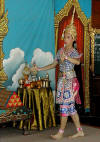
kaek (แขก)
Thai.
‘Guest’ or ‘visitor’. Term used to
refer
to people of Indian descent (fig.),
i.e. the indigenous people from the Indian Subcontinent, including
Pakistan, Sri Lanka, etc. It may also be transcribed khaek or Kaek
(Khaek), with a capital letter. See also
farang.
回
kaen (แคน)
1. Thai. A
bamboo
mouth organ. A traditional
Thai wind instrument with multiple pipes and a polyphonic
sound, somewhat like that of
an
organ, and which is mostly played by the people of northeastern
Thailand (fig.).
It is made from the firm stems of reed (fig.)
and usually left in its natural colour, although occasionally it may
be dyed to make it look more attractive (fig.).
It is held with both hands and played by blowing air into the
mouthpiece (fig.),
whilst alternately covering and uncovering small tone holes with the
tips of ones fingers, to
alter the pitch of the sound produced
and which is proportional to each pipe's effective length. There is
just
one tone hole on each pipe,
located just above the mouthpiece. An instrument representative of
Isaan (map),
it is often displayed in art of that region (fig.).
Also transcribed khaen. See also
gaeng.
LISTEN TO ITS
SOUND IN VIDEO AUDIO.
回
2. Thai. Name in
Isaan
for the
takian thong,
a tree in English known by the name gagil and with
the botanical name Hopea odorata.
回
kaeng (แกง)
Thai. Generic name for a variety of
typically Thai, often soup-like, curries. It may be clear and
thin, or spicy and thickened with
coconut milk,
depending on the variety, which is often specified by adding a suffix, e.g.
kaeng phanaeng,
kaeng khi lehk,
kaeng khiao wahn,
kaeng som, etc. To those different curries,
meat, fish or seafood will be added, according to ones choice and liking, and to
specify the dish more accurately, the Thai word for the kind of meat, fish or
seafood used, will hence be added to the name of the curry. Many curries are
typically eaten with some raw vegetables that are served on the side, such as
yod
krathin
(fig.).
See also POSTAGE STAMP.
回
_small.jpg)
kaeng khiao wahn (แกงเขียวหวาน)
Thai. ‘Sweet green
curry’.
Name
of a kind of
curry
(kaeng),
made on the basis of green
chili paste
(fig.)
and
coconut milk,
which is mixed with water and cooked in a
wok,
whilst adding
other ingredients, such as a little palm sugar and
fish sauce,
meat or fish, crisp eggplant (makheua
proh -
fig.),
pea or cluster
eggplant (makheua
phuang -
fig.),
kaffir lime
leaves (makrud
-
fig.),
Thai Basil
(hora-phaa)
leaves (fig.),
and sliced red chili peppers.
See also POSTAGE STAMP.
回
%20Thai%20sweet%20green%20curry_small.jpg)
kaeng khi lehk (แกงขี้เหล็ก)
Thai. Name of a kind of curry (kaeng)
made with the young leaves and flowers of the
khi lehk american,
a kind of cassia tree
also known as
suwannaphreuk.
回
kaeng massaman (แกงมัสมั่น)
See
massaman.
回
kaeng phanaeng
(แกงแผนง)
Thai. Name of a kind of
red curry (kaeng)
with plenty of
coconut milk,
what makes it milder and thicker than regular red curries. It is
made with little shreds of
kaffir lime
leaf, sliced red
chilis
and bite-size chunks of either beef, pork or chicken, naming the
dish after the meet, e.g. kaeng phanaeng moo (pork) for the dish
with pork, kaeng phanaeng kai (chicken) for the dish with chicken,
etc.
回
_small.jpg)
kaeng som (แกงส้ม)
Thai. ‘Sour curry’ or
‘orange curry’.
Name
of a kind of
thin,
curry-like
soup (kaeng),
made of
tamarind
paste,
which is orange in colour and somewhat sour in taste. This then
forms the basis, in which other ingredients are added to form a
dish, which is further named according to the ingredients that are
added, e.g.
kaeng som cha-om kung
(fig.).
回
kaeng som cha om kung (แกงส้มชะอมกุ้ง)
Thai. Name of a
thin,
curry-like
soup (kaeng),
known in Thai as
kaeng som,
made of
tamarind
paste,
fish sauce,
sugar and lemon juice, and which is orange in colour and somewhat
sour in taste. In it, thick, square-cut
blocks of omelet mixed with young green Acacia leaves called
cha om,
are added (fig.),
as well as
kung,
i.e. ‘shrimps’.
回
_small.jpg)
kaen tawan (แก่นตะวัน)
Thai. Name for the Jerusalem
artichoke, the root of a kind of
sunflower,
with the botanical designation
Helianthus tuberosus, and which is also commonly known as sunchoke
and earth apple. It is cultivated for its edible tuber and in
Thailand, where it is grown commercially in
Khon Kaen
and
Phetchabun,
the root is sliced and eaten raw as a herbal snack.
The Jerusalem artichoke is not
at all an artichoke and the name Jerusalem is a corruption that
derives from the mispronunciation of girasole, the Italian word for
sunflower, which literally means ‘to
turn’ (gira) to the
‘sun’
(sole), the Italian equivalent for the Greek word heliotropio (ηλιοτρόπιο)
from which the English term heliotrope derives, which describes the
concept that members of the sunflower family always face the sun.
They follow the course of the sun by turning their inflorescences
towards the sun.
回
_small.jpg)
kae salak (แกะสลัก)
Thai term used for the art of
making three-dimensional sculptures or relief forms, by either chiselling,
carving, engraving, etching and sculpturing wood, stone or other materials,
including even fruit and vegetables (see
fruit carving).
Other methods of producing statues or three-dimensional, such as casting or
moulding, are called differently, i.e. for ‘casting’ the term loh (หล่อ)
is used which is also slang for ‘male beauty’, and for ‘moulding’ the
word pan (ปั้น) is utilized.
回
_small.jpg)
kae salak dun (แกะสลักดุน)
See
kaan salak dun.
回
kae salak pak (แกะสลักผัก)
Thai.
Carving of vegetables into sculptures following tradition. See also
fruit carving.
回
kae salak ponlamai (แกะสลักผลไม้)
Thai.
The artistic carving of fruit into sculptures or reliefs following
tradition. See also
fruit carving.
回
kaew (แก้ว)
Thai for ‘glass’,
especially ‘cut glass’ or ‘crystal’, as distinguished from sheet
glass, which is called krajok (กระจก). The term is also used as a
designation for precious and exquisite things, such as gemstones,
and often appears in names of places, places and temples, as in
Wat Phra Kaew.
Also transliterated kaeo.
回
kaew chao jom
(แก้วเจ้าจอม)
Thai. ‘Crystal minor
wife of a king (without his child)’.
Name for a small tree with the
botanical name Guaiacum officinale, commonly known as Roughbark
Lignum-vitae. It originates from the East Indies and was introduced
in Thailand by King
Rama V,
who brought it with him from Java after a visit to the island, and
subsequently planted it in the Royal Palace's garden. Today the
showy blue to bluish-white flower is the symbol of the Suan Sunandha
Rajabhat University (มหาวิทยาลัยราชภัฏสวนสุนันทา) and is portrayed
on a postage stamp issued in 2002 AD (fig.).
回
Kaew Jom Kaen (แก้วจอมแก่น)
Thai. ‘Crystal, [the]
core leader’.
Name of a book composed
by Princess
Sirindhorn
under the pseudonym Waen
Kaew (แว่นแก้ว),
and in English referred to as ‘The Mischievous Kaew’ (fig.).
The literary work is a youth book based on the princess' own
experiences from her childhood. The main character of the book is a
girl named Kaew (Crystal), who is also the core storyteller. Each
chapter she tells about one of her adventures, describing both her
mischief and her knowledge. She introduces her friends and nephews,
and even gives recipes to make Thai desserts. When UNESCO in 2013
presented the honorary prize of World Book Capital 2013 to
Bangkok
as the 13th city in its capacity that was declared the metropolis of
reading in order to encourage learning by books at an international
level, the princess granted royal permission to print the cover of
Kaew Jom Kaen on a commemorative postage stamp, issued to mark the
event (fig.).
回
_small.jpg)
kaew mangkon (แก้วมังกร)
Thai name for the
dragon fruit.
回
kaffir lime
See
makrud.
回
kah (ก๋า)
Thai. Another
name for
wih.
回
Kahkamukha (काकमुख)
Sanskrit. ‘Crow-faced’,
sometimes translated as ‘raven-faced’. A form of
Mahakala (fig.)
depicted with a black (kala)
complexion, wings and the head of a crow. This form of Mahakala,
i.e.
the Hindu god of time
and
a form of
Shiva
as the personification of
Kala
in a terrible form,
occurs especially in
Tantric
Buddhism and hence
in the religious art of Tibet.
The name is also
transcribed Kakamukha and he is sometimes referred to as Kahkamukha
Mahakala, or Kakamukha Mahakala. Compare with
Kaaknasoon.
回
Kahn Pheungboon Na Ayutthaya (ก้าน พึ่งบุญ ณ
อยุธยา)
Thai.
True name
of an early 20th
century novelist,
who
wrote under the
pseudonym
Mai
Meuang Deum.
READ
ON.
回
kahng kahw (ค้างคาว)
Thai name for ‘bat’.
Literally kahng means ‘to be left dangling’ or ‘perching’ and kahw
means ‘to stench’ or ‘stink’.
回
%202_small.jpg)
kahng kahw kitti (ค้างคาวกิตติ)
Thai. Name for the
hog-nosed
bat
which is also known as the Bumblebee Bat, the world's smallest bat
with the scientific name Craseonycteris thonglongyai. It has an
adult body weighing only between 1.5 and 2.0 grams, and a
wingspan of about 16 centimeters across.
These rare bats are insectivores and are only found in Thailand and
Myanmar,
where they are known to live in just a few limestone caves in
forested landscapes. It gets its name from
Kitti
Thonglongya
(กิตติ ทองลงยา), a Thai scientist who in 1973 first listed this
species which he discovered in a cave in the
amphur
Sai Yohk (ไทรโยค) in
Kanchanaburi
province.
Before that
time it was unknown to science. In
1986 it was listed in the Guinness Book of Records as the world's
smallest known mammal.
回
kahng kahw mongkut (ค้างคาวมงกุฎ)
Thai.
‘Diadem
bat’. Thai term for
Horseshoe Bat.
回
kahsahwapad (กาสวพัสตร์)
Pali-Thai. The robe of a Buddhist monk. See
also
traijiewon and
pah kahsahwapad.
回
kahthah (คาถา)
Another transliteration
for
kata.
回
kahtiyaw (กาเตียว)
Thai. Northeastern Thai name for the
krajiaw.
回
kai (ไก่)
Thai for
‘chicken’,
‘hen’,
‘cock’
or
‘rooster’.
As chicken, it refers to both the bird itself and to chicken meat used
in dishes.
In Thailand, the fowl correspondents to the first letter of the Thai
alphabet, i.e. ko kai (ก ไก่).
Though kai is the general term for rooster (fig.)
in Thai, when referring to the animal in the zodiac, usually the term
ra-kah (ระกา)
is used. Also
transliterated gai.
See also POSTAGE STAMP,
THEMATIC STREET LIGHT (1),
(2) and
(3),
and
MORE ON THIS.
回
kai betong (ไก่เบตง)
Thai. A breed of domestic
chicken, that originated from the langshan (แลงซาน) variety from
China
and was introduced to Thailand by Chinese immigrants. It is named after
the place where it was first bred for consumption, i.e. the
Amphur
Betong in
Yala
Province. Adult males have a reddish-yellow plumage and females are
whitish-yellow. Adult males have a reddish-yellow plumage and females
are whitish-yellow. Both sexes have yellow legs and feet, and a single
red comb. See also
Bantam.
回
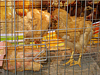
Kai Chao Liang (ไก่เจ้าเลี้ยง)
Thai. Literally ‘Ruler-bred
Cock’, but usually translated as ‘Royal Fighting Cock’. Another name for
the ‘Yellow
White-tail Fighting Cock’,
besides
Kai Chon Leuang Haang Khao
and
Kai Chon Phra
Naresuan.
回
Kai Chon Leuang Haang Khao
(ไก่ชนเหลืองหางขาว)
Thai. ‘Yellow
White-tail Fighting Cock’.
A special breed of fighting cock, also known in Thai as
Kai Chao Liang
and
Kai Chon Phra
Naresuan.
回
Kai Chon Phra Naresuan (ไก่ชนพระนเรศวร)
Thai. ‘Phra
Naresuan
Fighting Cock’. Another name for the
‘Yellow
White-tail Fighting Cock’, in addition
to
Kai Chon Leuang Haang Khao
and
Kai Chao Liang.
回
kai dam tun yah jihn (ไก่ดำตุ๋นยาจีน)
Thai. ‘Chinese medicinal steamed black
chicken’. Name of a dish prepared from an attractive Chinese breed
of chicken with the binomial name Gallus Gallus Domesticus Brisson.
It has a unique, fluffy plumage, which is usually white (fig.),
but may also have other colours, including black. Its feathers are
said to feel like
silk and the animal is hence given
the name Silkie (Silky). They are among the most docile of poultry
and are considered ideal pets, as well as ornamental fowl. Unlike
most other breeds, it has five toes (others usually have four), a
black skin (fig.),
black meat and bones (fig.),
and is both eaten (in Thailand usually as a soup) and used as an
ingredient in traditional Chinese medicine, for its high levels of
carnosine, a natural anti-oxidant that has a number of beneficial
properties, believed amongst others to improve muscle strength and
alleviate the effects of ageing and diabetes. Though this substance
is also commonly found in ordinary breeds of chicken, Silkies have
proven to have twice as much of it. In Thailand, they are sold on
markets, already slaughtered and plucked, and prepared in
restaurants in
Chinatown,
as well as in places with large Chinese communities, such as
Nakhon Sawan
and Doi Mae Salong in
Chiang Rai
province. Also known as Black-Bone Silky Fowl.
回
_small.jpg)
kai fah (ไก่ฟ้า)
Thai. Literally ‘sky fowl’ or ‘blue fowl’. Though, used as a term,
it translates as ‘pheasant’ and refers to fowls that are members of the
family Phasianidae, which also includes birds other than pheasants, such
as the
Red Junglefowl,
the
Green Peafowl
and the
Indian Blue Peafowl,
as well as several kinds of partridges and
peacocks.
In fact,
the family
Phasianidae recognizes only eight species of pheasant living in
Thailand,
i.e. the
Silver Pheasant,
Siamese Fireback,
Crested Firebak, Crestless Fireback, Kalij Pheasant, the Hume's
Pheasant, the Malayan Peacock-pheasant, the
Bar-tailed Pheasant, and the
Grey Peacock-pheasant. Most of them belong to the genus Lophura, apart
from the two Peacock-pheasants, that belong to the genus Polyplectron,
and the rather rare Hume's Pheasant, which as only species belongs to
the genus Syrmaticus.
回
kai fah lady (ไก่ฟ้าเลดี้)
Thai. ‘Lady fowl’. Name for the
Lady
Amherst's Pheasant, alongside
kai fah lady
amherst.
回
kai fah lady amherst
(ไก่ฟ้าเลดี้แอมเฮิรสท์)
Thai. ‘Lady Amherst fowl’. Name for
the
Lady
Amherst's Pheasant, alongside
kai fah lady.
回
kai fah lang khaw (ไก่ฟ้าหลังขาว)
Thai. ‘White-backed fowl’. Name for the
Silver Pheasant,
alongside
kai fah lang
ngun.
回
kai fah lang ngun (ไก่ฟ้าหลังเงิน)
Thai. ‘Silver-backed fowl’. Name for the
Silver Pheasant,
alongside
kai fah lang khaw.
回
kai fah lang thao (ไก่ฟ้าหลังเทา)
Thai. ‘Grey-backed fowl’. Name for
the
Kalij Pheasant.
回
kai fah phaya loh (ไก่ฟ้าพญาลอ)
Thai name for the
Siamese Fireback.
回
kai fah sih thong (ไก่ฟ้าสีทอง)
Thai. ‘Golden-coloured fowl’. Name
for the
Golden Pheasant.
回
kai jae (ไก่แจ้)
Thai. ‘Dwarfed fowl’. Name for the
Bantam.
回
kai juk (ไก่จุก)
Thai. ‘Tufted fowl’. Name for the
Crested Partridge.
See also
juk.
回
Kailasa (कैलास)
Sanskrit. A mountain in the
Himalayas, the dwelling
place of
Shiva and
Parvati. In Thai
Krailaat
and in Sanskrit also called Kailash.
回
kainn pone pain (ကင်းပုံပင်)
Burmese name used for
the
snake cucumber,
besides
kainn pone thee.
回
kainn pone thee (ကင်းပုံသီး)
Burmese name used for
the
snake cucumber,
besides
kainn pone pain.
回
kai pah (ไก่ป่า)
Thai. ‘Forest fowl’ or ‘wild fowl’. Name
for the Red Junglefowl, a tropical bird with the scientific name
Gallus gallus and a member of the Pheasant family, Phasianidae.
Roosters are more brilliantly coloured that their tame relative,
Gallus gallus domesticus, and can easily be distinguished by two
white patches on either side of the head. It is native to Southern
Asia, including Thailand.
According to Dr. Tom
Pizzari from the University of Oxford, chickens
originated in Thailand and the Red Junglefowl is the wild
ancestral population
that produced all the different breeds of domestic chicken found
worldwide.
No wonder the first letter of the
Thai alphabet
(fig.) is called ko kai (ก.ไก่),
which means
‘chicken’,
while the second letter is named kho khai (ข.ไข่),
which means ‘egg’, thus also solving the question of whichever came
first (fig.). Like many birds in the Pheasant family,
males and females show very strong sexual dimorphism (fig.).
Males are much larger with bright gold and bronze feathers and a
tail composed of long, arching feathers that look black, but shimmer
with metallic blue, purple and green in the light. It has a large
red comb on the head and fleshy wattles near its throat. The female
has a rather small comb and no fleshy wattles and her plumage is
rather dull, designed for camouflage, as she alone looks after the
eggs and chicks (fig.).
Red junglefowls are herbivorous and insectivorous, feeding on worms,
grass, corn, soybeans, and different kinds of grains found on the
ground.
See also
kai fah
and
See also TRAVEL PICTURE
and
WATCH VIDEO.
回
%20ไก่ป่า_small.jpg)
kai thong (ไก่ทอง)
Thai. ‘Golden fowl’ or
‘golden chicken’. Name of a kind
herb of which the golden-brown
hairs, that grow on this tuber-like plant's root, are used in
traditional medicine to stop bleeding.
回
,%20a%20Thai%20herb_small.jpg)
kai guang yuan jing (開光圓鏡)
Chinese. ‘Consecrated
Round Mirror’. Name for a Taoist altar mirror, a sacred object used
in Taoist and Chinese religious practices. The Consecrated Round
Mirror is often framed with auspicious symbols, such as golden
dragons, and is placed atop Taoist altars to ward off evil spirits
and negative energies, reflecting them away, acting as a spiritual
shield. The round shape of the mirror symbolizes Heaven, serving as
a bridge or point of connection between the earthly realm and the
divine, enhancing Taoist rituals and facilitating communication with
deities and spirits. This mirror represents clarity, truth, and the
pure reflection of the universe, representing the Taoist ideal of
seeing the world without distortion. The term kai guang (開光) means
‘opening the light’, referring to the ritual consecration that
imbues the mirror with divine energy, while yuan jing (圓鏡)
translates to ‘round mirror’, symbolizing Heaven. In Thai, it is
sometimes referred to as krajok klom peut saeng (กระจกกลมเปิดแสง),
meaning ‘round mirror that opens light’, emphasizing its role in
reflecting spiritual energy. Another Thai term for the mirror is
krajok beuk neht (กระจกเบิกเนตร), which means ‘mirror that opens the
eyes’, symbolizing spiritual enlightenment and awakening. In certain
contexts, the term krajok tien ngaan (กระจกเตี้ยนง่าน) is used,
meaning ‘mirror that clears the path’, signifying its power to clear
spiritual obstacles and open the way for divine connection.
回
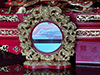
kajae (ກະແຈະ)
Lao for
thanaka (fig.)
or
wood powder used as a
traditional make-up.
回
kaki lima
Malay. ‘Five foot’. Architectural term for a covered pedestrian
walkway in front of colonial-style buildings, often shophouses, in
many old parts of cities and towns throughout
Malaysia and
Singapore, as well as in the old part of
Phuket
Town. The portico-like walkway is either sunken into the ground or
elevated from the road, yet in either case leveled with the ground
floor of a building, and provides a corridor to shield pedestrians
from the sun and rain by the overhanging upper floors of that
building. The name kaki lima derives from the fact that these
walkways were initially about five foot wide, although many are now
wider. Hence, the term is nowadays used generally for any type of
veranda or corridor,
regardless of
its function or width. Since many hawkers use the walkways to to
sell a local food, snacks and drinks, the term kaki lima is in
Indonesia slang for food vendors, though it is asserted that the
Indonesian term may also derive from the fact that originally those
peddlers on the sides off the road had mobile push carts, and were
referred to as kaki lima or ‘five footers‘, because of the two
wheels, the back stand, and the two legs of the guy pushing it.
WATCH VIDEO.
回
%202_small.jpg)
Kakku (ကက္ကူ)
Name of one of Asia's
largest and most spectacular ancient monuments, and one of
Myanmar's
hidden gems, consisting of an 12th century AD historical
Pa-oh
site, with a collection of around 2,000 ancient
stupas,
tucked away in the scenic highlands some 50+ kilometers south of
Taunggyi,
Shan
State’s thriving capital. The
stupas in this remote location are packed closely together in ranks
and while the main stupa stands about 40 meters tall, most are
around 20 meters high. According to legend, the first stupas were
built by King
Alaungsithu (fig.),
the 12th Century King of
Bagan.
Many stupas are richly decorated with religious and mythological
sculptures and figures, and while those allegedly date to the
17-18th century, some of the other structures are clearly much
older. In full its name is Mwe Taw Kakku (မွေတော်ကက္ကူ).
See
MAP.
回
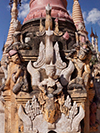
Kakusandha
Pali.
A
buddha of the past
and a precursor of
Sakyamuni,
i.e.
the historical
Buddha.
He was born in Khemavati, today's Gotihawa near
Lumbini
in southern Nepal as the son of a
brahmin
priest, who was a chaplain to the king of Khemavati. Like the
historical Buddha, he was married and also had a son. According to
legend, Kakusandha was 40 cubits (ca. 18.3 meters) tall, lived for
4,000 years until he renounced his worldly life, and died at the age
of 40,000. He is one of the four giant standing buddha's in
Ananda Phaya
in
Bagan,
located at its North Gate, the others being
Kassapa
facing South (fig.),
Konagamana facing East (fig.),
and
Gautama at the
West Gate
(fig.).
Initially, this giant Kakusandha image purportedly had a large blue
diamond in its forehead, which was stolen and later, in the 16th
century, surfaced again in India, where it became known as the Hope
Diamand. In Sanskrit, this buddha is known as Krakucchanda, in Thai
he is called Kukasan (กกุสันธ) or
Phra
Kukasan
Phutta Chao
(พระกกุสันธพุทธเจ้า), and in Burmese Kakuthan (ကကုသန်).
回
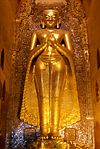
kakuthaphan (กกุธภัณฑ์)
1. Thai. The Thai Royal Regalia (fig.),
which consist of
the Great Crown
of Victory (fig.)
or
Phra Maha Phichai Mongkut
(fig.),
the Sword of State or
Phra Saeng Khan Chai Sri
(fig.),
the Royal Sceptre or
Tahnphrakon
(fig.),
the Golden Fan or
Padwaanlawichanie
and
Yak's
Tail (fig.),
and the Golden Sandal or
Chalong Phra Baht
(fig.).
In a ceremony on
Coronation Day,
which is held annually on May the fifth, these Five Insignia of
Kingship are placed on the throne in
Dusit Maha Prasat
Throne Hall (fig.).
In 1988, the
Royal Regalia
appeared on a set of postage stamps, issued to mark the
Longest Reign Celebrations of King
Rama IX (fig.).
Also transcribed kakuttapan.
回
%202_small.jpg)
2. Thai. Royal insignia or emblem, as well as the regalia or royal
signs of royal privilege. Also transcribed kakuttapan.
回
3. Thai. Name of Prince
Siriraj Kakuthaphan
(fig.),
the
59 child of King
Rama V.
回
Ka Kwe Bu Pe
Kayang
name for a female
dragon.
回
kala
(कला)
1. Sanskrit. Term used
to express time and energy, death and creation, as well as the
destruction of the universe. Personified as Kala or
Mahakala (fig.),
the Hindu god of time and
a form of
Shiva, and as
Kali or
Mahakali,
a form of his consort
Devi. Both represent
the terrifying destructive aspects of time, and it is Kala who
orders
Yama,
the god of death, who will die.
The Thai word for time
(kaan,
กาล) is derived from it. Pronunciation is ka-lah. See also
Phra Kaan,
golden parrot,
and compare with
kala.
回
2. In
Thailand,
Cambodia
and
Indonesia, term for
kirtimukha.
Pronunciation is ka-lah. Compare with
kala.
回
kala (काला)
Sanskrit-Pali.
‘Black’. The name
Kali
is derived from it and it also occurs in the name
Kalasin
which means ‘black water’ or ‘black river’. Pronunciation is
kah-lah. Compare with
kala.
回
kalachakra (กาลจักร)
Sanskrit-Thai. ‘Wheel of time’ or
‘time-wheel’, a circular frame or disc associated with the dance of
time and eternity performed by
Shiva., as well as
with the universe, as displayed in certain
kilkhor or sand
mandala
from Tibet (fig.).
See also
Nataraja.
回
Kaladevala
Sanskrit name for
Kalewin.
回
kalae (กาแล)
Thai. V or X shaped, often flame like ornament
at the top of traditional gabled roofs (fig.)
in North Thailand. ‘Ka’ literally means to cross, and ‘lae’ means to
look or to keep an eye on something. The origin is disputed, but
possibly goes back to the crossing of the slanting side beams
at the ridge of gabled roofs (fig.),
as can still be seen in simple huts today (fig.).
However, the word ‘ka’, which may also be transliterated as ‘kah’,
also means ‘crow’
(fig.),
a possible reference to the
chofa, that according
to some represents a highly stylized form of the
garuda
or
hamsa. Also
transcribed galae.
See also
THEMATIC STREET LIGHT.
回
_small.jpg)
kala face
See
kirtimukha.
回
kalaga (ကန့်လန့်ကာ)
Burmese. ‘Curtain’ or ‘screen’.
A kind of
appliqué tapestry, which is heavily embroidered with gold thread or
filigree
(fig.),
and
often decorated with small pieces of coloured
glass and/or small mirrors.
It is
typically used as Burmese
temple cloths and is usually made in relief using
kapok
as a filling. For the
production of larger embroidery pieces, some collaboration is required.
Whereas one or more workers sit on a makeshift scaffolding
erected over the top, i.e. the front side of the cloth, thus creating the
visible part, another team works from below, i.e. on the invisible back of the
cloth, while laying on their backs. The workers on the scaffolding push the
needle and thread through the fabric from above, passing it on to the aids
below, who push it back up from below (fig.).
Kalaga is in Burmese also referred to as
shwe gyi do,
which translates as
‘gold
thread embroidery’.
回
_small.jpg)
ka-lah (กะลา)
Thai for ‘coconut
shell’. The term is used especially to refer to the hemispherical
parts, after the
hairy
inner shell of a whole
coconut
has been
split into two halves, with one half being somewhat pointed, the
other
with three distinctive
germination pores at the base.
回
kalamae (กะละแม)
Thai. Name for a kind of Thai toffee
made of
sticky rice
flour,
coconut milk
and sugar which is boiled and stirred (kuan)
until it has turned sticky and dark. Although traditionally Thai,
its name is derived from the French word caramel meaning ‘burnt
sugar’. The
Mon people,
especially those from
Samut Songkhram,
have their own variety called kalamae
raman, said
to be the most delicious as it is made with plenty of
coconut.
It is wrapped in the dried, woody, bark-like spathes (bracts that
envelop a flower-cluster) of the
betel palm,
called kahb
(กาบ)
mahk. It is sold
either uncut or cut up together with the wrapper, in bite-size
pieces. The wrapper is not edible.
See also
TRAVEL PICTURE.
回
2_small.jpg)
kalamplih (กล่ำปลี, กะหล่ำปลี)
Thai. Name for a kind of Thai cabbage of the genus Brassica, which
is used as a leafy green vegetable. It has smooth leaves, that are
packed rather compact together. There are two kinds, i.e. a round
form and a pointed form. The latter is also referred to as kalamplih
hua jai, with the word hua jai (หัวใจ) meaning ‘heart’ and referring
to its shape. It is eaten fresh, usually sliced in small chunks, and
served as a complimentary vegetable with certain dishes. Also
transliterated galamplee.
回
%20kalamplih_small.jpg)
kalan
Term from
Cham religious
architecture referring to a sanctuary in the form of a tower.
回
kalapaphreuk (กัลปพฤกษ์)
The official Thai name
for the pink shower tree or
pink cassia
(fig.),
a deciduous tree that grows up to 12 meters tall and has the
scientific Latin name Cassia bakeriana. The name kalapaphreuk
however, is often used generally to refer to all cassia trees with
pink flowers, i.e. pink cassia trees. In Indian and Buddhist
cosmology, Kalapaphreuk are mythical
‘wish-fulfilling
trees’
known in Sanskrit as Kalpavriksha (कल्पवृक्ष). These trees are
believed to grow in idealized realms such as
Uttarakuru,
the northern continent in Buddhist cosmology, where they provide
anything the inhabitants desire—be it food, clothing, or
wealth—effortlessly. Symbolizing perfect abundance and harmony,
kalapaphreuk represent the karmic rewards of virtuous living,
offering a life free from suffering and scarcity. See also
kalaphreuk.
回
kalaphreuk (กาฬพฤกษ์)
The official Thai name
for the horse cassia, a kind of
pink cassia
(fig.),
a deciduous medium sized tree that grows up to 20 meters tall and
has the scientific Latin name Cassia grandis. See also
kalapaphreuk.
回
kalasa (कलश)
1. A flask or water pot alleged to contain the
amrita. It is one of
the eight auspicious symbols or
Ashtamangala
and is frequently seen as one of the
attributes of
Padmapani,
Kuan Yin,
Maitreya, and
Kubera. See also
Treasure Vase,
kundika,
Suwanphingkhaan,
and
puranakata.
See also THEMATIC STREET LIGHT.
回
_small.jpg)
2. In Hindu and Buddhist architecture the term
used for the peak that crowns a
stupa.
回
_small.jpg)
Kalasin (กาฬสินธุ์)
Thai-Pali-Sanskrit. ‘Black water’ or ‘black
river’. Name of a province (map),
as well as its capital city, in Northeast Thailand, 519 kms
Northeast of
Bangkok.
READ
ON.
回
Kalasin Dinosaur Park
Name of a small
roadside attraction located in Sahatsakhan (สหัสขันธ์) District,
Kalasin
Province. The public park features large, colourful dinosaur
sculptures inspired by fossil discoveries found in the region,
including Sauropods and Tyrannosaurus rex. Though not a full-scale
museum, it serves as a fun photo stop for visitors travelling to
nearby destinations such as the Sirindhorn Dinosaur Museum. The park
reflects Kalasin’s strong association with paleontology and is part
of the province’s broader dinosaur-themed tourism appeal.
See also THEMATIC STREET LIGHT (1)
and
(2),
WATCH VIDEO,
VIDEO (EN)
and
VIDEO (TH).
回
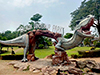
Kalasin Museum
Name of a
provincial cultural museum located in the former city hall of
Kalasin,
in northeastern Thailand. Established in 2002, it serves as a
repository of local heritage and traditions, with exhibitions
highlighting the way of life of the
Phu Thai
people, the province’s renowned pha praewa (ผ้าแพรวา)
silk,
Buddhist art and
amulets,
historical rulers, and cultural achievements. The museum also
features displays on the ancient city of Fah Daed Song Yahng (ฟ้าแดดสงยาง),
wax figures depicting traditional ceremonies, and collections of
local products and handicrafts.
WATCH VIDEO.
回
kaleb (กะเหล็บ)
Thai. Name of a type of basket, which is woven from
bamboo
and used by the men of
the
Lao Sohng
minority people from
Laos,
as a container to store
mahk (areca
nuts -
fig.)
and
bai chaphlu
(betel
leaves -
fig.),
i.e. two ingredients used in
betel nut
chewing (fig.),
as well as gold ornaments. All these items are typically used as a
dowry in their marriage rituals.
This kind of basket is round and bulbous above and rectangular at
the base.
See also POSTAGE STAMP.
回
Kalewin (กเลวิน)
The
reusi who paid homage to the
newborn prince
Siddharta
and to whom the infant showed his first
miracle by placing himself on the turban of the sage. Other texts,
however, mention a hermit with the name
Asita. In Sanskrit
Kaladevala.
回
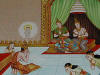
Kali
(काली)
1. Sanskrit. In Vedic times the name meant
‘the Black One’ and was associated with
Agni, the god of
fire, who had seven tongues with which he licked the offerings of
butter. Of these seven tongues Kali was the black, terrifying
tongue. See also
kala.
回
2. Sanskrit. ‘Black goddess’. The horrifying
form of
Devi, the consort of
Shiva. As
a goddess of death (fig.),
violence, and doomsday, she is one of the fiercest, strongest, and
most complex deities in all of
Hinduism,
and she's
is often depicted with a terrifying face with
a protruding tongue (fig.)
and tusks, and smeared with blood. If portrayed with multiple arms,
typically ten, of which at least one holds a weapon and another
sometimes the decapitated head of a giant dripping with blood, she
is known as also
Mahakali (fig.).
Her ornaments include
snakes,
skulls, and figures of children. She is a form of
Durga.
See also
kala.
回
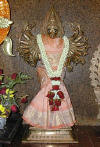
3.
Sanskrit.
Fourth and last of the four
yugas, and the
present time cycle according to Indian cosmology. For more see
Kali Yuga.
Compare with
kala.
回
Kalidasa (कालिदास)
Sanskrit.
‘Servant of
Kali’.
Name of a renowned poet in India (app. 550 AD) and author of the
Sakuntala, a drama in
Sanskrit which was translated into Thai by king
Vajiravudh. By some called
the Indian Shakespeare.
回
Kalij Pheasant
A species of pheasant
with the scientific name Lophura leucomelanos, and found in South
and Southeast Asia, especially in the foothills of the
Himalayas,
from northwestern India to western Thailand. This species is closely
related to the
Silver Pheasant
(fig.)
and has several subspecies, which can roughly be divided into two
main groups, according to their geographical appearance. Besides the
nominate race, the first group includes the subspecies Lophura
hamiltoni, Lophura melanota, Lophura moffitti and Lophura lathami,
which are found in the western and central part of its range, the
second group includes the subspecies Lophura williamsi, Lophura
oatesi, Lophura lineata and Lophura crawfurdi, which are found in
the eastern central part of this bird's range. The males of the
first group are glossy blue-black, with white to the rump or
underparts in most subspecies, and similar to the
Vietnamese Pheasant
(fig.),
the westernmost subspecies Lophura hamiltoni has a white crest,
whereas that of all others is blue-black. The plumage of males in
the second group is also glossy blue-black, but the tail and
upperparts are white or very pale grey, with most feathers densely
vermiculated with black. Females are brownish, with most feathers
pale-edged, giving the plumage a scaly appearance (fig.),
whilst in some subspecies the underparts are distinctly marked in
whitish and black. In Thai, known as
kai fah lang thao.
回
_small.jpg)
Kalika (कालिक, กาลิกะ)
Sanskrit-Thai. ‘Relating to time’, akin to the Thai word
kaan (กาล).
Name of
one of the eighteen
arahats,
who is usually depicted sitting
on an
elephant
whilst studying a scroll.
Though some sources state
that he formerly was a
mahout,
the
elephant, an animal of immense strength, endurance and perseverance,
is more likely an allegory for the power of Buddhism, whereas the
scroll represents the
sutra.
In Chinese he is known as the
luohan
Qi Xiang (骑象, or in traditional Chinese: 騎象), literally ‘To Mount an
Elephant’. In English he is referred to as the Elephant-Riding
Lohan
or the Dust Cleaning
Arhat,
indicating the dusty mind that needs to be cleaned and akin to
Chudapanthaka, the
Door Watching Arhat, who sweeps dusty floors as a cleaning
meditation. In Thai his name is pronounced Galiga, but he is also
called Kagkahti (คักขาทิ).
In Vietnamese, he is called
Ky Tuong La Han (fig.).
回
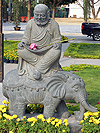
Kalitas (กาลิทัส)
Thai name for
Kalikdasa.
回
Kaliya (कालिया)
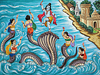
The
naga
serpent king with five heads, which was
subdued by
Krishna when he was a
mere child. It lived in a whirlpool of the river
Yamuna (fig.),
polluting the neighborhood with its poison, until it was removed by
Krishna. This scene is often depicted in art as the young Krishna
dancing on the head of the
snake.
See also
Naak Galyah.
回
Kali Yuga (कलीयुग)
Sanskrit. The present era or time period and
the most depraved of the four
yugas, the cycles of
creation. This cycle began in 3,102 BC and will last 432,000 years,
according to
Brahman beliefs.
回
Kali Yuk (กลียุค)
Thai name for
Kali Yuga.
回
Kalki
(कल्कि)
See
Kalkin.
回
Kalkin (कल्किन्)
The tenth, still to appear
avatara of
Vishnu in the form of
a white horse. Riding this horse he will destroy all evil with a
blazing sword and restore the innocence in the world, at the end of
the present
Kali era. Vishnu also
has another equine form known as
Vajimukha,
which is Sanskrit for
‘horse face’ (fig.).
Also called
Kalki.
回
ka-loong put (k'loong put)
Vietamnese. Name of a
highland ethnic musical instrument made from hollow
bamboo
pipes, arranged horizontally and
in increasing length, akin to a xylophone. The latter is in
Vietnamese known as trung (t'rung) and the ka-loong put is also
referred to as
trung
ka-loong put. The instrument is played by softly clapping the hands
in front of the openings of the pipes on one side, making the wind
blow through them and thus creating sound.
回
kalpa (कल्प)
Sanskrit. The duration of a cosmic period
equaling 4,320,000,000 years for mortals, but just one day and night
for
Brahma.
回
Kalwar (กาลหว่าร์)
Thai name for
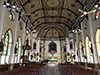
‘Calvary’, i.e. Golgotha, the place where
Jesus Christ
was crucified. A Portuguese 18th Century Roman Catholic
Church in
Bangkok
is named
Bot
Kalwar,
i.e. ‘Calvary Church’ (map).
After the fall of
Ayutthaya to the
Burmese in 1767 AD,
the Catholics
had moved from
the former Siamese capital to
the western bank of the Chao Phraya River
in
Thonburi,
where they in 1770 AD
built the
Santa Cruz Church
(map).
The original building had a rather Chinese design and was nicknamed
Kuti Jihn
(กุฎีจีน),
i.e.
‘Chinese
dwelling’,
and the community that grew around it became known by that name up
to present. Yet,
when in 1786 AD the Catholic Portuguese rejected French clergy,
King
Rama I
granted them a
plot of land on the eastern bank of the
Chao Phraya
River, where the
Portuguese
built a new church. This original building no longer exists and the
present-day church in gothic-style architecture is in fact the third
church building, that was
constructed in the reign of King
Rama V.
This church is also known as Holy Rosary Church.
WATCH VIDEO.
回
kalyanamandapa
(कल्याणमण्डप)
Sanskrit. ‘Mondop
of good fortune’ or ‘auspicious mondop’. A
hypostyle hall used for the
symbolic marriage of the temple deity.
回
kam (กรรม)
Thai for
karma.
回
kama (काम)
Sanskrit. ‘Love’ or ‘desire’. In
Hinduism,
kama is personified by the god of love, that is to say
Kama,
and it is a theme often celebrated in Hindu art, such as in the
Kamasutra, i.e. the
sutra or
‘discourse’ on kama, and in the erotic sculpted
bas-reliefs of
the Hindu-Jain
temples of Khajuraho in India. In
Buddhism, kama refers
to both the senses and visible phenomena.
回
_small.jpg)
Kama (काम)
Sanskrit. The Hindu god of love and desire,
portrayed as the most handsome of all gods. He is the son of the
goddess
Sri.
He is sometimes depicted with wings and carries a bow made of
sugarcane,
with a string of honeybees and arrows decorated with fragrant
flowers. His mount is a parrot and the
apsaras
are his servants. He shoots his love arrows to humans in order to
inspire romantic love and is the Hindu equivalent of Cupid. His
consort or
shakti is called
Rati (fig.).
He is also known as
Madana,
Manmatha and Kamadeva. In
Thai called Phra
Kaam.
See also
kama.
回
%20Kama%20on%20parrot_small.jpg)
kamala (कमल)
Sanskrit. ‘Lotus
flower’, i.e. a
red lotus. Pink, white and blue lotuses are called differently, i.e.
padma,
pundarika,
and
utpala,
respectively. The red lotus signifies the original nature and purity
of the heart, and as such it is the lotus of love, passion, and
compassion, as well as all other qualities of the heart. It is
therefore also the flower of
Avalokitesvara,
the
bodhisattva
of compassion.
回
kamaloka (कामलोक)
Sanskrit-Pali.
‘Sensuous world’,
i.e. the world of the five senses, which comprises the six lower
celestial worlds, the human world (manussaloka)
and the four lower worlds or
apaya, i.e.
the animal kingdom (tiracchahnayoni), the realm of ghosts
(petaloka), the demon world (asuranikahya), and the hells (niraya/naraka).
The term is a compound of the words
kama and
loka.
回
Kamboja (कम्बोज)
Name for a state in
Cambodia,
that existed between the 6th and 8th centuries AD, after the fall of
Funan, and also
known as
Chenla.
Kamboja
derives from the Sanskrit name
Kambuja.
回
Kambuja
Name of the ancient
Khmer
people. They are the supposed descendants of the Hindu sage Kambu
Svayambhuva, their eponymous ancestor.
An ancient legend
tells that
Shiva gave him the
apsara Mera, a celestial nymph, as
his bride. From their names the word Khmer is said to have derived,
i.e. Kambu and Mera became Kamera, later to be pronounced Khmer. A
royal lineage came forth from this couple and the name Kambuja means
‘born from Kambu’. In another legend, it is told that the father of
Mera was a
dragon
king who ruled over a watery kingdom. When his daughter was to marry
an Indian Brahmin named Kaundinya (another name for Kambu) and in
need of a dowry, he drank all the water of his kingdom in order to
provide his son-in-law with land. That land, is told, was named
Kambuja. This is reminiscent of a Thai legend in which a
phayanaag,
the chief of the
nagas,
drank all the water of the world to provide his son-in-law with
land, but was ordered by
Vishnu
to return it all and was squeezed until he had expelled all the
water he had consumed. These stories are perhaps inspired by
Cambodia's
Tonlé Sap
(fig.),
the largest freshwater lake in Southeast Asia (map
-
fig.), whose
dimensions swell and shrink up to five times its original size,
depending on the seasonal monsoons and the flow of the Tonlé Sap
river that in the Southeast converges with the
Mekhong
river. In the rainy season, when the level of the Mekhong rises
rapidly, it reverses the natural flow of the Tonlé Sap river,
causing it to flow upstream, into the lake. Tonlé Sap has the
highest concentration of freshwater fish in the world, thanks to the
mineral rich sediment carried into the lake by the annual floods.
The name Kambuja is still in use in
Cambodia
today. In Sanskrit known as
Kamboja.
回
kammataan (กรรมฐาน)
Thai-Pali-Rajasap.
Meditation in the Buddhist manner, leading to
Enlightenment and
tranquility of mind. See also
Thai Forest Tradition.
回
kamnan (กำนัน)
Thai. An elected official who oversees the
general welfare of the people in a
tambon.
回
kamphaeng (กำแพง)
Thai for a ‘surrounding wall’ or a ‘fortification’. When built
around a city or citadel, it is called kamphaeng
meuang.
回
kamphaeng kaew (กำแพงแก้ว)
Thai. ‘Jewelled wall’. A decorated wall built in a temple or palace
compound to separate a specially sacred area, as well as a parapet
built around a monument.
回
Kamphaeng Phet (กำแพงเพชร)
Thai. ‘Jewelled wall’ or ‘diamond wall’.
Historical capital of a contemporary province (map)
of the same name in North Thailand.
READ ON.
回
Kamphon Wacharaphon (กำพล วัชรพล)
Thai. Founder of the Thai Rath newspaper, who was praised by UNESCO
for his work in
education
and promoting and developing journalism in Thailand. He was lauded
by the organization as an individual of great importance for his
establishment of the Thai Rath Vithaya School network and the Thai
Rath Foundation. Kamphon devoted the last part of his life to
promoting formal education for those in rural and remote areas of
Thailand, building new schools, which now add up to over a hundred
and with around 30,000 students. Originally from
Samut Sakon,
where he was born on Saturday 27 December 1919, he built the first
school under his Thai Rath Vitaya school project in
Lopburi,
in 1969. He
passed away on 21 February 1996 zt the age of 77 and is commemorated
with a Thai postage stamp issued in 2019 on the occasion of the
100th anniversary of his birth. Also transliterated Kamphol
Vacharaphol.
See POSTAGE STAMP.
回
Kamphucha (กัมพูชา)
Thai name for
Kambuja and for
Cambodia.
回
kampie (คัมภีร์)
Thai. Something profound, sacred manuscripts, the bible. Also
transliterated kampih, khampih, khamphi, or similar.
回
kampieweht (คัมภีร์เวท)
Thai name for the
Vedas.
回
kampiewehttahng (คัมภีร์เวทางค์)
Thai name for
Vedanga.
回
kan (กัณฑ์)
Thai. Classifier used to indicate the ‘number’
of ‘sermons’ (thet).
回
Kanaka Bharadvaja (कनकभारद्वाज,
กนกภารัทวาช)
Sanskrit-Thai.
‘Golden
Bharadvaja’.
Name of one of the
eighteen
arahats,
who was a Buddhist mendicant monk known for begging with his
alms bowls
and eyes upraised, accepting food without shame. This is contrary to
normal practice, as monastic precepts prohibit monks to eyeball
anyone at any given time and monks on
bintabaat
are instructed to submissively bow their heads toward the ground (fig.)
when accepting food (fig.).
He thus represents one who can receive gifts graciously. He is
usually portrayed standing on one foot with one knee pulled up and
both hands stretched out in the air, holding a small alms bowl. It
is assumed that as joy descends from heaven, he raises the bowl to
receive happiness. In
Vietnam,
where
he is called
Cu Bat La Han (Cử Bát La Hán),
he is sometimes depicted seated on a
fenghuang
(fig.),
i.e. a
phoenix-like
bird (fig.).
In paintings he is sometimes pictured with a small disciple at his
side. In Chinese, he is known as the
luohan Tuo Bo
(托钵, or in traditional Chinese: 托缽), literally ‘To Hold An Alms Bowl
Up With The Palm’. In English, he is referred to as the Raised Bowl
Lohan
or Alms Holding
Arhat. In Thai his name is
pronounced Kanaka
Pharathawat, but he is also known
by the name Kaya Khaap Sulijarn (กะยะขาปสุลิจารย์). His Sanskrit
name is in part similar to
Bharadvaja
and
associated with the Bhardwaj or Bharadvaja Bird, i.e. a name used in
India for the
Greater Coucal
(fig.).
Sometimes Kanaka Paridhvaja.
回
_small.jpg)
Kanaka Vatsa (कनकवत्स, กนกวัจฉะ)
Sanskrit-Thai.
‘Golden Calf’. Name of
one of the eighteen
arahats,
who
was a
well-known public speaker and debater of the Buddhist doctrines and
famous for his sermons on happiness which he described as
experienced through the five senses, in contract to bliss which
defined he as joy not coming from the five senses, but from deep
within, like a feeling in ones his heart and not
being subject to changes on the outside, it could be sustained
indefinitely.
He often smiled during debates and
is sometimes portrayed
banging cymbals in joy. In Thai, his name is pronounced
Kanakawatcha, but he is also known as
Khayaket. In Chinese he is known as
the
luohan Xi Qing
(喜庆, or in traditional Chinese: 喜慶), literally ‘To Be Happy and
Celebrate’. In English, he is referred to as the Happy
Lohan
or
Jolly
Arhat.
In
Vietnam,
he is called
Khanh Hy La Han (Khánh Hỷ La Hán)
and
may be depicted
seated on a hoofed
mythical animal while
holding a rice bowl
(fig.).
Also written Kanakavatsa.
回
_small.jpg)
Kanaung (ကနောင်)
Burmese. Name of a
Prince of
Burma.
He was the younger brother of
Mindon Min
(fig.),
with whom he on 11 July 1853 forced their half brother
Pagan Min,
the 9th King of the Konbaung Dynasty, to abdicate, making Mindon Min
the new
King and
Kanaung the Heir Apparent.
He is acclaimed for his attempts to modernize the country by sending
scholars to Western countries and by founding an arms industry.
However, his efforts were cut short when he was killed by his two
nephews, sons of King Mindon Min, in an unsuccessful palace coup.
His remains lie buried at
Sanda Muni Phaya
(fig.),
a Buddhist temple at the foot of Mandalay Hill.
Often referred to as
Kanaung Mintha,
i.e. ‘Prince Kanaung’.
回
Kanaung Mintha (ကနောင်မင်းသား)
Burmese for ‘Prince
Kanaung’.
回
Kanchana Aranyawasi (กัญจนะ
อรัญวาสี/อรัญญวาสี)
Thai. Name of a senior
Buddhist monk of Wat Soong Men (วัดสูงเม่น), a forest temple in the
northern Thai province of
Phrae.
READ ON.
回
Kanchanaburi (กาญจนบุรี)
Thai. ‘City of gold’. A
provincial capital of app. 37,000 inhabitants in West Thailand, 128
kms from
Bangkok.
READ
ON.
回
Kanchanaphisek (กาญจนาภิเษก)
Thai-rajasap
for ‘Golden Jubilee’.
Term often used when referring to
structures built or projects initiated for the
Golden Jubilee of the
King, e.g.
Kanchanaphisek Bridge
(fig.),
the Kanchanaphisek
Ubosot
at
Wat Sri Phan Ton (fig.),
and Kanchanaphisek
Lighthouse (fig.).
Also transliterated Kanchana Phisek. See also
Flag 50th Anniversary on the Throne.
回
Kanchanaphisek Bridge
Name of a cable-stayed bridge over the
Chao Phraya River
in
Samut Prakan
Province, built as part of the Outer Ring Road project. It was
opened to traffic on 15 November 2007 and consists of a two pylons,
from which the suspension cables extend to the road surface, lifting
the 500 meter long main span, the longest of its kind in the nation,
more than 50 meters above sea level. The total length of the bridge
is 951 meters, has six lanes and is 36.7 meters wide (fig.).
In Thai, it is called Sapaan Kanchanaphisek (สะพานกาญจนาภิเษก),
meaning ‘Golden Jubilee Bridge’,
named after Highway 9, which is also called Thanon
Kanchanaphisek,
i.e. ‘Golden Jubilee Road’,
and that runs over the bridge. The name was changed in 1996 from
Highway 37, in honour of king
Rama IX
and to commemorate his Golden Jubilee on the
throne that year.
See MAP.
回
%203_small.jpg)
kan chiang (กรรเชียง)
1. Thai. ‘Paddle’
or
‘oar’, i.e. a less
common term for a rowing paddle or the act of paddling, i.e. the
rowing motion, as in phaay kan chiang (พายกรรเชียง), which means ‘to
paddle (with alternating strokes)’. The term derives from imagery
similar to crab legs.
回
2. Thai. ‘Leg joint’.
Term most commonly used in food context, as in kan chiang
poo, which refers
to the paddle-like segment of a crab or a ‘crab leg’.
See also POSTAGE STAMP.
回
kandara (कन्दर्)
Sanskrit for ‘elephant goad’. See
also
kho chang.
回
Kaneht (คเณศ)
Thai name for
Ganesha.
Also
Phra Kaneht.
回
kang (กัง)
A generic Thai name for
macaque,
though often specifically used for the
Pig-tail Macaque,
officially known as
Southern Pig-tail Macaque
and in Thai as
ling hang san.
回
kang (กั้ง)
Thai generic name
for ‘mantis shrimp’, a semi-large marine crustacean, which despite
its designation, is not a shrimp.
READ ON.
回
kanga (ਕੰਘਾ)
Punjabi. Name for a small wooden
comb used and worn by the
Sikh
and one of their five articles of faith. It is used both to untangle
their
kesh,
i.e. uncut hair, usually twice a day, and to keep the hair, which is eventually
wrapped into a topknot on the head, tightly in place, after which it is covered
by a scarf-like under-turban called
patka
and/or a turban known as a
dastar
or
pagri.
The kanga is a symbol of cleanliness and reminds Sikhs that their lives should
be tidy and organized.
回
kang han lom (กังหันลม)
Thai name for
‘windmill’.
回
kang han lom phalit faifah (กังหันลมผลิตไฟฟ้า)
Thai name for ‘wind
turbine’, a device that converts the kinetic energy of wind into
electrical energy using rotating blades connected to a generator.
Thailand has adopted wind turbines as part of its push toward
renewable energy under the Alternative Energy Development Plan (AEDP).
The country’s most prominent wind farms are located on the
Korat
Plateau in
Nakhon Ratchasima,
where steady winds and elevated terrain make it ideal for wind
energy production. These turbines contribute hundreds of megawatts
to the national grid and play a key role in reducing dependence on
fossil fuels and cutting carbon emissions.
WATCH VIDEO and
VIDEO (EN).
回
kang han nahm (กังหันน้ำ)
Thai term for ‘water
wheel’, a mechanical device that uses the flow of water to generate
rotational energy. Typically, it consists of a wheel fitted with
paddles or blades that capture the energy of moving water, such as
from a river or stream. Waterwheels have been traditionally used in
Thailand for various purposes, such as grinding grains, irrigating
fields, or generating mechanical power for simple machinery. The
design often reflects a rustic charm, with wooden or bamboo
components, and is an iconic feature in rural landscapes and
cultural dioramas. In modern contexts, they are also seen as
decorative features symbolizing harmony with nature. The invention
of the waterwheel is often accredited to
Wu Zixu, a general and politician of
the Wu Kingdom in the Spring and Autumn Period
(BC 722 - BC 481), who is also known as
Wu Yun (fig.).
One notable figure associated with the development of waterwheels in
China is Du Shi (杜詩), an engineer
and official of the Eastern Han Dynasty (ca. AD 23 - AD 220).
See also
LIST OF CHINESE RULERS
and
WATCH VIDEO.
回
kang han nahm chai pattana (กังหันน้ำชัยพัฒนา)
Thai name for the
chai
pattana aerator (fig.),
an invention of King
Bhumipon Adunyadet
used to increase the oxygen content of water. A sculpture of the
device, officially referred to as
Tribune Rama IX Waterworks,
was raised in the King
Rama IX Royal
Park in
Bangkok,
on the occasion of the 80th birthday of this monarch.
See
MAP.
回
_small.jpg)
kanit (กนิษฐ)
A Thai term for ‘younger sister’
and a synonym for nong (น้อง). Also transliterated ganit. In Thai it is also
spelled otherwise and then transliterated
khanit.
回
kanitah (กนิษฐา)
A Thai term for
‘younger sister’ and a synonym for nong (น้อง). Also transliterated
ganitah. In Thai it is also spelled otherwise and then
transliterated
khanitah.
回
Kanji (漢字)
Japanese.
Literally ‘Han character’, i.e. the Chinese characters that are used
in the modern Japanese writing system, along with hiragana and
katakana, as well as the Indo-Arabic numerals, and the occasional
Romanization of Japanese words. It is believed that Chinese script
first came to Japan on articles imported from
China
during the Han Dynasty, thus introducing the script when the
Japanese language itself had no written form. Since 1946, a
modified, simplified form of the Kanji script, called Shinjitai,
i.e. literally ‘New character form’, was officially adopted. In
comparison, Shinjitai relates to Kanji in a way similar as to what
Simplified Chinese is against Traditional Chinese, yet is less
extensive in its scope. See also
Ateji.
回
Kan Khwan
Kayang. Name of a traditional
religion as practiced by the
Kayang (Kayan) people
of Burma and Northern Thailand. Its doctrine asserts that the world
was created by the eternal creator Phu Kabukathin assisted by two
other deities, that is Ti who created the earth and La Taon who
created man and the animals. Kan Khwan belief trusts that all
components of the Universe are linked together by a giant spider's
web, embracing the earth, the moon and all the stars. In the
beginning the land of the earth was fluid, so, the god Phu
Kabukathin planted a small post in the ground. As the post grew the
earth also grew into seven outer and inner layers and it became
firm. The post was named
Kan Thein Bo,
meaning ‘the means of formation of earth’ and is today an important
part of their religious worship. Kan Khwan belief is in
practice since the Kayang people emigrated from Mongolia during the
Bronze Age.
回
Kannabhorn Bejaratana (กรรณาภรณ์
เพ็ชรรัตน์)
Thai. See
Kannaphon Phetcharat.
回
Kannaphon Phetcharat (กรรณาภรณ์
เพ็ชรรัตน์)
Thai. Name of the
daughter of Queen
Sunandha Kumariratana
(fig.)
and King
Chulalongkorn
(fig.),
born on 12 August 1878. The young princess drowned together with
her mother
on 31 May 1880,
when the boat (fig.)
they were traveling in on
their way to
the Royal Summer Palace (fig.)
in
Bang Pa-in
got involved in
an accident and capsized. Despite the presence of many
onlookers, no one dare come to her rescue, as the law forbade
commoners to touch any royal, even in order to save their lives.
King
Rama V had a
memorial erected for them at the Bang Pa-In Palace
(map
-
fig.).
The name Phetcharat (เพ็ชรรัตน์) means ‘glass diamond’. The princess'
full name is also transliterated Kannabhorn Bejaratana.
回
_small.jpg)
kannikah (กรรณิการ์)
Thai name for an up to 10 meter
tall, perennial shrub or a small tree, with the botanical name
Nyctanthes arbor-tristis,
and commonly known as Night-flowering Jasmine or
Night-blooming Jasmine. The fragrant flowers, that grow in clusters
of two to seven, have five to eight white petals, that form a
corolla with an orange-red centre. They open at dusk and close at
dawn, hence the name Night-flowering Jasmine. The scientific Latin
designation arbor-tristis
means ‘sad tree’ and refers to the fact that
the flowers lose their brightness during daytime, which led to the
tree sometimes being nicknamed ‘tree of sorrow’. Its fruit consists
of a heart-shaped to round capsule of about two centimeter in
diameter, which is flat at the sides and has two swollen sections in
the centre, each containing a single seed. This shrub is native to
southern Asia, including Thailand, and appears in several
Hindu
myths. It also has several medicinal uses.
Nyctanthes arbor-tristis
is portrayed on a Thai postage stamp issued in 2002 AD (fig.).
回
kanok (กนก)
1. Thai-Sanskrit. ‘Gold’ or ‘golden’, as in
‘kanok
nakhon’ (golden
city).
回
2. Thai. A flame-like
design consisting of double curves. See also
kranok
and
THEMATIC STREET LIGHT
(1),
(2),
(3),
(4)
and
(5),
and
WATCH VIDEO.
回
Kantarat (กานตรัตน์)
Thai. Name of an 18
holes golf course, uniquely and seemingly out of place located in
between two airstrips
(fig.)
at
Don Meuang
Airport (DMK) in
Bangkok
(fig.),
i.e. in between the
runway
used by
the Royal Thai Air Force and the one reserved for civil aviation.
Though situated in a secured area and in a way —at least in part— on
military domain, beside military personnel also civilians are
welcomed here to play golf amidst the continues flow of air traffic
and to the amazement of the many often flabbergasted passengers that
land and take off from this airport, especially those who are
confronted with this incongruous golf course for the first time.
See MAP.回
Kanthaka (कण्टक)
Sanskrit. ‘Rebel’. The snow-white horse of
prince
Siddharta,
born on the same day as its master. After carrying the prince away
from the palace during the
Great Departure, the horse
died of sorrow. Also Kantaka. Compare with
Balaha.
回
Kanthakumara (कण्टकुमार)
Sanskrit. ‘Rebel prince’. Son of
Uma or
Devi, the
shakti or consort of Shiva.
Also
Subramaniam and in Thai
usually called
Phra Kanthakuman.
Sometimes transcribed
Kantakumara.
回
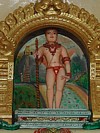
Kan Thein Bo
Kayang. ‘The means of formation of
earth’. Name of a kind of totempole worshipped by the
Kayang people of
Burma and Northern Thailand. It is said that after the creation of
the earth all land was fluid and Phu Kabukathin, the eternal
creator, therefore planted a small post in the ground, enabling
earth to grow and the land to become firm. This eventually enabled
the Kayang people to settle down. Every year between March and
April, the Kayang erect a new pole, if possible, made from the
Eugenia, the first tree said to ever been created. The pole
comprises of the sun, at its peak; the sanctuary, a place where the
deities reside; and the streamer, a ladder that connects earth with
heaven, with at the top a spider's web that humans need to pass to
go to heaven. See also
Kan Khwan.
回
kanthet (กัณฑ์เทศน์)
Thai. A chapter in the
jataka. See also
kan and
thet.
回
kan thuay (คันทวย)
Thai term for an
eave bracket.
回
kanun (ขนุน)
Thai name for the
Artocarpus heterophyllus (fig.),
a large fruit (fig.)
and its tree, of the genus Artocarpus which also includes the
breadfruit tree, and has the western nickname ‘jackfruit’. The
fruits have a dark yellow and very sweet flesh (fig.)
which sit like small bags around the thumb sized seeds in an
enormous brown-green husk with short, hexagonal, blunt prickles.
Jackfruit seeds are also be consumed and have certain health
benefits. They are a rich source of dietary fiber and are said to
give instant relief from indigestion and treat constipation.
The Thai name for
the tree is
ton kanun and
khanom met kanun,
i.e. ‘jackfruit seeds’, is the name given to a traditional Thai
candy (fig.).
Its fruiting season is from January to May (fig.).
In Vietnam, the wooden dolls (fig.)
used in
water puppetry
(fig.)
are typically carved from jackfruit
wood.
WATCH VIDEO.
回
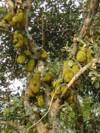
kanun sampalo (ขนุนสำปะลอ)
Thai. See
sake.
回
kanya (กัญญา)
See
ganya.
回
kao (เก่า)
Thai for ‘old’ or ‘of long standing’,
a word associated with the number
nine, due to
its similarity in
pronunciation, although
the word for ‘old’ has a low tone (เก่า), whereas the word for ‘nine’
has a falling tone (เก้า). Sometimes transcribed gao. See also
boraan.
回
kao (เก้า)
Thai for
‘nine’,
considered a lucky number associated with
long life, due to it
similarity to the word for ‘old’. Though pronounced similarly, the
word for ‘nine’ has a falling tone (เก้า), whereas the word for ‘old’
has a low tone (เก่า). Sometimes transcribed gao. See also
Rama IX.
Its Thai numeral is ๙.
回
kao kih (เก๋ากี้/เก๋ากี่)
Thai name for the ‘wolfberry’
or ‘Chinese
wolfberry’,
which is also known by a variety of other names, including the
commercially used designation goji berry, i.e. the circa 2
centimeter-sized,
orangey
red, ellipsoid fruit of a
plant with the botanical name Lycium chinense, or of the very
closely related Lycium barbarum. The berries are prized for their
highly nutrient and medicinal value. Though rarely found in fresh
form outside of their production region, fresh they are used to make
certain beverages, but in food they are generally used in dried form
and their shape and structure to some extent resembles that of
raisins. They are used in a variety of dishes, but are traditionally
cooked first (fig.).
They are sweet and, according to some, they also have a slightly
nutty taste. In Thailand, they can be found in bulk on the markets
of
Bangkok's
Chinatown.
Sometimes transcribed kao kee and also known by the names huay kih (ฮ่วยกี้),
and malet kao kih (เมล็ดเก๋ากี้) or met kao kih (เม็ดเก๋ากี้), i.e.
‘goji
seeds’ or ‘wolfberry
seeds’.
回
_small.jpg)
kaolad (เกาลัด)
Thai. ‘Chestnut’. Name of a glossy hard brown
edible nut, i.e. the seed of a tree with the botanical name Castanea
sativa. Chestnuts can be eaten raw, but in Thailand they are usually
roasted
and referred to as
kaolad
kua.
They are roasted in a
large
wok
filled with small pebbles or large grains of sand, measuring about
3-5 millimeters in size. When the sand heats up the pellets turn
black and the chestnuts are added to it. Then, the content is
stirred for 30 to 40 minutes to prevent the chestnuts from burning.
Some vendors may add roasted sugar or roasted coffee beans to it for
a better taste and aroma. Using the sand helps retain the heat for a
long time which in turn aids in gradually detaching the flesh from
the rind. The pebbles can be used for about a month after which they
begin to fall apart and turn into powder. Roast chestnuts have an
oily sweet taste and are considered a real delicacy. Freshly roasted
chestnuts are widely sold along Yaowarat Road in
Bangkok's
Chinatown,
where they are rather high-priced, though nowadays chestnuts are
also widely for sale in supermarkets, imported in packed form,
already roasted,
peeled and ready to eat, and usually at a fraction of the price in
Chinatown.
Also transcribed gaolad.
回
Kao Suriya
(เกาสุริยา)
In the
Ramakien the wife of the
mythological King
Totsarot of
Ayutthaya, and
mother of
Rama.
See also
LIST OF RAMAKIEN CHARACTERS & NAMES,
and
MORE ON THIS.
回
kapala (कपाल)
Sanskrit. ‘Skull’,
‘cranium’, ‘cup’, or ‘alms
bowl’.
Name for a ritual bowl made from a human skull, and in
iconography
used as an
attribute
of several
Hindu
and
Mahayana
Buddhist deities, especially in
Lamaism,
Tantrism,
and
Vajrayana
Buddhism.
READ ON.
回
kaphrao (กะเพรา)
Thai name for a species
of basil, with the scientific names Ocimum sanctum and Ocimum
tenuiflorum. In English, it is known by the designations Tulsi and
Holy Basil, the latter
not to be confused with Thai
Basil, which is a variety of Ocimum basilicum, known in Thai
as
hora-phaa (fig.).
Yet another type of basil commonly found in Thailand is maenglak (แมงลัก),
which is known in English as lemon basil (Ocimum citriodorum).
Kraphao is an
aromatic plant with hairy
stems and slightly serrated leaves,
about five centimeters
long and strongly scented. Flowers are
purplish and grow in elongate racemes. There are two
main morphs of Ocimum sanctum, i.e. one with
green leaves, the
other with purplish
leaves. The leaves are
used in Thai cuisine, most commonly in a dish known as
khao pad kaphrao kai (ข้าวผัดกะเพราไก่),
i.e. ‘basil [leaves] fried [with] chicken [served over plain boiled]
rice’.
Usually pronounced kaphao, without the ‘r’.
回
%20Ocimum%20sanctum%20basil_small.jpg)
kapi (กปิ)
Thai-Pali word for ‘monkey’, akin to
kabih,
kabi,
kabin (กบิล)
and
kabin (กบินทร์),
used besides the similar terms
ling and
wahnon.
回
kapi (กะปิ)
Thai. ‘Shrimp paste’. A
salty, fermented paste made from pulverized marine shrimp or krill
mixed with salt. There are numerous varieties, typically named after
the specific type of shrimp or krill used. To maintain quality and
consistency, only one type is used per batch—never a mixture. Kapi
is a staple condiment in Thai cuisine, used to season various dishes
or as a key ingredient in recipes. One notable example is
khao kluk kapi
(fig.),
a fragrant fried rice dish infused with shrimp paste. It is thought by some that the name of
Bangkapi,
a district or
khet
in eastern
Bangkok
derives from this as a compound of
bang
(บาง),
the name commonly used for riverside settlements,
and kapi,
allegedly due
to the local production
thereof. However, some inhabitants of this district with a large
Muslim community claim the name derives from the
kapioh
(fig.), the religious
brimless hat worn by Muslims, as an abbreviated
version of it.
In Southern Thailand, shrimp paste is called kheuy (เคย) or kheuy
kung
(เคยกุ้ง).
回
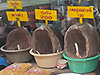
Kapilavasthu
Pali for
Kapilavatthu.
回
Kapilavatthu
(कपिलवस्तु)
Sanskrit. The empire in nowadays southern
Nepal (formerly India) where king
Suddhodana, the
father of the historical
Buddha ruled, and
consequently the birthplace of prince
Siddhartha.
See also
Lumbini. In Pali
called
Kapilavasthu and in Thai
Kabinlaphad.
回
kapioh (กะปิเยาะห์)
Thai-Malayu. Name for a traditional
kufi-like
brimless
hat worn by male
Muslims in southern
Thailand, especially in the deep southern provinces of
Pattani,
Yala
and
Narathiwat,
near the border with
Malaysia,
where it is called kopiah. They are either coloured, usually with a
patterned design (fig.),
or entirely white. Sometimes transcribed as kapiyo, kapio or
kapiyoh. It is claimed by some that the name of
Bangkapi,
a district or
khet
in eastern
Bangkok
with a large Muslim community, derives from this religious hat, as a
compound of
bang
(บาง),
the name commonly used for riverside settlements,
and an abbreviated version of kapioh, i.e.
kapi
(กะปิ), though since kapi also means
‘shrimp
paste’,
others say the name is related to the local production of this
important ingredient in
khao kluk kapi
(fig.). See also
taqiyah.
回
_small.jpg)
kapok
Name of a tropical tree
of the order Malvales and the family Malvaceae. Its scientific name
is Ceiba pentandra and previously it was separated in the family
Bombacaceae. There are many different species and it is also known
as ceiba, silk-cotton tree, Java cotton or Java kapok. In Thailand
the tree is of a medium size and grows up to 15 meters but some
species may grow as high as seventy meters tall with a very
substantial trunk up to three meters in diameter and
buttressed roots.
Adult trees produce several hundred seed pods (fig.)
which contain black seeds surrounded by a light, fluffy, cream-coloured
fibre that is a mix of lignin and cellulose, and which is also
called kapok. The fibre is buoyant, very resilient and resistant to
water, but cannot be spun. Instead it is used as filling in
mattresses, pillows, triangular floor pillows called
mon khwahn,
Burmese temple cloths with
filigree
and images in relief (fig.),
cuddly toys and for insulation. It was previously much used in life
jackets and similar appliances. But kapok is also highly flammable
and villagers often utilize it as a fuel to ignite a ‘taban
fai’
lighter (fig.).
When still young the cucumber-like seed pods are soft and green and
its flesh is edible (fig.),
both fresh or as an ingredient of a Thai curry called kaeng or gaeng,
but when they ripen the pods turn hard and light brown, and its
flesh becomes fibre. The seeds produce a vegetable oil. Today kapok
has largely been replaced by synthetic materials. In Thailand, Kapok
Trees yield between February and April and are called
ton
nun.
回
%20on%20tree_small.jpg)
kara (ਕੜਾ)
Punjabi. A round iron
or steel bracelet worn by
Sikh
devotees at all times, as
one of their five articles of
faith, and as
constant reminder that whatever a person does with his or her hands
has to be truthful and worthy towards God, with the circular form of
the bangle symbolizing God's eternity.
回
karahi (कड़ाही)
Name of a
wok-like, yet
deeper, circular, open cooking pan, used in India. It is also known
by a variety of other names, including karai, kadai, etc.
回
karanda
Common name for a
species of flowering shrub, with the botanical designation Carissa
carandas, which produces berry-like fruits that are rich in iron and
Vitamin C, and are said to have certain health benefits. They
purportedly reduce blood sugar levels, inhibit the growth of cancer
cells, and prevent heart diseases. The shrub grows naturally in
areas of the Indian subcontinent, including in lowland rain forests
of Sri Lanka, India, and Nepal, at the lower elevations of the
Himalayas.
In India, the berries are are commonly used as a condiment in
pickles and spices. In Thai, known as
manao mai ruh hoh,
or simply
manao hoh.
回
_small.jpg)
karaoke (カラオケ)
Japanese. ‘Empty orchestra’.
Entertainment in nightclubs, bars, saloons, roadside shops, etc.
Customers sing to a backing track whilst the song text appears on a
video or computer screen. In Thailand this form of entertainment has
become so popular causing the spread of so-called karaoke booths,
solitary enclosures with a private coin-operated VCD player,
microphone and screen where one chooses a listed song by typing in
its code, jukebox-style (fig.).
Karaoke-equipment can even be found in some
Bangkok taxis
allowing customers to spend their time in traffic jams in a relaxing
manner.
回
karawak, karawake, karawek, karaweik
(การเวก, ကရဝိက်)
1. Thai. A mythical creature half human and half bird. See also
Garuda
and
Vayupak.
回
2. Thai name for a
bird-of-paradise, in full called
nok
karawak.
Its tail feathers are used on a certain royal hat, which is known as
Phra Malah Sao Soong.
回
3. Thai. Common name for
kradang nga ngaw (fig.).
回
4. Burmese. A mythical swan-like creature, supposedly with a
melodious cry, which is used as a ceremonial royal barge in
Myanmar.
A replica of this Burmese royal barge known as the
Hintha Barge
(fig.)
and with the figurehead of a
hintha
bird (fig.),
is used by the
Intha
people to transport the
Hpaung Daw U Buddhas
(fig.)
during their annual festival and procession on Inle Lake.
回
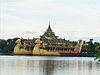
Karen
With
around
265,000 the
Karen
are the largest hill tribe in Thailand. They have lived in the
region for many centuries and are divided into several subgroups. In
Thailand, the most numerous are the
Sakoh (Sgaw),
Pwo
and
Kayah, besides the
Kayang and
Pha-duang
or
Padong, both
Long-neck Karen. The word
‘Karen’ is not known to the different subgroups themselves and the
Thai call them
Kariang
and
Nyang.
The term is however generally used by anthropologists when referring
to certain tribes who speak closely related tongues and who are not
that related to the languages of other hill tribes. They are
therefore placed in a separate category within the Tibeto-Burman
family of the Sino-Tibetan language group.
WATCH VIDEO
and
MORE ON THIS.
回
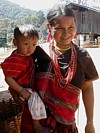
kare-sansui (枯山水)
Japanese. Term that
refers to a Japanese rock garden, oftentimes also called a
Zen
garden. The term
literally means ‘dried out mountains and rivers’ or ‘dry landscape’,
whereas the
Kanji
character formation of
kare (枯), could also bring to mind the picture of ‘old wood’ or ‘old
trees’, i.e.
petrified wood, as it consists of a compound made up of ki (木) and ko (古),
meaning ‘wood’ or ‘tree’ and ‘old’ respectively. However, the
etymology behind it is rather different, as this Kanji character
derives from Chinese, where it is a compound of the words mu (木) and
gu (古), also meaning ‘wood’ or ‘tree’, but is actually used as a pictophonetic pronounced ku, in which only mu suggest the meaning
while gu determines but the sound. This type of stylized miniature
landscaped garden is characteristically created using carefully
composed arrangements of rocks and stones, moss and moss covered
objects, pruned trees and bushes, gravel and sand, as well as water
features. These gardens are said to date back to the Ashikaga Era,
i.e. the Muromachi Period (1336—1573 AD), and were traditionally
created at Zen temples, designed to stimulate meditation, as well as
around
Shinto
shrines, and at palaces. They are typically intended to be seen from
a single viewpoint outside the garden and a distinctive feature is
the use of white sand or gravel, which symbolizes purity and is
often raked to represent ripples in water, thus creating a river of
white gravel or sand that represents a metaphorical journey through
life. Also spelled karesansui.
See also
PANORAMA PICTURE,
TRAVEL PICTURE (1),
(2),
(3),
(4) and
(5), and
WATCH VIDEO (1),
(2)
and
(3).
回
Kariang (กะเหรี่ยง)
Thai name for
Karen.
回
karin (करिन्)
Sanskrit for ‘elephant’.
See
Asian Elephant.
回
karma
(कर्म)
Sanskrit. The law of cause and effect, in
which one's present state is the result of actions from the past,
either in this life or in former lives. Karma ends when one attains
nirvana and the cycle of
death and rebirth is broken. Karma is closely linked with
samsara
and transmigration. In Thai
kam.
回
karoshi (過労死)
See
gwarosa.
回
karry (กะหรี่)
1. Thai for
curry.
回
2. Thai slang for a prostitute.
回
Karttikeya
(कार्तिकेय)
The god of war, leader of
Shiva's troops and usually
considered to be the son of Shiva and
Parvati.
READ ON.
回
karuna (กรุณา)
Thai term for
‘compassion’ or ‘kindness’. In some contexts, it can also mean
‘please’ or ‘to request politely’. It is one of the aspects or
faces of
Brahma (fig.),
the other three being
metta,
mudita, and
upekkha.
See also
Phra Phrom Sih Nah.
回
Karuppu (கருப்புசா)
Tamil. ‘Black’. Name of a Tamil deity, usually referred to as
Karuppu Sami, with the word sami meaning ‘deity’ or ‘god’.
According to legend,
Rama
had sent
Sita
to stay in the
ashram of
Valmiki, when
she was pregnant with Rama's heir. While there, she gave birth to a
son. Some days later, she left the ashram in order to do some chores
and asked Valmiki to keep an eye on her child in the cradle. Whilst
he was watching the infant he went into a deep meditation. When Sita
returned and found Valmiki in meditation, she didn't want to disturb
him and took her child. When Valmiki came out of his meditation, he
found the child missing. So, he put some holy grass in the cradle
and chanted a mantra that turned the grass into a real human child.
When he later found out that Sita had already taken her child, he
asked her to treat the newly made baby also as her own. When Sita
returned to Rama, he was surprised to see her with two boys. Able to
have only one heir, Rama wanted to test the purity of the boys. He
lighted a bonfire and asked the boys to approach him by crossing the
fire, saying that whoever was to be his heir would have to cross the
fire unhurt. In obeying Rama, the boy made from grass got stuck in
the middle of the fire and burnt his body, becoming very dark. Rama
made the real son his heir, but also blessed the other boy by
appointing him as his escort god, and named him
Karuppu,
but he also goes by a variety of aliases. In compliance with his
name, he is usually (though not always -
fig.)
portrayed with a black, or alternatively, with a dusky or greyish-blue
complexion,
his hair plaited in a thick tuft
(jata)
that hangs over to one side, and
three horizontal lines (tri-pundra)
applied on his forehead. Besides this, he stands upright
and wields a weapon with his right hand, in general a scimitar-like
sword, whilst he leans on a mace
(gada)
with the other hand. His image is
often found in
Hindu temples,
where he is usually called
Sri
Karuppana Swamy. As part of
his worship he is offered holy ash and alcohol, and a lit cigar or
cigarette is placed in his mouth. All those items relate to fire and
refer to his ordeal in the flames. This deity is popular among the
Tamil community of southern India, and shrines devoted to him are
always found at the outskirts of their villages, as he is believed
to be a warrior who masters all land and who prevents all evil from
entering a boundary, and thus from entering the village, an idea
which is reminiscent of the
Akha
spirit gates (fig.).
He is often worshipped
alongside
Muneeswarar.
回
_small.jpg)
kasalong (กาสะลอง)
Thai name for the
Indian Cork Tree,
an evergreen tree with
white, slaverform flowers.
In Thai, it is also known as
pihb.
回
kasalong kham (กาสะลองคำ)
Thai name for a tree with the botanical name Radermachera ignea,
which in Thai is also known as
pihb thong.
This
evergreen or
semi-deciduous tree grows to a height of between 6 to 20 meters and
blooms from January to May, displaying clusters of tubular, bright
orange flowers with a sweet jasmine-like fragrance, that grow on old
branches. It is the provincial tree of
Chiang Rai
province and is said to symbolize simplicity, endurance, advancement
and peacefulness. It is sometimes referred to
by the
common name
Tree Jasmine,
a designation which is however also commonly used for the
Indian Cork Tree,
which in Thai is known by the names
kasalong
and
pihb.
回
%20กาสะลองคำ,%20บีปทอง_small.jpg)
kasat (กษัตริย์)
Thai-rajasap meaning ‘king’, ‘raja’,
‘ruler’, ‘potentate’ and ‘monarch’. Its is an abbreviation of the
Thai word
kasatriya
which itself is derived from the Hindi word
Kshatriya.
回
kasatriya (กษัตริยา)
Thai-rajasap meaning ‘king’, ‘raja’,
‘ruler’, ‘potentate’ and ‘monarch’. Its is derived from the Hindi
word
Kshatriya. It is
generally used abbreviated (kasat),
whereas the full word appears only in compound words, called
kham samaht.
回
Kasetsart (เกษตรศาสตร์)
Thai. ‘Agriculture’.
Name of the
first agricultural university and the
third university in Thailand.
READ ON.
回
kasin (กสิณ)
Thai. Meditation of the four elements, but in general also used as a
term for any form of meditation, especially that of the ten kinds of
reflection, which is divided into phutkasin (ภูตกสิณ), that focuses
on the four elements, i.e. earth, water, fire, and wind; wankasin (วรรณกสิณ),
which concentrates on the four colours, i.e. green, yellow, red and
white; thought on light; and contemplation on space.
MORE ON THIS.
回
Kashyapa (कश्यप)
See
Kasyapa.
回
Kassapa
1. Pali. A
buddha of the past, a
precursor of the historical
Buddha. He is the
third of the five buddhas to spread
Enlightenment
in this world and one of the four buddha's in
Ananda Phaya
in
Bagan,
located at its South Gate, the others being
Konagamana facing East (fig.),
Kakusandha
facing North (fig.),
and
Gautama at the
West Gate
(fig.).
In Sanskrit he is known as
Kasyapa,
in Thai he is called
Phra
Kassap
Phutta Chao
(พระกัสสปพุทธเจ้า),
and in Burmese Kathapa (ကဿပ).
回
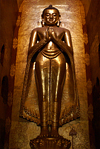
2. Pali. The monk who succeeded the
Buddha as leader of
the
Sangha. In mural
paintings usually portrayed as an old man accompanied by the young
monk
Ananda, the Buddha's
nephew and his most important disciple. Also
Maha Kassapa.
回
Kasyapa (कश्यप)
1. Sanskrit. Name of a
rishi who is the father of
the
devas,
asuras,
nagas
and all humans. He has several consorts, i.e. the thirteen daughters
of
Daksha, with whom he had several
offspring, e.g.
Garuda and
Aruna are his
sons with his consort Vinata, the
apsaras are his children through
Muni, the nagas are his sons from
Kadru,
Agni and the
Adityas
are his sons by his wife
Aditi,
etc. Also transcribed Kashyapa.
回
2. Sanskrit. Name of one of the
candidates for inclusion as the 17th or 18th
arahat,
especially when referred to as
Maha Kasyapa which is sometimes
spelled
Maha Kassapa.
As Maha Kasyapa the name may also refer to one of the four initial arahats, whom the Buddha had
asked to remain in the world to propagate the
dhamma, one for each of the four
directions of the compass.
回
3. Name of
the monk
who after the
Buddha's
Mahaparinirvana
succeeded him as leader of the
Sangha.
He is one of the
Ten Principal Disciples.
Also
Maha Kasyapa and
Maha Kassapa.
回
4. Sanskrit.
A
buddha of the past
(fig.),
a precursor of the historical
Buddha. In Pali, he is known
as
Kassapa (fig.).
回
kata (คาถา)
Thai term for a verse in
Pali or the text of a
thet or sermon, but also for
an incantation or a (magic) spell. Pronounced kaathaa (kahthah).
回
katana (刀)
Japanese. Name for a
Japanese sword, such as those worn by
samurai
in feudal Japan.
READ ON.
回
katha (คทา)
Thai name for
gada.
回
Kathavarayan (กัตตะวรายัน)
Name of a Indian-Tamil kind of
nat,
who according to legend was born from the rays that radiate from
Shiva's
third eye.
The goddess
Devi
appointed Kathavarayan as watchman of a garden that she had created
on the banks of the river
Ganges.
One day, Kathavarayan took away the dresses of women who came there
to bathe, and thus he was cursed by Devi, declaring that he had to
take birth seven times. In addition, he was convicted by the king to
die on pointed stake for his offence. However, when he was about to
die on the stake, Devi took pity on him and he got relieved from the
curse. She then instructed him to sit on her northeastern side and
bless all those who come to see her. As such, his image is often
found near the entrance of Hindu-Tamil temples, such as Wat
Sri
Mariamman
on
Silom
Road in
Bangkok.
This deity is celebrated on the full moon day in the month of
Chitirai, i.e. April-May, when his image is taken around the temple
is a procession.
回
ka-thi (กะทิ)
Thai for ‘coconut
milk’.
回
kathin (กฐิน)
Thai. The period of one month following the rainy season or ‘pansa’,
when pious laymen bring gifts and robes to all the monks of a
temple, usually in the month of November. For this ceremony people
will collect money on a small leafless tree by going around or by
placing it in their business or at the temple to which anyone
can make a donation (tamboon)
by attaching a banknote to its branches. On a certain day, or when
the
money tree
(fig.)
is considered full, it will be taken to the local local temple in a
procession and offered to the monks, often together with monk's
robes.
During the kathin ceremony, temples indicate their
participation by placing vertical banners called
thong kathin
at the temple.
The kathin tradition goes back to the assignment the Buddha gave to
his first disciples to find their own robe, rather than buying one.
He pointed to pieces of cloth hanging from tree branches in the
forest, torn off from passer-by's clothes. These could easily be
used to make a robe by stitching them together and then dying it.
This is one reason why a needle is one of the things (borikaan)
Buddhist monks are allowed to posses. See also
kathin phra racha thaan,
kathin luang,
thod phah pah,
kreuang kathin
and
krob trai.
Also known as thod kathin.
WATCH VIDEO.
回
_small.jpg)
kathin luang (กฐินหลวง)
See
kathin phra racha thaan.
回
kathin phra racha thaan (กฐินพระราชทาน)
Thai. The
kathin ceremony
performed by the king or a state dignitary in name of and
representing the king. Also
kathin luang. See also
Royal Barges.
回
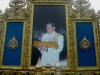
kathoei (กะเทย)
See
kathoey.
回
kathoy (กะเทย)
See
kathoey.
回
kathoey (กะเทย)
Thai for transvestite. In Thailand the term refers usually to men
who dress as girls or act girlish. In most large cities, many
cabaret shows are performed by those so-called ‘lady boys’ and draw
large crowds of curious tourists from all over the world
(fig.).
Kathoey
shows
are also very popular with Thai
gays and most gay discos and pubs have lip-sync performances with
guys in cross-dress doing their act. From a distance it is often
hard to tell if the performer is a girl or a kathoey.
Sometimes called the third gender and also transcribed kathoy,
kathey, kathoi, kathoei, kathui and kathuy.
The term is comparable with the Chinese
expression
nan se.
See also
look sawaat
and
phi seua kathoey.
See also
Calypso Cabaret.
WATCH VIDEO (1)
and
(2).
回
2_small.jpg)
kathputli (कथपुतली, कठपुतली)
Rajasthani-Hindi. ‘Puppet story’ or ‘wooden puppet’. An
Indian form of marionette theatre from Rajasthan, which uses
string-puppets made from
mango
wood and often without legs and feet, as the lower body is instead
covered in long skirts. The arms are always stuffed with cloth for
flexibility and to give them a natural, human-like appearance. The
puppets have strings attached to the head, waist and hands, but not
on the lower body. With animal puppets, such as camels and horses,
usually only the neck is movable. Puppeteers are traditionally from
the Bhatt community and the
main puppeteer is called sutradhar. He is
accompanied by a narrator-singer or bhagavat, drums, cymbals and the
harmonium, as well as a reed-like
bamboo instrument that emits a
shrill sound and is used to attract attention (fig.).
This performing art is believed to be more than two thousand years
old and is said to be
the most popular form
of Indian puppetry. In the past, puppeteers used to travel from
place to place and performed in villages to entertain the local
people, narrating stories and folk tales of legendary heroes or
historic events, though nowadays kathputli performances mostly find
place at hotels to entertain tourists.
回
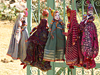
kathuy (กะเทย)
See
kathoey.
回
Katu
Vietnamese-Laotian.
Name of an ethnic minority group, that lives in
Vietnam
and
Laos,
and that has an estimated population of around 61,000.
Their language belongs to the
Mon-Khmer
linguistic family. Their funeral traditions include the construction
of small funeral huts in which the coffin is placed, and which are
adorned with wooden carvings, oftentimes of animals, such as water
buffaloes (fig.).
回
Kaunghmudaw Phaya
(ကောင်းမှုတော်ဘုရား)
Burmese. ‘Royal
Merit-making
Pagoda’.
Name of a Buddhist temple in Sagaing.
READ ON.
回
kaupina (कौपीन)
Sanskrit. A kind of loincloth worn as
underclothing by certain men in India. It consists of a rectangular
piece of cloth, which is bound around the waist with a horizontal
strap, cord, or even a chain (fig.).
It somewhat resembles the Japanese fundoshi (褌),
the string-like wrap as worn by sumo wrestlers, for one. It is the
recommended undergarment for
Brahmacharya,
and is typically worn by Indian
yogi
(fig.),
sadhu
(fig.),
brahman
priests and novices (fig.),
celibates, and other ascetics. It is even said that all great,
realized masters wore but the kaupina. Also pronounced kaupin.
回
%201_small.jpg)
Kauravas (कौरव)
Descendants of the Lunar king
Kuru,
a royal family branch in the Indian
epos
Mahabharata. See also
Pandava.
回
kaustubha (कौस्तुभ)
A magical gem that surfaced during the
churning of the
Ocean of Milk and is
worn
on the chest by both
Vishnu and
Krishna.
WATCH VIDEO.
回
Kawila (กาวิละ)
Ruler of
Lampang
and
Chiang Mai
in the beginning of the
Chakri dynasty. See
Chao Kawila.
回
kay (เกย)
Thai. Name of a platform
used to ascend or descend a riding animal, such as an elephant or a
horse, as used in the past by royalty. The platform is permanent and
can be either part of a building or freestanding, in which case it
will also have a staircase. Also transcribed gay or qay, and perhaps
etymologically related to the English word quay. A mounting platform
for royalty which can be moved and hence is not permanent, nor part
of a building and usually made of a lighter material, is called
kaylah (เกยลา).
回
%202_small.jpg)
Kayah (คะย้า)
A
subgroup of the
Karen
in Thailand.
回
Kayan
1. Name of
one
of the subgroups of the
Long-neck Karen, in
Thai called
Kayang.
WATCH VIDEO (1)
and
(2),
MORE ON THIS.
回
2. Name of
an indigenous tribe from the island of Borneo, categorized as a part
of the Dayak people, to which also the
Iban
(fig.)
belong.
回
Kayang (กะย้าง)
One of the subgroups of the
Long-neck Karen in
Thailand, originally from Burma. They live mainly in the provinces
of
Mae Hong Son
and
Chiang Rai,
close to the border with
Myanmar.
The name also refers to
their language. Their women's traditional costume includes the
wearing of brass coils. After 1000 AD the Kayang people dealt
economically and socially with the neighbouring
Shan
and the women were often seduced by these outsiders. Then the
Pwo from the
Thaton region alerted the Kayang about atrocities the Burman people
had inflicted upon them, so the Kayang started to look for a
solution on how to avert these threats. Since they are descendants
from
Lan Nan
Htu Su and
Ka Kwe Bu Pe,
they decided to institute a status symbol for their women. According
to
folklore, when the girls Mu Don and Mu Dan visited their
grandmother, the lady
dragon,
they were presented with gold bars when they left. They then started
to decorated themselves by winding gold coils around their wrists
and necks. As gold was rare the need for brass arose. This was
obtained by exchanging
silver with the Shan traders, mainly provided
by those of the Satoung village. Since 1070 AD the Kayang women have
worn brass coils. There are several reasons for wearing them e.g. to
avoid an unwelcome advances by the Shan and Burman chiefs; as
cultural identity to distinguish themselves from other ethnic groups
and to protect the women from intermingling with other races; and as
a status symbol, as they are descendants of the mother dragon they
adorn themselves in her likeness, with the idea that how longer the
neck is, the more graceful the looks are. The Kayang Long-necks
start wearing brass coils from the age of four. From then onward the
rings are changed about twice until the age of fourteen, with loops
being added to the spiral about every three years, as the girl grows
and ages. Brass coils for adults usually consist of multiple parts
that is, a main coil of 16-22 windings, with at the base a separate
5-6 coil winding, onto which a smaller coil of 62 mm diameter with 5
loops is attached perpendicularly, at the back (fig.).
Each set of brass rings is made in one piece from a single brass rod
and a total set of rings for adults can easily weigh up to 8 kilos,
depending on the number of coils. The men prepare the brass rods but
it are the women who fix the rings. Brass is a tough metal and the
winding is done manually by any strong woman with exceptional
talent, called a fixer. See also
Kan Thein Bo and
Kan Khwan.
WATCH VIDEO (1)
and
(2),
MORE ON THIS.
回
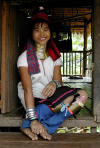
Kayaw (กะยาว)
A
subgroup of the
Karen
hill tribe whose women are typified by their long earlobes.
MORE ON THIS.
回
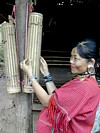
kayih (กาหยี)
Another Thai name for
velvet tamarind,
next to
yih.
回
Keeled Box Turtle
Name of an Asian
species of box
turtle,
with the scientific name Cuora mouhotii. It is found in
Thailand,
Laos,
Cambodia,
Vietnam
and
Myanmar, as well as
in
China
and India. It is alternatively known as Pyxidea mouhotii. Keeled Box
Turtles are characterized by a dorsally flattened, yellowish to
reddish or dark brown carapace, which is strongly serrated at the
back. It has three distinctive keels, i.e. one medial and two
lateral keels. Its limbs are gray to dark brown or black, with the
anterior surfaces of the forelegs being covered with large scales.
The toes are only partially webbed. This species is largely
terrestrial and only rarely enters water. It prefers moderately
moist habitats with plenty of vegetation and ground litter for
cover. In Thai it is called
tao jan.
回
_small.jpg)
Keinnaya (ကိန္နရာ)
Burmese term for
Kinnara,
a mythical bird with human head and torso.
In
Myanmar,
Buddhists believe that 4 of the 136 past animal lives of the
Buddha,
i.e.
chaht that the Buddha embodied in
the form of an animal, were Keinnaya, e.g. the
Canda Jataka.
It is also one of the 108 symbols on the
Buddhapada,
i.e. the
footprint (fig.)
or soles of the Buddha
(fig.).
The female form of a Keinnaya is called
Keinnayi. The Keinnaya is the
symbol of the Red
Karen
people.
回
Keinnayi (ကိန္နရီ)
Burmese. Female form of
a
Keinnaya.
回
kejih (เกจิ)
Thai term used for any
Buddhist monk who is a pundit famous for magic spells.
回
Kek Lok Si (極樂寺)
Chinese-Hokkien.
Name a Buddhist temple,
in the Malaysian state of Penang.
It covers an area of 120,000 square meters and is the largest
Buddhist temple in the country, as well as a significant religious
landmark for tourists from Southeast Asia and Hong Kong. Its name,
Kek Lok Si, translates to ‘Temple of Supreme Bliss’ and symbolizes
Sukhavati,
i.e.
‘Place of Great Bliss’, sometimes translated as
‘Paradise’
or
‘Pure
Land’,
of
Mahayana
Buddhism.
The temple is situated on Ayer Itam (亚依淡),
which in Malay literally means 'Black Water', yet is referred to as
‘Crane Hill’
as it resembles a flying crane, a name given to the site after the temple's construction,
which took place between 1890 and 1930. It features a seven-story
pagoda,
known in
Hokkien
as Ban Hoat Thah (萬佛塔), which translates as ‘Pagoda
of Ten Thousand Buddhas’,
which was commissioned by the Thai King
Rama VI
and houses 10,000 alabaster and bronze Buddha statues, as well as a
Buddha statue donated by King
Rama IX.
The pagoda boasts a Chinese-style octagonal base, a middle tier
inspired by Thai design, and crowned with a Burmese-style spiral
dome. By intertwining these architectural elements from various
cultures, it symbolizes the fusion of
Mahayana and
Theravada
Buddhism.
Due to its historical association with the Thai monarchs of the
Chakri
Dynasty, who all bear the crown title
Rama,
the pagoda is affectionately known as the ‘Rama Pagoda’. In
2002, a 30.2 meter high bronze statue of
Kuan Yin, the Goddess of
Mercy, was erected. This focal point for devotees was later covered
by an octagonal roof supported by 16 pillars. The temple's buildings
are predominantly constructed with granite. The complex includes
several prayer halls and pavilions, as well as a large pond in a
landscaped natural setting, including a charming mini cascading
waterfall, which is the home of over 500
turtles.
WATCH VIDEO and
VIDEO (EN).
回
kendi
A spherical drinking vessel, usually with a bulbous spout.
回
kendo (剣道)
Japanese.
‘Way
of the sword’.
Name of a modern Japanese fighting sport and martial art, which uses
bamboo swords known as shinai (竹刀), both for practice and
competition. Participants wear protective gear called
bogu
(fig.),
which literally means
‘armour’
and that is also known as kendogu, i.e.
‘kendo
equipment’.
This protective gear consists of a mask and breastplate, similar to
those used by a catcher in baseball, though the kendo mask also
hood-like helmet and shoulder protectors attached to it, making it
somewhat reminiscent of a coal hood or the monastic hood
worn by Christian
monks. In addition, the combatants wear gauntlet-like hand and
forearm protectors, as well as a skirt-like leg and groin protector.
回
keng (เก้ง)
Thai for
Barking Deer.
回
keng (เก๋ง)
1. Thai generic term
for any type of cottage, cabin, shack, hut or pavilion.
回
2. Thai term for rain
visors made of bamboo, wood, canvas or metal, as well as the hood or
roof of a boat, cart, wagon or car, i.e. a sedan.
回
3. Thai. Architectural
term for an edifice with a Chinese-style roof,
which typically has
upward curved corners, a
feature related to
feng shui,
in which it is believed that curved lines ward off evil spirits,
whilst straight lines are said to attract evil.
Also called
keng
jihn
(เก๋งจีน).
回
Keng Buppha Praphat (เก๋งบุปผาประพาส)
Thai. Name of a
pavilion in the European
Gingerbread-style, known in Thai as
reuan khanompang khing,
and located
within the compound of the
Bang Pa-in
Summer Palace
in
Ayutthaya (fig.),
in the middle of a garden beside a pond in the inner palace area and
built with the purpose for viewing flowers. It was completed on 16
June 1885, during the reign of King
Chulalongkorn.
See TRAVEL PICTURE
and
EXPLORER'S MAP.
回
kes (केश)
Sanskrit-Hindi word for
hair and which may also
be transliterated
kesh,
especially when referring to the practice of having
uncut hair.
Also
transliterated keza.
回
kesh (केस)
Hindi term for uncut
hair.
The practice of allowing one's
hair to grow naturally as a symbol of respect for the perfection of
God's creation. With the
Sikh,
the long
hair
is knotted on top of their head and usually held in place with a
comb known as a
kanga. Both the kesh and kanga are
worn by Sikh
devotees as
part
of the five articles of their faith.
The topknot is covered by a
turban known as
dastar or
pagri,
or by a scarf-like kind of under-turban called a
patka (fig.).
Also
transliterated kesha or keza and also spelled
kes.
回
ket (เกศ,
เกษ)
Thai-Rajasap.
‘Hair’,
‘strand
of hair’,
‘head’,
or ‘scalp’.
A word commonly used in poetry and royal terminology, with a meaning
similar to the
Sanskrit
kesh
or phao phom (เผ้าผม), and is usually used to refer to the hair on
the head.
回
ketsa (เกศ,
เกษ)
See
ket.
回
Ketu
(केतु, เกตุ)
1. Sanskrit-Thai. The
lower part of
Rahu
that represents his tail and is considered the personification of
comets and meteorites, whilst the upper part of Rahu travels through
the universe in a chariot pulled by eight black horses. The demon
Rahu was cut in two by
Vishnu using his
chakra for secretly
lining up among the gods and receiving a portion of the
amrita. Ketu is one
of the nine gods worshipped in the
phra prajam wan
system of the Hindus, lined up in the northwestern corner, facing
South. The Rahu name also appears in
the Buddhist
Phra prajam wan geut system
as
the
pahng pah leh laai Buddha
pose, corresponding with Wednesday after sunset.
回
2. Sanskrit-Thai. Name
of
the planet Neptune.
回
ketumala (เกตุมาลา)
Thai name for
the raised
skull or
ushnisha
(fig.),
i.e. the protuberance normally found on the head of a Buddha image,
as one of the marks of an enlightened being in Buddhist
iconography, and which in
Thailand is usually topped by
a lotus
bud (fig.)
or a
flame called
rasmie,
that
emerges from this bump,
as a symbol of
Enlightenment.
A certain style of Buddha images cast by order of King
Mongkhut, that is
Rama IV
(fig.),
were cast without the raised skull,
as prototypes of Buddhist art in the royal style of that era,
including Phra
Angkhirot, Phra Nirantarai (พระนิรันตราย),
and Phra Samphutthasiri (พระสัมพุทธสิริ).
回
Ketumati (เกตุมดี)
Thai-Sanskrit. The earthly paradise that the
bodhisattva
Maitreya will preside
over when he descends from
Tushita heaven as the
future
Buddha.
It is often referred to as the Pure Land and the name is sometimes
translated as ‘endowed with brightness’.
回
Keua Nah (กือนา)
Name of the eight
king of the Mengrai Dynasty ruling the ninth reign of the northern
kingdom of
Lan Na
from 1355 to 1385.
READ ON.
回
keub (คืบ)
Thai. Ancient Thai unit of
linear measure. In the past it
represented 12 inches (30.48 centimeters), but nowadays it is fixed
at 25 centimeters.
回
keun thao thang sih (ขึ้นท้าวทั้งสี่)
Thai. ‘Offering to all four’. A ceremony in
North Thailand in which six baskets with food are offered to the
protecting gods of a certain place. Firstly, these are for the four
lokapalas from
Buddhism, who guard
the four directions; but additionally, also for
Indra, ruler of the
Tavatimsa
Heaven and in Hindu cosmology a lokapala
himself; as well as for
Phra Mae Thoranee,
the goddess of the Earth. Despite the name ‘offering to all four’,
actually six baskets are used, thus offering both horizontally, i.e.
to the protectors of each directions of the compass, and vertically,
i.e. to the rulers of Heaven and Earth. Also transliterated kheun
thao thang sih.
回
keyuradhara (केयूरधरा)
Sanskrit term for a ring or
bracelet worn around the biceps on the
upper arm. It may be worn
as a
charm and is hence reminiscent of the Thai
prachiad
(fig.).
However, if the ring or bracelet is made of gold, then either the
Sanskrit term rukmaggada or kajcanaggadin will be used.
回

kha (ข่า)
1. Thai name for the blue or
‘Thai’
ginger,
a rhizome with culinary and medicinal uses either of the genus
Alpinia or of a type known as
krachai
in Thai. There are four species, i.e. the greater galangal (Alpinia
galanga), which
is a main ingredient in the dish
tom kha kai (fig.); lesser galangal (Alpinia officinarum); krachai or
fingerroot
(Boesenbergia pandurata -
fig.); and krachai dam or sand ginger (Kaempferia galanga -
fig.).
The rhizomes of the genus Alpinia are typified by their light colour
and pale purple-rose stems.
Also called
galanga,
galangal and
galingale.
回
2. A hill tribe of the
Mon-Khmer
race living in the North of Thailand and the
Shan States.
Another tribe with the
same name belongs to the Malay race.
回
khaet (ខេត្ត)
Khmer.
Term used
for
a
‘province’
in
Cambodia
and related to the Thai word
khet,
meaning ‘domain’ or ‘zone’.
回
Khaay Phetcharat (ค่ายเพชรรัชต์)
Thai. ‘Phetcharat
Camp’.
Name of
a scouting campground
in
Saraburi,
a province in Central Thailand. The camp, situated on a 125
rai
domain, i.e. 20 hectares, has the capacity to host up to 1,000
Scouts. The camp is built from natural materials, like
teakwood
and stones gathered from the surrounding mountains and is dedicated
to the youngsters and children participating in Scout programs of
the various provinces of
Thailand,
who come here to learn about nature and to practice physical
activities, such as sports and exercises. On the wall behind a
podium in an open-door hall on the compound is a portrait of Robert
Baden-Powell, the British Lieutenant-General, who founded the
World-wide Scout Movement. To its left is a portrait of King
Wachirawut
(fig.),
i.e.
Rama VI,
who in 1911 established the Thai Scouting organization, locally
known as
look seua
(fig.),
i.e. the ‘Tiger Cubs’, hence the many tiger statues on the compound.
In the centre top of the wall is an emblem that consists of a royal
crown with the Thai text Khaay Phetcharat and with the subtitle Nai
Phra Upatham (ในพระอุปถัมภ์), i.e. ‘Under Royal Patronage’. On 6 May
1911, King Rama VI Initially founded the
Wild Tiger Corps, in
order to train government officials, as well as civilians on
military drills, with the conviction that such a training would
instill a sense of discipline and loyalty to the country, the
monarchy and religion. Yet, after less than 2 months, the
organization was on 1 July 1911 transformed into the Thai scouting
organization, which is officially known as
Kha-na Look Seua Haeng
Chaht,
i.e. the ‘National Scout Organization of Thailand’. The camp's name
Phetcharat (เพชรรัชต์) means ‘Someone who has money and diamonds’.
This richness is locally depicted in the many gilded thematic street
lanterns across the compound that show a
horse pulling a wagon with
treasure (fig.)
in the form of
Chinese gold ingots
(fig.)
and coins. Near the entrance of the camp is also a huge statue of
Budai
(fig.),
an informal
Taoist-Chinese
wealth god,
also known as
Mi Le Fo
(fig.)
or the
Smiling Buddha,
who is said to disperse wealth from a large purse in the form of a
cloth sack or bag, that is filled with precious items, yet never
empties.
See also THEMATIC STREET
LIGHT
and
WATCH VIDEO.
回
khai jab san (ไข้จับสั่น)
Thai. ‘Shivering fever’. A name for
malaria. Also
khai pah.
回
khai khao (ไข่ข้าว)
Thai. ‘Egg
rice’.
Name of a dish consisting of a fertilized egg
with a nearly full-developed embryo inside
which is boiled alive and then eaten.
Originally from
China,
where they are called maodan (毛蛋)
or ‘furry eggs’, they are popular all over Southeast Asia and in the
Philippines it is a national dish called balut. In
Vietnam, they are
referred to as trung
vit lon (trứng
vịt lộn) or hot vit lon (hột vịt lộn), and in Cambodia as pong tia
kohn.
回
,%20Vietnam_small.jpg)
khai khem (ไข่เค็ม)
Thai for ‘salted
egg’. Also called
khai phok,
literally ‘daubed egg’, i.e. daubed in salt. It can either refer to an
egg preserved in saline water, or to an egg daubed in ashes or in a
mixture of chaff and (iodized) salt. Usually ducks' eggs are used.
Occasionally called khai phok khem.
回
_small.jpg)
khai khem din so phong (ไข่เค็มดินสอพอง)
Thai. ‘Marl salted egg’. A
salted egg produced by coating it with a mixture of marl (soil of clay
and lime), water and salt, and preserving it for a certain period of
time. This kind of egg is a well-known souvenir of
Lopburi.
See also
khai khem.
回
khai leuad awk (ไข้เลือดออก)
Thai. ‘Bleeding fever’. Thai name for
haemorrhagic fever.
回
khai look kheuy (ไข่ลูกเขย)
Thai. ‘Son-in-law
eggs’. Name of a dish of hard boiled eggs, cut in half and fried in
oil until they are golden brown and blistered. They are served in a
sweet, syrup-like sauce, made of tamarind paste, soft brown or palm
sugar, a little fish sauce and lime juice, mixed with topped fried
onion, dried red chilies and chopped coriander leaves. In English
usually referred to as deep fried boiled eggs.
回
_small.jpg)
khai mot daeng (ไข่มดแดง)
Thai. ‘Eggs of red ants’. Pupated larvae of
Weaver Ants,
in Thai known as
red ants. These white, roughly one centimeter long larva are found
in the ants nests (fig.),
high up in the trees (fig.).
The local population of
Isaan and North Thailand
consider them a real delicacy. Uprooting these nests is not easy,
due to the painful but harmless bite of the red ants.
回
khai muk (ไข่มุก)
Thai for ‘pearl’ or ‘pearly egg’.
READ ON.
回
khai nok kra-tha (ไข่นกกระทา)
Thai. ‘Quail's egg’. Eggs of a small bird in the pheasant family,
with the scientific name Coturnix coturnix. These small eggs are
considered a delicacy and widely sold on markets as a snack, either
hardboiled or as tiny eggs sunny-side up. As such, they are
typically served with
soy sauce.
Another popular snack consists of hardboiled quail's eggs wrapped in
wonton, known in Thai as
kiyaw,
and deep-fried until crisp (fig.).
Quail's eggs are also typically sold in small baskets or nets at
hot springs, to
allow visitors to boil them naturally in the wells (fig.),
when picnicking. In
sushi,
they are sometimes used raw.
WATCH VIDEO.
回
khai pah (ไข้ป่า)
Thai. ‘Jungle fever’. A name for
malaria. Also
khai jab san.
回
khai phalo (ไข่พะโล้)
Thai. Name for a dish
of eggs boiled hard in
soy sauce,
making the outside of the egg white turn brownish-beige. This dish
is actually named after a dish of pork stewed in a kind of gravy,
which besides the meat juices and soy sauce, also contains a powder
called phong phalo (ผงพะโล้), which is made from coriander seeds (fig.),
cinnamon (fig.),
pepper (fig.),
cardamom
(fig.),
and star anis (fig.).
The dish is typically eaten with large, block-like pieces of stewed
pork, known as three-leveled pork, referring to the different levels
of meet and fat, but also with chicken drumsticks and pieces of
fried
tofu. This
kind of eggs are also commonly served with the dish
khao kha moo bohraan
(fig.).
In English, it is referred to as soy egg and sometimes as ramen egg,
after the Japanese noodle dish ramen (拉麺) that is served with a
boiled soy egg.
回
_small.jpg)
khai phok (ไข่พอก)
Thai. ‘Daubed egg’. Another name for
khai khem.
The term may refer to khai khem phok din, meaning ‘salted egg daubed
with soil’, i.e. marl (soil of clay and lime), as in
khai khem din so
phong, or to khai phok khem,
when daubed in ashes or in a mixture of chaff and (iodized) salt.
回
khai ping (ไข่ปิ้ง)
Thai. ‘Toasted egg’ or
‘baked egg’. Name for a chicken egg in its shell, skewered on a thin
wooden stick and roasted over a charcoal fire. Prior to grilling the
egg,
kreuang prung,
such as pepper and
soy sauce
are injected, and mixed with the yolk and egg white, blending them
together, so it seems as if it is an ordinary boiled egg without egg
yolk.
回
%201_small.jpg)
khai sah (ไข้ส่า)
Thai for
dengue fever.
回
khai samphao (ไข่สำเภา)
Thai. ‘Samphao egg’ or
‘Chinese junk egg’.
Another name for
khai yiew mah.
回
_small.jpg)
khai yad sai (ไข่ยัดไส้)
Thai. ‘Stuffed egg’. Name of a dish that consists of
a lightly cooked omelet, that is folded into a square and filled
with minced meat mixed with some other ingredients.
READ ON.
回
khai yiew mah (ไข่เยี่ยวม้า)
Thai. ‘Horse urine egg’. Name of a preserved egg, usually a duck's
egg, prepared by soaking it in a mixture of clay, ash, salt,
quicklime and
rice
straw for several weeks to months, depending on the method of
processing. Sometimes, the eggs are coated with rice chaff (fig.),
in order to prevent them from sticking to one another.
The process turns the yolk
into a dark greyish green to black colour, whereas the egg white
becomes a dark brown, transparent jelly (fig.).
The transforming agent is alkaline and after the process is
completed the egg will have a strong odor of sulfur and ammonia.
In English, it has several
names, including century egg, hundred-year egg, thousand-year egg or
simply preserved egg. The Thai name refers to an old myth that
claims century eggs once were prepared by soaking eggs in horse
urine, but this is not plausible. The myth may have arisen due to
the ammonia smell that sometimes is released during certain
production processes. Century eggs
originally came from
China,
where they are called either
pidan (皮蛋), meaning
‘leather egg’ or ‘skin egg’, or sonhuadan (松花蛋), what translates as
‘pine-patterned egg’. The origin of the latter is not clear. It
might be due to either a snow crystal or pine branch-like pattern
near the surface of the albumen with some century eggs, or due to
the fact that the eggs in China were originally preserved in large
ceramic pots with patterns of pine trees. Since the Chinese first
came to Thailand often in junks, the egg is in Thai also called
khai
samphao,
meaning ‘Chinese junk egg’. Today, China is the world's largest
producer of century eggs. It is popular all over Southeast Asia and
in
Vietnam, where it is
called hot vit bach tao (hột vịt bắc thảo) or
trung vit bach tao (trứng vịt bắc thảo),
century eggs are often sold still covered in the black ash used to
salt them, thus assuring customers that they were made using the
traditional method (fig.).
In Thailand, century eggs are nowadays usually not longer made in
the traditional way, but by using a newer method that achieves the
same results and in which the eggs are soaked in a mixture of brine,
calcium hydroxide and sodium carbonate for about ten days, after
which they are wrapped in plastic and left to age for several weeks.
On Thai markets, these century eggs are easy recognizable by their
pink coloured egg shells, used to distinguish them from other duck
eggs, such as ordinary duck eggs and salted duck eggs, which are
left in their natural colour (fig.).
See also
Burmese jelly egg.
回
_small.jpg)
Khajon Jaratwong (ขจรจรัสวงษ์)
Thai.
Name
of
a Siamese prince
of the
Rattanakosin
Period, with the title of
momchao.
READ ON.
回
kha
khoo (ขาคู่)
Thai. Term for a
classic Thai-style design of inward curved furniture legs, typically
used in cabinets, coffee tables, chairs, etc. The design is
influenced by traditional Chinese art-styles and was commonly used
in so-called
opium beds, a kind of large coffee table on which
one would lay when smoking
opium.
回
,%20inward%20curved%20legs_small.jpg)
khakkhara (खक्खर)
Sanskrit. Name for a
ringed staff held by certain
arahats,
monks and
bodhisattvas
in
Mahayana Buddhism. It is meant to
inform people of their presence through the jingling sound caused by
the rings and in order to seek alms, as well as to warn small and
crawling creatures of their approach, so as to avoid stepping on
them. By announcing their arrival in this way they avoid speak
unnecessarily. It is also used by
Shaolin
warrior monks (fig.)
as a weapon and in prayer, e.g. by the abbot of a Chinese temple
usually wields the staff during grand ceremonies, striking the
ground three times to symbolize the breaking of ignorance. The
khakkhara consist of a usually thin, wooden staff capped with metal
loops and rings which are either four, six or twelve in number,
indicating the
Four Noble Truths,
the
Six Paramitas
or the
Twelve Nidanas,
respectively. Occasionally, the rings may be double (fig.).
The bodhisattva
Ksitigarbha
(fig.)
is usually depicted carrying a khakkhara, which he also uses to
force open the gates of hell, and the
arahat
Chudapanthaka (fig.)
was given one by the Buddha, to stop him from knocking on doors when
begging for alms. In Chinese called xi zhang (锡杖), literally ‘thin
cane’ or ‘thin walking stick’, but also ‘bestowing staff’. It is
sometimes referred to as a Buddhist beggar's staff.
回
Kham Hai Kaan Chao Krung Kao (คำให้การชาวกรุงเก่า)
Thai. ‘Word (or Testimony) given by
the People of the Ancient City’. A chronicle
in the archives of Thai history, which
dates from the
Ayutthaya
Period and records the kingdom's inception up to its destruction by the Burmese
in 1767 AD. It is an important book on the history of Thailand and was assumed
by Prince
Damrong Rachanuphaap,
the Father of Thai history, to be the source for the story
Khun Chang Khun Paen
(fig.).
回
Kham Chanoht (คำชะโนด)
Thai. Name of a
forest temple
in
Udonthani,
and a place of pilgrimage and worship,
which is believed to be located at the palace of the
Phayanagaraat
(fig.),
i.e. the
Naga King, known as
Chao Poo Sri Sutho
Nagaraat
(fig.),
and his Naga Queen called
Chao Yah Sri Patum Mah
Naki (fig.).
It is also known as
Wat Pah
Kham Chanot,
Meuang
Chanot or
Wang
Nakarin
Kham Chanot. It is idyllically located in the middle of a field surrounded by
water, inside a ca. 200 meters wide grove of Taraw Palms (fig.),
which in Thai are called
ton
chanoht,
hence the name of this forest temple.
See also TRAVEL PICTURES (1)
and
(2),
and
WATCH VIDEO (1) and
(2).
回
%201_small.jpg)
khamin (ขมิ้น)
1. Thai term used for both
‘Curcuma’ and ‘turmeric’,
the first one (Curcuma) actually being a genus in the plant family Zingiberaceae,
which contains species such as turmeric and
Siam Tulip,
the latter (turmeric) being a species with the botanical name Curcuma longa,
within the genus Curcuma.
回
2. Name of a limestone cave in Tai
Rom Yen, a circa 425 km² National Park in
Surat Thani,
known in Thai as
Tham Khamin (fig.).
回
kham meuang (คำเมือง)
Thai. Northern Thai dialect. Typical is the slow rhythm of its
speech, much slower than the other three main dialects in Thailand.
回
kham samaht (คำสมาส)
Thai term for a compound word or a combination of words.
回
Khamu (ຂະມຸ)
Laotian for
Khmu.
回
khan (ขรรค์)
Thai. A
kris-like dagger (fig.),
one of the regalia of kingship. Also Phra Khan and
Phra Saeng Khan Chai Sri
(fig.).
回
khan (ขัน)
Thai. A bowl, cup or basin possibly placed on
a pedestal called
phaan (fig.),
like a
betel-set. See also
khantoke.
回
khan bet (คันเบ็ด)
Thai. ‘Rod with a hook’.
Thai term for a fishing rod or fishing pole.
WATCH VIDEO.
回
_small.jpg)
khan dong (khăn đóng)
Vietnamese. Term for a turban, which in
Vietnam is tidily
wrapped and worn by boys and men (fig.)
as part of the traditional
ao gam
(fig.)
or ceremonial
dress (fig.).
In English usually referred to as Vietnamese turban.
回
_small.jpg)
kha-nah (คะน้า)
Thai name for Chinese broccoli, a
leaf vegetable in the family Brassica, with the scientific name
Brassica alboglabra, i.e. Brassica oleracea var. alboglabra. It has long, thick stems and leathery,
bluish-green leaves. It is very similar to another member of the
Brassica family, i.e. Brassica campestris, that is commonly known in
Thai as
phak kwahng tung,
but which additionally has yellow flowers (fig.).
Also known as kai lan and Chinese kale.
回
%20คะน้า_small.jpg)
Kha-na Look Seua Haeng
Chaht
(คณะลูกเสือแห่งชาติ)
Thai.
‘National Scout Organization of
Thailand’.
Usually referred to by
the
abbreviated term
look seua.
回
khanit (ขนิษฐ)
A Thai term for
‘younger brother or sister’ and a synonym for nong (น้อง).
In Thai it is also spelled otherwise and then transliterated
kanit or ganit.
回
khanitah (ขนิษฐา)
A Thai term for
‘younger brother or sister’ and a synonym for nong (น้อง). In Thai
it is also spelled otherwise and then transliterated
kanitah.
回
khan kaew (ขันแก้ว)
Thai. ‘Crystal bowl’ or ‘glass bowl’. Name for a wooden, usually
triangular,
phaan-like
tray on a pedestal that consists of three legs, and which is
generally decorated with paintings or carved figures, not seldom of
nagas.
It is used in Buddhist temples as a vessel to present religious
offerings such as flowers, known as
kreuang bucha.
The triangular shape represent the
Trairat
or
Triple Gem.
Occasionally, the tray may also be round in shape and the triangular
form is therefore also be referred to as khan kaew thang sahm (ขันแก้วทั้งสาม),
to specifically identify the triangular variety.
回
_small.jpg)
khanmahk (ขันหมาก)
Thai name for a
betel-set.
回
khanom (ขนม)
Thai. General name for sweets and sweetmeats. The term is both used
generally, and as a prefix with other names to define the type.
Thailand has a large variety of sweetmeats, many made on basis of
rice
flour,
coconut
and sugar.
In the past sweets were only made on special days and occasions,
either as part of merit making or
tamboon,
during festivals or when receiving important guests. The making,
eating and offering of sweets is still a common custom during
certain festivals today, e.g.
krayahsaad
which is
eaten during the
saad
festival, in
Isaan locals
offer sweets to each other during
phen
time on the day of
boon khaw sahk,
during
boon khaw pradap din
when sweets are offere to both deceased and living family members,
etc.
Thai sweets are often painstakingly and elaborately prepared
in order to make their appearance as attractive as their taste.
About the origin of the word khanom opinions are divided. Some
believe the word has derived from
khao
nom (ข้าวนม), i.e. ‘rice’ and ‘milk’, the main ingredients of many
sweets in India. However, most Thai sweets
don't have an Indian origin and use rice and
coconut milk as a
basis, rather than milk, and in Thai, coconut milk is called
ka-thi,
not nom. Others therefore believe the word is a Thai-Khmer
compound of either
khao
(ข้าว) or
khao
(เข้า) and
nom.
Both Thai words khao have a falling tone, thus making the spelling
unsure, but the first word khao means ‘rice’ and the latter ‘to
enter’ or ‘to add’. The word nom is Khmer and means ‘food prepared
with dough’ and ‘cake’. This would be consistent with the word for
bread which is
khanompang
in Thai and
nompang
in Khmer.
回
khanom a-lua (ขนมอาลัว)
Thai. Name for a traditional sweet
made of
coconut milk,
all purpose flour,
mung bean flour and sugar. The texture of
this jelly sugar candy is a little hard and dry on the outside but soft, moist
and tender on the inside, whereas they are usually dyed with various pastel
colours and shaped as little whipped cream cones.
See also POSTAGE STAMP.
回
_small.jpg)
khanom bah (ขนมบ้า)
Thai. Name of a snack or candy that
is crafted from glutinous rice flour, which is kneaded until it reaches a
moldable consistency. The dough is then shaped into round pieces, flattened
thinly, and cooked. After folding, the dough is left to rest before being fried
in oil until cooked through. Once cooked, it is set aside to cool, after which
sesame
seeds are sprinkled onto it.
Khanom bah resembles
sabah, i.e. the
large shinny seeds
of the
sea
bean, which kids
use to play
tossing games (fig.).
This snack is one of five
snacks used as a traditional offering to monks during the
Tenth Lunar Month Festival,
i.e. an autumnal religious festival known in Thai as
Praphenih Sart Deuan Sip,
in which ancestors and deceased relatives are honoured,
and in which the khanom bah symbolizes sabah seeds for the deceased to play a
tossing game.
See also POSTAGE STAMP.
回
khanom beuang (ขนมเบื้อง)
Thai. Name for a very ancient sweet
which original recipe came from India and was brought to Thailand by Indian
brahmins in the
Sukhothai
period. It consists of a small crispy pancake made from ground green gram or
mung bean flour, baked onto a hot plate and finished with various toppings, such
as whipped cream made from
coconut juice and sugar;
golden threads made of either duck egg yolk (light orange) or of minced shrimps
mixed with a saffron (dark orange) colouring agent; long scraps of shredded
coconut (almost ripe) and some coriander. When ready they are folded. It has
been around for more than 2,000 years making it the oldest known sweet in
existence. An ancient legend tells the story of
Gosiya,
a contemporary of the
Buddha.
He was a very rich but stingy man who loved eating khanom beuang pancakes. To
avoid having to share them with anyone he told his wife to make the sweets
upstairs, away from public eyes, so he could eat all by himself. When the Buddha
found out about the man's behaviour he sent
Mogallana to visit Gosiya during his
bintabaat
alms round and told him to beg for khanom beuang as an alms offering. Gosiya,
although unwillingly, couldn't decently refuse the monks request thus came up
with the idea to offer only a very small pancake. However, each time his wife
put the dough onto the baking plate it miraculously swell until it had the size
of the hot plate itself. After several attempts to make just a small khanom
beuang, he gave up his efforts and eventually became a generous man. Also
transcribed khanom bueng, khanom bueng and khanom beuang.
回
_small.jpg)
khanom chan (ขนมชั้น)
Thai. ‘Steamed layer candy’. Name
for a kind of ancient traditional dessert made in layers, usually
nine,
as this is an auspicious number, and is steamed similar to dumplings. It is also
often made in the shape of a flower, akin to
khanom cho muang (fig.),
though whereas the latter have a pinkish, violet, purple or lilac hue, khanom
chan can be of any colour.
See also POSTAGE STAMPS.
回
_small.jpg)
khanom cho muang (ขนมช่อม่วง)
Thai. ‘Purple bouquet candy’. Name
for a kind of ancient traditional dessert, which is less familiar to the younger
generation in Thailand. It is consists of steamed dumplings that are fashioned
as flowers and
that have a pale to dark violet, purple or lilac
hue, or a comparable tinge.
It is reminiscent of
khanom chan (fig.),
an ancient Thai traditional dessert made in layers and resembling flowers, as
well as of the Vietnamese dish
banh bao banh vac,
known in English as White Rose Dumplings (fig.),
a culinary specialty and signature dish from Hoi An.
See also
POSTAGE STAMPS.
回
khanom dara thong (ขนมดาราทอง)
Thai. ‘Gold Star Candy’. Name for a
kind of traditional dessert,
that consists of
jasmine
scented gold dough balls with sugar-coated and dry-fried
watermelon
seeds. It is also known as
khanom jah mongkut
(fig.).
They resemble small stars (dara)
or crowns (mongkut).
See also POSTAGE STAMPS (1)
and
(2).
回
_small.jpg)
khanom dih sam (ขนมดีซำ)
Thai name for a snack that is
crafted from a blend of rice flour, granulated sugar, brown sugar, water, and
salt. The dough is kneaded and left to rest for three hours, then vegetable oil
is incorporated. Small portions of dough are shaped into balls and placed on
oiled banana leaves to prevent sticking. A hole is pressed into the center of
each ball, and they are then fried in oil until golden brown. Finally, they are
drained in a colander.
This snack is one of five snacks
used as a traditional offering to monks during the
Tenth Lunar Month Festival,
i.e. an autumnal religious festival known in Thai as
Praphenih Sart Deuan Sip,
in which ancestors and deceased relatives are honoured,
and in which khanom dih sam represents a pawn or money
given to the deceased to serve as a resource to facilitate their time in hell.
See also POSTAGE STAMP.
回
khanom gui chai (ขนมกุยช่าย)
Thai. Name for a type of
steamed dumpling, filled with a mixture of chopped Chinese leek flowers (fig.)
and any kind of cooked meat as a matter of choice.
READ ON.
回
khanom hin fon thong (ขนมหินฝนทอง)
Thai. ‘Golden rain candy stone’.
Name for a traditional Thai dessert that Siamese soldiers in the past used to
take with them to the front as an easy bite-sized snack and as part of their
food supplies. It is made from flour, roasted beans or roasted rice, depending
on preference, which has been mixed with coconut milk and sugar that has been
simmered, and that is next molded into a solid lump similar to a stone or
pebble, and decorated with a tiny piece of
gold leaf.
回
_small.jpg "dog meat")
khanom jahk (ขนมจาก)
Thai. Name for a sweet made
from the flesh of a young
coconut, mixed with
pounded
lotus
seeds (fig.),
beans and
taro (fig.).
It is named after the leaf of the
nipa palm (fig.),
called
bai jahk (fig.)
in Thai, where it is wrapped and baked in. Also khanom jaak.
回
%201_small.jpg)
khanom jah mongkut (ขนมจ่ามงกุฏ)
Thai. ‘Master's crown candy’. Name of a small
cake-like candy
made of wheat flour, a chicken egg, egg yolk,
sugar, the thickest part of
coconut milk and watermelon seeds.
Its bottom resembles a miniature tart which is filled with an orange
coloured candy made of
egg yolk,
sugar and coconut cream and
which is flanked by peeled watermelon seeds. They resemble small
crowns (mongkut)
or stars (dara)
and are hence also known as
khanom dara thong
(fig.).
Also spelt khanom ja mongkut.
See also POSTAGE STAMPS
(1) and
(2).
回
khanom jihb (ขนมจีบ)
Thai. ‘Pinched
snack’ or ‘pleated pastry’. Savoury
sweetmeats made of thin sheets of
rice
or wheat dough enclosing minced meat and steamed in small round
bamboo
baskets called
kheng (fig.).
The dough wrapping is usually either light green or beige and they
come in a variety of different tastes, including pork, crab and
shrimp mincemeat. Some varieties are topped with a small piece of
carrot as garnishing. Sometimes transliterated khanom jeeb.
See also
jihb.
回
khanom jihn (ขนมจีน)
Thai. ‘Chinese
pastry’.
Noodles
made from
rice
flour, produced by pressing rice flower paste through a sieve, into
boiling water. Khanom jihn is served mixed or topped with
curry or condiments. When mixed
with bean curry it is called khanom jihn nahm phrik (a spicy-sweet
peanut-like sauce), if mixed with a catfish curry it is called
khanom
jihn kaeng plah dook (catfish curry), if topped with meat curry it
is called khanom jihn kaeng neua (meat curry), if mixed with a fish
soup it is called khanom jihn nahm yah (herbal sauce), when eaten
with a curry seasoned with dried
dok ngiaw
flowers (fig.)
it is called khanom jihn nahm ngiaw, and when eaten with powdered
shrimps and
pineapple slices,
coconut and
krathiam (garlic) it is called
khanom jihn sao nahm (stirred juice). The dish is especially popular
in Southern Thailand where it developed its own culinary genre.
In Isaan called
khao pun
and in the North known as
khanom sen.
Also transcribed kanom jihn, khanom jin, khanom chin, or similar.
回
2_small.jpg)
khanom khai hia (ขนมไข่เหี้ย)
Thai. ‘Monitor
lizard egg
sweets’. A sweet snack of small balls rolled from a dough made from sticky
rice
flour mixed with a paste of sweet potatoes, and with a filling of salted green
beans. The balls are then fried in oil until golden brown and crispy. hen done
they can be coated sugar, or for those who don't like them too sweet, they can
be sprinkled with
seeds instead, such as sago or
sesame,
which is done before being fried, so they stick to the dough. This snack
originates from the beginning of the
Rattanakosin
Period and was formerly known
as
khanom
khai
hong, i.e.
‘hamsa
egg sweets’.
Also spelled khanom kai hia.
回
%202_small.jpg)
khanom khai
nok kratah (ขนมไข่นกกระทา)
Thai. ‘Partridge egg
sweets’. Name for a snack similar to
khanom khai tao
but somewhat larger and made with sweet potato instead of
tapioca.
WATCH VIDEO.
回
khanom khai pla (ขนมไข่ปลา)
Thai. ‘Fish egg candy’.
Name for a traditional dessert or snack made of rice flour mixed with
toddy palm and shredded coconut. This snack is one of five snacks used
as a traditional offering to monks during the
Tenth Lunar Month Festival,
i.e. an autumnal religious festival known in Thai as
Praphenih Sart Deuan Sip,
in which ancestors and deceased relatives are honoured,
and in which the khanom khai pla, or alternatively
khanom kong,
represents a piece of
jewelry, elevating the appearance of the deceased in hell to a more
dignified state.
See also POSTAGE STAMP.
回
khanom khai tao (ขนมไข่เต่า)
Thai. ‘Turtle egg
sweets’. A sweet snack of small balls rolled from a dough made from
tapioca flour mixed with self-rising baking powder, undiluted coconut
milk, egg yolk, sugar and salt, and fried in oil until golden brown and
crispy. Due to the
added self-rising flour the
small fritter-like balls are rather light and frothy, somewhat
resembling Dutch and Belgian oil balls (oliebol/smoutebol) but rounder
and smaller. They have the shape and size reminiscent of turtle eggs,
hence the name.
They are on occasion served with
cinnamon
sugar.
Besides this, there is also a slightly larger variety, which is
made from sweet potato and called
khanom khai
nok kratah,
and if also coated with light or a mixture of light and dark sesame seeds (fig.)
they are
called
khanom nga.
They are often sold together with khanom khai tao and regularly referred to
by the same name.
Sometimes transcribed khanom kai tao. See also
ma tuan
and
pah thong goh.
WATCH VIDEO.
回
khanom kha kai (ขนมขาไก่)
Thai. ‘Chicken leg candy’.
Name for a Thai kind of snack that consists of rather hard, orangey
coloured, elongated cookies, that are made with bread flour and powdered
cream cheese, fried in oil, and have a spicy to salty taste. The name
kha kai is also used for breadsticks, also known as grissini. To
distinguish the candy from grissini, one can either refer to the candy's
distinctive color, namely orange, known as
sih
som
in Thai, or alternatively append the term
khanom
pihb,
which alludes to the tin canister called
pihb (fig.), that
is traditionally used to store candy in bulk. In
English, referred to as biscuit sticks.
回
khanom khao tom mat (ขนมข้าวต้มมัด)
See
khao tom mat.
回
khanom kliaw (ขนมเกลียว)
Thai. ‘Whorled sweets’,
‘coiled sweets’ or ‘plied sweets’. A glacé, bread-like snack, made
from wheat flour and egg, and seasoned with salt and pepper. The
obtained dough is twisted it into a helix-shape, which is fried until
crispy and then coated with sugar and sometimes with seeds or pieces of
preserved fruit, etc. It has a sweet taste and originates from
Sukhothai,
where it is widely available. Also transcribed khanom kliao, or
similiar.
回
khanom koh (ขนมโก๋)
Thai-Chinese name for a
kind of candy, made mainly from
sticky rice
powder and sugar, and a typical Chinese wedding candy. They are made
either plain or with a filling, usually a sweet bean paste. Often, they
are made into a round, disk-like shape, with a relief imprinted on the
top, or into a specific form, such as
fish, a
Chinese symbol for ‘excess’ or ‘surplus’.
Originally it is white (fig.),
but sometimes a colour is added. Often the used food colouring is red,
the colour associated with Chinese weddings
and a symbol for wealth, good luck, beauty and purity, but which makes
the outcome rather pinkish. There is also a softer variant known as
khanom koh oun (ขนมโก๋อ่อน), which is usually filled with a paste of
beans (fig.).
回
%20in%20Chinatown_small.jpg)
khanom kong (ขนมกง)
Thai. ‘Wheel sweets’. A
kind of traditional sweet from the central to southern regions of
Thailand and in English is usually referred to as cartwheel candy, as it
is fashioned in the form of a circle with a cross. It is made from a
dough that consists of a mixture of
sticky rice
flour and wheat flour which is fried in vegetable oil. Due to its
distinctive form, which resembles the
dhammachakka,
i.e. the Buddhist
Wheel of Law
(fig.),
this candy takes an important
place in certain Buddhist festivals and ceremonies, such as
the
Tenth Lunar Month Festival,
i.e. an autumnal religious festival known in Thai as
Praphenih Sart Deuan Sip,
in which ancestors and deceased relatives are honoured,
and in which the snack represents a piece of jewelry, elevating the
appearance of the deceased in hell to a more dignified state, as
well as in
wedding ceremonies, where it is given to newly wed couples as a kind of
ancestral ornament, in order to whish them good luck, progress and
growth, i.e. going forward just like the Buddhist Wheel of Law keeps on
turning, spreading
the
dhamma
endlessly.
This type of candy is depicted on a postage stamp issued in 2018 as part
of a set of six stamps on traditional Thai sweets.
See also POSTAGE STAMPS (1)
and
(2).
回
_small.jpg)
khanom krachao sida (ขนมกระเช้าสีดา)
Thai. ‘Sida's
basket candy’. A kind of Thai sweet consisting of small basket-shaped
tarts filled with pastel-coloured, shredded
coconut.
The name derives from an episode in the
Ramakien
story in
which
Sida,
when
was abducted by
Totsakan
to be taken to
Langka,
dropped the basket that she was carrying in the forest, where it
overgrew with vines.
See also POSTAGE STAMP
and
LIST OF
RAMAKIEN CHARACTERS & PLACE NAMES.
回
khanom krok (ขนมครก)
Thai. ‘Mortar sweets’. A
kind of Thai sweetmeat consisting of tiny bowl-shaped pancakes. They are
made on a specially designed griddle with small curved-in cavities,
comparable to a wafer iron but with round hollow spaces and without a
lid. They are prepared from
sticky rice
flour, sugar and
coconut milk.
When ready they are usually topped with some chopped spring onion. In
English sometimes referred to as
coconut-rice
pancakes (fig.)
and in Thai also called khanom krok
boraan.
The Thai word
krok
means ‘mortar’ and refers
to the fact that the sticky rice needs to be ground in a mortar in order
to make it into flour, whilst the word boraan literally means ‘ancient’,
but could in this context be translated as ‘after the old fashion’ or
‘in the old manner’. Also khanom krok.
See also POSTAGE STAMP.
回
_small.jpg)
khanom lah (ขนมลา)
Thai. Name of a
traditional snack of
Nakhon Sri Thammarat
that is made from rice flour, tapiaca starch and liquid palm sugar,
mixed with egg yolk and run though a kind of makeshift strainer that
was formerly made from a coconut shell with holes punched in it,
thus creating thins strands that are scattered on the surface of a
wok by moving the strainer over its surface, creating a orangey
mesh-like pattern. After briefly being fried the now dry mesh is
gathered from the wok by rolling it onto a bar or tube, creating
rolls ready for consumption. Whereas the name
khanom
is a generic for
sweets and sweetmeats, lah derives from
ka-lah,
i.e.
‘coconut
shell’ and refers to the fact that originally a coconut shell with
holes was used as a strainer. Khanom lah is one of five snacks used
as a traditional offering to monks during Sart (สารท), i.e. an
autumnal religious festival
during
the tenth lunar month when ancestors
and deceased relatives are honoured and in which khanom lah is
produced in large sheets that
represents the offerings of clothes to the spirits of the dead,
reminiscent of —and almost simultaneous to—
kathin, the
period of one month following the rainy season or ‘pansa’, when
pious laymen donate robes to the monks. The large sheets of khanom
lah offered in the
Praphenih Sart Deuan Sip, i.e. the
Tenth Lunar Month Festival, are typically rolled into the shape of
tall cones. Also transliterated khanom
la.
See also POSTAGE STAMP.
回
khanom look chub (ขนมลูกชุบ)
Thai. Marzipan-like sweets (khanom)
made from a paste of steamed green beans mixed with thick
coconut milk, sugar and water
moulded into miniature tropical fruits or vegetables (fig.)
and coated with a thin layer of jelly, applied by dipping (chub).
These gracefully created sweets can be found on food markets as well
as at buffets in hotels and restaurants, as a dessert. The term look
is a classifier for fruits and vegetables, used in Thai language to
express a unity or quantity.
回
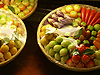
khanom met kanun (ขนมเม็ดขนุน)
Thai. ‘Jackfruit seed candy’. A
kind of
khanom thai, i.e.
golden bean paste and egg
yolk-based sweets, in the form of
jackfruit
seeds (fig.).
See also
kanun
and
POSTAGE STAMPS.
回
khanom moji (ขนมโมจิ)
Thai-Japanese. A
Japanese-style sweet, known as
mochi,
similar to
khanom pia
(fig.)
and made from a dough of steamed, pounded
sticky rice and cane
sugar, filled with a paste, usually of beans.
It was first introduced into Thailand by
Thai people who brought the sweet back from Japan as a souvenir or present for
relatives, after visiting the country. When production in Thailand began, its
taste was adapted to fit Thai tastes. It is a specialty from
Nakhon Sawan,
where Thai production first started, about 20 years ago. In English, it is called
mochi, which is the same as the Japanese name
mochi (餅), and which refers to the fact that it
is made from glutinous sticky
rice,
which is also known as mochi rice. One remarkable kind of mochi, which looks
like a large drop of water, is called Mizu Mochi, literally ‘Water Mochi’, yet
it is usually referred to as Raindrop Cake (fig.).
See also
mooncake.
回
_small.jpg)
khanom nga (ขนมงา)
Thai. ‘Sesame candy’. A kind
of sweet consisting of crispy balls rolled from a dough made from tapioca flour
and self-rising baking powder, and coated with light or a mixture of light and
dark sesame seeds. Due to the expansion of the dough, the pastry is hollow on
the inside, and this cavity is filled with a sweet bean paste, akin to that used
in
khanom look chub,
hence they are also known as khanom nga sai tua (ขนมงาไส้ถั่ว), i.e. ‘sesame
candy filled with beans’. They are often sold together with
khanom khai tao
(fig.)
and sometimes confusingly referred to by the same name. In English, they are
called sesame balls or sesame seed balls, a name which is also used for an
outwardly similar looking Chinese candy called
ma tuan (fig.).
回
%201_small.jpg)
khanom nuad mangkon (ขนมหนวดมังกร)
Thai. ‘Dragon
beard candy’. A kind of handmade traditional Chinese nougat-like candy, made
using a 2000-year old technique first introduced to the imperial court in
ancient
China,
in which a skilled candy-maker (fig.)
repeatedly stretches a small mass made of boiled sugar, maltose and some
vinegar, until several thousand fine strands are formed, which are then trimmed
in dry-fried glutinous
rice
flour to prevent excess glueyness, and coiled into a cocoon-like sweet.
Alternatively, the strands of sugar may be wrapped around finely chopped,
lightly roasted
coconut,
peanuts or sesame seeds. Dragon beard candy has a delicate crispness, and melts
on the tongue, but is best consumed within an hour after production, as after a
while it loses its fine texture and starts to become sticky. In Chinese, it is
called yin si tang (银丝糖), which can be translated as ‘silver silken candy’,
‘silver strings sweets’ or ‘silver fine threads candy’ and in English it is
sometimes referred to as Chinese cotton candy.
回
%20yin%20si%20tang_small.jpg)
khanom pahk moh (ขนมปากหม้อ)
Thai. ‘Pot-mouth candy’.
General name for a kind of sweets (fig.),
that consist of a soft, often coloured dough, made from
sticky
rice
flour stiffened with starch, and which is used as a wrapper for certain types of
filling, usually a mixture of grated
coconut, finely chopped
peanuts and minced meat, with salt and sugar. The dough is steamed on a piece of
cloth spanned over the mouth of a large pot and covered by a cone-shaped lid,
similar to the process of making
tapioca balls (fig.).
Once the dough has stiffened enough, the filling is added and the dough wrapped
around it. It is typically served with lettuce leaves and
prik khee
noo
chilies, and usually sprinkled with fried garlic or sometimes with
sesame seeds and a little
coconut milk,
known in Thai as
nahm
ka-thi.
This snack or desert is also referred to as
khao kriyab khanom pahk moh (ข้าวเกรียบขนมปากหม้อ),
i.e. ‘pot-mouth crispy rice candy ’.
回
%20pot-mouth%20candy_small.jpg)
khanompang (ขนมปัง)
Thai for ‘bread’. Compare
with the
Khmer word
nompang.
回
khanompang cham (ขนมปังฉ่ำ)
Thai. ‘Moist bread’ or ‘succulent
bread’. Name of a Thai snack that consist of a soft yet crispy, sweet, buttery,
toast-like cuboid chunk of bread, usually eaten with a fork, toothpick or
wooden skewer and drizzled with a
sauce of choice, such as chocolate or caramel. Its is made from a loaf of bread
of which the crusty edges have been removed, cut into large cuboid chunks which
are covered with butter mixed with sugar and then toasted on a baking plate
until crisp. See also
pang ping siab mai.
WATCH VIDEO.
回
_small.jpg)
khanompang nah moo (ขนมปังหน้าหมู)
Thai. ‘Bread topped with pork’.
Name for snack that consists of small, square, bite-sized slices of bread,
topped with minced pork and fried in oil until crispy, becoming a kind of
golden-brown mini-toasts covered with meatloaf. Prior to being spread on the
bread, the minced pork is mixed with garlic, coriander and eggs, and seasoned
with
soy sauce.
They are typically eaten with a sweet dip, which is made by boiling a mixture of
vinegar, sugar and a little
fish sauce,
which is then cooled down and either mixed with slices of fresh cucumber and red
shallots, or with finely chopped coriander and thinly sliced
prik khee
noo
chilies (fig.).
回
_small.jpg)
khanom phong (ขนมพอง)
Thai name for a snack made from
sticky rice which is prepared by first steaming the rice until cooked.
Subsequently, the cooked rice is placed into prepared molds of various shapes
and left to dry under the sun. Once dried, the rice is fried in very hot oil
until it puffs up into light, airy snacks. This snack is one of five snacks used
as a traditional offering to monks during the
Tenth Lunar Month Festival,
i.e. an autumnal religious festival known in Thai as
Praphenih Sart Deuan Sip,
in which ancestors and deceased relatives are honoured,
and in which the khanom phong snack of puffed rice symbolizes a raft for the
deceased, which serves as a vessel to traverse the stream of suffering, sin, or
karma.
See also POSTAGE STAMP.
回
khanom pia (ขนมเปี๊ยะ)
Thai. A kind of light pastry
cake filled with a paste, most often of beans, but also other fillings, such as
a
durian
paste (fig.)
or minced pork are sometimes used. The top is coated with egg yolk, making it
typically darker than the rest of the cake, and often bears the stamp of a
Chinese character, printed on it in red. Some varieties may have extra toppings,
such as sugar or
sesame
seeds. In English, it is usually referred to as Chinese cake or Chinese puff. It
is typically offered to monks on
bintabaat
at the end of the rainy season, during
owk pansa. Also
transcribed khanom piya. See also
khanom moji and
mooncake.
WATCH VIDEO.
回
,%20Chinese%20cake,%20Chinese%20puff_small.jpg)
khanom piak poon (ขนมเปียกปูน)
Thai. Name of a kind of
jelly pudding, also referred to as glutinous rice cakes, topped with
some grated coconut. It is made from rice flour mixed with arrowroot
or tapioca starch, lime juice, palm sugar and concentrated
pandan
juice. There are two kinds, i.e. a green variety and a black type
which is the basically same but made black with toasted coconut
husks.
回
_small.jpg)
khanom sai sai (ขนมใส่ไส้)

Thai.
‘Stuffed dessert’.
Name of a traditional Thai dessert made from a filling of sweetened
coconut mixed with palm sugar, wrapped in a soft, slightly chewy
outer layer made of
rice flour and
coconut milk. The dessert is then
wrapped in a
banana leaf and steamed. It is known for its fragrant
aroma and smooth texture. The name refers to the coconut
‘filling’
or sai (ไส้), which is
‘inserted’, i.e.
(ใส่). Together, sai (ใส่) sai (ไส้) could be translated as ‘insert
stuffing’. The first has a low tone, the second is a falling tone.
回
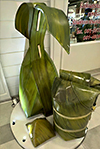
khanom sakoo (ขนมสาคู)
Thai. Generic name for any
snack or dessert made with sago. There are several kinds, and the most commonly
found desserts include
khanom sakoo sai moo
(tapioca
balls -
fig.) and
khanom sakoo piak
(tapioca
pudding -
fig.). Also
spelled khanom saku.
回
khanom sakoo piak (ขนมสาคูเปียก)
Thai. ‘Wet
sago-dessert’. Name for a watery, pudding-like dessert, usually
referred to as
tapioca
pudding. There are several types, each named after the main
ingredient it is served with, e.g. khanom sakoo piak maphrao aun (ขนมสาคูเปียกมะพร้าวอ่อน)
for tapioca pudding with young
coconut,
khanom sakoo piak met bua (สาคูเปียกเม็ดบัว) for tapioca pudding with
lotus
seeds (fig.),
khanom sakoo piak khao poht (ขนมสาคูเปียกข้าวโพด) for tapioca pudding
with corn, etc. The dish is sometimes made with
coconut milk and
according to ones taste and liking, some may add syrup or liquid
palm sugar and crushed ice to it. Also spelled khanom saku piyak.
回
%20tapioca%20pudding%20with%20corn_small.jpg)
khanom sakoo sai moo (ขนมสาคูไส้หมู)
Thai.
‘Sago-snack filled with pork’. See
tapioca balls.
回
khanom saneh jan
(ขนมเสน่ห์จันทน์)
Thai. Name for an old
kind of sweet, which loosely translates as ‘charming
sandalwood
candy’.
READ ON.
回
khanom sen (ขนมเส้น)
Northern Thai name for
khanom jihn.
Also transcribed khanom sen, or similar.
回
khanom tahn (ขนมตาล)
Thai. A kind of cake
made from
banana,
coconut milk,
rice
flour, yeast, and palm sugar, and topped with shredded coconut. It
usually served in small cups made from a banana leave.
See also POSTAGE STAMP.
回
_small.jpg)
khanom ta-koh (ขนมตะโก้)
Thai. Name of a pudding-like dessert made from flour, sugar,
coconut milk and other flavouring
ingredients, as well as an ingredient of choice, such as corn
kernels,
taro,
brown beans, Chinese water chestnuts (haew
-
fig.),
Job's tears
seeds (look
deuay -
fig.),
etc.. It
is typically served in cups made from
pandan
leaves and topped with either a decorative item, such as flower
petals, or a component used in the desert representative of the
ingredient of choice.
See also POSTAGE STAMP.
回
_small.jpg)
khanom thai (ขนมไทย)
Thai. A kind of orange
coloured sweetmeat made of egg yolk, sugar and
rice
flour. It is traditionally eaten on special occasions and
ceremonies. There are many kinds, each known by its specific name
e.g. khanom
foi thong
(ขนมฝอยทอง), i.e.
‘shredded or fluffy golden sweets’, also nicknamed ‘angel hair’
which is considered auspicious and often served in local ceremonies,
although it is not a typical Thai desert, but came from the
half-Portuguese half-Japanese female royal chef in the
Ayutthaya
period who introduced these sweet golden strands at the court;
khanom thong yib, meaning ‘picked gold sweet’; khanom met kanun, that
is ‘jackfruit seed sweet’, khanom
thong yod, which translates as
‘gold drop candy’ and khanom thong phlu, i.e. ‘rocket gold sweet’.
This kind of sweet can be soft or crunchy and if crunchy, the word
krob (กรอบ), meaning
‘crispy’, is added to the name. Thong means ‘gold’ and refers to its
orange colour. Also khanom Thai.
回
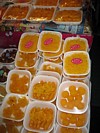
khanom thang thong (ขนมถังทอง)
Thai. ‘Golden Tank
Candy’. Name for a kind of traditional street food dessert
that consists of a
type of pancake made from
rice
flour,
coconut
and sugar, and which originally is topped with sweet shredded
coconut, though nowadays also other toppings may be used.
回
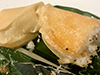
khanom thian (ขนมเทียน)
Thai. ‘Candle candy’.
Name of a traditional Thai dessert commonly prepared for auspicious
ceremonies, such as
Chinese New Year, as well as other
religious and cultural rituals. This pyramid-shaped confection is
wrapped in
banana leaves (fig.)
and consists of a
glutinous
rice
flour dough with either a sweet or savory filling. The dough is made
from glutinous rice flour mixed with
coconut milk and sugar, resulting
in a smooth and pliable texture. The sweet filling typically
consists of
mung beans and palm sugar, while
the savory version features stir-fried salted radish with pepper and
other seasonings. Banana leaves are used as wrappers and are often
softened by lightly passing them over a flame before being folded
into the distinctive triangular shape. The wrapped sweets are then
steamed until firm and glossy. Beyond its culinary appeal, khanom
thian holds symbolic importance, representing prosperity,
Enlightenment, and smooth transitions
in life, making it a staple in ritual offerings to deities and
ancestors. The triangular shape is believed to symbolize stability
and balance, reinforcing its role as an auspicious food in
Thai-Chinese traditions.
回
khanom thong ek (ขนมทองเอก)
Thai. ‘Prime Gold Candy’. Name for
a kind of traditional dessert,
that consists of
dumplings made with wheat flour and egg yolk, and topped with a
small peace of real
gold leaf.
See also POSTAGE STAMPS.
回
_small.jpg)
khanom thong muan (ขนมทองม้วน)
Thai. A traditional
sweetmeat made of flour,
coconut milk and
egg. They are baked on a waffle iron-like hot plate (fig.)
and resemble small pancakes, made into rolls (muan). There are two
kinds, i.e. soft or ‘fresh’ ones called khanom thong muan sod (สด)
and crispy ones called khanom thong muan krob
(กรอบ -
fig.). Both
types are dotted with black
sesame
seeds.
See also POSTAGE STAMP.
回
khanom thong yod (ขนมทองหยอด)
Thai. ‘Gold drop
candy’. See
thong yod.
回
khanom thuay foo (ขนมถ้วยฟู)
Thai. ‘Spungy Cup Candy’. Name for
a kind of (mini) rice flour muffins, usually referred to in English as steamed
cup cake. Also transliterated khanom thuai fu.
See also POSTAGE STAMPS.
回
_small.jpg)
khanom tom (ขนมต้ม)
Thai. Name of a dessert
or snack of small
coconut
ball dumplings, that consist of a soft dough made from glutinous
rice flour and filled with a stir-fried coconut filling mixed with
sugar that is boiled and afterward covered with shredded coconut.
Sometimes a colouring agent is added to the dough.
See also POSTAGE STAMP.
回
_small.jpg)
khanom tua paep (ขนมถั่วแปบ)
Thai. Name of a
traditional Thai street food dessert commonly known in English as
mung bean dumpling. This delicacy
is prepared using a special steamer called pahk
moh
(ปากหม้อ), which features cloth-stretched openings. A thin layer of
glutinous
rice
flour dough is spread over the cloth, then covered with a
cone-shaped metal lid to trap steam and cook the dumplings evenly.
Once steamed, the dumplings are carefully removed and rolled in
crushed mung beans before serving.
WATCH VIDEO.
回
khanom wahn (ขนมหวาน)
Thai. Literally ‘sweet
candy’, but rather and in general used as the generic term for any
‘dessert’.
回
khanom wai phrajan (ขนมไหว้พระจันทร์)
Thai. Literally ‘moon
revering candy’. Name used for a Chinese-style pastry commonly
referred to as
mooncake.
回
khanom wun krob (ขนมวุ้นกรอบ)
Thai. ‘Crispy jelly
candy’. Name of a traditional Thai dessert or candy that consists of sweet
cube-shaped crispy jellies in various colours, crunchy on the
outside and soft on the insides.
See also POSTAGE STAMP.
回
_small.jpg)
khantoke (ขันโตก)
Thai. A small round floor table (toke)
in
Lan Na, usually made
from rattan and sometimes painted with lacquer, on which a typical
northern Thai meal is served in a set of small bowls (khan).
The diners sit on the floor around the table and share a number of
dishes. Also khantohk.
WATCH VIDEO.
回
khantohk (ขันโตก)
See
khantoke.
回
khao (ขาว)
Thai word for ‘white’. Probably etymologically related to
khao,
the Thai word for ‘rice’.
It has a rising tone.
回
khao (ข้าว)
Thai for ‘rice’,
though the term is also used for other cereals, such as ‘grain’, and
in general for ‘food’ as a whole, as in the expression kin khao (กินข้าว),
i.e. ‘to eat’, literally ‘to eat [rice/food]’. The word has a
falling tone. See also
rice.
回
khao (เขา)
1.
Thai-Phasa Klahng
for ‘mountain’ or ‘hill’. The word has a rising tone and is
comparable to
the name
phanom
used in
Isaan,
the designation
doi
used in northern Thailand, and
the term
khiri
used mostly in southern
Thailand.
回
2. Thai for ‘horn’ or
‘horns’.
回
3. Thai for ‘dove’.
回
4. Thai for the
pronouns ‘he’, ‘she’,
‘they’, and ‘them’.
回
khao (เข้า)
Thai for ‘to enter’, ‘to come/go inside’, or ‘to add’. The word has
a falling tone.
回
khao chae (ข้าวแช่)
Thai. ‘Soaked
rice’.
Name of a traditional dish from
the central region. It consists of boiled
jasmine rice
soaked and served in iced water, which is scented with
flower leaves, and eaten with assorted side dishes, typically
including fried shrimp-paste balls similar to
look chin
kung thod or
kung ra-beud
(fig.),
deep fried fine threads of meat,
hua chai poh wahn
(fig.),
and various fresh vegetables, such as wild
ginger,
raw
mango,
cucumber, green shallots and red
chilies.
Initially, khao
chae was a dish that the
Mon people, who also
call it peung sangkraan (เปิงสังกรานต์), used to offer to the monks
in ceremonies during the
Songkraan
festival. In the reign of
Rama V, it was introduced to the
court by palace officials, who offered it the king. After the king's
death, the dish became familiar and widespread with commoners, who
initially called it khao chae chao wang (ข้าวแช่ชาววัง), literally
‘soaked rice of the court attendants’ or ‘soaked rice of the court
people’.
The dish is typically served during the hot season and eaten only
for lunch or in the afternoon.
回
%20jasmine%20rice%20in%20scented%20iced%20water_small.jpg)
khao din (เขาดิน)
Thai. ‘Earthen hill’ or ‘dirt hill’. Short for
khao din
wa-nah.
回
khao din wa-nah (เขาดินวนา)
Thai. ‘Earthen forest hill’. Popular name used
by the locals to refer to
Bangkok's
zoo, officially known as
Suan Sat
Dusit, i.e.
Dusit Zoo.
Often abbreviated khao din.
回
Khao Fachi (เขาฝ่าชี)
Thai. ‘Mountain
Pleasing to
Upasikas’.
Name of a mountain in
Ranong
Province with a viewpoint that offers clear and stunning views of
the sea and surrounding area, making it an ideal spot for watching
the sunrise and sunset.
WATCH VIDEO (1)
and
(2),
and
VIDEO (EN).
回
khao fahng (ข้าวฟ่าง)
Thai for millet or sorghum, a genus of numerous species of grasses,
some of which are raised for grain. It is a tropical cereal plant
bearing small nutritious seeds that pop like corn when roasted. Some
kinds are used as fodder plants or pasture, since it belongs to the
family of grasses.
It is somewhat similar to
look deuay.
回
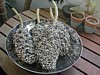
khao ho bai bua (ข้าวห่อใบบัว)
Thai. ‘Rice
wrapped in
lotus
leaf’. Name of a traditional dish of cooked or fried rice mixed with
some ingredients, wrapped in a lotus leaf and steamed in a
bamboo
basked called a
kheng,
thus transferring the fragrance of the leaf onto the rice, giving it
its special aroma. Ingredients can vary and besides some spices
often include shrimps, shredded pork, sliced sweet Chinese sausage
and a
shiitake mushroom. Sometimes also
cooked lotus seeds (fig.)
are added.
回
%202_small.jpg)
khao kha moo bohraan (ข้าวขาหมูโบราณ)
Thai. ‘Rice
with pork leg in the old style’. A dish consisting of stewed pork
leg,
khai phalo (fig.),
i.e.
a sliced up egg boiled hard in
soy sauce,
and some steamed vegetables served over
rice.
This dish is usually sold at roadside food stalls, front-home shops
and in the coupon-style mass restaurants of large shopping malls. It
has though a very high calorie value.
回
Khao Khanaab Nahm (เขาขนาบน้ำ)
Thai. ‘Mountains Flanked by Water’. Name of two mountains that are
roughly a hundred meters tall, separated by the
Krabi
River and located at the mouth of the river and the entrance to
Krabi
town. The twin mountains, located in a dense
mangrove forest, are home to some
amazing caves worth exploring. In the main cave, some human
skeletons have been found. They are presumed to belong to some early
dwellers, who settled in the area and perished in the cave when they
were cut off by an inundation. The cave today displays some of
edifices of earlier cave dwellers, as well as some human bones. The
eye catcher in the cave is the huge skull and bones of a giant human
or
yak,
whose remains are entwined by the skeleton of a large serpent, said
to be that of a
phayanaag,
i.e. the mythological ‘King of Snakes’. The mountains are regarded
as a landmark and symbol of Krabi, and the natural gateway to the
city. The mountain on the eastern side of the river can only be
reached by boat.
See also
EXPLORER'S MAP,
TRAVEL PICTURES (1) and
(2), and
WATCH VIDEO.
回
_small.jpg)
Khao Khlang Nok (เขาคลังนอก)
Thai name of an
important ancient site at Sri Thep Historical Park in
Phetchabun
Province, dating from the 13 to 14th centuries. Originally, it was a
large religious complex, yet today only its square base remains,
which measures circa 64 by 64 meters, with stairs that ascend
to the top from all four directions. The structure stands around 20
meters tall from its base to the apex and is divided into two main
levels, each about 5 meters in height. Encircling it in each
cardinal direction are some smaller
stupas
symbolizing cosmic
beliefs and reflecting architectural influences from southern India
and Central Java akin to Indonesia's
Borobudur. It has been suggested
that it originally consisted of a three-level structure and may have
served for ritualistic and navigational purposes. It was restored in
2012 and on 19 September 2023, UNESCO designated the ancient city of
Sri Thep as a World Cultural Heritage Site, making it the 4th site
in Thailand to receive this honour and the 7th World Heritage Site
in the country. Its official designation is The Ancient Town of Sri
Thep and its Associated
Dvaravati Monuments.
See also POSTAGE STAMP.
回
khao klong (ข้าวกล้อง)
Thai term for milled but unpolished
rice,
also referred to as half-milled rice. It is an
OTOP
product from
Prachuap Khirikhan,
for one. See also
khao som
meua.
回
khao kluk kapi (ข้าวคลุกกะปิ)
Thai. A dish of
rice
mixed with
shrimp paste (fig.),
known in Thai as
kapi,
and typically served with shredded omelet, dried or fried shrimps,
slices of fried Chinese sausage (kun
chiang),
thinly sliced sour
mango (ma
muang man) or grated
papaya,
sweet pork (wok-fried pork seasoned with
fish sauce,
dark
soy sauce
and sugar), dried chilies, chopped red onion or shallots, chopped
long beans, and a wedge of
lime,
though also other ingredients may variably be used (fig.). In Englsih, this
dish
may be referred to as rice seasoned with shrimp paste, or simply as
shrimp paste rice (fig.).
Also
transliterated khao khluk kapi.
回
_small.jpg)
khao kon thod (ข้าวก้อนทอด)
Thai. ‘Fried
rice
ball’. A kind of food made
from boiled rice mixed with egg, garlic, pepper, sugar,
fish sauce,
light
soy sauce
and sometimes with a little minced pork and some pulverized parsley
stems, moulded into balls and are coated with a layer of finely
crushed breadcrumbs before being deep-fried, thus creating a golden,
crunchy outer layer. They are a specialty from
Isaan and are
typically eaten with
naem,
slightly fermented, salted pork (fig.),
as an ingredient in a dish called
yam naem (fig.).
Their size is generally slightly smaller than that of a tennis ball.
Also called
kluk khao
thod, with the word kluk
meaning ‘to mix’ or ‘to roll’.
回
%202_small.jpg)
khao kriyab (ข้าวเกรียบ)
Thai. ‘Crispy rice
cracker’. Umbrella term for any type of cracker, a deep fried snack
by some better known by to the Indonesian name krupuk and made from
starch, typically
tapioca
or
rice
flour, mixed with water, at times some spices, and usually flavoured
with powdered shrimps or prawns, in which case it is referred to as
prawn cracker, in Indonesian called krupuk udang and in Thai khao
kriyab
kung
(ข้าวเกรียบกุ้ง). Prior to frying, the mixture is rolled out,
steamed, sliced and sun-dried. Crispy crackers are commonly served
as a starter in
Myanmar, while waiting for the main
dishes to arrive. Compare with
thua nao.
回
khao kriyab waw (ข้าวเกรียบว่าว)
Thai. Thin slices of
rice
flour crisped over an open fire (fig.),
often using a
tao tahn.
The ingredients for this fragile, round crackers include pounded
sticky rice
and oyster sauce. Usually also some sugar is added. Though, there
are several varieties and they are generally referred to as just
khao kriyab (fig.).
In the past it used to be a kind of snack or
khanom,
that was only found during certain
boon
festivals, especially
boon phrawet,
or in the cold season, after the rice harvest. Due to this
association with the past, it is by many youngsters seen as a rather
ancient snack. In
Isaan it is
called khao pohng (ข้าวโป่ง), i.e. ‘inflated rice’ or ‘blistered
rice’, or khao khiyab (ข้าวเขียบ); in the North it is named khao
khuab (ข้าวควบ), khao phong (ข้าวพอง) or khao pong (ข้าวปอง) -which
derives from pohng (โป่ง) or pong (ป่อง)- and also means ‘inflated
rice’ or ‘blistered rice’; and in the South it is known as kriyab
niauw (เกรียบเหนียว), referring to
khao niauw, i.e. sticky rice. The
name
waw
is derived
from its flat form and light weigth, which is reminiscent of a
traditional Thai kite (fig.),
called waw in Thai.
Compare with
thua nao.
回
_small.jpg)
khao kung krob (ข้าวกุ้งกรอบ)
Thai. Name for a crispy
dish made with
rice
and shrimps, mixed together and then deep-fried. It is a local
specialty from
Uthai Thani.
回
khao lahm (ข้าวหลาม)
Thai.
Sticky rice
or
khao niauw
grilled in a
bamboo cylinder called
krabok. The sticky rice is mixed with
sweet
coconut milk
and other ingredients, such as corn, Thai custard, beans, etc. It is
eaten by hand after the cylinder is peeled opened like a banana (fig.),
and is ideal to take as a snack on hikes or, as is often seen
upcountry, when going to work in the fields. In
Chonburi
province is a rural highway named Khao Lahm, and in
Bangkok
is a street that bears this name. Also transcribed khao laam, khaw
lahm and khao lam.
See also THEMATIC STREET
LIGHT.
回
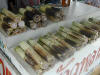
Khao Lak–Lam Ru (เขาหลัก-ลำรู่)
Thai. Name of a
National Park in
Phang Nga
Province,
that covers an area of
about 125 km². The park includes tropical evergreen montane forests
and a small coastal area. The park hosts diverse wildlife, including
mammals, including also
Binturongs (fig.),
over 170 bird species, and various reptiles and amphibians,
including the
Elongated Tortoise
(fig.).
Known for its beaches, waterfalls, and hiking trails, the park was
significantly impacted by the 2004 Indian Ocean
tsunami,
which caused severe damage and many deaths. Despite the tsunami's
impact, the park remains a vital ecological site with ongoing
conservation efforts.
WATCH VIDEO
and
VIDEO (EN).
回
khao man kai (ข้าวมันไก่)
Thai. ‘Chicken oily
rice’.
A dish of chicken over rice cooked with
coconut milk.
In English, it is
referred to as Hainanese Chicken Rice, and is said to be a specialty
introduced to Singapore by immigrants from Hainan Island, off the
coast of China, though their own invention and not ready available
in their home country and hence also called Singapore Hainanese
Chicken Rice. In Thailand, it is traditionally served with some
sliced cucumber, a soup made from chicken broth and parsley, to
which sometimes also chicken liver and coagulated blood are added,
as well as with a spicy sauce made from ingredients, that include
prik khee
noo chilies, ginger and
garlic. It is typically found at markets and roadside restaurants.
回
%201_small.jpg)
khao mao (ข้าวเม่า)
Thai. Shredded
rice
grain. Nearly mature rice which is harvested just before it has
fully ripened. It can be made of either glutinous or non-glutinous
rice and eaten uncooked as well as prepared. First the rice is
soaked in water to loosen the husk, then it is roasted (kua)
and pounded until it is flat. After this it is winnowed to remove
the husks and dust. Its natural colour is grey to light green, but
often its colour is made more attractive bright green by mixing the
rice with some fresh leaves of a tree called ton kahm pu (ต้นก้ามปู)
whilst it is being pounded, although nowadays more often a green
colouring matter is used instead. When popped it is called khao mao
rahng (ข้าวเม่าราง -
fig.) which
can be mixed with Thai herbs or spices and is then also known as
khao
kua ob samunphrai, i.e. ‘popped (kua) and roasted (ob) herbal (samunphrai)
rice (khao)’. Herbs may include fried onion, peanuts, dried
chilis and dried
makrud
leaves (fig.).
When fried and mixed with bean curds and dried prawns it is called
khao mao mih (ข้าวเม่าหมี่) and fresh it is called khao mao sot (ข้าวเม่าสด
-
fig.). Another variety is khao mao
krayahsaad
(ข้าวเม่ากระยาสาตร
-
fig.)
which is
caramelised with sugar and usually mixed with other ingredients,
especially seeds and nuts like the krayahsaad sweetmeat (fig.).
Glutinous khao mao finely ground into a powder and mixed with sugar
and grated
coconut is
used to make a candy known as
khanom
khao mao (fig.),
as well as a wrapper for a snack of deep-fried
banana called
gluay khao mao thod (fig.).
回
khao mo (เขามอ)
Thai-Khmer.
‘Small Rocky Mountain’. Name for an artificial miniature hill. There
are two types of khao mo. One is a small-sized and potted, i.e. a
form of miniature garden with a miniature hill of rocks and stones,
arranged in potted plants, in the same category as
penjing,
i.e. ‘miniature landscape’ (fig.)
and
bonsai, which means
‘potted plant’ (fig.).
The other is large-sized, i.e. built on the ground or in the middle
of a pond, and consists of a structure of genuine or replica rocks
and stones, piled on top of another to form a miniature hill, with
coves and nooks
(fig.),
and sometimes with waterfalls and caves. This second type of khao mo
is designed to decorate monasteries and royal palaces, a garden
architecture that dates back to the
Ayutthaya
Period. Whereas the Thai
word khao means ‘hill’ or ‘mountain’, and mo can be translated as
‘small hill’, the term mo is actually said to derive from the
Khmer
word t’mor, which
means ‘rock’. A popular khao mo in
Bangkok
is that of
Wat Prayun Wongsahwaht
(fig.)
in
Thonburi,
adjacent to the main entrance of this Buddhist temple, and part of
it. It is built in the middle of a pond filled with
turtles
and
fish,
and surrounded by a rock garden and a number of miniature
chedis
and
stupas,
cathedrals, pavilions, and rare plants. In the evening, it is
illuminated with both large spots and countless tiny Christmas or
LED lights.
回
khao mok kai (ข้าวหมกไก่)
Thai. Name for a
dish known in English as chicken biryani, that originated in Persia,
i.e. present-day Iran, and which in Thailand is made almost
exclusively by the
Muslim
population. It consists of steamed
rice,
sometimes mixed with raisins and sliced toasted almonds, which is
fried, mixed and seasoned with a sauce made from
curry
powder and some other herbs, such as ground
turmeric,
ground
cinnamon, clove,
star anise (fig.),
coriander seeds (fig.),
black pepper (fig.),
fennel seeds, and black
cardamom
(fig.),
and then topped with fried red onion slices and with fried or
marinated chicken, which are prepared separately. The dish is
usually also eaten with some fresh vegetables, such as sliced
cucumber and spring onion.
回
_small.jpg)
khao moo kaolih (ข้าวหมูเกาหลี)
Thai. ‘Korean pork
rice’.
Name of a dish that consists of chunks of pork, as well as
cabbage,
stir fried
separately in a
wok.
It is
served over
steamed
rice
and optionally with some slices of cucumber and topped with a fried
egg. It is usually served with a small bowl of broth-like soup,
often with some
phak chih,
i.e. coriander, and a piece of cooked
fak, i.e.
winter melon (fig.).
Also referred to as khao nah moo kaolih (ข้าวหน้าหมูเกาหลี), i.e.
‘rice topped with Korean pork’.
回
_small.jpg)
khao neung (ข้าวนึ่ง)
1. Thai. ‘Steamed
rice’.
Name of a dish which is prepared by soaking hulled rice in water,
dry it and then steam it. It may be mixed with steamed, crumbled
fish and is usually served with fresh
bai chaphlu, chilies
and slices of an
Isaan style sausage.
回
_small.jpg)
2. Thai. ‘Parboiled
rice’.
Name for rice that has been boiled in the husk, thus improving its
nutritional value. After this the rice is polished by hand to remove
the bran layer. The word parboil is a compound of partially and
boil, meaning ‘to boil until partly cooked’.
回
khao niauw (ข้าวเหนียว)
Thai. ‘Sticky
rice’.
Name for glutinous rice, a variety of
rice
which is
soaked in water and then steamed in a
huad
(fig.)
placed over a boiler, rather than cooked, and eaten with the
fingers. It is usually served in a small basket made of
bamboo and
called
aeb
(fig.),
kong khao or
kratib (fig.).
It is especially popular in
Isaan and
Northern Thailand, and has many different applications, e.g.
khao niauw moon,
sticky rice mixed with
coconut cream
eaten as a desert with barracuda
mango,
a sweet and soft kind of mango with yellow flesh;
grilled in a
bamboo
cylinder a snack known as
khao lahm;
ground and made into a kind of rice cracker, stuffed with sweet or
savory fillings and wrapped in leaves, used as the basis for brewing
sato, fried
rice balls (fig.),
khao kriyab waw
(fig.),
etc. Also referred to as as sweet rice, waxy rice (fig.),
botan rice, mochi or moji rice (as in
khanom moji),
and pearl rice. Often transcribed khao neaw or khaw niao.
回
khao niauw chup khai thod (ข้าวเหนียวชุปไข่ทอด)
Thai snack of glutinous
rice, i.e.
sticky rice,
which is steamed and then made into a ball, put on a stick and
dipped in egg yolk, and then grilled over a
charcoal
fire.
回
%201_small.jpg)
khao niauw moon (ข้าวเหนียวมูน)
Thai. ‘To mix
sticky rice
with
coconut
cream’. Name of a kind of desert consisting of glutinous rice (khao
niauw) mixed with palm sugar and
coconut cream, and served either with barracuda
mango, a
sweet and soft kind of mango with yellow flesh, or
durian.
See also POSTAGE STAMP.
回
Khao No–Khao Kaew (เขาหน่อ-เขาแก้ว)
Thai. ‘Offshoot
Mountain—Crystal Mountain’ or ‘Spire Mountain—Glass Mountain’. Name
of a twin karst or
limestone
mountain in
Nakhon Sawan
province. The mountains are home to a large troop of
wild
Crab-eating
Macaques, i.e.
Long-tailed Macaques,
known in Thai as
ling sahaem. Also transliterated Khao
No–Khao Kaeo.
See also TRAVEL PICTURE,
PANORAMA PICTURE,
MAP,
and
WATCH VIDEO.
回
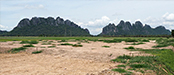
khao pansa (เข้าพรรษา)
Thai. ‘Entering the rainy season’. The
beginning of the rainy season in Thailand. It is the start of a
three month period when Buddhist monks retire to their temples to
study and meditate, and in which they refrain from travelling. At
the start of this festival people perform a
thaksinahwat (fig.)
in the temple and young men and boys are ordained as monks or
novices for a short period of time. Other lay people hold
celebrations in and around the temple and many make vows they will
try to keep during this period, such as –temporary– refraining from
drinking alcohol and smoking tobacco. The period starts with the
casting, procession and offering of large
thian pansa candles (fig.),
usually in the middle or at the end of July, and marks the start of
the
Buddhist Lent, that ends about three
months later with
ouk pansa, literally ‘exiting the rainy season’.
Also transcribed khaw pansa/phansa.
See also
Wax Candle Festival.
回
khao phad (ข้าวผัด)
Thai term, usually translated as ‘fried
rice’.
Whereas
khao
literally means
rice,
the word phad should actually be understood as ‘to mix food in a
wok with a
little oil’, i.e. ‘to stir fry’. The main ingredients are cooked
rice, an egg, sliced onion, finely chopped garlic and ditto spring
onions, and optionally some chopped tomato. When meat or other
constituents are added the Thai word for that ingredient or
supplement is then also added at the end, e.g. khao phad kai
(ข้าวผัดไก่) for ‘fried rice with chicken’, khao phad moo
(ข้าวผัดหมู) for ‘fried rice with pork’, khao phad poo (ข้าวผัดปู)
for ‘fried rice with crab’, khao phad talae (ข้าวผัดทะเล) for ‘fried
rice with seafood’, khao phad
kung
(ข้าวผัดกุ้ง) for ‘fried rice with prawns’, etc. On request a fried
egg (khai dao) can also be ordered with it which is served on top
and the dish is then referred to as khao phad khai dao
(ข้าวผัดไข่ดาว). Khao phad is typically served with some sliced
cucumber, green onions and half a lime to squeeze on top, and
sometimes with lettuce and some slices of tomato as well. Also
transcribed khao pad, khaw phad, khaw pad, khaw phat, khaw pat, khao
phat and khao pat, or a similar variety.
回
Khao Phaeng Mah (เขาแผงม้า)
Thai. ‘Horse Stall
Mountain’. Name of a hilly area
in
Wang Nahm Khiauw district
of
Nakhon Ratchasima
province, which is well-known for
its
krathing
viewpoint.
Here,
on a small hill,
Wildlife Fund Thailand offers a Gaur-watching programme,
within
the scope of its wildlife conservation activities.
From this hill, some large herds of
Gaurs
(fig.)
can be observed in the wild, especially when they come out in the
open to
graze on plants and grasses in the
surrounding fields,
typically between 6.00 and 8.00 AM and 4.00 to 6.00 PM. This
particular spot is also excellent to observe other animals that live
in this area.
回
Khao Phra Wihaan (เขาพระวิหาร)
Thai. ‘Temple mountain’
or ‘sanctuary on the mountain’. A
Khmer
temple built between the 9th and 12th centuries AD,
during the
Angkorian Period.
It is considered to be
one of the most
spectacular sites of the ancient Khmer Empire and was constructed
over a period of nearly 300 years. It straddles the border with
Thailand, near the present day Thai province of
Sri Saket,
where the temple's two
satellite stupas known as Prasat Santhop are located (map),
and
Cambodia,
with its entrance clearly on Thai soil, while the main complex is on
Cambodian territory, in the
khaet
Preah Vihear. This has caused a long standing dispute about its
ownership, until the International Court in Den Haag in 1962
eventually allocated it to Cambodia, where it is known as
Prasat Preah Vihear. However, the
dispute flared up again in July 2008 after the site was listed as an
UNESCO World Heritage site, angering envious Thai nationalists.
Tensions escalated into a military confrontation with both sides
accusing each other of violating ones autonomy. The complex lies at
657 meters above sea level in a sandstone mountain range but ends
abruptly on an overhanging cliff. Because of this the temple can
only be entered from the North, on Thai territory. Nearby is
Pha Mo Ih-Daeng (ผามออีแดง), a viewpoint (map
-
fig.) from where
one has a panoramic view of the Cambodian landscape below, as well
as of the
Khao Phra Wihaan temple
complex in the distance. Pha Mo Ih-Daeng, sometimes transcribed Pha
Mor E-Daeng or Phah Mo-I-Daeng, means ‘red small hill cliff’, and
from its top, a staircase leads down to bas-relief carvings located
at the mountain's side, which is part of the
Dangrek
mountain
range. It features three figures wearing
Khmer
costumes and seated in the
lalitasana
pose, and probably dates back to the mid-11th
century (map
-
fig.).
Both the temple, Pha Mo Ih-Daeng and the surrounding area on Thai
territory are part of Khao Phra Wihaan National Park, which covers
an area of about 130 km², partly stretching into
Ubon Ratchathani
Province.
Also transcribed Khao Phra Viharn.
See MAP.
回
_small.jpg)
Khao Phutthong (เขาพุทธทอง)
Thai.
‘Golden Buddha Hill’. Name of an arboretum established in 1980 AD,
at the main shrine of
Suan Mokkha Phalarahm,
in
Chaiya
district of
Surat Thani
province, which has a
garden
ubosot
that
is used as a meditation centre by followers of
Phuttathaat,
i.e.
Buddhadasa
Bhikku.
In full it is known as
Suan Rukkhachaht Khao Phutthong.
See also POSTAGE STAMPS.
回
khao pun (ข้าวปุ้น)
Name used in
Isaan for
khanom jihn.
回
Khao Sahm Hahd (เขาสามหาด)
Thai.
‘Three Beaches
Mountain’. Name of a hilltop viewpoint in
Phuket
that offers a panoramic view of three beaches—Kata Noi (กะตะน้อย),
Kata Yai (กะตะใหญ่), and Karon (กะรน). This name describes the
scenic landscape visible from the location, where the three
crescent-shaped bays can be seen
lined up along the coastline. Despite its name, the viewpoint is
commonly known as Jut Chom Wiw Karon (จุดชมวิวกะรน) or ‘Karon
Viewpoint’, though it is actually closer to Kata (กะตะ) than Karon.
It is one of Phuket’s most popular sightseeing spots, offering
stunning views of the
Andaman Sea and the surrounding
greenery. Also transliterated Khao Saam Haad.
WATCH VIDEO (1),
(2) and
VIDEO (E).
回
Khao Sahm Muk (เขาสามมุข)
Thai.
‘Three Porches
Mountain’ or ‘Hillock of the Three Porticos’. Name of a small
coastal mountain in
v
province, located on a spit of land, roughly in between
Bang Saen Beach (fig.)
and Ang Sila fishing village.
It offers a panoramic view over both those areas and features on the
provincial coat of arms (fig.).
The seashore hillock
has a
sala with a statue of the
goddess Chao Mae Sahm Muk, of whom it is
believed that she protects seafaring fishermen, as well as the local
population. Khao Sahm Muk is occupied by large groups of
Crab-eating Macaques,
that live here in the wild.
See MAP.
回
_small.jpg)
Khao Sahm Roi Yot (เขาสามร้อยยอด)
Thai.
‘Three Hundred Mountain Peaks’. A
National Park (map)
in
Prachuap Khirikhan,
which covers an area of
about 98 km². It is
located along the shoreline of the
Gulf of Thailand
and is home to
Tham Phraya Nakhon,
a cave (fig.)
which houses a royal pavilion (fig.)
known by the names
Phra Thihnang Khoo Ha Khareuhaat
and
Phra Thihnang Khoo Ha Sawan,
and which features
on the provincial emblem of Prachuap Khirikhan (fig.).
To fully appreciate the immense scale of this mountain range, it’s
best viewed from the air (fig.).
Also transliterated Kao Sam Roi Yod, or similar.
See MAP
and
WATCH VIDEO.
回
khao san
(ข้าวสาร)
Thai for ‘polished
rice’.
Khao San Road, a famous tourist hub in
Bangkok's
subdistrict
Banglamphoo,
is named after it. This walking street has a daily market and many
shops that stay open until late. The area is very popular with
backpackers and has a rather hippie-like atmosphere. There is a wide
variety of pubs and bars, as well as low-budget hotels and
guesthouses. It is one of the few places in Thailand where one can
watch street performances. The street and the adjacent area has a
nice mixture of visitors, including tourists and expats, as well as
many Thai people. Pronunciation khaw saan and sometimes transcribed
khao sarn or khao sahn.
See MAP.
回
%203_small.jpg)
khao soi (ข้าวซอย)
Thai.
Name of a northern Thai dish of thin flat egg
noodles that are poured with a curry-like broth served with chicken,
beef or pork and topped with the same noodles fried crisp, some
small red onion slivers and cuts of pickled Chinese lettuce. Fresh
lemon and
nahm phrik
phao,
a sauce of dried chilies fried in oil (fig.)
are used to spice up the dish. In the northern Thai town of
Chiang Mai
is a restaurant called
Mae Sai,
named after the northernmost town of Thailand in
Chiang Rai
Province, which has earned itself a Michelin Star preparing and
serving this typical
northern noodle dish.
See also POSTAGE STAMP and
WATCH VIDEO.
回
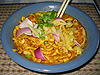
Khao Sok (เขาสก)
Thai. Name of a
mountain, as well as of a National Park in
Surat Thani
Province,
which covers an area of about 738 km².
READ
ON.
回
khao som meua (ข้าวซ้อมมือ)
Thai. ‘Hand-polished
rice’.
Coarse rice, also referred to as half-milled
rice. It is an
OTOP
product
from
Roi Et, for one. See
also
khao klong.
回
khao tok (ข้าวตอก)
Thai. ‘Popped
rice’.
Puffed rice, in Southeast Asian tradition, typically obtained by
heating the rice kernels in a large
wok
mixed with some
fine sand, usually from a nearby river.
READ ON.
回
khao tom mat (ข้าวต้มมัด)
Thai. ‘Boiled
rice
bundle’. Name of a traditional Thai dessert made from
glutinous
rice
mixed with
coconut milk, sugar, and salt,
often filled with ripe
banana or black beans. The mixture
is wrapped in banana leaves, folded into a compact shape, and tied
together in pairs with
bamboo strips (fig.)
before being steamed. This sweet, fragrant delicacy is commonly
prepared for religious ceremonies, festivals, and special occasions,
symbolizing unity and good fortune in Thai culture. Also referred to
as
khanom khao tom mat.
回
khao too (ข้าวตู)
Thai. Abbreviation for
khao too maprao oun.
Also spelled khaw tuh.
回
khao too maprao oun (ข้าวตูมะพร้าวอ่อน)
Thai. Name for a kind
of sticky candy or sweetmeat (khanom),
in English referred to as granulated
rice
balls or granulated rice cakes. It is made of sundried cooked
rice, which is pounded and then stirred over a soft fire, adding
water,
coconut
sugar,
coconut milk,
grated
coconut meat,
and some scraped flesh and juice of a young
coconut (maprao
oun). The mixture is then made fragrant with a
thian ob,
sometimes using
jasmine
or
ylang ylang.
The soft paste is then rolled into elongated balls, similar in shape
to
khai mot daeng (fig.),
or alternatively pressed into rounded moulds, to make small,
disc-like cakes, that are similar in shape and size to hockey pucks.
Also called
khao too.
回
_small.jpg)
Khao Yai (เขาใหญ่)
1. Thai. ‘Big
Mountain’. Name of Thailand's oldest national park, established on
18 September 1962 and covering an area of 2,168 km². It is situated
largely in the province of
Nakhon Ratchasima,
but also includes parts of
Saraburi,
Nakhon Nayok
and
Prachinburi.
The park's altitude ranges from 400 to 1,000 meter above sea level
and consists of evergreen forests and grasslands. There are around
3,000 species of plants, 320 species of birds and 67 species of
mammals, including the
Asian Elephant
(fig.),
tiger,
Asian Black Bear
(fig.),
Gaur (fig.),
Barking Deer
(fig.)
gibbon,
etc. There are also several
waterfalls,
including the
three level
nahm tok
Haew
Narok
(เหวนรก), the biggest in the park of which the name means the
‘abyss of hell’
(map
-
fig.)
and which
appears on a Thai definitive
postage stamp issued in 2008 (fig.),
Haew Suwat (เหวสุวัต), a 25 meter high cascade (map
-
fig.),
and
Sarika.
Haew Narok is nicknamed Susaan
Chang
Pah (สุสานช้างป่า), i.e.
‘Wild
Elephant's Graveyard’,
as sadly, many wild
elephants
have died here after falling into the waterfall, that seems to live
up to its name. On
5 October 2019, eleven wild
elephants
died here, all believed to belong to the same herd, and
making it one of the biggest losses of wild elephants living in
National Parks in Thailand on record.
See MAP
and
WATCH VIDEO (1),
(2)
and
(3).
回
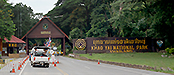
2. Thai. ‘Large Mountain’. Name of
a male spirit or protector deity with the title
Chao
Pho (เจ้าพ่อ), who is venerated on Koh Si
Chang, where he has a shrine on the slope of Mount
Phra
Chulachomklao
(fig.).
See also TRAVEL PICTURE
and
MAP.
回
_small.jpg)
3. Thai. ‘Large Mountain’. Name of
a
tambon
in
Cha-am (ชะอำ) District,
Phetchaburi.
回
khao yam (ข้าวยํา)
Thai. ‘Rice
salad’. A southern dish consisting of cooked dry rice, served with
some pounded dry shrimps, roasted shreds of
coconut,
pound roasted
prik kee noo
chilies and some fresh
vegetables, that include sprouted soybeans, finely shredded young
makrud
(kaffir lime -
fig.) leaves,
thinly cut
takrai
(lemongrass -
fig.),
sliced
tua fak yao
(Chinese long bean -
fig.), as
well as finely sliced
mango and some
manao
(lemon) on the
side,
and most importantly, a sauce called
nahm budu
or
nahm kheuy.
It is typically eaten as breakfast by pouring the sauce over the
ingredients, which are then tossed as a salad, squeezing the
lemon over it. It is often sold on markets and at simple food
stalls.
See also POSTAGE STAMP.
回
Khawih–Honwichai (คาวี-หลวิชัย)
Thai. Name of a Thai folktale about the friendship between a tiger
cub and a calf, that were changed into humans by a
reusi
(hermit), in order that their friendship could last forever without
becoming hazardous. The calf was named Khawih (Khawee) and tiger cub
was named Honwichai. The boys were then asked to stay with the
hermit until they reached adulthood, so that they would be able to
study. As they grew up and the time came for them to leave, the
hermit changed their clothes into those similar to princes and gave
them sacred knives in which he enclosed their hearts, so that they
could not be killed.
The story is also referred to with the names
in the opposite order, i.e. Honwichai-Khawih, and often
transliterated differently, e.g. Khawee-Honwichai, Kawih-Holwichai,
Kawee-Honwichai, etc. In 1999, a scene of the folktale was depicted
on a Thai postage stamp (fig.).
回
Khawin (คาวิน)
Thai. Name
of a hermit, who appears in the epic
Ramakien,
where he cast a spell that anything thrown in the water would
immediately sink to the bottom, in order to avoid anyone from
building a road
for the monkey army of
Phra Ram
(fig.)
to cross into
Longka.
However, by carrying the task out alone without
the aid of others, the curse could be broken. Hence, the
monkey-warrior
Nilaraat (fig.),
volunteered to take the task of throwing boulders into the sea upon
himself and thus got around the spell.
See also
LIST OF RAMAKIEN CHARACTERS & NAMES.
回
Khayaket (ขายะเคช)
Another Thai name for
Kanakavatsa.
回
Kheedkhin (ขีดขิน)
Thai name for a city
in the epos
Ramakien, which was
initially ruled by the monkey-king
Bali or
Phali
(fig.),
in Sanskrit known as
Vali,
until his half-brother
Sukrihp
(fig.),
in Sanskrit called
Sugriva,
seized power and
usurped the throne, becoming the de facto new ruler of
Kheedkhin. Also transliterated Khiht Khin or Khit Khin, and
sometimes referred to as
Khat Khin (คัตขิ่น),
Khet
Khin (เขตขิ่น), with
khet
meaning ‘domain’ or ‘zone’, or simply Khin (ขิ่น),
yet sometimes with a different spelling in Thai, changing the rising
tone into a low tone by using the
tone mark mai ek (ไม้เอก).
See also
LIST OF RAMAKIEN CHARACTERS & NAMES.
回
kheng (เข่ง)
1. Thai. A round platter-like
basketwork or crate made of
bamboo, used to pack or transport fish.
It is used for packaging
pla tu for one, each kheng
usually containing two or three fish (fig.).
回
2. Thai. A small or sometimes large (fig.)
round
bamboo
basket used to steam
khanom jihb and
dim san (fig.).
They are designed to be easily stacked upon each other and single or
top baskets might be covered with a chequer plaited lid.
回
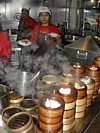
3. Thai. An indefinite
unit of capacity roughly equivalent to a basket.
回
khet (เขต)
Thai. ‘Domain’ or
‘zone’. Term used for the division of
Bangkok
into different zones, which is than upcountry, where zones are
called
tambon.
Besides 45 zones or khet, Bangkok also has
5 districts
called
amphur
which are administrative subdivisions of the province or
jangwat
of Bangkok. Bangkok's capital city is the khet Phra Nakhon. The
zones are divided into subdistricts called
khwaeng. The
Thai word khet is related to the
Khmer
khaet, the term for
a
‘province’
in
Cambodia.
回
Khet Raksah Phan Sat Pah (เขตรักษาพันธุ์สัตว์ป่า)
Thai. ‘Domain to preserve breeds of wild animal’. Name for any
Wildlife Sanctuary in the country, which exist in addition to the
many National Parks and National Marine Parks, in general known as
Uthayaan
Haeng Chaat.
MORE ON THIS.
回
khi lehk american (ขี้เหล็กอเมริกัน)
Thai. Another name for the
suwannaphreuk.
See also
kaeng khi
lehk.
回
khim (ขิม)
Thai. A stringed instrument (fig.)
of Chinese origin, constructed on a similar principle as the piano
and played with two percussion sticks.
回
khimar (خمار)
Arabic. Term for ‘veil’
or ‘headscarf’, as used by
Islamic
women. Compare with
hijab.
回

khing (ขิง)
Thai for
ginger.
回
khing daeng (ขิงแดง)
Thai word for
red ginger (fig.).
回
khiri (คีรี)
Thai-Phasa Pak Tai
term for
‘mountain’
used mostly in southern
Thailand, comparable to the general
Phasa Klahng
term
khao, the
name
phanom
used in
Isaan,
and the Thai-kham meuang
designation
doi
used in northern Thailand.
回
khlui (ขลุ่ย)
Thai. Name of a kind of end-blown woodwind instrument, traditionally
made of a long segment of
bamboo and sometimes decorated with skin,
though they also exist made from hardwood and even from plastic.
Unlike the
pih,
this flute has no reed, but has instead a wooden plug that, apart
from a small slit known as the duct, almost completely closes off
the front part of the cylindrical segment and serves as the
mouthpiece. Near the top of the flute, just a small distance
underneath the mouthpiece and beyond the wooden plug, is a -often
rectangular- hole with a bladed edge through which the breath
escapes, and which creates a whistling sound. The amount of breath
that escapes can be regulated by opening or closing off the finger
holes, which will influence the tones. The khlui generally has seven
finger holes and originally came in three sizes, namely small,
medium and large, each of which is known by its specific name, i.e.
khlui lib,
khloi phiang-ou and
khlui uh,
respectively. However, later someone created a flute with a higher
sound, which goes by the name khlui kruad (ขลุ่ยกรวด) and which is
used mainly with modern musical instruments, such as those used in
rock or pop.
In 1970, the khloi phiang-ou was depicted on one of a set of four
Thai postage stamps featuring Thai musical instruments (fig.).
Also spelled khluy. See also
khluythip.
回
khlui lib (ขลุ่ยหลิบ)
Thai. Name of a small-sized
khlui,
which is around 36 centimeters long and about 2 centimeters wide.
回
khloi phiang-ou (ขลุ่ยเพียงออ)
Thai. Name of a medium-sized
khlui,
which is around 45 to 46 centimeters long and about 4 centimeters
wide.
In 1970, the khloi phiang-ou was depicted on one of a set of four
Thai postage stamps featuring Thai musical instruments (fig.).
回
khlui uh (ขลุ่ยอู้)
Thai. Name of a large-sized
khlui,
which is around 60 centimeters long and about 4 to 5 centimeters
wide.
回
khlong (คลอง)
1. Thai for ‘canal’.
Bangkok
has a large network of canals. A boat tour on the canals of
Thonburi
(map)
is a popular tourist attraction.
Many canals also have public boat services and they are a fast way
to get around town. See also
Khlong Saen Saeb,
Khlong Maha Naak,
and
Khlong Rop Krung.
回
%20khlong_small.jpg)
2. Thai. In southern Thailand,
the term often used for a ‘stream’ or smaller ‘river’. While in
Central Thailand it usually refers to man-made canals, in the South
it frequently designates natural waterways — small rivers or tidal
streams — that flow through mangrove forests or connect inland areas
to the sea.
回
Khlong Banglamphoo (คลองบางลำพู)
Thai. ‘Banglamphoo
Canal’. Additional name used for the northern section of
Khlong Khoo Meuang (fig.),
which runs from the Fan Fah Bridge
near
Pom Maha Kaan
(fig.),
where it connects with
Khlong Maha Naak
(fig.),
to the
Chao Phraya River (fig.)
near
Pom Phra Sumeru
(fig.)
in
Banglamphoo
District.
See MAP.
回
_small.jpg)
Khlong Jik (คลองจิก)
Thai. ‘Pinch Canal’.
Name of a
canal
in
northeastern
Bangkok.
READ
ON.
回
Khlong Kacha (คลองกะจะ)
Thai. Name of a
canal
in northeastern
Bangkok,
that connects
Khlong Jik
(fig.)
with Khlong Hua Mahk (คลองหัวหมาก).
回
Khlong Khoo Meuang (คลองคูเมือง)
Thai. ‘City Canal
Ditch’.
A canal dug in 1783, on the orders of King
Rama I,
after he moved the capital from
Thonburi
to its present
location in Phra Nakhon, thus
surrounding the new capital and enclosing it
akin to
the moat of a fortified city. In the West, the city already had its
natural border, i.e. the
Chao Phraya
River, and with the canal dug, he consequently created an ‘island’,
which became known as Koh
Rattanakosin.
The canal
semi-circumvents inner
Rattanakosin
Island,
flowing alongside
Atsadang
Road, and making
a curve from the banks of the Chao Phraya River at the
Phra Pinklao
Bridge
(fig.)
in the North, formerly known as Tha Chang Wang Nah
(ท่าช้างวังหน้า),
to the Pak Khlong Flower Market
(fig.)
and the Rajini (ราชินี) School in the South. Somewhere halfway,
the canal features the
Pihkun Bridge
(fig.),
i.e. a pedestrian bridge
built in 1911 by
Queen
Saowapha
that connected inner
Rattanakosin with outer
Rattanakosin and eastern
Bangkok.
Confusingly,
the name Khlong Khoo Meuang (fig.)
is also used for
a second canal dug in
1785 when the city expanded and which is also known as
Khlong Rop Krung
(map
-
fig.),
a similar meaning that translates as the ‘Canal Encircling the
City’. To avoid a mix-up, the older canal is
usually referred to as
Khlong Khoo/Kuh Meuang Deum (คลองคูเมืองเดิม),
i.e.
the ‘Original
City Canal Ditch’,
while in
English, it
is known
as the Old City Moat.
See
MAP.
回
%201_small.jpg)
khlong lon (คลองล้น)
Thai. ‘Overflow canal’.
A canal that extends sideways from another canal and which is dug to
be used as an overflow or drainage system during heavy rainfall to
slow the rise of the water level in the main canal or waterway.
回
Khlong Maha Naak (คลองมหานาค)
Thai. ‘Canal of the Great
Naga’.
A canal
dug around 1785, on the orders of King
Rama I.
READ ON.
回
Khlong Nakhon Luang (คลองนครหลวง)
Thai. ‘Capital City
Canal’. Name of a canal in
Ayutthaya,
once the capital of
Siam.
It flows from the
Pa Sak river towards
Bang Pa-in,
passing through
the districts Nakhon Luang and Uthai. Along its route it has four
sewer canals, namely the canals
6, 26, 27 and 28,
whilst the section of the canal that flows in front of the
Singha's
Wang Noi Beverage Distribution Centre, is lined with colourful light
displays that at night are visible from afar.
回
_small.jpg)
Khlong Ohng Ahng (คลองโอ่งอ่าง)
Thai. ‘Bowl Jar
Canal’. Name of the
southern
section of the lager
Khlong Khoo Meuang (fig.),
a canal that
semi-circumvents the old
city and is hence also known as
Khlong Rop Krung. It
connects to
the Chao Phraya River (fig.)
near
Wang Burapha Phirom,
adjacent to and to the southeast of
Praisanihyakahn
(fig.).
The name drives from the fact that
in that
neighbourhood there was once a centre where
Mon
and Chinese earthenware was
sold. It is
the middle and second of 3 canals that
semi-circumvent
Rattanakosin
Island in the east
and together with the river in the west form a three-layered
protective barrier, the inner one being the
Old City Moat
(map
-
fig.), the outer one
Khlong Phadung Krung Kasem
(map
-
fig.).
Though, since they all enclose the old city, any one of these may
also be referred to as
Khlong Rop Krung,
though this name is
especially
used
for the
the first two canals.
See MAP.
回
%201_small.jpg)
Khlong Phadung Krung Kasem
(คลองผดุงกรุงเกษม)
Thai. ‘Canal to Keep
the City Secured’.
A canal dug in 1851 on the orders of King
Rama IV
and to serve
as a new outer moat for the expanding city.
It connects to the
Chao Phraya
River at
Wat Devarat Kunchon
Worawihaan (วัดเทวราชกุญชรวรวิหาร) in the North and runs to River
City in the South, roughly forming an arch that passes by Bobae
Market and
Hua Lampong Train Station
(fig.).
See MAP.
回
_small.jpg)
Khlong Prawet Burirom (คลองประเวศบุรีรมย์)
Thai. ‘Access to the
Pleasing City Canal’. Name of a
46 kilometer long canal
in
eastern
Bangkok.
READ ON.
回
Khlong Prem Prachakon (คลองเปรมประชากร)
Thai.
Name of a major, 50,846
meter long canal
in eastern
Bangkok,
that runs northbound and connects the capital with
Bang Pa-in
in
Ayutthaya
province.
Its construction started in 1869 and it is believed to be the first
canal dug in the reign of King
Rama V.
See also
Laksi.
回
Khlong Rangsit
Prayoonsak (คลองรังสิตประยูรศักดิ์)
Thai.
Name of a major canal
in northern
Bangkok.
READ ON.
回
Khlong Rop Krung (คลองรอบกรุง)
Thai. ‘Canal Encircling
the City’. A second canal ring
dug in 1785 on the orders of King
Rama I,
when expanding the new capital.
It was completed by
connecting
Khlong Banglamphoo
(fig.)
with
Khlong Ohng Ahng
(fig.),
and dug with the use of 10,000
Khmer
prisoners of war.
The canal runs in a large curve from the banks
of the Chao Phraya River near
Banglamphoo
in the North, to
Wang Burapha Phirom
in the South. It is 85
sen and 13
wah
(3,426
meters) long, 10 wah (20 meters) wide and 5
sok (cubit)
deep. It formed the ancient capital's eastern, northern and southern
frontier and consequently some forts were built alongside it, e.g.
Pom Maha Kaan
(fig.).
In total, 14 forts defended the city, tough today only 2 remain.
As is often the case with alleys (soi) and canals (khlong) in
Thailand, the local community refers to it by their own designation,
naming it after whichever well-known area it runs through or after
whatever famous building or meeting place that may be located in its
vicinity, and parts of it may therefore bear different names. In
Banglamphoo, for example, the canal is called Khlong Banglamphoo and
in another area it may be
given any of the names of the bridges that it passes under. In one
place it is known as
Khlong Ohng Ahng,
meaning ‘Bowl Jar Canal’, because in that neighbourhood there was
once a centre where
Mon
and Chinese earthenware was
sold. The current name is only officially in use for the whole canal
since 7 December 1982,
the year Rattanakosin celebrated its bicentennial,
and it is also known as
Khlong Khoo Meuang
(fig.).
In addition, the name is confusingly also used for the smaller Old
City Moat
(map
-
fig.)
which semi-circumvents inner
Rattanakosin
Island,
flowing alongside
Atsadang
Road,
from
Phra Pinklao
Bridge (fig.)
in the north to the Pahk Khlong Flower Market (fig.)
in the south.
See MAP.
回
_small.jpg)
Khlong Saen Saeb (คลองแสนแสบ)
Thai. A canal connecting
Bangkok
with
Chachengsao.
READ ON.
回
Khlong Sahmwah (คลองสามวา)
Thai. Name of a
khet
in
Bangkok, that
was established as a district on 21 November 1997 by splitting from
Minburi (มีนบุรี). The name translates to ‘Canal
with a width of Three
Wah’.
The term originates from a legal
classification established in 1891, during the reign of King
Rama V,
which defined any canal measuring three
wah
(ca. six meters) or more in width as a
khlong
sahm
wah,
with one wah being a measurement equal to
199.968 centimeters, or ca. two meters.
This official designation eventually became the name of the district
itself. Also transliterated Khlong Sam Wa.
回
Khlong Samrohng (คลองสำโรง)
Thai. Name of an
important 55 km long canal that spans
Samut Prakan
and
Chachengsao provinces. Originating
from the
Chao Phraya
River (fig.)
in Samut Prakan and merges with the
Bang Pakong
River (fig.)
in Chachengsao Province. Its name derives from
samrohng,
i.e.
the Wild Almond Tree,
an up to 30 meters large tree, with the botanical name Sterculia foetida
(fig.)
and also known in Thai as
po daeng.
Khlong Samrohng was originally created during the reign of King
Ramathibodi II of
Ayutthaya,
a period when this kingdom was heavily involved in maritime trade
and travel between villages and the capital city was largely
dependent on waterways. At that time, the Chao Phraya River served
as the primary route from the Gulf of Thailand to Ayutthaya, in
addition to two rivers in the region with river mouths, namely the
Tha Chin (fig.)
and Bang Pakong rivers. To connect these rivers and improve
transportation, the Kings of Ayutthaya ordered the construction of
canals to shorten travel times and bypass the numerous bends of the
Chao Phraya River. Hence, Khlong Samrohng, was dug to link the Chao
Phraya and Bang Pakong river mouths, establishing it as an important
transportation route. Around 1498, King Ramathibodi II ordered the
dredging of Khlong Samrohng on the eastern bank of the Chao Phraya
towards its mouth. However, there is evidence to suggest that this
waterway may have existed naturally, at least in part, before the
Ayutthaya Period. It is possible that Khlong Samrohng was originally
dug as a route for moving the army from the
Khmer
capital,
Angkor Thom
(fig.),
to the Chao Phraya River basin. The abundance of Samrong trees in
the region, along with the Khmer origins of other nearby canal
names, supports this belief. Khlong Samrohng is the stage for the
annual Lotus Throwing Festival (fig.),
a unique tradition held exclusively along this waterway, when locals
gather along the banks to throw lotus flowers onto a boat carrying a
revered replica of the
Luang Pho Toh
Buddha image
(fig.)
from
Wat Bang Phli Yai Nai (fig.).
Also transliterated Khlong Samrong.
See also POSTAGE STAMPS,
TRAVEL PICTURES (1),
(2) and
(3), and
WATCH VIDEO.
回
Khlong Sathorn (คลองสาทร)
Thai. A canal in
Bangkok's
Sathorn
District, which is
named after
Luang Sathon Rajayukta,
who in 1895
engineered the digging of the canal that connects the
Chao Phraya
River (underneath the
Taksin Bridge) with the Wat Hua
Lamphong Canal, which runs parallel to —and to the south of—
Rama IV
Road. The canal was dug in order to help improve public
transportation inside the city.
See MAP.
回
Khlong Seua Tai (คลองเสือตาย)
Thai. ‘Dead
Tiger
Canal’. Name of a canal
in
Samut Prakan,
that runs away from
Bangkok
in
roughly southeastern to eastern direction, parallel to Sukhumvit
Road.
READ ON.
回
Khlong Sok (คลองศก)
Thai. ‘Era
Canal’. Name of a river
in
Khao Sok (เขาสก -
fig.), in
Surat Thani
Province. Note that, though having the same transliteration in Latin
script, the Thai spelling of the name for the river (ศก) differs
from that of the place name (สก).
The Sok River is formed by the confluence of Khlong Phra Saeng (คลองพระแสง),
which emerges from the Chiaw Lan Reservoir
(fig.)
at the
Ratchaprapha Dam (map
-
fig.), with
the Phum Duang (พุมดวง) River, a tributary of the Ta Pi (ตาปี) River
which empties in the
Gulf of Thailand, just after passing the
city of Surat Thani. Due to its proximity to Khao Sok National Park,
the Khlong Sok River is a popular venue for rafting, canoeing and
river tubing.
See MAP,
and
WATCH VIDEO (1)
and
(2).
回
_small.jpg)
Khlong Thom Center (คลองถมเซ็นเตอร์)
Thai. Name of a huge
indoor market in
Bangkok
for tools, toys and electronics, that over time expanded into the
neighbourhood which besides shop houses also has a regular outdoor
market that on the edges merges into the markets and shops of
Chinatown
and
Little India.
It is also referred to as
Talaat Khlong Thom.
回
khluythip (ขลุ่ยทิพย์)
Thai. ‘Divine flute’.
Name given to a famous bronze sculpture of a boy playing a flute (khlui).
The original was initially created by the Thai artist Khien Yimsiri
(เขียน ยิ้มศิริ), but it has often been copied, both in bronze and
in other materials, especially wood. Also spelled khluithip.
See also POSTAGE STAMP.
回
_small.jpg)
Khmer
(ខ្មែរ)
1. The
inhabitants of
Cambodia.
From the 7th to the 15th century AD they established a powerful
kingdom based at
Angkor
from where they expanded their empire to rule over much of
Indochina. Officially, the Khmer Empire was proclaimed in 802 AD and
lasted until 1431 AD.
The Khmer were also present in Thailand's
central river basin as early as the
Dvaravati Period,
mixing with the local
Mon
who were already there,
and ultimately Dvaravati was invaded by King
Suryavarman
II in the first half of the 12th century, until
the Thai King
Phra Ruang
in 1238 AD rejected their sovereignty.
Their 7th to 11th centuries conquests brought cultural influence in
the form of art, language and religion, and due to their political
domination triggered the decline of the Dvaravati culture. They made
Lopburi
their central outpost and it became a religious centre.
For etymology and
Khmer legends see also
Kambuja.
MORE ON THIS.
回
2. Architectural style and art style from the Khmer period, in
Thailand especially present between the 7th and 13th centuries AD in
Central and Northeast Thailand. Its characteristics can however
still be found later, mixed with other art styles.
The Khmer
style architecture found in Thailand
positively resembles that of
Angkor Wat
in
Cambodia.
回
3. The
official language of
Cambodia,
also referred to as Cambodian. With an estimated 16 million native
speakers, it is the second most widely spoken Austroasiatic
language, after Vietnamese.
In addition, about one million people speak Khmer as their second
language. The dialect known as Northern Khmer is widely spoken in
the Thai provinces of southern
Isaan,
i.e.
Buriram,
Surin,
Sri Saket
and
Ubon Ratchathani.
See also KHMER SCRIPT.
回
Khmu (ขมุ)
Name of an ethnic hill
tribe minority group in Thailand, but which is also found in
Vietnam,
Myanmar, Southwest China, and Laos, where with a population of
around 450,000, it is one of the largest ethnic groups of the
country, based mainly in the North. Vietnam has the second largest
population with around 43,000 Khmu people, whereas Thailand has a
Khmu population of around 10,000, the same number as found in China,
where they are however not recognized as a separate ethnic group,
but instead listed as an undistinguished ethnic group. Most Khmu
people in Thailand arrived as refugees from Laos and Vietnam. They
are closely related to the
Mlabri.
Usually pronounced Khammu, from the Laotian word
Khamu, but
sometimes spelled Kemu, and in Vietnamese known as Khơ Mú.
回
kho (ขอ)
Thai name for
angusa. Also
kho chang.
回
khoa (खोआ)
Hindi term for condensed milk, i.e.
dried cow or water buffalo milk which is thickened, usually by
simmering in a
karahi, i.e.
a
wok-like, yet
deeper, open pan, and used as an ingredient in Indian cuisine,
especially in various types of sweets, such as
pedah (fig.).
There are several varieties, depending on the percentage of moisture
left within the cheese-like substance.
回
kho chang (ขอช้าง)
Thai. ‘Elephant hook’. Instrument used by
mahouts to drive
elephants. Also an
attribute of
Ganesha
(fig.)
and
Indra,
symbolizing
control or the possibility to steer someone in the right direction.
Ordinary elephant hooks usually have a simple
wooden handle, but others may be made of expensive materials such as
ivory
whilst some are elaborately carved or decorated (fig.).
In Thai also
kho
and in Sanskrit
angusa
or sometimes
kandara. See
also
patak
(fig.)
and
kho ngao (fig.).
回
khoi (ข่อย)
Thai name for the
Toothbrush Tree, a kind of tree which is also known as the Siamese
Rough Bush, and with the botanical name Streblus asper. Its wood has
been important in papermaking in Thailand for many centuries, as it
produces a kind of paper that is durable, even in the tropical
high-humidity climate, does not burn easily, and is resistant to
yellowing and insect damage. It is today still used in the
production of Thai
khon masks.
回
kho kai thod (ข้อไก่ทอด)
Thai. ‘Fried chicken knuckles’. A
dish of deep fried chicken joints, i.e. the soft gristle at the end
of a chicken bone. It is a crispy dish popular in
Isaan and usually
served with fresh vegetables such as salad, sliced cabbage and
cucumber. Its full name is actually
hen kho
kai thod which translates as
‘fried chicken ligaments’ or ‘fried chicken tendon’. Sometimes
transcribed kho gai thod.
回
_small.jpg)
Kho Khot Kra (คอคอดกระ)
Thai. One name for
‘Kra
Isthmus’
or
‘Isthmus
of Kra’,
besides
Kiw Kra.
回
khom (ขอม)
1. Thai. A member of the ancient
Khmer race.
回
2. Thai. The Cambodian script, used in
religious books in
Pali (fig.).
回
3. Thai adjective for
Khmer or Cambodian.
回
Khom Dam Din (ขอมดำดิน)
Thai-Khmer. ‘Ground submerging Cambodian’.
Nickname for the
Khmer
envoy (or
assassin) who was sent to arrest (or kill)
Phra Ruang.
According to legend, he was able to travel underground by using
magic powers. However, when he emerged to deliver the Khmer King's
message, legend says he was turned into stone by Phra Ruang. In one
account of this famous folk tale, which was first recorded in the
Chronicle of Upper
Siam
by Phra Wichian Preecha (พระวิเชียรปรีชา), the director of the royal
institute in the reign of King
Rama II,
Phra Ruang, the son of Khong Khrao (คงเครา),
was responsible for providing sacred water
from
Lavo
as a tribute to the ruler of the
Khmer
Empire. Instead of putting the sacred water into jars to send it the
Khmer capital, he invented baskets plugged by a kind of resin that
could hold the water without leaking. The Khmer emperor, however,
became suspicious of Phra Ruang' wit, fearing that this could
adversely affect his own power, so he ordered
Phraya
Decho (เดโช) to travel to Lavo and arrest or
kill Phra Ruang. Having heard rumours about this plan, Phra Ruang
fled to
Wat Mahathat,
a Buddhist temple in
Sukhothai
(fig.),
where he was ordained as a monk, thus enjoying the protection of the
robe. When Phraya Decho realized that Phra Ruang had fled, he
pursued him to Sukhothai using his magic power to travel
underground. Once he arrived at Wat Mahathat, he emerged from the
ground and saw a monk sweeping the floor. He asked the monk where he
could find Phra Ruang, not knowing that the monk in fact was Phra
Ruang himself. Realizing he was in imminent danger, Phra Rung used
some sacred power of his own and replied to the Khmer assassin to
stay put and not move, words that triggered a spell which gradually
transformed the assassin into a rock-like solid mass on the ground.
In 1907, King
Vajiravudh
visited the old
town of Sukhothai and wrote in his diary that the local people used
to flake out a sacred stone on the grounds of Wat Mahathat,
believing that it was the Khmer assassin who had turned into stone
and used it as a medicine as they believed that it had healing
powers. In order to maintain the rock surface, the king ordered the
governor to keep the stone in good condition. At the present, the
rock is kept and exhibited at the
Ramkhamhaeng
National Museum
in Old
Sukhothai
(fig.).
See also TRAVEL PICTURE.
回
Khon
(โขน)
Thai.
Classical
dance theater, typically
with themes from the
Ramakien.
READ ON.
回
kho ngao (ของ้าว)
Thai. A scythe-like weapon with
a hook underneath the blade and used particularly in hand-to-hand
combat on elephants’ backs, a type of warfare known as
yutthahadtie. See
also
kho chang and
Suriyothai.
回
%20มาลาเบียง%20(หมวกพระนเรศวรมาหาราช)%202_small.jpg)
Khong Beng (ขงเบ้ง)
Thai name for the
wise counsellor and clever strategist in the
story
Three Kingdoms.
In Chinese he is
referred to as Zhuge Liang (诸葛亮). He is often depicted wearing a
robe and holding a fan made of crane feathers. He is also known by
the nickname Wo Long (臥龍), i.e. ‘Sleeping
Dragon’.
回
khong dee (ของดี)
1. Thai. ‘Good article’
or ‘good product’. Name for specialties or goods characteristic to a
certain area. Each community has it own specialty, going from
handicrafts to food products. If the products are from to a certain
province, they are called khong dee khong
jangwat.
Many of these domestic articles may also be local
OTOP
products.
回
2. Another name used for a charm,
amulet or protective
talisman,
alongside the words
kreuang rahng,
kreuang rahw and
yan.
回
Khongkha (คงคา)
1. Thai name for
Ganges.
回
2. The goddess of the waters, rivers and
canals, in Thailand. She is worshipped in the annual festival of
Loi Krathong
and her mount is the
makara,
which in
iconography
may also
take the shape of a crocodile (fig.).
Her name is etymologically related to the Indian word
Ganges. Also
Mae Khongkha.
回
_small.jpg)
Khong Thongthip (คงทองทิพย์)
Thai. The name of an
artificial volcanic structure located at a PTT fuel station in
Krajahn (กระจาน),
U-Thong
District, in
Suphanburi
province.
It is designed as a visually striking landmark, combining creativity
with symbolic meaning. The name Khong Thongthip combines the word
khong (คง), which can mean ‘to remain’ or ‘to endure’, with Thong
Thip (ทองทิพย์), meaning ‘Divine Gold’ or ‘Heavenly Gold’,
reflecting its connection to the petroleum industry, often referred
to as ‘black gold’, while hinting at its location in U-Thong.
Together, the name can be interpreted as ‘Enduring Divine Gold’,
evoking a sense of everlasting value. The volcano offers an
immersive experience for visitors, allowing them to explore the
interior and ascend a staircase leading to a platform with panoramic
views of the surrounding area.
WATCH VIDEO
and
VIDEO (EN).
回
Khon Kaen (ขอนแก่น)
Thai. ‘Core (or heart) of the tree-stump’. A
university town and large provincial capital (fig.)
in the heart of
Isaan.
READ
ON.
回
khon mask
See
hua khon.
回
khon saai khao wat (ขนทรายเข้าวัด)
Thai. ‘To carry sand into a tempel’. Annual practice during
Songkraan
in which sand is brought back to the temple in order to replace all
the sand that has been carried out from temple grounds sticking to
visitors feet, as it is not considered good to take anything away
from a Thai temple, even unwillingly. Figuratively it also means to
do something for the general good. Nowadays the sand is often used
to make sand chedis, a local form of folk amusement called
ko phra chedi saai
(fig.).
WATCH VIDEO (1)
and
(2).
回
_small.jpg)
Khoo Kongsi (邱公司)
Chinese. Short name for
Malaysia's
largest
Hokkien clan house,
located
in the heart of George Town, Penang. It is fully known as Leong San
Tong Khoo Kongsi (龍山堂邱公司), which is also transliterated as Long Shan
Tang Qiu Gongsi. It is renowned for its elaborate and highly
decorated architecture, which serves as a testament to the
significant presence of the Chinese community in Penang. Kongsi (公司)
is a Hokkien term meaning ‘Company’ and originally referred to
incorporated businesses. Historically, the term has encompassed
Chinese social groups or partnerships. Among overseas Chinese,
kongsi referred to both clan organizations based on common ancestry
and district-dialect clubs for immigrants from the same region who
spoke the same language. The celebrated Khoo Kongsi is the grandest
and most splendid clan temple in the country and one of the city's
key historic attractions. The clan temple has maintained its
original historic setting, which includes an association building, a
traditional theatre stage, and late 19th-century row-houses for clan
members, all clustered around a granite-paved square in the heart of
George Town's oldest quarter.
WATCH VIDEO (1)
and
(2).
回
khoon (คูน)
The official Thai name for the
rachaphreuk.
Pronunciation khun.
回
Khu Bua (คูบัว)
Thai. ‘Lotus
Moat’. Name of an
archaeological site, situated about 12 km southeast of
Ratchaburi
town, and which dates from the
early
Dvaravati
period.
READ ON.
回
Khue Van Cac (Khuê Văn Các)
Vietnamese. Name of
a pavilion in the
Temple of Literature in Hanoi.
READ ON.
回
Khun (ขุน)
1. Thai. A non-hereditary title or
bandasak
of the lowest rank, just under a
Luang.
回
2. Thai. A title given to a prince or king of a region, before the
integration of Thailand. Also
Khun Luang.
Familiarly called
Tan Khun Khun Luang,
the next title in ascendant lineage, now in disuse.
回
Khun Chae (ขุนแจ)
Thai. Name of a
National Park in
Chiang Rai.
It covers an area of about 270 km² and is alternatively
transliterated Khun Jae.
回
%20National%20Park_small.jpg)
Khun Chang (ขุนช้าง)
The comic but faithful
husband from
Khun Chang Khun Paen
(fig.).
Khun Chang is depicted on the second design of a set of four postage
stamps on the story (fig.),
issued in 2011 to mark National Children's Day.
回
Khun Chang Khun Paen (ขุนช้างขุนแผน)
A classic of Thai literature written in verse
by King
Phra Phutta Leut La, the second monarch of
the
Chakri Dynasty.
READ ON.
回
Khun Chinnarat (ขุนชินราช)
Thai. ‘Royal Accustomed
Nobleman’.
The name and title of a palace official with
the duty of guarding the inner image hall, usually a confidant with
special privileges, who has free access to this part of the royal
palace at all times. The position is one rank higher than that of
Phan But
Sri Thep, the official with
the responsibility of guarding the outer image hall. The title cam
also be transcribed Khun Chinnaraj and might be translated as ‘the
Khun
leading (chin) to the
king (raj)’.
The word chin is Pali and means ‘to lead’.
回
Khun Dahn (ขุนด่าน)
Thai. Name of the most
formidable soldier under King
Naresuan
the Great (fig.),
serving as the chief of the
Nakhon Nayok
checkpoint during the King’s reign. In 1587, he led a courageous
resistance against the
Khmer,
securing his place as a hero in the hearts of the people. To honour
his legacy, shrines, known as Sahn Chao Pho Khun Dahn (ศาลเจ้าพ่อขุนด่าน),
have been erected in his name at various locations. Most notably,
the revered Pho Khun Dahn Shrine perched atop a cliff at Khao Cha-ngok
(เขาชะโงก) within the grounds of the
Chulachomklao Royal Military Academy
(fig.)
has become a place of worship for those seeking guidance
during difficult times. The shrine is considered sacred, and its
power was further affirmed during the Second World War when Japanese
occupying forces, who had established a base at Khao Cha-ngok,
demolished it. According to local belief, Khun Dahn then performed a
miracle that led to the deaths of many Japanese soldiers,
reinforcing the enduring faith in his spiritual presence. Also
transliterated Khun Dan.
WATCH VIDEO.
回
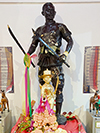
Khun Luang (ขุนหลวง)
Thai. A title given to a prince or king of a
region before the integration of Thailand. See also
Khun.
回
Khun Paen (ขุนแผน)
The dashing lover and
able warrior from the story
Khun Chang Khun Paen
(fig.).
His life-sized statue can be seen at Wat
Pah Leh
Laai
Worawihaan (วัดป่าเลไลยก์วรวิหาร)
in
Suphanburi,
as well as that of
Nang Phim.
Khun Paen is depicted on the first design of a set of four postage
stamps (fig.)
on the story, issued in 2011 to mark National Children's Day. Also
transcribed Khun Phaen.
回
Khun Sa (ขุนส่า)
Thai name of the now disposed
opium warlord who in the sixties fought in
the region of the
Golden Triangle for control of the
local opium trade and who in the early eighties retreated to
Burma
to operate from there. He was born from a
mixed marriage having an Unnanese father and a
Shan mother. He graduated from a
college in Tong Khi (Myanmar)
and became chief of the Myanmar Intelligence Unit before being
appointed a colonel in 1963. Due to his powerful position he was
able to benefit from the local production of opium and heroin, as
well as from the trade in
jade, gemstones and
ivory. Being a freedom fighter for
his people the money gained from their skills in the above mentioned
trades was used in their battle for an independent Shan state. In
1966 Khun Sa was captured by the Burmese and imprisoned in Myanmar
for seven years. He regained his freedom after his friend Fa Lan
(Chan Xu Chien) took two Russian doctors, who were sent to Myanmar
in an international aid project, hostage in exchange for the release
of Khun Sa. After this he rejoined the United Shan Army and later
founded the
Meuang
Tai
Army which grew to become one of largest armed
forces in existence in that period. Well aware of the harm drugs do
to people worldwide, he stated that he regretted this but said it
was a necessary evil for the sake of the freedom of his country, the
Shan State. In 1986 however, he finally laid down arms and
surrendered to the Burmese. He went to live in Rangoon where he
continued to benefit from the profits of his many trades. He was
nicknamed the King of Opium and is also known as Chang Xi Fu.
回
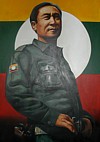
Khun San (ขุนสรรค์)
Thai. Name of one
of the eleven heroic leaders who in 1767,
at the end of the
Ayutthaya period,
fought the invading
Burmese in defence of the
Bang Rajan
camp in
Singburi
(fig.).
READ ON.
回
khwaeng (แขวง)
Thai. Name for a
subdistrict in
Bangkok,
as opposed to the name
tambon,
which is used
upcountry, i.e. outside Bangkok.
回
kiblat
Malay for
qibla.
回
kickboxing
See
muay thai.
回
Kiku (菊)
Japanese.
‘Chrysanthemum’. Name for the Chrysanthemum Seal, i.e. the Imperial
Seal of Japan.
READ ON.
回
kila (कील)
Sanskrit. Name for a
ritual, three-sided, dagger-like peg, used in Tibetan Buddhism to
affix things, especially to pin heavenly things on earth, and as
such represents the connection between Heaven and Earth. Whereas the
handle is usually composed of a triune form of faces, the blade is
generally decorated with two intertwined serpents or
naga,
which is reminiscent of an ancient Chinese myth, which claimed that
the world was surrounded by two intertwined
snakes,
which symbolized the power and wisdom of the creator. The handle is
sometimes made in the form
of a
vajra,
a royal symbol of power, absolute truth and indestructibility,
and the kila is then referred to as
Vajrakila.
It is mainly used in
Vajrayana
Buddhism, where it
also
occurs as an
attribute
of certain
deities. In
Tibet, it is known as
phurba. Also
transcribed keela or kihla.
回
_small.jpg)
kilah chon hua (กีฬาชนวัว)
Thai. ‘Bull fighting
sport’. Name for an ancient sport in which two bulls fight each
other. It originated in southern Thailand and is still held weekly
in the province of
Nakhon Sri Thammarat,
with different districts taking turn to host the event. Bulls
selected are those which have the best breeding and will be trained
and carefully looked after.
回
kilen (กิเลน)
Name for a creature of Chinese
fables. In Chinese, it is called khiling, a compound word consisting
of the prefix khi and the suffix ling. Khi stands for a male kilen,
whereas ling represents a female kilen. They are therefore often
depicted in pair (fig.).
In traditional
iconography the
kilen has a scaled, dear-like body, with on its back short curly
manes and a bushy tail; legs with hoofs like those of a horse; and
the head of a
dragon
with one dear-like horn. But in popular iconography (fig.)
it is usually depicted with a scaled body with long manes on its
back; a bushy tail; legs with the paws of a wild dog; the head of a
dragon, but somewhat resembling that of a lion; and two dear-like
horns. Besides this, other varieties with slightly different
features may also occur. In addition, the kilen is the animal that
in the Ming and Qing Dynasties was used for the insignia of a
military officer of the first rank, akin to the
crane
used on the
Mandarin square
(fig.)
for civil officials of
the first rank.
The kilen is one of the mounts of the Chinese
goddess of mercy, i.e. the
bodhisattva
Kuan Yin
(fig.).
The kilen represents truth and as such it is often found at the
entrances of palaces and temples in
China
and
Vietnam, suggesting one
has to enter with a truthful heart, leaving untruthfulness and any
lies at the door, i.e. to be honest to the ruler or deity one is
about to address. Sometimes transcribed as kilin, kylin, kirin or
qilin. Compare with
toh
(fig.).
回
%20from%20Chinese%20mythology_small.jpg)
kilet (กิเลส)
Thai. In Buddhist theology the term
for an unwholesome thought that causes unhappiness and barring the
way to bliss, metaphorically depicted as the demon
kiletsamaan. It derives from the
Pali term kilesa that means
‘defilement’,
any mental state that pollutes the mind and prevents the attainment
of
Enlightenment.
In Buddhist tradition, it is believed that there are 108
defilements, often called kilesa 108, or kilet 108 (กิเลส ๑๐๘) in
Thai. The
three root defilements are greed (lobha), hatred (dosa), and
delusion (moha), often called the
‘three
poisons’.
These core afflictions give rise to a range of secondary
defilements, such as envy, arrogance, doubt, restlessness, and
attachment. Together, they fuel suffering or
dukkha and keep beings trapped in
the cycle of rebirth called
samsara.
Defilements are often described metaphorically as stains, poisons,
or obscurations that must be removed through ethical conduct,
meditation, and wisdom. Overcoming these defilements is essential
for attaining spiritual liberation or
nirvana, making their
identification and gradual eradication a central focus of the
Buddhist path.
回
kiletsamaan (กิเลสมาร)
Thai. Name of a demon who bars the
way to bliss. The name is formed by merging the term
kilet and the name
Maan (Mara).
回
kim giao
Vietnamese name
for a coniferous tree in the family Podocarpaceae and with the
botanical name Nageia fleuryi.
READ ON.
回
kimono (着物, きもの)
Japanese. ‘Thing to
wear’.
Name for a Japanese traditional robe.
READ ON.
回
Kim Qui (Kim Quy)
Vietnamese. ‘Golden Turtle’. Name of a mythological turtle, known in
Chinese as Jin Gui (金龟), that according to a legend first appeared
during the third century BC to help King An Durong Vurong in the
defense of the ancient capital of Co Loa, by giving him a magical
cross-bow that in a single shot was able to fire multiple arrows. In
the 15th century AD, the turtle appeared again to reclaim a magical
sword that a fisherman had pulled out of the lake in Hanoi where the
turtle lived (fig.).
He had given the sword to Le Loi, a Vietnamese peasant, who had used
it to lead a rebellion against the then occupying Chinese armies,
which he had successfully overthrown. He consequently became emperor
and returned the sword to Kim Qui, afterwards naming the lake Hoan
Kiem, which means ‘Returned Sword Lake’
(fig.).
回
%20Jin%20Gui%20(Golden%20Turtle)%202_small.jpg)
Kinetic Rain
Name of a dynamic art
sculpture in Terminal 1 at Singapore's
Changi Airport. It consists of 1,216 bronze droplets that are
choreographically controlled by a set of high precision motors
working together in harmony to form different shapes, ranging from
the abstract to the familiar. It is crafted by the same art studio
that delivered the work on
The Petalclouds
(fig.),
also on display at the airport. It is
reminiscent of the static sculpture
Thong Yod,
literally ‘Golden
Drops’, a work
of art by Thai artist Arin
Roongjaeng (fig.)
on permanent display in
Icon Siam (fig.) in
Bangkok.
WATCH VIDEO (M).
回
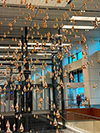
king amphur (กิ่งอำเภอ)
Thai. ‘Subdistrict’.
Name for a sub-unit of an
amphur,
a
previously administrative district equal to an
amphur.
Until 2007, Thailand had a total of 81 king amphur in 39 provinces,
but in that year, an announcement was made in the Royal Gazette,
elevating certain king amphur to amphur status. This resulted in all
81 king amphur at that time being upgraded to amphur status.
Currently, there are no longer any administrative regions at the
king amphur level in Thailand. Also transliterated king
ampheu.
回
King Cobra
With a body length of up to 585
centimeters, the
King
Cobra
is by far the world's longest venomous
snake.
Its colour is variable, from uniform brown to grey-brown or
green-grey, or uniform gray to black, and Northeastern Thai species
can also be orange-yellow to brown, with dark edged white bands
along the body. Juveniles are black with yellow bands and a yellow
chevron on the neck. Its hood is longer and narrower than that of
common cobras, and it also has pairs of prominent occipital scales
on its head. They are often found
in all parts of Thailand, especially in the southern provinces
and in
bamboo
reed forests, where they like to nest.
King cobras feed mainly on other snakes, in particular rat snakes,
and occasionally on lizards. It is
known by the scientific name
Ophiophagus hannah, with the
Latin
word ophiophagus literally meaning ‘snake
eater’. The venom of this dangerous snake is a very potent
neurotoxin and is fatal if left untreated. Victims of this snake
will experience severe pain, blurred vision, vertigo, drowsiness and
paralysis, followed by cardiovascular collapse and coma. Death then
soon follows due to respiratory failure. Fortunately, being a shy
and reclusive animal, people not often get bitten by this snake,
especially if compared to the
Monocled Cobra,
the
Siamese Russell's Viper
and the
Malayan Pit Viper.
In case an accident does occur, an antidote manufactured by the
Thai
Red Cross Society, is available in
hospitals nationwide. Notwithstanding the fact that the snake family
Colubridae is named after them, cobras themselves belongs to the
family of Elapidae, more specifically the genus Naja. It is
sometimes referred to as hamadryad and in Thai it is called
ngu jong
ahng. In 1981, it was
depicted on the first stamp of a set of four Thai postage stamps
featuring venomous Thai snakes (fig.).
WATCH VIDEO
and
VIDEO (EN).
回
%20งูจงอาง_small.jpg)
King
Crow
Another name for
the
Black Drongo
(fig.).
回
king kah (กิ้งก่า)
Name for any kind of lizard, but also generally used for the
king kah hua daeng.
See
also WILDLIFE PICTURES.
回
king kah hua daeng (กิ้งก่าหัวแดง)
Thai. ‘Red-headed lizard’. Name for the
Oriental Garden Lizard, a small tropical lizard that is able to
change colour (fig.)
according to its surroundings, for camouflage
or when offended, though not quite
as rapidly as
chameleons,
as well as in the breeding season when the frontal half of males
becomes red, often
with a black throat patch.
Its scientific name is Calotes versicolor and it belongs to the
family of Agamidae. It has a long body and tail, four legs, and a
rough scaly hide. Since males in the breeding season get a red head,
neck and throat, it
is commonly -yet incorrectly- named Bloodsucker (fig.).
The Thai word king kah is sometimes rather misleadingly translated
as chameleon, due to its ability to change colour and the fact that
it often occurs on the ground, as the name chameleon is derived from
the Greek words chamele (χαμηλή) and liontari (λιοντάρι), meaning
‘ground’ and ‘lion’ (fig.).
However, the king kah is not related to the commonly known chameleon
with its distinctive eyes and long tongue, which in fact belongs to
the family Chamaeleonidae. In former days the king kah used to be
called
pom kahng in Thai, but this name is
also used in
Isaan for the
Calotes mystaceus, a similar species of lizard with a greenish-blue
head, and commonly named
Blue Crested Lizard (fig.).
The Oriental Garden Lizard is also known as
Changeable Lizard, Eastern Garden Lizard
and
Garden Fence Lizard (fig.),
and is occasionally referred to as Tree Lizard. In Isaan, these and
some other lizards are on the local menu, usually served grilled on
a stick (fig.).
Juveniles have only small spines
on the head and back, and typically have two faint yellowish stripes
(fig.),
that run more or less parallel along their back, from the shoulder
to the tail (fig.).
Besides this, they also have two distinctive black spots on the back
of the head, near the neck (fig.),
that look like nostrils and are reminiscent of the
photosensitive
pineal gland in some species of lizard, such as the
Indochinese Water Dragon
(fig.).
In Thai it is also called
king kah
rua,
literally ‘fence lizard’. This species of lizard is insectivorous.
See also WILDLIFE PICTURES (1),
(2),
(3)
and
(4), and
WATCH VIDEO.
回
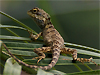
king kah hua sih fah (กิ้งก่าหัวสีฟ้า)
Thai. ‘Blue-headed
lizard’. Name for the Blue Crested Lizard, a coulorful agamid lizard
found in Southeast Asia, and with the scientific name Calotes
mystaceus. It is also commonly known as Indochinese Forest Lizard
and Moustached Lizard,
and in Thai as
pom kahng, ka-pom kah (กะปอมก่า)
and king kah suan (กิ้งก่าสวน), the latter
meaning ‘garden lizard’. The Blue-headed lizard has a blue-green
head with a horizontal, whitish stripe above the mouth,
that extends to the upper part of its back, keeled dorsal scales,
and large transverse reddish-brown spots on the back. Outside the
breeding-season, these lizards are variably brownish-grey with
darker flank markings (fig.).
Fully grown adults are about 33.5 to 39.5 centimeters tall,
including the tail. This species is more arboreal than other Calotes
species of the region. In Isaan, the Blue Crested Lizard, as well as
some other species of lizards are on the menu, usually served
grilled on a stick (fig.).
See also WILDLIFE PICTURES
and
TRAVEL PICTURES (1)
and
(2).
回
%20กิ้งก่าหัวสีฟ้า%202_small.jpg)
king kah kaew (กิ้งก่าแก้ว)
Thai. ‘Crystal lizard’. Name for the Forest Crested
Lizard, an agamid lizard with the binomial name Calotes emma. It is
found in South China, India, Myanmar, Laos,
Vietnam, Cambodia,
Peninsular Malaysia and Thailand, where two varieties exist, i.e.
Calotes emma emma, in Thai called
king kah kaew tai, i.e. ‘southern
crystal lizard’ (fig.),
and Calotes emma alticristatus or Northern Forest Crested Lizard,
which in Thai is known as
king kah kaew neua (fig.),
i.e. ‘northern crystal lizard’. They are two subspecies of the
common green forest lizard found in Thailand. While they belong to
the same species, there are some morphological differences between
them, especially in terms of colouration. The northern forest
crested lizard typically displays darker more subdued colouration,
with shades of dark olive green, brown, deep rusty orange, and
black, with distinct patterns and markings (fig.).
In contrast, the southern forest crested lizard generally exhibits a
more vivid colouration, with lighter shades of green and brown. Both have
a spike above each eye and two spikes above the
tympanum, and though they are similar those of the
southern subspecies
are larger than those
of the northern subspecies.
See also WILDLIFE PICTURES (1) and
(2), and
TRAVEL PICTURES (1) and
(2).
回
king kah kaew neua (กิ้งก่าแก้วเหนือ)
Thai. ‘Northern Crystal
Lizard’. Name of the Northern Forest Crested Lizard,
i.e. one of two
subspecies of
Forest Crested Lizard,
which is known in Thai as
king kah
kaew. It
is overall brownish and has a spike above each eye and two spikes
above the tympanum, which are smaller than those of the
Southern Forest Crested Lizard
(fig.),
the other subspecies of
Forest Crested Lizard,
whilst its body size is larger. Both varieties have strongly
developed dorsal crest and their colour changes during the breeding
season, or when agitated (fig.).
回
_small.jpg)
king kah kaew tai (กิ้งก่าแก้วใต้)
Thai. ‘Southern
Crystal Lizard’. Name of the Southern Forest Crested Lizard, one of
two subspecies of
Forest Crested Lizard,
which is known in Thai as
king kah
kaew.
It is soft greenish and grey, with dark bars, as well as a large
spike above each eye and two spikes above the tympanum. Its spikes
are larger than those of the
Northern Forest
Crested Lizard (fig.),
but both varieties are similar in the fact that they have a strongly
developed dorsal crest and that their colour changes during the
breeding season, or when agitated.
See also WILDLIFE PICTURES (1) and
(2), and
TRAVEL PICTURES (1) and
(2).
回
%201_small.jpg)
king kah rua (กิ้งก่ารั้ว)
Thai. ‘Fence lizard’.
Another name for
king kah
hua daeng.
回
king kah yak (กิ้งก่ายักษ์)
Thai. ‘Giant lizard’. A
name for the
Indochinese Water Dragon,
alongside
takong and
lang.
回
king keuh (กิ้งกือ)
Thai for
millipede.
回
king keuh mangkon (กิ้งกือมังกร)
Thai for
dragon
millipede.
回
king keuh mangkon chomphoo
(กิ้งกือมังกรสีชมพู)
Thai for
Pink
Dragon Millipede.
回
king of fruits
Epithet for the
durian,
the
mangosteen
being the ‘queen of fruits’.
回
King Prajadhipok Museum
Museum in memory of King
Prajadhipok,
who is also known as
Pokklao
and by the crown title
Rama VII.
The museum displays the Royal Regalia (kakuthaphan)
and personal effects of this monarch, as well as photographs, films
and documents concerning his life (fig.),
including the main historic events in which he played a key role,
e.g. the 1932 Revolution that led to the transition from an Absolute
Monarchy to a Constitutional Monarchy, and which resulted in the
Conferment of the first
Thai Constitution
(fig.),
when the country was actually still known as
Siam.
The museum is located in a neoclassic building opposite of
Mahakan Fort
(fig.).
It was designed by
a Western architect and built in 1906, in the reign of King
Rama V. The
three-storey edifice is decorated with Greco-Roman motifs and
reliefs, and has a dome-shaped tower topping the front hall. It was
originally known as the John Sampson Store, selling Western clothing
and custom-made suits. In 1933, the Public Works Department took
over the building as its headquarters and in 2001, the King
Prajadhipok Institute was authorized to make it into a museum, which
in Thai is known as
Phiphithaphan
Phrabaht
Somdet
Phra
Pokklao
Chao Yuh Hua (พิพิธภัณฑ์พระบาทสมเด็จพระปกเกล้าเจ้าอยู่หัว).
See
MAP.
回
%201_small.jpg)
King's Private Photo and Film
Conservation Building
Name of the
Bangkok
archive used for the storage and
preservation of personal pictures made by King
Bhumipon Adunyadet
during his lifetime, which consists of both
still and motion pictures. It is
housed in a 5-story building with a ground area of approximately
1,500 square meters and designed by the Faculty of Architecture of
the
Chulalongkorn
University
(fig.).
It features
high-tech techniques and a team
of technicians and experts trained at the National Cinema in the
maintenance and repair of slides, pictures and movies, which are
considered precious national treasure. The construction, which took
6 months, was done by the Italian-Thai Development Public Company
Limited at a cost of over 98,587,000 baht.
The project was launched for
King
Rama IX's
80th Birthday Anniversary Celebrations in 2007-2008 and at the
opening the front of the building was entirely wrapped in the
80th
Anniversary
logo (fig.).
The building, in Thai known as Ahkahn Anurak Film Phaapthaay
Phaapyon Suan Phra Ong (อาคารอนุรักษ์ฟิล์ม ภาพถ่าย ภาพยนตร์
ส่วนพระองค์), is located at Suan Seua Pah (สนามเสือป่า), i.e. the
‘Wild Tiger Field’,
in
Dusit.
See MAP.
回
King Wachirawut Museum
Museum in memory of King
Wachirawut,
whose name is also spelled
Vajiravudh
and who is known by the crown title
Rama VI.
It is located at the Territorial Defence Command in Phra Nakhon,
opposite of
Wat Poh,
and is a military museum to the core, displaying old rifles, machine
guns and army uniforms from the reign of King Vajiravudh, as well as
the royal attire, old uniforms, military epaulettes and medals of
this king, who himself trained at the Royal Military Academy
Sandhurst and at some point served with the Light Infantry in the
British Army. Besides a statue and portraits of the king, there are
also old photos of ceremonies in which the king presents medals and
colours to regiments of the Royal Thai
Army.
A section of the museum features Thailand's involvement in World War
I during his reign, with photos of the Thai military contingent
participating in the victory parades in London, Paris and Brussels.
In 1911,
Rama VI also founded the Wild Tiger Corps, in Thai known as
look seua
(fig.),
a para-military force during his reign, and part of the museum
covers the activities of this militia. Besides his contributions to
the Thai military, the museum also features some of Rama VI's
achievements in the civil sector, such as the establishment of the
Pasteur Institute, the Government Savings Bank, the first
waterworks, Vajiravudh College, and
Hua Lampong Train Station
(fig.).
In Thai known by the name
Phiphithaphan
Radjakaan Tih
Hok (พิพิธภัณฑ์รัชกาลที่ ๖),
which translates as
‘King Rama VI Museum’.
Also transcribed King Vajiravudh Museum.
回
%202_small.jpg)
Kinh (Kinh)
Vietnamese term
for the Viet people, i.e. the ethnic Vietnamese, and the largest
ethnic group in
Vietnam, who with a
total population of
around 96 million, form
over 85% of the population of Vietnam. Its pronunciation sounds more
like ‘king’, rather than
‘kin’.
回
kin khao reua yang (กินข้าวหรือยัง)
Thai. ‘Have you eaten
rice
yet?’. Informal greeting in
Thailand,
similar to the Burmese
thamin sa bibi la,
and the
Chinese
chi fan le ma.
These questions are usually rhetorical in nature, and posed
in order to show an interest in the other person's wellbeing, rather
than a nosiness into someone's actual eating habits or an invitation
to a meal.
回
Kinnaburut (กินบุรุษ)
Thai.
The male form of a
Kinnon. See also
Kinnara,
as well as
THEMATIC STREET LIGHT (1),
(2),
(3),
(4),
(5),
(6),
(7),
(8),
(9),
(10),
(11),
(12),
(13),
(14)
and
(15).
回
Kinnara (किन्नर)
Sanskrit. Originally a mythical creature with
a human body and the head of a horse, or the other way around. In
later times it became a combination of a bird and a man (Kinnara) or
woman (Kinnari),
with a human torso and head, and the wings and legs of a bird. In
India the Kinnaras were a subgroup of the
gandharvas.
It is similar to
a
Theppaksi
(fig.)
but its lower
arms have a winged section with feathers, whereas its counterpart
does not.
In Thai called
Kinnon and in Burmese known
as
Keinnaya.
See also TRAVEL PICTURES (1),
(2),
(3),
(4)
and
(5),
THEMATIC STREET LIGHT (1),
(2),
(3),
(4),
(5),
(6),
(7),
(8),
(9),
(10),
(11),
(12),
(13),
(14)
and
(15),
POSTAGE STAMP,
WATCH VIDEO,
and
VIDEO (EN).
回
%20Grand%20Palace%202_small.jpg)
Kinnari (กินรี)
Sanskrit-Thai. Name of
a mythical creature that is half-bird half-woman (fig.),
and dwells in
Himaphan forest. It
is the female form of a
Kinnon.
Statues of these
creatures can be found all over Thailand. A kinnari standing on a
globe is the logo of the Thailand Tourism Award (fig.),
and a roundabout
in
Ayutthaya
has a statue of three
Kinnari
holding up a fourth one (fig.).
Hence, an icon of Thailand associated with tourism, bronze statues
of kinnaris in
a
phranommeua
gesture (fig.),
making a respectful
wai
(fig.),
i.e. the traditional Thai greeting
with
the hands brought together
in front of the chest,
are lining the main road at
Suwannaphum
International Airport
(fig.)
to welcome and bid farewell to all travelers arriving and leaving
from Thailand's prime airport (fig.).
It is also celebrated in the northern Thai-Lan Na
style dance called
Fon Nok Kingkarah, i.e. the
Kinnari
Bird Dance (fig.), which originates from Myanmar's
Shan
State (fig.).
See also
Kinnara
and
Kinnaburut.
See also TRAVEL PICTURES (1),
(2),
(3),
(4)
and
(5),
THEMATIC STREET LIGHT (1),
(2),
(3),
(4),
(5),
(6),
(7),
(8),
(9),
(10),
(11),
(12),
(13),
(14),
(15),
(16)
and
(17),
POSTAGE STAMP,
and
WATCH VIDEO (1),
(2),
(3)
and
(4),
and
VIDEO (EN).
回
_small.jpg)
Kinnarin (กินริน)
Thai. Other name for
Kinnari.
回
Kinnon (กินนร)
Thai. Name for a race of beings that are
half-bird half-human. The male species is called
Kinnaburut, the
female species
Kinnari or
Kinnarin.
See also
THEMATIC STREET LIGHT (1),
(2),
(3),
(4),
(5),
(6),
(7),
(8),
(9),
(10),
(11)
and
(12).
回
kirpan (ਕਿਰਪਾਨ)
Punjabi. Name for
a
khan-like (fig.)
or
kris-like
(fig.)
iron dagger worn by
Sikh
devotees as
one of their five articles of
faith, and used
to
defend the rights of all those
who are
wrongfully
oppressed or persecuted,
irrespective of their race,
caste
or creed.
回
kirtimukha
(कीर्तिमुख)
Sanskrit.
‘Face of glory’. Indian term for a mask-like creature above some
temple doors, usually represented as a face with two horns, round
bulbous eyes, the nose of a human or
lion,
a wide mouth with teeth, often without a lower jaw. In both Buddhist
and Hindu (fig.)
mythology this creature
serves an apotropaic
purpose,
intending to drive away evil,
and protect the devout. It can sometimes be seen as an
ornament worn by certain door guardians at temples (fig.).
In Thailand,
Cambodia
and Indonesia it is called
kala.
In English also
kala face.
Compare with
balu pan gai
(fig.),
Taotie (fig.)
and
Rahu (fig.).
回
kite flying
Allegedly originating
from ancient
China,
flying kites is still a
popular activity
with both young and old today. It is done
all over East and Southeast Asia
(fig.)
and
in Thailand it is especially customary
as a pastime
at the beginning of the hot season.
Children usually fly their kites around dusk, when
school is out and temperatures are much cooler
(fig.).
Kites are flown for fun, as well as in competition, with contests
being referred to as
kite flying fights. Thai
kites have been recorded to exist since the
Sukhothai
period. A
fascinating kite is the so-called ‘singing’
tui-tui. The English name derives from the
homonymous
hawk-like bird, due to its way of
hovering in the air, like a bird of prey.
In Thai kites are called
waw
and kite flying is referred to as
chak waw.
See also
tit lom bon,
WATCH VIDEO
and
VIDEO (E).
回
%203_small.jpg)
kite flying fights
Traditional contests played with two teams in
which each team has to try and knock out the kite of the opposite
team by pulling it over a line. During the reign of King Rama V kite
flying became a popular sport and competitions were held with awards
as well as blessings from the king. On 3 April 1983 a revival of the
Thai Kite Flying Competition was held at
Sanam Luang, a large field in front of the
Royal Palace
Phra Rachawang
in
Bangkok.
Contests are played with a small diamond shaped female kite called
pak pao (fig.)
against a much larger pentagonal male kite, nearly two meters in
length and called
chula
(fig.).
Competitions are nowadays usually held at the beginning of the hot
season at Sanam Luang.
See also
tui-tui,
tit lom bon,
WATCH VIDEO
and
VIDEO (E).
回
Kiw Kra (กิ่วกระ)
Thai. One name for
‘Kra
Isthmus’
or
‘Isthmus
of Kra’,
besides
Kho Khot Kra.
回
kiyaw (เกี๊ยว)
Thai. Name for
‘wonton’,
Chinese-style dumplings, consisting of thinly rolled pieces of
dough,
made of wheat flour and eggs,
making them of a yellowish colour. These thin sheets of dough
are used as wrappers, filled with minced meat, typically pork or
shrimp (fig.),
which
is most commonly boiled and served in
noodle-like
soups like or with
bamih
(fig.),
especially
bamih
moo daeng
(fig.),
though it is sometimes
deep-fried too, and subsequently called kiyaw thod (เกี๊ยวทอด
-
fig.),
i.e.
‘fried
wonton’.
The square
wonton wrapper sheets are sometimes fried as a whole and made into
crispy crackers eaten as a snack with sweet and sour sauce or used
in noodles soups (fig.).
The name wonton is a corruption of the Chinese-Mandarin word huntun
(馄饨), which is usually translated as
‘Chinese ravioli’.
Wonton is somewhat reminiscent of jiao (饺) or jiaozi (饺子), a larger
type of Chinese dumpling with ground meat or vegetarian filling, in
English usually referred to as pot-sticker (fig.). The latter is in
Japanese called gyoza,
in
Kanji written
with the same characters as in Chinese, and in Thai known as
kiyawsah (เกี๊ยวซ่า).
Though almost the same,
the Japanese version
(fig.)
is in fact somewhat different from the Chinese, i.e. the wrappers
are much thinner, the
soy sauce
is seasoned with
rice
vinegar, and they tend to have a rich
garlic
flavour, which is less noticeable in the Chinese version.
Also transcribed kiaw and kiao.
回
%20wonton_small.jpg)
kiyaw (เคียว)
Thai. Name of an implement with
a short
handle and a
curved blade,
used for reaping
rice.
Similar to a sickle, but serrated. Also transcribed khiyaw or khiaw.
回
_small.jpg)
Klahng Dong Arboretum
Klahng Dong (กลางดง),
also transliterated Klang Dong, is a district in the Thai province
of
Nakhon Ratchasima,
that features several Chinese
pagodas, as well
as an arboretum with
Chinese rockery,
several ponds with
goldfish and small streams with
cascades, as well as with open-sided Chinese pavilions.
The landscaped garden features a botanical collection of exclusive
and rare trees, often with extraordinary deeply grooved bark or
another rough or curly texture, long aerial roots, waving
buttressed roots,
crooked or strongly
curving stems and branches, or other unique feature. Whereas the
lower part of the rock garden is mostly made up of natural stones
and slabs, the upper section partially consists of artificial rocks,
including a staircase and an imitation grotto named Long Dong (龍洞),
i.e. ‘Dragon
Cave’, of which the name is painted in red and embossed in
traditional Chinese script on the rock face.
Whereas goldfish in Chinese thought symbolize an abundance of
wealth, there is a tree that has the shape of a dragon, while some
of the rock formations resemble sculptures of animals,
e.g. a turtle and a sea lion with a ball on its nose, both in the
pond at the entrance to the park. This pond has an islet with a
Chinese pavilion on it, whilst the border of the pool is on one side
decorated with nine limestone slabs, each on one side carved with a
one the
Nine Dragons,
whilst on the reverse side each slab has a large Chinese character
for a specific word associated with a certain virtue, namely:
1. Fu (佛), i.e.
‘Buddha’;
2. Zhong (忠), i.e. ‘Loyal’; 3. Xiao (孝), i.e. ‘Filial’; 4. Ren (仁),
i.e. ‘Benevolence’; 5. Ai (愛), i.e. ‘Love’; 6. Ren (忍), i.e.
‘Tolerant’; 7. Liang (谅), i.e. ‘Forgiveness’; 8. Qiu (求), i.e.
‘Beg’; and 9. Quan (全), i.e. ‘Peace’. Whereas mid-2023 the garden
was well-maintained, most of the construction on the larger pagodas,
such as Yue Ta (月塔) or Chantra (จันทรา), i.e. the ‘Moon Tower’,
seemed to have been put on hold with no signs of progress anytime
soon. Though only the main skeleton of this pagoda is erected,
symbolism about its name and function is already visible throught
the edifice, from the
miao minge
(庙名额), i.e. the ‘temple name inscription board’ to the
Moon Gates,
i.e. circular doorways used in traditional Chinese architecture.
WATCH
VIDEO.
回
kle (แกละ)
Thai.
The remaining tuft of hair on the shaven head of a child, comparable
with the
juk.
Nowadays out of fashion. Hill tribe children often have their heads
shaved leaving a small lock of hair in front (fig.).
Also
brahmins
grow a
small tuft of hair
at
the back of their head, in the
bindu
chakra (‘circle
of drops’),
a
part where it is believed that a fluid is produced which can become
either
amrita,
the
elixir of immortality,
or the poison of death. See also
krajuk,
poi
and
bindu, and
compare with the
codhumbi,
worn by
Brahmin
priests and novices (fig.).
回
kleun yak (คลื่นยักษ์)
Thai. ‘Giant wave’. Term for a tidal
wave or
tsunami. See also
yak.
回
klieb kanun (กลีบขนุน)
Thai for
antefix.
回
klieb kanun prang (กลีบขนุนปรางค์)
Thai. The
antefix on some
prangs in
Khmer style.
回
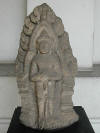
Klin Jorakae (กลิ่นจระเข้)
Thai. ‘Crocodile
Odour’.
Name of a kind of
kreuang khwaen,
i.e. net
or frame-like, stringed flower arrangements, that are used to
suspend at windows, doorways, gables, etc.
It is knitted into three diamond-shaped squares, using mainly
jasmine
buds (fig.).
At the corners are festoons of colourful flowers, such as
dok rak
(fig.)
and
dok
kulaab
(fig.),
or yellow
jampah
flowers
(fig.).
Its name derives from the fact that its shape is somewhat
reminiscent to that of a crocodile seen from above. This type of
flower decoration is depicted on a Thai postage stamp issued in 1991
(fig.).
回
Klin Khwam (กลิ่นคว่ำ)
Thai. ‘Inverted Odour’.
Name of a kind of
kreuang khwaen,
i.e. net
or frame-like, stringed flower arrangements, that are used to
suspend at windows, doorways, gables, etc.
It is knitted chain-like, using mainly
jasmine
buds (fig.)
and
dok rak
(fig.),
and has at its centre a horizontal octagonal shape or hexagram,
which has flowers hanging from each corner. This type of flower
decoration is depicted on a Thai postage stamp issued in 2005 (fig.).
It is also referred to as
Kohm Huad
(โคมหวด), i.e. ‘Huad
Lantern’
(fig.),
a name which is also used for lampshades made from a kind of
basket normally used
for steaming foodstuffs, especially
glutinous
rice,
and in Thai known as
huad.
回
_small.jpg)
klong (กลอง)
Thai generic term for
any kind of
‘drum’.
To
determine any
specific
type of drum an affix is added as a name classifier, e.g.
klong thad,
to refer to a wooden barrel-shaped drum
with a double drum head.
The
coat of arms of
Samut Songkhram bears the picture of a
such a drum floating on the water
(fig.), a reference to the old name of the
city, i.e.
Meuang Klong. The city's
symbol (fig.) also alludes to the fact that this
jangwat
lies on the banks of the
Mae Klong River
(fig.).
回
klong aew (กลองเอว)
Thai. ‘Middle drum’. A large
temple drum with a single
drum head. It is the largest drum in Thailand, with a length of
roughly three meters and a diameter of approximately fifty
centimeters. Its name refers to the middle of the drum which is
tapered. Originally from Burma where it is called
ozi. The drum is used to
gather the monks and to call the villagers to certain ceremonies,
especially during festivals such as
Songkraan and for the
ordination of young monks during
khao pansa. A smaller
version of a similar drum that can be carried hanging from the waist
is called
klong yao.
回
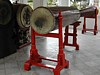
klong chana (กลองชนะ)
Thai. ‘Victory drum’. Drum used to announce victory with the
features of a Malay drum but shorter and more bulbous.
回
klong inthaperih (กลองอินทเภรี)
Thai. ‘Indra's
drum’. Term used for a large barrel-shaped
kind of war drum.
READ
ON.
回
klong khaek (กลองแขก)
Thai. ‘Guest drum’. Tall standing drum with hides on both drumheads.
It is tied with rattan strings stretching from one drumhead to the
other.
回
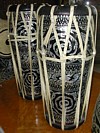
klong mahorateuk (กลองมโหระทึก)
Thai. A metal drum (fig.)
used in ceremonies of state. Formerly it was used to give warning
signals or to greet someone with music. Sometimes referred to as
simply
mahorateuk.
See also
Dong Son.
回
klong phen (กลองเพล)
Thai. Name for a large temple drum (fig.)
which is beaten at eleven o'clock in the morning to mark the start
of
phen,
the hour between eleven and twelve in the morning, when Buddhist
priests have their last meal of the day. The drumbeat, called ti
klong phen, will call the monks and novices together to start their
last meal and it is usually kept in a tower called
ho klong.
回
klong ram manah (กลองรำมะนา)
Thai. Name for a small frame drum, i.e. a flat
hand drum that has a drumhead of which the width is greater than its
depth. It has a high pitch and is used in the southern Thai music of
phleng tonyohng, which is performed
to accompany traditional
rong ngeng
folk dances, as well as
likae pah,
also referred to as likae ram manah (ลิเกรำมะนา).
In Central Thai traditional music, such as that played by a khreuang
saai (เครื่องสาย) or string ensemble, it is usually played in pair
with the
klong
thohn, and is hence referred
to as
thohn ram
manah
(fig.).
回
_small.jpg)
klong sabat chai (กลองสะบัดชัย)
Thai. A large flat drum held on two horizontal poles by two carriers
whilst the drummer plays it with his hands and elbows as well as
with his knees, moving about in a ceremonial manner. It is usually
accompanied by the beat of small handheld gongs. Features especially
in the North.
It is a war drum from
Lan Na,
that in the past was beaten during battle in order to encourage the
soldiers, and today is still seen in performing arts such as here
and in processions. In order to be auspicious and a morale for the
soldiers to fight bravely three rhythms or melodies were used, that were known
as Chai
Pherie
(ชัยเภรี), Chai
Dithi
(ชัยดิถี), and Chana
Maan/Mara
(ชนะมาร), which loosely
translates ‘Victory by Drum’, ‘Auspicious Triumph’, and ‘Conquering
[the] Evil [One]’, respectively.
See also TRAVEL
PICTURES
and
VIDEO.
回
klong thad (กลองทัด)
Thai. A drum with a
double drum head made of cow or buffalo hide and fixed with pins
onto the wooden barrel, a shape resembling that of the
klong inthaperih (fig.).
It is about 41 centimeters high and has a diameter of around 46
centimeters. There are always two klong thad that are played
together, one with a high "tum" sound, called tua phoo (ตัวผู้) or
the ‘male’ drum, the other with a low "tom" sound and known as tua
mia (ตัวเมีย) or the ‘female’ drum. On one side, they have a metal
ring, which is used to attach long sticks used as a support, when
the drum is placed with one drum head on a cushion, tilting it to an
inclined pose easy to play, which is done with a pair of circa 54
centimeter long
drumsticks. They are characteristically used
in the
mahori
and orchestras consisting chiefly of the
ranaat ek, such as the
pih phaat
(fig.).
They are oftentimes decorated, with the nicer ones inlayed with
ivory
or
mother-of-pearl
(fig.).
回
%202_small.jpg)
klong thohn (กลองโทน)
Thai. A kind of small, low-pitched, goblet-shaped hand drum, with a
wooden or ceramic body. In Central Thai traditional music, such as
that of a khreuang saai (เครื่องสาย) or string ensemble, it is often
played in pair with the
klong ram manah,
and is hence referred to as
thohn ram
manah
(fig.).
回
_small.jpg)
klong tuk (กลองตุ๊ก)
Thai. A drum resembling the
klong thad but
smaller, and barrel-shaped, similar to the
klong inthaperih.
回
klong winitchayperih
(กลองวินิจฉัยเภรี)
Thai. ‘[To make the] (final) decision drum’ or simply ‘decision
drum’. Name of a big barrel-shaped drum, similar is form and size to
the
klong inthaperih
(fig.),
and which in the past was erected at the edge of the palace. When
anyone wanted to petition a special request on an important issue or
submit a grievance, one could beat the drum and the palace doors
would be unlocked, akin to the system of the
Bell of Ramkamhaeng
(fig.)
used by
King
Ramkamhaeng
(fig.)
in the
Sukhothai
Period and described on Inscription Nº 1, i.e. the
Stone of Ramkamhaeng
(fig.).
An authorized messenger would then take the request or grievance and
bring it up to the king, and later return the latter's decision. To
prevent misuse and raise the threshold, as any presentation of a
petition was a disturbance of the king, the drum had to beaten 30
times, to prove it was worth the trouble. If anyone abused the
system by petitioning too many requests at once, a certain fee had
to be paid, thus encouraging restraint. The use of the decision drum
was eventually abolished by King
Rama IV
when other offices with direct channels for petitioning came into
place. Perih, also spelled pairih (ไภรี) and pairin (ไภริน), is a
Pali
—and now archaic—
term for ‘drum’, and thus has the same meaning as the word klong,
which also translates ‘drum’. It seems the term klong is here added
to clarify the meaning of the word perih for those who are not
familiar with this more archaic Pali term.
回
klong wong (กลองวง)
Thai. ‘Drum circle’. Percussion instrument consisting of several
drums with different tones hung in a circular structure.
回
_small.jpg)
klong yao (กลองยาว)
Thai. ‘Long drum’. Drum with a single drum
head carried hanging from the waist and played by hand (fig.).
It looks like a smaller version of the
klong aew, the long
narrow temple drum. This kind of drum is also used as an attribute
in a dance called
ram klong yao.
See also POSTAGE STAMP.
回
klot (กลด)
1. Thai. State umbrellas, held by an attendant
over the king, queen and the crown prince on state occasions to
protect them from the sun and rain. See also
chattra and
rom.
回
2. One of the permitted possessions
or
borikaan of Buddhist monks and
novices. It is an umbrella used to sit and meditate under (fig.) and to sleep under
in the forest when they go out on
thudong.
See also
rom
and
WATCH VIDEO.
回
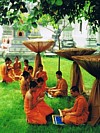
kluay (กล้วย)
Thai. ‘Banana’. Fruit of the
banana plant (fig.),
of the genus Musa of which there are many different species. See
gluay.
回
kluay pad (กล้วยพัด)
Thai. ‘Banana fan’. Evergreen tree that grows
up to 10 meters. Distinctive are its large paddle shaped leaves on
long stalks, resembling those of a banana plant (kluay)
but spreading like a fan (pad).
Since rainwater collects easily between its leaves and can be used
in emergencies to quench one's thirst, it got the nickname
traveller's palm or traveller's tree. Its Latin name is Ravenala
madagascariensis. Also transcribed gluay pad.
回
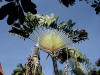
kluay ob neuy (กล้วยอบเนย)
Thai for
butter-baked
banana. A
snack made from raw, horizontally sliced banana, which is left to
dry, then seasoned with salt and deep fried. Next it is stirred
whilst sugar, sesame seeds and butter are added. It is a well-known
snack of the
amphur
Khirimaht (คีรีมาศ) in
Sukhothai.
Also transcribed
gluay ob ney. See also
gluay ob.
回
kluk khao thod (คลุกข้าวทอด)
See
khao kon
thod.
回
Knight
Common name for a species
of medium-sized butterfly, which is known by the scientific name Lebadea
martha. It is found across tropical and subtropical Asia and somewhat
resembles the
Commander
(fig.).
The
upper-side of its wings are orangey
brown, with brown, tawny and blackish spots, as well as white markings
that are arranged across the four wings in a V-shape which reach to the
very tips of the forewings, where the white markings are more scattered.
回
_small.jpg)
Knob-billed Duck
See
Comb Duck.
回
ko (โค)
Thai name for an ox or
bull,
and often used as a prefix for
Nondi. Also the
Cambodian word for an ox. In Buddhist art a white ox is the vehicle
of the Buddha. The word ko derives from the Sanskrit word go, which
in English means ‘cow’ and is also etymologically related to the
latter.
In India, the cow
is regarded as sacred, a phenomenon in the West usually referred to
as the holy cow (fig.).
The ox is the second animal in the cycle of the
Chinese zodiac
(fig.)
and represents patience, endurance and perseverance, and those born
in the Year of the Ox are said to be kind, honest and altruistic,
and are often charismatic people that attract a following.
The ox features on certain Thai postage stamps, including the Zodiac
Year of the Ox Postage Stamp issued in 2009 (fig.)
and the
Songkraan
Day Postage Stamp issued in 1997 (fig.),
and
the Zodiac Year of the Ox Postage Stamp issued in 2021 (fig.).
See also
Zebu,
Govinda,
and
THEMATIC STREET LIGHT.
回
kodawari (拘り, こだわり)
Japanese term that
describes the relentless and uncompromising pursuit of perfection,
with a sincere, unwavering focus on what one is doing, with
commitment to the highest of standards, and which eventually
reflects in the premium quality of the finished product, whether in
art, a craft or an activity. See
also
karoshi
and compare with the Chinese term
Kung Fu.
回
Kodchamukha (คชมุขา)
Thai-Pali term for
Gajamukha.
回
Kodchamukhasoon (คชมุขาสูร)
Thai-Pali term for
Gajamukhasun.
回
kodchasaan (คชสาร)
Thai-Pali term for ‘elephant’.
回
Kodchasih (คชสีห์)
Thai-Pali name of a fabulous animal
from the
Himaphan
forest, similar to a
lion but with
a trunk and tusks like an
elephant. It is very
similar to another mythological creature with an almost identical
physical appearance, but with a beard and hair that flows forward,
and which is known as
Takkatoh (fig.).
The name
derives from the words
kodchasaan,
meaning ‘elephant’ and
sih, i.e.
‘lion’. In Sanskrit, the cross
between an elephant (gaja)
and a lion (singha)
is called
Gajasingha (fig.),
of which there are several types. It is the symbol and logo of the
Ministry of Defence.
Also transcribed Kotchasih and Kochasi, and sometimes wrongfully
transliterated Kochasri.
It appears on a
Thai postage stamp issued in 1998 (fig.).
回
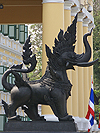
Kohdom (โคดม)
Thai for
Gautama.
回
Ko Gyi Kyaw (ကိုကြီးကျော်)
Burmese.
‘Great Aid Kyaw’.
Another appellation for the
nat
Min Kyawzwa.
回
koh (เกาะ)
Thai for ‘island’. Pronunciation
should be short, and it is also found
transliterated ko, go and goh. Thailand has an abundance of islands in both the
Gulf of Thailand
and the
Andaman Sea. The 11 top ten provinces with the
most islands are as follows:
Phang Nga
with 155 islands,
Krabi
with 154 islands,
Surat Thani
with 108 islands,
Satun
with 106 islands,
Trat
with 66 islands,
Ranong
with 56 islands,
Chumphon
and
Trang
each with 54 islands,
Chonburi
with 47 islands,
Phuket
with 37 islands, and
Prachuap Khirikhan
with 23 islands. Altogether, these provinces alone boast a combined total of 860
islands. The top 5 largest islands of Thailand are
Phuket
Island (fig.), located in the
Andaman Sea with an area of 514.675 square kilometers; Koh
Samui
(fig.)
in the Gulf of Thailand with 236.079 square kilometers;
Koh Chang (fig.), also in the Gulf of Thailand, with
an area of 212.404 square kilometers; Koh Tarutao in the Andaman Sea, covering
150.84 square kilometers; and Koh Pha Ngan (fig.) in the Gulf of Thailand, spanning
122.017 square kilometers. These islands are all over 100 square kilometers in
area. Besides these marine islands, there are also inland lake and river islands
located in freshwater bodies, such as
Koh Kret
(fig.),
for example.
See also POSTAGE STAMPS (1),
(2),
(3) and
(4),
TRAVEL PICTURES (1),
(2),
(3),
(4),
(5),
(6),
(7),
(8),
(9),
(10),
(11),
(12)
and
(13),
and
WATCH VIDEO.
回
Koh Chang (เกาะช้าง)
Thai. ‘Elephant
Island’.
Name of the largest island (koh) in the
Chang archipelago, which includes 66 islands
within the province. It is the third largest island in Thailand, with an area of
212.404 square kilometers. It is a district of
Trat
Province, located on the eastern side of the
Gulf of Thailand.
Koh Chang is part of Moo Koh Chang (หมู่เกาะช้าง) National Park, which covers an
area of about 650 km², and is known for its dense, steep jungles, waterfalls,
coral reefs, and long sandy beaches (fig.),
making it a popular destination (fig.)
for both Thai and international tourists seeking a mix of adventure and
relaxation. Among its treasures lies an abandoned cruise ship, a ghostly vessel
resting at the island's southernmost tip, nestled on the fringes of the jungle.
The island holds historical significance as the site of the Koh Chang naval
battle during World War II (fig.).
This naval engagement on January 17, 1941, saw a small but significant battle
unfold in these coastal waters between the French and Thai Navy, resulting in
the loss of 37 Thai lives.
回
kohk kek (โกกเกก)
Thai. Name of a running competition
on stilts. The player has to balance his stand on a cock's spur of each stilt,
holding on using his hands, while trying to outrun his competitors or
−alternatively− set the fastest time. The game is also known as thohk thek (โทกเทก),
and is sometimes described as kaanla-len deun mai suhng (การละเล่นเดินไม้สูง),
i.e. the ‘game of walking on high
stilts’.
See also POSTAGE STAMP.
回
Koh Kret (เกาะเกร็ด)
Thai. ‘Splinter Island’. Name
of a small island in the
Chao Phraya
River.
READ ON.
回
Koh Lanta (เกาะลันตา)
Thai.
Name of an island in
Krabi.
回
kohm fai (โคมไฟ)
See
kohm loy.
回
kohm kahng
(โคมค้าง)
Northern Thai speech for
kohm kwaen.
回
kohm kwaen (โคมแขวน)
Thai.
‘Hanging lantern’.
A kind of
Lan Na style lantern
primarily used for decoration, as well as a light source at
night. Its shape is usually either round, square,
hexagonal
or
octagonal. It is made of a wooden frame covered with
cellophane (fig.),
paper, glass or any other material that allows light to shine
through. They come in colours or just plain white, and are
adorned with
silver or gold paper edging and trimming (fig.).
Inside is a
lamp
or another light source that won't cause a blaze. It is
mostly used in Northern Thailand, where it is called
kohm
kahng. In Buddhist
communities, the offering of lanterns, a tradition known as
praphenih
kwaen kohm (ประเพณีแขวนโคม),
is closely associated with religious devotion and typically
takes place after the end of
Buddhist Lent, aligning with the
Yi Peng
(fig.)
or
Loi Krathong
(fig.)
festivals. This practice reflects the reverence for fire or
light as a sacred element that provides guidance and protection.
Hanging lanterns symbolizes the preservation of light, ensuring
that the flame remains steady, much like a spiritual safeguard
for those who partake in the tradition. Today, this custom is
observed at various temples in northern Thailand, where devotees
offer lanterns as an act of worship and seek blessings for
prosperity and well-being.
See also
POSTAGE STAMPS,
THEMATIC STREET
LIGHT (1),
(2),
(3),
(4)
and
(5),
TRAVEL PICTURES (1),
(2)
and
(3), and
WATCH VIDEO.
回
kohm loi (โคมลอย)
See
kohm loy.
回
kohm loy (โคมลอย)
Thai. ‘Floating lantern’. A lantern made from
paper similar to a hot air balloon with a candle or fuse supplying
the heat (fig.).
They are usually white but also coloured ones exist (fig.).
It is a tradition of North Thailand that dates back to the
Sukhothai
period when these lanterns were launched by its kings. During the
festival of
Loi Krathong in Sukhothai or
Yi Peng
in
Chiang Mai,
hundreds of lanterns are released simultaneously, lighting the sky
spectacularly (fig.).
According to Buddhist tradition, the
paper lanterns are lit and released into the sky as offerings to
Chulamanie, a
stupa
containing hair from the
Buddha
in
Tavatimsa
heaven. However, others may say that they do
this in order to rid themselves of sins, misfortune or bad
karma,
whilst yet others may do it just for the fun of doing it.
Also called
kohm fai
(fire lantern), and also transcribed as ‘kohm loi’.
WATCH VIDEO (M).
回
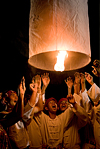
Kohmut (โกมุท)
Thai-Pali. Name of a
monkey-warrior
from the city
from the city of
Meuang Khiet Kheun (เมืองขีดขิน), who
appears in the
Ramakien.
He is an ally of
Phra Ram
(fig.)
and is described as having a
fur
in the colour of a
faded
lotus,
which is sometimes explained as pinkish purple. His weapon is a
sword
and he
wears a
golden
kabang-style
crown.
He is the counterpart of
Chaiyaamphawaan
(fig.).
He is one of the
eighteen
Wahnon Sip-paet Mongkut, and an
avatar
of
Phra
Himaphan.
Also transcribed Gohmut and Komut.
See also LIST OF RAMAKIEN CHARACTERS & NAMES,
and
TRAVEL PICTURE.
回
_small.jpg)
Kohn Phom Fai (โกนผมไฟ)
Thai. ‘To shave the
hair present at birth’. Another name for a ritual called
Tham Khwan Deuan.
回
koht (โกศ, โกษ)
1. Thai name for a royal urn, i.e.
a funeral urn used to store and transport the body of a deceased member of the
royal family prior to cremation, typically
at
Sanam Luang
(fig.).
The body is kept upright in a seated pose inside the large ossuary, which has a
krabok-shape
of which the mouth at the top is covered by a
chadah-like
lid, i.e. with a Thai crown-like spire. The koht is kept on a pedestal and
transported on a palanquin or royal chariot called
rajarot
(fig.),
in order to preserve the deceased royal's elevated position, i.e. on an higher
level than his or her subjects.
See also
TRAVEL PICTURE.
回
%20royal%20funeral%20urn_small.jpg)
2. Thai name for a royal urn, i.e.
a depository used to store the ashes and bones of a deceased member of the royal
family after cremation.
回
Koh Tao (เกาะเต่า)
Thai. ‘Turtle Island’. Name of a
small island off the eastern coast of the
Gulf of Thailand (fig.),
near the southern province of
Chumphon,
though administratively it belongs to the province of
Surat Thani.
It covers an area of just about 21 km² and has a population of less than 1,400.
Its most important town is Ban Mae Haad, which is also the main harbour. The
island has several secluded, sandy beaches (fig.)
and is said to be an important breeding ground for certain species of sea
turtles. It is also a famous paradise for snorkeling and scuba diving, and a
small viewpoint island,
located just off the northwestern coast of Koh Tao and known as Koh Nang Yuan (map
-
fig.). Historically, it was once a place where political prisoners
were detained, similar to Koh Tarutao in
Satun
Province. Also spelled Ko Tao.
See MAP.
回
_small.jpg)
Koh Thalu (เกาะทะลุ)
1. Thai. ‘Pierced
Through Island’. Name of a small
island
located on the western seashore of the
Gulf of Thailand,
off
the coast of
Prachuap Khirikhan,
in the
southernmost extremities of this
province,
roughly
near
Pha Fang Daeng, i.e. the ‘Red
Cliffs’ (fig.).
The island has an arched rock formation and a beautiful seabed rich
in corals and colourful fish.
WATCH VIDEO
and
VIDEO (EN).
回
2. Thai. ‘Pierced
Through Island’. Name of an island
in
Phang Nga
Bay, characterized by a towering
limestone cliff with
an arched tunnel-like cavity at its base.
WATCH VIDEO.
回
_small.jpg)
koi carp
See
pla kooy.
回
kok (กก)
Thai. General name for
sedges, a large family of rush or reed-like waterside or marsh
plants which includes the Papyrus Sedge.
The Thai name kok is used for several species, including the cyperus
(fig.),
carex, scirpus and fimbristylis. Of many kinds the stems are used in
weaving to make baskets, mats, etc. It is often seen as an
ornamental plant in garden pools but also as an imitation interior
plant, made from more durable synthetic materials (fig.).
See also
Kok River.
回
%20sedge,%20rush,%20reed%20(cyperus,%20carex,%20scirpus%20and%20fimbristylis)_small.jpg)
kokeshi (こけし, 小芥子)
Japanese. Name for a
simple traditional Japanese wooden doll, without arms or legs, and
usually dressed in a
kimono with floral motifs. It
often has a geisha-style or pageboy bob hairstyle with a hair
ornament, usually a kind of hair pin. Modern versions often have a
movable head.
回
_small.jpg)
kok ih-yipt (กกอียิปต์)
Thai. ‘Egypt(ian)
Sedge’. Name for the Papyrus Sedge, a kind of
kok,
that is a marsh plant, with the botanical designation Cyperus
papyrus. It can grow up to around 4 metres tall and consists of a
thick green stem, which is topped by a dense cluster of bright
green, thin lance-shaped leaves. When blooming, it will bear
whitish-green flower clusters, with a brownish centre (fig.).
回
%20กกอียิปต์%201_small.jpg)
Kok River
Name of a shallow, wide
and slow-moving river, that originates in
Myanmar's
Shan
State and enters Thailand in
Chiang Mai
Province.
READ ON.
回
Komodo Dragon
Common name for a large species of lizard found on the Indonesian
island of Komodo and a few neighbouring islands. It is the largest
living species of lizard on the planet and a member of the family of
monitor lizards.
It can grow up to 3.1 meters long and weigh as much as 166
kilograms.
回
Komuso (虚無僧, こむそう)
Japanese. ‘Priests of
Nothingness’ or ‘Monks of Emptiness’. Name of a 17th to mid-19th
century AD sect of
Zen
Buddhist mendicant monks in
Japan, who were distinguished for playing the
shakuhachi, a type of
bamboo
flute, in order to beg for alms
and for
meditation so as
to
achieve the desired state of Emptiness. While travelling, they were
also renowned for wearing the
tengai, a beehive-shaped reed hood
that fully covered the head and face, in order to manifest the
absence of specific ego.
回
Konagamana
Pali. A
buddha of the past, a
precursor of the historical
Buddha. He is
the 26th of the 27
buddhas
that preceded the
Sakyamuni
Buddha,
and one
of the four buddha's depicted in
Ananda Phaya
in
Bagan,
located at its East Gate, the others being
Kassapa
facing South (fig.),
Kakusandha
facing North (fig.),
and
Gautama at the
West Gate
(fig.).
According to Burmese mythology, Konagamana was born on a Wednesday
and is, similar to the
Phra prajam wan geut-system
of
Thailand,
in
Myanmar
associated with the Buddha of Wednesday.
In Thai he is known as Gonahkmana (โกนาคมนะ)
and in Burmese he is called Konagon (ကောဏာဂုံ).
回
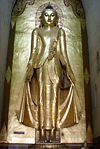
Konfutse (孔子)
Chinese name for the
Chinese philosopher and religious reformer (fig.),
who lived from 551 to 478 BC and is in English usually referred to
as
Confucius (fig.).
In
iconography,
he is typically portrayed with a long beard and holding one hand on
top of the other (fig.),
a
mudra
or hand position that
symbolizes the
balance of
yin
and
yang,
i.e.
yin-yang
(fig.).
In
Vietnam, his name is
Khong Tu (Khổng Tử).
See also
Cup of Confucius
and
WATCH VIDEO (1)
and
(2).
回
kong (ข้อง)
Thai. An aphaeresis of
takong.
回
kong (ฆ้อง)
Thai. Collective term for gongs, which have
many forms and shapes.
READ ON.
回
kong banchakaan (กองบัญชาการ)
Thai for
‘headquarters’.
回
kong dap phleung (กองดับเพลิง)
Thai. ‘Fire
brigade’. Protective work and fire control in Thailand.
READ ON.
回
kong hin (กองหิน)
Thai. ‘Pile of rocks’.
Term used for a kind of cairns, human-made stacks of stones often
seen in outdoor and wilderness settings. These structures serve as
landmarks, symbolizing a tangible mark left behind by individuals to
signify their presence or passage in specific locations. Commonly
found throughout Thailand in natural settings, especially mountains
and caves, these rock piles have historical roots. In ancient times,
people placed piles of rocks at intersections, mountain ravines, or
elevated hills—border areas frequented by travelers. This practice,
known as
kaan koh kong hin,
was considered a gesture of communication and reverence toward the
guardian spirit of the mountains, aiming to instill a sense of
security along these routes. These rock piles are reminiscent of
Buddhist stupas, that are regarded as sacred structures. However, in
recent years, there has been a growing trend among certain groups of
tourist, who engage in constructing these stacks of rocks. Various
explanations have been offered for this behavior, ranging from
securing a dwelling in the afterlife to the belief that stacking
rocks can bring stability, prosperity, and the fulfillment of
wishes. Today, entire fields of cairns, known as thung hin kong, can
be found in many natural tourist locations. Unfortunately, the
actions of these tourists have adverse effects on the natural
environment, leading to the destruction of scenery and potential
alterations to archaeological evidence at various ancient sites.
VIDEO (EN-1)
and
(EN-2).
回
_small.jpg)
kong hod (กองฮด)
Thai. Name of a
ritual, especially in
Isaan and the
North, but also known in
Laos,
in which Buddhist monks are blessed with water. Monks are expected
to learn various chants and translations of
Pali
texts, the
sacred language of
Theravada
Buddhism, and once
they have passed certain steps, the villagers arrange a
promotion ceremony for
them, in which they pour the monks with perfumed water. The ceremony
is usually performed on Buddha statues or on monks who have been ordained for at least
three years and includes gathering rain water, which is then usually
scented and poured over the head, neck and back of the monk, who
will wait motionless whilst making a
wai-gesture.
In the process, the villagers use
what looks like a ceremonial
trough (fig.),
i.e. an about 6
sok
long, wooden, narrow and open
receptacle, known in the Northeast as
haang hod,
and in the North as
hin hod nahm.
This adorned, gutter-like vessel is cut from tropical hardwood and
made in the form of a
naga,
the protector of both the waters and Buddhism (fig.).
The water runs through the channel of the
receptacle,
from the tail end down to the head of the naga, where the channel
ends in a hole, under which the monks take place. Although this
ceremony is still practiced today, the official promotion for monks
is now handled by the
Sangha.
See also
sek,
rod nahm mon,
boon song nahm and
song nahm phra.
WATCH VIDEO.
回
kong keun (กองเกิน)
Thai term for registered
men
of pre-military age who have been
listed for military service but are nor yet officially called up.
At the age of twenty every
Thai
boy is summoned to come and draw a lot of which the colour
determines
if one is
conscripted
or
let off: if the colour is red, one is drafted; if black, one is
exempt.
Volunteers
however may join the military at the age of 18.
回
kong khao (ก่องข้าว)
Thai. Another name
for
kratib or
aeb
(fig.).
回
Kongming Lock
A
traditional Chinese intellectual toy accredited
to Zhuge Liang, who is also known as Zhuge Kongming and who lived
during the
Three Kingdoms
Period. The toy is a kind of three-dimensional wooden puzzle, made
up of building blocks and based on the principles of
dougong (fig.),
i.e. interlocking wooden brackets used in ancient Chinese
architecture. Kongming Locks come in different sizes and shapes, and
with different internal structures. The concave and convex parts
inside the interpolation toy mesh perfectly. Nonetheless, they are
generally easy to take apart, but difficult to reassemble. In
Chinese, it is known as
Kongming Suo.
回
Kongming Suo (孔明锁)
Chinese for
‘Kongming
Lock’.
回
kong tamruat (กองตำรวจ)
Thai
for
‘police’. See
Royal Thai Police.
回
kong teik (功德)
See
gong de.
回
kong thap (กองทัพ)
Thai. ‘Army’ or ‘military might’. See also
Royal Thai Armed Forces.
回
kong thap reua (กองทัพเรือ)
Thai
for ‘navy’.
See also
Royal Thai Navy.
回
kong phan thahaan mah (กองพันทหารม้า)
Thai.
‘Cavalry’. Soldiers on horseback.
Though the Royal Cavalry
still has the occasional role to play on horseback, especially
ceremonially, such as during royal parades and as guards of honour,
today they operate mainly from light armoured vehicles and tanks (fig.).
These soldiers' ceremonial dress consists of a grey uniform with a
thin yellow stripe and brocade, red-gold collars and cuffs. They
wear black horse boots and on their heads they have a shiny,
silver
with gold helmet, with on top a blue, draping tail. When parading on
horseback, ordinary cavalrymen and non-commissioned officers also
hold a spear with a white tail, upright in their right hand.
See also CEREMONIAL DRESS OF THE ROYAL GUARDS,
MAP of THE 2nd CAVALRY DIVISION,
TRAVEL PICTURES (1)
and
(2),
and
EXPLORER'S MAP (1),
(2) and
(3).
回
%203_small.jpg)
kong wong (ฆ้องวง)
Thai. ‘Gong circle’. Percussion instrument consisting of several
small gongs (kong) with different tones hung on a circular rattan frame.
There are two types, i.e.
kong wong yai
(fig.)
and
kong wong lek
(fig.),
i.e. the ‘big gong circle’ and the ‘small gong circle’,
respectively. The kong wong yai dates from the
Sukhothai
period and is made with Indonesian-style gongs. It has 16 tuned
bossed gongs and is played with either one or two musicians, who sit
in the middle of the circle and may use either soft or hard beaters.
The kong wong lek dates from the reign of
Rama III, has
18 tuned bossed gongs, that are smaller and higher in pitch than
those of the kong wong yai. Each of the gongs is individually tuned
by applying beeswax on the underside of the gongs.
The two types of kong wong appear on Thai postage stamps issued in
1982, as part of a set of 8 stamps depicting Thai musical
instruments that are typically used in a music ensemble referred to
as
pih phaat
(fig.).
Also transcribed khong wong and sometimes referred to as bell wheel.
回
kong wong lek (ฆ้องวงเล็ก)
Thai. ‘Small gong circle’. Percussion instrument consisting of 18
tuned bossed gongs (kong), that are hung horizontally on a circular rattan
frame. It is played with either one or two musicians, who sit in the
middle of the circle and who may use either soft or hard beaters.
This type of bell wheel
dates from
the reign of King
Rama III.
Its name refers to the size of the gongs and not of the rattan
frame. It appears on a Thai postage stamp issued in 1982, as part of
a set of 8 stamps depicting Thai musical instruments that are
typically used in a music ensemble referred to as
pih phaat
(fig.).
See also
kong wong and
kong wong yai.
回
_small.jpg)
kong wong yai (ฆ้องวงใหญ่)
Thai. ‘Big gong circle’. Percussion instrument consisting of 16
tuned bossed gongs (kong), that are hung horizontally on a circular rattan
frame. It is played with either one or two musicians, who sit in the
middle of the circle and who may use either soft or hard beaters.
This type of bell wheel dates
from the
Sukhothai
period and is made with Indonesian-style gongs.
Its name refers to the
size of the gongs and not of the rattan frame. It appears on a Thai
postage stamp issued in 1982, as part of a set of 8 stamps depicting
Thai musical instruments that are typically used in a music ensemble
referred to as
pih phaat
(fig.).
See also
kong wong and
kong wong lek.
回
_small.jpg)
kong zhu (空竹)
Chinese.
‘Sky
bamboo’.
Name for the Chinese yo-yo, i.e.
a toy that originates from
China
and is the precursor of the western diabolo. It consists of a pair
of discs, usually a large one at the top and a smaller one at the
bottom, that are connected by a elongated axle which has a deep
groove, and which is kept spinning on a string through a
gyroscopic-like motion caused by the player, who accelerates or
slows the yo-yo by moving two sticks to which ends the string is
tied. Modern models are usually made of plastic and often have
grooves inset in the rim of the discs, which cause the yo-yo to make
a buzzing sound when spinning at high speeds and which allows the
player to determine and adjust the velocity of the yo-yo. It was
purportedly invented during the Ming Dynasty and initially made from
bamboo, hence the name.
Spinning the yo-yo is in Chinese referred to as
dou kong zhu.
回
kon tamleung thong (ก้อนตำลึงทอง)
Thai for a Chinese gold
ingot. It has a boat-like shape that resembles a smile
(fig.)
because it helps those who find it to be happy. It is
therefore an
attribute
of the
Smiling Buddha
(fig.)
who is also known by the names
Budai
(fig.),
Mi Le Fo and
Huan Xi Fo
(fig.).
Besides this it is also held by many other Chinese deities, in
particular by the
Chinese
wealth god,
Cai Shen.
It is often decorated with Chinese symbols or characters, e.g.
old Chinese coins, the
character
fu
(fig.)
or a picture of a
bat
(fu),
amongst others. In Chinese temples and shrines it is found in paper
form and used as a
burn offer in the Chinese ritual
gong de
(fig.).
In
feng shui,
replica Chinese gold ingots are placed in the wealth area, i.e. is
the southeast sector, of homes and businesses to attract fortune and
abundance. In present-day China,
the more convenient gold panda coins (fig.),
which since 1982 are issued annually by the People's Bank of China (fig.),
have become the accepted replacement for gold ingots, and are
popular with both collectors (fig.)
and those who like to invest their savings in gold.
There are also
silver
ingots, in Thai called kon tamleung or kon
tamleung ngun (fig.),
and in Mandarin gold and silver ingots are referred to as yuan bao
(元宝), which derives from the name for ancient currency. The same
Chinese word is also used for mock ingots, i.e. ingots made from
paper to be burnt as an offering, as in
gong de
(fig.),
as well as those made from plastic (fig.),
which are used for a variety of purposes, not seldom related to
religious worship. In Cantonese, ingots are called xisi (细丝), which
could be literally translated as
‘fine
silk’.
See also
tamleung
and
Thai gold.
回
koob (กู๊บ)
Thai Yai.
Name of a typical farmer's hat worn by the
Shan
people of
Mae Hong Son
province. See also
ngop
and
non la. 回
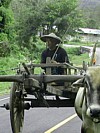
Koo Pohn Rakhang (กู่โพนระฆัง)
Thai name of an ancient
historical site located on the eastern edge of a raised mound near
Wat Burapha Ku Ka Sing (fig.)
in
Roi Et
Province. The site was officially registered as a national ancient
monument and published in the Royal Gazette on 18 November 2012. The
protected area covers approximately 2 rai, 3 ngan, and 17 square wah.
Koo Pohn Rakhang, also transliterated Ku Phon Rakhang, is identified
as an
Arokhayasahn
or
Arokyasala hospital sanctuary, a
distinctive type of religious structure established during the reign
of King
Jayavarman VII (fig.)
of the ancient
Khmer
Empire. Constructed in the
Bayon
artistic style and associated with
Mahayana Buddhist ideology, the
monument dates to the 18th Buddhist century, corresponding to the
late 12th to early 13th centuries AD. The construction of Arokyasala
sanctuaries across the empire reflects a major transformation in
state religion, marking the royal endorsement of Mahayana Buddhism
in place of earlier
Hindu traditions. These
hospital temples functioned both as centres of healing and as
religious institutions, forming an extensive network that served
communities throughout the Khmer realm. Architecturally, Koo Pohn
Rakhang was built primarily of
laterite,
with brick and sandstone employed in structural areas requiring
greater strength and in sections featuring carved decorative
elements. The monument’s layout follows a standard Arokyasala plan.
It consists of a single main sanctuary facing east, accompanied by a
library,
positioned to the southeast of the principal structure. The complex
is enclosed by a rectangular laterite wall. At the centre of the
eastern enclosure wall, aligned with the main sanctuary, is a
cruciform entrance pavilion, or
gopura.
A sandstone-paved walkway connects the front of the main sanctuary
directly to this gateway, reinforcing the strong axial orientation
characteristic of Khmer religious architecture.
WATCH VIDEO
and
VIDEO (EN).
回
_small.jpg)
kooprih (กูปรี)
Thai name for
Kouprey.
回
ko phra chedi saai (ก่อพระเจดีย์ทราย)
Thai. ‘Building a sand
chedi’.
Name of a kind of local folk
amusement which is derived from the religious rite
of
khon saai khao wat,
the practice of bringing sand back to the temple (fig.)
in order to replace all the sand that has been carried out from
temple grounds sticking to visitors feet, as a form of
tamboon.
Also called
ko sang phra chedi saai.
WATCH VIDEO.
回
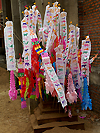
kopi luwak
Indonesian. ‘Civet
coffee’. Name for a kind of
coffee, which
is made from
coffee berries (fig.)
that
have been eaten by the
Common Palm Civet
(fig.).
READ ON.
回
kop sahm kha (กบสามขา)
Thai. ‘Three-legged
frog’. One of several designations used for
kaangkok sawan.
回
koram (โครำ)
See
Mainland Serow.
回
Koran (القرآن)
Arabic. ‘Recitation’. Sacred scriptures of
Islam. A collection of oral
revelations received by the prophet
Muhammad, considered
by
Muslims
to be the words of Allah. Also Quran and Al Quran, i.e. ‘the
recitation’.
回
Koran Angelfish
Common name for a
species of marine reef-fish, with the scientific name Pomacanthus
semicirculatus.
READ
ON.
回
Korat (โคราช)
1. Thai. Popular name
for
Nakhon Ratchasima
derived from the Plateau of Korat, the gateway to the plains of
Isaan.
回
2. Thai. A kind of
Siamese Cat,
with short, slate blue-grey hair. Also called
maew
korat and also locally known as maew malet (แมวมาเลศ) and maew sih
sawaat (แมวสีสวาด).
In 1995, this cat was depicted on one
of a set of four Thai postage stamps featuring Siamese cats (fig.).
回
Korat Zoo
See
Nakhon Ratchasima Zoo.
回
kornak
See
mahout.
回
Kosala (कोशल)
The empire of King
Dasharatha, the father of
Rama. Also transcribed
Koshala.
回
Kosih (โกสีย์)
A Thai designation for
‘Indra’.
回
Kosin (โกสินทร์)
A Thai name for
‘Indra’.
It is a compound of
Kosih and
In.
回
Kosathibodih (โกษาธิบดี)
1. Thai. Name of a
Siamese general and foreign minister during the
Ayutthaya
Period, with the title of
Chao Phraya
and also known as
Kosa Lek.
回
2. Thai. Name of a
Siamese diplomat and foreign minister in the
Ayutthaya Kingdom, with
the title of
Chao Phraya, who also known as
Kosa Paan.
回
Kosa Lek (โกษาเหล็ก)
Thai. Name of a Siamese
general and foreign minister during the
Ayutthaya
Period, with the title of
Chao Phraya.
He held the position of foreign minister under the name
Kosathibodih.
He was the older brother of
Kosa Paan,
who also became foreign minister after Kosa Lek, as well as
of
Thao
Chulalak (จุฬาลักษณ์), the concubine of King
Narai
(fig.).
To differentiate him from his brother he is usually referred to as
Chao Phraya Kosathibodih (Lek) and his brother as
Chao Phraya Kosathibodih (Paan).
See also TRAVEL PICTURES.
回
_small.jpg)
ko sang phra chedi saai (ก่อสร้างพระเจดีย์ทราย)
See
ko phra chedi saai.
回
Kosa Paan (โกษาปาน)
Thai. Name of a Siamese
diplomat and foreign minister in the
Ayutthaya Kingdom, with
the title of
Chao Phraya, who in 1686 AD led the
second Siamese diplomatic embassy mission to France, sent by King
Narai
(fig.).
He was the younger brother of
Kosa Lek, who held the position of
foreign minister before him, also under the name
Kosathibodih.
Kosa Paan's success in diplomatic negotiations earned him the
epithet Rajathoot Lin Thong (ราชทูตลิ้นทอง), i.e. ‘Golden-tongued
Diplomat’.
To differentiate him from his
brother he is usually referred to as Chao Phraya Kosathibodih
(Paan) and his brother as
Chao Phraya Kosathibodih (Lek).
Often transliterated Kosa Pan.
回
Kouprey
Common designation for
a rare wild ox, which is found in the forests of northern
Cambodia,
as well as across its political borders, into southern Laos, western
Vietnam,
and eastern Thailand. It is the national animal of Cambodia and has
the scientific name Bos sauveli, and in Thai it is called
kooprih.
Both the Thai and common name derive from the
Khmer
designation
goa bpray-ee,
which means ‘wild ox’, and if literally translated into Thai would
be
ko
pah (โคป่า).
Kouprey have tall
but narrow bodies, long legs and humped backs, and the colour of
their fur ranges from dark brown, to grey or black, while the lower
legs are tan. The horns of the female are lyre-shaped and spiral
upwards, whereas those of the male are wide and arch forward and
upward. In 1973, Thailand issued a series of postage stamps with
rare and endangered wild animals, including one with illustrations
of Kouprey (fig.).
Also known as
Kouproh and Grey Ox.
回
kraab (กราบ)
Thai. ‘To prostrate’ in
order to pay homage or to show respect. When gesture is combined by
a
wai,
it
is known as
aphiwaht,
and when using five parts of the body, it is known as
benjahngkhapradit, i.e. prostration
in which the head, hands and feet touch the ground (fig.).
Also transliterated krahb and a synonym of krahn/kraan (กราน),
a term that occurs in the Thai
Royal Hymn.
回
krab (กรับ)
1. Thai. Two, usually bean or
crescent-shaped pieces of wood, often painted red, that are used to
foretell the outcome of certain events. They are used by people who
want a simple yes or no answer to a specific question. The pair is
tossed onto the floor in front of a temple altar and from their
position on the ground an answer on ones fortune can be derived. If
both pieces land with the same side up, the answer is negative; if
they land with different sides up, this indicates a yin-yang balance
and the response is positive. They are found in temples and shrines,
especially Chinese ones or those with a Chinese background and often
in the presence of
Chinese fortune sticks
(fig.).
In English known as divining cups and sometimes referred to as
fortune bones. See also
fowl bone prognostication.
回
_small.jpg)
2. Thai. ‘Stick’ or
‘clapper’. Name for a pair of hand-held pieces of
bamboo or hardwood
sticks used as a rhythm instrument, somewhat like castanets. There
are two types: the one consists of a pair of straight, unattached,
wooden blocks and is called krab sephaa (กรับเสภา), named after a
kind of harmonic poem with melodious verses known as klon sephaa
(กลอนเสภา); the other type consists of wooden slats, sometimes with
-or made of- brass and with rounded ends, that are tied together at
one end, and which is known by the name krab phuang (กรับพวง), i.e.
‘cluster clapper’.
回
_small.jpg)
krabeua (กระบือ)
Another Thai term for
Water Buffalo,
besides the more popular
kwai.
回
krabeuang waw (กระเบื้องว่าว)
Thai. ‘Kite tiles’.
Term used in architecture for square or diamond-shaped roof tiles,
that are used to cover slanting roofs of mostly traditional-style
houses in Thailand. The shape is reminiscent of that of a kite
(fig.),
which in Thai is known as
waw,
especially the shape of the so-called female kite
(fig.),
hence the name.
回
_small.jpg)
krabi (กระบี่)
1. A Thai word for ‘sword’.
回
2. A Thai word for
‘monkey’, used only in literature.
回
Krabi (กระบี่)
Thai. ‘Sword(s)’. Town with a population of
around 25,000 inhabitants and capital of Krabi province (map)
in southern Thailand.
READ ON.
回
Krabi Monkey Trail
Name of a scenic and
adventurous path located at the southern end of Ao Nang (fig.)
Beach in
Krabi,
Thailand. This trail winds through lush jungle terrain and leads to
the secluded
Hahd
Phai
Plong,
i.e. ‘Bamboo [Stalk] Segment Beach’, offering visitors a chance to
experience the area's natural beauty up close. Along the way,
travelers may encounter playful groups of macaques, which have
earned the trail its name. The wooden trail, with steps and
handrails, ascends a small hill, offering stunning views of the
surrounding cliffs and coastline. The monkeys that inhabit the area
are often curious and may approach tourists. It's a short hike but
provides an exciting experience for nature lovers and adventure
seekers alike, blending the charm of Krabi’s beaches with a glimpse
into the region's wildlife.
WATCH VIDEO.
回
Krabi Yellow Lady's Slipper
Common name for a terrestrial Venus Slipper
orchid
with the botanical name
Paphiopedilum exul
(fig.).
回
krabiad (กระเบียด)
Thai linear measurement. A quarter of an inch (6.35 mm).
回
krabi krabong (กระบี่กระบอง)
Thai. ‘Sword(s) and club(s)’. Thai martial art
with hand weapons, namely swords (krabi
-
fig.)
and clubs (krabong).
Traditionally, it also
includes a form of ceremonial movements
(fig.).
This ritual combat is solemnly taught according to a 400 year old
tradition that originated in Wat Phutthaisawan in
Ayutthaya.
The elite bodyguard of the Thai king are today still trained
in this martial art. See also
Institute of Physical Education.
回
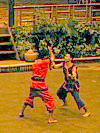
krabok (กระบอก)
Thai. A short
bamboo cylinder of roughly
forty centimeters long and usually open on one side. It can be used
as a container for
Chinese fortune sticks
(fig.);
to collect palm
sugar from the inflorescence of both
coconut palms
and
sugar palm
trees (fig.); as a
vessel for water; or for grilling sticky
rice, i.e.
khao laam (fig.),
sealing off the side which was left open. In
southern Thailand, it is also used to make a
percussion instrument known
as
loh (fig.).
See also
bong and
hun krabok.
回
%20short%20bamboo%20cylinder_small.jpg)
krabok tahn (กระบอกตาล)
Thai. ‘Sugar
krabok’.
A short
bamboo cylinder, used for
collecting palm sugar. It is open at the top, where a small hole is
made on either sides, to attach a string for suspension, which is
fixed with a knot. Sometimes only one hole is drilled and a
strap-like string with a loop is used instead. It is used both with
coconut palms
and
sugar palm
trees.
回
%20short%20bamboo%20cylinder%20for%20collecting%20palm%20sugar_small.jpg)
krabong (กระบอง)
Thai. ‘Club’ or ‘staff’. See also
gada,
katha and
bong.
回
krabong phet (กระบองเพชร)
1. Thai. A jeweled club or
gada,
usually with miraculous powers. It is commonly seen as an
attribute
of certain
yak.
回
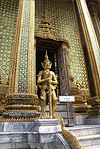
2. Thai generic designation for any cactus, typically of the genus Simaroubaceae.
Singapore's Award
Winning Changi Airport, named in 2023 as the World's Best Airport,
features a rooftop Cactus Garden
with more than
100 species of cacti (fig.).
WATCH VIDEO (1)
and
(2).
回
krabuan (กระบวน)
Thai term for
‘procession’.
回
Krabuan Phayuhayahtrah Chonlamahk
(กระบวนพยุหยาตราชลมารค)
Thai term for the
Royal Barge Procession.
回
krabuay (กระบวย)
Thai. A
coconut
shell dipper, scoop or ladle. The bowl is made of the shell of a
female coconut or a part without the three so-called ‘eyes’
(germination pores), whereas the handle is made of wood. They are
often decoratively carved (fig.).
If used for scooping water from water
containers, like those in a
ban nahm
(fig.),
they are also called
nahm buay.
See also
tawak.
回
_small.jpg)
krabung (กระบุง)
Thai. A kind of semi-large basket used to carry or store a variety
of vegetables or other goods, but especially to collect
rice.
It is woven from
bamboo strips called
tok,
and is round at the top and square at the bottom, and usually tapers
down from about below the rounded part. Some varieties have small
legs at each corner of the square base and are referred to as
krabung hasah (กระบุงอาสา).
回
%20basket%20round%20above,%20with%20square%20bottom_small.jpg)
krachai (กระชาย)
Thai. Name of a
ginger-like root of which
there are a number of different species, such as krachai or
fingerroot (genus Boesenbergia rotunda) which is also known as
Chinese ginger; krachai dam or sand ginger (genus Kaempferia
galanga) which is used as a traditional remedy for a number of
gastrointestinal disorders; krachai
khao
or
‘white krachai’
and sometimes known as Salaween (Salawin)
pink (genus Globba laeta); etc. Fingerroot has a yellow-orange to
light brown colour and owes its name to the shape of its rhizome
which resembles that of long carrot-like fingers growing out of a
centre nodule. Sand
ginger, also known as aromatic ginger
and in Thai as krachai dam, has dark brown to grey rhizomes (fig.)
which are near black on the inside, hence its Thai name of which the
latter word means ‘black’ or ‘dark’. The fingerroot and the sand
ginger both belong to a ginger subspecies known as
galangal
(in Thai
kha), of which only four varieties
exist.
回
,%20Fingerroot%20(Boesenbergia%20rotunda),%20Chinese%20ginger_small.jpg)
krachang (กระชัง)
Thai. Name of a
fish
coop, i.e. a cage to
hold live fish. Traditional ones are usually made from
bamboo and
are often round in shape. If so, they are also referred to as krachang klom (กระชังกลม), i.e. ‘round coop’ or ‘round cage’. The
latter one is depicted on a Thai postage stamp issued in 1995, as
part of a set of four postage stamps on wickerwork for catching and
keeping aquatic animals (fig.).
回
krachao fai fah (กระเช้าไฟฟ้า)
Thai. ‘Electrical
basket’. Name for a cable-car, consisting of a small cabin suspended
on a looped cable, for carrying passengers across a river, or up and
down a mountain, etc. It is often found at Thai temples that are
built on top of a mountain. It is often simply called krachao and if
the cable car is not suspended but on tracks it may also be referred
to as
rot
krachao.
回
%20cable%20car_small.jpg)
krachet (กระเฉด)
Thai. Name for
water mimosa, an aquatic floating plant with the scientific name
Neptunia oleracea. It has small green leaves and a lengthy green
stem, covered with a white, very soft, almost sponge-like covering,
that consists of jointed segments, with thin purplish white roots at
each joint. It is used in Thai cooking (fig.)
and is cultivated in floating gardens on slow moving rivers and
canals (fig.).
When used in cooking, the water mimosa is stripped of the white,
soft, sponge-like covering on the stem, and mixed with fish sauce,
clam sauce, oil, crushed garlic and red chilies, sugar, and salted
or fermented whole soybeans. In Thai, it is also known as phak roo
non (ผักรู้นอน) and phak non (ผักหนอน), the latter meaning
‘worm vegetable’, due to the grub-like shape of the covering on the
stem.
回
%20กระเฉด%201_small.jpg)
krachon (กระชอน)
1. Thai name for
a strainer, colander or sieve. Traditionally, they are woven from
bamboo strips called
tok
(fig.).
There are several kinds, but habitually it is either big and square
in shape with two large bamboo handles (fig.),
allowing it to be held by two people, one at either side, as well as
to rest it onto any large vessel placed underneath; or it is small
and hemispherical in shape with two curved handles in rattan, which
allow for it to be rested onto the rim of any pot placed underneath.
回
%20strainer,%20colander,%20sieve_small.jpg)
2. Thai name for
the mole cricket, a species of cricket with enlarged forelegs, used
for digging and swimming, and which is also known by the name
maeng
krachon.
回
krachut (กระจูด)
See
krajood.
回
kradaat sah (กระดาษสา)
Thai.
Paper made from bark of the
paper mulberry tree, which
in Thai is called
ton sah.
回
kradang nga ngaw (กระดังงางัว)
Thai. Local name for a
kind of hard and large creeper with the scientific name Artabotrys
hexapetalus
siamesis or simply Artabotrys siamensis, and
belonging to the genus of Annonaceae, the
same family as the
kradang nga songkhla
and
noi nah.
When young, this
climber grows just like the regular
Ylang Ylang
Tree (fig.),
but at around 180 centimeyers tall, it will start to vine. At the
top the branches have small spikes. A young vine will have green
branches but when older it is brown. The kradang nga ngaw has a
dense foliage consisting of single leaves that grow in alternate
order on the branches. The leaves are bottle-green and slightly
rippled with a paralleled rim and oval-round in shape. Each leaf has
a short leafstalk and is pointed at the bottom and towards the end.
Its edge is smooth, without jags or splits. It bears single flowers
that bloom near the bottom of the leaves. At first a flower is green
but gradually becomes yellow over time. Each flower has a
corolla of 3 petals which are sheltered by 3 similar sepals. The
oval-shaped flowers are rather small, thick and strong, with
tapering leaves that hold several pistils as well as stamens within.
The flowers have a very strong scent, especially during the evening
and at night. The kradang nga ngaw is used as an ornamental shrub
that gives plenty of shadow and bears flowers year round. Its
flowers is used to make perfume and a single flower is sometimes
given as a welcome or souvenir at restaurants. They are also often
found as part of the
phuang malai.
Its common English name is Ylang Ylang Vine or Climbing Ylang Ylang,
and in Thai it is also known as
karawek.
回
%20karawek%201_small.jpg)
kradang nga songkhla (กระดังงาสงขลา)
Thai. Name of a tropical tree with the Latin name Cananga odarata
and belonging to the genus of Annonaceae, the
same family as the
kradang nga ngaw and
noi nah.
It can grow up to 24 meters high and has yellowish green flowers
that are used in the perfume industry as they have exceptional
scent. In Malaysia called
ylang ylang. See also
Songkhla.
回
kradeung (กระดึง)
Small temple bells, often of increasing size, that hang from the
spire of a
chedi
or from the roof of a temple building to tinkle in the wind, akin to
wind chimes. They
are usually made from brass, nicely decorated and have a
usually heart-shaped metal plate that dangles from its clapper to catch the
wind. The mountain
Phu
Kradeung (fig.), in the province of
Loei,
is named after them, as local folk purportedly often
heard the sound
of bells jingling in the wind coming from this mountain on
Wan Phra, i.e. Buddhist holy
days.
回
kradong (กระด้ง)
Thai. A round, flat winnowing basket, used to fan the chaff from the
grain. Large-sized baskets are called ‘kradong
mon’. Due to
its shape the
victoria regia
(fig.),
called bua kradong in Thai, is named after it.
See also POSTAGE STAMP.
回
kradong mon (กระด้งมอญ)
Thai. A large-sized
kradong.
Officially a winnowing basket, but more often used to contain (fig.)
or dry food, such as
chilies,
in the sun (fig.).
See also POSTAGE STAMP.
回
_small.jpg)
kradook ngu (กระดูกงู)
1. Thai. ‘Snake
ribs’ or ‘snake bones’. Name for the
spinal column
or backbone of a snake,
with
consists of the
vertebrae to which the ribs are attached and which makes up the key
part of its skeleton.
回
2. Thai. ‘Snake
ribs’ or ‘snake bones’. Name for the keel, i.e. the timber at the
very bottom of the hull, that runs from the bow to the stern, and to
which the ribs are attached.
The resemblance
between the spinal column of a snake
can clearly be seen in the
main bridge at
Talaat Nahm Khwan-Riam
floating market,
which has been fashioned
in the form of the
skeleton of an ancient
rice barge
(fig.).
The keel
may also be referred to as the ship's backbone (fig.)
and to differentiate from the backbone of genuine snakes, it is in
Thai also called
kradook ngu reua.
回

kradook ngu reua (กระดูกงูเรือ)
Thai. ‘Snake
ribs [of a] boat’. Name for the keel (fig.).
See also
kradook ngu
and
reua.
回
Krae Sapthawanit (แกรศัพทวนิช)
Thai.
Name of a puppeteer from
Ayutthaya, who
derived
hun lakon lek
from
hun luang,
which had been performed from
the
Ayutthaya
Period
until the reign of
King
Rama V,
and developed it
on the model of the
Ramayana.
Hence, he is considered the father of hun lakon lek puppetry. He
first performed at
Wang Woradit
(fig.),
the former residence of Prince
Damrong Rachanuphaap.
He is habitually referred to as
Kru
Krae, with kru being a title meaning
‘teacher’.
回
_small.jpg)
krahang (กระหัง)
Thai. Name for a male
spirit in Thai folklore commonly associated with nocturnal flight
and rural environments. It is typically described as a man carrying a long wooden rice-pounding pestle (fig.), who
transforms at night and propels himself through the air by using
large woven winnowing baskets (fig.)
as wings.
Accounts often portray the krahang as a human practitioner of flawed
or forbidden magic whose failed rituals result in a condition that
causes uncontrollable night-time wandering. In some traditions it is
regarded not as a supernatural entity but as a human afflicted by a
spirit or by an inherited curse. The krahang is frequently linked to
village settings, where unexplained disturbances, thefts, or
sightings of strange lights are sometimes attributed to it. Although
less prominent than the krasue, the krahang appears in regional
folklore, popular media, and modern retellings of Thai supernatural
narratives.
See also POSTAGE STAMP.
回
krahm (คราม)
Thai. ‘Indigo,
blue, aniline blue’. Name of a plant with the botanical name
Indigofera tinctoria and in the family Leguminosae. It
flourishes especially during the rainy season and is utilized to
extract a blue colour, used a natural dye for dyeing
seua mo hom
(fig.).
Besides this it is said that pharmaceutically the leaves are an
effective cure against fevers and bronchitis.
Its botanical name is Baphicacanthus cusia and in
Northern Thailand it is known as hom and in
Nan
province by the name hom meuang. The plant can grow to about well
over a meter high and spread to a width of about 2 meter. Its has
small light green leaves that have obtuse apices and that are
arranged odd-pinnately on the branches. When flowering, it bears
pink flowers. Indigo can extracted from the leaves of a number of
plants and in northern
Vietnam
a different kind of indigo plant (fig.)
is used to make a natural product to dye most of the local hill
tribe's traditional costumes. The more the dyeing
process is repeated,
the darker blue and an almost black colour can be obtained (fig.).
回
%20Thai%20indigo%20plant%201_small.jpg)
krai (ไกร)
Thai. Collective term for trees of the genus
Ficus, such as the
Ficus concinna (fig.).
Grows from India to the Salomon Islands and Australia.
回
Krailaat (ไกรลาศ)
Thai name for the mountain on which the Hindu
god
Shiva dwells, in
Sanskrit named
Kailasa.
回
kraison (ไกรสร, ไกรศร)
Thai-Pali
word meaning
‘lion’.
It is mainly used in mythology, in lieu of
singh.
回
Kraison Jamlaeng (ไกรสรจำแลง)
Thai-Pali. Another name for
Kraison Mangkon.
Also transcribed
Kraisorn Jumlang.
回
Kraison Kaawih (ไกรสรคาวี)
Thai-Pali
name of a mythological creature from
Himaphan
forest, that
has the
body of a
lion, the head of a
Zebu cow,
the clawed feet of a bird of prey, and sometimes with the tail of a
horse. Also known as
singh
kaawih and sometimes
transliterated Kraison Kawee or Kraisorn Karwee.
回
Kraison Mangkon (ไกรสรมังกร)
Thai-Pali
name of a mythological creature from
Himaphan
forest, that
has the
body of a
lion
and the head of a
dragon
(mangkon).
It is also known as
Kraison Jamlaeng,
with the word jamlaeng meaning ‘disguise’ or ‘transform’, the name
thus referring to a lion in disguise, or a transformed lion. Also
transcribed
Kraisorn Mangkon
and sometimes called
Sihara Mangkon.
In appearance, the creature is very similar to
Toh (fig.),
a mythological lion with two antlers on its head.
回
Kraison Naga (ไกรสรนาคา)
Thai-Pali name of a mythological creature from
Himaphan
forest, that
has the
body of a
lion
and the head and tail
of a
naga,
while its body is also covered with scales. Also transcribed
Kraisorn Naga and in Thai pronounced kraison
naag.
回
Kraison Paksah (ไกรสรปักษา)
Thai-Pali. ‘Lion-bird’.
Name of a mythological creature from
Himaphan
forest, that
has the
body of a lion and the head and wings of a bird (paksah).
The body is often depicted in light green colour and has tiny
feathers, that somewhat appear to be scales. It is similar to
Sakun Kraison,
the mythological Bird-lion from Himaphan, but the latter is of a
different colour and has no wings. Sometimes transcribed Kraisorn
Puksa.
回
Kraison Rachasih (ไกรสรราชสีห์)
Thai-Pali. ‘Royal
Lion’.
Name of a mythological creature from
Himaphan
forest, with the body of a lion and belonging to the pure lions. It
appears in the story of
Wessandon,
where it is described
as a powerfully built, graceful
lion, with red manes, red lips, a red tail tip and red paws.
However, in other text it is said to be white in colour with golden
manes. It belongs to the group of pure lions and feeds on large
animals, such as deer or horses.
It
appears on a Thai postage stamp issued in 1998 (fig.).
With the
singha
or lion being the namesake of
Singburi,
there is a statute of a large bronze Kraison Rachasihl lion at the
entrance road into town (fig.).
回
Kra Isthmus
See
Isthmus of Kra.
回
Kraithong (ไกรทอง)
A Thai classical story about a crocodile named
Chalawan.
READ
ON.
回
krathin (กระถิน)
1.
Thai name sometimes used for certain species of
Acacia.
回
2. Thai name for the
Horse Tamarind, a small tree in the legume family Fabaceae.
READ ON.
回
krajab (กระจับ)
Thai. ‘Water chestnut’ or ‘water nut’. A nut-like fruit of the genus
Trapa, with a moustache shape, i.e. a curved V-form with its ends curled
up, like a buffalo's or bull's head, inside a thin black skin. They are eaten
raw, roasted or boiled, or dried and ground into a flour. In English,
it is known as water
caltrop, but due
to its distinctive shape it also has a number of allusive epithets,
such as
buffalo nut, mustache nut,
devil pod, and
bat nut.
The leaves of the plant float on the water in clusters and are
remiscent of the
Mosaic Plant
(fig.),
which in Thai is referred to as
krajab
kaew (กระจับแก้ว) or
krajab yipun (กระจับญี่ปุ่น), which translates as
‘crystal krajab’
and
‘Japanese krajab’,
respectively. It is sometimes confused with the
Chinese water chestnut, which in Thai is called
somwang.
回
krajab pih (กระจับปี่)
Thai. An ancient,
plucked, lute-like instrument, that originated in India and is used
in the classical music of central Thailand. This four-string
instrument has eleven raised frets, a slender neck and an elongated
headstock which is typically bent backwards. In 1970, the krajab pih
was depicted on one of a set of four Thai postage stamps featuring
Thai musical instruments (fig.).
回
krajah (กระจ่า)
Another name for
tawak.
回
krajaht (กระจาด)
Thai name for any
low-edged basket, made of thin, interwoven
bamboo strips, known as
tok
(fig.).
It typically has a square or hexangular base, yet with a round mouth
above. It is mainly used to hold vegetables or fruits. This type of
basket is often used for carrying loads across the shoulder, hanging
from a bamboo
pole, though it then has an elongated
handle and is called
krajaht haab
(fig.).
回
krajaht haab (กระจาดหาบ)
Thai name for a
low-edged basket with an elongated handle, made of thin, interwoven
bamboo
strips, known as
tok
(fig.),
and used for carrying loads across the shoulder, hanging from
a bamboo
pole called
mai kaan haab.
It typically has a hexangular or octagonal base, yet with a round
opening above, though occasionally also other models may be used.
回
krajang (กระจัง)
1. Thai. A design used in carving; leaves arranged in the shape of
two outstretched arms.
回
2. Thai. A
cornice structure with a
decorative design consisting of leaves, arranged in the shape of two
outstretched arms, found on wooden furniture.
回
krajiab (กระเจี๊ยบ)
1. Thai for roselle, a
flower of the genus
Hibiscus.
From its seed heads
(fig.)
a refreshing drink high in Vitamin C can be made (fig.)
by soaking them in boiling water. It is known by the
scientific name
Hibiscus sabdariffa and in Thai also called
krajiab daeng, i.e. ‘red krajiab’,
to distinguish it from
krajiab khiaw,
i.e. ‘green krajiab’. See also
farang chae krajiab.
See also THEMATIC STREET LIGHT.
回
2. Thai name for Okra, a vegetable
also known as Lady's Finger and which grows from a plant with the
scientific names Abelmoschus esculentus and Hibiscus esculentus. It
is also called
krajiab khiaw,
i.e. ‘green krajiab’, to distinguish it from
krajiab daeng, i.e. ‘red krajiab’.
回
_small.jpg)
krajiab daeng (กระเจี๊ยบแดง)
Thai. ‘Red krajiab’. See
krajiab.
回
krajiab khiaw (กระเจี๊ยบเขียว)
Thai. ‘Green krajiab’. See
krajiab.
回
krajiaw (กระเจียว)
Thai. Name of a plant
of the genus Curcuma domestica and belonging to the family of
Zingiberaceae,
the same family of
the
galingale, which it
resembles.
The plant bears a flower at the top (fig.)
and the flower bud is fit for consumption (fig.).
It is the provincial flower of
Chaiyaphum,
where they are found abundantly in the wild
(fig.).
Its flowers may be white, pink or purple.
It is also called
pathumah
and
bua sawan,
and in the North of Thailand it is called
dok aaw,
in the Northeast
kahtiyaw,
and in the South
juad.
Its name in English
is
Siam Tulip.
回
%20กระเจียว%202_small.jpg)
krajo (กระจ่อ)
Thai.
A traditional
silkworm breeding basket,
typically flat and round, reminiscent of a large
kradong mon
(fig.).
It is made of
bamboo and arranged in concentric circles in which the
silkworms are placed to build their cocoons. Depending on its size
it can hold up to several hundred silkworms. Sometimes, a brush-like
arrangement of sticks hanging from the ceiling may be used instead (fig.).
In India it consists of a frame and is called
chandrika.
In Thailand also called
jo.
See also
silk.
回
_small.jpg)
krajok kriab (กระจกเกรียบ)
Thai. ‘Mirror glass’ or
‘lead mirror’. Name of a traditional Thai decorative technique that
involves the use of flat, smooth pieces of coloured or mirrored
glass, carefully cut into geometric shapes and inlaid onto surfaces
such as temple walls, ceremonial objects, architectural elements and
statues (fig.),
reminiscent of stained glass. These glass pieces are often backed
with gold or silver leaf to create a shimmering effect and are
typically arranged in intricate patterns alongside lacquer and
gilded wood carvings. These mirrors were sometimes made by backing
glass with a reflective metal layer. While silver and mercury-tin
amalgam were common, lead or lead-based alloys were occasionally
used, especially in earlier or less sophisticated designs. These are
often referred to as lead-backed mirrors. It is commonly found in
temples from the
Rattanakosin
period
and reflects the refined craftsmanship and aesthetic sensibilities
of classical Thai art. See also
waen fah.
回
_small.jpg "waen fah")
krajong (กระจง)
Thai for
chevrotain.
回
krajong kwai (กระจงควาย)
Thai. ‘Buffalo
chevrotain’.
Name for the
Greater Mouse-deer,
a small mammal endemic to Thailand.
回
krajong lek (กระจงเล็ก)
Thai. ‘Small
chevrotain’.
Name for the Java Mouse-deer. About the size of a rabbit, it is the
smallest hoofed animal in the world and endemic to Thailand.
Confusingly, the name krajong lek or Java Mouse-deer is often used
for krajong noo or
Lesser Mouse-deer
(fig.),
and vice-versa.
回
krajong noo (กระจงหนู)
Thai. ‘Mouse
chevrotain’.
Name for the
Lesser Mouse-deer,
frequently confused with the Java Mouse-deer, whilst their names are
often used intertwined. This small mammal is endemic to Thailand.
回
krajong williamson (กระจงวิลเลียมสัน)
Thai name for the Williamson's
Mouse-deer, a kind of
chevrotain in
the Tragulidae family, endemic to Thailand.
回
krajood (กระจูด)
Thai. Name of a waterside or marsh
plant that thrives well in muddy ground. It belongs to the family of
sedges
and is found only in southern Thailand. Once they are harvested, the
plants are bundled and bathed in cold water to get rid of the mud.
Then, they are spread out on the ground to be dried in the sun for
1-2 days, during which time they will change in colour from green to
light brown. Next, they are bundled once again, put upright and
rinsed a last time by pouring water over them. Then, they are taken
to a large tank to be dyed in the desired colour and dried once
again, though this time not in the sun. Once dry, they are flattened
with a heavy roller, after which they are ready to be woven into the
desired product, i.e. baskets, mats, etc. Sometimes transcribed
krachut.
回
krajuk (กระจุก)
Thai. Another word for
juk.
回
kranok (กระหนก)
Thai. A characteristic Thai design in decorative art resembling
tongues of fire. See also
kanok
and
THEMATIC STREET LIGHT
(1),
(2),
(3),
(4)
and
(5),
and
WATCH VIDEO.
回
krapha (กระพา)
Thai name for a wicker hill tribe
basket (fig.),
which is carried on the back, and held in place either by two
shoulder strips or by a strip over the forehead, in order to relief
some of the weight from the back. It is woven from strips of
bamboo called
tok (fig.)
and rattan, round at the top and slantingly narrowing down to either
a square or round base. It is used for a variety of purposes, e.g.
to carry tools and goods to and from the field, to bring vegetables
to the local market, to gather kindling or brush wood, etc.
They are nowadays only
used by some of the hill tribe people in northern Thailand, as well
as those in other Southeast Asian countries (fig.)
and in southern
China.
回
%20wicker%20hill%20tribe%20basket_small.jpg)
krapo pla (กระเพาะปลา)
Thai. ‘Fish entrails’. Name of a Chinese crispy savoury made of the
entrails of fish. It is served in a soup cooked with
rice
whiskey (lao
khao) or as part of a spicy
salad called
yam krapo
pla. This salad knows
several varieties but in geberal consists of either sliced tomatoes
and onion, cut pieces of dried squid,
chilies,
cashew nuts and some green
celery-like vegetable (fig.),
or of sliced mango, coriander leaves, red onions and chilies (fig.),
reminiscent of
yam pla
duk foo. It is ubiquitously
sold around
Bangkok's
Chinatown
and is somewhat high-priced at around 500 baht per kilo.
回
kra-rohk (กระรอก)
Thai for ‘squirrel’. Thailand is home to some 13 species of tree
squirrel, 4 species of ground squirrel, and another 12 species
of flying squirrel, all in the family Sciuridae. Though most species
carry the word kra-rohk in their Thai name, there are also a few
species that are referred to as kra-len (กระเล็น) or kra-len
(กะเล็น), and kra-jon (กระจ้อน). Besides this, Thailand also has a
number of tree shrews (fig.),
rodents that are somewhat similar to squirrels, but belong to
another family and carry the designation (กระแต) in their Thai name.
Since it dwells in the branches of trees, squirrels in Chinese and
Vietnamese
iconography,
are said to correspond to the first
Earthly Branch of the
Chinese zodiac
(fig.),
i.e. Zi (子),
which also means
‘son’, ‘child’, and ‘seed’, and are hence a symbol for ones
offspring (fig.).
WATCH VIDEO.
回
kraseu (กระสือ)
Thai. Name of a
spirit in Thai and Lao folklore traditionally depicted as a woman
whose head separates from her body at night, trailing internal
organs such as the intestines, heart, and stomach. It is said to
emit a faint red glow and to roam fields, animal enclosures, and
wooded areas in search of raw flesh, blood, and various kinds of
refuse. By day, the spirit is believed to rejoin and conceal its
body. Explanations for the origin of a krasue vary across regional
traditions, with common narratives attributing its transformation to
curses, the misuse or failure of esoteric practices, or the
transmission of its condition through contact with the blood of
another krasue. Widely embedded in the cultural imagination, the
krasue features prominently in oral traditions, modern literature,
cinema, and television, and remains one of the most recognisable
supernatural figures in mainland Southeast Asian folklore.
See also POSTAGE STAMP.
回
krasob (กระสอบ)
Thai name for a tow
sack or gunny sack, a large bag traditionally made of coarse, woven
fabric such as jute, hemp, or burlap. These sacks are commonly used
for storing and transporting bulk materials like sand,
rice or
grains, onions, or other agricultural products. The term tow
refers to coarse fibers used in spinning, while gunny is derived
from the Sanskrit word goni (गुनी), meaning ‘sack’. Today, similar
sacks are also made from synthetic materials for durability.
WATCH VIDEO (M).
回
_small.jpg)
krasoo (กระซู่)
Thai name for the
Sumatran
Rhinoceros.
回
Krasuang Khamanakhom (กระทรวงคมนาคม)
Thai name for the
‘Ministry of Transport’, i.e. a ministry of the Government of
Thailand and in short referred to as MOT. It oversees several
departments, including the Marine Department, the
Department of Land Transport
known in Thai as
Krommakaan Khonsong Tahng Bok, the
Department of Civil Aviation, the Department of Highways, the
Department of Rural Roads, and the Office of Transport Policy and
Traffic. It was established on 1 April 1912 in the reign of King
Rama VI,
though derived
from the Ministry of Public Works, which was established earlier
under the name Department of Public Works by King
Rama V,
as part of his effort to modernize Thai bureaucracy. Its circular
logo consists of a chariot pulled by two horses, with a charioteer
and
Phra Ram
holding his bow and an arrow, surrounded by
kranok
motifs, and
reminiscent of the logo of the Department of Land Transport, which
depicts
Matulih
riding
Indra's
chariot pulled by two horses. The Ministry of Transport has featured
on Thai postage stamps (fig.)
on several occasions, especially stamps issued on its anniversary (fig.):
e.g. to commemorate its centenary in 2012, a set of four postage
stamps was issued (fig.).
In English, it is also known as Ministry of Transport and
Communications.
回
Krasuang Kalaahome (กระทรวงกลาโหม)
Thai name for the
‘Ministry of Defence’, the government department in charge of
defending the kingdom, i.e. maintaining its national security and
territorial integrity.
READ ON.
回
Krasuang Mahathai (กระทรวงมหาดไทย)
Thai. ‘Ministry of
Interior’. See
Mahatthai.
回
Krasuang Nakhonbahn (กระทรวงนครบาล)
Thai. ‘Metropolitan
Ministry’. Former
government department, that
during the reign of King
Rama V was
responsible for maintaining and
managing the order and security in the capital
Bangkok
and its surrounding area. The Metropolitan Ministry was headed by a
minister, who oversaw a number of agencies and services, some that
are unique to Bangkok, such as the Bangkok Metropolitan Police,
known in Thai as Kong Tamruat Nakhonbahn (กองตำรวจนครบาล). The
ministry's logo consists of a
thevada
riding a
singha
and holding up a
chakra
and sword. The Krasuang Nakhonbahn was later dissolved and parts of
it, such as the Metropolitan Police, were absorbed by the
Krasuang Mahathai,
i.e. the ‘Ministry of Interior’, which
still has the lion as its logo, though without the angel and his
attributes.
回
_small.jpg)
Krasuang Phanit (กระทรวงพาณิชย์)
Thai. ‘Ministry of
Commerce’.
Government department
responsible for trade and entrepreneurship, and the support and
promotion thereof.
READ
ON.
回
Krasuang Theknohlohyih Sahnsonthet
Lae Kahn Seusahn (กระทรวงเทคโนโลยีสารสนเทศและการสื่อสาร)
Thai name for the
Ministry of Information and Communication Technology, which was
established on 3 October 2002, by the Bureaucratic Restructuring Act
of
BE
2545, i.e. 2002 AD. It
is headed by a Minister of State and includes the Meteorological
Department and the National Statistical Office of Thailand.
Furthermore, the ministry oversees a number of public companies and
organizations, such as the Telephone Organization of Thailand (TOT),
CAT Telecom (Communications Authority of Thailand -
fig.), and Thailand Post, as well
as the Software Industry Promotion Agency. Its mission includes the
development and enforcement of policy concerning information and
communication technology of the country, research on the subject,
the promotion and encouragement of cooperation of all sectors and
divisions, both domestically and abroad, etc. Under the Pheu Thai
Party, the ministry in 2012 promoted free public WiFi and free
tablets for schoolchildren (fig.).
The Ministry's logo (fig.)
consists of the deity
Phra Phut,
the Thai
god of commerce and speech (fig.),
with a dark green complexion and seated on a pedestal. He is holding
a book (kampie)
in one hand and a sword (khan)
in the other, the first symbolizing his knowledge in various
sciences, the latter symbolizing his sharp intelligence. His head is
surrounded by a flame-shaped
aureole
(radsami),
which shows his enlightened wisdom. The deity is placed in a circle,
which at the top has a flame-like curl or phraket (พระเกศ) that
represents his commonsense, and a wave-like knot or ka-muat (ขมวด)
at the bottom, which refers to his embodiment of knowledge and
information.
See also POSTAGE STAMP.
回
Krasuang Yuttitham (กระทรวงยุติธรรม)
Thai. ‘Ministry of
Justice’. A key governmental body responsible for overseeing
Thailand's justice system, ensuring the fair application of laws,
and promoting legal equality. Its primary functions include shaping
national policies on legal matters, managing the country's prison
system (fig.)
and probation services, and providing legal aid to citizens unable
to afford representation. The ministry also plays a central role in
law enforcement, working in collaboration with other agencies to
uphold the rule of law. Additionally, it supports legal reforms and
international cooperation, ensuring compliance with global legal
standards. The Ministry is led by the Minister of Justice, who is
appointed by the Prime Minister.
回
krasuay (กระสวย)
1. Thai. Name for a
weaving shuttle, i.e. a shuttle
used in loom weaving (fig.)
to make the weft, the threads woven across a warp, the lengthwise
threads in a loom, to make fabric. It is made
of wood and the head and tail are pointed, a little bit similar to
the shape of a small boat. In the middle is a hole to place the reel
with yarn. In Thailand at least two kinds of shuttles are used in
loom weaving. The first one, called a flying shuttle (fig.),
can usually hold two reels of woof yarn and is
launched back and forth through
the shed, the area between upper and lower warp yarns, by pulling a
string that propels the shuttle from one side to the other. The ends
of the flying shuttle are reinforced with metal tips to protect the
wood and absorb the shock when it is launched and lands. The second
type of shuttle is used with a handloom and is passed back and forth
through the shed by hand (fig.).
It therefore has enlarged ends that function as handles,
facilitating an easy grip when pulling the weft thread between the
warp threads by hand. The latter holds just one reel of yarn.
See also TRAVEL PICTURE.
回
2. Thai. Name for a
spindle, i.e. a tool used in spinning to twist fibers into yarn or
thread. Although krasuay is primarily used to refer to a weaving
shuttle, the term can sometimes be used for both. The more precise
term for a spindle in Thai would be either mai mun (ไม้หมุน) or
krasuay pan daai (กระสวยปั่นด้าย), with krasuay being an abbreviated
form. So, while krasuay is more accurately associated with a weaving
shuttle, using the specific term mai mun (ไม้หมุน) for a spindle is
preferable.
回
kratahng toob (กระถางธูป)
Thai for incense burner, usually a large brass vessel filled with
sand and a bed of dropped off ashes in which
joss sticks
are placed. They are often elaborately decorated with
dragon
motifs, large handles or handles in the shape of
Bi Xie heads,
and sometimes even with a small roof (fig.).
Occasionally they are made of stone (fig.).
Before burning joss sticks the person offering them will first
perform an
athitahn.
It is believed that the smoke that emanates from incense burners in
Buddhist temples creates pure energy, known as Chi (or Qi). Also
called
toobbaat.
回
_small.jpg)
kratai jihn (กระต่ายจีน)
Thai. ‘Chinese rabbit’.
A
coconut
grater, a tool for grating coconut, having the form of a low, often
long, stool with a circular steel serrated knife (fig.).
Today, automated grating machines (fig.)
exist and for large quantities a grinding machine (fig.)
is generally used, which has a board studded with pins and a rotary
worked by a motor. The coconut is grated for its juice, known as
coconut milk,
which is used as an ingredient in several Thai curries.
回
kratha (กระทะ)
Thai nonspecific term for any
‘pan’, ‘pot’, ‘wok’
or ‘kettle’, including the special kind used for making
moo kratha
(fig.).
See also
kratha thong daeng.
回
kratha thong daeng (กระทะทองแดง)
Thai. Name for a large
copper kettle (kratha)
in which the
Yommabaan
in hell (narok)
boil sinful people as a punishment (fig.).
In
Diyu,
the Chinese realm of the dead, it is known as yóuguō (油鍋), literally
‘oil pot’ or ‘deep frying wok’.
回
kratheua (กระทือ)
Thai term for
Shampoo Ginger
(fig.),
as well as an adjective used in compound with certain
other species of
ginger,
such as
Beehive Ginger,
which is known in Thai as
kratheua philaat
(กระทือพิลาส) and kratheua
chang
(กระทือช้าง).
回
krathiam (กระเทียม)
Thai for garlic, a plant of the onion family
with a pungent bulb. It is widely used in Thai cookery and can be
found in different form on local markets nationwide. Whole garlic
preserved in salt and water is known as krathiam
dong
or pickled garlic and honey soaked garlic, known as
krathiam
thoon dong nahm pheung, is a
specialty of
Chiang Mai.
回
krathiam thoon dong nahm pheung
(กระเทียมโทนดองน้ำผึ้ง)
Thai for a singleton (thoon) of
garlic (krathiam)
soaked (dong)
in honey (nahmpheung), an
OTOP
specialty of
Chiang Mai,
especially from the
tambon
Mae Pohng
(Ban Pah Phai village) in the
amphur Doi Saket.
They are soaked for about three months and made in three tastes,
i.e. sour, sweet or salty, by adding vinegar, sugar or salt. They
are considered a healthy herb that can be stored for a long period
without the use of preservatives or chemicals, and are generally
eaten as part of a side dish with
rice.
回
krathing (กระทิง)
Thai name for the Indian Bison, usually referred
to as Gaur.
READ ON.
回
Krathing Daeng (กระทิงแดง)
1. Thai.
‘Red
Gaur’.
Name of an
in Thailand manufactured, non-carbonated, energy drink, that
contains water, cane sugar, caffeine,
taurine, inositol and B-vitamins, a recipe based on earlier energy
drinks from South Korea and Japan.
Its logo consists of two red Gaurs, in Thai known as
krathing,
charging towards each other, thus showing the alleged power of the
beverage (fig.).
The energy drink became well-known locally, due its sponsorship of
muay thai
boxing matches, where the brand's logo often is still on display
today.
It
later gained
international fame under the name Red Bull.
The
beverage was invented by Chaliao Yuwitthaya (เฉลียว อยู่วิทยา), whom
together with his son also owns the majority of shares in Red Bull,
and is listed as the richest person in Thailand, whilst his daughter
today looks after the Thai side of the business, i.e. Krathing
Daeng.
回
%20shirt_small.jpg)
2. Thai.
‘Red Gaurs’. Name of a patriotic,
rightwing
movement and anti-communist paramilitary organization in Thailand
during the seventies. Its members often included former
Vietnam
War veterans and mercenaries of
Laos'
Secret War. Being active to counter
communist
insurgencies in
Isaan
and the South, the movement was
initially heavily funded and backed by the United States government,
and
allegedly even
enjoyed royal endorsement. However, it
also
played a key role in the 6 October 1976 massacre at
Thammasat
University,
in which
46 students
and activists
were killed, and about two hundred injured, since
it
regarded the demonstrators as
leftists and
communist sympathizers, though in fact they were protesting
the
return of Thanom
and
Praphat, two senior military
officers and
former leaders of the dictatorial
regime that in 1973 had caused a bloodbad
against protesting students and –after being reprimanded by the
king– had fled the country.
Also known as Khabuankaan Krathing Daeng (ขบวนการกระทิงแดง), i.e.
‘Red Gaurs Movement’.
回
krathom (กระท่อม)
Thai. Designation for a tree with the botanical name Mitragyna
speciosa.
READ ON.
回
krathon (กระท้อน)
Thai. Name of a fruit tree and its bulbous, yellowish green to light
brown tropical fruit with a thick husk, known by the western name
santol,
of a which a local derivative is also sometimes used in Thai, i.e.
sathon (สะท้อน), whereas in northern Thailand it is referred to as
matong (มะต้อง) or mateun (มะตื๋น). Also
known by the epithet wild
mangosteen
and by the botanical names Sandoricum indicum
(fig.),
Sandoricum koetjape, and Sandoricum nervosum,
as well as Melia koetjape. Its fruiting
season is June to September.
回
krathong (กระทง)
1. Thai. Floating flower arrangement. The
trunk of a
banana plant is cut
in slices (fig.)
that are used to form the basis of the krathong which is then
decorated with the folded leaves of a
banana plant (fig.),
flowers, candles and
incense sticks.
Because of its folded leaves it resembles an open
lotus
flower and is able to float. During the festival of
Loi Krathong these
are placed in the water and pushed away to worship the goddess of
the water,
Mae Khongkha.
Nowadays, often less environmentally friendly materials such as
polystyrene foam came to be used to make the floating base of the
krathong, which has led to
avoidable
water pollution.
As a consequence, a new form of krathong made of dough was
developed, i.e. the so-called bread krathong (fig.),
which eventually dissolves in the water and becomes food for the
fish, a win-win solution. The origin of the krathong can be traced
back to
Nang Nophamat, the
daughter of a
brahman priest and a
lady at the court of king
Phra Ruang of
Sukhothai.
She is said to have wanted to please the king by ‘creating a new
style of lotus flower in different forms which were to be floated on
the streaming waters at night during the water festival’. Krathong
can be rather simple to very intricate structures. Especially those
that are made to take part in a contest and those made for royalty
can be quite elaborate (fig.).
Throughout the duration of the festival, there usually are also some
huge krathong made from paper and other materials, which are set up
along roads, in parks and on the streets, as lanterns or for sheer
decoration
TRAVEL PICTURES (1),
(2)
and
(3),
and
WATCH VIDEO
(1) and
(2).
回
2.
Thai name for a banana leave vessel, a small container made from the
leaves of a
banana plant, mostly
used as a container for food, as with the dish
ho mok.
回
krathong dokmai (กระทงดอกไม้)
Thai. Name of a
cone-shaped
offering,
that is
described as a type of
krathong
(fig.) and
with a shape reminiscent to that of a
phanom mahk
(fig.).
It exists as an offering in its own right, but is also used as a
kind of cover for certain offerings, especially with
toob thian phae, i.e. an
offering of candles and thick rods of
incense
(fig.).
It also resembles the cone-shape variant of a
kruay
upatcha. See also
dokmai.
See also POSTAGE STAMPS.
回
krathong sai (กระทงสาย)
Thai. Name for a kind
of
krathong
used in the
Loi Krathong Sai
festival in
Tak.
READ ON.
回
kratib (กระติบ, กระติ๊บ)
Thai. Name for a small basket used to
offer or serve
sticky
rice
and to keep it warm. It is made from either
bamboo or rattan, or from the
leaves of a plant from the genus Calathea, named klah (คล้า) in
Thai. Kratib made from the latter are accredited for their quality
to not get tainted by mould or fungi, despite the fact that they are
used in moist warm conditions. They are famously produced in the
northeastern province of
Nong Bua Lamphu,
where this plant is found abundantly, especially in Ban Huak
(บ้านห้วย), in the
amphur
Sri Bun Reuang (ศรีบุญเรือง). The name kratib is most commonly used
in the Northeast, besides its equivalent
kong khao, which is
also used in the North for this kind of
rice
basket, next to the term
aeb
(fig.).
In northern Thailand it is often served with a
khantoke
meal. Also called kratib
khao
and kratib
khao niauw.
回
%20sticky%20rice%20containers_small.jpg)
kratom
English for
krathom.
回
kraton
Reinforced villages in strategic locations from which local rulers
reigned ancient Indonesia.
回
kra-wahn (กระวาน)
Thai name for ‘cardamom’, the seeds of an aromatic Southeast Asian
plant of the ginger family Zingiberaceae, which are used as a spice.
There are two main genera, i.e. green cardamom (genus Elettaria) and
black cardamom (genus Amomum), with the latter also being referred
to as Siamese cardamom. Certain varieties of cardamom are considered
to be among the most expensive spices, priced even higher than
saffron and
vanilla. It is used in a variety of cuisines and also has medicinal
uses. In
Myanmar and
India,
ground cardamom is used as an ingredient in an
ice cream-like dessert called
kupih
(fig.)
and
kulfi, respectively.
回
_small.jpg)
krayahsaad (กระยาสารท)
Thai. A Chinese sweetmeat made of
rice
flour, nuts and
sesame,
cooked with sugar into a kind of caramelised
cereal bar (fig.).
It is particularly eaten during the
saad festival when the
sweetmeat is traditionally moulded into more fun shapes such as
puppets and animals.
回
kra-yo (กระยอ)
Thai. A liquid mixture of
rice
flour, water and salt, that is made into very thin sheets of a
dough-like pastry, called
phaen kra-yo,
which in turn are used as a wrapper for fresh spring rolls, also
known as summer rolls (fig.)
and in Thai as
popiya sod (fig.)
or popiya
Vietnam,
and in a dish known as
naem
neuang (แหนมเนือง).
回
%20spring%20roll%20rice%20wrappers%202_small.jpg)
kreuang bot yah (เครื่องบดยา)
Thai. ‘Drug grinder’. Name for a tool used in traditional medicine
to pulverize herbs. It consists of a usually handheld, metal,
disc-like blade, with a bar-like handle, that goes though its
centre, and a horizontally boat-shaped and vertically V-shaped,
metal groove, in which the herbs are placed. The metal blade is
pushed forth-and-back down the groove, thus crushing the herbs.
Sometimes the blade is not handheld, but supported by a wooden
frame-like structure, in which a heavy load puts weight on the
blade, whilst the handles are extended to facilitate the process of
moving the blade from a distance. See also
hin bot yah (fig.).
回
kreuang bucha (เครื่องบูชา)
Thai. A general term
for items offered in acts of worship or devotion, most commonly in
religious and ritual contexts such as
Buddhism,
Brahmanical
practice, spirit worship, and household shrines. Hence, it refers to
religious offerings made to a deity or sacred presence. Kreuang
bucha typically includes flowers,
incense, candles, food, water,
or symbolic objects placed before
Buddha images, deities,
spirits, or sacred sites. The term is comparable to
kreuang sakkara, but bucha
emphasises the act of worship, honour, or devotion itself and is
broader in scope, whereas kreuang sakkara carries a stronger sense
of formality and reverential homage, often associated with sacred
beings, monks, or royal and state rituals.
See also POSTAGE STAMPS.
回
_small.jpg)
kreuang hom
(เครื่องหอม)
Thai for
incense.
回
kreuang kanthet (เครื่องกัณฑ์เทศน์)
Thai. Offerings to a monk after his sermon.
See also
kan and
thet.
回
kreuang kathin (เครื่องกฐิน)
Thai. ‘Kathin
offerings’. General name for a variety of typical offerings brought
to Buddhist temples and given
to novices and monks
during the festival
of
thod kathin,
in a ceremony called
thod phah pah.
These offerings can encompass many different kinds of gifts, varying
from monetary donations to daily life essentials and objects allowed
for monks to have, yet
symbolically, it will always include a set of monastic robes called
traijiewon,
or at least a part of it.
The robes are usually placed on top of a
phaan
waen fah
(fig.),
i.e. a kind of double
tray, each with a foot
and often decorated with
mother-of-pearl,
and sometimes covered by a
krob trai,
i.e. a net-like arrangement of
stringed
dok rak
flowers (fig.).
回
kreuang kheun (เครื่องเขิน)
Thai. Decorative objects made in
lacquer.
回
kreuang khwaen (เครื่องแขวน)
Thai. General name for
different types of net or frame-like, stringed flower arrangements
or mobiles, alternatively made from
grains of popped
rice
and called
malai khao tok, occasionally in the
form of a lantern,
and that are used to suspend at windows, doorways, gables, etc. They
are mostly made up from
dok rak
(fig.),
decorated with colourful other flowers and additional
u-ba. There
exist many different models, some with fixed patterns, others rather
imaginative. Most fixed models have their own, often suggestive
names, such as
Viman Phra In
(fig.),
Viman Thaen (fig.),
Viman Nang Fah,
Bandai Kaew (fig.),
Bandai Thong,
Bandai Ngun,
Klin Jorakae,
Klin Khwam,
Phuang Kaew Sih Chan
(fig.),
Tahkahy Nah Chang,
etc. Their size ranges from tiny to very large and certain shapes
are used during certain traditional ceremonies, as
kreuang bucha.
回
_small.jpg)
kreuang klohk (เครื่องโขลก)
Thai. A stamping mill used to pound or grind
things. See also
krok tam khao.
回
kreuang krabeuang (เครื่องกระเบื้อง)
Thai. Collective term for different kinds of pottery, earthen ware,
ceramics,
porcelain
and tile work.
回
kreuang lahk (เครื่องลาก)
Thai.
‘Tractor’. Although four-wheel tractors do exist, most farmers use a
low-cost engine on two wheels with two long handlebars to manoeuvre.
This local vehicle can be hitched to a cart or wagon and used for
transporting goods and people. Furthermore, the engine can be used
to drive an Archimedes' screw fitted into a pipe in order to pump up
water (fig.) and irrigate
rice
paddies. In addition, the
tyres of the tractor can be taken off of the
wheels, which are serrated and function as rotating ploughs (fig.),
used in agriculture for ploughing
the fields and making this tractor multifunctional indeed. Able to
do many of the tasks
water buffaloes
used to do in the past and usually imported from Japan, this type of
tractor hence became nicknamed ‘Japanese
buffalo’.
See also
rot ih-taen.
回
kreuang muk (เครื่องมุก)
Thai. Name for decorative objects ornamented with
mother-of-pearl.
回
kreuang pan din pao
(เครื่องปั้นดินเผา)
Thai general term for earthenware, including
pottery
(fig.).
回
kreuang pradap langka wat
(เครื่องประดับหลังคาวัด)
Thai. ‘Temple roof decoration’. Roof fittings usually made of
ceramic and often depicting guardian figures, such as
dragons,
yaksahs,
thevadas and
nagas,
or
bats (fig.)
in
Vietnam
and
China.
They are generally crude in manufacture. Typically, monks will make
or buy roof decorations as well as roof tiles, and offer them for
sale (fig.)
to visitors, allowing them to make merit by giving a donation
towards the temple's further construction. Thus, people only buy
them symbolically as they leave them at the temple, i.e. immediately
donate them back. To make sure no tile is paid for twice, as well as
to memorialize the donation, donors can mark their donation by
writing their name with a thick marker pen on the tiles or fittings.
Usually their is also a written record of all donations. Larger
parts of a temple building often carry nameplates that have the
donors details and the amount they donated inscribed on them. In
this way, the needed funds are generated and the donors both
financially and
symbolically help in
the temple's further construction, whilst
anyone who likes can have his name recorded in the annals of a
particular temple at the same time. Compare with
Chinese
Imperial roof decoration.
回
kreuang prung (เครื่องปรุง)
Thai. ‘Food ingredients’. A set of small, often
lidded cups or glass bowls, with a tiny spoon, placed on either a
platter or a steel rack and containing spices used for seasoning a
dish according to ones personal taste. It is part of the usual
tableware at roadside
noodle
restaurants, especially those selling
guay tiyaw
noodle
soups. Dressing flavours include
nahm phrik
(salty fish sauce with sliced
chilies
-
fig.),
nahm som phrik (vinegar with sliced chilies), nahm tahn (sugar) to
counter spicy flavours and
prik pon
(ground dried chilies). In addition also thua pon (ground peanuts)
may be available.
回
kreuang racha-itsariyapon
(เครื่องราชอิสริยาภรณ์)
Thai. ‘Royal
decoration’. Term used for any royal decoration or medal bestowed by
the king, enlisting its receiver as a member of a certain order, as
well as for medals for acts of bravery, services to the State or the
Monarch, and for commemorative occasions.
See also POSTAGE
STAMPS (1),
(2)
and
(3).
回
kreuang rahng (เครื่องราง)
Thai. ‘Amulet’
or ‘talisman’.
Also kreuang rahw (เครื่องราว).
回
kreuang sakkara (เครื่องสักการะ)
Thai. ‘Offerings’
or ‘objects of veneration’. A generic term for ceremonial
items presented as a sign of reverence, most commonly in religious
contexts (e.g. Buddhism, spirit worship) and also in royal or state
rituals. These may include flowers,
incense, candles, food, or
specially arranged ritual objects. Sakkara emphasises the act of
showing reverence or paying homage, often toward sacred beings,
monks, or royalty. The term is closely related to
kreuang bucha,
which is slightly broader and refers to worship offerings in
general, whereas kreuang sakkara implies a more formal or heightened
sense of reverential weight.
回
kreuang sawey (เครื่องเสวย)
Thai.
Rajasap for ‘food’.
回
kreuang sih khao (เครื่องสีข้าว)
Northern Thai name for
krok sih.
回
kreuang soong (เครื่องสูง)
Thai. Name for a kind
of
fan,
similar to a
talapat
or
pad yot (fig.),
but attached to an approximate two meter long handle.
They are usually in the form of
lotus
buds (fig.),
often
kranok (fig.)
or
kanok-shaped
(fig.).
It is a symbol of royalty or honour, and is used either stationary (fig.),
or carried around in royal processions and ceremonies (fig.).
See also THEMATIC STREET LIGHT (1)
and
(2).
回
kreuang thuay chaam (เครื่องถ้วยชาม)
Thai. Generic Thai term used for
china,
ceramics, crockery and
porcelain.
The term china derives from the fact that high-quality porcelain was
first introduced in the West from
China,
where the present-day city of Jingdezhen in Jiangxi Province, which
has been producing
pottery
for 17 centuries and which is today home to the Jingdezhen Ceramic
Institute, is still considered the world's capital of ceramics,
while the Sanbao Ceramic Art Institute at Sanbao Village is also
taking an important position on the world's stage.
Porcelain is produced in a firing process, in which pottery is baked
in a kiln with high temperatures between 1,200° and 1,400° Celsius,
and then cooling it, often rapidly, causing vitrification, i.e. the
transformation of a substance into a glass, as well as the formation
of the mineral porcelainite, thus creating its strength,
impermeability to water, and translucence. See also
eggshell porcelain.
Also
thuay chaam.
回
kreuang tom (เครื่องถม)
Thai. Name for
nielloware,
i.e. decorative objects made from
niello.
回
kreuang yot (เครื่องยศ)
Thai. ‘Insignia of rank’. Court uniform or dress for state functions
in Thailand.
回
kreua thao (เครือเถา)
Thai. ‘Vine network’ or ‘vine’. Name of a decorative pattern with
many curving lines, akin to the Thai
kranok
(fig.), used
in temple and palace decoration of walls and pillars since the
Ayutthaya
period, when this
motif was
introduced through the trading of goods and exchange of cultures,
and said to be of western origin. Sometimes transliterated khreua
thao or krua thao and also referred to as laay kreua thao
(ลายเครือเถา), i.e. ‘vine network pattern’ or ‘vine pattern’.
See also
THEMATIC STREET LIGHT (1),
(2)
and
(3).
回
%20vine%20pattern_small.jpg)
kreua yaht (เครือญาติ)
Thai name for a pedigree, a genealogical table or family tree. A
recorded line of descent or systematic list of ancestors.
MORE ON THIS.
回
Krimuk
Pali. ‘With the face of
an elephant’. The term is a designation used for
Ganesha.
In Sanskrit, similar names for Ganesha, which translate ‘elephant
faced’, include Gajamukha (गजमुख), Vahranamukha (वारणमुख),
Gajavadana (गजवदन), Gajahnana (गजानन), and Mahtag-gavadana
(मातङ्गवदन). See also
Gajamuk.
回
kris
(กริช)
Javanese-Malay weapon similar to the Thai
khan
and indigenous to Indonesia, Malaysia, Brunei, southern Thailand and
the southern Philippines. A kris is a
long, bayonet-like dagger or short sword with a straight or curved,
double-edged blade ending in a sharp point. People in Java claim
that the curved form is derived from the movements of a
snake
and that its sharp point refers to the snake's tongue, as when used
to attack, it may be as deadly as some venomous snakes.
It was an
important weapon in ancient Malay and Indonesian warfare. The handle
of a traditional kris is usually highly ornamented. Also called
keris, a Malay word meaning ‘short knife’. In Thai the word kris is
used, though due to the intrinsic character of the Thai alphabet, it
is pronounced krit. Although seemingly related to keris, the word
kris purportedly has a Javanese origin and is derived from the old
Javanese word ngiris or ngeris, which means ‘to stab’. In some of
the places where this blades were once part of every day life and
often worn as a symbol of dignity or supremacy, they are still part
of traditional dress today (fig.).
Some krisses are heirlooms, handed down through successive
generations. Two crossed kris, one of them in its sheet, appear in
the bottom right
section of the shield in the coat of arms of the Kingdom of
Siam
(fig.),
where it signifies the Malay suzerainty.
回
Krishna
(कृष्ण)
Sanskrit. ‘The dark one’ or ‘dark blue’. The
eighth and most popular
avatar of
Vishnu, with a blue
complexion. He is first mentioned in the
Mahabharata where he
delivers the world the
Bhagavad Gita, a
religious poem of great significance in which he reveals himself as
a supreme being. An ancient myth relates that
Shiva
took two of his own hairs, one black and one white, then created
Krishna out of the black hair and
Balarama
(fig.)
from the white one.
Although an avatar of Vishnu, Krishna is worshipped as a god in his
own right and is as such the most celebrated god of the Hindu
pantheon. He is often portrayed as a young boy or
a youthful prince
with a
mayura feather tucked
in his headband,
playing the
bansuri
(fig.),
a
bamboo
flute
of which he is a
master. His
shakti or consort is
Radha (fig.).
As cowherd Krishna is known by the epithets
Govinda (fig.)
and Gopala, and in Thailand he is called
Phra Kritsana. See
also
gopis (fig.),
WATCH VIDEO (1)
and
(2),
and
VIDEO (M).
回
_small.jpg)
Krita
(कृत)
Sanskrit.
First of the four
yugas.
回
Kritsana (กฤษณะ)
Thai
name for
Krishna, the eight
avatar of
Vishnu.
回
krob trai (ครอบไตร)
Sanskrit. ‘Trai cover’,
i.e. a net-like arrangement of
stringed
dok rak flowers,
originally used to cover the
traijiewon,
the robes that are offered
to
novices and monks during
thod kathin
in a ceremony called
thod phah pah.
However, nowadays the stringed flower
arrangement
may
also be offered alone, as an additional gift in its own right,
without the robes, which are then presented separately. It is one
among several gifts offered
at Buddhist
temples during this festival, which are together referred to as
kreuang kathin,
i.e.
‘kathin
offerings’, and
usually encompass a range of gifts, varying from monetary donations
to daily life essentials and objects allowed for monks to have, yet
symbolically, it will always include a set of monastic robes or at
least a part of it.
The robes are usually placed on top of a
phaan
waen fah
(fig.),
i.e. a kind of double
tray, each with a foot,
and often decorated with
mother-of-pearl.
It is also known as
dokmai
klum trai
(ดอกไม้คลุมไตร), meaning ‘flower covering [the] trai[jiewon]’ or
‘floral trai[jiewon] cover’.
回
krodha (क्रोध)
Sanskrit. ‘Anger’. A feature of certain
Buddhist and Hindu gods intended to fend off foes and protect the
devout. The Thai word
kroht is derived from
it.
回
kroht (โกรธ)
Thai. ‘Anger’. Word derived from the
Sanskrit word
krodha. It is a characteristic of
certain Buddhist and Hindu gods, intended to ward off foes and
protect the devout.
回
krok (ครก)
Thai. A mortar with a pestle called
saak. This tool is
used in cuisine to prepare food, as well as in pharmacy, in addition
to the
kreuang bot yah (fig.)
and
hin bot yah (fig.),
to ground herbal medicines.
回
krok sih (ครกสี)
Southern Thai term meaning ‘grinding mortar’ or ‘husking mortar’. In
the North it is known as kreuang sih khao (เครื่องสีข้าว), i.e. ‘rice
grinding machine’ or ‘rice husking machine’. Despite its name it is
actually a kind or mill, similar top a flour mill and used to husk
rice before it is being pounded in a large mortar called
krok tam khao
(fig.).
It consists of a stone mill underneath and attached to a cylindrical
basket in which the unhusked rice is placed, and a flat, tray-like
basket with a high rim below, to collect the processed rice at the
bottom and which sometimes has a hole to allow for the husked rice
to be gathered into separate basket, usually a
krabung
(fig.),
placed below. The machine is operated by rotating the mill by hand,
either directly through a grip on the upper basket, or by a laver,
i.e. a wooden extension arm that is connected to such a grip.
回
%20grinding%20or%20husking%20mortar_small.jpg)
krok tam khao (ครกตำข้าว)
Thai. A large mortar used for pounding paddy
with the foot to separate the grain from the chaff. It is also known
as krok kradeuang (ครกกระเดื่อง) or simply kradeuang (กระเดื่อง).
See also
kreuang klohk.
WATCH VIDEO
and
VIDEO
(EN).
回
krok tam mahk (ครกตำหมาก)
Thai. A mortar for pounding
betel nut.
回
Krom (กรม)
1. Thai term for
‘Department’. It refers to an organised body of people assigned to a
specific duty by authority. In modern usage, it most commonly
denotes a government department or bureau under a ministry, and is
usually translated into English as ‘Department’, or sometimes as
‘Office’.
回
2. Thai. Historical
term that formed part of royal titles granted by the king to princes
and high nobles, as seen in ranks such as
Krom Luang,
Krom Phraya,
and
Krom Meun.
In this context, the word signified dignity, status, and an official
appointment rather than an administrative office. This historical
sense connects to an older, broader meaning of Krom as a division,
corps, or organised group of people entrusted with a particular
function. The modern governmental meaning evolved directly from this
earlier concept. The word itself is believed to derive from the
Khmer kram (ក្រាម), meaning a ‘group’ or ‘division’.
回
Krom Banchih Klahng (กรมบัญชีกลาง)
Thai ‘Central Account's
Department’. Name for the governmental unit, that in English is
referred to as the Comptroller General's Department or sometimes the
Department of Finance, i.e. the department that is responsible for
directing the Kingdom’s financial management, by supervising and
controlling the government's spending, and ensuring that all
departments observe monetary discipline and operate within the
central framework of the Comptroller General's Department, which is
aimed at being transparent and auditable, whilst receiving value for
money. It was established on 7 October 1890, during the reign of
King
Rama V,
and was initially called
Krom Sarahbanchih (กรมสารบาญชี), i.e. the ‘Department of Account’.
Afterward, King
Rama VI
formed the Inspection Department, which he on 18 September 1915
merged with the Department of Account. After the 1932 coup, the
ministries and their departments were reorganized and the Inspection
Department was transferred to be a new and independent agency under
the Office of the Prime Minister, whilst the Department of Account
was renamed Krom Banchih Klahng on 23 May 1932. Then, on 14 February
1959, the Budget Division which was initially under the Comptroller
General’s Department, was upgraded and became an independent agency
called The Bureau of Budget, and was also placed under the Office of
the Prime Minister. The department's logo consists of
Vayuphak
(fig.),
a mythological bird believed to guard treasure. To mark the 120th
anniversary of the department's establishment in 2010, a
commemorative ten
baht
coin was issued, bearing the department's logo on one side (fig.)
and the portraits of King Rama V and King
Rama IX
on the reverse side
(fig.),
and on October 7th of the same year, also a Thai commemorative
postage stamp was issued (fig.).
回
Krom Khun (กรมขุน)
Thai. Fourth level
hereditary rank and title that is bestowed by the King on certain
members of royal descent, one level below a
Krom Luang
and one level above a
Krom Meun.
Alternative transliteration and pronunciation Krommakhun.
回
Krom Luang (กรมหลวง)
Thai. Third level
hereditary rank and title that is bestowed by the King on certain
members of royal descent, one level below a
Krom Phra
and one level above a
Krom Khun.
Alternative transliteration and pronunciation Krommaluang.
回
Krommakaan Khonsong Tahng Bok
(กรมการขนส่งทางบก)
Thai. ‘Department of
Land Transport’. Governmental department in charge of all things
related to land transport, such as implementation of the law on land
transport, including collecting annual vehicle taxes and issuing
license plates; remedial actions to protect and promote road safety,
including technical testing of vehicles and issuing of exams, safety
tests and instructions to obtain a driving license (fig.),
as well as issuing driver's licenses (fig.).
Furthermore, the department promotes and develops the road network,
organizes the sector of land transport, and cooperates and
coordinates with other agencies and organizations involved in both
domestic and foreign fields of land transport. The Thai Department
of Land Transport was established on 11 August 1941 and is
affiliated to the
Ministry of Transport
known in Thai as
Krasuang Khamanakhom. The circular
logo of the Department of Land Transport depicts
Matulih
(fig.)
riding Indra's chariot pulled by two horses (fig.).
The charioteer
appears in the
Nemiraja
Jataka,
where he is ordered to take
Nemiraja in
Indra's chariot to view heaven and hell. Hence, the logo perhaps
wants to remind on how roads and cars can be like heaven when used
safely, but may also turn into hell when they wreak havoc and kill.
See MAP.
回
Krom Meun (กรมหมื่น)
Thai.
Fifth
level hereditary rank
and title that is bestowed by the King on certain members of royal
descent. Alternative transliteration and pronunciation Krommameun
and sometimes spelled Krom Meuan. It is one level below
a
Krom Khun.
回
krom phaet thahaan
bok (กรมแพทย์ทหารบก)
Thai. ‘Army
Medical Department’. Division of the Royal
Thai Army, which was established on 25 November 1899, and which
is responsible for providing medical services to military personnel,
both in military hospitals and in the field, including
aero-medical
evacuations and field surgery. Besides
this, the department (known in short as AMED) is responsible for all
other medical affairs, such as the training of staff, from first aid
up to university level. The Army Medical Department has a
mascot, which is known as Mo Oum (หมออ่วม), i.e.
‘Dr.
Worse’,
and its slogan is: Anurak Kamlang
Rob
(อนุรักษ์กำลังรบ),
which can be translated as ‘To Conserve
the Fighting Strength’.
The AMED's emblem
(fig.)
is coined on the Rod of Asclepius, the serpent-entwined pole
associated with healing and medicine, and consists of a
vajra-like
torch entwined by two
nagas
(fig.),
encircled by a
chakra
(fig.),
an emblem of the
Chakri
Dynasty. Military medical staff
wear a similar insignia on their uniforms (fig.).
When the department in 2010 celebrated its
110th anniversary, the event was commemorated with a set of four
postage stamps (fig.),
which were issued on 25 November 2009 and of which the first one
displays the statue at the entrance of the department's head
quarters
(map
-
fig.).
See also
kong thap.
See MAP.
回
%201_small.jpg)
Krom Phra (กรมพระ)
Thai. The second highest rank of a former
title given to a prince or princess of royal descent, as well as to
the
Front Palace,
i.e. the
viceroy or vice-king,
and the
Rear Palace,
i.e.
the third man in
power.
Thai pronunciation Krommaphra. See also
Krom Phra Nakhon. It is one
level under
Krom Phraya
and one level above
Krom Luang.
回
Krom Phra Nakhon (กรมพระนคร)
Thai. A former title for a prince or princess
of royal descent appointed to rule over a certain province. There
are five gradations with the highest title being
Krom Phraya or Krommaphraya,
followed by
Krom Phra or
Krommaphra,
Krom Luang
or Krommaluang, Krom Khun or Krommakhun and
Krom Meun
or Krommameun. Thai pronunciation Krommaphra Nakhon.
回
Krom Phra Rachawang Bowon Sathaan Mongkon
(กรมพระราชวังบวรสถานมงคล)
Thai. Royal title granted by the Siamese
monarchy until the 19th century. The holder of the title, also
referred to as
Wang Nah
or ‘Front Palace’, acted as vice-king and was second only to the
King. The viceroy or
Uparacha
(Phra
Maha
Uparaat) was usually a close relative of the ruling monarch, often a
son or a brother, and generally considered the second-in-line to the
throne. The title originated in the
Ayutthaya
Period and later gained significant powers during the
Rattanakosin
period, so much so that it in 1874 led to a crisis, known as the
Front Palace incident. The crisis
reflected a power struggle between King
Rama V and the then vice-king,
Krom Phra
Rachawang (Phra
Ong
Chao
Yod Yingyot), the eldest son of the former Vice-king
Phra Pinklao,
the younger brother of King
Rama IV,
and thus an uncle of King Rama V,
and eventually resulted in the Front Palace being stripped of its
power.
In 1885, after the demise of Yod Yingyot, the
title of
Krom Phra
Rachawang
Bowon
Sathaan
Mongkon
was abolished and replaced by the system of a crown prince.
The site of the last Front Palace in
Bangkok
is now the
National Museum.
During the reign of King Phetracha (1688-1703),
also the lesser position of a Rear Palace was introduced and during
the reign of King
Phra Chao Seua
(1703-1708),
the greater Front Palace became temporarily known as Phra Bantoon
Yai (พระบัณฑูรใหญ่), a Thai-Pali
title which means ‘Great Royal Command’, against Phra Bantoon Noi
(พระบัณฑูรน้อย) or ‘Minor Royal Command’ for the Rear Palace. See
also
Krom Phra Rachawang Bowon Sathaan Phimuk
and
Phra Rachawang.
回
Krom Phra Rachawang Bowon Sathaan
Phimuk (กรมพระราชวังบวรสถานพิมุข)
Thai. Royal title granted by the Siamese monarchy since the reign of
King Phetracha (1688-1703),
until the reign of King
Rama I (1782-1809).
It was introduced as a lesser title to that of
Krom Phra
Rachawang Bowon Sathaan Mongkon,
which in short is called
Wang Nah
and means ‘Front Palace’,
and is hence referred to as
Wang Lang,
i.e. ‘Rear Palace’. Initially, a commoner known by the name Job
Kotprasit (จบคชประสิทธิ์) was appointed to the position, though he
was executed after he fell out of favour. In the subsequent reign of
King
Phra Chao Seua
(1703-1708),
the position of Rear Palace was occupied by the King's younger son,
whilst his eldest son was appointed Front Palace. Due to the
inauspicious end of the first Rear Palace the King decided to change
the title of the Front Palace to Phra Bantoon Yai (พระบัณฑูรใหญ่)
and the Rear Place to Phra Bantoon Noi (พระบัณฑูรน้อย), titles that
derive from
Pali
and mean ‘Great Royal Command’ and
‘Minor Royal Command’, respectively.
Afterwards the original titles were again used. During the
Rattanakosin
period only one Rear Palace was appointed, namely
Anurak Thewet (fig.),
a nephew of King Rama I (fig.).
He was the last ever Rear Palace, who ruled from 1785 to his death
in 1806, after which the office went vacant and in 1885 was
abolished together with that of the Front Palace.
The site of the
last Rear Palace in
Bangkok is
now the
Siriraj Hospital Museum.
See also and
Phra Rachawang.
回
Krom Phraya (กรมพระยา)
Thai. Highest rank of a
Krom Phra Nakhon, formerly a
prince or princess of royal descent appointed to rule over a certain
province. Thai pronunciation Krommaphraya. It is the rank above
Krom Phra.
回
krom rachathan (กรมราชทัณฑ์)
Thai.
‘Department of
Corrections’. Thai government agency under the
Ministry of Justice responsible for
overseeing the national prison system and the rehabilitation of
prisoners.
READ ON.
回
krom sanphasahmit
(กรมสรรพสามิต)
Thai name for
the
Excise Department.
回
Krom Sanphawut Thahaan Bok
(กรมสรรพาวุธทหารบก)
Thai name for
the Army Ordnance, a military logistics branch of the Royal Thai
Army, which is responsible for the supply of weapons and other
military equipment, such as ammunition, to the Army combat units, in
order to sustain firepower and mobility. The service evolved from
the need for kings, warlords and governments to buy and provide
weapons for their troops. The first records go back to the
Ayutthaya
Period when weapons were
bought from the Portuguese. Until the reign of King
Rama V,
the unit involved in this was
known as
Krom
Phra Saeng,
i.e. the
‘Swords Department’,
yet in his campaign to
modernize the nation and improve its battle power,
King Rama V
on 8 April 1887
established the
Krom
Yuttanathikaan (กรมยุทธนาธิการ), literally the
‘Department of Combat Duty’,
by uniting the land and naval forces, and bringing several military
units of the Krom Thahaan
Mahaadlek
(กรมทหารมหาดเล็ก), i.e. the
‘Military Royal Officers
Department’
under its
jurisdiction, whilst making his still young son, Crown Prince
Wajirunhit
(fig.),
Commander-in-Chief. This department's responsibilities included the
planning, buying and making of weapons, as well as of ammunition. On
1 April 1890, the status of the department was elevated to that of a
ministry and renamed Krasuang Yuttanathikaan, i.e. the
‘Ministry
of Combat Duty’,
which later –under King
Rama VI–
eventually became
the
Ministry of Defence,
known in Thai as
Krasuang Kalaahome.
To keep pace with the development of military modernization, in 1902
a special department was created within this ministry, under the
name Krom Sanphawut, i.e. the
‘Ordnance Department’,
which eventually became the
Army Ordnance.
See MAP.
回
krom silpakon (กรมศิลปากร)
Thai name for the
Fine Arts Department.
Sometimes transcribed krom silpakorn.
回
krom thih din (กรมที่ดิน)
Thai. ‘Department of
Lands’. Governmental department under the Ministry of Interior,
referred to in Thai as
Krasuang Mahathai
or
Mahatthai,
which is in charge of all things related to land and property
ownership, such as the issuing of title deeds, in Thai known as
chanoht thih din (โฉนดที่ดิน) for landownership, and nangseua kamsit
(หนังสือกรรมสิทธิ์) for property ownership (fig.).
Its circular
logo (fig.)
depicts a garden-like scenery of vine-like motifs, with some flowers
and topped by
kranok
motifs, as well
as a
reusi,
who is standing upright and
holding a sword while facing a
figure
with a stick or
bong, who
rests with one foot on a rock, whilst in the top centre is the
figure of a
singha,
that is facing left and is enclosed by a semi-circle of flame-like
kranok
motifs, that spread from
the bottom, and which refers to the logo of the Ministry of
Interior, which is known as the Seal of the Lion and that was
designed by Prince
Narisara Nuwattiwong.
See also POSTAGE STAMPS (1)
and
(2), as well
as
MAP.
回

Krom Uthayaan Haeng Chaat Sat Pah Lae Phan
Pheut (กรมอุทยานแห่งชาติ สัตว์ป่า และพันธุ์พืช)
Thai name for the
Department of National Parks, Wildlife and
Plant Conservation.
回
krom utuniyom withayah (กรมอุตุนิยมวิทยา)
Thai. ‘Meteorological
Department’. In 1905, Thailand's meteorological journey began with
Admiral
Krommaluang
Chumphon
Khet Udomsak (ชุมพรเขตอุดมศักดิ์),
the
Prince of Chumphon
(fig.),
who introduced meteorology to the
Royal Thai Navy's navigation
course. By 1912, Vice-Admiral
Phraya
Rajawangson (พระยา ราชวังสัน), i.e.
Sri
Kamonnawin/Kamolnavin (ศรี กมลนาวิน) recognized its
significance, leading to the creation of a meteorological textbook
in Thai. Over time, the Meteorological Department evolved, shifting
from the Prime Minister's jurisdiction to the Ministry of Transport
and Communications in 1972, and later to the Ministry of Information
and Communication Technology in 2002 as part of governmental
reforms. Thailand's first meteorological service was established in
1923 as the Meteorological and Statistics Section, focusing on
rainfall and temperature data collection, and attached to the Water
Management Division of the Royal Irrigation Department under the
Ministry of Lands and Agriculture. Despite early challenges,
including unsuccessful attempts to send naval officers abroad for
meteorological training, progress was made. In 1936, the service
moved to the
Royal Thai Navy, becoming the
Meteorological Division, and later upgraded to a Department in 1942.
International collaboration grew with Thailand's membership in the
World Meteorological Organization in 1949, marking the nation's
commitment to advancements in meteorology. Today, the Department
actively participates in various WMO programs, ensuring its
alignment with global meteorological standards and technological
innovations.
See also POSTAGE
STAMP (1)
and
(2).
回
krom withayahsaat borikaan
(กรมวิทยาศาสตร์บริการ)
Thai. ‘Department of Science Service’. Organization under the
Ministry of Science and Technology, which origin dates back to 1891,
when it was set up as a small unit in the then Royal Department of
Mines and Geology. The present function of this leading science and
technology government agency is to collect, organize, provide and
apply scientific and technological information, as well as to
supervise, promote, research and develop this information. It also
acts as a reference laboratory which is able to perform impartial
laboratory tests, such as the analysis of raw materials and products
in the fields of physics, chemistry, physical chemistry, mechanics
and engineering, and biological science. The department's lab also
conducts environmental analysis of pollutant, as well as
instrumental and equipment calibration. In 2011, the department
celebrated its 120th anniversary, which was celebrated by a
commemorative postage stamp (fig.).
See MAP.
回
%201_small.jpg)
Krom Yut Seuksah Thahaan Bok
(กรมยุทธศึกษาทหารบก)
Thai for ‘Army
Training Command’.
回
krong nok hua juk (กรงนกหัวจุก)
Thai. Name for a square-based, pyramidical and usually wooden
birdcage (fig.),
which was originally designed to typically hold
Red-whiskered Bulbuls
(fig.),
a species of crested passerine bird
that is widely used to participate in
Asian bird singing contests. In Thai this species is known as
nok parod hua khohn,
i.e. ‘khon-masked
bulbul’, while its cousin, the
Black-crested Bulbul
(fig.)
is known in Thai as
nok parod leuang hua juk,
meaning ‘yellow tuft-headed
bulbul’. Hence, crested bulbuls are generally
also referred to as
nok hua juk (นกหัวจุก), i.e. ‘tuft-headed birds’, due to their crest
or tuft which in Thai is called
juk.
However, since hua juk (หัวจุก), literally ‘tuft-head’ or ‘topknot’,
can also be read as a compound word meaning ‘spigot’, krong
nok hua juk is frequently translated as ‘spigot birdcage’.
See also
THEMATIC STREET LIGHT.
回
kru (กรุ)
Thai. A cell, dungeon or hole inside a pagoda, usually filled with
relics and images of the Buddha.
回
kruad nahm (กรวดน้ำ)
Thai. ‘To pour water’. Ritual performed during Buddhist funeral
ceremonies, in which water is slowly poured into a vessel as a
libation, to dedicate merit to the dead in order that the deceased
may benefit from merit making (tamboon).
This ritual is performed in temples, using small metal flaks with a
corresponding cup. The flasks used for this are somewhat reminiscent of a
kalasa
(fig.),
the flask of which it is believed that it contains the
amrita.
A similar libation ritual was performed by
King
Naresuan,
when he poured water onto the ground from a pitcher, as a symbolic
proclamation of the freedom the country had gained from
Burma
after its defeat in the 1593 Battle of Nong Sarai (fig.).
He proclaimed that Siamese sovereignty would be lasting, just as the
water couldn't return to the pitcher once it was poured out, i.e.
set free
(fig.).
In this sense, the water pouring ritual at funeral ceremonies may
also be seen as a symbolic reference to the souls of the dead that are set free, i.e.
released from the body. A similar ritual is also performed during
bintabaat,
the daily
alms begging round of Buddhsit monks and novices,
after
tak baat,
i.e. the actual
offering of the food into the
alms bowl (fig.),
called
baat (fig.).
After the water has been poured into the small cup, the content of
the cup is discarded, usually at the foot of a tree.
See also
rod nahm mon
and
song nahm phra.
WATCH VDO.
回
_small.jpg)
kruay
upatcha (กรวยอุปัชฌาย์)
Thai. ‘Ordination
cone’. Name of a floral arrangement, with an horizontal star-shaped
base and either conical in shape and similar to a
krathong dokmai
(fig.)
or
phanom mahk
(fig.),
or bunch-like with a peak made of yellow paper, folded to resemble
leaves reminiscent to those at the top of a
pineapple.
The star-base is typically decorated with
stringed
dok rak
flowers, similar to those in
krob trai (fig.).
It is used as a religious offering,
especially during
ordination ceremonies,
known as
ngan
buat,
and dedicated to the
monks
who chant during the
ordination service.
See also POSTAGE STAMPS.
回
kruh
(ครู)
Thai. ‘Teacher, tutor or master’, derived from
the word
guru. Also spelt kroo and kru. See
also
phra kruh
and
Wan Kruh.
回
kruh bah (ครูบา)
Northern Thai term used
for revered Buddhist
monks,
and as a title it is placed in front of a monk's name (fig.).
See also POSTAGE STAMPS.
回
_small.jpg)
Kruh Kaay Kaew (ครูกายแก้ว)
Thai. ‘Master with the
Crystal Body’. Name for a fierce looking devil-like demon with a
black complexion and a set of black wings on his back. He has two
vampire-like, off-white fangs that grow downward and a red
pundra, i.e.
a
sectarian mark, on his forehead, in addition to
red eyes, red toenails,
and red, long, sharp fingernails. He has a thin body, like an
ascetic, because he cannot eat what is good, but can eat only dirty
things. It is said that Kruh Kaay Kaew was once either a monk or a
reusi,
i.e. a hermit, who lived almost a thousand years ago and who
possessed
Maharddhika,
i.e. ‘great supernatural power’, causing him to be nicknamed Borommakruh Phu Reuang Weht (บรมครูผู้เรืองเวทย์), i.e. the
‘Grandmaster who Glows Magic’, and even though his body has long
died, his spirit is said to still be alive. Hence, some people
worship him as a kind of wealth god in order to attract wealth and
success, though others and have warned that worshipping this spirit
is actually dangerous, claiming that this demon has
Khmer
origins, was once a teacher of
Jayavarman VII (fig.),
and that he is associated with the fall of
Angkor Thom
(fig.)
and
Angkor Wat (fig.).
Hence, when in August 2023 a large statue of Kruh Kaay Kaew was
erected in
Bangkok, it soon sparked widespread
controversy amongst local residents, especially after it was called
for on social media to buy, slaughter and sacrifice cats, dogs and
rabbits as an offer to this demon. Also spelled Kru Kai Kaew.
See also
TRAVEL PICTURE and
WATCH VIDEO.
回
_small.jpg)
krung (กรุง)
Thai for ‘city’. The
term is often used in place names,
when it will be transliterated using capitalization,
e.g.
Krung Thep,
or as a prefix to place names,
usually to
differentiate between a city and province,
which in Thai often have the same name. Hence, when using the prefix
krung, it refers to the city, otherwise to the province.
回
Krung Sri Satana Kanahut
(กรุงศรีสัตนาคนหุต)
Thai. Ancient, former name of
Vientiane.
回
Krung Thep (กรุงเทพฯ)
Thai. Abbreviation of the
official Thai name for
Bangkok.
READ ON.
回
Krung Thep Aphiwat Central Terminal
See
Bang Seu Grand Station.
回
Krung Thep Bridge
Name
of a bridge, known in Thai as
Sapaan
Krung Thep,
spanning the
Chao Phraya River
(fig.)
in
Bangkok,
with a length of 350.8 meters and located
just a short distance downstream from
Asiatique (fig.).
It pened on 25 June
1959 after 5 years of construction and is the second bridge built
over the Chao Phraya in Bangkok, after the
Krung Thon Bridge (fig.).
This steel bascule bridge has 5 spans, of which the longest is 64
meters.
Heavy congestion on the bridge led to the construction of the
additional,
concrete and higher,
New Krung Thep Bridge, being built in 1996. It was built adjacently
and is also known as
Rama III
Bridge,
named after the road to which it connects.
See MAP.
回
Krung Thon Bridge
Name
of a bridge that connects
Bangkok's
Dusit
district with
Bang Phlat at the
Thonburi
side,
across the
Chao Phraya River
(fig.).
This steel bridge has 6 spans, of which the longest is 64 meters
long, and covers a total length of almost 650 meters, though the
length of just the bridge alone is only about 366 meters, when not
taking into account the approach on each side of the river. The
bridge has two lanes in each direction and a small pedestrian path
along each side. It took over three years to built and was completed
in 1957 AD.
Locally, the bridge is known as
Sapaan
Krung Thon, but also as
Sapaan
Sang-i,
after the former name of the road it extends to.
See
MAP.
回
_small.jpg)
Krut (ครุฑ)
Thai name for the
Garuda.
It is Thailand's royal symbol and indicates the connection between
the Thai monarch as the protector of the nation, and the mighty
Hindu god
Vishnu, protector of the universe.
Used as an emblem
(fig.)
it is called Krut phah (ครุฑพ่าห์), a compound word of Krut and
phahana (พาหนะ), the latter meaning ‘vehicle’ or a ‘means of
transportation’, derived from the Sanskrit word
vahana,
as in the vahana or
mount of the Hindu god
Vishnu
(fig.).
A red Garuda over a green banner with the golden inscription dohy
dai rap
Phra Boromma Rachaanuyaht
(โดยได้รับพระบรมราชานุญาต), i.e. ‘by Royal Permission’ is a Royal
Warrant of Appointment (fig.)
given by the King of Thailand to any purveyor to the royal household
or to someone that has shown exceptional services and commitment to
the development of the nation, allowing receivers to advertise royal
patronage and mount a Garuda sculpture on the roof of the company.
He is often referred to with the title
Phaya
(fig.).
See also
look lep krut
(fig.)and
WATCH VIDEO.
回
Krut Trah Tang Hahng
(ครุฑตราตั้งห้าง)
Thai. ‘Garuda
Hallmark to Mount on a Business House’. Name for a red Garuda
or
Krut
sculpture
holding a green banner
with the golden inscription Dooy Dai Rap
Phra Boromma Rachaanuyaht, i.e. ‘By
(having received) Royal Permission’. It is the symbol of a Royal
Warrant of Appointment given by the King of Thailand to any purveyor
to the royal household or to someone who (or a business that) has
shown exceptional services and commitment to the development of the
nation. Receivers are allowed to advertise royal patronage and
businesses are permitted to place this special Garuda sculpture in
their offices and to mount a large version of it on the gate, roof
or facade of the company's building, as well as those of its
branches (fig.).
Singh,
Thailand's oldest beer,
was granted the Royal Warrant of Appointment and carries the royal
Garuda on its bottles and cans (fig.).
WATCH VIDEO.
回
Krut Yut Naak (ครุฑยุดนาค)
Thai. ‘Garuda
holding
naga’.
Name for the royal emblem of King
Rama II,
which consists of a garuda holding a three-headed naga with two
tails, one held in either hand.
回
_small.jpg)
kshatra (क्षत्र)
Sanskrit. ‘Supremacy’ and ‘dominion’.
See
Kshatriya.
回
Kshatriya (क्षत्रिय)
Hindi. The warrior or ruling class in India, the second
caste
in the pecking order of India's four traditional classes or
varna.
The term is derived from the Sanskrit word
kshatra,
meaning ‘supremacy’ and ‘dominion’, and relates to ‘those
who protect the earth or country’. And, although the political power
lay with the Kshatriyas, the
brahmins
as keepers
of religion enjoy more prestige and advantages. The Thai word for
king (kasat)
is derived from Kshatriya.
回
Ksitigarbha (क्षितिगर्भ, กษิติครรภ)
Sanskrit-Thai. ‘Earth Offspring’ or ‘Earth Womb’. Name of a
bodhisattva
who
is regarded as the bodhisattva of hell beings, due to his vow to
postpone buddhahood,
until all hells are emptied. He is therefore sometimes referred to
as the Bodhisattva of the Great Vow. He is one of the four principal
bodhisattvas in
Mahayana Buddhism, the others being
Samantabhadra,
Manjushri and
Avalokitesvara (fig.).
He is usually depicted carrying a
khakkhara, a
Buddhist beggar's staff (fig.)
which he uses to force open the gates of hell, and a
chintamani (fig.)
or a small bowl, which is sometimes explained to be a wishing jewel
akin to the
ruyi (fig.)
and
mani-stones, or a
singing
bowl
(fig.).
He is regarded as having powers to rescue souls from undesirable
forms of rebirth and is as such sought after for assistance through
the long judgement process by the
Ten
Judicious Kings of Hell (fig.).
In Chinese, he is known as
Ti Tsang
(fig.),
which translates as ‘Earth Storehouse’, but he is more often
referred to as ‘Earth Treasury’ (fig.).
He is one of the
Eight Great Bodhisattvas
(fig.).
See also
Yan Wang.
回
kua (คั่ว)
Thai. ‘To roast’ and ‘to pop’, as in roast chestnuts and pop corn.
回
kuaizi (筷子)
Chinese for
‘chopsticks’. The first word kuài (筷) is actually a compound word
consisting of the phonetic part kuài (快) meaning ‘fast’,
‘quick’ or ‘swift’ and the semantic part ‘zhù’ (竹) meaning ‘bamboo’.
In Traditional Chinese the old word for chopsticks is ‘zhù’ (箸)
which has the same pronunciation as another word meaning ‘to dwell,
to reside’ or ‘to stop’ (住). The use of the word zhù thus became
taboo on ships for obvious reason and was replaced by a word with
the opposite meaning, i.e. ‘fast’. This over time became the new
word for chopsticks and later the semantic part for ‘bamboo’ was
added. The latter word zi (子) is a noun suffix and can be understood
as a classifier, in this case used for ‘small things’. In Thai
called
takiab.
回
kuan (กวน)
Thai. ‘To mix, to stir’. Name for a method
used to preserve fruits by boiling and stirring until they have a
jam-like runniness which is cast into an edible form and dried. Also
the name for all kinds of sweets made of fruit in this manner, e.g.
kluay kuan,
ma muang kuan, etc. They are
sometimes covered with sugar and often nicely packed as souvenir
gifts (fig.).
Other traditional
methods of preserving fruits include
chae im
(soaking in syrup),
cheuam
(boiled in syrup) and
dong (pickling).
回
kuandao (关刀)
Chinese. ‘Blade of Kuan’. Name for a type of traditional Chinese
long weapon consisting of a heavy, serrated blade on a 1.5 to 1.8
meter long pole. The shape of the deeply curved blade somewhat
resembles a human hand. It has a spike at the back and usually also
an indentation at the spike's upper base to catch an opponent's
weapon. It is a defense weapon
rather than an offensive one. Its purpose is to disarm an enemy and
ward off his strikes rather than to attack (fig.).
To this end, a large
sash or veil cloth is
often attached at the joint of the pole and blade, to confuse
opponents. Also transcribed guantao and kuantao, but properly called
yan yue dao, literally ‘falling moon knife’. In literature it is
often referred to as ‘reclining moon blade’ or ‘crescent blade’ and
when held by the Tiger General
Kuan U
it is called the
Green Dragon Crescent Blade (fig.),
Qing Long
Yan Yue Dao in Chinese,
since its blade is decorated with the motif of a dragon. According
to legend, Kuan U was the inventor of the kuandao, hence the name,
but there is no historical proof of this. The kuandao is frequently
found in Chinese temples and shrines, as part of the Chinese long
weapons rack (fig.).
回
_small.jpg)
Kuan Ping (关平)
Chinese name for the
adapted son of
Kuan U, said to have
been adopted by the
Tiger General
of Shu, when he was seventeen. He was
general of the Kingdom Shu Han and served a military post in the
Kingdom of Shu (221-263 AD) during the
Three Kingdoms
era (220-280 AD) of
China. His
date of birth is unknown, but he died in 219 AD, after he was
captured along with his father near Mai Cheng, by forces of the
Kingdom of Wu. Both were promptly executed.
In
iconography,
he is often depicted alongside his father and his
aide-de-camp
Chou Tsang
(fig.),
typically holding a present in the form of a gift box and with his face
traditionally painted whitish or pink (fig.).
WATCH VIDEO.
回
Kuan U (กวนอู, 关羽)
Thai-Chinese name for
Guan Yu
(AD 160–219), the Tiger General
of Shu (fig.).
READ ON. 回
Kuan Yin (觀音)
Chinese goddess of mercy, in Japan known as
Kwannon and in Thailand as
Phra Mae Kwan Im.
READ ON.
回
kuay jab (ก๋วยจั้บ)
See
guay jab.
回
kuay tiyaw (ก๋วยเตี๋ยว)
See
guay tiyaw.
回
Kubera (कुबेर)
Sanskrit. The god of wealth
(fig.)
in both
Hinduism,
Jainism
and
Mahayana Buddhism. He is
the son
of Vishrava,
a
grandson of Brahma and known in Thai as
Thao
Lastian (ลัสเตียน),
with his consort Idavida, who is also known as Ilavida.
Hence, he is a
half-brother of
Ravana,
who defeated him and usurped his throne.
Kubera is guardian of the North and in Hinduism, he rules over the
yakshas and
kinnaras, who guard his
treasures. In Hinduism, he is often represented holding a
mongoose,
yet in Chinese Buddhism he is usually represented as an obese figure
accompanied by a mongoose vomiting coins and jewels or carrying a
money bag and a water jar, and seven treasures. In Sanskrit, he is
also known as
Vaisravana. In Pali, he
is known as
Kuvera
, a name which in Thai is referred to as
Thao
Kuwen.
His vehicle is a human.
Compare with
Phra
Sangkatjaai.
See also
Jambhala,
Luang Pho Sethi Nawakoht,
and
Kuperan.
回
_small.jpg)
Ku Cheng Tse (苦僧寺)
Chinese. Name of a Buddhist temple located in Penang, Malaysia.
Originally established in 1963 in Kampung Gajah, Butterworth, the
temple was relocated to its present site in 2003. Architecturally,
Ku Cheng Tse Temple embodies a blend of Thai and Chinese Buddhist
traditions, reflecting its diverse cultural heritage and strong Thai
influences. The temple serves as a place of worship for several
deities, including the Buddha, the revered Thai monk
Luang Poo Thuad (fig.),
and the
Eighteen Arahats
(fig.).
Beyond its religious role, it actively engages with the local
community by providing charitable services and medical assistance to
those in need. Ku Cheng Tse Temple is also part of the ‘Street of
Harmony’ initiative in Seberang Jaya, an effort led by the Penang
State Government to foster interfaith understanding by highlighting
the coexistence of various religious institutions within the area.
WATCH VIDEO.
回
kudan (กุดั่น)
Thai. Term that is
derived from the Indian word
kundan
and refers to the gilded and glass-inlaid ornamentation similar to
Indian gem-setting craftsmanship, reflecting the historical artistic
exchange between India and
Siam.
回
kuh bahn kuh meuang (คู่บ้านคู่เมือง)
Thai. A national institution or symbol, usually referring to an
important local edifice, statue or image. It is used and intended
locally, thus most cities and villages have their own kuh bahn kuh
meuang.
回
Kui Buri (กุยบุรี)
Thai. Name of a district in
Prachuap Khirikhan
Province, officially established as a district in 1963, and also
transliterated Kuiburi, Kuyburi, and Kuy Buri. It was originally
part of the district of Prachuap Khirikhan City, previously under
Phetchaburi
Province. The area gained prominence when King
Chulalongkorn, in 1906,
merged several districts from Phetchaburi and Chumphon to form
Pranburi Province. Later, his successor King
Rama VI,
renamed it Prachuap Khirikhan Province, with Kuiburi becoming a
minor district before achieving full district status. The district
is known for its scenic landscapes, including clear streams,
beautiful caves, and a Kui Buri Natural Park (fig.).
WATCH VIDEO and
VIDEO (EN).
回
Kui
(夔)
Chinese. Name of a
mythological creature, sometimes described as a one-legged monster
or spirit in ancient Chinese legends.
回
Kui Long (夔龍, 夔龙)
Chinese. Name of a
stylized
dragon-like
creature often seen in ancient Chinese art, especially bronze
vessels from the Shang and Zhou dynasties. It combines features of
the mythical
Kui
and
long, a dragon.
回
Kui Xing (魁星)
Chinese. ‘Chief star’.
Name for the god of examinations in Chinese mythology. Kui Xing was
a brilliant student and outstanding scholar, but was awfully
deformed. After passing the
Imperial Examinations (fig.)
with remarkable success he was supposed to have received the golden
rose from the emperor, but due to his disfigured appearance the
emperor was so shocked that he dropped the golden rose and it broke
into pieces, or according to another source, was so repulsed that he
refused to give it to him. In despair Kui Xing then either drowned
himself and his spirit drifted to heaven, or according to another
source, he fell or jumped into the water from a boat and was rescued
by a sea
dragon
(fig.)
that escorted him up into heaven (fig.),
where he became the deity of scholars who took imperial
examinations, as related by both sources. He is often depicted
standing on one leg and holding up a
Chinese writing brush
(fig.).
Chinese has a number of words pronounced the same, but with
different ideographs, which has led to a combination of meanings,
e.g. the word Kui can also be translated as ‘one-legged monster’. It
is suggested that his name before deification was
Zhong Kui
(Chung K'uei -
fig.),
although this might also be another god, as mythological characters
with similar backgrounds or service functions are sometimes blended
together and are spoken of as if they are a single entity. It is
therefore unclear if Chung K'uei actually ís Kui Xing or if he is
yet another character from Chinese mythology. Also transcribed K'uei
Hsing.
回
Kukai (空海)
Japanese.
‘Aviation Ocean’.
Name of a Buddhist
monk,
who in 804
AD during
the Tang Dynasty travelled to
China,
to acquire the esoteric teachings of Buddhism and on his return
founded the Shingon or
‘True Word’
school, i.e. one of the mainstream sects of Japanese Esoteric
Buddhism. His role is
reminiscent of that of
the Chinese monk Sanzang (fig.),
i.e.
Tripitaka,
who travelled
from China to India
in order to obtain a copy of the
sutras.
The meaning of the name Kukai,
literally
‘in the sky’ (ku) and ‘sea’ (kai), seems to indicate that he
travelled over the sea, i.e. to China, and must perhaps be
understood as an epithet. Pronounced Kookai.
回
Kukrit Heritage Home
The former home of
Momratchawong
Kukrit Pramoht
(fig.),
the Prime Minister of Thailand from 14 March 1975 to 20 April 1976,
who was named a World Historic Important Figure by UNESCO in 2009.
His former residence consists of a cluster of five teakwood houses
raised on stilts in traditional Thai style, surrounded by exotic
landscaped gardens with lily ponds, and filled with a wealth of
cultural treasures and artifacts collected by its former owner,
including a large collection of
khon masks
(fig.).
The concept is somewhat similar to
Jim Thompson's House.
The Kukrit Heritage Home has been registered by the
Fine Arts Department
as the ‘home of an important person’ and is open to the public. See
also
Kukrit Institute
and
MAP.
回
Kukrit Institute
See
Satahban Kukrit.
回
Kukrit Pramoht (คึกฤทธิ์ ปราโมช)
Prime Minister of
Thailand (fig.)
from 14 March 1975 to 20 April 1976, succeeding and preceding his
brother
Seni Pramoht,
between the
latter's second and
third term in office. Politically, he is remembered for his role in
establishing diplomatic ties with the People's Republic of
China,
meeting with Chairman Mao Zedong in 1975
(fig.),
whereas in his social life he is
remembered
for his role as founder of the
Khon
Thammasat
Troupe (fig.)
and as a passionate collector of khon
masks
(fig.).
Kukrit was born on 20 April 1911, and in 2011 his 100th anniversary
was commemorated with a set of 4 Thai postage stamps (fig.),
highlighting some aspects of his legacy, both in his professional
and personal life (fig.).
He was a descendant (great-grandson) of King
Rama II
(fig.)
and held
the royal title of
momratchawong.
His name is
usually transcribed Kukrit Pramoj or
Kukrit Pramoch, but is actually pronounced Keukrit Pramoht
(Pramote). See also
Kukrit Heritage Home and
Kukrit Institute.
回
%20statue_small.jpg)
kula (กุลา)
1. Thai. Name for a pentagonal kite,
sometimes called
chula.
回
2. Thai. Name for a foreigner, especially a
Burmese
who works
ruby mines in Thailand.
回
kulaab (กุหลาบ)
Thai. ‘Rose’. Name for the flower, which reportedly was originally
white in colour (fig.),
as well as for the prickly bush or shrub
it grows from. When referring to only the flower, it may be called
dok
kulaab, when referring to the plant in general, it may be called
ton
kulaab.
Roses originated in Persia and from there spread to India. There is
no evidence as to when roses were brought into Thailand, but a
record of the French Ambassador to the Court of King
Narai (1656-1688
AD)
states that roses had been seen
in
Ayutthaya.
The celebrated flower has often been publicized on Thai postage
stamps (fig.).
The rose was one
of seven types of
dok maijan, i.e.
sandalwood
flowers, used in the royal cremation ceremony of King
Rama IX in
October 2017, representing the
true love, as well as the loyalty of the people
toward the King.
See
also the Legend of the Rose,
Matanapatha,
as well as
TRAVEL PICTURE.
回
%20rose_small.jpg)
Kulaab Saipradit (กุหลาบ สายประดิษฐ์)
Thai.
Name
of a 20th century
novelist,
who
was born in
Bangkok
on 31 March 1905, during the final years of King
Rama V's
reign.
READ ON.
回
kulfi (क़ुल्फ़ी)
Persian-Hindi. Name
of traditional Indian ice cream
that
comes in various flavours and which is a popular dish during the
festival of
Holi,
especially
bhang
kulfi, which has
been described as a must-have dish for the celebration. The
term derives from the Persian word for ‘covered cup’, referring to
the fact that the ice cream, i.e. a mixture of dense evaporated milk
and ogher ingredients, was originally packed into metal cones and
immersed in slurry ice, similar to the Thai
nahm khaeng kot,
i.e. ice lollies
(fig.)
that today are
still produced in metal tubes placed in a
round aluminum ice box filled
with
slurry ice
(fig.).
It is also the popular name used in English to refer to a similar
ice cream-like dessert in
Myanmar,
which is locally referred to as
kupih or
kupih malain
(fig.).
回
kumaan duht rok (กุมารดูดรก)
Thai. ‘Child sucking a
placenta’. Name of a Thai figurine that is used as a charm.
READ
ON.
回
Kumaanthong (กุมารทอง)
Thai. ‘Golden prince’ or ‘golden child’. Name
of a mythological figure, which often seen in iconography in the
form of a figurine of a young prince. The most popular one being a
figurine of the prince holding a purse in one hand, while making a
kwak gesture with the other. The figurine
is said to bring good luck and fortune. In the story of
Khun Chang Khun Paen
(fig.),
Kumaanthong (fig.)
appears as
Khun
Paen's
ghost boy, who invokes
a female spirit called
Hohng Phraai.
The feminine form is called
Kumarithong. Sometimes referred to as
Kumara Thong. See
also
Sangthong and
dek thong.
See also TRAVEL PICTURE
and
POSTAGE STAMP.
回
Kumara (कुमार, ကုမာရ်)
1. Sanskrit. ‘Prince’. A name of the god of war
Skanda
(fig.),
as the son of
Shiva. It may etymologically
be related to
Mara,
the personification of evil.
See
also
Karttikeya, Guha,
Subramanya
and
Subramaniam.
回
2. Sanskrit. ‘Prince’, i.e. the son of a King.
回
3. Burmese. Name of Prince Yaza Kumara, whose name is also
transliterated
Yaza Kumar.
回
Kumari (कुमारी)
Sanskrit. ‘The maiden’. A name of
Parvati,
before she became the consort of
Shiva. In Nepal it is
believed that this goddess is embodied by a living girl,
until she becomes an adolescent and a new girl is
selected. During this
period the girl takes up residence in Kumari Ghar, a special house
or palace in the centre of Kathmandu, which she is not permitted to
leave, except on rare and special occasions, and if carried as her
feet are not allowed to touch the ground. The pre-pubescent girl is
chosen from the
Shakya
or
Vajracharya
clan of
the Nepalese
Newari community.
回
Kumarithong (กุมารีทอง)
Thai. ‘Golden princess’. The feminine form of
Kumaanthong.
Name of a mythological figure, which often seen in iconography in
the form of a figurine of a young princess. She is said to bring
good luck and fortune.
回
%20Golden%20princess_small.jpg)
Kumbhakarna (कुम्भकर्ण)
Sanskrit name for
Kumphakan.
回
Kummabhaya
Name of a mythological
prince from Yawnghwe, who according to legend liberated seven
princesses (fig.),
whom had been captured by a giant spider when they were bathing in a
lake and held confined in the
Pindaya
Caves (fig.)
in
Myanmar's
Shan State,
until the prince shot and killed the spider with an arrow from his
bow. The prince's name seems to be derived from the Sanskrit words
kumara
and
abhaya,
which mean ‘prince’ and ‘no fear’, respectively. Furthermore, it is
thought that the name
Pindaya derives from the word
pinguya, which translates as ‘taken
the spider’, an exclamation allegedly made the prince when killing
the giant spider.
回
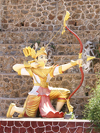
Kumphakan (กุมภกรรณ)
A demon from the
Ramakien. He is a son of
Thao
Lastian (ลัสเตียน),
i.e. Asuraphong (อสุรพงศ์),
with
Nang
Ratchada (รัชฎา) and
ranks as the younger brother of
Totsakan
(fig.).
He has a green complexion and −unlike most of the other important
yaks in the Ramakien−
he wears no
chadah-like
crown (fig.),
but a tiara-like
headdress called
kabang.
In
khon,
he is represented either with a green khon mask (fig.),
or a golden khon mask with
decorative lines in green (fig.),
i.e. the colour of his actual complexion.
He is asleep most of the time because of a curse by
Brahma.
He was initially so devout, intelligent and brave, that he induced
the envy of
Indra
over him.
Consequently, Indra requested Brahma's
consort
Sarasvati to
tie
Kumphakan's tongue when
Kumphakan was performing a major
Yajna for Brahma, along with his
brothers Totsakan and
Phiphek
(fig.).
During this act of offering and worship,
Kumphakan intended to
ask Brahma for a blessing, but with his tongue twisted, his asked
Brahma for Nidra-asana,
i.e. ‘the throne of sleep’ instead of Indra-asana, i.e. ‘the throne
of Indra’. In granting him his request, Brahma hence cursed
Kumphakan. Although in disagreement with Totsakan over the latter's
mistakes and wrongdoings, he is unable to openly oppose him and
joined his brother in his battle against
Phra Ram
(fig.).
Fighting on what he
knows is the wrong side, he wounded
Phra Lak
(fig.)
with the magical
Mokhasak
spear, but was eventually
killed by Phra Ram. In
the Ramayana,
he is
called
Kumbhakarna and is described
as a half-brother of
Kubera.
See also
LIST OF RAMAKIEN CHARACTERS & NAMES.
回
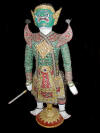
kumphan (กุมภัณฑ์)
Thai. A devil, demon, giant or monster. See
also
yak.
回
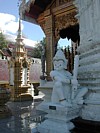
Kumphaniyah (กุมภนิยา)
Thai. Name of a
ceremony held by
Indrachit
(fig.)
in the epic
Ramakien,
which would make him invincible. However, the ceremony was disturbed
by
Phra Lak
(fig.)
and
Nilek (fig.).
See also
LIST OF RAMAKIEN CHARACTERS & NAMES.
回
Kumphanuraat (กุมภัณฑ์นุราช)
Thai. Name of a
kumphan,
i.e. a
demon, giant or
yak
in the epic
Ramakien,
who has a red complexion and wears a chadah-style crown.
Originally, Kumphanuraat was an angel named Sunon (สุนนท์) who
served
Phra Idsuan, i.e.
Shiva.
After teasing another angel, named Ratchanee (รัชนี), he was cursed
by
Shiva
to become a giant guarding the cave of Surakaan (สุรกานต์), where he
could eat any animal that entered his territory. His curse would be
lifted if he paid homage to
Phra Narai. One day,
Phra Ram
(fig.),
Phra Lak
(fig.)
and
Hanuman
(fig.),
Kumphanuraat noticed the three wandering his territory and
considered capturing Hanuman for food. A fight ensued, and
astonished by Hanuman's power, Kumphanuraat asked who he was and why
they had encroached on his territory. Upon learning that they were
soldiers of Phra Ram, the
avatar
of
Phra Narai, Kumphanuraat asked for
forgiveness from Hanuman and shared his story. After this,
Phra Ram
freed him from the curse, and he returned to his original form as
Sunon, flying back to Mount
Krailaat,
the mountain on which
Shiva dwells.
Sometimes transliterated Kumbhanurat.
See also
LIST OF RAMAKIEN CHARACTERS & NAMES.
回
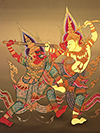
kumquat
Common name for a small
fruit-bearing tree, with the botanical designation Citrus japonica
and that belongs to the family Rutaceae. The tree bears edible
fruits that closely resemble oranges (Citrus sinensis -
fig.) and
mandarins (Citrus reticulata -
fig.),
but which are even smaller still. Also spelled cumquat. In
Vietnam,
the kumquat tree is considered a symbol of prosperity and during the
Tet (Tết) Festival,
i.e. the Vietnamese New
Year
(fig.),
people put up kumquat trees, akin to Christmas trees in the
Christian tradition,
especially in northern Vietnam, where the trees grow well in the
cold weather. See also
som
and
ton son.
回
%202_small.jpg)
kun chiang (กุนเชียง)
Thai-Chinese.
Designation for a Chinese-style, dry
-yet oily- sausage. It may be prepared from pork, shrimp or fish,
and is named adding the appropriate suffix to it, i.e.
moo,
kung
or
pla,
respectively. They are neither fermented, nor smoked or ripened, but
dried with heat. It is never eaten directly, but always cooked or
steamed before consumption, sliced and served with
rice
(fig.),
noodles or other dishes. Apart from meat, ingredients include curing
salt, sugar, pepper, garlic and optionally some Chinese seasonings,
such as cinnamon, ginger, soy sauce and Chinese rice wine, with
sugar contents varying from a low 1.4% in the cooler North of China,
to high in the hot southern areas, adjacent to Southeast Asian
countries, where sugar contents may in fact exceed 10%. Some
variations of Chinese sausage may also contain starch and food
colouring.
It is the most popular
ethinc meat product available throughout East and South East Asia
and is also known as yuen chang and lup cheong.
回
_small.jpg)
Kunchon Warih (กุญชรวารี)
Thai-Pali.
‘Water Elephant’. Also transcribed Kunchorn Waree. See
Chang Nahm.
回
kundaan (กุนดาน,
कुण्डन)
See
kundan.
回
kundala
(कुण्डल)
Sanskrit. ‘Earring’. Ornaments worn as
talisman to protect against
evil. The size and material used would indicate the status of the
wearer. Elongated ear lobes, like those of the Buddha, originated
from wearing heavy golden earrings and indicated royal descent.
回
Kundalini (कुण्डलिनी, กุณฺฑลินี)
Sanskrit-Thai.
‘Coiled power’. A
shakti
or form of
Durga,
which in
yoga is
understood to be an unconscious, instinctive or libidinal force,
that lies coiled at the base of the spine and which is also known as
corporeal energy. It is usually imagined as a sleeping serpent, that
resides in the sacrum bone and lies coiled in three and a half loops
around a
linga. Each loop is
said to represent creation, preservation, and destruction, whereas
the half loop is said to signify transcendence. This dormant energy,
in English sometimes referred to as serpent power, can be awakened
through the practice of yoga, meditation and various esoteric
practices, enabling it to rise up to top of the head along the spine
and merge with the crown
chakra, which
results in certain physical and psychological effects, such as
involuntary jerks or shaking of the body or limbs, and the sense of
energy rushes described as feelings of electricity circulating the
body, as well as mood swings and altered states of consciousness,
often trance-like. These occurrences are known as the Kundalini
experience. See also
Tantrism.
回
kundan (กุนดัน, कुण्डन)
Thai-Indian term for a
traditional Indian jewellery-making technique in which high-purity
gold foil is used to set precious and semi-precious gemstones into
intricately carved patterns. Originating from Rajasthan and Gujarat,
and refined under the
Mughal Empire, this method is known
for its opulence and craftsmanship. The gems are embedded into
shaped
gold
or gold-plated metal bases, and the surface is polished to a high
sheen. The Thai word
kudan
derives from it and refers to the gilded and glass-inlaid
ornamentation similar to Indian gem-setting craftsmanship,
reflecting the historical artistic exchange between India and
Siam.
A more elaborate form known as kundan meena (कुण्डन मीना) features
coloured enamel work called meenakari (मीनाकारी) on the reverse side
of the jewellery. Also transliterated
kundaan.
回
kundika (कुण्डिका)
Sanskrit. Name for a
kind of pitcher or ewer, i.e. a long-necked water-pouring vessel. In
Buddhist
iconography, the kundika is
sometimes depicted as an attribute of the
Buddha
or
certain bodhisattvas, whether or not in gold, and said to contain
the
amrita.
See also
kalasa,
Suwanphingkhaan.
See also THEMATIC STREET LIGHT.
回
kung (กุ้ง)
Thai general name for any aquatic,
prawn-like crustacean, such as lobster, shrimp, etc. See also
kung ten.
回
_small.jpg)
kung kaam kraam
(กุ้งก้ามกราม)
Thai. ‘Grinder-clawed
prawn’. A name for the
Giant River Prawn.
回
kung mae nahm (กุ้งแม่น้ำ)
Thai. ‘River prawn’. A
name for the
Giant River Prawn.
回
Kung Fu (功夫)
Chinese. ‘Virtuous
man’. Originally, the term Kung Fu (gōngfu) referred to a process of
training and any achievement through great effort. It combines the
word gōng (功) meaning ‘meritorious deed’ or ‘skill’, and fū
(夫) which translates as ‘man’ (note that tone of the second word
becomes neutral when combined with the first word, originally of the
same tone). The Chinese word for gōng (功) is itself actually a
compound word of two other characters, that is gōng (工) and lì (力),
of which the first means ‘work’ and the latter (lì) ‘strength’,
‘ability’, ‘power’ or ‘(physical) force’. Over time, Kung Fu became
a term used in reference to Chinese martial arts, said to have
derived from
Shaolin
(fig.).
As a martial art, Kung Fu is in Chinese also known as Wu Shu (武术),
i.e. ‘military technique’ or ‘martial art’, with the first character
Wu (武) being a compound of zhi (止), i.e. ‘to stop’ and ge (戈), i.e.
‘halberd’ (an ancient Chinese weapon), thus ‘to stop [an attack by]
a halberd’, and hence referring to the martial art's defensive
character. See also
Qi Gong
and compare with the Japanese term
kodawari.
回
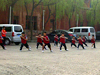
kung ra-beud (กุ้งระเบิด)
Thai. ‘Shrimp bomb’. Name for a snack made from a paste of seasoned
minced fish meat mixed with chopped shrimps (kung),
which is made into small balls and covered with small cubes of
bread. The balls are deep-fried in oil until golden brown and are
typically eaten with a spicy sweet-and-sour sauce and some cabbage
or salad. In English sometimes referred to as fried shrimp balls,
but that designation could also refer to
look chin
kung. It is an
OTOP
product of
Samut Sakon.
回
%20shrimp%20bombs_small.jpg)
kung ten (กุ้งเต้น)
Thai. ‘Dancing shrimps’. The name of a dish consisting of small
fresh water shrimps mixed with several spices whilst still alive.
They are sold by street vendors and on markets, straight from the
fish tank. The shrimps, called
kung in Thai,
jump (ten or ‘dance’) like a fish out of water, giving the dish its
typical name. A local dish from
Phayao.
WATCH VIDEO.
回
kung thalae (กุ้งทะเล)
Thai. ‘Sea shrimp’. Term for various species of small marine
crustaceans that belong to the order Decapoda. They are harvested
worldwide for human consumption and are widely used in many cuisines
due to their versatility in cooking. A commonly farmed species of
sea shrimp in Thailand is the Pacific White Shrimp, a species with
the binomial name Litopenaeus vannamei and also commonly known as
Whiteleg Shrimp and King Prawn, and in Thai called
kung
khao,
literally ‘white shrimp’. The specific names and terms for shrimp
can vary based on region and industry standards.
WATCH VIDEO
and
VIDEO (EN).
回
Kunti (कुंती)
Daughter of Shura and mother of the
Kauravas. She is an
important figure in the
epic poem
Mahabharata.
Previously she was named Pritha.
回
Kuperan (กุเปรัน)
Thai. Name of a
yak, i.e. a
demon
character,
in the
Ramakien.
READ ON.
回
kupih (ကူဖီ, ကူဖီး)
Burmese. Name for an
ice cream-like dessert in
Myanmar,
which consists of frozen coffee with sweetened condensed milk
and some ground
cardamom
(fig.).
It is also referred to as Burmese
kulfi, i.e.
the name for traditional Indian ice cream and of which kupih
is a local Burmese version. Its is cylindrical in shape and hence
somewhat reminiscent of the Thai
nahm khaeng kot,
i.e. ice lollies
(fig.)
that are produced
in metal tubes (fig.),
though kupih
is much denser and
more
creamy.
Also transliterated kupee and ku
hpee and
sometimes referred to as
kupih malain.
回
_small.jpg)
kupih malain (ကူဖီ မလိုင်, ကူဖီး
မလိုင္)
Burmese. ‘Kupih
cream’. Another name for
kupih,
an ice cream-like dessert in
Myanmar (fig.),
i.e. a
Burmese version of the Indian
kulfi, with malain meaning ‘cream’,
a word that itself derives from the Hindi term
malai. Also
transliterated kupee malain and ku hpee malai.
回
Kurma (कूर्म)
Sanskrit. ‘Turtle’
or ‘tortoise’.
The second
avatar of
Vishnu who supported
the churning stick during the churning of the
Ocean of Milk,
thus preventing it from going in the soft soil (fig.).
It thus became a symbol of stability. Also transcribed Kuurma.
WATCH VIDEO.
回
_small.jpg)
kurta (कुर्ता)
Hindi. Name for a kind of dress that
consists of a long, loose, tunic-like shirt, without a collar, which
is worn over a pair of trousers, that is either loose or tightly
fitting around the calves. It is worn by both men and women in
certain countries of southern Asia, including in India, and can be
simple or very colourful. It is sometimes referred to as
kurta-payjama (कुर्ता-पायजामा). Compare with
saree
(fig.).
回
_small.jpg)
Kuru
(कुरु)
A king of the Lunar race, who ruled over
Kurukshetra, a region near Delhi in northwestern India, that was
supposedly the battle scene of the war between his descendants the
Kauravas and the
Pandavas, described
in the
epic poem
Mahabharata.
回
Kusa
(कुश)
One of
Sita's two twin sons in the
Ramayana, neither of
whom were recognized by their father
Rama until they were
fifteen years old. The other son was
Lava. Also spelled Kusha.
回
Kushinagara (कुशीनगर)
See
Kusinagara.
回
Kushinara (कुशीनर, กุสินารา)
Sanskrit-Thai. Original
name of
Kusinagara,
which is still preferably used in Thai.
回
Kusinagara (कुशीनगर)
Sanskrit-Thai. Place in North India where the
Buddha died and where
his remains were cremated and divided up among eight kings.
Originally known by the name Kushinara, it is one of four important
Buddhist place of pilgrimage. Also Kushinagara.
回
Kusinara Ingyin Tawya Phaya
(ကုသိနာရုံ အင်ကြင်းတောရ ဘုရား)
Burmese. Name of
a Buddhist semi-gu
style cave temple in Mandalay, located at the foot of Mandalay Hill.
READ ON.
回
kutakhaan (กุฎาคาร)
Thai. Another term for
prasat and
prasada,
i.e. a Thai architectural form for palaces or religious buildings,
such as a
mondop (fig.),
with an usually multi-tiered, ornate roof, that has one or more
spires, such as
the
Chakri Throne Hall
(fig.),
Dusit Maha Prasat
(fig.),
Phra Thihnang Mahison Maha Prasat
(fig.),
and
Phra Thihnang Siwalai Maha Prasat
(fig.).
Also transliterated kuthakhan.
回
kuti
(กุฏิ, กุฎี)
Thai. ‘Cubicle’ or ‘cell’. The term today refers to the lodgings or living quarters of Buddhist monks in temples
or monasteries, but in the past it also referred to either a house
with multiple floors and with multiple rooms, that were usually
built in cloisters, called moo kuti (หมู่กุฏิ), akin to the term
moo ban.
回
Kuti Jihn (กุฎีจีน)
Thai. Name of an
old Portuguese-Thai
community in
Bangkok's
Thonburi
district. Its name derives from
the
epithet
in 1835
given to the
local
Santa Cruz Church,
after the original
church made of wood (fig.)
was rebuilt in a design
resembling Chinese edifices
called
Keng
(fig.)
and which led to it being
nicknamed
kuti
jihn,
i.e. ‘Chinese
dwelling’,
a name that was gradually adapted by the community that grew around
it. The community is home to the
Ban Kuti Jihn Museum,
a
small family-run museum that is
housed in a building that used to be the home of a Catholic family
and that is dedicated to the history, culture and traditions of this
old Portuguese-Thai community, especially to the historical events
in the period immediately
after the fall of
Ayutthaya in 1767,
and the establishment of Thonburi as the new Siamese capital
by King
Taksin
(fig.).
Besides this, the neighbourhood is also home to Sahn Chao Mae
Kwan Im
(ศาลเจ้าแม่กวนอิม), also known as Sahn Chao Giang An Keng (ศาลเจ้าเกียนอันเกง),
a
Thai-Chinese
shrine dedicated to
Kuan Yin,
the Chinese goddess of Mercy (fig.);
and
Wat Kanlayanamit Woramahawihaan
a
first class
Buddhist temple of
royal
rank,
that
features the
largest bell in Thailand (fig.)
and the
15.15 meter tall
Phra Phutta Trai Rattananayok
Buddha statue
(fig.),
which
for a long time was the tallest seated Buddha image in the capital.
回
_small.jpg)
Kuvalayapida
(कुवलयपीड)
Sanskrit
name of a demon in the form of an elephant, who was sent out by
Kansa to kill
Krishna, his nephew.
See also
Arishta.
回
Kuvera
(कुवेर)
Pali for
Kubera.
回
Kuwen (กุเวร)
Thai spelling and
pronunciation for
Kuvera
or
Kubera.
Commonly used with the prefix
thao,
i.e.
Thao
Kuwen. He is one of the
Four Heavenly Kings from
Mahayana Buddhism and typically
found at the entrance of
Chinese-Taoist
temples. It is another form of
Thao
Wetsuwan
(fig.),
who is typically depicted as a
yak
or giant holding a
mace. In
Thailand, he is usually depicted with a golden complexion and
holding a staff topped with a crystal ball. See also
Chatumaharachikah.
回
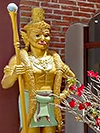
Kwae
(แคว)
Thai. ‘Tributary’.
Name of a river in
Kanchanaburi
Province.
The meaning of its name refers to the fact that there are actually
two rivers, namely the Kwae Yai, also referred to as the Sri Sawat
(ศรีสวัสดิ์) River, after an upstream district, and the Kwae Noi,
nicknamed Khwae Sai Yok (แควไทรโยค), also after an upstream
district. The Kwae Yai and Kwae Noi, literally the
‘Greater Tributary’
and the
‘Small or Lesser Tributary’
join in the
tambon
Ban Tai (บ้านใต้) in the city
of Kanchanaburi,
alongside a road called Song
Kwae, i.e. the
‘Two Tributaries’, to form the
Mae Klong
River (fig.)
that from Kanchanaburi flows through
Ratchaburi
and empties into the
Gulf of Thailand
in
Samut Songkhram
(fig.).
The Kwae is fully known in Thai as Mae Nahm Kwae and is in English
often incorrectly referred to as the River Kwai. The river became
famous for
the
infamous
Thailand-Burma
Railway built by the Imperial Japanese Army during WW II and
commonly referred to as the
Death Railway
(map
- fig.),
which for a large part runs parallel to the river, and
the
Bridge over the
River Kwae Yai (fig.),
as well as for the many large pontoons and rafts
that are either
pulled up and down the
river by small towboats and modified as restaurant or disco, or
used as
stationary floating accommodation (map1,
map2 -
fig.)
along the river banks.
See also
PANORAMA PICTURE,
MAP,
and
WATCH VIDEO.
回
Kwahm Suk Muan Ruam Pai
Nai Phrathet (ความสุขมวลรวมภายในประเทศ)
Thai for ‘Gross Domestic Happiness
(GDH)’. See
Gross
Domestic Happiness Index.
回
Kwahm Suk Muan Ruam Prachachaht
(ความสุขมวลรวมประชาชาติ)
Thai for ‘Gross National Happiness
(GNH)’. See
Gross
Domestic Happiness Index.
回
kwahng (กวาง)
Thai for
deer.
回
kwahng dao nahm khah trong (กว่างดาวหนามขาตรง)
Thai. ‘Straight
thorn-legged Rhinoceros Beetle’. Thai name for the
Long-armed Parry Beetle.
回
kwahng ha khao (กว่างห้าเขา)
Thai. ‘Five-horned
Rhinoceros Beetle’. Name for a beetle found in Southeast Asia, with
the scientific name Eupatorus gracillicornis, and also known as
kwahng sahng neua (กว่างซางเหนือ) or
duang kwahng sahng neua (ด้วงกว่างซางเหนือ),
as well duang kwahng ha khao (ด้วงกว่างห้าเขา). It has a size of up to
8 centimeters and is boldly coloured, with a shiny black head, legs
and underparts, and a golden brown elytra. Males have four large
horns on the pronotum and an extra-long cephalic horn. The larvae,
which are difficult to discern from their close relatives in the
genus Chalcosoma, are known to be aggressive and try to bite when
handled. For many people, this species of beetle is very popular,
either alive as pet or dead and framed as an insect collector's
item.
回
%20Eupatorus%20gracillicornis_small.jpg)
kwahng sahm khao (กว่างสามเขา)
Thai. ‘Three-horned
Rhinoceros Beetle’. Collective name for any kind of Atlas Beetle,
with a size of up to 13 centimeters, the largest beetles in
Thailand. They belong to the genus Chalcosoma, which includes the
species Chalcosoma caucasus, Chalcosoma atlas and Chalcosoma
mollenkampi.
回
Kwahng Thong (กวางทอง)
Thai. ‘Golden Deer’.
Name of a deer
from the
Ramakien,
which had
a golden fur, but actually was a disguise of the demon
Mariht, in
order to spy on
Nang
Sida
(fig.).
When
Phra Ram
(fig.)
realized
that it was indeed a demon, he shot and killed the golden deer with
his arrow. In khon, Golden Deer is represented by a dancer wearing a
golden crown in the form of a deer's head with antlers, yet in
miniature
khon masks
it is depicted as a human face with a white complexion, wearing a
crown in the form of a golden deer's head with antlers (fig.).
See also
kwahng.
See also
LIST OF RAMAKIEN CHARACTERS & NAMES.
回
%20kwahng%20thong_small.jpg)
kwai (ควาย)
Thai for
Water Buffalo,
used alongside the terms
carabao
and
krabeua.
回
Kwai: Calm (ควาย: คาล์ม)
Thai–English.
Name of a public art installation by Thai artist Maitree Siriboon (ไมตรี
ศิริบูรณ์), centred on a sculptural representation of a
Water Buffalo (kwai),
a potent symbol in Thai cultural and social discourse. The work was
presented as part of the Bangkok Art Biennale 2022 Chaos: Calm, which took place
across 11 venues in Bangkok and ran until February 2023, under the
theme Chaos: Calm, inviting artists to contemplate the tumultuous
conditions of the world around us as communities recover from the
Covid-19 pandemic, as well as the urgency to address the climate
crisis and socio-political uncertainty around the globe. In January
2023, while installed outside
Samyan Mitrtown,
the sculpture was destroyed after an intoxicated British tourist
attempted to climb onto it, causing the work to break into pieces.
The incident prompted strong condemnation from the chief executive
and artistic director of the Bangkok Art Biennale. Prior to this,
the sculpture was displayed at The Peninsula Bangkok.
回
_small.jpg)
kwak (กวัก)
Thai. To raise the arm and move (the hand) as
a summons, to gesture or to beckon, as in
maew kwak and
nang kwak. Also
kwak meua.
回
kwak meua (กวักมือ)
Thai. To raise the arm and move the hand
(meua) as a summons, to gesture or to beckon, as in
maew kwak and
nang kwak. Also
kwak.
回
kwan (ขวัญ)
Thai.
Also transcribed khwan or khuan.
The tuft or circle of hair at the back of the crown of the head,
metaphorically the seat of someone's spirit, especially the guardian
spirit with children. According to ancient Thai
phrenology
it shows the character of a person, and two such circles would
indicate a scoundrel nature. It can also be translated as heart,
moral, courage, and confidence, as in the
phittih
tham khwan
(พิธีทําขวัญ) i.e.
‘to
perform an encouragement ceremony’
(fig.).
Also
brahmins
grow a
small tuft of hair
at
the back of their head, in the
bindu
chakra (‘circle
of drops’),
a
part where it is believed that a fluid is produced which can become
either
amrita,
the
elixir of immortality,
or the poison of death.
See also
poi and
juk, and
Talaat Nahm Khwan-Riam.
回
kwan chang (ควาญช้าง)
Thai for
mahout.
回
Kwan Im
(กวนอิม)
See
Phra Mae Kwan Im and
Kuan Yin.
回
Kwan Yin
See
Kuan Yin.
回
Kwannon
Japanese goddess of mercy, in
China
known as
Kwan Yin
(Kuan
Yin
-
fig.)
and in Thailand as
Phra Mae Kwan Im.
She is the female form of the male
bodhisattva
Avalokitesvara,
the personification of
compassion in
Mahayana
Buddhism.
回
kwian
(เกวียน)
Thai name for
a cart, especially a
two-wheeled cart
(fig.)
drawn
by a
pair of water
buffaloes
or oxen (fig.),
and
used to transport paddy to
the
market.
As such,
those
cart
loads
stands at the origin of a
unit of capacity for
measuring
paddy or
rice,
officially called
kwian
luang
and equivalent to 2,000 liters. There are different traditional
types of carts according to the various regions of Thailand, and in
1992 a set of four postage stamps was issued with typical carts from
the North, the Northeast, the East and the West (fig.).
Discarded carts are often found parked in gardens, where they are
used decoratively, whilst old cart wheels are used either
decoratively, to build a garden fence, as part of garden furniture
or
sala-style
garden houses, or even to be made into a rocking horse (fig.),
a most original application.
The world's largest ox cart (fig.)
stands in
Wat Sam Roi Yot (วัดสามร้อยยอด),
a Buddhist temple near
Khao Sahm Roi Yot National Park
(fig.)
in
Prachuap Khirikhan
Province.
WATCH VIDEO (1)
and
(2),
VIDEO (M),
and
VIDEO (EN-1)
and
(EN-2).
回
%20cart%201_small.jpg)
kwian
luang
(เกวียนหลวง)
Thai. The official unit
of capacity for measuring
rice
or paddy. The term derives from
a two-wheeled cart
drawn
by a
water
buffalo
or oxen, and in the past
used
for
transporting
paddy to the
market.
Such a cart and its load was referred to as
kwian.
The measure was later made
official and settled at 2,000 liters, which is
equivalent to 100
thang or 2
ban luang.
回
kyai (ကျိုက်, ကျာ်)
Burmese-Mon
term for a
stupa
or a
pagoda,
especially when used in compounds as in
Kyaihtiyo.
Also transcribed kyaik, though the final
‘k’ is not clearly pronounced, if at all. However, the term pagoda
is in
Myanmar
used generally to refer to a temple and its compound, that is any
temple, whether it has an actual pagoda,
i.e. a sacred tower (zedi
or
stupa),
or not.
回
Kyaikpun Pagoda
See
Kyai Pun Bhura Kyee.
回
Kyai Pun Bhura Kyee
(ကျိုက်ပွန်ဘုရားကြီး)
Burmese-Mon
name of a Buddhist temple in
Bago.
READ ON.
回
Kyaihtiyo (ကျိုက်ထီးရိုး, ကျာ်သိယဵု)
Burmese-Mon
name of a renowned Buddhist pilgrimage site, located on a mountain
top in
Myanmar's
Mon State, and in English referred to as the Golden Rock, as it is
nowadays completely covered in
gold leaf.
In Burmese, the name could literally be translated as
‘simple, i.e. unadorned (yo),
ornamental umbrella (hti)
pagoda (kyai)’
or, if read as a compound, ‘umbrella shaft
stupa’,
though in the
Mon
language, the name means
‘pagoda (kyai) on the head (yo) of a
hermit’, with
the meaning of hti being derived from the Burmese term
tapathi (fig.)
and the Mon term
ithi, whilst the
Mon word yo is said to mean ‘on the head’. The latter meaning goes
back to an ancient legend, in which the
Buddha
is said to have given three strands of his hair as relics to three
hermits, one for each. Two of them deposited their relic in a golden
casket, which they kept in
Shwe Mawdaw
Phaya (fig.),
a pagoda specially built for the relic, whilst the third hermit,
named Taikthadharma,
kept his relic in his own topknot, underneath the characteristic
high cap worn by Burmese hermits (fig.),
in order to safeguard and cherish it. After the two hermits had died
and the end of Taikthadharma's life was also drawing near
Thagyamin
(fig.),
the king of the
nats
became anxious that the precious relic of the Buddha could be lost
and persuaded him to take measures for its safety before he himself
would die. The old hermit considered the matter for some time and
then agreed to give the relic to Thagyamin on condition that he
would find a rock to house it in. Furthermore, he requested that the
rock would be of the same shape as his own head. Thagyamin found
such a boulder in the sea and consequently balanced it on the
mountain edge at Kyaihtiyo, resting on an extremely small contact
area between the giant boulder and the mountain slope, allegedly
using the strand of the Buddha's hair to prevent the rock from
tumbling down, as the relic had now been deposited into a hole bored
into the rock, which was later sealed off with a pagoda that was
built over it (fig.).
Eventually, the hermit passed peacefully away at the foot of the
Golden Rock, which today is regarded as the second most important
Buddhist shrine in Burma, after the
Mahamuni Buddha Image
(fig.).
The Golden Rock is situated at an altitude of 1,100 meters and
is about 7.5 meters high. When it is pushed, it actually waggles,
but seems to defy gravity. In Thai, Kyaihtiyo is known as
Phrathat
In
Khwaen (พระธาตุอินทร์แขวน), i.e. ‘Suspended
Indra
Relic’, thus referring to the
Hindu god
with whom Thagyamin is identified. The stupa is associated
with people born in the Year of the
Dog,
i.e. 12 stupas that
contain Buddha relics of various years of the
Chinese zodiac,
and is hence the foreign counterpart of the
stupa of
Wat Ket Karam
(fig.)
in
Chiang Mai,
the pagoda in Thailand for
people born in the Year
of the Dog.
There are many copies nationwide,
especially in the area of the original Golden Rock, and there is
even a replica in
Kanchanaburi
(map
-
fig.), a province of Thailand
bordering Myanmar, with a large community of Mon people. Also
transcribed Kyaikhtiyo, Kyaitiyo and Kyaiktiyo.
See also TRAVEL PICTURES
and
MAP.
回
Kyansittha (ကျန်စစ်သား)
Burmese. Name of a King of
Bagan.
READ ON.
回
Kyaswa (ကျစွာ)
Burmese. Name of a King of
Bagan,
who ruled from 1235 to 1251 AD.
READ ON.
回
Kyat (ကျပ်)
Burmese. Currency
unit of
Myanmar.
回
kyat paung thee (ကျြက်ပေါင်သီး)
Burmese name for the Black Swallow-wort, also known as
Green Wax
Flower,
Cotton
Milk Plant, Green Milkweed Climber, Sneezing Silk,
Louise's Swallow-wort and Black Dog-strangling Vine.
It is a plant in the milkweed family, with the botanical names
Cynanchum louiseae, Vincetoxicum nigrum and Dregea
volubilis, with volubilis meaning
‘twining’
(fig.).
In
Myanmar,
the slender tapered seedpods, which are tightly packed with seeds
attached to puffy fibers, are used in home cuisine.
回
Kyaukgu Umin Phaya
(ကျောက်ဂူဥမင်ဘုရား)
Burmese. ‘Rock Cave Tunnel
Pagoda’.
Name of a 12th
Century AD Buddhist temple near the villages of Nyaung U and
Wetkyi-in, which are located in the greater Bagan region.
READ ON.
回
Kyauk Ka Lat (ကျောက်ကလပ်)
Burmese. ‘Rock Club’ i.e. a stone mace. Name of a limestone rock
formation in Hpa An, the capital of
Myanmar's
Kayin State, which is topped
with a golden
stupa.
It is located on a tiny islet in a lake and is surrounded by
monastic edifices.
See MAP.
回
Kyauk Sa Ga Gyi Phaya
(ကျောက်စကားကြီးဘုရား)
Burmese. ‘Stone
Pagoda of the Great Words’.
Name of a
brick
Buddhist temple in
Bagan,
which is
built in a
style
reminiscent of the early Bagan Cave Style architecture, known as
gu.
READ ON.
回
Kyaukse Sain Pwe (ကျောက်ဆည်ဆင်ပွဲ)
Burmese. ‘Kyaukse
Elephant Festival’.
Name of a
traditional
festival that originated in
Kyaukse.
READ ON.
回
Kyauk Taw Gyi Phaya
(ကျောက်တော်ကြီးဘုရား)
Burmese. ‘Great
Stone Deity
Pagoda’,
yet usually translated as ‘Temple of the Great Marble Image’.
Name of a Buddhist temple at the foot of Mandalay Hill (fig.),
which houses the largest marble
Buddha image
in
Myanmar.
READ ON.
回
kyaung (ကျောင်း)
Burmese. A temple, monastery or school in
Myanmar.
Pronunciation tjaung. See also
Kyaung Lain.
回
Kyaung Lain (ကြောင်လိမ်)
Burmese. Name of
an ancient brick monastery in
Inwa,
located adjacent to and to the east of
Myinmo Taung.
READ ON.
回
Kyay Thun Phaya (ကြေးသွန်းဘုရား)
Burmese.
‘Bronze Shed
Pagoda’.
Name of a Buddhist temple on the
outskirts of
Bago.
READ ON.
回
kyi
(ကြီး)
Burmese.
An alternative transliteration for
kyee.
回
kyee (ကြီး)
Burmese
term for ‘great’, ‘big’
or a ‘large’, as well as for
‘elder’,
‘mighty’ or ‘powerful’.
It is similar in use to the Sanskrit-Pali-Thai word
maha, which can also
be used in
Burmese. Yet, whereas
maha is typically used as a prefix before the name or title of
important persons, things and places, the word kyee is used as a
honorific suffix and added to the end of a name or title of
important persons, things and places. Also transliterated kyi or
gyi.
回
kyeezee (ကြေးစည်)
See
kyi-zi.
回
kyi-zi (ကြေးစည်)
Burmese. ‘Bell plate’. Name for a
small to medium-sized Burmese, brass, plate gong or chime, usually
with elaborate upward curved side corners and sometimes with
engraving (fig.).
Its early use is related to religious ceremonies and the smaller
bell plates are at present still used by some Burmese Buddhist monks
on
bintabaat,
i.e.
alms round (fig.).
The monks will hit them to ring three times in succession as a
symbol of the
Trairat. They
come in different sizes and shapes, but are always flat. The most
commonly found form is triangular and somewhat resembles a
krajab water chestnut
(fig.).
These metal plate gongs can be found in temple compounds and
monasteries all over
Myanmar, as well as
in some Thai temples, usually near the Burmese border. Some small
kyi-zi may also be used as percussion instrument in an
ensemble. Also transcribed kyeezee and nicknamed
Burma
bell. Pronounced chi-zi. See also
kong.
回
,%20a%20Burmese%20brass%20bell%20plate%20or%20flat%20gong%202_small.jpg)