|
Ramakien
The
Ramakien
is
derived from the
Indian
epic
Ramayana,
the ‘Story
of
Rama’, written more than 2,500 years ago by
Valmiki and
has 24,000 verses. In
India alone, there are several versions of the story in different languages,
such as
Sanskrit,
Hindi, Tamil and Assamese. The most important version is the original one in Sanskrit.
It is not only a great literary
classic but
is also considered the holy book of the
Hindus,
in importance exceeded
only by the
Vedas.
Beyond
India, the story of the Ramayana spread over Southeast Asia and was translated
in the vernacular of
Thailand, Indonesia,
Malaysia,
Cambodia, Vietnam,
Burma,
Laos,
(where it is considered a
jataka and
known as
Pha Lam Sadok or
Pha Lak Pha Lam),
and the Philippines.
In Thailand, there are a number of
variations and forms of the
Ramakien, the
Thai
version of the
Indian
epic, which
includes
incidents and details not found in the Sanskrit original,
such as the appearance of
Suphanamatcha
(fig.).
Some
of the versions are sponsored by the royal
court, while others are local versions, varying in form from tale or play to masked
drama. It is also represented in several other forms of art, such as sculpture,
murals and paintings (fig.).
The
most complete edition of the Ramakien
is the play
composed by
Rama I
(fig.)
in 1785,
the
first
king
of the
present
Chakri
dynasty.
Due to its
long and widespread
popularity the Ramakien is also deeply interwoven
into the Thai way of life, apparent in the different arts
and in daily life. Pictures of characters and
scenes
from the Ramakien
are found all over
Thailand,
expressed in several forms of art and in
the nomenclature.
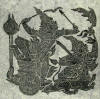
The story
relates the
vicissitudes
of
Phra Ram,
i.e. his birth as
Prince Rama, the son of
Queen
Kao
Suriya and King
Totsarot
of
Ayutthaya
(fig.),
and
his later
marriage
with
Sida,
the
daughter
of
King
Janaka. Sida
is
kidnapped by the demon-king
Totsakan, who
abducts
her to
Longka,
the
present Sri
Lanka. Then
follows the
account of the
lengthy battle between Rama
and the
ten-headed Totsakan,
in which Rama
is
assisted by
mythical half-man
half-animal
characters,
including
the
courageous
monkey-god
Hanuman (fig.),
always depicted
in white.
The
battle
brings the
defeat of Totsakan
and the
salvation of Sida,
after which Rama
returns as king.
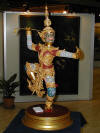
In
Khon, traditional
dance performances,
officially
all parts
including female
roles are played by men. In
lakhon
both men and women perform.
The themes
may be shortened versions
of the Ramakien, or
other
folk tales. The
complete version
of the Ramakien
consists of 311
characters and an
uninterrupted
performance would
last more than a month.
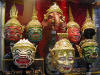
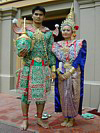
Khon
dancers
are dressed in rich
brocade embroidered
costumes
and
the human
characters usually
wear a
chadah,
a
kind
of conical headdress
resembling a small chedi.
The dancers
that represent demons
or
monkeys
wear masks in a
variety of colours and shapes according to their character.
By means of a complex
combination
of
mudras
and positions
of the body,
different
situations,
thoughts and feelings are expressed.
Every hand position in combination
with the pose of the body has an exactly defined meaning. The Sanskrit word
‘mudra’,
usually translated
as ‘handposition’
and also applied in
Buddhist iconography,
literally means ‘seal’ or ‘print’.
Only experienced khon adepts
are able to
distinguish the many gestures and their nuances.
回
Nonthok
A
popular story
preceding the
Ramakien
epic
has
protagonists
who are the previous incarnations
of
Rama
and Totsakan.
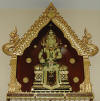
Nonthok,
the later Totsakan, had
the task
of washing the feet
of the gods who came to mount
Krailaat to worship the chief
god
Idsuan.
Whilst humbly performing his duty
he was constantly teased by the gods. They
pulled his hair and banged his head.
Weary of being
tormented he complained to the chief god and asked him for a diamond finger that
would kill when pointed to anyone hostile to him. Idsuan
at first granted him
his request
but after too many victims died
he reconsidered. He
charged
the god
Narai
-the later Rama-
to
silence Nonthok.
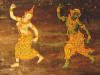
Disguised as a
female dancer Narai
was able to tempt Nonthok
into dancing with
him.
Because he didn't
know how Narai
urged him to imitate
his movements.
Copying him
faithfully Nonthok unconsciously
pointed
his lethal index finger on his own knee and immediately fell dying to the
ground.
The
worst
humiliation for Nonthok
however was that he
was killed by a being with human appearance. Because also Narai
thought this
punishment was too severe and humiliating he promised the possibility for revenge
in a next life. Nonthok
would come back as a
hideous giant with ten heads and twenty arms, whilst Narai would be born as an
ordinary mortal.
The
sequel is described
in
the Ramakien
epic.
回
Sangthong
The folk narrative of the
Sangthong
(fig.)
or the Golden
Conch
starts in a legendary prosperous city named
Phrom Nakhon,
which was ruled by King Phrommathat, who had two wives, i.e. Queen
Chantra Thewee and Queen Suwan Champa. When both wives became pregnant
simultaneously, the first with a boy, the latter with a girl. Because
only a male could inherit the throne, the second Queen out of jealousy
put a spell on the King to make him love her more and believe whatever
she would say, and in the meantime falsely accused Queen Chantra Thewee
of having a secret affair with some of the young soldiers in the palace.
Infuriated by this, the King expelled her from the palace, without even
listening to her side of the story.
After wandering for sometime,
Queen Chantra Thewee met an old couple who took pity on her and invited
her to live with them in a cottage outside the capital, where she would
help the couple to collect food and wood from the forest. Meanwhile, her
baby in the womb felt sympathy for his mother's hardship and by his
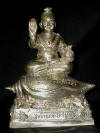
merit created a conch, in which he and sought shelter. Thus, the Queen
gave birth to a conch in which the baby remained until he grew up and
emerged as a cute boy with a topknot.
When the King learned of the birth of his son he was
delighted, thus Queen Suwan Champa quickly recited
the magic spell to control the King, who then ordered the boy and his
mother were arrested and floated out to sea on a raft, which was
eventually shipwrecked, separating Phra Sang from his mother, who was
washed ashore and ended up in the service of a rich man named Thananchai.
The boy, on the other hand, was rescued by a
Naga
and given a golden boat by
a
reusi
(hermit), who
directed him to the city of Benares, warning the prince that he had to
pass through Wasi, a city of giants.
Wasi was ruled by a female giant, who upon meeting
with Phra Sang adopted him as her son and heir, keeping the boy locked
in the city for a long time. Here, Phra Sang found a pond with liquid
gold and one with liquid silver, which had the power to change anything
submerged in it into pure gold or silver. When he later found a heap of
human bones and discovered that his foster-mother was giant that
devoured humans, Phra Sang took a bath in the pond of gold, which
subsequently turned his body into gold, and then
escaped by disguising himself as an ugly ogre, thus eventually reaching
the city of Benares after a long delay.
_small.jpg)
Here, he was accepted by the villagers and especially
by their children, who liked him because of his ugliness. Still
disguised as an ogre of the
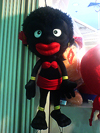
Ngo tribe, Phra Sang, now nicknamed
Chao
Ngo, enjoyed a
simple life in the village, where he taught the children to play polo
and got married to the youngest of the King's seven beautiful daughters.
However, the King, dismayed by the poor choice of his daughter, plotted
to kill Ngo. With a trick he tried to get rid of him, but after several
failed attempts, he annoyed the god
Indra, who intervened on the
behalf of Ngo.
Now Indra challenged the King with two questions and
if he were unable to answer them within seven days, Indra would smash
his head with his axe. Incapable of finding the correct answers, the
King in despair turned to Ngo for help. Ngo took up the challenge, took
off his disguise and revealed himself as Phra Sang, gave the right
answers and played a game of polo with Indra, who pretended to be
defeated and escaped. After this, the King gave his blessing to the
marriage and offered Phra Sang his throne.
Sometime later Phra Song was reunited with his
mother, who was subsequently acknowledged as the Queen Mother and when
the news of his wise and just reign reached the city
of Phrom Nakhon, many of its subjects migrated to live under his rule.
To stop a mass migration of its citizens, Phra Song was eventually
invited to return to Phrom Nakhon. Queen Suwan Champa soon after died
when she lost a bet to prove her ongoing accusations against her enemy.
She was burned to ashes and reborn in hell as a result of her grave
sins.
回 |