naag (นาก)
Thai. ‘Otter’. May also be transcribed naak or nahg. See also
naag lek leb san (fig.)
and
naag yai thammada
(fig.). 回
naag (นาค)
Thai for
naga. Also
transcribed
naak
and
nahg. 回
naag lek leb san (นากเล็กเล็บสั้น)
Thai. ‘Short-clawed otter’.
Name for the
Asian Small-clawed Otter. 回
naagprok (นาคปรก)
See
pahng nahg prok. 回
naag
yai thammada (นากใหญ่ธรรมดา)
Thai. ‘Large common otter’. Name for the
Eurasian River Otter.
回
naak (นาค)
Thai for
naga. Also written
naag and
nahg. 回
naakbeuang (นาคเบือน)
Thai.
‘Averting
naga’.
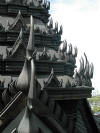
Architectural term for a kind of multiple
chofa,
i.e. bird's head-like finials, that appear
on
tapering roofs of temple
buildings. However, unlike chofa, which are placed
at the ridge on either end of a Buddhist temple's roof,
naakbeuang are mounted on the sides of tapering roofs, similar to
hang
hongse (fig.)
and as such are reminiscent of an
antefix
in the form of
naga (fig.).
Their very name also suggests that they represent
highly stylized forms of the naga (naak),
rather than stylized forms of a
Garuda, as is suggested in case of the chofa.
回
naaken
(นาเคนทร์)
Thai.
‘Elephant
king’,
‘snake
king’, i.e. a single word that means both
phaya
chang and
phaya
ngu, or alternatively
phaya
naak, and is used to refer to
a mythical
creature that is described as a snake with the head of an elephant,
or
alternatively, as an
elephant with the body of a snake.
READ
ON.
回
Naak Galyah (นาคกัลยา)
Thai name for the daughter of
the
Hindu
god
Shiva
(fig.),
who is depicted with the
snake-like body of a
naga,
and a crown of five hooded snakes over her own human head,
reminiscent of the
Buddha's
pahng nahg prok
pose, as well as
a set of bird-like wings, though in Chinese-style
iconography,
the crown of naga or snake heads may rather be
dragon
heads
(fig.). The name derives from her full Thai
designation, i.e.
Phra Mae Naak Galyanih, a name
similar to that of
Galyani Watthana
(fig.),
the late elder sister of King
Bhumiphon,
and which is also reminiscent of that of the five-headed
serpent
Kaliya,
which was
subdued by
the Hindu god
Krishna
(fig.). Shiva
also has another daughter with
Parvati,
who is named
Asokasundari.
In Thai her name may also be pronounced as
Naak Ganyah
and in English she is sometimes referred to as the Naga
Bodhisattva.
回
_small.jpg)
Naak Ganyah (นาคกัญญา)
Another Thai spelling for
Naak Galyah.
回
Naak Manop (นาคมานพ)
Thai. ‘Human
Naga’ or ‘Young Man Naga’.
A Thai mythical creature, half-man and half-serpent, with the head and
upper body of a young man and from the waist down with the body of a
snake. In full,
he is often referred to as
Naak
Naak Manop
Nagaraat.
Also transcribed Naag Manop.
回
_small.jpg)
naakprok
(นาคปรก)
Thai.
‘Overspreading
naga’. A
Buddha image with a
naga over his head. See also
Muchalinda and
pahng nahg prok. 回
Naaksen (นาคเสน)
Thai name for
Nagasena,
alongside
Nagasen. 回
naak shrinkhala (नाक श्रृंखला)
Hindi. ‘Nose
chain’. A type
of Indian ornament that consists of a chain which is attached
between the nose and the ear, usually with a ring and by piercing.
It is typically worn as wedding jewellery
(fig.)
by Hindu
brides in honour of
Parvati,
the goddess of love and marriage, and is removed on the wedding
night by the bridegroom to symbolize the end of the bride's
virginity. See also
ghaghra choli. 回
_small.jpg)
naan
Name for a
round
roti-like
flatbread made of wheat flour. The dough can be either leavened with
yeast or unleavened. It is baked in a clay oven, what
distinguishes it from roti which is usually cooked on a flat
iron griddle and uses unleavened dough. It originates from Central
Asia and is popular in Indian cuisine. Pronunciation nan. 回
%20indian%20round%20flatbread%20oven%20singapore_small.jpg)
naang chi (นางชี)
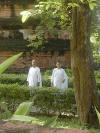
Thai. Buddhist nun in Thailand. Nuns are
lay people who keep eight precepts or voluntarily submit to the 227 rules of conduct of monastic discipline set out in the
Vinaya Pitaka,
although they do not belong to the
Sangha.
They usually shave bald like the monks and wear a pure white cloth.
Also
transliterated nang chi, nahng chih, or a similar combination of any
of the aforementioned spellings. See also
mae chi,
chi pah kao,
and
sihnlajarinee. 回
naang fah (นางฟ้า)
Thai. ‘Female angel’.
回
naang mai (นางไม้)
Thai. A female spirit or supernatural being inhabiting a
tree, a wood nymph, a dryad. While some are described as benevolent
and with powers to make miracles, some are malevolent and haunt
people, and yet others may may be both malicious and benign. Some
well-known naang mai are
Naang Takian
and
Naang Tani.
See also
Naang Naak. 回
Naang Naak (นางนาก)
Thai. ‘Lady
Naak’.
Name of a very popular female ghost, who is also known as
Mae Naak and
fully as
Mae Naak Phra Khanong, after the
district in
Bangkok (fig.)
where her story, supposedly based on events that took place during
the reign of King
Rama IV,
is set.
READ ON. 回
naang phaya (นางพญา)
A Thai name for ‘queen’.
回
Naang Takian (นางตะเคียน)
Thai. Name for a kind of
naang mai,
i.e. a female spirit
that inhabits trees and
sometimes appears as a beautiful young woman wearing traditional
Thai attire, luring wicked or immoral passersby into misfortune or
terrorizing those with evil intend, while righteous people are left
unarmed. Naang Ta-khian is said to dwell in a gagil tree, a large
forest tree with the botanical name Hopea odorata and in Thai known as
takian thong,
hence the name of this
wood nymph. The tree grows in
the wild and Naang Ta-khian haunts its immediate environment, as
well as houses made with gagil timber, though in this tree is seldom
felled for lumber, since the inhabiting ghost will be enraged and
follow the wood, that is except when the wood is used in Buddhist
temples, as those have special merit which is considered sufficient
to render the spirit harmless. However, many people worship tree
spirits as miracles and good fortune in lottery have been attributed
to her power. Hence to
appease or worship
this spirit,
believers will tie
coloured fabric
known as
pah phrae mongkon
around the
tree where a naang mai resides (fig.),
and even offer her traditional Thai silk dresses, usually in reddish
or brownish colours akin to the colour of the tree's trunk, in
comparison to
Naang Tani
or
Phi
Tani, another naag mai, who
mostly wears a green dress, as she inhabits
gluay tani
banana plants,
which are overall green in colour.
Also spelled Nang Takhian.
回
Naang Tani (นางตานี)
Thai. Name for a kind of
naang mai,
i.e. a female spirit that
inhabits trees. Naang Tani inhabits
gluay tani
banana plants,
hence the name of this
wood nymph. She is usually depicted as a beautiful young woman
wearing a green traditional Thai dress, akin to her abode, the
banana plant (fig.),
which is overall green in colour.
回
naem (แหนม)
Thai. Name for a snack of slightly fermented, salted
ground
pork and pork
skin fat, which is shredded and mixed with a handful of steamed
glutinous
rice,
monosodium glutamate, known in Thai as
phong choorot
(fig.),
and some
garlic. This is bound tightly together, previously with banana
leaves, nowadays more likely with strong transparent plastic. It can
be eaten raw, fried or grilled on a stick and has
a rather sour taste. It is a main ingredient in a dish called
yam naem (fig.).
Compare with the Burmese dish
Nga-tchain. 回
%203_small.jpg)
naen (เณร)
Thai. A Buddhist
novice, usually under the age of twenty
(fig.).
They need to keep only ten of the Buddhist commandments instead of the usual 227 rules of conduct for adult monks
called
pahtimohk,
and often attend special Buddhist schools for novices (fig.). Also
samanaen
or
sahmmanaen. 回

naga
(नाग, နာဂ)
1. Sanskrit-Hindi and Burmese. A mythical serpent with characteristics of a
cobra, usually represented with multiple heads (fig.)
and sometimes in human form, semi-human form (fig.) or as a snake with
human heads (fig.).
READ ON. 回
2. Sanskrit for
naag,
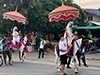
a candidate Buddhist monk in Thailand. Adolescents that ordain are
considered to gain merit in favour for their parents, not so much
for themselves. It is understood that by ordaining, the children pay
off a debt towards their parents for giving them life and for
raising them. All parents therefore expect their children to ordain
at some point in life, as this
brings merit for themselves. It is even said that one reason
for monks and novices to shave their heads is to resemble the
features of a
naga, for just as the naga helped the Buddha in his
ordeal to reach
Enlightenment, also the children help their
parents to get a better afterlife, by making merit for them. Before
the ordination ceremony, usually on the eve of the ordination day,
the
parents and/or close relatives of the monk-to-be (or alternatively a
monk) will shave his head and eyebrows as a
blessing, a ritual known as
plong phom naak (fig.), and the candidate novice is dressed in a long-sleeved
white shirt, a white apron, white sash, a naga belt, a white robe
embroiled with gold called
seua kruy (fig.),
and a necklace, though in some regions, the naag or naga are
dressed up in
princely attire (fig.).
The the buatnaag is brought to the temple
in a parade and
is not supposed to touch the earth. Hence, he is areeither carried
on shoulders of a relative (fig.),
seated on the back of a pick-up truck (fig.),
or rides
on horseback (fig.)
or sometimes even on the back of an
elephant (fig.).
This is followed by the
Tham Khwan Naag, a pre-ordination
ritual and purification rite conducted in order to educate the
naga
or
buatnaag,
i.e. the
candidate Buddhist
novice, on parental grace, nurturing a commitment to virtue
and monk's discipline that will lead to merit accumulation
and blessings for the parents.
Also
buatnaag.
WATCH VIDEO (1),
(2),
(3)
and
(4),
and
VIDEO (EN). 回
3. Hindi-Burmese name
for an ethnic group of people, whose dwelling places coincides with
parts of northwestern
Myanmar
and
northeastern India, and whom −due to their comparable cultures and
traditions− are listed as one ethnicity, with several tribes
and clans (fig.). Most Naga still have
rather primitive
lifestyles and their traditions have hardly changed over time (fig.).
Tribesmen typically
wear a distinguishing headdress, clothing and ornaments (fig.),
adorned with colourful plumes, fur, beads, seeds, animal bones,
claws, horns and tusks (fig.).
回
_small.jpg)
nagabaat (นาคบาศ)
Sanskrit-Thai. A magical arrow used by
Indrachit, one of the demons
in the
Ramayana.
Once this arrow was shot it changed into a
naga
and subdued or tied down whoever it was aimed at. In one scene in
the Ramayana, it was aimed at
Rama
and
Lakshmana
tied them down. However, when
the
Garuda,
the archenemy of the naga, accidentally flew by, the naga from fear
released Rama and Lakshmana. Also
pronounced naagbaat or naakbaat, and sometimes spelt
nakabaat. 回
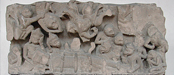
Naga Bodhisattva
See
Naak Galyah. 回
naga-bridge
See
Spean Neak. 回
nagah (နဂါး)
Burmese. Term used in
Myanmar to refer to a
legged
naga-like
mythological compound animal,
and which is usually translated as ‘dragon’.
Its pronunciation is nagā, rather than naga (nāga), and in Burmese
uses a different spelling. These legged, naga-like creatures are
often found in Burmese temple architecture where they serve as
guardian creatures and many ‒especially smaller‒
stupas
in Myanmar are decorated with them, usually flanked vertically on
the sides of the edifice and with the head below,
yet raised upward in a U-shape, though they may also be represented
in different poses (fig.).
Burmese-style
nagah can occasionally also be found in Thai temples (fig.). 回
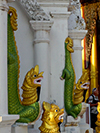
nagamakara
(नागमकर)
Sanskrit. The combination of a
naga and a
makara. 回
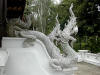
Naga Medaw (နဂါးမယ်တော်)
Burmese.
‘Royal Mother
Naga’.
Name of one of the 37
nats that
belong to the official pantheon of spirits
worshipped in
Myanmar. She was a beautiful woman of Mindon
village, who married a
naga. Her husband
eventually abandoned her and she consequently died of a broken
heart. However, according to others version, she is described as
being either the wife or the sister of Maung Tint De,
who later became the nat
Min Mahagiri
(fig.).
If described as the latter's sister, she was the wife of the
King of Tagaung. If described as the wife of Maung Tint De,
she is then also the mother of the latter's sons
Shin Nyo
and
Shin Byu, who became the nats
Taungmagyi
and
Maung Minshin,
and
Hnamadawgyi
is then Maung Tint De's sister and the
wife of the King of Tagaung.
In the version where Naga Medaw is described as the sister, it would
then actually be her who leaped
into a fire trying to rescue her brother when he was being burned
alive, and died of her burns. She is also known by the name
Shwe Nabay (fig.),
i.e. ‘Golden Side’, and is
depicted wearing a headdress fashioned as a naga, usually with a
green dress and sometimes holding a golden
naga.
Her name is pronounced Naga Medo. See also
Medaw.
See also LIST OF BURMESE NATS.
回
_small.jpg)
naga moutih (နဂါးမောက်သီး)
Burmese term for
dragon fruit.
Also transcribed naga moutdee or similar. See also
naga. 回
nagaprok
See
pahng nahg prok. 回
nagara
(नागर)
Sanskrit.
‘City’ or ‘capital’. The Thai word
nakhon, often used as a prefix in many city names, e.g.
Nakhon Sri Thammarat,
is derived from it. Also in India it is used in the naming of cities, e.g.
Kushinagara. 回
nagaraat (นาคราช)
Thai. ‘Naga-king’ or ‘king of the nagas’. A great
snake. See also
naga. 回
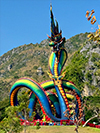
nagaraja
(नागराज)
Sanskrit
for
nagaraat. 回
Nagasen
(นากาเสน)
Thai name for
Nagasena, alongside
Naaksen. 回
Nagasena (नागसेना,
นาคเสนา)
Sankrit-Thai. ‘Army of
nagas’. Name of the Buddhist sage who lived around 150 BC in northern India.
He was an eloquent speaker and debater, and his name suggests strong
supernatural power. He was famous all over India for his homilies on
the maxim of ‘hear no evil’, uttering that since the sense of
hearing is one of the sources through which one becomes aware of the
world, Buddhists should avoid listening to immoral speech and
decadent sounds. He answered the questions about Buddhism posed by the Indo-Greek
King Menander I and which were recorded in the
Milinda Panha. He is depicted as
one of the 18
arahats, usually as an aged monk
scratching his ear with a stick to symbolize purification of the
sense of hearing. According to a Thai tradition it is he who made
the
Emerald Buddha that
was later brought to
Thailand. In Thai also
Nagasen
and
Naaksen.
In Chinese he is known as the
luohan Wa Er (挖耳), literally
‘To Dig the Ear’. In English, he is referred to as the Scratched Ear
Lohan or Ear Cleaning
Arhat,
and in
Vietnam,
where he is known as
Khoai
Nhi
La Han
(Khoái
Nhĩ
La Hán),
he may be depicted
seated on a
mythical
animal (fig.)
and
is associated with the 8th Patriarch Phat Da Nan De,
whose name in Roman script is usually transliterated
Buddhanandi,
which means ‘One Who Enjoys Knowledge’ (fig.). 回
_small.jpg)
nah fon (หน้าฝน)
Thai. One of several terms used
to refer to the annual wet
monsoon or
rainy season, which in
Thailand
takes places
roughly from the
beginning of June through to the end of September. Other terms
include
phansa and
reudoo fon.
See also
nahm thuam. 回
nahg
(นาค)
Thai. Another transliteration for
naag or
naak,
in Sanskrit known as
naga. 回
nah gleua (นาเกลือ)
See
nah kleua. 回
nah kaak (หน้ากาก)
Thai for ‘facial
mask’.
The wearing of facial masks
against polluted air, dust and smog, as well as for other health
issues, has since long become common practice in most cities in
Thailand. They are most frequently used by people working or
travelling unprotected in traffic-congested streets, such as traffic
police,
tuktuk
drivers, motorcyclists, garbage
collectors, etc. In places like
Vietnam, facial masks are commonly
worn anywhere in public, prompting the production of more trendy
masks (fig.).
In certain instances, like during the outbreak of airborne diseases,
the government will promote the wearing of facial masks. When
Covid-19 entered onto the world's stage, Vietnam was largely spared
of the disease and the fact that so many already wore facial masks
prior to the pandemic, as well as that so many Vietnamese drive
motorcycles (fig.)
rather than rely on public mass transportation, has certainly
contributed to this positive outcome, reporting just over 350 cases
of infected people and no deaths at all by the end of June 2020. As
the Covid-19 pandemic progressed in 2020, many original designs of
facial masks hit the market and slowly started to be come a fashion
statement for many now compelled to wear it in public at all times (fig.).
See also POSTAGE STAMPS.
回
_small.jpg)
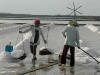
nah kleua (นาเกลือ)
1. Thai.
‘Salt field’. Field used to harvest salt by
evaporating sea water in the sun, a process known as seething. Salt
farms are divided into various plots and sea water is pumped from
plot to plot with the help of small windmills. Irrigation is done
with a great deal of expertise to ensure correct salinity and
high-quality salt. If the salinity is too high, the sea water
crystallizes into Epsom salts used in drug manufacturing, while
proper crystallization will not occur if salinity is low. In each
plot a different stage of the process takes places before the water
is sent into the next plot, while each stage requires a different
water temperature. Hence, each plot has a specific name, beginning
with nah pratiab (นาประเทียบ), the plot where the sea water heats up
in the sun and the salinity level is adjusted to between 6 and 7
degrees; then ity is pumped into nah tak (นาตาก),
for a repeat of the heating process in order to achieve salinity of
18 to 20 degrees; then onto nah cheua (นาเชื้อ), where the salinity
can reach 24 degrees; and then the water is pumped into the final
plot called nah plong (นาปลง), for crystallization, which takes
about 15 days. Before collecting the salt, which is done once a year
outside the rainy season, i.e. sometime between September and May,
the salt is placed into small heaps, in order to allow the final
moisture to more easily evaporate. After a crop is harvested, the
salt farmers clean the fields and tamp down the top to prevent water
filtration during crystallization. This tamping of the field can be
done manually with wooden planks on shafts (fig.) or by a small
crushed roller, which in Thailand resembles a
Flintstone's car.
The salt is typically
used to make
fish sauce
and to make ice and
slurry ice (fig.), as it lowers the freezing
point of water. Read more on this in
the topic below,
nahm khaeng kot. Also
spelt nah gleua.
WATCH VIDEO (1)
and
(2). 回
2.
Thai. ‘Salt field’. Name of a
tambon
in the
amphur
Banglamung (บางละมุง ) of
Chonburi
Province. It is a suburb of the beach resort of
Pattaya,
adjacent to its northern borders and in many ways a continuation of
the North Pattaya subdistrict. Its name suggests the earlier
existence of salt fields. Also spelt nah gleua. 回
nahm (น้ำ)
Thai for ‘water’. The
term is often used as a part in compound words, typically to
describe the liquid form of a certain substance, in which
translation may be different, e.g.
nahm pla,
which literally means
‘fish water’, yet translates as ‘fish sauce’,
nahm nom,
literally ‘breast liquid’, i.e. ‘milk’. It also appears in
compound words in which its Thai meaning is descriptive for things
with their own meaning in English, e.g. mae nahm (แม่น้ำ),
which literally means ‘mother water’, but in English translates as
‘river’, as in
Mae Nahm Khong,
the Thai name for
the
Mae Khong
River. Another example is
nahm khaeng,
which literally means ‘hard water’, but in English translates as
‘ice’. The opposite term of nahm in Thai is bok (บก),
i.e. ‘land’. 回
nahm buay (น้ำบวย)
See
krabuay. 回
nahm budu (น้ำบูดู)
Thai. A sauce made from a small, usually salted fish (often
mackerel) and some spices. First the fish is cooked until it has
become tender, then it is cleaned, using only the meat, which left
to simmer in some water, together with the spices, i.e. slivers of
crushed small red onion, sugar, cut
up
takrai
(lemongrass -
fig.), about three torn
leaves of young
kaffir lime (makrud
-
fig.) and a piece of
galangal
(fig.)
of about 2.5 centimeters long,
ground into fragments. When ready, it is
filtered and only the juice is used. Nahm budu sauce is one
of the ingredients for the local southern dish
khao yam. It is
also sold ready-to-use and can be kept for a long time. It is a
khong dee
product from
Pattani. See also
nahm kheuy.
回
nahm dokmai (น้ำดอกไม้)
Thai. ‘Flower water’. Name of a traditional hand-made Thai sweet which is also
known as
khanom
nahm dokmai, i.e. ‘flower water candy’, and is in English referred
to as floral rice cakes. Ingredients include rice flour, arrow root
flour, white
jasmine water, sugar, water and
food colour. The name derives from the fact that one of its
ingredient is scented
jasmine
water, i.e. water obtained by floating jasmine flower buds on its
surface to absorb the scent. This colourful cup-shaped candy is depicted on a postage
stamp issued in 2018 as part of a set of six stamps on traditional
Thai sweets (fig.).
回

nahm jim kai (น้ำจิ้มไก่)
Thai. ‘Chicken sauce’. A
at times
spicy dip made
from a variety of -usually- seasonal products,
such as pounded onions (fresh or pickled), bell pepper
chilies, sugar, salt, citric acid,
etc. It is commonly used as a dip sauce for
nang pla thod krob and for dishes
with chicken, hence its name.
回
nahm jim phrik (น้ำจิ้มพริก)
Thai. ‘Chili
dipping sauce’. Name of a green
chili
dip made from fresh green
chilies,
garlic,
coriander,
lime,
and occasionally
fish sauce or sugar.
回

nahm jim tua tat (น้ำจิ้มถั่วตัด)
Thai. ‘Crushed peanut
dipping sauce’. Name of a
chili
dip made from crushed peanut brittle,
lime,
chili, and
fish sauce.
回

nahm khaeng (น้ำแข็ง)
Thai for ‘ice’, literally ‘hard water’. In
many countries of tropical and subtropical South and Southeast Asia
ice is still made in ice factories and then delivered on a regular,
often daily basis to its users. Ice was first introduced to Thailand
in the reign of King
Rama IV, when it was imported from
Singapore, a journey of 15 days by boat. Ironically, the British
importer from Singapore was named Henry ‘Hot’. Ice is water from which the heat of fluidity has been
removed by using
liquid ammonia,
ether or sulfurous acid
as a cooling agent. It is obtained by
compressing the gas in a strong iron cistern which is then released
into an expansion vessel, called the
freezing tank (fig.).
As the compressed gas expands, it rapidly cools and thus freezes the
water stored in large moulds (fig.)
housed in a separate chamber, making blocks of ice in the course of
a few hours as a result of the intense cold produced by the rapid
evaporation of the liquid gas. Delivery of ice comes either in huge
blocks of ice or crushed in large bags and is still big business in
many up-country places, but also on city markets such as
Bangkok's
Chinatown.
Customers usually are the owners of fish restaurants, market booths
and so on, who use it to cool and store or display fresh food and
drinks. Ice vendors can often be seen delivering their produce early
in the day from large trucks, motorcycle sidecars, carts, etc.
Sometimes they use ice picks to move and drag large blocks of ice or
a handsaw to cut them (fig.),
custom-made. Nowadays the
more recent type of cylindrical ice ‘cubes’ with holes through the
centre can also be found, especially at supermarkets, sold in small
bags for personal use. A typical Thai kind of water-ice is
nahm khaeng sai, made from a large block of ice by paring flakes from its
surface with a plane and served in a plastic cup, poured with
a sweet and colourful syrup (fig.).
See also
aitim. 回
%20ice-making%20factory%202_small.jpg)
nahm khaeng kot
(น้ำแข็งกด)
Thai.
‘Pressed ice’. Fruit juice with sugar frozen into flavoured
water-ice on a stick (fig.). Fruit juice is poured into tubular cylinders that are
placed in a round aluminum ice box of which the bottom part contains
slurry ice, i.e. a mixture of water, ice and other ingredients, such
as salt (fig.), which is added to change the
freezing point of water, bringing the temperature of the ice down to
below 25 degrees Celsius. Water normally freezes at 0° Celsius. When
salt is added on the ice, it lowers the freezing point to below 0°
Celsius. Since the ice cannot get any colder than it already is the
surface first starts to melt, but as the salt
ice-water mixture is diluted by
further melting of the ice, the freezing point rises and the water
refreezes. A mixture of plain water and ice is in equilibrium at 0°
Celsius, but adding salt lowers the equilibrium temperature. The fruit juice
thus slowly freezes into an ice lolly. The aluminum ice box is covered with a rotating
lid with holes that hold the tubular cylinders. Occasionally rotating this cover prevents the
with fruit juice filled cylinders from becoming icebound to the ice below.
See also
aitim and
kulfi, and
WATCH VIDEO. 回
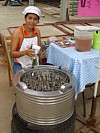
nahm khaeng sai (น้ำแข็งใส)
Thai. ‘Watery ice’.
Name for a kind of
khanom wahn, a traditional Thai
snack or dessert best explained as ‘shaved ice’. It is a kind of
water-ice, made from a large block of ice or
nahm khaeng,
by paring flakes from its surface with a plane and served in a
plastic cup, poured with a sweet and colourful syrup.
See also POSTAGE STAMPS. 回
%20Thai%20,%20water-ice,%20flakes,%20scraped,%20plane,%20syrup_small.jpg "nahm khaeng sai (water-ice)")
nahm kheuy (น้ำเคย)
Thai. A sauce obtained from salted prawns and used as one of the
ingredients for the local southern dish
khao yam.
It consists of shrimp paste, water, fish sauce, salt, palm sugar,
raw cane sugar, black pepper, shallots,
galangal
(fig.),
takrai
(lemongrass -
fig.)
and
leaves of
young
kaffir lime (makrud
-
fig.), most of it filtered out before the sauce is
served. Also transcribed naam khoei. See also
nahm budu.
回
nahm mon (น้ำมนต์)
Thai. ‘Blessed water’. A kind of
lustral
water, blessed by a senior
Buddhist monk and used by monks to bless believers or sacred
objects, by sprinkling them, using a brush or tassel-like
aspergillum, made from
bamboo. This religious action is known as
rod nahm mon (fig.).
Prior to its use, wax from a candle is dripped into the blessed
water, to symbolize
Enlightenment. It
also represents the four elements, i.e. earth, fire, wind and water,
in which the earth is represented by the drops of wax, fire by the
flame of the candle, wind by the extinguishment of the flame of the
candle, and water by the water in the bowl. To hasten their merit,
believers sometimes throw coins into the situla-like holy water
vessel, as a kind of
tamboon (fig.).
In addition,
gold
leaf, devil's
grass, which in Thai is called
ya phraek, and
lotuses
may be placed in the bowl in
order to increase magical
powers. The bowl can be a Buddhist
alms bowl
(fig.) called
baat
(fig.)
or a similar shaped vessel (fig.). See also
toh nahm mon,
mon,
sek and
song nahm phra.
回
_small.jpg)
nahm nom (น้ำนม)
Thai for ‘milk’. With
nom (นม) meaning ‘breast’, the term literally
means ‘breast juice’ or ‘liquid of the breast’, and as such it is
reminiscent of the word mammal which is Latin meaning ‘of the
breast’, a term related to mammalia, which is the ability to produce
milk. Milk has been intertwined with culture, religion and mythology
for millennia. The Thai name for the Milky Way, for example, is in
Thai known as
Thahng Chang Pheuak,
i.e. the
‘Path of the
White Elephant’,
with the
White Elephant
being considered an auspicious animal that occurs frequently in
Buddhism, such as in the dream of
Maha Maya and in the
Wetsandorn
Jataka
(fig.),
i.e. the last
Totsachat.
In India, the
Churning of the Ocean of Milk
by the gods and demons, produced the Holy Cow, and the ancient
Greeks coined the term galaxy from the word gala, meaning ‘milk’,
believing that the Milky Way was formed when Hera, wife of Zeus and
goddess of womanhood, spilled her breast milk while feeding her son
Heracles, each drop of milk ending up as a star. The first recorded
civilization that had a dairy culture were the Sumerians, who lived
in southern Mesopotamia around 9000 years BC. Thailand has a rather
young dairy industry. The first Thai dairy company was established
only in 1962, after negotiations with Thai and Malaysian
businessmen, and the Australian Dairy Product Board. Thailand's
domestic dairy cows today has a production capacity of ca. 3,500
tons of raw milk per day from about 310,000 cows nationwide.
回
nahm
ob (น้ำอบ)
Thai. Name of a
fragrant water made from
Thai herbs and flowers such as
Ylang Ylang,
jasmine,
rose, and others. It has a sweet and gentle scent and is commonly
used to freshen up spaces or create a refreshing atmosphere, such as
during ceremonies or for personal fragrance. Nahm ob is made by
boiling herbs and flowers in water, then filtering and storing the
liquid in containers. It may also be enhanced with a small amount of
sugar or honey to increase sweetness and fragrance. In Thai
traditional medicine, nahm ob is also used for health and beauty
care by applying it to the skin or using it in rituals, such as in
water used in the
Songkraan festival.
See also
POSTAGE STAMPS.
回
Nahm Phi (น้ำพี้)
Thai. Name of a natural source of iron ore, as well as products such
as swords, made from it. The name derives from its location, i.e. a
village in
Uttaradit, where several mines and ancient
melting furnaces are located, in particular in the
tambon
Thong Saen Khan (ทองแสนขัน). The iron ore of this area is considered
to have
saksit
and deliver robust high-quality steel, referred
to as lek Nahm Phi (เหล็กน้ำพี้), and has been used since ancient
times to make weapons of war. Traditionally ore of two mines, known
as Bo
Phra Saeng and Bo Phra
Khan, has been reserved specially
to forge royal swords, including the King's Sword
of State
(fig.).
To honour this tradition, the city of Uttaradit has erected a small
museum in front of the Provincial Hall, which displays several Nahm
Phi products and tools used in the production of metal, as well as
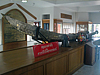
the world's biggest Nahm Phi sword (map). Sometimes transcribed Nam Pee. 回
nahm phrik
(น้ำพริก)
1.
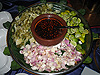
Thai. A sauce that consists of
salty fish sauce
(nahm pla)
with sliced
or finely chopped
phrik
kee noo bird
chilies. When ordering food in a Thai restaurant, it is
usually served along with the dish in a small, separate platter, and
at roadside food stalls it is often part of the regular
kreuang prung.
It is used to spice up dishes, like a combination of salt and
pepper. 回
_small.jpg)
2.
Thai. A
chili dip made of
either
kapi
(shrimp paste),
nahm pla
(fish sauce) or
pla rah (fermented fish), mixed
with garlic,
phrik
kee noo bird
chili and either lemon,
tamarind,
madan
(garcinia) or
mango. The name can be defined more
specifically by adding the name of its main ingredients at the end,
e.g. nahm phrik pla rah for chili sauce made with fermented fish.
The name nahm phrik is also used as a general designation in a
variety of other dishes that include chilies, e.g.
nahm phrik
oung,
nahm phrik phao,
nahm phrik num, etc.
See also POSTAGE STAMP. 回
_small.jpg)
nahm phrik num
(น้ำพริกหนุ่ม)
Thai. Name for a northern style dip dish, made from fresh
green
chilies
and eggplant, that are roasted (fig.)
and then ground. Like
nahm phrik
oung, it is typically eaten with
sticky rice,
some fresh and steamed vegetables, and crisp pork. It is usually part of a
khantoke style meal
(fig.). Also transcribed naam phrik noom. 回
_small.jpg)
nahm phrik oung (น้ำพริกอ่อง)
Thai. Name for a northern style dish, made from dried
chilies,
ground pork, tomatoes, lemongrass and various herbs, which are all pounded and
then cooked until the pork is done. Like
nahm phrik
oung, it is typically eaten with
sticky rice,
some fresh and steamed vegetables, and crisp pork. It is usually part of a
khantoke style meal. Also transcribed naam phrik awng. 回
_small.jpg)
nahm
phrik phao (น้ำพริกเผา)
Thai. A sauce made of
dried
chilies fried in oil, used as a
seasoning or relish for food. It is an indispensable condiment of
the northern style dish
khao soi (fig.). 回
nahm phu ron (น้ำพุร้อน)
Thai.
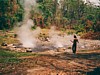
‘Hot spring’. Hot springs arise where accumulated
groundwater is heated up by the earth's core at places where the earth's crust
is thin enough to allow the water to rapidly rise again. Sometimes this creates
geysers spurting out hot water to staggering heights, although many hot springs
are at times no more than bubbling wells of hot water. Hot springs usually have
hot fumes of sulphur dioxide and are rich of minerals. Many places
therefore offer therapeutic baths in cooled down water, while others may sell
chicken or
quail's eggs to boil
(fig.).
WATCH VIDEO. 回
nahm pla (น้ำปลา)
Thai. ‘Fish sauce’. Name of a sauce with a very salty taste used as
an important ingredient in most Thai dishes. It is made from fish or
other sea creatures, such as prawns or squid, that fermented in
salt. In Thai restaurants it is the local equivalent of table salt.
It is used as an ingredient in
nahm phrik and is always part of
the regular
kreuang prung.
See also
nahm. 回
%20fish%20sauce_small.jpg)
nahm tao (น้ำเต้า)
Thai for ‘calabash’. It's a
fruit of a gourd-bearing vine in the family of Cucurbits,
in Thai known as
taeng.
It has a
hard but thin skin and when dried completely it can be used a vessel for liquids (fig.).
Its shape resembles the number 8, believed to be the most auspicious
number in
China
because it is associated with wealth. Eight (八) in Chinese is
pronounced
ba
and is a homonym with the word ba (巴), which means
‘to
long for’ and ‘to wish’, while it in addition also sounds similar to
fa (发), i.e.
‘to
make a bundle of money’, and occurs as a compound in words such as
facai (发财),
meaning
‘well-off’
or
‘becoming
rich in a short time’.
Furthermore, the loop of the number 8, similar to ∞, indicates
perpetually and thus longevity. Chinese people call a calabash
hu lu and regard it as a
symbol for protection (fig.), believing it has the power to save from
sickness and pain. They believe it can also safeguard against
accidents and evil spirits. In the past physicians would carry
medicine with them inside a calabash, hence it became a legendary
tool associated with healing. Since then and because of this the
Chinese believe the calabash has supernatural shielding and healing
powers. Nowadays many often wear a small calabash made from
jade (fig.) or wood for
safekeeping (fig.),
as it is believed it is able to absorb bad qi (chi) and negative
energy. In art nahm
tao can be made from any material (fig.),
including porcelain, bronze, etc. and are often elaborately
decorated with Chinese figures or symbols (fig.). Some Chinese deities,
e.g.
Ji Gong
(a
luohan
-
fig.),
Li Tieh-kuai
(one of the
Eight
Immortals
-
fig.), Siw or
Shou (the god of longevity and one of the
Three Star Gods),
carry a calabash with
them as a sign of their ability to cure difficult ailments.
Besides this
the chimneys of some
joss paper
ovens in Chinese temples and shrines may have the shape of a nahm
tao (fig.).
In
Vietnam, it is called
bau (bầu)
and is used as part of a traditional instrument named
dan bau
(fig.).
Also called bottle gourd. Compare with
kalasa (fig.),
and see also
phai nahm tao
and
tanghulu. 回
_small.jpg)
nahm thuam, Nahm Thuam (น้ำท่วม)
1. Thai term for an ‘inundation’ or ‘flood’. In the rainy season,
known as
nah fon, roughly from the beginning of June through to the end of September,
public lives and traffic (fig.) are often affected by floods, when drainage
systems get overloaded and congest due to heavy rainfall, flooding
streets and roads in no time. During the rainy season of 2011, many
provinces. as well as large parts of
Bangkok have suffered from
devastating floods (fig.), that have caused damage and hardship, as well as
loss of life and property, to a large number of people. This severe
flood, and in particular the assistance given to the flood victims
by volunteers and relief organizations such as the
Thai Red Cross Society,
who provided relief efforts and rendered consumables, as well
as rehabilitation services in the wake of the floods, was in 2012
remembered with a Thai postage stamp (fig.).
See also
monsoon
and
VIDEO. 回
%201_small.jpg)
2. Thai. Name of a king, with
the title
of
Phra Chao, who ruled the
Lan Na
Kingdom for about two
years,
from
1322 to 1324 AD.
He belonged to the House of
Mengrai,
the Dynasty named after its founder
Poh Khun
Mengrai (fig.)
and which ruled the territory of what is today northern Thailand,
from
1296 to
1551
AD autonomously, and
from then onward to
1578 AD as a vassal
under
Burma. 回
nahm thung (น้ำถุ้ง)
Thai. Northern style water bucket, woven from thin strips
of
bamboo called
tok, and patched with resin to
prevent if from leaking. It is hemispherical in shape and has a
wooden handle made from two slats that cross at the top, reminiscent
of the northern style
kalae (fig.).
It is typically used to fetch or scoop water from a river or well,
and often seen used by
mahouts when they bathe their
elephants in the river (fig.),
though it is also used by
rice farmers to carry rice seeds when
sowing their paddies (fig.),
as well as to traditionally decorate certain establishments, such as
lodges (fig.). 回
%20northen%20Thai%20water%20bucket_small.jpg)
nahm tok (น้ำตก,
ນ້ຳຕົກ)
1. Thai.
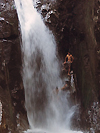
‘Waterfall’. Thailand has many waterfalls, mainly
in the National Parks. The most well-known are
Erawan Waterfall in the province of
Kanchanaburi; Thi
Loh Suh Waterfall (fig.)
in the province of
Tak,
considered one
of the largest and most impressive in the country; the 100 meter high Mae Surin
Waterfall in
Mae Hong Son province, Na Meuang
Waterfall (fig.) on the island of
Samui
in
Surat Thani, Wachirathan
Waterfall (fig.), also known as Tahd Khong
Yohng (ตาดฆ้องโยง),
located on the opposite side of Pha Mon Kaew (ผาม่อนแก้ว),
a steep cliff in
Doi
Inthanon National Park (fig.),
in the province of
Chiang Mai;
the unique Long Roo or Moonshine Waterfall (map
-
fig.)
in
Ubon Ratchathani, that falls from a
cavity in the face of a gorge-like cliff in Pha Taem National Park (fig.);
Phliw Waterfall in Chantaburi (map
-
fig.), and many more.
Also transcribed nahmtok. In Lao, the term for waterfall is the same
as in Thai, though additionally they may also use the term
nahm tok taht (ນ້ຳຕົກຕາດ).
See also POSTAGE STAMPS (1)
and
(2),
and
WATCH VIDEO. 回
2.
Thai. Name of a dish served with charcoaled meat, chicken or fish,
and a spicy sauce called jaew (แจ่ว), which is made with pulverized,
roasted
sticky rice
(khao niauw
kua),
fish sauce,
lime juice, ground dried chilies, crushed parsley,
garlic, shallots and sometimes spring onions. The sauce is mixed
with the meat and usually fresh
mint leaves (fig.)
are also added. This dish originates from
Isaan and is traditionally eaten with
sticky rice. 回
_small.jpg)
3. Thai. Name of a street-side
noodle soup
from central Thailand, which consists of a spicy broth enriched with
raw animal blood mixed with salt, especially of cows or pigs, and
which is also known as
guay tiyaw
nahm tok. Besides
noodles, the soup contains sliced meat and usually also
look chin
(fig.),
soybean
sprouts (fig.),
pieces of liver, some green vegetables such as
kaphrao
(basil) leaves,
and sometimes
kiyaw (fig.)
and
blood tofu (fig.).
It can further be
spiced up with
kreuang prung,
in accordance with one's own taste. Usually
kaeb moo
or crispy
pork cracklings (fig.)
are served with the dish, or in it. 回
_small.jpg)
Nahm Tok Taht Kuang Si (ນ້ຳຕົກຕາດ ກວາງຊີ)
Lao. Name of a
three-tiered waterfall located about 29 kilometres south of Luang
Prabang (ຫຼວງພະບາງ). The main fall, with a 60-metre drop, begins in
shallow pools atop a steep hillside which is accessible by a trail
to the left of the falls. The water flows into a turquoise blue pool
before continuing downstream, with multiple cascades. Most pools,
renowned for their milky turquoise waters are open for
swimming and feature rope swings and an overhanging tree limb for
jumping into the water.
See also TRAVEL PICTURE and
WATCH VIDEO (1)
and
(2), and
VIDEO (EN). 回

Nahm Tok Tham Soda (น้ำตกถ้ำโสดา)
Thai. Name of a
waterfall that cascades in front of a temple cave
in
Roi Et.
At this site, the water flows over the entrance of a shallow
cliff-side cave that serves as a Buddhist sanctuary. During the
rainy season, the water cascades with energy, while in the dry
season, it slows to a gentle trickle, revealing he rock face and
temple structure. The name Soda is
derived from sodaban or
sodahban,
a term referring to one who has attained the
first stage of
Enlightenment
in
Buddhism—a
‘stream-enterer’ or
saint. Therefore, the name may also symbolize sainthood or the
attainment of spiritual awakening.
WATCH VIDEO. 回

Nahm Tok Ngao (น้ำตกหงาว)
Thai. Name of a
waterfall, as well as of the national park in which it is situated,
located in Thailand's southern
Ranong
and
Chumphon Provinces,
and covering an area of about 668 km². 回

nahm ton (น้ำต้น)
Thai name for a kind of
vase-like
water pot used for storing
drinking water, with an elongated
neck and sometimes closed off with a disconnect lid, which is
habitually bell-shaped or tapering and decorated with a
lotus
bud-shaped handgrip. Its shape is reminiscent of a calabash, which
is called
nahm tao
in Thai and that is also used to
store water. Hence, it is believed that the shape of the nahm ton
initially derived from the calabash, although nowadays the nahm ton
is produced in a variety of different forms. It originally comes from northern Thailand,
where it is typically used ceremonially, i.e. together with bowls
and plates of food and placed on
khantoke
floor tables,
either to welcome guests or as a food offering. It
is generally made from terracotta, though it may occasionally be made from
another material, such as
lacquered
wood. In a more elaborate form it may even be decorated with
mother-of-pearl
(fig.). 回
%20northern%20Thai%20water%20vessel%20with%20elongated%20neck_small.jpg)
nahm yah (น้ำยา)
1. Thai name for Chinese herbal
tea. There are several
varieties that differ in level of bitterness, including bitter tea, twenty-four
tea, lo han guo tea and gherrysanthamun tea. This herbal extract that serves as
an invigorating tonic can be found at Chinese herbal stores in
Bangkok's
Chinatown. 回
2. Thai. Fish soup eaten with
khanom jihn. 回
Nahrot Chadok (นารทชาดก)
Thai-Sanskrit. Name for one
of the
Totsachat, i.e.
life stories of the
ten last
incarnations of the
Buddha,
in which the
bodhisattva
was born as Nahrot,
a form of
Brahma.
READ ON. 回
nai (นาย)
Thai for
‘mister, man or boy’. Generally used in a rather poetic context, but
also in front of men's names. It is the masculine equivalent of
nang
and may also be transliterated naay.
回
nai (ไน)
Thai name for
spinning wheel, a
usually hand powered household device used
for winding skein (loosely-coiled bundles of yarn or thread) of cotton or silk onto a reel which is afterward placed in a
krasuay (fig.), a shuttle
used for weaving cloth (fig.). A nai consists of
a base with legs
and a spindle driven by a large wheel with a crank or treadle.
A piece of yarn forms a connection linking the wheel with the spindle,
thus driving both when the wheel is turned. The skein is tied to the reel which is placed on the spindle, a small axle
of steel called leknai (fig.) in
Thai. When the driving wheel is revolved the spindle will
rotate at high-speed, coiling up the yarn. More modern versions are
made of steel (fig.),
and older methods used
hand-held spinning tops, a practice still occasionally found in
poorer rural areas of Thailand, such as with the
Akha hill tribe (fig.).
It was originally depicted on the flag of India, but was later
replaced by the
Ashoka
Chakra,
i.e. a 24-spoked
dharmachakra
(fig.). Also called
lah. 回
%201_small.jpg)
Nai Amphur (นายอำเภอ)
Thai for ‘Prefect’, the person
holding the position of chief local administrative officer. He (nai)
is the person in command of the government officials in a district
responsible for the administration of that district, which is known
in Thai as an
amphur.
Also transliterated Nai Ampheu. 回
Nai Chan Nuad Khiao (นายจันหนวดเขี้ยว)
Thai. Name of one
of the eleven heroic leaders who in 1767,
at the end of the
Ayutthaya period,
fought the invading
Burmese in defence of the
Bang Rajan
fort in
Singburi
(fig.).
READ ON. 回
Nai Choht (นายโชติ)
Thai. Name of one
of the eleven heroic leaders who in 1767,
at the end of the
Ayutthaya period,
fought the invading
Burmese in defence of the
Bang Rajan
fort in
Singburi
(fig.).
READ ON. 回
Nai Dok (นายดอก)
Thai. Name of one
of the eleven heroic leaders who in 1767,
at the end of the
Ayutthaya period,
fought the invading
Burmese in defence of the
Bang Rajan
fort in
Singburi
(fig.).
READ ON. 回
Naihe Qiao (奈何桥)
Chinese.
‘Bridge
of No Avail’.
Chinese name for the
Bridge of Troubled Water. 回
Nai In (นายอิน)
Thai. Name of one
of the eleven heroic leaders who in 1767,
at the end of the
Ayutthaya period,
fought the invading
Burmese in defence of the
Bang Rajan
camp in
Singburi
(fig.).
READ
ON. 回
Nai Luang (ในหลวง)
Thai
for ‘King’, a designation mostly used when speaking of,
or referring to, contemporary monarchs. See also
kasat.
回
Nai Meuang (นายเมือง)
Thai. Name of one
of the eleven heroic leaders who in 1767,
at the end of the
Ayutthaya period,
fought the invading
Burmese in defence of the
Bang Rajan
fort in
Singburi
(fig.).
READ ON. 回
nai phon (นายพล)
Thai term meaning
‘general’, referring to a high-ranking commissioned officer in the
military or
police,
including positions equivalent to brigadier general, major general,
lieutenant general, and general.
See
also
Ranks of the Royal Thai
Military and Police.
回
Nairit (ไนรฤติ)
Thai pronunciation for
Nairitti. 回
Nairitti (नैरृती)
Sanskrit. Guardian or
lokapala of the Southwest (fig.)
and god of the sun, sometimes represented with a halo and a
lotus in
each hand. He drives a chariot
pulled by seven horses (fig.),
steered by
his charioteer
Aruna,
who drives him across the sky and over the horizon, thus
causing dawn. Also transcribed
Nairriti, and in
Thai known as
Phra Ahtit or as
Nairit.
See also
Surya. 回
Nairriti
See
Nairitti. 回
Nai Thaen (นายแท่น)
Thai. Name of one of
the eleven heroic leaders who in 1767,
at the end of the
Ayutthaya period,
fought the invading
Burmese in defence of the
Bang Rajan
fort in
Singburi
(fig.).
READ ON. 回
Nai Thong Hmen (นายทองเหม็น)
Thai. Name of one of
the eleven heroic leaders who in 1767,
at the end of the
Ayutthaya period,
fought the invading
Burmese in defence of the
Bang Rajan
camp in
Singburi.
READ ON. 回
Nai Thong Kaew (นายทองแก้ว)
Thai. Name of one of
the eleven heroic leaders who in 1767,
at the end of the
Ayutthaya period,
fought the invading
Burmese in defence of the
Bang Rajan
fort in
Singburi
(fig.).
READ ON. 回
Nai Thong Saeng Yai (นายทองแสงใหญ่)
Thai. Name of one of
the eleven heroic leaders who in 1767,
at the end of the
Ayutthaya period,
fought the invading
Burmese in defence of the
Bang Rajan
fort in
Singburi.
READ ON. 回
nakabaat
(นาคบาศ)
See
nagabaat. 回
Nakarin (นาคินทร์)
Thai. ‘King of
Snakes’
or ‘Serpent King’, a designation sometimes used for
the
Phayanaag
or
Phayanagaraat
(fig.),
i.e. the
‘Naga
King’. It is a
compound which derives from the words
naak, i.e. Thai for
‘naga’,
and
In,
Thai for
‘Indra’, as he Naga King is believed to be a form of
Indra. 回
Nakarin (นครินทร์, ณครินทร์)
Thai designation meaning either
‘Governor’ or ‘Great City’. It is a compound which derives from
the Sanskrit word
nagara
—in Thai called
nakhon— and
In, which is
a Thai name for
Indra, but
also means
‘Big’
or ‘Great’, a term referring mostly to a person, but it may also be
used for a place. See also
Sri Nagarindra. 回
nakatayah amih myah (နက္ခတ်တာရာအမည်များ)
Burmese. ‘Names of the Planets’. Chart with a legend explaining the
38 astronomical symbols on the convex ceiling of the inner
sanctum (fig.)
at
Maha Wizaya Zedi in Yangon (fig.). 回
Nakathibodih (นาคาธิบดี)
Thai. Title derived
from
Pali and
Sanskrit,
and used in Buddhist and Southeast Asian religious contexts to
denote a sovereign or supreme lord of the
nagas, the semi-divine serpent
beings associated with water, fertility, protection, and liminal
realms. The term is composed of
naga, a serpent deity, and
adhibodi (อธิบดี), meaning ‘overlord’, ‘ruler’, or ‘supreme
authority’, indicating dominion over other nagas and authority
within their cosmological domain. 回
nakhon (นคร)
Thai.
‘City’, as in
Phra Nakhon Sri Ayutthaya. Derived
from the Sanskrit word
nagara. 回
Nakhon Chai Sri (นครชัยศรี)
1. Thai. A regional name of the
Tha Chin
River used near
Nakhon Pathom,
roughly between
Suphanburi,
where it is known
by the local name
Suphan
River and
Samut Sakon,
the only place where the river is indeed known as the Tha Chin River. 回
2. Thai. Name of an
amphur
or district in
Nakhon Pathom. 回
Nakhon Nayok (นครนายก)
1. Thai.
‘First
City’ or ‘Leading City’. Name of a province (map).
READ ON. 回
2. Thai. Name of a river in
eastern Thailand. It originates in Khao Yai National Park and is
about 130 kilometers long. It flows southwestward, to the
tambon
Bang Taen (บางแตน) in the
amphur
Ban Sang (บ้านสร้าง) of
Prachinburi
Province, where it joins the Prachinburi River to become the
Bang Pakong River. 回
Nakhon Pathom (นครปฐม)
Thai.
‘First
city’. Derived from the Pali name ‘Nagara
Pathama’ and considered to be Thailand's oldest city and
once the centre of the
Dvaravati empire.
READ
ON. 回
Nakhon Phanom (นครพนม)
Thai-Sanskrit-Khmer.
‘City of hills’. A provincial capital
in Northeast Thailand with a population of around 34,000 and situated
approximately 740 kms from
Bangkok.
READ
ON. 回
Nakhon Ratchasima (นครราชสีมา)
Thai. A large provincial capital in Northeast Thailand (Isaan) with a population of approximately 203,000 and located 259 kms from
Bangkok.
READ
ON. 回
Nakhon Ratchasima Zoo
Also
known as Korat Zoo, this wild animal park is administered under The
Zoological Park Organization of Thailand and is located some 19 km
from the city centre, on a 218 acre plot of land. It claims to host
more than 1,500 animals and some 200 species from around the world,
with an effort made to house the animals in accommodation and cages
similar to their natural habitat. Since the climate of Nakhon
Ratchasima is similar to that of the natural wildlife of the Savanna,
it focuses on the Big Five from Africa, i.e. the Lion, Leopard,
African Elephant, White Rhinoceros, and the African Buffalo. The zoo
also is the largest Sarus Crane breeding centre in Thailand and its
bird exhibition includes various species of other cranes as well.
The zoo also has a seminar centre that can accommodate up to 200
people and a water play park. 回
Nakhon Sawan
(นครสวรรค์)
Thai.
‘Heavenly
City’. Large capital of a province (map)
of the same name in Central Thailand.
READ ON. 回
Nakhon Sri Borirak (นครศรีบริรักษ์)
Thai. The later title
of Phia Meuang Pan (พญาเมืองแป้น).
READ ON.
回
Nakhon Sri Thammarat (นครศรีธรรมราช)
The provincial capital of a province (map)
of the same name in South Thailand, 780 kms
South of
Bangkok.
READ ON. 回
Nakhon Thom (นครธม)
Thai name for
Angkor Thom in
Cambodia. 回
Nakhon Wat (นครวัด)
Thai name for
Angkor Wat in
Cambodia. 回
naki (นาคี)
1. Thai for
‘snake’. 回
2. Thai for ‘elephant’. 回
nak muay (นักมวย)
Thai.
‘Boxer’, especially in
muay thai. The
official fighting colours used by the nak muay are red
or blue,
with the
one in
red
usually being the better
boxer, with
more fights won. 回
Nakula (नकुल, นกุละ)
1. Sanskrit-Thai.
‘Mongoose’. Name of
one
of the eighteen
arahats, who
formerly was a warrior with immense strength.
He gave up the life of fighting and
became a monk. Quietly cultivating his mind through deep and constant meditation, he finally attained
Enlightenment. He is
considered one of the Buddha's favourite disciples and his sphere of
influence is said to have extended through all of India.
He is usually portrayed as seated in meditation with a peaceful countenance and a small
alms bowl
in his lap, thus indicating that he is a mendicant monk. Sometimes,
he is portrayed as a teacher, with a small boy by his side
and holding a
prakam, a
string of beads used in Buddhism.
On other occasions he is depicted with a
mongoose, a reference to his name, or with
chanchu,
the three-legged moon toad. In Chinese he is known as the
luohan
Jing Zuo (静坐, or in traditional Chinese: 靜坐), literally
‘Still
Seated’ or ‘Quietly Sitting’, while
in
Vietnam,
he is known as Tinh Toa La Han (Tĩnh
Tọa
La Hán) and may be
depicted seated on a
horse
(fig.). In English, he is referred to as the
Meditating
Lohan
or the Silently Seated
Arhat. In Thai, his name is
pronounced Nagula, but
he is also known by the name Yahsaloh (ยาสะโล). Also Vakula
and Pakula. 回
_small.jpg)
2. Sanskrit.
‘The
Charming One’.
Name of
one of the
Pandavas,
i.e.
the fourth son of
Pandu,
and the older twin brother of
Sahadeva.
His mother was Madri and his godly father the
Ashwin
twin Nasatya. He
was attractive, humble, diplomatic and helpful, and an excellent
sword fighter, who conquered the western direction. Being a son of
one of the
Ashwin
twins, he was also
a master of chariot and
horse
riding. 回
nal
A staircase in Indian architecture. 回
Nalagiri
(नालागिरी, नालागिरि)
Sanskrit. ‘Tube Mountain’, with the word nala meaning
‘tube’ and giri meaning ‘mountain’, akin to the Thai
word khiri (คีรี), yet the word nala is also the name of an
‘instrument for perforating an elephant's ear’. Nalagiri is
the name
of the
elephant that was calmed by the Buddha when it was
made drunk with toddy and set
loose by his jealous nephew
Devadatta,
in order to kill the Enlightened One when he was on alms round. The ferocious and intoxicated
elephant made all people flee at its sight. Yet, the Buddha kept on
walking, although
Ananda tried to prevent and protect him. Approaching the
elephant the Buddha touched the advancing animal on the forehead and
gently stroked it. Calmed by the Buddha, the elephant bowed down on
its knees, before him. The confrontation took place in
Rajagaha,
the capital of the Kingdom of
Magadha and a major city of ancient India.
Some sources suggest that the name Nalagiri might mean ‘black
mountain’, said to be a common reference to elephants in some places
and which in Sanskrit would then be pronounced Nilagiri
(नीलगिरी). Besides this, Nalagiri is also called Nalgiri and
sometimes referred to as
Dhanapala. 回
_small.jpg)
naligah (นาฬิกา)
Thai for ‘clock’, i.e. a device
also known as a timepiece or watch, used for measuring time, as well
as a classifier for time itself, used to indicate the hour, as in
o'clock. The term is also used in compound words, such as
naligah daed,
i.e. ‘sundial’ (fig.),
and
ho naligah, i.e. ‘clock tower’ (fig.). 回

naligah daed (นาฬิกาแดด)
Thai. ‘Sunlight clock’. Thai
term for a sundial, i.e. a device that tells the time of day by the
position of the sun.
READ ON. 回
nal mandapa
Portico above a staircase.
See also
nal and
mandapa. 回
namadsakahn
(นมัสการ)
Thai. Another word for
wai
or
phranommeua.
The term can also be translated as ‘to worship’ or ‘to pay homage’,
as well as ‘to make a pilgrimage’.
It
correspondents with a
mudra known
in Sanskrit
as namaskara and which represents prayer.
WATCH VIDEO.
回
namaste (नमस्ते)
Hindi-Nepalese. Hindu
greeting which is said when meeting others and that can be
translated as ‘I salute the divine within you’ or ‘I bow to the
divine in you’, meaning ‘the sacred in me recognizes the sacred in
you’, a manifestation of the
idea in the
Advaita Vedanta
that everyone and everything
is god, because the self or soul, known as
atman,
merges with brahman, the one eternal being.
回
Nan (น่าน)
1. Thai.
‘Territory’. A province (map) in North Thailand with a
capital of the same name that has a population of approximately 25,000 and
is situated 668 kms
from
Bangkok.
READ ON. 回
2. Thai. Name of a river in northern Thailand that near
Nakhon Sawan merges with the rivers
Yom (fig.),
Wang
(fig.)
and
Ping
(fig.), thus forming the
Chao Phraya
River
(fig.). 回
Nanak Dev
The founder of the
Sikh faith
in the late 15th century.
Born in 1469 he passed away in 1539 at the age of seventy. He is
considered the apostle of peace and the first
guru of modern
thinkers in India. 回
Nan Chao (น่านเจ้า, 南诏)
Thai-Chinese name of a well-organized, quasi military polity, that
flourished during the 8th and 9th centuries, in what is now part of
southern
China
and northern Southeast Asia.
READ
ON. 回
Nanda Bayin (နန္ဒဘုရင်)
Burmese.
The eldest son of
King
Bayinnaung
(fig.)
of
Burma
and one of the principal commanders in his father's army. After the
latter's dead he became King of the Toungoo Dynasty, from 1581
to 1599. Yet, as king, he never gained the full support of his
father's chosen vassal rulers and within the first three years of
his reign, both Upper Burma and
Siam
revolted. In
1593, his son and the heir apparent,
Min Gyi
Swa,
was defeated and killed by the
Ayutthayan
King
Naresuan
in a legendary duel on
the backs of
war elephants (fig.).
Unable to keep his
father's realm together, Nanda Bayin presided over the collapse of
the Toungoo Empire, the largest empire in the history of Southeast
Asia. See also
Suphankanlaya. 回
Nandi
(नन्दि)
Sanskrit.
‘Joy’. The
bull, or ‒according
to some texts‒
buffalo (fig.), that
serves as the vehicle of the god
Shiva
(fig.).
The
Zebu
or Holy Cow is
the
first creature that surfaced
during
he
Churning of the Ocean of Milk
(fig.)
and is hence sometimes depicted on waves of milk (fig.).
It is symbol of fertility
as well as of male strength, virility, and potency. This is
symbolized in the hump on the back of Zebu bulls (fig.),
which is said to represent a
linga (fig.),
i.e. an ancient
Hindu
fertility symbol in the form of a phallus.
It is often seen in Khmer temples, facing the direction of the main sanctuary. In murals, it is usually depicted
with a white complexion. Also
Nandin, and in Thai
Nondi or
Nontih. See also
Nandi mandapa. 回
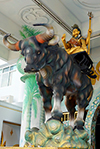
Nandi Baba (नंदी बाबा)
Hindi. ‘Daddy or
Granddaddy
Nandi’,
as well as ‘Father or Granddad Joy’. Name given to an actual
existing
bull
in
the contemporary Indian city of Varanasi (fig.)that
is named after
Nandi,
the mount of
Shiva (fig.),
and which has an extraordinary story with a unique daily routine.
READ ON. 回
Nandikesvara
(नन्दिकईश्वर)
Sanskrit.
‘Lord of Nandi’. A form of
Shiva popular in
Java. His
attributes are
a
lotus bud, a jar and a trident. He appears as guardian of gates,
sometimes accompanied by
Nandi. 回
Nandi mandapa
(नन्दिमण्डप)
Sanskrit. Porch or pavilion used in ancient
Khmer temples to shelter a statue of
Nandi and which was
faced in the direction of the main sanctuary. 回
Nandimitra (नन्दिमित्र, นนทิมิตร)
Sanskrit-Thai. ‘Friend of Joy’, sometimes translated as ‘Happy
Friend’.
Name of one of the candidates
for inclusion as the 17th or 18th
arahat,
generally portrayed in company of a small
dragon by his feet, by some understood to
be a symbol of the deepest inner motivations which he subdues.
In his hands he holds the spiritual
pearl and a small bowl, which is sometimes understood to represent a
chintamani,
i.e. a
wishing gem.
According to one legend, when the people of a small kingdom went on
a rampage against the Buddhist monasteries and stole the
sutras,
which ended up in the palace of an undersea king, Nandimitra subdued
the dragon guard and restored the sutras back to earth. Hence, he is
referred to as Dragon Subduing
Arhat
or Taming Dragon
Lohan.
Since there were initially only sixteen arahats, he is
seen as a guest arahat and is
the author
of the ‘Record of
the Perpetuity of the
Dhamma’
which describes the initial Sixteen Arhats.
In Thai his name can be pronounced Nonthimit or Nanthimitra, but he is also
known as kilih (คีลี).
In Chinese, he is known as the
luohan Jiang Long (降龙,
or in traditional Chinese:
降龍), literally ‘Lower [the] Dragon’ or ‘Descend [to the] Dragon’,
and in Vietnamese, he is called
Hang Long La Han (Hàng Long La Hán -
fig.). In Pali his name is Nantimitolo. However, the name Nandimitra
is occasionally also used for
Subinda,
the Pagoda Holding Arhat (fig.).
If so, Nandimitra is then in the
listing referred to by the name
Nantimitolo. 回
_small.jpg)
Nandin
(नन्दिन्)
See
Nandi. 回
nan feng (男风)
Chinese. ‘Male wind’. A Chinese idiom that denotes a fashion of
forming male company, including intimate relations. It may however
suggests male chauvinism with an ability to exclude the female. In
Pinyin nán fēng. See also
long yang. 回
nang (หนัง)
Thai.
‘Hide, peel, skin’. Name used for an art form in which
leather, usually that of a water
buffalo is cut in the form of figures (fig.),
often with religious and mythological
themes, which are used for decoration or in
shadow play.
The term is thus also used for shadow puppets, which are also
referred to as
nang talung (fig.)
and
nang yai
(fig.),
depending on the type, as well as for shadow puppet theatres, which
are generally known as rohng nang (โรงหนัง).
After the popularity of shadow plays declined and had to give way to
the arrival of motion picture,
the term nang developed to also mean
‘movie’ or ‘film’, used alongside the terms phaap-a-yon (ภาพยนตร์)
and jo ngeun (จอเงิน), which mean ‘moving pictures’ and ‘silver
screen’ respectively.
回
nang (นาง)
Thai for
‘lady, woman or girl’. Generally used in a rather poetic context but also in
front of women's names, as in
Nang Nophamat.
It is the feminine
equivalent of
nai and may also be transliterated naang. 回
Nang Kaew Nah Mah (นางแก้วหน้าม้า)
Name of a
Thai folktale about an ugly girl, with a face like that of a horse (mah),
who fell deeply in love with a prince,
who rejects her because of her horse-like face. Due to her kindness
and her unconditional true love to the prince, an angel transforms
her into a beautiful woman. Eventually, the prince falls for her and
they lived happily together. The moral of the story is that one
should not judge people by their appearances.
See also POSTAGE STAMP. 回
nang klahng plaeng (หนังกลางแปลง)
Thai. ‘Movie in open air’. Term
for outdoor cinema, which in Thailand is in general carried out by
a travelling movie company, that produces a movie onto a giant
screen from the truck it also travels in. Showing only Thai movies
and sometimes low-budget foreign movies (usually Chinese) dubbed in
Thai, the genre has only few admirers, yet for them it has become a
kind of cult.
See also POSTAGE STAMP. 回
nang kwai jih (หนังควายจี่)
Thai.
‘Grilled Buffalo Skin’.
Name of a traditional food preservation method rooted in the wisdom
of the
Isaan people. The process
begins with salting buffalo skin to dry-cure it, ensuring its
longevity and enhancing its flavour. Once prepared, the salted skin
is grilled over a charcoal stove, a method that infuses it with a
smoky aroma and cooks it thoroughly. After grilling, the skin is
pounded until it becomes soft and chewy, making it ready to eat on
its own or as an ingredient in various dishes. Popular preparations
include salted buffalo skin curry, salad, soup, and other creative
recipes, showcasing the versatility of this preserved delicacy in
Isaan cuisine. 回

Nang Kwak (นางกวัก)
Thai.
‘Beckoning Lady’. Female statue (nang)
with one or both (fig.) arms raised and summoning with her hand(s) as if to gesture or
to beckon (kwak).
She invites happiness and good fortune and is often found displayed in
shops to attract good business. Usually portrayed with a large purse full of
money. Compare with
Maew Kwak and
Maneki-neko.
WATCH VIDEO. 回
%202_small.jpg)
Nang Laweng (นางละเวง)
Thai.
Name of the daughter of the King of
Langka,
who set out to seek revenge for the death of her brother
Utsaren. She
fell in love with Prince
Phra Aphaimanih
(fig.)
and eventually became his second human wife, the prince's earlier
human wife being
Nang Suwanna Malih (fig.), the daughter of the King of
Crystal Island.
Besides this, the prince also had two non-human wifes, i.e. the
ogress
Nang
Phi Seua Samut
(fig.),
with whom he had the son
Sin Samut;
and the mermaid Nang
Ngeuak,
with whom he had his son
Sut Saakhon
(fig.).
Nang Laweng appears
on the last stamp in a series of eight Thai postage stamps issued in
2009 to publicize the story of Phra Aphaimanih as
a major literary work
of the
Rattanakosin
Era
(fig.).
In full known as Nang Laweng Wanla (นางละเวงวัณฬา).
回
_small.jpg)
Nang Nophamat (นางนพมาศ)
The daughter of a
brahman
priest and a lady at the court of King
Phra Ruang of
Sukhothai, who developed a new style
of
lotus flower which were to be floated on the streaming waters at night to
please the king. They probably lay at the origin of the present-day
krathong used during the
Loi
Krathong festival. 回
Nang Phim (นางพิมพ์)
Thai. ‘Lady Print’. Abbreviation for
Nang Phimphilalai. 回
Nang Phimphilalai (นางพิมพิลาไลย)
Thai. Another name for
Wanthong, a character
from the story
Khun Chang Khun Paen, who
is also often referred to by an abbreviation of this name, i.e.
Nang Phim. Nang Phimphilalai is
depicted on the fourth design of a set of four postage stamps (fig.)
on the story, issued in 2011 to
mark National Children's Day.
回
nang pla thod krob (หนังปลาทอดกรอบ)
Thai. ‘Crispy fried fish skin’. A snack consisting of deep fried
fish skin, which can be dipped in either a sweet-and-sour
nahm phrik
sauce or a spicy
nahm jim kai sauce. Also fishbones
are fried, salted and consumed in the same manner. Those are known
in Thai as
kaang pla thod (fig.). Basically, this
snack can be made of any find of fish and is a specialty, as well as
a
khong dee
product from both
Ayutthaya and
Samut Prakan.
Also called nang
pla krob or nang pla thod. 回
%201_small.jpg)
Nang Rakasot Thewi (นางรากษสเทวี)
Thai. One of the seven
Nang Songkraan,
i.e. the one who is celebrated if
Songkraan is on a Tuesday,
which is also indicated by the pink
colour of her dress, in line with
the traditional
sih prajam wan
system. Her attributes are a
trisula (officially held in the right hand)
and a bow (formally held in the left hand), her mount is a
pig
or
varaha, and her jewel a
moonstone.
She has the same name in Lan Na
culture.
See also POSTAGE STAMPS
and
TRAVEL PICTURE.
回
%201_small.jpg)
Nang Songkraan (นางสงกรานต์)
Thai. ‘Miss
Songkraan’ or ‘Songkraan Ladies’. (One of)
the seven daughters of
Tao
Kabin Maha Phrom.
READ ON.
回
Nang Suwanna Malih (นางสุวรรณมาลี)
Name of a female character in
the story
Phra Aphaimanih (fig.).
She is the
daughter of the King of
Crystal Island, with whom
Phra Aphaimanih fell in love. However, Nang Suwanna Malih had already been engaged to someone else
from the island of
Langka and
their love affair
started a conflict that developed into a full-scale war between the
two islands, that lasted for many years and only ended when
Nang Laweng
(fig.),
the daughter of the King of Langka, fell in love with Phra Aphaimanih. After the
war, Prince Phra Aphaimanih ordained as a monk and Nang Suwanna Malih and Nang
Laweng both follow him in his ascetic life. Also spelled
Nang Suwanna Malee.
回
%202_small.jpg)
nang talung
(หนังตะลุง)
Thai. A puppet theatre consisting of a shadow play in which
the shadow of a figure, cut from a piece of leather or dried hide (nang) in
the shape of a human form (fig.), is projected onto a screen
(fig.). Its stories
are usually based on the
Ramakien
and so are the protagonists
(fig.),
though there are also characters from religion, such
Idsuan
(fig.),
who is typically portrayed riding on the Usupharaj
bull
Nandi
(fig.),
as well as its own characters, such as
Prai Nah Bot
(fig.),
i.e. the preluder
who represents the performer who recites the invocation, introduces
what follows and gives comments on certain issues to the audience,
and characters from folklore, such as
reusi
(fig.)
and
tua talok
characters,
who are typically
depicted with his one hand shaped as a human penis
(fig.),
etc.
See also
nang yai. See also
LIST OF RAMAKIEN CHARACTERS & NAMES.
回
%20shadow%20puppet%20theatre_small.jpg)
Nang Usa-Thao Barot (นางอุษา-ท้าวบารส)
Thai.
Name of a folk tale
that is set in
Udonthani
and which describes the love story between Nang Usa and
Thao Barot.
READ ON.
回
nang yai (หนังใหญ่)
Thai. A kind of entertainment similar to
nang talung, but larger. It uses large
sheets of leather cowhide (nang)
elaborately carved into framed images, often from the
Ramakien.
Either side has a wooden handle to hold the image up and to prevent the leather
sheet from bending. The figures are manipulated in front of an illuminated
backdrop, accompanied by an orchestra called
pih phaat.
Wat Khanon
in
Ratchaburi
is home to the
Nang Yai
Museum, which houses a large collection of
leather
nang yai sheets with scenes and
characters from the Ramakien that are
displayed against white sheets and
light boxes (fig.).
Nang yai images were depicted on a set of four Thai postage stamps issued in
1998 (fig.)
in order to promote the Visit Thailand Year, as well as in 1969 (fig.).
In 1982, a monument was inaugurated
at the southern end of
Lahn Khon Meuang
in
front of the Bangkok City Hall, to commemorate the
bicentenary of
Rattanakosin's
foundation in 1782 AD, and which is made in the form of a
large gilded nang yai sheet in
metal (fig.)
which bears
the
carved image of the emblem
that was designed for the occasion and that is
erected on poles that symbolize the two handles of genuine
shadow play sheets. See also
LIST OF RAMAKIEN CHARACTERS & NAMES.
回
%202_small.jpg)
Nan Gyi Thohk (နန်းကြီးသုပ်)
Burmese.
‘Thick
Noodle
Salad’.
Name of a
Shan
inspired
dish similar to
Shwe Taung Noodles (fig.),
but which uses thicker noodles and
without
crackers. 回
Nankarine (နံကရိုင်း)
Burmese.
Name a
female
buffalo,
who is said to have raised a prince who got lost in the wilderness, according to
one version, she nursed two princes, namely the brothers Thamala and Wimala, the
founders of
Hanthawaddy,
i.e. the later
Pegu
and
present-day
Bago.
Afterwards, the
prince(s) was/were found by some soldiers and returned to the palace, wherein the
buffalo followed them and rammed through the palace gates to get to her
stepchild(ren). As a consequence, she was killed by the guards and
became the
nat
Nankarine Medaw (fig.),
who is also known as
Pegu Medaw
(fig.).
Also transliterated Nankaraing. 回
Nankarine Medaw (နံကရိုင်းမယ်တော်)
Burmese.
Another name for the
nat
Pegu Medaw,
after the
female
buffalo
Nankarine.
See also LIST OF BURMESE NATS. 回
Nan Phaya Kyaung (နန်းဘုရားကျောင်း)
Burmese name of a 11th
century AD temple in the village of Myinkaba, near
Bagan.
READ ON. 回
nan se (男色)
Chinese. ‘Male beauty’. A Chinese idiom that refers to the
seductive features in boys and men which on occasion may be even somewhat
feminine. In
Pinyin nán sè. The term is comparable with the Thai word
kathoey. See also
long yang and
duan xiu. 回
napa
cabbage
See
phak kahd khao. 回
Narai (นารายณ์)
1. Thai. An earlier incarnation of
Rama,
an
avatar of the
Hindu god
Vishnu.
He dwells in the Waikuhn heaven and is called
Narayana in Sanskrit.
See also
Phra Narai.
MORE ON THIS. 回
2. King
and
ruler of
Ayutthaya
(fig.), from 1656 until his death
in
Lopburi (map
-
fig.), in 1688, during the revolt of Ayutthaya.
He is one of the Great Kings in Thai history referred to as a
Maha Raj.
As such, his statue (fig.)
is included in the monument at
Uthayaan Rachaphak
(fig.). Also
Phra Naraiyamaharaat
(fig.). 回
%201_small.jpg)
Narai banthom
sin (นารายณ์
บรรทมสินธุ์)
Thai-rajasap. ‘Narai sleeping on the ocean’. Thai term for
Vishnu
Anantasayin (fig.),
which is usually referred to as just
Anantasayin. 回
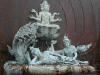
Narai plaeng
son (นารายณ์แผลงศร)
Thai. ‘Narai shooting an arrow’. Common name for
the depiction of
Vishnu,
Rama or
Narai with a bow. See also
Narai song peun
and
yoksorn (fig.). 回
Narai song
peun (นารายณ์ทรงปืน)
Thai. ‘Narai with a weapon’. Portrayal of
Vishnu,
Rama or
Narai with a bow
(fig.). See also
Narai plaeng son
and
yoksorn (fig.). 回
_small.jpg)
naraka (नरक)
Sanskrit. ‘Hell’. The Thai word
narok
derives from it. In Pali, the hell is called
niraya. 回
Narapati Sithu (နရပတိ စည်သူ)
Burmese. Name of a
12th Century AD King
of
Pagan.
He reigned from 1174 to 1211 AD and is regarded the last
important ruler of Pagan. His reign was peaceful and prosperous,
allowing Burmese culture to rise and ultimately emerge from the shadows
of the earlier
Pyu
and
Mon
cultures, its script even replacing that of the
two latter, while the term Mranma (Myanma)
was beginning to be used overtly. With his
leadership unquestioned, the Pagan Empire reached its peak during his reign, and
would decline gradually after his demise. In 1183 AD,
King
Narapati Sithu had
Sulamani Phaya
(fig.)
built. See also
Aungzwamagyi
and
Shwe Indein Zedi. 回
Narasimha
(नरसिंह)
Sanskrit. ‘Man-lion’. The fourth
avatar of
Vishnu with the body of a man and the head of a lion
(fig.).
In this incarnation, he killed
the
Rakshasa
Hiranyakashipu, as the
latter wanted to revenge his brother Hiranyaksha, whom was killed by
the boar
Varaha
(fig.),
the third and previous avatar of Vishnu. See also
reusi nah seua (fig.).
In Pali called
Narasingha
and in Thai
Norasingh. 回
%204th%20avatar%20of%20Vishnu%20as%20man-lion_small.jpg)
Narasingha
Pali.
‘Man-lion’. See
Narasimha. 回
Narathihapate (နရသီဟပတေ့)
Burmese. Name of
the last king of the
Bagan Dynasty, who reigned from
1256 to 1287 AD. He was a man overwhelming appetite, who loved his
food and drink, so much so that the Glass Palace chronicle records
that he was the reincarnation of an ogre who lived on
Mount Popa (fig.).
And because he had become a man from the state of an ogre he was
violent and envy, proud and wrathful, and gluttonous in eating and
drinking. He was great in wrath, haughtiness and envy, exceeding
covetous, and ambitious. He had 3,000 concubines and maids of honour.
The royal chronicles further describe his rule as tyrannically, with
some of his preoccupations ranging in the territory of the bizarre,
with one of the most notorious aspects of his rule was his severe
and often irrational punishments for minor offenses, such as
sneezing or yawning in his presence, which was punishable by death.
Narathihapate ascended to the throne following the death of his
predecessor, King
Uzana.
The most significant threat to his reign came from the Mongols, then
referred to as by the Burmese as Taruks, when Kublai Khan's forces
invaded Bagan's territory in 1277 AD. Initially, Narathihapate
managed to repel the Mongol forces at the Battle of Ngasaunggyan,
but a series of campaigns against Pagan between 1283 and 1287,
culminating in the fall of the capital. Facing the Mongol threat,
Narathihapate fled the capital, earning him the nickname Taruk-Pyay
Min, i.e. the
‘King who fled from the
Taruks’. He sought refuge in the southern parts of the kingdom, but
upon his return to Pagan to rule as a vassal for the Mongols, he was
assassinated in 1287 by his own son, Thihathu (သီဟသူ), who poisoned
him before he reached Pagan. The fall of Pagan to the Mongols marked
the end of the Pagan Empire, which had been the first to unify the
regions that would later constitute
Myanmar. The once-great Pagan
Empire, which had flourished for centuries, disintegrated and faded
into irrelevance, consigning Pagan to the annals of history.
Following this collapse, a period of fragmentation ensued, paving
the way for the emergence of numerous smaller states. Narathihapate
is remembered for his inability to protect the kingdom from the
Mongol invaders and for his cowardly flight from the capital when
faced with imminent invasion. 回
Narathip Phongpraphan (นราธิปพงศ์ประพันธ์)
Another name of
Prince
Wan Waithayakon.
Also spelled
Naradhip Bongsprabandh. 回
Narathiwat
(นราธิวาส)
Thai. ‘Residence of wise people’. Name of a
province and its provincial capital in South Thailand.
READ
ON. 回
Narayana
(नारायण)
Sanskrit.
‘Path of man’. In Hindu mythology it is the name of the god of
creation, later synonymous with the god
Brahma and even later it became another name for the Hindu god
Vishnu.
Also
Phra Narai. 回
Naresuan
(นเรศวร)
King of
Ayutthaya, who
ruled from 1590 until 1605. He was born in
Phitsanulok in
1555, a son to King
Mahadhammaracha
and his principal wife and Queen
Wisutikasat, the daughter of King
Chakraphad.
He was taken to Burma as a hostage, so that his father, who had been put on the throne by the Burmese after they had conquered Ayutthaya
in 1569, would be a loyal vassal
to Burma. Naresuan stayed in Burma for seven years what probably
made him the only
Siamese King
who ever could speak Burmese. In 1571 the Burmese King
Bayinnaung (fig.) allowed him to return home in exchange for his sister,
Princess
Suphankanlaya. Despite his young age (16
years) his father sent him to the northern town of Phitsanulok to govern the
region also making him heir to the throne of Ayutthaya. He played
a key role in the defense of Ayutthaya, against both Burmese and
Khmer attacks. These Khmer invasions gave the Siamese an excuse to
mobilize troops and increase their weaponry, without arousing
suspicion with the Burmese and allowing the Siamese-Burmese conflict
to escalate into a war of independence. In a duel on elephants
(fig.) during the 1593
(fig.) Battle of Nong Sarai (map
-
fig.), he defeated Minchit Sra,
whom in Thai-Burmese is referred to
by the names Mangsahmkiat (มังสามเกียด) or Mangkayohtchawa (มังกะยอชวา),
i.e. the
Burmese crown prince and a grandson of Bayinnuang, the King of
Pegu, and in doing so liberated Ayutthaya
from the yoke of Burma.
During his reign he consolidated his kingdom and tried to expand its
borders (fig.).
He died age 50 at Meuang Hang in the
Shan
states while leading a campaign to forestall the Burmese takeover of
that region in 1605. He is
considered one of the Great
Kings in Thai history (fig.)
referred to as a
Maha Raj, and hence
also called
Phra Naresuan
Maha Raj or Somdet
Phra Chao Naresuan
Maha Raj.
As such, his statue (fig.)
is included in the monument at
Uthayaan Rachaphak
(fig.).
He
is further immortalized in several statues (fig.)
and memorials, such as the King Naresuan Memorial (map -
fig.) in Ayutthaya, and the
19 meters tall statue
(fig.)
at
Lahn Isaraphaap 109 in
Angthong.
He was a huge enthusiast of cock
fighting (kaanchon kai
-
fig.)
and at shrines devoted to him one will generally find stone
sculptures of cocks, often placed there as offerings (fig.).
He is often depicted
pouring water from the
Suwanphingkhaan, a royal
golden pitcher used to
supply cold water to the King,
as a declaration of
Ayutthaya's
independence from
Hongsawadih. See also
list of Thai Kings.
MORE ON THIS
and
WATCH VIDEO (1),
(2) and
(3). 回
Naret Worarit (นเรศร์ วรฤทธิ์)
Thai.
Name of the 17th
child and 8th son of
King
Mongkut, the
fourth monarch of the
Chakri
dynasty with the crown title
Rama IV. The
prince was born on 7 May 1855 as Kritsadahphinihaan (กฤดาภินิหาร).
The prince held several important government positions under his
brother King
Rama V,
having served as Ambassador to the United Kingdom and to the United
States of America, Minister of Public Works, and Minister of the
Metropolitan Police, whilst during the reign of King
Rama VI,
he was Advisory
Minister and served as Minister of the
Murathathorn.
After a 1890 visit to Singapore with King
Chulalongkorn,
he
reorganized the police after the Singaporean model and later developed
it into the current
Royal Thai Police.
He passed away on
20 August 1925 and is remembered as a royal member who made a great
contribution to the nation. He is commemorated as a prominent
personage on a Thai postage stamp issued in 2012 (fig.)
His name is also transliterated Nares Varariddhi. 回
%20Nares%20Varariddhi%202_small.jpg)
Narin (นรินทร์)
Thai. A royal title derived from the Sanskrit word Narendra (नरेन्द्र),
which means ‘Leader of the People’ or ‘Lord of Men’, and which can
be translated to ‘King’ or ‘sovereign’. Narendra is a compound of
Nara (नर), meaning ‘man’ or ‘person’, and ‘Indra’ (इन्द्र), the name
of the king of the gods in Hindu mythology. Narin may also be
transliterated Narintr, Narint or Narind. . 回
nariphon (นารีพล)
Pali-Thai. ‘Women fruit’. Name for a fabulous tree that yields
fruits in the shape of fairy-like beings, who offer erotic pleasure. These pixies grow from
this tree's branches, ready to be picked off by sexually frustrated
hunters. However, it can only be found in
Himaphan forest. These special fragrant ‘flowers’ are
described as 16 year old girls, with skins
reminiscent of ripe
maprahng plums (fig.),
large sapphire blue eyes with golden irises, 45 degrees falcate
noses, golden hair with at the top a crown-like tuft,
connecting eyebrows, and very soft bodies as they have no
skeleton, yet with all five sensual desires, i.e. shape, sound,
smell, taste and feeling, just ideal. Some sources relate that
the tree is looked after by sages called
reusi (fig.), and
that it is sometimes used
as a tool in meditation.
Often transcribed nariphol and also known as
makkariphon (fig.)
and
makkaliphon. 回
%20woman%20tree_small.jpg)
Narisara Nuwattiwong (นริศรานุวัดติวงศ์)
A younger brother of King
Rama V,
who is best known for his artistic talent, both as a designer and composer. His
architectural work includes the designs of
Wat Benjamabophit,
i.e. the
Marble Temple
in
Bangkok
(fig.);
the seal of Bangkok (fig.),
i.e. the image of
Indra
riding on the
elephant
Erawan
(fig.);
the
Pig Memorial (fig.);
besides several government buildings, while his most notable
contribution in music is as the author of the earlier lyrics of the
Royal Hymn, known
in Thai as
Phleng Sansaroen Phra Barami.
His name is also
transcribed Narisara Nuvativongse and in English texts he is often
referred to as Prince Naris.
He was born on 28 April 1863 and passed away on 10 March 1947 at the
age of 83.
See also POSTAGE STAMPS (1) and
(2). 回
%201_small.jpg)
Narod (นารอด)
Thai. Name of a
hermit
or
reusi,
who was the son of
Brahma.
He was born from the fifth head of Brahma and is considered the first
hermit of the
Triphum,
respected as a seer of the
Triloka. He was
very well versed in music and had special knowledge of herbs, various magic
spells, and astrology. Narod
is the teacher of all other hermits, said to total 108, akin to
the 108
auspicious signs of a buddha,
who are seated in the most powerful pose known as
pahng
thera.
The largest statue of a hermit in the world, in
Suphanburi,
is a representation of
Narod (fig.). 回
narok (นรก)
Thai term referring to
‘hell’, a place comparable with
Christian purgatory.
READ ON. 回
narom (นรม)
Thai honorific
conveying reverence or exalted status. 回
Narrowest Part of Thailand
Name
that refers to the area where the nation's land is at its narrowest.
It is found at Moo (หมู่) 2, Baan Khot Saai (บ้านโขดทราย) in Haht
Lek (หาดเล็ก). Here, Thailand's land area measures just 450 meters
across. This constricted stretch lies between Kilometer Markers
81-82 on the
Trat-Khlong
Yai (คลองใหญ่) Road, bordered by
Cambodia on
one side and the
Gulf of Thailand on the
other. In Thai, it is known as
Suan Khaeb Thih Soot Khong
Prathet Thai.
The
narrowest part of land on peninsular Thailand is the
Isthmus of Kra
(fig.),
known in Thai as
Kho Khot Kra or
Kiw Kra.
回

Na Satta (ณ สัทธา)
Thai. Name for a
cultural sanctuary in
Ratchaburi
where Thai history, spirituality, and art come to life through
immersive exhibits and modern innovation. Spread across a lush
16-acre landscape, the park offers visitors a journey through
time—showcasing wax figures of national
heroes,
international leaders (fig.),
and of the Princess Mother
Sri Nagarindra (fig.), alongside traditional architecture from all four
regions of Thailand (fig.). Highlights include religious zones featuring
Buddha statues
from various historical periods, the
Jataka
Cave narrating Buddhist teachings, and a serene garden dotted with
bonsai
(fig.) and sacred imagery. Interactive installations and seasonal
light festivals, such as the dazzling Winter Illumination, blend
storytelling with technology, making heritage accessible and
engaging. At the entrance, visitors are welcomed by
Piti,
whose name means
‘Joy’
or
‘Delight’,
the park's endearing pet-flower mascot. Piti is a charming character
designed as a flower fairy, with a colourful flower head, a cheerful
face, and a bright costume. Piti embodies the spirit of the Na Satta
Light Festival Winter Illumination (fig.). The name Na Satta may be translated as
‘Upon
Believe’,
‘Upon
Faith’,
or
‘Upon
Devotion’.
WATCH VIDEO (1),
(2),
(3),
(4)
and
(5).
回

nat
(နတ်)
A Burmese spirit similar to the Thai
chao thi and which
can be both a nature spirit and a spirit from mythology (fig.), especially the spirit of someone who
met a violent
and unjust or untimely death.
READ ON. 回
Nataraja
(नटराज)
Sanskrit.
‘Dancer-king’. A depiction of
Shiwa as the
‘Lord
of Dance’, standing on one leg with the other in the air. It
represents cosmic truth and energy,
i.e. the destructive energy with
which Nataraja dances at the end of each cosmic age. Hence,
his cosmic dance symbolizes
creation,
preservation and destruction at the same time, and is the source of all movement within
the cosmos, the latter being represented by the arch of flames. The
purpose of the cosmic dance, which Shiva performed in Chidambaram in
South India and which by some Hindus is regarded as the centre of
the universe, is to release men from the illusion of the physical
world and of the idea of Self. Nataraja is always represented in the
Chaturbuja
style, i.e. with
four arms, and whilst he
holds three arms stretched out, the fourth one is held across the
chest in the
gajahasta or
elephant trunk pose, with the wrist
limp and the fingers are pointed downward, toward the uplifted foot.
The gestures of the dance represent Shiva’s five activities, i.e.
Creation, which is symbolized by the
hourglass-shaped
bando-drum
(fig.);
Protection, which is represented by the
abhaya
mudra (fig.);
Destruction, symbolized by the fire of
Agni that
cleanses sins and removes illusion;
Embodiment, indicated by the one foot planted on a
midget (fig.),
i.e. the dwarf-demon
Apasmara, who represents ignorance
and thus by subduing him allowing the birth of knowledge;
and Release, which is represented by the foot held aloft, and is
said to grant eternal bliss to those who approach him. He also wears
a
snake coiled around his upper arms and neck, which −due to their
natural process of molting or shedding their skin− symbolizes
reincarnation,
i.e. the transmigration of the soul from one body to another. Statues of
Nataraja
are worshipped in most Hindu temples (fig.). See also
kalachakra,
tandava
and
hiranyagarbha.
See also
TRAVEL PICTURE and
WATCH VIDEO. 回
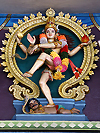
nataya (นาฏย)
A
Thai term meaning ‘concerning dance’, as well
as ‘regarding drama’ or ‘about stage performance’, which derived
from Sanskrit. See also
Nataraja,
a name used for
the Hindu god
Shiwa
as
‘Lord of Dance’. 回
Nathlaung Kyaung
(နတ်လှောင်ကျောင်း)
Burmese.
‘Shrine Confining
Nats’
or
‘Monastery Holding Spirits’.
Name of a
Hindu
temple in
Bagan dedicated to the god
Vishnu
and located inside the city walls of old Bagan.
READ ON.
回
National Archives King Bhumibol Adulyadej
Name of a specialised archival institution
in
Pathum Thani
dedicated to the preservation, curation, and exhibition of
documents, photographs, audiovisual materials, and artefacts
relating to the life of
King
Bhumipon Adunyadet
(Rama IX),
and his extended royal family. Covering the period from his early
life through his reign to his passing, the archive serves as both a
historical repository and a research centre, facilitating the study
of the monarch’s personal biography, royal duties, and familial
context within modern Thai history. In Thai, it is known as Ho
Jotmai Het Haeng Chaht
Chaleum Prakian
Phra
Baht
Somdet
Phra
Boromma
Chonkathibet
Maha
Bhumipon Adunyadet
Maharat
Borommanat
Bophit
(หอจดหมายเหตุ แห่งชาติ เฉลิมพระเกียรติ พระบาทสมเด็จพระบรม ชนกาธิเบศร
มหา ภูมิพลอดุลยเดช มหาราช บรมนาถบพิตร),
which roughly translates to
‘The
National Archives in Honour of His Majesty King Bhumibol Adulyadej
the Great’.
WATCH VIDEO.
回

National Bird
See
nok prajam
chaht. 回
National Broadcasting and Telecommunications
Commission
See
Samnakngaan Khannakammakaan Kitjakaan Krajaai
Siang Kitjakaan Thorasap Lae Kitjakaan Thorakhammanahkhom Haeng
Chaat. 回
National Gallery
The National Gallery compiles and displays
both classical and temporary art of renowned Thai artists for anyone
with an interest in art. It also exhibits oil paintings made by King
Bhumipon. It was
inaugurated on 8 August 1977 by princess Maha Chakri Sirindhorn and is located
at the
Phra Pinklao
Bridge near
Sanam Luang.
Officially, it is known as The National Gallery and
in Thai it is referred to as Phiphithaphan
Sathaan Haeng Chaht
Ho Silp (พิพิธภัณฑสถานแห่งชาติ หอศิลป). It is housed in the building
that between 1902 and 1968 accommodated the
Royal Thai Mint, today located in
Pathum Thani
(fig.).
In April 1901, King Rama V had ordered a new Mint to be built
alongside Khlong Lod (คลองหลอด), a canal along
Chao Fah
Road that is the northern part of the
Old City Moat
(map
-
fig.)
which semi-circumvents inner
Rattanakosin
Island
and of which the section on Chao Fah Road is nowaday for the most
part underground,
covered by roads and only visible underneath the Phra Pinklao
Bridge, where it connects to the
Chao Phraya
River, and at
Saphaan
Phaan
Phiphop
Leelah
(สะพานผ่านพิภพลีลา), where it disappears under the bridge that
connects to
Rattanakosin
Island
and whose name translates as
‘Bridge
Past the World of Grace’.
The Opening Ceremony of the new Mint was held on 4 February 1902.
Its production capacity was about 80,000-100,000 coins per day.
See
MAP. 回
National Hymn
See
Phleng Chaht Thai. 回
National Institute of Development
Administration
Name of
a public graduate university in
Bangkok's
Bangkapi district. It is
considered one of the three leading institutions of higher learning
in Thailand, together with the
Chulalongkorn
University
(fig.)
and the
Thammasat
University (fig.). It
was founded in 1966 and is best known to the greater public by its acronym NIDA.
Among its notable alumni are several professors and politicians, including
Somchai
Wongsawat, who was briefly Prime Minister of Thailand in 2008.
See also List of Thai Prime
Ministers,
POSTAGE STAMP,
and
MAP. 回
%20in%20Bangkok_small.jpg)
National Memorial
A
38
rai museum in
Pathum Thani under the supervision of the Armed Forces Education
Department, Supreme Command Headquarters. It is a memorial praising
the military deeds of Thai historical heroes, providing information
on Thai history and major Thai battles, including Thai military
missions abroad. The exhibition consists of dioramas and photos, as
well as narrative explanations. On display are decommissioned
military weapons and other hardware (fig.), the evolution of uniforms and ranking insignias,
visual representations of major battles, and the story from the
Sukhothai to the
Rattanakosin period. The National
Memorial is located in the
tambon
Khu Khot (คูคต) of the
amphur
Lam Luhk Kah, just across
Bangkok's
northern provincial border,
where the Phahonyothin and Wibhawadi Rangsit Roads join. In Thai
called
Anuson
Sathaan Haeng Chaht.
See MAP.
回
_small.jpg)
National Museum
There
are several National Museums throughout the Kingdom of Thailand, all
named National Museum, followed or preceded by the name of their location
or an important historical figure, i.e. National Museum
Nan,
Ramkhamhaeng
National Museum in
Sukhothai
(fig.), National Museum
Bangkok,
Thalang
National Museum in
Phuket (fig.),
etc.
However, in English, the
location sometimes precedes the name, e.g. Nan National Museum (map
-
fig.).
Of those, the National Museum of Bangkok (map)
is the largest museum in Southeast Asia and was founded in 1874 by
King
Rama V. It is housed in the former
Wang Nah Palace, originally the
residence of the
Krom Phra Rachawang Bowon Sathaan Mongkon
and part of
Phra Rachawang,
the Grand Palace. It served as a royal residence for 5 prince
viceroys, until King Rama V eliminated this position. The museum features
objects from Thai art and history, from the Sukhothai to the
Rattanakosin period, as well as items and representations from the pre-Thailand period. It also exhibits sculptures from elsewhere in Asia, including one of the
earliest
Buddha images in the
Gandhara
style from India. The museum consists of several wings, including
the Raja Ratha Hall, which is home to objects related to royal
funerals, such as
several
Rajarot
and
koht, i.e. royal funeral carts and
royal urns (fig.),
as well as royal
palanquins called
rachakaanhaam
(fig.).
The museum used to have free English, German, French and Japanese language
tours given by volunteers, but nowadays the museum has fitted most
displays with QR Codes that can be scanned for more detailed
information. In Thai, it is called Phiphithaphan Haeng Chaat
(พิพิธภัณฑสถานแห่งชาติ).
WATCH VIDEO. 回
_small.jpg)
National Park
See
Uthayaan Haeng Chaat. 回
National Science Museum
Name of a public
institution dedicated to the promotion of scientific knowledge,
technological innovation, and science education in
Thailand.
Established in 1995 under the supervision of the Thai government,
the museum operates as a national centre for the communication and
dissemination of science to the wider public through exhibitions,
research initiatives, and educational programmes. The institution is
located at the Technopolis complex in
Pathum Thani, where it forms a museum
complex comprising several specialised museums, including the
Science Museum, the Natural History Museum, the Information
Technology Museum, the
Rama IX
Museum, and the Futurium innovation centre. Among its most
recognisable structures is the main Science Museum building, whose
distinctive architecture consists of three large cube-shaped volumes
balanced on their corners and interconnected to create a striking
geometric form that symbolises the dynamic and exploratory nature of
scientific inquiry. Through interactive exhibitions, educational
outreach, and public engagement activities, the National Science
Museum serves as a key institution for fostering scientific literacy
and encouraging interest in science, technology, engineering, and
environmental awareness among students, researchers, and the general
public in Thailand. The exhibition begins with a section devoted to
King
Mongkhut (Rama IV),
who is widely regarded as the
Father of Thai Science (fig.)
for his promotion of scientific learning and his well-known
prediction of the solar eclipse of 1868. Abbreviated NSM and in Thai
fully known as Ongkahn
Phiphithaphan
Witthayasaht Haeng
Chaht (องค์การพิพิธภัณฑ์วิทยาศาสตร์แห่งชาติ)
and abbreviated OPWC (อพวช).
WATCH VIDEO. 回

National Stadium
Name of a large sports
complex in
Bangkok's
Pathum Wan District, that
consists of several sporting facilities and stadiums, the main and
oldest venue being
Sanam Supachalasai
(fig.),
named for
Bung Supachalasai
(fig.),
the Father of Thai Sport,
who overlooked the
construction of the National Stadium, which began in 1937. Other
amenities within the compound include Thephasadin (เทพหัสดิน)
Football Stadium, Chindarak (จินดารักษ์) Stadium, Nimibut (นิมิบุตร)
Indoor Sports Arena, Wisutharom (วิสุทธารมณ์) Swimming Pool and the
Chanthana Yingyong (จันทนยิ่งยง) Gymnasium. In Thai it is known by
the names
Sanam Kilah Haeng Chaht and Krihtah
Sathaan Haeng Chaht (กรีฑาสถานแห่งชาติ).
See also TRAVEL PICTURES,
PANORAMA PICTURE, and
POSTAGE STAMPS. 回

National Telecommunications Commission
See
Samnakngaan Khannakammakaan Kitjakaan
Thorakhammanahkhom Haeng Chaat. 回
National Theatre
The first theatre in
Bangkok, which stages Thai classical
performances of both
khon and
lakhon, as well as Thai classical music.
The theatre developed from the Fine Arts Department of Theatre and
Dance music, when the latter in 1932 received the transfer of this
performing art from the Bureau of the Royal Palace, when the present
National Theatre did not yet exist. The first performances were held
in a hall known as the Fine Arts Theatre, but this hall was
destroyed by fire on 9 November 1960. The next year, construction of
the National Theatre began, which lasted about 4 years. The National
Theatre was officially opened on 23 December 1965 by then Prime
Minister
Field
Marshal Thanom Kittikachorn. In Thai, it
is called
rohng lakhon haeng chaht.
See MAP. 回
_small.jpg)
Nat Kadaw (နတ်ကတော်)
Burmese.
‘Spirit Consort’. Term for a spirit medium, often someone who
pretends to go into a trance, and who is also referred to as a
nat
dancer. The dancer is typically either a girl or woman, or a gay
boy. He or she is considered a consort and servant of a certain
spirit or nat, and performs especially during the festival of
Nat Pwe by
making a spiritual
dance which may be joined by devotees who will spray him or her with
perfume and offer money, that is usually pinned to dancer's dress.
See also
nat
and
gado bwe. 回
_small.jpg)
Nat Pwe
(နတ်ပွဲ)
Burmese.
‘Festival of spirits’. Annual religious festival in
Burma, held in August in Taungbyon, about 20 kms North of Mandaley,
a place named after the brothers Shwe Hpyin Gyi and Shwe Hpyin Nge Taungbyon who
were executed in the 11th century AD on the orders of King
Anawratha because they failed to
place stones near
a
pagoda, as they were ordered.
During the festival there are special
spirit mediums, some who pretend
to go into a trance and also referred to as
nat
dancers (fig.)
and in Burmese known as
Nat Kadaw. 回
natsaw (နတ်ဆော်)
1. Burmese. Wizards in Burmese
demonology, i.e. magicians, diviners and so-called wise men and
women, who practice their arts in private and not in a hierophantic
capacity among the rural folk of
Myanmar.
Compare with
shaman. 回
2. Burmese. Angelic beings,
similar to the Thai
thevada (fig.)
and
thepanom (fig.),
of which statuettes
are used to ward off evil and to
protect certain buildings, such
as the Golden Palace Monastery in Mandalay (fig.),
as well as the people residing within it. Compare
with
Hangshi. 回
_small.jpg)
navagraha (नवग्रह)
Sanskrit. The
nine planets, that is, the sun, the moon,
Mars, Mercury, Jupiter, Venus, Saturn, Neptune and Earth. They are commonly
depicted on lintels or as part of the front door of a Hindu or
Khmer temple.
Note that this list includes our sun, which is actually a star, and
the Earth's moon, but does not include the planets
Pluto, which
wasn't discovered until 1930 AD and in 2006 reclassified as a
dwarf planet, i.e. one of possibly several hundred, nor it includes Uranus,
which was discovered only in 1781 AD, whereas all the others had been
known since prehistoric times. See also
Pang kahntang phra prajam wan,
Rahu,
and
noppakro. 回
Naval Dockyard
Shipyard of the
Royal Thai Navy, located on the
west bank of the
Chao Phraya
River in
Thonburi,
directly to the opposite of the
Grand Palace.
READ ON. 回
Naval Dockyard Museum
See
Royal Dockyard Museum. 回
Naval Museum
Museum
in the
amphur
meuang
of
Samut Prakan,
which houses a sizeable collection of real-sized and miniature naval
vehicles, both old and new, and ranging from
Royal Barges
(fig.),
submarines and other war
vessels, to all kinds of military
aircraft (fig.). It also displays decommissioned weaponry, such as
deep sea mines (fig.), torpedoes
(fig.),
flak and canons, as well as military uniforms, a few actual ancient Royal Barges (fig.)
and old figureheads (fig.),
with some of those dating back to the reign of King
Rama V.
In Thai, the museum is known as
Phiphithaphan
Nai Reua (พิพิธภัณฑ์นายเรือ).
It is located in the
tambon
Pahk Nahm (ปากน้ำ), opposite of the Naval School.
See also
Royal Barges Museum.
See
MAP and
WATCH VIDEO. 回

Nawaminda Kasatriyathiraat Royal Air Force
Academy
Another transliteration
for Navaminda Kasatriyadhiraj Royal Thai Air Force Academy. See
Rohng Rian Nai Reua Ahkaht
Nawamintha Kasatriyathiraat. 回
navaranga
Sanskrit. The central hall of a temple. 回
Navaratri (नवरात्रि, นวราตรี)
Sanskrit-Thai.
Annual Indian religious festival around the beginning of October,
that extends
nine nights and ten days, and in which daily
puja
ceremonies are held.
READ ON. 回
Navel of the Mekhong
See
Sadeua Mae Nahm Khong. 回
nayaka (नायक)
Sanskrit for ‘leader’. The Thai word
nayok
derives from it. 回
nayok (นายก)
Thai. ‘President’ or ‘chairman’. The term is derived from the
Sanskrit word
nayaka. 回
Naxi (纳西)
Chinese. An ethnic group of people in
China, that dwells in the
foothills of the
Himalayas, mainly in the northwestern part of
Yunnan, as well as the southwestern part of
Sichuan Province.
READ ON.
回
Na Zha (哪吒)
See
Nezha. 回
neak (នាគ)
Khmer for
naga, the Cambodian equivalent for the Thai
word
naak. Also
transliterated nee-ak. 回
Neak Tah Dambang Kranhoung (អ្នកតាដំបងក្រញូង)
Khmer.
‘Grandpa Rosewood Club’. Name of a mythological figure from Battambang, a city and province in
Cambodia.
READ ON. 回
Needlefish
Common name
for
a
kind of a slender fish in the family
Belonidae, of which there are several species.
READ ON. 回
nei hua (内画)
Chinese. ‘Inside painting’.
Name for a kind of
traditional Chinese art in which
illustrations and often
Chinese calligraphy
are
hand-painted on the inside surface of a glass or crystal object.
READ ON.
回
Nemiraat Chadok (เนมิราชชาดก)
Pali-Thai. Name of one of the
ten
jataka,
i.e. life stories of the previous
incarnations of the
Buddha,
which are known in
Thai as
chadok.
In this story, the
bodhisatta
is born as
the son
of the King of Mithila.
READ ON.
回
Nemiraja (เนมิราช)
See
Nemiraat Chadok.
回
Neochera dominia
Latin-scientific binomial name for a species a moth in the family
Noctuidae.
READ ON.
回
Neon Cuckoo Bee
Common name for a parasitic
bee with the scientific designation Thyreus nitidulus and known in
Thai as
pheung
sih fah (ผึ้งสีฟ้า),
i.e. ‘light blue bee’, due to the brilliant metallic black-and-blue
bands on this solitary and sturdy species. There are several
subspecies and is distributed from Australia and New Guinea to
Southeast Asia. The common name derives in part from the cuckoo bird
(fig.),
as the female neon cuckoo bee likewise seeks out the burrow nest of
another bee and deposits her egg into an unguarded brood cell.
回
_small.jpg)
Neon Tetra
Common name for a small freshwater fish with the scientific name
Paracheirodon innesi. It has a blue back and a
silver-white abdomen
with a horizontal, iridescent blue stripe on its sides, running from
the nose to the base of the adipose fin, and an iridescent red
stripe that runs from the middle of its abdomen to its tail fin,
which is transparent and symmetrical
in shape. When seen from the front, their
fluorescent eyes seem to glow like small neon lights (fig.).
Due to its attractive colours, which are reminiscent of the Thai
national
tricolour (thong
trai rong
-
fig.), it is a very popular aquarium fish
and, though originally from South America, it is bred on a large
scale in Thai fish farms, for trade and export. In Thai its is named
Pla
Neon (ปลานีออน). 回
%20ปลานีออน_small.jpg)
Nepali topi (नेपाली टोपी)
Nepali
name for
a type of brimless hat (topi),
which is part of the Nepalese national dress (fig.)
and of which there are two main types, i.e. the
Dhaka topi (fig.),
a colourful –mostly pinkish–
type of
hat, made with
a
fabric with a typical design of print
that originated from Dhaka, the capital of Bangladesh;
and the
Bhad Gaule topi (fig.),
a similar type of
brimless hat, but all-black and
typically worn by the Newa people of Nepal. The latter originates
from the town of Bhaktapur (fig.),
which is otherwise known as Bhadgaon, hence the name. 回
,%20Newari%20traditional%20hat%20(Nepal)_small.jpg)
nephrite
A greenish gray fibrous gem similar to
jade. 回
neraphusihthai (เนระพูสีไทย)
Thai name for the
Black Bat Flower. 回
Net-winged
Beetle
See
hing hoi chang. 回
neua (เนื้อ)
1. Thai for ‘beef’, as
well as a generic term for ‘meat’. 回
2. Thai for ‘flesh’ or
‘body tissue’, not necessarily for eating. 回
3. Thai for ‘flesh of
fruit’. 回
4. Thai for ‘substance’
or ‘material’, where something is made of. 回
5. Thai for ‘content’,
‘essence’ or ‘main point’, i.e. the important part, as in neua
reuang (เนื้อเรื่อง), which translates to ‘plot’ or ‘storyline’, and
neua ha (เนื้อหา), meaning ‘content’ or ‘subject matter’. 回
6. Thai for ‘texture’
or ‘consistency’, i.e. how something feels in terms of texture or
density. 回
7. Thai for a ‘style’,
‘melody’ or ‘melody line’, or a ‘pattern’ in traditional Thai music,
i.e. a type of musical mode, especially in classical Thai music. 回
8. Archaic Thai term
for ‘fabric’ or ‘cloth’. 回
neua saai
(เนื้อทราย)
Thai. A name for
Hog Deer, in addition to
tahmanae. 回
Neung
Tambon Neung Phlitaphan (หนึ่งตำบลหนึ่งผลิตภัณฑ์)
Thai.
‘One District One Product’. See
OTOP. 回
Newa
(नेवा)
Another name for Nepal, besides
also Newal, Nepar and
Newar,
and all synonyms, with Nepal being the
Sanskrit
form and Newar the
Prakrit
form, and
phonetically different forms of the same word, and instances of the
various forms, appear in texts in different times in history. 回
Newar (नेवार)
Name of the historical
inhabitants of the Kathmandu Valley and its surrounding areas in
Nepal. See also
Newa. 回
New Theory
Theory developed by King
Bhumipon Adunyadet to improve the agricultural
benefits for owners of small farms, enabling them to be self-supporting. In Thai, known as
tritsadie mai.
See also POSTAGE STAMPS. 回
Nezha (哪吒)
Chinese. Name of a
Taoist
child-deity and warrior-god, who was born as the third son of a
high-ranking military commander.
READ ON.
回
nga (งา)
1.
Thai for ‘ivory’ and
‘elephant tusk’. The hard substance of
the creamy-white tusks of an elephant which it uses as its tool and weapon
(fig.).
Ivory is often used as a raw material to make artifacts, but is illegal in many
countries. Contrary to the African elephant where both male and
female elephants develop tusks, only the
Asian bull wears
sizeable tusks, whereas the female
Asian elephant
usually lacks tusks or has very small ones.
Nakhon Sawan
in Central Thailand has long been a centre of trade in ivory and
artifacts made from it. Elephants are a protected species in
Thailand and only ivory from the tusks of a live animal, which have
been removed or cut short for protection, or of an elephant that has
died of a natural cause or accident, is considered legal. Trade in
smuggled or illegally imported ivory from Africa, which was
discovered to also take place in Thailand, is a criminal offence. In
China,
ivory carving is strictly regulated by the government and artifacts
cannot be exported from the country without special permission from
the Chinese authorities. Chinese ivory carvings (fig.)
are well-known for their often elaborate details and exquisite
craftsmanship. 回

2.
Thai for ‘sesame’.
回
3.
Thai name for the
entrance component in a fish trap. It consists of either a row of
lined spokes or a funnel-shaped circle of spokes, both of which are
lined towards each other and tapering at the end, in order to let
the fish in, but preventing it from leaving the same way. There are
two kinds of nga in use, i.e. the nga kaeng (nga with hard
spokes) and the nga oun (nga with soft spokes). 回
%20funnel-shaped%20spikes_small.jpg)
Nga Htat Gyi (ငါးထပ်ကြီး)
Burmese. Name of a
13.9 meter tall
Buddha image, erected in a 5-tiered building in Yangon's Bahan Township.
READ ON. 回
Ngakywenadaung (ငကျွဲနားတောင်း)
Burmese.
‘Earring
of Ngakywe’.
Name of a Buddhist
stupa
in
Bagan.
READ ON. 回
Ngam Meuang (งำเมือง)
King of
Phayao during the
Lan Na period, who lived from
1238 until 1298 AD.
READ
ON. 回
Nga Moe Yeik (ငမိုးရိပ်)
Burmese.
Name of the giant
Crocodile
King
from the tragic love story
Shin Mway Loon nae Min Nandar
(fig.).
It is sometimes represented on the railing of
staircases at temples (fig.)
in
Myanmar, as a form of
makara (fig.). 回
nga mon (งาม้อน)
Thai.
‘Mon sesame’.
Name for
the Beef
Steak Plant, i.e. Korean Perilla, a plant with the botanical name
Perilla fructescens and that, akin to the
Sesame Plant, with the
binomial name Sesamum indicum, also produces
oil-yielding
seeds, known as perilla
seeds.
The upper parts of its stems are covered with small hairy calyces, each of
which contains around three tiny seeds. In Thai, it is
also known as
nga khi mon (งาขี้ม้อน),
and in English as
Sesame
Leaves.
Despite
these names, the Beef Steak Plant or Korean Perilla, which belongs
to the genus Perilla in the family Lamiaceae, is completely
different from the Sesame Plant, which belongs to the genus Sesamum
in the family Pedaliaceae. Unlike the Sesame Plant, the leaves of Perilla are also edible, hence the synonym Sesame Leaves also
commonly used for Perilla fructescens. 回
nga myat na (ငွကျမတ္နား)
Burmese.
‘Great
Bird’.
Name of a
flag-shaped ornament, reminiscent of the tail of the
hintha bird (fig.)
as seen on
hintha
pillars (fig.)
and in English usually referred to as the vane. It is a typical part of most
hti
(fig.)
that crown the spires of Buddhist
stupas
in
Myanmar
and consist of a tiered and
ornamented finial
in the form of a lacy umbrella. 回
ngan (งาน)
1.
Thai. A unit of area equal to a quarter of a
rai, i.e. 400 square meters. 回
2.
Thai for ‘work’ or ‘employment’, but also for ‘festivity’,
‘celebration’, ‘party’, etc. This dual and rather opposite meaning,
i.e. toil vs.
sanook, may derive from the fact
that many festivities need a lot of work in preparation and perhaps
also clean-up afterwards. Thais have a rather hedonistic nature,
though some would say they are intrinsically lazy, that is of course
with the exception of planning festivities. This quality was already noted by many
a western author of the past. Nicolas Gervaise in 1688 wrote
that the Siamese of his time were born lazybones, who would gladly
renounce any wage if it required hard work (fig.), and Ernest Young
similarly noted in 1889 that the Siamese were lazy in their daily
duties, but very vigorous when it came to organizing festivities.
Even the Thais today are not ashamed to say of themselves that they
are khi-kiat (ขี้เกียจ), meaning ‘lazy’, a term which in the West
may at best be used to negatively describe someone else, but surely
not to identify oneself, even if it were true. Anyway, when invited to a party one better
be inquisitive about the nature of it, as one might just as well be
headed for some work instead. Perhaps this is the real reason for
the dual meaning of the word ngan, i.e. to lure the pleasure-seeking Thais to work by
saying that there is a party! Also transcribed ngaan or ngahn. 回
Ngang Tah Daeng Keht Khot (งั่งตาแดงเกศคด)
Thai.
‘Crooked-headed
Red-eyed Provider’. Name of a Buddhist
amulet
that is bent at the top and with
the depiction of a
Buddha image that has
large red eyes, usually consisting of red ruby-like stones or cut
glass.
READ ON. 回
ngan wat (งานวัด)
Thai.
‘Temple fair’.
Term for a traditional community event held at Buddhist temples,
featuring religious ceremonies, cultural performances, amusement
rides, games, food stalls, and local markets. These fairs often
coincide with important Buddhist festivals, temple anniversaries, or
seasonal celebrations. Temple fairs serve as both religious
gatherings and social events, where people participate in
merit-making activities such as offering alms, listening to sermons,
and making donations. At the same time, they enjoy entertainment
such as live music, traditional dances,
nang talung shadow puppetry, and
likay
folk theatre. The atmosphere is lively, with colorful lights,
bustling crowds, and a variety of street food and local snacks. Some
fairs also feature carnival-style games, Ferris wheels, and
fortune-telling booths.
WATCH VIDEO. 回

ngao (ง้าว)
Thai.
‘Hook’. Popular speech for the
antefix on traditional
teakwood
Thai houses.
See also POSTAGE STAMPS (1)
and
(2),
as well as
THEMATIC STREET LIGHT. 回
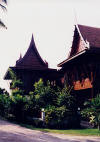
ngapyo (ငှက်ပျော)
Burmese generic term for ‘banana’,
covering several kinds. In
Myanmar,
hands of bananas with a
single
coconut,
decoratively arranged in a basket or onto a tray,
are a typical offering for the
nats,
known as
gado bwe (fig.). 回

ngat-chain (ငါးချဉ)
Burmese. ‘Pickled
fish’.
Name of a dish from
Myanmar,
which consists of
fish meet
that has been scraped off from the skin, traditionally by using the
side of a sea shell and mixed into a paste adding a lot of
monosodium glutamate. Alternatively, shrimp meet can be used. The
paste is molded into large lumps, that are wrapped in a cover of
fresh leaves to prevent it from drying out and from which buyers are
sold a portion, that is typically wrapped in a palm leaf. The paste
is subsequently made into a salad (fig.), mixed with oil, seasoning powder,
and some vegetables, including parsley. The taste of this pickled
fish dish is rather sour. Also transcribed ngarr hkyain and
pronunciation rather as nga-tcheng. Compare with the Thai snack
naem. 回
nga tih hak (งาที่หัก)
Thai.
‘Broken tusk’. Thai name for
tanta. 回
Ngazi Shin (ငါးစီးရှင်)
Burmese. One of 37
nats that
belong to the
official pantheon of spirits
worshipped in
Myanmar. He
is the nat representation of the
14th Century King Kyawswa I of
Pinya, the son
of King Thiha Thu of
Pinya, and reigned from 1344 to 1350 AD as the Lord of Five
White Elephants.
He died suddenly of illness.
Initially, there
was another Ngazi Shin nat from the
Pagan
Kingdom in the original
37 nats, who was eventually replaced by this one.
See also LIST OF BURMESE NATS.
回
ngeuak (เงือก)
Thai. ‘Mermaid’. Name for legendary creatures with a woman's head and torso, and a
fish's tail, that often occur in Southeast Asian
legends. In the
Ramayana,
Suphanamatcha, the daughter of
Totsakan,
is a mermaid. In the story
Phra Aphaimanih,
she appears as a certain mermaid referred to as
Nang Ngeuak. With regard
to the latter story, she is
depicted on the third stamp in
a series of eight Thai postage stamps issued in 2009 to publicize
the story of Phra Aphaimanih as
a major literary work
of the
Rattanakosin
Era
(fig.).
A famous mermaid
is the golden statue of
Nang
Ngeuak at Laem
Samilah (แหลมสมิหลา) in
Songkhla,
seated on a rock and reminiscent of the Little Mermaid of Langelinie
in Copenhagen. The
statue, referred to in English
as the Golden Mermaid (map
-
fig.),
represents the character Nang Ngeuak from the story
Phra Aphaimanih.
It is also related
that one starry
night when the mermaid was on the beach combing her hair with a
golden comb, she was frightened away by a young fisherman and during
her flight, she had dropped her comb. Smitten by her beauty and
wanting to return the golden comb to her, the fisherman came back to
the beach every night waiting for her return, but she never came
back. Sometimes transcribed
ngyak.
See also POSTAGE STAMPS
(1),
(2),
(3)
and
(4),
THEMATIC STREET LIGHT, as well
as
TRAVEL PICTURES (1) and
(2). 回

ngeuan rai plaay (เงื่อนไร้ปลาย)
Thai. ‘Knot without a tail’ or ‘knot without an end’. Thai
designation for a
Chinese knot,
which in Chinese is known as
pan chang. 回
Ngiaw (เงี้ยว)
Thai. Name of an
ethnic tribe in northern Thailand, also called
Shan. 回
ngiw (งิ้ว)
Thai term for Chinese Opera, as well as for
Peking Opera
(fig.). Performances are in Chinese and
are a mixture of drama, rant and melodious recitation. The faces of the actors
are -sometimes heavily- covered with make-up (fig.) and they dress in colourful
Chinese costumes (fig.), sometimes wearing conspicuous headdresses
(fig.). Whereas
in China, performances can be seen in many different places, in
Thailand only larger cities may have a permanent theatre, whilst more remote towns and villages
usually have
to wait for a touring troupe to pass by. See also
lian pu. 回
%20Chinese%20opera,%20China%201_small.jpg)
ngo (เงาะ)
1. Name for members of the
Sakai
and allied tribes,
an aboriginal race allied to the Negroid pygmies found in the
jungles of Malaya and southern Thailand, who call themselves
Mani (fig.). They are dark skinned and
have curly hair, hence their name, which in Thai means ‘hair’. In
the story of
Sangthong
(fig.),
Phra Song disguised himself as an ogre with a mask of this race, to
escape from the city Wasi, which was ruled by a female giant that
devoured humans. When arriving in Benares (fig.) in this disguise, he was
subsequently nicknamed
Chao Ngo (fig.). Since Phra Sang had earlier bathed in a
pond with liquid gold, that had the power to change anything
immersed in it into pure gold, figures of Ngo are nowadays believed
to attract gold or alternatively money, as the story also relates of
a pond with liquid
silver, in Thai called
ngun, and which
besides ‘silver’ also means ‘money’. Also called Ngo Pah (เงาะป่า)
or Ngo Pah Sakai (เงาะป่าซาไก), with the word pah meaning ‘wild’ or
‘savage’. Sometimes transliterated Ngor.
See POSTAGE STAMPS (1),
(2), and
(3),
as well as
TRAVEL PICTURES and
THEMATIC STREET LIGHT.
MORE ON THIS.
回
_small.jpg)
2. ‘Hair’
or ‘hairy’. Thai name for the
rambutan (fig.),
a fruit with a hairy red husk. 回
_small.jpg)
ngop (งอบ)
Thai.
Name of a Thai farmer's hat, lampshade-shaped and resembling an
upside-down basket of interwoven
bamboo slivers. Woven from bamboo and lined with palm
leaves, called
bai lahn. Inside
sits a ring to fit it on the head. Mainly worn
by Thai peasant women. Also transcribed ngob. See also
non la. 回
Ngo Pah (เงาะป่า)
Thai. ‘Wild
ngao’
or ‘Forest
ngao’.
Name of a classical story, written by King
Rama V
in 1916, reportedly over a period of just 8 days. It is said to
originate from an account of a ngao tribe in
Pattalung
Province, told by one of the tribesmen who had become King Rama V's
court attendant. It relates the love story of
Somphla (ซมพลา) and Lamhap (ลำหับ).
Though the latter was
engaged to Hanao (ฮเนา), Somphla fell in love with Lamhap. With the help
of his friend Mai Pai (ไม่ไผ่), who agreed to act as a go-between,
he is able to meet with Lamhap on the day of
her wedding, somewhere in the woods, where she was taken by Mai Pai
in order to safely meet with Somphla. However, they were tracked
down by Hanao and his
older brother, and a fight broke out between them, in which Somphla was killed by
Hanao's brother. As a
consequence
Lamhap commits suicide and grief-stricken also Hanao kills himself. In 1996, a
scene from the story is portrayed on one of the stamps in a set of
postage stamps on
famous
classical Thai literary works
written by former Thai kings (fig.). 回
ngop nahm chiao
(งอบน้ำเชี่ยว)
Thai. Name for a kind of
ngop,
from
Trat
province. These
bamboo hats, typically used
by farmers and fishermen, are named after the place where they are
made, i.e. the
tambon
Nahm Chiao, though the local population calls them muak
bai jahk (หมวกใบจาก), meaning ‘nipa palm
leaves hat’, after the material they are made of, i.e. dried nipa
palm leaves on a bamboo frame (fig.). The hats come in different shapes,
i.e.
wok-shaped,
turtle-shaped,
round or oval-shaped and pointed, and are typically covered with oil
or grease on the outside as a protecting layer against the sun and
rain.
Inside sits a
flexible ring, woven in such a manner that it can be stretched out
to fit it on the head, after which it turns back to its former
position, fixing the hat firmly on ones head, one size fits all
(fig.). The local community of Nahm Chiao presented one of their hats
to the Princess Mother, for which they in return received the royal
approval to name that particular type of hat
Somdet. See also
non la. 回
%20bamboo%20hat%20from%20Trat%20province%201_small.jpg)
ngu (งู)
Thai. Generic
term for
snakes. 回
ngu hao (งูเห่า)
Thai. ‘Barking
snake’. Name for the Monocled
Cobra,
also known as the Monocellate Cobra, Thai Cobra and
Indochinese Cobra, a species of
cobra with the scientific name Naja kaouthia.
It is one of the most dangerous venomous snakes and found in all
parts of the country. The Thai name refers
to its hissing when it feels threatened and is about to strike,
whereas the English term monocle refers to a distinct single,
variable shaped, monocle mark, just behind its hood. This mark is
usually pale and oval or circular, with a dark centre and
occasionally a narrow dark outer border. Sporadically it may have
two dark spots in the pale oval mark. This
venomous and potentially lethal snake will expand its hood and raise
the anterior third part of its body, hiss and strike when it feels
threatened (fig.). Unlike some other species of cobra, the fangs of this
species are not modified for
spitting venom. Its average length is about 200 centimeters.
In Thai, this species is sometimes referred to as ngu hao thammada (งูเห่าธรรมดา),
which means ‘common barking snake’, whereas other
species of cobras will start with the prefix ngu hao, followed by a
specifying term, e.g.
ngu hao
phon phit sayaam.
It is usually medium to dark brown or grey-brown, though there are
many other colour variations, some pale, others near-black. Many
species are uniform, others are slightly banded. The throat is white
with a pair of small
lateral spots. It also occurs in an albino and leucistic
variation, which are both known as
ngu hao
pheuak
in Thai. In
1981, it was depicted on the third stamp of a set of four Thai
postage stamps featuring venomous Thai snakes (fig.).
回
%20งูเห่า_small.jpg)
ngu hao
pheuak (งูเห่าเผือก)
1. Thai name for an albino version of the Monocled Cobra,
which is also known as the albino Monocellate cobra, a variation of
the
cobra with the scientific name Naja kaouthia. Its length is around
200 centimeters and
its body is white or pale yellowish-white with distinct red eyes.
Albinism is often mistaken for leucism and the Thai term
pheuak, which
is usually translated as ‘albino’, is also used for leucistic
varieties.
See also
ngu hao. 回
,%20Naja%20kaouthia%20Lesson,%20งูเห่าเผือก_small.jpg)
2. Thai name for a leucistic Monocled Cobra, a
mutated variety of a
cobra with the scientific name Naja kaouthia. It has pale scales,
caused by DNA mutation.
The reduced pigmentation makes
its body pale pinkish brown, but it has normally coloured eyes, not
red as with albinos. Albinism is often mistaken for leucism and the Thai term
pheuak, which
is usually translated as ‘albino’, is used for both varieties. Its average
length is about 200 centimeters. See also
ngu hao. 回
_small.jpg)
ngu hao phon phit sayaam
(งูเห่าพ่นพิษสยาม)
Thai. ‘Siamese venom-spitting barking
snake’. Designation for the
Indochinese
Spitting Cobra.
回
ngu hua ka-lohk (งูหัวกะโหลก)
Thai. ‘Cranium-headed
snake’. Name for the
Puff-faced Water Snake, used alongside
ngu leuam oh. 回
ngu jong ahng (งูจงอาง)
Thai name for the
King Cobra. 回
ngu
kaab mahk hahng nin (งูกาบหมากหางนิล)
Thai. ‘Betel
palm-spathe
nin-tailed
snake’. Name for the
Cave Dwelling Snake.
回
ngu kapa (งูกะปะ)
Thai name for the
Malayan
Pit Viper. 回
ngu khiaw bon
(งูเขียวบอน)
Thai. ‘Caladium-green
snake’. Name for the
Green Cat-eyed Snake,
alongside
ngu khiaw dong.
回
ngu khiaw dok mahk (งูเขียวดอกหมาก)
Thai. ‘Green
betel nut
flower
snake’. A
name for the
Golden Tree Snake,
alongside
ngu khiaw phra in. 回
ngu khiaw dong
(งูเขียวดง)
Thai. ‘Green jungle
snake’. Name for the
Green Cat-eyed Snake,
next to
ngu khiaw bon.
回
ngu
khiaw hahng mai sih makok (งูเขียวหางไหม้สีมะกอก)
Thai. ‘Green olive colour burnt-tail
snake’. Name for the
Big-eyed Pit
Viper,
next to
ngu khiaw
hahng mai ta toh.
回
ngu khiaw
hahng mai ta toh (งูเขียวหางไหม้ตาโต)
Thai. ‘Green burned-tail big-eyes
snake’. Name for the
Big-eyed Pit
Viper,
next to
ngu khiaw
hahng mai sih makok.
回
ngu khiaw
hahng mai thong khiaw (งูเขียวหางไหม้ท้องเขียว)
Thai. ‘Green burned-tail green-bellied
snake’. Name for the
Pope's Pit Viper.
回
ngu khiaw
hahng mai thong leuang (งูเขียวหางไหม้ท้องเหลือง)
Thai. ‘Green burned-tail yellow-bellied
snake’. Name for the
White-lipped Pit Viper.
回
ngu khiaw pahk naeb
(งูเขียวปากแหนบ)
Thai. ‘Green clamping-mouth
snake’. Name for the
Long-nosed Whip Snake.
回
ngu khiaw phra in (งูเขียวพระอินทร์)
Thai. ‘Indra's
green
snake’. A name for the
Golden Tree Snake,
alongside
ngu khiaw dok mahk. 回
ngu kin haang (งูกินหาง)
Thai. ‘Snake
eats tail’ or ‘tail-eating
snake’. Name of a
traditional Thai children's game, in which players are divided into groups, i.e.
a father snake and a mother snake with her baby snakes. The aim of the game is
for the father snake to try to outwit the mother snake and catch one of the baby
snakes that she is trying to protect. The game is traditionally played during
Songkraan
and is depicted on a Thai postage stamp issued in 1999 to
publicize the
Bangkok 2000 World Youth Stamp Exhibition Stamp and the 13th Asian
International Stamp Exhibition (fig.).
回
ngu laam (งูหลาม)
Thai for
Burmese
Rock Python, next to
ngu leuam. 回
ngu laam pahk
pet (งูหลามปากเป็ด)
Thai. ‘Duck-mouth python’. Name for the
Blood Python.
回
ngu leuam (งูเหลือม)
Thai name for
Burmese
Rock Python, besides
ngu laam. 回
ngu leuam oh (งูเหลือมอ้อ)
Thai name for
Puff-faced
Water Snake, alongside
ngu hua ka-lohk. 回
ngu maew sao (งูแมวเซา)
Thai. Literally ‘cat-abating
snake’, the Thai designation for the ‘Siamese
Russell's Viper’ (fig.),
though some dictionaries translate the term maew sao as ‘king cobra’,
a title normally reserved for the snake species Ophiophagus hannah, which is
usually named
ngu jong ahng
in Thai. Perhaps, this confusion comes from the very loud hissing sound that the
Siamese Russell's Viper will make when threatened, which is reminiscent to that
of the
cobra,
generically named
ngu hao in Thai,
meaning ‘barking snake’. 回
ngun chieng (เงินเจียง)
Thai name for
a former type of Thai money, which
was used
only in northern
Thailand, and –due to its shape– it is in English known as
bracelet money
(fig.).
See also
Coin Museum. 回
ngun (เงิน)
Thai for ‘silver’, as well as
for ‘money’. In
Thailand,
silver has been an important metal for centuries, particularly in the creation
of jewelry and decorative items. Traditional Thai art includes the production of
embossed silverwork (fig.),
known as
kaan salak dun
(fig.),
which employs repoussé and chasing techniques. The Hill Tribes of Northern
Thailand, including the
Lisu (fig.),
Hmong (fig.),
and
Akha (fig.),
as well as those of Southern China, such as the
Dong (fig.)
and
Zhuang
(fig.),
are well-known for their intricate silverwork. These communities use traditional
methods to craft beautiful silver pieces, involving techniques such as repoussé,
engraving, and
filigree. In
China, silver has played a
significant role, particularly during the Ming and Qing dynasties when it became
a crucial part of the economy. The Ming Dynasty (1368 to 1644) saw the
establishment of a silver-based economy with taxes collected in silver, making
it the primary medium of exchange. During the Qing Dynasty (1644 to 1912), the
demand for silver increased as the Chinese imperial court engaged in extensive
trade. Silver was traded for Chinese exports, including
silk,
porcelain,
and
tea.
A significant amount of silver was imported into China from the Americas,
particularly from the mines in the Bolivian Tin Belt, Cerro Rico de Potosi, the
world's largest silver deposit which has been mined since the sixteenth century,
and from Mexico, where vast quantities of silver were extracted by Spanish
colonists. This silver was transported to Manila in the Philippines, then a
Spanish colony named after King Philip II of Spain, by Spanish galleons. From
there, it made its way to China. The influx of silver had a profound impact on
the Chinese economy, leading to increased monetization and economic growth, but
also contributing to inflation and other economic challenges, especially when
supply could not keep up with demand due to issues such as shipwrecks. Chinese
emperors prized silver for its beauty, durability, and economic value. It was
collected as tribute from vassal states and as taxes from citizens, helping to
finance the imperial court and military campaigns. Silver was also crafted into
elaborate items for the imperial court, including vessels, jewelry, and
decorative objects. Also transliterated ngeun. See also
Wat Sri Suphan
(fig.)
and China
Silver
Panda
Coin (fig.). 回
%201_small.jpg)
ngun dok jan
(เงินดอกจันทน์)
Name for an ancient coin, formerly used in the
Srivijaya period. A large number of
coins have been found in
Chaiya.
Its name derives from the fact that one side of the coin had the imprint of a
sandalwood flower. Also transcribed ngeun dok chan. See also
dok maijan
and
Coin Museum.
回
ngu
nguong chang (งูงวงช้าง)
Thai for ‘Elephant-trunk Snake’. See also
ngu and
chang. 回
ngun hoi (เงินฮ้อย)
Thai. Name for a type of ancient
Thai money
used by peoples
that inhabited the
Mekhong region,
i.e. northern Thailand and
Isaan,
and reportedly bears some influences from
Vietnam and
China.
It is similar to
ngun lahd
or
ngun reua,
but is
longer and narrower at the centre, and has a rim made of double dots
that surround the edges, and sometimes an official mark, which is
usually stamped in the centre, whereas the surface of ngun lahd
money is smooth, apart from the marks stamped on them, which
generally number three. See also
Coin Museum. 回
_small.jpg)
ngun keuak mah (เงินเกือกม้า)
Thai. ‘Horseshoe money’ or
‘silver horseshoe’. Name for kind of money that was used only in
northern Thailand, sometime in the
Lan Na
Period, and
is a kind of double
bracelet money
(fig.),
made in the shape of two
horseshoes joined together.
See also
Coin Museum. 回
ngun lahd (เงินลาด,
เงิดหลาด)
Thai. ‘Tilted money’. One of many names for
ngun reua,
other names being ngun lahd hoi (เงินลาดฮ้อย),
ngun ping (เงินปิง), ngun lahng (เงินลาง), ngun hahng (เงินฮาง), ngun nahm
(เงินหนาม), ngun siyan
(เงินเสี้ยน), ngun dahn (เงินด่าน
-
fig.), ngun nahm hok nahm sahm
(เงินน้ำหกหน้าสาม -
fig.),
and
in English usually referred to as lad money or boat money. It is
similar to
ngun hoi (fig.),
but broader at the centre, and it is smoother, apart from the
imprint of the money's official stamp, which usually consists of
three of the same marks stamped next to each other, one in the
centre, one in the left corner and one in the right corner. The
corners are slightly tilted, making it look somewhat like a small
paddle boat seen from above, hence the names ‘tilted
money’
and ‘boat
money’.
It was used by peoples that lived near the
Mekhong
area, i.e. northern
Thailand and
Isaan,
and reportedly bears some influences from
Vietnam
and
China.
Compare with
ngun hoi.
See also
Coin Museum.
回
_small.jpg)
ngun pahk phi (เงินปากผี)
Thai. ‘Spirit-mouth-money’. Name for money that is put in the mouth
of a dead person. Traditionally, before a corpse is cremated in a
Meru, a close
member of family of the deceased will put a coin in the mouth
of the dead person and sometimes leaves a banknote in the coffin, as
well. The meaning of this is symbolically. After the body has been
cremated, nothing is left, except for the coin. This shows that
when we die we can not take anything with us, at all. The banknote
that was put in the coffin however is a payment for the journey to
the afterlife. The idea is similar and perhaps goes back to Greek
mythology, where the deceased kept an obolos (ὀβολός), i.e. an
ancient Greek
silver coin, in their mouth to pay Charon, the ferryman who brought the souls of the dead to Hades, the
Underworld and Abode of the Dead.
To reach Hades one had to cross the Acheron, a branch of the river
Styx and known as the River of Woe. For the passage Charon charged a
small coin which was placed under the tongue of the deceased by
pious relatives, because without payment ones soul was left waiting
on the banks for eternity. In ancient
China,
high officials and members of certain dynasties were traditionally
buried with a coin-shaped
jade tablet in their mouth, as
jade
is associated with immortality and is believed to have
the power to purify. A similar
ritual is still practiced today, but now among commoners in
present-day China, who place jade, pearls, jewelry and coins in the
mouth and around the body of a deceased relative before the funeral
takes place.
Also transcribed ngern
paak phee
or ngeun
pahk phih.
See also
gong de. 回
ngun reua (เงินเรือ)
Thai. ‘Boat money’. Nickname for a kind of former
Siamese money, so called due to its long and narrow shape, which is reminiscent
of that of a boat. It was made from either brass or bronze and came in a variety
of sizes. Officially, this type of money is called
ngun lahd, though it is
also known by many other names and nicknames, such as
ngun hoi (เงินฮ้อย), ngun lahd hoi (เงินลาดฮ้อย),
ngun ping (เงินปิง), ngun lahng (เงินลาง), ngun hahng (เงินฮาง), ngun nahm
(เงินหนาม), ngun siyan
(เงินเสี้ยน), ngun dahn (เงินด่าน
-
fig.), ngun nahm hok nahm sahm
(เงินน้ำหกหน้าสาม -
fig.), and is in English
is usually referred
to as lad money. Also transcribed ngern
reua and ngeun reua. Compare with
ngun hoi.
See also
Coin Museum. 回
,%20ngun%20lahng%20(เงินลาง)_small.jpg)
ngu pahk
kraba (งูปากกระบะ)
Thai. ‘Tray-mouth
snake’. Generic name for
pit vipers. 回
ngu phang kah (งูพังกา)
Thai. ‘Mangrove
(sp. Rizophora)
snake’. Name for the
Mangrove Pit Viper.
回
ngu plong thong
(งูปล้องทอง)
Thai. ‘Golden [bamboo stem] segment
snake’. Name for the
Mangrove Catsnake.
回
ngu saai rung
(งูสายรุ้ง)
Thai. ‘Rainbow
snake’. Designation for the
Rainbow Water Snake.
回
ngu saam liam (งูสามเหลี่ยม)
Thai. ‘Triangular
snake’. Name for the
Banded Krait.
回
ngu sae haang
mah (งูแส้หางม้า)
Thai. ‘Horsetail whip
snake’. Name for the
Dog-toothed Cat Snake.
回
ngu sing
haang laai (งูสิงหางลาย)
Thai. ‘Stripe-tailed haunting
snake’. Name for the
Oriental Rat Snake.
回
ngu thahng maprao
laai khihd (งูทางมะพร้าวลายขีด)
Thai. ‘Stripe-marked
coconut palm leaf
snake’. Name for the
Copperhead Racer.
回
ngyak
See
ngeuak. 回
Nian (年)
Chinese. ‘Year’. Name of a Chinese mythical monster which for a long
time terrorized the people of a certain Chinese village. Once a
year, at the beginning of spring, it would come to the village to
demand a human sacrifice of a young child for it to eat. Eventually
the people of the village decided that they would no longer submit
to its dreadful rule and frightened it away with the loud noises of
firecrackers. The use of
firecrackers during Chinese Lunar New Year (Guo Nian)
today still commemorates
this defeat of evil. 回
nibbhana
Pali
for
nirvana. 回
niche
The recessed part of a wall that generally contains a
sculpture and is flanked by two pilasters. Also
bay. 回
Nicobar Pigeon
Name for a colourful, ground-loving pigeon, that occurs on the
Andaman and Nicobar Islands, from where it got its name. It is also
found on many other islands, most abundantly on the smallest, least
disturbed ones. Though it has become rather rare in the wild, it is
widely spread across South and Southeast Asia, including on islands
off Southwest peninsular Thailand and around peninsular Malaysia,
islands off southern Cambodia and
Vietnam, as well as on islands
around Sumatra, India, Myanmar, Indonesia and the Philippines, for
one. Adults have a ruff of glossy, light to dark grey hackles and a
mantle of metallic green plumage, which mixes with bronze at the
scapulars. They have a short white tail and dull red legs, and its
beak is grey with a dark knob at the top, which is slightly larger
with males than with females. In Thai, Nicobar Pigeon are
called
nok cha pih nai. 回
_small.jpg)
niello
A black composition consisting of an alloy of lead, copper
and
silver fused with precious metals such as gold and silver by heating. The
technique used includes incising and polishing. This art form was
introduced to Thailand around 700 years ago via
Nakhon Sri Thammarat.
See also
nielloware. 回
nielloware
Decorative objects made from
niello,
a black composition consisting of an alloy of lead, copper
and
silver fused with precious metals such as gold and silver by heating. The
technique used includes incising and polishing. This art form was
introduced to Thailand around 700 years ago via
Nakhon Sri Thammarat.
Due to the materials used there are typically two types of nielloware,
i.e. a black surface with silver designs and black surface
with gold designs. In Thailand
called
kreuang tom. 回
Nih Banpacha
(หนีบรรพชา)
Thai. Escape or depart to enter into priesthood or clergy.
Thai term used to indicate the
Great
Departure of the
Buddha.
See also
Banpacha and
Buat. 回
nikaya (निकाय)
1.
Sanskrit-Pali. ‘Collection’. Term used in
Theravada
Buddhism to refer to the discourses described
in the
Sutra,
i.e. the second of the three parts or
‘baskets’
of the
Tripitaka, and which contains a
total of five discourses, i.e. the deegha nikaya or ‘long’
discourses; the majjhima nikaya or ‘middle-length’ discourses; the
samyutta nikaya or ‘thematically linked’ discourses; the anguttara
nikaya or ‘gradual collection’ discourses; and the khuddaka
nikaya or ‘minor’ discourses. 回
2.
Sanskrit-Pali. ‘Collection’. Term used to
refer to
a monastic sect, division or lineage, as in
Mahanikaya. 回
Nilanon (นิลนนท์)
Thai. Name of a character from the
Ramakien, a monkey soldier of
Rama, who captured
Phiphek and brought him before
Rama. He was also present when
Phra Lak was struck by the
spear of
Kumphakan and became unconscious, and he
was sent to inform
Phra Ram of the incident. He is depicted with a
dark red body, dressed as a war lord and holding a sword as his
weapon, and he wears a
golden
kabang-style
crown.
Khon masks
of this character are usually rather orangey
in colour (fig.).
In some stories, he is described as
the son of
Phra Phleung, though in other
accounts he is portrayed as an
incarnation thereof. See also
LIST OF RAMAKIEN CHARACTERS & NAMES.
回
_small.jpg)
Nilapanan (นิลปานัน)
Thai-Pali. Name of a
monkey-warrior
from the city
Meuang Chomphoo (เมืองชมพู),
who appears in the
Ramakien.
He is an ally
of
Phra Ram
(fig.)
and is depicted with
a fresh brown fur
and
wearing a
golden
kabang-style
crown.
He is one of the
eighteen
Wahnon Sip-paet Mongkut, and an
avatar
of
Rahu
(fig.).
Also transcribed Nilapahnan.
See also
LIST OF RAMAKIEN CHARACTERS & NAMES.
回
_small.jpg)
Nilaphat (นิลพัท)
Name of a monkey in the
Ramakien, who in the
Ramayana is known as Nila (तिल)
and nicknamed Anila (अतिल),
whom together with
Ongkhot beheaded the
yak
Vayupak,
after the latter had captured
Phra Ram and
Phra Lak.
He has the exact same features of
Hanuman
(fig.), apart
from the fact that his fur is black (fig.).
In murals, he may be depicted with multiple arms (fig.). He is the adopted son of
Maha Chomphoo
(fig.)
and
Kaew
Udon,
who was given to them by Phra
Idsuan
because
they didn't have any offspring
of their own. In Thai also pronounced Ninlaphat.
See also
LIST OF RAMAKIEN CHARACTERS & NAMES,
and
TRAVEL PICTURES. 回
_small.jpg)
Nilaraat (นิลราช)
Thai-Pali. Name of a
monkey-warrior
from the city
Meuang Chomphoo (เมืองชมพู),
who appears in the
Ramakien.
He is an ally
of
Phra Ram
(fig.)
and is depicted with
an indigo fur
and
wearing a
golden
kabang-style
crown.
Besides being an
important figure in the battle against
Longka,
he also volunteered for the task of throwing large boulders into the sea
by himself,
in order to build a road, and by doing the task alone broke a spell
cast by the hermit
Khawin. He is one of the
eighteen
Wahnon Sip-paet Mongkut, and an
avatar
of
Phra Samut,
the god of the oceans. Also transcribed Nilaraj and Nilarach.
See also
LIST OF RAMAKIEN CHARACTERS & NAMES.
回
_small.jpg)
Nilek (นิลเอก)
Thai-Pali. Name of a
monkey-warrior
from the city
Meuang Chomphoo (เมืองชมพู),
who appears in the
Ramakien.
He is an ally
of
Phra Ram
(fig.)
and is depicted with
a brown fur
and
wearing a
golden
kabang-style
crown.
He joined
Phra Lak
(fig.)
when he went to disturb
Indrachit's
(fig.)
Kumphaniyah
Ceremony.
He is one of the
eighteen
Wahnon Sip-paet Mongkut, and an
avatar
of
the Thai deity
Phra Phinai,
the Thai deity of the elephants, who is also known as
Ganesha.
See also
LIST OF RAMAKIEN CHARACTERS & NAMES.
回
_small.jpg)
Nilgai
(नीलगाय)
Hindi. ‘Blue cow’. Common name for a species of antelope, with the
scientific designation Boselaphus tragocamelus in the family Bovidae,
and of which the males are somewhat similar in appearance to the
Mainland
Serow (fig.),
a cloven-hoofed mammal that also belongs to the family Bovidae and
which is distributed from India through southern
China
and Southeast Asia. Like the Mainland Serow, male Nilgai have an
erectile mane on the back of the neck, but unlike the former they
have a goat-like beard on the midsection of the throat. Both sexes
(fig.) also have a white throat bib and white spots on the cheeks, as well
as a narrow white stripe along the underside of the body and white
colouring on the lower legs and near the lips. The Nilgai is the
biggest Asian antelope and one of the most commonly seen wild
animals in central and northern India, as well as in eastern
Pakistan, where they live mostly in herds (fig.)
on the plains and low hills. Whereas female Nilgai
have a short
yellow-brown coat
(fig.), males or bulls have a dark coat with a
grey-bluish tinge that darkens as they reach maturity, as well as
horns, which are absent in females (fig.).
Its name refers to the bluish tinge of the bull's coat, and since
this is reminiscent of the sacred cow, it has saved the Nilgai from
being hunted, although they are deemed a crop menace. Sometimes also
called Nilgau.
See also WILDLIFE PICTURES. 回
%20Panna%20NP_small.jpg)
nimit (นิมิต)
1. Thai.
‘Create’. See also
look nimit. 回
2. Thai.
‘Sign’ or ‘omen’. A vision or sign for the future.
See also
look nimit. 回
nimon (นิมนต์)
Thai-Rajasap.
‘Invite’ or ‘ask’, especially with respect to monks to be present
at or take part in a religious rite. 回
nin (นิล)
Thai.
Name of a dark blue to black gemstone. See also
nintakoh. 回
nine
As
in many Asian cultures, the number nine is in Thailand considered to
be a lucky number. According to numerologists, the number is in
general associated with forgiveness, compassion and success on the
positive side, as well as self-righteousness and arrogance on the
negative. As the final numeral, i.e. the largest possible single
digit, the number nine holds special rank
and mathematically it has some unique properties, e.g. the sum of
the two-digits resulting from nine multiplied by any other
single-digit number will always equal nine (e.g. 9x7=63; 6+3=9), and
the sums of nine multiplied by any two, three or four-digit number
will also break down to nine (e.g. 9x73=657; 6+5+7=18; 1+8=9). In
Thailand however, the obsession with the number nine is rather
divine and is associated with long life, a belief strongly
encouraged by the fact that King
Rama IX was the longest reigning
Thai monarch up-to-date (see also
list of Thai kings). The
association however, goes back to ancient Chinese beliefs, where the
character for ‘nine’ (九) resembles that of ‘power’, ‘force’ and
‘strength’, i.e. li (力), and its pronunciation (jiu) is a homophone
for the word ‘long-lasting’ (久). Even in Thai, the number ‘nine’,
i.e.
kao
(gao) with a falling tone (เก้า), is similar to the word
kao (gao)
with a low tone (เก่า), meaning ‘old’ and ‘of long standing’.
In addition, there are nine planets, in Sanskrit known as
navagraha, nine
Durgas,
Nine Dragons, i.e. the nine sons of the first
Chinese dragons,
etc. At
some point, car license plates with multiple-digits of the number
nine, were specially made by the Department of Transportation to
raise taxes and were sold by auction, with many of the bids going
well over a million
baht. On 9
September 2009 (09/09/09), many Thai people made
tamboon
in Buddhist temples or at a statue (or picture) of King Rama IX, or
bought a
lottery ticket with the number nine on it.
Its Thai numeral is ๙. See also
nopparat
and
navagraha.
回
Nine Armies War
Name of the Burmese-Siamese
War which was fought between 1785 and 1786 AD, between the Konbaung
Dynasty of
Burma
and the Chakri Dynasty of resurgent
Siam.
It is so-called because the Burmese came in nine armies. In early
1785, the Burmese King
Bodawpaya
(fig.)
sent an expedition force to take
Phuket
to prevent foreign arms shipments to Siam but the invasion force was
driven back. In October 1785, Bodawpaya pursued an ambitious
campaign to expand his dominions into the lands of the former
Ayutthaya
Kingdom. He launched a four-pronged invasion towards
Chiang Mai,
Tak,
Kanchanaburi,
and Phuket. The combined strength was about 50,000 men. The invasion
forces faced heavy resistance from the Siamese forces and finally
the war became a total disaster for Burma. The failed invasion
ultimately turned out to be the last full-scale invasion of Siam by
Burma.
回
Nine Dragons
The total
number of
dragons, i.e. the
nine sons of the first
Chinese dragons.
With nine being a
unique number,
with the Chinese character for ‘nine’ (九) resembling that of
‘power’, ‘force’ and ‘strength’, i.e. li (力), whilst its
pronunciation (jiu) is a homophone for the word ‘long-lasting’ (久),
and with the auspicious dragon itself being a symbol of power and
strength, the Nine Dragons combined represent the pinnacle of
everlasting power and strength. Hence, the Nine Dragons are often
revered together, as in the Nine Dragons Wall (fig.)
or Nine Dragons
Screen (fig.), a type of screen wall, with reliefs of the nine Chinese
dragons, usually depicted in various colours. In the compound surrounding the Temple
of Heaven in Beijing (fig.)
there is even a coniferous tree with a trunk of intertwined stems,
that is said to resemble Nine Dragons and which is hence venerated
as such (map
-
fig.).
In addition,
the Nine Dragon River is the name of the
Mekhong
River
Delta in South
Vietnam (fig.).
See also TRAVEL PICTURES.
回

Nine Emperor Gods
Name
in
Taoism
for
the nine sons manifested by Dou Fu Tian Zun, the Heavenly Emperor
Father of All Stars, and Dou Mu Yuan Zun, the Mother of the Big
Dipper, who holds the Registrar of Life and Death. When the Heavenly
Emperor Father of All Stars,
the Initial Gust of Positive
Yang
Energy, collated with
the Mother of the Big Dipper,
the Initial Gust of Negative
Yin
Energy, it resulted in the Big-Bang.
The nine sons are described as
high-ranking Star Lords who preside over the movement of planets and
coordinate mortal Life and Death issues.
They
are celebrated in the
Nine Emperor Gods Festival,
in Thailand referred to as
thetsakahn kin jae,
i.e. the
Vegetarian Festival.
Their names are: Tan Lang Tai Xing Jun (貪狼太星君); Ju Men Yuan Xing Jun
(巨門元星君); Lu Cun Zhen Xing Jun (祿存貞星君); Wen Qu Niu Xing Jun (文曲紐星君);
Lian Zhen Gang Xing Jun (玉廉貞綱星君); Wu Qu Ji Xing Jun (武曲紀星君); Po Jun
Guan Xing Jun (破軍關星君); Zuo Fu Da Dao Xing Jun (左輔大道星君); and You Bi
Da Dao Xing Jun (右弼大道星君).
回
nintakoh (นิลตะโก)
Thai name for the black spinel, a black precious stone (fig.), used as a
gemstone in jewellery. It has a hardness of
8.0 which can only be surpassed by black diamond or sapphire, far
more expensive stones and not easily obtainable in a range of sizes.
Spinel comes in a variety of colours but the relatively rare opaque
black type is only found in a few areas, including Thailand (fig.). It is often found in ruby and sapphire
bearing areas and has been mined in Thailand for centuries,
especially in the
amphur Bo Phloy in the province of
Kanchanaburi,
but also in the amphur Wang Chin in
Phrae
province and the amphur
Sri Satchanalai in
Sukhothai province. Due to it excellent hardness, high reflectance and
lack of cleavage, black spinel is ideal for everyday wear in
jewellery (fig.). It also called pleonast and ceylonite, and by the local
population it also called
nin ton. Black spinel is
sometimes sold under the misleading name black onyx, but that has a
hardness of only 6.5 to 7.0 and is therefore more susceptible to
damage, and thus inferior for use in jewellery. 回
_small.jpg)
nipa palm
Name
of a species of palm that thrives in the soft mud of coastal wetlands
near
brackish and salt water areas of estuaries,
but away from wave action. It can grow well over three meters and its
leaves (fig.) are used for thatching
(fig.), whilst young leaves are used to roll
cigarettes called burih
bai jahk
and as a wrapper for sweetmeats called
khanom jahk
(fig.).
When harvesting,
by cutting the stalks off at the base of plant, always minimal three
stalks should be left intact, in order to prevent the plant from
dying and thus to secure a future harvest.
Besides the use of the
stalks and leaves, the plant's inflorescence can be tapped before it blooms to
yield a sweet sap, which is used as an ingredient to make alcohol,
usually called nipa sap vinegar or palm vinegar. Its fruit consists
of a cluster of woody nuts, compressed into a large ball (fig.), that grows
upward on a single stalk (fig.). When ripe, the nuts detach from the
cluster and float away on the tide, occasionally germinating while
still waterborne. This fruit cluster is sometimes referred to as
water coconut and can be made into a refreshing drink, usually consisting of
both the sap and the translucent flesh of this fruit (fig.).
The nipa palm has a very high sap yield, rich in sugar. Fermented
into ethanol, the sap may allow for the production of 15,000 to
20,000 liters of fuel per hectare, three times as much as sugarcane,
and almost ten times the yield produced from corn. In
Myanmar, the stems, which are buoyant, are
used to train swimming. In Thai, it is called
jahk
or ton jahk and sometimes atta. Due to its dwelling in an environment
similar to that of
mangrove it is also known as
mangrove palm (fig.). 回
Nipplefruit
See
makheua cartoon. 回
nipphaan (นิพพาน)
Thai name for
nirvana. 回
niqab (نِقاب)
Arabic term which means ‘veil’ or ‘mask’, and refers to a piece of
cloth that covers the face of some Muslim women, typically as a part
of the
hijab.
In addition, they may also wear gloves, thus completely covering the
body, though this type of full-length Islamic veil should not be
confused with the burqa, a term used to describe a full-length piece
of clothing that covers the whole body from the top of the head to
the ground, with a netted opening concealing the face. A somewhat shorter
version of the burqa is the chadri, which covers only the head and
upper body up to the legs, and is worn over a hijab-like
outer garment.
回
niraht (นิราศ)
Thai.
‘To travel to a distant land, separated from a loved
one’. A style of travel tale, usually written in the form of a letter in verse
to a beloved one. 回
niraya
Pali term for ‘hell’. In Sanskrit,
the hell is called
naraka, from which the Thai
word
narok derives. 回
nirvana
(निर्वाण)
Sanskrit. Annihilation or liberation of all suffering,
desire, delusion and future rebirths. The Buddhist state of
Enlightenment reached while still on earth. The
Buddha attained nirvana
seated under a
bodhi tree.
In Thai
nipphaan,
a term derived from the
Pali
word nibbhana. 回
niwet (นิเวศน์)
Thai for ‘palace’
and ‘residence’. 回
Nisumbha (निशुम्भ)
Sanskrit. Name of an
asura,
who first appears in the 5th chapter of the
Devi Mahatmyam, together with his
brother
Sumbha. The
duo sought to conquer the
triloka
by subjecting
themselves to severe penance and purification rituals, in order that
no man nor demon could destroy them. They traveled to Pushkar (fig.),
where they remained in prayer for ten thousand years, and when the
god
Brahma
saw their penitence, he was
pleased and granted them their request. When
Chanda
and
Munda, two lesser
asuras in the
brothers' service,
had encountered the goddess
Devi, they were
overwhelmed by her beauty and reported this back to Sumbha and
Nisumbha. Hence, they were sent out to abduct her, yet were
destroyed by Devi. Consequently, the brothers confronted the goddess
Devi themselves, but
despite their boon, both were slain by her, as the boon had no
protection against gods nor goddesses. Sumbha and Nisumbha are
sometimes explained to be symbols of arrogance and pride, which is
ultimately overcome by the Devi's humility and wisdom. Also
transliterated Nishumbha and Nizumbha.
回
Niu Tou (牛头)
Chinese. ‘Ox-Head’
or ‘Bull-Head’.
Name of a guardian of the Underworld in Chinese mythology.
READ ON.
回
niw (นิ้ว)
Thai for ‘finger’,
and a term also used as a linear measurement equal to 4
krabiad,
or 2.083 centimeter.
回
Noble Truth
Term used in the teachings of the
Buddha.
There are
Four Noble
Truths in
total, of which the last one enfolds into the
Eightfold Path. 回
nohra (โนรา)
See
Manohra. Also
nora. 回
Noi Acharayangkun (น้อย
อาจารยางกูร)
Thai. Name of a Thai
writer and scholar, who is best known for writing the first modern
textbooks on the Thai language and who is known by the noble title
Phraya Srisundaravohara (พระยาศรีสุนทรโวหาร). He was born in
Chachengsao in 1822 and entered
monkhood at the age of thirteen, at
Wat Saket (fig.)
in
Bangkok,
where he studied language and scripture. After full ordination at
twenty, he remained in the monastery for eleven years, after which
he left to pursue a career in King
Mongkhut's (fig.)
royal court, eventually becoming head of the royal press. Under King
Chulalongkorn (fig.),
he held various prestigious titles, including head of the Royal
Scribes Department, court poet, and head of the palace school, where
he taught the royal children, including Crown Prince
Wajirunhit
(fig.)
and the future King
Wachirawut
(fig.).
Noi authored textbooks and was known for his expertise in the Thai
language. He served on the Privy Council, a body of advisors to the
monarch, typically composed of individuals who are appointed for
life or until retirement, until his death in 1891.
See also POSTAGE STAMP. 回
noi nah (น้อยหน่า)
Thai name for custard apple or sugar apple, a sweet and succulent fruit with the
scientific Latin name Annona squamosa and belonging to the genus Annonaceae, the same family as the
sour sack (fig.),
kradang nga ngaw and
kradang nga songkhla. They are
round with a thick rind grow and from a small tree or shrub which has narrow but
long pointed leaves
(fig.).
Inside they have white flesh of fruit and many large black seeds (fig.).
See also POSTAGE STAMP. 回
nok (นก)
Thai for ‘bird’. In Thailand, at least 988 different species of
birds have been listed, some which occur year-round, others that
are only seasonal. In
Bangkok alone there are an estimated 200
different species of bird. The largest bird in the country is the
Green Peafowl,
whereas the allegedly smallest birds in Thailand include the
Golden-bellied Flyeater (Gerygone sulphurea)
and some species of flowerpecker, all with a size of around 8.5 to 9
centimeters. Worldwide there are no less than 9,680 different bird
species, of which the largest one is the ostrich and the smallest
one the hummingbird, weighing less than 2 grams.
Besides real birds, Thai mythology also features many fabulous
birds, including several creatures that are half bird-half man or something else, e.g.
Garuda,
Kinnon,
Tantima,
nok hadsadi,
Samphati,
Sadayu, etc. 回
nok ahy ngaw (นกอ้ายงั่ว)
Thai name for the
Oriental Darter. 回
nok
bangrok yai (นกบั้งรอกใหญ่)
Thai. ‘Large sheaved-streaked bird’. Name for the
Green-billed Malkoha. 回
nok chai len khiao (นกชายเลนเขียว)
Thai. ‘Green wetland bird’. Name for the
Green Sandpiper. 回
nok cha pih nai (นกชาปีไหน)
Thai name for
the
Nicobar Pigeon. 回
nok deun dong kho daeng (นกเดินดงคอแดง)
Thai. ‘Red-necked jungle-walking bird’. Name for the
Red-throated Thrush, i.e. one
of the two races or subpecies of the
Dark-throated Thrush. 回
nok deun dong kho dam (นกเดินดงคอดำ)
Thai. ‘Black-necked jungle-walking bird’. Name for the
Black-throated Thrush, i.e. a
subspecies of –and hence sometimes also referred to as– the
Dark-throated Thrush, which in Thai
is
nok deun dong kho khem. 回
nok deun dong kho khem (นกเดินดงคอเข้ม)
Thai. ‘Dark-necked jungle-walking bird’. Name for the
Dark-throated Thrush, a rare spcies
of thrush, of which there exist two races, i.e. the
Black-throated Thrush, known in
Thai as
nok deun dong kho dam, and the
Red-throated Thrush, which in
Thai is referred to as
nok deun dong kho daeng. 回
nok hadsadie (นกหัสดี)
Thai.
‘Elephant bird’. Mythological bird with the head of an
elephant and a tail sometimes in the form of a
kranok (fig.).
Occurs occasionally in the form of a
chofa, usually the representation of
a highly stylized bird (fig.).
There is also a variant which
has a
Hintha bird (fig.)
depicted with an elephant's head, and which could be referred to as
Hintha-Hadsadi (fig.). Also
nok hadsadin. 回

nok hadsadin (นกหัสดิน)
See
nok hadsadie. 回
nok hang (นกฮัง)
Thai name for
the
hornbill
and short for nok krahang (นกกระฮัง). Also
nok ngeuak. 回
nok hok lek pahk daeng (นกหกเล็กปากแดง)
Thai. ‘Small red-billed parrot’. Name for the
Indian Hanging Parrot. 回
nok
hua khwaan khiao pah phai (นกหัวขวานเขียวป่าไผ่)
Thai. ‘Green ax-headed
bamboo forest bird’.
Name for the
Laced Woodpecker. 回
nok hua khwaan khiao tapohk daeng (นกหัวขวานเขียวตะโพกแดง)
Thai name for the
Black-headed Woodpecker. 回
nok hua khwaan sahm niw lang thong
(นกหัวขวานสามนิ้วหลังทอง)
Thai. ‘Three-inched ax-headed
golden-backed bird’. Name for the
Common Flameback. 回
nok hua khwaan sih niw lang thong
(นกหัวขวานสี่นิ้วหลังทอง)
Thai.
‘Four-inched ax-headed
golden-backed bird’.
Name for the
Greater Flameback. 回
nok hua khwaan yai ngon leuang (นกหัวขวานใหญ่หงอนเหลือง)
Thai. ‘Large yellow-naped ax-headed bird’.
Name for the
Greater Yellownape. 回
nok hua khwaan yai sih thao (นกหัวขวานใหญ่สีเทา)
Thai. ‘Large grey-coloured ax-headed bird’.
Name for the
Great Slaty Woodpecker. 回
nok hua toh lek kha leuang
(นกหัวโตเล็กขาเหลือง)
Thai.
‘Small, big-headed,
yellow-legged bird’.
Name for the
Little Ringed Plover. 回
nok ih-kohng
(นกอีโก้ง)
Thai name for the
Purple Swamphen. 回
nok ih-lam (นกอีล้ำ)
Thai name for the
Common Moorhen. 回
nok ih-phraed
(นกอีแพรด)
Thai. Name
for the
Pied Fantail, often
specified as
nok ih-phraed thaeb ok dam.
回
nok ih-phraed
thaeb ok dam (นกอีแพรดแถบอกดำ)
Thai. Name
for the
Pied Fantail. Also called
simply
nok
ih-phraed, yet the additional wording thaeb ok dam is a
specification, meaning ‘black bar breast’. 回
nok ih-seua
hua dam (นกอีเสือหัวดำ)
Thai. ‘Black-headed shrike’. A name for the
Long-tailed Shrike,
and though it could also be translated as ‘Black-headed tigress’, it should not
be confused with the Tiger Shrike, which is named nok ih-seua laai seua
(นกอีเสือลายเสือ) in Thai. 回
nok
ih-wahb takkataen (นกอีวาบตั๊กแตน)
Thai. Name
for the
Plaintive Cuckoo.
See also
takkataen. 回
nok
ihyang (นกเอี้ยง)
Thai generic name for a starling. 回
nok ihyang
dahng (นกเอี้ยงด่าง)
Thai name for the
Asian Pied Starling. 回
nok ihyang dam
(นกเอี้ยงดำ)
Thai. ‘Black Myna’. A name
for the
Talking Hill Myna, alongside
nok khun thong. 回
nok ihyang hua sih thong (นกเอี้ยงหัวสีทอง)
Thai. ‘Golden-headed Myna’. Name
for the
Golden-crested Myna. 回
nok ihyang kwai (นกเอี้ยงควาย)
Thai. ‘Buffalo Myna’.
Name for the
Jungle Myna. 回
nok
ihyang ngon (นกเอี้ยงหงอน)
Thai name for the
White-vented Myna. 回
nok ihyang ngon kon laai (นกเอั้ยงหงอนก้นลาย)
Thai name for the
Common Myna. 回
nok ihyang nuan (นกเอี้ยงนวล)
Thai name for the
Vinous-breasted Starling.
See also
nuan. 回
nok ihyang salikah
(นกเอี้ยงสาลิกา)
Another spelling for
nok ihyang sarikah. 回
nok ihyang sarikah (นกเอี้ยงสาริกา)
Thai name for the
Common Myna.
Sometimes spelled
nok ihyang salikah.
See also
sarikah lin thong. 回
nok ihyang tham
(นกเอี้ยงถ้ำ)
Thai. ‘Cave Myna’. Name
for the
Blue Whistling Thrush. 回
nok insih (นกอินทรี)
Thai name
several carnivorous birds of which there are many different species
(fig.), such as the falconida and accipitridae, including also the eagle, a symbol of
Vajrayana Buddhism. 回
nok insih thalae (อินทรีทะเล)
A Thai name for the
White-bellied Sea Eagle, next to
nok ouk. 回
nok jahb kah (นกจาบคา)
Thai name for
bee-eater. 回
nok jok pah
hua toh (นกจอกป่าหัวโต)
Thai name for the
Brown Barbet. 回
nok kaab bua (นกกาบบัว)
Thai. ‘Lotus
spathe bird’. Name for the
Painted Stork. 回
nok kaek
(นกแก๊ก)
A Thai name for the
Oriental Pied Hornbill,
next to
nok kaeng
and
nok ngeuak lek. 回
nok kaek tao
(นกแขกเต้า)
Thai name for the
Red-breasted parakeet. 回
nok kaeng (นกแกง)
A Thai name for the
Oriental
Pied Hornbill, alongside
nok kaek
and
nok ngeuak
lek. 回
nok kaew kho waen sih kulaab
(นกแก้วคอแหวนสีกุหลาบ)
Thai. ‘Rose-ringnecked parrot’.
Name for the
Rose-ringed Parakeet. See also
kulaab. 回
nok kaew mohng (นกแก้วโม่ง)
Thai. ‘Gigantic parrot’
or ‘oversized parrot’.
Name for the
Alexandrine Parakeet.
See also THEMATIC STREET
LIGHT. 回
nok kah (นกกา)
Thai for ‘crow’, which in English is known as the
Jungle Crow. 回
nok kahang (นกกาฮัง)
Thai name for the
Great Hornbill. 回
nok kah fahk sih riyab (นกกาฝากสีเรียบ)
Thai. ‘Plain-coloured parasite plant
bird’.
Name for the
Plain Flowerpecker. It may also be transcribed
nok ka faak see riab, or similar. 回
nok kah
nahm (นกกาน้ำ)
Thai. ‘Water-crow’.
Name for the
Little Cormorant. See
also
nok kah. 回
nok kah nahm pahk yao (นกกาน้ำปากยาว)
Thai. ‘Long-billed water-crow’.
Name for the
Indian Cormorant. See
also
nok kah. 回
nok kah nahm
yai (นกกาน้ำใหญ่)
Thai. ‘Large water-crow’.
Name for the
Great Cormorant.
See also
nok kah. 回
nok kah wao (นกกาเหว่า)
Thai designation for the
Asian Koel
(fig.).
Though the bird is listed in the cuckoo order of birds, the term kah or nok kah
actually means ‘crow’
(fig.),
perhaps suggesting a certain association or resemblance with the much larger
bird. The word wao has no specific meaning. 回
nok kaling (นกกะลิง)
Thai name for the
Grey-headed Parakeet. 回
nok kaling
khiad (นกกะลิงเขียด)
Thai name for the
Rufous Treepie. 回
nok
kalum phoo khao
(นกกะลุมพูขาว)
A Thai name for the
Pied Imperial-pigeon, along with
nok lum
phoo khao. 回
nok
karaang hua khwaan (นกกะรางหัวขวาน)
Thai name for the Common
Hoopoe. 回
nok karaang hua ngok (นกกะรางหัวหงอก)
Thai name for the
White-crested Laughingthrush. 回
nok
karaang kho dam (นกกะรางคอดำ)
Another Thai name for
nok so hoo. 回
nok karong thong kaem
khao (นกกะรองทองแก้มขาว)
Thai name for the
Silver-eared Mesia. 回
nok karong thong pahk daeng (นกกะรองทองปากแดง)
Thai name for the
Red-billed Leiothrix. 回
nok
khamin hua dam yai (นกขมิ้นหัวดำใหญ่)
Thai. ‘Large, black-headed canary’. Name for the
Black-hooded Oriole. 回
nok khamin thaay thoy dam (นกขมิ้นท้ายทอยดำ)
Thai. ‘Black occiput canary’ or ‘black nape canary’. Name
for the
Black-naped Oriole. 回
nok khao fai
(นกเขาไฟ)
Thai. ‘Fire dove’. Name for the
Red
Collared Dove,
which is also known as the
Red turtledove. 回
nok khao jud
(นกเค้าจุด)
Thai. ‘Spotted owl’. Name for the
Spotted Owlet. 回
nok khao khaek (นกเขาแขก)
Thai. ‘Visitor dove’, ‘guest dove’ or
‘Indian dove’. Name for the
Eurasian
Collared Dove.
See also
kaek. 回
nok khao khiao (นกเขาเขียว)
Thai. ‘Green dove’. Name for the
Emerald Dove. 回
nok khao khrae
(นกเค้าแคระ)
Thai. ‘Pygmy owl’. Name for the
Collared Owlet. 回
nok
khao pah lang jud (นกเค้าป่าหลังจุด)
Thai. ‘Wild dotted-back owl’. Name for the
Spotted Wood-owl. 回
nok khao pah sih nahm taan (นกเค้าป่าสีนำตาล)
Thai. ‘Wild brown owl’. Name for the
Brown Wood-owl. 回
nok
khao plao thammada (นกเขาเปล้าธรรมดา)
Thai. ‘Common green pigeon’. Name for the
Thick-billed Pigeon. 回
nok khao yai (นกเขาใหญ่)
Thai. ‘Large turtledove’. Name for the
Spotted Dove. 回
nok khao yai pan
sumatra (นกเค้าใหญ่พันธุ์สุมาตรา)
Thai. ‘Large Sumatran owl’. Name for the
Barred Eagle-owl. 回
nok khiao kahn tong lek (นกเขียวก้านตองเล็ก)
Thai name for the
Lesser Green Leafbird. 回
nok khiao kahn tong nah phaak sih thong (นกเขียวก้านตองหน้าผากสีทอง)
Thai name for the
Golden-fronted Leafbird. 回
nok
khiao kahn tong pihk sih fah (นกเขียวก้านตองปีกสีฟ้า)
Thai name for the
Blue-winged Leafbird. 回
nok khiao kahn tong yai
(นกเขียวก้านตองใหญ่)
Thai name for the
Greater Green Leafbird. 回
nok khiao krah (นกเขียวครา)
Thai name for the
Asian Fairy-bluebird. 回
nok khiao
pahk ngum (นกเขียวปากงุ้ม)
Thai. ‘Green bird [with a] downward-curved
beak’. Name for the
Green Broadbill. 回
nok khun thong
(นกขุนทอง)
Thai. ‘Golden
khun bird’. Name
for the
Talking Hill Myna, alongside
nok ihyang dam. 回
nok khwaek (นกแขวก)
Thai name for the
Black-crowned Night Heron. 回
nok kin plih dam muang
(นกกินปลีดำม่วง)
Thai. ‘Black-purple banana inflorescence-eating (fig.)
bird’. Name for the
Purple Sunbird.
See also
plih. 回
nok kin plih kaem sih thabthim (นกกินปลีแก้มสีทับทิม)
Thai. ‘Ruby-cheeked banana inflorescence-eating (fig.)
bird’. Name for the
Ruby-cheeked Sunbird.
See also
plih
and
thabthim. 回
nok
kin plih ok leuang (นกกินปลีอกเหลือง)
Thai. ‘Yellow-breasted banana inflorescence-eating (fig.)
bird’. Designation for the
Olive-backed Sunbird.
See also
plih. 回
nok
kittiwehk kha dam (นกคิตติเวกขาดำ)
Thai name for the
Black-legged Kittiwake. 回
nok
krajaab thammada (นกกระจาบธรรมดา)
Thai. ‘Common weaverbird’. Name for the
Baya Weaver. 回
nok krajib (นกกระจิบ)
Generic Thai name, or prefix to names, for any species of
Tailorbird,
as well as for some similar species, such as the
Plain Prinia,
which in Thai is named
nok krajib yah sih riab. Note also that
warblers carry the prefix nok krajid, a comparable designation for a species of
bird, which is often also comparable in many other ways. 回
nok krajib hua daeng (นกกระจิบหัวแดง)
Thai.
‘Red-headed
Tailorbird’.
Name for the
Ashy Tailorbird. 回
nok krajib kho dam (นกกระจิบคอดำ)
Thai.
‘Black-necked
Tailorbird’.
Name for the
Dark-necked Tailorbird. 回
nok krajib thammada (นกกระจิบธรรมดา)
Thai for
‘Common Tailorbird’. 回
nok krajib yah sih riab
(นกกระจิบหญ้าสีเรียบ)
Thai name for the
Plain Prinia. 回
nok
krajid phan jihn (นกกระจิ๊ดพันธุ์จีน)
Thai. ‘Chinese-breed warbler’. Name for the
Chinese Leaf-warbler. 回
nok krajid thong sih nahm tahn (นกกระจิ๊ดท้องสีน้ำตาล)
Thai. ‘Brown-bellied warbler’. Name for the
Buff-throated Warbler. 回
nok krajok chawah (นกกระจอกชวา)
Thai. ‘Javanese sparrow’. Name for the
Java Rice Sparrow. 回
nok kraraang hua ngok
(นกกระรางหัวหงอก)
Thai name for the
White-crested Laughingthrush. 回
nok krarian
lek (นกกระเรียนเล็ก)
Thai. ‘Small
crane’. Name for the
Demoiselle Crane. 回
nok krasah daeng (นกกระสาแดง)
Thai.
‘Red heron’. Name for the
Purple Heron. 回
nok krasah
kho khao (นกกระสาคอขาว)
Thai. ‘White-necked stork’. Name for
the
Woolly-necked Stork. 回
nok krasah nuan
(นกกระสานวล)
Thai. ‘Light-coloured stork’. Name for
the
Grey Heron. See also
nuan. 回
nok krasah pahk
leuang (นกกระสาปากเหลือง)
Thai. ‘Yellow-billed stork’. Name for
the
Milky Stork (Mycteria cinerea). Confusingly, in
translation the Thai name is the same as that for the in
Africa living Yellow-billed
Stork (Mycteria ibis), a similar but different bird in the same
family. However, the plumage of the Milky
Stork is overall white with black flight-feathers and tail, whereas that of the
Yellow-billed
Stork is
pinkish-white with pink and white scapular
bars and extensive black colouring on the lower wings, lower
back, rump and tail (fig.). 回
nok kratae
tae waed (นกกระแตแต้แว้ด)
Thai. ‘Frivolously-bawling
tree shrew bird’. Name for
the
Red-wattled Lapwing. 回
nok kratah pah phai (นกกระทาป่าไผ่)
Thai. ‘Bamboo forest
partridge’ or ‘wild bamboo partridge’.
Common Thai name for the
Mountain Bamboo-partridge. 回
nok kratah phai jihn (นกกระทาไผ่จีน)
Thai for ‘Chinese
Bamboo Partridge’. 回
nok kratah thung
(นกกระทาทุ่ง)
Thai. ‘Field
partridge’. Designation for the
Chinese Francolin. 回
nok kra-ten
hercules
(นกกระเต็นเฮอร์คิวลิส)
Thai. ‘Hercules
kingfisher’. Name for
the
Blyth's Kingfisher. Also
nok ka-ten hercules (นกกะเต็นฮอร์คิวลิส). 回
nok
kra-ten hua dam (นกกระเต็นหัวดำ)
Thai. ‘Black-headed kingfisher’. Name for
the
Black-capped Kingfisher. Also nok ka-ten hua
dam (นกกะเต็นหัวดำ). 回
nok kra-ten noi thammada (นกกระเต็นน้อยธรรมดา)
Thai. ‘Small common kingfisher’. Name for
the
Common Kingfisher. Also
nok ka-ten noi thammada (นกกะเต็นน้อยธรรมดา). 回
nok kra-ten pak lak
(นกกระเต็นปักหลัก)
Thai. ‘Settled-down kingfisher’. Name for
the
Pied Kingfisher. Also
nok ka-ten pak lak (นกกะเต็นปักหลัก). 回
nok kra-ten yai thammada (นกกระเต็นใหญ่ธรรมดา)
Thai. ‘Large common kingfisher’. Name for
the
Stork-billed Kingfisher. Also nok ka-ten yai
thammada (นกกะเต็นใหญ่ธรรมดา). 回
nok
kratid khee moo (นกกระติ๊ดขี้หมู)
Thai. ‘Pig-shit munia’.
Name for the
Scaly-breasted Munia. 回
nok
kratid tapohk khao (นกกระติ๊ดตะโพกขาว)
Thai. ‘White-bottomed munia’.
Name for the
White-rumped Munia. 回
nok kratid yai pahk leuang (นกกระติ๊ดใหญ่ปากเหลือง)
Thai. ‘Large yellow-billed finch’.
Name for the
Yellow-billed Grosbeak. 回
nok kwak (นกกวัก)
Thai. ‘Beckoning bird’.
Name for the
White-breasted
Waterhen. See also
kwak. 回
nok lum phoo
khao (นกลุมพูขาว)
A Thai name
for the
Pied Imperial-pigeon, alongside
nok kalum phoo khao. 回
nok naang aen (นกนางแอ่น)
Thai generic name for any kind of
martin, swallow, swift or swiftlet, of which there are many species
and subspecies, including Cave Swifts
(Aerodramus fuciphagus), which are found in Southeast Asia, including in Thailand's
Viking Cave on
Phi Phi
Leh Island, and which is known for the production of edible
swallow's nests
(fig.),
an expensive delicacy sold in many shops and restaurants (fig.)
in
Bangkok's
Chinatown. 回
%201_small.jpg)
nok naang nuan thammada (นกนางนวลธรรมดา)
Thai. ‘Common
Seagull’.
Name for the
Brown-headed Gull. 回
nok ngeuak (นกเงือก)
Thai name for
the
hornbill.
Also
nok hang. See also
ngeuak. 回
nok ngeuak dam (นกเงือกดำ)
Thai. ‘Black
hornbill’.
Designation for
the Asian
Black
Hornbill. 回
nok ngeuak hua raed (นกเงือกหัวแรด)
Thai. ‘Rhinoceros-headed
hornbill’.
Designation for
the
Rhinoceros Hornbill. 回
nok ngeuak krahm
chang (นกเงือกกรามช้าง)
Thai. ‘Elephant's molar
hornbill’.
Name for
the
Wreathed
Hornbill, with krahm chang being the molar of an
elephant (fig.),
which shape is reminiscent of that of this
hornbill's beak.
回
nok ngeuak krahm chang pahk riab (นกเงือกกรามช้างปากเรียบ)
Thai. ‘Smooth-billed elephant's molar
hornbill’.
Name for
the
Plain-pouched Hornbill, with krahm chang being the
molar of an elephant (fig.),
which shape is reminiscent of that of this
hornbill's beak.
回
nok ngeuak lek (นกเงือกเล็ก)
A Thai name for the
Oriental
Pied Hornbill, beside
nok kaek and
nok kaeng. 回
nok ngeuak pahk dam
(นกเงือกปากดำ)
Thai. ‘Black-billed
hornbill’.
Designation for the
Bushy-crested Hornbill. 回
nok ouk (นกออก)
A Thai name for the
White-bellied Sea Eagle, next to
nok insih thalae. 回
nok pahk haang (นกปากห่าง)
Thai. ‘Separate-billed bird’.
Name for the
Asian Openbill. 回
nok parod dam
(นกปรอดดำ)
Thai.
‘Black
Bulbul’. 回
nok
parod hua khon (นกปรอดหัวโขน)
Thai. ‘Khon-masked bulbul’. Name for
the
Red-whiskered Bulbul (fig.), referring to its crest,
which is apparently seen as reminiscent of the masks worn by khon actors
(fig.). 回
nok parod hua sih kamao
(นกปรอดหัวสีเขม่า)
Thai name for
the
Sooty-headed Bulbul. 回
nok parod jihn (นกปรอดจีน)
Thai designation for
the
Chinese Bulbul. 回
nok parod kho
laai (นกปรอดคอลาย)
Thai name for
the
Stripe-throated Bulbul. 回
nok
parod leuang hua juk (นกปรอดเหลืองหัวจุก)
Thai. ‘Yellow
juk-headed bulbul’. Name for
the
Black-crested Bulbul. 回
nok
parod ok laai kled (นกปรอดอกลายเกล็ด)
Thai. ‘Scaly-design-breast bulbul’. Name for
the
Scaly-breasted Bulbuls. 回
nok parod suan (นกปรอดสวน)
Thai. ‘Garden bulbul’. Name for
the
Streak-eared Bulbul. 回
nok
parod thao hua khao (นกปรอดเทาหัวขาว)
Thai. ‘White-headed grey bulbul’. Name for the
White-headed Bulbul. 回
nok parod
thong (นกปรอดทอง)
Thai. ‘Golden bulbul’. Name for
the
Black-headed Bulbul. 回
nok phaya fai yai (นกพญาไฟใหญ่)
Thai. ‘Great(er)
phaya
fire bird’. Name for
the
Scarlet Minivet. 回
nok phiraab ngon
(นกพิราบหงอน)
Thai. ‘Crest comb pigeon’, ‘crowned pigeon’ or ‘crest-combed dove’. Name for the
Western Crowned-pigeon. 回
nok phiraab ok daeng luson (นกพิราบอกแดงลูซอน)
Thai. ‘Luzon red-breasted pigeon’. Name for the
Luzon Bleeding-heart Pigeon. 回
nok phiraab pah
(นกพิราบป่า)
Thai. ‘Wild pigeon’ or ‘forest dove’. Name for the
Rock Pigeon. 回
nok
phrodok nuat daeng (นกโพระดกหนวดแดง)
Thai.
‘Red-moustached barbet’ or ‘red-whiskered barbet’.
Designation for the
Fire-tufted Barbet. 回
nok pihk san sih nahm
ngun (นกปีกสั้นสีน้ำเงิน)
Thai. ‘Blue short-winged bird’. Name for the
White-browed Shortwing. 回
nok
plao ko sih muang (นกเปล้าคอสีม่วง)
Thai for ‘Purple-necked dove’.
Name for the
Pink-necked Green pigeon. 回
nok plao nah daeng (นกเปล้าหน้าแดง)
Thai. ‘Red-faced dove’. Name for the
Jambu Fruit Dove. 回
nok
prajam chaht (นกประจำชาติ)
Thai. ‘National bird’,
for Thailand this is the
Siamese Fireback. 回
Nokrong (นกร้อง)
One of the two
(fig.) founders of
Phitsanulok,
the other being
Garnboon
(fig.). 回
_small.jpg)
nok saeng saew
haang pla (นกแซงแซวหางปลา)
Thai. ‘Fish-tailed drongo’. Name for the
Black Drongo. 回
nok sahlikah khiao
(นกสาลิกาเขียว)
Thai name for the
Green Magpie. 回
nok sih chomphoo suan (นกสีชมพูสวน)
Thai. ‘Pink-coloured garden bird’. Name for the
Scarlet-backed Flowerpecker. 回
nok siwa hahng sih tahn (นกศิวะหางสีตาล)
Thai. ‘Brown-tailed
Shiva bird’. Name for the
Chestnut-tailed Minla. 回
nok so hoo (นกซอฮู้)
Thai name for the
Black-throated Laughingthrush. Also
transcribed nok saw hu. 回
nok
taew laew pah gohng gahng (นกแต้วแล้วป่าโกงกาง)
Thai name for the
Mangrove Pitta.
See also
pah gohng gahng. 回
nok taew laew
thammada (นกแต้วแล้วธรรมดา)
Thai name for the
Blue-winged Pitta. 回
nok takaab dong (นกตะขาบดง)
Thai. ‘Jungle roller’. Name for the Dollar Roller or
Oriental
Dollarbird.
Also transcribed
nok takhaab dong.
See also
takaab. 回
nok
takaab thung (นกตะขาบทุ่ง)
Thai. ‘Field roller’. Name for the
Indian Roller. Also
transcribed
nok takhaab thung.
See also
takaab. 回
nok takrum (นกตะกรุม)
Thai name for the
Lesser Adjutant.
回
nok tang lo (นกตั้งล้อ)
Thai name for the
Great Barbet.
回
nok teen
thian (นกตีนเทียน)
Thai. ‘Candle-feet bird’. Name for the
Black-winged Stilt. 回
nok thalae kha khiaw thammada
(นกทะเลขาเขียวธรรมดา)
Thai. ‘Common green-legged sea bird’. Name for the
Common Greenshank. 回
nok theud theu
malayoo (นกทึดทือมลายู)
Thai name for the
Buffy
Fish-owl. 回
nok theud
theu phan neua (นกทึดทือพันธุ์เหนือ)
Thai name for the
Brown Fish-owl. 回
nok tit kaem leuang
(นกติ๊ดแก้มเหลือง)
Thai name for the
Yellow-cheeked Tit. 回
nok
waen phu khao (นกแว่นภูเขา)
Thai. ‘Ringed mountain bird’. Name for the
Mountain
Peacock-pheasant. 回
nok waen tah khao
(นกแว่นตาขาว)
Thai. ‘White eye-ring bird’. Name for the
Oriental White-eye. 回
nok
waen tah khao lang khiaw (นกแว่นตาขาวหลังเขียว)
Thai. ‘Green-backed white eye-ring bird’. Name for the
Japanese White-eye. 回
nok wah (นกหว้า)
Thai name for the
Great Argus. 回
nok yahng
krok pan chawa (นกยางกรอกพันธุ์ชวา)
Thai. ‘Javanese breed gargling egret’. Name for the
Javan Pond Heron. 回
nok yahng
krok pan jihn (นกยางกรอกพันธุ์จีน)
Thai. ‘Chinese breed gargling egret’. Name for the
Chinese Pond Heron. 回
nok yahng kwai (นกยางควาย)
Thai. ‘Buffalo egret’. Name for the
Cattle Egret. 回
nok yoong farang (นกยูงฝรั่ง)
Thai. ‘Foreign peafowl’. A name for the
Flame Tree,
besides
haang nok yoong farang. 回
nok
yoong india (นกยูงอินเดีย)
Thai. ‘Indian peafowl’. Name for the
Indian Blue Peafowl. 回
nok yoong
thai (นกยูงไทย)
Thai. ‘Thai peafowl’. Name for the
Green Peafowl. 回
nom (នំ)
Khmer for ‘cake’ or ‘food prepared with dough’, as in
nompang. 回
nomklaw tawaai (น้อมเกล้าฯ ถวาย)
Thai. Rajasap for
‘offer’ and ‘devote’, if the addressed is a king. Also
tunklaw
tawaai. See also
tawaai. 回
nompang
(នំបុ័ង)
Khmer for ‘bread’. See also
nom
and compare with the Thai word
khanompang. 回
non (หนอน)
Thai generic name for any kind of caterpillar, worm, maggot or grub.
Some species of butterfly are in Thai named after their features as
a caterpillar, e.g.
phi seua
non kah fahk thammada, or a combination of their
features as a butterfly and how they looked as a caterpillar, e.g.
phi seua non khao sahn laai seua.
To warn off would-be predators, some caterpillars have large dots
that look like eyes of a larger animal, toxic hairs or thorny
tentacles, while others my imitate the features of a
snake. Some
caterpillars are very large, such as that of the
Atlas Moth, which may be up
to 12 centimeters long. Whilst life as a butterfly is usually much
shorter than that of the caterpillar stage, the butterfly usually is
more adored, and compared to butterflies, information on
caterpillars is rather rare and much harder to find. This only seems
to confirm what George Carlin once said: ‘The caterpillar does all
the work, but the butterfly gets all the publicity’.
回
_small.jpg)
Nondi (นนที)
Thai name for
Nandi. Often
used with the prefix
ko,
which means
bull or ox. Also
Nontih. 回
nong (หนอง)
Thai term for a natural
body of standing water such as a pond, marsh, or swamp. It is
typically used to describe low-lying areas where water collects,
often forming wetland habitats that support aquatic plants and
wildlife. In place names, the term indicates the presence of such a
water feature, contributing to both the ecological and geographical
identity of the location. 回
Nong Bua Lamphu
(หนองบัวลำภู)
Thai.
Provincial capital of a
jangwat (map)
of the same name, in Northeast Thailand.
READ
ON. 回
Nong Kai/Nong Khai (หนองคาย)
Thai.
Provincial capital of a
jangwat (map) of the same name in
Northeast Thailand 615 kms from
Bangkok.
READ
ON. 回
Nong Nooch Botanical Garden
Name of a tropical
garden near
Pattaya, that spans a
sprawling 500 acres and stands as a prominent tourist destination.
Established in 1980 by Nong Nooch Tansacha (ตันสัจจา) and currently
managed by her son Kampon (กัมพล), it holds the distinction of being
the largest botanical garden in Southeast Asia. Originally conceived
as a fruit plantation, it evolved into a tropical garden following
inspiration from an overseas trip. The garden's notable features
include the French Gardens, modeled after the Gardens of Versailles,
and Dinosaur Valley, housing more than 180 life-sized dinosaur
statues. Moreover, Nong Nooch boasts a diverse collection of flora,
thousands of animal statues from across the globe, a museum with an
extensive array of unusual cars, and serves as a significant
scientific hub with its own Cycad Gene Bank. Notably, alongside its
rare plants and cacti, Nong Nooch features another captivating
attraction: the outer walls of most buildings are adorned with
natural-colored pebbles depicting diverse scenes, such as Thai rural
life, dinosaurs, and Buddhist motifs. Additionally, visitors can
interact with elephants by feeding them bananas, adding to the
unique experience at Nong Nooch.
WATCH VIDEO. 回

non la (nón lá)
Vietnamese. ‘Leaf hat’. Name of a distinctive,
traditional, conical farmer's hat, made from
bamboo and dried palm leaves and kept on the head by a chin
strap, typically a piece of
silk cloth. See also
koob. 回

non plok
(หนอนปลอก)
Thai name for the Plaster Bagworm, the casebearing larva of the Phereoeca uterella,
a moth commonly known as the Household Case-bearing Moth (fig.), a species of moth similar in
appearance and closely related to the clothes moth. The 70-80 mm
large larval case consists of a slender, flat, spindle-shaped case,
somewhat resembling the shape of a surfboard, but with the size of a
cantaloupe seed.
The case is assembled from silken fiber and sand particles,
as well as other debris. It has a small opening at each end and the
larva is able to feed and move around from either end. The upper
body of the worm-like larva has tiny legs, like a caterpillar, with which it drags the
case, that holds the rest of its otherwise legless body, around (fig.). Its favourite
diet consists of spider webs, but it also feeds on cloth materials
made of natural fiber. It is often found hanging on tree trunks, on
walls or underneath furniture. 回
%20plaster%20bagworm%202_small.jpg)
Nonsih (นนทรี)
1.
Thai. Name of a man in
the
Ramakien,
who was created by
Phra Ram
(fig.),
in order to ensure that the
yak or giant
Unnaraat
remained pinned to a
cliff with a grass arrow from papyrus, onto which he was impaled for
hundred thousand million years. Phra Ram also created a rooster
named Kai
Kaew (ไก่แก้ว), i.e. ‘Crystal
Cock’, to crow if the arrow moved, so that
Nonsih could hammer the arrow back
in place if it loosened, thus ensuring that the curse would cause
Unnaraat's eternal suffering.
See also
LIST OF RAMAKIEN CHARACTERS & NAMES.
回
2. See
Yellow Flamboyant. 回
Nonthaburi (นนทบุรี)
Thai. Name of a
jangwat (map) and its provincial capital, in Central Thailand.
READ
ON. 回
Nonthi (นนทิ)
See
Nondi. 回
Nonthok
(นนทก)
A earlier incarnation of
Totsakan who had the task of washing the feet of the gods who came to mount
Krailaat to worship the chief god
Idsuan. While he performed this humble
task the gods constantly
teased him. They pulled his hair and banged his head. Weary of this he made his complaint to the chief god and asked him for a diamond
finger that was lethal when pointed to anyone harmful to him. At first Idsuan agreed but when too
many victims died he changed his
mind. The story precedes the Thai epic
Ramakien.
See also
LIST OF RAMAKIEN CHARACTERS & NAMES,
and
MORE ON THIS. 回
Nontih (นนที)
See
Nondi. 回
non ton phut (หนอนต้นพุด)
Thai name for the caterpillar of the
Oleander
Hawk-moth
(fig.), a species
of
hawk moth
that belongs to the Sphingidae family and with the scientific name
Daphnis nerii, that feeds on the highly
toxic leaves of Oleander
(fig.), but which is
unaffected by the oleander toxins, and on leaves of plants and
shrubs referred to in Thai as
ton
phut, which includes species of the genus
Tabernaemontana (fig.),
Gardenia, etc. Newborn caterpillars are pale
bluish and green in colour, with two white lines with a pale bluish
shade on either side, and
tiny black-bordered white spots, as well as elongated white-bordered
black markings and two black-bordered bluish-white
eyespots on the forefront of the body. In addition, it has a short
yellowish-orange tail on the back of the body. As it grows, the
overall body colour of this caterpillar changes to green and later
to orange and blackish-brown as it reaches the pupa stage, whilst
the pupa itself is reddish-brown. The young green caterpillar is in
Thai also known as
non
cha khiao (หนอนชาเขียว), i.e.
‘green tea caterpillar’,
whereas the grown orange and blackish-brown caterpillar is also
called non sih nahm tahn (หนอนสีน้ำตาล), i.e.
‘brown-coloured caterpillar’. 回
_small.jpg)
Nonyuphak (นนยุพักตร์)
Thai. Name of a demon,
giant or
yak
in the
Ramakien, who
was the son of
Thao
Chakraphad,
ruler of
Maliwan. His
brothers are
Banlaichak
and
Suriyapop (fig.). See also
LIST OF RAMAKIEN CHARACTERS & NAMES.
回
noodle
A word derived from German and meaning
‘strip of pasta’. The
noodle reached Thailand along the ancient trade routes from
China, where it
originated.
READ ON. 回
nop, noppa- (นพ)
Thai for
‘nine’,
a number considered highly
auspicious in many
parts of Asia, including in Thailand. In compound words its
pronunciation is noppha, also transliterated noppa. See
nine. 回
Noppaburi (นพบุรี)
Thai. ‘Nine cities’. Part of the
full name of
Chiang Mai,
as formerly used. Its origin however is rather obscure, with
different sources giving different interpretations and explanations.
According to one source in Thai, the name purportedly derives from
the name of the nine tribes from three
Lawa
villages, who each
looked after one of the three sacred wells at the foot of
Doi Suthep,
i.e. the Golden Well, the
Silver Well and the Crystal Well, which −according to legend− were
blessed and given to the people by
Indra for
being good natured.
Hence, the city is sometimes also referred to as
Maha
Nakhon
Haeng Sethi Thang
Kao
(มหานครแห่งเศรษฐีทั้ง ๙), i.e.
‘The Great City of the Nine Wealthy Ones’. However, another Thai
source speaks of a legend in which the city is referred to as
Noppihsih (นพีสี), which allegedly means Nine Hermits or
Reusi. Yet,
the same source explains that the name may also be a compound of
nop (นพ), which besides
‘nine’
−it
claims−
also means
‘new’,
and isih (อิสี), which it says means ‘one
who is ordained’. Moreover, it states that
ordained priests were
in the past also called Chiang, and since Chiang Mai means ‘New
City’, Noppihsih is than just a synonym for this. In addition, some
sources mention an old citadel or fortified city,
allegedly
of the
Lawa
people and which was called
Wiang
Noppaburi, that once stood at the
site where Chiang Mai was later built.
See also
buri. 回
noppakro (นพเคราะห์)
Thai.
‘Nine luck’ or ‘nine stars’. The nine stars used in astrology. See
also
navagraha. 回
noppalai (นภาลัย)
Pali-Thai for ‘welkin’, ‘sky’, or ‘blue
infinite’. A suffix often placed behind the name of King
Phra
Phutta Leut La (Rama
II). Also transliterated
and pronounced naphalai. 回
noppapadon (นพปฎล)
Thai. The nine-layered parasol, a symbol of kingship. See
also
chattra. 回
nopparat (นพรัตน์)
1.
Thai-Pali. ‘Nine
Jewels’
or ‘Nine Gems’.
Name for the nine natural precious stones
that are considered the jewels of the nation. These are 1. a
diamond; 2. ruby; 3. emerald; 4. yellow
sapphire;
5.
garnet; 6. blue sapphire; 7. mukdah (a kind of gem that
translates as ‘pearl’) or
moonstone; 8.
zircon or topaz; 9. chrysoberyl and
black spinel (in Thai
called
nintakoh)
or cat's eye. Each gem also represents a certain aspect, namely: 1.
power, wealth, and victory; 2. success and longevity; 3. strength
and security; 4. charm and love; 5. wealth and longevity; 6. love
and wealth; 7. purity and happiness/victory; 8. wealth and success
in legal affairs; 9. protection by spirits and protection from fire.
Note that sometimes also other gems or
aspects are listed and that
zircon is may also be used instead of yellow sapphire.
Also transcribed
noppharat. 回
%202_small.jpg)
2. Thai-Pali.
‘Nine
Jewels’
or ‘Nine Gems’.
Name for
the highest royal
decoration bestowed upon
a commoner. It was introduced by the king to grant as an
honourable reward in civil service or for services to his majesty
personally.
Also transcribed
noppharat.
See also POSTAGE STAMPS. 回
noppasoon (นพศูล,
นภศูล)
Thai-Sanskrit. The decorative spire adorning the top of a
prang.
It consists of a sword or spear, which branches out in three levels
and in four directions, i.e. four branches per level with the sword
as the highest point in the middle reaching. Its origin is uncertain, but
it is presumed that it refers to a
trihsoon (fig.)
or trident, the weapon of the Hindu god
Shiva.
There is also a linguistic connection: ‘noppa’ means nine, ‘trih’ means three, and
‘soon’ is derived from the Sanskrit
word sula (शूल),
which can mean ‘spear’, ‘spike’, ‘stake’ or ‘tooth’, but also ‘peak’
and ‘pike’. The prang is originally a
Khmer structure and was initially intended
as a symbol used in
Brahmanism. When the Thais
later tailored the use of the prang in
Buddhism,
they kept the decorative spire and changed its meaning to be a
symbol of the weapon of
Idsuan. It is also transcribed
nopphasoon and it may alternatively be known as fak phakao (ฝักเพกา),
ngaeng khing (แง่งขิง), lamphu khan (ลําภุขัน), or salad dai (สลัดได),
and although these names are apparently sometimes used interchangeably, more correctly
each name may refer to a certain style. 回

Nopphaburi (นพบุรี)
See
Noppaburi. 回
noppharat
(นพรัตน์)
See
nopparat. 回
nora (โนรา)
See
Manohra. 回
Norasingh (นรสิงห์)
Thai name
for
Narasingha. 回
Northern Forest Crested Lizard
See
king
kah kaew. 回
Northern Palm Squirrel
Name for a kind of squirrel, with the scientific designation
Funambulus pennantii. It has
alternating pale off-white and dark brown stripes on its back, and
is very similar to the Himalayan Striped Squirrel,
but has a thicker tail, off-whitish
to cream stripes, and has no white ear tufts (fig.).
It is found in India, where it is fairly common in the North, as
well as in some nearby countries, such as Nepal and Pakistan, and
also on the Nicobar and Andaman Islands. It is also called
Five-striped Palm Squirrel (fig.), a name that clearly distinguishes it
from the Three-striped Palm Squirrel, which in turn is also known by
the common name Indian Palm Squirrel and the Latin designation Funambulus
palmarum.
See also WILDLIFE
PICTURES. 回
_small.jpg)
Northern White-cheeked Gibbon
Common designation for a
species of
gibbon
found only in northern Laos and northern
Vietnam, and formerly also in
Yunnan,
in southern
China.
READ ON. 回
nose chain
See
naak shrinkhala. 回
novice
See
naen
and
shin thamanei. 回
nowkchaan (นอกชาน)
Thai. The uncovered part of a patio found in a traditional
Thai pile dwelling. 回
nuad reusi (หนวดฤาษี)
Thai.
‘Hermit's beard’ or ‘beard of a
reusi’.
Thai name for
Spanish Moss (fig.),
an angiosperm in the family Bromeliaceae, with the botanical name
Tillandsia usneoides, that grows hanging from tree branches, and
so-called due to its resemblance to the long beard of a hermit (fig.),
and also called krao reusi (เคราฤาษี), which is a synonym of nuad
reusi. Also spelled nuat reusi. 回
nuan (นวล)
Thai. Name for a fine, whitish
or bluish-grey, powder-like layer
or waxy substance
covering the surface of some plants,
fruits and vegetables (fig.), like a natural film. The term
is equivalent to the English botanical term glaucous, which derives
from Greek and means ‘bluish-grey’, and
is in Thai
also used to described any creamy colour, by adding the prefix
see, meaning ‘colour’, to it. 回
%20film%20of%20fine%20whitish%20powder%20on%20the%20surface%20of%20some%20fruits%20and%20plants_small.jpg)
nuat paen boraan (นวดแผนโบราณ)
Thai.
‘Massage in accordance with the ancient plan’. Thai name
for
traditional
massage. Also
gaan nuat paen boraan. 回
nun (นุ่น)
Thai name for
kapok. 回
Nung (Nùng)
Vietnamese. Name of an ethnic minority group with around 700,000
members. They live primarily in the hills of northern
Vietnam, but
also in southern
China,
where they are called Nong (侬) and, together with the
Tay, are classified as
members of the
Zhuang
(fig.).
The Nung speak a language which is part of the
Tai language family and have
their own script, which was developed around the 17th century.
回
nutmeg
Name of an East Indian tree of the genus Myristica fragans bearing
an hard aromatic seed (fig.)
which is used as a spice and in medicine. In Thai the tree is called
ton jan thet. 回
Nu Wa (女娲)
Chinese
dragon-goddess, who –according to one
myth– created mankind from yellow clay.
READ ON. 回
nyak
(न्यक्)
Sanskrit.
‘Downward’. A mythological water
snake. The meaning of the name
could refer to its role as guardian of the underworld, as snakes are
often regarded as messengers between the underworld and the human
world, perhaps for the reason that they tend to live in cracks and
holes in the ground. See also
naga. 回
Nyanasamvara
Pali for
Yannasangwon. 回
Nyang (เนียง)
Thai. Another name for
Kariang.
MORE ON THIS. 回
Nyaunggan Sayadaw (ညောင်ရမ်းဆရာတော်)
Burmese.
The term for a royal abbot i.e.
the religious preceptor within a certain region in Upper Burma.
The term includes the honorific
sayadaw,
which literally means ‘royal teacher’ and initially referred
to the senior monks who taught at the former Burmese royal courts.
See also
Thathanabaing. 回
Nyaunggyin (ညောင်ချင်း)
Burmese. One of 37
nats that
belong to the
official pantheon of spirits
worshipped in
Myanmar.
In life, he was a descendant of the captive King Manuha or Makuta,
i.e. the 59th and last king of Thaton, a
Mon
kingdom in Lower
Burma
that existed between
the 4th Century BC and 11th Century AD. He died of leprosy during
the reign of King
Anawrahta (fig.)
of
Pagan.
In
iconography,
he is usually
portrayed holding a cane.
See also LIST OF BURMESE NATS.
回
Nyaung Shwe (ညောင်ရွှေ)
Burmese.
‘Golden
Banyan
Tree’.
Name of a town and township in
Myanmar's
Shan
State, located to
the north of
Inle
Lake (fig.).
It is known in Shan as Yawnghwe and is the birthplace of
Prince Sao
Shwe Thaik, the last
Saopha of
Yawnghwe and
first President of the Union of
Burma (fig.),
whose
former
palace today houses the Nyaung Shwe Cultural
Museum (fig.),
which is also home to
the
Bamboo Buddha
(map
-
fig.).
Besides those, places of interest include
Yattana
Manaung Phaya (map
-
fig.), a permanent
market, as well as Red Mountain Vineyards &
Winery (map
-
fig.),
and
Kyaut Phyu Gyi
Phaya
(map
-
fig.),
the latter two both out of town. 回
Nyaung-u Sawrahan (ညောင်ဦး စောရဟန်း)
Burmese. Name of a
10th Century King of
Bagan,
who is also known as the so-called Cucumber or Farmer King
Taungthugyi Min. He had the
Ngakywenadaung Pagoda built, of which the name means the
‘Earring
of Ngakywe’,
and it is assumed that during his reign the creation of the Burmese
alphabet, as well as the fortification of Bagan may have begun.
回