saab (สาบ)
Thai-Isaan.
A kind of fresh water fish trap, used in places where the water
is shallow. It consists of a round, long
tapering wickerwork case,
lined and braided
with
rattan
rods. The top is open to enable a view inside to
check upon the fish already caught. It has a funnel-shaped mouth with
spikes to prevent the fish from swimming back out. See also
lob,
son,
sai
and
sang.
回
saad (ศารท/สารท)
Thai. Any festival traditionally held at the end of autumn, as in
‘saad kanom koh’, an annual festival held more or less during
fall, when Chinese sweetmeat made of rice flour is eaten. The term
is however often used popularly for any annual festival. See also
krayahsaad.
回
Saadsada (ศาสดา)
Thai. ‘Savant’ or ‘religious prophet’. A name
for the historical
Buddha, the Enlightened One.
See also
Phra Samasam,
Mahamuni
and
Mahalabamuni.
回
saai (ทราย)
1. Thai for ‘sand’.
回
2. Thai. Short for
neua saai, meaning ‘Hog
Deer’.
回
Saai Sanithawong (สาย สนิทวงศ์)
Thai.
Name of a Siamese Prince, who was a contemporary of King
Rama V.
READ ON.
回
saak (สาก)
Thai. A pestle used to grind things in a
mortar called
krok
(fig.).
Its form is reminiscent of the physical shape of a praying mantis (fig.),
which is therefore called
takkataen tam khao in
Thai. In Hindu mythology, a pestle named Musala, is an attribute of
the god
Balarama,
the
god of ploughmen (fig.),
an older brother of
Krishna
and an
avatar
of
Vishnu.
回
Saam Kok (สามก๊ก)
Thai for the story of the
Three
Kingdoms.
回
Saam Liam Thong Kham
(สามเหลี่ยมทองคำ)
Thai for the
Golden
Triangle.
回
Saam Phraan (สามพราน)
Thai. ‘Three Hunters’. Name of a
tambon,
as well as an
amphur
of the same name,
in
Nakhon Pathom.
The name derives from a story which relates that in the time when the
Phraya
Phaan
was governor of
Nakhon
Sri Wichai,
i.e.
presentday Nakhon Chai Sri
(นครชัยศรี)
district in Nakhon Pathom, there was a wild
elephant
with a nice character and very clever, and which was suitable to
become a
war elephant,
so Phraya Phaan sent out some hunters to catch it. However, no one was able to
do so, until three hunters volunteered for the task. They dug a large pit on the
path that this wild elephant regularly used to travel on. Due to the ingenuity
of the three hunters, the elephant could be caught and offered to the Phraya.
Hence, the local people named the area where the elephant was caught Saam Phraan.
Also transcribed
Sahm Phran.
See MAP
and
THEMATIC STREET LIGHT.
回
saamloh (สามล้อ)
Thai.
‘Tricycle’. Thai for a rickshaw (fig.).
If motorized it is nicknamed a
tuktuk
(fig.)
after the sound of its engine. If it is a push-bike it is also
called
rot
saamloh tihb
(fig.).
Often spelt samlor or samloh. The first ever
pedal-driven
rickshaw in Thailand
was used
in
Nakhon Ratchasima
in 1933.
Before
then, they were pulled by a person running on foot. See also
rot thaeksih,
POSTAGE STAMPS (1),
(2)
and
(3),
and
WATCH VIDEO.
回

sabah (สะบ้า)
Thai name for the Entada rheedii, a large kind of
sea bean.
回
sabai (สบาย)
Thai word
and concept, that means a variety
of things, such as
‘comfortable’, ‘at
ease’, ‘enjoyable’, ‘happy’, ‘cozy’, ‘secure’, ‘safe’, ‘sheltered’, ‘homely’, ‘agreeable’, ‘snug’, ‘happy’,
etc. and which is etymologically related to the term
sappaya
which means ‘a condition that is suitable for living or carrying out
various activities with good results, consisting of the four factors
(patjai
sih) and dialogue, encompassing the 4 things that are
necessary for human life, e.g. food, medicine, clothing and housing’.
回
sabbannu (သဗ္ဗညု)
Pali.
‘Omniscient’. Term in
Buddhism
for a person who
knows everything concerning all of the
Dhamma,
he who has the all-perfect
wisdom, sometimes translated as
‘One of Boundless Knowledge’
or the
‘Enlightened One’,
and hence a designation used for any
buddha,
and especially the
Buddha.
回
Sabbannu Phaya (သဗ္ဗညုဘုရား)
Burmese-Pali
name for
a just over 60 meter high Buddhist temple in
Bagan, i.e.
the tallest of all monuments in this ancient kingdom and former
capital of
Burma.
READ ON.
回
sabha (सभा)
Sanskrit-Hindi term meaning
‘assembly’
or
‘congregation’ and often used to refer to a
large assembly-room or hall, and as such typically found in combination with
names of
Hindu and Vedic temples, and
Sikh
gurudwaras.
回
sabong (สบง)
Thai. A
sarong-like
lower garment of a Buddhist monk, worn below the
angsa
and underneath the
pahkahsahwapad.
回
Sachi (शची)
Sanskrit. Name of
Indra's consort.
She is the goddess of wrath and jealousy, and a daughter an
asura
who was killed by Indra. She is described as
very beautiful and sometimes as having a thousand eyes. She is associated with
lions and elephants (fig.).
Sometimes transcribed Shachi and also known as Indrani.
回
Sacred Garlic Pear
Common name for a species of
flowering tree with the botanical name Crateva religiosa and also commonly known
as Temple Plant and Spider Tree. It is a deciduous tree that can reach a height
of up to 15 meters and is native to Southeast Asia. Its leaves are trifoliate,
often clustered at the ends of branches, shining above and pale below. The showy
flowers are yellowish white, usually arranged in terminal clusters and they bear
long, spidery stamens. The tree produces rounded, woody berries, which contain
kidney-shaped seeds that are buried in yellow pulp. Various parts of the plant,
including the bark, leaves, and roots, have been used in traditional medicine
for their potential medicinal properties. It is one of the various
bodhi trees under which some of the
buddhas
known to
Theravada
Buddhism attained
Enlightenment. In Thai, it is known as
kum nahm (กุ่มน้ำ).
See also POSTAGE STAMPS.
回
Sadayu (สดายุ)
Thai. A large bird in the epic
Ramakien
and the younger brother of
Samphati. He
has the face of the
Garuda
and the body of a bird with green feathers. He witnessed the
kidnapping of
Sita by Tossakan and courageously
tried to intervene, but was critically wounded by the demon. Yet, it
brought
Rama the news
of Sita's kidnapping and showed him her ring, as proof, then it
died. It is sometimes associated with
Tantima. Also
Nok Sadayu.
回
_small.jpg)
Saddleback Anemone Fish
Common name for a species of
anemone fish, with the scientific designation Amphiprion polymnus. This fish has
a black body, with a yellowish face and two
main white markings, i.e. one thick
vertical bar behind the eyes, the other an often incomplete bar (or just a large
spot) on its back and spreading onto the dorsal fin, which is reminiscent of a
saddle. In addition, the anal and caudal fins are lined with white. This species
is found only in the
Gulf of Thailand. Like other
species of
anemone fish it dwells near the seabed, in areas with sea anemones. The
Saddleback Anemone Fish is depicted on the last of four Thai postage stamps
issued in 2006 to publicize the anemone fish of Thailand (fig.).
It is also commonly known as Saddleback Clown Fish, which is alternatively
spelled Saddleback Clownfish, and in Thai it is called pla cartoon ahn mah
(ปลาการ์ตูนอานม้า), i.e.
‘horse saddle cartoon fish’.
回
_small.jpg)
Sadeua Chiang Rai (สะดือเชียงราย)
Thai. ‘Navel of
Chiang Rai’.
Name for the Chiang Rai
City Pillar
Shrine, which consists of a spot on a hilltop (doi)
located in the northern part of the city of
Chiang Rai,
adjacent to Wat Phrathat Doi Chom Thong (วัดพระธาตุดอยจอมทอง), a Buddhist temple
with a
chedi
that contains relics of the
Buddha, hence the name
Phrathat.
Different from most other City Pillars in the nation, known in Thai as
sahn lak meuang,
the shrine in Chiang Rai is erected in open-air and consists of
one large elevated pillar surrounded by various smaller ones.
See also
TRAVEL PICTURE and
WATCH VIDEO.
回
Sadeua Mae Nahm Khong (สะดือแม่น้ำโขง)
Thai. ‘Navel of the Mekhong River’. Name of a spot in the
Mekhong River
considered to be the point where the Mekong River is
the deepest.
READ ON.
回
sadhu (साधु)
Sanskrit term
used to refer to someone who renounces the secular world and strives
for a religious life.
READ ON.
回
Sadok Kok Thom (สด๊กก๊อกธม)
Thai-Khmer. Name of a
Khmer sanctuary
in
Sa Kaeo,
that dates back to the
11th century. It
was built in red sandstone and
laterite,
by the order of
Udayadityavarman II (1050-1066 AD) and dedicated to the
Hindu
god
Shiva.
The sanctuary is best known as the original site of a 1.51 meters high
stele,
known as inscription K 235,
that originally stood in the northeast corner of the temple's court and has
inscriptions in both
Sanskrit
and ancient Khmer, and which
is considered to be one of the most revealing writings from the
Angkorian Period,
describing the
rule of twelve
Khmer kings over the course of the two and a half centuries, giving account of
some basic events of their reigns, as well as some major events, such as the
relocation of the capital. The temple
was formerly known as
Prasat Meuang Phrao
and is also called
Prasat
Sadok Kok Thom or
Prasat Hin
Sadok Kok Thom, and is sometimes spelled
Sdok Kok Thom or Sdok Kak Thom. It has been portrayed on a Thai postage stamp,
as part of a set of four stamps issued in 2009 to mark the annual
Thai Heritage Conservation Day
(fig.).
The meaning of the word Sadok is
likely
‘Lake’ or ‘Reservoir’, but the meaning of
the word
Kok
is
disputed,
yet −as in Thai− it possibly refers to the general name for
‘sedges’,
the family of rush or reed-like waterside or marsh plants,
whilst Thom is a Khmer word meaning ‘Big’, as in
Angkor Thom.
Hence, the name is by some translated as ‘Great Reed Lake’.
回
sa-do kro (สะเดาะเคราะห์)
Thai. Ritual to get rid of bad luck, usually by sprinkling holy
water on the head.
回
sadtah (ศรัทธา)
Thai. The belief in a
religion.
回
Saeng Ahtit (แสงอาทิตย์)
Thai. ‘Sunlight’. Name of a
demon character from the
Ramakien
(fig.).
He is the second son of Phaya Khon (พญาขร) and a younger brother of
Mangkonkan
(fig.).
He owned the
Surakaan crystal
ring, which
Phra Phrom
(fig.)
gave him as a weapon,
and that has the power to emit a deadly ray that can instantly age
anyone into death. He had deposited it with Phra Phrom at the time that
Totsakan
(fig.)
send him into battle against
Phra Ram
(fig.).
When
Phiphek
(fig.)
informed Phra Ram of this, he ordered
Ongkhot
(fig.)
to transform himself into the
yak
Jitraphairi/Wichitphai (จิตรไพรี/วิจิตรไพรี), the younger brother of
Mangkonkan and a half-brother of Saeng Ahtit, and told him to fetch
the ring from Phra Phrom. When
Saeng Ahtit was
losing the battle against Phra Ram, he also send his −genuine−
half-brother to go and get the Surakaan crystal ring from Phra
Phrom, only to learn that he had already given it back to him
earlier, thus discovering the deceit. Enraged about this treachery,
Saeng Ahtit forced himself into a fierce battle with Phra Ram, but
was hit by the latter's
Phrommat
arrow and died
on the battlefield.
He seems to be one of the demons
that took part in the
Churning of the Ocean of Milk
(fig.)
depicted in the sculpture at
Suwannaphum
International
Airport (fig.).
回
%20with%20naga%20bow_small.jpg)
Saeng Neon (แสงนีออน)
Thai name for an evergreen shrub with the
botanical designation Leucophyllum frutescens and in Thailand commonly found as
an outdoor ornamental plant. It originates from the US and is in English
commonly known by a variety of names, including Texas Ranger, Wild Lilac, Purple
Sage, and Texas Rain Sage, among others.
回
_small.jpg)
Saen Meuang Ma (แสนเมืองมา)
Thai. Name of the
ninth king of the
Mengrai
(fig.)
Dynasty who ruled the
Lan Na
kingdom from 1385 to 1401 AD. His consort
was
Phra
Nang
Tilohk Jutha Thewi (fig.),
with whom he fathered
Phra Chao
Sahm Fang Kaen (fig.).
See also TRAVEL PICTURES
and
LIST OF LAN NA KINGS.
回
_small.jpg)
Saen Phu
(แสนภู)
Thai. Name of
a nephew of King
Mengrai and the founder of
Chiang Saen, a
former kingdom and present-day
amphur
on the south bank of the
Mekhong River in
Chiang Rai,
established in 1328 AD. He later ascdended the
Lan
Na throne as the
third king of the
Mengrai (fig.)
Dynasty who ruled the
Lan Na
kingdom twice, i.e. first between 1318
and 1319 AD and again for a second term in office between from 1324
to 1328 AD.
His name is also
transliterated Saenphu.
See also
LIST OF LAN NA KINGS.
回
_small.jpg "Saenphu")
saenyahkon (แสนยากร)
Thai. ‘Army’ or ‘military
might’. See
Royal Thai Armed Forces.
回
saffron
A spice derived from the
dried
pistils and styles of the saffron crocus, a kind of wild crocus with
the scientific name Crocus cartwrightianus, originally from
Southwest Asia, but now domesticated as Crocus sativus and
cultivated also in other parts of the world, especially in central
Spain's La Mancha region. It has long been the
world's most expensive spice by weight, nicknamed Red Gold,
and is used as a yellowish orange dye or colouring matter for food
and textiles.
Traijiewon or
pah kahsahwapad,
the saffron-coloured robes (fig.)
worn by Buddhist
monks,
are not dyed with
the costly saffron, but rather, at least in the past, with
turmeric,
a far less expensive dye. It occurs both dried and in powdered form
(fig.).
In both
Buddhism
and
Hinduism, the
colour saffron −or alternatively ochre− symbolizes renunciation. The
name saffron allegedly derives from the Arabic word zafaraan, i.e.
‘gold strung’, which is itself
derived from the adjective asafar, meaning ‘yellow’. In Thai
ya faran.
回
_small.jpg)
Sagaing
(စစ်ကိုင်း)
Burmese. Name of a small former
kingdom located on the west bank
of the
Irrawaddy River (fig.),
across from
Ava, which is
located on the east bank, near present-day Mandalay,
and can be reached by boat as well as by the old (map
-
fig.)
and new (fig.) Ava bridges.
It existed from 1315 to 1365
AD and was founded by
King
Athinkhaya
Saw Yun
(fig.),
who was the son of King Thihathu,
ruler of the
Myinsaing
Kingdom. After the latter had appointed Saw Yun's stepbrother as heir-apparent to the throne of
Myinsaing, rather than his own son Saw Yun, who was made governor of Sagaing
instead, Saw Yun had resented and rebelled against his father the King and
consequently seized Sagaing and made it into a rival kingdom. After the split, the remaining part of the Myinsaing Kingdom became the
Pinya
Kingdom. Hence some source will say that Sagaing was
ruled by a junior branch of the
Myinsaing Dynasty. Today Sagaing is referred to as Sagaing Division and is an
administrative region of Myanmar, in the southeast bordering Mandalay Region.
The area is home to dozens of Buddhist monasteries and hundreds of
stupas
(map -
fig.)
in various shapes and sizes, both on hilltops (map
-
fig.) and in the valley (map
-
fig.), as well as some modern (fig.),
a gilded replica of
the Japanese giant Daibutsu
Buddha
(map
-
fig.), ancient ritual ponds (map
-
fig.), etc.
See also TRAVEL PICTURES
and
MAP.
回
Sagar (စကား)
Name of a village
in
Myanmar's
Shan State.
READ ON.
回
Sahadeva (सहदेव)
Sanskrit.
‘With the gods’,
though sometimes translated as
‘Equal to a thousand
gods’.
Name of
one of the
Pandavas, i.e.
the fifth son of
Pandu,
and the younger twin brother of
Nakula.
His mother was Madri and his godly father the
Ashwin
twin
Dasra.
He was an excellent sword fighter, as well as a master of chariot and
horse
riding. 回
sahaprachachaat (สหประชาชาติ)
Thai name for the United Nations, an
organization of which Thailand is a strong supporter, with much of its regional
organizations based in
Bangkok, including a total of 24 UN agencies that are
active in Thailand (fig.),
including UNESCO, the agency that is responsible for the choice and management of the many
World Heritage Sites, of which there are many in the Southeast Asian region (map
-
fig.). Thailand actively contributed to UN peacekeeping
operations and has ratified a series of UN human rights, labour and environment
conventions and treaties.
See MAP.
回
Sahatsadecha (สหัสเดชะ)
Thai-Pali. ‘Having the strength of a thousand
’. Name of a
yak, i.e. a giant
or demon from the
Ramakien. He is described as
having a white complexion (fig.),
one thousand heads and two thousand arms. He was the ruler of the city of
Pahngtahn (ปางตาล) and an ally of
Totsakan,
whom he helped in his fight against
Rama, yet he
was killed by
Hanuman (fig.).
In
iconography, he
is usually depicted with a
chadah-like
crown, with multiple layers of small white heads
(fig.).
In architecture, he is often portrayed together with Totsakan, a yak with a
green complexion. Both stand at the entrance of
Wat Arun (fig.),
as well as at the northern gate of the Western entrances of
Wat Phra Kaew
(fig.).
In 2001, he was depicted on a Thai postage stamp, as part of a set of four
stamps with giants that guard temple entrances (fig.).
He is also one of the 12 giants that stand at the check-in hall of
Suwannaphum
International Airport (fig.)
in
Samut Prakan.
Also transcribed Sahasadeja and usually referred to as
Thao
Sahatsadecha
(fig.).
See also POSTAGE STAMPS,
LIST OF RAMAKIEN CHARACTERS, and
TRAVEL PICTURE (1)
and
(2).
回
_small.jpg)
sahlih (สาลี่)
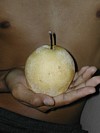
1. Thai name for the Chinese pear or sand pear, of the genus Pyrus
pyrifolia. It has succulent creamy-white flesh and tastes either
sweet or sweet and a little sour. Its flesh is sandy and crispy or
soft in some varieties.
回
2. A cake-like sweet, known as Thai sponge
cake and also referred to as
kanom
sahlih. This light,
yet rather dry cake, is made by steaming it in a style similar to au-bain-marie
(fig.)
and usual flavours include
coffee
or mocha,
pandanus
and strawberry (fig.).
It is typically cut into small square blocks, each of which may be topped with
some kind of edible garniture, such as a raisin or a piece of preserved fruit.
回
_small.jpg)
3. Thai for ‘trolley’.
回
4. Thai for ‘wheelbarrow’,
more specifically referred to as
rot
sahlih.
回
Sahm Fang Kaen (สามฝั่งแกน)
Thai.
Name of the tenth monarch of
the
Mengrai
(fig.)
Dynasty, who ruled the
Lan Na
Kingdom
from 1401 to 1441 AD. He is the son
of Phaya
Saen Meuang Ma (fig.),
the ninth king of Lan Na with his consort
Phra
Nang
Tilohk Jutha Thewi (fig.),
who thus became Queen Mother.
See also TRAVEL PICTURES
and
LIST OF LAN NA KINGS.
回
_small.jpg)
sahmmanaen (สามเณร)
See
naen.
回
Sahmphan Bohk (สามพันโบก)
Thai-Isaan.
‘Three Thousand Potholes’. Name of a large solid area of rock
with cliff-like sides and large rocky rapids along the
Mekhong
River in
Ubon Ratchathani
which features thousands of holes and puddles.
READ ON.
回
sahn (ศาล)
Thai term meaning a court of law or
judicial institution. In legal usage, it refers to an official body vested with
the authority to interpret and apply the law, adjudicate disputes, and deliver
judgments in accordance with legal procedures. The term encompasses various
levels and types of courts within Thailand’s judicial system, including civil,
criminal, administrative, and constitutional jurisdictions. Beyond its legal
meaning, sahn can also denote a pavilion or shrine in general Thai usage, but
within a juridical context it specifically signifies a formal institution of
justice responsible for upholding the rule of law and ensuring the fair
resolution of cases. Often transliterated san, though pronunciation is with a
long vowel.
回
sahn chao (ศาลเจ้า)
Thai. Generic name for any Chinese
shrine, used alongside the term
ahm.
回
Sahn Chao Beung Tao Gong-Ma (ศาลเจ้าปึงเถ่ากง-ม่า)
Thai
name for a Thai-Chinese
shrine in a Chinese Temple in
Khon Kaen,
which on its premises is also a shrine dedicated to Pu Khru Yen (ปู่ครูเย็น),
who is also referred to as Yah Khru Yen (ญาครูเย็).
He was an
Isaan astrologer who lived in
the 20th century AD, had knowledge of black magic, and could
accurately predict providence. He was also a doctor of herbal
medicine and a master of traditions. He moved from his native place
in
Nakhon Phanom
and settled in Khon Kaen. He wore white clothes and a rosary around
the neck, and is today worshipped by the people of Khon Kaen.
WATCH VIDEO.
回
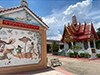
Sahn Chao Kuan U Rai Hai Lam (ศาลเจ้ากวนอู ไร่ไหหลำ)
Thai
name for a Thai-Chinese
shrine in Bang Saen (บางแสน),
Chonburi,
dedicated to
Kuan U (fig.), the
Tiger General of Shu.
READ ON.
回
Sahn Chao Mae Kwan Im (ศาลเจ้าแม่กวนอิม)
Thai
name for a Thai-Chinese
shrine at the
Kuti Jihn Community
in
Bangkok's
Thonburi
district
(fig.),
dedicated to
Kuan Yin,
the Chinese goddess of Mercy (fig.).
READ ON.
回
Sahn Chao Pho Doi Thong (ศาลเจ้าพ่อดอยทอง)
Thai. Name of a Thai-Chinese shrine
located on a hill overlooking the city of
in
Chiang Rai.
WATCH VIDEO.
回
Sahn Chao Pho Khrut (ศาลเจ้าพ่อครุฑ)
Thai
name for a small and rather unique shrine tucked away in a short and
narrow street in
Bangkok's Phra Nakhon
District, that is entirely devoted to the
Garuda
(fig.).
Being the nation's royal
symbol, as well as emblem of the Civil Service (fig.),
the shrine is especially visited by government officials, who come here to make
offerings and pray, especially to request a good result when taking a civil
servant's exam or in order to ask for a career advancement. Although edifices
and statues of Garuda can be found in many places and temples all over Thailand
(fig.),
a shrine devoted solely to this mythological half-man-half-bird is
one of its kind.
回
_small.jpg)
Sahn Chao Pho
Mae Klong (ศาลเจ้าพ่อแม่กลอง)
Thai.
Name of a Thai-Chinese shrine in
the tambon Mae Klong in
Samut Songkhram,
adjacent to the northern side of the local
Talaat Rom Hoop
(fig.)
Railway Market (fig.).
It is dedicated to the local guardian spirit, referred to as
Chao Pho (fig.).
WATCH VIDEO.
回
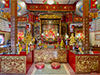
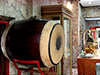
Sahn Chao Pho Ho Klong (ศาลเจ้าพ่อหอกลอง)
Thai.
‘Chao Pho
Drum Tower Shrine’. Name of a Thai-Chinese
shrine in
Bangkok
dedicated to the deity
Chao Pho Ho Klong
(fig.),
a protective
deity, who warns people for looming dangers by the sound of
drumbeats.
He is said
to be the spirit of
Chao Phraya
Si Surasak (สีห์สุรศักดิ์), an important military leader from the
Thonburi
period, who in battle used to encourage his troops by beating on a
war drum. After his death, people would sometimes hear drumbeats
coming from his drum, whilst no one was near, and each time just
before something bad was about to happen, as it were a supernatural
warning sign. His spirit is thus believed to safeguard the
population and warn them for looming dangers.
This place of worship is especially frequented by by government officials and military
staff, many of whom come here to pray for job positions. The shrine has several
drums, similar to those formerly located in the
Rattanakosin Drum Tower (fig.).
In order to receive a blessing, visitors to the shrine are supposed to hit the
main and largest of the drums seven times. See also
ho klong
and
WATCH VIDEO.
回
Sahn Chao Pho Peung Thao Kong (ศาลเจ้าพ่อปึงเถ่ากง)
Thai.
Name of any Thai-Chinese shrine
dedicated to
the
Tae Chew deity
Peung Thao Kong,
who is also known as
Pae Kong. Alternatively
called
Sahn Peung Thao Kong
(fig.).
Compare with
sahn phra phum
and
sahn chao thih.
回
%204_small.jpg)
Sahn Chao Pho
Seua (ศาลเจ้าพ่อเสือ)
Thai
generic name for any shrine in Thailand devoted to
Xuanwu,
who in Thai is known as
Chao Pho Seua, i.e. the
‘Tiger Guardian Spirit’.
There are numerous shrines all over Thailand, and the one built in Phra Nakhon,
Bangkok,
is associated with a local
legend in which the son of
Yai Phong (ผ่อง),
a resident of a certain village, was killed by a
tiger and
hence the villagers hunted it down with the intend to
kill it. Yet, when Grandma Phong saw the
beast, she felt pity for it and adopted the tiger as her pet, thus replacing her
son. Seven years later, the old lady passed away and when the villagers cremated
her body, the tiger jumped into the cremation fire and also died. Consequently,
the villagers built the shrine in Phra Nakhon for the tiger that was so loyal to
its owner (fig.).
回
Sahn Chao Pho Sitthichai (ศาลเจ้าพ่อสิทธิชัย)
Thai.
‘Shrine of Sitthichai's Guardian Spirit’. Name of a sacred
shrine in
Ayutthaya made entirely of
golden
teakwood.
It is believed to house the spirit of the royal son carried in the
womb of Queen
Sunandha Kumarirat
(fig.),
the fifth consort of King
Rama V,
who was killed
on 31 May 1880,
when the boat she
was traveling in on
her way to the Royal Summer Palace (fig.) in
Bang Pa-in got involved in
an accident and
capsized. At the time of her
passing, the queen was five months pregnant. The name Sitthichai,
which can be translated as ‘Victory
of Righteousness’ or
‘Victory of Merit’,
is believed to refer to the unborn prince who tragically passed away
in the baoting accident along with his mother, Queen Sunandha
Kumarirat, before being born. This shrine holds deep spiritual
significance for the people of Ayutthaya, who believe that their
prayers and wishes made here will be fulfilled. Devotees often leave
cuddly toys and stuffed animals at the shrine as offerings to honour
the spirit of the child.
回

Sahn Chao Tha Reua (ศาลเจ้าท่าเรือ)
Thai.
Name of a
prominent Thai-Chinese
shrine in
Phuket
Province, known for being a place where people come to seek
blessings for health and healing from Po Seng Tai Te, a traditional
Chinese god of medicine.
The shrine also includes a space dedicated to the worship of
Kuan U, a legendary figure in Chinese history and mythology revered for his
loyalty, bravery, and sense of justice. Kuan U was a general during the Three
Kingdoms period in China and later became a significant deity in Chinese
religious and Taoist traditions. In the shrine's courtyard stands a statue of
Kuan U, reputed to be the largest in Phuket.
In April 2004, the shrine celebrated its 125th Anniversary.
WATCH VIDEO (1) and
(2), and
VIDEO (EN).
回
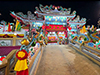
sahn chao thih (ศาลเจ้าที่)
Thai
name for a kind of
spirit
house
with four, and on occasion six legs (fig.),
that houses the
chao thih, the animist guardian spirit of the land.
Also transliterated sahn chao tih, sahn jao thee, saan chao thih, or
similar. See also
sahn phra phum
and compare with
Sahn Chao Pho Peung Thao Kong.
WATCH VIDEO.
回
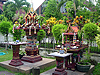
sahn lak meuang
(ศาลหลักเมือง)
Thai. A
shrine in Thailand housing the
lak meuang,
i.e. the
sao inthakhin
or city pillar (fig.).
Every provincial capital has its own city pillar, believed to house
the city's guardian spirit. It represents the centre of town and the
point from which distances between cities are measured.
See also MAP
and
WATCH VIDEO (1)
and
(2).
回

Sahn Peung Thao Kong (ศาลปึงเถ่ากง)
Thai.
Name of any Thai-Chinese shrine
dedicated to
the
Tae Chew deity
Peung Thao Kong,
who is also known as
Pae Kong.
He is a
Tae Chew
deity worshipped as the
Chinese protection god for residences, locations and dwellings, i.e.
to protect and maintain the place of residence, especially for a
neighbourhood, a community or a village.
He is associated with
Di Zhuia (fig.),
the
Chinese protection god for residences, locations and dwellings
concerning ones land, home or house, and as such the Chinese
equivalent of the Thai
chao thih,
the animist guardian spirit of the land.
A small altar dedicated to
Di Zhuia
may also be found in many Sahn Peung Thao Kong shrines.
Alternatively
called
Sahn Chao Pho Peung Thao Kong
(fig.).
回
%201_small.jpg)
sahn phra phum
(ศาลพระภูมิ)
Thai
name for a kind of
spirit house
with one leg, that houses the
jawed
(fig.),
a
Hindu
household god
that protects lands and homes. See also
sahn chao thih
and compare to
Sahn Chao Pho Peung Thao Kong.
WATCH VIDEO.
回
_small.jpg)
sah paper
Paper
made from the
paper mulberry tree. In Thai
kradaat sah. See also
ton sah.
回
sahrihrikathat (สารีริกธาติ)
Thai. A relic of the
Buddha. See also
Phramahathat.
回
Sahtsanah Phraam
(ศาสนาพราหมณ์)
Thai name for
Brahmanism.
回
Sa Huynh
(Sa Huỳnh)
Ancient
civilization that existed about 4,000 years ago in the region of
present day southern
Vietnam and which is considered the precursor
of
Cham
culture.
回
sai (ไซ)
A kind of fish trap woven from
bamboo and rattan rods. It has a
spiked hole at the top
to allow small
fish and other aquatic creatures
entrance.
Once they are inside they are entrapped as the
funnel-shaped spikes keep them from escaping. There are many
different types of sai, named according their form, use or origin,
such as
sai song hee
(northern dialect, trap with two holes -
fig.), sai
lao (Laotian trap), sai kad kung (shrimp trap
-
fig.),
sai thon (enduring trap),
sai nahm tao (water bottle trap), sai hua moo (pig head trap),
sai khai jorakae (crocodile egg trap),
jib sai (sip trap),
sai loy (flaoting trap),
etc. It is especially used in water areas
with a strong current and in not too shallow water.
They are often hung symbolically from the ceiling in commercial
establishments, to catch business and fortune, rather than fish (fig.).
This practice presumably derives from the fact that in Chinese, fish
are called yú (鱼), a word with
the same sound as yú (逾)
meaning ‘to exceed’ and yú (余),
meaning ‘surplus’. Hence, fish traps are symbols for good luck and
used symbolically to catch a ‘surplus of money’ or ‘money in
excess’. See also
saab,
son,
lob,
sang
and
tum.
回
_small.jpg)
sai baat (ใส่บาตร)
Thai.
‘Offering into an
alms bowl’.
Making merit by putting food into the alms bowl of Buddhist monks.
See also
tamboon
sai baat (fig.)
and
bintabaat.
回
Saijai Thai (สายใจไทย)
Thai.
‘Thai
Heart Line’.
Name of a philanthropic organization under the Royal
Patronage of Princess
Sirinthon,
that collects and
manages donations to help soldiers, police and volunteers, who have been
injured, disabled, or killed in the line of duty while defending the nation.
See also POSTAGE STAMP.
回
saika (ဆိုက်ကား)
Burmese. Term for a type of
tricycle taxi used in
Myanmar,
which is fashioned with a side car,
in which two passengers can take place, sitting in a back-to-back position.
Though the term for this Burmese-style
rickshaw
sounds somewhat like
a local pronunciation of the English word
‘cycle’,
it is in fact the Burmese transliteration of the English
‘side
car’.
Sometimes transliterated saiq ka.
See also POSTAGE STAMP.
回
_small.jpg)
sai krok moo (ไส้กรอกหมู)
Thai. ‘Pork sausage’. Dish made of minced pork mixed with boiled
rice and lard, stuffed into a pig's entrails and grilled over a
gridiron. It is eaten with fresh sliced ginger, cabbage and whole
but small chili peppers called prik kih noo. It is usually sold on
street side footstalls and comes either as a sausage or as a string
of small balls prepared in the same way.
回
Sailendra (शैलेन्द्र)
Sanskrit.
‘Ruler of the mountain’. A
Mahayana
Buddhist dynasty that ruled in central Java during the eighth and
ninth centuries AD, and in
Shrivijaya from the
eighth to the thirteenth century AD. Also spelled
Shailendra.
回
sailfish
See
pla bai.
回
sain
(ဆင်)
Burmese
for ‘elephant’,
and also transliterated shaing or sin. The term is somewhat reminiscent of the Thai term for elephant, i.e.
chang.
See
also
Asian Elephant
and
Kyaukse Sain Pwe.
回
Sainshin
(ဆင်ရှင်)
Burmese.
Name of a
stupa
in
Sagaing,
which consists of a compound of the word
sain, meaning
‘elephant’,
and the term
shin used
to refer to someone or
something noble, similar to
the Thai word
Phra.
The white and gilded
zedi
is built on a concrete platform adjacent to
a small brownish-red
sala.
In the middle it is surrounded by floral motifs and figures of
balu pan zwe,
i.e. an ornamental motif on
pagodas
depicting an ogre (balu)
clutching a garland with both hands.
See MAP.
回
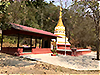
Saint Andrew's Cathedral
Name of an Anglican cathedral in
downtown
Singapore
and the oldest Anglican site of worship in the nation state.
READ ON.
回
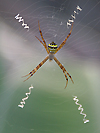
Saint Andrew's Cross Spider
Common name for a commonly found orb-web spider, which actually comprises of two
species, i.e. Argiope aetherea and Argiope keyserlingi, which are similar in
appearance, but with the females of A. aetherea being generally larger than
those of A. keyserlingi. Its common name, Saint Andrew's Cross Spider, derives
from the characteristic zigzag, cross-shaped web decorations, known as
stabilimenta, that form an X, usually with a hollow centre in which the spider
positions itself by aligning its legs in pair with each of the four lines of the
zigzag web decorations. Both species display sexual dimorphism, with females
being considerable larger than males. Adult females grow to 15 millimeters in
body length and their abdomen is oval shaped with transverse white, yellow and
reddish-brown stripes and dots, whereas the thorax and head are brownish-silver.
Males are dull brown in colour and without a pattern on the abdomen.
Also lacking
the bright colours of adult females, are juvenile females, who are rather
pale brownish grey with just a few with dots, and reside
on a web with a circular pattern of zigzag stabilimenta
(fig.).
The legs of both sexes are brownish with
yellowish and beige bands, which are more frequent in females.
回
sai sin (สายสิญจน์)
Thai.
A white thread used in various ceremonies in Thailand, but
also in other countries of the region, such as
Cambodia,
Myanmar, and
Laos.
Its use has an animist aspect to it and besides being used in
Buddhist rites, it is also found with most Thai hill tribe people
and other minorities, who practice
animism.
It is symbolic for the
sutra,
the teachings of the
Buddha.
It is held by Buddhist monks whilst chanting
mantras
or put around a temple building
(fig.),
house or entire village in order to dispel evil spirits. In the
seubchatah
ceremony it spans the
interior of the
bot,
starting from the main Buddha image in the building
(fig.),
and on other occasions it is tied
around the wrists
(fig.)
as a
talisman,
or as a lucky charm with the power to protect (fig.).
It is also used in funerals (fig.)
and formerly when executing the capital punishment (fig.),
as well as in wedding ceremonies (fig.).
In India, a similar cord is used by
brahmin priests
and by devotees during certain occasions, and is known as a
brahman cord (fig.).
See also
yajnopavitam,
mongkon
and
mongkonlasut.
WATCH VIDEO,
VIDEO (M)
and
VIDEO (MT).
回.
sai ua (ไส้อั่ว)
Thai. Northern Thai-style, long-coiled, spicy pork sausage, stuffed with a
mixture of minced pork,
kaeng
kua
chili paste and herbs, and traditionally grilled for many hours over a smoky
coconut
husk fire. The sausage is usually served in fairly thick slices, which are
sometimes additionally deep fried. The word ua (อั่ว) is
Phasa Neua
and
means ‘to
stuff’.
回
%20Northern%20Thai-style,%20long-coiled,%20spicy%20pork%20sausage_small.jpg)
Saivite
Name given to the
followers of
Shiva
(fig.)
or his cult, i.e.
Shaivism,
which has several different sects and which philosophy claims to encompass all
facets of Hindu thought. Saivites often wear
a
pundra,
i.e. a sectarian mark, usually a
tri-pundra
(fig.),
which
consists of three horizontal lines (fig.).
Sometimes spelled Shaivite.
回
_small.jpg)
saivite cord
Thin brown thread worn over the shoulder by
Saivite
priests, crossing their chest. It is akin to the
brahman cord (fig.)
worn by
brahmin priests. In
Shaivism,
its function is both for identification and to remind the wearer of his vows,
but when worn over the right shoulder, it usually signifies that the wearer is
performing a death ceremony. The sacred thread has three strands, which
symbolize purity in thought, word and deed. See also
yajnopavitam and
sai sin.
回
saiyaat (ไสยาสน์)
See
reclining
Buddha.
回
Sai Yohk (ไทรโยค)
1. Thai. Name of a protected
natural area in western
Thailand,
Kanchanaburi
Province,
situated along the
Kwae Noi River (fig.)
near the Thai–Myanmar
border.
READ ON.
回
2. Thai. Name of a
district or
amphur
in
Kanchanaburi
Province,
located northwest of
Bangkok.
回
sak (สัก)
Thai.
‘To tattoo’. In Thai tradition, tattoos usually have a protective
purpose and may have a religious (fig.)
or animist significance, and are thus worn by many a monk (fig.)
or believer.
READ ON.
回
Sa Kaeo (สระแก้ว)
Thai. ‘Crystal pool’. Name of a province (map)
and its capital city in East Thailand, 237 kms East of
Bangkok.
READ ON.
回
Sakadagami (สกิทาคามี)
Pali-Sanskrit-Thai.
Name of the second of the
four stages of
Enlightenment in
Buddhism,
i.e. the stage before
Anagami, and
in which the
partially enlightened person has
cut off three of the five chains with which the ordinary mind is bound, namely
belief in self (atman);
attachment to rites and rituals; and skeptical doubt.
回
Sakai (ซาไก)
Thai
name for the
Mani (fig.),
an ethnic minority group of Negrito people found in the southern Thailand
and in Malaysia, where they are known as
Orang Asli.
回
sakdina (ศักดินา)
Thai.
Name of a formal numerical ranking system in pre-modern
Siam
that assigned every person, from
the king down to commoners and slaves, a notional value expressed in units of
land. The term combines sak (ศักดิ์), meaning ‘power, ‘authority’, or ‘status’,
with na (นา), meaning ‘field’ or ‘rice land’, and it denoted the quantified
measure of an individual’s social position within the administrative and legal
order. Rather than representing actual land ownership, sakdina functioned as a
symbolic and bureaucratic index used by the state to determine rank, duties,
legal standing, corvée obligations, and the scale of punishments or compensation
under the law. Codified most clearly in the
Ayutthaya period and
preserved in legal texts such as the Three Seals Law, the system integrated
social hierarchy with governance by linking status to service to the crown,
thereby structuring relationships between rulers, officials, commoners, and
dependants within a centralized
mandala
polity. In scholarly interpretation, sakdina is understood not as a feudal
landholding system in the European sense, but as an indigenous mechanism of
social stratification and administrative control that articulated authority,
labour obligations, and legal value through a standardized numerical hierarchy
tied conceptually to agricultural land.
回
sake (สาเก)
Thai.
Name for the
breadfruit
and its tree. The species is related to the
kanun
and is also called
kanun
sampalo.
Its scientific name is
Artocarpus altilis
and it belongs to the botanic family Moraceae. The fruit may weigh
up to 2 kilograms and has a thick green peel that turns yellow when
the fruit ripens. In Thailand it is mainly picked when still unripe
and used as a vegetable in curries, or deep-fried and eaten as a
snack.
回
,%20Artocarpus%20altilis_small.jpg)
Sakhon Yangkhiawsot (สาคร ยังเขียวสด)
Thai. Name of a
puppeteer from
Nonthaburi,
who popularized
hun lakon lek.
In 1985, he founded the Joe Louis (โจหลุยส์)
Puppet Theater, which was named
after his nickname, i.e. Jo Liu (โจ
หลิว). He gained royal
support from Princess
Galyani Watthana, who
endorsed it to achieve Royal Patronage.
He is habitually
referred to as
Ajaan Sakhon, with ajaan
being a honorary title meaning ‘teacher’.
He was born in 1922 and died on 21 May 2007 in
Bangkok, less
than a year after he won the Best Traditional Performance Award at the 10th
World Festival of Puppet Art in Prague.
回
_small.jpg)
Sakka (สักกะ)
Pali-Thai. Another name for
Indra,
used especially in his position as ruler of
Tavatimsa,
in Thai also referred to as thao
Sakkathevarat.
回
Sakkya (စကြာ)
Burmese
name for
Sakya.
回
Sakoh (สะกอ)
A
significant subgroup of the
Karen
in Thailand. Also
Sgaw.
MORE ON THIS.
回
Sakon Nakhon (สกลนคร)
Thai. Province (map)
and its capital city in
Isaan situated 647 kms Northeast of
Bangkok.
READ ON.
回
saksit (ศักดิ์สิทธิ์)
1. Thai.
‘Sacred’ or ‘holy’.
回
2.
Thai. Special
spiritual powers attributed
to certain Buddhist monks in Thailand. These monks, called
Phra
saksit,
often transfer their powers (saksit) onto
amulets
and
votive
tablets
(fig.)
which are consequently considered
a safeguard against evil influences and bad luck. Saksit also means
‘effective’.
MORE ON THIS.
回
sakti (ศักติ)
Thai for
shakti.
回
Sakun Kraison (สกุณไกรสร)
Thai-Pali.
‘Bird-lion’.
Name of a mythological creature from
Himaphan forest, that
has the brown body
of a lion
and the beak, feet and tail
of a bird, but unlike
Kraison Paksah (the
Lion-bird), without any wings.
In appearance, it is in many ways reminiscent of
Sang Praeng,
a mythological lion with clawed feet and a feathery tail, but without a beak.
Both creatures are of a different colour, but in art this is not always visible,
especially in bronze sculptures. Sometimes transliterated Sagn Kraison or Sagoon
Kraisorn.
回
Sakuntala (ศกุนตลา)
A
Sanskrit
drama written by the Indian poet
Kalikdasa
and translated into Thai by king
Vajiravudh.
回
Sakya
(शाक्य)
1. Sanskrit-Pali. The clan or tribe to which
prince
Siddhartha belonged. He became the historical
Buddha.
Also Sakiya. In Sanskrit
Shakya
and in Burmese
Sakkya.
回
1. Sanskrit-Tibetan. One of the
Red Hat Sects of
Lamaism,
i.e.
Tibetan Buddhism,
the other one being Nyingma, and whose monks during special ceremonies wear
elongated crescent-shaped hats (fig.).
回
Sakyamuni (शाक्यमुनि,
ศากยมุนี)
1. Sanskrit-Pali-Thai. ‘Sage of the
Sakya
[tribe]’. A designation for the historical
Buddha
after he was apprenticed by the brahman master
Arada
Kalapa and the sage
Udraka
Ramaputra. In
Sanskrit known as
Shakyamuni
and in
Myanmar
usually referred to as
Mahamuni,
though the term Sakya also exists, but usually transliterated
Sakkya.
回
2. Thai. Name of the principal
Buddha image of
Wat Suthat in
Bangkok (fig.),
which originates from
Sukhothai. It was in 1808
transported by raft to Bangkok on the orders of
Rama I,
and is fully known by the name
Phra
Sri
Sakyamuni.
See MAP.
回
sa-la (สละ)
Thai. Fruit with the Latin names Zalacca and
Salacca and a palm tree with a height of up to seven meters. The
tree bears fruit throughout the year. The skin has the pattern of a
snake's skin. This
nutritious fruit grows in large tight bunches at the top of the tree
trunk and its buttery coloured inside (fig.)
tastes between a
banana and a
pineapple
but has a rather unpleasant aftertaste. It is nicknamed
snake fruit
and in Indonesia and
Malaysia
is known as salak. A variation of the fruit is called
ra-kam,
but these are slightly shorter and more bulbous in shape (fig.)
than the sa-la.
回
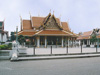
sala (ศาลา)
1. Thai. An open-sided
gazebo-like
shelter, hall or
pavilion (fig.)
of a generally permanent nature consisting only of pillars and a
roof as protection against the sun and rain. It occurs within the
precincts of a temple complex, on waysides and in fields (fig.).
The roofed
structure offers an open view of the surrounding area, and may be
used for relaxation.
As a compound or in composition with a name, the final
‘a’ is often
dropped, as in
sahn chao tih,
and its pronunciation then changes to sahn (ศาล),
because a final
‘l’ is in Thai
pronounced
‘n’ (see
Thai Consonants).
See also POSTAGE STAMPS (1),
(2),
(3) and
(4),
and
THEMATIC STREET LIGHT.
回
2. Thai. A hall or pavilion.
回
3. Thai. A public building.
回
Sala Chaleum Krung (ศาลาเฉลิมกรุง)
Thai.
‘Pavilion to Celebrate the City’.
Name of the Royal Theatre in
Bangkok.
READ
ON.
回
Sala Dusidalai (ศาลาดุสิดาลัย)
Thai. Name of a
royal convention hall in
Dusit
(fig.),
located within the compound of
Chitralada Palace,
adjacent to the private Royal Villa of King
Rama IX
(fig.)
and used by the King or Queen to grant audiences to high-ranking officials and
dignitaries, as well as to organize certain royal events, such as banquets, etc.
See MAP.
回
_small.jpg)
Salah (صلاة)
Arabic. ‘Prayer’. Name for the
ritual prayer in
Islam,
performed five times a day
at prescribed times: Fajr (dawn), Dhuhr (midday), Asr (afternoon),
Maghrib (sunset), and Isha (night). Each Salah consists of a sequence of
movements and recitations, starting with the standing position (Qiyam) where
verses from the
Koran
are recited. This is followed by bowing (Ruku) with hands on knees,
standing again, and then prostration (Sujud) with the forehead touching the
ground, which is repeated twice in each unit of prayer (Rakat). The prayer
concludes with sitting (Tashahhud) and the recitation of specific supplications.
Salah is a means to maintain a direct connection with
Allah,
seeking guidance, expressing gratitude, and attaining spiritual growth. The
times for the five daily prayers at dawn, midday, afternoon, sunset, and night,
are often indicated on a screen in a
mosque,
displaying the exact times for each prayer, which vary daily based on the
position of the sun.
回
salahkkaphad (สลากภัต)
Thai. A presentation of food to priests by lots.
回
salahk kin baeng (สลากกินแบ่ง)
Thai for ‘lottery’. The people of Thailand are very fond
of gambling and the government lottery is the only officially recognized form of
gambling, though illegal forms of underground gambling and betting are widely
available too. Unlike the electronic system found in many other countries, the
Thai lottery system is still paper-based, and tickets are available from agents,
which receive these tickets from retailers. Yet, in recent years, the lottery
results of winning tickets are made available in a digital form, i.e. on the
website of
The Government Lottery
Office.
Each ticket has two parts with the same ticket number that consists of 6 single
digits and are sold in pairs, thus a winning number also carries a double prize.
The government lottery is held twice a month and the winning numbers are
published on the 1st and 16th of every month, and many can't wait to check the
results (fig.).
Winning tickets with a prize money of less than 20,000
baht
can be cashed with a local agent, who will
charge a 2% commission on the amount, whereas winning tickets with higher money
prizes need to be cashed at The Government Lottery Office, who will issue a cheque. Many people will buy tickets at boots or from hawkers near locations
deemed auspicious, such as important temples, palaces, etc. They will also try
to get tickets with the number
nine,
which is considered to be a lucky number. However, potential players should be
vigilant, as there are usually fake lottery tickets circulating too, as part of
a well-organized scam. Also called huay (หวย) or huayber (หวยเบอร์).
See also POSTAGE STAMP.
回
%201_small.jpg)
sala kaan parian (ศาลาการเปรียญ)
Thai. Name for a sermon
or teaching hall within a Thai Buddhist temple complex.
回
Sala Kaew Kuh (ศาลาแก้วกู่)
Thai. Name of a
religious-mythological theme park in
Nong Kai,
along the Mekhong River, opposite from
Laos,
with —mostly large— statues depicting characters and scenes from
Buddhism
and
Hinduism.
READ ON.
回
sala kahnprian (ศาลาการเปรียญ)
Thai. Name for a sermon
or teaching hall within a Thai Buddhist temple complex.
Pronunciation and alternative transliteration
sala kaan parian.
回
Sala Look Khun (ศาลาลูกขุน)
1. Thai.
‘Juror Hall’ or ‘Jury Hall’.
Name of a
building (sala)
within
Phra Rachawang,
i.e. the
Grand Palace,
where once meetings for government officials and civil servants were held. In English it is usually referred to as the Look Khun Hall and sometimes
transcribed Luk Khun Hall and fully known as Sala Look Khun Nai (ศาลาลูกขุนใน),
the
‘Inner Juror Hall’, due to
its location within the palace. Initially the building housed the Office
of the Auditor General and
today it is
home to
the Office of
His Majesty's Principal Private Secretary.
See also POSTAGE STAMPS (1),
(2)
and
(3), and
MAP.
回
2. Thai.
‘Juror Hall’ or ‘Jury Hall’.
Name of a temporary pavilion or shelter
(sala)
used as a venue to seat senior
government officials, palace officials, and other
dignitaries, when they have an
audience with the King, or are
spectators during certain royal ceremonies in which the King or a senior member
of the royal family is present. They are erected adjacent to the
Phra Thihnang Song Tham,
the ceremonial residence
used
by the King,
usually one on each side of it.
回
sala pao (ซาลาเปา)
Thai for
dim sam.
回
Sala Rajakarun (ศาลาราชการุณย์)
Thai.
‘Royal Beneficence Hall’. Name of a
monument built at Khao Lahn (เขาล้าน), a former refugee camp of the
Thai Red Cross Society
established by the Queen and
used to house Cambodian people during the
Khmer
Rouge regime of Pol Pot,
and
located at
Tambon
Mai Root (ไม้รูด) of
Ampheu Klong Yai (คลองใหญ่)
in
Trat
Province. When the Cambodian refugees
in 1985 eventually returned home, the camp was closed, but in 1992 it was
refurbished into a society centre and a monument with a
lotus bud shaped tower
by architect Prof. Dr. Bandit Chulasai (บัณฑิต จุลาสัย), and renamed in the
honour of Queen
Sirikit,
who is the royal patron of the Thai Red Cross. In 1997,
it appeared on a Thai postage stamp to commemorate the annual Thai Red Cross Fair (fig.).
回
Sala Sahathai Samakhom (ศาลาสหทัยสมาคม)
Thai. Name of a royal hall
located within the compound of
Phra Rachawang,
i.e.
the
Grand Palace,
in
Bangkok.
READ ON.
回
Sala Samrahn Mukhamaht (ศาลาสำราญมุขมาตย์)
Thai.
‘Mukhamaht Front Pavilion’. Pavilion within the compound of the
National Museum
in
Bangkok.
It was built in the reign of
King
Chulalongkorn
and designed by Prince
Narisara Nuwattiwong, a younger brother of King
Rama V,
who also designed
Wat Benjamabophit,
i.e. the
Marble Temple
in Bangkok (fig.),
as well as the seal of Bangkok (fig.),
i.e. the image of
Indra
riding on the
elephant
Erawan
(fig.).
The
sala
was initially named
Phra Thihnang
Rachareudih
(ราชฤดี), which could be translated as
‘Royal Love Hall’, and was used as a royal pavilion where members of the royal
family could eat out in the Ngae Taeng (แง่เต๋ง) Garden, located in
Dusit
Palace, near
Phra Thihnang Amphon Sathaan
(fig.).
In the reign of King
Rama VI
the pavilion was renamed Sala Samrahn Mukhamaht and
in the reign of King
Rama VII,
when the museum was established, it was relocated
to its current location.
See
also POSTAGE STAMP and
MAP.
回
_small.jpg)
sala sangweht (ศาลาสังเวช)
Thai. A pavilion within a Buddhist
temple compound in Thailand designated for funeral rites and related ceremonies.
The structure is typically used to hold wakes, memorial services, and other
activities associated with death and mourning prior to cremation. Unlike the
crematorium (meru
or
pah chah),
which is specifically for the act of cremation, the sala sangweht serves as a
communal hall for relatives and attendees to gather, perform chanting, and pay
respects to the deceased. Also transliterated sala sangwej.
回
sala tree
A tree which grows up to 15 meters high and
with the botanical name Shorea robusta, yet it is commonly mistaken
with another tree, with the Latin designation Couropita guianensis.
However, Couropita guianensis was not introduced into South Asia
until the late 19th century AD, after which it was mistakenly
believed to be Shorea robusta.
The
Buddha
is said to have died stretched out between two sala trees (fig.)
and according to some sources he was also born underneath a sala tree,
yet due to the mix-up
Couropita guianensis was planted
at many Buddhist temples throughout South and Southeast Asia.
In
iconography, this
scene is generally depicted as
Maha Maya
holding a tree branch with her right hand (fig.)
and sometimes with an infant emerging from her side
(fig.).
Some sources speak however of the prince's birth taking place under
a
teak tree
(fig.).
Couropita guianensis can be recognized by its typical reddish pink flowers that
grow directly from its stem (fig.),
and from its large round seeds (fig.)
that gives the tree the epithet
cannonball
tree. The sala tree is often
found at Thai
temples (fig.)
and its large fruits are reminiscent of the
look nimit,
nine
cannonball-like stones (fig.)
that are used in Buddhist temples to mark the sacred ground on which
the
ubosot,
i.e. the ordination hall,
is built. In Thai, Couropita guianensis is
known as
ton sala
langka, i.e.
‘Singhalese
Sala Tree’,
perhaps referring to the fact that this
tree was introduced from Guyana to a botanical garden in Sri Lanka
in 1881, yet definitely indicating the difference from the original
sala tree, i.e. Shorea robusta.
See also TRAVEL PICTURES.
回
Sala Wah Kaan Krung Thep Maha Nakhon
(ศาลาว่าการกรุงเทพมหานคร)
Thai. Literally ‘Governor's
Court’ or ‘Hall where
Bangkok is Governed’. Name for the office building of the Bangkok Metropolitan
Administration (BMA), in English usually referred to as the Bangkok City Hall,
and which includes the offices of the Governor of Bangkok. The building is
located at the northern end of
Lahn Khon Meuang, i.e. the ‘Citizen's
Courtyard’, a large public square and events square,
which is usually referred to
in English as the ‘City Square’
(fig.).
See also TRAVEL PICTURE.
回
_small.jpg)
Salawin (สาละวิน)
Thai name of a 2,815 km long river that rises in Tibet and
runs through China's
Yunnan province, where it is
known as the Nù Jiāng (怒江), meaning the ‘Indignant River’ and possibly referring
to its raging torrents as it passes through deep gorges. It then continuous to
meanders through
Myanmar, where it is
known as the Thanlwin River (fig.
-
map). It enters into Thailand in
Mae Hong Son
province, where it flows for only a short distance through the Salawin National
Park and is fed by the Pai (ปาย) and Mey
(เมย) tributaries,
before leaving Thai soil again near the village of Mae Sam Laep, streaming back
into
Burma. Near Mawlamyaing
it becomes a delta and eventually flows in the Andaman Sea. Though the Pai River originates in the Thai mountainous region of the
amphur
Pai and which is about 180 km long, feeds the Salawin River in the Kayah
State of Myanmar. The Mey (Moei) River is about 327 km long and originates in
the amphur Phop Phra of
Tak
province. Unlike most rivers in Thailand, the
Mey (Moei) River
flows northward, for some distance,
forming the natural border between Burma and Thailand. It unites with the Salawin
River in the amphur
Sop
Mey/Moei (สบเมย) of Mae Hong Son province. In
English, The Salawin is known as Salween, also spelled Salwin.
See MAP.
回
_small.jpg)
Sala Wong Klom (ศาลาวงกลม)
Thai. ‘Circular
pavilion’. Name of a round pavilion at the
Chulachomklao Royal Military Academy
(fig.)
that serves as a memorial to its founder, King
Chulalongkorn,
of whom it
houses a bust. It is located between the CRMA Convention Hall and the CRMA
Library building.
WATCH VIDEO.
回
%201_small.jpg)
saleung (สลึง)
1. Thai.
An obsolete monetary unit with a value of a quarter of a
baht,
i.e. a twenty-five
satang
coin.
It is still found on ancient
coins and stamps. See also
tamleung.
回
_small.jpg)
2. Thai. Weight measurement used
by jewelers and pharmacists in Thailand, equal to a quarter of a
baht,
i.e. 3.75 grams. See also
tamleung.
回
saliang (เสลี่ยง)
Thai. ‘Sedan chair’.
When used
for royalty or high-ranking monks its is often finely ornamented
with
kranok motives or
rows of
thevadas, a decorative feature in
Thai known as
thepchumnum (fig.).
Some saliang, especially those for royalty, are gilded.
In Thai also
kaanhaam,
yahnamaht
and
yahnumaht.
See also
palanquin.
回
%20sedan%20chair_small.jpg)
saloh (สะล้อ, ซะล้อ)
Thai. A traditional
fiddle-like instrument with two or three strings and played with a bow.
It is similar to the
so sahm saai,
but smaller and is typically used in the
northern
Lan Na region.
The saloh is usually made from rosewood
and its sound box consists of
a polished shell of a
special type of
coconut
with a hole at
one side, which is covered with animal skin. Also called
so
(fig.).
回
,%20so%20(ทร้อ)_small.jpg)
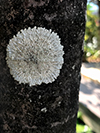
Salted Rock Shield
Common name of a
lichen in the group of
foliose,
whose members grow in flat, two-dimensional, leaf-like lobes.
It is of the genus Xanthoparmelia, which has a great numbers of synonyms, e.g.
Almbornia, Neofuscelia, Chondropsis, Namakwa, Paraparmelia, and Xanthomaculina,
and is known by has the scientific names Xanthoparmelia mexicana and Parmelia
mexicana. It grows in a rosette, i.e. a
circular arrangement of leave-like lobes, that are gray-green in colour. It can
grow up to 10 centimetres in diameter. It is similar and related to the Green
Rock Shield, a species of lichen of the same genus
and with the scientific names Xanthoparmelia lavicola and Parmelia lavicola.
回
salt field
See
nah kleua.
回
salwe (စလွယ်)
Burmese term for a set of strings or chains
that is worn over the shoulders are fastened at the chest with one or more
ornamental plaques. It is usually made from a precious metal, such as gold or
silver, and is worn in order to indicate rank, which could be read from the
material and the number of strands. Though reminiscent of the European livery
collar or chain of office, its use can actually be traced back to the wearing of
the
brahman cord
(fig.)
by members of the highest
caste
in
Hindu
society. It is also found worn
by certain Burmese
Buddha images,
especially
crowned Buddha
statues, such as the Nga Htat Gyi Buddha (fig.)
in Yangon, as well as by boys under
the age of 20 during the
shinpyu
ordination ceremony
(fig.),
when they dress in princely
attire prior to becoming a Buddhist novice known as
shin thamanei. See also
Mandarin square.
回
Salween
See
Salawin.
回
Sama
(साम)
Sanskrit. The second of the four
Vedas,
which deals with the knowledge of worship, and is the originator of
Indian classical music. Also
Samaveda.
回
samahkhom nak sasom trah praisanihyahkon haeng
prathet thai (สมาคมนักสะสมตราไปรษณียากรแห่งประเทศไทย)
Thai name for
The Philatelists Association of
Thailand.
回
samahkhom phaet rabob thaang deun ahaan haeng prathet thai
(สมาคมแพทย์ระบบทางเดินอาหารแห่งประเทศไทย)
Thai name for
Gastroenterological Association of Thailand.
回
samahkhom tantra (สมาคมตันตระ)
Thai.
Tantra
Association’ or ‘Tantra Society’. Another name for
Wat Phra Siwa Chao,
a Thai
Hindu
sanctuary in
Bangkok known in
English as
‘Lord
Shiva
Temple’.
回
samaddhi
See
dhyani
and
samahti.
回
samahti (สมาธิ)
Thai for
‘meditation’. The historical Buddha attained
Enlightenment
seated in a position of concentration or meditation, as is
seen in images depicted with a
dhyani
mudra.
Generally meditation is an attempt to experience the deepest
realities by inner contemplation. Buddhist monks in Thailand
typically meditate on death, often making use of corpses or photos
of dead people. Some even go as far as to lock themselves up inside
a crematorium for meditation, which is somewhat reminiscent to the
sadhu in India, who
cover their body and face in
vibhuti
(fig.),
i.e. sacred ash taken from a cremation fire (fig.).
In addition, there are weekly magazines available to the larger
public, with titles such as Ahdyahkam (อาชญากรรม)
meaning ‘Crime’,
and 191 (i.e. the emergency number of the Special Branch of the
Royal Thai Police),
that show gruesome pictures of victims of murder and people killed
in traffic accidents. Sometimes transcribed samaati en in popular
speech also called
wipatsanah
and
kammathaan (กรรมฐาน).
回
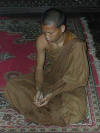
samana (शमण,
สมณะ)
Pali-Thai. ‘One who strives’.
A term used for an hermit or ascetic.
回
samanaborikaan (สมณบริขาร)
Thai.
The eight necessary articles or utensils required by Buddhist monks
in daily life. These include an
alms bowl
or
baat,
clothing or
pahkahsahwapad,
a needle, a razor, a water filter and an umbrella. Also
borikaan.
回
samanaen
See
naen.
回
samanasak (สมณศักดิ์)
Thai.
‘Ecclesiastical dignity’.
Term for ecclesiastical peerages, i.e.
titles or ranks, traditionally given to Buddhist monks in Thailand, who are
ordained members of the
Sangha.
回
samanera (श्रामणेर)
Sanskrit. Ascetics,
mendicant monks or wanderers of diverse religious discipline in
ancient India. The term today refers to a novice in the Buddhist
order. Officially transcribed with an ‘r’ following the ‘s’, i.e.
śrāmaṇera (shrAmaNera). In Thailand, the term for a novice is
samanaen,
which is usually abbreviated to
naen,
and in Myanmar it is
shin thamanei.
回
Samantabhadra (समन्तभद्र)
Sanskrit. ‘Universal
worthy one’. The Sanskrit name for
Puxian.
回
Samaveda (सामवेद)
Sanskrit. See
Sama.
回
Sambar
See
Sambar Deer.
回
Sambar Deer
Common name for a large deer, with the scientific name
Cervus unicolor. Its coat is dark brown, with chestnut marks on the rump and
underparts, and mane-like hairs on the neck and throat (fig.).
Males may have large rugged antlers (fig.),
that may exceed well over one meter in length, and of which the brow tines are
simple and the main beams typically forked at the tip. Sambar Deer are found in
southern Asia, including India and Nepal (fig.);
mainland Southeast Asia, including Thailand (fig.)
where it is called
kwahng pah
(กวางป่า), meaning ‘wild deer’ or ‘forest deer’; southern China; Indonesia; and
the Malaysian island of Borneo. There are several
subspecies and one particular species, i.e. the Sunda Sambar (Cervus
timorensis), which is slightly smaller, is known to be a favourite prey of the
Indonesian Komodo dragon (fig.).
Also called simply Sambar. In 1976, Sambar Deer were depicted on a Thai
postage stamp, as part of a series on wild animals (fig.).
See also WILDLIFE PICTURES (1)
and
(2),
and
TRAVEL PICTURE.
回
_small.jpg)
sa-mee (สมี)
Thai.
A former Buddhist monk defrocked as a result
of a serious transgression. See also
abat
and
Buddhist
precepts.
回
Sammakon
(สัมมากร)
A neighborhood in
Bangkok's Saphaan Soong
district, which consists of a village-like community, of which a good deal is
purportedly royal property. The rather tranquil area off Ramkhamhaeng Road
features four large lakes, which are referred to as thale saap sammakon
(ทะเลสาปสัมมากร), i.e. ‘Sammakon Lakes’.
Also transliterated Sammakorn.
See also
QUADCOPTER PICTURES (1)
and
(2), as well as
MAP.
回
Sammanakkha (สำมนักขา)
Thai.
Name
of a female giant or
yak
character in the
Ramakien.
READ ON.
回
Sammasam (สัมมาสัม)
Thai-Pali Buddhist term meaning
‘Right Understanding’. Pronunciation Sammahsan.
回
Samnakngaan Khannakammakaan Kitjakaan Krajaai Siang
Kitjakaan Thorasap Lae Kitjakaan Thorakhammanahkhom Haeng Chaat
(สำนักงานคณะกรรมการกิจการกระจายเสียง กิจการโทรทัศน์และกิจการโทรคมนาคมแห่งชาติ)
Thai for the Office of The National Broadcasting and
Telecommunications Commission, referred to in short as NBTC. It was
established in December 2010 and is the successor of the Office of The National
Telecommunication Commission or NTC, which is
known in Thai as
Samnakngaan Khannakammakaan Kitjakaan Thorakhammanahkhom
Haeng Chaat,
which in turn
developed from
the Department of Posts and Telegraph, and hence its logo is a
Garuda
over a post horn (fig.).
See MAP.
回
_small.jpg)
Samnakngaan Khannakammakaan Kitjakaan
Thorakhammanahkhom Haeng Chaat
(สำนักงานคณะกรรมการกิจการโทรคมนาคมแห่งชาติ)
Thai for Office of The National
Telecommunication Commission, known in short as the NTC, an organization
that developed from the Department of Posts and Telegraph, and its logo is a
Garuda
over a post horn.
The organization plays a role in managing radio frequencies for
telecommunication activities, as well as supervising
telecommunication transactions in order to yield the highest
benefits in terms of education, culture, and state security. Other
duties include the promotion of free and fair competition, as well
as support for research and development, in the Thai
telecommunications industry.
The
organization
was established in 2004 and in December 2010 it converged with other
departments and was transformed into the Office of The National Broadcasting and
Telecommunications Commission, referred to in short as NBTC and
known in Thai as
Samnakngaan Khannakammakaan Kitjakaan Krajaai Siang
Kitjakaan Thorasap Lae Kitjakaan Thorakhammanahkhom Haeng Chaat
(fig.).
回
_small.jpg)
Samnakngaan Khannakammakaan Khumkhrong Phoo
Boriphohk (สำนักงานคณะกรรมการคุ้มครองผู้บริโภค)
Thai for Office of the Consumer
Protection Board, the government agency that
ensures the rights of consumers, as well as fair trade, competition,
and accurate information in the marketplace. It looks after the interests of
consumers nationwide
and mediates in conflicts. The agaency is in existence since 1979
and consists of several departments, including a
Complaint Centre, known in Thai as Soon Rab Reuang Rahw Rong Thuk
(ศูนย์รับเรื่องราวร้องทุกข์),
where complaints are reviewed and legal advise is given.
The Office of the Consumer
Protection Board
also has its own police force, a specialized branch of the
Royal Thai Police.
See also POSTAGE STAMP and
MAP.
回

Samnakngaan Tamruat Haeng Chaat (สำนักงานตำรวจแห่งชาติ)
Thai. ‘Office of the National Police’,
which
in English is officially referred to as
Royal Thai Police.
回
Samnak Pattibat Tham Sanku (สำนักปฏิบัติธรรมสันกู่)
Thai. ‘Sanku
Meditation
Institution’. Name of a Buddhist meditation
center, located on a forested hill on the outskirts of Mae Rim, just north of the city of
Chiang Mai.
READ
ON.
回
Samnak Phijahranah Phaaphayon Lae Wihdithat
(สํานักพิจารณาภาพยนตร์และวีดิทัศน์)
Thai. ‘Film and
Video Consulting Agency’. Government bureau under the Department of Cultural
Promotion, which in turn is a division of the Ministry of Culture.
It acts as a regulating body in all matters related to moving
pictures and the film industry.
回
%202_small.jpg)
Samnaksong Narinthammarattanarahm (สำนักสงฆ์
นรินทร์ธรรมรัตนาราม)
Thai. ‘King of the
Righteousness Jewel Monastery’, ‘Lord of the
Dhamma Jewel Temple’ or ‘Temple
of the Leader of the Righteousness Jewel’. Name of a Buddhist temple in
Nan.
Whereas samnaksong is another word for ‘temple’ or ‘monastery’, which literally
means ‘monastic office’ or ‘office of the monks’, with song being an
abbreviation of
Phrasong,
thammarattana, i.e. the ‘Righteousness Jewel’, is a compound of
thamma
or
dhamma and
rattana,
and refers to the Teachings of the
Buddha,
a term that
often appears in Buddhist names, especially of temples, where it usually refers
to either all or one of the Rattanatrai,
i.e. the ‘Triple Gems’ or ‘Three
Jewels’, that
is to say the Buddha,
his teachings (dhamma)
and the Sangha.
The suffix rahm or raam derives from
araam
and also means ‘temple’ or
‘monastery’, whereas
Narin
is a royal title that means ‘Leader of the People’ or ‘Lord of Men’,
and which can be translated to ‘King’ or ‘sovereign’.
WATCH
VIDEO.
回

sa-moh (สมอ)
Thai. Name for the gall-nut, a medicinal fruit in
the form of a small nutlike sphere (fig.), that
Indra
offered to the
Buddha
from a tree in heaven in order to strengthen him, during
the seventh weeks after he attained
Enlightenment,
while he was sitting under the
Rajayatana Tree to meditate and enjoy the Bliss
of Vimutti, i.e. the freedom from suffering, without eating anything during the
whole period.
The fruit is used as a herbal medicine and in
the
iconography
of
Myanmar,
a certain pose of
Buddha images
(fig.)
represents the
Buddha with his arms hanging at his side, with one hand holding onto his robe
and the other holding a gall-nut fruit between thumb and middle finger (fig.).
This pose is believed to represent the Buddha offering the
dhamma as a cure for suffering.
The sa-moh may
also be described as fruit from a tree with the botanical name Prunus
cerasiferaas, which is commonly known by the names purple-leaf
plum, cherry plum, and myrobalan plum. See also
Haripunchai.
回
Samohson Krung Thep Krihtah (สโมสรกรุงเทพกรีฑา)
Thai.
Literally ‘Bangkok
Athletics Club’.
However, the term krihtah, sometimes transliterated kreetah or kreetha,
is used for all kinds of track and field sports, and the name is
figuratively often
translated as
‘Bangkok Sports Club’, yet to avoid
confusion with the
Royal Bangkok Sports Club,
it is in English altogether referred to as ‘Krung
Thep
Kreetha Sports Club’. It is
located in
Bangkok's
khwaeng
Hua Mahk, in the
khet
Bangkapi, alongside ‒yet somewhat off‒ the
Bangkok-Chonburi
Highway.
It features a golf course, with two club houses, and facilities for fitness,
swimming,
tai chi,
qi gong,
and
yoga.
See MAP.
回
_small.jpg)
Samon (สามล)
King from the Thai story
Sangthong
whose daughter
Rochana
(fig.)
married
Phra Sang.
回
Samonthat (สามลทัศ)
Thai. Name of one of the seven
guardian spirits that looks out for children and that are generally known as
Mae Seua.
This
thevada
guards all the children that
are born on a Wednesday and is represented with a human-like body and the head
of an
elephant,
similar to the
Hindu deity
Ganesha (fig.).
回
_small.jpg)
sampan (สำปั้น)
See
reua
sampan.
回
sampannih (สัมปันนี)
Thai. Name of an ancient Thai
dessert, usually fashioned in the shape of a beautiful flower, often in white or
in a pastel colour. These flowers-shaped biscuits are made with wheat flour or
tapioca
flour, coconut milk and sugar. They are crispy on the outside, soft on the inside, and
purportedly melt in the mouth. Their taste is described as mellow sweet. The name
means ‘darling’ or ‘beloved’, and it is considered a suitable snack and a
souvenir to give to a loved one. Its appearance and taste is variable and the
recipe has over time changed to suit demand according to the time period.
Nowadays, the centre of the flower may be decorated with a little gold powder or
gold leaf.
See also POSTAGE STAMP.
回
_small.jpg)
Samphati (สัมพาที)
Thai. Mythological bird from the
Ramakien
with enormous power. It is the oldest son of
Garuda
and the older brother to
Sadayu. He
has the face of the Garuda and the body of a bird with a red plumage. He is
known for his self-sacrifice because he protected his brother from the piercing
rays of the sun, after he was being punished for trying to eat it, when he
mistook it for a fruit, thus infuriating
Surya. The
heat of the rays caused his feathers to fall so Samphati remained featherless
until the day the curse would be lifted. Also called
Nok Samphati.
回
_small.jpg)
sampot
(សំពត់)
Khmer.
A piece of clothing covering the lower part of the body (fig.).
Traditionally, it is considered the national garment of
Cambodia
and comparable to the Thai
pah nung
and the Burmese
longyi.
There are various kinds and
styles, as well as different fabrics, with the sampot
thep
apsara being a
famous type of sampot from the Khmer Empire era, which is
typically found worn by
apsaras
in
Khmer
art.
Besides the latter, there is
also the sampot alorgn, sampot chang kben, sapot chorabap, sampot
lberk, sampot samloy, sampot sang, sampot seai sua, whereas the two
main fabrics are referred to as sampot hol and sampot phamuong.
Compare with the Thai
johng kraben (fig.).
回
samrohng (สำโรง)
Another Thai name for
po daeng,
an up to 30 meters large tree, with the botanical name Sterculia foetida (fig.).
The name
reportedly comes from the
Khmer
language, where it is pronounced somrong.
回
samrong (สำรอง)
A species of tree commonly known as
Malva Nut Tree and with the binomial name Scaphium macropodium, found in many parts of Southeast Asia, including
Cambodia,
Vietnam,
Malaysia,
Singapore,
Indonesia and Thailand, where it is especially cultivated in
Chanthaburi
and
Trat.
Its plum-like fruit is used as a herb in traditional medicine to improve general
health, as well as to treat certain respiratory conditions and other ailments,
such as cough, phlegm, sore throat, apthous ulcers and fever. It has several
other names, depending on the region. In Central Thailand, it is known as phung
thalaai (พุงทะลาย) and in
Isaan it is
called bakjong (บักจอง). Its dried fruit, known as look samrong,
is found in bulk in
Bangkok's
Chinatown.
回
%20สำรอง,%20พุงทะลาย,%20บักจอง_small.jpg)
samsara
(संसार)
Sanskrit.
The transmigration of the soul caused by the perpetual cycles of
birth, aging, death and rebirth, accompanied by suffering. Both
Hindus and Buddhists try to break this cycle by striving for the
elimination of lust and desire. In Thai called
sangsarawat.
回
Samuha Kalahome (สมุหกลาโหม)
Thai. Name for the High Chancellor of the Interior Command of the
southern districts, with the title of
Chao Phraya,
a post which derived from the
Samuha Nayok. It is also
referred to as Samuha
Phra
Kalahome and is sometimes incorrectly translated as Prime Minister, a position
with similar powers but which was created only later and thus at best would be
its successor.
回
Samuha Nayok (สมุหนายก)
Thai. Name for the High Chancellor of the Interior Command of the
northern districts, with the title of
Chao Phraya.
READ ON.
回
Samuha Phra Kalahome (สมุหพระกลาโหม)
See
Samuha Kalahome.
回
Samui (สมุย)
Large
island
(map)
in the
Gulf of Thailand,
off the coast of mainland
Surat Thani,
the southern province of which
it is also a part. Although its port and main commercial centre are
in Nathon, Chaweng is its main holiday destination, offering many
shops and restaurants, as well as nightclubs and accommodation in
any category. Another place on the rise is Lamai, just a short
distance south of Chaweng. Besides the many pristine sandy beaches
Samui also has some waterfalls (map
-
fig.),
numerous
coconut plantations, the unusual ‘grandfather and
grandmother’ rock formations (map
-
fig.),
a safari park, the Big Buddha (map
-
fig.)
on nearby Koh Fahn
island, etc. Only a short boat trip away to its West is Ang Thong
National Marine Park and to its North lies the popular ‘hippy
island’ Pha Ngan
(map
-
fig.).
Samui is often referred to as Koh Samui or Ko Samui, meaning Samui
Island.
See MAP.
回
samurai (侍)
Japanese. In the past, a member of the Japanese warrior
caste
(fig.),
who followed a code of conduct and chivalry known as Bushido (武士道), meaning
‘Way of the Warrior’.
Bushido is related to the ancient Japanese concept of Yamato Damashi, in which a
warrior never retreats or surrenders, but fights either until victory or death.
These warriors were clothed in elaborate
combat dresses, including ornate battle helmets (fig.),
that typically had two
antler-like
projections at the front (fig.),
often in the form of two
birds' heads facing each
other.
In Japanese,
Rhinoceros Beetles
(fig.)
are referred to as kabutomushi, literally ‘helmet insects’, as their
armour-plated bodies and forked horns are reminiscent of samurai helmets.
In Chinese, the Bushido is pronounced Wushidao, with the character dao (道) being
the same as that for
Tao or Dao, the all
embracing, ultimate and primordial principle of
Taoism,
which is usually translated as the ‘Right Way’. Nowadays the term samurai stands
for a Japanese army officer.
See also
katana and
Tamahagane.
回
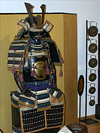
samut (สมุทร)
Thai term for ‘sea’
and thus a synonym of
thalae. However, while samut and thalae both
refer to large bodies of water, samut is a more formal, literary term often
found in classical or official contexts, such as in place names like
Samut Prakan,
whereas thalae is the common, everyday word used in casual conversation. Thalae
can also be used in other contexts, such as in
thalae mek,
meaning a
‘sea of clouds’.
See also
Maha Samut.
回
Samut Prakan (สมุทรปราการ)
Thai. ‘Fortress
at Sea’. Name of
a province (map)
and its capital city in the region of central Thailand, 29 kms south
of the centre of
Bangkok.
READ ON.
回
Samut Sakon (สมุทรสาคร)
Thai-Sanskrit. Literally ‘Ocean Lake’, but
usually translated as ‘Ocean City’. A province (map)
and its capital city of the same name on the
Gulf of Thailand.
READ
ON.
回
Samut Songkhram (สมุทรสงคราม)
Thai. ‘Ocean of war’. Name of a province (map)
and its modern coastal capital in West Thailand, 72 kms southwest of
Bangkok.
READ
ON.
回
Samyan (สามย่าน)
Thai. ‘Three junctions’ or ‘Three
quarters’. Name of a historic district in
Bangkok.
Pronunciation Sahm Yahn.
回
Samyan Mitrtown (สามย่านมิตรทาวน์)
Thai–English. Name of a
large-scale mixed-use urban development on
Rama IV
Road in
Bangkok, situated in the historic
Samyan district near
Chulalongkorn University
(fig.).
The name is a hybrid of Thai and English, combining
Samyan, the historic
district, mitr (มิตร), meaning
‘friend’
in Thai, and town in English, together expressing the idea of a friendly,
community-oriented urban centre. Conceived under the concept of an Urban Life
Library, it integrates food culture, learning spaces, work environments, retail,
cultural venues, and 24-hour facilities within a single, transit-connected
complex. Designed to support contemporary urban lifestyles, Samyan Mitrtown
functions as a community-oriented hub that accommodates students, professionals,
and city residents, while reinforcing the area’s role as a centre of education,
commerce, and everyday urban life. It opened on 20
September 2019 and was built at a cost of around 9 billion baht. In January
2023, a public art installation titled
Kwai: Calm
(fig.),
a
Water Buffalo (kwai)
sculpture by artist Maitree Siriboon (ไมตรี ศิริบูรณ์),
displayed outside Samyan Mitrtown, was destroyed when an intoxicated British
tourist attempted to climb onto it, leaving the sculpture in pieces.
Pronunciation Sahm Yahn Mit Town.
See also TRAVEL PICTURE and
WATCH VIDEO.
回

Sanam Bin Nahm (สนามบินน้ำ)
Thai. ‘Water Airfield’. Name of
an area in
Nonthaburi,
which prior to ca. 1937 AD was used as an airstrip for floatplanes.
Its use declined with the expansion of the
Don Meuang
Airport and the
name is now used to refer both to the area and a major local highway
that runs through it.
回
Sanam Bin Sra Pathum (สนามบินสระปทุม)
Thai. ‘Lotus
Pond Airfield’. Name of a former makeshift airfield located on the
grounds of a horse racetrack at the
Royal
Bangkok Sports Club
in
Bangkok's
Pathumwan District, which was used during
the onset of aviation in Thailand, in
the beginning of the 20th century. It was the first time used for a
flying demonstration on 31 January 1911 by the Belgian pilot
Charles Van den Born
(fig.),
who with a flight in his plane the
Farman
(fig.)
introduced aviation to Thailand. Sra Pathum Airfield was utilized
until March 1914, when the first real airport, i.e.
Don Meuang
International Airport, became operational.
Whereas
the name
pathum
means ‘water
lily’ or ‘lotus’, and
derives from the name of its location, i.e.
Pathumwan (ปทุมวัน),
sra
means
‘pool’ or ‘pond’. See also
Sanam Bin Nahm.
回
Sanam Kilah Haeng Chaht (สนามกีฬาแห่งชาติ)
Thai. ‘National Sports
Field’. Name for the
National Stadium
(fig.)
in
Bangkok.
回
Sanam Luang (สนามหลวง)
1. Thai.
‘Royal Field’.
The
Phra
Meru
(fig.)
field in front of the royal palace, in
Bangkok. On
this large grassland often
kite
flying fights (fig.),
concerts and demonstrations are held, the annual
Royal Ploughing Ceremony (fig.)
takes place and traditionally members of the royal family are cremated (fig.),
which is but a short distance from the palace, where a kings'
remains are lain in state until his body is transported, placed
upright inside a
koht, i.e. a
royal funeral urn (fig.),
by means of a royal funeral procession (fig.)
to the crematorium
(fig.).
In 1948, the first weekend market in Bangkok was established here,
which in 1982 was relocated to its present-day site on Phahon Yothin
Road and renamed the Phahon Yothin Market, which later became the
Chatuchak
Weekend Market (fig.).
See MAP.
回
%20Watthana%20(กัลยาณิวัฒนา),%20Galyani%20Vadhana%202_small.jpg)
2. Thai. ‘Royal Field’. Name of
a royal lawn within the King
Mongkut
Memorial Park
in downtown
Phetchaburi
(fig.),
sometimes referred to as Sanam Luang
Phetburi,
in order to differentiate it from the
Phra
Meru
field in
Bangkok
(fig.).
回
Sanam Supachalasai (สนามศุภชลาศัย)
Thai. Name of the main and oldest
stadium at the
National Stadium
sports complex
in
Bangkok. It
was built in 1937 and named for Navy Captain
Bung Supachalasai (fig.),
Deputy Commander in Chief of the Royal Thai Navy and First Director General of
the Department of Physical Education with the title of
Luang and considered the
Father of Thai Sport,
who overlooked the construction of the National Stadium.
The top of
the gable of the main entrance has a the national tricolour flanked by statues
of
Indra
on
Erawan (fig.),
fashioned after the emblem of Bangkok (fig.)
and in a style reminiscent of
Socialist Realism.
See also TRAVEL PICTURE,
PANORAMA PICTURE, and
POSTAGE
STAMP. 回
_small.jpg)
Sanchi
(साँची)
Hindi. An
important Buddhist site where the emperor
Ashoka,
in the third century BC, had the Great Stupa built which was doubled
in size about a hundred years later.
回
Sanctuary of Truth
See
Prasat Satjathamm.
回
sandalwood
An
aromatic and lightweight kind of wood very suitable for fine
detailed woodcarvings and thus highly popular. Commonly found are
carved sandalwood fans and various Buddhist artifacts. Clubs or
maces made from sandalwood were in the past used to carry out the
capital punishment of high raking officials and royalty, such as the
execution of king
Taksin. Traditionally royal
cremation urns are also made of sandalwood. In Thai, it is called
mai jan
and
dok maijan
(fig.),
artificial flowers made of sandalwood, are used for the ritual
lighting of funeral pyres. There are several kinds of sandalwood,
including Indian sandalwood, white sandalwood, red sandalwood, etc.
Phra Maha Ut
images (fig.)
often have the imprint of one or more sandalwood-flowers
on them, which are a symbol of sammah samphutta (สัมมาสัมพุทธะ),
i.e. the
‘Perfectly
Enlightened One’.
In Thai known as
mai jan
or
mai chan (ไม้จันทน์).
回
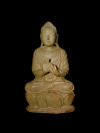
sandalwood flower
See
dok maijan.
回
Sanda Muhki (စန္ဒာမုနိ)
Burmese. Name of an ogress, who −desiring to offer
something to the
Buddha−
offered him her own two breasts. For this radical act of merit, the Buddha
prophesied that Sanda Muhki would be reborn as a future great king and ardent
supporter of Buddhism, who would build a city at the foot of Mandalay Hill.
Since in 1857 AD, King
Mindon Min (fig.)
founded the city of Mandalay, Sanda Muhki is seen
as the latter's earlier incarnation. Of course, the cutting off of female
breasts reminds of the legendary Amazon, whose Greek name Amazona (αμαζόνα)
literally means ‘breastless’, as these forceful Scythian female warriors of
Greek mythology were alleged to have cut off their right breast so as not to
interfere with the use of a bow or a spear.
In Thai, she is known as
nang
yak
Khamukhi
(นางยักษ์ขมูขี). Pronunciation Sanda Muni,
as in
Sanda Muni Phaya.
回
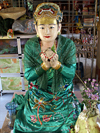
Sanda Muni Phaya (စန္ဒာမုနိဘုရား)
Burmese. Name of a Buddhist temple
located at the foot of Mandalay
Hill (fig.),
which houses
1,772 marble
steles
inscribed with
the
Sutta
(395
slabs);
Vinaya (1,207
slab);
and
Abhidhamma (170
slab), erected in 1913 by the hermit Ukhandi (Ukhan
Tithe) and placed in numerous freestanding
stupas.
The temple is named after
the
ogress
Sanda Muhki
(pronounced Sanda Muni -
fig.), believed to be an
earlier incarnation of King
Mindon Min (fig.),
the
founder of the city of Mandalay, who also created the similar
Kuthodaw Pagoda
(fig.),
a Buddhist temple located nearby which also houses a version of the
Tipitaka and which is sometimes dubbed
the world's largest book.
See also MAP
and
TRAVEL PHOTOS.
回
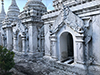
Sandbox Tree
Common name for a large, up to 60 metres
tall, evergreen tree, with the botanical name Hura crepitans and known in Thai
as Phohsri (โพศรี). This monoecious tree has large
ovate leaves and while the red male flowers grow on long spikes, the red
female trumpet flowers with no petals grow solitary on stems. The tree'
spiny trunk gave it the epithet Monkey No-climb Tree. The
pumpkin-shaped
fruit of the Sandbox Tree consists of
crescent-shaped
seeds arranged radially. When ripe, the fruit explodes and the seeds are
catapulted over large distances, often landing several tens of meters away from the
parent tree. The sound of this ballistic form of dispersal, known as explosive dehiscence, led to the tree
also being nicknamed Dynamite
Tree.
回
_small.jpg)
Sand Bubbler Crab
Name of a species of tiny crab of the genus Scopimera inflata and
belonging to the family
Ocypodidae. They don't grow much
larger than a mere 1.5 centimeter (fig.)
and have pincers that point downwards, enabling them to scoop sand
into their
highly adapted mouthparts at
high speed. They
feed on organic matter and microscopic small creatures called myofauna
that are living in the upper layer of damped soil on sandy beaches.
Soon after the tide has exposed the beach these tiny crabs emerge
from small burrows in the sand and start sieving detritus from the
sand. During this process they pass sand particles through their
mouths, filtering the edible elements out and regurgitating unwanted
particles in the form of tiny pellets of sand, which they discard
all over the beach. In Thai, they are called
poo pan saay,
which translates as
‘sand
molding crab’.
Sometimes referred to by the scientific name Dotilla fenestrate. See
also
piyaw and
poo sahaem kaam daeng.
See also WILDLIFE PICTURES (1)
and
(2), and
WATCH VIDEO.
回
%201_small.jpg)
sand ginger
Common name for
a type of rhizome with the botanical name Kaempferia galanga and
known in Thai as krachai dam (fig.),
and one of four species of the genus Alpinia, known in Thai as
krachai.
回
Sand Martin
Common name for
a circa 12 cm long passerine bird in the
swallow family, with the scientific designation Riparia riparia.
Adults are brown above and white below, with a somewhat fainter
brown band on the breast, while the legs are brown and the bill is
black. This species has a wide range, occurring in Europe, parts of
northern Africa, Asia and America in summer, while wintering in
eastern and southern Africa, and parts of southern America and Asia.
It lives near bodies of water and rivers, where it feeds on small
insects, mostly flies whose early stages are aquatic. It breeds in
colonies, typically nesting in burrows bored in the sand on a river
bank (fig.).
Also known as Bank Swallow, Collared Sand Martin, and European Sand
Martin.
See also WILDLIFE PICTURES.
回
_small.jpg)
sandon (สันดอน)
Thai. A sandbank or bar at the mouth of a river,
especially the bar at the mouth of the
Chao Phrya river
in
Samut Prakan,
where
reua khut
(dredgers) with the appropriate name ‘sandon’ can be seen (fig.)
looking after the draught, that is the depth of the river needed to
navigate a ship. See also
don.
回

sand pagoda
See
chedi saai.
回
sang (ซั้ง)
Name for a type of fish trap made from
bamboo
wickerwork with a spiked entrance to prevent the fish from escaping,
once inside.
There are many different models
and shapes. They are usually slightly oval or round and tapering.
Small twigs are placed inside the trap to attract the fish to come and
hide in between them, entrapping them inside. When the trap is recovered
the entrance is shut with some sticks or sometimes with a net.
It is used for entrapping fresh water fish near riverbanks, where
the water is shallow and where it is affixed to the bottom using wooden
sticks. Sometimes called
gram or
glam, or referred
to by its local name or according the type, e.g.
lob,
son,
sai
and
saab.
See also
tum.
回
_small.jpg)
Sang (สังข์)
1. Thai name for
Sankha.
回
2. Thai. Term,
often
used as part of a compound,
that refers to the
Sangha.
回
2. Thai. Name of a
small island off the coast of
Prachuap Khirikhan
Province,
located on the western seashore of the
Gulf of Thailand. It is
situated near Koh
Singh,
roughly between
Pha Fang Daeng, i.e. the ‘Red Cliffs’ (fig.),
and
Koh Thalu
(fig.).
WATCH VIDEO
and
VIDEO (EN).
回
sangbuab (ซังบวบ)
Thai. ‘Fiber gourd’ or ‘cob gourd’.
A name for
luffa.
回
Sangha (สงฆ์, संघ)
Thai-Sanskrit. ‘Multitude’, ‘assembly’ or
‘association’. The community of monks that follow the Buddhist
canon. It is one element of the
Trairat,
together with the
Buddha
and the
Dhamma.
The Thai Sangha is divided into two denominations, i.e. the
Mahanikaya
sect and
Dhammayutika sect, the first one
being the largest with about 35 times as many
monks.
回
Sangharama (सङ्घाराम)
1. Sanskrit term for a Buddhist temple or
monastery, literally the arama or
araam of the
Sangha,
i.e. the community of Buddhist
monks.
回
2. Sanskrit. Buddhist name of
Kuan U sometimes used
after his death and his deification
as a
bodhisattva
and the guardian of the
dharma.
回
_small.jpg)
Sanghavasa (संघवस)
Sanskrit. The monks quarters in a Buddhist temple complex.
回
sang-i (囍, ซังฮี้)
Chinese-Thai. ‘Double happiness’. A Chinese
sign or character often used during weddings (fig.)
to express the happiness that the new couple may befall. The word
sang means ‘double’ or ‘couple’ and i means ‘happiness’. In Pinyin,
also transcribed xĭ, and in English sang hee or sang-hi. See also
foo.
回
囍
Sangkayana (สังคายนา)
Thai-Pali. Grand Council held by the Buddhist
Sangha for
the purpose of revising the
Tripitaka.
There was one held in
Chiang Mai
in 1477 AD. Also called
Sangkayanai.
回
Sangkayanai (สังคายนาย)
See
Sangkayana.
回
Sangkalok (สังคโลก)
Chinese pronunciation for
Sawankhalok.
Also Sangkhalok.
回
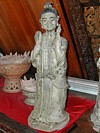
sangkhaathi (สังฆาฏิ)
Thai. A yellow or orange piece of additional clothing folded in a
very particular way into a rectangle and worn by monks over the left
shoulder during religious services inside the monastery or temple
and as protection against the cold, a kind of winter cloak worn by
monks on their robes, yet normally folded over the left shoulder in
Buddhist ceremonies. It is one of three pieces of cloth called the
traijiewon.
Also transliterated sangkaati.
回
Sangkhalok (สังคโลก)
See
Sangkalok.
回
Sangkhlaburi (สังขละบุรี)
Thai. Name of an
amphur
in the northern part of
Kanchanaburi
province with a population of around 40,000 inhabitants.
It has a lot of natural attractions such as waterfalls, rough
jungle and the Khao Laem reservoir which flooded
the local valley as well as parts
of the former city and today still reveals the
old half-sunken temple (map
-
fig.).
The western part of town, across the wooden
Mon bridge (map
-
fig.)
that connects the Thai village of Sangkhlaburi with the
local Mon village, consists largely of rafthouses
built on the water. It is one of the few places in
Thailand where the people, dressed in
longyi (long
Burmese-style
sarong)
and often with their faces covered in
thanaka
powder, can be seen carrying goods on the top of their
head, without using their hands. Also on the Mon side is
Wat Wang Wiwekaram,
a Buddhist temple in a mixture of Thai, Burmese and Indian styles and with its
satellite
pagoda built in the style
of the Mahabodhi pagoda in
Bodhgaya (map
-
fig.).
Sangkhlaburi is the last town before reaching the border with Burma at the
Three Pagoda Pass
(fig.),
and along the main road
into town is
Wat
Somdet
(วัดสมเด็จ), a temple with features on either way of the road, including an old
ubosot
that has
Buddha images
sitting on each of the window sills, on the outer side; a square
wihaan
with a pointed roof
(map
-
fig.);
a few
chedis;
a row of Buddha images (fig.); as well as a giant
reclining Buddha (fig.).
Sometimes transcribed
Sangklaburi. It was formerly named Wang Ka.
回
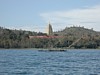
Sang Praeng (สางแปรง)
Thai-Pali name of a mythological
creature from
Himaphan forest, that
has the body of a
singha,
with clawed feet and a feathery tail. Its body is sometimes depicted with scales
and in a yellow colour.
Also transcribed Saang Praeng or sometimes Sang Prang. In appearance it is
somewhat similar to
Sakun Kraison, which
besides claws and a feathery tail, also has a beak, and is of a brown colour.
回
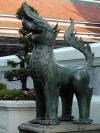
sangsarawat (สังสารวัฏ)
Thai
term for
samsara.
回
Sangthong (สังข์ทอง)
Thai. ‘Golden
Conch’. Name
of a hero from a
traditional Thai story of the same name, who is usually
referred to as Prince
Phra Sang.
The prince had a body of gold and married
Rochana
(fig.),
the daughter of King
Samon.
To avoid unwanted attraction to his golden complexion, Prince Sangthong
disguised himself as
Chao Ngo (fig.),
an ogre (fig.)
with characteristics of members of the
Ngo Tribe,
i.e. with a black complexion and curly hair (fig.).
The folk narrative is written in dramatic verse by King
Rama II and
has also been adapted
for stage performance, while
it also appears in the Panyas
Jataka Stories where it is known by the name
Suwana
Sang
Jataka.
It is popular in southern Thailand in the form of a narrative
written for chanting. There are several
Thai postage stamps that portray characters and scenes from the
story Sangthong, e.g. a 1973 stamp in a set of four stamps on Thai
literature (fig.),
while two complete series of stamps have been dedicated to the
theme, the latest one issued on the 2010 National Children's Day (fig.).
Also commonly called
Hoi
Sang, sometimes
transcribed Sang Thong, and reminiscent of
kumaanthong.
See POSTAGE STAMPS (1),
(2), and
(3),
THEMATIC STREET LIGHT,
and
TRAVEL PICTURES.
MORE ON THIS.
回
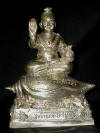
Sangwaan Talaphat (สังวาลย์ ตะละภัฏ)
Thai. Name of the Princess Mother, i.e. the
mother of both King
Bhumipon Adunyadet (fig.)
and his older brother
King
Ananda Mahidol.
She is officially known as
Princess
Sri Nagarindra.
回
Sankha
(शङ्ख)
Sanskrit. ‘Conch [of victory]’. An attribute
of several gods (fig.)
and the instrument used by
Vishnu
to herald his victories over
the demons. It is also a symbol for the primordial sound
Aum and is also
present in Buddhism. It is seen during certain festival, especially
in
Hinduism (fig.).
In Thai
Sang
and
Phrasong.
回
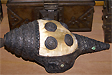
sa-noo (สะนู)
Thai term referring to the humming
bow sometimes attached to traditional Thai kites. It is one of several regional
names for this component, also known as oot (อูด) in certain local dialects and
sometimes transliterated as sanu. The term is derived from the Thai word thanoo
(ธนู), also spelled thanu, which means ‘bow’. The humming bow is occasionally
simply referred to by this root name as well. It is typically crafted from a
bent bamboo slat with a fibre string stretched across it like a bowstring. It is
affixed to the front of the kite’s frame (fig.).
As the kite soars through the air, the airflow and tension cause the bow to
vibrate, producing a distinctive humming or whistling sound. This sound is a
hallmark of many traditional Thai kites, particularly those flown in central and
southern Thailand. See also
waw doei-doei,
toei-toei,
kite flying and
WATCH VIDEO.
回
sanook (สนุก)
Thai word meaning ‘entertaining, amusing, pleasant, enjoyable, to
have a good time, to be vivacious and to enjoy’ as an adjective, and
‘entertainment, amusement, pleasure, enjoyment, a good time, fun and
joy’ as a noun. Also sanook sanahn (สนุกสนาน), and also
transcribed sanuk and sanuk sanan.
In
Isaan,
the term for sanook sanahn is
muan seuhn.
回
Sanphat (สรรพัชญ์)
Thai. ‘The All-knowing’, a nickname for the
Buddha. Also
Sanphet.
回
Sanphet (สรรเพชญ์)
1. Thai. ‘The All-knowing’, a
nickname for the
Buddha. It
is integrated in the name of the temple
Wat Phra Sri Sanphet
in
Ayutthaya (fig.).
Also
Sanphat.
回
2. Thai. ‘The all-knowing, he who knows everything’. Crown titles
for nine monarchs of the
Ayutthaya Period, starting with King
Maha Dhammarachathiraat (fig.), with the title
Somdet
Phra
Sanphet Thih I (สมเด็จพระสรรเพชญ์ที่ ๑); followed by King
Naresuan (fig.),
with the title
Somdet Phra Sanphet Thih II; King
Ekathotsarot
(fig.),
with the title
Somdet Phra Sanphet Thih III; King Sri Saowaphak (ศรีเสาวภาคย์),
with the title
Somdet Phra Sanphet Thih IV; King
Prasat Thong
(ปราสาททอง),
with the title
Somdet Phra Sanphet Thih V; King Chai (ไชย),
with the title
Somdet Phra Sanphet Thih VI; King Sri Suthammaracha (ศรีสุธรรมราชา),
with the title
Somdet Phra Sanphet Thih VII; King Suriyenthrathibodi (สุริเยนทราธิบดี),
with the title
Somdet Phra Sanphet Thih VIII;
and
King Thaisa (ท้ายสระ),
with the title
Somdet Phra Sanphet Thih IX.
回
Sanshiliu
Tiangang (三十六天罡)
Chinese.
‘Thirty-six Celestial Guardians’. Name of are a group of divine
warrior-spirits in
Taoist
cosmology, revered as powerful protectors of the heavenly order and guardians of
the spiritual realm (fig.). Each Guardian presides over a distinct celestial domain or
spiritual function and is often depicted seated upon a symbolic animal—real or
mythical—that reflects their unique attributes and powers. These Guardians serve
as enforcers of cosmic balance, defenders against evil forces, and patrons of
Taoist rituals, especially in contexts involving exorcism, alchemy, and astral
protection. Closely linked to the ancient Chinese system of astrology and star
worship, the 36 Celestial Guardians are sometimes understood as the
personifications of the 36 Heavenly Stars, complementing the 72 Earthly Fiends,
known as Qishi'er Disha (七十二地煞) in Taoist magical traditions, and together
represent powerful celestial and terrestrial forces in Taoist cosmology,
astrology, and martial folklore. In temple art and ceremonial texts, the 36
Celestial Guardians are venerated for their martial strength, spiritual
authority, and unwavering commitment to upholding the
Tao
across all realms.
WATCH VIDEO (1)
and
(2),
VIDEO
(E1) and
(E2).
回

Sanskrit (संस्कृत)
An ancient language from India meaning ‘pure’. Etymologically it is of
Indo-European origin and is used in the sacred texts of
Hinduism. In Buddhism it is the language of
Mahayana
Buddhism compared to
Pali,
that is used in
Theravada
or
Hinayana
Buddhism. Its position in the cultures of South and Southeast Asia
is similar to that of Latin and Greek in Europe and its influence on
Thai is significant. Sanskrit uses the
Devanagari
script. It is sometimes referred to as
deva-bhasa,
meaning ‘divine language’. The name is derived from the word
Samskrtam and may be translated as ‘well put together’, ‘refined’ or
‘highly elaborated’, but is also
translated ‘pure’. It comes
from the root samskar, meaning ‘to put together’ or ‘to compose’. It
is also called Samskrtaa Vaak,
meaning ‘Sanskrit Speech’, but which is often translated as the
‘Cultured Language’. In
Thai called
Phasa Sanskrit.
回
Santa Cruz Church
Name of a Catholic church, located on the
western bank of the
Chao Phraya
River, in
Thonburi.
READ ON.
回
santi (สันติ)
Thai word meaning
‘peace’,
‘peaceful’,
‘peacefulness’,
‘tranquility’,
‘quietness’,
‘calmness’.
回
Santi Khiri (สันติครีรี)
Thai. ‘Peaceful Mountain’. Nickname
for
Doi Mae Salong.
回
santol
Western name for
krathon.
回
san tou liu bi (三头六臂)
Chinese.
‘Three heads six arms’. Iconographic style,
especially used in
Taoist
religious art, in which a certain deity is depicted with three heads
and six arms (fig.),
to indicate his or her great power. Since the term is used to
describe
a being of formidable powers,
it is also
used an idiom for someone who possesses remarkable abilities.
回
_small.jpg)
sao (เสา)
Thai word meaning ‘pole’, ‘post’, ‘pillar’,
‘shaft’, and ‘shank’.
回
Sao Fah Din (เสาฟ้าดิน)
Thai.
‘Pillar
of Heaven and Earth’.
Term for a freestanding wooden spirit post typically found in
open-air settings, especially at Chinese shrines, where it is
typically adorned with
dragons
coiling around it.
The pillar symbolizes the connection between heaven and earth and
represents divine protection, strength, and the harmonious flow of
energy between the celestial and earthly realms. The Pillar of
Heaven and Earth is believed to be the place where the
Jade Emperor,
the supreme ruler of all gods in Chinese mythology, delivers royal
commands from heaven to the human world. The dragons, regarded as
auspicious symbols, channel blessings and fortune to worshippers. As
a focal point for rituals and offerings, the pillar acts as a bridge
between the spiritual and human worlds, invoking prosperity,
balance, and protection.
WATCH VIDEO.
回
_small.jpg)
Sao Hah (เสาร์ ๕)
Thai.
‘Saturday Five’.
Term for a particularly auspicious day in Thai culture, celebrated
when the 5th day of the 5th lunar month coincides with a Saturday.
This rare alignment is considered to hold special significance due
to its numerical symbolism. The number five is traditionally
associated with good fortune and positive energy in Thai astrology
and Buddhist beliefs. This day is viewed as an ideal time to start
fresh, as it marks a moment of spiritual renewal and an opportunity
for a new beginning. It is believed to be especially powerful when
it falls on a Saturday, as Saturday is traditionally linked with
Saturn, the planet associated with wisdom, strength, and the ability
to overcome obstacles. The
‘Saturday
5’
is thus seen as an incredibly auspicious moment to harness the
energies of the cosmos to enhance one's life, attract prosperity,
and seek protection from evil forces. In Thai Buddhist tradition,
the day is often observed with ceremonies aimed at invoking
blessings, improving one's destiny, and gaining wealth and success.
These ceremonies may include rituals like lighting sacred candles,
making offerings to monks, and prayers for protection and prosperity.
回
sao inthakhin (เสาอินทขีล)
Thai.
‘Barrier post’ or ‘guardian pillar’. Another name for
lak meuang,
i.e.
the
City Pillar,
in which the guardian spirit of a city dwells. Also transliterated
sahw inthakin.
WATCH VIDEO.
回
sao nang jaran (เสานางจรัล)
Another term for
sao nang riang.
回
sao nang naeb (เสานางแนบ)
Thai. ‘Adjacent lady poles’. Architectural term for
decoratively carved, quadrangular, stone pillars, placed at the porch or roofed
entrance of certain structures in
Khmer style, such as
prasat hin, and which aid in the support of the
porch's roof. They can be either monolithic or compounded of several stone
blocks.
回
_small.jpg)
sao nang riang (เสานางเรียง)
Thai. Term for
a distinctive type of architectural element found in
Khmer
prasat hin
architecture, particularly along the processional or royal walkways leading
toward major sanctuaries. These features consist of regularly spaced stone
pillars topped with
lotus-bud
finials, conceptually derived from ceremonial lanterns or lamp-posts that once
illuminated ritual pathways. In later interpretative traditions, these pillars
acquired a symbolic association with celestial beings: they were conceived as
representing
Apsaras
(fig.)
standing in orderly rows to welcome the king or devotees approaching the
sanctuary. Morphologically, the pillars are typically square in section and
often exhibit a slight concave waist, lending them a graceful, anthropomorphic
quality consistent with their later symbolic interpretation. Their
lotus-bud
capitals retain the angular contours of the shaft beneath, forming the
characteristic square
lotus
motif seen from the 9th century pre-Angkorian
Bakong (បាគង) style onward. Also
known as
sao nang
jaran.
回
%202_small.jpg)
Saopha
(စော်ဘွား)
Burmese.
‘Lord of the Skies’. A royal title used by the hereditary rulers of the
Shan
States of
Myanmar.
It is the Burmese equivalent of the Thai title
Chao Fah.
回
Sao Sanom (สาวสนม)
Thai. ‘Youthful Concubine’. Name
of a perennial plant in the family Burseraceae, with the botanical
designation Santiria griffithii, and which grows up to 10
centimetres in height. Its main stem is sparsely covered with hair
and it has thin leaves that usually spread along the ground. The
flowers consists of three purple petals and three yellow stamens.
This species thrives well in the cracks of rocks and is usually
found deep in the forest.
It is depicted on a postage
stamp issued in 2009 as part of a set of four stamps on wild flowers
found in Thailand (fig.).
It is also found in Indonesia,
Malaysia, and
Singapore.
回
Saovabha (เสาวภา)
Another
transliteration for
Saowapha.
回
Saowapha (เสาวภา)
Thai. A
wife of
Rama V
and mother to
Wachirawut,
who as the eldest son of this queen ascended the throne as
Rama VI
(fig.)
in 1910.
She was also the mother of
Prajadhipok
(fig.).
Her full name is Saowapha Phongsri and was born as
the daughter of King
Mongkut
and his Consort
Queen Piyamawadi
Sri Phatcharinthra Mata (ปิยมาวดี
ศรีพัชรินทรมาตา), and was hence a full sister of both Queen
Sunandha Kumarirat
(fig.)
and Queen
Sawang Watthana.
She was eventually bestowed
with the title
Queen Mother of Thailand by King
Rama VII
and
is also referred to as
the Queen Regent.
She was born on
1 January 1864 AD and passed away at the age of 55 on 20 October
1919.
Her name is usually transliterated Saovabha, and she is
also known by the name Sri Phatcharinthra (ศรีพัชรินทรา), which is
sometimes transliterated Sri Bajrindra. The
Queen Saovabha Memorial
Institute
in
Bangkok
(fig.),
which also houses the capital's
Snake Farm
(fig.),
is named after her. See also
Pig Memorial
and
POSTAGE STAMPS (1),
(2) and
(3).
回
_small.jpg)
Saowaphak Narirat (เสาวภาคย์ นารีรัตน์)
Thai. Name of a
royal consort
of King
Chulalongkorn.
She was born as Piu Ladawan (ปิ๋ว ลดาวัลย์) on 26 January 1854 AD.
On 15 April 1873, she bore
King
Rama V
a daughter, who was named Chandra Saradavara and bestowed with the title
Princess of Phichit.
Saowaphak Narirat passed away at the age of 33, on 21 July 1887.
She has
a memorial at
the Royal Summer
Palace (fig.) in
Bang Pa-in.
回
_small.jpg)
Sapaakahchaad Thai (สภากาชาดไทย)
Thai name for the
Thai Red Cross Society.
回
saphaan (สะพาน)
Thai for ‘bridge’. Also
transcribed sapaan and saphan. Some of the more important bridges
in Thailand include the
Industrial Ring Road Bridge
(fig.),
i.e. the largest bridge
in the Kingdom; the Thai-Lao Friendship Bridge
(fig.);
Krung Thon
Bridge (fig.);
Memorial Bridge
(fig.);
Rama VIII Bridge (fig.);
Rama IX Bridge (fig.);
Kanchanaphisek Bridge
(fig.);
the
Bridge over the River Kwae (fig.);
and the wooden bridge of Sangkhlaburi (fig.),
said to be the longest of its kind in Thailand.
回
Saphaan Atsadaang (สะพานอัษฎางค์)
Thai. Name of a jetty in the
sea, located at the former
Royal Summer Palace
on Koh Si Chang,
in
Chonburi
Province.
READ ON.
回
Saphaan Charoenrat 32 (สะพานเจริญราษฎร์ ๓๒)
Thai.
‘Prosperity 32 Bridge’.
Name of an arched
bridge that spans
Khlong Maha Naak.
READ
ON.
回
Saphaan Chonlamarkwithi (สะพานชลมารควิถี)
Thai.
‘Chonlamarkwithi
Bridge’.
Name of
a stunning coastal bridge in
Chonburi.
It was built to improve connectivity between the coastal towns of Bang Saen (บางแสน)
and Ahng Silah (อ่างศิลา) and completed in 2010, to help ease traffic congestion
in Chonburi's city centre. Spanning approximately 6 kilometres, the bridge
offers a vital link during weekends when many day tourists from Bangkok head to
the ever-popular Bang Saen Beach (fig.),
while providing breathtaking panoramic views of the sea, especially captivating
at sunset.
WATCH VIDEO
and
VIDEO (EN).
回

Saphaan Kwai (สะพานควาย)
1. Thai.
‘Buffalo
bridge’.
Name of an area in
Bangkok, named after its
local history. In the past, the area was farmed and there was a great need for
water buffaloes
to work the fields. Hence, a wooden bridge was built over a local canal
to allow buffalo traders to send their animals to the area. Also commonly
transcribed Sapaan Kwai and Saphan Khwai,
or similar.
See also
kwai
and
saphaan.
回
2. Thai.
‘Buffalo
bridge’. In the past, when the land and roads
upcountry got flooded during the rainy season, it was common practice to connect
dry areas of land by making a live bridge, formed by
water buffaloes.
The people would then cross the flooded area by walking over the buffalos'
backs.
Also transcribed Sapaan Kwai and Saphan Khwai,
or similar.
See also
kwai
and
saphaan.
回
%20buffalo%20bridge%201_small.jpg)
Saphaan Phon Phracha (สะพานพรประชา)
Thai.
Name of an arched and partly
covered
bridge that spans the
Tha Chin River
in
Suphanburi,
and connects the main road towards
Chainat to
the Sam Chuk City Office and
the adjacent Sam Chuk Market (fig.), which is also known as
Talaat Roi Pih, i.e.
the ‘100-Year
Old Market’,
because this old-fashioned Chinese
community market, complete with wooden shop houses, has retained its authentic
Thai character from a century ago. The bridge has a road and staircases for
pedestrians on either side of it.
This
type
of arched
viaduct with a roof is rather unique
for Thailand, yet similar to a
style
of pedestrian bridges commonly used in
Myanmar,
especially around
Inle
Lake (fig.),
and is also somewhat reminiscent of the Wind and the Rain Bridges (fig.)
found in southern
China (fig.).
See MAP.
回
sapodilla
See
lamut.
回
sapparot (สับปะรด)
Thai term for
‘pineapple’.
回
sappaya (สัปปายะ)
Thai term
that means ‘a condition that is suitable for living or carrying out
various activities with good results, consisting of the four factors
from Thai
Buddhism
and known as
patjai sih, and dialogue, with the
former encompassing the 4 things that are necessary for human life,
e.g. food, medicine, clothing and housing’.
See also
sabai.
回
Sappayasaphasathan (สัปปายะสภาสถาน)
Thai compound name
that consists of the words
sappaya, i.e.
‘a
condition suitable for living created by dialogue’;
sapha (สภา),
meaning
‘council’
or ’body’;
and
sathan,
which translates as
‘place’
or
‘location’.
It is the name for the
Thai Parliament
Building (fig.)
in
Dusit,
located along the
Chao Phraya
River in
Bangkok,
and in short referred to as
Ahkaan Rattasapha.
Also transliterated
Sappaya-Saphasathan, Sappaya-Saphasathaan and
Sappayasaphasathaan.
回
Sapria
Name for a genus of parasitic flowering
plants (fig.),
found in the tropical forests of South and Southeast Asia and that attach
themselves to the roots of a host vine, specifically plants of the genus Vitis
and Tetrastigma, the latter also being the sole host for parasitic species of
the
rafflesia. Sarpia flowers
are approximately 20 centimeters in diameter and have ten lobe-like petals,
which are bright red in colour, with either yellowish or white dots. There are
just three species, which all occurs also in Thailand, namely Sapria himalayana,
Sapria ram and Sapria poilanei. In Thai, they are generally referred to as
krathohn reusih (กระโถนฤๅษี), i.e. ‘reusi's
spittoon’, whereas the different species are known separately as krathohn phra
reusih (กระโถนพระฤๅษี) or ‘phra
reusi's spittoon’, krathohn
Phra Ram
(กระโถนพระราม) or ‘Rama's
spittoon’, and krathohn
nang sidah (กระโถนนางสีดา),
or ‘lady
Sida's
spittoon’, respectively.
回
Sapta Matrika (सप्तमात्रिरिका)
Sanskrit.
‘Seven Mothers’. Name for seven goddesses
that are worshipped in South India and that are believed to wield great power.
They are usually depicted standing or seated alongside each other, each one
dressed in a
traditional
saree
of a different colour.
WATCH VIDEO.
回
Sapta Sindhava (सप्तसिन्धव)
Sanskrit. Term referring to the seven great
rivers mentioned in the
Vedas,
i.e. the
Ganges,
Jumna,
Sarasvati
(now replaced by the small
present-day Sarsuti river that joins the Ghaggar river), Satlej,
Parushni, Marudvridha and Arjikija. Those are the five rivers of the
Punjab along with the Sarasvati, which has since disappeared, and
the Indus. Sometimes the term refers to the seven great world seas.
See also
panjanatie.
回
Saptatathagata
(सप्ततथागत)
Sanskrit. Compound term derived
from sapta, meaning
‘seven’
and Tathagata, meaning
‘Thus-Gone’
or
‘Thus-Come’,
an honorific epithet of a
Buddha, denoting a
canonical grouping of seven
buddhas recognised within
Buddhist traditions. The term conventionally refers to a sequence of past
Buddhas culminating in
Gautama Buddha, and is
particularly prominent in early Buddhist and
Mahayana textual and ritual
contexts, where these figures are invoked collectively as exemplars of
Enlightenment across successive cosmic
ages. The concept underscores the cyclical nature of time and the recurring
manifestation of Buddhahood, reflecting the doctrinal view that awakened beings
arise repeatedly to rediscover and teach the
Dharma.
They are usually referred to as the
Seven Buddhas
of Antiquity.
回
Saraburi (สระบุรี)
Thai.
Name of a province (map)
and its capital city in Central Thailand, 110 kms north of
Bangkok.
READ
ON.
回
sarai (สาหร่าย)
Thai term for
‘seaweed’.
回
sarai phuang a-ngun
(สาหร่ายพวงองุ่น)
Thai. ‘Clustered grapes
seaweed’. Name for a kind of edible green algae from the coastal
regions of the Indo-Pacific, with the scientific designation
Caulerpa lentillifera. It grows in small clusters on a stem as tiny,
soft and succulent bubbles. In English, it is known as sea-grapes or
grape algae and is sometimes referred to as green caviar.
回
_small.jpg)
sarai ruang peung (สาหร่ายรวงผึ้ง)
Thai. ‘Seaweed honeycomb’.
Architectural term for a decorative part, sometimes attached over
doorways or windows of traditional buildings, such as temples or
palaces. It consists of triangular pieces of carved wood, that seem
to droop like jelly or seaweed (sarai) from the lintel on which it
is attached, and with a form and pattern that is reminiscent of
honeycombs (fig.)
that hang from a tree branch (fig.),
roof's edge or eave, hence the name.
回
%201_small.jpg)
saranae (สะระแหน่)
Thai umbrella name for various mint plants, such as Mentha cordifolia, an
edible, aromatic herb commonly known as ‘marsh mint’ and ‘kitchen mint’, and
Melissa officinalis, which is commonly known as ‘lemon balm’ or ‘balm mint’.
Whereas both
plants have small, bright green, serrated leaves,
Mentha cordifolia
has purplish-brown stems,
while Melissa officinalis has green
stems.
Both
species are
used in Thai
cooking, but also eaten fresh or used as garnish. It is also
the source of menthol, a mint-tasting organic alcohol found in its oil, and used
as a flavouring as well as to relieve local pain. Saranae is also used for the
terms
‘mint’ and ‘peppermint’, which typically refers to certain extracts
of the plants from either species.
回
%20saranae_small.jpg)
saranai
A
Cham-wind
instrument, sometimes referred to as the Cham oboe. In Vietnamese, it is called
kèn saranai, with kèn being a similar, yet Vietnamese wind instrument, with a
double reed and a conical wooden body, which in turn is reminiscent of the North
Indian shehnai.
The saranai plays an important role in traditional orchestras of the Cham
people, and is used on many occasions, such as festivals and funerals. It
consists of three main parts, i.e. 1. the reed, made from a palm leaf of a tree
with the botanical name Corypha saribus, and attached to a small metal pipe; 2.
the body, a hollow wooden cylinder, which tapers soemwhat towards the end and
with eight holes, of which seven are placed in a straight line and at equal
distances from each other, and the eighth hole at the end on the opposite side
of the last of the seven holes; and 3. the bell, made of precious wood and which
gradually gets bigger. It is the Cham counterpart of the Thai
pih.
回
_small.jpg)
Saranatrai (สรณตรัย)
See
Traisarana.
回
saraphi (สารภี)
Thai name for a flowering shrub or small
tree, classified in the family Calophyllaceae and with the botanical
designations Mammea siamensis and
Ochrocarpus siamensis. It is endemic
in
Thailand,
but also occurs in other countries of mainland Southeast Asia, such as Laos,
Cambodia and
Vietnam. In southern Thailand, it is referred to as sroiphi
(สร้อยภี), which is pronounced soiphi.
This evergreen tree bears small oval fruits
and blooms
fragrant yellow or white flowers.
回
Saranrom (สราญรมย์)
Thai.
Name of a former palace in
Rattanakosin,
which in full is generally referred to as
Phra Rachawang
Saranrom, i.e. ‘Saranrom Palace’.
READ ON.
回
Sarasvati (सरस्वती, สรัสวดี)
1. Sanskrit. The
Hindu
goddess of art and
learning.
READ ON.
回
2. Sanskrit-Thai. Name of a former river in India, part of
the
Sapta Sindhava
and of which the goddess Sarasvati was originally a personification. When the
river dried up in a desert, as mentioned in the
Mahabharata, the
goddess in question developed an independent identity and got a new meaning.
Today the Sarasvati has been replaced by a small river that joins the Ghaggar
river and is called Sarsuti.
回
Sarawat Thahaan (สารวัตรทหาร)
Thai for ‘Military Police’, against
thahaan sarawat
which means ‘military policeman’.
Each branch of the Thai armed
forces has its own military police force, all abbreviated สห (SH), initials that
stand for สารวัตรทหาร (Sarawat
Thahaan). See also
Royal Thai Police.
回
_small.jpg)
saree (साड़ी)
Hindi. Name for the traditional dress worn by girls and
women in India, as well as in Nepal, Sri Lanka, Myanmar, Malaysia, Bhutan, and
Bangladesh. It consists of a lengthy colourful piece of unstitched cloth, often
decorated with glittery flecks and bands, and which is wrapped around the waist
and draped over the shoulder. The small glittery mirror-like ornaments stitched
on the outside not only reflect the sunlight, but are also meant to turn away
evil and bad luck, similar to the mirrors placed over doorways in India (fig.).
It is typically between 5 and 6 meters long and the loose end of the saree can
also be used to cover the head to act as a headscarf or as a ghunghat (घूँघट),
i.e. a ‘veil’. Also transliterated sari or sarih. Compare with
kurta
(fig.).
回
%201_small.jpg)
Sareungka Matsaya (ศฤงคมัสยา)
Thai-Sanskrit. Name of a mythological
creature, described as a magical
fish
with a unicorn, i.e. a single
horn, on its forehead.
READ ON.
回
sarikah lin thong (สาริกาลิ้นทอง)
Thai. ‘Golden-tongue
Myna’. Name of a kind of
bird-shaped charm, either in the form of an
amulet
or a
talisman,
as a kind of
takrut,
a scared
tattoo,
or printed on a
pah prachiad,
usually in combination with
yan-signs
and a
kata (or sacred
script), and is hence also referred to as yan sarikah. As an amulet, it
often appears as a pair of birds, usually in a rather simple shape, e.g. carved
from wood in a rough way and
typically with some
yan-signs
written on it (fig.),
and −if as a pair− often tied together with a small piece of
cloth in several different colours and known as
pah phrae mongkon.
Also transcribed sarika lin tong and often shortened to just sarikah or sarika.
See also
nok ihyang sarikah.
回
%20sacred%20bird%20tattoo_small.jpg)
Sariputta (สาริพุทธา)
Pali-Thai. Name of a wandering ascetic monk
who, when he encountered the teachings of the
Buddha,
became one of his chief disciples and one of the
Ten Principal Disciples. He often preached the
Dhamma and
was given the title Dhammasenaapati, i.e. ‘General of the Dhamma’.
He is regarded as the founder of the
Abhidhamma
tradition. Sariputta died on a full moon, just a few months before
the Buddha, and having achieved
parinippahn.
In Burmese religious art he is usually depicted together with
Mogallana
(fig.),
seated in front of a Buddha image. In Thailand he is more likely
seen in a standing pose, also in front of Buddha images. In Sanskrit
Sariputtra.
回
Sariputtra (शारिपुत्र,
สารีบุตร)
Sanskrit-Thai for
Sariputta.
回
Sarnath (सारनाथ)
Location, also known as
Isipatana, near Varanasi in North India, where
the
Buddha
held his first
public discourse
after he had
attained
Enlightenment. This first
sermon was
given to the
panjawakkie
or five ascetics in a deer park.
Formerly named
Mrigadava.
See also
dhammachakka.
See
MAP.
回
sarong (โสร่ง)
Thai. Garment consisting of a
waistcloth hanging from the hips, as worn in India and in some
countries of Southeast Asia. In Thailand the pattern of a sarong
often indicates which part of the country one comes from. Girls may
wear a similar waistcloth called
phah thung
(fig.).
Burmese style sarongs are usually longer than those worn in
Thailand. See also
longyi
(fig.),
pah nung
and
sabong.
回
sarsom (सरसों)
Hindi for ‘mustard’, i.e. oriental mustard plants of the
genus Brassica juncea, a plant related to the edible Brassica campestris,
commonly known as Cantonese vegetable or Chinese mustard cabbage (fig.),
and in Thai as
phak kwahng tung.
The seeds of the Indian mustard plant can be prepared into mustard, as well as
into mustard oil, while its leaves can be eaten as mustard greens. Many parts of
northern India Indian mustard plant fields, as oriental mustard is said to
originate from this region, i.e. the foothills of the
Himalayas (fig.).
The plant and its flowers are confusingly similar to those of rape or rapeseed,
another member of the family Brassicaceae, with the botanical name Brassica
napus and a leading source in the production of vegetable oil.
回
%202_small.jpg)
Sarus Crane
Common name for a species of crane, with the scientific
designation Grus antigone. Standing 152 to 156 centimeter tall, the Sarus Crane
is the tallest flying bird in the world. It is found in parts of South and
Southeast Asia, as well as of Australia. It is easily distinguished from other
cranes by its overall grey colour and the bare red head and upper neck, which
often also has some black, and the pale to greyish crown (fig.).
Its legs are pinkish-grey. In India, this bird is honoured as a bearer of good
fortune (fig.).
Sarus Cranes pair for life and their faithful nature has led them to be
venerated as symbols of marital bliss. To help strengthen their partnerships the
cranes perform elegant courtship dances.
See also WILDLIFE PICTURES.
回
_small.jpg)
Sarvanivarana Vishkambhin (सर्वनिवारणविष्कम्भिन्)
Sanskrit. ‘Every Hindrance Obstructing’ or
‘Every Obstacle Impeding’. Name of the mediator
bodhisattva, who
is one of the
Eight Great Bodhisattvas.
READ ON.
回
satahban (สถาบัน)
Thai for an institution for higher education.
See
education.
回
Satahban Kukrit (สถาบันคึกฤทธิ์)
Thai name for the Kukrit Institute, which is
named after the former Thai Prime Minister,
Momratchawong
Kukrit Pramoht, whom in
2009 was named as a World Historic Important Figure by UNESCO. The project to
build the institute was begun generating power to celebrate the 100th anniversary of M.R.
Kukrit’s birth on 20 April 2011, the day on which the
institute was officially opened to the public by Princess Maha
Chakri
Sirindhorn,
and which was also commemorated by issuing of a set of four postage stamps on
M.R. Kukrit Pramoht (fig.).
The institute is located on a 3,500m²
plot of land owned by the Treasury Department, and which is part of a public
park near
Bangkok's financial district. The institue celebrates the life of this
extraordinary man and features his achievements both in politics and in society.
See also
Kukrit Heritage Home and
MAP.
回
%201_small.jpg)
satang (สตางค์)
Thai. The satang is Thai currency equivalent
to one-hundredth part of a
baht.
Existing coins are the
silver coloured coins of 1, 5 and 10 satang,
and the brass coloured coins of 25 (fig.)
and 50 satang (fig.),
although only those of 25 and 50 satang are circulated. See also
tambun sai
baat (fig.)
and
satang roo.
回
%202_small.jpg)
satang roo (สตางค์รู)
Thai. Name for a
satang coin from the
reign of
Rama
V (fig.),
which had a round hole
in the center in
order to string them together to create a higher value or easily carry them
around in bulk (fig.).
On one side a
chakra (fig.),
a weapon of
Vishnu
(fig.) and an
element on the coat of arms
of the
Chakri
Dynasty
(fig.), is embossed.
Compare with
fang kong qian,
ancient Chinese coins (fig.).
回
_small.jpg)
Satanih Klahng Krung Thep Aphiwat
(สถานีกลางกรุงเทพอภิวัฒน์)
Thai.
‘Bangkok
Prosperity Central Station’
or ‘Bangkok Revolutionary
Central Station’ (fig.).
New name granted by
King
Rama X
for the
Bang Seu Grand Station
in September 2022, on the request of the
Cabinet Secretariat,
while
additionally, the
Royal Household Bureau has informed the Cabinet Secretariat that the King also
named the State Railway of Thailand’s (SRT) Light Red Line commuter train route,
that runs from Bang Seu (บางซื่อ) to Taling Chan (ตลิ่งชัน), Nakhon Withi (นครวิถี),
whereas the Dark Red Line commuter train route, linking Bang Seu (บางซื่อ) and
Rangsit (รังสิต), received the official name Thani Ratthaya (ธานีรัถยา). See
also
Bang Seu Grand Station.
回
satay (สะเต๊ะ)
Thai.
Name of any kind of skewered food.
READ ON.
回
sathan (สถาน)
1. Thai for ‘place’,
‘site’ and ‘location’.
回
2. Thai name for a species of
jasmine,
with the botanical binomial designation Jasminum grandiflorum.
回
Sathan Patibattham Samakom Thammathada (สถานปฏิบัติธรรมสมาคมธรรมธาดา)
Thai.
Name of a Buddhist meditation centre in
Saraburi
Province. It is also
known as
Thammathada Sangharam. The centre is recognised
for its peaceful setting and its prominent architectural feature—a large white
stupa
that serves as a focal point for the community. The centre functions as a place for
Dhamma
practice, offering opportunities for
meditation,
mindfulness training, walking meditation, and listening to Dhamma talks. Open to
people of all ages and backgrounds, it aims to cultivate mental clarity,
compassion, and spiritual development according to the teachings of the
Buddha.
WATCH VIDEO
and
VIDEO (EN).
回

sathit (สถิต)
Thai for
‘static’, ‘to stand’, ‘to stay’,
‘to remain’, ‘to live’,
especially of a person who is in a high position, i.e.
‘to hold a high position’.
回
Sathorn
(สาทร)
Thai.
Name of an area, a
canal (fig.) and a road in
Bangkok, which is also transliterated Sathon and
that is
named after
Luang Sathon Rajayukta.
Though in
the heart of the Thao capital, there are some green oasis's too,
such as Ban Suan Sathorn (fig.).
WATCH VIDEO.
回

Sati (सती)
Sanskrit. ‘The virtuous one’. Name of the first consort of
Shiva and an aspect or form of
Devi, who in her
next life incarnated as
Parvati (fig.).
She is a personification of the divine Prakriti, the basic matter of which the
Universe consists, and took human birth as a daughter of
Daksha. As a daughter of the latter she
is also known as
Dakshayani, and
because she has a turmeric-golden complexion she is accordingly also named
Gauri, the ‘Turmeric-hued One’. According to myth, Sati sacrificed herself by
entering the sacrificial fire in protest against her father Daksha’s deliberate
insult to her husband Shiva. This act was neither connected with widowhood nor
intended as a model for human conduct, but expressed cosmic and moral rupture,
leading ultimately to her rebirth as Parvati and the restoration of cosmic
balance. In later historical periods, her name was misappropriated to legitimise
the social practice known as sati, in which a widow was expected—or compelled—to
immolate herself on her husband’s funeral pyre. This practice has no basis in
the
Vedas, was regionally and
socially limited, and was widely contested before being formally abolished in
the 19th century. It is today understood as a grave social injustice rather than
a religious injunction. In parts of India such as Varanasi (fig.),
women are commonly discouraged or unofficially barred from attending or standing
at the cremation
ghats (fig.)—especially
at the moment the body is placed on the funeral pyre. It is sometimes locally
explained that this restriction helps prevent the self-immolation of widows,
recalling the historical practice of sati. However, this explanation reflects
later popular belief rather than a demonstrable historical rule: sati was never
a universal custom, has long been abolished, and is no longer legally or
socially normative. The continued exclusion of women is better understood as
arising from customary gender roles, ritual conventions, and notions of
emotional restraint, rather than from any direct injunction linked to the
goddess Sati or the former practice bearing her name.
回
satkona (षट्कोण)
Sanskrit name for a hexagram, i.e. a six-pointed star,
which is composed by putting together two equilateral triangles, one pointed up
and the other pointed down, with the intersection being the shape of an even
hexagon. It is often found as a decorative symbol in Indian architecture, both
Muslim and
Hindu. In Hindu
iconography, the three top triangles of the
star represent the
Trimurti, i.e. the Hindu divine triad
Vishnu,
Brahma and
Shiva (fig.),
whilst the three bottom triangles represent those deities' consorts or
shakti, that is
Lakshmi,
Sarasvati
and
Parvati
respectively, each of whom are positioned on the opposite side of
the corresponding male deity's triangle. As such, it represents the union
between male and female, and thus creation, akin to the union of the two
triangles of the
bando
held by Shiva, a
hourglass-shaped drum (fig.)
that represents the
primordial sound and rhythm from which the universe emerged. The triangular
shape of the drum also represents this concept of creation, i.e. the upward side
symbolizes the male creative principle or
linga (fig.),
the downward side represents the female creative principle or
yoni (fig.),
and creation begins where the two triangles meet. The satkona is hence sometimes
represented with the
ohm sign (fig.)
in its centre, which represents the primordial sound that was present at the
creation of the Universe. The six-pointed star is also used as a
mandala, then called
satkona
yantra. In Islamic architecture and
artifacts, the symbol is referred to as the Star of David, a king and prophet of
the Old Testament, which is revered by both Muslims and Jews alike. Also
transcribed Sadkona or Shatkona.
回
_small.jpg)
sat lomkheun sangkasih (สัตว์ลมขึ้นสังกะสี)
Thai. ‘Zinc wind-up animal’.
Name for a toy
animal made from tin.
READ ON.
回
sa-to (สะตอ)
Northern Thai name for a briefly deciduous tree to 35
meter high, with a red-brown bark and small buttress roots. It has creamy-white
flowers, tightly packed into globular heads on very long, drooping stalks, 30 to
45 centimeters in length. Its strap-shaped, 30 to 45 centimeters long, slightly
twisted, pod-like fruit grows in clusters on a swelling known as a receptacle,
at the end of a long drooping stalk. They are bright green when young and turn
glossy black when mature, with edible seeds arranged horizontally across the
pods and clearly visible from the outside.
The beans, usually gathered from the wild, are a popular ingredient in several
local dishes, such as sa-to phad
kung
(sa-to seeds stir fried with shrimps -
fig.),
and can be found on markets, sold in bunches, still in the pod, or just the
seeds separately (fig.),
sold in plastic bags. The tree is rather uncommon and grows always close to
streams. The flowers secrete a nectar and are pollinated by
bats.
The Thai word sa-to is used to refer to any kind of Parkia
Tree (fig.), most commonly Parkia
speciosa but also Parkia leiophylla. In addition, there are two
subspecies from Central Thailand, i.e. Parkia sumatrana and Parkia timoriana.
The pods of Parkia sumatrana are spirally twisted, and its seeds are arranged
diagonally across the pods, whereas Parkia timoriana has straight pods, which
are slightly swollen over the seeds. Sometimes transcribed sato, sataw or
similar, and also known by the names bitter bean, twisted cluster bean and stink
bean.
回
,%20bitter-%20twisted%20cluster-%20or%20stink%20bean_small.jpg)
sato (สาโท)
Thai rice wine, an not yet distilled,
alcoholic beverage. It is traditionally made from glutinous or
sticky
rice, yeast mixed with a
starter culture called look paeng to assist the fermentation
process, and water. Steamed sticky rice is mixed with the starter
culture and kept in a fermentation tank for three days to allow the
starch in the rice to change to sugar. Then water, twice the amount
of the rice, is added and a second fermentation takes of about five
to seven days to be completed. After this the rice wine is squeezed
from this substance and filtered. It is sometimes mixed with fruit
juice. It is produced mainly in
Isaan where
it is usually sold in large earthen jars. Also known as
lao-u (เหล้าอุ).
See also
lao khao.
回
%20Thai%20rice%20wine%20-%20sato%20(สาโท)%20-%20lao%20khao%20(เหล้าขาว)_small.jpg)
sat prajam wan (สัตว์ประจำวัน)
Thai.
‘Animal per day’.
System in Thailand in which each day of the week corresponds with a
certain mythological or real animal,
that is, the
Garuda
(fig.)
for Sunday, the
tiger
(fig.)
for Monday, a
lion
(fig.)
or horse for Tuesday, an elephant for Wednesday, that is a
phlaay
or
male tusked
elephant (fig.) before noon and a
phang
or
female tusk-less (i.e.
actually short-tusked)
elephant
(fig.) for the afternoon or
evening, a
rat
for Thursday (fig.), a Guinea pig
(fig.) for Friday and a serpent or
snake
for Saturday. The choice of animals is derived from the mounts of
seven important gods, who in turn are associated with celestial
bodies laid out in the
dao prajam
wan
system. Animals assigned to the days of the week vary in the
different Southeast Asian countries, and may as well differ locally.
In
Myanmar (fig.),
the animals are the same as in Thailand, but the snake
for Saturday is referred to as the
naga (fig.).
See also
wan tua,
thep prajam wan,
Phra prajam wan
and
sih prajam
wan.
回
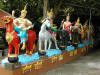
Satrud (สัตรุด)
Twin brother of
Lakshmana
and the incarnation of
Vishnu's
club.
回
sattaburiphan (สัตตะบูริพัน)
Thai. Name a prominent
decorative finial positioned at the central ridge of a temple roof,
especially on the roof of an ordination hall. It resembles a
sattaphan (fig.),
an i.e.
‘altar screen’, and
symbolizes Sataboriphan (สัตบริภัณฑ์), the seven
concentric mountain ranges that surround a sacred mountain believed
to be situated at the heart of the
Himalayas. The central peak
represents Mount
Meru, the cosmic mountain at the
center of the universe in Buddhist cosmology, while the two ends
signify the walls of the universe. At the peak of Mount
Sumeru
lies the
Tavatimsa
Heaven, the celestial realm of the 33 gods, marking the mountain as
a central axis in Buddhist cosmology.
See also
THEMATIC STREET LIGHT.
回
_small.jpg)
sattaphan (สัตภัณฑ์)
Thai.
‘Altar screen’. A richly decorated heavy screen intended
to be placed in front of an altar. They are made explicitly as
tamboon
making offerings to monasteries and feature
seven spiked candle posts, referring to the seven mountains
surrounding
Mt. Meru
(fig.).
回
Sattasoon (สัทธาสูร)
Thai. Name of a giant or
yak
from the
Ramakien.
He has a red complexion, has
tah jorakae, i.e. ‘crocodile eyes’ in which the
eyelid covers the upper-part of the eyeball,
and wears a
chadah-style crown
(fig.).
He is the king of Krung Atsadong/Asadong (กรุงอัสดงค์), which is also referred
to as
Meuang
Atsadong/Asadong
(เมืองอัสดง). He is an ally of
Totsakan,
whom he joined in battle
against
Rama,
together with Wirunjambang (วิรุณจำบัง), a
prince and a son of
thao
Lastian (ลัสเตียน),
i.e. Asuraphong (อสุรพงศ์),
with
Nang
Ratchada (รัชฎา).
回
_small.jpg)
Satul (สตูล)
Another transcription for
Satun.
回
Satu Lokapala (စတုလောကပါလ)
Burmese.
‘Four
Lokapala’
or
‘four keepers of the world’. The four guardians that
protect the world by presiding over the four points of the compass. In
Myanmar,
they are often seen at Buddhist temples and
pagodas, usually erected
around a tall post called
Tagundaing
(fig.), which is decorated at the top, usually with mythological
animals, such as the
hintha,
nagas, etc.
They are dressed in royal attire and always in a standing pose,
most commonly
with the
hands brought
together as in a respectful greeting, though
sometimes they may hold a
conch (fig.)
or a different
attribute
each, usually with one of them
holding a conch and thus reminiscent of
Thagyamin
(fig.),
the Lord of the
Nats.
The term is related to the Thai-Pali word
jatulohkabahn.
Satu is pronounced sa-too.
回

Satun (สตูล)
Thai.
Name of a province (map)
and its capital city on the southern west coast of the Thai
peninsula, 973 kms south of
Bangkok.
READ ON.
回
Satya (सत्य)
Sanskrit.
‘Truth’.
Another
name for
Krita,
first of the four
yugas.
回
satyagraha (सत्याग्रह)
Hindi.
‘Insistence
on (agraha) truth
(satya)’.
A term coined and
developed by
Mohandas Karamchand
Gandhi (fig.),
i.e.
Mahatma Gandhi,
and which refers to his philosophy and practice of non-violent resistance, which
he used in his struggles for social justice
in South Africa and against British rule in India.
回
saung-gauk (စောင်းကောက်)
See
Burmese harp.
回
Savang Vadhana (สว่างวัฒนา)
Thai. Another spelling for
Sawang Watthana.
回
Savatti (สาวัตถี)
Place in India where the
Buddha performed a miracle in an attempt to convince disbelievers.
回
Sawang Khiri Tham (สว่างคีรีธรรม)
Thai. Name of a
Mahayana Buddhist shrine in
Loei
dedicated to the Chinese goddess of mercy
Kuan Yin,
who in Thai is referred to as
Phra Mae Kwan Im.
The complex, which belongs to the Sawang Khiri Tham Foundation, features a large
golden statue of Kuan Yin located on the roof of the Wihaan Maha Bodhisat Kwan
Im Phankorn (วิหารมหาโพธิสัตว์กวนอิมพันกร), as well as a building known as
Wihaan Phuttha Chayanti (วิหารพุทธชยันตี), which is dedicated to various deities
from both Mahayana and
Theravada
Buddhism.
See EXPLORER'S MAP,
TRAVEL PICTURE (1) and
(2), and
WATCH VIDEO (1),
(2) and
(3).
回
Sawang Watthana (สว่างวัฒนา)
Thai. Name of
Sri Savarindira, a
consort of King
Chulalongkorn
(Rama
V -
fig.),
and who is bestowed with the title Queen Grandmother of Thailand,
since she is the grandmother of both
King
Ananda Mahidol (Rama
VIII) and King
Bhumipol Adulyadej
(Rama IX).
She was also the mother of Prince
Wajirunhit,
the nation's first ever Crown Prince (fig.),
whom however died of typhoid at age sixteen, as well as of
Mahidol Adulyadej.
Queen Sawang Watthana was born on 10 September 1862, as the
daughter of
King
Mongkut
and his Consort Queen Piyamawadi
Sri Phatcharinthra Mata,
which is sometimes transliterated Piyamavadi Sri Bajarindra Mata (ปิยมาวดี
ศรีพัชรินทรมาตา), and passed away on 17 December 1955. She was a full sister of
both Queen
Sunandha Kumariratana
and Queen
Saowapha
Phongsri, all of whom became consorts to
Rama V. The 150th Anniversary of the Chakri Dynasty her birth was commemorated with three
series of Thai postage stamps, the first one issued on 10 September 2010, the
second on 10 September 2011 (fig.),
and the third on 10 September 2012 (fig.).
She is also known by the name Phra Phanwassah Ayyikah
Chao,
and the
Phra Phanwassah Building (map
-
fig.)
within the compound of the contemporary
Somdet
Phra
Boromma
Racha
Thewih Na Sri Racha
(สมเด็จพระบรมราชเทวี ณ ศรีราชา) Hospital in
Chonburi
Province, which she founded, is
named after her, and today houses a museum dedicated to her majesty (fig.),
whilst in the garden a memorial (fig.)
contains
her statue (map
-
fig.).
She also established the Queen's Housing Resort (fig.),
a hospice built on stilts in the sea (fig.),
and known in Thai as Reuan Nai Thalae (เรือนในทะเล), i.e. ‘Dwelling in the Sea’
(map
-
fig.).
Pronounced Sawaang Watthanah and also spelled Savang Vadhana.
回
_small.jpg)
Sawankhalok (สวรรคโลก)
1. A present-day
amphur in
Sukhothai,
in the North of central Thailand and famous for its ceramic
earthenware made there between the 14th and 16th centuries AD. Its
old name was
Sri
Satchanalai, nowadays a
historical park with ancient ruins and more than two hundred kilns
from the past (fig.).
See MAP and
WATCH VIDEO.
回

2. Name of ceramic earthenware from
Sawankhalok made between the 14th and 16th centuries AD. The style
was influenced by Chinese art from the Song Dynasty and pottery of
this period imported by
China,
from
Sukhothai
and
Ayutthaya,
was called
Sangkalok,
a mispronunciation of Sawankhalok. A typical characteristic is the
tattoo-like design on its figurines (fig.).
回
sawankot (สวรรคต)
Thai.
Rajasap
for ‘dying’. Also called
sinphrachon.
See also
anchern jut.
回
sawarot (เสาวรส)
Thai for
passionfruit.
回
sawatdi (สวัสดี)
Thai. ‘Be blessed’.
Official greeting used when first meeting someone and to a lesser
extend also when parting.
READ ON.
回
Saw Yun (စောယွမ်း)
Burmese. Name of the King and founder of the
14th century
Sagaing Kingdom, a small realm on the west bank of the Irrawaddy
River near present-day Mandalay, that in 1315 AD gained autonomy of the larger
Myinsaing Kingdom, which was ruled by Saw Yun's father King Thihathu, and after
whose death Sagaing became fully independent. As the eldest biological son of
King Thihathu, Saw Yun had resented and rebelled against his father after the
King had appointed Saw Yun's stepbrother as heir-apparent to the throne of
Myinsaing, rather than his own son, due to the fact that the latter's mother was
a commoner. Instead Saw Yun was made governor of Sagaing, which he consequently
seized and made into a rival kingdom. After the split, the remaining part of the Myinsaing Kingdom became the Pinya Kingdom. In full, this ruler is known as
Athinkhaya
Saw Yun (fig.).
He died in 1327, leaving behind four children, three sons and a daughter. All of
his sons became king of Sagaing while his only daughter became the mother of
the
Shan
King
Thadominbya
(fig.), who in
1365 AD
founded the Kingdom of
Ava.
回
Saxophone Pub
Name of a renowned live music bar
and restaurant in
Bangkok,
established in 1987, celebrated for its nightly performances by leading Thai and
international musicians. It is located near the
Victory Monument
(fig.)
and has become an iconic institution in Thailand’s nightlife and jazz and blues
scene, offering nightly performances from both local (fig.)
and international musicians.
WATCH VIDEO (1)
and
(2).
回
Sayaam (สยาม)
Thai pronunciation for
Siam.
回
Sayaam Thewathiraat (สยามเทวาธิราช)
See
Siam
Thewathiraat.
回
sayaek daang (แสยกด่าง)
Thai name for a succulent
ornamental shrub of the family Euphorbiaceae, with the botanical
name Pedilanthus tithymaa senior monk or abbot of a monasterydes variegatus. It originates from the
Americas and has alternate green leaves mottled (daang) and bordered
with pale yellowish, and arranged on thick dark-green zigzag stems,
that grow to about 50 centimeters in length. In English, its common
name is Devil's Backbone, though it is also known as Zigzag Plant
and a variety of other names.
回
%202_small.jpg)
sayadaw
(ဆရာတော်)
Burmese. An honorific term for a senior monk
or abbot of a monastery in
Myanmar.
The term literally means
‘royal teacher’ and initially referred to the senior monks who
taught at the former Burmese royal courts. The more distinguished ones are
sometimes referred to as
sayadawgyi, with gyi being an affix of
reverence meaning ‘great’. See also
Nyaunggan Sayadaw and
Thathanabaing.
回
sayadawgyi (ဆရာတော်ကြီး)
Burmese. ‘Great royal teacher’. Title of
reverence used for a more distinguished
sayadaw, i.e.
a senior monk or abbot of a monastery in
Myanmar.
It is the Burmese equivalent of a bishop and comparable to the term
Luang Pho
used in
Thailand.
回
Scaly-breasted Bulbul
Common name for a species of bulbul with the scientific
designation Pycnonotus squamatus and which is found in Southeast Asia, including
Thailand, Burma, Indonesia and Malaysia, as well as Borneo and Brunei. It is
characterized by scaly white marks on a black breast and flanks, which
distinguishes it from all other species of bulbul. Also distinctive is its black
head with a contrasting white throat. It has yellow-olive wings with dark grey
primaries, whilst its rump and vent are bright yellow to orange. Its tail is
black with tiny white tips on the outer feathers (fig.).
This fruit-eating bird is a common resident in southern, peninsular Thailand. In
Thai named
nok parod ok laai kled.
回
%203_small.jpg)
Scaly-breasted Munia
A roughly 11 centimeter tall, small
gregarious bird, with the binomial name Lonchura punctulata, and which has at
least two subspecies. Adults have a stubby dark bill, plain brown upperparts,
often with somewhat paler uppertail-coverts, and a dark brown throat. Its
underparts are white, with distinctive brown (in Lonchura punctulata topela -
fig.) or black (in
Lonchura punctulata subundulata) scale markings, and creamy white
undertail-coverts and belly. The sexes are similar (fig.),
but juveniles lack the scaly markings and instead have uniform buff underparts,
whilst their upperparts are pale brown (fig.).
It is a very common resident throughout Thailand, except in parts of the
southern peninsula. It frequents open woodland and cultivation, and feeds mainly
on seeds. Also known as Nutmeg Mannikin and Spice Finch (fig.),
and in Thai as
nok kratid khee moo.
See also
WILDLIFE PICTURE,
WATCH VIDEO and
VIDEO (E).
回
%202_small.jpg)
Scarlet-backed Flowerpecker
A species of bird, with the scientific
name Dicaeum cruentatum. It belongs to the family Dicaeidae and the description
cruentatum derives from the Latin verb cruentare, which means
‘to stain with blood’ and
refers to the male's red or ‘bloodstained’
crown, neck, back, uppertail-coverts and rump (fig.).
Besides the red back, males have a white chin, belly and vent, with black bill,
legs and feet, whilst the sides of their head and breast is blackish, and their
wings blackish blue. Females are brownish olive above with only a red rump and
red uppertail-coverts, and pale underparts (fig.).
Juveniles are similar to females, but have a slightly darker crown and nape, and
no red at all, but instead have orange-tinged uppertail-coverts, and their legs
and feet are rather grey, whilst the bill is mostly pinkish-orange with a dark
tip (fig.),
especially with regards to the lower mandible, whereas the upper mandible may
have a more extensive dark tip, sometimes leaving only the base of the upper
mandible pinkish-orange. It is found in Southeast Asia, as well as in parts of
South and East Asia. In Thailand, it is known as
nok sih chomphoo suan,
and with a size of a mere 8.5 to 9 centimeters, it is the smallest bird in the
country (fig.),
together with the Golden-bellied Flyeater (Gerygone sulphurea) and some other
species of flowerpecker, such as the
Plain Flowerpecker,
all with an identical size.
See also WILDLIFE PICTURE.
回
%204_small.jpg)
Scarlet Milkweed
Common designation for a flowering plant, with the botanical
name
Asclepias curassavica.
It is widely grown as an ornamental garden plant for its yellowish flowers with
hanging reddish-orange petals, that bloom in clusters at the extremity of the
stems (fig.).
The plant also has medicinal value in herbal therapeutically treatments. The
stem is used as medication for heart disease and the fresh leaves are used to
repel parasites. Also called Blood Flower and Mexican Butterfly Weed, due to its
source of food for butterflies. In Thai, it is known as fai deuan ha
(ไฟเดือนห้า), which translates as ‘fifth month fire’.
回
Scarlet Minivet
Common name of an up to
22 centimeter tall passerine bird, with the
scientific name Pericrocotus flammeus. This Scarlet
Minivet is found in tropical and subtropical southern Asia, from the Indian
subcontinent east to southern China, Indonesia, and the Philippines. Their
habitat consists of forests and well-wooded areas, including gardens, especially
in montane regions.
There are many subspecies, but of the
nominate race, males have a black head and black upperparts, and scarlet
underparts. In addition, the tail, rump and long wings also have patches
of red, though the scarlet colour varies across populations, and may be any
shade of red or even orange. Females are grey above, with a yellow face and
underparts. Otherwise they are similar, but the scarlet colour is
replaced by yellow. These birds typically glean for insects, which they
sometimes flush out of the foliage by beating their wings. In Thai, this bird is
called
nok phaya fai yai,
i.e. ‘Great(er)
phaya
fire bird’. In 1980, this bird was depicted on the last
stamp of a set of four Thai postage stamps featuring Thai birds (fig.).
See also
Long-tailed Minivet
(fig.)
and
Short-billed Minivet (fig.).
回
Scarlet Passion Flower
Name of a species of vine and
passionflower, that originates
from central America and the Amazon region, and has the botanical designation Passiflora coccinea. It is also commonly known as Red Passion Flower and in Thai
it is called sri mahlah (ศรีมาลา). Its small wine-red fruits have edible pulp.
The vine bears showy flowers, with red petals and white-purple corona filaments
that surround the elongated floral axis, that is topped by the ovary, from which
sprout three purplish styles with stigmas that consist of lobe-like pads, with a
whitish tip and that grow facing downward, while at its bottom the ovary is
surrounded by the purplish filaments of the stamen, which have greenish-yellow
anthers.
回
%201_small.jpg)
Scarlet Skimmer
Name of a tropical Asian
dragonfly, native to East
and Southeast Asia. It has the scientific name Crocothemis servilia servilia and
belongs to the family Libellulidae. Males are scarlet red (fig.),
but females are of a dark yellowish brown colour (fig.).
Both sexes have transparent wings with yellow and brown venation, and amber wing
patches at the base of their wings. Both also have a characteristic black dorsal
stripe at the centre of the abdomen. It is also called Crimson Darter and Ruddy
Marsh Skimmer, and in Thai it is known as
malaeng poh ban boh.
See also WILDLIFE PICTURES.
回
Schomburgk's Deer
Name for a graceful species of deer with
the binomial name Cervus schomburgki, which occurred in Thailand, but is now
extinct.
It was dark brown with lighter underparts, while the underside of the tail was
white. The stag had the largest antlers of all
deer species found in the country, with up to 33 tines.
It inhabited the swampy plains of central Thailand, especially in the
Chao Phraya
River valley. Its natural habitat declined with the rise of commercial rice
production and avoiding dense vegetation, they were easy targets for hunters.
The wild population of
Schomburgk's Deer
hence became extinct in 1932, probably due to over-hunting,
whilst the last captive animal died in 1938. In Thai it is known as saman (สมัน)
or neua saman (เนื้อสมัน) and is displayed on the logo of the
Zoological Park Organization of Thailand.
回
%20สมัน%202_small.jpg)
scorpion
See
maengpong.
回
Scorpion Fly
Common
name for a flying insect with the scientific designation Panorpa communis.
READ ON.
回
Scott's Market
Former name of a market in Yangon, which was built in 1926
and named after James George Scott, a British civil servant at that time. After
independence from British rule, the market was renamed
Bogyoke Aung San Market.
回
Scrambled Egg Tree
See
song bah dahn.
回
scripture cabinet
A
lacquer
cabinet used in temple libraries to hold palm leaf Buddhist
manuscripts to protect them from humidity, insects, etc. It is
placed usually in the
ho trai
or library, generally a wooden building on pillars placed in a basin
to keep creeping vermin out. In Thai called
tuh phra
thamma.
回
Sea Almond
See
hoo kwahng.
回
Sea Anemone
See
dokmai thalae.
回
sea bean
Name for a seed of any of a number of tropical
plants and trees of which the seeds are dispersed by floating upon
the ocean currents. In Thailand this mainly refers to a large seed
that sits within a long podlike seed-vessel and grows from a large
woody vine with the scientific name Entada rheedii which belongs to
the family of Leguminosae-Mimosoideae. The shrub grows along brooks
and rivers in the tropical rain forest and drops its seeds one by
one from its pod into the waterway where they start to drift towards
the sea. Once they have reached the open sea they travel with the
ocean currents until they wash up on a beach somewhere, perhaps
thousands of miles away from their origin. Sea beans are buoyant
because of an air pocket within the seed and their hard outer
covering helps them survive their long-distance journey. The seeds
can be polished to a nice shine and are made into garlands and
jewelry by hill tribe people, whereas children use the seeds in
tossing games (fig.)
and the pod as a musical instrument. Also called drift seed. In Thai
called
sabah.
回
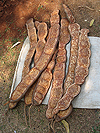
sea coconut
Common name for a rare and protected species
of
coconut palm,
with the botanical name Lodoicea maldivica, that bears large seemingly double
coconuts
and is native to certain islands, hence the name. Its peculiar shape,
resembling two kidneys merged together like a
Siamese twin,
have led to its nickname, i.e. lady's butt coconut. It is so rare and highly
prized that a single coconut reportedly can fetch up to 30,000 baht on the
market. Also commonly known as double coconut and by the
French designation coco de mer.
In Thai, it has several designations, including
ton maprao
faed (ต้นมะพร้าวแฝด), i.e. ‘twin coconut tree’;
ton
maprao
thalae (ต้นมะพร้าวทะเล) or
ton taan
thalae (ต้นตาลทะเล),
i.e. ‘sea coconut’ and ‘sea palm’, respectively;
as well as the less flattering maprao
toot negro
(มะพร้าวตูดนิโกร),
i.e.
‘negro's butt coconut’.
See also
poo maphrao.
回
sea cucumber
See
pling thalae.
回
SEA Games
Abbreviation for Southeast Asian Games, a
biennial sports event (fig.),
that was first held in 1959 and hosted by
Bangkok. It was
initially organized under the name SEAP Games, i.e. Southeast Asian Peninsular
Games, and included the six founding members
Thailand,
Burma, Malaya,
Laos,
South
Vietnam and
Cambodia.
When
Singapore in 1965 gained independence, it was included as a member in its
own right. When in
1977 also Indonesia and The Philippines were included the name was changed to
Southeast Asian Games (fig.).
Though variable per event and organizing country, the games may have as much as
43 different types of sport
(fig.)
with some, such as
takraw
(fig.),
being typically Southeast Asian disciplines. Currently, the games have
participants from Southeast Asian
11 countries and is regulated by the Southeast Asian Games Federation, which is
supervised by the International Olympic Committee and the Olympic Council of
Asia.
Present countries include Thailand,
Myanmar,
Malaysia, Laos,
Vietnam, Cambodia,
Indonesia, The Philippines, Singapore, Brunei, and East Timor.
So far, Thailand has hosted the event six times, the last time in 2007, in
Nakhon Ratchasima.
Its logo consists of a ring of ten circles,
one for each of the the ten
ASEAN nations. When the games were first held in
1959, under the then name SEAP Games, the logo had just six circles, one for
each of the founding member countries (fig.).
回

sea
grapes
See
sarai phuang a-ngun.
回
Sea Gypsies
See
Chao Le.
回
seahorse
See
mah nahm.
回
sea
jelly
See
maeng kaphrun.
回
Sea
Roach
See
malaeng saab thalae.
回
SEATO
Abbreviation of ‘Southeast Asia Treaty Organization’.
Formally established on 23 February 1955 in
Bangkok, though the initial treaty
was signed on 8 September 1954, as a unified response and collective defense
against Communism in China and Southeast Asia, with the support of the United
States and as part of the Truman Doctrine, which sought to create collective
bilateral defense treaties. During the inaugural meeting, chaired by the Thai
foreign minister prince Wan Waithayakon, it was announced that SEATO's
headquarters would be located in Bangkok. Besides the US and Thailand, initial
members included Great Britain, France, Australia, New Zealand, The Philippines,
and Pakistan, which was included because East Pakistan, today's Bangladesh, was
geographically close to Southeast Asia. Later, also Taiwan became a member,
while South Korea and South
Vietnam joined as dialogue partners. During the
Vietnam War, the US sought to make the regional conflict into a SEATO collective
defense problem, but failed to do so, as members did not agree to help each
other militarily. As a result, first Pakistan and later France withdrew from the
organization, which eventually was formally dissolved on 30 June 1977. After
all, during the first conference, then prime minister
Phibun Songkram
had told the delegates, that the organization's goal was to ‘preserve freedom
and peace with honour, and promote economic and social wellbeing’, rather than
promising direct military support.
Its flag and logo consists of a sky blue field with a white shield,
longitudinal lines, which are blue on white, but reverse to white on blue in the
lower right quadrant, and in the middle is a yellow stalk, with seven levels and
a pinnacle. Whereas blue symbolizes peace and stability, yellow stands for
prosperity, and the lower right quadrant refers to Southeast Asia, the working
area of the organization. The seven levels of the stalk are understood to refer
to the initial number of country members, headed by the pinnacle, which may
either refer to the US, as the initiator of the treaty, or to Thailand, a main
player and the initial host, as well as the country where the organization's
headquarters were located.
回

sea
urchin
Name for a typically spiny, often globular
animal, that lives on the seabed and of which a wide variety of species exist.
They belong to the phylum of
echinoderms, which also includes
sea cucumbers, i.e. their
closest relatives.
These creatures move about
slowly, either crawling with tube-like tentacles or pushing themselves with
their spines. They feed primarily on algae but some species also eat slow-moving
or sessile (immotile) animals. Among their predators are sea otters,
starfish,
and humans, notwithstanding their often razor-sharp spikes that in some species
are also
venomous. The most dangerous sea urchin is the Toxic Flower Urchin (Toxopneustes
pileolus) which occurs in the Indo-West Pacific and is capable of delivering
extremely painful and medically significant stings when touched. It has venom
injecting fangs that deliver a poison that may stay in the victim's system and
can keep stinging for years. In Thai known as
men thalae,
i.e. literally ‘sea porcupine’. In English, they are also nicknamed
Hedgehogs of the
Sea, as they not only resemble hedgehogs but also because the name urchin derives from the old French term herichun, which means
‘hedgehog’. Sea urchins can live for up to 200 years.
回
sedge
See
kok.
回
see (สี)
1. Thai. ‘Peel’ and ‘rub’. To mill or husk
(rice). Also transcribed sih or si, as in
silom.
See also
rohng see khao.
回
2. Thai for ‘colour’, ‘paint’ and ‘dye’.
Also transcribed si or sih.
回
sek (เสก)
Thai. To charm, to cast a spell. As in
sekpao.
The term is also used to express blessings, in which water is
sprinkled or poured out, as in
rod nahm mon.
See also
kong hod.
回
sekpao (เสกเป่า)
Thai. To charm or cast a spell (sek)
by muttering a magic formula and blow (pao) with the mouth as if to
transfer the magic to the object or person. This practice is usually
performed by a senior monk, a village headman or an elder to bless
or wish someone good luck prior to a long journey, an important task
ahead, etc.
回
self-mummification
See
sokushinbutsu.
回
sema (เสมา)
Thai. ‘Boundary marker’. Name for a sacred
boundary stone marking a consecrated Buddhist space. See also
bai sema.
回
Sema Dhammachakra Award
Name of
a prestigious Thai honour bestowed upon
individuals and organisations that have rendered outstanding service to
Buddhism. Established in 1982, it is
regarded as one of the highest forms of recognition for
contributions to the promotion, preservation, and dissemination of
Buddhist teachings in Thailand.
READ ON.
回
sen
(เส้น)
Thai
unit of length, equal to 40 meters.
回
Sena
(সেন)
Bengali. A Hindu dynasty in East India during
the 12th century AD, following the
Pala
dynasties and which school of art is known as the Pala Sena style.
回
seng-phe (เซง-เพ)
Thai. A
Thai Yai
sweet from the province of
Tak, cooked from black
(deep purple)
sticky
rice,
sugarcane
juice and
coconut milk, and
baked or grilled, with
coconut
cream topping.
回
Seni Pramoht (เสนีย์ ปราโมช)
Three-time Prime Minister of Thailand,
i.e. from 17 September 1945 to 13 January 1946, from 26 February 1975 to 14
March 1975, and from 20 April to 6 October 1976. Between his second and third
term, his brother
Kukrit Pramoht (fig.)
was Prime Minister, i.e.
from 14 March 1975 to 20 April 1976. Usually transcribed Seni Pramoj or Seni
Pramoch, but actually pronounced Seni Pramoht (Pramote).
回
Sentosa
Name of a popular resort island in Singapore,
located off the southern coast of Singapore, separated from the main island of
Singapore by a channel of water and known for its diverse range of attractions,
entertainment, and recreational activities. It is accessible by its boardwalk, a
road, a monorail, and a scenic cable car that offers breathtaking views of
Keppel Harbour and the
South China Sea. The island
has a network of walking trails and boasts a wide array of attractions catering
to various interests. Some notable ones include Universal Studios Singapore,
S.E.A. Aquarium, and Adventure Cove Waterpark. It is also home to several
pristine beaches,, a range of accommodations, and world-class golf courses. It
also features natural beauty and greenery for those who appreciate nature and
wildlife and there is a Butterfly Park & Insect Kingdom and Sentosa Nature
Discovery. The island offers a diverse range of dining options, from casual
beachside eateries to fine dining restaurants. Resorts World Sentosa houses a
shopping complex where visitors can find various retail outlets and
entertainment options. The name Sentosa is Malay and means ‘Tranquility’
and drives from the Sanskrit Santosha, meaning ‘Satisfaction’. Through history,
the island has always been of strategic importance and is home to four ancient
forts. During World War II is was a British military fortress and the base of
the Royal Artillery, but under Japanese occupation it became home to a POW camp.
After WWII, the island had a for a while a basic military training camp and the
coast artillery was replaced with Gurkha infantry units. Today, Sentosa no
longer has a military presence or any significant military activity.
WATCH VIDEO.
回
sepparoot
Penan.
Term for branchless, straight, natural wooden stems, that are stripped bare of
their bark, after which fine wooden curls are sliced from the pale whitish
sapwood at different intervals, yet leaving these curled wooden strips attached
on one end, so that they hang around the stick like dangling ornaments. The ca.
2 meter tall sticks are created to honour the forest and its animals on which
the
Penan
people depend for their livelihoods, and are placed in the ground to pay respect
to the animals the Penan hunt and to appease their spirits.
回
serban
Malay. Term for a turban, which in
Malaysia is still
worn as part of the traditional dress of the
sultans (fig.).
回
sericulture
The production of
silk, also known as
silk farming.
回
Sermporn Dhammavaro (เสริมพร ธมมวโร)
Name of a highly educated monk,
holding a Master’s degree and having achieved the highest level of
Dhamma studies, who in 2022 was
granted the royal ecclesiastical title
Phra Wachiraworakhun.
Also transliterated and pronounced Sermphon Thammawaroh.
回
serpent star
Another name for
brittle star.
回
sesame
Name of an East Indian plant with the botanical name
Sesamum indicum. It has about 20 species,
whaich are
found in tropical and subtropical regions, and is cultivated for its
oil-yielding seeds, which may be brown, white (fig.)
or black, and are rich in calcium, magnesium and iron.
Myanmar,
India and
China
are global commercial hubs for the cultivation and production of
black sesame seeds. White seeds are black seeds that have been
hulled while brown seeds are white seeds that have been enhanced by
toasting. Sesame is an annual plant that grows to about a meter tall, with
opposite lanceolate leaves which are between 4 and 14 centimeters
long. It bears white to purple, tubular flowers
(fig.),
which are 3 to 5 centimeters long. However, there are also some wild
varieties. One of those, found in northern Thailand, has
broad leaves and stalks of which the upper parts are covered with small, 1 to 3 centimeters long,
hairy
calyces, that are green in colour and grow horizontally, and each of
those contains around three tiny seeds. When dried, sesame seeds are
edible and are used to make candy bars (fig.).
It is said that sesame seeds have a soporific effect and it is given
to children to induce sleep, cf. Sesame Street which is broadcast
before children's bedtime. In Thai called
nga
and candy made from it is called nga lua and nga tad.
See also
krayahsaad
and
nga mon.
回
Sesame Leaves
See
nga mon.
回
Sesha (शेष)
See
Shesha.
回
setthi (เศรษฐี)
Thai. Term that means ‘rich person’, ‘wealthy
person’, or ‘millionaire’, yet in the
context of
Buddhism, setthi is used to
describe a person who is materially wealthy, but who is also involved in
generous acts, often linked to merit-making, charity, or supporting the Buddhist
community,
using their wealth to promote generosity and selflessness, embodying Buddhist
ideals. Buddhist lore mentions several wealthy figures, some of whom lived
during the era of the
Gautama
Buddha
and many of whom
attained
Sotapanna, the first of the four
stages of
Enlightenment,
such as
Thananchai Setthi (fig.),
Menthaka
Setthi
(fig.),
Nang
Visakha Setthi
(fig.),
Chotika Setthi (fig.),
Anathabinthika Setthi (fig.),
Punna Setthi (fig.),
and
Chatila Setthi (fig.).
回
Setthi Khamfan (เศรษฐีคำฝั้น)
Thai. Name of the eight son of Prince Chai Kaew of
Lampang and thus a
descendant from the house of
Thipchakratiwong.
Between 1805 and 1815 he also governed as the ruler of
Lamphun. Later, from
1823 to 1825, he was a
Chao Luang,
a Siamese vassal prince who ruled as the third king of
Lan Na under the
suzerainty of
Rattanakosin.
See also
list of Thai kings.
回
seua (เสือ)
Thai for ‘tiger’.
Tigers are native to much of eastern and southern Asia and the
subspecies native to Thailand is known as the Indochinese tiger,
which in Thailand still occurs in the wild, mostly in National
Parks. A good way to see tigers in the kingdom is in Sri Racha Tiger Zoo in
Chonburi
province, which claims a population of 200 tigers, a large facility
though the infamous Xiongsen Bear and Tiger Mountain Village (map
-
fig.)
in scenic Guilin (fig.),
in southern
China,
with an alleged 1,800 animals, seems to posses the world's biggest
captive population of tigers, but this grim and outdated wildlife
park has been accused of being a front for the sinister and illicit
trade in tiger body parts and sale of tiger bone wine, and allegedly
featured a live feeding show, in which calves were put into tiger
enclosures to be mauled to death and eaten in front of whooping
family audiences. In Sai Yok district,
just North of
Kanchanaburi
town, is
the
infamous
Wat Pah
Luang
Tah
Maha
Bua
Yanasampannoh (วัดป่า หลวงตามหาบัว ญาณสัมปันโน),
a forest temple commonly referred to as the Tiger Temple (map
-
fig.),
where a
Buddhist
monk and his supporters
rehabilitated domesticated tigers back into the wild. Yet, the temple over time became a
tourist attraction and soon allegations were made that the tigers
were being mistreated for commercial gain, which led to the
confiscation and removal of the ca. 150 tigers by the Thai
authorities, and the temple was closed to the public. Though this
wild
animal is most commonly orange with near white underparts and dark
vertical stripes, there are also so-called white tigers (fig.)
which are- though technically known by the name chinchilla
albinistic- not albinos, but tigers with a genetic condition that
all but eliminates fur pigmentation. Besides this, tigers are often
depicted in Thai art and in temples. They are associated with
reusi
who is usually dressed in tiger fur and dwells in, or in the
proximity of caves.
Shiva
is often seated on tiger fur (fig.).
In Thai mythology tigers
are related to Saturday and the mount of
Phra Sao, the
god of Saturday, is a tiger. In Chinese and Indian mythology, the
tiger is the seat of
Zhao Gong Ming
and
Parvati,
respectively. The tiger is also the third animal in the
Chinese zodiac.
Since its forehead (fig.)
has a marking that resembles the Chinese character wang (王), meaning
‘king’, the tiger is in Chinese culture regarded as the King of the
Animals (fig.)
and represents royalty and fearlessness.
Since tigers represents
strength they are often associated with certain aphrodisiacs and
although they have no scientific medical value traditional Chinese
medicine promotes tiger based drugs. Also called phayak (พยัคฆ์),
especially in mythology, and in Sanskrit called
viagra.
See also
tiger claw
(fig.).
See also
THEMATIC STREET LIGHT
and
WATCH VIDEO (1)
and
(2).
回
seua dao (เสือดาว)
Thai. ‘Starry tiger’. Common Thai name for the
Leopard.
回
seua fai (เสือไฟ)
Thai. ‘Fire tiger’. Name for the
Asian Golden Cat.
回
seua kohng (เสือโค้ง)
Thai. ‘Arching tiger’. See
Camouflage Tree.
回
seua kruy (เสื้อครุย)
1. Thai. A long white ceremonial gown as worn
by a
brahman
priest or a candidate for the Thai Buddhist monkhood (fig.).
See also TRAVEL PICTURE.
回
%20white%20gown%20brahman%20priest_small.jpg)
2. Thai. An academic gown. They can be of any
colour, depending on the university's choice or tradition. It
typically has one main colour, often
indigo, black (fig.),
red or white which is then embroidered with colourful borders and/or
ribbons, defining the related faculty or specialty. They are worn by
students on the day of their graduation when they receive their
diploma and sometimes by academic staff and graduate students on
special occasions. They are usually available from rental shops (fig.)
around the universities.
回
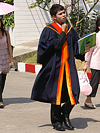
seua laai mek (เสือลายเมฆ)
Thai name for the
Clouded Leopard.
回
seua mo hom (เสื้อม่อฮ่อม/เสื้อหม้อห้อม)
Thai. A blue cotton farmer's shirt, sometimes
worn with a similar pair of trousers and with a
pahkaomah
around the waist. The blue
colour of the shirt is acquired from a plant called
krahm, known
in Northern
Thailand as hom, by
soaking it in water. Next this solution is mixed with chalk and left
to soak for two days and nights (fig.).
The blue substance obtained is subsequently blend with a liquid
gained from water mixed with ashes, a procedure that gives a
reaction making the blue chalky substance suitable for submerging
the cotton. Next, cotton material is immersed repeatedly until it
has absorbed the dye, and hung to dry in the sun (fig.).
This process is repeated up to four times, until the typical dark
blue colour is obtained.
Its name is derived from the earthen pot (mo/moh) in which the
shirt (seua) is dyed in.
Native to northern Thailand it is often produced in
Phrae
province. Also transcribed seua moh hom.
回
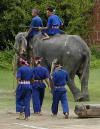
seua phaew (เสือแผ้ว)
Thai. ‘Clean tiger’. A name for the
Fishing Cat, next to
seua pla.
回
seua pla (เสือปลา)
Thai. ‘Fish tiger’. A name for the
Fishing Cat, next to
seua phaew.
回
seua racha pataen (เสื้อราชปะแตน)
Thai. ‘Royal pattern shirt’.
Name of a long-sleeved jacket with a
Mandarin collar or Mao collar, i.e. a
stand-up collar, that if white in colour and with five buttons is since 1980
used as the uniform of civil servants, and is the reintroduction of an earlier
form of uniform that since the reign of King
Rama V until 1932
was commonly worn by civil servants, and consisted of a white jacket worn over a
navy blue
johng kraben, a loin cloth that is passed
between the legs and tucked in at the wearer's lower back
(fig.),
and that was actually referred to as the purple cloth and typically worn with
closed-toe shoes. It was introduced after King Rama V visited India in 1872, and
the name racha pataen is a distortion of its original designation racha pattern.
Since its initial introduction,
the jacket has been popular
with the upper and middle classes
for a long time.
See also TRAVEL
PICTURES.
回
seubchatah (สืบชะตา)
Thai. ‘To follow, to descend from, or
to succeed in fate, fortune or luck’.
Animist
ritual ceremony, initially especially in northern Thailand, but
nowadays increasingly also found in other places around the nation.
In English, it is usually referred to as
the
succession ceremony and in it a
sacred white thread, called
sai sin,
is
spanned across the interior of the
bot,
wihaan or even outdoors, usually
starting from a Buddha image, often the temple's principal statue. It will be connected to the
heads of the monks and the people sitting underneath it on the
floor, or on chairs if outdoors, with additional vertical threads
hanging from the horizontal ones. This physical
connection symbolizes the spiritual one. A
shaman will conduct a rite
whilst Buddhist
monks
are
invited to preach. The ceremony, believed to prolong life, can be held
at any time and its host will reward the shaman for his service,
usually with cash, though the event may also be organized by a
temple with a senior monk leading it. During this event in northern
Thailand, sometimes also wooden logs,
known as
mai kham or
mai kham sarih, are placed against a
bodhi tree
to symbolically support it (fig.).
Compare with
Toh Chatah Chiwit.
WATCH VIDEO (1) and
(2).
回
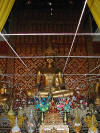
seung (ซึง)
Thai. A traditional musical instrument, somewhat
comparable to a guitar. It is made from hardwood and has either four or six
strings, which are most often made of steel wire, and nine raised frets. This
plucked lute-like string instrument is from the northern region of
Lan Na
and somewhat like the
krajab pih, an ancient
instrument used in the classical music of central Thailand. Also transcribed
sung.
回
_small.jpg)
seung swing (เซิ้งสวิง)
Thai. ‘Net song and dance’. A
Thai folk dance from
Isaan,
in which the participants dance while holding
a small fishing net called swing, and usually also have a small
bamboo
basket on their
belt to hold the day's
catch and which in Thai is known as a
takong or
kong (fig.).
The term seung refers to a kind of musical song-and-dance from
northeastern Thailand.
See also POSTAGE STAMP.
回
Seven Buddhas
Term
referring to the Seven Buddhas of Antiquity, i.e. the past
Four Buddhas
of the present cosmic age or aeon, who have already attained
Enlightenment,
and three
Buddhas
from past aeons, namely
Vipassi,
Sikhi,
and
Vessabhu.
See also
Saptatathagata.
回
Seven Gods of Fortune
Name given to seven deities worshipped in
Japan, most of whom derive from the
Eight Immortals
of
China.
READ ON.
回
Seven-striped Barb
Common name for a species of freshwater
fish, with the scientific designation Probarbus
jullieni, and also commonly known as Jullien's Golden Carp.
READ ON.
回
Sgaw (สะกอ)
Another
spelling for
Sakoh.
回
shadow play
See
nang thalung
and
nang yai.
回
Shaikh Ahámad-e Qomi
See
Sheikh Ahmad Qomi.
回
Shaikh al-Islam (شيخ الإسلام)
See
Sheikh al-Islam.
回
Shaivism
The cult of
Shiva
(fig.),
which has several different sects and which philosophy claims to encompass all
facets of Hindu thought. Its followers
are known as
Saivites
(fig.).
See also
Shivaism.
回
sha ji xia hou (杀鸡吓猴)
Chinese. ‘Kill the chicken to scare the
monkeys’. According to an ancient story, there once was a man who raised
monkeys, which became more and more naughty and ill-behaved as they grew up,
often destroying his belongings. Hence, one day the man caught a chicken and
assembled the monkeys. He killed the cock in front of the monkeys and told them
that if they wouldn't behave and stop causing trouble, they would end up just
like the chicken. The monkeys
were frightened and became obedient ever after. Hence this
ancient idiom is used metaphorically to mean to frighten somebody by punishing
someone else, i.e. to punish an individual as an example to others.
回
Shakra (शक्र)
Sanskrit. ‘Mighty’, ‘powerful’ or ‘the mighty one’. An
epithet for
Indra, used
mainly in
Buddhism.
It can also mean ‘radiant’ or ‘bright’, and in mythology it refers to the
Adityas,
whereas shakradhanus means ‘rainbow’. See also
Thagyamin.
回
shakti (शक्ति)
1. Sanskrit. ‘Strength’. The
consort of a Hindu god personifying the female energy of that god.
So is
Parvati
e.g. the
shakti of
Shiva.
In Hindu art, if the shakti is depicted on the side of the
corresponding male deity, it is usually to his left, i.e. closest to
his heart, which suggests that he holds her close to his heart. In
Thai sakti (ศักติ).
回
2. Sanskrit. ‘Strength’.
The name of the Hindu goddess of strength.
回
shakuhachi (尺八を)
Japanese. Name for a type of
bamboo
flute played by the mendicant monks the
Komuso sect of
Zen
Buddhism in Japan during the 17th to
mid-19th century AD, in order to beg for alms and for meditation
so as to achieve the desired state of Emptiness.
回
Shakya (शक्य)
Sanskrit. ‘Capable, able’. The clan or tribe
to which prince
Siddhartha belonged who became the historical
Buddha.
In Pali
Sakya.
回
Shakyamuni
(शक्यमुनि)
Sanskrit. ‘Sage of the
Shakya
clan’. A name for the historical
Buddha.
In Pali Sakyamuni.
回
shaman
Name for a priest from
Shamanism, in
which some priests enter a trance and consequently make
contact with the supernatural. Compare with the Burmese
natsaw.
回
Shamanism
A primitive belief in which some priests or
shamans enter
a trance and consequently make contact with the supernatural.
回
Shambhala (शम्भल)
Sanskrit.
Name of a mythical
kingdom in
Tibetan Buddhism,
said to be ruled by
Maitreya, a
bodhisattva now
living in
Tushita heaven and
waiting to be reborn as a future
Buddha
in order to restore faith.
In Thai, known as Samphala (ศัมภละ), which is sometimes also transcribed
Shambhala.
回
Shampoo Ginger
Common name for a species of wild
ginger
with the botanical name Zingiber zerumbet and which is also referred to as Wild
Ginger, Bitter Ginger and Pinecone Ginger. It has thick bracts that are
initially reddish-pink below and yellowish-green above, and eventually turn
completely dark pinkish-red. It bears white flowers that sprout from the bracts. In Thai, it is known as
kratheua.
回
%202_small.jpg)
shamuak (ฉมวก)
Thai for harpoon, a barbed, fish-hook-like missile with a rope
attached, for catching fish. It is not completely legal. See also
pramong.
回
shan (山)
Chinese for ‘mountain’.
回
Shan (ฉาน, ရှမ်း)
1. Thai-Burmese. An ethnic group of
Tai
origin, that lives for the most part in
Myanmar's Shan State
(fig.),
but also inhabits adjacent regions of Thailand and
China.
There are five major groups, which are further divided into numerous
subgroups. Among the five major groups are the
Tai Yai (fig.),
who also live in West and Northwest Thailand, where they are also
known as
Ngiaw.
回
2. A language spoken mostly in
Myanmar's Shan State,
but also in Kachin State, in northern Thailand, and in
Xishuangbanna
Dai Autonomous Prefecture of
Yunnan
Province in southern
China.
回
Shan baun-bi (ရှမ်းဘောင်းဘီ)
Burmese. ‘Shan pants
or Shan trousers’. Name for long
baggy trousers, akin to the Thai
kaangkaeng le
(fig.),
and commonly worn by men in rural
Myanmar,
especially as part of the traditional dress of many of the ethnic groups. The
Shan baun-bi is lightweight and very spacious. It is worn wrapped around the
waist and folded over to keep
them in place (fig.),
which differs from most Thai models that are usually
tied with a string from the
back, to form a belt.
Also transcribed Shan baung-bi.
回
,%20long%20baggy%20trousers%20in%20Burma_small.jpg)
Shan Cai (善财)
Chinese. ‘To cherish wealth’, usually
referred to as ‘Child of Wealth’. Chinese name for
Sudhana,
a youth from India who was seeking
Enlightenment
and on his quest studied under 53 teachers, including
Avalokitesvara
and
Maitreya,
as described in the
Avatamsaka Sutra.
He is finally taught that wisdom only exists for the sake of putting it into
practice. In the Tale of
Kuan Yin
and the Southern Seas, he is described as a disabled boy who was given a new,
healthy and handsome body, by jumping of a cliff after Kuan Yin, leaving his
disabled body in the ravine. After this, he became Kuan Yin's acolyte and is
therefore at times portrayed at her side (fig.),
often together with
Long Nu, a later female
acolyte of Kuan Yin.
In another story, described in the Precious Scrolls,
Shan
Cai became her acolyte after she appeared in the middle of the ocean. This
episode is often portrayed in art with the boy walking on the waves across the
sea to join with her (fig.).
In the classical Chinese novel
Journey to
the West,
he is known as Red Boy. Also transliterated Shan Tsai.
WATCH VIDEO.
回
Shan Da Wang (山大王)
Chinese. ‘Great
Mountain King’. Name of
a
Mountain-Protection King, a deity in
Taoism.
READ
ON.
回
shan zi (山子)
Chinese. ‘Mountain offspring’ or ‘small mountains’. Name
of a Chinese art form in which miniature sceneries and landscapes are carved
from small to medium-sized natural rocks and
boulders (fig.),
usually in its interior after it has been split open, while using and
maintaining existing outlines in the natural shape of the rock. The finished work is
typically put on a decorative wooden stand. See also
Chinese rockery.
回
%202_small.jpg)
Shaolin (少林)
Chinese. Though the name literally translates
as ‘Young Forest’, it in fact refers to the location of a Buddhist
monastery in
China's
Henan province (fig.).
Shao (少) refers namely to Mount Shaoshi (少室山), the ‘Young Home’
mountain on which the monastery is built. Lin (林) indeed means
‘forest’, but the full name of the monastery is in reality Shaolin
Si (少林寺), with the word si (寺), meaning ‘Buddhist temple’ or ‘court
office’. The name should thus be interpreted as ‘Buddhist temple in
the woods of Mount Shaoshi’. The monastery initially served as a
defense against bandits (fig.)
and contributed to the development of a martial arts form (fig.),
consisting of nineteen different types (fig.),
which lay at the origin of Chinese fighting sports, including the
renowned
Kung Fu
(fig.).
It is practiced by the fighting monks (fig.)
of the Shaolin order in China, but has followers
worldwide. Now the term Shaolin is more often than not used in
reference to this martial art, though the Shaolin monastery
also stands at the origin of
Zen Buddhism.
Monks that ordain into the order and accept to follow its nine rules
are given the
jieba, i.e.
nine rounded marks that are burned onto the head with
incense sticks
(fig.),
in three rows of three (fig.).
The temple
is also known for its famed
Pagoda Forest (fig.).
See also
Bodhidharma.
See also TRAVEL PICTURES (1)
and
(2).
回
Sharanga (शारङ्ग)
Sanskrit. Name of the celestial bow of the
Hindu god
Vishnu and
one of the objects that
surfaced during the
Churning of the Ocean of Milk.
This bow, along with
Shiva's
bow,
Pinaka, was crafted by
Vishvakarma,
the divine architect and maker of weapons. Once,
Brahma wanted to determine
who was the superior archer between Vishnu and Shiva. To this end, he
orchestrated a conflict between the two, which escalated into a fierce duel,
disturbing the balance of the universe. Vishnu eventually emerged victorious,
defeating Shiva with his arrows. Brahma, along with other gods, intervened and
declared Vishnu the winner. In his anger, Shiva gave his bow, Pinaka, to an
ancestor of King
Janaka,
Sita's father. Following
this, Vishnu entrusted his bow, Sharanga, to a sage who, over time, passed the
bow down to his grandson,
Parasurama, an incarnation of Vishnu.
After completing his life's mission, Parasurama handed Sharanga to Rama, with
whom it became primarily associated.
回

shark
See
chalaam.
回
Sha Wujing (沙悟净)
Chinese. ‘Sand understanding purity’. Name of a fallen
immortal who was punished by the
Jade Emperor for breaking
a crystal goblet. He was exiled from heaven, where he previously was the General
who Raises the Curtain, and sent to the mortal world as a hideous sand demon. On
earth he dwelt in the quicksand river where he attacked innocent passers-by and
received weekly punishments from heaven. In search of powerful bodyguards to
protect the monk Xuanzang on his
Journey to
the West, he
was recruited by
Kuan Yin in
exchange for relief from his punishment. After the pilgrimage he was rewarded
and transformed into a
luohan.
His weapon of choice is a
Monk's Spade
(fig.),
i.e. a double-headed staff, with a crescent-moon blade at one end (fig.)
and a spade at the other. In English, he is also known as Friar Sandy.
See also .
回
Sheikh Ahmad Qomi
Arabic. Name of a Persian expatriate trader who lived in
Siam
for 26 years. He was born in the Islamic centre of Tainajahar in Qom and is said
to have arrived at
Ayutthaya
in 1602 AD, during the rule of King
Naresuan the Great, of whom he received
official permission to stake out two suitable sites, one for his residence,
another for his religious and trading quarters. His mission to Siam was twofold:
firstly, to open a trading post, secondly, to bring Islamic teachings of the
Shi'ite Sect to Siam. Having settled, he embarked upon developing his Islamic
mission and his trading post, and within a decade the Shi'ite Chao Sen Sect was
firmly established and the trading mission prospered. While becoming somewhat
prosperous on the way, he gained a reputation of being an honest and reliant
merchant. It was during this period that he married a young lady by the name of
Ob Chuay who bore him two sons and a daughter. The eldest son, was named Chuen,
the second one died before reaching his teens, while his daughter was named Chi.
He rose to favour with King
Song Tham
(1610-1628),
who appointed him to the highest administrative positions and put him in charge
of Siam's entire trade with the Middle East and Muslim India. He was appointed
the first holder of the title of
Chularachamontrih,
a Thai version of the Muslim office of
Sheikh al-Islam. His
later descendants, known as the
Bunnag family, continued
their prominent role in Siamese politics and trade, well into the
Bangkok period.
Also transcribed Shaikh Ahámad-e Qomi.
回
Sheikh al-Islam (شيخ الإسلام)
Arabic. ‘Islamic tribal elder’ or ‘revered
old man of Islam’, sometimes translated as ‘Islamic scholar’. A title and office
of superior authority in the issues of
Islam
which is supposed to be bestowed upon followers of the
Koran who acquired
deep knowledge of its principles and are of age, wise in Islam and reputable
among peers. In Thailand this office is called
Chularachamontrih.
Also transcribed Shaikh al-Islam, Sheikh ul-Islam or similar.
回
She Jiang (蛇将)
1. Chinese.
‘Snake
General’
or ‘Military Commander
[with a] Serpent’.
Name one of the four guardians at the gate of Tian Zi Dian
(天子殿), i.e. the
‘Palace
of the Son of Heaven’,
usually referred to in English as the
‘Emperor's
Hall’
in
Diyu, the Taoist
Hell, the other three
guardians being the Chicken Feet Ghost
Ji Jiao Gui
(fig.),
the
White Impermanence
Bai Wu Chang (fig.),
and the Eagle General
Ying Jiang (fig.).
This demon
has a black complexion, downward growing fangs, bulging
eyes, and holds a snake, which in the middle is curled around his neck.
At Fengdu Ghost City
(fig.),
the Snake General is displayed next
to the Eagle General (fig.).
回
2. Chinese.
‘Snake
General’.
Name of a
military
commander,
who served under
the
Black
Warrior
Xuanwu,
i.e. the
Taoist
protector god of the North (fig.),
together with the Tortoise
General Gui Jiang (fig.).
回
_small.jpg)
sheng (笙)
Chinese. Name for a
traditional Chinese reed mouth organ, said to be one of the oldest
Chinese instruments
still in use today. The modern version consists of a metal mouth-piece and
vertical
bamboo and sometimes
also metal pipes.
The name sheng may also be used to refer to a small
bottle gourd
wind instrument with bamboo pipes (fig.),
which is played by some Thai hill tribes (fig.),
who often dance and swing the instrument from side to side while playing (fig.).
Due to the multiple pipes (fig.),
its sound is polyphonic. The latter
is comparable to the
lu sheng, another
gourd-shaped musical instrument, but with larger bamboo pipes or reeds (fig.).
回
_small.jpg)
Shen Nong (神农)
Chinese. Literally ‘god of agriculture’, a
designation for the first farmer and founder of herbal medicine, as well as an
early emperor and the god of husbandry. He is traditionally seen as one of the
three Emperors who are credited for creating Chinese culture, together with
Fu Xi
and
Huang Di (fig.),
the
Yellow Emperor. He is the
author of
China's earliest book on pharmacology
compiled systematically. It is believed that he lived around 2700 BC. According
to legend, Shen Nong was a also skilled ruler, a creative scientist and patron
of the arts, commonly known as the ‘divine healer’. He is attributed with
inventing
tea,
as well as discovering the medicinal benefits of numerous other plants. His
farsighted edicts required, among other things, that all drinking water be
boiled as a hygienic precaution. One summer day while visiting a distant region
of his realm, he and the court stopped to rest. In accordance with his ruling,
the servants began to boil water for the court to drink. Dried leaves from a
nearby bush fell into the boiling water, and a brown liquid was infused into the
water. As a scientist, the Emperor was interested in the new liquid, drank some,
and found it very refreshing. And so, according to legend,
tea
was discovered in 2737 BC. Regularly
transcribed Shennong or Shen Nung,
and in Thai also referred to as Iamtee or Iantee.
His title as emperor was
Yan Di, which means ‘Flame Emperor’, and as one of the
Si Shi,
he is known as Shen Nong-shi. See also
cha.
See also
LIST OF CHINESE RULERS.
回
Shesha (शेष)
Mythological serpent with a
thousand heads, symbol of the cosmic waters and the animal on which
the Hindu god
Vishnu
rests, especially during
the nights that separate two cosmic periods. Also known as
Ananta
and
Vasuki.
回
_small.jpg)
shi (世)
Chinese for ‘generation’ and also a homonym with
shi, which is part of the word
shi liu, meaning ‘pomegranate’.
See also
thabthim.
回
shi (石)
Chinese for ‘stone’ and part of the word
shi liu, meaning ‘pomegranate’,
one of the three fruits of abundance, together with the
peach
(fig.)
and the
fingered citron (fig.).
See also
thabthim.
回
Shield Sundew
See
ya fai takaad.
回
shiitake (椎茸)
Japanese. Name of an edible mushroom native to East Asia.
It is found as an ingredient in many Asian dishes, especially in Thai, Japanese,
Chinese, Vietnamese and Korean cuisine. On markets it is usually sold in dried
form. In Japan it is considered a great delicacy and is believed to prevent
premature aging, as well as to be a remedy for poor blood circulation,
respiratory diseases, liver problems, fatigue and weakness. The mushrooms,
called ‘shii’ (椎) in Japanese, are traditionally cultivated on dead tree logs.
In English the shiitake is known as Chinese black mushroom or black forest
mushroom, in Thai as
hed hom
and in Chinese as xianggu (香菇). Both in Thai and Chinese the names literally
mean ‘fragrant mushroom’. Other appellations are the Chinese word songrong (松茸)
and the Japanese matsutake (松茸). Although pronounced differently these words are
written with the same Chinese or
Kanji
characters. The first character in Chinese is pronounced song (松) and also means
pine.
回
%20shiitake_small.jpg)
Shikra
Common name for a small bird of prey, that grows to about 36
centimeters tall, and which was given the scientific designation Accipiter
badius.
READ ON.
回
shi liu (石榴)
Chinese for ‘pomegranate’,
one of the three fruits of abundance, together with the
peach
and the
fingered
citron. See also
shi and
thabthim.
回
shin (ရှင်)
Burmese equivalent of
the Thai word
Phra,
i.e. a word used as a prefix to the name or title of a monk or noble, as in
Shin U Pagok
and
Shin Thiwali, though
it can also mean ‘to live’ or ‘to be alive’, as well as ‘to be sharp’ with
regards to sight or light.
回
Shin Byu (ရှင်ဖြူ)
Burmese.
‘White Nobleman’.
Another name for the
nat
Maung Minshin (fig.). See also
shin
and compare with the term
shinpyu.
回
Shindaw (ရှင်တော်)
Burmese. One of 37
nats that
belong to the official pantheon of spirits
worshipped in
Myanmar. In life, this
nat was a young Buddhist
novice and the
son of a monarch of the
Inwa era,
who purportedly died of a
snakebite. In
iconography,
he is sometimes portrayed
wearing a robe and carrying a fan over his shoulder, somewhat reminiscent of the
monk
Shin Thiwali (fig.),
yet with out an
alms bowl
or walking stick, but holding
prayer beads (fig.)
instead. Compare with the nats
Mintha Maungshin,
who was also a novice monk, and
Thandawgan,
who according to one version
also died of a
snakebite.
See also LIST OF BURMESE NATS.
回
Shingon (ရှင်ကုန်း)
Burmese.
‘Lady Humpback’.
Name of a
female spirit
that belongs to the official pantheon
of 37
nats
worshipped in
Myanmar. In life, this
nat was a maid of King Thihathu of
Ava and
accompanied him to the battlefront, yet died on her way back to the capital. In
iconography,
she is usually
portrayed walking with limp while her arms are dangling besides her.
See also LIST OF BURMESE NATS.
回
Shingwa (ရှင်ကွ)
Burmese. Name of a
female
nat and one of
the 37 that
belong to the official pantheon of spirits
worshipped in
Myanmar. She is the nat
representation of the sister of
Mandalay Bodaw
and was killed together with her brother for hiding the brothers
Shwe Hpyin Gyi (fig.) and
Shwe Hpyin Nge
(fig.),
who had been negligent in their duties and were
executed on the orders of
King
Anawrahta (fig.)
for not having placed
bricks near a pagoda. Her
brother was
killed for not properly supervising them.
See also LIST OF BURMESE NATS.
回
Shin
Mihne (ရှင်မိနှဲ)
Burmese. Another name for
Shin Nemi.
回
Shin Mway Loon (ရှင်မွေးလွန်း)
Burmese. Name of a legendary
Kinnari
Princess
in
Myanmar,
usually described as the local equivalent of the female protagonist
in the western romance Romeo and Juliet, her male counterpart being the
Kinnara Prince
Min Nandar, while their story is known as
Shin Mway Loon nae Min Nandar
(fig.).
Shin Mway Loon was the beautiful
daughter of the Queen of the Kingdom of Okkalapa, i.e. present-day Yangon, who
died prior to giving birth to Shin Mway Loon, who was still in her womb and
discovered to be still alive only during the royal cremation ceremony. She was
freed and taken to the palace, but believed to be a bad omen because she was
born on the cremation ground, the poor princess grew up lonely and isolated in
her palace, until she became the lover of Prince Min Nandar.
MORE ON THIS.
回
Shin Mway Loon and Min Nandar
Name of a legend in
Myanmar,
about a
Kinnari
Princess
and
Kinnara
Prince, whose love for one another led to their tragic end.
READ ON.
回
Shin Mway Loon nae Min Nandar (ရှင်မွေးလွန်း နဲ့
မင်းနန္ဒာ)
Burmese name for the tragic love story of
Shin Mway Loon and Min Nandar,
a popular egend of love and romance in
Myanmar.
MORE ON THIS.
回
Shin Nemi (ရှင်နဲမိ)
Burmese. Name of a
female spirit
that belongs to the official pantheon
of 37
nats
worshipped in
Myanmar.
In life, she was the daughter of the
younger sister of
Maung Tint De (fig.), who
died from a sudden illness and became the nat
Thonbanhla (fig.).
She
died of grief from her mother's death, at the age of two. She is also known by the names
Shin
Mihne, Ma Nemi and
Ma Hne Galay, of which
the latter means
‘Little
Lady with the Flute’.
See also LIST OF BURMESE NATS.
回
_small.jpg)
Shin Nyo
(ရှင်ညို)
Burmese.
‘Brown Nobleman’.
Another name for the
nat
Taungmagyi (fig.).
回
shinpyu (ရှင်ပြု)
Burmese ordination ceremony in which a boy under the age
of 20 becomes a
samanera,
i.e. a novice in
Theravada
Buddhism. The ceremony is very similar to the
Poi Sang Long
festival as celebrated in Thailand's
Mae Hong Son
province (fig.),
and when an
elephant
is used (fig.),
it is reminiscent of the
Buat Chang Had Siew
ordination ceremony (fig.)
held annually
in
Sri Satchanalai.
The boys are dressed in princely attire, including the
salwe
(fig.), as a symbolic reference to prince
Siddhartha, who abandoned his throne in
exchange for a secular life of self-detachment. The ceremony is regarded as a
tradition of coming of age and the merit gained by the act goes in part to the
boy's parents, especially the mother, who for the occasion will be referred to
as
Medaw.
Hence, those who are not blessed with a male child will seek for an orphan or a
boy from a poor family in order to also receive merit. A Buddhist monk will
shave the boy's head and after the ceremony is over, the boy will be ordained
and spend some time −however short it may be− in the temple, to study the
dhamma (fig.).
In contrast to Thai novices, who shave their hair and eyebrows once a month, on
wan kohn,
Burmese novices shave their heads once a week and do not not shave off their
eyebrows (fig.).
Also transcribed shinbyu.
WATCH RELATED VIDEOS (1),
(2) and
(3),
and
VIDEO (EN). 回
_small.jpg)
shin thamanei (ရှင်သာမဏေ)
Burmese term for a Buddhist novice, otherwise known as
samanera
(fig.),
a word that is closer to the
Mon and
Shan terms
for it. Whereas the word
shin
is a term similar to the Thai word
Phra,
which is equally used as a prefix to the name or title of a monk or noble, as in
Shin U Pagok
and
Shin Thiwali, the
word thamanei is the exact term for a novice of the Buddhist Order. Since the
latter refers to someone who studies the
dhamma, it certainly is reminiscent of
the Thai word
tam,
which is pronounced
thamma when
referring to the Pali equivalent, and thus suggests perhaps a similar
etymological root. Also spelled shin thamane.
See also
Medaw and
Mintha Maungshin.
回
_small.jpg)
Shin Thiwali (ရှင်သီဝလ)
Burmese. Name of a deified Buddhist monk in
Myanmar, who in Thailand in known as
Phra Siwalih.
However, in Thailand he is portrayed
holding a
klot,
i.e. an
ecclesiastical umbrella (fig.),
and in Myanmar he is usually portrayed
with
a Burmese-style
pad bai lahn
or
pad yot,
i.e. a
fan
used by monks
(fig.).
Due to his extraordinary
luck factor, that
brings peace
in the form of happiness and good luck to
anyone who worships
him, his statue, amulet or relic, he is in Myanmar particularly prayed to by
people taking exams, and is believed to have been born from an ear. See also
shin.
回
Shinto (神道)
Japanese. ‘Way of the gods’. A
Japanese religion that focuses mainly on ritual practices, such as ancestor
worship, in order to establish a connection between the present and the past.
Whereas the word shin can be translated as ‘God’,
‘deity’, ‘soul’
or ‘spirit’, the
Kanji
To is the Japanese equivalent of the
Chinese principle of
Tao,
and means ‘path’, ‘way’,
‘road’, ‘morality’,
‘truth’ and ‘method’.
Shinto also encourages
animism
and the concept of
arahitogami, in which a deity appears as
a human
being. See also
torih,
kare-sansui,
and
Taoism.
回
Shin U Pagok (ရှင်ဥပဂုတ္တ, ရှင်ဥပဂုတ်)
Burmese. Name of a deity worshipped especially in
Myanmar,
who is believed to guard and have authority over water.
READ
ON.
回
shiok
Singaporean term for ‘great’,
‘fantastic’ or ‘delicious’.
回
Shiva (शिव)
Sanskrit. ‘Auspicious’ and ‘fortunate’. One of
the three prominent gods of the Hindu
Trimurti,
the pantheon that also includes
Brahma
and
Vishnu
(fig.).
He represents both destruction and regenerating energy. In Thai art,
he is generally depicted with a blue complexion (fig.),
his hair plaited in a
jata, a
thick tuft, and
wearing a
brahman
cord
(fig.)
which is sometimes
depicted as a snake. He has an
urna
on his forehead (fig.)
and a
crescent
(fig.)
in his hair, or alternatively on his crown. His many
attributes include a
trisula
or trident and an axe, and he is often seated on tiger fur (fig.).
The Bengal tiger's skin was originally an emblem of Shiva, as he
killed the ‘tiger of desire’ and used its skin as his meditation
seat.
His consort is
Devi,
who is also known as
Parvati
(fig.)
and
Uma.
He is the
lokapala
of the Northeast and his mount is the
water buffalo
or bull (fig.)
Nondi,
also called
Nandi
(fig.).
He is often found depicted in a cosmic dance and as
‘lord of dance’, a
representation of cosmic truth and energy
known as
Nataraja
(fig.).
Shiva is originally a pre-Vedic deity of India, going back to the
period of the Indus Valley Civilization. Later, in the Vedic period,
Rudra, the
Vedic god of storm, merged in him and made him the destroyer in the
Hindu trinity.
He is also identified by the names
Isana,
Ishana
(fig.),
Prithivi
and
Rudra,
and in Thai he is known as
Siva,
Siwa,
Thaksin,
and
Idsuan, and
is usually referred to with the prefix
Phra,
e.g.
Phra Idsuan
(fig.).
In
khon
performances, he
is represented with a
khon mask
in the form of a human head
with a white complexion
and wearing a golden
chadah-like
crown, with a peak which is somewhat inflated in the middle.
When portrayed in combination with Vishnu, he is known as
Harihara
(fig.),
and in combination with Uma as
Ardhanari
(fig.).
His symbol
is the
tri-pundra,
a
sectarian mark consisting of
three horizontal bars, often with a red dot in the centre,
that he and the followers of his cult –known as
Saivites
(fig.)–
may wear, usually applied on the forehead, using
ashes. Shiva has two daughters, i.e.
Asokasundari
and
Naak Galyah,
who is a
winged serpent
(fig.).
Sometimes spelled Shiwa. See also
Wat Phra Siwa Chao,
Shaivism,
Shivratri,
Shivalinga,
linga
and
pladkik.
回
Shivaism
First and most important form of veneration in
Angkor
practiced in
Cambodia
from the 5th century AD and in which the Hindu god
Shiva
is worshipped by the name
Bhadeshvara. See also
Shaivism.
回
Shivalinga
See
linga.
回
Shivratri (शिवरात्रि)
Sanskrit. Annual Indian religious festival
held on the moonless fourteenth night of the new moon in the Hindu month of
Phalgun, i.e. in February or March, in which the marriage between
Shiva
and his
shakti is celebrated. His consort,
who personifies the female energy of this Hindu god, is then worshipped in all
her different aspects and
avatars, including both benevolent
appearances, such as
Devi,
Parvati and
Uma,
and her terrible or malicious forms, such as
Durga and
Kali.
The deeper significance of this festival is the union between the male and
female energy, as is also symbolized
in the
linga
and
yoni,
which in combination represent creation (fig.).
Some devotees believe that it was on the auspicious night of Shivratri that
Shiva manifested himself in the form of a linga, whilst it is also generally
assumed that it was on this night that Shiva performed the
tandava,
the cosmic dance of the primal creation, preservation and destruction. Devotees
observe strict fast in honour of Shiva, though many go on a diet of fruits and
milk, while some do not consume even a drop of water, as it is believed that
sincere worship on this auspicious day absolves a person of sins and liberates
one from the cycle of
reincarnation.
Worshippers take an early ritual bath, preferably in river
Ganges (fig.)
and –if possible– at Varanasi, the Indian city which is claimed to be the
permanent abode of the god Shiva. Devotees also ritually immerse a
Shivalinga
with milk, honey or water, at a nearby
Shiva temple. During the celebrations, temples are decorated with lights and
parades (fig.)
are held
featuring the main protagonists of
Shaivism.
The name of the festival is a compound of the name Shiva and
ratri (रात्रि),
which signifies ‘night’. The name of this event can thus be translated as ‘the
night of Shiva’. Sometimes transliterated
Shivaratri and also
known as
Maha Shivratri, i.e. ‘the
Great night of Shiva’.
回
Short-billed Minivet
Common name for a 20 centimeter tall passerine bird, with
the scientific designation Pericrocotus brevirostris.
Adult males have a black head and black upperparts, and scarlet underparts. In
addition, the tail, rump and long wings also have patches of red, though
the scarlet colour varies across populations, and may be any shade of red or
even orange. Females are grey above, with a yellow face and underparts.
Otherwise they are similar,
but the scarlet colour is replaced by yellow. It is very
similar to the
Scarlet Minivet,
but with a different wing pattern and a shorter bill, and the female is a
slightly darker grey above. See
also
Long-tailed Minivet
(fig.).
回
_small.jpg)
Shou (寿)
Chinese. Name of the Chinese god of longevity.
In
iconography,
he is always depicted with
a semi-bald, oversized, abnormally high
forehead and carries a staff with a
dragonhead and a
Peach of Immortality
in his hands. He may sometimes also carry a
nahm tao
bottle gourd. He is one of the
Three Star
Gods,
together with
Fu
and
Lu,
a trio which in Thai is known as
Hok Lok Siw (fig.).
As the symbol of good health and long life he is usually used for the sixth
cycle birthday celebration or as birthday wish. The flowerhorn, a kind of fish
with a hump on its forehead (fig.),
which is often called by the Chinese name
luohan,
refers to him.
WATCH VIDEO (1)
and
(2).
回
Shri
(श्री)
Sanskrit. Goddess of fortune and wealth, and consort of the Hindu
god
Vishnu.
Also known as
Lakshmi.
See also
Sri.
回
shrimp
See
kung.
回
shrimp paste
See
kapi.
回
Shrimp Plant
Common name of an evergreen shrub,
with the botanical name Justicia brandegeeana.
It grows about one metre tall and bears white flowers that emerge from red,
overlapping
bracts, of which the shape is reminiscent of that of a
Mantis Shrimp (fig.),
hence the shrub's common name. It belongs to the family Acanthaceae, and is
related to the
Golden Shrimp Plant
(fig.).
In Thai, it is known by the name Saai Rung (สายรุ้ง),
i.e. ‘Rainbow’.
回
%202_small.jpg)
Shrivijaya
See
Srivijaya.
回
Shudra (शूद्र)
The lowest of the four social classes from the
Hindu
caste system
(varna)
in India originally consisting of prisoners of war and conquered
people, but later unskilled labourers and fallen members from the
three higher castes.
Members of this cast
are considered to have no second birth.
Besides the lowest caste, there are also the dalit or the
‘untouchables’. These are pariah or social outcasts, that are
considered less than human and as such are not part of any of the
social classes, not even the lowest. The latter group formerly
included slaves. Also Sudra.
回
Shuicao (水草)
Chinese. ‘Wet grass’ or ‘water grass’. Name
of
a Chinese warrior-deity, who serves as the
main protector-god of horses. He is usually depicted seated on a horse and with
six arms. He has multiple faces, with a vertical
third eye
on his main face. He holds a variety of attributes, including a sword and a
kuandao (fig.).
He is associated with both the
Mazu
(fig.)
and the
Mawang (fig.),
a
group of
Chinese deities worshipped since antiquity as the
co-protectors of horses, especially during the Ming Dynasty. Horses are believed
to bring power and prosperity, as in the past they were the possession of
powerful rulers
and generals. Hence, today, statuettes of horses are often found in the offices
of many a Chinese manager or businessman.
回
_small.jpg)
Shun Feng Er (顺风耳)
Chinese. ‘Ears [that hear the sounds] taken with the wind’,
sometimes also translated as ‘Favourable Wind Ears’,
‘Wind-accompanying Ear’ or ‘Fair Wind Ears’. Name of a mythological
figure from
Taoism.
He and his brother (fig.)
are said to have been the ruthless generals Kao Ming and Kao Chuch,
treacherous brothers in the Shang Dynasty, who having died in a
battle on Peach Blossom Mountain, remained there and haunted the
place. One day, the Mother-Ancestor
Tian Hou
(Matsu/Mazu)
passed through there and the brothers began to compete for her
affection. To get rid of them
Tian Hou
challenged them to a fight: if any of them won, she would marry him
but if she won, they both would have to serve her forever. Tian Hou
won and the brothers serve her still, looking and listening for
those who need her help. In art and temples Shun Feng Er is
generally depicted having his hand to his ear and usually with a
brown or red complexion, and sometimes with two horns. He is found
in mainly Tian Hou temples, on the left side of the offering tables.
He is habitually depicted together with his brother
Chien Li Yen
(Chin Lei Ngan) who will then be to the right of the altar and is
easily recognized by the hand shielding his eyes from the sun and
who is usually portrayed having a green complexion, and sometimes
with one horn. However, their position to the altar and colours may
be reversed, thus it is their unique positions of the hands that are
the conclusive keys for recognition.
However, occasionally, he
and his brother may be portrayed in the
tou liu bi
iconographic style, with three
heads and six arms, and
with a different complexion, as is the
Yu Huang
Dian (玉皇殿), i.e. the
Jade
Emperor Palace Hall at Fengdu
Ghost City (fig.).
Also called Shun
Fung Yi.
回
_small.jpg)
Shwedagon (ရွှေတိဂုံ)
Burmese. Large bell-shaped
pagoda (fig.) or
chedi
in Yangon (Burma),
covered with 60 tons of gold and adorned with precious
gemstones. Its construction is said to have started in the 5th
century AD to house eight hairs of the
Buddha.
Throughout the centuries it was enlarged, restored and rebuilt.
回
_small.jpg)
Shwegugyi Phaya (ရွှေဂူကြီးဘုရား)
Burmese. ‘Great Golden Cave
Pagoda’.
Name of a Buddhist
gu-style
temple
in
Bagan, which
was constructed in 1140 AD, during the reign of King
Alaungsithu (fig.),
who was also assassinated here.
READ ON.
回
Shwegugyi Zedi Taw (ရွှေဂူကြီးစေတီတော်)
Burmese. ‘Golden Cave
Pagoda’.
Name of a Buddhist temple
in
Bago, located just south of
Kyai Pun Bhura Kyee
(map
-
fig.). It consists of a hill
with the remnants of an older temple, topped with
stupa
and
zedi,
while newer structures, including rows of standing
Buddha images
and a row of concrete monks on alms begging round, surround the
central mound.
See MAP,
PANORAMA PICTURE,
and
TRAVEL PICTURE.
回
shwe gyi do (ရွှေချည်ထိုး)
Burmese. ‘Gold
thread embroidery’.
Name of a
kind of
appliqué tapestry, which is
heavily
embroidered with
gold thread or
filigree
(fig.),
and
often
decorated with small pieces of coloured
glass and/or small mirrors.
It is
typically used as Burmese
temple cloths and is usually made in relief using
kapok
as a filling. It is also referred to as
kalaga (fig.),
which translates as
‘curtain’ or ‘screen’.
回
Shwe Hpyin Gyi (ရွှေဖျင်းကြီး)
Burmese. ‘Golden
Chaff the Elder’, but
usually translated as ‘Goldpot
the Greater’. One of 37
nats
worshipped in
Myanmar.
He is the elder brother of
Shwe Hpyin Nge
(fig.)
and a son of
Popa Medaw
(fig.)
with
U Byatta (fig.).
He is also known as
Shwe Hpyin Naungdaw
and
Min Gyi, and
together the brothers are also referred to as Taungbyone Min Nyinaung
(fig.), i.e.
‘Brother Lords’
(fig.).
See also LIST OF BURMESE NATS.
回
_small.jpg)
Shwe Hpyin Naungdaw (ရွှေဖျင်း နောင်တော်)
Burmese. ‘Goldpot
the Elder’. A synonym for
Shwe Hpyin Gyi.
回
Shwe Hpyin Nge (ရွှေဖျင်းငယ်)
Burmese. ‘Golden
Chaff the Small One’, but
also translated as ‘Goldpot
the Younger’. One of 37
nats
worshipped in
Myanmar.
He is the younger brother of
Shwe Hpyin Gyi
(fig.)
and a son of
Popa Medaw
(fig.)
with
U Byatta (fig.).
He is also referred to as
Shwe Hpyin Nyidaw
and
Min Le, and together the brothers are also known as Taungbyone Min
Nyinaung
(fig.), i.e.
‘Brother
Lords’
(fig.).
See also LIST OF BURMESE NATS.
回
_small.jpg)
Shwe Hpyin Nyidaw (ရွှေဖျင်း ညီတော်)
Burmese. ‘Goldpot
the Younger’. Another
appellation for
Shwe Hpyin Nge.
回
Shwe Indein Zedi (ရွှေအင်းတိန်စေတီ)
Burmese. ‘Golden
Indein
Pagoda’.
Name of a Buddhist
temple complex
in Indein, a village near Inle Lake in
Myanmar's
Shan
State, and which consists of a group of ancient Buddhist pagodas.
READ ON.
回
Shwe Mawdaw Phaya (ရွှေမောဓောဘုရား)
Burmese. Name
of a Buddhist
pagoda
in
Bago.
READ ON.
回
Shwe Mje Hna (ရွှေမျက်နှာ)
Burmese. ‘Gold
Face’. Nickname for
Min Mahagiri, the Burmese
nat who is also known by his birth name
Maung Tint De, and who is depicted with a
golden complexion (fig.),
as well as of his sister
Hnamadawgyi.
Also transcribed Shwe Myet-hna.
See also LIST OF BURMESE NATS.
回
Shwe Nabay (ရွှေနံဘေး)
Burmese.
‘Golden Side’.
Name of one of the 37
nats that
belong to the official pantheon of spirits
worshipped in
Myanmar, and whom is also
known as
Naga Medaw (fig.).
Her name is also transcribed Shwe Nabei and Shwe Nanbei.
See also LIST OF BURMESE NATS.
回
_small.jpg)
Shwenandaw Kyaung (ရွှေနန်းတော်ကျောင်း)
Burmese.
‘Golden Palace Monastery’ or ‘Golden Palace
School’. A
teakwood
edifice in
the traditional Burmese architectural style, that originally was part of the
Mandalay Royal Palace (fig.)
and occupied by King
Mindon Min
(fig.),
the
founder of Mandalay (fig.).
After his father's death and believing the building to be haunted by his
father's spirit, King Thibaw Min, the son and successor of King Mindon Min, had
it
dismantled
and relocated to a plot of land adjacent to the Atumashi Monastery (fig.),
where it was reconstructed as a monastery in honour of his father. Initially,
the wooden edifice was covered with
gold leaf,
which gave it its name. However, over time the gold vanished due to effects of
rain and weather, though small remnants of gold are still noticeable in the many
crevices of the outer carvings of the Buddhist and mythological figures that
adorn the monastery. Today, the Golden Palace Monastery
is the single remaining major original structure of the Royal Palace,
after
the latter was bombed and largely destroyed in World War II. Originally being a
palace building, it features a stone
mango
staircase (fig.)
leading up to the monastery.
See also TRAVEL PHOTOS
and
MAP.
回
Shwe Nawrahta (ရွှေနော်ရထာ)
Burmese.
‘Golden Warrior’.
Name of a spirit that
belongs to the official pantheon of
37
nats
worshipped in
Myanmar.
He represents the merged personalities of
two historic Burmese rulers, i.e.
Governor
Anawrahta
of
Ava, the son in law of King Minkhaung I of
Ava,
who in 1407 AD
was captured and killed by
the troops of King Razadarit of
Hongsawadih, and
Nawrahta of Yamethin, grandson of
King Minkhaung II of Ava and the eldest son of King Thihathura, who was executed
by drowning after a failed attempt in 1501 to assassinate King Shwenan Kyawshin.
In
iconography,
the nat Shwe Nawrahta
is sometimes portrayed holding a polo stick and a ball.
See also LIST OF BURMESE NATS.
回
Shwesandaw Phaya (ရွှေဆံတော်ဘုရား)
Burmese.
Burmese.
‘Golden Hair
Pagoda’.
Name of a Buddhist pagoda in
Bagan,
which was built in 1057 by
King
Anawrahta.
READ ON.
回
Shwe Sitthin (ရွှေစစ်သင်)
Burmese.
‘Golden Warrior’.
One of 37
nats that
belong to the official pantheon of spirits
worshipped in
Myanmar.
In life, he was a royal prince, the son of
King Uzana II, i.e. Saw Mon Nit, the last ruler of the
Pagan Empire,
who reigned as viceroy from 1325 to 1368 AD, initially under the suzerain of the
Pinya Kingdom and from 1365 onward under the
Ava
Kingdom. Prince Shwe Sitthin died after his father imprisoned him for
neglecting his duties and playing while going to war.
In
iconography,
he is usually portrayed in a seated pose, wearing a
chadah-style
golden crown and holding a sword by its hilt, upright in his hand. In Thai, he
is known as Chwe Jidteng (ชเวจิดเตง).
See also LIST OF BURMESE NATS.
回
Shwe Taung Khauk Swe (ရွှေတောင်ခေါက်ဆွဲ)
Burmese for
Shwe Taung Noodles.
回
Shwe Taung Noodles
A
popular
noodle
dish
from
Myanmar,
which consists of yellow egg noodles in a soup or gravy made of chicken broth,
coconut milk (fig.),
turmeric,
curry or dahl powder,
fish sauce
and
lime
juice,
served with small chunks of chicken meat and topped with slices of fresh red
onion, some crisp fried noodles, tiny krupuk crackers, some fresh greens and a
sliced hardboiled egg. Also transliterated Shwaytaung Noodles and in Burmese
known as
Shwe Taung Khauk Swe.
It is somewhat similar to the
Shan
inspired dish
Nan Gyi Thohk,
but which uses thicker noodles and lacks the
tiny
krupuk crackers.
回
Shwe Kyat Kya Phaya (ရွှေကြက်ကျဘုရား)
Burmese.
‘Fallen
[at the] Golden Chicken
Pagoda’.
Name of a Buddhist monastery
along the Irrawaddy River in Mandalay (fig.),
adjacent to
Sagaing Bridge.
According to legend, King
Anawrahta (fig.)
was presented with a girl named Sawmonhla, who
was a daughter of the then Shan King, in order for him to marry her
and become his Queen. However, King Anawrahta didn't want her as his
wife and sent the girl back home. On her way back to the
Shan
Kingdom,
Sawmonhla came to a
stupa
erected in the honour of a previous
chaht
or
incarnation
of the
Buddha,
when he was born in the form of a Golden Chicken. Here, it is said
that the girl lost a golden earring, which fell from her ear, and
which explains the name of the temple, as kya means
‘to
fall’.
See MAP.
回
Shwezigon Phaya (ရွှေစည်းခုံဘုရား)
1. Burmese.
‘Golden Dune
Pagoda’
or
‘Golden
Stupa
Pagoda’.
Name of a Buddhist temple near
Bagan.
READ ON.
回
2. Burmese.
‘Golden Dune
Pagoda’
or
‘Golden
Stupa
Pagoda’.
Name of a Buddhist temple in
Ava,
located at the south-westernmost corner of the ancient city
(fig.),
along the city moat (fig.)
and within the old city
walls (fig.).
See MAP.
回
_small.jpg)
Shyama (श्याम)
Sanskrit. ‘Black’
or
‘dark’. Another
name for
Mahakali,
a terrible form of
Devi. It is
also the word of which the name
Sayaam
or
Siam, the old
name of Thailand, derives.
回
Si
(ศรี)
See
Sri.
回
si (สี)
See
see.
回
sia chihp yah
sia sat (เสียชีพอย่าเสียสัตย์)
Thai. ‘Lose [your] Life Don't Lose [your]
Honesty’ or ‘Waste [your]
Life Don't Waste [your] Promise’, which is usually translated as ‘Better to Die
Than to Lie’ or
‘Death Before
Dishonesty’. Motto of the National Scout Organization of
Thailand, in Thai known as
Kha-na Look Seua Haeng
Chaht
or in short as
look seua, and
which is also part of their emblem
(fig.).
回
Siam (สยาม)
1. The ancient name for Thailand,
until 1939.
The term
is derived from the
Sanskrit
word
shyama
meaning
‘dark’
or ‘black’,
a
name given by the
Khmer
on the
grounds
of the dark complexion of
the Thai.
Until
the
Garuda or
Krut (fig.)
was introduced as the national
state symbol and arms of Thailand in 1911, the then nation of Siam
had no official arms, yet used a
Royal Arms that is known in Thai as
trah phaen din
and
which is
today still used as the
coat of arms of the
Royal Thai Police,
appearing in on the hats
(fig.)
and helmets (fig.)
of all police officers.
Siam may also be transcribed —and is properly
pronounced—
Sayaam.
回
2.
Name of an area in
Bangkok's Pathumwan District, that has a large number of shopping malls, one of
them,
Siam Paragon
(fig.), housing
Southeast Asia's biggest
aquarium known as Siam Ocean World (fig.).
It is located at the intersection of the North and South Lines of the
Bangkok Mass Transit System,
opposite of Siam Square, a market-like area with many smaller shops. The name is
also frequently used for other establishments as well as for shopping malls in
other areas, such as Icon Siam (fig.) in
Thonburi,
which has an interesting musical fountain (fig.
-
map)
and
Thailand’s first floating museum (fig.).
Also transcribed Sayaam.
See MAP
and
WATCH VIDEO (1) and
(2).
回
Siamang (เซียมมัง)
Thai-English. Common name for a kind of
gibbon, with the
scientific name Symphalangus syndactylus, and sometimes listed with the other
gibbons, as Hylobates syndactylus.
It is the largest of the lesser apes and can be twice the size of other gibbons
(fig.).
It has extremely long arms, that are longer than its legs.
Remarkably, it has two fingers on each hand that are fused together, hence the
name syndactylus. It
has a black fur, with
long, dense, shaggy hair, which on
the head has a neat centre parting, and
an inflatable gular pouch, which inflates when the animal is calling, producing
a call that may carry for several kilometers when conditions are right
(fig.).
Whereas unmated individuals live solitary, family groups consist of two adults
and up to three small and large juveniles. The female gives birth to a single
young (fig.) every two or three years.
There are two subspecies recognized of Siamang, i.e. the nominate race, commonly
referred to as the Sumatran Siamang (Symphalangus
syndactylus
syndactylus), and the Malaysian Siamang (Symphalangus
syndactylus
continentis). It is found in the rainforests of Thailand,
Malaysia, and Sumatra. In Thai, it is also commonly known as
chanie
dam yai (ชะนีดำใหญ่), i.e.
‘dark black gibbon’.
回
%20adult%20with%20young_small.jpg)
Siamese Alexandrine Parakeet
See
Alexandrine Parakeet.
回
Siamese Brow-antlered Deer
Common name for a medium-sized deer, indigenous to
Southeast Asia and with the scientific name Cervus eldi siamensis, one of three
recognized subspecies of Cervus eldii, the others being Cervus eldi eldi
(Manipur Brow-antlered Deer) and Cervus eldi thamin (Burmese
Brow-antlered Deer). The Siamese Brow-antlered
Deer is most commonly found
China,
Laos,
Vietnam,
Cambodia
and Thailand, more specifically in Thailand's
Isaan, near the
border with Cambodia. In summer it has short, orange-red to golden-brown hair,
with pale patches on the back (fig.),
similar to the summer coat of Burmese Brow-antlered Deer (fig.),
but without a dark dorsal line (fig.).
Annually in winter, its fur turns dark brown and stags will grow antlers. Its
legs are long and thin, and males have strongly curved antlers, of which the
main beams grow more backwards than upwards and with a long brow tine, which
gave this species its name. Generically the three subspecies are also known as
Eld's Deer and in Thai as
la-ong and
lamang, as well
as
la-ong lamang,
and the specific name for the Siamese Brow-antlered Deer is la-ong phan
thai (ละองพันธุ์ไทย) or lamang phan thai (ละมั่งพันธุ์ไทย).
WATCH VIDEO.
回
%20ละอง%20-%20ละมั่งพันธุ์ไทย_small.jpg)
Siamese Cat
A typical Thai breed of cat and one of the
first Oriental species to be distinctly recognized. They have blue,
almond shaped eyes and a rather triangular head. Its fur is of a
creamy base colour with dark points on its snout, ears, lower legs
and paws, genitals and tail. Original Siamese Cats (fig.)
are squint-eyed and have a kink at the end of their tail, features
that are regarded as flaws in the West and thus have largely been
eliminated through selective breeding, but in Thailand they
are still common, especially in stray cats whereas housecats are
usually bobtailed. According to legend, one day, when all the men of
Siam
had left their homes to defend the kingdom, just two temple cats, a
male named Tien and a female named Chula, had remained in order to
guard a golden goblet belonging to the Buddha and kept in a sacred
temple. Tien got bored with the task and after mating, he left Chula
in order to search for someone else to come and look after the
goblet. Chula was so dedicated to her duty to guard the goblet
alone, that she didn't risk to take her eyes off of it, not even
once, so well she guarded the goblet that she turned cross-eyed. And
just in case she would fall asleep, she wrapped her tail around the
goblet’s stem so tight, that she developed a kink in it. Later, all
her kittens were born with these features, and this continued to
happen to later generations, even up to this present day. Another
story tells that there once was a princess who used her cat's tail
to keep her rings while she was bathing, with the kink in the tail
preventing the rings from falling off and going lost. In the West
the Siamese cat is named after the former name of Thailand, but in
Thailand it is called
wichian
maat, meaning ‘golden
thunderbolt’.
回
Siamese Cobra
See
ngu hao.
回
Siamese Dog
See
sunak.
回
Siamese Fighting Fish
See
pla kad.
回
Siamese Fireback
A medium-sized species of
pheasant, with the binomial name Lophura diardi and hence also known as Diard's Fireback.
Males are around 82 centimeters long, with a bluish
grey plumage and a long curved blackish tail. It has a typifying
golden-yellow patch on its back, which gave rise to its name, and the
plumage of its rump is scaled with dark red
and
indigo-black. The colour of its
legs and feet are pinkish red to crimson. Its head has ornamental black
crest feathers an an extensive red facial skin with wattles, whilst the
eyes are reddish brown. With a length of around 60 centimeters, females
are somewhat smaller and have a brown plumage with scaled black and
white wing and tail feathers (fig.).
The Siamese Fireback is distributed to the lowland and evergreen forests
of non-peninsular and mainland Southeast Asia, and belongs to the family
Phasianidae, which includes eight species of pheasants living in
Thailand.
Since 1985, the Siamese Fireback is Thailand's
National Bird,
nominated by the Department of Forestry. In Thai, this
pheasant species
is called
kai fah phaya loh.
See also
kai fah.
回
%20ไก่ฟ้าพญาลอ_small.jpg)
Siamese Jungle
Queen
Common name for a species of
butterfly found in South and Southeast Asia, and with the scientific
name
Stichophthalma louisa siamensis.
READ ON.
回
Siamese Narrow-headed Soft-shell Turtle
See
taphaab.
回
Siamese Russell's Viper
A venomous and potentially
lethal species of
snake, with the scientific name
Daboia russelii siamensis. It is found exclusively in parts of Southeast
Asia, southern China and Taiwan. It has a pinkish-brown body with a
vertebral row of large, dark brown, often
mango-shaped spots,
that are delineated with a black inner edge and a somewhat thinner white
outer edge. On both flanks there is a row of similar, yet somewhat
smaller mango-shaped spots with less white, placed zigzag against those
of the vertebral row above, and all over the body are smaller dark brown
spots scattered between the large ones. Occasionally, there may be
blotches with a different shape, seemingly as if two spots are merged
together, forming a larger blotch and outline, usually with an
indistinguishable shape. The tail is similar with all of the above spots
gradually reducing in size towards the end, and similar blotches appear
on the crown of its head. When threatened, this terrestrial and
nocturnal species will make a very loud, continuous hissing sound, that
can be quite alarming. Sometimes called Eastern Russell's Viper
and in Thai known as
ngu maew sao.
回
%20งูแมวเซา_small.jpg)
Siamese twin
Name for monozygotic twins who are
joined at some part of the body.
The term was coined in
Thailand, then still known as Siam, and
introduced in the West by Robert
Hunter, a Britton who internationally spread word of
In and
Chan, a
Siamese twin born on 11 May 1811, during the reign of King
Rama II. The
twin was the fifth child of Tai-ai, a Chinese immigrant and his
mixed-blood wife Nok, who lived on a raft house in the subdistrict
Mae Klong
in
present-day
Samut Songkhram.
The newborn infants were conjoined twins, attached to each other at
the chest by shared tissue. Hazardous plans to separate them where
eventually abandoned and the boys lived on to become real
celebrities. Even though living reasonable normal lives public
interest in the twins grew and after an audience with King
Rama III
their recognition was established, allowing them to make a good
living from their initial misfortune. They worked in circuses and
freak shows, went to live abroad and even got married. They died in
1874. In June 2001 a pair of conjoined crocodiles, that hatched at
the
Samut Prakan
Crocodile Farm
and Zoo, were named after the famous Siamese twins. In Thai called
faed sayaam.
See
also
EXPLORER'S MAP and
TRAVEL PICTURE.
回
Siam Insect Zoo
Name of a museum and live insect facility located in Mae Rim,
Chiang Mai.
READ ON.
回
Siam Niramit (สยามนิรมิต)
Thai. ‘Siam
Created’. Name of a venue
in
Bangkok's
Huay Khwang Distric, that
offers a spectacular show of Thailand's
arts and cultural heritage (fig.). Performances takes place in a huge theatre, which
claims to have one of the largest podia in the world. There are also outdoor
attractions, such as
music and dance performances,
elephant
feeding, as well as elephant
rides, and there are
traditional villages built in the styles of the four regions of Thailand (fig.),
where some traditional handicrafts (fig.)
and cooking of Thai snacks (fig.)
are demonstrated, and which can be enjoyed prior to or after the show (fig.). Due to
its success in the capital, a second theatre was opened in
Phuket.
See MAP.
回
Siam Paragon (สยามพารากอน)
English-Thai.
Name of a major upscale shopping mall in Bangkok, Thailand. Whereas
Siam,
in Thai pronounced
Sayaam,
is
the ancient name for Thailand, for
the latter part
the
Thai name uses a direct transliteration of
the English word Paragon, meaning a
‘model of excellence’
or an
‘outstanding example’.
It is one of the largest shopping centres in Thailand, alongside
Icon Siam, CentralWorld,
and Central WestGate. Siam Paragon is located in central Bangkok, directly in
front of
Siam
BTS Station,
an interchange station on both the Sukhumvit Line and the
Silom Line of the BTS
Skytrain, making it one of the city’s most accessible commercial locations. The
mall contains a wide range of retail stores and restaurants, along with a
16-screen multiplex cinema, the
Siam Ocean World (fig.)
aquarium, an exhibition hall, a Thai Art Gallery, and an opera and concert hall.
Additional leisure facilities include a bowling alley and a karaoke centre. Siam
Paragon is operated as a joint venture between Siam Piwat (สยามพิวรรธน์), which
also owns the nearby Siam Center and Siam Discovery malls, and
The Mall Group
(fig.),
the owner of The Emporium. Financial results are not publicly disclosed, as Siam
Paragon Development is a privately held company. The complex was built on the
former site of the Siam Intercontinental Hotel, which was demolished in 2002
after the expiration of its lease. The land is leased from the Crown Property
Bureau for a period of 30 years and was historically part of the royal parkland
of
Sra Pathum Palace (fig.).
Siam Paragon officially opened on 9 December 2005. Construction costs were
approximately 15 billion baht. The total site area covers around 52
rai, equivalent to
approximately 8.3 hectares or 21 acres.
WATCH VIDEO.
回
Siam
Park
Amusement and water park, located on a 300
rai
plot of land in
Bangkok's
Kannayahw
district. The park, which first opened on
1980, is separated into different areas and sub-zones. It features over 40
different attractions and themes, including a giant wave pool, a huge speed
slide, a three-storey spiral slide, and several rollercoasters, as well as a
learning zone with a wax museum. It is also known as Siam Park City, and in Thai
referred to as Suan
Sayaam,
as well as Suan Sayaam Thalae (สวนสยามทะเล), i.e. ‘Siam
Ocean Park’.
See MAP.
回
siamsih (เซียมซี)
Thai name for
Chinese fortune sticks.
In
Mandarin
known as
qiuqian.
回
Siam Serpentarium
Name of an
educative establishment that combines a
snake
museum with a
snake farm
and nursery,
as well as with a thrilling snake show that takes place in an auditorium known as the
Naga Theatre.
READ
ON.
回
Siam Society
Name of an organization that focuses on
preserving traditional Thai culture. It was founded on 26 February
1904 in the Oriental Hotel in
Bangkok, during
the reign of King
Rama V and by Thai and foreign
intellectuals. Today, the society has an excellent reference library
and an ethnological museum exhibiting Thai Folk Art, and also
publishes a journal. In Thai, the Siam Society is called
Sayaam Samaakom (สยามสมาคม)
and is located in Soi Asoke, off Sukhumvit Road. Its emblem (fig.),
the head of an
elephant
on a
horse collar-like shield
adorned with a
lotus
bud and flames above,
as well as with a
garland or
pendulum below, was designed in 1926. On the frame of the shield, in
Thai, is the society's slogan, i.e.
wichah yang hai geut
mitraphaap (วิชชายังให้เกิดมิตรภาพ), which translates as
‘Knowledge
Gives Rise to Friendship’.
Whereas the elephant is the symbol of
Siam (fig.),
it also represents wisdom and friendship, while the lotus and flames
on the frame, reminiscent of those sometimes used in the
iconography
of Indian deities (fig.),
may represent
Enlightenment,
and the garland the beauty that results from it all. To mark its
100th anniversary in 2004, a commemorative postage stamp
(fig.)
was issued, with the emblem and an illustration of Ban Khamthiang
(บ้านคำเที่ยง), in English known as
Khamthiang Memorial House (fig.),
a more than 160-year old traditional teakwood house from northern
Thailand (fig.),
that the Siam Society runs as a museum under royal patronage.
See also POSTAGE STAMPS (1)
and
(2),
MAP
and
WATCH VIDEO.
回
_small.jpg)
Siam Thewathiraat (สยามเทวาธิราช)
Thai. The guardian spirit of the
nation. If depicted when holding a money bag, i.e. the nation's
money bag, he is also the protector of the nation's finances and as
such is used by Bank of Thailand as its official logo, as was
depicted on a postage stamp (fig.)
issued in 1992 to commemorate its 50th anniversary.
Also transcribed
Sayaam
Thewathiraat.
See THEMATIC STREET
LIGHT,
POSTAGE STAMP,
and
WATCH VIDEO.
回
Siam
Tulip
Name for a tropical plant with the
scientific Latin name Curcuma alismatifolia and native to northern Thailand and
Cambodia.
It belongs to the family of Zingiberaceae (ginger species) and its flower
somewhat resembles that of
red ginger (fig.).
It is the provincial flower of
Chaiyaphum, where they
are found abundantly in the wild, especially in the 90 km²
Pah Hin Ngahm National Park which is
home to one of the most well-known fields of wild Siam Tulips. Although not
related to the tulip it may also be referred to as Summer Tulip. Its flowers may
be white, pink or purple (fig.).
In Thai it has many names, including
pathumah
and
krajiaw (fig.).
回
%20กระเจียว%201_small.jpg)
Siang Khwang
An ancient kingdom in present-day
Laos, formerly called Phuan and situated near the ‘field of jars’. Its
population is considered to be the ancestors of the Siamese from
Central Thailand. In 1830 it was briefly occupied by the Vietnamese but recaptured in 1834 by Luang Phrabang in
collaboration with
Siam. Also
Xiengkhouang.
回
Siang Miang (เซียงเมี่ยง)
Thai. Name of a
folk tale from
Isaan about a common
farmer, who is described as a wise person, well-mannered and witty,
but also cunning, which causes him time and again to fight and
overcome the problems caused by his own intelligence.
The folk tale has been passed on for many centuries. It is prevalent
in the north and northeast of Thailand and has different content
from
a Thai-Laotian folk
tale of the
Lan Chang
era, which is prevalent
in the central region and know as
Chiang Miang,
as well as by the name
Sri Thanonchai. Also transliterated
Xiang Miang. See also
miang.
回
Sian Toh (เซียนท้อ)
Thai name
of the Canistel, a fruit with a
captivating history, that originates from southern Mexico and parts
of Central and South America, including Guatemala, Costa Rica,
Panama, and Nicaragua. Botanically known as Pouteria campechiana and
belonging to the family Sapotaceae, this tropical fruit has
gradually made its way into Thailand’s agricultural landscape.
Despite its origins, its name often evokes Chinese cultural
references, as Sian ─also transliterated
Xian
(เซียน, 仙)─ denotes divine beings or immortals in
Taoism, and
Toh (ท้อ,
桃) translates to
peach in
Tae Chew Chinese. This has
caused some confusion, as Sian Toh is neither a peach nor Chinese,
though its soft texture and sweet taste invite comparisons. In
Thailand, the fruit is also popularly known as Mon Khai (ม่อนไข่),
meaning ‘Mon
Egg’, and has been cultivated for around two decades, primarily in
the northern and northeastern regions. This evergreen tree grows up
to 20 meters tall, with glossy, lanceolate leaves and fragrant
cream-colored flowers. The fruit is oval with a pointed tip,
ripening to a vibrant yellow color. Its sticky, sweet flesh
resembles pumpkin or steamed sweet potato, making it ideal for fresh
consumption or use in desserts such as jam, custards, and pancakes.
The fruit also holds medicinal value, with uses ranging from
treating bleeding gums to fevers, and its hardwood is suitable for
construction. Nutrient-rich, particularly in niacin and vitamins,
Mon Khai is celebrated for enhancing skin radiance, gaining
popularity among those seeking smooth, glowing complexions.
回
_small.jpg)
Sida
(สีดา)
Thai name for
Sita, the consort of
Phra Ram
in the
Ramakien,
the Thai version of the
Ramayana.
She is the daughter of King
Totsakan
and
Nang
Montho, but after her birth it was predicted by
Phiphek, the younger brother of Totsakan, that the princess would bring ruin to
the demon family. Hence, Sida was placed in a bowl and set afloat on
a river. It was later found by the hermit
Chanok Jakrawat,
who adopted the girl. Later, the demon King
Totsakan
fell in love
with Sida, not knowing it was his own daughter, and abducted her.
However, Sida was already married to Phra Ram and her abduction sets
in motion a struggle between the monkey army of Phra Ram and
Totsakan's army of demons.
In
khon,
Sida wears only a
chadah-style
conical crown
(fig.)
and no mask at all, whereas in puppetry, she
usually has a white complexion,
yet her complexion in miniature
khon masks
is rather human-like, with a skin colour somewhere between faded
pink and a very pale yellow
(fig.).
Also referred to as
Nang
Sida
and sometimes transcribed Seeda or Sidah.
回
,%20consort%20of%20Phra%20Ram%20in%20the%20Ramakien_small.jpg)
Siddha (सिद्ध)
Sanskrit. ‘One who is accomplished’. Term in
Jainism
for a liberated soul, which has
destroyed all of its
karma. It refers to
perfected masters, who have transcended their ego, usually through
meditation.
回
Siddhartha (सिद्धार्थ)
Sanskrit. ‘Goal accomplished’, ‘every wish
fulfilled’ and ‘he who succeeds and prospers’. The name of the
prince who later became the historical
Buddha.
In Pali Siddhatta.
回
Siddhatta
Pali for
Siddhartha.
回
sidphratathahkot (ศิษย์พระตถาคต)
Sanskrit-Thai. A disciple or follower of a
great man, namely the
Buddha.
回
sih (ซี่)
Thai. The classifier used for teeth, ribs,
bars, pales, prongs, tines and spokes, e.g.
fan song sih
(ฟันสองซี่),
i.e. ‘two teeth’.
回
sih (สีห์)
Pali-Thai term for
‘lion’.
回
sih (สี่)
Thai for the
number
‘four’ (๔).
回
Sih
See
Sri.
回
siha (သီဟ)
Pali-Burmese term for
‘lion’.
回
Siha Khak Khah (สีหะคักคา)
Another name for
Singh Khak Khah.
Also transcribed Seeha Khak Khah.
回
Sihara Mangkon (สีหรามังกร)
Another name for
Kraison Mangkon.
Also transcribed Seehara
Mangkon.
回
sihdoh (สีดอ)
Thai term for a male
elephant
that grows short tusks. See also
Asian Elephant,
phlaay
and
phang.
回
Sih Hoo Hah Tah (สี่หูห้าตา)
Thai.
‘Four Ears, Five Eyes’. Name of a legend from
Chiang Rai,
about a bear-like creature with a
blackish fur, four ears
and five eyes, and which was earlier referred to as
Maeng Sih
Hoo Hah Tah, literally ‘Four-eared, Five-eyed Invertebrate’.
According to the legend, the creature was thought to be the incarnation of the
father of a boy called Ai Thuk Khata (อ้ายทุกคตะ), who was a
buffalo- and
cowherd,
and had caught the creature in his snare trap that he had put up near a cave
in the forest, with as bait the head of his deceased father, after it had fallen
off the decomposed body, and as he was instructed to do by his father when the
latter was still alive. The boy took the creature home in secret and tried to
look after it the best he could, though Sih Hoo Hah Tah refused to eat and busy
with his duty of herding the cows and buffaloes, the boy could not give the
creature his full attention. Then, one day in winter, the boy brought some
firewood home in order to make
charcoal for his stove. When Ai Thuk Khata showed
a piece of hot burning charcoal to the creature, Sih Hoo Hah Tah grabbed
it from him and to the boy's astonishment hungrily ate it whilst it was still
red-hot. The boy then started feeding all the charcoal to the creature. When the
next day, Sih Hoo Hah Tah defecated, even more surprisingly, the creature
produced gold in great quantities. Hence, the boy started feeding the creature
more red-hot charcoal, upon which the creature defecated more gold, which the
boy buried in the garden around his home. Then came the news that Simah (สีมา)
the royal daughter of
Phaya
Phanthumatiraat (fig.) was looking to get married. However, the sole
condition for her to marry was that her hand would go to the person who could
produce a drain between his house and the palace that could capture rain of
gold. Though seemingly impossible for most, Ai Thuk Khata hired a worker to
built him a channel between his house and the palace, and filled it with gold
from the creature, which started to flow towards the palace. On investigating
its origin, the king arrived at the house of Ai Thuk Khata, who consequently was
allowed to marry with the princess. After the marriage, the king asked about the
source of the gold and Ai Thuk Khata told him his story. They then dug up the
gold in the garden and made it part of the national treasury, but when also the
creature was invited to the palace, it out of fear fled several times and was
subsequently put in a cage, from which it once again escaped when the king
opened it in order to palpate the creature. The king followed Sih Hoo Hah Tah as
it fled into the cave nearby where it was first caught in the snare trap, but in
doing so the cave closed its entrance behind him and the king got trapped, his
position unknown to anyone outside. The king then found a small hole through
which he could see his mistresses and expecting to die inside, he asked them to
open their
phah thung
(fig.),
so he could enjoy their naked beauty once more before he would certainly die.
When they obeyed, laughter was heard coming from the cave, but the sound of it
made the cave unbolt again and the king was able to escape. After this, the
creature was never spoken of again and when the king died, Ai Thuk Khata as his
son-in-law became his successor. The king's ashes were enshrined in
Wat Phrathat Doi Khao Kwai Kaew in Chiang Rai, a temple said to have been
specially built for this event. The story of Sih Hoo Hah Tah is thus related to
Buddhism and according to a senior monk and abbot of the regional temple, its
four ears are said to symbolize the Four
Phrommawihaan, i.e. the
‘Four Sublime States of Mind’,
whereas its five eyes represent the Seen Hah or
Sihnha, i.e. the
‘Five Conducts’ or five
commandments of the
Buddha,
which form the religious precepts for Buddhist laymen. Sih Hoo Hah Tah also
appears as a popular
amulet
believed to bring its owner wealth. It is
often portrayed as a
wahnon-like
creature (fig.),
similar to the
monkey-warriors
of the
Ramakien
(fig.),
while its fur may have any colour.
At the
Subinnimit Foundation in
Nonthaburi,
there is a giant statue of Sih Hoo Hah Tah (fig.). Also transliterated Sihuhata.
WATCH VIDEO (1)
and
(2).
回
%20legendary%20creature%20with%204%20ears%205%20eyes_small.JPG)
sihk (ซีก)
Thai.
‘Section’ or ‘portion’. An old Thai monetary unit with a value of
eight
siyaw
or two
feuang.
There are four sihk in one
saleung.
It is still found on old coins and stamps. Also
transcribed
seek or siek.
回
_small.jpg)
sihnha (ศีลห้า)
Thai. The five commandments of the
Buddha,
the Buddhist religious precepts for laymen. Monks and members of the
Sangha
are supposed to submit to
the
227
rules of conduct
concerning
monastic
discipline
written down
in the Vinaya Pitaka or
Vinay
Pidok.
However, young novices
(naen)
need to
uphold only 10 precepts.
In both Sanskrit and Pali the Five Precepts for Buddhist laymen are
called Panjasila or Pancha Sila (पञ्चशील),
i.e. ‘Five Conducts’
or ‘Five Virtues’.
See also
jam sihn
and
Buddhist
precepts.
回
_small.jpg)
sihnlajarinee (ศีลจาริณี)
Thai
term for a woman who observes the precepts and practices
dhamma,
is steadfast in the precepts and dhamma, and also means a woman who ordains,
wears white (fig.),
observes the precepts and practices dhamma temporarily. Literally,
sihn (ศีล) means ‘precepts’, whilst jarinee (จาริณี) translates to ‘virgin’.
See also
mae chi and
naang chi.
回
sih prajam wan (สีประจำวัน)
Thai.
‘Colour per day’.
System in Thailand in which each day of the week corresponds with a
certain colour, that
is, red for Sunday, yellow for Monday, pink for Tuesday, green for
Wednesday, orange for Thursday, light blue or turquoise
for Friday, and purple for Saturday, respectively. Sometimes two
colours, white and black, are added aligning with the
navagraha,
the nine celestial bodies of
Hindu
astrology, representing the Sun (Sunday, red), the Moon (Monday,
yellow), Mars (Tuesday, pink), Mercury (Wednesday, green), Jupiter
(Thursday, orange), Venus (Friday, blue), Saturn (Saturday, purple),
Rahu
(Ascending Node of the Moon,
white) and
Ketu
(Descending Node of
the Moon, black).
Note, however that
Rahu
is also a name for the planet Earth,
that causes the eclipses
of the sun and moon, akin to
Rahu,
the
demon
of darkness,
whilst
Ketu is
also the lower part of
Rahu
that represents his tail and is considered the personification of
comets and meteorites.
There are sometimes small deviations in the
use of these colours,
especially
with regards to the exact hue or shades, i.e. pale or dark. For
example, whereas Wednesday is officially associated with green,
sometimes mild tones of blue, gray and brown
are
suggested
alternatives,
akin to their use
for Wednesday
in
Hinduism,
and black, which is the colour of Saturday in Hinduism, may
occasionally be used instead of purple.
In Thailand, this colour
system is also used to determine the field of the flag with the
escutcheon of members of the royal family (see
Vexillology & Heraldry).
Compare with
thep prajam wan,
Phra prajam wan,
sat prajam wan
and
dao prajam wan,
and see also
rung
and
wan tua.
WATCH VIDEO (E).
回
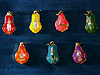
sih saek (สีแสก)
Thai. Name of a tree species commonly
found in wetlands and lowland areas of Thailand, often identified
with the Grey Teak or Lead Tree, scientifically known as Combretum
quadrangulare. This medium-sized deciduous tree is characterized by
quadrangular stems and small leaves, and it typically grows near
ponds, swamps, and marshy terrain. In Thai place names, such as
Wat
Nong Si Saek, the term
denotes the presence of these trees around a body of water,
conveying both a botanical and geographical identity.
回
Sikh
(सिख, ਸਿੱਖ)
Hindi-Punjabi. Indian
religion founded by the
guru
Nanak Dev
(1469-1539) in the late 15th century which emphasizes submission to
God and service to people. Sikh means ‘disciple’ or ‘seeker of the
truth’ and followers believe in one God, share the Hindu beliefs in
karma
and
reincarnation,
but reject the rituals. Sikhs believe that greediness, desire,
pride, anger and any attachment to passing values of earthly
existence are the source of all evil. This self-centeredness is
called haumai and separates humans from God. It is the cause of ones
karma that leads to the endless cycle of birth, death and rebirth, a
sequence that can only be broken by
Enlightenment
and spiritual unity with the one God. Its teachings emphasizes
equality of all people regardless of caste or gender. To demonstrate
their acceptance of this equality all men are instructed to change
their last name into
Singh
(lion), whilst all women adapt the name Kaur (princess). The Sikh
invite people of all
castes
to come and meditate together,
irrespective of their social background. They also started a
tradition of free distribution of food to poor and rich alike, to
create a sense of equality known as pangat. In Sikh history there
have been ten great gurus. Its founder Nanak Dev appointed his
successor who was followed by nine others. The last one however, the
guru Gobind Singh (1666-1708), pronounced the end of this line of
succession and ordained the Sikh holy scripture, the
Adi-Granth
to be the ultimate spiritual authority, rather than any person or
new successor. The holiest of Sikh shrines is the
Golden Temple
(fig.)
in
Amritsar,
which
foundations were laid during the
period of the fifth guru,
Arjan Dev
(1581-1606).
The Sikh escutcheon
consists of a double-edged sword known as khanda, in a circle called
chakkar (a word related to
chakra)
and flanked by two scimitars. This coat of arms is also referred to
as khanda, after the sword, and is also displayed in black on a
saffron
field (fig.)
on the Sikh flag, known as Nishan Sahib, meaning ‘Symbol of the
Guru's Honour’. It is customarily flown on a flagpole (fig.),
which is wrapped in fabric (fig.).
Male Sikh believers
wear a turban (fig.),
a bangle, a dagger, and short-like underpants. Officially, they are
not allowed to cut their hair and adults do not shave nor trim their
beards, but instead keep it up by a net. Sikh
devotees who participated in the
ceremony of initiation, i.e. a kind of baptism known as Amrit
Sanchar, commit to five articles of faith that collectively form the
external identity of the Sikh way of life, and by keeping those five
articles is considered khalsa, i.e.
‘pure’.
The
five articles, also known by the
five Ks, consist of: wearing
1.
kesh,
i.e. uncut hair; 2. the
kanga, i.e. a
small wooden comb used to first untangle and then firmly keep
the hair tied into a topknot; 3. an iron bracelet, called a
kara;
4.
kacchera,
i.e. boxer
short-like undergarment made from 100% cotton; and 5. an iron
dagger known as
kirpan.
There are an estimated 22
million Sikh believers worldwide and Thailand has Sikh temples known
as
gurudwaras in
most large cities, as many of the numerous Indian immigrants are
Sikh believers. Also Sikhism.
回
Sikhi (สิกขี, सिखी)
Thai-Pali. Term for the first
buddha
of the world according to the belief of certain groups in Thailand, a
primordial
buddha
believed to have attained perfect
Enlightenment countless aeons ago,
or it can be the name given to a
Buddha statue
of such a buddha, such as
Phra Wisutthep Somdet Ong Phatom,
also referred to as
Somdet
Phra
Phuttha
Sikhi
Pathom,
as well as to certain ancient
Buddha images. He was
called Sikhi because his
ushnisha (turban) looked
like a sikha (सिखा), meaning
‘crest’
or ‘tuft’,
but also ‘flame’,
conveying the image of something rising upward like a blaze. In Buddhist
contexts, the term can metaphorically signify the flame of wisdom or spiritual
radiance, and it is etymologically related to the name of this past buddha.
He is
one of the
Seven Buddhas known
as the
Saptatathagata.
回
sikhara (शिखर)
Sanskrit. ‘Mountain peak’, ‘pinnacle’ or ‘summit’.
Architectural term used to refer to the rising tower of North Indian Hindu
temples, usually erected over the sanctuary where the presiding deity is
enshrined is the most prominent and visible part of a Hindu temple of North
Indian style. Its South Indian equivalent is the
vimana. Also transcribed shikhara.
回
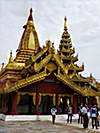
sila daeng (ศิลาแดง)
Thai. ‘Red stone’. A Thai name sometimes used
for
laterite,
though officially it is called
sila laeng.
See also
din daeng.
回
sila jahreuk (ศิลาจารึก)
Thai. A stone with a carved inscription. See
also
stele.
回
silakhun (ศีลคุณ)
Thai Buddhist term meaning ‘moral
conduct’, or the ‘virtue of moral discipline’. See also
sihnha.
回
sila laeng (ศิลาแลง)
A Thai name for
laterite.
回
silat
Collective term used for the
indigenous martial arts from Southeast Asia, as opposed to those
from the northern parts of the Far East, such as
China.
回
Si Ling-chi (西陵氏)
See
Xi Ling
Shi.
回
silk
Soft fabric of high quality made from the
spinnings of Mulberry Silkworms, i.e. the larvae (fig.)
of the
Domesticated Silkmoth
(Bombyx mori -
fig.), used
in
sericulture.
Silk fibers have a
triangular prism-like structure which allows cloth made from it to
refract incoming light at different angles, giving it a shimmering
appearance. Silk was first developed in ancient
China,
possibly around 2700 BC and began to reach the West in the 4th
century BC by merchants who would exchange it for other precious
goods. Imperial China anxiously tried to keep a monopoly on silk
production by imposing an imperial ban and condemning to death
anyone attempting to export silkworms or their eggs, but with the
advent of the
Silk Road
were eventually unable to prevent the spread of its techniques.
Western cultivation began in 552 AD, when two Byzantium monks sent
by the emperor Justinian smuggled silkworms and mulberry leaves out
of China, hidden in
bamboo rods. Thai silk gained
worldwide recognition when
Jim Thompson,
an American designer and textile trader, whose reputation earned him
the epithet King of Silk, introduced hand-woven Thai silk, called
Mai Thai,
to the world. According to an ancient legend silk was discovered
when a silkworm's cocoon fell into the
tea
cup of
Leizu, a
young Chinese empress, wife of the Yellow Emperor, Huang. Trying to
extract it from her drink she began to unroll the thread from the
cocoon, resulting in the discovery of the silk thread and the start
of sericulture. She was a daughter of the
Xi Ling
Shi, the ‘Western mountain
clan’ and is said to also have invented the silk reel and silk loom
(fig.).
She later became known as
Can Shen, the
Chinese ‘goddess of the silkworm’. Etymologically, the English word
silk derives from the Chinese word si (丝
or 纟), whereas the Thai word
mai
seems to be related to Chinese
word mi (糸),
which stands for ‘fine silk’. If woven in the traditional Thai
manner by hand, it is in Thai called
Mai Thai.
In Thailand, the
administrative building
of the
Krasuang Kalaahome,
i.e.
Ministry of Defence
in
Bangkok, ,
was
at somme point in time used as a royal
silk weaving
factory, and
Queen
Sirikit Kitthiyagon
has been a lifelong supporter and fervent propegator of Thai silk
production and
silk farming,
and in
2003 established the
Queen Sirikit Museum of Textiles (fig.),
which is under her auspices. See also
pah sompak.
回

Silk Cotton Tree
Silk Cotton Tree is an epithet commonly applied to Cochlospermum
religiosum, known in Thai as suphannikah (สุพรรณิการ์), an
ornamental deciduous tree reaching up to 15 metres in height and
noted for its conspicuous yellow blossoms that appear on bare
branches during the hot season. Native to India and mainland
Southeast Asia, the species has long been planted in temple grounds
and monastic compounds. In India and
Burma
it has also been utilised as a source of industrial gum, though its
earlier significance was primarily sacred. In Buddhist cosmology,
Silk Cotton Trees are traditionally regarded as dwelling places of
the
garudas,
reinforcing the tree’s association with sanctity and merit. Because
early
Muay Thai instruction historically
took place in temple courtyards and rural monastery grounds, the
tree became symbolically linked to Muay Thai culture. Its seasonal
flowering on stark, leafless wood came to embody qualities admired
in the martial art—endurance, discipline, respect for teachers, and
spiritual merit—and its flowers were used in offerings during
wai kruh
rituals. Confusion frequently arises with the closely related
Cochlospermum regium, known in Thai as Thip Feuang Fah (ทิพย์เฟื่องฟ้า),
sometimes called the Yellow Cotton Tree or Buttercup Tree, a South
American species with similar yellow flowers and cottony seed pods
but no historical or cultural connection to
Thailand
or Muay Thai traditions. This latter species is the provincial
flower of
Uthai Thani.
In Thai usage, however, the name ton suphannikah (ต้นสุพรรณิการ์)
properly refers to Cochlospermum religiosum, while the Red Cotton
Tree, Bombax ceiba, is known as
ton ngiw
(fig.)
or ton chim phalih (ต้นฉิมพลี).
回
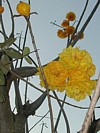
silk farming
The
production of
silk
is a process that starts with a silk moth laying its eggs.
READ ON.
回
Silk Road
Name given to an extensive, ancient network of
interconnecting land and maritime trade routes, that existed for almost three
millennia and ran for about 6,500 kilometers, from the Far East, over and along
South and Western Asia, through to the Mediterranean region. It gradually
developed from around the 2nd Century BC and was named after
silk, then the most lucrative and sought after
commodity, which was exported from
China
under an exclusive monopoly, in addition to other luxury goods, such as spices,
tea, and porcelain. Besides this, the Roman Empire exported their luxury
household goods, such as gold,
silver, jewelry, glassware, wine, and carpets in
eastern direction, while India, which lay at the Silk Road's junction, traded
–often first hand– with all parties involved of both sides, self exporting
ivory, precious stones, pepper, and textiles, in both directions. The starting
point of the overland northern trade route was the then Chinese capital city of Chang'an, i.e. present-day Xi'an (fig.).
See also
Zhang Qian.
回
silkworm
See
mai.
回
silom (สีลม)
Thai. Literally ‘to rub the wind’, a term used for a
‘windmill’. The word is a compound of si (see)
which means ‘to rub’ or ‘to mill’, and lom which translates as ‘wind’. Rather
than for milling Thai windmills are more commonly used for pumping water into
fields (fig.),
especially salt fields called
nah kleua
(fig.).
In
Bangkok's
Bang Rak (บางรัก)
district, an area with several foreign embassies, as well as the head offices of
many large corporations, an important street, located between Sathorn and
Surawong Road, is called Silom Road (map).
As a reference to its name a metal statue of a full-scale windmill is put up in
the street.
See also
bai kang han and
MAP.
回
%20by%20night_small.jpg)
Silpa Bhirasri (ศิลป์
พีระศรี)
Professor of Italian origin, born in Santa
Giovani, Florence on 15 September 1892, with the western name of
Corrado Feroci
(fig.).
After his education at the Academy of Fine Arts in Florence he was
appointed its professor in 1914. In 1923 he came to Thailand on an
invitation from the Thai government and was in 1924 appointed
sculptor of the Royal Institute for Fine Arts. In 1933, he founded
the School of Fine Arts and became its administrator and teacher in
art, art history and several art disciplines. Following a visit by
Prime Minister Field Marshal
Phibun
Songkram (fig.),
the school's status was in 1943 raised to that of a university.
Corrado Feroci was entrusted with the task to establish the
Silpakorn
University (fig.)
and was appointed professor and dean of the Faculty of Painting and
Sculpture (fig.).
In 1944, during WW II, professor Feroci changed his name to Silpa
Bhirasri and became a Thai citizen. He died of cancer in
Bangkok
in 1962. His contribution and devotion to Thai art give him a unique
status. In 1992, he was commemorated with a Thai postage stamp (fig.),
issued to celebrate his 100th birthday. Also
Silpa
Phirasih.
See also POSTAGE STAMP
and
TRAVEL PICTURES.
回
_small.jpg)
silpakahntat phummai pen roop tahngtahng
(ศิลปะการตัดพุ่มไม้เป็นรูปต่างๆ)
Thai description for
topiary.
回
Silpakorn University
University in
Bangkok founded in 1943
previously the School of Fine Arts founded by the Italian sculptor
Corrado
Feroci (fig.)
who was also the dean of the Faculty of Painting and Sculpture (fig.).
The university also has an Art and Cultural Centre (fig.)
in
Nakhon Pathom,
which is known as the Sanam Chan Palace (fig.)
Campus (fig.).
Also spelled Silpakon University and in Thai known as
Mahawithayahlay
Silpakon.
回
Silpa Luat Dat (ศิลปะลวดดัด)
Thai. ‘Wire Bending Art’. Name of an art form, in
English usually referred to as Wire Art, in which sculptures or
three-dimensional forms are created using wire as the primary material. It
involves bending, twisting, and shaping metal wire to create intricate and
detailed artworks, manipulating the wire to form various shapes, patterns, and
structures, ranging from simple figures to complex and abstract designs, using
various types of wire, such as steel, copper, or aluminum, depending on the
desired outcome and purpose of the artwork, whilst using the opportunity to play
with negative space, light, and shadow, resulting in visually captivating and
dynamic compositions. The artworks (fig.)
can be freestanding, wall-mounted, or even incorporated into larger
installations. In
topiary
(fig.),
i.e. the art of sculpting and training live plants, typically bushes and trees,
into intricate and ornamental shapes
(fig.),
wire art may be incorporated
as internal support structure
or as a guide for plant growth,
adding an additional layer of creativity and allowing for more intricate and
detailed designs.
See also TRAVEL PICTURE.
回
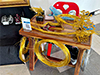
Silpa Phirasih (ศิลป์
พีระศรี)
Another transcription for
Silpa
Bhirasri.
回
sittuyin
(စစ်တုရင်)
Burmese. ‘War representation of the four
characteristics of an army’, i.e. a Burmese variety of chess. The four army
characteristics in the name refer to chariots,
war elephants,
the cavalry, and the infantry. Sittuyin derives directly from the ancient Indian
strategy game
chaturanga, i.e. the common ancestor of
chess, which is said to have arrived in
Burma
in the 8th Century AD. The game board consists of 64 squares, i.e. 8 rows and 8
columns, though without alternating colours and with two diagonal lines across
the board. The pieces on the game board are similar to those of western chess,
though the King is sided by a general, rather than a Queen, and a set of
elephants
act for the bishops found in
western chess, and the setup of the pieces on the game board in starting
position is also different, as pawns, referred to as feudal lords, are on the
board in the initial position. The other pieces are put on the squares behind
the pawns, in positions chosen by the players themselves, and deployed prior to
the first actual move. In English, sittuyin is known as Burmese Chess. See also
mahk ruk.
回
silver
See
ngun.
回
silver and gold trees
Annual tribute that vassal states in the
past were required to pay to the ruling kings, as an indication of their
loyalty. See also
ton mai
ngeun ton mai thong.
回
Silver Bluggoe
Common name for a
banana cultivar
with the botanical name Musa acuminata x balbisiana and
known in Thai as
gluay hak muk (fig.).
回
Silver Date Palm
See
Inthaphlam Bai Ngun.
回
Silver-eared Mesia
Common name for a colourful, 16.5 to 18 centimeter tall
bird in the Timaliidae family, with the scientific name Leiothrix argentauris,
and found in many parts of South and Southeast Asia, from the Eastern
Himalayas to Western
China,
ranging South, down to Malaysia and Sumatra, through Indochina. They also reside
in northern parts of the Indian subcontinent, Southwest China and Southeast
Tibet. There are some subspecies, with males of the form Leiothrix argentauris
galbana having a black head, with a yellow patch on the forehead, and silvery
ear-coverts. The mantle and back are greyish-olive, the lower belly whitish, and
the rump and vent are reddish-orange. The bill is yellow, the throat and breast
are deep yellow, and there is a reddish patch in the middle of the wings, which
are otherwise greyish near the shoulders and yellow near the tips. The female is
similar, but the yellow on the breast is paler and doesn't extend as far down.
The reddish wing-patches are also lighter, whilst the neck is somewhat darker.
Females also have light yellow under-tail coverts. Other subspecies are similar,
with only minor differences, e.g. Leiothrix argentauris ricketti has a darker,
almost orange throat, and Leiothrix argentauris cunhaci has a larger patch on
the forehead. Silver-eared Mesias feed on insects and some plant material,
whereas vegetables and certain fruits are eaten when available, such as berries,
which they search for under bushes. In captivity, they become uneasy when they
are alone, but they are easily made tame in an aviary environment. This bird
species is related to the
Red-billed Leiothrix
(fig.).
In Thai, it is named
nok karong thong kaem khao.
回
%201_small.jpg)
Silvered Leaf Monkey
Common name for a species of Leaf Monkey
native to Southeast Asia, and with the scientific names
Presbytis
cristata and
Trachypithecus cristatus. In Thailand it is found on the southern peninsula. It
is identified by its dark-skinned face and overall dark grey fur, which has pale
tips, giving it a silvery appearance. Like with some other Langurs, infants are
of a bright orange colour. They usually live in groups of up to 10 individuals,
especially in swampy areas, and riverine or
mangrove
forests. Its diet consists
mainly of young leaf shoots and forest fruits. Also known as Silvery Lutung and
Silvery Langur, and in Thai called
kaang thao or
kaang ngok, meaning ‘Grey
Langur’.
回
_small.jpg)
Silverfish
See
malaeng sahm ngahm.
回
Silver Pheasant
Name for a pheasant with the scientific name Lophura
nycthemera and which occurs in mainland Southeast Asia.
READ ON.
回
Silver Star
Common name for a small epiphyte,
with the botanical designation Tillandsia
stricta.
READ ON.
回
Silvery Gibbon
Common name of a critically
endangered species of
gibbon,
with the scientific designation Hylobates moloch.
READ ON.
回
sim (สิม, ສິມ)
Isaan-Laotian.
A term in the Thai-Lao cultural
language for the most important sanctuary and
ordination hall of a Buddhist temple in Laos and the
Isaan,
similar to the
bot
or
ubosot,
and often referred to as Sim Isaan (สิมอีสาน), i.e.
‘Isaan Sim’ or
‘Northeastern Sim’.
This significant architectural structure in Northeast Thailand's
temples and monasteries is traditionally built from wood, bamboo, or
rattan. Sim are small, sacred spaces intended for monks' activities,
like ordinations and
kathin
ceremonies, and not for laypeople. Sims are categorized based on
their location: Sim Bok (สิมบก),
‘Land Sim’,
are permanent structures within temple grounds, while Sim Nam (สิมน้ำ),
i.e.
‘Water Sim’,
are temporary and surrounded by water, following Sri Lankan Buddhist
beliefs in water's purity. Due to the perishable materials used,
many older Sim have decayed, though examples still exist in various
northeastern provinces. Recently, there has been a movement to
preserve the Isaan Sim's unique style, often by constructing larger
structures to accommodate more people. The construction of the
concrete sim is more elaborate than the wooden sim. The walls or
bases are decorated with various beautiful patterns. There are doors
and windows, usually no more than two or three on each side. An example is the Isaan
Sim at Wat Pah Saeng Arun
(วัดป่าแสงอรุณ)
in
Khon Kaen,
recognized for its blend of Thai and Lao architectural elements,
brick and mortar construction,
naga-shaped
gable, and notable mural paintings. Sim often have unique mural
paintings known as
hoop taem.
The word sim is derived from the terms sima (สีมา), as in bai sima
or
bai sema, stone boundary
markers at the eight cardinal points around an
ordination hall (fig.),
and
wisung khama sima, i.e. the royal granting of the land
to monks to have a
temple constructed,
which materializes in the presenting of the consecrated boundary
foundation stone of the ordination hall, as well as from the term
pattasihma, which appear in
inscriptions on stone slabs that declare the dedication intentions
of the builders and are placed behind the sim.
回
simha (सिंह)
Sanskrit
for
singha.
回
Simhahanu (सिंहहनु)
Sanskrit. ‘Lion's jaw’. Grandfather of
Siddhartha
who possessed the bow that the prince used in a contest to proof his
skills in order to allow him to marry
Yasodhara,
a weapon that others could hardly lift. He had five sons, namely
Suddhodana,
Dhautodana, Shakradana, Sulkodana and Amritodan.
回
simhasana (सिंहासन)
Sanskrit
for ‘lion
throne’, one of the seated positions or
asana in
iconography.
回
sindura (सिन्दूर)
Hindi. An orange-red powder, used by married women in
India to apply a vermillion stripe along the parting of their hair (fig.),
as well as a
bindi
(fig.),
in order to indicate their martial status (fig.).
Also called sindoor, which may also be transliterated sinduhr.
回
_small.jpg)
Sing (สิงฆ์)
Thai-Pali name of a mythological creature from
Himaphan forest, very
similar to a
singha
or
singh, but with
clawed feet and a purplish complexion. Sometimes transcribed Sinkh.
回
Singapore
Name of a sovereign island nation and city-state
in Southeast Asia, which covers an area of just 733.1 km² and has a population
of around 5.5 million, and that is officially known as the Republic of
Singapore. The country's name derives from the Sanskrit word Singapura (सिंहपु)
and means
‘Lion
City’. Its maritime location and
animal name are merged and symbolized in the
Merlion,
the official mascot and a popular
landmark of Singapore at
Marina Bay,
that consists of a mythical creature with the head of a lion and the body of a
fish (fig.).
The Merlion features on the reverse side of one
Singapore Dollar (fig.)
coins of the third series issued in 2013.
Embossed next to it is the
Singapore Orchid, the national flower of
Singapore (fig.),
which already featured on the one cent coins of the previous second series
issued between 1985 and 2013.
Singapore was founded in 1299, on an island then known as Temasek, by Prince
Sang Nila Utama (सङ् नील उत्तम) of the
Srivijaya
Empire, who as king took the crown title Sri Tri Buana (श्री त्रि भुवन). Its
location at the southern end of the Malay
peninsula made Singapore of major geopolitical and strategic importance,
especially with the
Strait of Malacca
and Singapore Strait (fig.) being the main ship
passageway for the India-China trade and
second busiest sea
route of the world for maritime traffic,
linking the
South China Sea
(fig.)
with the Indian Ocean, via the Andaman Sea and Bay of Bengal. Hence, the area
was between the 16th and 19th centuries gradually taken over by the
European colonial powers, with Singapore becoming a British colony in 1824, some
five years after Sir Stamford Raffles (fig.)
in 1918 established a new port and a British trading post, thus becoming the
founder of modern Singapore. When the region
in 1963 gained independence from Great Britain, it initially consisted of a
federation of the former British colonies of Malaya and Singapore, including
Sabah and Sarawak on the northern coast of Borneo, yet after Singapore's
secession from the federation in 1965, the federation's name was adapted by
inserting the first to letters of Singapore into the name Malaya to form
Malaysia, in order to indicate the historical connection and former political
union between the two nations. The national flag of Singapore (fig.) was adopted in
1959, the year Singapore became self-governing within the British Empire, and
remained the national flag upon the country's independence from Malaysia on 9
August 1965. It consists of a horizontal bicolour of red above white, with in
the upper-left quadrant a white crescent moon, which symbolizes a young nation
on the ascendant, facing a pentagon of five small white five-pointed stars, that
represent democracy, peace, progress, justice and equality. Vessels at sea do
not use the national flag, but instead Singapore-registered civilian ships fly
the Red Ensign of Singapore, which was introduced in 1966 and consists of a red
flag with in white a centered ring with in it a vertical crescent underneath
five stars, whereas military vessels fly the Singapore Naval Force Ensign
introduced in 1967 and which consists of a white flag with a red top left hand
quarter with in white a crescent sided by five stars in a circle and in the
lower right hand quarter an eight pointed red star with narrow white lines
inserted within the star; all non-military vessels owned by the government, such
as the Police Coast Guard, fly the State Marine Ensign, which was introduced in
1960 and is similar to the Singapore Naval Force Ensign, but with the main field
in dark blue.
See also TRAVEL PICTURES (1),
(2) and
(3), and
WATCH VIDEO.
回
Singapore Cherry
See
takhob.
回
Singapore Dollar
Name of the official currency of the Republic of
Singapore.
It is abbreviated with the currency code SGD and is often denoted by the symbol
$ or S$. The Monetary Authority of Singapore (MAS) is responsible for issuing
and regulating the Singapore Dollar. The Singapore Dollar is divided into 100
cents and coins are issued in denominations of 5, 10, 20, and 50 cents, as well
as $1. Banknotes are available in denominations of $2, $5, $10, $20, $50, and
$100. Singapore's currency features a combination of historical and modern
elements, with images of prominent figures, landmarks, and symbols of the
nation, such as
Merlion
(fig.)
and the
Singapore Orchid (fig.).
Singapore is known for its stable and well-managed economy, contributing to the
strength and reliability of its currency.
回

Singapore Flyer
Name of a 165 metres tall
observation wheel in the
Marina Bay (fig.)
area of
Singapore and one of
the largest ferris wheels in the world.
It is situated in close proximity
to several other
prominent landmarks, such as
Marina Bay Sands (fig.)
and the
Gardens by the Bay (fig.).
The Singapore Flyer has a unique and modern design, featuring 28 air-conditioned
capsules that can each accommodate up to 28 passengers. The capsules are mounted
externally to the wheel structure, providing unobstructed views. It takes the
wheel about 30 minutes to complete one full rotation. The Singapore Flyer
officially opened to the public in 2008 and offers a stunning night experience,
with the city lights creating a picturesque view, whilst the ferris wheel is
illuminated itself, adding to the visual appeal.
回
Singapore Orchid
The national flower of
Singapore.
It was chosen in 1981 as a symbol of the country's unique identity and heritage.
It is a representation of the unity and harmony among Singapore's people. Its
botanical name is Vanda Miss Joaquim and it is a hybrid orchid, resulting from a
cross between Vanda teres and Vanda hookeriana. It is named after Agnes Joaquim,
a horticulturist who played a crucial role in cultivating and promoting the
hybrid. The orchid has a distinctive and vibrant appearance with a combination
of pink, purple, and white hues. The orchid is celebrated for its resilience,
elegant beauty, and the representation of Singapore's multiculturalism, as it
brings together different elements just like the diverse population of the
country. It features on one
Singapore Dollar coins of the third series issued from 2013 onward (fig.),
embossed next to a depiction of
Merlion,
the official mascot and a popular
landmark of Singapore (fig.),
as well as on one cent coins of the previous second series issued between 1985
and 2013.
回
Singapore Rhododendron
Common name for a flowering plant in the family Melastomataceae,
with the botanical term Melastoma malabathricum.
READ ON.
回
Singburi (สิงห์บุรี)
Thai. ‘Lion
city’. Name of a province (map)
and its capital city of the same name in Central Thailand.
READ
ON.
回
singh (สิงห์)
1. Thai pronunciation for the
Pali
term ‘singha’,
i.e. a mythological
lion.
回
2. Name of Thailand's oldest
beer and the only one that carries the
Krut Trah Tang Hahng
i.e. the
Garuda
symbol for a Royal Warrant of Appointment given by the King of
Thailand. Usually referred to as bia(r) singh and in English as
singha beer.
回
2. Name of a small
island off the coast of
Prachuap Khirikhan
Province,
located on the western seashore of the
Gulf of Thailand,
roughly between
Pha Fang Daeng, i.e. the ‘Red Cliffs’ (fig.),
and
Koh Thalu
(fig.),
a small island with an arched rock formation. Koh
Singh features a
rock formation
in the shape of a
mythological
lion, hence
its name.
WATCH VIDEO
and
VIDEO (EN).
回
singha (सिंह)
1.
Pali and Hindi pronunciation for
singh,
derived from the
Sanskrit
word
simha. and
meaning ‘lion’.
In Pali and Hindi called
singha
and in
Burma
cinthe.
In
Buddhism
it is considered the guardian of Buddhist teachings usually
portrayed in a mythological form. Especially in northern Thailand
they are often found in pairs guarding temple entrances. In general
the term is used when referring to lions in a metaphorical sense,
e.g. mythological lions and when a sign of the zodiac. Mythological
lions are also known as
kraison,
and the common word used for actual lions is
singtoh.
There are several types, many with features of other animals, such
as
Toh, which
has two antlers (fig.)
and
Sang Praeng,
with clawed feet and a feathery tail (fig.),
to name just two. Most of these composite creatures dwell in
Himaphan
forest.
It appears on a Thai
postage stamp issued in 1998 (fig.).
In Thai
iconography,
the singha is typically portrayed with a curly fur
and adorned with a flame pattern design known as
kranok. See also
Snowlion.
See POSTAGE STAMPS,
THEMATIC STREET LIGHT.
回
2. English pronunciation for
Thailand's oldest beer, which in Thai is known as
singh
(fig.).
回
singhabanchon (สิงหบัญชร)
Thai term for a window behind which
a Thai king in the past used to receive foreign visitors.
回
Singha Nat Racha (สิงหนาทราชา)
Thai. Name of a
Shan
leader (fig.)
with the Thai title of
Phraya
(according to some sources
Phaya),
who was appointed as the first ruler of
Mae Hong Son.
In 1874 he commissioned the construction of a
chedi
at
Wat Phrathat Doi Kong
Moo
(fig.)
and his wife in 1875 commissioned the casting of a twelve meter long reclining
Buddha image which today rests in
Wat Phra Non
(fig.).
Today, his statue stands at an intersection in the city on the road towards both
aforementioned temples.
回
_small.jpg)
Singha Park
Name of an over 8,000
rai
recreational domain in
Chiang Rai
and the largest agricultural tourism destination in Thailand, known in Thai as
Singh Park (สิงห์ปาร์ค). The domain features various gardens with attractive
plants and trees, a
tea
plantation, a
rubber
plantation, a lake, walking and biking trails, an observation tower, various
animals, and a large golden statue of a mythological
lion,
known in Thai as
singh,
and in English pronounced
singha (fig.),
akin to the
Pali
and Hindi pronunciation, that is
situated in a hilly grass field and which refers
to the name of the park.
See also
TRAVEL PICTURES
and
WATCH VIDEO.
回
Singh Khak Khah (สิงหคักคา)
Thai-Pali
name of a
mythological creature from
Himaphan forest, that
has the body of a
singha, but scaled and of
a dark purple colour. In
addition, its lower legs and feet are reminiscent to those of an
elephant. Sometimes
transliterated Singha Khak Kar and also known as
Siha Khak Khah.
回
Singh Phanon (สิงหพานร)
Thai-Pali
name of a
mythological creature from
Himaphan forest. It has
the lower body of a lion (singha)
and the upper body of a monkey (phanon), though its feet are also like those of
a monkey. In art, it is often depicted standing
upright whilst holding a staff with both
hands, in front of its body. See also
Apsonsi
and
Phanon Mareuk.
回
singing bowl
Name for a kind of bowl-shaped bell or gong used as a
stimulation utility for meditation, trance induction and prayer, especially in
Mahayana Buddhism and
feng shui.
It originates from the
Himalayan region but is widely used
throughout the South Asia and the Far East. In Chinese Buddhism, the monks
strike the singing bowl when chanting prayers (fig.),
but usually it is played by rubbing a wooden mallet around the rim of the bowl,
causing an overtone, which is referred to as ‘singing’, hence its name. They may
also have
mantras, such as
Aum or the six
syllable
Aum mani padma hum,
inscribed on them (fig.).
It is traditionally made from five metals called panchaloga in
Sanskrit, in
general a bronze mixture of copper, tin, zinc and iron, and another metal,
although nowadays also other materials are often used. Singing bowls are usually
kept on hassock-like cushions (fig.).
Also called Tibetan singing bowls, Himalayan singing bowls, rin gongs or suzu
gongs. See also
muyu.
回
_small.jpg)
Singh Singhaseni (สิงห์ สิงหเสนี)
Thai. The personal name of
the
Chao Phraya
Bodindecha.
回
singtoh (สิงโต)
Thai for ‘lion’. This word is commonly -though
not always- used when referring to a real animal. When referring to
a mythological lion generally the word
singha
or
kraison
is used. See also
simha,
singh,
singha and
Toh.
回
Singtoh Jihn (สิงโตจีน)
Thai. ‘Chinese lion’. Name used in Thailand to refer to
Rui Shi.
回
Sin Kyone
(ဆင်ကျုံး)
Burmese.
‘Elephant
Stockade’ or ‘Elephant Moat’.
Name of a fortress, located at the east bank of the
Irrawaddy River (fig.),
to the
south of —and connected to—
Ava. It
is named after the village where its is located and was
built to protect the Mandalay capital
against the British during the
Third Anglo-Burmese War. As such, it is one of three
19th century fortresses built for the purpose, the others ones being
Asaykhan Fortress
(fig.) in
Sagaing, on the opposite
side of the river, and
Tha Byae Tan Fortress (fig.)
to
the north of Ava.
However, despite all this, the bastions failed to prevent the British conquest
in 1885 AD. The fortress' square layout and its surrounding moat, as well as two
canons and are all that remain today. Also spelled Sinkyone.
See MAP.
回
Sin Myar Shin (ဆင်များရှင်)
Burmese.
Name of a Buddhist temple in
Sagaing, which
in full is named
Yadana Zedi Sin Myar Shin Phaya Kyee,
literally ‘Great
Pagoda of the
Bejeweled
Stupa
with Many
Elephants’, and which was built in 792 AD by King Mohnyin of
Inwa. The
stupa
is said to enshrine five
relics that were brought back from
Sri
Lanka
by two Buddhist
monks.
The platform onto which it is built is surrounded by a
gallery of
White Elephants
(fig.),
hence the name of this pagoda. The
outer edge of the compound is lined with statues of
monks out on alms round, while the garden also features
a
pahng nahg prok
image
(fig.).
At the beginning of this row of monks is a standing
Buddha image
holding an
alms bowl (fig.),
while in his front are
Sumedha
(fig.), i.e.
a former incarnation of
Siddhartha
Gautama,
who is here represented as a
Burmese
hermit or
tapathi
(fig.)
laying flat on his belly in worship of
Dipankhara
(fig.),
and offering some of the
lotuses given to him
by
Sumidha, who is here sitting besides him, after
having pledged to her that they would become husband and wife in all their
future existences.
See TRAVEL PHOTOS (1) and
(2), as well as
MAP.
回
sinphrachon (สิ้นพระชนม์)
Thai.
Rajasap
or royal language for ‘dying’, similar to
sawankot. The
term occurs regularly on pedestals in Thailand together with the
term
phrasoot
or
somphop.
回
Sin Samut (สินสมุทร)
1. Thai. ‘End of the Ocean’. A son of
Phra Aphaimanih
and the ogress
Nang
Phi Seua Samut
(fig.),
in the story Phra Aphaimanih, who −with the help of a mermaid− moved the rock in
front of the cave in which Phra Aphaimanih was held captive by the ogress, thus
helping him escape to Koh Kaew Pitsadahn (เกาะแก้วพิสดาร), i.e. ‘Queer Crystal
Island’, a fictional island at the tip of Sumatra. Later, Sin Samut was adopted
by
Nang Suwanna Malih (fig.).
The HTMS Sin Samut, a submarine of the type
Madchanu once
used by the Royal Thai Navy (fig.),
was named after this character.
回
_small.jpg)
2.
Thai. ‘End of the Ocean’. Name of a submarine, usually referred to as the HTMS
Sin Samut, i.e. a U-boat of the type
Madchanu that was once
used by the Royal Thai Navy (fig.),
and which is named after a character from the
story
Phra Aphaimanih.
回
Sih Phih
(สีพี)
Thai name for
the city or kingdom of
Sivi,
i.e. the hometown of Prince
Wetsandorn
and the setting
in
the
Totsachat or
last
jataka
Wetsandornchadok,
where it is related that the city had a
White Elephant with powers to bring rain.
Also spelled Si Phi or See Phee.
回
Sipsongpannah (ສິບສວງພັນນາ,
สิบสองพันนา)
Laotian-Thai.
‘Twelve hundred paddies’. A region in the South Chinese province of
Yunnan, in the North
bordering Nan Chao, and in the 12th century AD under the rule of the
independent
Tai
and later, in the 17th century, kingdoms of
the
Thai Lu. In
Chinese known by the name of
Xishuangbanna.
Compare with
Lan Na.
MORE ON THIS.
回
Sirikit (สิริกิติ)
See
Sirikit Kitthiyagon.
回
Sirikit Kitthiyagon (สิริกิติ์
กิติยากร)
Born
the daughter of a Thai prince and his consort, on Friday 12 August
1932. Queen of Thailand by marriage to king
Bhumipon
Adunyadet, on 28 April 1950
(fig.).
She breathes new life into Thai traditional handicrafts and
encourages the continuation of this cultural heritage on a national
level. For her
dedication and legacy
to preserve the arts and crafts of Thailand, she was given the title Preeminent Protector of Arts and
Crafts (fig.)
and in this role she is depicted on a set of six postage stamps
issued in 2013 (fig.).
She is also chair of several
organizations, including the national Red Cross. She gave birth to
four children, three daughters and one son, the present King
Maha
Vajiralongkorn (fig.).
The name Sirikit means ‘beauty and honor’. Her personal Royal Flag (fig.),
known as Thong Sirikit Kitthiyagon (fig.),
consists of a golden crown over her initials, the letters S (ส)
and K (ก) in blue and white, on a light blue
field, the colour of her birthday (see
sih prajam
wan), though there is
also another version of
this flag,
which has the logo and text in white print, and in addition to the
crown and the initials, it has a ribbon with the text Song Phra
Charoen (ทรงพระเจริญ), which is
rajasap,
meaning ‘to prosper’ or ‘to be prosperous’, but is usually
translated as ‘Long Live the Queen’ (fig.).
Although the Queen has often appeared on a number of Thai postage
stamps (fig.),
to commemorate her
80th birthday
anniversary a unique set of stamps was issued with representations
of the Queen
during different stages of her life, from childhood to the present
adult Queen,
with intervals of ten years (fig.).
Many projects and edifices,
such as the
Sirikit Medical Center
in
Bangkok (map
-
fig.),
as well as a
lotus
flower (fig.),
a rose (fig.) and an
orchid
(fig.),
and a shrub with the botanical designation
Mussaenda philippica
(fig.),
and a section of
Chatuchak
Park
(fig.),
have been
named after her. Queen Sirikit
passed away on 24 October 2025, aged 93.
See also POSTAGE STAMPS (1),
(2),
(3),
(4),
(5),
(6),
(7),
(8),
(9)
and
(10).
回

Sirindhorn (สิรินธร)
Another -often used- transliteration for the name of princess
Sirinthon.
回
Sirindhorn Museum
Name of Thailand’s first dedicated dinosaur
museum and a key centre for paleontological study, also known as the Phu Kum
Khao Dinosaur Research Center.
READ ON.
回
Sirinthon (สิรินธร)
1. Name of the second daughter and third child to King
Bhumipon and
Queen
Sirikit.
READ ON.
回
2. Name of an
amphur
in
Ubon Ratchathani.
回
Siriraj Bimuksthan Museum
Museum on the history of the
Siriraj Hospital
(map
-
fig.),
located in the former
Thonburi Train Station
(fig.),
adjacent and since 2003 part of to the main hospital complex in
Bangkok Noi. In Thai, it is known as
Phiphithaphan
Siriraat Phimuk
Sathaan
(พิพิธภัณฑศิริราชพิมุขสถาน), but
this is officially transliterated as Siriraj Bimuksthan Museum,
although it should be pronounced Siriraht Phimukhsthan Museum, which
literally translates as the Siriraj Rear (Position) Musem, due to
the fact that it was once the place of the Rear Palace, known in
Thai as
Krom Phra Rachawang Bowon Sathaan Phimuk,
or simply
Wang Lang,
with its last ever occupant being
Anurak Thewet
(fig.).
It is just one of several museums belonging to the
Siriraj Hospital Museum (fig.).
See MAP.
回
_small.jpg)
Siriraj Hospital
Name of
the first royal hospital in the country,
originally called
Wang Lang
Hospital, after the former palace and residence of the last
Krom Phra Rachawang Bowon Sathaan Phimuk,
that once stood on its location. It was renamed in memory to Prince
Siriraj Kakuthaphan
(fig.),
who died of dysentery at the short-lived age of one year and seven months. He
was the fifth son to Queen Sri Patcharintra and the 59 child of King
Rama V, who had it built to provide
medical treatment to the public when the era of modern medicine made its way to
Thailand.
When current members of the royal family
need medical attention they customarily come here. The hospital was also
Thailand's first medical school, built to help medical students with their
studies and research projects and to educate medical students the hospital had a
hall with didactic materials, which today has been made into a museum, known by
the name
Siriraj Hospital Museum (fig.).
Siriraj Hospital was officially opened in a ceremony on 26 April 1888 and Rohng
Rian Phaetayakon (โรงเรียนแพทยากร), often transliterated Bhatayakorn, Thailand's
first medical school, was opened in 1889. These events marked the beginning of
modern medicine in Thailand.
See also POSTAGE STAMPS (1),
(2),
(3),
and
(4),
and
MAP.
回
Siriraj Hospital Museum
General name for a group of educational
museums located within the compound of the
Siriraj Hospital
(map
-
fig.)
in
Bangkok Noi, which initially doubled as Thailand's first medical
school. Originally, it was a didactic classroom, founded to help
medical students with their studies and research projects, but later
became a museum with permanent exhibits which expanded into its
present form, i.e. spread out over three buildings and several
halls, that are separately known as: the
Siriraj Bimuksthan Museum
(fig.),
located in the former
Thonburi Train Station
(fig.);
the
Siriraj Medical Museum (map
-
fig.),
which consists of the Ellis Pathological Museum, the Songkran
Niyomsane Forensic Museum, the Parasitology Museum (fig.),
and the Ouay Ketusingh Museum on the History of Thai Medicine, all
accommodated on the second floor of the
Adulyadejvikrom Building, which is
named after
Mahidol Adulyadej
(fig.);
the Sood Sangvichien Prehistoric Museum and Laboratory, housed
besides the morgue in the Anatomy Building; and the
Congdon Anatomical Museum (fig.),
named after Dr. Edgar Congdon, who founded the museum in 1927, and
which is also in the Anatomy Building, conveniently located above
the Dissecting Room. Parts of the museum have some rather morbid
objects on display, such as the cross-section of human bodies, heads
and body parts, and babies affected by genetic anomalies and
disorders, frozen in time inside jars filled with formaldehyde.
There are also exhibits of the bodies of accident victims, and
even the dried body of an infamous serial killer, who in the fifties
was known to eat the livers of children.
In Thai, the mueum is called
Phiphithaphan
Satahn Rohng Phayahbahn Siriraht
(พิพิธภัณฑสถานโรงพยาบาลศิริราช). In English, the museum is also
nicknamed the Museum of Death, and its objectives are in many ways
similar to those of the
Human Body Museum
(fig.)
at the Faculty of Medicine of the
Chulalongkorn
University.
See MAP.
回
_small.jpg)
Siriraj Kakuthaphan (ศิริราชกกุธภัณฑ์)
Thai. Name of
the 59 child of King
Rama V
(fig.)
and the fifth son (fig.) to Queen
Sri Phatcharinthra. He was
born on 27 November 1885 and died of dysentery at the short-lived
age of one year, six months and 4 days, on 31 May 1887.
Siriraj Hospital
(fig.)
and the Siriraj
School of Nursing and Midwifery are named after him. Sometimes
transcribed Sirirat Kakudhabhandu or Siriraj Kakuttapan. See also
kakuthaphan.
回
_small.jpg)
Siriraj Medical Museum
Museum located on the second
floor of the Adulyadejvikrom Building
of the
Siriraj Hospital
(fig.)
in
Bangkok Noi, and part of the larger
Siriraj Hospital Museum (map
-
fig.).
This one museum consists itself again of four halls or museums,
which are separately known as the Pathological Museum, which
displays a genuine healthy human heart and hearts with diseases,
several types of cancer, fetal development and congenital anomalies;
the Forensic Museum, which displays objects such as human skeletons,
skulls and organs collected from homicides and suicides, as well as
from accidental and natural death cases, including even the
preserved corpse of a notorious serial killer; the Parasitology
Museum, which features all kinds of parasites, their origin and how
they affect the human organs (fig.);
and the Museum on the History of Thai Medicine, which includes also
Thai traditional medicine. In Thai, the Siriraj Medical Museum is
known as
Phiphithaphan Kahn Phaet
Siriraht (พิพิธภัณฑ์การแพทย์ศิริราช).
See MAP.
回
_small.jpg)
Sirimahannop (สิริมหรรณพ)
Name of Thailand's largest sailing
ship, a three-masted vessel with a length of 58.5 meters and 11
meters wide.
READ ON.
回
Siriyalai Palace
Name of a contemporary royal palace in
Ayutthaya.
READ ON.
回
Si Shi (四氏)
Chinese. ‘Four
Shi’ or ‘Four
Sirs’. Name of
a group of semi-mythological rulers and
culture heroes from the period preceding the Xia Dynasty in ancient China, and
that
are said to have taken part in the creation of the world. They are four in
number and known as
You Chao-shi,
Fu Xi-shi,
Sui Ren-shi,
and
Shen Nong-shi,
each taking the annex shi to their names, thus referring to their
membership of this clan, although Shi can also be used as a masculine honorific
like ‘Mister’ or ‘Sir’.
回
Sisowath (ស៊ីសុវតិ្ថ)
Khmer.
King of
Cambodia,
who ruled from 1904
to 1927. He was born
on 7 September 1840 as the son of King Ang
Duong, and a half-brother of Prince Si Votha and Prince Norodom. At his birth,
Cambodia was under joint Siamese and Vietnamese rule, and Sisowath was educated
in the Siamese capital
Bangkok.
回
_small.jpg)
Sita
(सीता)
The wife of
Rama
and heroin in the epic
Ramayana.
She is the embodiment of the female virtues. In the Thai version of
the Ramayana, the
Ramakien,
she is called
Sida
(fig.).
回
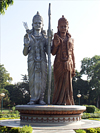
Sitagu Sayadaw (သီတဂူဆရာတော်)
Burmese. Name of a
Burmese
meditation
teacher and
Theravada
Buddhist scholar.
READ
ON.
回
sitar (सितार)
Hindi. A long-necked bowl lute, i.e. a plucked stringed
instrument used in India (fig.),
though according to some sources probably originating from Persia. It
consists of a long hollow neck with 20 to 25 strings, of which only 6 or
7 are playable strings, the others being auxiliary strings, that give the
instrument its sympathetic resonant sound, which is amplified by a gourd
resonating chamber. Some sitars have a secondary gourd resonator near the top of
the hollow neck. Originally, sitars were made of quality materials, such as
teakwood
for the neck, and deer
horn, ebony or camel bone for the bridges.
It is similar to the veena,
which in Hindu mythology is the
preferred instrument of
Sarasvati, i.e.
Surasvati
(fig.), the
Hindu goddess of art and
learning (fig.),
as well as of
Matangi, the Tantric form of Sarasvati,
in her form as
Raja-Matangi
(fig.).
回
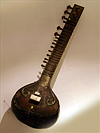
sith (สิทธิ์)
Thai for
‘right’
or
‘claim’, which derives from
sitthi.
回
Si Tian Wang (四天王)
Chinese. ‘Four
Heavenly Kings’. Term for four guardian gods in
Mahayana Buddhism, one for each of the
cardinal directions of the world, similar to
lokapala. They are known by the names
Duo Wen Tian
(fig.),
Zeng Zhang Tian
(fig.),
Chi Guo Tian
(fig.),
and
Guang Mu Tian
(fig.).
They correspondent with the Indian lokapala of the North, South, East, and West,
i.e.
Kubera
or
Vaisravana,
Yama
or Virudhaka (विरूढक),
Indra
or Dhritarashtra (धृतराष्ट्र), and
Varuna
or
Virupaksa (fig.),
respectively.
They are often placed at the entrance of Chinese temples, usually in pairs, two
on each side. They are also known as the Diamond Kings of Heaven, and might have
different attributes. Compare with
Chien Li Yen
and
Shun Feng Er. In
Vietnamese, they are known as Tu Dai Thien Vuong (Tứ Đại Thiên Vương).
In Thai, they are together referred to as
Chatumaharachikah and
individually known as
Thao
Thatarattha, Thao
Wirunhok,
Thao
Wirupak,
and Thao
Kuwen.
回
_small.jpg)
Sitthaat (สิทธารถ)
Thai name for
Siddhartha.
Also pronounced Sittharot and Sittharta.
回
Sittharot (สิทธารถ)
Thai name for
Siddhartha.
Also pronounced Sitthaat and Sittharta.
回
sitthi (สิทธิ)
Thai for
‘right’
or
‘claim’, from which the term
sith
derives.
回
Sitthiporn Kritdakorn (สิทธิพรกฤดากร)
Thai. Name of a prince of the
Rattanakosin
era, with the title of
momchao.
READ
ON.
回
sitting Buddha
One of the four positions of
Buddha images in
iconography.
See also
iryapatha.
回
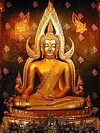
Siva
(ศิวะ)
Thai name for
Shiva.
Also transcribed Siwa.
回
Sivi
Name
of a kingdom as well as the name of a king in the ancient Indian
epic
Mahabharata, in
addition to the
hometown of Prince
Wetsandorn
and the setting
in
the
Totsachat or
last
jataka
Wetsandornchadok,
where it is related that the city had a
White Elephant with powers to bring rain,
and which in
Thai literature is referred to as
Meuang
or
Nakhon
Sih Phih.
回
Siwa (ศิวะ)
Thai name for
Shiva.
Also transcribed Siva.
回
Siwaleung (ศิวลึงค์)
Thai for
linga.
回
Siwaling (ศิวลิงค์)
Thai for
linga.
回
Six Paramitas
Term in
Mahayana Buddhism for the perfection of six
virtues as a way to purify
karma, i.e.
generosity, proper, conduct, endurance, diligence, concentration and wisdom. The
Sanskrit word paramita (पारमिता, in Thai:
ปารมิตา) means
‘traversed’ or ‘perfection’, as in
Prajnaparamita.
In
Theravada
Buddhism there are ten vitues, known by
the Pali term Dasa Paramiyo.
回
Sixty Heavenly Generals
See
Tai Sui.
回
siyaw (เสี้ยว)
Thai. ‘Quarter’.
An obsolete Thai monetary unit with a value of four
sihk,
or one fourth of a
solot. It is still
found on old coins and stamps. Also
transcribed seek or siek.
回
_small.jpg)
Skanda (स्कन्द)
Sanskrit. The god of war and one of the sons
of
Shiva
and his consort. His mount is the
mayura
or
peacock. He is is associated with
Phra Angkahn
(fig.)
and
Wei Tuo
(fig.),
and also known as
Kumara
(fig.),
Karttikeya (fig.),
Guha,
Subramanya
and
Subramaniam.
回
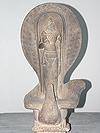
skink
General name for a lizard-like reptile in the family
Scincidae, of which its English name is derived. See also
jing lehn.
回
Skipper
Name for a group of generally small
butterflies, that belong to the family Hesperiidae and the subfamily
Hesperiinae.
READ ON.
回
Slaty-headed Parakeet
Common name for a species of parakeet which
is also known as the Himalayanan Parakeet and with the scientific name
Psittacula himalayana. It ranges throughout many parts of southern Asia.
Adults of both sexes have bluish-green feathers, a dark grey head, with a light
blue tint in the neck. Males have a dark maroon patch on the wings and long
central tail feathers which are shorter in female birds. The tail is green at
base, blue in the middle and bright yellow at the tip. The parakeet features a
bright red-orange upper mandible with a paler yellowish lower mandible. It is
sometimes kept as a family pet in the hill tribe villages in northern Thailand.
See also
TRAVEL PICTURES.
回
_small.jpg)
Slender Green Broadwing
Common name for a species of damselfly in the family
Calopterygidae. These damselflies have a metallic green-bronze body with a long
slender abdomen, and large, transparent green-bronze to brownish wings, which
are broad all the way to the body. They are usually found near gently moving
water. It is also commonly known as Clear-winged
Forest Glory and its Latin scientific
name is
Vestalis gracilis. In Thai, the species is referred to as
malaeng poh khem
nahm tok
pihk riyaw (แมลงปอเข็มน้ำตกปีกเรียว), suggesting that it dwells in the vicinity
of waterfalls.
See also POSTAGE STAMP.
回
Slender Sharksucker
Common name for a kind of remora suckerfish,
i.e. a species of medium-sized cleaning fish, with the scientific designation
Echeneis fasciata.
READ ON.
回
Slender Squirrel
Name of a small species of tree squirrel that occurs in
primary and tall secondary forests, from Thailand to Malaysia, including Borneo
and as far as
Singapore and Sumatra. This rodent belongs to the family of
Sciuridae and has the scientific name Sundasciurus tenuis. Its upperparts are
brown whilst its underside is light grey to pale (fig.).
It also has a pale area around each eye. The ears are small and usually
orange-brown in colour. Its tail is long and slender, and it feeds on soft tree
bark (fig.),
fruits and small insects. In Thai it is called
kra-rohk
hang
mah lek (กระรอกหางม้าเล็ก),
i.e. ‘small horsetail squirrel’.
回
%20กระรอกหางม้าเล็ก_small.jpg)
Slow
Loris
Generic name for a rather cute-looking species of
nocturnal mammal belonging to the genus Nycticebus, of which five recognized
subspecies exist, i.e. the Sunda Slow Loris (Nycticebus coucang), Bengal or
Northern Slow Loris (Nycticebus bengalensis -
fig.), Pygmy or Lesser
Slow Loris (Nycticebus pygmaeus), Javan Slow Loris (Nycticebus javanicus), and
Bornean Slow Loris (Nycticebus menagensis). Slow Lorises are distributed
throughout South and Southeast Asia, ranging from northeastern India to The
Philippines and from
Yunnan
to Java. They have a rounded head, with small upright
ears, large eyes and a narrow snout. Their trunks are long, whilst the arms and
legs are nearly equal in length, with adaptations on the hands and feet, that
enable them to grasp onto tree branches for extended periods. Their fur is
greyish-buff to brown, with a variety of darker markings, depending on the
species. Used for both defense from predators and to protect their fur, slow lorises are able to produce a toxin.
They have glands in the flexor region of their upper arms that ooze a sticky
oil-like substance which mixed with saliva turns toxic, activated by enzymes in
the saliva, which is achieved by licking these brachial glands. Bites of slow
lorises, though rare, can be extremely painful and can put a human into
anaphylactic shock within less than an hour, potentially causing death.
The ability to produce this
two-stage venom is unique in the animal kingdom and makes the slow loris the
only venomous primate on the planet. So far only three species have been tested
for venom, namely Nycticebus bengalensis, Nycticebus coucang and Nycticebus
pygmaeus, but observations suggest that the other species are equally venomous.
To increase its survival rate if spotted, the slow loris freezes and covers its
face, assuming a posture that makes its eyes and the stripes on its face
resemble the markings
of a
cobra,
especially the monocle mark, but which
in Indonesia gave it the nickname
the Shy One. It will furthermore mimic a
cobra by using the extra
vertebrae in its neck to sway like a
snake
and is even known to make hissing
sounds. It otherwise makes little to no noise, and reminiscent of the sloth,
this arboreal omnivorous mammal moves about very slowly, hence its common
designation.
回
_small.jpg)
Small Indian Civet
A species of civet with the binomial name
Viverricula indica.
It is found in South and
mainland Southeast Asia.
READ ON.
回
Small Indian Kite
Another designation for the
Pariah Kite.
回
Small Salmon Arab
Common name for a butterfly, with the scientific
designation Colotis amata. It is a small butterfly in the family Pieridae, found
in some parts of Asia. The male's upperside has a salmon-pink ground-colour,
with black edges and markings (fig.),
whereas the underside is yellowish-green, with a dirty wash and some of the
black markings of the upperside showing through. In the female, the
ground-colour of the upperside is paler than in the male and the markings are
duller, whilst the underside also has a much paler ground-colour and is more
tawny-yellow, with a curved dark band and some spots (fig.).
However, there is purportedly also another form of the female, in which the
ground-colour is pale primrose-yellow to pure white.
回
_small.jpg)
Small Staff Sergeant
Common name for a butterfly, with the scientific designation Athyma zeroca and
that belongs to the family Nymphalidae. Above the wings of the male are
brownish-black, with a single white bar that stretches across the wings but ends
at the lower apex of the forewings, which each have two larger and one smaller,
obliquely-placed white patches. In addition the wing edges have a double
row of pale brownish patches, that –especially in the outer row– seems to form a
continuous line.
On the underside, the wings
have a black and brown ground-colour, with a pattern of white and pale lilac
streaks and spots. This butterfly is found in tropical and subtropical Asia,
including in Thailand, where it is called
phi seua
jah lek (ผีเสื้อจ่าเล็ก), i.e.
‘small sergeant butterfly’.
回
%202_small.jpg)
Small-toothed Palm Civet
See
Three-striped Palm Civet.
回
Small Yellow Sailor
Common name for a butterfly, with the
scientific designation Neptis miah, and with a wingspan of 4.3 to 5.3
centimeters. Above, the wings are black with yellowish-orange spots, that line
up to form three vertical bands, of which the two upper ones are flanked by a
slant bar. Its preferred habitats are jungle streams and rivers. This butterfly
is very similar to the
Cambodian Lascar
(fig.).
回
_small.jpg)
Smiling Buddha
A designation for the Chinese god
Budai.
回
snake
Elongated, limbless
reptiles of the suborder Serpentes.
READ ON.
回
snake bean
See
tua fak yao.
回
snake cucumber
Name of a small bulbous member of the gourd
family, that grows from a tropical vine. It is grown for its edible fruits,
which are also known as ivy gourds and wild snake gourds, not to be confused
with
snake gourds (fig.).
READ ON.
回
snake farm
Farm where venom is milked from
snakes to produce antidotes for
emergencies in case of venomous snake bites. The venom is injected
into horses who produce the serum (fig.).
The horses are unaffected by the poison. In
Bangkok
(map),
the snake farm is linked with the
Thai Red
Cross Society (fig.)
and
the
Queen Saovabha Memorial
Institute
(fig.),
and
is open to the public (fig.).
To save time in emergency situations, Thai hospitals and clinics
around the country have a photographic name list of all indigenous,
venomous snakes, including pictures of certain bite marks and their
related health hazards (fig.).
See also
Siam Serpentarium
and
POSTAGE STAMP.
回

snake gourd
Name of an elongated and narrow gourd, which
twists and becomes orange-red as it ripens.
READ ON.
回
Snakeskin Gourami
See
pla salid.
回
Snow
Fungus
See
hed hoo noo.
回
Snowlion
Name of a mythological animal
from Tibet.
READ ON.
回
Snowy Orchid-tree
A species of flowering shrub native to tropical
southeastern Asia, with the botanical name Bauhinia acuminata and also commonly
known as Dwarf White Bauhinia and White Orchid-tree. This shrub grows to a
height of two to three meters. The leaves, typical of Bauhinia species, are
bilobed and shaped somewhat like an
ox hoof.
Its fragrant flowers are 8 to 12 centimeters in diameter, with five white
petals, ten yellow-tipped stamens, and a green stigma. It is widely cultivated
throughout the tropics as an ornamental plant. The plant has a number of
ethno-botanical uses. In Java, the roots are used to treat cough and cold, and
in India the leaves and bark are used to treat asthma. In Thai, known as
galong.
回
_small.jpg)
snuff bottle
Name for a kind of small
flask formerly used in
China
to hold powdered tobacco, somewhat similar to a
western snuff box.
READ ON.
回
so (ซอ)
Thai. General name for
traditional fiddle-like,
bowed string
instruments. The name probably goes back to a related instrument, in Thai
comparably known as
so
(fig.),
a word that
itself is related to
tro,
a Khmer word for a similar two-stringed musical instrument in
Cambodia.
There are several types of so, including the three-stringed
so sahm saai,
the two-stringed
so uh and the two-stringed
so duang.
回
_small.jpg)
so (ทร้อ)
Thai.
Another name for
saloh
(fig.).
The writing using the letters tho thahaan (ท) and roh
reua (ร) which combined are pronounced as a s-sound in
Thai, is directly related to the Khmer word and musical instrument, named
tro.
回
,%20saloh%20(สะล้อ,%20ซะล้อ)_small.jpg)
So (โส้, โซ่)
See
Soh.
回
Socialist Realism
Name of a communist art style that is
characterized by the glorified and highly idealized depiction of communist
values while romanticizing the revolutionary idea.
Though it originated in the Soviet Union in the early 1920s, it is still
prevalent today in a number socialist countries, such as
China,
Cambodia
(fig.) and
Vietnam
(fig.).
Socialist Realism is often State-sponsored and used as a form of propaganda that
aims at elevating the proletariat, i.e. the common workers
and soldiers, while at the same time idolizing political leaders,
who usually pose as common people. In many cases it
is also used in statues that glorify war heroes (fig.).
See also
TRAVEL PICTURE (1),
(2),
(3)
and
(4).
回
sodahban (โสดาบัน)
Thai. Term used for one who has just attained
the first stage of
Enlightenment, a saint. The
term also means sainthood and to attain sainthood. Also spelled
sodaban, in Pali known as
Sotapanna,
and also referred to as simply soda or sodah.
回
so duang (ซอด้วง)
Thai. Name of a two-stringed
so with a slim wooden
sound box which is made of a
bamboo joint and with a bow attached to the
strings. The front of the body is
covered with a piece of
snake skin, whilst it is open in
the back, to allow amplification of the sound resonance. Modern versions are
often made of wood
(fig.)
and might be adorned with
ivory. See also
so uh.
回
_small.jpg)
Soh (โส้, โซ่)
Name of a small ethnic group that lives in
Isaan, especially
in
Mukdahan,
where they have been since the foundation of the city. In 1816, during the reign
of
Rama II, Soh
people from several places from the Lao side of the
Mekhong River, moved
to Isaan and settled in places, such as
Nong Kai,
Sakon Nakhon,
Kalasin,
Ubon Ratchathani
and
Nakhon Phanom. Most
settlers travelled on foot over paths that are still in use today, in particular
by the Soh themselves, who use these ancient trails to visit relatives. They
have their own language, dress and traditions, such as
Soh Thang Pan.
In Thai also called
Chao Soh and sometimes
transliterated So.
回
sohm jihn (โสมจีน)
Thai for
ginseng.
回
Sohmsawalih (โสมสวลี)
Thai. Former wife of Crown Prince
Maha
Vajiralongkorn
(fig.)
and Princess Mother of
King
Bhumiphon's
first grandchild, i.e. Princess
Phatcharakitiyapha. She was born on
Saturday 13 July 1957 as Soamsawali Kitthiyagon (โสมสวลี กิติยากร),
a niece of Queen
Sirikit Kitthiyagon,
with the title of
momluang.
In 1991, after her divorce with the Crown Prince, she was given the
title Phra Woraraja Thinatdahmaht (พระวรราชาทินัดดามาตุ), i.e.
‘Glorious Royal Niece and Mother’,
but in translation usually referred to as
‘The
Princess Mother of the King's First Grandchild’.
Her personal flag consists of
a lilac field (i.e. a pale form of purple, the colour of
the day on which she was born according to the
sih prajam wan
system), with her initials, i.e. a strongly
stylized pink and white S (ส) bordered by
purple and underneath a golden
yan sign
(fig.).
Often transcribed
Soamsavali
and Soamsawali.
回
Soh Thang Pan (โส้ทั้งปั้น,
โซ่ทั้งปั้น)
Name of a traditional dance performed in
Nakhon Phanom, by the men
and women of the Soh, an ethnic group that lives in
Isaan. It is
performed during funeral ceremonies, in order to send the soul of the deceased
to heaven. Also called
Praphenih Soh Thang Pan.
回
sok (ศอก)
Thai.
‘Elbow’ or ‘cubit’. An ancient measure of length, approximating to the length of
a forearm. Since 1 sok equals 2
keub, 1 sok in the
past was 60.96 centimeters,
but since 1 keub has now been
fixed at 25 centimeters
1 sok in modern measurements is only 50
centimeters.
Also transcribed sawk or sauk.
回
sokushinbutsu (即身仏)
Japanese.
‘Immediate
buddha
body’.
Name of a today outlawed process in which Buddhist priests in Japan
tried to mummify themselves, through a regimen of rigorous diets,
that included eating bark and roots, and drinking poisonous tea made
from the toxic sap of the Urushi tree, normally used
to produce
lacquer,
in order to expedite their path to
Enlightenment,
believing that they would instantly attain buddhahood if they
succeeded. It is assumed that the practice of self-mummification was
brought to Japan by the Buddhist
monk
Kukai, as
part of secret
Tantric
practices he learned in
China.
回
Soldier Fly
Any fly in the family
Stratiomyidae, a reasonably large family of
true flies in the order Diptera, found worldwide
and containing about
400 genera and over 2,800 described species, but which is
particularly diverse in the tropics. The
name Stratiomyidae is
a composite that derives from the Greek words startiotehs (στρατιώτης) and muia
(μυια), meaning ‘soldier’ and ‘fly’, respectively.
Though Soldier Flies are diverse in size and shape, they commonly are either
partly or wholly metallic green, with some members imitating features of wasps.
They are often rather inactive and typically rest with their wings placed one
above the other over the abdomen. These flies do not bite nor sting and their
name is said to derive from the bright, almost militaristic colours.
回
_small.jpg)
solot (โสฬส)
Thai. An
obsolete Thai monetary unit equal to one
1.128th of a
baht.
It is still found on ancient coins and stamps (fig.).
Also
lot.
回
som (ส้ม)
Thai
for ‘orange’.
READ ON.
回
soma
(सोम)
Sanskrit.
Life nectar identified with the elixir of
immortality or
amrita.
回
Soma
(सोम)
Sanskrit. Another
name for the moon god
Chandra.
回
Somchai Thitawiriyoh (สมชาย ฐิตวิริโย)
Thai. Name of a prominent Buddhist
monk from
Roi Et
Province. He was born on 7 April 1925 into a
Hindu family and, after
developing an interest in
Buddhism, was ordained as a monk in
1944. He became a prominent
Vipassana
meditation master in the
Thai Forest Tradition, following
the venerated monk
Luang Poo
Man Phoorithattoh
(fig.),
becoming his disciple at
Wat Pah
Ban Nong Pheu (วัดป่าบ้านหนองผือ). After practicing meditation and deepening his
understanding of the
dharma, he began teaching others in
his hometown. In 1990, Luang Poo Somchai was elevated to the rank of Phra
Rajakannachan (พระราชาคณะชั้น) and received the title Phra Wisutthiyana Thera (พระวิสุทธิญาณเถร).
He passed away peacefully on 18 June 2005, at the age of 80, after 60 years in
the monastic life. His relics are enshrined at Wat Khao Sukim (วัดเขาสุกิม), a
temple in
Chanthaburi
where he was the founder and former abbot,
and at Wihaan Thitawiriyajaan Anusorn (วิหารฐิตวิริยาจารย์อนุสรณ์ -
fig.),
a memorial hall at
Wat Beung Sai Thong
in Roi Et, dedicated to Luang Poo Somchai.
WATCH VIDEO.
回

som chun (ส้มฉุน)
Thai. Name of a traditional dessert,
whose designation literally translates as
‘pungent
orange’.
The dish is divided into two types, namely royal style and villager style. The
royal style
uses sweet and sour summer fruits, floating in syrup, which is made from water
scented with
pandan,
sour orange juice, salt, sugar, and
scented
jasmine
water, i.e. water obtained by
floating jasmine flower buds on its surface to absorb the scent.
Popular fruits are sour orange segments,
lychees,
jackfruit,
sa-la,
lamyai,
slices of sour
mango,
and
longkong, whilst other
popular ingredients may
include fried onion and sliced
ginger. The
villager style variety uses sour fruits, such as raw mango or gooseberry, mixed
with sugar, fish sauce and dried shrimp. This dessert has similar
characteristics to
loi kaew
and is eaten cool.
See also POSTAGE STAMPS.
回
_small.jpg)
Somdet (สมเด็จ)
Thai. ‘Majesty’, ‘serenity’, or ‘holiness’.
Title usually utilized as a prefix in titles of kings, as well as
with names of royalty or monks of high rank, as in Somdet Phra
Phutthachan. From the
Ayutthaya
Period (1350-1767) onward the title for a monarch is Somdet (Phra),
in the
Thonburi
period
(1767-1782) this has changed into Somdet
Phra Chao
and in the
Rattanakosin or
Bangkok period (after 1782), it is Phrabaht
Somdet (Phra), followed by the name and when referring to the king
also by suffix
Chao Yuh Hua
(เจ้าอยู่หัว), which means ‘the Lord who is (at) the head’.
回
_small.jpg)
Somdet Ong Pathom 21 Sok (สมเด็จองค์ปฐม ๒๑
ศอก)
Thai. Name of a large Buddhist shrine in the
tambon
Tha
Kanun (ท่าขนุน),
amphur
Thong Pha Phum (ทองผาภูมิ), in
Kanchanaburi
Province, and located at
the beginning of the National Road 323 to
Sangkhlaburi, where at
the end of this same road into this border
town with
Myanmar is a similar
—yet smaller— roadside shrine (fig.), that belongs to
Sangkhlaburi's Wat Somdet (fig.),
while the
Somdet
Ong Pathom 21
Sok shrine is part of the nearby
Buddhist
temple Wat Kanun and features a giant white
Buddha image seated
in
the
bhumisparsa
pose
on an elevated platform.
The platform is flanked on
either side by a large open
sala-like
hall each of which contains a row of 17 gilded Buddha images, all
also seated in the
maravijaya pose.
Since 1
sok is 50 centimeter, its
name suggests that the principal Buddha image is 10.5 meter tall.
See also
Somdet,
ong and
sok.
See also PANORAMA PICTURES,
and
TRAVEL PICTURES,
as well as
MAP.
回
Somdet Phra Boromma Raja Channanie
(สมเด็จพระบรมราชชนนี)
Thai. Title for the mother of the king. See
also
Somdet,
Phra,
Borom,
Raja
and
Channanie.
回
Somdet Phra Bowon Raja Chao Maha Surasinghanat
(สมเด็จพระบวรราชเจ้ามหาสุรสิงหนาท)
Thai. The official and full title of
Surasinghanat
(Boonma),
the first
Uparacha
or Viceroy (map
-
fig.) of the
Rattanakosin
Period and the younger brother of
King
Rama I.
See MAP and
TRAVEL PICTURE.
回
_small.jpg)
Somdet Phra Pan Pie Luang (สมเด็จพระพันปีหลวง)
Thai. ‘Holy Majesty worshipped for a thousand
years’. Mother of the king, and widow of nobility. See also
Somdet,
Phra,
Luang
and
panwatsa.
回
Somdet Phra Sakayamuni Sri Sumet Bophit
(สมเด็จพระศากยมุณีศรีสุเมธบพิตร)
Thai. Name of
the largest
reclining Buddha
in Thailand, located in the Maha Wihaan Phra Non Yai
at Wat Bang Phli Yai Klang, in
Samut Prakan.
READ ON.
回
Somdet Phra Suwan Pathum Phutthaphotchana
Woraphon (สมเด็จพระสุวรรณปทุมพุทธพจนวราภรณ์)
Thai. ‘His Holiness the
Golden Lotus, Noble
Ornament of the Buddha’s Teachings’. Name of the
principal
Buddha statue
in the Silver
Ubosot of
Wat Don Yai (fig.)
in
Pathum Thani.
This large white
Buddha image is also popularly known as
Luang Pho Jai Dee Mang
Mee Sri Suk (ใจดีมั่งมีศรีสุข), which roughly translates to the
‘Venerable
Father, Kind-hearted and Blessed with Prosperity and Well-being’.
WATCH VIDEO.
回
Somdet Phra Yanawachirodom (สมเด็จพระญาณวชิโรดม)
Thai. Ecclesiastical title of
Luang Pho
Wiriyang Sirintharoh (วิริยังค์ สิรินธโร), a prominent Thai Buddhist
monk,
Meditation Master and Patriarch of the
Thammayutnikaai
Order in Canada. Born in
Saraburi,
he was ordained as a monk in 1941 and trained within the
Thai Forest Tradition under
renowned teachers including
Man Phoorithattoh (fig.).
Throughout his life, Wiriyang was widely respected for promoting
meditation
practice and Buddhist education. He served as the first abbot of
Wat Thammamongkhon
in
Bangkok
(fig.)
and founded numerous temples in Thailand and Canada. In 1975, he established the
Prateep Dek Thai (ประทีปเด็กไทย) programme,
‘Thai
Children's
Lamp’,
an early childhood development initiative that expanded to thousands of centres
across Thailand. He also founded the Willpower Institute in 1997 to promote
meditation training and world peace, with branches in several countries. From
2016 to 2020 he served as acting abbot of
Wat Sri Rattana Thammaram
in
Samut Prakan.
Over his long career, he received numerous ecclesiastical titles, culminating in
the rank of Somdet Phra Yanawachirodom in 2020. Wiriyang died in Bangkok at the
age of 100, leaving a legacy of meditation teaching, charitable work, and
institutional development within Thai Buddhism. King
Vajiralongkorn bestowed an
honorary decorated funeral urn (koht)
for him and has accepted his remains into perpetual royal care. The relics or
ashes of Somdet Phra Yanawachirodom have been enshrined at
Wat Thammamongkhon.
A portion of the relics have also been enshrined at various branches of the
Willpower Institute, such as Wat Sri Rattana Thammaram
(fig.).
WATCH VIDEO.
回

som fak (ส้มฟัก)
Thai.
A snack of sour shredded fish mixed with fermented rice and wrapped in banana
leaves.
回
som kaek (ส้มแขก)
Thai. Name for a fruit, made up of the words
som and kaek, which translate as ‘orange’ and ‘foreign’. It has the scientific
name Garcinia cambogia and belongs to the same genus as the
mangosteen,
which is in Latin known as Garcinia mangostana. This yellowish to orange fruit
is pumpkin-shaped and is primarily found in the southern part of Thailand. It is
used as a herb to loose weight, since the fruit contains hydroxycitric acid or
HCA, a derivative of citric acid that is found in a variety of tropical plants,
and high quantities of its extracts are purportedly effective in suppressing fat
accumulation, though are also potentially hepatotoxic and could cause liver
damage. In English it is commonly known as Gambooge, Brindleberry, Brindall
berry and Malabar
tamarind, and
in Sri Lanka it is called Goraka. Products made from the som kaek fruit are a
well-known souvenir from
Narathiwat
province.
回
som ma-ngua (ส้มมะงั่ว)
Thai for a large
lemon-like
fruit of the genus Citrus medica l. var. medica, somewhat resembling
a citron or yellow lemon.
回
%202_small.jpg)
som-oh (ส้มโอ)
Thai name for
pomelo.
回
som-oh meua (ส้มโอมือ)
Thai. ‘Hand
pomelo’. Name for the
inedible fingered citron, which has no flesh of fruit in it, but consists only
of a thick rind. It originates from India and was brought to China by a Buddhist
monk, where it was given the nickname Buddha's Hand, since this fragrant
lemon-like citrus fruit consists of segmented,
yet partly fused, finger-like sections (fig.). It is used predominantly in Chinese
culture as a perfume and air freshener, as well as a religious offering (fig.)
in Buddhist temples (fig.).
Its trinomial name is Citrus medica var. sarcodactylus. In Chinese, it is called
fu shou, with the first
word sounding like
fu,
which means ‘blessing’, ‘good luck’
and ‘happiness’. It is hence regarded as one of the three fruits of abundance,
together with the
peach
and the
pomegranate.
As such, it also occurs frequently in oriental art (fig.).
回
somphop
(สมภพ)
Thai.
Rajasap
or royal language for ‘birth’, a term similar to
phrasoot.
Compare with
sinphrachon and
sawankot.
回
som set (สมเสร็จ)
See
phasom set.
回
som si thong (ส้มสีทอง)
Thai. ‘Golden orange’. A special variety of
som
(orange), grown in the northern province of
Nan.
Though of the same species as oranges of the Central Plain, climatic
differences make this specific golden-skinned type more aromatic.
回
somtam (ส้มตำ)
Thai. A popular native dish of sliced green
papaya
mashed and mixed with spices (i.e.
chilies, sugar,
palm sugar, lemon or lemon juice and fish sauce), tomatoes, peanuts
and sometimes dried shrimps and carrots. Generally it will be mixed
with a raw crab in which case it is called
somtam poo
and in
Isaan it is often
mixed with akind of fermented fish called
pla rah,
a dish known as somtam Lao or somtam pla rah. A popular vegetarian
version is somtam khai khem, papaya salad mixed with a salted (khem)
duck's egg (khai). It is especially liked by people from Isaan. If
it is eaten without any extra ingredients it is called somtam Thai.
回
_small.jpg)
somtam poo (ส้มตำปู)
Thai. The dish
somtam
mixed and pounded with a crab, either a raw, fresh water crab, known
in Thai as
poo jeud
(fig.),
or with a land crab, known in Thai as
poo nah (fig.),
though the above names might be more specified or other names, as
well as other species of crab may be used, such as poo daeng (ปูแดง)
which translates as ‘red crab’; poo seua (ตําปูเสื่อ), i.e. ‘reed
mat crab’; poo mah (ตําปูม้า), i.e. ‘horse crab’; etc.
Also transcribed somtam pu.
回
somwang (สมหวัง)
Thai name for the Chinese water chestnut, a tuber-like
stem base, known as a corm or bulbo-tuber, of a species of sedge, with the
botanical name Eleocharis dulcis, which grows in the muddy soil of marshes.
Officially and originally it was -and by some it is still- called
haew,
which also means ‘to be disappointed’. Thus, when describing it, it sounded
rather negative and the name was almost jokingly changed to somwang, which
literally means ‘to live up to one's expectation’. These small aquatic corms are
rounded in shape and reddish-brown in colour, with a somewhat cone-shaped,
tapered end at the basal area. Inside, they have a crunchy, pale yellowish flesh
(fig.),
which is edible. They are a popular ingredient in Chinese cuisine and can be
eaten raw, slightly boiled, grilled, pickled or sweetened. In Thailand, they are
often eaten as dessert and are the main ingredient in a dessert called
thabthim krob
(ทับทิมกรอบ), literally ‘crispy rubies’. In Chinese called
biqi.
See also
krajab.
回
%20biqi_small.jpg)
son (ซ่อน)
Thai northern dialect (kham
meuang). Name for a kind of small
fish trap made of
bamboo.
See also
saab,
lob,
sai
and
sang.
回
_small.jpg)
song (ทรง)
Thai. A prefix used to form terms of reverence
when speaking of or addressing royalty or deity. When it is used
before a noun it has the force of a verb, the term becoming an
intransitive verb with a meaning appropriate to the object, as in
songmah.
See also
rajasap.
回
song (สงฆ์)
Thai for
Sangha, i.e.
‘monastic
community’.
回
song (สรง)
Rajasap
or Thai term used by and for royalty, monks and priests to take a
bath, and in expressions such as
song nahm
phra.
回
song bah dahn (ทรงบาดาล)
Thai name for a species of 3 to 5 meter-sized flowering shrub or small tree,
that originates from Polynesia, and with the botanical names Cassia surattensis
and Senna surattensis. In English, it is commonly known as Scrambled Egg Tree,
whilst in the South Pacific region it is called Kalamona. It also goes by the
designation Glaucous Cassia. The botanical term glaucous derives from the Greek
word glaukos (γλαυκός), which means ‘bluish-grey’ and
refers to the bluish-grey powder-like or
waxy coating or film on the surface of the tapering,
egg-shaped leaves (i.e. rounded at both ends or slightly notched or pointed),
that can easily be rubbed off, akin to the pale
substance on plants (fig.),
fruits and vegetables (fig.),
which in Thai is referred to as
nuan.
This tree bears bright yellow flowers with five petals, and blooms in cycles
year-round. Its fruit consists of a flat, elongated pod, which is between 7 and
10 centimeters long, and about 1 to 1.5 centimeters wide. Below, the pod has a
straight base with rounded edges and a short, yet very thin, needle-like,
protruding pointed tip in the middle.
回
%201_small.jpg)
Songkhla (สงขลา)
Thai. Name of a province (map)
and its capital seaport-city in South Thailand.
READ ON.
回
Songkhla Lake
Name of a lagoon located in the southern,
peninsular part of Thailand, and often referred to as the largest natural lake
in the nation. It covers an area of ca.
1,040 square kilometers (map)
and borders
Songkhla Province
in the North, South and East, and
Pattalung
Province in the West.
It consists of three distinct parts, i.e. Thalae Saab Ton Bon (ทะเลสาบตอนบน),
i.e.
‘Upper
Lake’,
in the North; Thalae Saab Ton Klahng (ทะเลสาบตอนกลาง), i.e.
‘Central
Lake’,
in the middle; and a southern part known as Thalae Saab Ton Lahng
(ทะเลสาบตอนล่าง), i.e. the
‘Lower
Lake’,
which gives access to the sea by a narrow strait, that connects to the
Gulf of Thailand. The lake is fed by several
rivers and its salinity levels hence change accordingly, especially with regard
to location and the season. A small population of
Irrawaddy Dolphins
is found in the
Central
Lake.
回
Songkraan (สงกรานต์)
Thai-Sanskrit. ‘To rise’ and ‘to
move’. It refers to the date on which the sun moves into Aries, the
sign of the
zodiac (fig.)
also known as the Ram. It is considered the beginning of a new year,
the end of the dry season and the incitement of the first rains.
According to the lunar calendar Songkraan usually falls in mid-April
and is in Thailand celebrated from the 13th to 15th. In preparation
houses are cleaned and all rubbish is burnt. Families get together
and it is an opportunity to show solidarity. In religion Buddha
images are sprinkled with water (fig.),
an act called
song nahm
phra. Youths will pay
their respect to the elderly and monks by sprinkling them with water
while on the streets a celebration takes place in the form of a
water festival (fig.)
in which water is tossed exuberantly (fig.).
Another practice during the festival is to smear each others face
with wet talcum (fig.)
or lavishly throw the dry powder around, creating large dusty clouds
(fig.).
There are also parades featuring a Miss Songkraan, in Thai called
Nang Songkraan,
and who in fact represents (one of) the seven daughters of
Tao
Kabin Maha Phrom,
a deity who had his head cut off when losing a bet, and which in the
parade is carried on a
phaan (fig.)
or platter by Nang Songkraan. In
Myanmar
the festival is called
Thingyan
and in
Isaan it is
referred to as
boon song
nahm. In Thai also called
Trut Thai,
i.e. ‘Thai New Year’.
See also POSTAGE STAMPS (1)
and
(2),
and
WATCH VIDEO.
回
Son Glin (ซ่อนกลิ่น)
Thai.
‘Concealed Fragrance’.
Thai name for the
Tuberose.
回
songmah (ทรงม้า)
Rajasap
for ‘riding a horse’.
回
songmah kanthaka (ทรงม้ากัณฐกะ)
Thai. ‘Riding the horse
Kanthaka’.
Term in
rajasap
referring to a scene in the life of
Siddhartha
in which the horse Kanthaka carries the prince away from the palace
during the
Great Departure (fig.).
回
song nahm phra (สรงน้ำพระ)
Thai-Rajasap.
The sprinkling of Buddha images with water. It
is a religious activity with the intention
to pay respect to the Lord Buddha
and
takes
place particularly
during the festival of
Songkraan. In
Burma, the
ritual
is a regular practice performed
by visitors to the
Shwedagon
pagoda on a daily basis, rather than an event reserved only for
the annual water festival (fig.).
Song
is also the Thai term used for and by monks to express ‘bathing’.
See also
kruad nahm,
kong hod
and
boon song nahm.
See also POSTAGE STAMP.
回
songthaew (สองแถว)
Thai. ‘Two rows’. Pick-up or truck (fig.)
with two rows of seats or benches in the back and a roof covering.
It usually operates as a share taxi, i.e. somewhere between a
private taxi and a conventional bus, on a fixed or semi-fixed route
and for a set fare, but without a fixed time schedule and able to
stop anywhere to pick up or drop off passengers. It may also be
hired individually like a regular private taxi. They come in
different sizes and are more common outside
Bangkok. At the end of
the line and at popular stops the driver may wait for enough
customers before setting off again. When all seats are taken
passengers often hang from the back or sit on the roof.
See also POSTAGE STAMPS.
回
Song Tham (ทรงธรรม)
King of
Ayutthaya,
from 1610 to 1628.
回
Son Ta (Sơn Tà)
Vietnamese
term for a
traditional, durable reddish-brown
lacquer
(fig.)
crafted from natural resin sourced from high-quality resin harvested from
Toxicodendron succedaneum, a tree native to
Vietnam.
The resin is extracted by carefully tapping the trees, collecting the sap, and
purifying it to remove impurities. This meticulous process results in a durable
finish that enhances wooden furniture and decorative elements in palaces and
temples, reflecting Vietnam’s artistic heritage and its cultural and spiritual
significance in craftsmanship. In Vietnam, where this lacquer is prized for its
exceptional adhesion, durability, and resistance to water, acids, and
termites,
Son Ta has been used for centuries.
回
soob lom
(สูบลม)
Thai
name for a bellows, i.e. a device designed to deliver a strong blast of air,
which in Thailand is typically cylindrical in shape and
made
from wood or
bamboo.
READ ON.
回
soom kai (สุ่มไก่)
Thai.
A convex shaped, backyard chicken coop, woven from thin
bamboo
strips
and used for keeping poultry. It is placed over the fowl to entrap it and often a
heavy object is placed on the top, to prevent the animal from overturning the
cage. At the top it has a round opening to allow one to grab or feed the animal. When it is in the open some
keepers place a piece of plastic or cloth on
the top for shade or against the rain. In
Phitsanulok,
a giant chicken coop is erected at the Indochina Intersection (map
-
fig.).
See also
takra sai kai,
THEMATIC STREET LIGHT,
TRAVEL PICTURE, and
WATCH VIDEO.
回
%20backyard%20chicken%20coop_small.jpg)
soom pla (สุ่มปลา)
Thai. A bell shaped
coop-like tool woven with spacious intervals
from thin
bamboo
strips
and used to catch fish, frogs and other
aquatic animals in shallow water, most commonly in
rice
paddies (fig.).
The coop has a tapering shape and an opening at the top. It is placed over the
fish to entrap it and is then caught by hand through the opening at the top. It
is used in combination with a
takong
to
store the fish already caught. They are sometimes used as lampshades or lanterns
(fig.)
in local restaurants and are sold in miniature as a souvenir.
See also THEMATIC STREET LIGHT.
回
_small.jpg)
Soon Oo Pon Nya Shin (ဆွမ်းဦးပုညရှင်)
Burmese. Name of
a Buddhist hilltop temple in
Sagaing.
READ ON.
回
Soon Phumipanyah Manut (ศูนย์ภูมิปัญญามนุษย์)
Thai. ‘Human
Wisdom Center’. Name of a building at
Wat Pathum Wongsawaht (fig.),
a Buddhist temple in
Nakhon Nayok,
that
houses a
local
Thai Phuan
textile museum, as well as an atelier with treadle operated looms
traditionally used for hand weaving of
fabrics, such as
silk. It
also displays the utensils of the Thai Phuan people, as well as woven fabrics in
various patterns of these
Laotian immigrants who settled in this area over 200 years ago.
WATCH VIDEO
and
VIDEO (EN).
回
Soon Rian Roo Phalang Ngaan Thot Thaen Bangchak (ศูนย์เรียนรู้พลังงานทดแทนบางจาก)
See
Sunny Bangchak.
回
Sooty-headed Bulbul
Designation for a
species of songbird with the binomial name Pycnonotus aurigaster and native to
Southeast Asia, from Myanmar and South China to Java. It has a black cap, and a
white rump. There are several subspecies, including Pycnonotus aurigaster
klossi,
with a red vent (fig.)
and somewhat
reminiscent of the
Red-whiskered Bulbul
(fig.),
and Pycnonotus aurigaster thais, which has a yellow vent (fig.)
and is
the variety most commonly found in Thailand.
In Thai it is known
as
nok parod hua sih kamao.
See also WILDLIFE PICTURES.
回
%203_small.jpg)
sop (สบ)
Thai. ‘Junction’. The word is derived from
Khmer and refers to
an area at the confluence of two rivers. It is used in certain place names in
the north of Thailand, e.g. Sop Mey (Sop Moei) in
Mae Hong Son
where the Mey (Moei) river unites with the
Salawin river, and Sop
Ruak which is located at
the
Golden Triangle
where the Ruak River (fig.),
named after a species of small
bamboo and the natural border line between Burma
and Thailand, flows into the
Mekhong river, etc.
Sometimes transcribed sob.
回
so sahm saai (ซอสามสาย)
Thai. ‘Three-stringed
so’.
A traditional fiddle-like instrument with three strings and played
with a bow (fig.).
Its body is usually made from a large polished
coconut
shell cut in half, and covered with animal skin.
To reduce the
skin's resonance,
the player typically
glues a jewel onto the skin before playing (fig.).
It is the hardest to play among the different types of
traditional fiddle-like,
bowed
string instruments, such as
the
so
and
so, and is
hence frequently used in pictures to show off ones knowledge or high
social status. Well-off musicians would have their instrument
custom-made from superior materials. The
so sahm
saai
is comparable to the
saloh
(fig.).
See also
mahori.
In 1970, the so sahm saai was depicted on one of a set of four Thai
postage stamps featuring Thai musical instruments (fig.).
回
%201_small.jpg)
Sotapanna (โสดาบัน)
Pali-Sanskrit-Thai.
‘Stream-enterer’.
Name of the first of the
four stages of
Enlightenment in
Theravada
Buddhism,
i.e. the stage before
Sakadagami,
in which someone has entered the stream
leading to
nirvana, the state of liberation.
In reaching this stage, one has successfully cut off the first three of the ten
chains that bind beings to
samsara, i.e. the
the perpetual cycles
of birth, death, and rebirth. The
three chains that are cut in this stage are: 1. the eradication of the belief in
a permanent, unchanging self; 2. the elimination of all doubt regarding the
Trairat,
Rattanatrai
or
Triple Gem, i.e. the
Buddha,
his teachings known as the
Dhamma,
and the order of
monks
called
the
Sangha;
3. the dismissal of the misconception that mere external observances or rituals
could lead to liberation. By overcoming these initial three fetters, a Sotapanna
has entered the stream of Enlightenment and is assured of eventual liberation,
as they have gained an unshakable confidence in the path to nirvana.
回
Sothon (โสธร)
See
Phra
Phutta Sothon.
回
sot sri racha (ซอสศรีราชา)
Thai.
‘Sri
Racha sauce’. Name of a thick hot
sauce, made from a paste of
sweet
chili
peppers, rice vinegar, garlic,
sugar and salt.
READ ON.
回
so uh (ซออู้)
Thai. ‘Whining
so’. Name of a
two-stringed fiddle-like,
bowed string
instrument, with
a sound box that consists of
a polished
coconut
shell
of which the front is covered with
buffalo
skin (fig.),
whilst it is open in the back, to allow amplification of the sound resonance.
The sound hole is at times decorated with elegantly carved figures (fig.).
It is played whilst seated (fig.),
with a bow which is attached in between the two strings, making it different
from its northern counterpart, the
saloh (fig.).
See also
so duang.
回
%202_small.jpg)
sour sack
Common name for a small tree in the
family Annonaceae, with the botanical designation Annona muricata, and also
commonly known as prickly
custard apple,
soursop and soursapi (fig.).
Its edible fruit, which is referred to by the same names, is egg-shaped, dark
green, and with a prickly skin. It can weigh up to 10 kilograms and grow up to
30 centimeters in length. The juicy flesh of fruit is acidic and whitish in
colour, and its aromatic pulp is used to prepare juices. It has black seeds and
in cross-section, it is reminiscent of its cousin, the
sugar apple (fig.). The
petals of its flowers are thick and creamy-yellowish in colour (fig.).
Its glossy, dark green leaves are oblong and measure up to 16 centimeters long
and are about 7 centimeters wide (fig.).
They are somewhat paler below than above. This plant is originally from the
Caribbean, but is now found in many tropical regions around the world, including
in Southeast Asia, where it arrived via the Philippines. In
Filipno it is called guyabano;
in
Vietnam mang cau gai; in Indonesia
sirsak; and in Thai
thurian
thet (ทุเรียนเทศ),
i.e. ‘outlandish
durian’.
回
%20mang%20cau%20gai%20-%20fruit_small.jpg)
South China Sea
Name of a significant maritime
domain that borders the shores of China, the Philippines, Borneo, a northern
section of Indonesia, and mainland Southeast Asia.
READ ON.
回
Southeast Asian Box Turtle
Name of a semi-aquatic
turtle
with a blackish brown to olive brown coloured carapace and a blackish olive head
with yellow stripes on the side, and a pale, yellowish pink chin and throat. Its
scientific name is Cuora amboinensis, referring to the island of Ambon in
Indonesia. It is found from northeastern India and Bangladesh to the Philippines
and, with the exception of New Guinea, the whole of Indonesia. Southeast Asian
Box Turtles live mainly in lowland swamps, though they may sporadically occur in
forests and other places well away from water. They are omnivores feeding on
soft vegetation and fruit, as well as earthworms, fish, mollusks and
crustaceans. It is alternatively known as Amboina Box Turtle (fig.)
or Asian Box Turtle, and in Thai as
tao hab, meaning ‘shut
turtle’ or ‘closed turtle’, referring to fact that the plastron, the flat to
slightly concave part of the shell structure on the turtle's underside, fits
tightly in the openings of the dome-shaped carapace. Full-grown adults are about
25 centimeters long.
回
%202_small.jpg)
Southeast Asian House Mouse
A subspecies of the common House Mouse (Mus musculus), with
the scientific name Mus castaneus, which is endemic to Southeast Asia. It has
brownish-beige upperparts, with a greyish shine, a white belly, and a long dark
tail.
It typically dwells near rice granaries in rice producing townships.
回
_small.jpg)
Southeast Asian
Spiny Turtle
Name of a semi-terrestrial
turtle,
with the scientific name
Heosemys spinosa, and with a strongly-serrated carapace edge
and spiny keel, features that fade away with age, making older individuals much
smoother than juveniles. It is found in the Philippines, Brunei, Indonesia,
Malaysia,
Singapore, Myanmar, and Thailand. It
inhabits wet evergreen forests,
usually in the vicinity of small streams, both in lowland and hill areas. Its colouration, i.e. a brownish carapace and a blackish head and legs, help
camouflage this species amongst the leaf litter of the forest floor which it
habitats. Apparently, mating behaviour is stimulated by rainfall, and males in
captivity purportedly become excited when sprayed with water, chasing females in
an attempt to mount. This unique turtle
is portrayed on one of a set of four Thai postage stamps issued in 2004, in
order to publicize turtles and to promote their conservation (fig.).
In Thai, it is known as tao chak (เต่าจักร), i.e.
‘Cog-wheel
Turtle’.
回
Southeast Asia Treaty Organization
See
SEATO.
回
Southern Forest Crested Lizard
See
king kah kaew tai.
回
Southern Pig-tail Macaque
See
ling hang san.
回
Southern White-cheeked Gibbon
Common designation for a
species of
gibbon
endemic to
Laos
and
Vietnam, and
with the
scientific name Nomascus siki.
READ ON.
回
soybean
High-protein bean of
the soy, a plant species originally from
China
and Japan. It has the botanical name Glycine max and grows between
50 and 125 centimeters tall. Soybeans are used to make
soy sauce
and
tofu,
among other things. Fresh they are used as an important ingredient
in
phad thai
and in
spring rolls.
Also
called soya bean and in Thai
thua leuang.
Its pods are somewhat
similar to those of the
pigeon pea, a
shrub known in Thai as
thua rae and
thua ma hae.
回
Soybean Pod Bug
Name of an insect in the family
Coreidae, with the scientific name Riptortus linearis. It has a
brownish body, with pale yellowish underparts and protruding eyes.
The legs are light brown and the hind legs are large with spikes.
Both the larvae and adults of this species feed on the juice of
soybeans,
hence its common name. In Thai, it is known as muan
thua leuang
(มวนถั่วเหลือง).
回
%20มวนถั่วเหลือง,%20มวนฝักถั่ว_small.jpg)
soy sauce
Name of a fermented sauce
invented in China and which is widely used as a seasoning condiment
in East and Southeast Asian cooking. It is made from
soybeans,
roasted grain, water and salt. There are two types, i.e. light soy
sauce and dark soy sauce. In Thai it is called nahm sih eew (น้ำซีอี๊ว)
and in Chinese jiangyou (酱油) which literally means ‘thick oily
sauce’ or chiyou (豉油) which translates as ‘fermented beans oil’.
Also soya sauce.
回
spa
(สปา)
Term initially used for a
therapeutic water treatment, though in a modern and commercial sense
the term has internationally expanded to cover a much wider field of
treatments, often including also herbal therapies, as well as
reflexology and massage, and it over time has also become the name
given to establishments that offer such treatments. The name derives
from the Belgian town of Spa, which dates back to Roman times when
it was called Aquae Spadanae and which up to the present-day is
famous for its natural mineral springs, though in a commercial
context it is often unjustly claimed to be an acronym for sanitas
per aquam, i.e. Latin for ‘health
through water’.
Most decent hotels in Thailand nowadays offer a spa, usually with a
variety of treatments, and in many places spas can also be found in
and around commercial areas, such as markets and shopping malls.
回
Spade-leaf Sword
Common name for
an aquatic plant with the
botanical designation Echinodorus cordifolius and which in Thai is
known as
bua amason (fig.).
回
Spanish Flag
See
phakah krong.
回
Spanish Moss
Common name for an angiosperm in
the family Bromeliaceae, with the botanical name Tillandsia
usneoides, that grows hanging from tree branches. Despite its common
name (moss) and it specific name (usneoides), which means
‘resembling
Usnea’,
i.e. the
generic and botanical name of a plant commonly known as Tree Moss or
Beard Lichen, it is in fact related neither to mosses nor to lichen,
and though listed as a flowering plant, its flowers are tiny and
inconspicuous. In Thailand, its is cultivated as an ornamental
plant, which is typically found in parks and gardens. In Thai, it is
commonly known by the names
nuad reusi
and krao reusi (เคราฤาษี), which both mean ‘hermit's beard’ or ‘reusi's
beard’ (fig.).
Spanish Moss is related to the
Silver Star (fig.),
a small epiphyte, with the botanical name Tillandsia
stricta.
See also
reusi.
回
_small.jpg)
spathe
Large bract or bracts
enveloping a flower-cluster, from the Greek word spathe (σπάθη),
meaning ‘sword’ or ‘broad blade’. Although usually translated as
‘sword’, it actually refers to any broad blade, either of wood or
metal. In Thai called
kaab.
回
_small.jpg)
spean (ស្ពាន)
Cambodian
for ‘bridge’, comparable to the Thai word
saphaan.
Also transliterated s'bpee-un. The
Khmer
term is mostly used when
referring to antique Cambodian architecture, e.g. the
Naga-bridge
at the South gate of
Angkor Thom
(map
-
fig.),
but also as the name of a ‘bridge
head’,
a natural sandstone rock bridge over a river
in the
jungle near
Angkor.
回
Spean Neak (ស្ពាននាគ)
Khmer. ‘Naga-bridge’.
Name for any bridge in
Cambodia
decorated
with nagas, but especially the bridges of stone at the gates of
Angkor Thom
near Siem Reap (map
-
fig.),
which are adorned with
devas on the one
and
asuras on the
other side, holding the serpent
Vasuki, a scene from
the
Churning of
the Ocean of Milk. In Thai, the term is
Saphaan
Naak, and is also used
for stone staircases lined with naga
banisters that lead to the main
sanctuaries of
ancient
Khmer temples
in Thailand, such as
Prasat Hin Phimai
(fig.).
Since the naga is
the guardian of the
Buddha,
as well as the protector of the earthly waters,
bridges at Buddhist temples are usually adorned with nagas (fig.), allowing for a safe
passage over the water. See also
spean,
neak,
TRAVEL
PICTURES (1) and
(2),
and
MAP.
回
Spectacled Leaf Monkey
See
Dusky Leaf Monkey.
回
Spectacled Spiderhunter
Common name for a species of passerine bird
with the scientific designation Arachnothera flavigaster.
READ ON.
回
spider
See
maengmoom.
回
Spider Flower
See
phak siang farang.
回
Spider
Lily
1. A common name for the
Crinum
(Crinum asiaticum -
fig.),
besides Giant Crinum Lily, Grand Crinum Lily, and Poison Bulb.
回
2. Tropical
plant with the Latin name Hymenocallis caribaea,
and officially fully named Caribbean Spider
Lily or Variegated Spider Lily. It
carries white flowers with a
diameter of up to 15 centimeters and resembling a white spider,
hence its name. In Thai, it is called
phlab phleung teen pet,
which translates as ‘duck feet lily’, and refers to its resemblance
of webbed duck's feet. See also
Spider Flower
(fig.).
回
,%20hymenocallis%20caribaea_small.jpg)
Spider Tree
Another name
for the
Sacred Garlic Pear.
回
Spider Wasp
Generic common name for wasps
that belongs to the family Pompilidae, a genus which contains some 5,000
species.
READ ON.
回
spinning top
See
look khaang.
回
Spiny-backed Spider
See
maengmoom lang naam.
回
Spiny Balloonfish
Common name for a marine fish, with
the scientific-Latin designation Diodon holocanthus.
READ
ON.
回
Spiny Bitter Gourd
Another name for the
gac
or Gac fruit, known in Thai as
fak khao.
回
Spiny Bottom Tree Frog
Common name for an arboreal
frog in the family Rhacophoridae, with the scientific designation Rhacophorus
exchopygus.
READ ON.
回
Spiny-tailed House Gecko
See
jingjok.
回
Spiny Turtle
See
Southeast Asian Spiny Turtle.
回
Spirama helicina
Latin. Scientific designation for the
Contrasting Catocalin Moth, i.e.
a species of Owlet Moth of the genus Spirama, of which there are
several species.
READ ON.
回
spirit house
Shrine
where the guardian spirit of the land resides. When a new home is
built scale models with a likeness of a puppet house or a miniature
temple on a platform are placed in
an auspicious spot,
usually in front of
the building or on the roof, so that the
phra phum chao tih,
the spirits that formerly lived on the land, can move into it.
There are different guardian
spirits for different spheres of influence, including Phra Chai
Kassapa for barns and silos, Phra Chai Mongkhon for houses, Phra
Chai Mongkut for farmyards and compounds, Phra Khan Thoraphon for
cattle pens and corrals, Phra Khonthan for honeymoon homes, Phra
Nakhonrat for gates and portals, Phra Thamahora for fields, Phra
Than Thirat for gardens and orchards, and Phra That Tara for
temples, monasteries and shrines.
The location
for the spirit house
is often chosen after consultation with a
brahmin
priest.
Commonly
two spirit houses are erected next to each other (fig.).
The larger one of the two has just one leg and is known as
sahn phra phum,
whilst the smaller one has four and sometimes six legs (fig.),
and is referred to as
sahn chao tih
(fig.).
Often a
jawed
(fig.),
the image of a guardian spirit, is placed in the larger spirit
house.
Offerings are left at the spirit house to appease the spirits as
most believe that otherwise those could cause problems. When a new
spirit house is purchased, the old one cannot just be tossed aside
or thrown out together with the household trash, but needs be neatly
disposed of against the base of a sacred
banyan
tree
or in the corner of a caring temple compound, where benevolent
spirits will guard it (fig.).
Some banyan trees host so many abandoned spirit houses that they
look like reel spirit house graveyards and people will not pass by
without making a respectful
wai
in its direction or honking their horn if driving a car. There are
similar practices in many other countries of Southeast Asia (fig.),
South Asia and the Far East.
回
Spot-billed Duck
Common name of species of duck, with the scientific
name Anas poecilorhyncha. It also commonly known as Spotbill and Indian
Spot-billed Duck (fig.),
and breeds in South, East and Southeastern Asia (fig.). Adults are 55-66 centimeters
tall and typically have a yellow-tipped black bill, a pale head with a blackish
crown and eyestripe. They have a brown-spotted breast and flanks, and their
wings are brown, with white-edged, dark green speculum feathers (fig.),
whilst the underwings are mostly white. Their legs are orange. There are several
subspecies and some have a red loral spot (fig.),
whilst the Chinese Spot-billed Duck has a blue speculum.
回
%20เป็ดเทา%205_small.jpg)
Spot-billed Pelican
See
Grey Pelican.
回
Spotted Archerfish
Common name for a species of
perciform fish in the family Toxotidae, widely recognized for its unique
predatory behaviour of shooting jets of water to dislodge terrestrial insects
and other prey from overhanging vegetation. It is primarily distributed in
brackish environments such as estuaries, mangroves, and tidal rivers, but can
also penetrate freshwater habitats upstream. The species exhibits a laterally
compressed body, typically marked with four large, well-defined black spots on
the upper flanks, interspersed with smaller blotches, and a golden rim around
the eye socket. Spotted Archerfish display remarkable visual and motor precision
in their hunting strategy, capable of directing water jets over distances
exceeding 1.5 metres, and may also leap from the water to capture prey directly.
They occupy shaded margins of their habitats, feeding on insects, other
invertebrates, and floating organic matter. T. chatareus is of interest in
ethology and behavioural ecology for its complex hunting techniques and sensory
adaptations. Also referred to as Common Archerfish, Seven-spot Archerfish or
Largescale Archerfish and Blowpipe Fish.
回
_small.jpg)
Spotted Black Crow
Common designation for a butterfly, with the binomial name
Euploea crameri bremeri. It is found in Asia and belongs to the Danaid group of
butterflies, which includes both Crows and Tigers. Its wings, with a span of
88-94 mm, are very dark brown to almost black on the upperside and are almost
unmarked, except for a marginal and submarginal series of white spots, of which
the submarginal spots increase in size towards the front of the fore wings. The
head, thorax and abdomen are very dark brown to greyish black and the head, as
well as the underside of the thorax and abdomen, is spotted with white. The
antennae are black. The male of this species extrudes a pair of yellow hair
pencils from its abdomen when alarmed, presumably to startle or frighten
would-be attackers. In Thai, it is known as
phi seua jon
kah laai jud.
回
%20ผีเสื้อจรกาลายจุด%201_small.jpg)
Spotted Deer
Common name for a species of deer, with the scientific
designation Axis axis and also commonly referred to as Chital or Cheetal. It is
the most common deer species in the Indian subcontinent, besides India including
also Bangladesh, Bhutan, Sri Lanka, Nepal (fig.),
and to a lesser extend also Pakistan, and is easily recognized by its
pinkish-fawn to ruddy-brown coat marked with white spots, and its white throat
and underparts. Males grow up to 75 centimeter long antlers, which are usually
three-pronged and curved. Though at first sight somewhat similar to the
Siamese Brow-antlered Deer
in summer coat (fig.),
the species is actually a close relative of the
Hog
Deer (fig.).
回
_small.jpg)
Spotted Dove
Name for a long-tailed, slim pigeon which is a resident
breeding bird in tropical southern Asia, from India and Sri Lanka, to south
China and Southeast Asia.
Its back, wings and tail are pale brown, with a black neck patch which is
heavily spotted with white dots. The head and underparts are pinkish, shading to
pale grey on the face and lower belly. The legs are pinkish red (fig.).
Spotted Doves eat grass seeds, grains and other vegetation and, being rather
terrestrial, forage on the ground, either alone or in pairs. It is also known as the Spotted-necked Dove and Spotted
Turtle Dove, and either of these names sometimes with an additional adjective
prefix that refers to its geographical habitat, i.e. Malayan, Indian or Chinese.
In
Malaysia it is
popularly known as Terkukur, a name that
sounds very much like its call, a
gentle coo-coo-croo. Its
scientific Latin name is Streptopelia chinensis and in Thai it is called
nok khao yai, meaning
‘large turtle dove’. See also
Oriental
Turtle Dove.
See also WILDLIFE PICTURES (1)
and
(2).
回
%20นกเขาใหญ่_small.jpg)
Spotted Flower Mantis
Common name for a species
of
praying
mantis, with the scientific
name Creobroter gemmatus. Males are about 4 centimeters in length,
whilst females -that are known to be cannibalistic- grow up to 6
centimeters large. Both sexes are mainly green in colour, with a
dark-edged, fawn spot on the wings, located approximately near the
centre. Their legs are banded with a lighter, often green-yellowish
colour. In Thai, it is called
takkataen tam khao
pihk taem (ตั๊กแตนตำข้าวปีกแต้ม), i.e.
‘spotted wing mantis’.
Also commonly known as Jeweled Flower Mantis and Indian Flower
Mantis.
回
%20ตั๊กแตนตำข้าวปีกแต้ม_small.jpg)
Spotted Owlet
A small owl with the
binomial name Athene brama, which is found in tropical and
subtropical Asia, from India and Nepal (fig.)
to Southeast Asia. This small species is about 21 centimeters tall,
has no ear-tufts, grayish brown upperparts, heavily spotted with
white, and lighter underparts streaked with brown. The facial disc
is pale (fig.)
with a white superciliary. Its eyes are black with a yellow iris.
There are several subspecies and some forms are lighter than the
nominate form. They like staying in cavities of old trees (fig.)
and holes in walls (fig.)
and temple ruins. It is mainly nocturnal, but is sometimes seen in
the day, poking out its head from the shelter of its hole or
perching in trees, where it is mobbed by other birds. It eats a
variety of insects, worms and small vertebrates, including rodents,
lizards and small birds. Like other nocturnal birds of prey,
non-undigested food is pressed into a pellet and regurgitated. In
Thai it is named
nok khao
jud. See also
Zee Kwet.
See also WILDLIFE PICTURES (1)
and
(2).
回
%20นกเค้าจุด_small.jpg)
Spotted Palmfly
Common name for a species of
butterfly, with the binomial name Elymnias malelas.
It belongs to the Nymphalidae family and occurs in South and
Southeast Asia. It has a wingspan between 7.5 and 9
centimeters, and its underwings are blackish-brown, with a whitish
wash and a series of whitish spots, especially at the upper edge of
the hindwings and to a lesser extend also near the apex of the
forewings. In addition, there are two indistinct pale smudgy patches
near the centre of the forewings. The upperwings are also overall
blackish-brown, with a pale spot near the centre and a silvery-white
wash and markings in the forewings of females, and a purplish-blue
wash and markings in the forewings of males. The body is mostly
black with white spots. In Thai, this butterfly is named
phi seua
non
maprao laai
jud
(ผีเสื้อหนอนมะพร้าวลายจุด), which translates as
‘spotted
coconut
butterfly caterpillar’, a name that thus in part
refers to its larvae, that feed on the leaves of
coconut palms.
回
_small.jpg)
Spotted Wood-owl
An owl with the binomial
name Strix seloputo, which belongs to the genus Strix, that consists
of owls without ear-tufts. Its common name derives from the white
spotting on its upperparts. In addition, it has heavy dark barring
on the underparts and its facial disc is plain, pale rufous, whilst
its eyes are black. It grows to a height of about 48 centimeters.
The Spotted Wood-owl is found in Southeast Asia, including southern
Myanmar,
Laos,
Cambodia,
southern
Vietnam, Peninsular
Malaysia,
Singapore and Thailand, though it is an uncommon resident in the two
last places, and in Thailand most likely to be found on the southern
peninsula. It occurs in lowland forest, secondary forests,
mangroves and also near human
settlements and cultivated areas, such as
oil palm
and
rubber
plantations. It is a nocturnal bird of prey and gets active early in
the evening, though it is more often heard than seen, when they call
to each other with a cry similar to a distant dog's bark. It prefers
to perch high up in trees and if disturbed, it compresses its
plumage to mimic a dead piece of wood, while watching with
half-closed eyes. It feeds on small rodents, such as mice and rats,
but also on insects, such as
beetles. In
Thai it is called
nok khao
pah lang jud.
回
%20นกเค้าป่าหลังจุด_small.jpg)
Spring Festival
Another name for
Chinese New Year.
回
Spung Tree
Common name of a large deciduous
trees, with the botanical designation Tetrameles nudiflora, and known in Thai by
the names ton somphong (ต้นสมพง) and ton ngun (ต้นงุ้น). It is found across
southern Asia from the Indian subcontinent through southeast Asia and into
northern Australia. It can grow to over 45 meters tall, its trunk is buttressed,
and the bark is shiny grey. In
Cambodia,
it is famous for growing on top of some of the ancient
Khmer
ruins at
Angkor Wat
(fig.),
especially in
Ta
Prohm
(fig.),
where
Red-breasted Parakeets
(fig.)
and Siamese
Alexandrine Parakeets
(fig.)
have regularly been observed perching and nesting high-up in large hollows
in the trunk and branches of these trees.
回
_small.jpg)
spring roll
See
popiya.
回
squirrel
See
kra-rohk.
回
sra (สระ)
Thai for ‘pool’ or ‘pond’.
Also transcribed sa, as the r is not pronounced. It is the Thai
equivalent for the
Khmer
word
srah
and is especially used to refer to the water basins in ancient
temples. Those usually consist of rectangular or occasionally L-shaped
reservoirs, which are made with large
laterite
or stone blocks, and often with a staircase that descends into the
water. They are thought to have been used for ritual bathing. The name sra
regularly occurs in names of temples, as well as in place names, e.g.
Sa Kaeo.
See also
ghat
(fig.),
baray
(fig.)
and
baoli.
回
%20temple%20pool%20or%20pond_small.jpg)
srah (ស្រះ)
Khmer
word for ‘pool’ or ‘pond’.
Also transcribed sra or sa, and the Cambodian equivalent for the
Thai word
sra or sa. It is especially used to refer to the
water basins in ancient temples. See also
baray
(fig.).
回
Sra Pathum (สระปทุม)
Thai for ‘Lotus Pond’, a name often used
for Buddhist temples, as well as for the very first airport in Thailand, usually
referred to as
Sanam Bin Sra Pathum
(fig.),
i.e. ‘Lotus Pond Airfield’, and for a royal palace in
Bangkok's Pathumwan
District, located along
Khlong Maha Naak
(fig.)
and commonly referred to as
Wang Sra Pathum, i.e.
‘Lotus Pond Palace’. The palace is
the former residence of Queen
Sawang Watthana
and is currently used as the
residence
of Princess Maha
Chakri
Sirindhorn.
回
Sravasti (श्रावस्ती)
Hindi. A
ancient city in North India where the
Buddha
meditated and performed a number of miracles. As a reaction to those
who doubted his teachings the Buddha performed the Great Miracle in
which he levitated whilst water and fire gushed from his body, and
his appearance multiplied.
回
srei (ស្រី)
Cambodian
or
Khmer
for ‘woman’, as in
Banteay
Srei. It is also transcribed srey and a synonym of
sadarih,
reminiscent of the Thai word satri (สตรี), i.e.
‘lady’, ‘woman’ or ‘girl’.
MORE ON THIS.
回
Sri (ศรี)
1. Pali. Goddess of fortune and
wealth, and consort of the Hindu god
Vishnu.
Also known as
Lakshmi
and in
Sanskrit
transcribed as
Shri.
See also
abhisheka of Sri.
回
_small.jpg)
2. Thai. Prefix meaning ‘majestic’ and
‘glorious’ and is often placed before proper names and place names,
as in
Phra
Nakhon Sri Ayutthaya,
the full name of
Ayutthaya.
Sometimes
transcribed
as Sih or Si and so pronounced.
回
3. Thai-Kham
Meuang.
In the northern
Lan Na
dialect
Sri
(ศรี) may be pronounced Sari (สะ-หรี) and then means ‘bodhi
tree’.
See also
mai kham sarih (fig.).
回
Sri Aria Metrai (ศรีอริยเมตไตรย)
See
Maitreya.
回
Sri Ayutthaya Lion Park
Name of an interactive zoological
park located in
Ayutthaya Province.
Established as a modern wildlife attraction, the park combines
elements of a traditional zoo with safari-style and hands-on animal
experiences. It houses a diverse collection of animals, including
large mammals such as
lions
and
tigers, as well as monkeys,
giraffes, zebras, birds, reptiles, and domesticated farm animals.
birds, reptiles, and domesticated farm animal. Facilities are laid
out to accommodate families and educational visits, with pedestrian
pathways, shaded areas, cafés, and recreational zones. Sri Ayutthaya
Lion Park functions primarily as a leisure and tourism destination,
complementing Ayutthaya’s role as a major cultural and historical
centre. Also transliterated Sriayuthaya Lion Park.
WATCH VIDEO.
回
Sri Intarathit (ศรีอินทราทิตย์)
Warlord (fig.)
who at the
beginning of the 13th century AD conquered an area
in the North
of Thailand ruled by the
Khmer.
In
1238, the Thai
consequently
founded
their
first
independent
kingdom of
Sukhothai.
Also transliterated
Sri Intaratit and
Sri
Intharatit
and
Sri
Indraditya.
See also
list of Thai kings
and
WATCH VIDEO (1)
and
(2), and
VIDEO (EN).
回
_small.jpg)
Sri Mariamman (ศรีมาเรียมมัน)
1. Another name for
the Hindu goddess
Lakshmi,
who in South India is known as
Mariamman
or
Maha
Mariamman.
回
2.
Name of each of the many
temples around the world, dedicated to the Hindu deity Sri Mariamman, most of
them of Tamil origin, such as the one in
Singapore. Sometimes, as in Kuala Lumpur,
Sri
Maha
Mariamman.
WATCH VIDEO
and
READ VIDEO DESCRIPTION.
回
Sri Nagarindra (ศรีนครินทรา)
Official name of the Princess Mother, i.e.
the mother of both King
Bhumipon Adunyadet
(fig.)
and his older brother King
Ananda Mahidol,
who was born on Sunday 21 October 1900 as just
Sangwaan (สังวาลย์), initially without a family name, as the use of those only
started in 1913, after which the surname
Talaphat (ตะละภัฏ) was added. The initials of this name Sangwaan,
i.e. a strongly stylized white S (ส) and W (ว)
appear in her Royal Cypher, which is otherwise shaped as a
lotus
bud. Her personal flag has this cypher in
white on a red field (fig.),
the colour that corresponds to her day of birth, i.e. Sunday in the
sih prajam wan
system.
She bears the royal title
Somdet Phra Boromma Raja Channanie,
referred to in short as
Channanie
(fig.).
The Princess Mother passed away on 18 July 1995, at the age of 94. She lived
part of her life at
Doi Tung Royal Villa (fig.)
in
Chiang Rai
province and was a special patron for the various hill tribe people, to whom she
is known as
Mae Fah Luang, i.e. ‘Royal
Mother from the Sky’, a nickname
given to her by the hill tribe people due to the fact that she often arrived
from the sky in a helicopter. She is remembered for her love of flowers and
gardening, and as a result a multitude of public parks and gardens nationwide
are named after her, such as the
Somdet
Phra
Sri Nagarindra Park in Roi Et
(fig.),
located in the shadow of
Ho Woht 101,
the 101 meter tall
‘Roi Et
Woht
Tower’ (fig.). Today, there is a Princess Mother
Memorial Park (map
-
fig.)
in
Thonburi,
near Wat Anongkaram (วัดอนงคาราม), where the princess spent her childhood years;
the
Princess Mother's 95 Public Park (map
-
fig.) in
Trang;
and the Sri Nagarindra Dam (map
-
fig.)
in
Kanchanaburi
is named after her, as are many parks nationwide.
Also spelled and pronounced
Sri
Nagarin or
Sri
Nakarin (ศรีนครินทร์). See also
Sangwaan Talaphat,
and
WATCH VIDEO (1),
(2),
(3)
and
(4),
and
VIDEO (M).
回
%2010_small.jpg)
Sri Phang Nga (ศรีพังงา)
Thai. Name of a
Thai National Park, located in
Thailand's southern
Phang Nga
Province, and covering an area of about
246 km².
WATCH VIDEO
and
VIDEO (EN).
回
Sri Phatcharinthra (ศรีพัชรินทรา)
Thai.
Another name for Queen
Saowapha
Phongsri,
the Queen Mother of
Thailand.
回
_small.jpg)
Sri Praht (ศรีปราชญ์)
Renowned Thai poet from the 17th
century AD.
回
Sri Preukthetsuan (ศรีพฤกเทศวร)
Thai. Name of an annual kind of worship
dance from Prasat Hin Wat Sra Kamphaeng Yai in
Sri Saket
province, performed
each year at the end of January.
回
Sri Saket (ศรีสะเกษ)
Thai. Name of a province (map)
and its capital city in
Isaan, 571
kms northeast of
Bangkok.
READ
ON.
回
Sri Satchanalai (ศรีสัชนาลัย)
1. A present-day
amphur in
Sukhothai,
which bears the
old name of
Sawankhalok
and is home to a
Historical Park.
This old princely city was a
former satellite city from Sukhothai
and is located along the
Yom
River. It was founded in 1250 and in the 13th and 14th centuries
served as a residence for the crown prince. The park,
which is depicted on a
set of four Thai postage stamps issued in 1993 to mark the annual
Thai Heritage Conservation
Day
(fig.),
includes the ancient
ruins of Wat
Naang Phaya
(วัดนางพญา -
fig.),
Wat Chang Lom (fig.),
Wat Chedi Jed Thaew (fig.),
and the hilltop temple
Wat Khao Phanom Phleung (วัดเขาพนมเพลิง -
map), which lies at the end of a
steep
laterite
staircase.
WATCH VIDEO.
回
2. A national park in
Sukhothai,
covering an
area of about 213 km².
See also
MAP OF NATIONAL PARKS.
回
Sri Savarindira (ศรีสวรินทิรา)
Thai. Royal title of
Queen
Sawang Watthana,
the Queen Grandmother of Thailand
(fig.).
回
Sri Sunthon (ศรีสุนทร)
1. Thai heroin and
thao
who in 1785, together with her sister
Thep
Krasatri, prevented a
Burmese invasion of
Phuket
Island. Also known as
Muk.
See also
heroines
of Phuket.
回
2. Thai.
Name of a district or
tambon
in
Phuket.
回
3. Thai. Name of a
DC-6B aircraft, which made its maiden flight on 1 May 1960,
to Hong Kong and then on to Taipei and Tokyo.
It was the very first airplane ever used in the service of Thai
Airways International and as such it appears on the first of a set
of four Thai postage stamps issued in 2010 for the occasion of the
airline's 50th birthday anniversary (fig.).
The name was given by King
Bhumiphon.
回
Sri Suriyawongse (ศรีสุริยวงศ์)
Name of a prominent 19th century member of the
Bunnag
family, who served as Regent upon King
Chulalongkorn's
ascension to the throne,
who at that time was still underage.
He was knowledgeable in military
affairs and served as chief of
the armed forces department under King
Mongkut, when he held
the position of
Samuha Phra Kalahome, one of the two
High Chancellor of the Interior
Command of old
Siam, in
charge of Defence (see
Krasuang Kalaahome). He was pro-West and
pioneered ship building by being the first Siamese
to have freight built in the Western style. He was also dedicated in suppressing
corruption and those who meant harm to the country. His overall competence made
him a powerful man, both public and behind the scene, where he was influential
even in decisions that concerned the succession of the throne.
He was born as
Chuang Bunnag
(ช่วง บุนนาค) on Friday
23 December 1808, at the end of the reign of King
Rama I. On 23
December 1808, a commemorative stamp with his portrait was issued to mark the
bicentennial anniversary of his birthday (fig.).
He was Regent from 1868
until 1873 and died ten years later in
Ratchaburi.
His name is pronounced Si Suriyawong.
回
%20Chuang%20Bunnag%20(ช่วง%20บุนนาค)_small.jpg)
Sri Suwan (ศรีสุวรรณ)
Thai. The brother of
Phra Aphaimanih.
He is depicted on the first in a series of eight Thai postage stamps issued in
2009 to publicize the story of Phra Aphaimanih as
a major literary work of the
Rattanakosin
Era
(fig.).
回
Sri Thanonchai (ศรีธนญชัย)
Thai. Name of a Thai-Laotian folk
tale of the
Lan Chang
era which is also known as
Chiang Miang. The folk tale is about a
trickster called
Sri Thanonchai,
who can talk his way out of any situation, and who is good at twisting words and
making people believe him. He persistently claims to be innocent and to do
exactly what people tell him to do. The story is set during the
Ayutthaya
Period and describes the intellectual rivalry
between this antihero and others, especially Jessada, i.e. the King of
Ayutthaya. In
that time, peasants struggled under draconian laws and authoritarian government,
which Sri Thanonchai time and again subverted using his tricks, which were
occasionally sinister or sadistic in nature, and most often through word play or
interpreting orders too literally, e.g. when told to tie up his master's cattle,
he hangs them from a tree. Eventually, Sri Thanonchai schemes his way into the
royal court, where he frequently offends the monarch, yet remains there until
his demise. The king several times ordered his execution, but Sri Thanonchai
always escapes, either by deceiving his executioners or proving his innocence in
court by demonstrating that he never told an untruth, yet was merely following
orders. Despite many outrages, the king always pardons Sri Thanonchai, in part
in acknowledgment, because no one could outsmart him, and partly in recognition
of his service, as many of Sri Thanonchai's tricks also humiliated the enemies
of Ayutthaya by turning their pride or greed against them, e.g. when a Burmese
bull tamer challenged the inhabitants of Ayutthaya to a bullfight with his
unbeatable bovine, Sri Thanonchai accepted the challenge and came to the fight
with a calf, which the bull refused to fight, thus forfeiting the match when the
bull left the ring.
回
Srivijaya
A
Mahayana
Buddhist empire that from the 7th to 13th centuries AD stretched
from Sumatra to the Indonesian archipelago and the Malaysian
peninsula, with parts of the South of present-day Thailand,
including
Chaiya
(fig.)
which, as a seaport, played an important role in the trade between
the Thai-Malaysian peninsula, India and
China.
The scale of this empire as well as its capital are still disputed,
though it is generally believed that this was Palembang in Sumatra.
Also a form of art and sometimes spelled Shrivijaya, and in Thai
Sri Wichai.
回
Sri Wichai (ศรีวิชัย)
1. Thai. Name of a
Kruh Bah,
i.e. a venerated monk, who lived in the first half of the 20th century AD,
i.e. born on 11 June 1877 and passed away on 10 February 1938. He was the
former abbot (fig.)
of Wat Bahn Pahng (วัดบ้านปาง) in
Lamphun,
who in 1935
led his followers to pave a walkway up to
Wat Doi Suthep
in
Chiang Mai,
which later became the first motor road. He
revised the
Lan Na-Thai
version of the
Tripitaka,
and built many temples in his lifetime. Hence, he is recognized as Lan Na's
Great Teacher or Kruh Bah, and his monument now stands at the entrance to Wat
Doi Suthep (fig.).
A
monument,
consisting of a 21 metre tall statue
of Kruh Bah Sri Wichai,
is located at the
gateway to Lamphun, along the Lamphun-Chiang Mai
Highway, adjacent to Wat Doi Ti (วัดดอยติ
-
map -
fig.).
See POSTAGE STAMP (1)
and
(2), as well as
TRAVEL PICTURES (1)
and
(2).
回
_small.jpg)
2. Thai name for
Srivijaya.
回
3. Thai. Former name of the
amphur
Nakhon
Chai Sri (นครชัยศรี),
a district in
Nakhon Pathom. It is usually referred to in full as
Nakhon
Sri Wichai
and is related to the history of
Saam Phraan (fig.).
回
staghorn
Popular name of a parasitic plant that grows on trees in the
rainforest and which shape resembles a stag's antler or horn. Some
of the species of fern may
grow to up to 1.8 meters tall and may then collapse under its own
weight. Also used in gardens where it grows to no more than half its
natural size. There are several species worldwide, and the botanical
names of those endemic to Thailand include Platycerium holtthumii,
Platycerium wallichii, and Platycerium coronarium, of which the
latter is one of the two species of staghorn native to the
Philippines, the other genus being Platycerium grande, while
Platycerium superbum and Platycerium bifurcatum are commonly
cultivated as ornamental plants.
回
stambha (स्तम्भ)
Term from
Sanskrit
to indicate a free standing column.
回
standing Buddha
One of the four
iryapatha
(fig.),
the different positions of the body, e.g. walking
(fig.),
standing, seated (fig.),
and reclining (fig.),
in which the
Buddha
can be portrayed according to recognized
iconography.
回
_small.jpg)
St. Andrew's Cross Spider
See
Saint Andrew's Cross Spider.
回
star anis
See
pooy kak.
回
starfish
See
pla dao.
回
Starfish Sansevieria
See
Starfish Snakeplant.
回
Starfish Snakeplant
Common name for a drought-tolerant succulent with thick, cylindrical, slightly curving, spike-like leaves.
READ
ON.
回
Star Flower Tree
Common name of a medium-sized for an ornamental evergreen tree, with a height of
up to 25 meters.
READ ON.
回
star fruit
Greenish yellow, edible fruit of the Averrhoa
carambola, a tree with a height of up to twelve meters. The tree is
native to Indonesia, India and Sri Lanka, as well as the
Philippines, where it is known as either balimbing or saranate,
depending on the sourness of the fruits. The tree and its fruit are
popular throughout Southeast Asia, the South Pacific and parts of
East Asia. The tree produces fruit almost the whole year round (fig.).
Its
attractive flowers are pinkish
with white edges and a purple centre (fig.). The fruit, as well as the tree, are in English also called Carambola. In Thai
ma feuang.
回
star gooseberry
See
mayom.
回
Star
Pine
Common name for a pine tree
referred to in Thai as
ton son
chat.
回
State Railway of Thailand
Name of the state-owned rail
operator in Thailand, which was founded in 1890 as the Royal State Railways of
Siam.
READ ON.
回
stele
Upright, usually flat stone panel with an
inscription (fig.),
the earliest method used to record historical events. In China,
important and glorious events were usually recorded on
jade
tablets. Sometimes steles
are used as a tomb slab. Also written stèle. In Thai
sila
jahreuk.
回
Steppe Eagle
Common name for a bird of prey, with the scientific designation
Aquila nipalensis.
READ ON.
回
Sthaviravada
Pali
for
Theravada.
回
stick insect
See
malaeng phi.
回
sticky rice
See
khao niauw.
回
sticky rice basket
See
aeb,
kratib
or
kong khao.
回
Stilt-legged Fly
Common name for a family of flies with long legs and the
scientific name Micropezidae. They belong to the order of Diptera, which has
many genera and subfamilies, most of them distributed in tropical and
subtropical habitats. Their bodies are long and their fore legs are markedly
smaller than the other pairs. They usually have darkened wings, though some
species have reduced wings, whilst others are entirely wingless and resemble
ants, both in behaviour and form, raising their frontlegs up so that they
resemble ant antennae. Yet some species mimic wasps and are especially similar
in appearance to some ichneumonid wasps, which due to the extreme lengthening
and curving of the abdomen are also known as scorpion wasps. In Thai
Stilt-legged Flies are called
malaeng wan klaay mot,
meaning ‘ant-like fly’.
回
%20แมลงวันคล้ายมด_small.jpg)
Stingless Bee
See channarohng.
回
Stink Bug
See
Asian Stink Bug.
回
St. Joseph Church
Name of a more than 300 year old Roman Catholic church in
Ayutthaya,
the very first Catholic establishment ever in the Kingdom of
Siam.
READ ON.
回
Stonechat
Common designation for an extended species of flycatcher,
with the broad scientific name Saxicola torquata. However, the subspecies that
occurs in southern Asia and Southeast Asia particularly, is known as Saxicola
maura, which is commonly referred to as Siberian Stonechat or Asian Stonechat.
The male in breeding plumage has a black head and upperparts, a noticeable white
semi-collar, a white scapular patch and rump, and a bright rufous breast. The
male in breeding plumage is strikingly similar to the slightly larger
White-bellied Minivet.
The female has a pale brown to rufous head and upperparts, also a white
semi-collar, and a pale, unstreaked pinkish-yellow rump. Females also have a
pale supercilium. Males in non-breeding plumage are similar to females, but have
a black face and more black on the lower mantle (fig.).
The Asian Stonechat is also known as Common Stonechat, Collared Stonechat,
Collared Bushchat or Collared Bush Chat, Collared Indian Bush Chat, and
Black-headed Chat. In Thailand, where this bird is known as nok yod yah hua dam
(นกยอดหญ้าหัวดำ) or ‘black-headed grass-top bird’, it appears as a resident or
apparent resident, as well as a non-breeding visitor or winter visitor.
See also WILDLIFE
PICTURES (1)
and
(2).
回
_small.jpg)
Stone Forest
English designation for Shi Lin
(石林),
a 12
kilometer² large limestone rock garden near
Kunming, in
China's
Yunnan
province.
It allegedly dates back to the time when the
Himalayas
(fig.)
were formed, and is said to have the same age as
Suan Hin Pha Ngam
(map
-
fig.) in Thailand's
Loei province. See
also
Chinese rockery (fig.).
See MAP.
回
Stone of Ramkhamhaeng
Name of an ancient
sila
jahreuk, a stone block with
an
epigraph, allegedly written
by King
Ramkhamhaeng (fig.) and
discovered at
Prasat Hill in
Sukhothai,
on 17 January 1833 by
King
Mongkhut, i.e.
Rama IV
(fig.). Although its origin has been
disputed, it has been held as a primary source for information on
the history of Sukhothai. A famous section from the
inscription reads: ‘This land of Sukhothai is thriving. There is
fish in the waters and rice in the fields. The king does not collect
taxes from his subjects; whoever wants to trade (...), let him
trade. This Sukhothai is good, the faces of the people are shining
bright. The king has hung a bell in the opening of the gate; if any
commoner has a grievance which sickens his belly and grips his
heart, he goes and strike the bell: King Ramkhamhaeng will question
the man, examine the case and decide justly for him...’. This led to
the believe that the early Siamese rulers were goodhearted and just
by nature. While the original
stele,
shaped like a small pyramidal
obelisk,
is housed in the
National
Museum in
Bangkok,
a replica can also be found at the Monument of King Ramkhamhaeng (fig.)
in
Sukhothai
Historical Park
(fig.). See also
Bell of Ramkhamhaeng
(fig.),
as well as
POSTAGE STAMP
and
THEMATIC STREET LIGHT,
and
WATCH VIDEO.
回
Stork-billed Kingfisher
Common name for a very large kingfisher, that can grow up
to 41 centimeter in length, depending on the species, and with the scientific
names Halcyon capensis and Pelargopsis capensis. It is a tree kingfisher, i.e. a
short-tailed, large-headed compact bird with a long pointed bill, and is a
widespread −yet sparsely distributed− resident throughout tropical South and
Southeast Asia. In Thailand, it is known as
nok kra-ten yai thammada,
meaning ‘large common kingfisher’. It has a large, bright-red bill with a dark
tip, a grey head and head-sides, a buff neck and underparts, a
turquoise-greenish back, and a blue tail and wings. Apart from the primaries,
which are whitish to pale-buff, the underside of the wings, i.e. the anterior
part is buff, and the legs and feet are bright-red.
回
%20นกกระเต็นต้นไม้%201_small.jpg)
Straight-line Mapwing
Common name for a species of
butterfly
in the family Nymphalidae and with the scientific designation
Cyrestis nivea, which is found in Southeast Asia, and of which there are several
subspecies. It has a white to off-white upperside, with black veins that form an intricate pattern of map-like
markings, that are somewhat reminiscent of stained glass, similar to the
Common Map (fig.),
yet —unlike in the latter— these lines are straight. See also
Little Mapwing (fig.).
Sometimes spelled Straight Line Mapwing.
回
Strait of Malacca
Name
of a narrow, elongated waterway in Southeast Asia, lying between the Malay
Peninsula to the northeast and the Indonesian island of Sumatra to the
southwest. It extends for approximately 930 kilometres from the
Andaman Sea in the northwest to the
Singapore Strait (fig.)
in the southeast, where it opens into the
South China Sea
(fig.).
At its narrowest point, near
Singapore, the strait is about 2.8
kilometres wide. The strait is one of the world’s busiest maritime passages,
serving as the principal shipping route between the Indian Ocean and the Pacific
Ocean. It carries a significant portion of global trade, including petroleum and
liquefied natural gas, making it a critical artery of international commerce.
Historically, the strait has been a key link in maritime trade networks
connecting South Asia, the Middle East, and East Asia, contributing to the rise
of port cities such as Malacca, Penang, and Singapore. Due to its heavy traffic
and strategic importance, the Strait of Malacca has been prone to piracy,
territorial disputes, and environmental pressures. It is jointly overseen by the
bordering states of Indonesia,
Malaysia,
and Singapore, which cooperate to maintain security and navigational safety.
WATCH VIDEO
and
VIDEO (E).
回

strangler fig
Casual name for a vine that sends its roots
down the trunk of its host tree. Once the roots reach the ground and
are able to take advantage of added nutrients they will increase in
number and begin to fuse together, eventually enclosing its host
completely and spreading a large crown above it. The host tree will
finally die from lack of light and rot away, leaving the fig
standing as a bogus tree with a hollow centre (fig.).
The tiny seeds of the fig are spread by animals that eat its fruit
and deposit their feces together with the indigestible sticky seeds
on the branches of trees. Fig seeds that end up on a tree branch
with sufficient light and moisture have the right conditions to take
root. Occurs mainly in tropical and subtropical rainforests.
Its name often refers specifically to the species
Ficus citrifolia and
Ficus
bengalensis,
though the term generally includes all figs that share this unique
life cycle. See also
banyan
tree
and
WATCH VIDEO (1)
and
(2), and
VIDEO (EN).
回
Strawberry Finch
See
Red Avadavat.
回
Straw Mushroom
See
hed faang.
回
Streak-eared Bulbul
Common name of a 17.5 to 19.5 centimeter tall songbird (fig.),
with the scientific name Pycnonotus conradi, though previously named Pycnonotus blanfordi,
a name now reserved for the
Irrawaddy Bulbul (fig.),
a similar bird which was
previously considered to belong to the same species and
referred to as subspecies
with the scientific names Pycnonotus blanfordi blanfordi and Pycnonotus
blanfordi conradi. The Streak-eared Bulbul belongs to the Pycnonotidae
family and is found in mainland Southeast Asia. It
is nondescript, has a
yellowish vent (fig.),
pale eyes and whitish ear-covert streaks (fig.),
and differs from the Irrawaddy Bulbul by the olive and yellow colouring. Juveniles are
paler, have fainter ear-covert streaks and brown eyes (fig.).
In Thai, it is known by the name
nok parod suan.
See also WILDLIFE PICTURES (1),
(2)
and
(3), and
WATCH VIDEO.
回
%204_small.jpg)
Streaked Fantail Warbler
Common name for a small passerine bird, with
the scientific designation Cisticola juncidis and also commonly known as Zitting
Cisticola. It is brown
above, heavily streaked with black markings, and a broad white-tipped tail,
while the underparts are whitish. Overall the sexes, as well as the geographical
races are very similar, yet adult males have more markings on the back and less
streaking on the crown than adult females. Their habitat consists of rice
paddies, marshes and −mainly wet− grasslands. The subspecies found
in Indochina is Cisticola juncidis tinnabulans.
回
%201_small.jpg)
Stream Glory
Common name for a species of
damselfly,
with the scientific designation Neurobasis chinensis.
READ ON.
回
String of Nickels
Common name for
an epiphytic
climbing plant with the botanical name Dischidia nummularia and also commonly referred to as String of Coins.
This succulent plant has small, somewhat rounded
and bulbous, opposite leaves. In
the wild, it usually grows on the trunks of trees, and occurs in South Asia,
southern East Asia, Southeast Asia, and Australasia. It is also
a popular, easy-to-grow houseplant. In Thai, it is
known as kled mangkon (เกล็ดมังกร),
a designation reminiscent of the
Dragon Scales Fern, a tropical epiphytic fern
with the botanical name Pyrrosia piloselloides (fig.)
and known in Thai as
kled
nagaraat
(เกล็ดนาคราช), i.e. ‘Scales of the
Naga-king’.
回
_small.jpg)
Striped Albatross
Common name for a species of butterfly in the family
Pieridae and with the scientific designation
Appias libythea olferna.
READ ON.
回
Striped Blue Crow
Common name for a species of butterfly in the family Nymphalidae and with the
scientific designation
Euploea mulciber.
READ ON.
回
Striped Jumper
Common name for a species of
Jumping Spider,
with the scientific designation Epocilla calcarata.
READ ON.
回
Striped Narrow-headed Soft-shell Turtle
See
taphaab.
回
Striped Red Mullet
Common name for a species of goatfish in the family
Mullidae, with the scientific terms Mullus surmuletus and Mullus
fuscatus.
READ ON.
回
Striped Water Snake
See
Rainbow Water Snake.
回
Stripe-nosed Halfbeak
Common name for a species of fish with the scientific name Zenarchopterus
buffonis, and that belongs to the family Hemiramphidae. It grows up to 23 cm in
length and inhabits the surface levels of brackish water, such as river estuaries and
mangrove, as well as
coastal waters throughout
much of Southeast Asia and the western Pacific. It lives in
shoals and is usually found swimming just below the water's surface, where it
feeds on terrestrial insects. Its
elongate
needle-like body may be used as a compass to determine the
current, as the majority of
fish in a shoal generally point in the direction of the prevailing current. The
name halfbeak derives from the fact that the lower jaw is long and spear-like,
and the upper jaw somewhat shorter, an arrangement that allows these fish to
easily feed on floating debris, especially fallen insects. There is a
distinctive black line running along the centre of the upper jaw, and a pale
spot on the tip of the lower jaw that
seems to glow in the water, reminiscent of
a fluorescent, yellowish-green, felt-tipped marker. This
spot may be effective in attracting insects, its main source of food. Its flanks
are silvery with a dark horizontal stripe, and the dorsal surface olive-brown.
This fish is
not a commercially fished. Also known as Buffon's River-garfish
and in Thai called
pla krathung hew
haang tat
(ปลากระทุงเหวหางตัด), which translates as ‘cut-tail garfish’
and refers to its truncated tail.
回
%20ปลากระทุงเหว%20(ปลาเข็ม)_small.jpg)
Stripe-throated Bulbul
Common name of a songbird, with the scientific name Pycnonotus finlaysoni. It belongs
to the Pycnonotidae family and is found in mainland Southeast Asia (fig.),
as well as southern China. It
has greyish-olive upperparts, with a yellowish shine on the wings, whilst its
underparts are grey, apart from the belly, which is whitish, and the vent which
is yellow. It has yellow stripes on its throat and fore-crown, black lores, and
its bill and legs are dark grey (fig.).
In Thai, it is known as
nok parod kho laai.
回
%20นกปรอดคอลาย%201_small.jpg)
stucco
A kind of plaster used in
architectural decorations, sculpture, and as mortar between building
blocks.
Building 2 of the
College of
Engineering at the
Chulalongkorn
University has several
stuccos by
Silpa Bhirasri,
reflecting the working and engineering equipment (fig.),
while the General Post Office in
Bangkok
(fig.)
has several stuccos of Thai postage stamps, including
the First Issue
(fig.);
a stucco stamp depicting
Rama I
issued to commemorate the 150th Anniversary of the Chakri
Dynasty the
Chakri
Dynasty (fig.);
a Thai postage stamp of
Rama V,
with a face value of 1
At
(fig.),
of 2 At (fig.),
and one with a face value of 1
Baht
or 1
Tical
(fig.);
as well as a stamp of
Rama VI,
with a face value of 3
Baht
(fig.).
回
Stump-tailed Macaque
See
ling sen.
回
stupa (स्तूप)
Sanskrit. ‘Mound’ or ‘burial hill’. Term used
in India to indicate a mound structure housing relics of the
historical
Buddha
or revered monks. Sometimes it may be used to contain sacred images
or other objects. In Thai named
chedi.
回
suan
(สวน, ສວນ)
Both Thai and Lao term for ‘park’
or
‘garden’.
WATCH VIDEO.
回
Suan Chalong Sirirat Sombat
(สวนฉลองสิริราชสมบัติ)
Thai. Name
of a public park, located on a
stretch
between Maruphong (มรุพงษ์) Road and the west
bank of the Pakong River, in the
northeastern part of the city of
Chachengsao.
Among its attractions is a Buddhist monument, that consists of a
dhammachakka
with
two
deer
(fig.),
enclosed by four small
obelisks
with
bas-reliefs
of
fish
and
lotuses.
The park is named after the
anniversary
celebrations of the
enthronement
of King
Rama IX.
Also pronounced
Suan Chalong Siriratchasombat.
See MAP.
回
_small.jpg)
Suan Dusit Arun (สวนดุสิตอรุณ)
Thai. Name of a large elevated urban park located atop the
Central Park
Shopping Mall (fig.) within the
Dusit
Central Park
mixed-use development in
Bangkok.
Covering approximately 11,200 square metres, it is recognised as
Thailand’s largest sky park and is designed according to biophilic
principles, integrating landscaped walkways, water features, and
predominantly Thai plant species to promote ecological balance and
human well-being in a dense urban setting. Central Park occupies the
former site of the Dusit Thani Bangkok Hotel.
Opened in 1970, the hotel was a
symbol of Thai hospitality and contemporary elegance for nearly five
decades before its closure and demolition in 2019, paving the way
for the visionary Dusit Central Park development.
The sky park's name combines
Dusit,
derived from the Buddhist
Tusita
Heaven and associated with bliss and contentment, and
Arun,
meaning dawn or first light (fig.),
symbolising renewal and rebirth.
Suan
Dusit Arun functions as a public recreational space, scenic
viewpoint, and symbolic green link between the modern cityscape and
the adjacent
Suan Lumphini,
offering breathtaking views of
Lumphini
Park (fig.)
and the city skyline beyond, reflecting Bangkok’s evolving approach to sustainable urban
development. Central Park and Dusit Arun Park officially opened on 4
September 2025, and following its captivating transformation, the
iconic Dusit Thani Bangkok hotel also reopened.
WATCH VIDEO.
回

Suan Hin Pha Ngam (สวนหินผางาม)
Thai.
‘Beautiful Cliff Rock Garden’.
A limestone garden in the
amphur
Nong Hin, in
Loei province
(fig.),
of which the hills and cliffs were formed by the erosion of sedimentary rock,
and the movement and crumpling of the earth's crust as continental plates came
together. This natural attraction covers an area of about 3,600 acres and was
once covered by sea. It allegedly dates back to the time when the
Himalayas
(fig.)
were formed, and is said to have the
same age as the
Stone Forest
(map
-
fig.)
in Kunming,
China.
See MAP and
WATCH VIDEO (1),
(2),
(3) and
(4), and
VIDEO (E).
回
%201_small.jpg)
Suan Khaeb Thih Soot Khong Prathet Thai
(ส่วนแคบที่สุดของประเทศไทย)
Thai name for the ‘Narrowest
Part of Thailand’.
回
suan kuat kaew (สวนขวดแก้ว)
Thai for
‘terrarium’,
a miniature, self-contained ecosystem created within a transparent container,
typically made of glass or plastic. It typically contains soil, plants, and
other natural elements like moss, small stones, or wood pieces. Terrariums can
be open or closed. Open terrariums allow air circulation and are suited for
succulents and cacti, which prefer drier conditions. Closed or sealed
terrariums, which are sealed with a lid, maintain a humid environment and are
ideal for moisture-loving plants such as ferns and mosses. Terrariums are
popular for their aesthetic appeal and low-maintenance requirements, making them
great decorative pieces for homes or offices. They offer a unique way to
bring a touch of nature indoors and can serve as a small-scale representation of
a forest or jungle environment. With proper care, terrariums can thrive for long
periods, requiring minimal watering and maintenance. Sealed terrariums with
miniature moss gardens are today increasingly found for sale on markets and in
shopping malls throughout Thailand.
WATCH VIDEO.
回

Suan Kulaab (สวนกุหลาบ)
Thai.
‘Rose Garden’.
Name of a male-only college in
Bangkok's
Phra Nakhon district,
which was founded in 1882 by King
Rama V
and named after its predecessor, i.e. a private school for the offspring
of this monarch who fathered 97 children, and which was located in the area of a rose garden
in the
Grand Palace. Today,
it is the oldest public secondary school in Thailand but it was initially
established as a peer's school to educate the children of the royal household
and other nobility. It is built in
neo-classical European style and with
a length of 198.35
meters, it has the longest school building
in the nation. Many prominent politicians, attorneys, judges, scholars, and
businessmen have formerly attended Suan Kulaab as a
mathayom
student, including several of the country's prime ministers. In 1999, the long
building was elected Outstanding Preservation Building by the Association of
Siamese Architects, an organization under the Royal Patronage, and in 2011 it
featured on a Thai postage stamp, issued to commemorate the centenary of its
construction in 1911 (fig.).
In full, the school is named Suan
Kulaab
Withayahlay, which may
also be transcribed Suankularb Wittayalai (สวนกุหลาบวิทยาลัย).
Compare the length of its facade with that of the
Thawornwatthu
Building at
180 meter
(fig.)
and of the
Bang Seu Grand Station
(fig.)
with a stunning 596.6 meter length.
See MAP.
回
%202_small.jpg)
Suan Loi Fah Chao Phraya (สวนลอยฟ้าเจ้าพระยา)
Thai.
‘Chao Phraya Sky
Floating Park’. Name of the
Chao Phraya Sky Park, an elevated garden on an abandoned rail bridge over
the
Chao Phraya River (fig.),
which is popularly referred to
as
the
Garden Bridge
(fig.).
回
Suan Luang Phra Ram Kao (สวนหลวงพระรามเก้า)
Thai.
‘King
Rama IX
Royal Park’. Name of a 500
rai
public
park situated off Sri Nakharin Road in eastern
Bangkok.
It was built in 1987 to commemorate the 60th birthday of king
Bhumipon Adunyadet
and is by locals usually referred to by its abbreviation Suan Luang Roh Kao
(สวนหลวง ร. ๙). It has a well-maintained garden and a lake with a
chai pattana aerator
(fig.),
as well as a sculpture
of it (map
-
fig.), which represents an invention ascribed to King Bhumipon and which is used to transfer oxygen to bodies of still water. Landmark
of the park is a round building with a golden spire, that serves as a gallery in
commemoration of the life of the king and includes photos, paintings, and
information about royal projects. The rather dated building also appears on one
side of a rare one
baht
golden coin issued in 1992 (fig.)
and of which only 1,000 were minted. There is also a Chinese Garden, in Thai
called Suan Jihn (map
-
fig.),
and a Thai pavilion called
Phlabphlah
Yot (map
-
fig.),
built in a pond with
water lilies.
See MAP.
回
%201_small.jpg)
Suan Lumphini (สวนลุมพินี)
Thai.
City park in
Bangkok
named after
Lumbini,
the birthplace of the
historical
Buddha.
READ ON.
回
Suan Mai Thai Ban Pho Liang Meun
(สวนไม้ไทยบ้านพ่อเลี้ยงหมื่น)
Thai.
‘Thai Wood Garden [at] Stepfather Meun's
House’. Name of a circa 150
rai
woodland in
Lamphun
that features rare plants and trees,
flowers from Thai literature, and
a large collection of terracotta art. It consists mostly of edifices and
sculptures related to Thai and Hindu religion and mythology, as well as of
didactic statuettes depicting
yogi
(fig.)
in various
yoga
poses. In English, the
attraction is known as The Terracotta Garden at Lamphun and besides some large
lotus
ponds, there is also a small waterfall that flows from a statue of
Umamahesvara,
i.e. the Hindu god
Shiva
together with his consort
Uma
(fig.).
At the base of it, in the water, is a statue of Shiva's mount, the
bull
Nandi,
similar to those placed
in the
Nandi mandapa
(fig.).
WATCH VIDEO (1)
and
(2).
回
Suan Mokkha Phalarahm (สวนโมกขพลาราม)
Thai. ‘Garden of Release and Delightful Strength’. Name for a meditation centre,
established
in 1932 by
Buddhadasa
Bhikku
and located in a forest in
Chaiya
district of
Surat Thani
province. The name is a compound name
composed of mokkha, which derives of
the term
moksha
and
translates as ‘liberation’ or ‘release’;
phala (พละ),
which means ‘strength’ or ‘power’, and
araam,
which can be translated as ‘delight’ or ‘pleasure’. The forest temple has its
main shrine at the top of
Suan Rukkhachaht
Khao Phutthong.
See also POSTAGE STAMPS.
回
Suan Nok Thai Seuksah (สวนนกไทยศึกษา)
Thai. ‘Thai Bird Teaching Garden’.
A bird conservation centre in
the city centre of
Phitsanulok,
consisting of a garden with large bird cages,
complete with displays of Thai and scientific names and characteristics of many
kinds of bird, especially those that occur in Thailand, and which display both
commonly found, as well as rare or
endangered bird species. In English, it
calls itself Garden Birds of Thailand, a rather misleading
name, as the conservation centre in fact holds many species other than garden
birds. Perhaps the name Garden with Birds of Thailand, would be more
appropriate.
See MAP.
回
_small.jpg)
Suan Nong Nooch Pattaya (สวนนงนุชพัทยา)
Thai. ‘Pattaya
Nong Nooch Garden’.
The official name in Thai for a
500 acres
tropical garden near
Pattaya, which in English
is usually referred to as
Nong Nooch Botanical Garden, Nong Nooch
Tropical Garden, Nong Nooch Tropical Botanical Garden, or simply Nong Nooch
Garden.
回
suan ok
(ဆွမ်းအုပ်)
Burmese pronunciation
for
hsun
ok, i.e.
the conical, usually cone-shaped, tray-like food containers with a stand, which
used for offering food, especially to Buddhist monks. In Thailand, similar food
containers are referred to as
tiab.
回
Suan Pah Chana Sakon (สวนป่าชนะสกล)
Thai. ‘Total
Victory
Forest Garden’. A hillside garden with large statues of figures from
Buddhism
and
Hinduism, especially
Hindu
deities, but also from Thai mythology. The garden is situated near the
Isaan village Ban
Somboon, in the
tambon
Sahmtom of the
amphur
Phu Reua, in
Loei province. Among the
images is a large statue of a multi-headed
Ganesha; the goddess
Lakshmi or
Padma; a
multi-headed
naga; the
monkey-warrior
Hanuman;
Mahamayuri,
i.e. the Great
Peacock,
trampling on a
cobra;
the sacred
swan
Hamsa, etc.
In English it is also referred to as Chana Sakol Forest Park.
See MAP.
回
%202_small.jpg)
Suan Pakkad Palace
Former residence of
Chumphotphong Boriphat (จุมภฏพงษ์บริพัตร), Prince of
Nakhon Sawan,
son of
Field Marshal
Boriphat Sukhumphan
(fig.)
and a
grandson to King
Rama V,
and who was
one of Thailand's leading art collectors.
Suan Pakkad means ‘cabbage garden’ and refers to what the land was
before it became the royal residence. The palace consists of five
traditional Thai houses with a beautifully kept garden. Today it is
a museum and houses a large collection of Asian art and antiques,
and exhibits -amongst others- a collection of sea shells, mineral
crystals and pottery from
Ban Chiang.
In Thai it is known as Wang Suan Pakkad (วังสวนผักกาด).
See MAP.
回
Suan Palm Farm Nok (สวนปาล์มฟาร์มน)
Thai name for the
Parrot and Palm Garden
(fig.)
in
Chachengsao.
回
suanpan (算盘)
Chinese for
abacus. See also
Chinese abacus.
回
Suan Phan Phai (สวนพันธุ์ไผ่)
Thai. ‘Bamboo
reproduction garden’. Name of a 300
rai area with
a wide collection of
bamboo species for research and breeding. It is
located in the
tambon
Noen Hom (เนินหอม)
of
Prachinburi province and
supervised by the Department of Corrections which has allocated an
area as a training centre to educate inmates on how to grow and cut
bamboo, and manufacture bamboo furniture. In English usually
referred to as Bamboo Garden.
回
Suan Phuphan Rat (สวนผู้พันรัตน์)
Thai. ‘Colonel Rat
Garden’. Name of an orchard in
Lopburi
that specializes in the growing of unusual fruits and which
allegedly has around a hundred different varieties of rare fruits in
it, including agricultural curiosities such as
manao fak thong,
gluay thep phanom,
etc.
The
rare fruit garden project is an initiative of the local hobby
farmer Lt. Colonel Phairat Pahlawat (พันโท ไพรัตน์ ปาลวัฒน์).
Whereas the word phuphan (ผู้พัน)
in the name of the garden refers to his military rank,
Rat
(short for
Phairat),
is his nickname and means
‘gem’ or ‘jewel’.
回
Suan Romanih Naht (สวนรมณีนาถ)
Thai. Literally the name
could be translated as ‘garden of the joyful woman who is
dependable’. The name, however, was coined by Queen
Sirikit
and the term naht (นาถ) at the end was taken from the end of a title
used to refer to the Queen, i.e. Phra Boromma Rajanih Naht (พระบรมราชินีนาถ),
and the park's name is hence understood to mean the ‘Garden that
pleased the Queen’. It is the name of a public park in Bangkok,
located on Mahachai Road, on the grounds of a former maximum
security prison. In 1991, the government decided to demolish the old
prison and turn the area into a
29
rai, 3
ngan
and 72 square
wah
large park, to commemorate the occasion of Queen
Sirikit's
60th Birthday Anniversary in 1992. The park was officially opened on
17 August 1999, in the presence of
Crown
Prince
Maha
Vajiralongkorn. One of its
attractions today is the
Corrections Museum
(fig.),
which is partly built in what remains of the former prison. Besides
a fitness area, the park also features a basketball court, a jogging
lane, and a skateboard area.
Also transcribed Romannih Naht or Romanee Naat Park.
See MAP
and
WATCH VIDEO.
回
_small.jpg)
suan rukkhachaht (สวนรุกขชาติ)
Thai name for
‘arboretum’.
回
Suan Rukkhachaht Khlong Chan (สวนรุกขชาติคลองจั่น)
Thai. ‘Khlong Chan
Arboretum Park’. Name of a botanical park
in
Bangkok's
khet
Bangkapi
dedicated to the conservation and display of native Thai trees and plants. It
serves both as a recreational green space and as an educational site where
visitors can learn about Thailand’s forest flora. The park is maintained by
Thailand’s Royal Forest Department and includes walking paths, a central pond,
canals, and labelled plant specimens. It is also notably dog-friendly, allowing
dogs off-leash — a rare feature among Bangkok parks.
WATCH VIDEO.
回

Suan Sat Chiang Mai (สวนสัตว์เชียงใหม่)
Thai. ‘Chiang
Mai
animal garden’. Name for the
Chiang Mai
Zoo.
回
Suan Sat Dusit
(สวนสัตว์ดุสิต)
Thai. ‘Dusit
animal garden’. Official name for
Bangkok's
Dusit Zoo.
回
Suan Sat Peut Khao Khiao
(สวนสัตว์เปิดเขาเขียว)
Thai. ‘Khao
Khiao open
animal garden’. Thai name for the
Khao Khiao Open
Zoo (fig.)
in
Chonburi
province.
回
Suan Sat Phatah (สวนสัตว์พาต้า)
Thai. ‘Pata animal garden’.
Name for the
Pata Zoo.
回
Suan Suay Samakhom Tae Chew
(สวนสวยสมาคมแต้จิ๋ว)
Thai. ‘Beautiful Park of the Tae Chew
Community’. See
Susahn Tae
Chew.
回
Suan Warih Phirom (สวนวารีภิรมย์)
Thai. ‘Garden of Watery Delight’ or
‘Garden of Delightful Waters’.
Name of a residential
community park in Khlong Sahm Wah (คลองสามวา) District in
Bangkok. The name is derived from
the Thai words
suan, meaning ‘garden’,
warih,
meaning ‘water’, and
phirom, meaning ‘delight’ or
‘pleasant enjoyment’. In a broader linguistic and cultural context,
the name reflects a common pattern in Thai toponymy, in which
references to natural elements such as gardens and water are used to
evoke tranquillity, fertility, and an agreeable living environment.
At the centre of the lake, known as
Beung
Nai Phon, stands a pedestrian
suspension bridge, whose supporting pillars are designed in the form
of the
Giant Swing
(fig.).
This structure recalls the iconic red
teak
swing
formerly used in the annual
lohchingchah
festival
and today a prominent
ceremonial landmark located in front of
Wat Suthat Thepwarahrahm
(fig.)
in the historic centre of the capital. Also transliterated Suan
Waree Phirom.
WATCH VIDEO.
回
_small.jpg)
suay (สวย)
1. Thai. ‘Beautiful’, ‘pretty’,
‘nice’, ‘lovely’, ‘nifty’, ‘fair’, ‘legible’, ‘picturesque’, ‘pleasant’,
‘goodly’, and ‘winsome’. Term used to express ones appreciation for
beauty, with regards, to girls, women, and objects or places pleasing to the eye
in general; for boys and men the term loh (ลออ) or
hloh (หล่อ), i.e.
‘handsome’, is used instead.
READ
ON.
回
2. ‘Not wet’. Thai term used for well-cooked
rice, that is
not wet, nor raw, nor overcooked.
READ ON.
回
suay (ส่วย)
1. Thai. ‘Levy’. A synonym for ratchupakaan (รัชชูปการ),
i.e. ‘capitation’ or ‘poll tax’, and refers to a tax that started in the reign
of King
Rama VI and is
levied as a fixed sum on every male citizen collected from able-bodied men aged
between 18 and 60 years, who have not served in the military or who have
received an individual exemption, and without reference to personal income or
resources.
回
2. Thai. ‘Tribute’. Items collected from the
native population and that were sent to the royal family according to the
ancient method of collecting taxes, i.e. the goods the state levied from the
cities under its rule, as well as a tribute from a vassal.
回
3. Thai. ‘Bribe’. In colloquial speech, the term
used for so-called tea money, i.e. money given to government officials in
exchange for certain benefits in a corrupt way.
回
4. Thai. Name of an ethnic minority group of
people that lives in
Isaan, i.e. the
northeastern region of Thailand, whose members speak a language that belongs to
the
Mon-Khmer
family.
回
suay (ส้วย)
1. Thai. ‘Sharp-angled’. Term for objects or
things that have the appearance of a sharp angle.
回
2. Thai term for ‘to cut’, ‘to slice’, ‘to
dissect’.
回
suban (สุบรรณ)
Thai-Sanskrit.
A
designation for the
Garuda which is derived
from the
composed words su
(สุ) and pron (ปรณ), which means
‘person with beautiful wings’.
回
Subankhiri (สุบรรณคีรี)
Thai. Literally ‘Mountain
Suban’,
which translates as ‘Mountain
Garuda’.
However, he is usually referred to as
Thao
Subankhiri and as such also called
‘Lord of the Mountains’. Name of a
yak
character who is depicted with a green complexion and bulging
tah phlohng, i.e. ‘wide open eyes’.
He wears a
chadah-style
crown with several faces, similar to
that of
Totsakan (fig.),
making the two hard to distinct. His
weapon is a
gada, i.e. a
club or mace. Like many other
giant characters, he has upright tusk-like fangs in the corners of his mouth. At
Wat Thipsukhontharam
(fig.)
in
Kanchanaburi,
he is erected in pair
with
Waiyawet (fig.),
guarding
Phra Phutta Mettaprachathai
(fig.).
See
MAP.
回
_small.jpg)
Subhadra (सुभद्रा)
Sanskrit. One of the princesses to which
Arjuna
married, the sister of
Krishna
and mother of
Abhimanyu.
回
Subhuti
Name of a prominent figure in
Buddhism, who was one of the
principal disciples of the
Gautama
Buddha.
Known for his profound understanding and mastery of the concept of
Sunyata, i.e. ‘emptiness’
or
‘voidness’.
He was born into a wealthy family as a the son of the merchant
Sumana
and thus the younger brother of
Anathapindika,
who is known in Thai as
Anathabinthika Setthi
and would later become the Buddha's chief male patron (fig.). Subhuti is prominently featured in several
Mahayana Buddhist
sutras, where he engages in
dialogues with the
Buddha
and other disciples. His teachings emphasize the
importance of transcending conventional understanding and embracing the profound
wisdom of emptiness to attain liberation.
However, in
Mahayana Buddhism, Subhuti is described as a nephew of
Anathapindika, rather than his
brother, and he
is either affiliated
with,
or the same person
as, the
arahat
Pindola
Bharadvaja, who is also
known as
Ajita,
of whom some
claim he is the same person as the future
Maitreya
Buddha.
回
Subinda (สุปิณฑะ)
Pali-Thai.
Name of
one of
the eighteen
arahats,
who according to legend, was the last disciple to meet the Buddha before his
death. Afterwards, he always carried a specially made, small
pagoda, to remind him of the
Buddha's earthly presence, as in Buddhism the pagoda is a container to house
relics of the Buddha. He is also known by the Sanskrit name
Nandimitra
which may be translated as ‘Friend of Joy’ or ‘Friend of
Nandi’,
Nonthimit (นนทีมิตร)
in Thai, but is in some texts translated as the ‘Sweet One’. By this name he is
the narrator of a record of the perpetuity of the
dhamma, called the
Nandimitravadana (नन्दिमित्रावदान),
literally the ‘Sayings of Nandimitra’, but usually referred to as ‘A Record of
the Perpetuity of the Dhamma’. However, the name Nandimitra is found also used
for the
Dragon Subduing Arhat (fig.),
who is also referred to as
Nantimitolo.
He is sometimes depicted as a
venerable sage holding a scroll or a sacred book in one hand, whilst snapping
the fingers of the other. It is believed that this gesture symbolizes sudden
Enlightenment,
indicating the rapidity with which he attained spiritual insight, though some
think it may also signify his understanding of the impermanence of things. In
paintings he is occasionally portrayed next to an
alms bowl
and an
incense burner or
seated in meditation.
In Chinese he is known as the
luohan Tuo
Ta (托塔), literally ‘To Hold A Pagoda
Up With The Palm’, which in
English is referred to as the Raised Pagoda
Lohan or the Pagoda
Holding
Arhat.
In
Vietnam,
he is
known as
Thac
Thap La Han (Thác Tháp La
Hán)
and
may
be depicted seated on a
Water Buffalo
(fig.).
In Thai, his name is pronounced
Supinta, but he is also known by Thais as Suphathoh (สุพะโท).
回
_small.jpg)
subinnimit (สุบินนิมิต)
Thai. ‘Visionary dream’. Term that refers to
Maha Maya's
dream about a
white
elephant
from the
Himaphan
woods that touched her and announced the future birth of the
Buddha.
回
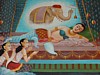
Subramaniam
(सुब्रमनियम)
Another name for
Phra
Kanthakuman or
Kanthakumara, son of
Devi.
回
Subramanya (सुब्रह्मण्य)
Sanskrit. Another name for
Skanda
and
Kanthakumara, the
Hindu
god of war
and the son of
Shiva and
Parvati, who
is also known as
Karttikeya (fig.).
Also spelled
Subrahmanya.
回
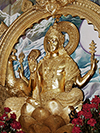
Suchada (सुजात)
Name of a devoted, young, rich and beautiful
milkmaid, who offered
Siddhartha the last meal
before his
Enlightenment. The meal,
some sweet milk-rice with honey, was offered in a golden bowl when
the Buddha-to-be was meditating under a
banyan
tree. After finishing the meal
Siddhartha took the golden bowl and threw it in a river, asking that
if he was destined to become a Buddha, to let the bowl float
upstream, rather than downstream. The golden bowl astonishingly went
upstream, all the while keeping in the middle of the river (fig.),
an event known in Pali as
patisotagami,
which means
‘to go against the
current’.
After his Enlightenment, Siddhartha began a period of fasting that
lasted for seven weeks. During the seventh week, the Buddha
meditated under the
Rajayatana Tree. On the fiftieth morning, after
seven weeks of fasting, two merchants came into his presence. They
were called Tapussa and Bhallika. They offered the Buddha rice cakes
and honey to break his fast and the Buddha told them some of what he
had found in his Enlightenment. These two merchants became the
Buddha's first lay followers. Sometimes the bowl of milk-rice
offered by Suchada is said to have been the meal that ended
Siddharrtha's six years of asceticism. Also transliterated
Sujata.
回
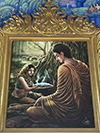
Suddhodana (सुद्धोदन, สุทโธทนะ)
1. Pali-Thai. Father (fig.)
of the historical
Buddha
and ruler of
the kingdom of the
Sakyas,
named
Kapilavastu, in
present-day Nepal. Also known by the names
Totsarot and
Dasharatha.
回
2. Pali-Thai. Another name for the father of
Rama,
the main character in the
Ramakien,
whom is also known as
Totsarot
and is described as a mythological king of
Ayutthaya.
回
Sudhana
1. Pali-Sanskrit name of
Shan Cai, a
youth from India who was an
acolyte of
Kuan Yin
seeking
Enlightenment
(fig.).
The final and most famous section of the
Avatamsaka Sutra,
describes Sudhana’s pilgrimage in search of complete
Enlightenment,
during which he studies under 53 spiritual teachers,
including
Avalokitesvara
and
Maitreya. Rather than a
single lineage, these teachers represent the totality of existence —
monastic figures and laypeople, women and men, royalty, merchants,
artisans, gods, and
bodhisattvas
— expressing the
Huayan
vision that awakening is present
throughout the world.
回
2. Pali name for
Suthon
or
Phra Suthon,
a character from the the story
Manohra.
回
Sudra (शूद्र)
See
Shudra.
回
Sud Sakhon (สุดสาคร)
Another spelling for
Sut Saakhon.
回
Sufi (صُوفِيّ)
Arabic. A practitioner of Islamic mysticism; a
Muslim mystic.
回
sugar apple
Name for a fruit with the scientific name
Annona squamosa, also known as
custard
apple and in Thai called
noi nah.
回
sugarcane
A perennial plant that belongs
to the family of grasses and which has the botanical name Saccharum
officinarum. Its stem is either green or reddish-brown, and is made
up of jointed segments (fig.),
called growth rings and root bands. The segments are made up of
vascular bundles, that contain an edible sweet sap from which sugar
is gained, as well as molasses (a viscous by-product of the refining
of sugarcane) and rum, and nowadays also ethanol. The root bands
that lie along the stem have buds on them and sugarcane is
propagated by planting a section of the stem in soil, after which
new cane will grow from the buds. It requires lots of sun and water
and hence thrives well in the hot and wet climate of Southeast Asia,
where it is commercially produced in many places (fig.).
In Thailand (fig.),
it is especially cultivated in
Kanchanaburi
Province, which has some sugar mill factories that press the sweet
juice from the plants. It is typically sold on markets and food
stalls as a
refreshing snack or pressed into a drink. Old wooden sugarcane
presses are often found in gardens as a decoration and occasionally
they may be seen still in use (fig.).
In
Hinduism,
sugarcane represents refreshing sweetness and thriving growth, and
being a popular food for
elephants it may also
be offered to
Ganesha. ‘Sugarcane
in the mouth of an elephant’, is a popular Thai proverb meaning ‘a
fait accompli’.
In Thai
ton ohy,
and also spelled sugar cane.
See also POSTAGE STAMP
and
WATCH VIDEO.
回
_small.jpg)
Sugarcane White Grub
See
malaeng noon luang.
回
Sugar Palm
Name of an attractive,
single-stemmed palm tree, with the scientific name Borassus
flabellifer and also known by the common names Asian palmyra palm,
Toddy palm (after the sugary sap which is harvested of its
inflorescence
and fruits -
fig.) and Cambodian palm. It has a
bare,
coconut tree-like trunk and may grow to a height of about 25
to 30 meters. The leaves, which are used for thatching, fans, mats,
hats, baskets, umbrellas and as writing material, are circular and
fan-like, ribbed and bluish green in colour. These grow on stalks of
around 1.5 to 2 meters in length, which develop a canopy of several
dozen fronds which may spread 3 meters across. The fruits, called
look taan (fig.)
in Thai, each measure about 10 to 18 centimeters in diameter, grow
in clusters and have an attractive dark chestnut husk, often with a
sunburst effect, gradually changing to a yellow-golden colour
towards the top. Inside sit three pale-white, translucent, jelly
seed sockets, covered with a thin,
creamy white
skin (fig.).
The fruits
can be made into sugar, i.e. palm sugar, as well as be eaten fresh.
The endocarp is used to make
chao taan
cheuam.
Sugar Palms are long-lived and can become well over a 100
years old. In Thai this tree is called
ton taan
or
ton taan
tanoht.
回
Sugriva
(सुग्रीव)
Name of a monkey warrior, half-brother of
Vali
(fig.),
the king of the monkeys, as well as an uncle of
Hanuman (fig.).
After he wrongly assumed that his brother had been killed by a
demon, Sugriva usurped Vali's throne. When Vali upon his return
found his brother on the throne, he concluded that he had betrayed
him, not prepared to listen to any attempts by Sugriva to explain
himself. Hence, the brothers became bitter enemies and Sugriva was
exiled. After this, Sugriva met
Rama
and they became allies, and when
Sugriva challenged Vali to a fight, Rama emerged from behind a tree
and with his bow shot and killed Vali with an arrow. After Vali's
death, Sugriva recaptured his kingdom and made
Angada,
Vali's son, crown prince and second in command. In Thai, he is
called
Sukrihp.
回
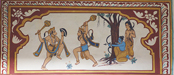
Suicide Tree
Common name for
a small to medium-sized tree, with the botanical name Cerbera odollam.
READ ON.
回
Sui Ren (燧人)
Chinese. ‘Fire Man’. Name of one of the
Si Shi,
a
group of semi-mythological rulers and culture heroes from the period preceding
the Xia Dynasty
in ancient
China. He is often
described as the third of the Three Sovereigns during the Three Sovereigns and
the Five Emperors Period. He is also said to be as the discoverer or inventor of
fire and in
iconography he is
regularly depicted with a
third eye.
As one of the Four Shi,
he is known as Sui Ren-shi. Besides meaning ‘fire’, the word sui
can also be understood as to ‘create fire’, i.e. to obtain fire by
drilling wood, striking flints, from the sun's rays, etc.
回
Sujata (सुजात)
See
Suchada.
回
sukh,
sukha (सुख, สุข)
Sanskrit-Thai term that
can be translated as ‘delight’, ‘comfort’, or ‘happiness’. It is often used in
compound names, such as
Sukhothai,
i.e. ‘Dawn of happiness’,
and the word sukha (สุขา), meaning ‘toilet’, derives
from it and is as such sometimes jokingly translated ‘happy room’.
回
Sukhavati (सुखावती)
Sanskrit. ‘Place of Great Bliss’,
sometimes translated as ‘Paradise’. The term refers to the western
heaven of
Mahayana
Buddhism guarded by
Amitabha,
one of the five transcendental or
dhyani
buddhas. In Thai, it is known as Sukhawadih (สุขาวดี) and in
Hokkien,
a southern Chinese language, as Kek Lok (極樂). As such, it occurs in the names of
Daen Sukhawadih, a
religious park in Thailand's
Phetchaburi province, and in Kek Lok Si (極樂寺), a Buddhist temple in the Malaysian
state of Penang.
回
Sukhothai (สุโขทัย)
Thai. ‘Dawn of happiness’.
Name of a province (map)
and its capital city in North Thailand, 427 kms north of
Bangkok.
READ ON.
回
Sukhothai Historical Park
Name of
a UNESCO World Heritage site in
northern Thailand's
Sukhothai
province, that spans
approximately 70 square kilometers and encompasses the ruins of the ancient
capital of the Sukhothai Kingdom, which thrived from the 13th to the 15th
centuries. The park is divided into a central zone containing key archaeological
sites such as
Wat Mahathat (fig.),
Wat Sri Sawai
(fig.),
Wat Sa Si. and the remnants of the royal palace complex known as Neun
Prasat
Phra Ruang
(เนินปราสาทพระร่วง) or
‘Phra Ruang
Castle Hill’,
as well as surrounding areas that feature additional temples and remnants of the
Sukhothai Kingdom's architectural and cultural legacy. As a significant symbol
of Thailand’s heritage, the park offers valuable insight into the political,
religious, and social developments of early Thai civilization.
The park's central zone is also the heart of the
annual
Loi Krathong
(fig.),
where this
festival is celebrated most exuberantly with vibrant parades in traditional attire (fig.).
Each province showcases its own krathong (fig.)
along with its representative for Miss Krathong. Other events include the
election of the annual Miss Krathong, a market, and a sound-and-light show that
narrates the history of this ancient kingdom, with its ruins serving as a
backdrop. Throughout the week-long festivities, the park is adorned with giant
floating lotuses, and its entrance is decorated with a festive gate
(fig.).
Other highlights of Sukhothai Historical Park include the Ramkhamhaeng National Museum (fig.),
the King
Ramkhamhaeng
Monument (fig.),
the
Bell of Ramkhamhaeng (fig.),
Wat Sri Chum
(fig.),
Wat Phra Phai Luang
(fig.),
Wat Saphaan Hin (fig.),
Wat Sorasak (fig.), Wat Traphang Thonglang,
and Thewalai Maha Kaset.
回

Sukhumahn Marasih (สุขุมาล มารศรี)
Thai.
Name
of the 52nd child of King
Mongkut,
who besides his daughter was
also his
concubine, until he died when she was only ten years old. Consequently, she
became the wife of the succeeding monarch King
Chulalongkorn, her
half-brother, with whom she married at the age of 17, and with whom she had a
son and a daughter, i.e. Prince
Boriphat Sukhumphan (fig.)
and
Princess
Suttha Thipayarat.
The Queen's name is sometimes transliterated Sukhumala Marasri.
回
sukiyaki (鋤焼, สุกี้ยากี้)
Japanese-Thai. ‘To roast on a plough’. Name
for a soup-like dish with mainly
wun sen glass
noodles.
Originally from Japan,
Thailand
has developed its own
modified version which consists of thinly sliced meat or chicken,
fish, seafood or
tofu mixed
with leafy vegetables, spices and sometimes mushrooms, and bring to
a slow boil and let simmer in a shallow iron pot, known as a
steamboat. The dish was originally cooked over a suki, that is a
plough, hence its name. In modern Japanese, non-Kanji
script, it is written
スキヤキ. In
Thai, it is transcribed in a number of different ways, e.g. สุกียากี,
สุกี้ยากี and so forth, and is also called suki nahm, or just suki.
回
%202_small.jpg)
Suk Kesaroh (ศุข เกสโร)
Name of a venerated Buddhist monk with
the ecclesial title
Luang Poo,
who was born in 1847 AD, in the reign of King
Rama IV.
He ordained as a monk in 1869 at Wat Pahk Khlong Makhaam Tao
(วัดปากคลองมะขามเฒ่า) in
Chainat,
where he later in life became the abbot.
Luang Poo Suk
was revered as having great
spiritual power and was the royal teacher of Admiral
Krommaluang
Chumphon Khet Udomsak, i.e.
Aphakon Kiatiwong (fig.).
Suk Kesaroh is also known as
Phra Kruh
Wimonkunahkon (พระครูวิมลคุณากร). He passed away in
1923 AD,
aged 76. His name is
also spelled Suk Kesaro and Sook Gesaroh.
See also POSTAGE STAMP.
回
%20B_small.jpg)
sukon (สุกร)
Thai for ‘pig’,
‘swine’,
or ‘hog’
and a term typically used in relation to the twelfth and last
animal sign of the
Chinese zodiac.
Also transliterated sukorn, sugon or sugorn.
回
Sukrihp (สุครีพ)
Name of a monkey warrior of
Rama and the
regent of
Meuang
Kheedkhin
in the epos
Ramakien. He was the
son of the Sun (Phra
Ahtit) and Kahn Atchana (กาลอัจนา).
He is the half-brother of
Bali (Phali, and
in Sanskrit called
Vali
-
fig.),
whose throne he usurped, and an uncle of
Hanuman (fig.).
He is depicted as a monkey with red fur and usually wearing a
chadah-style
headdress with a conical peak (fig.)
of which the tip folds backwards. He is also represented on one of the
Royal Barges,
which is consequently named after him, i.e.
Reua Sukrihp
Khrong Meuang, and is also depicted
holding a sword on the logo of the Directorate of Air Inspection. Besides
this, he is also often portrayed while breaking a
chattra, a reference to the scene where he
was ordered by king
Rama to
destroy
Totsakan's
huge royal umbrella, which the latter used to block out the sun in order to
put the city of
Longka
in the dark. Also transcribed Sukhreep and Sukhrip,
and in Sanskrit known as
Sugriva. In addition,
he may also be referred to as
Anuchakakat (อนุชากากาศ), which translates to younger brother or anucha (อนุชา)
of Kakat/Kaakaat (กากาศ), which is the former name of
Bali.
See also
LIST OF RAMAKIEN CHARACTERS & NAMES.
回
,%20Ramakien%20monkey%20warrior_small.jpg)
Suktantha (สุกทันต)
Thai.
‘Ripe teeth’.
Name of a former
Buddhist monk turned
reusi, i.e.
hermit, who lived in the middle of the 13th century AD, at the
beginning of the Siamese kingdom. At that time, he was a great
teacher and the top
guru
of the city of
Lavo,
i.e. present day
Lopburi.
As a hermit, he resided in a cave on a mountain called Thammik
Banphot (ธรรมิกบรรพต). Among his disciples and students were several
later rulers, most notably of the three kings of
Lan Na,
i.e.
Ngam Meuang,
Mengrai and
Ramkhamhaeng,
who
met as co-students of this hermit and became lifelong friends (fig.).
In literature often referred to as Suktantha-reusi (สุกทันตฤาษี),
i.e.
the ‘hermit
Suktantha’.
回
Suktantha-reusi (สุกทันตฤาษี)
See
Suktantha.
回
Sulalihwan (สุลาลีวัน)
Thai. Name of a female character from the story
Phra Aphaimanih
(fig.).
She is the stepdaughter of
Nang Laweng, the daughter of the King of
Langka (fig.).
Also referred to as
Nang
Sulalihwan and in English also transliterated Sulaleewan.
回
_small.jpg)
Sulamani (စူဠာမဏိ)
Burmese. ‘Crowning Jewel’ or ‘Small
Ruby’. Name of a shrine erected
by the
Hindu
god
Indra
in his celestial domain
Tavatimsa
and used as a reliquary, in full referred to as Sulamuni
Cetiya,
where
Sakka
enshrined the
Buddha's
hair. In Thai known as
Chulamanie.
回
Sulamani Phaya (စူဠာမဏိဘုရား)
Burmese.
Name of a Buddhist
pagoda
in
Bagan,
named after
Sulamani.
READ ON.
回
Sule (ဆူးလေ)
Burmese. Name of an ancient
pagoda, which today is
located
on a roundabout in the centre of downtown Yangon.
READ ON.
回
sultan (سلطان)
Arabic. ‘Power’, ‘strength’ or
‘authority’. Title for a
Muslim sovereign.
回
Sultan Tit
Common name for a species of
songbird, with the scientific name
Melanochlora sultanea
and known
in Thai by the
name nok tit sultaan (นกติ๊ดสุลต่าน). It is about 17 centimeters
tall and mostly black with a metallic greenish shine, apart from a
large yellow crest and a yellow belly. Sexes are similar, but adult
females are more brownish and have duller yellow parts, while the
chin and throat are a dark glossy olive-green. This bird is depicted
on a Thai postage stamp issued in 1975 as part of a set on Thai
birds (fig.).
回
Sumana
Name of a wealthy merchant in
Savatti
during the era of the
Gautama
Buddha. His
son,
Anathabinthika Setthi (fig.), was acknowledged as the
wealthiest trader in the region and earned recognition as the primary male
supporter of the
Buddha. His
other son,
Subhuti, was one of the principal
disciples of
the
Buddha,
known for his profound understanding and mastery of the concept of
Sunyata, i.e.
‘emptiness’
or
‘voidness’.
回
Sumatran Rhinoceros
Common name of a species of rhinoceros, with the
scientific name Dicerorhinus sumatrensis. It is the only still existing species
of the genus Dicerorhinus, as well as the the smallest rhinoceros, growing to a
shoulder height of up to 145 centimeters, a body length of about two and a half
meters, and weight of around 650 kilograms. It has two horns, i.e. a larger
nasal horn of up to 25 centimeters, and a smaller horn, which is typically a
stub. Its body is usually covered with reddish-brown hair. Sumatran Rhinoceroses
inhabit rainforests, swamps and cloud forests, and were once found in India,
Bhutan, Bangladesh, Myanmar, Laos, Thailand, Malaysia, Indonesia, and China,
though they are now critically endangered, with only six substantial populations
found in the wild, to be precise: four on the Indonesian island Sumatra, and two
in Malaysia, i.e. one on Borneo and one on the Peninsula. In 1973, Thailand
issued a series of postage stamps with endangered wild animals, including one
with the depiction of Sumatran Rhinoceroses (fig.).
In Thai, it is called
krasoo.
回
Sumbha
(शुम्भ)
Sanskrit. Name of an
asura,
who first appears in the 5th chapter of the
Devi Mahatmyam, together with his brother
Nisumbha. The duo sought to conquer the
triloka
by subjecting themselves to
severe penance and purification rituals, in order that no man nor demon could
destroy them. They traveled to Pushkar (fig.),
where they remained in prayer for ten thousand years, and when the god
Brahma
saw their penitence, he was pleased and
granted them their request. When
Chanda and
Munda,
two lesser
asuras in the
brothers' service, had
encountered the goddess
Devi, they were
overwhelmed by her beauty and reported this back to Sumbha and Nisumbha. Hence,
they were sent out to abduct her, yet were destroyed by Devi. Consequently, the
brothers confronted the goddess
Devi themselves, but
despite their boon, both were slain by her, as the boon had no protection
against gods nor goddesses. Sumbha and Nisumbha are sometimes explained to be
symbols of arrogance and pride, which is ultimately overcome by the Devi's
humility and wisdom. Also transliterated Shumbha and Zumbha.
回
Sum Chaleum Phra Kian (ซุ้มเฉลิมพระเกียรติ)
Thai-rajasap
name for an altar-like honorary monument erected for royalty or high-ranking
monks (fig.),
usually with a large portrait of the person to whom it is dedicated, generally
in a decorative golden frame. For royalty, the monument is in the main adorned
with a
silver
and a golden
phum dokmai,
and sometimes with the Thai national flag and the personal royal flag of the
intended member of the royal family. It is typically erected either on the side
of the road, as well as at palaces and temples, or near public places of
interest. Additionally, it is also erected as an arched gate-like structure over the road (fig.),
typically over the main road into and out of a city and then specifically called
Sum Chaleum Phra Kian Pratu
Meuang (ซุ้มเฉลิมพระเกียรติประตูเมือง), or alternatively on the sides of a pedestrian bridge.
The framed portrait is also referred to as krop roop phra boromma chahyahlak
(กรอบรูปพระบรมฉายาลักษณ์).
See also
TRAVEL PICTURES (1),
(2)
and
(3).
回
Sum Chaleum Phra Kian Kanchana Phisek
(ซุ้มเฉลิมพระเกียรติกาญจนาภิเษก)
Thai-rajasap
name for a monument erected in 1996 AD, in the honour of King
Rama IX,
to commemorate the Golden Jubilee (Kanchana
Phisek) of his reign, i.e. 50 years on the throne. The statue
consists of the heads and front legs of four
White Elephants,
standing back to back and carved from white marble. These are placed on an
octagonal base, which is surrounded by marble
phum dokmai.
The memorial is located at the intersection of
Saphaan
Phaan
Phiphek
Leelah
(สะพานผ่านพิภพลีลา), i.e. the
‘Bridge which Phiphek Gracefully Crossed’, and
Phra Pinklao
Road, near the northeastern corner of
Sanam Luang.
In English, the memorial is referred to as Rama IX Golden Jubilee Monument.
See MAP.
回
%201_small.jpg)
Sumedha
(सुमेध, သုမေဓာ)
Sanskrit-Burmese. A former
incarnation of
Siddhartha
Gautama,
at the time of the first of his 27
buddha
predecessors,
Dipankhara.
When Sumedha, who lived the life of a
brahman
ascetic, met Dipankhara (fig.), he vowed that one day he would be a buddha
too. This was consequently confirmed by the omniscient buddha
Dipankhara and all his 26 descendants, and thus Sumedha became the
11th of the 27 buddhas who preceded the historical
Sakyamuni
Buddha.
According to legend, he became an ascetic at the age of 9,000 years
and attained
Enlightenment
after having practiced austerities for 8 months. He is said to have
lived for 90,000 years. The canonical story of Sumedha is widely
celebrated
in
Myanmar,
where he is usually depicted as a
Burmese
hermit or
tapathi
(fig.),
laying flat on his belly in worship of
Dipankhara, often while
presenting him with an offering.
According to legend,
Yashodhara,
the later wife of Siddhartha, appears as a girl named
Sumidha and meets her future
husband for the first time. As the story goes, Sumedha spotted Sumidha holding 8
lotuses
(fig.)
and offered to buy one of her flowers, to give it as offering to
Dipankhara (fig.). However, recognizing him as a future buddha, the girl pledged to
give him
5 of her lotuses if he would promise that they would become husband
and wife in all their future existences, i.e.
chaht.
回
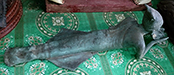
Sumeru (สุเมรุ)
Thai. Another word for
Meru.
回
Sumet (สุเมธ)
Thai-rajasap.
‘Wise man’, i.e.
anyone who possesses wisdom, a philosopher. The term is often used for the
Buddha
and may appear in the name of certain
Buddha images,
such as in
Somdet Phra Sakayamuni Sri Sumet
Bophit,
Thailand's largest
reclining Buddha
image.
See also
Saadsada,
Phra Samasam,
Mahamuni
and
Mahalabamuni.
回
Sumidha (सुमिध)
Sanskrit. Name of
Yashodhara,
the wife of Siddhartha
Gautama,
in a previous
incarnation,
when she met Siddhartha, i.e.
her future husband, for the first time in his earlier incarnation of
Sumedha
(fig.),
a
brahman
ascetic,
when the latter was about to meet the
buddha
Dipankhara
(fig.),
i.e. the first of 24
buddha
predecessors,
and offer him
some flowers.
Yet, as he tried to buy flowers as an offering, he found out that the king had
already bought all the flowers for his own offering. Spotting
Sumidha holding 8
lotuses,
he offered to buy one of her flowers. However, recognizing him as a future
buddha, she pledged to give him 5 of her lotuses if he would promise her that
they would become husband and wife in all their future existences or
chaht (fig.).
She is also known as
Bhadra.
回
Sum Pratu Watthanatham Thai-Jihn
(ซุ้มประตูวัฒนธรรมไทย-จีน)
See
Chinatown Gate.
回
sumwimaan (ซุ้มวิมาน)
Thai
compound term that consists of the word sum (ซุ้ม), i.e. a slightly convex or
arched shaped facade,
often
with multiple arches and pinnacles,
and typically erected as an altar-like honorary monument for royalty, and the
word wimaan (วิมาน), i.e. the abode of a god or the dwelling place of a deity.
It is frequently used in
iconography as an emblem, e.g.
in the royal seal of
Phra Phutta Leut La, i.e.
King
Rama
II (fig.);
as part of the provincial coat of arms of
Ayutthaya (fig.);
on the emblem for the bicentenary of
Rattanakosin
(fig.); etc.
回
sunak (สุนัข)
Thai. The official word for
‘dog’ and ‘puppy’, derived from the
Sanskrit
term shunaka (शुनक),
meaning ‘dog’.
Although dogs are generally loved by most Thais (fig.),
there are also many homeless dogs and people are occasionally
attacked by dogs that turn wild, with some reports of small children
having succumbed to their injuries, usually from multiple bites.
Thailand has an estimated 10 million stray dogs, of which around
500,000 roam the streets of
Bangkok. Stray dogs often live in packs
and many have skin diseases (fig.)
and open wounds from fighting, while some may also be rabid. Some
temples
and
good-hearted people look after stray dogs (fig.)
and also the king is a major supporter by urging his
subjects to treat stray dogs well. King
Bhumipon's
favourite pet is his dog called
Thongdaeng
(fig.),
which means Copper in English. People in Bangkok usually keep to
small dog breeds for pets, as these are more easy to keep indoors,
which is ideal for those living in flats, and many will have a
pedigree. Thailand also has its own breed known as the Siamese Dog
or Thai Ridgeback Dog (fig.),
of which exist several varieties (fig.).
Another breed unique to Thailand is the Bang Kaew dog
(บางแก้ว), named after the village from which it originated, i.e.
Ban Bang Kaew, in the
Amphur
Bang Rakam in
Phitsanulok, where the
abbot of the local temple kept a number of dogs, that allegedly
mated with a wolf. Although fierce, this breed is famed for its
calmness and loyalty.
Some people in Thailand eat dog meat (fig.),
such as the
Akha
in Northern Thailand and the
Soh in
Sakon Nakhon,
which has
a dog market selling cooked dog,
though the practice is more
common in
China
(fig.),
especially in the south (fig.),
and in northern
Vietnam (fig.).
In popular speech dogs are called
mah
and occasionally suwaan (สุวาน), a word derived from Pali is used.
The dog (gou) is the eleventh animal in the
Chinese zodiac
(fig.)
and those born in the Year of the Dog are said to love travel, to be
eloquent and to possess good speaking abilities. They belong to the
element tu (土), that represents earth and correspondents to the
colour yellow and the celestial stems
wu (戊) and ji (己).
The dog features on many a Thai postage stamp, including the Zodiac
Year of the Dog Postage Stamp issued in 2006 (fig.)
and the
Songkraan
Day Postage Stamp issued in 1994 (fig.).
See POSTAGE STAMPS (1),
(2)
and
(3),
TRAVEL PICTURES (1) and
(2), and
WATCH VIDEO (1),
(2),
(3),
(4),
(5),
(6) and (7), and
VIDEO (E).
回
Sunandha Kumarirat (สุนันทากุมารีรัตน์)
Thai. A daughter
of King
Mongkut and
Princess Consort Piam, and later
became one of five queens of King
Chulalongkorn,
of whom she was a
half-sister. Besides this, she was
also was a
full sister to two of the other queen
consorts of
Rama V, i.e. Queen
Sawang Watthana
and Queen
Saowapha
Phongsri. She was born on 10
November 1860 in
Bangkok
and died at the untimely age of 19, on 31 May 1880,
when her boat (fig.) capsized while on the way to the Royal Summer Palace in
Bang Pa-in,
an accident that killed also her daughter Princess
Kannaphon Phetcharat
(fig.) and an unborn son. Despite the
presence of many onlookers, no one dare come to her rescue, as the law forbade
commoners to touch any royal, even in order to save their lives. She is
portrayed on one of a rare set of unmarked
postage stamps of the Royal Family issued in circa 1893 (fig.).
The royal compound at Bang Pa-in has an
obelisk-shaped
memorial commemorating Queen
Sunandha Kumarirat
and her daughter (map
-
fig.).
She is also referred to
as Nang Reuarom (พระนางเรือร่ม), meaning
‘Queen of the Sinking Boat’.
The
latter part of her name,
rat,
derives from
rattana,
meaning
‘jewel’,
and is therefore sometimes transliterated as Sunandha Kumariratana.
回
Sun and Moon fans
Name for a kind of Chinese-Taoist
fans, typically carried along with statues of deities in processions or placed
at their altars in pairs
(fig.)
and adorned with intricate Chinese symbols.
Characteristically, one fan displays the Chinese character for
‘Sun’,
while the other bears the character for
‘Moon’.
In Buddhist iconography, the combination of these two characters, ri (日) for
‘sun’
and yue (月) for
‘moon’,
forms the character ming (明), which means
‘bright’,
‘clear’,
or
‘to
understand’,
a symbol for
Enlightenment.
Additionally, some fans depict images with deeper meanings, such as a
dragon
representing male power, and a
phoenix
symbolizing the female counterpart—both embodying the principles of
yin-yang. In Thai, these fans are known
as
pad
suriya-chandra
(พัดสุริยัน จันทรา), and in Chinese
as ri yue shan (日月扇).
回
Sun Bin (孙膑)
Chinese.
‘Peach
Blossom’,
a military strategist, who lived during the Warring
States Period and after his death was deified.
READ ON.
回
Sunda Striped Skink
Common name of a small,
arboreal lizard belonging to the family Scincidae and also commonly referred to
as the Banded Lipinia, Sipora Striped Skink, and Common Striped Skin, and with
the binomial name Lipinia vittigera.
READ ON.
回
sundial
See
naligah daed.
回
sunflower
See
thaan tawan.
回
Sunih Sawanprathihp (สุณี สุวรรณประทีป)
See
Luang Sakdi Sanyawut.
回
Sunlaka Sathaan (ศุลกสถาน)
Thai. Literally
‘sanctuary’,
as in harbour, but also ‘customs
facilities’. Thai name
used for the old Customs House located
along the lower eastern bank of the
Chao Phraya River
in
Bangkok, near the
former offices of the
East Asiatic Company (fig.),
and which were once considered the symbolic gateway into
Siam.
The historic Customs House was built in 1888 and used by the Customs Office
until it in 1949 moved to Khlong Toei Port. The building later came to be used
as staff residences for the Bang Rak Fire Department until early 2016, when
those tenants were relocated due to the progressive deterioration and crumbling
of the building, which now awaits renovation.
See also POSTAGE STAMP
and
MAP.
回
_small.jpg)
Sunny Bangchak
Officially
known as the Bangjaak/Bangchak Renewable Energy Learning Center, Sunny Bangchak
is a multifaceted facility dedicated to renewable energy education and
innovation. Beyond being a large solar farm, it features diverse renewable
energy sources such as solar, water, wind, and geothermal energy. The center
includes an algae research dome for biodiesel production, a 4D movie theater on
renewable energy, and an exhibition room showcasing the importance of energy in
modern life. Outdoor exhibits at Sunny Bangchak demonstrate practical
applications of renewable energy, including palm plantations, a green refinery,
a sufficiency economy model, a community gas station, and a used vegetable oil
project. These exhibits illustrate how sustainable practices can be integrated
into daily life. Sunny Bangchak's comprehensive educational programs and
interactive exhibits aim to raise awareness about the value of renewable energy
and its role in a sustainable future, making it a vital resource for anyone
interested in sustainable energy solutions. In Thai, known as
Soon Rian Roo Phalang Ngaan Thot Thaen Bangchak.
Also transliterated Bangjaak.
回

Sunthorn Phu (สุนทรภู่)
The most celebrated Thai poet who lived from
1786 to 1855. It was first assumed that he was born in Klaeng, in
the province of
Rayong,
but scholars nowadays believe that he actually came from
Thonburi.
As a writer he was highly praised by king
Rama II,
with whom he adapted a version of the
Ramakien,
and he is the author of the romantic epos
Phra Aphaimanih,
his most famous work. During the reign of king
Rama III
he fell into disgrace, but was later reinstated by king
Rama IV.
Today his statue stands in Klaeng and another one was erected in
June 2005 in Thonburi, now thought to be his birthplace.
Klaeng
today has a memorial
park with a monument of this poet, as well as with statues of the
main characters from Phra Aphaimanih, Sunthorn Phu's most celebrated
work.
See also POSTAGE STAMP
and
LIST OF
RAMAKIEN CHARACTERS & PLACE NAMES.
回
%20Thai%20poet%20and%20author%20of%20Phra%20Aphaimanih%20(พระอภัยมณี)_small.jpg)
Sunthorn Ratchawongsa (สุนทรราชวงศาฯ)
Thai. Name of
the first
ruler of
Yasothon,
with the title of
Phra
and who ruled from 1814 to 1823 AD.
READ ON.
回
Sunthorn Wohaan (สุนทรโวหาร)
Thai. Name of a
Phraya
and important poet from
Chachengsao, who was
the author of the first ever textbook of Thailand, called Baep Riang Luang
(แบบเรียนหลวง), and which was used to teach in
Suan Kulaab,
the
rose garden school inside the
Grand Palace. He is
regarded as the highest authority on Thai language during the reign of
King
Rama V and for the
occasion of the
100th anniversary
of
Rattanakosin
in 1882, he was appointed
chief examiner of the
Ramakien
murals in
Wat Phra Kaew,
i.e. the Temple of the
Emerald Buddha.
He lived from 1822 to 1891, is nicknamed Noi
Ajaan
Yahng Koon (น้อย อาจาร ยางกูร)), and is
fully known as Phraya
Sri
Sunthorn Wohaan, also transcribed Phya Si Sunthon
Wohan.
See also
LIST OF RAMAKIEN CHARACTERS & NAMES.
回
_small.jpg)
Sun Tzu (孫子)
Chinese. Name of a general and
military strategist of the Qi Kingdom (though later fled to the Wu Kingdom)
during the Eastern Zhou Period of
China, who lived between 544 and
496 BC. He was also a philosopher and writer, and is credited as the author of
The Art of War, an influential work of military tactics that throughout time has
inspired military and political leaders worldwide, and in Chinese is known as
Sun Tzu Bing Fah (孫子兵法), literally ‘Master
Sun's Military Methods’.
He describes a war strategy that defies convention and with principles based on
Taoism,
such as
Wu Wei
and to go with the flow. Tactics described are those used by what is referred to
as the True General, who hides his intentions and relies on deception, e.g. when
strong, look weak; when weak, look strong; when far away, give the impression
you are close; when close, give the impression you are far away; etc. Another
tactic is to use the least amount of effort and the fewest resources, i.e. the
best war is won without fighting, according to the
Taoist
concept of ‘soft
overcomes hard’, and uses soft war, such as manipulative diplomacy, bluffing,
spies, etc. in order to convince the other party they are defeated and to give
up without even fighting. To fight and conquer in all battles is not supreme
excellence; supreme excellence consists in breaking the enemy's resistance
without fighting. In modern
Pinyin,
Tzu is transliterated as Zi,
and his full name thus is spelled Sunzi.
回
Sun Wukong (孙悟空)
Chinese. Name of a mythical
monkey, with acrobatic skills and a child-like playfulness, but also with a
cunning mind.
READ ON.
回
Sunyata (शून्यता, สุญญตา)
Sanskrit-Thai
term for the
Pali
expression
anatta, used in
Buddhism to
describe
‘non-ego’ and ‘non-soul’, and usually
translated as ‘nothingness’
or ‘emptiness’.
See also POSTAGE STAMP.
回
Sun
Yat Sen (孙逸仙)
Chinese. Name of the
founder
(fig.)
and in 1912 for less than a year the provisional President of the Republic of
China. Afterward
he became the leader of the Kuomintang until his death in
1925. He was succeeded by
Chiang Kai Shek (fig.).
Usually referred to as Dr. Sun Yat Sen and his name is also transliterated Sun
Yat-sen.
He is nicknamed Sun Zhongshan
(孫中山), i.e. ‘Sun
[of/from the] Central Mountains’.
See also
Wuchang Uprising.
See LIST OF CHINESE RULERS
and
TRAVEL PICTURE.
回
suo yi (蓑衣)
Chinese. Term for a kind of raincoat woven
from straw, rush or
fan palm
leaves, and typically used by farmers in southern
China,
as well as by cormorant fishermen (fig.).
Whereas the character
suo (蓑) refers to any rain coat made of straw,
rush, fan-palm leaves, and so forth,
the word yi (衣)
is used as a classifier for clothes.
回
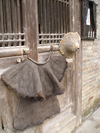
Suphan (สุพรรณ)
1. Thai. A regional name for the
Tha Chin River used
near
Suphanburi,
roughly between
Chainat,
where it is known by the local name
Makhaam Thao River, and
Nakhon Pathom,
where it is referred to as the
Nakhon Chai Sri River. 回
2.
Pali-Thai. ‘Gold’ or ‘golden’. As a prefix in compound names and words it is
sometimes pronounced suphana, as in
Suphanahongse.
回
Suphanahongse (สุพรรณหงส์)
Pali-Thai. ‘Golden Swan’. Name of one of the
most prominent
Royal Barges,
as well as another name for the mythical swan
hongse. Its
figurehead is part of the logo of the
Tourism Authority of Thailand
(fig.).
In Thai pronounced Suphanahong, also known as
hong thong
and as a barge in full called
Reua Phra Thihnang Suphanahong
(fig.).
Sometimes transcribed Suphannahongse. See also
Reua Ekachai Heun Haaw and
Reua
Ekachai Laaw Thong (fig.).
See also THEMATIC STREET LIGHT (1),
(2),
(3),
(4),
(5),
(6),
(7),
(8),
(9),
(10),
(11),
(12),
(13),
(14),
(15),
(16),
(17) and
(18).
回
Suphanamatcha (สุพรรณมัจฉา)
Pali-Thai. ‘Golden fish’. A
mermaid
and daughter of
Totsakan
in the
Thai
Ramakien,
with whom the monkey-general
Hanuman
(fig.)
begot his son
Madchanu,
who was born with the body of a monkey and the tail of a fish (fig.).
The story does not appear in the original Sanskrit text of the
Ramayana,
but does occur also in the
Khmer
version, known as
Reamker,
where Suphanamatcha is called Sovanna Maccha. See also
Suwan,
Suphan
and
Matsya.
See also
LIST OF RAMAKIEN CHARACTERS & NAMES.
回
Suphanburi (สุพรรณบุรี)
Pali-Thai. ‘City of gold’. An ancient city and
the capital of a province (map)
with the same name.
READ
ON.
回
Suphankanlaya (สุพรรณกัลยา)
Pali-Thai. ‘Golden Lady’. Name of a
16th century Princess of
Ayutthaya who was a Queen
Consort of King
Bayinnaung
(fig.)
of
Burma.
READ ON.
回
Supreme Patriarch
See
Phrasangkaraat.
回
Sura
(सुरा, สุรา)
1. Sanskrit. Goddess of wine who surfaced
during the churning of the
Ocean of Milk,
as well as the name of a beverage distilled from rice meal which was
popular among the
Kshatriya
warriors and people from the lower castes alike.
回
2.
Thai for ‘alcohol’.
回
Surakaan (สุรกานต์)
1. Thai. ‘Precious Crystal’. Name of a
magical crystal ring, that
occurs in the
Ramakien.
Phra Phrom
(fig.)
gave it as a weapon to
Saeng Ahtit,
and it has the power to emit a deadly ray that can instantly age anyone into
death. When
Phra Ram
(fig.)
was informed that Saeng Ahtit had deposited it with Phra Phrom at the time that
Totsakan
(fig.)
send him into battle, the latter
tricked Phra Phrom into giving the crystal ring to
Ongkhot
(fig.),
who had disguised himself as Jitraphairi/Wichitphai (จิตรไพรี/วิจิตรไพรี), the
half-brother of Saeng Ahtit.
See also
LIST OF RAMAKIEN CHARACTERS & NAMES.
回
2. Thai. ‘Precious Crystal’. Name
of
a monkey-warrior
from the city of Meuang
Kheedkhin, that appears
in the
Ramakien
as
an ally of
Phra Ram
(fig.).
He
has a yellowish-red to
vermilion fur
and
wears a
kabang-style crown.
He is
one of the eighteen
Wahnon Sip-paet Mongkut, and an
avatar
of
Phra
Mahachai.
See also LIST OF RAMAKIEN CHARACTERS.
回
_small.jpg)
Suranari (สุรนารี)
Born as Mo (fig.)
in
Korat
in 1771 AD during the rule of King
Taksin
the Great. She was the daughter of
Nai
Kim (กิ่ม) and
Nang
Boonma (บุญมา) and married to
Chao Phraya
Mahisarathibodi, acting governor of Korat. In 1826 the troops of
King Anuwong of Vientiane rebelled against Thai supremacy and
conquered several cities in northeastern Thailand. When they
besieged Korat with an army of 3,000 men, Mo led a successful
counterattack with the women of Korat, forcing the Laotian troops to
retreat. Afterwards she led her troops back into Korat where she
added an army of men to her group and joined up with the troops of
the capital in order to drive the army of King Anuwong further from
Thai territory (fig.).
For her courage and for liberating Korat King
Rama III
conferred her with the title of Lady Suranari. Her statue now stands
in the city of
Nakhon Ratchasima
(fig.).
See
also POSTAGE STAMPS
and
TRAVEL PICTURE.
回
Surang
(สุหรั่ง)
See
Jone Surang.
回
Suraphon Sombatcharoen (สุรพล
สมบัติเจริญ)
Thai. Name of an iconic
look thung
singer-songwriter from
Suphanburi
and a pioneer in the
genre.
READ ON.
回
Surasinghanat (สุรสิงหนาท)
Thai. The first
uparacha
or viceroy of the
Rattanakosin
period with the title
Somdet
Phra
Bowon
Racha
Chao
which is followed by his name and
the prefix
Maha.
Born in 1743 as
Boonma (map
-
fig.), he was the
younger and only brother of
Thong Duang,
also known as
Chao Phraya
Chakri,
the later King
Rama I.
He was a descendant of a noble family
from the
Ayutthaya Period, the son
of a middle-level official in the Mahatthai (มหาดไทย), the Ministry of the
Interior which at that time was responsible for the provinces North and East of
the capital, and a Chinese mother who herself was born into a rich family.
Through
Thong Duan's
principal wife this family was also closely related to the
Bunnag
family. He was a
great warrior who often fought at the side of his elder brother, when he was
commander of the troops campaigning in the northern regions and later in the
East. After the fall of Ayutthaya in 1767 he joined the service of
Phra Chao Taksin
and brought his elder brother to the king's
attention, who after some successes in battle, in
1769 raised Thong Duan to the position
of
Yommaraat
and in 1770 to that of Chakri, the same year in which Surasinghanat himself was
made a Yommaraat. In 1778 Surasinghanat, joined his brother when he conquered
the Laotian Kingdoms of
Vientiane,
Luang Prabang and
Champasak,
that all fell in the same year and were made
vassals of
Siam.
As a consequence the
Emerald Buddha,
which was moved from
Chiang Mai
to Vientiane by
King Setthathirat in 1564,
was brought back to
Thonburi,
where the armies arrived back in April 1779. In 1781, both brothers were again
on campaign, this time in Cambodia. Their mission was to put a pro-Siamese
monarch on the throne, after a rebellion had led to the death of the previous
Khmer king. But in the meantime rebels at home marched on Thonburi and
seized King
Taksin,
who by then had become mentally ill and stood accused of megalomania. Chao
Phraya Chakri hastily went
back and the rebels invited him on the throne, an offer which
he accepted on 6 April 1782 and Surasinghanat was made viceroy. In 1785, when
the Burmese king Bodawhpaya launched a major attack on Siam, the viceroy took up
position in
Kanchanaburi
and successfully blocked the
Three Pagoda Pass, the
key Burmese invasion route.
Boonma
was married to princess
Sri Anocha, a sister of
Chao Kawila,
and died in 1803. He
is also known by the title
Krom Phra
Rachawang
Bowon Maha Surasinghanat and is accredited for ordering the construction of
Phra Thihnang Phutthaisawan
(fig.)
and for sending back the
Phra Phutta Sihing
Buddha image
from Chiang Mai
(fig.).
See MAP
and
TRAVEL PICTURE.
回
_small.jpg)
Surasvati (สุรัสวดิ)
Short name for
Surasvati Devi,
who is otherwise known as
Sarasvati.
回
_small.jpg)
Surasvati Devi (สุรัสวดิเทวี)
Thai name for
Sarasvati. In
short, also called just Surasvati.
回
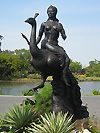
Surat Thani (สุราษฎร์ธานี)
Thai.
Name of a province (map)
and its capital city in South Thailand, situated on the east coast
of the Thai peninsula 644 kms from
Bangkok.
READ ON.
回
Surin (สุรินทร์)
Sanskrit-Thai. ‘God
Indra’. Name
of a province (map)
in
Isaan, 457 kilometers northeast of
Bangkok
and bordering
Cambodia.
READ ON.
回
Surin Chokhong (สุรินทร์จอข่อง)
Thai-Burmese name for
the Burmese general who in 1767 invaded
Singburi,
where he met fierce resistance from the heroes of
Bang Rajan.
READ ON.
回
Suriya (सूर्य, สุริยะ)
See
Surya.
回
Suriyaland Pattaya (สุริยาแลนด์พัทยา)
Thai. Name of a café
located on the outskirts of
Pattaya,
featuring a unique music zone and arts garden, a flea market and a museum, with
retro and Japanese-inspired items. Housed in a building shaped like a giant
guitar, it offers second-hand collectibles such as movie memorabilia, ceramics,
bicycles, antique radios, and classic vehicles. A standout feature of Suriyaland
is its outdoor garden, home to the allegedly world's largest ukulele and the
towering world's largest guitar. These impressive structures serve as the
museum's iconic centerpiece, offering vibrant photo opportunities. Visitors can
climb the guitar to explore its design, which includes cables that mimic guitar
strings, and enjoy a panoramic view of the surrounding area. It’s a must-visit
destination for fans of music, vintage treasures, and Japanese culture.
WATCH VIDEO
and
VIDEO (EN).
回

Suriyaphong Pharitdet
Thai.
Name of the ruler of
Nan
in the reign of
King
Rama V, who had
the title of
Phra Chao.
READ ON.
回
Suriyapop (สุริยาภพ)
Name of
a giant or
yak
character in the
Ramakien.
He has a red complexion and wears a
chadah-like crown,
that has a rather straight and thick peak with three crenate notches at the base
and a tip with an obliquely forward sloping surface, and which is generally
described as a
bamboo
shoot crown.
At first glance, he is confusingly similar to
Totsakiriton
(fig.),
but he has no
elephant
trunk-like nose. He
is
one of the 12 giants, set up in 6
pairs, that guard the entrances in the enclosure of the Temple of the
Emerald Buddha,
i.e.
Wat Phra Kaew
in
Bangkok,
where he is erected in pair with
Indrachit
(fig.),
who in turn is
similar to
Totsakiriwan
(fig.),
but also lacks the
elephant
trunk-like nose.
Pronounced Suriyaa-phop, but also
known as
Suryapop (สุรยะภพ), which is pronounced
Surya-phop.
His brothers are
Nonyuphak and
Banlaichak.
See also
LIST OF RAMAKIEN CHARACTERS & NAMES.
回
_small.jpg)
Suriyothai (สุริโยทัย)
Thai-Sanskrit. ‘Sunrise’. Queen and royal consort of King
Chakraphad, the 16th King (17th reign) of
Ayutthaya.
She was killed in a war with the Burmese on 3 February 1549 AD, thus
sacrificing her life to protect her husband and her country from
foreign aggression. Seated on a
war elephant
(fig.)
and disguised as a male warrior in battle dress, she interrupted the
fighting between the king and Phra Chao Prae (พระเจ้าแปร) of Burma,
when her husband's
chang seuk
collapsed from wounds and
the king was in danger of being killed. Both parties were fighting
with a
ho ngao
(fig.),
a scythe-like weapon used particularly in hand-to-hand combat on
elephants’ backs, a type of warfare known as
yutthahadtie,
but since the queen's elephant was much smaller than that of the
king and that of her opponent, she had a great disadvantage. She was
eventually slashed to death, though her interference saved the king
from further attacks. A
pagoda or
chedi
(map
-
fig.)
and a memorial shrine (map
-
fig.)
in the former rear palace of Ayutthaya commemorates her heroic deed,
as well as a memorial park, featuring a large statue of the Queen
riding her war elephant (fig.).
A historical movie about the life of Queen Suriyothai was
co-sponsored by Queen
Sirikit Kitthiyagon.
回
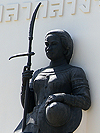
Surya, Suriya (सूर्य, สุริยะ)
Sanskrit-Thai. The Vedic sun god. He is
regarded as a symbol of radiance, knowledge,
Enlightenment, and
also stands for time, space and universal order. He is often
portrayed with a halo (fig.)
and a
lotus
in each hand. He drives a chariot pulled by seven horses and is the
lokapala
of the Southwest. In Thailand, his name is pronounced Suriya, but he
is also known by the name
Nairitti
(fig.).
He, together with the moon god
Chandra,
discovered the deceit of the demon
Rahu
when the
amrita
was distributed. They informed
Vishnu
who immediately cut the demon in two with his discus. However, the
amrita swallowed by Rahu already had its effect and both parts lived
on separately. Because Rahu has never forgotten the betrayal by the
sun and the moon he chases them alternately with open mouth thus
causing the eclipses of the sun and moon each time he swallows them.
Because he was cut in two he has no lower body causing them to keep
on slipping through. At the so-called
kama-sutra
temples in
Khajuraho (fig.),
Surya is depicted with two women, one on either side of him,
representing morning and evening.
He is the father of
Yama, the god of
death (fig.),
and is otherwise known as Vivasvat. In Chinese, he is referred to as
the Sun Star King and known as Tai Yang Xing Jun (太陽星君 -
fig.).
See also
LIST OF RAMAKIEN CHARACTERS & NAMES.
回
_small.jpg)
Suryavarman (សូរ្យវរ្ម័ន)
Khmer.
Ruler of the
Angkor
Kingdom
from 1006 to 1050 AD. He ascended the throne after he usurped King
Udayadityavarman in circa 1002 AD.
Major constructions built by
King
Suryavarman
include the temple
Khao Phra Wihaan
(fig.)
in the
Dangrek
mountain range (fig.) and the West
Baray, i.e. the second Angkorian reservoir,
as well as
the completion of Phimeanakas and
Ta
Keo, of which construction for
the former began at the end of the
10th century, during the reign of
Rajendravarman II
(944-968 AD), and for the
latter
in the late 10th to early 11th century AD, under
the auspices of
Jayavarman V.
Suryavarman is also
referred to as Suryavarman I. Angkor Wat,
the largest of the
Khmer
temples, was built in the early 12th century by Suryavarman's namesake
Suryavarman II. The name Suryavarman could be translated as ‘Protected by
Surya’.
See also
varman.
回
Susahn Hoi 75 Lahn Pih (สุสานหอย 75 ล้านปี)
Thai. ‘75-Million-year-old Shell Cemetery’.
Name of a beach in
Krabi
province that has some of oldest shellfish
fossils on Earth. It is part of Hahd Nopharat
Tara-Moo Koh
Phi Phi
National Park (fig.),
that also includes the
Phi Phi Islands
(fig.). The 40 to 75 million
year built-up of shellfish fossils has created this beach that looks like it
consists of concrete slabs. These slabs are made up of shells from shellfish
that were compressed into a gigantic plate that over time broke into pieces. In
the past, this area initially had fresh water and was a natural habitat for
shellfish, but a shift in tectonic plates caused salt water to come into the
area. The salt caused the shells to fuse together creating this limestone beach
with shelly slabs that have a thickness of about 40 centimeters. When the
tectonic plates shifted again it raised the land and exposed the fossils found
here today. Besides a
visitors and information center, the park also has has a number of displays on
shells and fossils.
WATCH VIDEO.
回
Susahn Tae Chew (สุสานแต้จิ๋ว)
Thai. ‘Tae
Chew
Graveyard’. Name of a former Chinese cemetery in
Bangkok's
Sathorn district,
used for more than 80 years as a burial place for deceased immigrants from the
ethnical subgroup of Han Chinese people, who settled in Thailand from the
coastal region of
southeastern
China.
With over 4,750,000 the Tae Chew make up for more than half of the ethnic
Chinese population in Thailand and this burial ground covers an area of 150
rai. Today,
the area has been renovated into a recreational park, where people go to
exercise or relax, some even in hammocks between the graves (fig.),
and it has been renamed the Beautiful Garden in the Cemetery or
Suan Suay Samakhom Tae
Chew in Thai, literally the ‘Beautiful
Park of the Tae Chew Community’. Besides the many ancient graves there are old
Chinese buildings, a religious shrine, an open-air gym, a sports field, etc.
This Chinese or
Mahayana cemetery is one of the few
Buddhist graveyards in Bangkok, as Thai or
Theravada
Buddhists usually cremate their departed. Also transcribed Susan Teochew.
See MAP.
回
%204_small.jpg)
sushi (寿司)
Japanese. A Japanese dish of balls of cold rice topped with raw fish (sashimi)
or other ingredients, including various meats and vegetables. The dish has
derived from the practice of fermenting fish with salt and rice, i.e. fish being
put into fermenting rice, causing the fish to break down into amino acids, due
to the vinegar produced from the fermenting rice. In the past, the fermented
fish was taken out of the rice for consumption whilst the fermented rice was
disposed of,
as it was only used as an agent to ferment the fish. Nowadays the rice used is
special sushi rice, a Japanese short-grained white rice mixed with rice vinegar,
sugar and salt, and occasionally Japanese rice wine (sake) and an edible kelp.
The rice is cooled to room temperature before being used as sushi filling. There
are several types of sushi, all with their own names, depending on the different
fillings and toppings, condiments and the way they are put together, e.g.
maki
sushi, a type of
sushi wrapped in sheets of dried seaweed using a sushi rolling mat called
makisu
(fig.).
Sushi is served in small bite-size chunks and usually served with soy sauce and
sometimes with
wasabi.
In Japanese, non-Kanji
script, sushi is written すし. In kanji script the word
sushi could literally be translated as ‘long life’ and ‘control’, neither of
which have anything to do with the food, unless it perhaps refers to the
preservation of the fish after the fermentation process. The kanji script here
is used for its phonetic value rather than for its semantics, as the word sushi
is generally understood to mean ‘it is sour’. The phonetic usage of kanji script
to represent words like this is known as ateji (あてじ) in Japanese. See also tsukemono and
gari.
回
sut (สูตร)
Thai for
sutra,
‘thread’. It stands for the teachings or tracts of the
Buddha
that form the second part of the Buddhist
Tripitaka
and are symbolized by the
sai sin. The word is
also used as verb to express the use of the sai sin and could be
translated as ‘to wind with a thread’.
回
_small.jpg)
Sutaungpyay Nagah Yohn (ဆုတောင်ပြည့်နဂါးရုံ)
Burmese. ‘Wish-granting Dragon
Prayer Hall’.
Name of a Buddhist
temple
in Mandalay, located on the southwestern corner of the
Mahamuni
Buddha (fig.)
temple complex, to the south of— and adjacent to— its western entrance corridor.
It features only a few building and a garden with a collection of ancient
stupas.
The word
nagah
in the temple's name refers to
Burmese-style
dragons,
i.e. mythological,
naga-like
creatures, yet different from naga (fig.)
in that nagah have legs
(fig.).
See EXPLORER'S MAP and
TRAVEL PICTURE.
回
Sutaungpyay Phaya (ဆုတောင်းပြည့်ဘုရား)
Burmese.
‘Pagoda
of the Fulfilled Wish’.
Name of a Buddhist
temple
on top of
Mandalay Hill
(fig.).
READ ON.
回
Su Taung Pyi Paya (ဆုတောင်းပြည့်ဘုရား)
Another transliteration for
Sutaungpyay Phaya.
回
Suthida
(สุทิดา)
Thai. Queen consort of Thailand and fourth
wife of King
Vajiralongkorn.
She was born on 3 June 1978 as Suthida Tidjai (สุทิดา ติดใจ) and was made the
queen consort on 1 May 2019, just days before King
Rama X's official
coronation. Her royal name is Suthida Phatchara Suthaphimon
Laksana
(สุทิดา พัชรสุธาพิมลลักษณ). Born on a Saturday, her personal flag consist of a
purple field (fig.), i.e. the colour of her birthday
according to the
sih prajam wan-system,
with her royal cypher, i.e. a monogram consisting of the
Thai letters s and th (สท)
stylized in purple and yellow, underneath
a
chadah-style
crown, which represents the Great Crown of Victory (fig.).
回
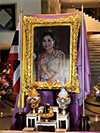
Suthon (สุธน)
See
Phra Suthon.
回
sutra (सूत्र)
Sanskrit. ‘Thread’, ‘string’, ‘formula’ or
‘discourse’. The teachings or tracts of the
Buddha
that form the second part of the Buddhist
Tripitaka,
and which contains a
nikaya, i.e.
a ‘collection’ of five discourses, i.e. the deegha or ‘long’
discourses; the majjhima or ‘middle-length’ discourses; the samyutta
or ‘thematically linked’ discourses; the anguttara or ‘gradual
collection’ discourses; and the khuddaka or ‘minor’ discourses. The
term is however also used for some Hindu texts, as in Kamasutra,
i.e. a discourse on
kama
or ‘love’. In Thai, pronounced
sut
and symbolized by a white string known as
sai sin. See also
Buddhist precepts.
回
Sut Saakhon (สุดสาคร)
Thai. Name of a character from the
Phra Aphaimanih
story by
Sunthorn Phu.
He is the son of Prince Phra Aphaimanih with a
mermaid named Nang
Ngeuak
(fig.).
She had met the prince when he and his son
Sin Samut
were held captive
by an ogress in an undersea cave. The mermaid helped them escape,
and the two produced a son of their own. Sut Saakhon was later sent
on a quest to search his father and rides
a
dragon-horse,
that in Thai is called
mah nin mangkon (fig.).
He is depicted on the fifth of a series of eight Thai postage stamps
issued in 2009 to publicize the story of Phra Aphaimanih as
a major literary work
of the
Rattanakosin
Era
(fig.).
Also spelled Sutsakon and Sud Sakhon.
回
_small.jpg)
sutta
Pali
for
sutra.
回
Suttha Thipayarat (สุทธา ทิพยรัตน์)
Thai.
Name of
the
19th child
of
King
Chulalongkorn, and first
daughter with Queen
Sukhumahn Marasih.
She was born on 14 September
1877 and was bestowed with the royal title
Princess of
Rattanakosin.
She is the
elder full sister of Prince
Boriphat Sukhumphan (fig.).
回
suvarna
(सुवर्ण)
Sanskrit-Pali word meaning ‘gold’ or
‘golden’. The Thai word
Suwan
derives from it.
回
Suvarnabhumi (सुवर्णभूमि)
Sanskrit-Pali. ‘Land of gold’. In ancient
literature it refers to a territory in Southeast Asia, probably
Thailand. The name likely refers to the many paddies, e.g.
Lan Na
that when ready for harvest turn yellowish gold. See also the Thai
term
Suwannaphum.
回
Suvarnavabhasa (सुवर्णवभासा)
Sanskrit. ‘Golden One’. Name of a golden
peacock (mayura)
king, who lived near the
Himalayas and who used to recite the
Mahamayuri
dharani daily with great devotion. One day the
peacock king travelled with his family to the mountains, forgetting to recite
the dharani. He was caught by hunters and thinking of his forgetfulness of the
dharani he immediately began to recite it and was able to free himself. The
Buddha told
Ananda that the peacock king was none
other than the Buddha himself. Consequently, the dharani became known as the
Golden Peacock Charm and is believed to be efficient in all cases of dangers, on
top of a protection from
snake bites.
回
%203_small.jpg)
Suwaan (สุวาลย์)
Thai. Name of one of the two scribes of
Phra Yom
(fig.),
the god who presides over the dead. He is depicted with a pen and
book in which he records the bad deeds of mankind (fig.),
whereas his counterpart
Suwan
keeps record of the good deeds. Compare with the Vedic scribe
Citragupta.
In Chinese mythology, there are four scribes, i.e. one who
keeps record of the good deeds of humankind, one who records their
bad deeds, and each of them with a personal controller, who checks
that not mistakes are made. They are collectively referred to as the
Magistrates of the Netherworld
(fig.).
回
Suwan (สุวรรณ)
1. Thai word meaning ‘gold’ or ‘golden’. In
compound names and words, it is usually pronounced suwanna, as in
Suwannaphum,
Suwanna
Chedi
(fig.),
and
Nang Suwanna Malih (fig.).
Compare with Sawan (สวรรค์), i.e.
‘Heaven’.
回
2. Thai. Name of one of the two scribes of
Phra Yom
(fig.),
the god who presides over the dead. He is depicted with a pen and
book in which he records the good deeds of mankind (fig.),
whereas his counterpart
Suwaan
keeps record of the bad deeds. Compare with the Vedic scribe
Citragupta.
In Chinese mythology, there are four scribes, i.e. one who
keeps record of the good deeds of humankind, one who records their
bad deeds, and each of them with a personal controller, who checks
that not mistakes are made. They are collectively referred to as the
Magistrates of the Netherworld
(fig.).
回
Suwannaa (สุวรรณา)
Thai. Name for a species of
water lily,
with the botanical name Nymphaea suwanna and commonly as the Suwanna
Water Lily. This free-blooming hardy water lily originates from
Thailand and blooms all year round. It is a hybrid of the the Khao
Thammanune and the Blue Capense. This kind of water lily has petals
with two alternating colours and it is depicted on a Thai postage
stamp issued in 2008 (fig.).
回
suwannaphreuk
(สุวรรณพฤกษ์)
1. Thai. ‘Golden flora’.
Nickname for a kind of cassia tree with the scientific Latin name Senna
spectabilis or Cassia spectabilis, commonly known as
Golden Wonder Tree. It is officially known by the Thai name khi
lehk american and the botanical name Cassia floribunda and refers to a tree of
which the young leaves and flowers are used to make a curry called
kaeng khi lehk. It has
yellow, upward growing flowers and is sometimes confused with the
rachaphreuk,
another cassia tree with similar, yet drooping flowers (fig.).
Its fruit consist of long, flattened pods. Confusingly,
the name suwannaphreuk is in Thai literature also used for
the cordia dentata (see below). In addition, it is sometimes also commonly
referred to as
Golden
Shower Tree, a name also used
for and better befitting the Cassia fistula,
since it has drooping flowers.
回
%20khi%20lehk%20american%20(ขี้เหล็กอเมริกัน)%20senna%20or%20cassia%20spectabilis_small.jpg)
2. Thai. ‘Golden
flora’. Name for a small flowering and
ornamental tree or shrub with edible fruit. It has pendant
clusters of crinkly, papery, pale yellow flowers and
sand-paper-like leaves. It is commonly known
as yellow cordia and its scientific Latin name is Cordia dentata. It belongs
to the family Boraginaceae.
However, the name suwannaphreuk is in Thailand also used for the
Cassia floribunda and the senna or cassia spectabilis (see above).
回
Suwannaphum (สุวรรณภูมิ)
1. Thai. ‘Golden land’. The name of a land
mentioned in many ancient sources, such as the
Mahavamsa and some stories of the
Jataka. The name refers to the
Indochina peninsula, practically equal to Southeast Asia, though it
is nowadays claimed by many of the member states as if it refers
exclusively to their particular nation. See also
Suvarnabhumi.
回
2. Thai. Name of a district (amphur)
in the province
Roi Et.
回
3. Thai. Name of Thailand's largest airport
(fig.), that officially opened for all domestic and international commercial flights on
28 September 2006 (fig.).
It is located in the
amphur
Bang Phli of
Samut Prakan
province (map),
about 25 km East of
Bangkok. The main
departure hall features a large statue (fig.)
of a Thai-style interpretation
of
the
Churning of the Ocean of Milk
(fig.),
and lining the main road from and into the airport are bronze statues of
Kinnaris,
i.e. mythical half-bird half-woman
creatures, in a
phranommeua
gesture (fig.),
i.e. making a respectful
wai
(fig.),
the traditional Thai greeting
with the hands
brought together
in
front of the chest,
in order to welcome and bid farewell all travelers arriving and leaving from
Thailand's prime airport (fig.).
On 28 September 2024, exactly 18 years to the day after Suvarnabhumi Airport
opened in 2006, the airport unveiled its new Secondary Terminal Building 1
(SAT-1), increasing its annual passenger capacity from 45 to 60 million.
Spanning 251,400 square meters, the terminal connected to the Main Terminal via
a 1-kilometer underground tunnel with an Automated People Mover (APM). SAT-1
featured areas for arrivals, departures, lounges, and retail spaces,
incorporating energy-efficient systems and Thai-inspired design.
The centerpiece of the SAT-1 Hall is the
striking
Himaphan
Elephants (fig.),
a metal strip sculpture crafted from layers of loosely woven strips of metal.
This work seamlessly blends cultural heritage with contemporary design, creating
a unique fusion of tradition and modern artistry.
See MAP,
POSTAGE STAMPS (1),
(2)
and
(3),
PANORAMA PICTURE,
and
TRAVEL PICTURES (1),
(2),
(3),
(4),
(5) and
(6).
回
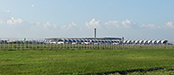
Suwannasahm (สุวรรณสาม)
Pali-Thai. Name of one of the ten
jataka,
i.e. life stories of the previous incarnations of
the
Buddha.
READ
ON.
回
Suwanphingkhaan (สุวรรณภิงคาร)
Pali-Thai. ‘Golden pot’. Name for a
type of royal food accessory. It is a compound of the words Suwan meaning ‘gold’
and phingkhaan meaning ‘pot’, and is a kind of water pot, pitcher, flask or jar,
used to supply cold water to the King. Some sources claim that it is used for
pouring water ritually, in order to declare the abolishment of someone's rights,
as at the time when King
Naresuan
(fig.)
poured water from the Suwanphingkhaan onto the ground, as a declaration of
Ayutthaya's
independence from
Hongsawadih.
Sometimes transliterated Suwanbingkarn.
See also
Treasure Vase,
kundika,
kalasa,
and
puranakata.
See also THEMATIC STREET LIGHT.
回
Suwaphan Sanithawong (สุวพรรณ สนิทวงศ์)
Thai.
Name of a
Momratchawong,
who was the eldest son of
Saai Sanithawong.
READ ON.
回
swa (စွာ)
Burmese. ‘To be impudent’ or ‘to be
aggressive’. Sometimes transliterated hcwar.
See also
Suphankanlaya.
回
swallow's nest
Bird's nest made from the saliva of a
certain species of swallow, known as cave swift.
READ ON.
回
Swan
Goose
Common name for a rare species of goose, with the
scientific designation Anser cygnoides. It is found in
China
and Mongolia, and may sometimes winter in
Laos
and
Thailand,
as well as in northern
Vietnam (fig.).
It has greyish-brown upperparts and is white to pale buff below, with a whitish
throat and neck-sides, whilst the back of its long neck is seal brown. Its legs
and feet are orange, whilst its bill is black, with a thin white stripe that
surrounds the bill base, and a basal knob on the upper side of the bill in
males. There is also a domesticated breed, which is generally referred to as
Chinese Goose. The latter is somewhat larger, its males have a more prominent
basal knob, and the breed also has a white variety with a completely orange bill
(fig.).
With the brown variety of the Chinese Goose, the black bill sometimes has an
orange wash towards the base and on the basal knob.
回
%201_small.jpg)
swastika (स्वस्तिक)
Sanskrit. ‘Well-being’. A hooked cross, in
either clockwise or counterclockwise direction. As a religious
symbol it occurs in
Buddhism
and
Hinduism, and
even more frequently in
Jainism,
where it represents the
Tirthankara
Suparsva, the seventh
jina. In Buddhism
it is interpreted as a symbol of the
dhammachakka,
the Wheel of Law, and stands for universal harmony and the balance
of opposites. In Buddhism, especially
Mahayana Buddhism (fig.),
it often appears on the chest or soles, and sometimes in the palm of
the hand, of certain
Buddha images,
especially those from China or in Chinese style (fig.).
In Hinduism, when in clockwise direction, it represents the cosmic
dance around a fixed centre, i.e. the evolution of the universe and
as such guards against evil, but in counterclockwise direction, it
represents the involution thereof and is thus considered evil. It is
also seen as a symbol of the four points of the compass and of the
sun, thus signifying stability and representing the sun god
Surya. The
sign is considered auspicious by all Hindus and is therefore often
found as a decorative symbol or as a mark to convey good luck (fig.).
The word swastika first appeared in the
epic
of the
Ramayana
and the
Mahabharata. In
Chinese, it is known by the name wan, which means ‘all’ or
‘eternality’. Also transcribed svastika.
回
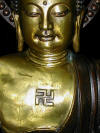
sweet chili sauce
Name of a savory
sauce typically used as a dip sauce for
spring rolls,
dumplings, etc.
READ ON.
回
Swing Kings
Name of a Thai jazz big band, formed in 2014 by
Chulalongkorn
University (fig.)
musicians, known for their 10-member ensemble, powerful brass and vocal-driven
performances, and innovative blending of pop, rock, disco, and jazz. They are a
vibrant presence in Bangkok’s live music scene—especially at
Saxophone Pub—and
have gained recognition in broader jazz circles through festival appearances and
high-profile venue performances.
WATCH VIDEO (1)
and
(2).
回

swordfish
See
pla bai.
回