|
Early History
Originally the
Tai were an
animist
people
in
Southwest
China, though
not ethnically
Chinese,
and from the
9th century began to migrate southward, little by little,
into parts of
Southeast Asia and the fertile
Chao Phraya
valley.
They settled
down in an area that today is
Burma,
Laos
and
Thailand,
and here they
came into contact with other civilizations such as the
Mon,
Khmer
and
Lawa.
From the 7th to 14th century AD the Khmer established a mighty Kingdom based in
Angkor, from where they expanded and would eventually rule over practically the whole of Indochina. They were already present in Thailand's most important basin during the
Dvaravati
period, where they mixed with the local Mon population. Whilst their
conquests throughout the 7th to 11th centuries brought
cultural influences in art, language and religion, their political
dominance eventually overthrew the
Dvaravati culture. They made
Lopburi
their central outpost and it soon became a religious centre.
Throughout the region different
small Kingdoms were founded but remained subject to the overwhelming power
of the Khmer.
In
1238
the first independent Thai Kingdom of
Sukhothai
(dawn
of happiness)
was established in the northern part of the region, taken from the
Khmer by the war lord
Sri Intaratitya.
In
1281
the more northerly
Haripunchai
was conquered, this time from the Mon by the armies of King
Mengrai (fig.).
It was made part of the northern realm of
Lan Na
(a
million
paddies),
a Kingdom that flourished between the 13th and 14th century AD, with
Chiang Mai as its
centre. King Mengrai consolidated the power of the northern regions by
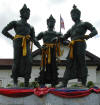
making a pact (fig.) with two other rulers
(fig.),
King
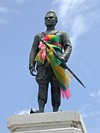
Ramkhamhaeng
(fig.)
of Sukhothai and King
Ngam Meuang
(fig.) of
Phayao. In
the
13th century Lopburi was wrested from the Khmer by
the increasing power of Sukhothai to the North.
Thus,
several city states grew and the Thais gradually became leaders of
multiracial
districts
and vassal states. Their subjects were made tributary, worked in
commission for the state, and had to fight in the wars of its Kings. In
return they were given use of land, dispensation of justice, and the
advantages of a community larger than the usual family or village.
Sukhothai
developed amongst several
rival
Thai Kingdoms into the most
important power centre in the North. During the reign of King
Ramkhamhaeng (1279-1298)
absolute monarchy
commenced,
Theravada
Buddhism
introduced
by
Indian
monks and
missionaries
from
Sri Lanka was adopted as the
official religion,
and
the
first
Thai script was created by the King
based on
Khmer script.
Sukhothai
is
still regarded as
Thailand's
first real Kingdom and capital, and the cradle of its civilisation. It would
preserve this regional power
status for
almost a century until the city of
Ayutthaya,
founded
in 1350
by prince
Ramathibodi
on
an
island
in the
Chao Phraya
river
as
the
capital of a new southern Thai
state, gained
supremacy.
After several
incidental
conflicts
the Kingdom of
Sukhothai was
eventually
overshadowed
by
this
mighty rival from
the south, which would soon make Sukhothai its vassal
and finally
place it under
direct rule.
Ayutthaya
also knew a period of foreign rule under the Khmer and Burmese. Only
King
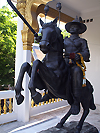
Naresuan
(fig.)
would bring temporary relief from this. Burma had conquered Ayutthaya in 1569
and had made it into a vassal state, placing a Thai vassal King on the throne.
Born in 1555, as
son to this King Maha Thammaracha and his principal wife, a daughter of
King Chakkraphat, Naresuan was as a child taken into captivity to Burma
to ensure loyalty from his father. In 1571 the Burmese King Bayinnaung allowed
him to go home in exchange for his sister. In spite of the young age of 16 his
father immediately sent him to the northern province
Phitsanulok to rule the
region. At the same time he was appointed successor to the throne of Ayutthaya (fig.).
He finally became King in 1590 when his father died, and in 1593 he liberated Ayutthaya from the
Burmese yoke when he defeated Minchit Sra, the
Peguan-Burmese
crown prince, in a duel on elephant
back (fig.), fought in Nong Sarai near
Suphanburi.
%201_small.jpg)
During the Ayutthaya
period
Buddhism
was intertwined with countless
aspects
of
animism
and
Brahmanism,
partly due to
the influence of the remaining Khmer
culture,
and thus
became to date a mishmash
of different
gods
and spirits.
The
Thai monarchs
became
absolute
rulers
and
started
to present
themselves as the
incarnation
of
a divine being,
following the
Indian-Brahmin
example.
This made the
‘god King’, in contrast
to the Kings of the Sukhothai
period,
a
distant, inaccessible being
who wielded
unrestricted rule over his people. As
Chao Chiwit (Lord
of Life)
the sovereign
could
accordingly
decide over
the life
and
death
of his
subjects.
Initial
contacts with Europe
were
made in
the beginning
of
the 16th
century
with Portugal
and later
with England
and France.
Although
the
population
continued to
call themselves Thai, the
country started to become known
by the name
Siam,
which is derived
from
Sanskrit
and means
‘dark’,
a
name given by
the Khmer
on the grounds
of the dark complexion of
the Thai.
It
remained
the official name
of the country until 1939.
After
the Burmese
conquered
Ayutthaya
in
1767 following a two year siege and battle in which they destroyed the
city completely, General
Taksin
founded a new
capital in Thonburi,
then
a
vast
swampy
delta
with
the
nickname
‘sea
of
mud’.
Fled to
Chanthaburi in the Southeast
he raised an
army and within the same year
Taksin
was able to recapture a large part of
Central Siam.
The Burmese
were
dispelled,
reconstruction
started, and
the general crowned himself
King.
The King
of
Chiang Mai
managed to
dispel the
Burmese
from
the
largest
part
of
North
Thailand
with the support of the
Siamese, and
the
northern
city states finally
became vassals
of Siam,
that now began
to
consolidate
its power.
The
control
of
the
country
was recovered
and several northern states were merged and added to
Central Siam.
In
1772 King
Taksin
appointed
General Yotfa
commander-in-chief of the
Siamese
army
and after the
latter conquered the
Laotian
town
of
Vientiane,
he
brought
the
Emerald Buddha
back
to
Thonburi
where
it
was temporary
placed in
Wat Arun.
After
King
Taksin
showed signs
of megalomania
he was
expelled from office
in 1782,
by order of
General
Chakri
after a
smouldering struggle for
power, and executed by the then prevailing
protocol:
beaten to death under a red satin cloth with a sandalwood club. Afterwards
Chao Phraya
Chakri
took office as Yotfa,
the first
King
of the
Chakri
dynasty
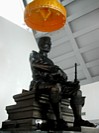
(fig.),
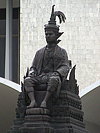
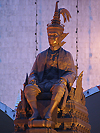
later
named
Rama I
(fig.).
回
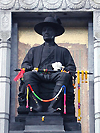
Chakri Dynasty
General
Chao Phraya
Chakri
took office as Yotfa,
the first
King
of the
Chakri
dynasty
(fig.),
later
named
Rama I
(fig.),
and
made the
Garuda
the
national emblem
of the
monarchy. As
the
mythological
mount
of
the Indian god
Vishnu, the
protector
and
second
god
in
Hindu theology
of which
Rama
is an incarnation,
it
reflects the
position of the Thai monarch as the protector of the nation.
In 1809 King Chakri's son ascended the
throne and ruled until
1824. He was
succeeded by
Phra Nang Klao, the
third
King
of
the Chakri
dynasty (fig.)
who introduced the use of crown titles for the
Kings of the Chakri
dynasty, taking the crown title of
Rama III for himself, whilst bestowing the titles
Rama I and
Rama II
posthumously upon his predecessors.
The
titles Rama
and Chakri,
derived from an incarnation
of the
Hindu god
Vishnu,
indicates
that the idea
of divine descent
continued to exist
to a certain extent.
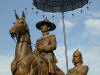
With the
rule
of Rama I
both the Chakri
dynasty and
the
Bangkok period
began.
The
capital
was moved from Thonburi
to
the
eastern
bank of the Chao Phraya
river,
where it was better
secured against possible attacks from Burma. The Chakri
dynasty still
continues to the present day with
King
Bhumipon Adunyadet
reigning
since 1946 as
Rama IX.
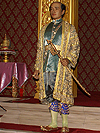
King
Mongkut (fig.),
half
brother
of Rama
III, called
Phra Chom Klao by the Thai,
lived 27
years as
a Buddhist
monk before
ascending the throne
in 1851 as
Rama IV
(fig.).
During his priesthood
he studied
Sanskrit,
Pali, Latin
and
English, history
and
several
western
sciences, including
astronomy.
Interested by
western
ideas he
modernised
his realm and established
diplomatic
relations with the then Superpowers.
To avoid colonisation
commercial treaties were signed, though always with very favourable
conditions for
the West.
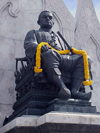
By presenting himself as a friend rather
than a foe
and approaching the
Superpowers with gifts instead of weapons
King
Mongkut succeeded in averting an imminent colonisation, at least
temporarily. Due to the establishment of several allies none of the
Superpowers dared to attack or invade Siam for fear of a conflict with
each other.
The monarchy
became once again more humane.
The
law forbidding
subjects to look into the face of the
King
was done away
with as well as
the system
of
forced labour
for the state.
In 1868 Mongkut
died of
malaria.
He had 82
children and 35 wives.
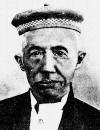
His eldest son
Chulachomklao,
in the West
known as
Chulalongkorn,
continued the
policies
of his father.
Educated by
European
private
teachers he
continued with
reforms after the western
model.
Public schools
were
established
and
modernisation
implemented,
including the
construction
of a railway
network.
Under his rule
slavery was abolished and
a modern judicial
and prison system was established.
In this
the
King
was assisted
by his General
Advisor
Gustave Rolin-Jaequemyns (fig.),
a
Belgian diplomat
whose
merit
in 1898
availed him
the title of
Chao
Phraya
Aphai
Raja, the
highest
noble title
ever given to a
foreign national.
The custom of
granting noble ranks
to ordinary citizens
was abolished after the rule of
Chulalongkorn's
successor
Rama VI.
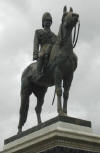
During
the expansionist
aims of
the
colonial Superpowers,
Chulalongkorn
was compelled
under pressure of a possible
military
intervention
to make more
concessions
and give up
substantial
parts of
Siamese
territory:
the
East of
the
Mae Khong was ceded to
imperial
France,
whilst
in the
South
the British
laid claim to parts of the
vassal
states
around
Penang.
That
Siam
was never colonised is owed to
the
reserved
diplomacy
of
Siam
and
the
fact
that
the British
and
French wanted
to
avoid conflict.
Siam was a neutral
buffer
state
between their colonies
in
Burma
and
Indochina.
The
colonial
threat
necessitated
Rama V
precisely demarcating
the
borders of his realm,
forcing him to
centralise
administrative power and incorporate the still remaining
smaller
vassal
states into
Siamese territory.
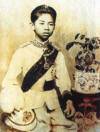
With
crown
prince
Wajirunhit's (fig.)
untimely death
in
1895
at the age of seventeen, his half-brother
prince
Wachirawut, eldest son of
queen Saowapha, was appointed
as the
new successor to the throne by
King Chulalongkorn,
at the age of thirteen. After
the
death
of
Rama V,
who left of 77 children
(fig.), he ascended the throne
in 1910 (fig.).
As
Rama VI he implemented even more reforms, especially in the field of
education and administration.
Educated in
the
West
he
introduced
the use of surnames
for his subjects and encouraged them to adopt more western ways, such as
western clothing and hair
style.
He
stimulated patriotism and promoted
nationalism on
a large scale.
In 1917
he changed the
Siamese
flag
(a
white elephant on a
red field)
by
the
present
red-white-blue-white-red,
horizontal
striped
banner,
colours
symbolising
the nation
(red),
the monarchy
(blue)
and
religion
(white).
His
regime was
rather
extravagant and when he died in
1925 the
treasury was empty.
During
the
rule
of his successor
Prajadhipok absolute
monarchy
came to an end.
Because of the enormous breach
his predecessor had made in the
treasury
the economy
was stagnant.
This in
combination
with the existence of an
oligarchic
system that
excluded even the most
brilliant
civilians from higher posts eventually led to a coup d'état
in 1932.
A group
of
anti monarchist
soldiers supporting
the Western
educated intellectual
Pridi Phanomyong
(fig.),
seized power
and
introduced
a constitutional monarchy. At
this time
Rama VII was
diligently working on a new constitution that might have worked
better than the so-called
democratic
system that
was imposed by the leaders of the conspiracy.
But
in spite of this
Rama VII
on
10 December
1932
signed the constitution that would bring an end to more than seven hundred years
of
absolute monarchy.
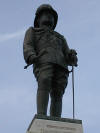
Before
his execution King Taksin cursed General Chakri saying that his power would come to an end if Thonburi, the
ancient capital under Taksin,
would ever be connected with Rattanakosin, the part of town where King Chakri
established his government. In 1932 a
Memorial Bridge
was built to celebrate the 150
year anniversary of the Chakri
dynasty, connecting both places. When in the same year
absolute monarchy came to an
end, many saw this as a fulfillment of
the Taksin curse.
回
Modern History
With the
induction of
the first
Thai Constitution
(fig.)
in
1932,
democracy
existed in
principal
though there were
still frequent coup
d'états, in which
Thailand
was
sometimes ruled for lengthy periods by
military
leaders
and even
dictators.
One
coup followed
the other and
in 1935 a
disappointed
King
Prajadhipok
eventually
abdicated.
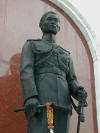
King
Ananda,
son of the
brother
of the
childless
King Prajadhipok,
succeeded
the abdicating
Rama VII.
He
was
however just
ten years old and still at school in
Switzerland,
and it
was not until after WW II that he would return to
Siam
as
Rama VIII.
In
1946
some
months after
his return
the
young
King
was found shot
dead in his
bed,
a
mystery
that
was never
officially
resolved.
He
was
succeeded
by his younger
brother,
the
present
King
Bhumipon Adunyadet,
who wasn't
formally crowned King until after his marriage with
Sirikit Kitthiyagon,
on
5
May
1950.
He became Thailand's longest reigning King.
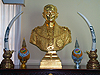
During the interregnum the
Kingdom was ruled by
a governmental council but also lived in the grip of
military
despots
such as
Phibun Songkram (fig.),
who found his
inspiration
from leaders like
Mussolini
and
Hitler. He became
leader of the government on the brink of WW II, after
a power
struggle with
Dr.
Pridi Phanomyong.
Whilst Field Marshal Phibun
ruled
the
people
with an iron
fist,
in 1939
he changed the name of
Siam into
Prathet Thai
or
Thailand
(Land
of the Free), then
a
contradiction in terms.
In
1944
he was forced to
step down having sided with Japan during WW II.
For a short while it
seemed a
democratic
civil
regime
would be installed,
but
due to the confusion
that arose after the
mysterious death of
Rama VIII, the military
once again seized power in the 1947 coup d'état,
staged by Phibun Songkram and aimed at his
political
comeback. The coup
was led by
ambitious army officers, that included
the likes of the corrupt and brutal
Phao Sri Yanon (เผ่า ศรียานนท์).
In
1948, the disgraced
Phibun
was restored with
the help of Phao
Sri Yanon, who soon after
became Police General
and
staged a show trial in which three scapegoat
members of the palace staff were found guilty of negligence in the death
of King Ananda and were evetually executed.
By now
Phibun's
support had
faded and
already
back
in
May 1950
attempts for a coup
were made,
on
the
quaysides
along
Phra Rachawang
(fig.),
the
royal
palace.
The premier
was taken
hostage and abducted to a warship
that lay at
anchor
on
the
Chao
Phraya.
After being
released by his captors
he swam ashore
and the ship was
bombed by
the air force.
In 1955,
the premier together with Phao started a new political party, named Seri
Manang Khasilah (เสรีมนังคศิลา) and housed in
Ban Manang Khasilah (fig.).
Phao established
the
Atsawin Waen Phet,
a secretive
organization
that resorted to extrajudicial killing,
assassination and murder, in order to elliminate political opponents.
Hence convinced of a landslide victory, Phibun in 1957 organized
elections, but lost to the opposition. Hence, Phao rigged the Bangkok
election to give Phibun a substantial lead over his chief opponent, but
soon after Phibun
was ousted by yet
another
coup
and
Phao Sri Yanon fled the country.
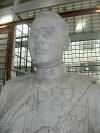
In
1957, General Sarit
became
the
new leader.
This
charismatic
dictator
carried out
many
reforms
and
consolidated
central government. In
1963
he died from a
liver disorder.
Senior
military
officers Thanom, Praphat
and Narong
took
power and installed another
dictatorial
regime that would last for ten years.
The infrastructure
of the country developed but unemployment in the countryside took on dramatic proportions,
causing many to
migrate to the capital. In 1973, student
demonstrations
against
the military
regime
resulted in carnage with many students killed (fig.). King
Bhumipon
intervened
in empathy with the rebellious
population, opening
the gates of the
Chitralada
Palace to fleeing protesters and
calling for calm in a televised speach.
The
King held an
audience with student leaders and a
democratic
coalition
government
was
installed with
Sanya Dharmasakti,
the rector of the
Thammasat
University, as the new
Prime Minister,
appointed by the King.
Thanom
and
Praphat both
fled the
country.
The
following three
years became a
period
of reformation, called
the Democratic
Experiment,
Unions
and
political
parties
were
formed,
and corruption
was
openly
denounced.
Then in
October
1976 Thanom
and
Praphat returned and again there were extensive demonstrations.
Forty-six students at Thammasat University
were killed and two hundred injured in a massacre by rightwing
factions,
such as the
Khabuankaan
Krathing Daeng,
who forced their way onto
campus
angered over a
puppet
hung up by
students
which resembled crown prince Wachiralongkorn.
Martial law was declared and a
military
junta
took over.
Thousands of
students
fled the capital
after
6 October
1976
and joined the
subversive CPT, the Communist Party
of
Thailand,
in the jungle.
Another two coups followed and
later,
under the
rule
of
General
Kriangsak Chomanan, more room was
created for
democracy. In 1980
he was forced
to step down and was succeeded by
Prem Tinasulanonda,
the supreme
commander of the army.
Under
his
rule
the
domestic
communist
threat
was ended and
the economy
experienced
strong growth.
In
1988 the
helm was
taken over by
Chatichai Choonhavan, the
first
democratically
elected
premier. The economy
kept growing,
but the
influence of the
military
in political
affairs
declined, resulting in another
coup in
February
1991,
this time
under leadership of
General Suchinda Kraprayoon. The military
installed
a
government
with
Ananda Panyarachun as
the new
premier.
On
22
March 1992
new elections
saw a
victory for
the pro-army
parties
and Narong Wongwan
became the
new premier.
But amidst
accusations
of
Narong's
involvement in
the Thai drug
trade
the military
used its constitutional
prerogative
to replace
him.
On
May
fifth
the popular
opposition
leader
Major General
Chamlong Srimuang
of
the Palang Dharma Party
began
a
hunger
strike
in
protest
against
General Suchinda Kraprayoon,
who
in spite of
all
promises
to the contrary became
premier
in
April.
Although
Chamlong
stopped his
action
a few days
later, protest
against
Suchinda
continued.
When
a massive crowd of protesters
marched
towards government buildings the army intervened and
opened
fire on the
crowd.
About
fifty
people lost
their lives and hundreds of
opposition
leaders,
including
Chamlong,
were arrested.
A
day later
protesters
clashed again with the army when it fired on an estimated
35,000
or so
demonstrators.
About two
thousand protesters entrenched themselves
in the Hotel Royal
and
were brutally removed and arrested.
%201_small.jpg)
Breakthrough finally came following the intervention of
King
Bhumipon. All
protesters,
including
Chamlong,
were released and
Suchinda and
Chamlong were
received together by
the
King, who
charged
them to find a
solution to this
political
crisis. General Suchinda
was
reprimanded for he had failed
to find a peaceful
solution to a
political
problem.
After
King Bhumipon
promised
amnesty
to all parties
involved,
Suchinda
resigned
as
premier on
May
24 and on
June
10 the King
appointed
Ananda Panyarachun
again
to premier,
this time
ad interim.
Four months
later, on
13 September,
new
parliamentary
elections took place this time with great gain for
the anti-military
parties, who
secured
185 of
the 360 seats
in total,
enough to form a government, and
Chuan Leekpai, leader of the Democrat Party, became Prime Minister at the head
of a five-party coalition.
On 20 May 1995, Chamlong Srimuang, the
deputy Prime Minister and head of the Palang Dharma Party, announced his party's
withdrawal from the coalition, amid a land-reform scandal implicating a Democrat
MP. Following the defection of this coalition partner, Chuan Leekpai was forced
to dissolve Parliament. In the subsequent election, which was were marred by
allegations of vote-buying, the Chart Thai Party won the largest number of
parliamentary seats, and on 13 July 1995, its party leader Banharn Silpa-archa,
commonly known as Little Big Man, became the 29th Prime Minister and named
Palang Dharma Party MP Thaksin Shinawat deputy Prime Minister in the new
government, after Thaksin reduced his stake in his monopolistic
telecommunications company when he made a profit of around a billion baht less
than two months earlier, a move that enabled him to pursue a political career,
as the Constitution forbids MPs and cabinet members to have contracts of a
monopolistic nature with the State.
Little Big Man, also nicknamed Mr. ATM for
allegedly dispensing dirty money under the table, was involved in numerous
corruption scandals, one of which weakened the harmony in his administration.
Threatened with defections from his coalition government, he was forced to
resign, after only little more than a year in office. His short-lived, yet
highly incompetent administration, is believed to have paved the way for the
economic crisis that started that very next year. New elections were held amidst
allegations of vote-buying and electoral fraud, and on 11 November 1996,
long-time political operator General Chavalit Youngchaiyudh, emerged as the
victor from hotly contested elections, which were rated the dirtiest and most
violent since 1976, and in which five people were killed.
The onset of the 1997 Asian financial
crisis caused a loss of confidence in the Chavalit government, after it devalued
the Thai baht, which was then pegged to the U.S. dollar. The nation's currency
swiftly weakened and lost more than half of its value, causing the Thai stock
market to drop 75% and triggering the worst economic downturn in the nation's
history, in which massive numbers of people were laid off, especially in the
financial sector, real estate and construction. On 8 November 1997 Chavalit
resigned from the post, handing over power to Chuan Leekpai, who formed a new
coalition government, which enacted several economic reforms and held office
throughout the following years, until the beginning of 2001, when it collapsed
just days before its term was scheduled to end.
The necessary, but unpopular austerity
measures taken during the financial crisis by the second Chuan Leekpai
government, helped pave the way for the political comeback of the populist
telecommunications tycoon Thaksin Shinawat, an ambitious MP and former police
officer, foreign minister, and deputy Prime Minister, who on 14 July 1998
founded his own political party Thai Rak Thai (TRT), which soon presented itself as a
new force in Thai politics to be reckoned with. Aimed at the involvement of
young blood politicians and public participation, and a populist platform of
economic growth and development, the popularity of the self-made billionaire and
his party steadily rose, despite allegations of conflict-of-interest during his
former term in office, for which he had been forced to resign.
In his bid to become the next Prime
Minster, the strong contender and rising political star in May 2000 bought a
major stake in the independent television channel iTV, through his company Shin
Corp. This sparked concerns of political interference and fears that Thaksin
would dominate the television station and exploit it for political gain. In
September of the same year, the National Counter-Corruption Commission
investigated allegations that Thaksin concealed his wealth in 1997 while he was deputy
Prime Minister and discovered that he allegedly transferred shares worth
millions of baht to several of his employees, including the housekeeper,
driver, maid, and a guard. Thai law requires any politician taking office to
report all assets they control, anywhere in the world, whether in their name or
not, which is then compared with the politician’s wealth upon vacating office,
to determine if there has been an unusual net increase in wealth during their
term in office. Thaksin narrowly escaped conviction in the Constitutional
Court by 8 to 7, though a decade later, a Supreme Court ruling in another case
accepted a possibility of bribery in the asset concealment case. In December
2000, the increasingly powerful politician was again under investigation, now
for allegedly laundering money through stock market share sales to a foreign
firm in the British Virgin Islands.
In national elections held on 6 January
2001, the Thai Rak Thai party won an overwhelming victory, with 248 seats out of
500, and Thaksin became Prime Minster, forming a coalition government with the
New Aspiration party. The coalition gave Thaksin control of more than 320 seats,
enough to prevent a no-confidence motion against him. The Poll-watch Foundation
reported several cases of alleged poll fraud and vote buying, and disqualified
at least seven candidates, of which five from Thai Rak Thai and one from New
Aspiration.
Promising a new political era, many
reforms were speedily initiated, creating new ministries and introducing a
corporate-style
approach, in which ministers were expected to act like CEOs (Chief Executive
Officers). Thaksin's regime quickly became rather authoritarian, increasingly
focusing on his personality through dominating news coverage
and becoming a media star. On 3 March 2001, a Thai Airways plane bound for
Chiang Mai from Bangkok's Don Meuang Airport, was destroyed by an explosion and
fire that occurred just minutes before Thaksin was to board. Five members of the
cabin crew were aboard and one was killed. Speculations of an assassination
attempt on Thaksin surged, but were
quickly abandoned when no traces of
explosive were found, though investigators were never able to determine the
exact cause for the explosion.
Thaksin's government introduced a range of
partly effective policies to alleviate rural poverty, including debt relief for
farmers still suffering from the financial crisis, and launched the country's
first universal healthcare program, as well as a highly controversial drug
suppression campaign, in which an estimated 3,000 people were killed, often in
alleged extra-juridical executions by police. Focusing on social scourges, the
government declared earlier closing times for entertainment venues such as bars
and nightclubs, whilst generally trying to model Thai society after that of
Singapore, admiring its order, prosperity and cleanliness, but also its state
model.
Thaksin became the country's first
Prime Minister to serve a full four-year term, but by the time of new general
elections on 6 February 2005, he had lost much of his support with the urban
middle class and had come under severe criticism for corruption and abuse of
power. Though his reputation
was tainted, he still had the grassroots support of the rural electorate, and the
poll
resulted in another landslide victory for Thaksin and his Thai Rak Thai party,
claiming 350 constituency and party-list seats in the 500-member parliament,
able to form a single-party government. However, the Election Commission said
there had been widespread vote buying and the leader of the Mahachon Party
claimed that the ruling party had warned voters in the North and Northeast, that
they would not receive development funds if they did not support the party.
Prompted by the alarming
election results, the leaders of the
Mahachon Party and Democratic Party stepped down, paving the way for the young
and charismatic Abhisit
Vejjajiva to assume responsibility as leader of the Democrat
Party. Abhisit is born in Newcastle (England) and
studied in Eton and Oxford, where he gained a bachelor degree in philosophy,
politics and economics, with first class honours, and a master degree in
economics. He entered politics as a candidate for the Democrat Party in the
general elections that followed the 1991 coup, becoming a Bangkok MP.
%202_small.jpg)
Encouraged by his electoral victory and new mandate, Thaksin now became ever more conceited,
especially with the press. Reluctant to accept any comments of his critics, he
deflected questions of reporters and lashed out to anyone who opposed his ideas.
Irritated by his authoritarianism and dismayed
by his manipulation and
overall grip on the press, reporters led by media tycoon Sondhi Limthongkul
started to speak out against Thaksin's autocratic rule and the government's
attempts to muzzle the press. The criticism escalated in law suits from both
sides and thousands, including some prominent public figures who initially
backed Thaksin, now started to join in with this anti-Thaksin pressure group.
The political divisions sharpened and when on 23 January 2006 the
Shinawat family
sold its stake in Shin Corp to Temasek, an
investment company owned by the government of Singapore, for about 73 billion
baht without paying any tax, it enraged his critics and caused a public outcry.
On 4 February, an estimated 50,000 people descended on Royal Plaza, to call for
the resignation of Thaksin. The protest was organized by
media tycoon Sondhi
Limthongkul and teamed up with political activists and other disgruntled groups
to form the PAD, the People's Alliance for Democracy, otherwise known as the Yellow
Shirts, the colour of their shirts and of Monday, the King's birthday, thus
suggesting their support for the Monarchy. In mid-February, Chamlong Srimuang,
leader of the politicized Santi Asoke sect of Buddhism and a former ally of
Thaksin, also turned against him and joined the protests.
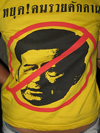
Unwilling to give in to the demands of the demonstrators, caretaker Prim
Minister Thaksin dissolved the House of
Representatives and called for a snap election, hoping to return with a new
mandate from his electorate that would help him crush his opponents. The poll was
boycotted by three opposition parties, that claimed it was rushed and designed
to distract from corruption allegations. Thus, despite of wining the 2 April
election, more than 100,000 people rallied to call upon the King to ignore the
polls and appoint a new, interim leadership, something the King declined to do,
yet on 4 April Thaksin announced that he would step down as Prime Minister and
resign from politics, as soon as parliament had selected a successor.
The following month, on 8 May, the Constitution Court nullified the April 2
elections, in a bid to end the political impasse, ruling that the election was
unconstitutional because it was held too soon after the House of Representatives
was dissolved, and that this would put smaller parties at a disadvantage. This
controversial ruling came after the King had called on the courts to intervene
and execute their duties justly, saying that it was impossible for a democratic
election to have only one party, one man.
On 24 August, there was an assassination attempt on Thaksin, who immediately
fired General Panlop Pinmanee, the deputy chief of Internal Security Operations,
suspecting he was part of an alleged plot to kill him. The General denied any
involvement saying that if he would have been behind it, he would not have
missed.
Mounting street protests and
tensions eventually came to a head in September, when on the evening of the 19th the
military, led by General Sonthi Boonyaratglin, seized power and ousted Thaksin
in a coup d'état and abrogated the Constitution,
only weeks before new elections were scheduled. The move allegedly came after
the Army had learned of a suspected conspiracy to provoke a violent clash to
brutally end the month-long PAD protests, and was launched while Thaksin was in New York for
a meeting at the United Nations. Small mobs of anti-PAD militants in support of, and
allegedly paid by, Thaksin had previously attacked and beaten PAD
protesters, and the atmosphere had become ever more
tense. The staged bloodless coup was purportedly aimed to prevent more violence.
An interim constitution was established, which specified a process for drafting
a new permanent constitution, and a month after the coup, an interim civilian
government was formed. Though Abhisit, the leader of the Democratic Party, had
prior to the events voiced his disapproval of the coup, saying that the party
did not support any kind of extra-constitutional change, now promised the
junta-appointed premier, Surayud Chulanont, his full support as a way forward
for the country, but did ask the coup leaders to quickly return power to the
people.
Though on the surface political calm seemed to return to normal, an organized
underground movement now started to oppose the interim government, resulting in
terrorist activities in which numerous schools in rural areas were burned and
bombs were planted. On New Year's Eve 2006, several bombs went off and grenades
were thrown at pedestrians from flyovers in numerous locations around Bangkok,
killing and injuring a number of people, besides some that had failed to
detonate.
Following allegation of Thaksin's corruption and abuse of
power the draft for the new permanent constitution
was particularly designed to tighten control over corruption and
conflicts-of-interest of politicians, decreasing their power. In
a national referendum called by the military junta on 19 August 2007, the
majority of the voters accepted the new permanent
constitution, after the draft was a month earlier unanimously approved by
the junta-appointed Constitution Drafting Assembly. With the constitutional
changes done, the way was paved for a new general election,
which was finally held on 23 December 2007, sixteen months after the coup.
Meanwhile, the Constitutional Court had in May unanimously
dissolved the populist Thai Rak Thai party, following a punishment according to
the 1997 Constitution, and had banned 111 of its executives from politics for
five years for election fraud. Evidence showed that TRT had hired smaller
parties to field candidates to run in the 2 April 2006, so that it could avoid
the requirement of having to win 20% of eligible votes. Though still enjoying
strong support from their rural electorate,
a proxy party for Thai Rak Thai was formed, called
People Power Party (PPP) and led by former Bangkok governor Samak Sundaravej, a
Thaksin loyalist. In the elections of 23 December
2007, the People Power Party, won the majority of votes and Samak was
elected Prime Minister of the first government under the 2007 constitution.
Yet, with insufficient seats, he was forced to form a
coalition government with five minor parties.
After his victory, Samak openly acknowledged of being Thaksin's
nominee and held daily national state television broadcasts
with his own political messages, which were ill received by his opponents. In
one televised interview with Al Jazeera, Samak set off a firestorm with his
answers about his role in the 1976 massacre of students at the Thammasat
University, when he was interior minister, claiming that only one unfortunate
person was killed i n
the incident
(whereas the
official number is 46 and it is widely believed that the actual number
killed is much higher). In February
2008, Samak offered Thaksin, who since the coup remained in self-imposed exile,
to come back to Thailand and get close control of the People
Power Party, personally guaranteeing his safety.
Encouraged by his allies now in power, Thaksin returned to Thailand on 28
February 2008 to face corruption charges, presuming that the courts would
rule in his favour, as he claimed that all the accusations against him were
politically motivated.
In March, Thaksin appeared before the Supreme Court in one of his two criminal
corruption cases. He pleaded not guilty and was ordered to report back at a
later date. In the meantime he was allowed to leave the country. When in May the
ruling party decided to amend the constitution, aimed at paving the way for
Thaksin's reinstatement and saving the PPP from dissolution after one of its
leading members was charged with electoral fraud, it
fueled its opponents anger even more. Fearing for a political amnesty for
Thaksin, the PAD (Yellow Shirts) movement resumed their street protests in a bid
to block any constitutional amendment and Thaksin's feasible, even behind the
scene, return to power. In August thousands of anti-government protestors
stormed Government House to force out the leadership.
While Samak had in part been successful in controlling the post-coup
institutions, such as the police and civil service, the courts however, had
always remained independent and on 9 September, the Constitutional Court
unanimously disqualified Samak for premiership for violating
Article 267 of the Constitution, when he received financial payments for hosting
a television cooking program whilst in office. He was replaced by Somchai
Wongsawat, the brother-in-law of Thaksin.
With Thaksin's allies still in power, the anti-government protests by the PAD
continued unabated, and with it rose to the pro-government support of the United
Front for Democracy against Dictatorship (UDD), which was formed in 2006 to
oppose the military coup and the military junta, and whose mebers are dressed in
red shirts, the colour that in the national flag represents the nation or the
people. They had stopped their protests after the electoral win of the
PPP, but reorganized to counter the PAD. With both groups now in place clashes
were inevitable and the protest became increasingly more violent. Occasional
grenade attacks occurred aimed at PAD protestors on their rally site and on 7
October, two people were killed and over 300 wounded when police tried to clear
PAD supporters from the are around Government House and Parliament.
Although having allowed Thaksin to travel abroad while on
bail and whilst his corruption case was already set for trial,
the Supreme Court on 21 October sentenced Thaksin in
absentia to two years in prison, for abuse of power in a land purchase case. Now
officially a convicted criminal who jumped bail, an international arrest warrant
against Thaksin was issued. He allegedly applied for political asylum in
Britain, but when the Thai chief prosecutor called on Britain to extradite him,
he was blacklisted in many European countries and declared persona non grata. He
left Britain and started to move about from country to country in his private
jet.
On 28 November 2008, anti-government protestors of the PAD seeking the
resignation of Prime Minster Somchai Wongsawat, shut
down
Suwannaphum
International
Airport, bringing all air travel to a standstill. The PAD, whose members consist
of mostly urban middleclass, also sought to change the governing and electoral
process that had empowered the rural masses, whom some see as poorly educated.
On 2 December, the Constitutional Court disbanded the
People
Power Party after finding it guilty of fraud in the 2007 elections,
disqualifying PM Somchai Wongsawat from office. Following the verdict, PAD
leaders ordered their supporters to leave the airport. The ruling set the
stage for the Democtaric Party leader Abhisit
Vejjajiva
to become Prime Minister, not in the least because of the
support of several MPs of the dissolved PPP party, who formed new
parties, including Newin Chidchob, the former right-hand man
of Thaksin.
Abhisit took office on 17 December 2008, but with the Democratic Party now in
power, opposition to the government also changed camps, with Thaksin's loyalists
vowing to oppose the administration and demanding the resignation of the newly
sworn in premier, claiming that he was not elected by the
people and did not have a valid mandate. Ex-party members of the PPP also
regrouped to form the Pheua Thai Party and PPP leader Samak Sundaravej
would less than a year later die of liver cancer.
Thaksin, who continued to travel internationally, despite a
warrant for his arrest and extradition efforts, also persisted in stirring up
the situation with a series of video satellite addresses to swelling crowds of
UDD protestors, in which he called for them to continue the fight and the
overthrow of the government. On 11 April
2009, thousands of UDD protestors besieged the
ASEAN
summit held at the Royal Cliff Resort in
Pattaya,
causing it to be abandoned and world leaders to be airlifted to safety, whilst
police stood largely idle by. The following day the Red Shirt protestors
descended on Bangkok, where mobs blocked the entrances of the Criminal
Court, demanding the release of their leaders who were arrested during the
Pattaya protest. The protest became fiercer
and protestors clashed violently with armed troops and riot police, causing
havoc and setting public busses alight whilst steering them into the front lines
of government troops, as makeshift projectile fire bombs, whilst also
threatening to blow up liquid gas trucks that they stole and parked on strategic
places in the middle of Bangkok
roads and bridges. The Red Shirts
also clashed with local citizens as they attempted to storm their living area,
leaving two people living in the area killed. Supporting
protests were held in other provinces, and imitating the strategies of the
Yellow Shirts, major roads and railway lines were blocked. On 14 April,
thousands of soldiers moved through the areas of the Bangkok were the Red Shirts
had gathered, shooting paper bullets into the air to disperse the crowds. Rally
leaders told everyone to return home and the protests ended with relatively
little bloodshed, though two people had died by the hands of Red Shirts and more
than a hundred were injured in the clashes. Some protest leaders were arrested,
but most were later released on bail.
Three days later, on 17 April, Sondhi
Limthongkul, a PAD leader of the Yellow Shirts, was ambushed by gunmen, who riddled his car
with 84 bullets from AK47 and M16 automatic riffles, injuring him, a close aid,
and his driver. Doctors removed shrapnel from his temple and he was released
from hospital a week later.
In the wake of the
Songkraan
protests,
the government revoked Thaksin's passport for instigating
the violence and his alleged role as bankroller for the UDD. On 26 February
2010, the Supreme Court seized 46 billion baht of his frozen assets, after
finding him guilty of abnormal wealth. The next day, tensions were raised again
as M67 grenades were thrown at three branches of the Bangkok Bank.
In part angered by the seizure of Thaksin's funds, UDD protesters in early March
converged on Bangkok to press demands for Abhisit to call new elections. The
protesters occupied parts of Bangkok, vowing to stay until their demands were
met. In a show of their willingness to shed their own blood, the Red Shirts
collected human blood from amongst their peer and poured it on the fence and
entrance gate of the Prime Minister's private home.
The situation escalated further on 10 April 2010, when
protesters took control of a TV broadcasting station and kidnapped the station's
director. When the military tried to break up the protesters' rally site near
the Phan Fah Bridge and Rajdumnoen Road, violent clashes broke out, resulting in
26 people being killed, including 5 soldiers, and over 800 injured, on both
sides. Fatalities also included a Japanese cameraman for Reuters. CCTV footage later showed that there seemed to be a
third party militia involved, dressed in black and carrying weapons that were
not part of the Army's arsenal. The UDD leadership insisted that their
protestors were unarmed, though many of the Red Shirts arrested were found in
the possession of weapons, including grenades and rocket launchers. This
third party was suspected to be the Red Shirt's own militia, under the
leadership of a suspended former general named Khattiya Sawasdipol, better known
by the nickname Seht Daeng, i.e. the ‘Red Commander’,
who purportedly was behind much of the violence.
After the clashes at the Phan Fah Bridge, the
violence also spread to other parts of the city, but eventually the UDD regrouped
and moved the focus of their rally to Rachaprasong, adjacent to
Lumphini Park and in front of the Chulalongkorn Hospital, opposite the financial district on
Silom
Road, where they entrenched
themselves behind a makeshift barricade of tiers and bamboo sticks. This move brought them closer to their rally stage, the main
centre
of the gathering, in front of Central World Shopping Centre.
From their new position, they threatened to invade also Silom Road and bring
life in the financial district to a halt. This prompted local residents and
business owners to come out in large numbers and counter the Red Shirts by
peaceful means, calling slogans and calling on the Red Shirts to return home.
With the mere intention to protect their businesses and homes, they did not want
to take a political stance, thus calling themselves the Multi-colour Shirts,
distancing themselves from both Red Shirt and Yellow Shirt protestors.
However, the peaceful protest of the Multi-colour Shirts was met with violence
when five M79 grenades were fired from the Red Shirt
encampment into the unarmed crowd at Sala Daeng, killing one and injuring
more than 80, whilst the army stood idle by. The inaction of the army was often
related to the fact that some of the drafted soldiers actually sympathized with
the UDD. These individuals became known by the nickname
taeng moh, meaning
‘watermelon’, i.e. green on the outside (like the army), but red on the inside
(like members of the UDD).
Instead of using this attack on civilians as an pretext to crack down on the Red
Shirts, the government continued to drag its feet, letting things escalate
further and over the following days more grenades were launched into police and
army encampments, and drive-by shootings occurred in some instances.
Interestingly, each time the Red Commander had warned for or spoken of an
imminent attack, it soon after happened, thus confirming suspicions about his
involvement in the assaults. In fact, the day after he was suspended from the
army by Army Commander Anupong Paochinda for breaching official disciplines,
Anupong's office at the Royal Thai Army Headquarters was bombed by grenades
launched from a M79 rocket launcher, which left the office demolished.
Eventually on the evening of 13 May, Seht Daeng was himself shot in the head,
apparently by a sniper, whilst being interviewed at Rachaprasong intersection by
a reporter from the New York Times. He was critically wounded and hospitalized,
but died three days later.
In a bid to end the crippling protests, the Prime Minister announced he was willing to
hold elections on 14 November should the Red Shirts accept the offer, but
shelved the plan because demonstrators refused to leave their encampment.
On 19
May, the Army, backed by armoured personnel carriers moved in and the
rally was broken up in a final series of violent clashes,
resulting in the deaths of
11 protestors and an Italian journalist —six of them in
Wat Pathum Wanaraam Ratchaworawihaan despite the fact
that it had been declared a safe zone
for the injured—,
and
arson attacks that destroyed many key buildings in Bangkok, including Central
World Shopping Centre (fig.).
Most Red Shirt leaders surrendered and were arrested or
fled and are wanted on terrorism charges for their roles in the rally,
with many of the arsonists still at large. The total number of casualties by the
end of the two-month-long mass rally stood at 87 dead and well over a thousand
injured. In the wake of the rally and subsequent riots,
martial law was declared
in Bangkok and most of the provinces.
I n the way forward, independent bodies examining a raft of reforms are to
present their conclusions by the end of the year, paving the way for a
referendum on a new constitution at the start of 2011, with elections scheduled
by late spring and a new government under a new constitution perhaps formed by the
middle of 2011
This election finally took place on 3 July 2011. In a strategic move the now
fugitive Thaksin asked his younger sister Yinglak Shinawat to become leader of
the Pheua Thai Party, as such acting as a stand-in for himself.
Though without any prior political experience nor with a clear program or
vision, the soon dubbed clone of Thaksin,
whose family name is her biggest asset but also her most controversial,
quickly became very popular, not in the least by making populist promises of
exaggerated increases in people's wages and tablet computers for all students (fig.). The fact that she had before lied in court to protect her brother seemed to have
had little impact on her popularity, especially in Thaksin's former strongholds
of the North and Isaan.
With 264 seats out of 500 in the House of Representatives, the Pheua Thai
party secured a clear majority in the general election, which allowed Yinglak
Shinawat to become Thailand's first
female Prime Minister.
回 |