Vachara Asana (วัชรอาสน์)
Sanskrit-Thai. The
bodhimanda or
exact place underneath the
bodhi tree where
the Buddha attained
Enlightenment and was marked later by a
thaen,
called Vachara
Asana,
which is placed in between the bodhi tree and the
Buddhagaya
Chedi,
built by the emperor
Asoka.
回
Vach Vidyavaddhana
(วาจวิทยาวัฑฒน์)
Thai. An alternative transliteration
for
Waht Witthayawat
(fig.).
回
vahana
(वहन)
Sanskrit.
‘Vehicle’ or ‘bearing’, ‘carrying’. The mount of a god,
i.e. either a genuine animal or a mythological creature, e.g. the
Garuda is the vahana of the god
Vishnu
(fig.);
Airavata, the vahana of
Indra
(fig.); the
bull
Nondi
or Nandi, the mount of
Shiva
(fig.);
etc.
回
Vairochana
(वैरोचन)
Sanskrit.
‘Illumination’ or ‘sun’. The Javan
Adi-Buddha and one of the five
jinas,
dhyani buddhas or transcendental
buddhas from
Vajrayana
Buddhism.
READ ON.
回
Vaishnava
(वैष्णव)
Sanskrit.
‘Worshippers of
Vishnu’. A sect which consider Vishnu to be the main god and whose followers in India can be
recognized by an elongated
V or U-shaped sign on their forehead,
usually
with another mark of a different colour inside, such as a red dot (fig.)
or a vertical line (fig.).
回

Vaishnavi (वैष्णवी)
Sanskrit. Name of the
ferocious form of
Lakshmi,
the shakti
of
Vishnu and one of the seven
Matris.
回
Vaishya
(वैश्य)
Sanskrit. The third of the four main
Hindu
castes
(varna) in India
consisting of traders, farmers and shepherds. Also spelled Vaisya.
回
Vaisravana
(वैश्रवण)
Sanskrit. Guardian of the northern direction.
His mount or vehicle is a human. In
China,
this deity is a
Chinese wealth god
known by the names
Tsai Shen
Yeh
and
Chai Sing Ihya
(fig.),
as well as one of the
Four Heavenly Kings, called
Si Tian Wang. He is
known as
Duo Wen Tian and usually depicted
holding a Chinese halberd, called
ji,
and a
pagoda, two of
his attributes (fig.),
according to Chinese tradition.
In Thai,
Phra Paisarop and
Thao
Wetsuwan
(fig.),
and also spelled Vaishravana. See also
Kuperan (fig.)
and compare with
Kubera
and
Jambhala.
回
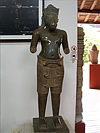
Vajimukha (वाजिमुख)
Sanskrit. ‘Horse face’. One of two equine forms of
Vishnu,
the other one being
Kalkin.
In
Khmer art,
Vajimukha
is represented by a
human body with the crowned head of a horse.
He is associated with
Hayagriva, the Hindu god of knowledge and
wisdom.
回
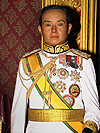
Vajiralongkorn (วชิราลงกรณ)
Name of
King
Rama X,
the only son and second child
to King
Bhumipon and
Queen
Sirikit.
READ ON.
回
Vajiravudh (วชิราวุธ)
1. Thai. ‘Armed with a
vajra’.
Name of
Rama VI.
See also
Wachirawut.
回
2. A Thai designation for the Vedic god
Indra. See also
Wachirawut.
回
3. Thai name of
a royal school that was initially established by King
Wachirawut
(Vajiravudh) for the children of the royal family and originally
called rohng rian mahaat lek luang (โรงเรียนมหาดเล็กหลวง), i.e. the
‘Royal Pages School’ or ‘Royal Guards School’. Under King
Rama VII the school was merged with
racha withayahlay (ราชาวิทยาลัย), i.e.
‘King's College’ or ‘Royal College’, and renamed
Wachirawut
Withayahlay (วชิราวุธวิทยาลัย), i.e. ‘Vajiravudh
College’, after its founder King
Rama VI.
Today, it is an all-boys boarding school located across the street
from
Chitralada
Palace in
Dusit.
Its emblem consists of the
Great Crown of Victory, known as
Phra Maha Phichai Mongkut,
with a
rasmi
(fig.),
over the Thai number six (๖) and a
vajra, each and every one a symbol that
refers to the sixth monarch of the
Chakri Dynasty.
The original Royal Page School was established in 1910, and in 2010,
the Vajiravudh
College's Assembly Hall appeared on a Thai
postage stamp, issued to commemorate the
100th anniversary (fig.).
See MAP.
回
%202_small.jpg)
3. Thai. Part of the name of a
school in
Songkhla (fig.),
i.e.
Maha
Vajiravudh,
that was established by
Chao Phraya
Yommaraat
and at its foundation named after the then Crown Prince.
回
Vajirunhis
(วชิรุณหิศ)
See
Wajirunhit.
回
vajra
(वज्र)
Sanskrit.
‘The
hard one’ or ‘the mighty one’. A term used to refer to a
sceptre, diamond or thunderbolt, suggesting
indestructibility. The name derives from the fact that it is
allegedly made from the hardest material on
earth and is used as a metaphor to describe its
indestructible nature. Besides its durability, its other
characteristics are illumination and sharpness, features that
represent intellect and are able to destroy all obstructions,
whilst as a thunderbolt it is also a symbol for instant
Enlightenment. In
Vajrayana Buddhism, it
is the most important symbol and represents absolute truth. In
Hinduism, the thunderbolt is held by several gods, including
Indra. In Thailand,
Mekala, the god of lightening, holds
a thunderbolt. There also exist a double vajra, like the one
that appears in the emblem of Bhutan. The double vajra, also
referred to as the vajra cross or the double dorje (i.e. the Tibetan
word for vajra), is an
attribute
of
Amoghasiddhi (fig.),
and is known in Sanskrit as Visvavajra (fig.). In Thai,
the vajra is known by the name
wachira
(fig.).
回
_small.jpg)
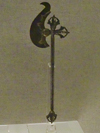
vajra axe
A kind of axe with a handle in the form of a
vajra.
It is used by Buddhist priests in religious
rites in
Vajrayana
Buddhism to symbolically
destroy any obstacles that obstruct the path towards
Enlightenment.
In
iconography,
it is an attribute wielded by certain wrathful deities as a likewise
weapon.
回
vajra bell
Vajraghanta.
回
Vajracharya (वज्राचार्य, วัชราจารยะ)
Nepali-Thai.
‘Carrier
of the
vajra’.
A
Vajrayana
Buddhist priest among the
Newari
communities of Nepal, who
is highly accomplished in Vajrayana practices and rituals. See also
Kumari.
回
Vajradhara
(वज्रधर)
Sanskrit.
‘Wielder of the
vajra’. A
representation of the
Adi-Buddha usually crowned and with jewels. In Nepal and Tibet, he is
sometimes shown with his female
counterpart, but when alone, he is usually depicted holding a vajra and a bell, known as
ghanta, with his hands crossed
in front of his chest.
Akin to the
Dhyani Buddhas, who are also known
as the Wisdom Buddhas, Vajradhara
is often found depicted in Tibetan-style
mandalas (fig.).
In Thai, this
Buddha image
is known as
Phra Wacharaton. See also
Vajrasattva.
回
_small.jpg)
Vajraghanta (वज्रघण्टा)
Sanskrit. Compound of the words
vajra
and
ghanta, and meaning
‘Diamond
bell’. This kind of bell
has a handle in the form of a vajra, and is mainly used in religious
rites (fig.)
in
Vajrayana
Buddhism.
回
_small.jpg)
Vajrakila (वज्रकील)
Sanskrit.
Name for a
kila (fig.)
of which the handle is made in the form
of a
vajra.
回
Vajrangusa (वज्रअङ्कुश)
Sanskrit.
Compound of the words
vajra and
angusa, meaning
‘diamond hook’ or
‘mighty hook’, a tool used by
mandala gatekeepers to summon the divinities to
come and reside in the mandala. Also transcribed Vajrankusa.
回
Vajrapani
(वज्रपाणि)
Sanskrit.
‘Bearer of the
vajra’.
A
bodhisattva in
Vajrayana Buddhism. He
is represented holding a vajra in one hand and sometimes also with two
lotuses and a bell. In
Mahayana Buddhism, he is considered, by some, to be
Avalokitesvara.
He is described as
the protector and guide of the
Sakyamuni
Buddha
and one of the earliest three
protective deities or bodhisattvas surrounding the Buddha, who rose
to symbolize the Buddha's power.
His consort is Chagna Dorje (fig.),
with whom he is frequently portrayed in the
yabyum pose. In painted compositions of the
Red Hat Sect (fig.) or Nyingma
School of
Tibetan Buddhism,
he is often
depicted in the company of the nine-headed protector deity
Rahula.
Also in Tibetan Buddhism, he is
known as Mahasthamaprapta and forms a triad with
Amitabha
(fig.)
and
Avalokitesvara
(fig.). He is
also one of the
Eight Great Bodhisattvas
(fig.),
while
Ha Jiang
(fig.)
and
Heng Jiang
(fig.),
the muscular, fierce-looking door guardians that
in Japan are together referred
to as Ni-Ou (仁王) and that are
often found at
Buddhist-Taoist
temple entrances across Asia, are said to be
manifestations of
Vajrapani. He is
also associated with
Acala or
Acalanatha
(fig.),
who in Japan is known as
Fudo Myoo (fig.),
all holders of the vajra.
Vajrapani
is also associated with
Vajrasattva
and in
Vietnam
he is
known as Kim Cuong (fig.).
回
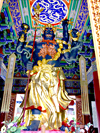
Vajraputra (वज्रपुत्र,
วัชรบุตร)
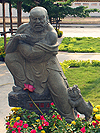
Sanskrit-Thai. ‘Thunderbolt Son’. Name of
one of the eighteen
arahats,
of whom it is said that he
convinced
Ananda
to balance learning and practice, in order to attain
the wisdom needed to persuade others of the virtues of a balanced
life.
He is therefore sometimes called
the Persuading
Arhat.
He
is usually
depicted
with
his right
index finger
pointing down while
watching
a
playful
lion
cub by his
side.
Besides being protectors of the
dharma,
lions are symbols of the invincible might of Buddhism.
Some sources however, mention that before
becoming a monk, he had been a lion-killer and that the lion cub
joined him out of gratefulness for abandoning his former occupation.
In Chinese he is known as the
luohan
Xiao Shi (笑狮, or in traditional Chinese: 笑獅), literally
‘Smiling
Lion’.
In
Vietnam,
where he is sometimes depicted seated on a Vietnamese-style
kilen,
he is called Tieu Su La Han
(fig.),
and in English, he is also referred to as the Laughing Lion
Lohan
while his name in Thai
is pronounced Wachrabut or Wachrabutra, though he
is also called
Watjahn Tohsukoh (วัดจารย์โตสุโข).
回
vajrasana
(वज्रआसन)
Sanskrit.
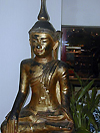
‘Diamond throne’. An
asana in both Buddhist and
Hindu
iconography in which the legs are crossed on top of each other with
the feet resting on the opposite thigh, the soles upward.
回
Vajrasattva
(वज्रसत्त्व)
Sanskrit.
‘Someone whose essence is
vajra’.
A deity who in
Vajrayana Buddhism is the principle of
purity
and purification, and whose role is similar to that of
Vajradhara
(fig.).
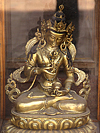
In art, he is usually depicted holding a vajra against his chest and
a bell against his left hip (fig.).
回
Vajrasphota (वज्रस्फोट)
Sanskrit. Name of a Tibetan guardian, also known as the
mandala
western gatekeeper. He is usually depicted as a –sometimes
potbellied– figure, with a
snake
around his neck and wearing a crown
decorated with skulls. He is standing in the alidha
asana
posture, i.e. a lunging position, with one leg stretched out for
balance, while placing the weight mainly on the other leg, which is
bent at the knee. His
attribute is a chain, which he uses to
shackle the divinities who have come to reside
in the mandala.
回
Vajrayana
(वज्रयान)
Sanskrit.
‘Diamond vehicle’. A sect of
Mahayana Buddhism that started in the 4th century AD and was important in Northeast
India from where it spread to Nepal, Tibet and East Asia. It stimulated highly
developed ritual veneration practices in which
mantras and
mandalas were used,
yoga
was employed and harmony with the universal spirit was
aimed for. Also known as
Mantrayana.
回
Valaya Alongkorn
(วไลยอลงกรณ์)
Thai. Name of a Siamese Princess
of the
Rattanakosin
Period.
READ ON.
回
Vali
(वाली)
Sanskrit. Another designation for
Valin (fig.),
who was king of the monkeys, and a half-brother of
Sugriva.
When the latter challenged Vali to a
fight,
Rama
emerged from behind a tree and with his bow shot and
killed Vali with an arrow (fig.).
回
Valin (वालिन्)
Sanskrit. ‘Having a tail’. King of the monkeys, son of
Indra and brother of
Sugriva. His consort is
Tara and his son
Angada.
In Thai known as
Bali. Also called
Vali.
回
Valmiki
(वाल्मीकि)
Author of the Indian epic
Ramayana, the
‘Story of Rama’, written over 2,500 years ago
and containing 24,000 verses.
MORE ON THIS.
回
Vamana
(वामन)
Sanskrit. ‘Midget’. The fifth
avatar of
the god
Vishnu
in the form of a midget. As an
incarnation of Vishnu he is likewise portrayed with a blue
complexion. His mother was
Aditi and he
is thus one of the twelve
Adityas, as well as a younger brother of
Indra.
回
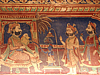
Vanaspati
(वनस्पति)
1.
Sanskrit. ‘Lord of the jungle’. A form of
Shiva
in
Hindu mythology.
In Thailand
known as
Panaspati.
回
2.
Sanskrit. The realm of plants.
回
Vanavasi (วนวาสี,
วันวาสี)
Thai name for the
arahat
Vanavasin.
Also known as Wakanaju (วัคนะจุ).
回
Vanavasin (वनवासिन्)
Sanskrit-Thai. Name of
one of the eighteen
arahats,
who according
to legend was born under a
banana plant,
his favourite spot for meditation
where he is believed to also have gained
Enlightenment.
Hence, he was given the Sanskrit name Vanavasin which means ‘Living
in a Forest’. In
art
is usually
depicted
seated on
a
banana leaf (fig.),
holding a string of beads
known as
prakam (fig.)
and leaning on the
Sutra, a symbol for his study of the
dhamma
and the
Tripitaka.
In Thai
his name is pronounced
Vanavasi,
but he is also known as Wakanaju (วัคนะจุ).
In Chinese he is known as the
luohan Ba Jiao (芭蕉), literally
‘Banana’ or ‘Banana Herb’ and in English he is referred to as the
Plantain
Lohan or the
Arhat Under the Banana Tree.
In
Vietnam,
he
is known as
Ba
Tieu La Han (Ba Tiêu La
Hán)
and may be depicted
seated on a hoofed mythical
animal
(fig.),
somewhat reminiscent of a
Bi Xie.
Also called Vanavasa and sometimes transcribed Vanavaasin.
回
_small.jpg)
vanilla
Name of a tropical
climbing
orchid
that has fragrant flowers and a long pod-like fruit, called vanilla
bean, from which the obtained substance is used as a flavouring
agent for foods or as a fragrant scent in cosmetics.
回
_small.jpg)
varada
(वरदा)
Sanskrit.
‘Granting of wishes’. One of the most frequent
mudras in
Hindu and Buddhist
iconography in which the hand is held out, the open palm facing forward with the fingers
pointing downwards. It indicates the dispensing of favours and occurs with both
standing and seated images, sometimes even while seated on
a
naga (fig.), generally with the right hand but occasionally with
the left (fig.).
Compare with
pahng prathan phon
(fig.).
回
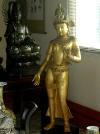
Varadis Palace
See
Wang Woradit.
回
Varaha
(वराह, วราหะ,
วาราหะ)
Sanskrit-Thai.
‘Boar’. The third
avatar
of the Hindu god
Vishnu, in the form of a boar
(fig.).
He took this avatar in order to crush
Hiranyaksha
(fig.),
an
asura or
rakshasa, that had abducted the
Earth and had hidden it on the bottom of the cosmic ocean.
According to legend, the battle between the two that followed lasted
for a thousand years, and was won by Varaha, who then carried the
Earth
back from the ocean between his tusks and restored it to its
place in the Universe. The Earth is personified in Vishnu's consort
Prithivi,
who incarnated as his
shakti each time
Vishnu
incarnated as one of his
avatars, and in her third shakti she is
known as
Varahi
and depicted with the head of a sow (fig.).
In Thailand, the story of Varaha is depicted on the murals of
Wat Phra Kaew,
the Temple of the
Emerald Buddha,
in
Bangkok
(fig.).
See also
Pig Memorial (fig.).
回
_small.jpg)
Varahi (वाराही, วราหี, วาราหี)
Sanskrit-Thai.
‘Sow’. Name of the
shakti
of
Varaha,
i.e. the third
avatar
of the Hindu god
Vishnu
in the form of a
boar,
and hence a form
Prithivi,
depicted with the head of a sow.
She is one of the
Matris,
i.e. a group of seven mother goddesses in the Hindu religion. In
Thai, pronounced Warahi and also referred to as Phra Mae Warahi (พระแม่วาราหี).
In Nepal, she is known as Barahi.
See also TRAVEL PICTURE.
回
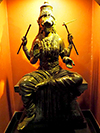
Vardhamana
(वर्धमान)
Sanskrit. ‘Increaser’. A
tirthankara and the founder of
Jainism who was later
bestowed with the title
Mahavira.
He was born into a royal family, probably in 599 BC, in
the same region of North India as the
Buddha.
He travelled
and preached for thirty years and died in 527 BC at the age of 72.
回
Variable Sailor
Common name for a butterfly with
the scientific designation Neptis zaida and found in parts of
mainland Southeast Asia, including
Yunnan,
Myanmar
and
Thailand.
It has a wingspan of between 6 to 7 centimeters and its upper-wings
are black with orange markings, i.e. three horizontal bars and a
slanted bar at the apex of each forewing. The tip of the forewings
also have a very narrow white edge, visible only on closer
inspection. It is similar to the
Small Yellow Sailor
(fig.),
the
Cambodian Lascar
(fig.),
the Common Lascar (Neptis
hordonia), and the Common
Jester (Symbrenthia lilaea), as well as reminiscent of the
Common Sailor
(fig.).
In Thai, it is known as
phi seua
ka-lah
see
sih nah (ผีเสื้อกะลาสีสี่หน้า).
回
_small.jpg)
Variable Squirrel
A
species of medium-sized squirrel naturally present in Thailand,
Burma, Laos, Cambodia and South
Vietnam. It occurs in diverse
habitats, from primary and secondary forests to open woodland,
plantations and urban areas. These squirrels are arboreal (fig.), diurnal
and feed on a variety of seeds and fruits. As its name suggests they are
very
variable in colour and patterning (fig.). There are many subspecies, which
can vary from black, brown, chestnut or creamy white with diverse
patterning, but its upper side is typically of a darker colour than
its underside. It has the scientific name Callosciurus finlaysoni,
and is thus also known by the name Finlayson’s squirrel. In
Thai it is called
kra-rohk
khao (กระรอกขาว)
and kra-rohk lahk sih (กระรอกหลากสี), i.e.
‘white squirrel’ (fig.) and ‘multi-coloured squirrel’, respectively.
See also WILDLIFE PICTURES (1)
and
(2), and
WATCH VDO (1),
(2)
and
(3).
回
%20กระรอกขาว_small.jpg)
varman (वर्मन्,
វរ្ម័ន, วรมัน)
Sanskrit-Khmer-Thai.
‘Protected by’. A title used by several
rulers, i.e. members of
the second
caste of the
warrior
or ruling
Kshatriya
class
in India, but also in Southeast
Asia, especially by
Khmer
and
Cham kings.
The Khmer word can however also mean
‘shield’ or ‘armour’, as well as ‘protective
coat of armour’, and is sometimes translated as ‘warrior’, whilst
the Sanskrit term is also translated as ‘defence’, ‘defensive armour’,
and ‘shelter’. In Thai, it is additionally understood that the first
part of the word derives of the word wora (วร), i.e.
a synonym of the
Thai word praseurt (ประเสริฐ) and meaning ‘superb’, ‘glorious’,
‘heavenly’ and ‘sublime’, a word typically used to refer to royalty,
as in worakaay (วรกาย), meaning ‘body of a king or prince’ and
worakanyah (วรกัญญา), i.e. ‘royal lady’.
See also
Jayavarman.
回
varna
(वर्ण)
Sanskrit.
Literally translated varna means ‘colour’, but its root (vrn) means
‘to choose’ and it generally refers to a ‘caste’ or ‘class’, that is
the caste system or
classification of closed off social classes in
Hinduism
which consists of four castes, i.e. the
Brahmans,
the learned class;
Kshatriya,
the royal or warrior class;
Vaishya, the
class of traders; and
Shudra, the
agricultural and serving class. The latter caste also has a subclass
known as Mali and refers mostly to gardeners. Besides the lowest caste, there are
also the dalit or ‘untouchables’. These are the pariah or social
outcasts, that are considered less than human and as such are not
part of any of the social classes, not even the lowest. The latter
group formerly included slaves. The origin of the castes is related
to the creation myth of Purusha, a giant with 1,000 heads and 1,000
limbs, and a body that took up the entire universe, and who was
sacrificed and dismembered by the gods to create the world. His head
became the Brahmin class, his arms the kings, his thighs became the
producers, and his feet became the slaves. The sun was created from
his eyes, his mind became the moon, whilst his navel was used to
create space. All the creatures on earth and in the sky came from
his melted fat, and the gods
Indra and
Agni were born from his mouth. With the
dismemberment of Purusha the gods brought order to the cosmos and
created the institution of sacrifice, which would have to be
repeated over and over to maintain that order. In 1950, the caste
system was officially abolished and although the Constitution states
that people of all castes have the same rights, discrimination is
still prevalent in Indian society, where ones caste can be
determined by someone's last name. People of the different castes
also have different customs, e.g. people of the two upper castes are
not supposed to eat meet, drink alcohol or smoke, as thee habits are
viewed as
impure
and only to be adopted by the lowest castes, though nowadays the
newer generations care less about these customs. See also
Veda.
回
Varuna
(वरुण)
Sanskrit. Vedic god of the waters and guardian of the western
direction, and sometimes described as the god of invisibility. His
vahana or mount is the
makara or the
crocodile,
though in
Cambodia
he is occasionally believed to be depicted on top of the sacred swan
Hamsa, as is thought to be the case in
rock carvings at Koh Ker.
In Thailand, he is associated with
Phra Phirun, the Thai god of rain. His consort is
Varuni,
who is also known as
Madira.
回
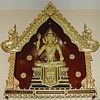
Varuni
(वारूणी)
Goddess of wine and the
shakti of
Varuna.
She is also known as
Madira.
See also
Sura.
回
Vase of Plenty
Another name for
the
Treasure Vase, which in Thai is known as
puranakata.
回
Vasudeva
(वसुदेव)
Father of
Krishna.
回
Vasudhara (वसुधार, ནོར་རྒྱུན་མ།)
Sanskrit-Tibetan. ‘Stream of
wealth’, ‘Stream of gifts’, and ‘Stream of gems’. Name of the female
bodhisattva
of wealth,
prosperity, and abundance. Though a Buddhist deity
who is venerated especially in
Tibetan Buddhism
(fig.),
she is also related to the
Hindu
goddess
Lakshmi (fig.)
and in the
Mahabharata,
she is the associated with
the abundance
of the waters of the
Ganges (fig.)
and thus with the goddess
Ganga (fig.).
The
Treasure Vase is one of her symbols
and may appear as an
attribute beneath
her feet. In
iconography
she
is often depicted while standing upon a pair of horizontal Treasure
Vases that spill an
endless stream of jewels.
回
Vasuki
(वासुकि)
Another name for
Ananta,
king of serpents and
nagas. Also
known as
Shesha.
回
vat
(វត្ត)
Cambodian or
Khmer word for temple. In Thai
wat.
回
Vayu
(वायु)
Sanskrit-Thai. ‘Wind’ or ‘air’. Vedic god of the wind or air and protector of the
northwestern direction. His mount is the antelope. The Thai word for storm,
i.e.
phayu (fig.) is derived from his name.
Also spelled Wayu.
回
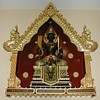
Vayuphak (วายุภักษ์,
วายุพักตร์)
1.
Sanskrit-Thai. A
malicious creature
from the
Ramakien,
half-bird,
half-asura,
who was the son of a giant and a bird, and ruled the Kingdom of
Wichian,
located at the slopes of the Universe. Being half-bird, half-ogre,
his lower body is often described to have the features of an eagle. He waged war with
Phra Ram (fig.) and
Phra Lak (fig.), whom he captured with the
intention to eat them. However,
Sukrihp
(fig.)
and
Hanuman (fig.) fought over them and liberated Phra Ram and Phra Lak.
Eventually, Vayuphak was beheaded by Rama's monkeys, led by
Ongkhot (fig.) and
Nilaphat (fig.). In
Thai, the preferred spelling is Vayupaks (วายุภักษ์), though the
name is often misspelled Vayupaktr (วายุพักตร์), but since neither
the ‘s’
nor the ‘tr’
are pronounced, in English both the transliterations Vayuphak
and Wayuphak are correct, though in English the name is sometimes
misspelled Vayupak or Wayupak. This is due to the similarities in
both appearance and name to another creature, i.e.
Asurapaksi (อสูรปักษี),
in which the word
paksi (ปักษี)
is written with a p (ป) and not with ph (พ).
He is also known as
Asuravayuphak
(fig.)
and is used as the figurehead (fig.)
on the escort barge
Reua Asuravayuphak (fig.).
Since he is regarded as a creature that guards treasure, he is used
as the logo of the Ministry of Finance of Thailand, including its
subdivisions, such as the logo of the
Royal Thai Mint
(fig.),
as well as the logo of the
Comptroller General's Department
(fig.),
known in Thai as
Krom Banchih Klahng,
as well as on the emblem of the Krung Thai Bank and that of the
Government Lottery Office.
回
%201_small.JPG)
2.
Sanskrit-Thai. ‘Bird (as in
paksi) of the air (vayu)’.
Another designation for the
mythical half-human and half-bird creature otherwise called
Karawak,
a name that is also used for a
bird-of-paradise, i.e.
nok
karawak.
Compare with
Asurapaksi.
回
VC Pith Helmet
Type of a
lightweight cloth-covered tropical helmet worn by the Vietcong, i.e.
the
North Vietnamese Army, during the
Vietnam War. Its is dark green in colour, with a brown leather
chinstrap, and originally with an insignia of Vietnam's National
Emblem attached in the
front, which consists of a golden
five-pointed star on a red background, over a the top-part of a cogwheel and flanked
by two golden ears of
rice.
Today, it is still widely worn by civilians, especially in northern
Vietnam.
回
Veda
(वेद)
Sanskrit.
‘Knowledge’. The term -generally used in the
plural- refers to a collection of ancient hymns and verses sacred to
Hinduism
and of which the earliest was written between 1500 and 1000 BC. According to the
Arians,
the Vedas were never actually composed and have no author, but their texts
were revealed by divine revelation through seers called
rishi
and the Aryan culture was completely
based on them. In total there are four Vedas, that is to say the
Rig
Veda,
Sama
Veda,
Yajur
Veda, and
Atharva
Veda, which is the youngest. The oldest of these texts, the Rig
Veda, which was roughly composed between 1500 and 1000 BC, states
that Vedic society was divided into four hierarchical classes, known
as
varna or ‘colours’ (i.e.
castes),
namely the
Brahmans,
i.e. the learned class;
Kshatriya,
the royal or warrior class, including high officials;
Vaishya, i.e. the class of merchants and
landowners; and
Shudra,
the agricultural and serving class, as well as the class of
craftsmen, while slaves were part of the dalit or ‘untouchables’. The Brahmans were the
centre of the Vedic religion as they
performed the important rituals of sacrifice for the benefit of the
kings and nation, to bring wealth, victory and heir to the
throne. As such, they were supported financially and protected by
the Kshatriya.
The Vedic people worshipped a pantheon of gods, some that they
brought with them from their homeland and others that they
accumulated from indigenous tribes that they encountered as they
moved through North India and assimilated into their own pantheon.
Many of those gods became the predecessors of the present Hindu
pantheon. When in the 5th century BC the nomadic people of the Vedic
tribes began to settle in permanent cities and the actual practice
of sacrifice began to decline, it gave way to the rise of
Buddhism,
which
opposed the social class order
and challenged the authority of the Brahmins.
The Thai word for knowledge, i.e. wet (เวท)
derives from Veda.
回
Vedanga (เวทางค์)
Thai-Sanskrit. The six
Sanskrit dissertations on grammar and rituals.
回
Vedanta (वेदान्त, เวทานต์)
Sanskrit-Thai. ‘The end of
Veda’, that is complete knowledge.
The term refers to the fundamental truth as expressed in the Vedas
and seen in the light of the teachings as written out in the
Upanishads,
Sanskrit treatises on philosophy. One of the six great schools of
learning of Hindu philosophy. See also
Advaita Vedanta.
回
Vedas
See
Veda.
回
vedika
(वेदिका)
Sanskrit. A balustrade enclosing a
chaitya or an
object
of worship.
回
vegetable carving
The traditional sculpting of vegetables into shapes or reliefs, usually to
adorn banquets. In Thai
pak kae salak. If fruit is used it is called
ponlamai kae salak in
Thai, although one term is often used for both. See also
fruit carving.
回
Vegetarian Festival
See
thetsakahn kin jae.
回
Velvet Tamarind
Common name of a 20-25 meter tall, fruit-bearing tree, native to
southern
Thailand and
Malaysia, and with the binomial name Dialium
indum. Its small, egg-shaped, acorn-like fruit has a black shell
with a powdery, somewhat velvety film (in Thai known as
nuan) and a flavour similar
to
tamarind,
from where it derives its English name. Though of a different
colour, the fruit’s shape, size and appearance is somewhat
reminiscent of that of the
phikun (fig.)
and of unpeeled
lotus
seeds (fig.). It is eaten as a snack,
often dried, sugar-coated and spiced with
chili. The tree is valued for its hard
and compact wood. In Thai it is known as
yih and
kayih, and in
Malay as keranji madu.
回
%20Dialium%20indum_small.jpg)
Vereenigde Oostindische Compagnie
Old-Dutch for the
Dutch East India Company. See also
V.O.C.
回
Verenigde Oostindische Compagnie
Dutch for the
Dutch East India Company. See also
V.O.C.
回
Vessantara
Pali for
Wetsandorn.
回
Vessantara jataka
See
Wetsandornchadok.
回
vexillology
The
scholarly study of flags. The term is derived from the Latin word
vexillum meaning ‘small sail’, a specific type of square banner used by Roman legions in antiquity,
which was suspended from a horizontal crossbar attached to a spear.
The study is closely related to heraldry, the knowledge of coats of
arms, of which
vexillology
originally was a sub-discipline.
Thai people like flying flags and a wide range of them can be seen
all over the nation, many of them related
to the monarchy. On special occasions or in certain
places also flags from other nations are flown (fig.).
See also
Vexillology & Heraldry.
See also THEMATIC
STREET LIGHT.
回
_small.jpg)
viagra (व्याग्र)
1. Sankrit for ‘tiger’. The Latin word vigorem, the origin of the English word vigour, i.e.
physical strength or energy, possibly derives from it. Also spelled
and transcribed differently as
vyaghra
(व्याघ्र).
回
2. Commercial name for the medicine sildenafil
citrate, a drug used to treat impotence.
回
vibhuti (विभूति)
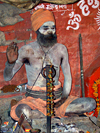
Sanskrit term for sacred ash,
which is taken either from a temple flame or from a cremation fire (fig.).
The ash, which is considered food from
Agni,
the god of fire (fig.),
is often used by
sadhu to cover their body
and face (fig.).
It symbolizes the destruction of ones
karma
in the fire of austerity, as
well as the conquest over death (fig.).
回
Victoria amazona
See
Victoria regia.
回
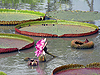
Victoria regia
Latin. Tropical water plant with giant leaves. Sometimes it bears white flowers
that turn pink after being pollinated and then perish within twenty-four to forty-eight hours.
Also called Victoria amazona and Giant
Water
Lily.
In
Thai known as
bua victoria,
but due to its shape also called bua
kradong,
after a
flat round winnowing basket (fig.).
回
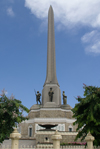
Victory Monument
Monument in
Bangkok, built to commemorate the 59 victims of
the campaign against the French in Indochina, at the beginning of 1939, during
the premiership of Field Marshall
Phibun Songkram. The monument
(fig.) is decorated
with sculptures representing the war heroes from the different military forces,
i.e. the Air
Force, Army and Navy, as well as from the Thai Royal Police, and the civilian population. The monument is
characterized by a fifty meter high
obelisk (fig.)
and the names of the victims are engraved on a plaque (fig.).
It was completed and officially inaugurated on 24 June 1940, on
the same day as
Democracy Monument.
In Thai it is called
Anusawarih Chai Samora Phum.
See MAP.
回
Vidhura (विदुर)
Sanskrit. ‘Wise’. Also spelled
Vidura. Compare with
Vedas and see
also
Vithura Chadok.
回
Vientiane (ວຽງຈັນ,
เวียงจันทน์)
Lao-Thai. ‘Walled city (wiang)
of
sandalwood (jan)’. Also transcribed Wiangchan and Viangchan. The present-day capital of
Laos on
the eastern banks of the
Mekhong river. It is part of a larger
homonymous prefecture which itself is located in a province of the
same name. Whereas the total population of the province is believed
to be over 730,000, the city has only an estimated 200,000
inhabitants. According to legend the city
was founded by prince Thattaradtha when he left the legendary Lao
Kingdom of Muong Inthapatha Maha Nakhon because he was deprived of
the throne in favour of his younger brother. He first founded the
city Maha Thani Si Phan Phao, located on the western banks of the
Mekhong river which was later renamed
Udonthani.
Afterward he founded a new city on the opposite site of the river which
he named
Chanthabuli Si Sattanakhanahud
(Krung
Sri Satana Kanahut/Krung
Sri Sattanah Khonhut) and which purportedly
was
the precursor of present-day Vientiane. Historians however think
that Vientiane more likely was an early
Khmer outpost that
centreed around a
Hindu temple. When the Khmer Empire
declined the remaining Khmers then probably either moved out, were killed
or assimilated into the Lao civilization. In 1354, when Fa Ngum
founded the Kingdom of Lan Sang, Vientiane became an important
administrative city and in 1560 King Setthathirath officially
established it as the capital. When Lan Sang fell apart in 1707, it
became an independent kingdom which in 1778 was conquered by the
Siamese general
Chao Phraya
Chakri and made a vassal of
Siam. In 1827,
when
King Anuvong
raised an unsuccessful rebellion against
Bangkok, it was eradicated
by the Siamese armies of King
Phra Nang Klao
(Rama III).
It eventually passed to French rule in 1893 and became the capital
of the French protectorate of Laos in 1899. Vientiane is sometimes
translated as ‘moon city’ or ‘city of the moon’ which possibly is a
misconception of the word chan (jan) which in Lao may be translated
as both ‘moon’ and ‘sandalwood’, or goes back to the legendary city
of Chanthabuli, which could be translated identically. The name
written in Thai however, suggests that the word chan (jan) means
sandalwood.
回
Viet Cong (Việt Cộng)
Vietnamese. ‘Viet Community’
Name of the political organization in
Vietnam, known in English as the
National Liberation Front.
READ
ON.
回
Viet Minh (Việt Minh)
Vietnamese. Name of the
nationalist front against imperialism in
Vietnam, that was erected in
Nanjing sometime around late 1935 and early 1936, and —after
becoming dormant— revived in 1941 by Ho Chi Minh (Hồ Chí Minh), to
seek independence from French Colonialism. The United States
initially supported France, though in World War II they helped the
Viet Min fight Japanese occupation. After World War II, the Viet
Minh again fought for independence from France in the Indochina War,
that ended in 1954 following the defeat of the French at the Battle
of Dien Bien
Phu (Điện Biên Phủ -
fig.), which led to the end of
French presence in Vietnam, as well as to the
Geneva Accord (fig.), that
partitioned the country into North and South at the 17th Parallel.
In the accords, the administration of North Vietnam was given to the
Viet Minh, which became a socialist state with Ho Chi Minh appointed
as its Prime Minister, while South Vietnam came under the control of
Ngo Dinh Diem (Ngô Đình Diệm), who was previously appointed Prime
Minister by Emperor Bao Dai (Bảo Đại). Civilians
were given the opportunity to move freely between the two
provisional states for a 300-day period, which led to ca. one
million northerners, mainly minority Catholics, fleeing to the
south, fearing persecution by the communists whilst around 90,000
southern Viet Minh being resettled in the Communist North. Many of
those later joined the
Viet Cong, to
fight South Vietnam and the United States in the Vietnam War. Those
who resettled in the North returned via the Ho Chi Minh
Trail, a cross-border logistical supply route that ran from
the North to the South through
Laos
and
Cambodia,
whilst some of those who stayed behind, estimated to number
5,000-10,000, were simply reactivated.
回
.jpg)
Vietnam (Việt Nam)
Vietnamese. Name of the
easternmost Southeast Asian nation on the Indochina Peninsula,
stretching from north to south along the South China Sea.
READ
ON.
回
Vietnamese Blue Crested Lizard
Common name of
an agamid lizard found in Vietnam, and with the scientific name
Calotes bachae. In the breeding-season, these lizards' head and
anterior body part turn bluish-turquoise, similar to the
Blue Crested Lizard (Calotes
mystaceus -
fig.),
yet somewhat duller and with less markings. Outside the
breeding-season adults are brownish-grey with dark markings.
Juveniles are similar to non-breeding adults. In Vietnam, it is
known as Nhong Xam Nam Bo (Nhông Xám Nam Bộ).
回
_small.jpg)
Vietnamese Mickey Mouse
Plant
Name of an attractive plant, shrub or tree with the binomial name
Ochna integerrima and recognizable form its
attractive, berry-like fruits, which are shiny black and dangle from bright-red
sepals in a way that resembles the face of Mickey Mouse, hence the name. In
the blossoming season it profusely blooms bright yellow flowers,
believed to bring good luck and prosperity, thus making it a popular
tree in
Vietnam during the Tet Festival, the traditional Vietnamese
New Year. The Vietnamese Mickey Mouse is the provincial tree and
flower of
Mukdahan,
and is in Thai called chang nahw (ช้างน้าว) and kraje (กระแจะ),
though the latter name is also used for a plant with the scientific
designation Naringi crenulata.
回
%20ช้างน้าว,%20กระแจะ%202_small.jpg)
Vietnamese
Pheasant
A
species of pheasant with the scientific name Lophura hatinhensis,
sometimes listed as a subspecies of the Edwards' Pheasant or Lophura
edwardsi, i.e. Lophura edwardsi hatinhensis.
Males have a dark blackish blue plumage, with scaled light bluish green
feathers on their wings. They have a red facial skin, white crest
feathers and brown eyes. Females are dark brown and lack the white
crest feathers. Both sexes have
pinkish red legs and feet, and their tails may -or may not- have a variable number of additional white, central
flight feathers, the main difference with the
Edwards' Pheasant, which has only brownish blue tail feathers (fig.).
Another distinction is that the white crest of Lophura hatinhensis
is slightly longer than that of Lophura edwardsi. Vietnamese
Pheasants measure up to 65
centimeters and their diet consists of grain,
seed, plants and insects.
Native to central
Vietnam,
they were
discovered only in 1964 and are thought to be the rarest pheasants
in captivity, with just over a
hundred Vietnamese Pheasants living in zoos around the world.
Threatened by increased
deforestation and hunting,
there are believed to be
less than 2,500 birds left in the wild, making this species
endangered. Also known as
Vo Quy's pheasant and in Vietnamese as ga loi lam duoi trang (gà lôi
lam đuôi trắng), meaning ‘white-tailed
blue thunder fowl’.
In Thai, both species are known by the name
Edwards'
Pheasant, i.e. kai fah edwerd (ไก่ฟ้าเอ็ดเวิร์ด).
回
%202_small.jpg)
vihaan
Pali for
viharn.
回
vihara
(विहार)
Sanskrit for
viharn.
回
viharn (วิหาร)
Thai. A word derived from the
Sanskrit word
vihara and
in Thai usually called viharn
(vihaan). Initially, it was the diurnal dwelling place for Buddhist monks,
yet is usually described as the sermon hall, prayer hall or chapel. In a
Thai temple complex it is the counterpart of the
ubosot or
bot,
and is
distinguished from the former by the absence of
bai sema, marker stones that
surround the ubosot. It is also the hall where important Buddha images are sometimes housed,
especially if the temple doesn't have a bot. Also spelled wihaan.
回
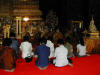
Vijayadazaami (विजयादशमी)
Hindi. ‘Victorious tenth’. The climax of the ancient Indian festival
of
Navaratri, that extends nine nights and ten days.
READ ON.
回
Vijayanagara
(ವಿಜಯನಗರ, विजयनगर)
Kannada-Hindi. ‘City of Victory’. A powerful kingdom in southern Central India in the 15th and
16th centuries AD, with its capital
Hampi.
Also an art style from that period and region.
回
Vimala (วิมาลา)
See
Wimala.
回
viman (วิมาน)
Thai. A castle in the air. The abode of angels, paradise
(fig.).
Pronunciation vimahn.
回
vimana
(विमान)
1. Sanskrit. A chariot or cart of the gods,
a mythical flying machine.
回
2.
Sanskrit. The towered shrine of
Hindu temples in South Indian style.
Also known as a vimanam tower. Its North Indian equivalent is
called
sikhara.
回
Vimanmek (วิมานเมฆ)
Thai.
‘Paradise in the clouds’. A three-storey mansion in
European style entirely erected in golden
teak wood without the use of a single nail. It was originally constructed in 1868
AD on the
island of Koh Si Chang, off the coast of
Chonburi.
It was initially known as
Phra
Thihnang Manthatrattanaroht and
part of
Phra Chutathutrachatahn
(fig.). In 1897, it
became a Summer Palace for King
Rama V, after his return from Europe. In 1901, it was relocated to
Dusit in
Bangkok,
where it was the royal residence of King
Chulalongkorn,
who lived there between 1902 and 1906. In 1935 it was closed down, but reopened
again in 1982 by Queen
Sirikit
as a museum to mark Bangkok’s bicentennial celebrations. In 2002,
four postage stamps with art objects of the mansion (fig.)
were issued to commemorate the 100th anniversary since it was
first inhabited.
See MAP.
回
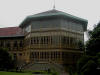
Viman Nang Fah (วิมานนางฟ้า)
Thai. ‘Castle of a Female
Angel
(naang
fah) ’. Name for
a large,
viman or
castle-shaped
(fig.)
kreuang khwaen,
i.e. net or frame-like,
stringed flower arrangements, that are used to suspend at windows, doorways,
gables, etc. It is knitted of mainly
jasmine buds
(fig.)
and white
dok rak (fig.), and it has a
variety of other colourful flowers and garlands attached to it. This type of
flower decoration is depicted on a Thai postage stamp issued in 2005
(fig.).
回
Viman
Phra In (วิมานพระอินทร์)
Thai. ‘Indra’s
Castle
(in the sky)’. Name for a specific kind of
kreuang khwaen, a stringed flower
arrangement, that is used decoratively and usually hung up at
doorways or windows. It is constructed like a net, with a triangular
end at both the top and the bottom, and an open, rectangular,
frame-like space or window in the middle. At the top of this open
space, there is a bracket-like net formation that looks like a
curtain hanging open from its centre, and which is decorated with
flowers. Often, an image of the god Indra is attached at the top
triangular part (fig.),
hence the name, whilst the triangular part at the bottom might have
a
kranok design attached.
See also TRAVEL PICTURES.
回
_small.jpg)
Viman Thaen (วิมานแท่น)
Thai. ‘Base Castle’.
Name for a specific kind of
kreuang khwaen,
a stringed flower arrangement, that is used decoratively and usually
hung up at doorways or windows. It is knitted like a net,
using mainly
jasmine buds
(fig.)
and white
dok rak (fig.). It is
shaped with a tapering,
roof-like end at the top and an open, rectangular, frame-like space
or window in the middle.
At the corners of
this window are pink or red flowers, that are handmade from rose
petals and finished with a real flower at its centre.
Strings of jasmine flower buds hang like open curtains from the top
of the open frame to its sides. on the left and right top of the
frame, as well as at its bottom, are festoons made mainly of dok rak
and yellow
jampah
flowers
(fig.). This type of
flower decoration is depicted on a Thai postage stamp issued in 1991
(fig.).
回
_small.jpg)
Vimean Akas (វិមានអាកាស)
Khmer. Name of
a
Hindu
temple in
Angkor Thom
(fig.),
usually
referred to as
Prasat
Vimean Akas, but also known as
Phimean Akas.
READ ON.
回
Vinay
(วินัย)
Pali-Thai. The canonical organ or ecclesiastical
doctrine for rules on monastic discipline. It binds the
Sangha and
is
written down in the
Vinaya
Pitaka or Vinay Pidok,
the first part of the
Tripitaka.
It
was initially compiled during the First
Buddhist Council after the Buddha's death and based on the memory of
Upali (fig.), one of the
Ten Principal Disciples
and a top master of the
Vinaya. See also
Ovada Patimokkha
and
Buddhist precepts.
回
Vinaya
(विनय)
Sanskrit for
Vinay.
回
vinegar fly
See
malaeng wih.
回
Vinous-breasted Starling
Common designation for a species of starling,
with the scientific Latin name Sturnus burmannicus.
READ ON.
回
Violet Allamanda
See
ban buri muang.
回
Violin Beetle
Name for a species of ground beetle
in the Carabidae family, with the
scientific designation Mormolyce phyllodes.
READ ON.
回
Vipassana (วิปัสสนา)
Thai. Another transliteration
for
wipatsanah.
回
Virabhadra (वीरभद्र)
Sanskrit. Name of a warrior deity created by the
wrath of
Rudra, to wreak havoc when
Daksha insulted
Shiva. He came forth from
the locks of Shiva’s matted hair and
was created together with his consort
Bhadrakali,
who arose from the wrath of
Devi. Also transcribed Veerabhadra.
WATCH VIDEO.
回
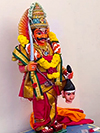
Virupaksa (विरूपाक्ष)
Sanskrit. ‘Having deformed eyes’
or ‘Diversely-eyed’. Name of the Indian
lokapala
of the West, whom in Thai is known as
Wirupak.
回
Virupaksha (विरूपाक्ष)
Another spelling for
Virupaksa.
回
virasana
(वीरसन)
Sanskrit.
‘Posture of a hero’. An
asana often seen in
iconography and in which the right foot rests
on the left thigh, with the left foot under the right thigh.
回
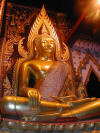
Virudhaka (विरूढक)
Sanskrit. ‘Deity that
enlarges’, sometimes translated as
‘Patron of Growth’.
Name for
Zeng Zhang Tian
(fig.),
one of the
Four Heavenly Kings. Also
transcribed Wirudhaka and in Thai known as
Wirunhok.
回
Virunchambang (วิรุฬจำบัง,
วิรุณจําบัง)
Name of a
yak, i.e. giant demon from the
Ramakien. He couldn't fight against
Rama
thus he fled and hid in the foam of the ocean, but
Hanuman caught him with his tail (fig.) and killed him. He is
described as having a navy blue complexion. In
iconography, he is usually depicted
with a
chadah-like, cockerel tail
crown, that seen from the side, is wavy and arches backward at the
tip. In architecture, he is usually portrayed in companion with
Maiyarahp,
a yak with a pale mauve complexion
(fig.). Both
stand at the third door of the Northern entrances of
Wat Phra Kaew.
In 2001, he was portrayed on a Thai postage stamp, as part of a set
of four stamps with yak that guard temple
entrances (fig.).
Also transliterated Wirunjambang and Wirunchambang. Due to its
ability to hide in the sea, reminiscent of Virunchambang, the HTMS
Wirun, a
‘gigantic’ submarine of the type
Madchanu once
used by the Royal Thai Navy (fig.),
was named after this giant character.
See LIST OF RAMAKIEN CHARACTERS.
回
_small.jpg)
Virunhok (วิรุฬหก)
See
Wirunhok.
回
Visakha (วิสาขะ)
1. Visakha, also
known as Migaramata, was a wealthy aristocrat during the era of the
Gautama
Buddha. Born into
affluence in the kingdom of
Magadha, Visakha met the
Buddha at age seven,
attaining
Sotapanna, the first of the four
stages of
Enlightenment,
at that young age. Visakha later served as the Buddha's chief
patron, supporting him and the monastic community generously and
became renowned as the foremost female lay disciple in generosity.
She relocated to
Savatti,
where she founded the Migaramatupasada Temple, one of the era's
crucial temples alongside Jetavana Monastery, which was founded by
Anathabinthika Setthi, her male
counterpart, who stood as the Buddha's greatest male patron and
benefactor (fig.).
回
2. See
Visakha Bucha.
回
Visakha Bucha (วิสาขบูชา)
Thai. The annual commemoration of the
Phrasut (birth),
the
Enlightenment, and the
Parinippahn (passing away) of the
Buddha,
events that according to tradition all fell on the same day (fig.),
throughout his life (fig.). In Thailand, this day is a public holiday (Wan Visakha Bucha) and
falls on
the 15th day of the waxing moon in the sixth lunar month. This is
usually in the second half of May. In Buddhist temples Visakha
Bucha is commemorated by a candle procession, the singing of
mantras,
and preaching. In
many places, also a
Buddha image
bathing ceremony is held, akin to the ritual of
Song nahm
phra and usually performed
with an image of the Buddha when still a child (fig.).
Often abbreviated to Viskaha (sometimes
transliterated Vesak), and more lengthy known
as Visakha Puranamee Bucha
(วิสาขปุรณมีบูชา).
See also
bucha and
POSTAGE STAMPS (1),
(2),
(3),
(4) and
(5).
回
Visantrawee (วิสันตราวี)
See
Wisantrahwih.
回
Vishakha (विशाख)
Another name for
Karttikeya,
the
Hindu
god of war, and
son of
Shiva and
Parvati.
回
Vishnu
(विष्णु)
One of the three prominent gods of
Hinduism, preserver of the universe and second god in the
Hindu
Trimurti or divine triad,
which includes
Brahma and
Shiva. He is
often depicted with four
arms (fig.), holding a ball or
lotus,
chakra,
conch and a
gada (fig.),
representing the four elements, i.e. earth, fire, water and wind,
respectively. He sometimes uses the latter, i.e. the mace to create
wind by whirling it
violently in the air. He may be portrayed either seated, standing (fig.),
or reclining on the serpent
Ananta floating on the cosmic sea (fig.).
He descended to earth in nine different forms or
avataras to
restore peace and silence evil forces, namely: as 1. the fish
Matsya
(fig.);
2.
the
tortoise
Kurma
(fig.); 3. a boar (fig.)
called
Varaha (fig.);
4. the man-lion
Narasimha or
Narasingha (fig.);
5.
the midget
Vamana (fig.);
6.
Parasurama (fig.) or alternatively
Balarama
(fig.);
7.
Ramachandra (fig.);
8.
Krishna; and
9. the Buddha
or alternatively Parasurama. His tenth avatara as the horse
Kalkin is yet to come,
and some sources claim that
Prithu
is also an avatar of Vishnu.
He thus has a total of ten avatars, i.e. five in human and five in
animal form, though there is also a myth in which he has a female
avatar called
Mohinih. His
consort is
Lakshmi,
who was incarnated with him each time he incarnated as one of his
avatars
on earth. His mount is the
Garuda (fig.)
and he is often depicted on its back (fig.), sometimes whilst subduing
Rahu, the demon whom he cut in half
with his chakra after he was found drinking from the gods'
amrita (fig.). He has two consorts:
Bhumidevi and
Lakshmi,
who originated during the churning of the ‘Ocean
of Milk’. In combination with Shiva he is known as
Harihara (fig.). In a
linga Vishnu is represented as the
octagonal prism part (fig.).
His symbol is the
urdhva-pundra,
a
U-shaped
sectarian mark,
often
with a red dot
(fig.),
that he and his followers may wear,
typically applied
on the forehead, using river clay mixed with
sandalwood paste,
reminiscent of
thanaka.
He is often represented
seated on the
snake
Ananta (fig.),
which is also known as
Shesha (fig.),
or reclining on it, a pose known as
Anantasayin (fig.).
In his avatar as Dhanvantari, Vishnu is one of the health deities,
together with the
Ashwin
Twins, who
are
said to be the
physicians to the gods. In Thailand, called
Wasuthep,
Phra
Witsanu and
Phra Narai,
and
Bangkok
has a Vishnu Temple (fig.).
See also THEMATIC
STREET LIGHT,
TRAVEL PICTURE,
and
PANORAMA PICTURES (1)
and
(2).
回
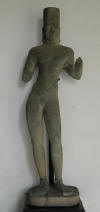
Vishnukam (วิษณุกรรม)
Another Thai designation for
Vishvakarma.
回
Vishvakarma (विश्वकर्मा,
วิศวกรรม)
Sanskrit-Thai. ‘All-accomplishing’ or ‘all-creator’. A designation for the divine architect of Universe
and the presiding Hindu deity of all craftsmen and architects. He is
one of three creator gods found in
Hinduism,
alongside the Vedic god
Prajapati
and the
Puranic
god
Brahma. His
name is mentioned at the end of the full official name for
Bangkok,
Krung Thep Maha
Nakon,
that ends with the words
Witsanukam
Prasit and translates as
‘accomplished
by
Vishnukam’,
i.e.
‘built
by
Vishnukam’.
In Thai also known as
Phra Witsanukam.
回
Vishvantara
(विश्वन्तर)
Sanskrit
for
Wetsandorn.
回
vitarka
(वितर्क)
Sanskrit. A
mudra in which
the
Buddha holds one or two arms up in front of his chest, bent and with the hand(s) held forward forming a circle with the thumb and index finger. This
mudra indicates
‘exposition’ and refers to education, just as the
dhammachakka mudra
(fig.),
in which the Buddha forms a circle with both hands.
回
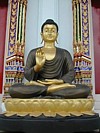
Vithura Chadok (วิธุรชาดก)
Thai name for one of the
ten
jataka,
i.e. life stories of the previous incarnations of
the
Buddha,
in which the
bodhisattva
was born as a wise
man named Vithura
Bandit.
READ ON.
回
V.O.C.
Dutch. Abbreviation for the old-Dutch ‘Vereenigde Oostindische
Compagnie’ or ‘Verenigde Oostindische Compagnie’ in contemporary
Dutch spelling, and literally translated as ‘United East Indian
Company’, but usually referred to as the
Dutch
East India Company.
回
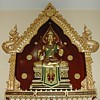
votive tablet
A religious tablet or plaque made to convey a wish or
request, or to express the fulfillment of a promise. Collections of
similar-sized, usually antique votive tablets are oftentimes
displayed in a wooden ledge, board or shelf-like structure (fig.), which
may in addition be carved or decorated with floral or
kranok motives, and shaped to resemble a
temple gate (fig.). In Thai called
phra phim. Compare with
pata.
回
_small.jpg)
vo thuat (võ thuật)
Vietnamese collective term for
‘martial arts’.
READ
ON.
回
vrata (व्रत)
Sanskrit-Hindi term for any
‘vow’
or firm purpose. In
Hinduism, the term indicates a form
of religious self-control with the goal to carry out certain
obligations or refrains, with the prospect of achieving divine
blessing, often to obtain certain desires. This practice usually
includes moral restraint and strict celibacy and devotees taking a
vrata may wear a
Brahmacharya cord around their
waist, i.e. a simple white cord which has been blessed in the temple
and reminds the wearer to keep the mind centreed above the waist in
thought, word and deed. In
Jainism,
the laity follow five anu-vrata or
‘lesser
vows’,
whilst
monks follow five
maha-vrata
or
‘great
vows’,
namely:
ahimsa or
‘nonviolence’;
satya
or
‘truth’;
asteya or
‘non-stealing’;
Brahmacharya, i.e. ‘meditation in
Brahma’ or
‘chastity’;
and aparigraha, meaning
‘non-possession’
or
‘non-attachment’.
See also
satyagraha.
回
vyaghra (व्याघ्र)
Another English transcription as well as Sanskrit spelling for
viagra.
回