taab (ตาบ)
Thai. A decorative or protective
neckpiece, which at some time in the past was worn by kings (fig.)
and warriors, and sometimes also by Thai dancers.
Nowadays, it can still be seen on traditional marionette puppets
(fig.).
See also THEMATIC STREET LIGHT.
回
,%20Thai%20warrior%20neckpiece_small.jpg)
taak (ทาก)
1. Thai. Name used for almost
all types of snails, slow-moving
gastropod molluscs with a spiral shell. There are many different
types and may live on land, in freshwater or in the sea. A commonly seen kind in
Thailand
is the
Apple Snail
(fig.), which
lays its pink
eggs, clung
together
in
clusters. These pink, caviar-like,
clusters of eggs are typically
found near freshwater,
often on poles or the stalks of plants that stand in the water, such
as
rice (fig.). This particular type of snail is therefore an
natural enemy of rice plants
and has several names
in Thai, including hoy
cherih (หอยเชอรี่),
i.e. ‘cherry snail’. Generally, snails are also called
hoy taak (หอยทาก). Alternatively
transcribed thaak.
WATCH VIDEO (1)
and
(2).
回
%20Thai%20snail_small.jpg)
2. Thai general name for slugs
and used for any gastropod mollusc that either has a very reduced, a
small internal or no shell at all. There are many different types.
Some species of slugs feed on leaves and thus often destroy
plants, though other species are
predators, eating snails, earthworms or even other slugs. Besides
this many slugs may occasionally also eat carrion, including dead of
their own kind.
回
,%20slug,%20shell-less%20mollusc_small.jpg)
3. Thai for leech, a bloodsucking, worm-like,
invertebrate and hermaphrodite animal living on land and with the
scientific name Haemadipsa interrupta, of the family Hirudinae.
Being hermaphrodite means that each animal has both the female and
also the male reproductive organs inside its body and when two
leeches meet and want to mate, they will choose who is going to
provide the sperm and who will provide the egg cells.
Leeches have two suckers, i.e.
one at each end of the body. Whereas the posterior disc-like sucker
is used for locomotion, i.e. moving and erecting the body, the
anterior sucker is used for adhesion to the host and feeding.
Leeches have segmented bodies and belong to the phylum Annelida,
which also includes ringed worms. Whereas most leeches are best
known for sucking onto another animal and feed of its blood or
haemolymph, i.e. the internal body fluid of invertebrate animals,
though most species live a predatory life, actively hunting and
feeding on small animals such as insects, snails and other worms.
Since they don’t have teeth to chew their food, they will swallow
their prey in one piece. Leeches are commonly found in Thai rainforests and will cling
to passer-bys, people and mammals alike, and suck their blood. They
may even make their way into clothing and shoes (fig.). Its
bite is not painful but the leech will inject an anti-haemostatic
agent that prevents the blood from curdling
(fig.) and enables the leech to
suck blood without difficulty, after which their bodies swell (fig.). Bloodsuckers usually stick to their
host until they are full and then let go and drop off by themselves.
To remove them sooner one could spray them with salt or burn them
with a cigarette. To prevent leeches from attacking, locals often
smear a mixture of saliva and
tobacco on their exposed skin, but one
may also spray insecticide or a mosquito repellant containing
diethyl-m-toluamide (DEET). Leeches were in the past often used
medically, for bloodletting. Akin to the taak is a leech living in
freshwater which has the Latin name Hirudinaria manillensis and is
in Thai known as
pling, though
the term is occasionally also used for terrestrial leeches, but then
usually the suffix bok (บก),
meaning ‘land’, is added, i.e. pling bok (ปลิงบก).
回
taan (ฐาน)
See
tahn.
回
taanbat (ฐานบัทม์)
See
tahnbat.
回
taanphrakon (ธารพระกร)
Thai.
Royal stick or sceptre,
part of the Thai regalia or
kakuttapan.
It represents the king's power over his subjects to lead them in the
right directions, yet under the
totsaphit rajatham
or ten royal virtues, ruling with righteousness for the benefit and
happiness of the Thai people.
回
taanphraphuttarup
(ฐานพระพุทธรูป)
See
tahnphraphuttarup.
回
taban (ตะบัน)
Thai name for a
betel nut
grinder, a
cylindrical tool with a metal
rod and a wooden pestle, which is used to mash the mixture of betel
nut,
chalk and spices, making it
finer and easier to chew.
The cylindrical tube is usually made from iron or brass, and its
bottom end is plugged with a wooden pestle that serves as a stopper.
An appropriate amount of betel nut and piper betel leaves is chopped
and put into the cylinder and then pound with the metal rod, until
they are fine. Then, the wooden pestle is pushed forward to force
the mixture along the cylinder to the open end. The grinder is
typically a part of a traditional
betel set (fig.).
See also POSTAGE STAMP.
回
taban fai (ตะบันไฟ)
A lighter made on the principle of the
fire piston. It consist of two parts, that is: a cylinder called
krabok taban and a compressor named look taban.
This primitive fire
starting device was widely used by several primeval tribes in the
jungles of Southeast Asia, as was observed by British explorers
already in the mid 1850's. Unlike other primitive fire starting
methods such as the bow or hand drill, the fire saw, flint and
steel, the fire piston operates by compression, a principle later
adopted by the diesel engine invented by Rudolf Diesel. It is
believed that the idea of the primitive fire piston may have
inspired him.
The tool may be made from buffalo horn,
elephant
tusk or hardwood,
which is turned into a hollow round, cylinder-like rod or bar
with a lathe. It is about 8 to 12 centimeters long. The end of the
krabok taban is often made into a pointed shape to allow the
insertion of a pointed piece of metal to scrape out the ashes. The
compressor is usually made from the same material as the cylinder
but a little longer and with a good grip to make it easy to handle
and avoid hurting your hand when the compressor is pressed down the
cylinder
to ignite a spark. At the end of the compressor a concave is
drilled out to store the kindling or fueling
agent, such as
kapok.
The taban fai is a lighter that will ignite a spark
by rushing the compressor down in the cylinder. This causes an
explosion of the air inside and makes a spark that will light the
kindling attached in the hollow concave at the end of the
compressor. It is also called fai ad, fai yad, bok yad, lehk tob fai
or fai tob, and in English sometimes referred to as fire plunger.
回
_small.jpg)
Tabatkya Zedi (တဘက်ကျစေတီ)
Burmese.
‘Anti-falling
Pagoda’.
Name of a
Theravada
Buddhist temple in Old
Bagan. It
dates from 1046 AD and is located
near the Tharabha City Gate (fig.)
and opposite of the
Buddhist library
Pitaka Taik (fig.),
which was built 12 years
after this temple. Tabatkya Zedi has a square floor plan and
is
surrounded by a low brick wall. It has
three terraces and
is topped in the center by a
bell-shaped
stupa,
though the spire with its gilded
hti-umbrella
has been toppled in the August 2016 earthquake. Also transliterated
Tabhaat Kya Zedi.
See MAP.
回
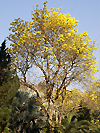
Tabebuia
chrysantha
Tupian-Greek. Botanical name for the Trumpet Tree
or Golden Tree, a deciduous tree of the genus Tabebuia, in the family
Bignoniaceae. The tree originates from South America and the name
tabebuia, a neotropical genus of about a hundred species, is a
contraction of tacyba and bebuya meaning ‘ant wood’ in the Tupi
dialect, a language spoken by Indian peoples living along the coast
of Brazil, in the Amazon River valley and in Paraguay. Chrysantha is
a Greek compound word (χρυσάνθα)
which derives from the words chrysos (χρυσός,
‘golden’) and anthos (άνθος,
‘flower’), and means ‘golden flower’, due
to its yellow trumpet flowers. In Thai it is known as leuang india (เหลืองอินเดีย)
meaning ‘yellow India’. It usually blooms in two or three flushes
from March to May, producing flowers in bulbous clusters. The tree
is often multi-trunked and has a height that ranges from 6 to 12
meters.
回
Tabebuia rosea
Tupian-Latin. Botanical name for the Rosy Trumpet
Tree, a deciduous tree of the genus Tabebuia, in the family
Bignoniaceae. It blooms from January to April and produces light to dark pink trumpet
flowers,
usually with fading to dark yellow eyes which mostly grow in
clusters. The tree originates
from South America and for the etymology of the name tabebuia see
Tabebuia chrysantha.
In Thai the tree is called
chomphu phanthip
meaning ‘pink celestial strain’. It is similar to the Tabebuia
impetiginosa, i.e. the Lavender Trumpet Tree.
回
,%20rosy%20trumpet%20tree,%20%20tabebuia%20rosea,%20tabebuia%20impetiginosa%203_small.jpg)
Tabinshwehti (တပင်ရွှေထီး)
1. Burmese.
‘Unitary Golden Umbrella’.
Name of a former Burmese King and founder of the
Taungoo
Empire, who
reigned from 1530 to 1550 AD. His military campaigns, between 1534
and 1549, created the largest kingdom in
Burma
since the fall of the
Pagan
Empire in 1287, and was the
impetus for the eventual reunification of the entire country by his
successor and brother-in-law
King
Bayinnaung (fig.).
He was born at the palace of Taungoo King Mingyi Nyo on 16 April
1516, and assassinated on 30 April 1550 by a close confidant of
Mon descent,
but also a pretender to the throne, who had lured the King to the
region near Pantanaw, a town in the
Irrawaddy Region of Southwest Myanmar, under the pretext to track an
auspicious
White Elephant.
回
2. Burmese.
‘Unitary Golden Umbrella’. One of 37
nats that
belong to the
official pantheon of spirits
worshipped in
Myanmar. In
life, this nat had the same name, i.e.
warrior King Tabinshwehti, the founder of the
Taungoo
Empire. He was
assassinated on his 34th birthday, on the orders of Smim Sawhtut,
one of his close advisers. He was killed by his own guard while he
was drunk.
See also LIST OF BURMESE NATS.
回
Ta-buang (ทบวง)
1. Thai. Name for a
government agency in the central administration that may or may not
belong to the Office of the Prime Minister or the Ministry.
回
2. Thai. Name for
government
agencies in the central administration that have the same status as
the Ministry but are called Ta-buang.
回
Tachina Fly
See
malaeng wan bian.
回
Tae Chew (แต้จิ๋ว)
1. Thai name for an ethnical subgroup of the Han
Chinese people who principally live in the coastal region of
southeastern China, especially in the Chaozhou (潮州)
prefecture of Guangdong (Kwangtung - 广东) province, from where more
than half of the ethnic Chinese population in
Thailand trace their
ancestry. They speak a
branch
of Chinese belonging to the Southern Min dialect, equally known as Tae
Chew. Most of them came to
Siam as traders, especially during
the
Ayutthaya Period and at least as early
as the 13th century AD. King
Taksin (fig.), who was the son of a Tae
Chew immigrant named Hai-Hong, actively encouraged Chinese
immigration and trade. Thailand today has about 8.5 million ethnic
Chinese of which 56% are Tae
Chew. Also transcribed Teochew,
Taechew, Teochiu and Tae Chiw. See also
Susahn Tae
Chew.
回
2. Thai name for the largest Chinese dialect
group in
Thailand, spoken in most places, apart from
Phuket
and
Songkhla, where the predominant Chinese dialect is
Hokkien
(and to some extend
Hakka),
and the North, where Hakka is the most important Chinese dialect,
though most of the Hakka people can usually speak Tae Chew as well.
It is the largest Min language and the only branch of Chinese that
cannot be directly derived from Middle Chinese (the language spoken
from the 6th to 10th century AD) and therefore has little
intelligibility with most other Southern Min dialects. Much of the
Tae Chew that is spoken in
Thailand
today is a rather old form of the original vernacular and not spoken
anymore in the motherland, where the local tongue continued to
develop over time. In Mandarin it is known as Chaozhou hua (潮州话),
literally a ‘dialect of Chaozhou’.
It is also transcribed Teochew,
Taechew, Teochiu and Tae Chiw.
回
tael
Name for a historical
unit of weight or currency in East Asia, notably used in
China, primarily as a measure for
precious metals (fig.).
The English term tael derives from the Portuguese, which in turn
originates from the Malay word tahil, signifying
‘weight’. In
Mandarin,
the tael is known as liang (兩), which freely translates as
‘volume’ or ‘quantity’, with the most prevalent official tael measure weighing approximately 37.5 grams. The Thai equivalent
of the tael is known as the
tamleung.
回
taen (แตน)
See
toh.
回
taeng (แตง)
Thai.
General name for plants of the family Cucurbitaceae, of which many
are grown in
Thailand, such as taeng kwa (a small cucumber), taeng
rahn (a large cucumber),
taeng thai (a melon),
taeng moh (the watermelon), etc. Compare with
makheua.
回
taeng moh (แตงโม)
1. Thai
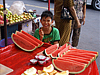
for the watermelon, a fruit of the genus Citrullus and with the scientific
name Citrullus lanatus. There are numerous varieties, differing in
size, shape, coulour of skin and flesh. The watermelon belongs to a
large and distinguished family of vines, which includes gourds and
cucumbers, many of which names in Thai start with the prefix
taeng.
While some of these vines are climbers, the watermelon with its
large and heavy fruit spreads across the ground. Its sweet succulent
flesh is usually red, but may also be yellow (fig.). Its seeds too are
edible and roasted these are a popular snack throughout Southeast
Asia.
回
2. Thai.
Name for one of the two drum barges used in the
Royal Barge
Procession, the other one being Ih-Leuang (อีเหลือง).
Whereas the Ih-Leuang barge opens the parade as the first
boat in the middle, preceded only by the reua pratu nah (เรือประตูหน้า)
or ‘front door boats’ that actually sail on the sides,
the Taeng Moh barge sails out in front
of the King's Golden Swan Barge.
回
taeng thai (แตงไทย)
Thai.
Name for
a
melon, the fruit of a plant with the botanical name Cucumis melo,
that has been cultivated into many varieties and of which the rind can be either smooth,
rough, ribbed, wrinkled, or netted, such
as that of the Japanese crown melon (fig.).
The colour of the flesh is often whitish to pale yellowish-green
with a darker green outer edge, or either entirely light green or
orange.
See also TRAVEL PICTURE.
回
_small.jpg)
Taengwood Tree
Name for a kind of tree found
in some countries of mainland Southeast Asia, including
Cambodia,
Laos,
Myanmar,
Thailand,
and
Vietnam, and that produces tropical hardwood. It is listed in
the Dipterocarpaceae family and though disputed, it is usually given
the botanical name Shorea obtusa. In Thailand, it is known as Teng
or Mai Teng (ไม้เต็ง) in general; Jik or Mai Jik (ไม้จิก) in
Isaan;
and Ngae or Mai Ngae (ไม้แงะ) in the North, besides a variety of
more specific regional names, including Mai Teng Khao (เต็งขาว) in
Khon Kaen;
Chan Tok, Chanatok or Chanatak (ชันตก) in
Trat;
Nao Nai (เน่าใน) in
Mae Hong Son;
Kho Jeua (เคาะเจื้อ)
or Jeua (เจื้อ)
in the
Lawa
dialect of
Chiang Mai; Prajad (ประจั๊ด) in the
Khmer
dialect
of
Buriram;
Prajeuk (ประเจิ๊ก) in the Khmer
dialect of
Surin;
Lahnai (ล่าไน้)
in the
Karen
language; Lenai (เหล่ไน้)
in the Karen dialect
of the North; Laeney (แลเน่ย)
in the Karen
dialect of
Mae Hong Son; Oung Liang Yong (อองเลียงยง)
in the Karen
dialect of
Kanchanaburi,
etc. According to Thai
Buddhist folklore, the
Buddha was
seated in deep
meditation
under a Taengwood Tree, when
Muchalinda
(fig.), the king of
nagas (fig.),
protected him against
heavy rain by making a cover with its multi-headed figure, whilst
coiling its body under the Buddha, to lift him above the
floodwaters, a scene that in
iconography is known as
the
naagprok
pose (fig.).
However, some sources describe the tree under which the
Buddha was
seated during
this event as
Freshwater Mangrove,
a tree with drooping bright red flowers
(fig.).
The Taengwood Tree grows in relatively dry areas and in Thailand up to an
altitude of 1,300 metres. It is deciduous, grows up to 27 meters
tall, but usually smaller, and flowers from January to July,
producing distinctive yellow flowers in drooping branched clusters,
with long narrow and pointed petals, that are twisted and
overlapping, but not fused together at the base. It has nut-like
fruits with 3 shorter and three larger wings. The wood is a
preferred source of firewood, while the yellow resin from its trunk,
known as
dammar, from Malay and meaning
‘resin torch’, is used to make torches, as well as paraffin wax used
in
batik
(fig.).
The hard timber has a long lifespan and is commercially exported,
usually under the name Taengwood Balau, whereas the tree is also
commonly known as Burma Sal and Siamese Sal.
See POSTAGE STAMP.
回
Tagundaing (တံခွန်တိုင်)
Burmese term for an
ornamented victory column or flagstaff, typically ranging from 18 to
24 meters in height, found within the grounds of Burmese Buddhist
pagodas and monasteries, known as
kyaung.
These columns, inspired by the
Asoka Pillar
(fig.), are erected to symbolize the submission of
nat
(fig.), local
animistic spirits,
to the Buddhist
Dhamma.
The top of the column typically features a mythical bird called
Hintha or
Hamsa,
or occasionally a
Kinnara,
while the base may be adorned with representations of the
Satu Lokapala
(fig.)
or
Thagyamin
(fig.).
回

tah jorakae (ตาจระเข้)
Thai. ‘Crocodile eyes’. Term
used in
iconography
to refer to a style of eyes
of certain characters from the
Ramakien, especially demons or
yak,
and in which the upper
eyelid in part covers the eyeball,
similar to those of crocodiles (fig.), known in Thai as
jorakae.
If the eyes are wide open, with the pupil completely visible,
the style is known as
tah phlohng
(fig.).
See also
tah mangkon.
回
_small.jpg)
Tahkahy Nah Chang (ตาข่ายหน้าช้าง)
Thai. ‘Elephant-faced
Mesh’. Name of a kind of
kreuang khwaen,
i.e. net or
frame-like, stringed flower arrangements, that are used to suspend
at windows, doorways, gables, etc.
This particular type is rather simple and is knitted in a triangular
shape using mainly
jasmine buds
(fig.)
and
dok rak
(fig.),
and is adorned at the corners with colourful flowers, often yellow
jampah
flowers
(fig.),
or small garlands made of dok rak and roses. The tapering sides are
also adorned, usually with the same kinds of flowers, but of a
smaller size. Its name derives from the fact that the shape is
remniniscent of that of the head from an elephant as seen from the
front.
回
Tah Khai (ตาไข่)
Thai. ‘Egg Eyes’.
Another name for
Ai Khai,
a disciple of the highly venerated monk
Luang Poo Thuad (fig.).
回
tahmanae (ตามะแน)
Thai. A name for
Hog Deer, next to
neua saai.
回
tah mangkon (ตามังกร)
Thai for
‘dragon eyes’.
回
tahn (ฐาน)
Thai. Base or pedestal for a statue. Also
transcribed taan. See also
thaen.
回
tahnbat (ฐานบัทม์)
Thai.
Base or pedestal for a Buddha image in the
form of an upside-down
lotus
(fig.).
Also transcribed taanbat.
回
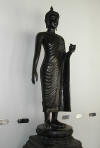
tahn singh (ฐานสิงห์)
Thai. ‘Lion base’. The foot of a pedestal in the form of a
lion's paw.
回
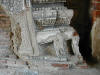
tahnphraphuttarup (ฐานพระพุทธรูป)
Thai.
Base or pedestal for a
Buddha image,
often in the form of a
lotus (fig.),
but also in other forms such as
elephants (fig.).
When the pedestal has outward turned legs in the shape of a lion's
paw, it is called
tahn singh.
Regularly pedestals may have a
pah thip,
an
ornamental cloth hanging from the bottom of the Buddha image, in
front of the pedestal (fig.).
At
Phra Phutta Monthon,
a Buddhist
compound and park in
Nakhon Pathom,
there are four garden sections
with garnite pedestals,
that represent the
sangwechaniyasathaan sih
tambon (สังเวชนียสถาน ๔ ตำบล),
i.e.
the four major stages in the Buddha's life
(fig.),
namely
his birth (fig.),
his
Enlightenment
(fig.),
his first discourse (fig.),
and his demise (fig.).
These pedestals
are also are
depicted on a set of Thai postage stamps issued in 1988 (fig.).
Also spelt taanphraphuttarup.
回
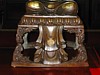
tah phlohng (ตาโพลง)
Thai. ‘Wide open eyes’. Term
used in
iconography
to refer to a style of open, somewhat bulging eyes of certain
character from the Ramakien, especially demons or
yak.
In this style, the pupil
is completely visible. When, however, the upper eyelid partly covers
the eyeball, the style is known as
tah jorakaen
(fig.).
Compare also with the term
dragon eyes.
回
_small.jpg)
Tai
1. An
animist people
in
Southwest
China
(Sipsongpannah),
though
not ethnically
Chinese,
who from the 9th century began to migrate southward, little by
little,
into parts of Southeast Asia and the fertile
Chao Phraya valley.
They
settled
down
in an area that nowadays
would cover
Burma, Laos and
Thailand.
They are the predecessors of the present-day people of the
Thai
race. See also
Tai Yuan.
MORE ON THIS.
回
2. A
branch of the Tai–Kadai language group,
that comprises of
Thai,
Lao,
Shan, and
Zhuang.
回
3. An
ethnic minority group in
Vietnam, also known as
Tay.
回
4. An ethnic minority group in
Vietnam, also known as
Thai.
回
Tai Bai Jin Xing (太白金星)
Chinese. Name of
one of the higher-ranking celestial beings in the Taoist pantheon,
also known as the Star God Venus. He is a deity in
Taoism
associated with the
planet Venus, whose role encompasses governing celestial phenomena
and maintaining cosmic order, particularly overseeing the movements
and positions of celestial bodies, including the sun, moon, and
stars.
回
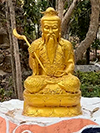
tai chi (太极)
Chinese. Martial art and system of
calisthenics with slow controlled movements, fully known as
tai chi chuan.
While popular and prevalent throughout
China,
in
Thailand, it is practiced each morning in
Bangkok's
Lumphini Park by both the young and -especially- the old,
though usually by people with a Chinese background. The gracefully
performed movements are aimed at developing concentration, balance
and grace while bringing inner peace. It is often
performed with certain gear,
such as folding fans (fig.)
or –usually fake– swords (fig.),
and more recently also a special racket and a ball made heavy with
sand are being used to
practice
a form of tai chi known as rou li (fig.).
回
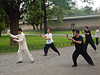
tai chi
chuan (太极拳)
Chinese. ‘Great ultimate boxing’. Chinese martial art which has many
traditional schools and different styles, sometimes including
weapons such as
tessen
war
fans
(fig.), etc. One of its earliest masters is said to have been the supposed
13th century grandmaster
Chang
Sanfeng, a semi-mythical
Chinese
Taoist monk (fig.)
who is believed to have been a former
Shaolin
disciple. The gracefully performed
movements whilst holding a fan or other weapon are aimed at
developing concentration, balance and grace. In the West often known
simply as
tai chi.
回

Tai chi tu
See
Taijitu.
回
Tai Guo (泰国)
Chinese for ‘Thailand’.
Though actually using the homophone Tai for Thai, the term Tai Guo
could literally be translated as ‘Peaceful Land’, ‘Safe Country’ or
‘Grand Nation’. Yet when the characters are swapped, Guo Tai (国泰)
becomes the Chinese name for the Honk Kong air carrier Cathay
Pacific. In Pinyin, Tai Guo is spelled tàiguó.
回
Taihe Shan (太和山)
Chinese. ‘Mount of the
Greatest
Peace’ or ‘Mount of Great Harmony’. Name of a mountain in
China's Hubei province. In mythology, it is
believed to be the abode of
Zhenwu, the protector god of the North in Chinese
Taoism.
On the opposite sides of the Yangtze River in Wuhan, the capital of
Hubei, there is a
Tortoise Mountain and a
Snake
Mountain, a clear reference to the
tortoise-snake,
the symbol of Zhenwu. In
the past the area was known for its many Taoist monasteries which
were academic centres of research and teaching, with emphasis on
meditation, martial arts, traditional medicine, agriculture and
Taoist art. Also referred to as Mount
Wudang.
回
tai jian (太监)
Chinese.
‘Highest supervisor’. Term for a
court eunuch in Imperial China.
回
Taijitu (太極圖)
Chinese. ‘Diagram of the supreme Ultimate’. Name for a Chinese symbol (fig.)
which represents the principle of
yin
and
yang,
and therefore often mistakenly called
yin-yang.
Also spelled Tai chi tu.
回
Tailed Judy
Common
designation
for a butterfly, with the scientific name Abisara neophron.
READ ON.
回
Tailorbird
Name of a small bird belonging
to the genus Orthotomus. They are warblers and are usually brightly
coloured, with green or grey upperparts and a yellow-white or grey
underside. Some species have reddish-brown on the head. They have
short wings with rounded tips and a short tail which is typically
held upright. Its bill is flat and rather wide and long compared to
its head. At the corners of its bill are short, hard hairs.
Tailorbirds build their nests by piercing the edges of a large leaf
which are then sewn together with plant fiber to make a cradle in
which the actual grass nest is constructed. It is a resident breeder
in tropical south Asia, from Pakistan and India to southern
China
and Indonesia. Worldwide there are 15 species of which 5 are found
in
Thailand
i.e. the Mountain Tailorbird, the
Common Tailorbird, the
Dark-necked Tailorbird, the Rufous-tailed Tailorbird, and the
Ashy Tailorbird (fig.). In Thai it is called
nok krajib.
WATCH VIDEO.
回
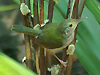
Taiping Rebellion
Tai Ping (太平) may mean ‘Heavenly
Peace’, ‘Highest
Peace’
or ‘Peace
and Security’,
and is the name given to a widespread civil war in southern China between
1850 and 1864, in which about 20 to 30 million people perished,
making it history's most deadly civil war and leading to the
devastation of the Yangtze delta, China's so-called
rice bowl. The
rebellion against the then ruling Qing Dynasty was led by a
heterodox Christian convert with the name Hong Xiu Quan (洪秀全), who
claimed that he was the younger brother of
Jesus
Christ. The rebels attempted to replace the
corrupt feudal system, as well as all Chinese folk religions, with
social reforms that were anchored in a kind of pseudo-Christian
belief system that promoted full social equality, land
redistribution, and common property for all. Whilst the
former ideal, i.e. to do away with the dynasty, inspired Sun Yat Sen,
the first president of the republic, as well as Mao Ze Dong, the
latter seems also to have been enthused by certain principles shared
by communism. Hong Xiu Quan founded the Taiping Heavenly Kingdom and
placed its capital at Nanjing. Although he controlled large parts of
southern China, his troops –known as the Chang Mao (长毛) or
‘Long-hairs’–
were besieged by imperial forces throughout most of the rebellion.
British sailors had initially sided with the Xiao Dao (小刀) or ‘Small
Swords’ rebels, one of a number of revolutionary groups in that
period, due to the fact that this group had occupied the walled city
of Shanghai and most of the Chinese sections of the city, yet had
not invaded the foreign concessions. However, the French supported
the imperial government and brought in troops to support the
imperial army. This dual stand caused foreigners to fight each other
and thus the British authorities, who until then had officially
remained
neutral,
were forced to side with the French. In
the end, the
rebels became divided by infighting and were eventually crushed by the
Qing imperial army, with the aid of
French and British forces.
回
Tai Shang Lao Jun (太上老君)
Chinese. ‘Supreme Old
Master’ (fig.).
Another name for
Lao Jun
(fig.),
that is
Lao Tzu, the founder of
Taoism (fig.), in his deified form.
回
Tai Sui (太岁)
Chinese god of the year. Name of any of the
Sixty Heavenly Generals, who assist the
Jade Emperor
in his task to guard the mortal world.
READ ON.
回
Tai Yai (ไทใหญ่)
Thai. ‘Great
Tai’.
One of the subgroups of the
Shan
people, who also live in
Thailand. They are also referred to as Tai Luang (ไทหลวง) or Tai Lohng (ไตโหลง), and is English as
Tai Proper, besides the name
Ngiaw, which is
used in general for all the Shan people. Sometimes
transcribed Thai Yai.
回
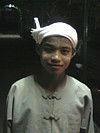
Tai Yuan (ไทยวน,
ไท-ยวน)
Name for a subgroup of the
Tai
people,
which
lives in Northern
Thailand and whose
members today all have the Thai nationality. They are also
referred to as Khon Meuang (คนเมือง),
Tai
Lan Na (ไทล้านนา),
and Tai Neua (ไทเหนือ),
though the latter term is also used for a group of people living in
Yunnan. Sometimes
transcribed Thai Yuan.
回
Taj Mahal (ताजमहल)
Hindi. Name for the famous
mausoleum in Agra, in India's northern state of Uttar Pradesh.
READ ON.
回
Tak (ตาก)
Name of a province (map)
and its capital city on the eastern banks of the
Ping
River in North
Thailand.
READ ON.
回
takaab (ตะขาบ)
1. Thai for
centipede.
Also transliterated takhaab and ta-kahb.
回
2. Thai name for a roller bird, as in
nok takaab thung, the
Indian Roller.
回
3. Thai. Name of a rhythmic instrument.
回
4. Thai name for a
centipede-like
stick made of split
bamboo.
回
takan (ตะคัน)
Thai. ‘Censer’. Earthen receptacle
for burning incense or gum spices, as well as an ancient dish-shaped,
clay
phaang pha theed-like
receptacle used as
lamp (fig.).
Also referred to as
tao
spa (เตาสปา).
回
%20censer%20(incense%20burner)_small.jpg)
tak baat (ตักบาตร)
Thai. To put food in the
alms bowl of Buddhist monks. An alms bowl is called
baat (fig.)
in Thai and tak baat is an act usually done in the morning during
bintabaat (fig.).
After giving alms to monks, it's customary to pour a small amount of
water into a cup and then pour the water onto the soil. This is done
to dedicate the merit gained by the almsgiving to the dead as a kind
of
libation in order to keep
hungry ghosts at bay. See also
kruad nahm.
回
_small.jpg)
Tak Baat Phra Roi (ตักบาตรพระร้อย)
Thai.
‘Offering alms
to one hundred monks’. Name of a large-scale Buddhist merit-making
ceremony in which laypeople offer alms (tak baat)
to a procession of approximately 100 monks. Commonly held on
significant religious or royal occasions, this event reflects
communal devotion and the
Theravada
Buddhist tradition of generosity (dana).
Offerings typically include cooked
rice,
dried foods, fruits, and other necessities. The event is usually
organized in public spaces such as streets, temples, or civic areas,
symbolizing unity, spiritual merit, and the continuation of Buddhist
cultural practices.
WATCH
VIDEO.
回
Tak
Baat Thewo (ตักบาตรเทโว)
Thai.
To put food in the
alms bowl of Buddhist monks as an act of
tamboon on
the morning of the first night of the waning moon of the 11
month of the lunar calendar, to remember the occasion when
the Buddha came down from the heaven, known in Thai as
Thewalohk,
i.e. ‘World of the gods’. The word Thewo (เทโว) is an abbreviation
of the Pali word Theworohana (เทโวโรหนะ), which translates as the
‘descend from Thewalohk’. It takes place around
owk pansa, at the end
of the rainy season.
回
Ta Keo (តាកែវ)
Khmer. ‘Tower of crystal’. Temple in
Angkor dedicated to
Shiva and built in the late 10th to early 11th century
AD, under the auspices of
Jayavarman V.
回
takhob (ตะขบ)
Thai name for a small tree with
the botanical designation Muntingia calabura. This tree has tiny white
flowers and bears
small round edible date-like berries, that initially are green, but which turn red and sweet when ripe
(fig.). The juicy fruits contain a large number of tiny
yellowish seeds. They are a favourite food source for many
fruit-eating birds (fig.).
It is widely found in
Vietnam, where it is called trung ca (trứng
cá), i.e. ‘fish eggs’. It originates from
South and Central America, and in Thai it is also called takhob
farang, whereas in
English it has a variety of names, including Singapore Cherry,
Strawberry Tree, Jamaican Cherry, and Panama Berry. The berries
somewhat resemble the acidulous fruits of the Governor's Plum, which
is also known as Indian Plum, i.e. a tree with the botanical name
Flacourtia indica.
回
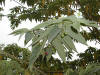
takiab (ตะเกียบ)
Thai for ‘chopsticks’, a pair of
small, slightly tapering sticks of even length, usually square at
one end and round at the other, that are both held in one hand as
eating utensils in Eastern cuisine. They are the traditional ‘cutlery’ of the Chinese, Japanese, Koreans, Taiwanese and
Vietnamese, each with its own distinctive variation. In
Thailand and
other Southeast Asian countries they are used only with
noodle
dishes.
Ordinary chopsticks were initially made of wood or
bamboo, but
also of
ivory,
jade and
other precious materials as a luxury item. In ancient
China,
the emperor used
silver chopsticks to check if there was poison in
his food, as it was believed that if the food was poisoned the colour of the chopsticks would change from silver to black.
In
Vietnam,
wood of the
kim giao
(Podocarpus
fleuryi -
fig.)
is used to make
chopsticks, in the past reportedly for the same reason, i.e. that
this wood changes colour when it comes into contact with toxins,
allowing the chopsticks to be used to test for poisoned food.
Nowadays,
chopsticks are commonly made of plastic. Though plastic is more
environmentally friendly (the Chinese alone use an estimated 45
billion pairs of disposable chopsticks per year which adds up to 25
million fully grown trees) and better resistant to wear, wooden
chopsticks are far more convenient as they provide a much better
grip for picking up food, against the plastic ones which have a
tendency to let things slip. Wooden chopsticks, especially the
larger sized ones, can also be used for cooking (fig.), whereas plastic
ones can't, since the high temperatures would damage them or produce
toxic emissions. Chopsticks are believed to have originated in
ancient China where they are called
kuaizi. Japanese chopsticks differ
from those from China in that they are made of lacquered wood (fig.)
and taper to a pointed end, whereas Chinese chopsticks end in a
blunt tip. The latter is more commonly used for picking boiled
rice
from a plate that is placed on the table, whereas the Japanese type
is used to sweep the rice from the bowl into the mouth, holding the
bowl in front of the mouth. In general, Thailand uses the Chinese type but also sells
the others, mainly as souvenirs. In China, when finished eating, one
should lay the chopsticks on the plate and certainly never place
them upright, like in a glass or another vessel, as that is done on
certain occasions to memorize a deceased person. In
Vietnam, it is
believed that chopsticks placed vertically in a rice bowl look very
much like
incense sticks
burned for the dead (fig.),
and is hence an evocative sign not appreciated anywhere.
回
%20set%20of%20chopsticks_small.jpg)
takian thong
(ตะเคียนทอง)
Thai name for a large,
rapid growing tree with
buttressed roots
and a dark brown, flaky bark.
It has the botanical name Hopea odorata and is in English known as the gagil tree. It is a widespread
species, distributed from the west coast of India, Bangladesh, the Andaman and
Nicobar Islands, lower
Myanmar, throughout Indochina, including
North
Vietnam and peninsular
Malaysia. In
Thailand,
it is prevalent throughout the country in lowland evergreen dipterocarp to dry
evergreen forests up to an altitude of 900 meters. It is occasionally found by
streams, open forest, near beaches and peat swamp forest. Its wood is often used
by sculptors to make large artistic carvings (fig.).
In Thailand, the tree is considered sacred by many who believe it to be the
abode of a powerful tree nymph named
Naang
Takian. In Thailand, it bears
flowers around January-December and fruits from January to
August. In
Isaan it is also known by the name
kaen.
回
takkataen (ตั๊กกะแตน,
ตั๊กแตน)
Thai. ‘Grasshopper’ or ‘mantis’.
The
generic name for all members of the Acrididae family, i.e. the
predominant family of grasshoppers, though the term is also used as
a prefix in the name for members of other families of grasshoppers,
such as mantises and
stick insects,
etc. Many
grasshoppers
are straight
winged insects with long strong hind legs, that
enables them to jump far. There are many different species occurring in
diverse sizes and colours, which in some species can be rather bright (fig.). Locusts and certain larger species of grasshoppers
are eaten by some Thai
people, and can be seen for sale at many food markets throughout the
country (fig.). Its taste is told to be nutty. Commonly seen
in Thailand is the large
praying mantis (fig.),
a predatory insect that holds its forelegs like hands folded in
prayer. In Thai, the latter is called
takkataen tam khao,
which translates as ‘rice crushing mantis’.
WATCH VIDEO and
VIDEO (EN).
回
%202_small.jpg)
takkataen king mai (ตั๊กแตนกิ่งไม้)
Thai name used for a
stick bug, i.e.
an insect that camouflages as a stick (fig.)
and which is also commonly called a walking stick.
回
_small.jpg)
takkataen lang ngo (ตั๊กแตนหลังงอ)
Thai name for the
Monkey Grasshopper.
回
takkataen phung
phluy (ตั๊กแตนพุงพลุ้ย)
Thai. ‘Pot-bellied grasshopper’.
Designation for the
Large Brown Leaf Katydid (fig.).
The last word (phluy) is usually pronounced without the
‘l’,
i.e. phuy, thus in full: takkataen phung phuy.
回
takkataen tam khao
(ตั๊กแตนตำข้าว)
Thai. ‘Rice crushing grasshopper’ or
‘rice pounding mantis’. General name for any
praying mantis (fig.), a predatory insect of the genus Mantis, that holds
its forelegs like hands folded in prayer.
Its Thai name is derived from its physical form,
which resembles a
saak
tham
khao
(สากตำข้าว), i.e. a pestle used to grind
rice in a mortar.
Other Thai names include takkataen yohng yoh (ตั๊กแตนโยงโย่),
takkataen tha phanom
(ตั๊กแตนท่าพนม) and takkataen toy muay
(ตั๊กแตนต่อยมวย), meaning
‘grasshopper halfway between sitting and
standing’, ‘grasshopper in a
phranommeua pose’ (i.e. with the hands together
as a greeting or to pay
respect, like in a Thai
wai)
and ‘boxing
grasshopper’, respectively.
Praying mantises belong to the
order of Mantodea, which has nine families and includes more than
200 genera worldwide, each genus with several members of its own.
In total, there are 2,210 species of mantis found
in tropical areas all over the world. The genera native to Asia
include the Armantis, Ameles, Asiadodis, Creobroter, Deroplatus,
Hierodula, Odontomantis,
Rivetina, Tenodera, Theopompa and Theopropus. The most
commonly found species in
Thailand are the Hierodula bipapilla Serville (Green
Mantis) and Hierodula membranacea Burmeister (Giant Asian Mantis).
Mantises
generally have a
green or brown colour, but there also exist species that are
beautifully coloured, or have -sometimes colourful- markings, e.g.
Spotted Flower Mantis
(fig.). Due to their predacious nature, it either
waits motionless to ambush unsuspecting prey or slowly stalks it,
often using a sit-and-wait strategy (yohng yoh - โยงโย่)
to get within striking distance. It therefore has the need for a
good camouflage and certain genera have less ordinarily
shapes, such as that of leaves, sticks, flowers or flower buds, such
as the Orchid
Mantis (fig.).
These are in Thai often referred to as
malaeng phi, i.e. ‘ghost insects’ (fig.).
Some species may grow up to a length of about 25-30 centimeters and
they are sometimes kept as pets. Mantises hatch from egg cases
referred to as mantis oothecae. The shape of the ootheca is
distinctive for each species, yet many have a horn-like projection
to one side (fig.). See also
Mantis Shrimp. In Thai known generally as
takkataen.
See also WILDLIFE PICTURES
and
TRAVEL PICTURES.
回
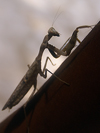
Takkatoh (ทักทอ)
Thai. Name for an animal from the
Himaphan forest,
similar to a lion but with a trunk and tusks like an
elephant. In
Pali the cross between an elephant (gaja)
and a lion (singha)
is called
Gajasingha (fig.),
of which there are several types. It is similar to the
Kodchasih
(fig.),
but with a goatee and furry hair on the top of its head which
extends to the front, a bit like a Mohawk haircut.
回
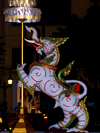
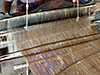
ta-koh (ตะกอ)
Thai name for
the
heddle bar on
a traditional
weaving loom, used
to separate the warp threads.
The
heddle bar
typically
consists of two wooden rods bridged by
vertical cords, thus forming
elongated eyes through which each thread in the warp passes through.
To weave cloth, the heddle is
moved
up and down
in an
alternating fashion
by lifting and lowering the
heddle bar, usually by means
of
loom
pulleys (fig.),
in order to allow the passage of
the weft-thread,
which is passed
back and forth through the shed with the aid of a shuttle, in Thai
known as krasuay, in which
sits the
reel from which the
weft
unrolls
(fig.).
回
takoh (ตะโก)
1. A Thai name for
persimmon.
回
2. Thai. Name for a style of
Buddhist monk's
alms bowl. It is an
alms bowl
with
a compressed and flat-bottomed shape,
and is usually referred to as baat
song
takoh
(บาตรทรงตะโก), i.e. ‘persimmon
(fig.)-shaped
alms bowl’. Compared to the original
baat song thai deum, i.e. the
‘old-shaped Thai alms bowl’, it has a less rounded bottom so it can
be placed on the floor.
This style of alms bowl has been in
use for centuries.
回
takong (ตะกอง)
A Thai name for the
Indochinese Water Dragon, alongside
lang and
king kah yak.
回
takong (ตะข้อง)
Thai. ‘Creel’. Name for a
bamboo
basket (fig.),
which is used as a tool for keeping aquatic animals (fig.), such as
crabs, fish, shrimps, clams, etc. They
usually have a narrow
bottleneck-like opening that can be closed off with a lid in the
form of funnel-shaped spikes (fig.),
known in Thai as
nga
(fig.).
There are many different kinds and shapes,
some with the form of a animal and called accordingly, such as
takong pet (duck creel), takong mah (dog creel -
fig.),
takong gai (chicken creel), etc.
A takong pet is a creel woven in the shape of a duck
and typically has floats on its sides to enable it to drift on the
water, like a duck (fig.).
Sometimes transliterated takhong and also called
kong, an aphaeresis.
回
_small.jpg)
takrai (ตะไคร้)
Thai for any kind of plants or
grasses belonging to the genus Cymbopogon which has a variety of
about 55 species, including lemon grass (fig.), citronella grass, etc. Takrai is a
widely used herb in Southeast Asian cooking. Its stalks contain a
citrus flavoured oil but are too hard to be eaten, except for the
softer inner part. When used fresh it is therefore usually finely
sliced or sometimes bashed and added to food where its aromatic oils
are absorbed. Although habitually served with the dish for flavour
it is generally not meant to be eaten. It is used in a variety of
Thai dishes, such as
tom yam, tom kha, etc. It is also exists in dry
or powdered form. Commonly found in
Thailand are the species Cymbopogon flexuosus and Cymbopogon citratus. Besides takrai this
herb has many local names, depending on place. In North Thailand it
is called jakrai, in the South krai, in
Mae Hong Son
ka hom, in
Surin
churt kreuy or lo kreuy, and the
Karen
call it howo tapoh.
回
_small.jpg)
takrai nihb mahk (ตะไกรหนีบหมาก)
Thai. ‘Betel nut
scissors’.
Name for a betel
cutter, i.e. a metal or copper tool with two handles,
of which one side has a blade, the other a modified groove. The head
is habitually engraved with ornamental designs, and often made in
the form of a
naga-head or the head of another animal,
often mythological, such as that of a
hongse or a
singha, generally depending on the region. It is used to
pinch or nip off slices of betel nut and is usually part of a
traditional
betel-set
(fig.).
See also POSTAGE STAMP.
回
%20betel%20nut%20cutter_small.jpg)
takra sai kai (ตะกร้าใส่ไก่)
1. Thai. ‘Fowl basket’. Name for
a kind of basket used to transport fowl, also referred to as a
poultry
basket (fig.).
May be transcribed takraa sai gai or takrah saai gai.
See also
soom
kai.
回
2. Thai. ‘Fowl basket’. Name for
a kind of basket used to transport fighting cocks. May be
transcribed takraa sai gai or takrah saai gai.
See also
soom
kai.
回
takraw
(ตะกร้อ)
1. Thai. Traditional game played over a net (fig.),
similar to volleyball, but with a rattan ball, also called takraw
(see below).
READ ON.
回
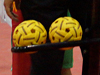
2. Thai. A lightweight
spherical ball, originally loosely hand-woven of rattan (fig.),
though these days usually made from more durable, synthetic
materials, such as polyester, and
used in a foot sport that is also known as
takraw
(see above).
Officially, the ball must have a circumference of between 42 and 45
centimeters, have 20 intersections and 12 pentagonal holes. It has a
weight that ranges from 150 to 180 grams. In the past, one
form of torture used in Thai prisons was a large rattan takraw ball, referred to as the
elephant ball
(fig.),
which on the inside had sharp nails sticking through. A prisoner was
put inside the ball, which was then kicked around by elephants,
encouraged by the guards.
Miniature takraw balls are also found as key hangers and as
souvenirs, and they make fun toys for pet birds, such as parakeets
and parrots (fig.). Also
called look takraw (ลูกตะกร้อ) and sometimes spelt takro.
See also THEMATIC STREET LIGHT.
回
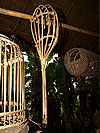
3. Thai. A basket made
from rattan with a long handle, that is used for picking fruit from trees. Also spelt takro.
回
takro
(ตะกร้อ)
See
takraw.
回
takrut (ตะกรุด)
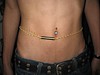
Thai. A charm of rolled gold or
silver strips,
or of a bullet shell (fig.)
usually filled with 108 herbs blessed by a monk, providing immunity
from physical assault to those who wear it strung around the neck or
the waist, though there are also smaller versions that are worn
around the wrist. It sometimes has a piece of cord
tightly coiled around it (fig.).
It is usually an alternative for those who want
supernatural protection against bullets but don't like to get a
sacred
tattoo.
Also trakrut. If the takrut consists of a single
cylinder, it is known
as takrut thohn/thone (ตะกรุดโทน); if it
consists of two cylinders attached parallel to each other, it is
called takrut
faed/faet (ตะกรุดแฝด),
i.e. ‘twin
takrut’;
and if it has three cylinders, it is referred to as takrut
sahm
kasat
(ตะกรุดสามกษัตริย์), literally ‘three kings takrut’. See also
takrut
sahm huang and
takrut
song huang.
回
takrut sahm huang
(ตะกรุดสามห่วง)
Thai. ‘Three-looped
takrut’
or ‘three-ringed takrut’. A charm that consists of a cylinder
with three loop-like rings at the top, often made from glass and
sometimes with a
piece of cord tightly coiled around it. It generally contains a piece of paper
with religious writings on, and is blessed by a senior monk, usually
a
Luang Pho
or a
Luang Poo.
See also
takrut
song huang.
回
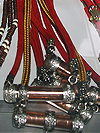
takrut song huang (ตะกรุดสองห่วง)
Thai. ‘Two-looped
takrut’
or ‘two-ringed takrut’. A charm that consists of a cylinder
with two loop-like rings at the top, often made from glass and
sometimes with a
piece of cord tightly coiled around it. It generally contains a piece of paper
with religious writings on, and is blessed by a senior monk, usually
a
Luang Pho
or a
Luang Poo.
See also
takrut
sahm huang.
回
_small.jpg)
Taksin (ทักษิณ)
Thai. ‘South’ or ‘southern’. The wind
direction guarded by the
lokapala
Phra Yom.
See also
Udon,
Isaan,
Burapah,
Ahkney,
Horadih,
Prajim and
Phayap.
回

Taksin
(ตากสิน)
Thai. ‘Wealth of
Tak’. General who
after the fall of
Ayutthaya in 1767 assembled an army (fig.) in
Chanthaburi to chase out the invading Burmese.
READ ON.
回
Taksin Bridge
Name of a bridge in
Bangkok
named after King
Taksin
and which connects
Sathorn
Road on the east bank of the
Chao Phraya
River with
Krung
Thonburi
Road on the west bank.
回
takuad (ตะกวด)
Thai name for a
monitor lizard of the species varanus bengalensis.
回
takuhatsugasa (托鉢笠)
Japanese. Name of a traditional
kind of hat made from
bamboo and rounded at the top,
akin to some types of
ajirogasa,
and
worn
especially by Japanese mendicant monks to offer shade during alms
rounds, as well as by pilgrims.
回
Talaat Khlong Thom (ตลาดคลองถม)
Thai. ‘Khlong Thom
Market’. Name of a market named after a neighbourhood in
Bangkok's
Chinatown
and which includes
Khlong Thom Center, i.e.
a huge indoor
market for tools, toys and electronics (fig.).
回
Talaat Sot Mahachai (ตลาดสดมหาชัย)
Thai. Name of a fresh market located in
Samut Sakon,
that is one of Thailand’s largest seafood markets.
READ ON.
回
talaat nahm (ตลาดน้ำ)
Thai. ‘Water market’. A floating market where
people trade from boats.
READ ON.
回
Talaat Nahm Khwan-Riam (ตลาดน้ำขวัญ-เรียม)
Thai. ‘Khwan-Riam Water Market’.
Name of a
floating market
located on
Khlong Saen Saeb,
a major canal in
Bangkok.
READ ON.
回
Talaat Nahm Lao Wiang (ตลาดน้ำลาวเวียง)
Thai. ‘Lao
Wiang Water Market’. Name of a
is a
floating market
in
Saraburi,
located
on and along the
eastern bank of
the
Pa Sak River. The name of the
market suggests that it is organized by Thais of Laotian descent,
who belonged to the ethnic super-group of the
Lao Wiang.
Around the market are the ruins of
an
ancient temple, as well
as a display of some
local
pottery
and Thai
cultural effigies, such
as a replica
buffalo.
See MAP.
回
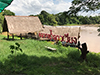
Talaat Nat Rot Fai (ตลาดนัดรถไฟ)
Thai. ‘Train Flea Market’. Name
for a number of night markets held in different locations throughout
greater
Bangkok.
READ ON.
回
Talaat Roi Pih (ตลาดร้อยปี)
Thai. ‘100-Year
Old Market’. Name for old-fashioned markets, often
with wooden shop houses, that have retained their authentic Thai
character from a century ago, hence the name. There are several such
markets nationwide, such as the Chinese community Sam Chuk Riverside
Market in
Suphanburi,
which is famous for
its unique giant
look chin.
See MAP.
回
%20in%20Suphanburi%201_small.jpg)
Talaat Rom Hoop (ตลาดร่มหุบ)
Thai. ‘Shadow Valley Market’.
Local name for the Mae Klong Railway Market
in
Samut Songkhram,
where local vendors set up shop alongside the rail tracks,
which are still in operation,
with a train passing by several times a day.
Hence, each time this train
arrives,
everyone and everything needs to move aside. In order to be able to move
away quickly many vendors display their merchandise on
retractable trolleys, whilst others display their groceries on low
trays that don't need to be removed as they fit underneath the
carriages of the train (fig.).
See also
TRAVEL PHOTOS,
MAP, and
WATCH VDO.
回
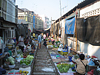
Talaat Sampheng (ตลาดสำเพ็ง)
Thai. Name of a bustling semi
open-air, wholesale market at Sampheng Lane and in many of the
adjacent narrow alleys, in
Bangkok's
Chinatown. It is set
up in many of the narrow alleys in this area where
motorbikes come and go to deliver supplies. The
market is a source for many a vendor who comes here to
buy goods en mass and sell them on as loose items
elsewhere.
See
MAP.
回
%201_small.jpg)
Talaat Tha Tian (ตลาดท่าเตียน)
Thai. ‘Tian Wharf Market’. Name
of a large indoor dry
fish
market
in
Bangkok's
Phra Nakhon district.
The market is
situated in the centre of a U-shaped building which
on
the outside is
lined with shop houses, many also selling dried and salted seafood
products (fig.).
It is located
adjacent and to the west of
Wat Poh,
and named after as well as situated at the
Tian Wharf along the
Chao Phraya
River. In the early
Rattanakosin
Period, a
floating market
was held along the shores of this wharf and the dry fish market
evolved from this. Additionally, the name thian (เตียน) could
also be translated and means ‘tidy’, ‘leveled’, ‘even’ or ‘smooth’.
See
MAP.
回
%201_small.jpg)
talaat thong nahm (ตลาดท้องน้ำ)
Thai. ‘Market (talaat) in the middle (thong)
of the water (nahm)’. See
talaat nahm.
回
Talaat Tonsak (ตลาดต้นสัก)
Thai. ‘Tonsak Market’,
or literally ‘Teak
Tree
Market’, is a lively hub in
Nonthaburi,
offering over 200 shops with fresh foods, street foods, and
desserts. It also features various services like car care, haircuts,
massages, and more, providing a convenient experience for visitors.
The market hosts events such as surf skating and cultural festivals.
Opposite the market is a roadside
zebra shrine
(fig.),
believed to symbolize traffic safety, as local beliefs link
the black-and-white stripes to pedestrian crossings.
WATCH VIDEO.
回

Talaat Trok Moh (ตลาดตรอกหม้อ)
Thai. ‘Pot Alley
Market’. Name of a fresh market in Soi Thetsah (ซอยเทศา) in the
Khwaeng
Wat Ratchabophit,
Khet
Phra
Nakhon, in
Bangkok,
which in English is usually referred to as Trok Moh Morning Market,
which is often transliterated Trok Mor Morning Market. Historically,
the market extended its reach to the
Giant Swing (fig.)
and the area now occupied by Bangkok City Hall (fig.),
and was at the time described as one of the oldest and liveliest
markets in the city. However, in 1973, coinciding with the
construction of Bangkok City Hall, the market's extend was
substantially reduced and traders relocated to their current
premises. Today, the market has earned recognition for its diverse
offerings, featuring seafood, fresh fruits, vegetables, rice and
curry, and clothing. Whereas the downsized market area is
characterized by a Chinese-Portuguese architectural style, the
majority of businesses are managed by individuals of Thai-Chinese
descent.
WATCH VIDEO
and
VIDEO (EN).
回
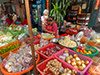
talaew (ตาแหลว)
Thai. Thin strips of
bamboo (fig.) called
tok
(fig.), which are plaited
(fig.) into a
circular or star shaped object with five or seven points, found mainly in
northern
Thailand. The hill tribes, place them at the entrance to
their houses or villages to keep away the spirits of the deceased.
Similar items, either circular or star shaped, are placed in
(fig.)
or at paddy fields during the
rice growing
season (fig.)
as a protection for the offers made to
Poh Sop (fig.).
It may also be used as a charm on a pot containing a potion, or as a
boundary mark. Also called
chalaew.
回
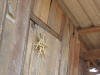
Talamae Sri (ตะละแม่ศรี)
Thai.
Name of the
daughter of Suthasomma (สุทธโสม/สุตตโสมมะ), a
Mon
King from
Hongsawadih,
who became the
wife of King
Mengrai (fig.),
the founder
and ruler (fig.)
of
Chiang Rai
and
Chiang Mai,
as well as a king of
Lan Na (fig.).
Chao
Nang
Talamae Sri is also
referred to as Usah Paikoh (อุสาปายโค) or Nang Phaiko/Paikoh (นางพายโค/ปายโค),
and is accredited with renovating
Wat Ming Meuang in
Chiang Rai (fig.).
回
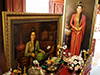
talapat (ตาลปัตร)
Thai. Originally a feather
fan
or, like the
pad bai laan (fig.),
a fan made of a palm leaf, and which is used by Buddhist monks
to hide their face when preaching or chanting, similar to the
pad yot (fig.).
Though nowadays, it is often made from other materials, such as
cloth.
As the described religious fan it has an approximately 70 cm long handle, but
there is also a similar type, that in general is referred to as
kreuang soong,
which has a much longer handle, about two meters in length. Its
use may be stationary, or it may be carried around in royal
processions and ceremonies as a symbol of royalty or honour. In some ways
the longer variety has a similar purpose as the
chattra or
chat (fig.)
and it is often used or
displayed simultaneously (fig.).
回
%202_small.jpg)
talisman
An object which it is believed to bring good
fortune to its holder. The counterpart of an
amulet,
which rather serves an apotropaic purpose.
回
Talking Hill Myna
Common name for a tropical bird that belongs to the starling family
Sturnidae. It is also called Hill Myna or Common Hill Myna, and In
Thai it is known by the names
nok
khun thong and
nok ihyang dam. This genus has
representatives in tropical southern Asia, from India and Sri Lanka
in the West, to
Thailand,
Malaysia
and Indonesia in the East. Until recently, only two species were
recognized, i.e. Gracula religiosa and Gracula ptilogenys, but
several additional subspecies of Gracula religiosa have now been
listed as being distinct species, including the Gracula religiosa
intermedia, which is found mostly in northern Thailand, and the
Gracula religiosa religiosa, which is found on the southern
peninsula, where it is sometimes called nok khun thong
kwai by
the locals. This glossy black bird typically has large yellow
wattles on the head, usually in the area of the neck, though their
position and shape varies with species. Its legs and beak are
bright yellow or orange. The Talking Hill Myna gets its name from its ability to mimic human
speech, a skill for which it has become a popular pet (fig.), both in
Thailand and overseas. It is still fairly common in the wild, though
not normally outside the forests.
See POSTAGE STAMP
and
WATCH VIDEO.
回
_small.jpg)
talokbaat (ถลกบาตร, ตลกบาตร)
Thai. ‘Bowl-case’ or ‘bowl-bag’. An
alms bowl-sack with shoulder strap, a
removable bag with a cloth sling, used for carrying an alms bowl (baat)
in. It sometimes has a foot at its base, on which the bowl can rest
when placed on the floor or on a table (fig.).
回
tam (ธรรม)
Thai name for
dhamma.
回
tam (tằm)
See
con tam.
回
Tamahagane (玉鋼)
Japanese. ‘Precious
steel’. A kind of iron sand unique to Japan and used to forge
katana,
i.e. Japanese swords, such as those worn by
samurai
in feudal Japan.
回
tamarind
An evergreen tree that grows to 25 meters and
has the Latin name Tamarindus indica. Its fruits have elongated
pods of a woody structure, somewhat reminiscent of pea pods. There are several varieties,
mostly sweet or sweet-sour, as well as some other, related species, such as
makhaampom,
makhaamthet
and
velvet tamarind.
Tamarind fruits
develop in three distinct stages: growth, maturation and ripening,
and they are usually harvested at two stages, i.e. half ripe and
fully ripe. At the half ripe stage the pulp is yellowish
and has a more dense consistency, particularly in the case of sweet
forms. At the fully ripe stage the pulp shrinks, due to loss of
moisture, and changes to reddish-brown and becomes sticky.
At this stage, the sticky fruit sits very lose in the peel, around
shiny brown seeds, and is held together by inedible fibres (fig.).
Sometimes tamarind is also harvested at the unripe, growing stage,
when the fruit is sour, the seeds soft and white, and its peel still
attached to the greenish-white flesh. It is then eaten entirely,
i.e. with skin, seeds and flesh, dipped in a mixture of sugar, salt
and chilies, or processed for other purposes. Tamarind
is slightly
laxative and is processed as an ingredient for
phad thai,
chutney and curries, as well as in drinks. In
Thailand, the general name is
makhaam (fig.)
and sweet varieties are widely grown in
Phetchabun province.
回
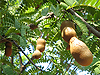
tambon (ตำบล)
1. Thai. ‘Rural administrative subdistrict’. A
subdivision of an
amphur
administered by a
kamnan and consisting of several
mu ban or villages.
In 2025,
Thailand has a total of 7,255 tambon. In
Bangkok,
subdistricts are named
khwaeng.
See also
thetsabahn tambon.
回
2.
Thai. The major stages in the
Buddha's
life, the four most important
being referred to as sangwechaniyasathaan sih
tambon
(สังเวชนียสถาน ๔
ตำบล), namely his birth, his
Enlightenment,
his first discourse, and his demise. These stages, symbolized by
stone pedestals, are represented on a set of Thai postage stamps
issued in 1988 (fig.).
回
tamboon (ทำบุญ)
Thai. Offering or merit making for religious
purposes to gain advantage either for oneself or for a third person.
This may consist of make temple offerings (fig.);
donate food to mendicant monks (sai
baat -
fig.); release birds (fig.);
release or feed of turtles or fish (fig.); a temporary stay in a
temple; burning candles or
joss sticks
(fig.);
an offering of
paddy, i.e. unhusked
rice,
mixed with rice flour
(fig.); attach
gold
leaf to Buddha images or other sacred
objects (fig.); a prayer (fig.);
a
miniature boat offering (fig.),
etc. It could be said that tamboon in is certain cases akin to a social safety
net and as such the country's alternative welfare distribution
network, that forms the backbone of survival for anyone not
covered by the governmental social security system which is very basic
and benefits only some. Often the people selling flowers, birds or
fish food are disabled or poor people without an education nor a
job, trying to make a living. By buying from those individuals one
supports them. The merit therefore does not necessarily comes from
the act of feeding the fish or releasing a bird in itself, but more
so from the fact that one is supporting a fellow citizen who is not
as well off. In this way Buddhist temples may likewise act as
intermediaries, collecting from the rich who make merit and
distributing among the poor. See also
dana.
回
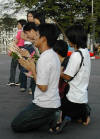
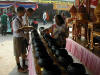
tamboon sai baat (ทำบุญใส่บาตร)
Thai. To perform a good deed or to make merit
(tamboon)
by giving an offering into (sai) the
alms bowl (baat)
of a Buddhist monk. Sometimes in temples several alms bowls are
arranged in a long row in which small coins, usually 25
satang
(fig.)
are offered. The
alms bowls are typically 108 in number,
symbolizing
the 108 auspicious signs of a
buddha.
This form of tamboon may occur in combination with
Buddha images as in the
phra prajamwan
system (fig.).
Sometimes transliterated tamboon saai baht. See also
sai baat.
回
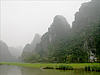
Tam Coc (Tam Cốc)
Vietnamese. ‘Three Caves’. Name
of a village in Ninh
Binh Province (fig.), an area that is often referred to as Ha Long Bay
(fig.) on land,
as it is likewise dotted with numerous karst formations. It is part
of the
Trang An eco-tourism area, which
since 2014 is listed as a UNESCO World Heritage Site (fig.)
under the name Trang An Scenic Landscape Complex and that also
includes
Hoa Lu and
Chua Bai Dinh
(fig.). It is often referred to as Tam Coc-Bich
Dong as it consists of a flooded cave karst system called
Tam Coc, and a series of mountain pagodas known as Bich Dong (fig.).
The region can best be visited by small rowing boat passing several
tunnel caves, through which the Ngo Dong (Ngô Đồng) River flows.
See
MAP.
回
tamleung (ตำลึง)
1. Thai. A monetary that equals
4
ticals.
The term derived from
Khmer
and was formerly used as a unit of currency equal to four
baht.
Nowadays, is is used as a unit of weight and is fixed at 60 grams.
See also
tael,
saleung and
kon
tamleung thong.
回
2. Thai. A weight unit that
equals 4
baht
or 60 grams. The term
derived from
Khmer
and was formerly used as a unit of currency, but nowadays, as a unit
of weight, it is fixed at 60 grams.
See also
tael,
saleung and
kon
tamleung thong.
回
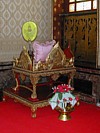
tammaht (ธรรมาสน์)
Thai. A pulpit in the form of an
elaborately carved seat. See also
phanak phing.
回
tamnaan (ตำนาน)
Thai term for
‘legend’
or
‘myth’.
It refers to a traditional story or narrative that is often rooted
in historical events, folklore, or cultural beliefs and is passed
down through generations. Also transliterated tamnan.
回
Tamnaan Luang Pho Loy Nahm Hah Phi-Nong
(ตำนานหลวงพ่อลอยน้ำ ๕ พี่น้อง)
Thai.
‘Legend
of the
Five
floating
Luang Pho
brothers’.
Name of a legend that in English is referred to as
the Legend of the 5 Floating Buddha Statues.
According to the legend, there
once were five brothers who ordained and became enlightened monks.
They prayed together and vowed that they would dedicate their lives
to help all living creatures, by stopping their suffering. When
these five monks passed away, their spirits dwelled in five Buddha
statues and displayed their miraculous power by allowing these
Buddha statues to float along five rivers, until they stranded and
were found by the local villagers, who enshrined each Buddha statue
in a temple in the vicinity where they were found. The five
Buddha images
and temples are: 1.
Luang Pho
Sothon
(fig.),
a Buddha image seated in the
dhyani pose,
which was found in
the
Bang Pakong River and
is today enshrined
in
the
Sothon Wararam Woriwihaan
Temple (fig.)
in
Chachengsao;
2.
Luang Pho Toh (fig.),
a Buddha
image seated in the
bhumisparsa
pose,
which was found at the
Chao Phraya
River and now
located at
Wat Bang
Phli Yai Nai (fig.) in
Samut Prakan;
3. Luang Pho Wat Rai Khing (วัดไร่ขิง),
a Buddha image seated in the
bhumisparsa pose,
which was
found in
the
Nakhon Chai Sri River and now housed at Wat Rai
Khing in
Nakhon Pathom;
4. Luang Pho
Wat Ban Laem,
a Buddha image standing
in the
pahng um baat
pose,
which was
found floating in the
Mae Klong River and is now standing at
Wat Phet Samut Worawihaan in
Samut Songkhram;
and 5. Luang Pho Wat Khao Ta-Khrao (วัดเขาตะเครา), also known as
Luang Pho Thong Khao Ta-Khrao (ทองเขาตะเครา),
a Buddha image
seated in the bhumisparsa pose,
which was
also found at
the
Mae Klong
River, though some sources mention the
Phetchaburi
River,
and is currently enshrined at Wat Khao Ta-Khrao in Phetchaburi.
Since these Buddha statues are 5 in number, they were depicted on a
set of 5 Thai postage stamps, each with a value of 5 Baht, and
issued on 5/5/2555
BE,
that is 5 May 2012 AD (fig.),
believed to be an auspicious date for the occasion.
回
tamnaay laksana (ทำนายลักษณะ)
Thai. ‘Personality prophecy’. Refers to a
scene in
Buddhism where the
reusi
Kaladevaila honoured the newborn prince
Siddhartha causing the latter to perform his first
miracle by placing himself on top of the turban of the sage (fig.).
On the fifth day after his birth king
Suddhodana invited eight
brahman priests to foretell the future of the prince.
Seven of them proclaimed that he had the auspicious signs of a
monarch or a
buddha,
depending on whether he would strive for a secular or religious
career. The eight brahman confirmed that if he denied a worldly life
he would attain
Enlightenment.
回
Tamnak Chan (ตำหนักจันทร์)
Thai. ‘Chandra
Palace’ or ‘Moon Palace’. Name of a two-storey building
that was commissioned by
King
Chulalongkorn
as a residence for Vajirananavarorasa,
the tenth
Supreme Patriarch
of Thailand, who was in office from 1910 to 1921. It is located
adjacent to
Tamnak Phet
(fig.),
within the compound of
Wat Bowonniwet
in
Bangkok
(fig.).
It is named for Princess Chandra Saradavara (จันทราสรัทวาร), a
daughter of Chulalongkorn, who donated the funds for its
construction.
回
Tamnak Phet (ตำหนักเพ็ชร)
Thai. ‘Diamond Palace’.
Name of a two-storey building in western
Gingerbread-style, built by King
Mongkut as a royal residence within
the compound of
Wat Bowonniwet
in
Bangkok
(fig.), adjacent
to
Tamnak Chan.
The front porch of this L-shaped edifice is decorated with
elaborately detailed openwork lattices, typical of the
reuan kanompang khing-style.
回
_small.jpg)
Tamnak Phra
Mae Kwan Im (ตำหนักพระแม่กวนอิม)
Thai. ‘Residence hall of the
goddess of Mercy’. Name of a Chinese temple in
Bangkok's Laht Phraw (Lad Phrao) district.
READ ON.
回
Tam Toa (Tam Tòa)
Vietnamese. Name of an old
Catholic church in Dong Hoi (Đồng Hới), nowadays the capital of
Quang Binh (Quảng Bình) Province in central
Vietnam. It was built in the
late 19th century and was destroyed by American bombs on 11 February
1965, during the Vietnam War. It has remained in ruins ever since.
The building belongs to one of the oldest Catholic parishes in
Vietnam, with its roots dating back to the mid 17th century AD, and
efforts to restore it have led to a conflict with the local
government who wants to keep it undisturbed as a war relic.
See MAP.
回
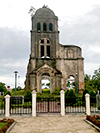
tandava
(ताण्डव)
Sanskrit.
Cosmic dance of the Hindu god
Shiva.
See also
Nataraja and
kalachakra.
回
tang cong (糖蔥)
Chinese. ‘Sugar shallot’ or ‘onion candy’.
Name of a Chinese-Taiwanese confectionary made from liquid sugar or
syrup.
READ ON.
回
tang meh (ตังเม)
Thai name for nougat, a sweet
made from sugar or honey, nuts and egg-white. Different from the
West is that usually roast peanuts, called
thua lisong, are used, whereas in
western nougat, called tang meh
farang, several kinds of roast
nuts are used, ranging from almonds, hazelnuts, walnuts to
pistachios, but usually not peanuts. It is made in a huge block
filled with pulverized,
roast peanuts. From this block a string is pulled using some strength
which is cut into small pieces (fig.).
The term tang meh possibly derives from the Chinese word for nougat
(fig.),
i.e. niu ga tang (牛轧糖), in which the character tang (糖) is the
Chinese equivalent of the Thai word
kanom,
i.e.
‘candy’.
回
%20nougat_small.jpg)
Tanimbar Corella
Common name for a species cockatoo, with the scientific name Cacatua
goffiniana. It is the smallest species of the white cockatoos and
originates from the Tanimbar Archipelago in Indonesia. It
has been introduced in several other countries, including also
Singapore, and occurs in
Thailand as a feral bird
(fig.).
The Tanimbar Corella is overall white, with pinkish-salmon
lores, a pinkish tinge on the upperparts, and a washed yellow tinge
on the underside of the wings and tail. It has a short crest, of
which the feathers can be raised. The legs and feet are bluish-grey,
the beak is deep pale, and the colour of the eyes can range from
reddish-brown in females to brown or black
in males, though otherwise both sexes are similar. Juveniles have
dark grey eyes. Its habitat includes open forest and cultivation. In
Thai this bird is called kra tua
goffin
(กระตั้วก็อฟฟิน).
回
%201_small.jpg)
tanka
Pali for
thangka.
回
Tan Khun Khun Luang
(ท่านขุนขุนหลวง)
Thai. The next title in ascending line after a
Khun or
Khun Luang,
now obsolete. Also the popular name for a Khun. Also transliterated
Than Khun Khun Luang.
回
tanta (दन्त)
Sanskrit. ‘Tooth’ or ‘tusk’. An
attribute of
Ganesha (fig.)
and refers to his broken tusk that he uses as a divine weapon to
destroy obstacles. In Thai called
nga tih hak,
literally ‘broken off tusk’. Also danta.
回
Tantima
(ทัณฑิมา)
Thai. Mythological bird
of the
Himaphan forest.
It has the head of a bird and the body of a
Garuda. According to legend, it loves to dwell near
lotus pools, where it looks for fish. In some
legends this bird has the face of a human and it is sometimes associated with the bird
Sadayu,
the younger brother of
Samphati.
It is usually depicted holding a long rod with both
hands and is often seen in pairs, standing guard at the gates
of certain temple buildings (fig.),
such as in
Wat Phra Kaew, where a bronze pair
guards
Wihaan Yod (fig.).
Also referred to as
nok
Tantima.
回
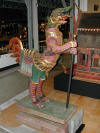
Tantkyitaung Zedi (တန့်ကြည့်တောင်စေတီ)
Burmese.
‘Tantkyi
Mountain Pagoda’.
Name of a Buddhist hilltop temple near
Bagan.
READ ON.
回
tantra
(तन्त्र, ตันตระ)
Sanskrit-Thai. ‘Weave’, ‘loom’, ‘warp’, ‘groundwork’ or
‘underlying principle’. A term
used to refer to a collection of sacred texts and practices
associated with
Tibetan Buddhism (fig.). There are also tantric texts in
Hinduism. The central theme of the tantra is the divine energy and
creating power symbolized by the female characteristics (shakti)
of a god, personified in a goddess. See also
samahkhom tantra.
回
Tantra Thewalai (ตันตระเทวาลัย)
Sanskrit-Thai. ‘Tantra
Idol Shrine’
or ‘Home
of
Tantra
Deities’.
Another name for
Wat Phra Siwa Chao.
See also
thewalai.
回
Tantrism
A late form of
Brahmanism, that consists of a
Hindu
doctrine in which the worship of demons −in particular
Devi−
plays an important role, as well as a mystical form of
Vajrayana Buddhism.
Tantra
yoga
is described as the extreme
expression of
Hinduism
and designed to
invoke possession by Indian spirits, in order to break the chain of
reincarnation.
It is a form of occultism, in which the
shakti
of
Durga
or
Kundalini
force is aroused,
releasing psychic powers that can be channeled either into white or
black magic by the medium.
Whereas white magic is employed in healing,
advanced disciples in black magic indulge in the most degenerate and
perverse behaviour, from human sacrifices to sorcery, including
meditation on severed human heads, the eating of bits of flesh and
unconsumed parts of cremation rites, and other horrifying practices. It
became important in Northeast India after
the 8th century AD, and is still practiced in Mongolia, Tibet and
Nepal. It expanded the Buddhist pantheon and emphasizes the worship
of
shakti,
whilst placing greater importance on the esoteric practices
based on the
tantra.
In India, the Hindu sect of the Aghoris have
similar practices. They dwell on Hindu cremation and charnel
grounds, eat leftovers from human dead bodies, drink and eat from a
kapala
(fig.),
i.e. a bowl made from a
human skull, and smear
vibhuti
on their bodies (fig.),
i.e. ash from a human
cremation pyre. Followers engage in morbid and gruesome occult
practices that date back to the 5th century AD. They are
sadhus
and followers of
Shiva
in his
manifestation as
Bhairava,
and of Durga. They claim to live in a natural state of no fear and
no disgust, hence the name Aghori, which derives from the
Sanskrit
word aghora (अघोर),
an euphemistic title of Shiva, that means ‘not terrific’ or ‘not
terrible’, yet which is usually translated as ‘one who has no fear’.
Besides cannibalism, the Aghori sadhus also indulge in the smoking
of marihuana, the drinking of alcohol and human urine, and the
eating of animal feces and decomposing meat for which they scavenge
in garbage, etc. They also practice rituals of animal and
human sacrifices. See also
Dakini
(fig.).
回
tao (เตา)
Thai generic term for a ‘stove’,
a ‘cooker’, as well as for a ‘kiln’. The specific type is defined by
adding a suffix, e.g.
tao tahn,
tao tawaan,
tao turiang,
tao wong,
etc.
回

tao
(เต่า)
Thai for ‘turtle’,
‘terrapin’ or ‘tortoise’.
The Thai word tao
is used to refer to all species of turtles and tortoises, despite
the fact that ‘tortoises’ are in reality land turtles, and ‘turtles’ are either aquatic or semi-aquatic reptiles, including
‘sea turtles’ and ‘terrapins’. Often no difference is made when translating the
word from Thai, using one for the other and vice versa. Other
languages, such as Chinese and Sanskrit, also have certain words
that are not specific whether it concerns a turtle or tortoise, i.e.
the Chinese word
gui
refers to both, whereas
bie
specifically means ‘turtle’. Besides this Chinese has specific words
to refer to certain mythological creatures that are some form of
turtle or tortoise, e.g.
Xuanwu. In Hindu mythology the second
avatar of
Vishnu is
known as
Kurma, which translated means
either ‘turtle’ or ‘tortoise’, though from the context it can be
understood that it rather was a turtle, since Kurma
supported the churning stick
during the churning of the
Ocean of Milk
(fig.),
thus preventing it from going in the soft soil of the ocean. Given
the above and the fact that foreign
texts, or translations thereof, are often ambiguous in their
meaning, Thailex may at times also use one term for the other,
usually depending on the origin of the word or following the
original texts, but only when related to mythology. In the domain of
science, Thailex always uses the proper term, e.g. with animal
names. If such was unspecified or unclear from the original text,
then the word ‘turtle’ is used, which correctly refers to any of all
the species. See also
tao
mangkon.
回
tao (เท้า)
1. Thai for ‘foot’ or
‘pedestal’.
回
2. Thai for ‘to lean on’. In
this regard it can be used as a prefix for the name of deities or
gods, on who one leans in need. It can than be written with a
capital letter in English.
回
Tao
(道)
Chinese. ‘Right Way’. The all embracing,
ultimate and primordial principle of
Taoism,
with which
Taoists
aspire to become one by
comprehending the universal law that everything returns to its
source. The Tao has been
described as a square circle, a sound that can't be heard and an
image without form, said to be everything and nothing, and while it
is nowhere, it can be seen without looking for it.
Also transcribed Dao.
回
tao angloh (เตาอั้งโล่)
See
tao tahn.
回
tao bai mai
(เต่าใบไม้)
Thai. ‘Leaf turtle’. Name for the
Asian Leaf Turtle.
回
tao ban
(เต่าบ้าน)
Thai. ‘House turtle’. A name for the
Giant Asian Pond Turtle, along with
tao waai.
回
tao bua (เต่าบัว)
Thai. ‘Lotus
turtle’. A name for the
Yellow-headed Temple Turtle,
alongside
tao wat and
tao bung hua leuang.
回
tao bung hua leuang
(เต่าบึงหัวเหลือง)
Thai. ‘Yellow
head turtle’. A name for the
Yellow-headed Temple Turtle,
next to
tao bua
and
tao wat.
回
tao
dam (เต่าดำ)
Thai. ‘Black turtle’. A name for
the
Black Marsh Turtle.
回
tao dao
india (เต่าดาวอินเดีย)
Thai for
Indian Star Tortoise.
回
tao dao
pa-mah
(เต่าดาวพม่า)
Thai for
Burmese Star Tortoise.
回
tao hab (เต่าหับ)
Thai. ‘Shut turtle’ or ‘closed turtle’. Name for the
Southeast Asian Box Turtle. The
name refers to fact that the plastron, the flat to slightly concave
part of the shell structure on the turtle's underside, fits tightly
in the openings of the dome-shaped carapace.
回
tao
hok leuang (เต่าหกเหลือง)
Thai name for the
Asian
Forest Tortoise. The word
hok translates as ‘spill’
or ‘six’
and may refer to the sometimes hexagonal shape of this tortoise's
scutes, whereas leuang means ‘yellow’
and refers to the carapace's colour, which is dark brownish
gray with light brown to vague yellow
clouds in the centre of each scute, which are striated.
回
tao hoo (เต้าหู้)
Thai for
tofu.
回
Tao Hua (桃花)
Chinese.
‘Peach
Blossom’,
a
Taoist deity,
who is also referred to as the peach god.
READ ON.
回
Taoism
An influential philosophy in
China,
probably founded in the 4th century BC by
Lao Tzu (fig.),
and advocating humility and religious piety. The
Tao-te Ching forms the basis of Taoism, in which
Tao is the comprehensive ultimate and primordial
principle. Its objective is to become one with the Tao by
comprehending the universal law that everything returns to its
source. It has been described as a square circle, a sound that can't
be heard and an image without form. It is everything and nothing,
and although it is nowhere it can be seen without looking for it.
Also transcribed Daoism. See also
Wu Wei,
Yu Huang,
Quan Zhen, and
Qiu Chang Chun.
WATCH VIDEO
and
VIDEO (EN).
回
Taoist
1. Follower of
Taoism.
Also transcribed Daoist.
回
2.
Adjective of
Taoism.
回
Taoist Gate of Hell
According to Chinese folklore in
Taoism, the
souls of the deceased have to enter the
Underworld through a gate,
known in Chinese as
Gui Men Guan.
回
tao jan (เต่าจัน)
Thai for
Keeled Box Turtle.
回
tao kaem daeng (เต่าแก้มแดง)
Thai. ‘Red-cheeked turtle’. A name for the
Red-eared terrapin, alongside
tao yipun.
回
tao kaem khao (เต่าแก้มขาว)
Thai. ‘White-cheeked turtle’. A name for the
Black Marsh Turtle.
回
tao ko laai (เต่าคอลาย)
Thai. ‘Striped neck turtle’. A name for the
Chinese Stripe-necked Turtle.
回
tao kra-ahn
(เต่ากระอาน)
Thai name for the
Mangrove Terrapin.
回
Tao Maliwaraat (ท้าวมาลีวราช)
The distinguished old man who came from his
abode in the
Himalayas to arbitrate the differences between
Ramachandra and the demon king.
Also transcribed Thao Maliwaraat and Thao Maliwaraht.
回
tao mangkon (เต่ามังกร)
Thai. ‘Dragon-tortoise’. Name of
an auspicious animal from Chinese mythology. It
has the characteristics of two kinds of favourable animals, i.e. the
tortoise
and the
dragon (fig.).
It is depicted with the head of a dragon and the body of a
tortoise (fig.).
It is the symbol of longevity and power, because the tortoise is an
animal with a long life, whereas the dragon is animal with an
enormous strength. It is thus a combination of the great
virtues of both the dragon and the tortoise (fig.), two out of the four
animals from Chinese paradise. Those four animals are the tortoise,
the dragon, the
hongse
and the
tiger,
though in some instances they may consist of a dragon, tortoise, red
phoenix or other bird, and a white tiger (fig.).
The tortoise with dragonhead embodies the intelligence and ability,
that comes with courage, and the prestigious and influential power
of the dragon, as well as the steadfast power, endurance, happiness
and lasting physical force of the tortoise. A statue of the dragon-tortoise is believed to have the power to bring about or enhance progress,
strength, fortune, influence,
etc., depending on how the statues is
placed with regard to the points of the compass. It is sometimes
depicted with the characteristics of all four animals from Chinese
paradise, i.e. the tortoise, the
dragon, the hongse and the tiger (fig.).
A female dragon-turtle is, like the
Rui Shi
lion, usually depicted with a young (fig.).
Though it originated in
China,
it also occurs in other Southeast Asian nations and in northern
Vietnam there is in fact a hill shaped like a giant
dragon-tortoise (map
-
fig.). Sometimes transcribed thao mangkon. See also
tortoise-snake.
回
tao nah (เต่านา)
Thai. ‘[Rice-] field turtle’. A name for the
Rice-field Terrapin.
回
tao rahng (เต่าร้าง)
Thai name for the
fishtail palm.
回
Tao
Ramathep (เท้ารามเทพ)
Thai. Name of the
guardian god of the holy relics of the Buddha, together with
Tao
Kadtukam (Kattukam).
In iconography he is generally
represented together with the demon-god
Rahu (fig.)
and
seated with the right knee uplifted in a casual yoga position. Though, sometimes
he is depicted seated in
half lotus position on
the coiled
body of a
snake
that
uses its head as a cover, similar to the
pahng nahg prok pose
with
Vishnu
(fig.)
and some Buddha images (fig.). He is also depicted on the front side of the famous
Jatukam-Ramathep amulet (fig.).
Also spelled Thao Ramathep.
WATCH VIDEO.
回
tao
sahm san (เต่าสามสัน)
Thai. ‘Three-keeled turtle’ or ‘three-barred
terrapin’. A name for the
Rice-field Terrapin, and referring to the three
strong keels or bars on this turtle's carapace, which is somewhat
reminiscent of the upper shell of
horseshoe crabs (fig.).
回
Tao Samon (ท้าวสามล)
The old king with seven daughters from the
story of
Santhong.
Also known as king Benares.
回
tao tahn (เตาถ่าน)
Thai. ‘Charcoal stove’ or
‘cinder oven’.
Name for a brazier, a kind of a
small charcoal stove (fig.) which is often used on markets, etc. It is made
of earth, chaff, ashes, galvanized iron and cement. It is also called
tao angloh,
which name derives from a Chinese earthen stove, and
this kind of furnace, sometimes in a somewhat different style, may
also be referred to as
tao wong, i.e. ‘circular stove’ (fig.).
Besides charcoal, also kindling is sometimes used for fuel,
especially with the tao wong. Also transliterated tao
thaan.
回
_small.jpg)
tao tawaan (เตาตาหวาน)
Thai. The oven stoked up to heat the pans used
to process sugar from the bud of the
coconut palm
(fig.).
‘Tao’ means oven, ‘ta’ is the bud of the tree that produces the
fruits and ‘waan’ sugary or sweet.
回

Tao-te
Ching
(道德经)
Chinese. ‘Book of the way’. Book that forms
the basis for the philosophy of
Taoism
and is attributed to its founder
Lao Tzu.
回
Taotie (饕餮)
Chinese. Name of a ferocious
mythological animal, the fifth son of the
Dragon King
(fig.),
commonly
represented
in the form of a zoomorphic mask
motif.
READ ON.
回
tao turiang (เตาทุเรียง)
Thai for a kind of kiln used in
Sawankhalok.
回
tao waai
(เต่าหวาย)
Thai. ‘Rattan turtle’. A name for the
Giant Asian Pond Turtle, alongside
tao ban.
回
tao wat (เต่าวัด)
Thai. ‘Temple
turtle’. A name for the
Yellow-headed Temple Turtle,
besides
tao bung hua leuang
and
tao bua.
回
tao wong (เตาวง)
Thai. ‘circular stove’.
It uses kindling for fuel, rather than charcoal. See also
tao tahn.
回
tao yipun (เต่าญี่ปุ่น)
Thai. ‘Japanese turtle’. A name for the
Red-eared terrapin, alongside
tao kaem daeng.
回
tapathi (တပသီ)
Burmese term for
a recluse,
ascetic or
hermit (fig.).
They typically dress in dark brown robes and wear a
distinctive hat, which is similar in shape to that of the Indian
rishi (fig.)
and the Thai
reusi (fig.).
In
Mon, the term is
ithi, which drives from the Pali
word risi, which in turn derives from the Sanskrit word
rishi.
回
%20ascetic%20or%20hermit%20in%20Myanmar_small.jpg)
taphaab (ตะพาบ)
Thai common name for the
Asiatic
or Malayan Soft-shell
turtle,
found in Southeast Asia. It belongs to the family Trionychidae
and has the scientific name
Amyda cartilaginea.
In
Thailand it is also known
by the names taphaab nahm (ตะพาบน้ำ),
taphaab suan (ตะพาบสวน),
taphaab khao tauk (ตะพาบข้าวตอก),
taphaab thammada (ตะพาบธรรมดา)
and taphaab thai (ตะพาบไทย),
meaning ‘water
soft-shell turtle’, ‘garden soft-shell turtle’,
‘popped
rice
soft-shell turtle’,
‘common
soft-shell turtle’ and
‘Thai
soft-shell turtle’, respectively. In
Isaan
it is called
pla
fah (ปลาฝา),
literally ‘capped fish’. It has a round to oval, olive-grey to green carapace with dark spots and a soft belly, white
with males and grey with females, though the shell of juveniles is
somewhat darker, with tiny
yellow and larger dark spots. The yellow spots are also visible on
the juvenile's head, which has a typical nozzle-shaped snout. Males
have long and thick tails, but those of females are short. A mature
Asiatic Soft-shell Turtle can grow to a length of over 80 centimeters and a weight
of 35 kilograms or more. It occurs in rivers and canals, as well as in
garden beds, in all parts of the kingdom. Some people, mainly Chinese, breed
soft-shell turtles for
consumption, but not the Chinese or Taiwanese
soft-shell turtle (Pelodiscus or Trionyx
sinensis -
fig.), as that particular species grows much slower.
The Siamese or Striped Narrow-headed Soft-shell Turtle
(Chitra chitra), also known as Giant Thai Soft-shell Turtle
and Burmese Chitra, and in Thai as taphaab mahn laai (ตะพาบม่านลาย),
meaning
‘dotted or striped-curtain
soft-shell turtle’,
is allegedly the largest known Soft-shell Turtle
in the world, measuring up to 140 centimeters and weighing around
150 kilograms (fig.).
It is found in Indonesia, Myanmar, Malaysia and Thailand.
回
_small.jpg)
tapioca
Starch gained from the thickened root of the
manioc,
i.e.
cassava
(fig.).
Also called tapioca starch and in Thai known as
paengman.
It is the basic ingredient to manufacture
monosodium glutamate (MSG),
but also an ingredient in many a food product, especially in the
form of starch. In addition, it is also used as fodder and to
produce bio-fuel.
回
tapioca balls
A
snack of
tapioca dough obtained by kneading
small-sized tapioca pearls in warm water, and filled with minced
pork and condiments, such as ground white pepper, ground roasted
peanuts,
fish sauce,
onion and palm sugar. The dough is steamed on a piece of cloth
spanned over the mouth of a large pot and covered by a cone-shaped
lid, until the balls have become semi-transparent (fig.).
It is typically served with lettuce leaves, chopped fried garlic,
chopped coriander and
prik khee noo
chilies, very similar to
kanom pahk moh. In Thai
known as
kanom sakoo sai moo, i.e.
‘sago-snack filled with pork’.
回
%20khanom%20sakoo%20sai%20moo%201_small.jpg)
tapioca
starch
See
tapioca.
回
tapohn (ตะโพน)
Thai. A drum with a double drum
head, horizontally placed in a holder and played with both hands
whilst sitting on the floor. Sometimes called pohn.
回
Ta Prohm (ប្រាសាទតាព្រហ្ម)
Khmer.
‘Grandfather
Brahma’.
Presentday name
of an ancient
Khmer
temple at
Angkor,
which was formerly known as Rajavihara. According to a
stele
commemorating its foundation, the temple was founded in 1186 AD by
King
Jayavarman VII, as a
Mahayana
Buddhist monastery. The temple's main image represents
Prajnaparamita,
i.e. the
bodhisattva
of knowledge (fig.),
and was purportedly modelled on the king's mother. The inscriptions
also state that the temple had considerable riches, including gold,
pearls and silks. Expansions and additions to Ta Prohm continued
well into the 15th century. Today, the complex is very popular,
because it is left in much the same condition in which it was found,
i.e. in the jungle and covered with trees of which the roots
overgrow the ruins. In Thai, Tah Phrom (ตาพรหม).
As in many other Angkor temples, many of the walls are decorated with
Apsaras (fig.).
See also
Phra Phrom,
raja
and
vihara, as
well as
Thai Family Tree.
See also
THAILAND'S NEIGHBOURS & BEYOND,
as well as
TRAVEL PICTURES (1),
(2),
(3) and
(4), and
MAP.
回
Ta Pu Yie (淡浮院)
Tae Chew-Chinese
name for
Anek Kuson Sala. In Thai, it
is transcribed Tah Poo Ih (ต้าผู่อี่). In Mandarin, it is pronounced
Tan Fu Yuan, transliterated in Thai as Tahn Foo Yewian (ต้านฝูเยวี้ยน).
回
taqiyah (طاقية)
Arabic
term for the
brimless,
short, and rounded cap,
worn by
Muslim
boys and
men (fig.).
In English, it is known as a prayer cap, and Thai in called
kapioh
(fig.),
yet
in some places it may also be called a kufi,
topi,
or just a cap.
There are many varieties and it can be of any colour, but often it
is –and in some instances needs to be–white. See also
Hadj.
回
_small.jpg)
Tara (तर/तारा)
1. Sanskrit. ‘One who enables crossover’.
Name of a
bodhisattva,
i.e. a Buddhist goddess, who is especially worshipped as the
female emanation,
shakti
or spouse of
Avalokitesvara
(fig.).
Her name is derived from
the word ‘to cross’, and refers to her function, i.e. to help
mankind to cross safely from birth to death. She is described as
full of compassion and devoted to alleviating the suffering of
mankind. Gradually, she became the personification of love and
compassion. In this sense, she is associated with the Chinese goddess
Kuan Yin (fig.).
Eventually, Tara was elevated to the status of mother of all
buddhas
and is often depicted with a royal crown and holding a
vajra.
Her name is
sometimes spelled Tārā, which means ‘star’ and is related to
dara,
the Thai word for star, and a term used for both heavenly bodies and
celebrities. In
Vajrayana Buddhism, there are five goddesses named Tara,
corresponding to the five
jinas
or transcendental
buddhas. They are the
consorts of the five great
bodhisattvas, who were created by the jinas and hold the
rank of a bodhisattva. In
Tibetan Buddhism,
there are 21 forms of Tara, each with a different colour, posture,
and
attribute
(fig.).
They can have either peaceful or wrathful appearances.
The most frequent forms are Green Tara and White Tara (fig.).
回
2. Wife of the monkey king
Vali in the Indian epic
Ramakien.
回
Taraw Palm
See
chanoht.
回
taro
See
pheuak.
回
Tarut (ตรุษ)
Another pronunciation for
Trut.
回
Tatakot (ตถาคต)
Thai. Term for a
buddha or
Buddha,
derived from the Sanskrit word Tathagata.
回
Tatar Grasshopper
Name of a 6 to 7 centimeter
large grasshopper, with the scientific names Cyrtacanthacris tatarica, Acanthacris tartarica, and Cyrtacanthacris ranacea. It has a long, tapering body, which is overall
brownish, with alternating light and dark brown streaks, as well as
some pale yellowish markings. Its antennae are pale yellow and it
has dark spots spread allover the outer-wings, leading to its
nickname Brown-spotted
Locust. It has three pairs of legs, the
larger posterior pair with some spines, similar to the
Bombay Locust
(fig.).
It feeds on cotton and corn leaves and is hence considered a
potential pest. In Thai, it is known as
takkataen
saitahkhaentahkris (ตั๊กแตนไซตาแคนตาคริส),
a transliteration of this creature's designation in Latin, as well
as by the name takkataen faai (ตั๊กแตนฝ้าย), which means ‘cotton
grasshopper’.
回
%20ตั๊กแตนไซตาแคนตาคริส_small.jpg)
Tat Bunnag (ทัต บุนนาค)
Thai. Name at birth of
Somdet
Chao Phraya
Borom
Maha
Phichaiyaht
(fig.).
Also transliterated That Boonnaak, or similar.
See also
Bunnag.
回
Tathagata (तथागत)
Sanskrit word meaning a
buddha or
Buddha.
In Thai
Tatakot.
回
Tatmadaw (တပ်မတော်)
Burmese. ‘Armed Forces’. The official name of the military
apparatus of
Myanmar under
command of the
Ministry of
Defence. It is composed of the Army, the Navy and the Air
Force, whilst auxiliary forces include —though are not limited to—
the Myanmar Police Force (fig.).
回
tat molih (ตัดโมฬี)
Thai. ‘Cutting the hair tuft’. In religious
context the term refers to prince
Siddhartha who cut his hair after the
Great Departure,
thus giving up his secular life to start his spiritual existence.
See also
Pittih Kohnjuk.
回
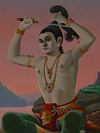
tattoo
See
sak.
回
Taungmagyi (တောင်မကြီး)
Burmese.
‘Lord of the South’.
Name of a
spirit
that
belongs to the official pantheon
of 37
nats worshipped in
Myanmar.
During his life,
he was known as
Shin Nyo,
brother of
Shin Byu, who later became the nat
Maung Minshin. Both
brothers served under King Duttabaung of Prome. According to legend,
the king became so fearful of the brothers' strength that he forced
them to fight each other, to death. They are the sons of
Maung Tint De,
the extremely strong son of a blacksmith, who was burned to death by
the King of
Tagaung for similar —yet unfounded— fears that he might usurp the
throne, and after his death became
the gold-faced
spirit
Min Mahagiri (fig.).
According to another version the brothers are described as the sons
of
Naga Medaw
(fig.).
See also LIST OF BURMESE NATS.
回
_small.jpg)
Taung Min Gyi (တောင်မင်းကြီး)
Burmese.
‘Southern
Minister’.
Name of a Buddhist temple located on the west bank of
Taungthaman Lake
in Amarapura.
READ ON.
回
Taungoo (တောင်ငူ)
Burmese. Name of
a former vassal state of the
Ava Kingdom, that grew in
importance and produced a dynasty of the same name, which rulers
−especially the Kings
Bayinnaung
(fig.)
and
his predecessor
Tabinshwehti− with military
campaigns succeeded in unifying
Burma
and integrating many other former sovereign kingdoms and states
into the Taungoo Empire, and thus came to rule the largest empire in
the history of Southeast Asia, even exceeding the size of the
earlier
Khmer
Empire and including much of modern-day Burma, the Chinese Shan
States, the northeastern Indian State of Manipur,
Lan Xang
(Laos),
Lan Na
and
Siam
(both part of
present-day
Thailand).
Also transliterated Toungoo.
回
Taungoo Mingaung (တောင်ငူမင်းခေါင်)
Burmese.
‘Minkhaung of
Taungoo’.
One of 37
nats that
belong to the
official pantheon of spirits
worshipped in
Myanmar.
In life, he is by some believed
to be Minkhaung II, twice viceroy of
Taungoo between 1549 and 1584 AD,
and a younger brother of King
Bayinnaung
(fig.).
However, Minkhaung II
died of natural causes,
according to one report from dysentery or, though reported yet less
likely, from a strong
smell of onions coming from an onion field he was passing by on his
quest to find a cure for his
illness. But, since one of the main criteria for being inducted into the
pantheon of the 37 nats usually includes a violent dead, many belief
that this nat in life was actually Minkhaung I,
the viceroy of Taungoo
from 1446 to 1451 AD, who was brutally assassinated, i.e. hacked to
death by a sword.
See also LIST OF BURMESE NATS.
回
Taungthu (တောင်သူ)
1. Burmese. Another name for the people of the
Pa-oh ethnic group (fig.)
in
Myanmar. Also
transcribed Taundhu.
回
2. Burmese term for cultivators of agricultural
crops other than paddy.
Also transcribed taundhu. See also
Taungthugyi Min.
回
Taungthugyi Min (တောင်သူကြီးမင်း)
Burmese.
‘Cucumber
King’
or
‘Farmer
King’.
Another name for the
10th Century
Bagan
King
Nyaung-u Sawrahan.
According to legend, King Nyaung-u Sawrahan usurped the throne from
King Theinhko. Once a farmer, Nyaung-u Sawrahan killed Theinhko when
he stole a cucumber from his field, after which Nyaung-u Sawrahan
was accepted as the new King by the Queen, supposedly in order to
prevent unrest in the kingdom. See also
Taungthu.
回
Tavatimsa
Pali. The
heaven of 33 gods presided over by
Indra.
It's a place on the summit of the mythical
Mt. Meru
and one of the heavens that can be reached by
accumulated merit. The
Buddha spent
one rainy season there preaching to his mother
who had died shortly after his birth. The Buddha descending from
Tavatimse heaven is often portrayed in Southeast Asian art and was
the starting point for the creation of the
walking Buddha image that originated in
Sukhothai.
This heaven is said to house
Chulamanie,
a
stupa
containing hair from the Buddha, which is worshipped by Buddhists
during certain nights by releasing
kohm loy, i.e. paper
lanterns, into the sky as offerings (fig.).
A
tower-like structure in
Lay Myat Nar
Phaya
(fig.)
depicts the
Buddha's
descent from the Tavatimsa Heaven.
In Thai
called
Dawadeung.
See also
Apsara.
回
tawaai (ถวาย)
Thai.
‘To present, to dedicate’. Term used when the receiver is a prince
or monk, as in
tawaai phra traipidok.
If the recipient is a king, the correct term is
toonklaw tawaai
or
nomklaw tawaai.
回
tawaai naet (ถวายเนตร)
See
paang
tawaai naet.
回
tawaai phra traipidok
(ถวายพระไตรปิฎก)
Thai.
To present (tawaai)
a volume of the
Tripitaka (traipidok)
to a monk, as a form of
tamboon.
回
Tawagu Phaya (တဝဂူဘုရား)
Burmese. Name of a small group of
freestanding
stupas
located in a grove
in the field just
behind
Bagaya Kyaung
(fig.) in
Inwa.
The main stupa in the centre is
a
gu-like,
that is cave-style edifice, reminiscent of the Thai
mondop. It
houses a
Buddha image
seated in the full
lotus position
and with a
bhumisparsa
mudra.
See also TRAVEL PICTURES (1)
and
(2), and
MAP.
回
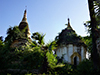
tawak (ตวัก)
Thai. A ladle made of
coconut shell and wood. Its handle is
made of wood and attached to the coconut shell scoop or bowl
whickered by a piece of rattan. It somewhat resembles a wooden
spoon. There are generally three types of ladle, that is one with a
shallow bowl, one with a slightly deeper bowl and one with a very
deep bowl. Also called
krajah or jah, in southern
Thailand
it is called
jawak or wak, and in the North
phaak. See also
krabuay.
回
%20coconut%20shell%20ladle_small.jpg)
tawed (เตว็ด)
Thai.
‘Figure’.
Another word for
jawed.
回
Tawny Coster
Common name of a butterfly (fig.), with the scientific
designations Acraea terpsicore and Acraea violae. In Thai, it is
known as
phi seua non nahm kathokrok (ผีเสื้อหนอนหนามกะทกรก), which
translates as
‘thorny butterfly passiflora caterpillar’,
a name that refers to the leaves of the Passiflora foetida, which
the larvae of this butterfly, which are reddish-brown with fine
black spines, prefer to feed on. The upperside of the male butterfly
is tawny, with transverse black spot on the forewings and a black
apex and termen. The hindwings also have some black spots and black
border, with pale, almost white spots.
The underside is similar
to the upperside, but paler, and females are similar to males, but
duller. In both sexes, the antennae are black, the head and thorax
black with pale brownish-yellow and white spots, and the abdomen is
black near the front and orangey at the back, with narrow transverse
black lines. On the head there is also has an orangey epistome.
回
%201_small.jpg)
Taxila
(तक्षशिला)
Sanskrit.
The
ancient capital city of the
Gandhara
civilization
and a former
Buddhist centre of learning,
which developed the
Gandhara
style, an Indian art form in which
Buddha images have
realistic features and draped attire. Today, Taxila is
a UNESCO World Heritage Site
in present-day Pakistan.
See also POSTAGE STAMP.
回
Tay (Tày)
Vietnamese. With an estimated 1.5 million
members, the second largest ethnic group in
Vietnam, after the
majority of Viet people. Most members live in the hills and valleys
of northern Vietnam and are self-supporting agriculturalists. They
typically inhabit small villages of a dozen or so households,
usually located at the feet of mountains, where they cultivate the
fertile plains, planting
rice
and other crops, such as corn and sweet potatoes. Most Tay abide by
animism and ancestor worship. They speak
Tai and are are closely
related to the
Nung, and the
Zhuang
(fig.) in
China.
In China, the Tay are known as Dai Yi (岱依) and are, together with
the Nung, classified as members of the Zhuang.
回
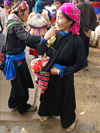
tazaung
(ဆောင်)
Burmese.
‘Room’ or ‘chamber’.
Name of small pavilions, located within Buddhist temple complexes
or palaces in
Burma.
There are different types with different functions, with some being
similar to the Thai
sala,
while
others are more reminiscent of a
mondop,
or may serve as the temple's
belfry, or as a building
that connects two main halls in a monastery or a palace.
They usually have
pyatthat-like
rooftops. Also hsaung.
回
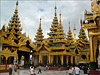
Tazaung Daing (တန်ဆောင်တိုင်)
Burmese.
‘Leading
Light Pillar’ or ‘Leading Light Post’. Name of a
festival in
Myanmar,
similar to
Loi Krathong
in
Thailand,
and celebrated during the full moon day of the eight lunar month of
the Burmese calendar called Tazaungmon, which is usually in
November. In
English, the event is referred to as the Festival of Lights or
Balloon Festival, as hot air balloons lit with candles, similar to
the Thai
kohm loy floating
lanterns (fig.),
are released and monk's robes weaving competitions are held. The
festival marks the end of the rainy season, as well as the end of
the
kathin
season, during which monks are offered new robes and alms. Whereas
the hot-air balloons date back to the late 19th century, when the
British first held hot air balloon competitions, the origin of the
robe weaving competition goes back to
Maha Maya,
the mother of the
Buddha,
whom after her death was reborn in
Tavatimsa
heaven. It is believed that when the Buddha went there to preach to
his mother during the rainy season, she near the end of his visit
spent the entire night weaving a monk's robe for him.
Gautami,
the
sister of
Siddhartha's
mother, who became his guardian after Maha Maya died,
continued this tradition and began offering new robes annually, thus
initiating the tradition of
thod kathin.
Also spelled Tazaungdine.
回
tea
See
cha.
回
tea brick
Dried
tea which is pressed
into an easily transportable and storable
block, in the past usually square in shape, though in our time the dried tea may be pressed into chunks
of any form, sometimes even decorative, as a
souvenir or a novelty item,
such as the form of
Chinese gold ingots
(fig.)
or ancient Chinese
coins
(fig.)
called
fang kong qian
(fig.),
perhaps to indicate that they in the past were also used as a form
of currency, though
most
commonly they are nowadays disc-shaped. Also referred to as
compressed tea. See also
cha.
回
tea ceremony
A
ritualized form of making, serving and drinking
tea.
Though these rituals can be found in many countries with a tea
culture worldwide, they are practiced typically by people from nations such as
China,
Korea and Japan. The Chinese tea ceremony, which is locally called
cha
yi (茶仪), includes certain gestures, e.g. the server will lift the
teapot high-up three consecutive times while pouring the hot water
on the dried tea leaves, whilst the drinker will tick with his index
and middle fingers together on the surface of the table to express
his recognition, yet without saying a word. When pouring
ready-to-drink tea from a pot, rather than just hot water on tea
leaves, often an additional cylindrical cup is used, in which the
tea is poured first. Afterward, the tea is poured from the
cylindrical cup into the drinking cup and the cylindrical cup is held
under the nostrils to absorb the aroma before dinking the tea. Chinese
people always use tea to welcome guests in their home, filling a cup
of tea for only seven-tenths of its capacity, believing that the
other thirty percent will be filled with friendship and affection,
in line with
Confucius' wisdom: ‘behave toward
everyone as if receiving a great guest’.
See also
Chinese tea house
and
Lu Yu.
回
_small.jpg)
tea egg
A chicken's egg boiled until hard and then
simmered in black
tea,
which is mixed with various spices, such as ground
cinnamon, star anise (fig.),
fennel seeds, cloves and Szechuan peppercorns, and soy sauce. To
allow the fragrance and flavours of the tea and spices to penetrate
the hard-boiled egg, the shell is gently cracked all around, which
produces marbling that becomes visible when the egg is peeled (fig.).
In Chinese tea eggs are known as
chayedan,
i.e. ‘tea-leaves eggs’.
回
_small.jpg)
tea house
See
Chinese tea house.
回
teak
Name for a deciduous tree with the
botanical name
Tectona grandis. It is
recognizable from its large rough leaves (fig.),
and the dull coloured flowers and
seeds that sit on the sides and rise
above the canopy. The leaves resemble those of the
ton phluang (fig.),
but they have a rough surface instead of a smooth one. When
squeezed, they release a dark red sap (fig.),
which some hill tribe women reportedly use to colour their lips as a
natural alternative to cosmetic lipstick.
According to some sources, teak is the tree under which
Siddhartha was born
(fig.)
and of which
Maha Maya holds a branch standing during the delivery, a
scene often depicted in art (fig.).
Other sources however state that Maha Maya reached out to pick a
flower of the
Ashoka
blossom when the prince was born.
Besides this, the tree is famed for its use as tropical
hardwood (fig.),
which is
sometimes called
djatiwood
and in Thai known as
mai sak.
Logging, usually with the aid of
elephants
(fig.),
is nowadays strictly regulated, and while trees are cut at a much
youmger age as in the past, for every tree cut a new one must be
replanted. However, there is reportedly still a lot of illegal
logging going on by poachers, who during transportation of the logs
habitually use forged documents to support their claims that the
logs have been imported from neighbouring
Myanmar.
Due to its
hard qualities it is used for furniture, as well as for carving art (fig.),
especially for making very detailed reliefs
(fig.).
Nowadays,
the thick logs from the past have now become rather rare.
The tree itself is in Thai called
ton mai sak.
回
teak tree
In Thai
ton mai sak.
See
teak.
回
teakwood
In
Thai
mai sak.
See
teak.
回
tears grass
See
deuay.
回
Temiya (เตมีย์)
Thai-Pali. Name of the
bodhisatta
in one of the
jataka stories,
when he was born as the son of Queen Chanda Devi, the wife of the king of Kashi,
i.e. Varanasi.
READ ON.
回
Temminck's
Tragopan
Common name for a medium-sized pheasant, with the scientific name
Tragopan temminckii. Adult males are crimson, with grey-edged, white
ocelli-like spots below and black-edged, white spots above. They have a brown
tail, barred with chestnut and a grey tip,
a dark
bill with some faded yellowish
patches, and pinkish-orange
legs. The neck, breast and hind-crown are dark orange, whilst the
forehead and ear-coverts are black. They have bare blue facial skin,
and an inflatable dark-blue lappet on the throat, as well as
inflatable, horn-like appendixes over the eyes. These features stand
at the origin of its Chinese name, i.e. hong fu jiao zhi (红腹角雉),
which translates as ‘red-bellied
horned pheasant’. Adult females are
brown, with white spots, and a bare blue eyering. This bird is
widespread in northern India, China and some northern areas of
Southeast Asia, such as Northwest
Vietnam.
回
_small.jpg)
temple
See
wat
or
araam.
回
Temple of Dawn
See
Wat Arun.
回
Temple of Heaven
See
Tian Tan.
回
Temple Plant
Another name for the
Sacred Garlic Pear.
回
temple
tree
Nickname for the
frangipani tree, often grown in temples grounds.
回

temple drum
Large
drum in temples and monasteries usually kept in the drum tower or
ho klong (fig.).
The most common is called
klong aew.
回
Temple Of Literature
Name of a Confucian temple in
Hanoi, in northern
Vietnam, which was first built in the beginning
of the 11th century AD.
READ ON.
回
tengai (天蓋)
Japanese. Name of a
beehive-shaped reed hood that fully covers the head and face and
worn by the mendicant monks the
Komuso
sect of
Zen
Buddhism in Japan during the
17th to mid-19th century AD, in order to manifest the absence of
specific ego.
回
teng lang (เต็งลั้ง, 灯龙)
Thai-Chinese term for any type
of Chinese lantern. It derives from tung long (เติงหลง, 灯笼), which
literally translates as ‘caged lamp’ or ‘light
basket’, and since it is often red in colour, it may also be
referred to as hong tung long (หงเติงหลง)
or
hong deng long (红灯笼), which means ‘red
lantern’ and which is a symbol of good fortune (fig.).
See also THEMATIC STREET LIGHT (1),
(2),
(3),
(4)
and
(5).
回
_small.jpg)
Ten
Judicious Kings of Hell
According to popular
Taoist
beliefs influenced by Buddhist
karma, the Ten Judicious Kings of Hell
(fig.),
who come up against the Ten Celestial Judges, are
responsible for the
judgement
of the soul after death by examining
the deeds of the newly-deceased, in order to dispense punishments
for evil acts and rewards for good deeds, and accordingly give them
a
reincarnation in a fit form. The
concept comes from the apocryphal Sutra of the Ten Kings, which
describes the ten spheres through which a soul must pass on its way
to rebirth. It was believed that each sphere was presided over by a
king and hence hell is made up of ten courts. They are also called
the Ten Kings of Hell (Diyu
-
fig.) or the Ten
Yama Kings and are sometimes depicted
in the presence of
Ksitigarbha
(fig.),
the bodhisattva of hell beings, who is regarded as having powers to
rescue souls from undesirable forms of rebirth. In
Vietnam, they are
known as Thap Dien Diem Vuong (Thập Điện Diêm Vương), and statues of
the judges are often found in
pagodas, as funeral rites for
the saving of the souls of the deceased were once closely linked
with Buddhist rituals.
回
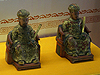
ten kam ram khiyaw (เต้นกำรำเคียว)
Thai. ‘Sheaves and
sickle
dance’. A Thai folk dance in
which the participants dance while holding a sheaf (kam) of
rice
in one hand and a
serrated sickle
(kiyaw
-
fig.) in the
other.
See also POSTAGE STAMP.
回
Ten Principal Disciples
Monks and the main disciples of
the historical
Sakyamuni
Buddha.
Depending on the source, the disciples included in this group vary,
and according to the Vimalakirti
Sutra
the members are:
Sariputta (fig.),
founder of the
Abhidhamma
tradition;
Mogallana
(fig.),
the disciple who was the most
accomplished in supernatural powers;
Maha Kassapa
or
Kasyapa
(fig.), the monk that succeeded
the Buddha
as leader of the
Sangha;
Ananda
(fig.),
a cousin of
Siddhartha
Gautama and chief
disciple;
Rahula
(fig.),
the only son of
Prince
Siddhartha
and Princess
Yashodhara; Upali (fig.), a top
master of the
Vinaya,
which in the First Buddhist Council after the Buddha's death was
compiled based on his memory;
Anuruddha Thera (fig.),
a cousin to Prince
Siddhartha
who frequently appears in the Jataka (fig.)
and who is described as an affectionate and loyal disciple of the
Buddha
and a master of clairvoyance;
Maha Katyayana (fig.), who is known in Thai as
Phra Sangkatjaai
(fig.)
and whom
the
Buddha praised for his excellence in explaining the
Dhamma;
Purna (fig.), the greatest teacher of the
Dhamma;
and Subhuti
(fig.),
who had a deep understanding of the potency of Emptiness. Large
marble images of the Ten Principal Disciples are on display at Chua Linh Ung (fig.),
a Buddhist
pagoda
in Da Nang in central
Vietnam.
回
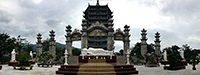
Terminal 21
The name of a chain of
theme-based shopping malls located in Thailand,
owned and operated by
Siam
Retail Development Co., Ltd., a subsidiary of the prominent Land and
Houses Group, one of Thailand’s leading real estate developers.
It is known for its distinctive design concept that integrates
global city themes into each of its floors. The first branch,
Terminal 21
Asoke, opened in
Bangkok
in 2011, and subsequent branches were established in other cities
across Thailand. Each mall is characterized by its innovative
architectural layout, which blends retail, dining, and entertainment
spaces with thematic elements representing iconic cities from around
the world, such as Paris, London, Tokyo, and Istanbul. Terminal 21
malls are designed to provide an immersive shopping experience,
featuring open, expansive layouts with wide balconies and
multi-level viewing platforms, creating dynamic spatial interactions
for visitors. These malls are strategically located in urban centers
with easy access to public transportation, enhancing their appeal to
both local and international shoppers. Terminal 21's combination of
global city aesthetics, consumer-oriented design, and accessibility
positions it as a significant contributor to Thailand’s retail
landscape.
WATCH VIDEO
and
VIDEO (EN).
回

termite
Name of a small subtropical or tropical antlike,
social insect of the genus Isoptera, of which there are an estimated 4,000 species.
They are sometimes referred to as white ants and in
Thai called pluak (ปลวก).
The genus has several families, the three main ones, which are economically the most significant as pests,
being Kalotermitidae,
Rhinotermitidae and Termitidae,
with the latter including the subfamily Macrotermes. In Southeast Asia
alone there are about 270 species, with around 90 of them living in
Thailand. Eleven of those are
economically significant as pests and are divided into two main
categories, i.e. dry wood termites and subteranean termites, in Thai
known as pluak mai haeng (ปลวกไม้แห้ง) and pluak tai din
(ปลวกใต้ดิน), respectively. In
Thailand, about 95% of all economic
damage is caused by two species belonging to the last group, i.e.
the rubber termite or Asian
subterranean termite (Coptotermes
gestroi) and the Mound-Building Subterranean Termite (Globitermes
sulphureus), which in Thai are known as pluak yahng phara
(ปลวกยางพารา) or ‘rubber tree
termite’ and pluak tih sahng jom pluak (ปลวกที่สร้างจอมปลวก),
respectively. Termites
live in large colonies, often inside a
termite mound (fig.).
Physically, termites differ from ants by three main features: 1.
termites' antennae are straight and look like a very fine
string of pearls, whereas those of ants are elbow antennae, i.e.
bent in an angle; 2. the termite's waist is broader than that of
ants; 3. in alates, i.e. winged
adults, the termite's wings are
equally long and shaped the same, whereas those of ants are not the
same size nor shape. See also
mot.
See also WILDLIFE PICTURES.
回
termite
mound
Name
of a sculptured, cone-shaped, hard earth mound,
home to a small tropical antlike social insect
called
termite (fig.).
Termite mounds can be small or tall, and the outer form can be
rather simple, with a smooth rounded shape, to quite complex, wavy
structures (fig.),
which increases the surface area and thermal mass, providing a
cooling system during the day, as well as a heating system at night,
by flattening out the daily temperature fluctuations, since the
thermal mass will absorb thermal energy when the surroundings are
higher in temperature than the mass, and give thermal energy back
when the surroundings are cooler. Besides this,
there is a complex system of labyrinth-like tunnels and cavities
inside a termite mound. Cool wind is drawn into the base of the
mound via channels and its coldness is stored using wet soil. As the
air warms during the day, it flows upwards and out of the mound via
vents. This gives the mound the ability to keep a stable temperature
throughout. Termites live in large colonies and do not feed on wood
as is commonly believed but on fungus, as they lack enzymes in their
intestines to break down wood cellulose. Inside the termite mound,
there are several chambers, including a nest chamber and humid food
chambers used to cultivate fungus. These fungus gardens are supplied
with wood fiber, hence the confusion with regard to their
nourishment. Termites are heavily preyed upon by other insects,
reptiles, birds and even larger mammals, such as the pangolin and
some bears. Worker termites build and maintain the chambers as well
as a labyrinth of tunnels leading to them. Soldier termites have the
important task of defending the termite mound from enemies and for
that reason have enlarged jaws. Unlike ants termite workers may be
of either sex, but only one male and female in the entire colony
reproduce: the queen with her distended abdomen produces eggs and
the king fertilizes them. At certain times, often at sundown during
the rainy season, the nest will send out large swarms (fig.) of winged
offspring (fig.) to establish new colonies.
In popular Thai speech, these winged termites are called
maeng mao (fig.),
meaning ‘drunken insects’, since they
seem to be completely disorientated and once they have dropped on
the floor, they act even more so, going around in circles, as if
they are drunk. Although the majority of them
will die, it takes only one male and one female to become the king
and queen of a new colony. In
Hinduism, termites and ants are
considered divine beings and are believed to be the first beings
ever created. As such, they are the subjects of a number of myths,
especially in connection with procreation. In traditional folklore
they play an essential role in the creation process. Some say the
world was created from their excreta, whilst others believe that the
first humans were made from the clay of termite mounds. In India, it is also
widely believed that
rainbows
originate from termite mounds or anthills. In addition, termite
mounds and anthills are the haunt of snakes, which are inextricably
connected with the cult and myths of the
naga. Also known as termitaria
and in Thai called jom pluak (จอมปลวก).
回
terracotta
Italian. ‘Baked earth’. Hard
orange to brown clay, used in architectural decorations, sculpturing and
pottery. It is made into
unglazed, usually brownish-red earthenware, including statuettes. Famous places where terracotta is produced, include Koh Kred
or Ko Kret (เกาะเกร็ด) in
Nonthaburi,
Dan Kwian (ด่านเกวียน)
in
Nakhon Ratchasima, and Ban Thung Luang
(บ้านทุ่งหลวง) in
Sukhothai.
Sometimes spelled terra-cotta.
WATCH VIDEO.
回
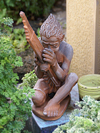
Terracotta Army
See
Terracotta Warriors.
回
Terracotta Garden
Name of a traditional theme park in the northen Thai
province of
Lamphun
which features a number of lifesized
Khmer-style monuments, art and architecture, much of
it in
reddish sandstone and
terracotta.
In Thai, this location is known by the name Suan Mai Thai Ban Pho
Liang Meun (สวนไม้ไทยบ้านพ่อเลี้ยงหมื่น), which translates as
the
‘Wooden Garden of
Stepfather Meun's Thai House’.
回
Terracotta Warriors
Name for a collection of about 8,000,
life-sized,
terracotta
funerary statues
(fig.),
that were excavated near the mausoleum of
Qin Shi Huang Ti,
the first emperor of the Qin
Dynasty and the founder of
China. The terracotta
sculptures allegedly represent exact replicas of the then soldiers and
servants of the aforementioned emperor, and beside warriors, such as
archers, cavalrymen and infantrymen, the
collection also includes horses,
chariots and charioteers, as well as officials, acrobats, strongmen
and musicians. Each statue is said to be unique, varying in aspect,
height, uniform and hairstyle, in accordance with the model's
function, rank and military unit. The Terracotta Warriors were
discovered by accident in 1974, in the district of Lintong, about 40
kilometers East of the city of Xi'an. Today, the Terracotta Warriors
have become one of China's prime tourist attractions, and copies of
the terracotta army's soldiers and chariots (fig.)
can be found all over China, as well as abroad, such as
in
Thailand's
Anek Kuson Sala
(fig.).
Construction of the tomb, with 35 square miles the largest in China
(i.e. 500 times bigger than any other tomb excavated in the nation),
was started as soon as emperor Qin ascended the throne and is said
to have lasted 37 years, hence it continued even after his death. At
one point some 710,000 people worked on it. So far, no one has been
able to find the entrance to the tomb where the emperor is buried.
See MAP.
回
_small.jpg)
Territorial Defense Student
Name of a Thai youth
enrolled in a military training program organized by the
Royal Thai Armed Forces
to develop discipline, leadership, and national defense skills,
offering exemptions from conscription and pathways to military and
civilian careers. The Territorial Defense Student Program is a
cornerstone of Thailand’s military youth training system, providing
secondary and university students with opportunities to develop
discipline, leadership, and national defense skills. It prepares
cadets for roles in both military and civilian leadership, fostering
patriotism and readiness. Rooted in the ‘Youth Soldiers’ initiative,
known in Thai as Yuwachon Thahaan (ยุวชนทหาร) and established in
1934, the program evolved into its modern form after World War II to
meet contemporary defense needs. Cadets progress through five levels
of training, encompassing theoretical coursework, practical
exercises, and field training, with annual exams ensuring
participants uphold military standards. The program operates across
the three branches of the armed forces: the
Royal Thai Army,
focusing on leadership and infantry skills; the
Royal Thai Navy, specializing in
naval operations at bases like Sattahip; and the
Royal Thai Air Force, offering
training in aviation mechanics. Cadets wear khaki-green uniforms
with rank insignias denoting their level and leadership roles, with
advanced trainees participating in specialized activities like
parachuting, requiring exceptional fitness. Graduates gain notable
benefits, including exemption from conscription, rank equivalencies,
and advantages in military academy admissions. Grade 3 graduates are
fully exempt from conscription, while Grade 5 graduates with a
bachelor’s degree can be commissioned as second lieutenants. The
cadet's grade or training level, ranging from Grade 1 to Grade 5, is
indicated by a Thai numeral—1 (๑), 2 (๒), 3 (๓), 4 (๔), or 5
(๕)—displayed in yellow on the tip of their left collar. The program
not only enhances Thailand's defense readiness but also cultivates
disciplined and capable individuals, ready to contribute to national
security and society at large. In Thai, this reserved officers'
training corps is known as nak seuksah wichah thahaan (นักศึกษาวิชาทหาร),
though they are often referred to by the abbreviation ro. do. or r.d.
(ร.ด.), which stands for raksah dindaen (รักษาดินแดน), and freely
translates to
‘Territorial
Defense’.
回

tessen (鉄扇)
Japanese. ‘Iron
fan’. Name for a war fan, a folding fan with outer spokes made of iron and
used in oriental warfare, originally from Japan. The fan was
designed to look like a normal, harmless folding fan, so it could be
taken to places where swords or other weapons were not allowed. The
war fan was used as a throwing weapon or for fending off arrows,
kung-fu stars and darts, and even as an aid in swimming. Some tessen
were solid clubs shaped to look like a closed fan. A certain style
of
tai chi chuan using a fan (fig.)
is derived from the use of war fans. In Chinese, it is called
tie shan
and in Thai
pad lek.
回
_small.jpg)
tetrahedron (τετράεδρον)
Greek term for a building with four gable
ends. See also
jaturamuk.
回
teuk chang (ตึกช้าง)
Thai for ‘Elephant
Building’.
回
teuk hun yon (ตึกหุ่นยนต์)
Thai for ‘Robot
Building’.
回
tha (ถะ)
Thai name for a
Chinese-style
pagoda
(fig.).
回
tha (ท่า)
1. Thai. ‘Pose’ or
‘posture’, a term
typically used for poses in dance. It is
similar to
pahng, but the
latter is more frequently used to indicate
the attitude, position, pose or style
of a
Buddha image or other
statues.
回
2. Thai. ‘Wharf’ or
‘port’.
回
thaan (ถ่าน)
Thai. ‘Charcoal’. Burnt wood
used as a fuel. Charcoal is produced by removing fluid from wood by
means of heating it in the absence of oxygen. The process of
carbonizing the wood therefore takes place in a oven underneath the
ground and takes several hours. Charcoal is mainly used by street
vendors using a small charcoal brazier called
tao tahn
(fig.) for cooking food on
(fig.), and in
foundries. In Myanmar,
bamboo charcoal is used for cooking
rice, i.e. added to the water, as it is said to absorb chlorine, bad
odor and toxic substances from it. Typically, unindustrialized
charcoal is always packaged in the same manner in most, if not all
places across mainland Southeast Asia, i.e. in large woven
polypropylene bags, generally left open at the top yet laced with plastic cord,
i.e. tied in an
open web-like pattern. The legendary creature
Sih Hoo Hah Tah
(fig.)
eats
red-hot charcoal which it defecates as pure gold (fig.). Also transcribed tahn.
回
thaan tawan (ทานตะวัน)
Thai for ‘sunflower’. A kind of
annual flowering plant, with a large flower head and the botanical
name Helianthus annuus. It is produced commercially, in
Thailand especially
in the provinces of
Saraburi
and
Lopburi,
with the latter celebrating an annual
Sunflower Blooming Festival
in December (map
-
fig.).
Its seeds are edible and roasted they are a popular Thai snack,
while the roots of the species
Helianthus tuberosus, which
are
known in Thai as
kaen tawan, are also edible
(fig.).
There are several cultivars.
See also POSTAGE STAMP (1),
(2) and
(3).
回
thaat (ธาตุ)
See
that.
回
Thab Lan (ทับลาน)
Thai. Name of a
Thai National Park that
covers a 2,235 km² area in
both
Nakhon Ratchasima and
Prachinburi Provinces.
Its name is also transliterated Thaplan and is pronounced Thap Lahn.
回
thablang (ทับหลัง)
Thai for
lintel.
回
thabthim (ทับทิม)
1. Thai for pomegranate,
the name of a tropical tree and its fruit, of the genus Punica. The
fruit has a thick and tough rind, and inside it has many seeds with
a reddish pulp varying in colour from deep crimson to pale rose,
hence its name which derived from French means ‘many-seeded apple’. The reddish-pink flesh covering the seeds is translucent and juicy
and tastes either sweet or sweet and slightly sour. The tree fruits
during the rainy season. In Chinese it is named
shi liu,
which is written with the character
shi,
meaning ‘stones’ and refers to the many seeds, while it is also
homonymous with the word
shi
meaning ‘generation’. It is
regarded as one of the three fruits of
abundance, together with the
peach and the
fingered citron, and is thus often
represented in Chinese art (fig.).
回
2. Thai name for ruby, a
rare transparent precious stone varying in colour from deep crimson
to pale rose.
See POSTAGE STAMP.
回
3. Thai name for a Chinese
goddess, who is fully known as
Chao Mae Thabthim
(fig.).
回
Tha Byae Tan (သပြေသန်း)
Burmese. Name of a
fortress, located at the east bank of the
Irrawaddy River (fig.),
near the old
Ava bridge (fig.) or
southern bridge to Sagaing, southwest
of Mandalay and just north of the mouth of
the
Myit Nge River near
Inwa. It was
built under King
Mindon Min (fig.)
between 1874 and
1878 AD in order to protect the
Mandalay capital against the
British during the Third Anglo-Burmese War,
as one of three forts, the others being
Asaykhan Fortress
(fig.)
and
Sin Kyone Fortress (fig.).
Also transliterated Thabyedan.
See
MAP.
回
Tha Chang Wang Luang (ท่าช้างวังหลวง)
Thai. ‘Main Palace
Elephant
Wharf’. Location at the
Chao Phraya
River in
Bangkok,
near the old city gate at the
Grand Palace,
where in the reign of
Rama I,
the royal palace elephants were taken to bathe.
When in 1808, the
Phra
Sri
Sakyamuni
Buddha image (fig.) from
Sukhothai was transported to
Bangkok by raft, in order to be installed at
Wat Suthat (fig.), a wharf was built at
the location to unload the Buddha image. However, the large image
could not pass through the
city gate, which was
consequently demolished and a new one was built afterward, which was
named Pratu Tha Phra (ประตูท่าพระ), i.e. ‘Buddha Wharf Gate’ or
‘Buddha Port Gate’ and the wharf is since
then referred to as Tha
Phra, i.e. ‘Buddha Wharf’
or ‘Buddha Port’. Today, it is still a boat landing from where
ferries cross the river and which is by local residents unofficially
still called Tha Chang, i.e. ‘Elephant Wharf’.
回
Tha Chin (ท่าจีน)
Thai. ‘Chinese Seaport’. Name of
a river in central
Thailand, that flows through the Central Plains.
It is a distributary of the
Chao Phraya
River, that branches off near the province of
Chainat
and then flows
southward, more or less parallel to the Chao Phraya, but to its
West, until it empties into the Gulf of Thailand at the province of
Samut Sakon.
The Tha Chin River is an important source for local distribution of
tap water. Only near its mouth at Samut Sakhon is the river called
Tha Chin, i.e. the old name of Samut Sakon, because in the past, it
had been a trading port dealing with a vast number of Chinese junks.
However, along its flow, the river is known by a variety of regional
names: after it splits from Chao Phraya River at Chainat, it is
called
Makhaam Thao River; near
Suphanburi
it is known as the
Suphan
River; and near
Nakhon Pathom
it is referred to as the
Nakhon Chai Sri River. Tha Chin is
also transliterated Tachin and is pronounced Thah Jihn.
See also MAP
and
WATCH VIDEO.
回
Thadingyut (တင်းကျွတ်)
Burmese. ‘The End of
Buddhist Lent’.
Name of a lunar month in
Myanmar, which
coincides with the
end of the Buddhist Lent,
i.e. the three-month annual retreat observed by Theravada Buddhists
known in
Pali
as Vassa and
locally as Wa or Thadin, whereas the end of it
is known as
Watwin or
Thadin Gyut (Kyut), literally
‘The Top of Buddhist Lent’, and is akin
to the Thai period of
owk pansa.
On
the full moon day of this month,
usually somewhere in
September/October, the Lighting Festival is held, which commemorates
the
Buddha's
descent from
Tavatimsa
Heaven
after having preached the
Abhidhamma
there to his
mother
Maha Maya during the rainy season.
Thadingyut Festival is known in full as
Thadin Gyut Pwe Taw,
i.e. the ‘Week of the Fall Festival’, and considered the second most
popular festival in Myanmar, after
Thingyan, i.e. the New Year Water
Festival.
回
Thadin Gyut Pwe Taw (သီတင်းကျွတ်ပွဲတော်)
Burmese. ‘The End of Buddhist
Lent Festival’. Full name for the
Thadingyut Festival. See
also
pwe taw and
pwe.
回
Thadominbya (သတိုးမင်းဖျား)
Burmese. Name of a
Shan
King, who was born on 7 December 1345 as the son of Princess Soe Min Kodawgyi of
Sagaing (fig.)
and Viceroy Thado Hsinhtein of Tagaung, and thus a grandson of
King
Saw Yun
(fig.),
the founder of the Sagaing Kingdom. In 1365 AD, he founded
Ava and reigned it from 26 February
1365 to ca. 3 September 1367 AD, when he passed away, aged 21. In
his 3+ years of reign, he laid the foundation for the reunification
of
central
Burma
and took on corrupt clergy.
See also
TRAVEL PICTURES.
回
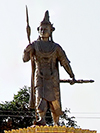
thaen (แท่น)
Thai. Base, pedestal or altar. See also
tahn.
回
Thaen Khwan (แทนขวัญ)
Thai. Name for a species of
water lily,
with the botanical name Nymphaea tan khwan and commonly as the Tan-khwan
Water Lily.
READ ON.
回
Thaen Phong (แทนพงศ์)
Thai. Name for a species of
water lily,
with the botanical name Nymphaea tanpong and commonly as the Tanpong
Water Lily. This free-blooming hardy water lily originates from
Thailand and blooms all year round. It is a hybrid of the Mayla and
the Madam Ville Frongoniere, and was bred by Pairatana Pongpanich of
the Department of Agriculture. The flower bud tapers towards the top
end and bulges in the middle, whilst the tip of the petals is
pointed. The petals are white and red, whilst the layers of petals
are specially dense, with more than 45 petals. This water lily is
depicted on a Thai postage stamp issued in 2008 (fig.).
回
Thagyamin (သိကြားမင်း)
Burmese. ‘King Thagya’
or ‘Lord Thagya’.
Name of the
nat
who is the appointed leader of all other nats, i.e. nature spirits
or spirits from mythology (fig.), especially the spirits of
those who
met a violent
and unjust death, and of which there is a pantheon 37 in total,
although Thagyamin himself has not suffered a sudden and violent
death. He was designated their leader by King
Anawrahta in the 11th
century, in an effort to merge the existing practices of
animism with those of
Theravada Buddhism. Thagyamin is
said to rule over the
deva plane of existence and
is often depicted holding a
conch in both
hands, or a conch in one hand and a
yak-tail's
fly-whisk in the other. Sometimes he is represented standing on a
three-headed
White Elephant,
similar to
Erawan, the mount of the
Hindu god
Indra, with whom he is identified. In
Buddhism, he
is associated with
Shakra.
Sometimes transcribed Thagya Min and also called Thagya nat.
See also LIST OF BURMESE NATS.
回
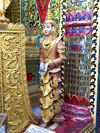
thahaan sarawat (ทหารสารวัด)
Thai for ‘military policeman’. See also
Sarawat
Thahaan.
回
Thahng
Chang Pheuak
(ทางช้างเผือก)
Thai. ‘Path of the
White Elephant’.
Thai name for the Milky Way.
回
thahng deun jong krom (ทางเดินจงกรม)
Thai term for a
meditation path, a lane that is typically about 1 meter wide and 15
meters long, with the entire floor leveled so that one can walk
easily without having to worry about any obstacles, oftentimes fashioned as
a kind of elongated sandbox and used by Buddhist monks to walk
whilst
meditating, a practice done barefooted and known in Thai as deun
jong krom (เดินจงกรม),
literally ‘to
walk being mindful’. The meditation path is usually covered with a
roof and as such somewhat resembles an elongated
sala-like
edifice. At one end it typically has a large
thian pansa, i.e. a
large Buddhist candle (fig.).
WATCH VIDEO (1)
and
(2).
回
Thahng Rot Fai Mareutayu
(ทางรถไฟมฤตยู)
Thai for
Death Railway.
回
Thai (Thái, ไท)
Vietnamese-Thai. Name of an ethnic minority group in mainland
Southeast Asia, not to be confused with the
present-day people of the
Thai
race, who inhabit
Thailand.
There are many subgroups. In
Vietnam, the
traditional attire of the
women consists of a long-sleeved blouse or a short-sleeved
shirt in pale blue, purple, white, red or pink colour, worn over a long
black skirt, with a waistband is a bright colour (fig.). The short-sleeved shirt is
trimmed with a black collar-like band with
silver buttons or clips,
whereas the long-sleeved blouse has no buttons, but is of one piece. The latter is typically covered with
an embroidered cloth that is wrapped around the lower
torso, and stretches from the breasts to navel. Also
spelled
Tai
and sometimes Thay or
Tay, of which
the latter spelling is not to be confused with the other ethnic
minority group in Vietnam.
回
Thai (ไทย)
1. The present-day people of the Thai
race, formerly called Siamese, who inhabit
Thailand.
回
2. Language spoken by the present-day people
of
Thailand.
回
Thai Air Force Museum
See
Royal Thai Air Force Museum.
回
Thai Airways
Name of the national airline of
Thailand.
READ ON.
回
Thai Bank Museum
Museum founded by the Siam Commercial Bank,
Thailand's first ever local bank
(fig.),
and located at its head office in
Chatuchak
District (fig.).
The museum exhibits objects and
information on the historical development of the Thai financial
world and commercial business, which is strongly related to the
bank's own history. In Thai, the museum is known as Phiphithaphan
Thanakhaan Thai (พิพิธภัณฑ์ธนาคารไทย).
See also
Mahison Rachareuthay
and
Bank of Thailand
Museum.
See MAP.
回
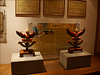
Thai-Belgian Bridge
Flyover on
Rama IV
Road in
Bangkok
that crosses Witthayu Intersection near
Lumphini Park.
The viaduct
originally stood on the largely
residential Leopold II Boulevard in Brussels and was built to
improve traffic during the 1958 World Fair. The elevated road
connected the brand new ring road around central Brussels with the
highway to the coastal city of Oostende. Though intended to be a
temporary measure, the viaduct stayed for over 25 years. The viaduct
was dismantled in 1984 and replaced with a 2,5 kilometer-long
tunnel. The classic story is then that the dismantled bridge was
shipped to Thailand and rebuilt in Bangkok, yet other sources state
that the Thai-Belgian Bridge in Bangkok would have been made up of
parts of another temporary bridge that was put up next to the
Brussels viaduct during its demolition. In any case, Belgian
engineers constructed Bangkok’s first of many flyovers as a gift
from the Belgian government.
See MAP.
回
Thai basil
Another name for a kind
of basil, with the botanical name
Ocimum
basilicum var. thyrsiflora
and known in Thai as
hora-phaa.
回
Thai
Black
Tarantula
See
beung.
回
Thai cabbage
See
kalamplih.
回
Thai-Chinese Culture & Arts Exchange Centre
Organization that looks after
the coordination of the cultural exchange relations between
Thailand and
China.
It is located in
Bangkok's Huay Khwang (ห้วยขวาง) District, opposite of the
Chinese Culture Centre (fig.).
In Thai, it is known as
Soon Laek Plian Silapa
Wattanatham
Thai-Jihn
(ศูนย์แลกเปลี่ยนศิลปวัฒนธรรมไทย-จีน).
See MAP.
回
Thai Constitution
See
Ratthathammanoon.
回
Thai Dragon Tree
Common epithet
for an ornamental plant with the botanical binomial names Dracaena
cochinchinensis and Dracaena loureiroi, the latter often misspelled
as Dracaena loureiri. In Thai, it is known as chanpha (จันผา,
จันทร์ผา).
回
_small.jpg "Sea Almond (leaves)")
Thai eggplant
See
makheua proh.
回
Thai fisherman pants
See
kaangkaeng le.
回
Thai Forest Tradition
Theravada
Buddhist lineage
of monasticism that focuses on
kammataan,
which started around 1900 AD with
Phra Ajaan Man
(fig.),
who strived for a return the oldest form of
Buddhism
by concentrating on a strict observance of the
Vinay,
while teaching the actual practice of
jhana,
and the realization of
nibbhana. His
doctrine includes that virtue is a matter of the mind and that
intention forms the essence of virtue, rather than the widely held
belief that virtue is a matter of ritual and that good results are
achieved by conducting the proper ritual. Practitioners of this form
of monasticism that consists of wandering meditating monks typically
dwell or are accommodated in so-called forest temples called
wat pah.
回
Thai gold
Thai gold usually contains 96.5% gold, which is a bit over 23 karat.
The remaining 3.5% are
silver and bronze. Thai gold is measured in
baht,
a unit of weight that equals 15.244 grams
for gold bars and ingots, and 15.16 grams for gold jewelry. Because
pure gold, in Thai referred to as
thong nopphakhun
and
thong kham neua kao, is considered too soft to make jewelry, a lower karat like
18k is recommended. The price of Thai gold is published daily by the
government and every gold shop uses that price for selling their
gold items on that particular day. Gold shops display the buying and
selling prices on their windows. Thai gold is a popular item amongst
the Chinese population during
Chinese New Year (fig.)
when the young traditionally buy gold to give
to senior family members. Since 1982, a well-liked
collectable among Thai-Chinese people are the popular Chinese gold panda coins
(fig.), which
are issued annually (fig.) by the People's Bank of China (fig.). See also
Chinese gold ingot.
回
_small.jpg "buang sra-wang")
Thai Heritage Conservation Day
Since 1985, an annual event organized on 2 April, the birthday of
Princess
Sirinthon, to celebrate her efforts
to preserve a variety of national heritages, such as culture, art,
language, literature, history, archeology, architecture, music, and
religion. Since 1988, this annual event is commemorated by issuing a
set of postage stamps (see
list). In Thai,
Wan Anurak Moradok Thai.
回
Thai Human Imagery Museum
Museum in
Nakhon Pathom
with a permanent exhibition featuring life-size wax images of famous
Thai and foreign personalities.
READ ON.
回
Thai Khoo Fah (ไทยคู่ฟ้า)
1. Thai. ‘Thai Pair of the Sky’.
Name of the Government House of Thailand, i.e. a building in
Neo-Venetian Gothic style, that resembles the Palazzo Santa Sofia in
Venice and since 1963 houses the offices of the Prime
Minister and the cabinet ministers. It was built in 1923, in the
reign of King
Vajiravudh (fig.),
and designed by the Italian architect Annibale Rigotti. It was initially
referred to as
Baan
Norasingh
and Teuk
Kraison,
i.e.
‘House Norasingh’
and
‘Kraison Building’,
and served
as the residence of General
Chao Phraya
Ram Rakhop (รามราฆพ), i.e.
Momluang Feua
Pheungboon Na
Ayutthaya
(เฟื้อ พึ่งบุญ ณ อยุธยา)
and his family. When the general eventually moved, he sold the
edifice to the
government during the time when
Phibun Songkram
(fig.)
was premier, to be used as a reception venue for
foreign guests of the government, rejecting a bid from
the Japanese government, who wanted to turn it into their Embassy.
But at the time, the
government lacked the necessary funds for the purchase, so the Royal
Treasury was asked to step in and buy the property on their behalf, for the amount
of 1 million
baht. The
office of the Prime Minister was given the care of the building,
and
had it renovated and modified with the help of the
Italian sculptor
Corrado Feroci
(fig.).
Though the government initially used it as a venue to entertain foreign
guests of the government, from 1963 onward it is used as the
Government House. When Sarit Thanarat/Dhanarajata
was premier, he further purchased the land and mansions around the Government House, including the
assets that belonged to the Royal Treasury in front of the
Department of Highways, for nearly 57 million baht. Today,
Thai Khoo Fah (fig.),
is located on a 45,000 square meters plot of land near the
Royal Turf Club in
Bangkok (fig.). In
2012, the building was published on a postage stamp, to mark
the 80th Anniversary of the Office of the Prime Minister (fig.).
See MAP.
回
%20Government%20House%20of%20Thailand_small.jpg)
2. Thai. ‘Thai Double Sky’. Name
of an Airbus A319 CJ, which purchase was approved by the former
prime minister Thaksin Shinawat,
to serve as the Office of the Prime Minister, and nicknamed the Thai
Air Force One. After the coup of 2006, which ousted Thaksin Shinawat, the
aircraft was transferred
to the Royal Thai Air Force. It is currently used primarily to
transport VIPs and as a reserve aircraft for members of the royal
family. Its Thai name is the same as that of the Government House of
Thailand, as it was meant to serve as its double in the sky.
回
Thailand
Thailand is a unified kingdom, previously
known by the name
Siam.
It was officially established in 1238 AD, the traditional founding
date.
READ ON.
回
Thailand Balloon Festival
Annual event in
Bangkok featuring balloon art, i.e.
multiple party balloons that are made into sculptures. During the 4th
Thailand Balloon Festival in June 2009, the main theme was creatures
from Thai mythology, featuring multiple balloon sculptures of
fabulous creatures (fig.),
many of them inhabitants of
Himaphan forest, including the most gigantic
Hanuman in Asia (fig.).
The happening, organized for the first time in 2006, should not to
be confused with the Thailand International Balloon Festival, which
features hot air balloons. In Thai, the
Thailand Balloon Festival is called
thetsakahn look pohng yak.
回
_small.jpg)
Thailand-Burma Railway
See
Death Railway.
回
Thailand-Burma Railway Centre
The
Thailand-Burma Railway Centre in
Kanchanaburi is an interactive museum, as well as a
research and information Centre dedicated to presenting the story of
the Thailand-Burma Railway, which ran from Nong Pladuk in Thailand
to Thanbuyuzayat in Burma and was built by the Imperial Japanese
Army during WW II. The museum consists of eight galleries featuring:
an introduction in view of a timeline; the different phases of
planning; construction and logistics; a geography of the railway;
the living conditions in the camps; medical aspects; a summary of
the deaths; the end of the war; and what happened after the war. The
museum has video and slide show displays and sixty panels describing
the history of the
Death Railway from its inception to the final scene of the
line in 1947, in both Thai and English. The text is supported by
artwork, (electronic) maps, scale models, a diorama (fig.), graphics, actual war time
photographs and plans. The museum is situated just beside the
Don Rak war cemetery, on which it offers a panoramic
view from its coffee shop. See also the
Hellfire Pass Memorial.
See MAP and
WATCH VIDEO.
回
Thailand Cultural Centre
Complex in
Bangkok that promotes the culture and
arts of
Thailand,
especially the performing arts, such as
khon.
For this purpose, the venue has several auditoria and an outdoor
amphitheater. It also features a cultural library and several
permanent exhibition on Thai life and culture, including a
collection of
khon masks. The Thailand
Cultural Centre was built with a grant from Japan and in tribute
features a Japanese pavilion and Japanese-style garden (fig.),
as well as a Thai pavilion, which is built over a pond and houses a
Buddha image.
The foundation stone was laid
on 1 April 1983 by
Princess
Sirinthon
and the venue was inaugurated on 9 October 1987 by King
Bhumiphon.
The Thailand
Cultural Centre is located in Huay Khwang (ห้วยขวาง) District,
adjacent to the
Chinese Culture Centre (fig.),
and is built on a plot of land measuring 22
rai,
2
ngan
and 83
wah,
donated by Mr. Phairoht (ไพโรจน์) and Mrs. Thipawan Jirachanahnon
(ทิพย์วรรณ จิรชนานนท์).
The centre is under the
supervision of the
Fine Arts Department
and is also referred to as Thailand Culture Centre. In Thai, it is
known as Soon Wattanatham
Haeng Prathet Thai
(ศูนย์วัฒนธรรมแห่งประเทศไทย).
See MAP.
回
%201_small.jpg)
Thailand Earth Observation Systems Satellite
Name of the first satellite in Southeast Asia, that is used for
natural resource exploration in
Thailand
and which is operated by
the Thailand's national space agency, i.e. Geo-Informatics & Space
Technology Development Agency (GISTDA), in cooperation with EASD
Astrium SAS in France, who developed the satellite. The project is
funded by the Thai Ministry of Science and Technology and stems from
the cooperation between the French and Thai governments. It is also
referred to by its abbreviated name, i.e. THEOS, which is Greek for
‘God’. The satellite was launched into orbit on 1 October 2008
from Dombarovsky Air Base near Yasny in Russia, using a Dnepr
carrier rocket of the International Space Company Kosmotras. The
satellite has an
orbital inclination of 98.78° and orbits earth
every 101.4 minutes.
See also POSTAGE STAMP.
回
Thailand Post
See
Praisanih Thai.
回
Thailand Tobacco Monopoly
Thai state enterprise, that ‒until the signing of the
ASEAN
Free Trade Area agreement in 1992‒ had a monopoly over the
manufacturing and distribution of tobacco products in
Thailand.
READ ON.
回
Thai Labour Museum
Museum on the evolution of
Thai labour, from the time that slavery still existed up to the
present. It is located in
Bangkok's Makkasan district, in a building that was first used as
the office of the Railway Police and later as office of the Labour
Union, from where it conducted its operations. In front of the
museum a monument is erected to celebrate the dignity of labour,
which consists of a sculpture of a man and a woman pushing a large
mechanical wheel forwards, symbolizing the (cog-)wheel of (labour)
history (fig.).
Inside the museum, murals depict the history of the evolution of
Thai labour, and displays objects from the past, such as a Chinese
rickshaw,
an important vehicle of the past. A former police cell, which still
has metal bars, has been adapted as a library with the works of prof.
Nikhom Chantharawituhm (ศ. นิคม จันทรวิทูร),
the foremost expert on Thai labour. The exhibition is divided into
six themes, i.e. 1. forced labour as the foundation of the ancient
society; 2. labour during the time of the reformation of the
country; 3. the sorrows of the labourer; 4. labour and democracy; 5.
from the dark age to the golden age; and 6. Thai labour today.
See MAP.
回
%202_small.jpg)
Thai Lu (ไทลื้อ, ไตลื้อ)
Ethnic
minority group and a subgroup
of the
Tai,
who migrated some 200 years ago from
China's
Xishuangbanna
to
Thailand
and mainly settled in the
provinces of
Chiang Mai,
Chiang Rai,
Phayao,
and
Nan.
Their religion is similar to Thai
Theravada
Buddhism. In Nan, they have influenced Buddhist architecture and a
typical Thai Lu style temple is recognizable from its thick walls
with small windows and stairs with broad handrails and double or
triple roofs with curved
gable boards.
They build their traditional houses of wood or
bamboo on solid
wooden poles. On the ground floor is usually the kitchen and a place for
weaving. They are known for their hand-woven fabrics. In
Thailand, they are estimated to be with ca. 100,000.
The word Lu, Leu or
Leua in the Tai languages means
‘North’,
akin to the Thai word Neua (เหนือ).
Also
transliterated Thai Leua, Tai Lue, and Tai Leua.
They are also called
Lawa
and
Lua,
and in
China,
the
ethnic
Tai are classified as Dai (傣),
in
Laos
as
Tai
(ໄຕ), in
Myanmar
as
Tai Yai,
and in
Vietnam as
Tai
and
Thai.
See also
Tai Yuan
and
Wa.
See also TRAVEL PICTURE.
回
%202_small.jpg)
Thai Mask Play
See
khon.
回
Thai Military
See
kong thap.
回
Thai Parliament Museum
Name of a museum
within the Parliament House of Thailand in
Dusit
and
dedicated to the political history of Thailand after the transition
to a constitutional monarchy in 1932. In Thai, the museum is known as Phiphithaphan Lae Jodmaay Het
Rattasaphah (พิพิธภัณฑ์และจดหมายเหตุรัฐสภา).
See MAP.
回
THAIPEX
Abbreviation for ‘Thailand
Philatelic Exhibition’,
a biannual event
organized by the Thai Post Office, in which stamp collectors exhibit their national and
international stamp collections. There may also be competitions.
The exhibition is usually held in August in a
location in or around
Bangkok. It was first held in 1971 under the
name ThailandPEX, and has occasionally been organized under
different names, especially when it was
part of a larger international event. Since 1973, special
commemorative stamps with the Thaipex logo have been issued on the
occasion of each of the exhibitions. In Thai, it is known as
ngan sadaeng trah praisanih yahkon haeng
chaht (งานแสดงตราไปรษณียากรแห่งชาติ),
which translates as
‘national postage stamps' exhibition’.
回
Thai Phuan (ไทยพวน)
Name of a
Tai
Theravada
Buddhist people
spread out in small pockets over most of the
Isaan,
with other groups dotted in Central
Thailand and
Laos.
They number around 205,000 and their population is split fairly
evenly between Laos and Thailand. Their language is closely related
to other tribal Tai languages. In the beginning of April the Thai
Phuan of
Sri Satchanalai
hold their annual
Buat Chang
Had Siew
ceremony in which they use
elephants to parade
buatnaag
novices into the temple. Also
transcribed Tai Phuan and sometimes called just Phuan or Lao Phuan.
回
Thai plum
See
makok.
回
Thai Pony
See
mah klaeb.
回
Thai Red
Cross Society
Society founded on 26
April 1893, during the reign of King
Rama V, to provide relief to the victims of the
territorial conflicts along the borders of
Siam and French Indochina, over
land on the left bank of the
Mekhong River. Initially and prior to 1906,
the organization was called Red
Unnahlohm
Society of
Siam
(fig.),
referring to the
yan-like (fig.) insignia
(fig.) worn on the cap of the
soldiers of those days (fig.),
which the organization took at its emblem (fig.)
and also appeared on its
flag
(fig.). At first, the society only dispatched
medical supplies, food and clothing to the soldiers engaged in
defending the country, and aided to alleviate the suffering of the
injured. Later, during the reign of King
Rama VI, the scope of its
activities was widened to include general health care, disease
prevention and relief services. In 1920, the society was recognized
officially by the International Committee of the Red Cross and a
year later accepted as a member of the League of Red Cross and Red
Crescent Societies. The society has always been closely associated
with the royal family and is under royal patronage, with many
projects initiated by royal members, such as the
Queen's Housing
Resort in Sri Racha (map
-
fig.). From its
foundation onward successive queens have been the Thai Red Cross
Society's presidents and at present princess
Sirindhorn serves as executive vice
president, while a council of 20 members and 12 representatives from
the provincial Red Cross chapters are appointed by the queen to
oversee the operations of the organization. The Thai Red Cross
Society is represented in all of Thailand’s 77 provinces
(fig.) and the provincial Red Cross chapters are
usually chaired by the provincial governor’s wife. Besides hospitals
(map
-
fig.)
and administrative offices (fig.), the society has several specialized
branches and services, such as a cancer institute (map
-
fig.),
a national blood centre
(map
-
fig.),
an organ
donations centre (fig.), a nursing
college, a first-aid and health training centre, a research
centre, a children's home for orphans (fig.), etc. In the society's Queen Saovabha Memorial Institute
anti-tuberculosis (map
-
fig.) and rabies vaccines, as well as
snake serums are produced (fig.),
both for domestic use and export. In Thai called
Sapaakahchaad Thai.
See MAP.
回

Thai Red Cross Youth
Movement founded on 27th January
1922 by the initiation of Prince
Boriphat Sukhumphan
(fig.),
the then Executive Vice-president of the
Siam
Red Cross Society,
and initially known as the Siam Red Cross Youth Division. Its goal
is to inculcate Thai youth to be good citizens, have
self-dedication, as well as values and ideas of peace and good
health, and to offer voluntary services to the society. Hence, on
January 27th the annual Thai Red Cross Youth Day is observed. There
are today more than 900,000 Thai Red Cross Youth members all over
the nation, though the majority are girls. Initially, membership was
available for children aged
8
to 18, but in 1978 the
age range was expanded from 8
to 25 years old. In Thai, the organization is
known as Yuwakahchaad Thai (ยุวกาชาดไทย) and its emblem is a red
cross on a white background in a pale blue circle, the same colour
as the girls' uniforms, whereas boys wear a white shirt over blue
shorts.
See also POSTAGE STAMP,
as well as
TRAVEL PICTURE.
回

Thai Song Dam (ไทยทรงดำ)
Another name for
Lao Sohng.
回
Thai Talipot Palm
Common name for the
bai lahn
fan palm (fig.).
回
Thai Thani Arts and Culture Village
Name of an arts and
cultural village, located just south of
Pattaya
(fig.)
city, in
Chonburi
province, that
highlights authentic Thai traditions and lifestyles. It features a
replica of the
Lan Na-style
Ho Kham Luang Grand
Pavilion (fig.),
and a northern traditional market. The village also includes a
khantoke
northern-style dinner (fig.),
traditional houses in the different architectural styles of the four
regions of Thailand (fig.),
and cultural performances.
回

Thai Water Dragon
See
Indochinese Water Dragon.
回
Thai Waterworks Museum
Museum located at the Samsen
Water Treatment Plant in
Bangkok's Phaya Thai District.
READ ON.
回
Thai Yai (ไทใหญ่)
See
Tai Yai.
回
Thai Yuan (ไทยวน)
See
Tai Yuan.
回
Thaksin (ทักษิณ)
1. Thai name for the South. See also
Isaan
and
Phayap.
回
2. Thai. Name for a kind of base for
chedi,
and also known as
tahn
thaksin.
回
3. Thai. Another name for
Shiva,
the Hindu deity who
represents destruction.
回
thaksinahwat (ทักษิณาวรรต)
Thai. A circular procession around a temple,
an important shrine or a
stupa,
in a clockwise direction with the temple or shrine on the right,
whilst holding candles, or other offerings. It is practiced during some Buddhist festivals, such as
Khao Pansa
and
Visakha Bucha.
When candles are used, it is also referred to as
kaan wian thian. It is the opposite of an
uttarawat. Compare this with the Sanskrit word
pradakshina.
WATCH VIDEO.
回

thalae (ทะเล)
Thai for ‘sea’ and thus
a synonym of
samut. However, while samut and
thalae both refer to large bodies of water, samut is a more formal,
literary term often found in classical or official contexts, such as
in place names like
Samut Prakan,
whereas thalae is the common, everyday word used in casual
conversation. Thalae can also be used in other contexts, such as in
thalae mek,
meaning a
‘sea of clouds’.
Also transliterated thale.
回
thalae mek (ทะเลเมฆ)
1. Thai.
‘Sea of clouds’.
Name for a natural phenomenon that arises due to low stratiform clouds that form a foggy band,
often floating in between mountains.
回
%202_small.jpg)
2. Thai.
‘Sea of clouds’.
Name for a lunar mare, i.e. a dark spot of basaltic lava on the
moon's surface, visible from Earth, and in generally referred to by
its Latin name Mare Nubium.
回
Thalang (ถลาง)
1. Ancient name for
Phuket. It
derives from the old
Yawi word
telong, which means ‘cape’
and the Malay name for the island, i.e. Tanjung Salang, which means
‘Cape Salang’ and was
itself distorted into
Junk Ceylon in some Western sources.
The northernmost
amphur of the province, which was the location
of the old capital, is still named Thalang.
Sometimes transcribed Tha-Laang.
回
2. Name of the northernmost
amphur of the province
Phuket, where
the old capital used to be located. It is also the former name of
the island and is sometimes transcribed Tha-Laang.
回
Thalon (သာလွန်)
Burmese. Name of the eighth king
of the Toungoo Dynasty of Burma, who reigned for 19 years, from 19
August 1629 until his death on 27 August 1648. He was born on 17
June 1584 as the son of King Nyaungyan Min and thus a grandchild of
King
Bayinnaung (fig.).
He is acclaimed for successfully rebuilding the war-torn country
after the preceding near century long warfare, thereby instituting
many administrative reforms and restoring the economy. During his
reign an revenue inquest was made for the first time in the peaceful
kingdom. Also transliterated Thalun.
回
_small.jpg)
tham (ธรรม)
Thai
pronunciation of the
Pali
word
dhamma.
Also pronounced
thamma.
回
tham (ถ้ำ)
Thai
for ‘cave’.
Most caves in Thailand are limestone caves that have formed over
long periods of time when corrosive trickles of rain water seeped
through tiny pores and cavities in the limestone, eating away at the
rock. Cavities became cracks allowing more water to enter and erode
more rock, sometimes allowing for an underground river to form. The
flow of such as subterranean river then can create enormous
underground chambers, in which in due course speleothems, such as
stalactites and stalagmites are formed. This happens when a single
drop of water saturated with minerals trickles from the rock. Each
time this occurs it leaves behind the faintest ring of limestone, a
process that is repeated time and again, over time depositing enough
limestone rings to eventually form a very narrow hollow tube known
as a soda straw. These can grow quite long, but are very fragile. If
they become plugged by debris, water begins flowing over the
outside, depositing more calcite and eventually form into cone-shaped stalactites. The same water drops that fall from the tips
of stalactites deposit more limestone on the floor below over time
resulting in the formation of rounded stalagmites. Given enough time these
formations can meet and fuse, creating columns.
回
Tham Din Phiang (ถ้ำดินเพียง)
Thai.
Name of a tunnel cave within the compound of
Wat Tham Sri Mongkhon
(fig.) in
Nong Khai.
The grotto is said to be the abode of the
naga and
a
golden statue of a seven-headed naga guards the entrance. The cave
has been formed by water erosion and allegedly has
an underground corridor that connects all the way to the
Mekhong
River, several kilometers away.
Visitors are let in only in small
groups of a few people at a time, as most of the
area in this subterranean place is narrow while the
ceiling is mostly low. Year-round, the
cavern is at least in part inundated and visitors are
asked to take off their shoes before entering, as
in most places one needs to walk through shallow streams
or pools of still water. Whereas walking
upright would be virtually impossible for adult visitors
most of the time, in a few places one will also have to
squeeze through narrow corridors, often while wading
through low water. At certain
spots the passage is in fact so narrow or low that
visitors will have to crawl on their knees or belly in
order to pass through. The naga tunnel
cave is eventually exited at the top by a series of
steep ladders, just a short walk back downhill to the
main entrance where visitors can retrieve their shoes.
See
also
TRAVEL PICTURES
and
MAP.
回
%202_small.jpg)
thamin sa bibi la (ထမင်းစားပြီးပြီလား)
Burmese. ‘Have you eaten
rice yet?’. Informal greeting in
Myanmar,
similar to the Chinese
chi fan le ma, and the Thai
kin khao reua yang.
These questions are usually rhetorical in nature, and posed
in order to show an interest in the other person's wellbeing, rather
than a nosiness into someone's actual eating habits or an invitation
to a meal. Also transliterated thamin sa pyeepyee la, or similar.
回
Tham Kaew (ถ้ำแก้ว)
Thai.
‘Chrystal
Cave’. Name of a
huge
limestone cave in
Surat Thani
province,
located in a steep
cliff near
Khao Sok National Park (fig.).
This little visited, off the beaten track cave is situated about a
kilometer from the entrance along the main road but the mountainous
path towards it is challenging, i.e. steep and slippery, with sharp
rocks. Some sections are fitted with metal ladders and ropes to hold onto to
facilitate the way up and down.
WATCH VIDEO (1)
and
(2).
回
Tham Kaew Saraphat Neuk (ถ้ำแก้วสารพัดนึก)
Thai.
‘Magic
Crystal Cave’ or ‘Crystal
Cave of the Various
Imaginations’. Name of a stunning cavern
located on the compound of
Wat
Tham
Trairat
(วัดถ้ำไตรรัตน์), a Buddhist temple in
Nakhon Ratchasima
province. The cave is believed to be sacred and used to be a
residence of several revered monks, such as
Luang Poo
Dun Atulo (ดูลย์ อตุโล), Luang Poo Chot Khunasampanno (โชติ
คุณสัมปันโน), and
Luang Pho
Pheum
Barami (เพิ่มบารมี). The cave is divided into
five major zones, namely: 1. The entrance to the cave is the name
also used as a generic name for the entire cave, i.e.
Tham
Kaew Saraphat Neuk (ถ้ำแก้วสารพัดนึก),
which means ‘Magic Crystal
Cave’; 2. Tham
Phra Phut
(ถ้ำพระพุทธ) or ‘Buddha Cave’;
3. Khrohng Kraduk
Phra
Reusi
(โครงกระดูกพระฤาษี), meaning the ‘Hermit’s
Skeleton’, i.e. the remains of a hermit
that allegedly lived in the cave some 4,000 year ago;
4. ‘Pratu
Mangkon
(ประตูมังกร) or ‘Dragon Gate’;
and 5.
Phiphithaphan
Hin lae Rohng Phapphayon Tham (พิพิธภัณฑ์หินและโรงภาพยนตร์ถ้ำ),
which translates as ‘Rock Museum
and Cave Theatre’.
In English, the cave is referred to as Magic Cave Land. This
subterranean labyrinth of interconnecting grottos is inhabited by a
small colony of microbats that find their way in and out by an
open-ended shaft in the ceiling.
WATCH VIDEO.
回
%201_small.jpg)
Tham Khamin (ถ้ำขมิ้น)
Thai.
‘Turmeric
Cave’. Name of a
huge
limestone cave in Tai Rom
Yen, a circa 425 km² National Park in
Surat Thani.
READ ON.
回
Tham Khwan Deuan (ทำขวัญเดือน)
Thai.
Name of a ritual in which the hair present at
birth, which in Thai is called phom fai, is shaved. The ritual is
consequently also known as
Kohn Phom Fai
and often referred to as
Phittih
Tham Khwan Deuan. It takes place when
the infant has reached the age of one month (deuan), i.e. pass the
danger period, when the infant is considered to be no longer at risk
of dying. An auspicious day is chosen and on the occasion, it will
also be given its name. The term Tham Khwan literally means ‘to perform welcoming rites’. Compare also with
khwan
and
Phittih
Kohnjuk.
See also TRAVEL PICTURE,
POSTAGE STAMPS
and
WATCH VIDEO.
回
Tham Khwan Naag (ทำขวัญนาค)
Thai.
‘Blessing
the
Naga’.
Name of
a pre-ordination
ritual and purification rite conducted in order to educate the
naga
or
buatnaag, i.e. the
candidate Buddhist
novice, on parental grace, nurturing a commitment to virtue
and monk's discipline that will lead to merit accumulation
and blessings for the parents, and in which the naga
will receive the
traijiewon
or
pahkahsahwapad,
i.e. the monk's habit, which symbolizes the protection one enjoys as
a monk.
See also POSTAGE STAMPS
and
WATCH VIDEO.
回
Tham Le Khao Kop (ถ้ำเลเขากอบ)
Thai. Name of a limestone cave
with a subterranean stream in
Trang,
which can be visited only by a flat-bottomed rowing boat.
READ ON.
回
thamma (ธรรม, ธัมมะ)
Thai
pronunciation of the
Pali
word
dhamma.
Also pronunced
tham.
回
Thammakaay (ธรรมกาย)
Thai ‘Legal
body’, ‘truth body’ and ‘reality body’.
Name of a Thai Buddhist
tradition known in English as
Dhammakaya.
回
Thammasat (ธรรมศาสตร์)
Thai ‘Legal science’. The term derives from the Sanskrit word
Dharmasastra, an ancient book of the
law in
Hinduism, and refers in Thai to the
science or philosophy of the law, i.e. jurisprudence.
In the late 19th century, the
Thai legal system
was
reformed with the
assistance of
Gustave Rolin-Jaequesmyns, a
Belgian diplomat and adviser to King
Chulalongkorn, who helped
to establish law courts and
founded the International Law Institute, the precursor of the
Thammasat
University
founded by
Pridi Phanomyong (fig.), where he
is now honoured with a statue (fig.). Both
in 1973
and 1976
the university
was the scene of
a massacre (fig.)
twice, first during an
uprising in which students and other citizens alike demanded
democracy, the second time during
demonstrations
against the return of the former dictators of the military
regime who in 1973 had
fled the country.
For its 60th Anniversary in 1994, a memorial building was erected
and a plaza was established on the University's Tha Phrachan Campus,
located on the east bank of the
Chao Phraya River in
Bangkok, along where the former
Rattanakosin
western city wall
(fig.)
used to be and which
today features a
paifang-style
(fig.)
memorial wall and archway.
The middle section of this
watchtower-like
walled gate (fig.)
has battlements
similar to the
bai sema
(fig.)
of a crenellated city wall,
and refers to the base of the ancient city wall built in the reign
of King
Rama I,
that was discovered underneath the adjacent 60th Anniversary
Building during restoration works in 1997. The Thammasat Association (fig.
-
map) in the
khet
Sathorn, is a
prestigious organization and leading center for all students and
alumni of the Thammasat University that supports and develops
activities in education and social development. There is also a
large campus in
Pathum Thani,
which in its front has a
large water pond filled with
lotus
flowers, the symbol of
Pathum Thani,
whose name actually means
‘Lotus
City’.
See also
TRAVEL PICTURE
and
PANORAMA PICTURE.
回
_small.jpg)
Thammathada Sangharam (ธรรมธาดาสังฆาราม)
Thai. Another name for
Sathan Patibattham Samakom
Thammathada,
a Buddhist
meditation centre in
Saraburi
Province.
回
Thammayut (ธรรมยุต,
ธรรมยุติ)
Thai word derived from the Pali word
Dhammayutika, meaning ‘group
adhering the
dhamma’. It is the name of a
sub-sect of the Thai
Theravada school of
Buddhism, founded in 1833
by King
Mongkut and modeled after an early
Mon form of monastic discipline which is
generally stricter than its counterpart. Its aim was to make
monastic discipline more orthodox, as it was found that there were
serious discrepancies between the rules given in the Pali Canon and
the actual practices of the monks. It also tried to get rid of all
non-Buddhist, folk-religious and superstitious elements that had
become part of Buddhist practices. Thammayut monks are expected to
attain proficiency in meditation, as well as Buddhist scholarship
through study of the scriptures. They are allowed to eat only once a
day, before noon, and only what is in their
alms bowl. This is in contrast with the
monks of the
Mahanikaai sect, who specialize in
either meditation or study of the scriptures, not in both, and are
allowed to eat twice before noon, as well as to accept side dishes.
In 1855, the
Khmer king Norodom invited a Cambodian monk
educated in the lineage of King Mongkut, to establish a branch of
the Thammayut order in
Cambodia.
With the passing of the Sangha Act of 1902, the Thammayut sect was
formally recognized as the lesser of Thailand's two Theravada
denominations. It became stronger under royal patronage and the
present-day royal family is purportedly still closely associated
with the Thammayut order. Also called
Thammayutnikaai.
回
Thammayutnikaai (ธรรมยุตินิกาย)
See
Thammayut.
回
tham moh (ทำหม้อ)
Thai
for
pottery making.
回
Thamoddarit (သမုဒ္ဒရာဇ်)
Burmese.
Name of a
Burmese monarch, i.e. the founder of and
first
King of
Bagan.
回
Tham Pah Acha Thong (ถ้ำป่าอาชาทอง)
See
Wat Tham
Pah Acha Thong.
回
Tham Pha Tai (ถ้ำผาไท)
Thai.
‘Independent Cliff Cave’
or ‘Free Cliff Cave’. Name of a
cave
in
Lampang
province, as well as
of the
National Park in which it is located. Whereas the national park
covers an area of about 1,214 km², the limestone cave has a depth of
about 1,150 meters, of which about 405 meters can be visited. The
cave is home to some
bats
(fig.)
which are preyed upon by at least one local
Cave Dwelling Snake (fig.)
and some smaller creatures, such as the cave dwelling giant Huntsman
Spider. Also transliterated Tham Phah Thai.
See also
WILDLIFE PICTURE and
WATCH VIDEO.
回
Tham Phet (ถ้ำเพชร)
Thai.
‘Diamond Cave’. Name of a cave
in
Krabi,
located on the small peninsula of Railay (ไร่เลย์), between its
eastern and western bays and beaches. This small limestone cave is
about 130 meters deep and has a bridge-like walkway for visitors to
facilitate sightseeing. It is home to some Micro-bats
(fig.)
that dwell between its stalactites and stalagmites. The cave is also
known as Tham Phra Nang Nai (ถ้ำพระนางใน), i.e. ‘Inner Princess
Cave’ or ‘Inner Queen Cave’.
See EXPLORER'S MAP,
TRAVEL PICTURE, and
WATCH VIDEO.
回
%201_small.jpg)
Tham Phraya Nakhon (ถ้ำพระยานคร)
Thai.
‘Princely City Cave’. Name of a
cave in
Khao Sahm Roi Yot
National Park, in
Prachuap Khirikhan, which
consists of
a compound of the words
tham,
Phraya,
and
nakhon. The
cave is home to a royal pavilion (fig.)
known as
Phra Thihnang Khoo Ha Khareuhaat,
built
in 1890 by order of King
Chulalongkorn,
after his second visit to the
cave. The mansion today houses a statue of this former monarch, who
is known by the crown title
Rama V.
See MAP.
回
Tham Sat My Lai (Thảm Sát Mỹ Lai)
Vietnamese for ‘My
Lai Massacre’.
回
thana (သနပ်)
Burmese
name for the Fragrant Manjack, a shrub or small tree with the botanical name Cordia
dichotoma, of which the leaves, called
thana hpe, are used in
Myanmar
as a
wrapper to make
cheroot-cigars
(fig.).
回
thanaakhaan (ธนาคาร)
Thai
for
‘bank’, i.e. a financial
institution.
The first ever Thai bank that came into being is the Siam Commercial
Bank (fig.),
founded in
1907 and sprouting from the Book Club which was established in 1904.
Later other banks were
established,
such as the Government Savings Bank
(map
-
fig.),
which was founded in 1913 under the name Saving Treasury and
initially located in the
Grand Palace,
and using the
personal
funds of
King
Rama VI.
The word Thanaakhaan derives from the Sanskrit term dhanagara, in
which dhana means ‘wealth’ or ‘money’.
回
_small.jpg)
thana hpe (သနပ်ဖက်)
Burmese.
‘Thana leaf’,
i.e. the leaves of the Cordia dichotoma, which are edible. In
Myanmar, they
are also dried and used as a wrapper to make
cheroot-cigars
(fig.).
回
thanaan
(ทะนาน)
Thai name
for a vessel made of a
coconut shell and used for scooping
rice,
which later became a unit of capacity for uncooked rice, now
officially settled at one liter and called
thanaan
luang. See also
thang.
回
thanaan
luang (ทะนานหลวง)
Thai. The
official unit of capacity for measuring uncooked
rice,
equivalent to one liter. The term is derived from a vessel made of a
coconut shell, used for ladling rice, which is known as
thanaan. See also
thang.
回
thanaka
(သနပ်ခါး)
Burmese. Traditional fragrant paste
used in Myanmar for cosmetic purposes
and facial painting. It consists of organic
wood powder
mixed with water, which is obtained from pulverizing or rubbing
(fig.) wood
bark of the
Wood-apple
Tree (Limonia acidissima) on a stone
slab (fig.).
Markets in Myanmar usually have ample thanaka wood vendors selling
chunks of wood (fig.),
which they may saw into smaller sizes to order (fig.).
The use of thanaka is very popular, especially amongst Burmese minority groups in parts of
Thailand and in
Burma, both as
protection from the sun or simply as a decoration. By some it is
also believed to have protective powers. When under British rule as
part of the British-Indian Empire, Burma has long been administered
as a province of India and the practice is probably a Burmese
adaptation of a Hindu tradition known as
tilaka, a Sanskrit word used for a
coloured mark worn on the forehead of most Hindus, typically as a
sign of spiritual devotion
(fig.),
or as a decoration. Like the tradition, the word thanaka is most
likely also related to this Sanskrit word. The custom also occurs in
Laos where it is known as
kajae.
Also transcribed thanakha.
回
_small.jpg)
Thananchai Setthi (ธนัญชัยเศรษฐี)
Thai.
‘Victory
over Wealth’
or ‘One
who brings Wealth’.
Name of a wealthy and generous follower of the
Buddha,
known for his immense charity and support for the monastic
community. He was the son of
Menthaka
Setthi
(fig.),
also famed for his charitable acts, and the father of
Visakha
(fig.).
Though born into affluence, he attained
Sotapanna,
the first stage of
Enlightenment,
and used his wealth to promote generosity and selflessness,
embodying Buddhist ideals. Thananchai's wealth was used to achieve
spiritual victory through charity and devotion to the Buddha.
In Sanskrit, he is known as Dhananjaya (धनञ्जय), a name also used
as an epithet for
Arjuna,
the hero of the
Mahabharata,
symbolizing his prowess in battle and his acquisition of wealth and
victory.
See also
setthi
and
WATCH VIDEO.
回

Thandawgan (သံတော်ခံ)
Burmese. One of 37
nats that
belong to the
official pantheon of spirits
worshipped in
Myanmar.
In life, he was Ye Thiha, a
royal messenger of Minkhaung II, the viceroy of
Taungoo, i.e. a brother of the 16th
Century King
Bayinnaung
(fig.).
Some belief Minkhaung II became the nat
Taungoo Mingaung,
though other ascribe this nat representation to
Minkhaung I. According to
legend, Ye Thiha went to the forest to fetch flowers for his king,
but contracted malaria and died, though according to another
version, the cause of his death was from a snakebite, also while
collecting flowers for his king. In
iconography,
he is sometimes
portrayed in a seated pose while holding a
fan made of palm leaves on a
stick. Compare with the nat
Shindaw.
See also LIST OF BURMESE NATS.
回
thang (ถัง)
1. Thai name
for a bucket or pail, used for storing
uncooked
rice.
It is customarily made from wood, with a metal ring on the top rim,
in the centre and at the bottom, and a wooden grip in the middle of
the opening, leveled with the top of the bucket. This bucket
traditionally
has a capacity of 20 liters, and is used to
scoop and measure rice. As such, it stands at the origin of a measure of capacity, especially for
rice, equivalent to 20 liters and referred to by the same name.
回
_small.jpg)
2. Thai
name of a measure of capacity, especially for
rice,
equivalent to 20 liters. The term is derived from a wooden bucket
used for storing uncooked rice. One thang equals 20
thanaan, officially referred to as
thanaan
luang and equivalent to 20 liters; 50 thang equals
1
ban or
ban luang;
and 100 thang is the equivalent of 1
kwian,
officially known as
kwian
luang.
回
thangka
(टङ्क)
1.
A piece of cloth, often made from silk, painted with deities from
Tibetan
Mahayana Buddhism. Also
tanka.
Compare with
mandala.
回
2.
An object of veneration and a source of inspiration when meditating.
Also
tanka.
Compare with
mandala.
回
Thanh Giong (Thánh Gióng)
Vietnamese. ‘Saint Giong’. Name of a Vietnamese mythical folk hero.
READ ON.
回
Thanh Thai (Thành Thái)
Vietnamese. Name of
an Emperor of the Nguyen (Nguyễn) Dynasty, who reigned for 18
years, from 1889 to 1907 AD.
READ ON.
回
thani (ธานี)
A Thai term for
‘city’, which is used often as part of city names, next to
krung,
nakhon, .
回
Thani (ตานี)
1. Thai. Old name for the town
of
Pattani in the South of
Thailand.
回
2. Thai. Name for a species of banana. See
gluay thani.
回
Thaniniwat Sonakun (ธานีนิวัต โสณกุล)
Name
at birth of
Phitayalahp Phrithiyakorn.
回
Than Tai (Thần Tài)
Vietnamese. ‘God of Wealth’.
Name of a wealth deity, akin to Chinese wealth deities, who are
generally referred to as
Cai Shen (fig.).
Than Tai
typically is one of two deities placed in small Vietnamese home
altars, together with
Tu Di Gong, the Chinese Lord of the
Soil and the Ground, who in Vietnamese is known as
Tho Cong (fig.).
According to local beliefs, these house shrines (fig.) should always be
erected in such a manner that they face the
entrance door, and its deities are offered fruit, food and drinks, the latter
usually in the form of
tea
traditionally offered in either 5 or alternatively
3 small cups.
回
_small.jpg)
thao (ท้าว,
ທ້າວ)
Thai-Lao. Honorary title meaning ‘lord’,
‘prince’ and ‘king’. Also used in a feminine way and
accordingly translated as ‘dame’, ‘princess’ and ‘queen’.
In titles usually transcribed with a capital letter Thao, but also
often spelled tao or Tao.
回
Thao Barot-Nang Usa (ท้าวบารส-นางอุษา)
See
Nang Usa-Thao Barot.
回
Thao Pajit-Nang Oraphim (ท้าวปาจิต-นางอรพิม)
Thai. Name of an ancient folk tale
that is set in
Phimai
in the pre-Sukhothai
era, during the
reign of the
Khmer,
when the area was known by the name
Suvarnabhumi,
around the 15th-16th century
BE.
It relates the love story between
Thao
Pajit and
Nang
Oraphim,
people
from two big cities, i.e. Phimai and
Nakhon Thom.
The tale also mentions that
Meru Phrommathat
(fig.)
was the cremation ground used for the legendary ruler
Thao
Phrommathat.
回
Tha Phae (ท่าแพ)
Thai. ‘Raft Landing’. Name of an
ancient city gate located on the eastern wall of
Chiang Mai.
READ ON.
回
that (ธาตุ,
ທາດ)
1.
Thai. One of the four elements from antiquity, namely earth,
water, air and fire. Pronunciation and alternative transliteration
is thaat.
回
2.
Thai-Lao. A relic of the
Buddha
or a
shrine with a relic of the Buddha. Common in Laos and some parts of
Thailand.
In Laos, the term is also frequently used to refer to a
stupa,
i.e. the edifice
that houses relics, as in
That Dam (fig.).
Pronunciation and alternative spelling is thaat.
回
3.
Thai. A funeral temple for members of the monarchy. Pronunciation
and alternative transcription is thaat.
回
Thatarattha (ธตรฐ)
Thai name of one of the
four guardian gods,
also known as the
Four
Heavenly Kings,
and the guardian of the East,
who is associated with
Indra.
READ ON.
回
Thatbyinnyu Phaya
See
Sabbannu Phaya.
回
That Dam (ທາດດຳ)
Lao.
‘Black
Stupa’.
The name of a 16th-century Buddhist
pagoda located in central
Vientiane,
Laos,
situated within a peaceful garden known as
Suan
That
Dam
(ສວນທາດດຳ). Historical accounts suggest that the
stupa
was originally gilded, but was stripped of the gold during the
Siamese invasion of 1828, leaving behind the bare, weathered
structure now covered with moss and vegetation. According to popular
belief, the stupa is guarded by a seven-headed
naga, a serpent-like mythical
creature said to have defended the city during times of conflict.
The stupa is located in today's Historic Town Conservation Zone,
i.e. the Historic Area of Vientiane Capital.
WATCH VIDEO
and
VIDEO (EN).
回
_small.jpg)
Thathanabaing (သာသနာပိုင်)
Burmese.
‘Keeper of the Faith’. Term used
for the
Supreme Patriarch
of the Buddhist church in
Upper Burma
during the Konbaung Dynasty, comparable to the
Phrasangkaraat
in Thailand,
while prior to this period the term
Sangha-raja
was popularly used.
The
office was abolished in 1938 AD by the British authorities in
colonial
Burma,
after the death of Taunggwin
Sayadaw
U Visuddha Silacaraha,
the last Buddhist monk to hold the office. See also
Nyaunggan Sayadaw.
回
That Kong Khao Noi (ธาตุก่องข้าวน้อย)
Name of an ancient
stupa
in
Yasothon,
officially known as
Phrathat
Tad Thong (พระธาตุตาดทอง)
and located within Tad Thong Temple. It was built in the 18th
century, possibly linked to the local folktale
of Khao Noi. In this legend, a
son was working in the fields when his mother brought him a small
portion (noi) of
rice
(khao).
Feeling insulted by the small amount, the son became angry and, in a
fit of rage, killed his own mother. According to another tale,
villagers from one community heard about the renovation of Phrathat
Phanom and decided to gather their valuable and sacred objects to
place inside it. However, as they traveled toward Phrathat Phanom,
they encountered another group of villagers returning from the site,
who informed them that the renovation had already been completed.
Consequently, the villagers chose to enshrine their offerings in a
newly constructed
pagoda
at Tad Thong Village, which became known as Phrathat Tad Thong, a
brick pagoda with a tower-like structure, standing on a multi-tiered
square base. Its uppermost section takes the form of a lotus. At all
four corners of the pagoda, there are niches that may have once
housed
Buddha images.
The temple complex also contains
bai sema
boundary stones dating back to the
Dvaravati
period, as well as a
collection of smaller pagoda models. In front of Phrathat Tad Thong,
there is a traditional Northeastern-style house situated on a square
plot. Inside, a Buddha image in the
Maravichaya
pose, crafted by a
local artist, is enshrined. Phrathat Tad Thong was officially
registered as a national ancient monument and announced in the Royal
Gazette on 27 September 1936. The temple area, covering
approximately 0.56 acres, was later officially demarcated and
published in the Royal Gazette on 15 January 2009. This site is
under the care of the
Ubon Ratchathani
Regional Office of the
Fine Arts Department.
WATCH VIDEO.
回

thattiya (ทัตติยะ)
Thai term
meaning
‘to give’.
回
Thaton (ท่าตอน)
Thai. Name of a
tambon
located along the
Kok River (fig.)
in the
amphur
Mae Ai,
in the far north of the Thai province
of
Chiang Mai
and bordering
Myanmar. Its main
attraction is the hilltop temple
Wat Thaton (fig.).
This sleepy Thai town
is not to be confused with
Thaton,
a former
Mon
Kingdom
and present-day town in
Myanmar.
回
Thaton (သထုံ)
Burmese-Mon.
Name of a
Mon
Kingdom
in Lower
Burma,
located on the Tenasserim plains in present-day
Myanmar
and not to be confused with the Thai town
and
tambon
of
Thaton
(fig.).
The Kingdom was founded in ca. 300 BC and ceased to exist in
1057 AD after it was
defeated by King
Anawrahta
(fig.),
who captured and took its ruler King
Makuta
to
Pagan (fig.)
as a prisoner.
回
thawaanbaan (ทวารบาล)
Thai term for
dvarapala,
which derives from the Pali
words thawaan and paan (ปาล), which mean ‘door’ or ‘gate’, and ‘to
look after’ or ‘to guard’, respectively.
In
Thailand, the term often refers to any of the giant or
demon, i.e.
yak
guardians, found at entrances
of temples, palaces, and important tourist attractions.
回
_small.jpg)
Thawai (ทวาย)
Thai. Name of a people and city in southern
Myanmar
and in
English known as Dawei. The name derives from the
Mon
term hawai, which means ‘to
sit cross-legged’, in
reference to the
Buddha's
lotus position.
See also
phanaeng choeng.
回
Thanwantari (ธันวันตรี)
Thai name of one of the
avatars
of
Phra Narai,
who is considered to be
a health deity, also referred to
as
phaet sawan,
i.e.
‘physician
of heaven’.
His name derives of Dhanvantari,
the matching avatar of the Hindu god
Vishnu.
回
Thawornwatthu (ถาวรวัตถุ)
Thai. Name of an elongated
building along
the southwestern part of
Sanam Luang
(fig.).
READ ON.
回
Thayaan Phikaat (ทะยานพิฆาฎ)
Thai. A Thai
Army Lieutenant, who in 1912
took an aviation course
in France.
Afterward, he received a proper Air Force rank and was at the same
time promoted to Group Captain. He took
his aviation training
course together with
Army Captain
Luang Ahwut Sikhikorn
(fig.)
at Mourmelon-le-Grand (fig.),
a military airfield in northern France, flying
a
Nieuport 11 trainer monoplane
(fig.).
They were sent to France together with
Army Major
Luang Sakdi Sanyawut
(fig.),
who
received his initial training
at
Villacoublay (fig.),
a military air base near Paris, and learned to fly in a
Breguet Type III biplane
(fig.).
Of both aircrafts
replicas are
on display at the
Royal Thai Air Force Museum
in
Bangkok (fig.) and the planes are depicted
on the first two postage stamps of a double set of 8 postage stamps
each (fig.),
issued in 2012 to commemorate the 100th anniversary of theses
pioneer's initial training, which eventually led to the
establishment of the
Royal Thai Air Force.
The trio became known as the
Founding Fathers of the Royal Thai Air Force,
sometimes referred to as the Parents of the RTAF, and Thayaan was
bestowed with the title of
Phraya.
He is also known as
Thip Ketuthat.
回
_small.jpg)
The Bangkok City Model
Name of
a huge scale model of inner
Bangkok
(fig.)
that was built in 2009 by The Bangkok
Department of City Planning.
It measures 10,4 by 13,8 meters, i.e. 143.52 m², and is made to a
scale of 1:750, encompasses 20
khet
or zones, and covers an area of ca. 80 km².
Where the
Chao Phraya
River (fig.)
divides the city in east and west, the model is split and visitors
can walk on the divide for a better view from the banks of either
side.
It is located in a vacant hall of the former
Thailand Tobacco Monopoly
in
Bangkok
(fig.).
In Thai, The Bangkok City Model is known as Hun Jamlong
Meuang
Krung Thep
Maha Nakhon
(หุ่นจำลองเมืองกรุงเทพมหานคร).
WATCH VIDEO.
回
theen (เถร)
Thai-Pali. ‘Elder’. A senior
Buddhist monk who has been more than ten years in the priesthood.
Also
thera
as in
Theravada.
May also be spelt then.
回
The Government Lottery
Office
State-owned enterprise
under the
Ministry of Finance.
READ ON.
回
The Helix Bridge
Name of a pedestrian
bridge, officially known as The Helix, in
Singapore. It is an
iconic structure that connects Marina Centre with Marina South in
the
Marina Bay (fig.)
area. The bridge is named for its helical tubular structure, built
to resemble a double-stranded helix DNA structure. The bridge is
constructed using stainless steel, giving it a modern and sleek
appearance. The helical design is made up of curved steel tubes that
are illuminated at night, creating a visually stunning effect.
The Helix is an integral part of
the pedestrian network around the Marina Bay area, connecting key
attractions, such as
to
Marina Bay Sands
(fig.),
Gardens by the Bay, and the Singapore Flyer.
回
thein
(သိမ်)
The
ordination hall at Buddhist temples in
Burma and as
such the Burmese counterpart of the Thai
bot.
回
The Mall Group
Name of a major shopping center
and retail entertainment complex operator in Thailand. The group
opened its first retail store in Bangkok in 1981 and though that was
disbanded in 1988, its operations over time expanded to include some
of Thailand's main shopping centers, with brands that include The
Mall (M Lifestore), Emporium, Siam Paragon (fig.),
Power Mall, Gourmet Market, The Mall SkyPORT, EmQuartier, SportsMall, BeTrend, BLÚPORT, EmSphere, Bangkok Mall (Bangkok Arena), and BLÚPEARL. It's head office is currently at The Mall Bangkapi.
Many of these often gigantic malls have lush indoor gardens,
sometimes with pools, waterfalls and even live animals, such as
giant fish and parrots. To attract more visitors many malls
regularly organize special thematic events, markets and fairs.
See also TRAVEL PICTURE and
WATCH VIDEO (1),
(2),
(3),
(4),
(5),
(6)
and
(7), and
VIDEO (EN).
回
The Narrowest Part of Thailand
See
Narrowest Part of Thailand.
回
Theng (เท่ง)
Thai.
Name of one of the
tua talok
characters (fig.)
in
the lesser Thai
shadow play known
as
nang thalung.
He is usually depicted as an old
man with dark skin, a big nose, a bald forehead and curly hair in the back of
his head, a potbelly, and wearing only a checkered sarong, a
pahkaomah
behind which he carries a southern-style knife called
miht aai krok, and wearing a kind
of shawl or necklace.
Characteristically,
his face is reminiscent of a
hornbill
(nok
hang), and his one hand is shaped as
a human penis complete with testicles
(fig.).
The character was reportedly
invented in
Songkhla Province as a change to
the classical characters that up to then were depicted with a slim
and tall figure.
He is also referred to as Aai Theng (อ้ายเท่ง).
回
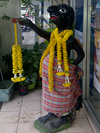
The Old Siam Plaza
Name of a historic
shopping center in
Bangkok's
Wang Burapha (วังบูรพา) District, known for its colonial-style
architecture and diverse range of specialty stores. Established in
1993 on the former site of the Ming Meuang Market, it offers
textiles, traditional Thai desserts, firearms, and a notable
selection of gem and jewelry shops. A 2023 renovation transformed it
into a mixed-use complex with residential units, preserving its role
as a cultural and commercial landmark in old Bangkok.
WATCH VIDEO
and
VIDEO (E).
回

THEOS
Abbreviation for
Thailand Earth Observation Systems
Satellite.
回
thep (เทพ, ទេព)
Both a Thai and a Khmer term for a
deva,
a god, a deity, an angel, a miracle worker or something divine. In
Thai, also called
thevada. See
also
Apsara.
See also THEMATIC
STREET LIGHT.
回
thepaniyai (เทพนิยาย)
Thai. ‘Mythology’. A legend or
myth.
回
thepanom (เทพนม)
Thai.
‘To pay homage to
angels and gods’.
A compound word referring to a respectful posture clasping the hands as
a token of worship and sign of respect, a gesture commonly known as
phanom, phranom or
phranommeua,
and more commonly as
wai
(fig.).
In
iconography,
it often occurs as a depiction of an angel,
thep,
thevada,
deva
or
devi
(fig.). Also
spelled thephanom, and a compound of
thep and
phanom. See also
gluay thep phanom
and
THEMATIC
STREET LIGHT (1)
and
(2).
回
thepatida (เทพธิดา)
Thai. A goddess or angel.
回
thepbut (เทพบุตร)
Thai. ‘Offspring of a
thevada’.
Term for an angel or a
male deity.
回
thepchumnum (เทพชุมนุม)
Thai. ‘Assembly of
thevadas’. The rows of
devas,
garudas,
yakshas,
etc., often seen as decoration on
rajarot,
royal sedan chairs (fig.),
chedis, temples,
etc., both in sculptured
form and as painted murals. One of the more well-known thepchumnum
are those of the two
golden
redented chedis
at the compound, in which 4 monkeys and 16 giants from the
Ramakien
support the base
of these
pagodas, which were built by
King
Rama I
to house the ashes of his parents, i.e. those of his mother in the
gilded
chedi
on the North, and those of his father in the gilded chedi on the
South (fig.).
回
Thep Haeng Kwahm Samret (เทพแห่งความสำเร็จ)
Thai. ‘God of Success’ or ‘Deity of
Accomplishment’. A designation used for
Ganesha.
回
thephanom
(เทพนม)
See
thepanom.
回
The Philatelists Association of Thailand
Association of stamp collectors and interested persons, under the
royal patronage of Princess
Maha
Chakri
Sirinthon. It was established in
1975 and originated from a group of enthusiastic stamp collectors
who, together with some senior officials of the then Post and
Telegraph Department, officially founded and registered the
association. Their first ever meeting was held on 9 August 1975 to
elect an ad-hoc executive committee, as is required by the
association's regulations, and therefore 9 August of each year has
been designated as the Association's establishment day.
On 9 August 2011, a Thai postage stamp was issued to mark
the 36th anniversary of its
establishment (fig.).
In Thai, the association is
known by the lengthy name
samahkhom nak sasom trah praisanihyahkon haeng
prathet thai.
See MAP.
回
The Petalclouds
Name of a kinetic art
sculpture in Terminal 4 at Changi Airport (fig.)
and crafted by the same art studio that delivered the work on the
Kinetic Rain
(fig.)
sculpture, also on display at the airport. Suspended 200 metres
across the Central Galleria, the sculpture consists of six clouds,
each adorned with 16 petal elements and seamlessly blend art, music,
and science, as the petals move in a choreographed dance,
accompanied by animated lighting and synchronized music, creating a
mesmerizing spectacle. The intricate design showcases the
intersection of artistic creativity and technological innovation.
The suspended clouds, each petal element supported by four specially
designed cables, result in a total of 384 cables and 192 winches
controlling the movement of the entire installation. Beyond the
petal elements, various components like motors, oscillators, and LED
lights contribute to the overall aesthetic and require meticulous
attention. The Petalclouds stand as a testament to the harmonious
integration of art and engineering.
WATCH VIDEO.
回
Thep Kasatri (เทพกษัตรี)
Thai heroine with the title of
thao
who in 1785 prevented a Burmese invasion of
Phuket
Island, together with her sister
Sri Sunthon.
Also known as
Chan,
Satri and
Thep Krasatri.
See also
heroines of Phuket.
回
Thep Krasatri (เทพกระษัตรี)
See
Thep Kasatri.
回
Thepnorasi
(เทพนรสีห์)
Thai. Creature from Thai mythology with a body
that is half man and half lion, and also known as Thepnorasingh (เทพนรสิงห์),
literally ‘Angel-lion’.
It is similar to
Narasimha, yet differs in this that the latter
has the body of a man with the head of a lion, whereas in
Thepnorasi
the head and torso are those of a man and the part from the hips
down that of a lion
or
singha
(fig.). It is a creature from
Himaphan forest
and is depicted either standing or walking upright. It serves an apotropaic purpose and
could be seen as the Thai equivalent of the
Burmese
Manuthiha (fig.).
See also
Apsonsi.
回
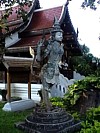
Theppaksi
(เทพปักษี)
Thai-Pali. ‘Angel-bird’. Name of a mythical
creature, half-bird
half-celestial being from
Himaphan Forest, with the upper body of a
thep, i.e. an
angel depicted as a male human, and the lower body of a bird (paksi -
fig.).
It is similar to the
Kinnon but has no winged section with feathers on its
lower arms (fig.).
回
_small.jpg)
Thep Patchanna (เทพปัชชุนนะ)
The god of the storm clouds in
Lan Na folklore. His
mount is a
mom. Also known by
the name of
Watsawalahok Thep.
回
thep prajam wan (เทพประจำวัน)
Thai system
in which each day of the week corresponds with a certain
deity. These seven deities (fig.)
are Phra
Jan for Monday (fig.),
Phra Angkahn
for Tuesday (fig.),
Phra Phut for
Wednesday (fig.),
Phra Phareuhadsabodih for Thursday (fig.),
Phra Suk for Friday (fig.),
Phra Sao for
Saturday (fig.)
and
Phra Ahtit
for Sunday (fig.).
In Thai the days are derived from these gods and their names appear
in them e.g. Thursday is wan phareuhad, Sunday is wan ahtit, etc.
See also
wan tua,
dao prajam wan,
sat prajam wan,
Phra prajam wan and
sih prajam wan.
回
The Privy Council Chambers
Name of the government
building used by the Office of the Privy Council, a private agency
of the King that is supervised by a Secretary-General appointed by
the King, and responsible for supporting the Privy Council in their
duties towards the Crown, or as instructed by the King. In Thai, it
is known as Thamniyeb Ongkhamontrih (ทำเนียบองคมนตรี).
回
Thep Than Jai (เทพทันใจ)
Thai. ‘Instant Deity’. Name used
in
Thailand
for the Burmese
nat-like
deity
Bo Bo Gyi, a benevolent guardian
spirit found in Buddhist temples in
Myanmar (fig.).
Thep Than Jai is
basically the same deity but sometimes depicted in a style more
typically Thai.
回
_small.jpg)
The Stock Exchange of Thailand
A juristic entity set up under
the Securities Exchange of Thailand Act, which started operations on
30 April 1975 and serves as a
centre for the trading of listed
securities.
READ ON.
回
The Supreme Court of Thailand
The final court of
appeal, i.e. the highest court where the Chief Justice presides.
READ ON.
回
The
Queen's Gallery
Thai art gallery founded in response of queen
Sirikit's
whish to provide a permanent
home for the exhibition of a wide range of Thai visual arts,
especially sculpture and paintings, in order to promote Thai culture
and artists, both young and well established talents. The gallery
also acts as an education centre giving training courses to Thai
nationals from all backgrounds, turning them into professional
artists in various disciplines. The queen is a loyal patron of the
gallery.
回
thera (เถระ)
See
theen.
回
Theranuthera (เถรานุเถระ)
Thai-Pali. The Buddhist hierarchy, the
governing body of the Buddhist clergy. See also
Sangha.
回
Therasapha (เถรสภา)
Thai-Pali. Buddhist council. See also
Sangkayana.
回
Theravada
(थेरवाद)
Sanskrit-Pali. ‘Words of the elders’ or ‘teachings of the elders’.
A
Hinayana sect of Buddhism that spread to Southeast Asia
from India via Sri Lanka, where it is the dominant form of Buddhism.
Its texts are written in
Pali.
回
Therawaht (เถรวาท)
Thai for
Theravada.
回
thet (เทศน์)
Thai. ‘Sermon’, as in
kanthet and
kreuang kanthet.
回
thetsabahn (เทศบาล)
Thai for ‘municipality’. See
also
thetsabahn tambon.
回
thetsabahn nakhon (เทศบาลนคร)
Thai for ‘city municipality’.
Name for a municipal district in large cities with a population of
50,000 or more and with sufficient income to provide public services
according to the duties provided by law. There are currently 30 city
municipalities throughout Thailand.
回
thetsabahn tambon (เทศบาลตำบล)
Thai for ‘municipal district’.
It is often abbreviated as th t (ทต.). See also
thetsabahn
and
tambon.
回
thetsakahn (เทศกาล)
Thai for ‘festival’, ‘festival season’, ‘festivities’ and ‘holiday’.
The term is reminiscent of ‒and possibly linguistically related to‒
Tet (Tết), i.e. the Vietnamese New Year (fig.).
回
thetsakahn hua toh (เทศกาลหัวโต)
Thai for ‘Big
Head Festival’.
回
thetsakahn kin jae (เทศกาลกินแจ)
Thai. Lent or fasting period according to
Chinese custom. In translation it is generally called
Vegetarian Festival,
but it is also known as the
Nine Emperor Gods Festival.
This nine-day festival is celebrated the most exuberantly in
Phuket,
but is also popular in other regions and all over
Thailand
restaurants place small yellow banners with red Thai and Chinese
characters (fig.)
to indicate that they serve vegetarian food. It is believed the soul
and mind are purified by refraining from meat consumption. Believers
will gather to help clean out spirit shrines and light candles to
prepare the arrival of nine angels. To symbolize their presence,
nine lanterns are lit up and placed aloft a pole, known as Ko Teng.
A ceremony is also held to welcome Yok Ong Song Te. Festival
partakers dress in white, place yellow and red banners and make
small altars in front of shop houses (fig.).
On the sixth day of the festival in Phuket this custom is
accompanied with parades in which spiritualist mediums chastise
themselves whilst in a trance, doing such things as body piercing
and walking over hot coals. Other participants walk over lit candles,
crossing the bridge of
purification, whilst receiving a stamp with red Chinese signs on their back,
as proof of their participation and the reward for their commitment
to the nine days festival.
Throughout the festival firecrackers are used abundantly to add lustre and noise to the celebrations. On the last day of the
festival there will be a goddess procession. This festival usually
takes place somewhere in the beginning to the middle of October and
coincides with the Indian festival of
Vijayadazaami,
to which it bears many resemblances. See
also
jae and
mangsawirat.
回
thetsakahn look pohng yak (เทศกาลลูกโป่งยักษ์)
Thai name for the
Thailand Balloon Festival.
回
thevada (เทวดา)
Thai. A
deva,
god, deity, angel, miracle worker or something divine. Also
transliterated Thewada.
The
Thewada
bar in
Bangkok, which is decorated with colourful paintings of
angels and themes of
Himaphan,
serves so-called
creation cocktails
whose
names are
inspired on creatures
of this legendary heavenly place of Thai mythology, such as its
Mekhala
cocktail,
named after the goddess of lightning
and
topped with a smoke bubble that
symbolizes
Mekhala's crystal ball
(fig.).
See also THEMATIC STREET LIGHT.
回
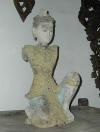
Thevasathaan (เทวสถาน)
Thai.
‘Divine place’ or ‘angelic place’. Name of a
Brahmin temple built in 1784, on the
orders of King
Rama I, to be
used for holding Brahmin rites and ceremonies. The temple comprises
of three Thai-style buildings, made from brick and mortar. Each
building has a different colour of roof and is actually a
Hindu
shrine, each for another deity. The first
one on the premises from the main entrance, with a brown roof, is devoted to the god
Shiva
and
contains his image in a blessing pose, whereas the building in the middle,
with a green roof, has a
shrine dedicated to
Ganesha, and the last shrine, with an
orange roof, is devoted to
Vishnu.
In front of the first building is a large golden statue of
Brahma, enshrined
under an open, arched pavilion. Past the entrance on the left is a small
garden with a pile of rocks, topped by a small golden statue of Shiva,
and on the opposite side stands a tall
sala tree.
In the back of the compound is an assemby hall where devotees
gather. This temple is located adjacent to the
Giant Swing,
another residue of one of the Brahmin rites from the past. Sometimes
referred to as the Brahmin Shrines, in Thai
Boht
Phraam,
and also transcribed Devasathan.
See MAP.
回
_small.jpg)
Thevasathaan Uthayaan Phra Phi Kaneht
(เทวสถานอุทยาน พระพิฆเนศ)
1. Thai.
‘Place of the deity
Ganesha’.
Name of a religious complex, also referred to as the Ganesha Idol
Park in
Chachengsao Province, and located on the
banks of the Bang Pakong river at Bang Talaht, in the
king amphur
Klong Kheuan.
It is allegedly the
world's
largest bronze statue
of Ganesha, described to stand 39 meters
tall (fig.), and the project was officially initiated in a casting ceremony
held on 28 January 2012, in which the giant head of the statue was cast using
phaen thong kham,
donated by the public. The
lampothon
statue is in the
Chaturbuja-style, i.e. with four
arms, and with a halo
in the shape of a lasso called
pasa, an
attribute
that in
Hindu
iconography
represents an instrument used to destroy desire and craving.
At the top of the lasso is a
circle wreathed in flames,
similar to the
chintamani
(fig.),
with the word
ohm
inside. Among his
attributes are also a
writing brush, that represents
literature and refers to his role as the god of arts, as well as
some food favoured by Ganesha, such as
mango. At his left leg sits a
rat,
i.e. the official vehicle
or
vahana of Ganesha.
There is also a Ganesha Idol Park in
Nakhon Sawan,
located on the east bank of the
Chao Phraya
River in the tambon Klang Daet (กลางแดด) of
the
amphur
meuang
(map
-
fig.) and
featuring a large Ganesha statue in a seated pose and with a pink
complexion, which in colour and design is reminiscent to the large
reclining statue of Ganesha at
Wat Samaan Rattanaraam
(map
-
fig.),
also in Chachengsao.
See
MAP.
回
2. Thai.
‘Place of the deity
Ganesha’.
Name of a religious complex
(fig.)
in
Nakhon Sawan
Province, located on the east bank of the
Chao Phraya
River, in the tambon Klang Daet of the
amphur
meuang,
and known in English as
Ganesha
Idol Park. It features a large
Ganesha statue in a seated pose and with a pink complexion. The
statue is similar in style and colour to the to the large pink
reclining statue of Ganesha (map
-
fig.)
at
Wat Samaan Rattanaraam
in
Chachengsao, whereas
the name is also used for a 39 meter tall bronze statue
of
Ganesha (map
-
fig.),
also in Chachengsao. Besides the large pink statue of this
Hindu
deity, the temple has several other smaller statues and
images of Ganesha, as well as a number of statues and
shrines devoted to other deities and characters from both Thai and
Hindu religion and mythology, such as
Phra Witsanukam
(fig.);
nagas,
including those forming
a
naga-bridge
(fig.);
reusi tah fai
(fig.);
Vishnu
(Narai)
on his
Garuda;
Jivaka Komarabhacca
(fig.);
etc.
See also
TRAVEL PICTURE (1),
(2),
(3),
(4),
(5) and
(6), and
MAP.
回
_small.jpg)
thevathut
sie (เทวทูต ๔)
Thai. ‘Four divine emissaries’. The several
life phases, ending in death. A term used to indicate the
observations of
Siddhartha when he went outside the palace walls for the
first time and noticed the suffering of ordinary people. He
consequently met an ascetic or hermit (samana),
a cripple, a sick man and a dead man (fig.). The term stands for old age,
sickness, death and rebirth, respectively. See also
Four Encounters.
回
thewalai (เทวาลัย)
Thai. Term for the
dwelling place of deities, i.e. the place where idols are enshrined,
and although it is more the concept of a ‘shrine’, it is sometimes
translated as ‘temple’. See also
Tantra Thewalai
and
TRAVEL PICTURE.
回
_small.jpg)
thewalohk (เทวโลก)
Thai. ‘Angelic world’,
‘world of the gods’ or ‘heaven’. Term for the world (lohk)
or plane where the gods live.
READ ON.
回
thewi (เทวี)
Thai. ‘Princess’
or ‘queen’.
The title derives from the
Sanskrit word
devi, which
means
‘goddess’
and as such emphasizes the often
avatar-like
statues ascribed to royalty in
Thailand.
Sometimes transliterated dhevi or thevi. Compare also with
thep
and
thevada.
回
thian ob (เทียนอบ)
Thai. A horseshoe- or U-shaped fragrant candle used for smoking
sweetmeats, such as
khao too maprao oun.
The curved candle has a wick sticking
out on each side, which are both lit and blown out again, after
which the smouldering scented candle is
quickly placed into a pot, usually on a small platter in the centre,
together with the sweetmeats and closed off with a lid, allowing the
smoke to spread and its aroma to penetrate the sweetmeats.
When the smoke has died out, the process is repeated until
satisfactory. Also called thian ob
kanom.
回
thian pansa (เทียนพรรษา)
Thai. ‘Pansa
candle’. Name for large
candles which are cast (fig.)
as a means of
tamboon, either in an decorative
mould or elaborately carved afterwards, before being carried around
in a procession (fig.),
at the beginning of the rainy season, with the start of
khao pansa. Yhe candles are
entered in a contest in which neighbouring villages compete against
each other for the most beautiful candles. Eventually the candles
are offered to the local temple (fig.). See also
Wax Candle Festival.
Sometimes
transcribed thian phansa. See also
kaan wian thian.
回
1_small.jpg)
thian phae (เทียนแพ)
See
toob thian phae.
回
thian
phu luang (เทียนภูหลวง)
Thai. A plant, with the botanical name Impatiens phulungensis, that is found only in
Thailand. It is a succulent
that blooms between July and October, and bears bright pink flowers, that have
heart-shaped petals (fig.).
The plant grows mostly in
mountainous areas, and is commonly
found in Phuluang Wildlife Sanctuary, in Loei Province.
回
Thich Quang Duc (Thích Quảng Đức)
Name of a Vietnamese
Mahayana Buddhist monk, whom on 11 June 1963 publicly burned
himself to death in Saigon, in protest of the violation of religious freedom and
the discriminative policies against Buddhists by the then South Vietnamese
regime. For his ritualistic suicide, the abbot
of Phuoc Hoa Pagoda went by car (fig.)
to the spot where he was to immolate himself
and calmly seated himself in the
lotus position.
A fellow monk then poured gasoline over his head and Thich set himself alight
with a match (fig.). After his death, he became venerated as
a
bodhisattva
(fig.)
and in Ho Chi Minh City
a small memorial park accommodates his statue (map).
回
Thick-billed Pigeon
Name of an olive green pigeon with the binomial name Treron
curvirostra and a distinctive, heavy bill, red at the base and yellowish green
at the tip. Being sexually dimorphic, females are recognized by a green mantle,
whereas that of males is maroon, yet both sexes have red legs and the same characteristic,
yellow wingbars and pale blue-green orbital rings. Different from the female,
the male also has light underparts and a grey crown. Thick-billed Pigeons
inhabit most forest types, including mangroves and are found through much of
Thailand, where it is called
nok khao plao thammada. Also known as
Thick-billed Green-pigeon.
回
%20นกเขาเปล้าธรรมดา%202_small.jpg)
thien kaew (เทียนแก้ว)
Thai. ‘Glass candle’. A
kind of traditional Thai hand-made sweet that takes the form of
stuffed dough, somewhat cake-like, shaped as triangular pyramids and
wrapped in
banana
leaf. They are usually
made from
tapioca
flour or
in some regions
sticky rice
flour, with a
filling of coconut, green
or red beans, or
mung bean. It is
also referred to as
kanom
thien kaew
and in some regions known as kanom jok (ขนมจ็อก) and kanom nom sahw
(ขนมนมสาว). They are
commonly used in
tamboon,
i.e. the act of merit making, especially during the
Songkraan
festival. This
type of candy is depicted on a postage
stamp issued in 2018 as part of a set of six stamps on traditional
Thai sweets (fig.).
回
Thien Khuyen (Thiên Khuyển)
Vietnamese. Name of the
Vietnamese-Taoist Judge of the Heavens.
READ ON.
回
Thien Tu Bao Chau (Thiền Tự Bảo Châu)
Vietnamese. ‘Protection [by the]
Pearl of Self-meditation’
or ‘Security Gem of Self-taught
Zen’.
Name of a small
Mahayana Buddhist temple in
Hoi An.
READ ON.
回
thihra (ธีร)
Thai. ‘Learned man’, ‘wise man’ and
‘genius’.
回
thihraraat (ธีรราช)
Thai. ‘Learned king’ or ‘wise king’. A
designation given to King
Vajiravudh for his literary work.
回
thim (ทิม)
Thai. Name given to a pavilion
within the compound of a royal palace. It has several meanings,
depending on its use. It can be a pavilion used as accommodation for
the palace guards along the edge of the palace's fortified walls,
but also a Thai-style
sala
used as a waiting place for high-ranking officials or monks prior to
an audience with the King. See also
thimdahb.
回
thimdahb (ทิมดาบ)
Thai. ‘Sword pavilion’.
Name for the [weapons'] shelter or accommodation of the palace guards,
located within the grounds of a royal palace. See also
Murathathorn
and
thim.
回
Thinglish
Term, mostly used by expatriates living in
Thailand, to express the
incorrect use of English grammar, vocabulary (word choice) and
pronunciation by Thais, often due to interference from their own
language, as well as local anomalies and colloquialism.
For example, the Thai term
for ‘same’ in is meuan kan (เหมือนกัน),
but can also be meuan meuan kan (เหมือนเหมือนกัน), thus in English,
the Thais will often say the word same twice, i.e. ‘same
same’. With regards to incorrect
pronunciation, typical examples are:
university and electricity, which are pronounced ‘univer-city’
and ‘electric-city’, with the
penultimate and ultimate syllables pronounced
as city (town); vegetable, which is pronounced
‘vege-table’, with the penultimate and
ultimate syllables
pronounced as table (furniture), etc. In addition, there is also a
certain laziness of the tongue, which is by the way equally commonly
found in the Thai language, when the letter R is either unpronounced
or swapped for an L, and vice versa. A common example is the
question from a Thai waiter for more
rice, i.e.
‘You want mo(le) lice’?
The incorrect use of grammar often relates to syntax, i.e. the grammatical arrangement of words
into a sentence, as in the example
‘you are my friend’,
which Thais often almost literally translate from
Thai, i.e. khun pen pheuan khong phom, or simply khun pheuan phom (คุณ
[เป็น] เพื่อน
[ของ] ผม),
meaning you [are] friend
[of] I/me, into
‘you my friend me’,
seemingly also thinking that ‘my
friend’ is one indivisible term as it is
and that the word ‘friend’
on its own doesn't exist, as is often thought with the word birthday
too, which is usually spoken of as ‘happy birthday’, e.g. tomorrow
is my ‘happy birthday’. Thinglish or the incorrect interpretation of
English may sometimes lead to misunderstanding or funny situations,
especially when the R is swapped for an L, as in the incident when a
Thai tour guide with regards to politics was asked the question ‘How
often do you have elections in Thailand?’, he greatly astonished
replied ‘Eve-l-y morning’! Sometimes spelled Tinglish and also
called Thenglish, Thainglish and Thailish.
回
Thingyan (သင်္ကြန်)
Burmese. Name of
the Water Festival in
Myanmar, which takes
place toward the end of the hot, dry season and ushers in the
Myanmar New Year. Thingyan
Festival is considered the most
popular festival in Myanmar, followed by
Thadingyut,
which celebrates
the
Buddha's
descent from
Tavatimsa
Heaven
after having preached the
Abhidhamma
there to his
mother
Maha Maya during
Buddhist Lent.
Thingyan is the Burmese equivalent of the Thai
Songkraan.
回
Thipangkon (ทีปังกร)
Thai. ‘Lamp bearer’. Name of a
royal prince of the
Chakri
Dynasty of
Thailand, namely the fifth yet only recognized son of King
Vajiralongkorn.
Hence he is the heir presumptive to his father and first in line to
the throne. His name derives from the Sanskrit
Dipankhara,
which means ‘Lamp bearer’. The prince was born on 29 April 2005 and
is fully known as Thipangkon Ratsamichot (ทีปังกร รัศมีโชติ),
which may also be transliterated Dipangkorn Rasmijoti. He is
actually the seventh child of King
Rama X,
whose mother is the King's third legal wife Srirasmi Suwadee
(ศรีรัศมิ์ สุวะดี). The king also has a daughter from his first
marriage and a daughter and four sons from his second marriage, yet
he disowned the four sons after the then-Crown Prince divorced his
second wife. Since Prince Thipangkon was born on a
Friday, his personal flag consists of a blue field, the colour of
his birthday in
the
sih prajam wan-system,
with his royal cypher, i.e. his monogram that consist of the stylized Thai
letters Th (ท) in light blue and P
(ป) in yellow.
回

Thipchakratiwong (ทิพย์จักราธิวงศ์)
Thai. Name of the dynasty that ruled
Chiang Mai from
1774 to 1939.
This period started after the revolt of
Lan Na against Burmese rule, that began
with the liberation of
Lampang and the 1774 recapture of
Chiang Mai
by the Siamese King
Taksin, and lasted until seven years after
Chiang Mai was made a province of
Siam
in 1932. This dynasty includes
Chao Kawila,
the first king of Lan Na under Siamese
rule, and is also known by the name
Chao Jed
Ton,
the ‘Dynasty of the Seven Lords’. Also transliterated
Thippachakkrathiwong. See
also
Thip Chang
and
list of Thai kings.
回
Thip Chang (ทิพย์ช้าง)
Thai. Name of the ruler of
Lampang,
who reigned
from 1732 to 1759 AD.
READ ON.
回
Thip Ketuthat (ทิพย์ เกตุทัต)
See
Thayaan Phikaat.
回
Thipphimaan (ทิพย์พิมาน)
Thai. ‘Angelic
Paradise’. Name of a royal palace in
Pak Chong (ปากช่อง) District, in
Nakhon Ratchasima,
which on its compound also has an art gallery known as Phimaanthip (พิมานทิพย์),
i.e. ‘Paradise of Angels’, and usually transliterated and
referred to as Pimarntip Art Gallery, as well as the Thipphimaan
Veterinary Hospital, both under the auspices of Princess
Chulaphorn Walailak
(fig.),
the youngest daughter of King
Bhumipon Adunyadet
(fig.),
and features some of her art work, most notably several depictions
of
Leopards.
The top floor, which is in part decorated in Chinese traditional
style, houses a number of
zheng
(fig.),
i.e. ancient Chinese zithers, multiple-stringed instruments with a
flat soundbox that are placed horizontally and played with the
fingers and a plectrum, as well as pictures of the princess posing
with this ancient Chinese instrument, also called gu zheng (古筝),
i.e. ‘ancient zheng’, which she is said to master. This floor also
has a room with has a royal collection of LEGO toys. Also
transliterated Tippimarn.
回
third eye
1. The name at times given to the curl of hair
between the eyebrows of some gods, otherwise called an
urna.
According to legend it radiates the beams of light that enlighten
the world and is a symbol for great, all-seeing wisdom. It is one of the marks
of an enlightened being. In oriental iconography it is often depicted as a
round sign, though
it may also be depicted as an actual, additional eye (fig.). In
Hinduism it is
regarded the seat of occult power. The third eye of
Shiva, for example, will eventually
consume the universe and that of
Durga created the
goddess
Kali. Besides this it
is also seen as the ajnakhya, one of the six
chakras or
centres of spiritual energy of the body, representing inner vision. Hindus often place a red,
white or black mark, called pundra or
tilaka,
on their forehead which indicates either a third eye or refers to
their marital status, its significance varying from community to
community. Sometimes called a
buddha eye (fig.).
See also
Wisdom
Eyes.
回
2.
The colloquial name for the iridescent,
photosensitive spot between the eyes in
some reptiles and which is officially known as the pineal gland (fig.).
This gland recognizes differences in light and is thought to help
avoid threats from above, such as attacks from aerial predators, as
well as to assist with basking, in order to keep the body
temperature within certain boundaries, i.e. thermoregulation. Also
called pineal eye or parietal eye.
回
Third Lotus Prince
A title given to
Nezha,
the
Taoist
child-deity, who is fully known as Nezha San Taizi. He is usually
depicted holding a magical Golden Hoop in the left hand and a
Fire Spear in the right hand, whilst subduing a sea
dragon
(fig.).
In Chinese,
Lian Hua San Taizi, literally
‘Third
Lotus Flower Crown Prince’.
回
Thirty-six Celestial Guardians
See
Sanshiliu Tiangang.
回
Thisa Taik Phaya (သစ္စာတိုက်ဘုရား)
Burmese. ‘Pagoda
of the Oath’,
‘Temple of the Loyal Fight’ or ‘Temple of the Faithful Struggle’.
Another name for the
White Temple
Yattana Pontha
in
Ava
(fig.).
回
thobe (ثَوب)
Arabic. ‘Garment’. Term for a type of long outer garment with wide sleeves, worn by Muslim men,
and similar to the
jubbah
(fig.),
that –except for the hands and face– covers the entire body to
almost ankle-length.
Also transcribed thaub or thawb.
回
%202_small.jpg)
Tho Cong (Thổ Công)
Vietnamese name for
Tu Di Gong, the Chinese Lord of the
Soil and the Ground (fig.).
He is also known by the names Tho Dia (Thổ Địa) and Tho Than (Thổ
Thần).
In
Tae Chew his name
is
Di Zhuia
(fig.)
and he is the
Chinese equivalent of the Thai
chao thih,
the animist guardian spirit of the land. In
Vietnam,
he is typically one of two deities placed in small home
altars, the other one being
Than Tai (fig.),
the Vietnamese name for Chinese wealth deities, who are generally
referred to as
Cai Shen (fig.).
According to local beliefs, these Vietnamese house shrines (fig.) should always face the
entrance door, and its deities are offered fruit, food and drinks, the latter
usually in the form of
tea
traditionally offered in either 5 or sometimes 3 small cups.
回
thod kathin (ทอดกฐิน)
See
kathin.
回
thod man pla (ทอดมันปลา)
Thai name for local fish cakes.
The term could be interpreted as both ‘oil fried fish’ and ‘fried
fish fat’. Ingredients include fish meat; a spicy
curry paste, normally used to make
nahm phrik
kaeng
(fig.);
sliced Chinese longbeans, called
tua fak yao
in Thai (fig.);
bai
makrud
or kaffir leaves (fig.),
cut into slivers; chicken egg yolk; sugar and salt. The items are
mixed into a paste and fried in oil as flat slabs. They are
a Thai specialty often found as a snack on
markets or as a starter in restaurants.
See also TRAVEL PICTURE.
回
_small.jpg)
thod phah (ทอดผ้า)
Thai. Offering robes to
Buddhist monks in Thailand. Also
thod phah pah.
回
thod phah pah (ทอดผ้าป่า)
Thai.
Ceremony in which laymen present robes and
other offerings to Buddhist monks in Thailand. Also
thod phah.
回
thohn ram manah (โทนรำมะนา)
Thai name for
two hand drums, i.e. the
klong
thohn
and the
klong ram manah,
played as a pair in Central Thai traditional music (fig.),
especially in string ensembles. The thohn gives a low pitch and the
ram manah gives a high pitch. In 1970, these drums were depicted
played as a pair on one of a set of four Thai postage stamps
featuring Thai musical instruments (fig.).
Also transcribed ton rammana, tone ram manaa, or similar.
回
%202_small.jpg)
thom (ធំ)
Cambodian or
Khmer for ‘great’, as in
Angkor Thom.
回
Thonbanhla (သုံးပန်လှ)
Burmese.
‘Beautiful in Three Ways’. Name
of a female
nat,
and one of the 37 that
belong to the
official pantheon of spirits
worshipped in
Myanmar. In
life, she was a
native of a
Mon
village and is described has
having been extremely beautiful. Hence, she was given to King
Duttabaung of Pyay to become one of his consorts. However, when his
chief consort learned of this, she became jealous of her beauty and
thus told the king that Thonbanhla was in fact very ugly and so fat
that she could not enter through the city gate. Upon hearing this,
the king refused Thonbanhla into his harem and she consequently died
in despair. Another story says that she actually was the youngest
sister of
Maung Tint De (fig.), i.e.
‘Brother Handsome’, the extremely
strong son of a blacksmith who
was executed by
the King of Tagaung, lest he
might usurp his throne.
In this version, she was as a child adopted by a Rakhine King during
Maung Tint De's persecution by the King of Tagaung. Later, she married King Smim Htaw Yama of Utthala
(Oakkala), and gave
birth to a daughter, but then died of a sudden illness.
Consequently, the daughter also died of grief from her mother's
death and thus became the nat
Shin Nemi (fig.).
See also LIST OF BURMESE NATS.
回
Thonbodih (ธนบดี)
Thai name for a deity associated with the
Chinese wealth god
Tsai Shen
Yeh
or
Chai Sing Ihya
(fig.).
Usually referred to as
Phra
Thonbodih.
回
Thonburi
(ธนบุรี)
For a
short period a former capital of
Siam,
founded after the fall of
Ayutthaya in 1767 (fig.) and then
situated in vast
swampy
delta with
the nickname
‘sea
of
mud’.
Located near the
estuary and on the western bank of the
Chao Phraya
River,
it lays opposite
Rattanakosin and is
today a
khet
(zone) of greater
Bangkok.
The capital was founded by King
Taksin
(fig.)
and is fully known as Krung
Thonburi Sri Maha Samut
(กรุงธนบุรีศรีมหาสมุทร).
Whereas the word thon (ธน), which can also be pronounced thana (as
in
thanakaan, meaning
‘bank’),
can be translated either as
‘estate’ or ‘wealth’,
the word
buri
derives from the Sanskrit word puri, and
refers to a
‘city’,
commonly a
‘fortified
city’.
Hence, the full name can be translated as
‘Fortified
City Estate at the Graceful Ocean’,
though other translations include
‘City
of Wealth Gracing the Ocean’.
Though not an official province,
Thonburi is by some at times referred to as
jangwat
Thonburi. The area is home to
Wat Arun
(fig.),
Wat Prayun Wongsahwaht
(fig.),
the
Royal Dockyard Museum
(fig.),
Thonburi Palace
(fig.)
or
Phra Rachawang Deum (fig.), as well as the
Princess Mother Memorial Park (map
-
fig.).
Today, the area has a large network of
canals and a boat tour on those
is a popular tourist attraction
(fig.).
回

Thonburi Train Station
Built in 1900, during the reign of King
Rama V,
at the mouth of
Bangkok Noi Canal. The site was originally a
property of a Muslim family which was relocated to the other side of
the canal, where King Rama V had a
mosque built for them in compensation. During WW II
the Imperial Japanese Army used the rail line to deliver weaponry
and supplies to its troops in
Kanchanaburi,
as part of the construction of the
Thailand-Burma Railway.
During the war the station was entirely damaged by bombs and was
rebuilt in its original architectural style after the war was over,
commissioned by
Phibun Songkram.
The train station resumed service and the station was the terminus
and departure point for mainly southern-bound trains, as well as
trains to and from Kanchanaburi. In 2003, the land of the station
and its surrounding area was purchased by the adjacent
Siriraj Hospital
(fig.)
for expansion. Hence, the rail track was shortened and the train
service was moved about a kilometer eastward, whilst the old train
station became
a museum
on the history of the hospital, officially known as the
Siriraj Bimuksthan Museum (fig.).
See MAP.
回
_small.jpg)
Thonburi Palace
In Thai, it is known as
Phra Rachawang Deum, literally the
‘Former Palace’, but is usually translated as the ‘Old Palace’. It
was the royal residence
of King
Taksin,
located in
Thonburi,
adjascent to
Wat Arun,
and today within
the compound of the Royal Thai Navy Headquarters
at the old Wichai Prasit
Fort (fig.).
READ ON.
回
thong (ทอง)
Thai for
‘gold’
or
‘golden’.
See
Thai gold
and
Chinese gold ingot.
回
Thong Bo Po Ro (ธง
ภ.ป.ร.)
Thai. Name for the
personal Royal Flag of King
Bhumiphon,
in full known as Thong Bhumipon Adunyadet Parama
Rajatiraat,
and which
consists of a golden crown over his initials, the letters B (ภ)
P (ป)
and R (ร) in
yellowish-orange, blue, and white, on a yellow
field, the colour of his birthday
(see
sih prajam wan). Another version of the
same personal Royal Flag of the King,
consists of a yellow field with the logo and text in red print (fig.),
and in addition to the crown and the initials,
it has a ribbon with the
text Song Phra Charoen (ทรงพระเจริญ), which is
rajasap, meaning ‘to prosper’ or
‘to be prosperous’, but is usually translated as ‘Long Live the King’.
Pronounced Thong Po Po Ro and often transcribed Thong Bor Por Ror.
回
_small.jpg)
thong chaht (ธงชาติ)
Thai. ‘National flag’. The flag of a nation.
The present Thai national flag
is a
horizontal striped
red-white-blue-white-red
banner. According to
vexillology,
the colours
symbolize
the nation
(red),
the monarchy
(blue)
and religion
(white).
It was
introduced
in 1917
by King
Rama VI
and replaced the
thong kha khaay, a
briefly used flag consisting of a red field with with two
horizontal white stripes (fig.).
The latter was initially a maritime merchant flag
and briefly used as the national
flag,
reportedly introduced because
the
King had
taken offense when some of his
subjects had flown the until then
used
national
flag,
i.e. a
White Elephant on a red field (fig.)
known as
thong chang
(fig.),
upside down during a flood in
order to indicate distress. The present flag is also known
by the name
thong trai rong, meaning tricolour (fig.). See also
Vexillology & Heraldry
and
WATCH VIDEO.
回

thong chai chaleum phon thahaan reua (ธงชัยเฉลิมพลทหารเรือ)
Thai. ‘Victory flag in honour of
the sailors’. Victory flag in
honour of its sailors, which consist of the Thai national tricolour,
with
in the centre, in yellowish gold, the emblem of the Royal Thai Navy, i.e. a golden royal
chadah-style crown over a ship's anchor,
with a twisted chain and a
chakra
(fig.).
It is in use since 1936 AD, though the same flag has also been used
since 1917 as the Thai naval jack, known in Thai as
thong chahn.
回
thong chahn (ธงฉาน)
Thai
name for the naval jack, an additional national flag flown by
warships at the head of the ship, usually on special occasions and
while not on the move. The one in use since 1917 AD is the same
design as the Thai victory flag in honour of its sailors and known
in Thai as
thong chai chaleum phon thahaan reua
(fig.),
which is in use since 1936.
回
thong chang (ธงช้าง)
Thai. ‘Elephant flag’. A former
Siamese flag consisting of a red field, akin to the initial national
flag of
Siam
(fig.),
but with the figure of a
White Elephant
in the middle
(fig.). Today this can still be seen as
part of the ensign of the Royal Thai Navy (fig.),
placed in a circle on the
thong chaht,
the present Thai tricolour.
Besides this the navy also has a flag consisting of a blue
field with a white circle (fig.). This circle depicts a yellow
chadah-like
crown above a
chakra
encircling an anchor.
The former
Siamese national flag
was
used from 1855 to
1893-1917, prior to that the
elephant was smaller an encircled by a
chakra
(fig.),
a flag sometimes referred to as thong chang chak (ธงช้างจักร -
fig.)
and also used simultaneously by the Siamese Navy. In turn, the
latter was an adaption of the former
naval and national flag,
which has only a chakra on a
red field (fig.), a flag called thong chak (ธงจักร) and only proceeded by
the first Siamese flag, sometimes referred to as thong
sayaam
and consisting of just a plain red field (fig.).
National flags following the thong chang are thong chang song kreuang chak (ธงช้างทรงเครื่องจักร), i.e. a red field with a
decorated
White Elephant
and a
small
chakra
in the top left corner
(fig.),
which was used in the reign of King
Rama V,
[initially] as the flag on royal battleships and ─only according to
a few unconfirmed sources─ temporary doubled as a national flag;
thong chang song kreuang (ธงช้างทรงเครื่อง),
the same flag without the chakra (fig.)
and according to some sources flown in reverse with the elephant
facing the hoist;
thong kha khaay (fig.),
the first striped national flag and initially a maritime flag
on merchant ships; and eventually the present tricolour (fig.).
See also
Vexillology & Heraldry.
回
%20Flag%201855-1916_small.jpg)
Thongdaeng (ทองแดง)
Thai. ‘Copper’. Name of the 17th
royal dog
of King
Bhumipon Adunyadet,
i.e.
a female copper-coloured dog, that was born
as a stray dog (fig.)
in a soi (side street) nearby a Medical Centre on
Rama IX
Road, on Saturday 7 November 1998, as one of a litter of 7 puppies,
from a mother called Daeng (แดง), i.e. ‘Red’. The other puppies,
mostly female, were named Lamun (ละมุน), Kalua (คาลัว), Nun (หนุน),
Kohroh (โกโร), Kohsoh (โกโส), whilst the only male puppy was named
Thongleuang (ทองเหลือง), which means ‘Brass’. When the King presided
over the opening ceremony of the Rama IX Medical Center, a doctor presented Thongdaeng to King Rama IX. At that time, Daeng was ill and unable to
sufficiently care for her litter. The King took Thongdaeng to
Dusit
Palace, where she was adopted by
Ma-li
(มะลิ),
i.e. ‘Jasmine’, a dog already owned by the King, who had just
delivered 9 puppies herself the day before Thongdaeng arrived. In
2000, Thongdaeng became pregnant from Thongtae (ทองแท้),
a Basenji dog whose name translates as ‘Real Gold’, with
similar features to Thongdaeng and also raised by the King.
Hence, on Tuesday 26 September 2000, Thongdaeng delivered a litter of 9
puppies, 3 female and 6 male, at the Veterinary Faculty Clinic of
the Kasetsart University in
Bangkok.
The female puppies were named Thongchompunut (ทองชมพูนุท), Thongyod
(ทองหยอด) and Thong-att (ทองอัฐ), whereas the male puppies were
named Thong-aek (ทองเอก), Thong-muan (ทองม้วน), Thongthat (ทองทัต),
Thongphlu (ทองพลุ), Thongyip (ทองหยิบ), and Thongnopphakhun (ทองนพคุณ).
Thongdaeng's
full name and title are Khun
Thongdaeng
Suwanna-chaht
(คุณทองแดงสุวรรณชาติ), which is sometimes
spelled Khun Tongdaen Suvarnnachad. In 2002, the King wrote a
biography of his so-called uncommon common dog, titled Reuang
Thongdaeng (เรื่องทองแดง), i.e. the ‘Story of Thongdaeng’, which
instantly became a bestseller. See also
sunak
and
POSTAGE STAMPS.
回
Thongdi (ทองดี)
Thai. ‘Good Gold’. Birth name of
the royal father of
King
Rama I, who was
was born in the
Ayutthaya period
at Ban Sakae Krang, in the Sakae Krang River basin, in the old city
of
Uthai Thani.
His title is
Somdet
Phra
Pathom
Borom
Maha
Chanoknaht,
i.e. ‘Royal Father of the Great First King’.
回
Thong Duang (ทองด้วง)
Thai. ‘Golden chrysalis’. Birth name of
Chao Phraya
Chakri,
who later became King
Rama I.
回
thong kathin (ธงกฐิน)
Thai. Name of a kind of
vertical banners that are placed at Buddhist temples during the
kathin
ceremony in Thailand indicating their participation.
READ ON.
回
thong kha khaay (ธงค้าขาย)
Thai. ‘Trade flag’. The
former
Siamese Civil Ensign and national
flag
of
Siam,
used briefly from
1916
to
1917. It consists
of
a red field with with two horizontal white stripes one-sixth wide, and one-sixth
from the top and bottom. Its Thai name derives from the fact that
this flag was initially used as a maritime flag on merchant ships.
It is
the precursor of the current national tricolour (fig.), the
thong trai rong
(fig.), and thus used for a
while simultaneously with the
thong chang
song kreuang (fig.).
The striped flag was reportedly introduced by
King
Rama VI
as he had taken offense when some of his subjects had flown the
national flag upside down during a flood in order to indicate
distress.
See also
Vexillology & Heraldry
and
POSTAGE STAMPS.
回
_small.jpg)
thong kham neua kao (ทองคำเนื้อเก้า)
Thai term used for pure
gold,
besides
thong nopphakhun.
回
Thong Kongsun (ธงกงสุล)
Thai. ‘Consular Flag’. Flag of the Consul of Thailand. It consists of the
thong trai
rong, i.e. the National Tricolour (fig.)
as a background, with additionally
a
white elephant on
a blue circular
background. It is similar
to Thai
Ambassador Standard (fig.),
known in Thai as
Thong Raja Thoot, but on the Consular flag the elephant is depicted without
regalia nor on a pedestal.
回
_small.jpg)
thongkhamplaew (ทองคำเปลว)
Thai for
gold leaf.
回
thong kwahw (ทองกวาว)
Thai name for the
Tiger Claw,
a tree also known as
Flame of the Forest and Bastard
Teak.
回
Thong
Maai Yod Jom Phon Reua (ธงหมายยศจอมพลเรือ)
Thai. ‘Flag that intends the
rank of admiral of the fleet’. Name for the
flag of the Admiral of the Fleet of the Royal Thai Navy (fig.).
It consists of a navy blue field with five white
chakra, one in each corner and one at
the centre of the flag, akin to the rank (fig.).
回
_small.jpg)
Thong Maha Raj (ธงมหาราช)
Thai. ‘Flag of the Great King’. Name for the
Royal Standard, a yellow field with a red
Garuda.
The Queen has
the same emblem but depicted on
a swallow-tailed flag, named
Thong Rajanih
(fig.). There are two
models, i.e.
Thong Maha Raj Yai and
Thong Maha Raj Noi, meaning ‘Big Royal Standard’ and ‘Small Royal Standard’, respectively. Whereas the first one relates
to a large square flag, the second refers to a smaller model of it,
not larger than 60 centimeters and prolonged with a long, white,
slightly tapering, swallow-tailed streamer (fig.).
The Crown Prince has a similar flag called
Thong
Yaowaraht
in Thai, i.e. a red
Garuda
on a yellow field,
but the yellow field is surrounded by a broad blue frame (fig.).
Other princes in the
Chakri
dynasty use a flag called
Thong
Rajawong which consists of a blue field with a
yellow disc that features a red Garuda (fig.), whereas other
princesses have the same emblem, but depicted on a swallow-tailed
flag.
Besides this the present king,
Rama IX, also has a personal flag
called
Thong Nai Luang and
consisting of a
yellow field with the king's initials (ภ.ช.ร.
- P. Ch. R.) underneath
the
Phra Maha Phichai Mongkut,
the Thai royal crown in the form of a
chadah
(fig.).
During his reign also several memorial flags were designed
(fig.), i.e. on
his 50th (fig.) and 60th anniversary on the throne (fig.),
to commemorate his 72th birthday (fig.),
i.e.
the sixth cycle of 12 years according to the
zodiac, his 80th birthday (fig.),
etc.
See also
Vexillology & Heraldry.
回
%20Thai%20Royal%20Standard,%20yellow%20field%20with%20a%20red%20Garuda_small.jpg)
Thong Maha
Raj Noi (ธงมหาราชน้อย)
Thai. ‘Small Flag of the
Great
King’. Name for a smaller model of the
Thong Maha Raj which is also known
as
Thong Maha
Raj Yai. It cannot be larger than 60 centimeters and is prolonged
with a long, white, slightly tapering, swallow-tailed streamer.
It is similar to the
Small Standard used by
the Crown Prince (fig.).
See also
Vexillology & Heraldry.
回
Thong Maha Raj Yai (ธงมหาราชใหญ่)
Thai. ‘Big Flag of the
Great
King’. See
Thong Maha Raj.
See also
Vexillology & Heraldry.
回
Thong
Nai Luang (ธงในหลวง)
Thai. ‘Flag of the King’. The personal flag of
the king. It bears the Thai
Royal Emblem on a yellow-orange field, i.e. the king's initials B.P.R. (ภ.ป.ร.
-
fig.) underneath the
Phra Maha Phichai Mongkut, a
chadah-like
crown. It is flown throughout the kingdom year round, especially on 5
December, the king's birthday, when it is seen on display in large
numbers. In Thai, the flag is called Thong
Nai Luang
or Thong Barama Phithai.
回
_small.jpg)
thong nopphakhun (ทองนพคุณ)
Thai term used for pure
gold,
besides
thong kham neua kao.
回
thong phra phutta sahtsanah (ธงพระพุทธศาสนา)
Thai. ‘Flag of Buddhism’.
Flag consisting
of an orange field with a
dhammachakka
(fig.).
Also known as
thong thammachak. Besides the Thai
Buddhist flag there is also an International Buddhist flag, in Thai
known as
thong phra phutta sahtsanah sakon
(fig.).
See also
Vexillology & Heraldry.
回
thong phra phutta sahtsanah sakon (ธงพระพุทธศาสนาสากล)
Thai. ‘International flag of
Buddhism’.
International
Buddhist flag consisting of five vertical stripes in blue, yellow,
red, white and orange, followed by five horizontal stripes of the
same colours.
Vexillologicaly the
five colours are symbolic of the five Buddhist
commandments, known as
sihnha
in Thai. Besides
this, each vertical colour represents a different aura as emanated
from the body of the Buddha when he attained
Enlightenment, i.e. blue represents loving
kindness, peace and universal compassion; yellow corresponds to the
middle path;
red stands for the blessings of practice, i.e. achievement, wisdom,
virtue, fortune and dignity; white symbolizes the purity of the
dharma;
and orange represents the Buddha's teachings and wisdom, reminiscent
of the colour orange in the
sih prajam wan
which corresponds with the
pahng samahti
pose in the
Phra prajam wan system, both associated with
Thursday. The five horizontal
colours together
are
a compound of the five vertical colours and
represent a sixth
aura, known as the ‘essence
of light’. The five vertical and five horizontal stripes together
also symbolize the ten
Buddhist precepts
(as with the flag, an additional five to the first five) as upheld
by novices (naen)
and most lay people on special occasions, e.g. on Buddhist holy days
or during
Buddhist Lent.
However, in Nepalese tradition, the five colours represent five
parts related to the body of the Buddha, with
blue representing the hair of the Buddha;
whilst yellow stands for his dress; red symbolizes the blood of the
Buddha; white the teeth and bones of the Buddha;
and orange represents the Buddha's heart. The flag was originally designed in Colombo, Sri Lanka and first
hoisted in public on
Visakha
day in 1885.
Besides the International Buddhist flag, Thailand also has a
national Buddhist flag known as
thong phra phutta sahtsanah
or
thong thammachak (fig.). See also
Vexillology & Heraldry.
回
Thong Phra Ratcha Phithi Borommarachaphisek (ธงพระราชพิธีบรมราชาภิเษก)
Thai. ‘Flag Royal
Coronation Ceremony’. Name for a flag with the
emblem of the Coronation
Ceremony of King
Maha
Vajiralongkorn, i.e.
Rama X,
issued in 2019. It consists of a yellow field, for Monday, the colour of
the King's birthday, according to the Thai
sih prajam wan
system. The emblem itself
consists of
ten-layered
chattra, i.e. the multi-layered
royal umbrella, with in front of it
a
chadah-style
crown, that represents the Great
Crown of Victory, with
underneath it the Thai number ten (๑๐),
representing the Crown Title of Rama X, as well as the King's initials M.V.K. (ม.ว.ก.),
referring to his name and his royal status as a member of the House of
Chakri (fig.).
Flanking the initials are a
mythological lion known as a
Singha (fig.),
and a
Gajasingha of
the type
Takkatoh
(fig.),
each holding another
ten-layered chattra.
Crossed behind the dark blue shield with the King's initial's are
the Sword of State (fig.)
and the Royal Sceptre (fig.),
one with the Golden Fan, the other with the Yak's Tail
(fig.),
all objects that are part of the
kakuthaphan
(fig.),
i.e. the Thai regalia.
At the bottom is a green banner with in gold the text Phra Ratcha
Phithi Borommarachaphisek Phutthasakkarat
2562
(พระราชพิธีบรมราชาภิเษก
พุทธศักราช ๒๕๖๒), which translates as
‘The
Royal Coronation Ceremony, Buddhist Era 2562 (2019 AD)’.
Furthermore,
the emblem
is embellished with
kranok,
a characteristic Thai design resembling tongues of fire
(fig.).
In full, this flag is
also referred to as
Thong Trah Sanyalak
Phra Ratcha Phithi Borommarachaphisek,
literally ‘Flag with the Emblem of the Royal Coronation Ceremony’.
See also
Vexillology & Heraldry.
回

Thong Phra Ratcha Phithi Maha Mongkhon Chaleum
Phra Chonmaphansa Hok Rop (ธงพระราชพิธีมหามงคลเฉลิมพระชนมพรรษา 6
รอบ)
Thai. Flag of the Grand
Royal Ceremony Celebrating the 6th cycle birthday anniversary. Flag
with the emblem for the 72nd birthday anniversary of
King
Maha
Vajiralongkorn, i.e.
Rama X,
in 2019.
It consists of a yellow field, for Monday, the colour of
the King's birthday, according to the Thai
sih prajam wan
system. The emblem itself
consists of
ten-layered
chattra, i.e. the multi-layered
royal umbrella, with in front of it
a
chadah-style
crown, that represents the Great
Crown of Victory, with
underneath it the Thai number ten (๑๐),
representing the Crown Title of Rama X, as well as the King's initials M.V.K. (ม.ว.ก.),
referring to his name and his royal status as a member of the House of
Chakri (fig.).
Flanking the initials are a
mythological lion known as a
Singha (fig.),
and a
Gajasingha of
the type
Takkatoh
(fig.),
each holding another
ten-layered chattra.
Underneath this, in pink, is the Thai
number 72 (๗๒),
indicating the King's 72nd birthday, and at the bottom is a
pink banner with the golden text Phra Ratcha Phithi Maha Mongkhon
Chaleum Phra Chonmaphansa 6 Rop, 28 Karakadaakhom 2567 (พระราชพิธีมหามงคลเฉลิมพระชนมพรรษา
๖ รอบ, ๒๘ กรกฎาคม ๒๕๖๗), which translates as ‘The
Grand Royal Ceremony Celebrating the 6th Cycle Birthday Anniversary,
28 July 2567’,
with
BE 2567 being 2024 AD.
Furthermore,
the emblem
is embellished with floral and
kranok
motifs
(fig.).
See also
Vexillology & Heraldry.
回

thong prajam thahaan bok (ธงประจำกองทหารบก)
Thai. ‘Regular flag of the
Army
Corps’. It consists of the
national tricolour, with in the centre a sunburst and a
chakra,
as well as the
pathum unnahlohm
(fig.),
i.e. a kind of unnahlohm similar to the
yan
sign (fig.). In
the top left corner is the
Phra Maha Phichai Mongkut
over the King's the initials B.P.R. (ภ.ป.ร. -
fig.)
in a pale blue notched circle.
See also POSTAGE STAMP.
回
_small.jpg)
Thong Rajanih (ธงราชินี)
Thai.
‘Flag of the Queen’. Name for the Standard of
the Queen. There
are two models, i.e.
Thong
Rajanih Yai and
Thong
Rajanih Noi, meaning ‘Big Standard of the Queen’ and ‘Small Standard of the Queen’, respectively. Whereas the first one relates to a large, rectangular,
swallow-tailed flag, the second refers to a smaller model of the
Thong Maha Raj,
not larger than 60 centimeters and prolonged with a long, red,
slightly tapering, swallow-tailed streamer (fig.).
Besides this, Queen
Sirikit also has a
personal
Royal Flag (fig.),
referred to as
Thong So Ko (often transcribed Sor Kor and short for
Thong
Sirikit Kitthiyagon),
named after
her initials, the letters S (ส)
and K (ก) in blue and white
(fig.).
These are placed on a light blue
field, the colour of her birthday
(see
sih prajam
wan), and under
a golden crown, similar to the personal Royal Flag of the King (fig.),
but without the radiating beams of light at the top (fig.). See also
Vexillology & Heraldry.
回
%20Royal%20Standard%20of%20the%20Queen%20of%20Thailand_small.gif)
Thong Rajanih Noi (ธงราชินีน้อย)
Thai.
‘Small Flag of the Queen’. Name for the Small
Standard of the Queen. It refers to a smaller model of the
Thong Maha Raj, not larger than 60
centimeters and prolonged with a long, red, slightly tapering,
swallow-tailed streamer. The Small Standard of the Queen is thus the same
as the
Thong Maha Raj Noi, the
Small Royal
Standard used by the King (fig.),
but with a red streamer, opposed to the white one used for the King.
See also
Vexillology & Heraldry.
回
_small.jpg)
Thong Rajanih Yai (ธงราชินีใหญ่)
See
Thong
Rajanih.
回
Thong Raja Thoot (ธงราชทูต)
Thai. ‘Flag of the Royal Envoy’. Standard
of the Ambassador of Thailand. It consists of the
thong trai
rong, i.e. the National Tricolour (fig.)
as a background, with additionally
a
white elephant in ceremonial
dress and on a pedestal,
against a blue circular
background. It is similar
to the flag of the Royal Thai Navy (fig.),
but with a blue rather than a red disc, whereas the consular flag of
Thailand, known as
Thong Kongsun, is the same apart from the elephant, which is depicted
without regalia nor on a pedestal (fig.).
回
_small.jpg)
Thong
Rajawong (ธงราชวงศ์)
Thai. ‘Flag of the Royal House’. Standard for members of the
Chakri
dynasty, other than the King,
Queen, Crown Prince or Royal Consort of the Crown Prince. There are
two models, i.e.
Thong Rajawong Fai Nah and
Thong Rajawong Fai Nai. However, if
left unspecified it most likely refers to the first, rather than to
the latter. Of each model exist two types,
referred to as Yai and Noi, meaning ‘Big’ and
‘Small’, respectively.
Whereas the first one relates to a large square flag
with a yellow circle that features a red
Garuda (fig.),
the second refers to a smaller model of it, not larger than 60
centimeters and prolonged with a long, slightly tapering,
swallow-tailed streamer which is white for princes (Fai Nah) and red
for
princesses (Fai Nai). See also
Vexillology & Heraldry.
回
Thong Rajawong
Fai Nah (ธงราชวงศ์ฝ่ายหน้า)
Thai. ‘Flag of the Royal House for Officials of the King’. Standard
for princes of the
Chakri
dynasty, other than the Crown
Prince, consisting of a square blue field with a
yellow disc that features a red
Garuda. Besides this type which is sometimes referred to
as Thong Rajawong Yai Fai Nah, there is also a smaller model, named
Thong
Rajawong Noi Fai Nah.
This consists of a
smaller flag, not larger than 60 centimeters and prolonged with a
long, white, slightly tapering,
swallow-tailed streamer. Also called
Thong
Rajawong Yai Fai Nah.
See also
Thong Rajawong Fai Nai and
Thong
Rajawong. See also
Vexillology & Heraldry.
回
_small.jpg)
Thong Rajawong
Fai Nai (ธงราชวงศ์ฝ่ายใน)
Thai. ‘Flag of the Royal House for Ladies of the Court’. Standard
for
princesses of the
Chakri
dynasty, other than the Royal
Consort of the Crown Prince. It consists of a blue field with a
yellow circle that features a red
Garuda, depicted on a swallow-tailed
flag. Besides this type which is referred
to as Thong Rajawong Yai Fai Nai, there is also a smaller model,
named
Thong
Rajawong Noi Fai Nai.
This consists of a
smaller flag, not larger than 60 centimeters and prolonged with a
long, red, slightly tapering,
swallow-tailed streamer. Also called
Thong
Rajawong Yai Fai Nai. See also
Thong Rajawong Fai Nah and
Thong
Rajawong. See also
Vexillology & Heraldry.
回
Thong
Rajawong Noi Fai Nah (ธงราชวงศ์น้อยฝ่ายหน้า)
Thai. ‘Small Flag of the Royal House for Officials of the King’. Standard for princes of the
Chakri
dynasty, other than the Crown
Prince, consisting of a flag akin to the
Thong Rajawong Fai
Nah, a square blue field with a yellow disc that features a red
Garuda,
but not larger than 60 centimeters and prolonged with a
long, white, slightly tapering, swallow-tailed streamer. See also
Vexillology & Heraldry.
回
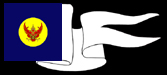
Thong
Rajawong Noi Fai Nai (ธงราชวงศ์น้อยฝ่ายใน)
Thai. ‘Small Flag of the Royal House for Ladies of the Court’. Standard for
princesses of the
Chakri
dynasty, other than the Royal
Consort of the Crown Prince, that
consists of a small flag
similar to the
Thong Rajawong Fai
Nah, but not larger than 60 centimeters and prolonged with
a long, red, slightly tapering,
swallow-tailed streamer. See also
Vexillology & Heraldry.
回
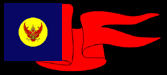
Thong
Rajawong Yai Fai Nah (ธงราชวงศ์ใหญ่ฝ่ายหน้า)
Thai. ‘Big Flag of the Royal House for Officials of the King’. Another name for
Thong Rajawong Fai
Nah. See also
Vexillology & Heraldry.
回
Thong
Rajawong Yai Fai Nai (ธงราชวงศ์ใหญ่ฝ่ายใน)
Thai. ‘Big Flag of the Royal House for Ladies of the Court’. Another
name for
Thong
Rajawong Fai Nai. See also
Vexillology & Heraldry.
回
thong samphao (ท้องสำเภา)
Thai. ‘Junk belly’. Name for an architectural style in
which the base of a building, pedestal or other structure is
boat-shaped. The named derives from a Chinese junk, which in Thai is
called
reua sampao
(fig.).
回
thong samrit
(ทองสัมฤทธ์)
Thai for ‘bronze’, an alloy consisting mainly of copper,
known in Thai as thong daeng (ทองแดง), with usually tin as an
additive, which in Thai is called
dihbook.
However, it may also consist of different compositions, one in
particular which is referred to as brass, known in Thai as thong
leuang (ทองเหลือง), and that is made with copper and zinc as an
additive, of which the latter in Thai is called sangkasih (สังกะสี).
It is widely used in the making of sculptures (fig.).
回
Thong So Ko (ธง
ส.ก.)
Thai. Name for the
personal Royal Flag of Queen Sirikit (fig.),
fully known as Thong
Sirikit Kitthiyagon,
and which
consists of a golden crown over her initials, the letters S (ส)
and K (ก) in blue and white, on a light blue
field, the colour of her birthday
(see
sih prajam wan).
There also exists a special edition of this flag, with only white
print and underneath the crown an additional ribbon with the
text Song Phra Charoen, which means ‘Long Live the Queen’ (fig.).
回
Thongthaem Tawanyawong (ทองแถมถวัลยวงศ์)
Thai. Name of a younger brother of King
Chulalongkorn
and a son of King
Mongkut
and His consort Queen Sangwaan. He was born on 17 October 1857, and
is fully known as
Prince Thongthaem Tawanyawong Krom(ma) Luang Sanphasaatsuphakit (ทองแถมถวัลยวงศ์ กรมหลวงสรรพสาตรศุภกิจ).
The prince is remembered as the Father of Film, who brought back
equipment from Europe when he travelled there with his brother King
Chulalongkorn
in
1897. He became the first
Thai filmmaker and filmed the King at court and in royal ceremonies
between 1900 and 1910. The prince died on 16 April 1919 and is
depicted on a Thai postage stamp issued in 1997, to commemorate the centenary of
cinematography in Thailand (fig.).
回
thong thahaan reua (ธงทหารเรือ)
Thai. ‘Navy flag’. Former
Siamese naval
flag used from 1912 to 1917 AD (fig.).
It consists of
a red field with a decorated
White Elephant,
and
in the top corner the emblem of the Royal Thai Navy, i.e. a golden royal
chadah-style crown, over a ship's anchor,
with a twisted chain and a
chakra
(fig.).
回
thong thammachak (ธงธรรมจักร)
Thai. ‘Dhammachakka
flag’. Another name for the Thai Buddhist flag (fig.), in Thai officially
called
thong phra
phutta sahtsanah.
Besides the Thai Buddhist flag there is also an International
Buddhist flag, in Thai known as
thong phra phutta sahtsanah sakon
(fig.).
See also
Vexillology & Heraldry.
回
Thong Trah Sanyalak
Phra Ratcha Phithi Borommarachaphisek (ธงตราสัญลักษณ์
พระราชพิธีบรมราชาภิเษก)
Thai. ‘Flag with the
Emblem of the Royal Coronation Ceremony’. See
Thong Phra Ratcha Phithi
Borommarachaphisek.
回
thong trai rong (ธงไตรรงค์)
Thai for tricolour. Name for any flag
consisting of three colours, but in Thailand the name generally
refers to the present national flag which is in use since 1917 and
consists of horizontal
red-white-blue-white-red
stripes.
See also
thong chaht. See also
Vexillology & Heraldry
and
WATCH VIDEO.
回
Thong Yaowaraht (ธงเยาวราช)
Thai. ‘Flag of the Young King’. The Standard of the Crown Prince, consisting of a
square yellow field
with a red
Garuda,
surrounded by a blue border. It is
derived from the Royal Standard, called
Thong Maha Raj
in Thai (fig.).
There are two models, i.e.
Thong Yaowaraht Yai
and
Thong Yaowaraht Noi,
meaning ‘Big
Standard of the Crown Prince’ and
‘Small
Standard of the Crown Prince’, respectively. Whereas the first one relates to a large square flag,
the second refers to a smaller model of it, not larger than 60
centimeters and prolonged with a long, white, slightly tapering,
swallow-tailed streamer (fig.).
The different flags can be specified even more by adding certain
other suffixes, i.e. Fai
Nah (ฝ่ายหน้า) which means
‘official of the king’ and refers to the
flag used by the Crown Prince personally, or Fai Nai (ฝ่ายใน) which
means ‘lady of the court’ and refers to the flag of the Royal Consort of the Crown Prince,
who uses the same emblem but depicted on a swallow-tailed flag
(fig.),
called
Thong Yaowaraht
Fai Nai.
Other princes in the
Chakri
dynasty have a blue field with a
yellow disc or circle that features a red Garuda, whereas other
princesses have the same emblem, but depicted on a swallow-tailed
flag. Also called
Thong Yaowaraht Fai Nah (ธงเยาวราชฝ่ายหน้า). See also
Yaowaraht.
See also
Vexillology & Heraldry.
回
Thong Yaowaraht Fai Nai
(ธงเยาวราชฝ่ายใน)
Thai. ‘Flag of the Young King's Lady of the Court’. The Standard of
the Royal Consort of the
Crown Prince. It uses the
same emblem as the
Thong Yaowaraht, but is depicted on a swallow-tailed flag. Also
called
Thong Yaowaraht Yai Fai Nai (ธงเยาวราชใหญ่ฝ่ายใน).
See also
Vexillology & Heraldry.
回
Thong Yaowaraht Noi (ธงเยาวราชน้อย)
Thai. ‘Small Flag of the Young King’. Name for a smaller model of the
Thong
Yaowaraht which is also known as
Thong Yaowaraht Yai.
It cannot be larger than 60 centimeters and is prolonged with a long, white,
slightly tapering, swallow-tailed streamer.
It is similar to the
Small Royal Standard used by
the King (fig.).
Also called
Thong Yaowaraht Noi
Fai Nah. See also
Vexillology & Heraldry.
回
Thong Yaowaraht Noi
Fai Nah (ธงเยาวราชน้อยฝ่ายหน้า)
Thai. ‘Small Flag of the Young King,
Official of the King’. Full name for
Thong Yaowaraht Noi.
See also
Vexillology & Heraldry.
回
Thong Yaowaraht Noi Fai Nai (ธงเยาวราชน้อยฝ่ายใน)
Thai. ‘Small Flag of the Young King's Lady of the Court’. A small
version of the Standard of the Royal
Consort of the
Crown Prince (fig.).
It consists of smaller model of the
Thong Yaowaraht, not larger than 60 centimeters and prolonged
with a long, red, slightly tapering, swallow-tailed streamer. See also
Vexillology & Heraldry.
回
Thong Yaowaraht Yai (ธงเยาวราชใหญ่)
Thai. ‘Big Flag of the Young King’. See
Thong
Yaowaraht.
回
Thong Yod (ทองหยอด)
1. Thai. ‘Golden
Drops’. Name of a kind of traditional Thai candy made with egg yolk.
READ ON.
回
2. Thai. ‘Golden
Drops’. Name of a work of art by Arin Roongjaeng.
READ ON.
回
thoralek (โทรเลข)
Thai for ‘telegraph’. Telegraphy
was introduced in Thailand in 1875, when
King
Rama V instructed the Directorate of Joint Logistics to
construct the first telegraphic cable between
Bangkok and
Pahk Nahm (ปากน้ำ),
in
Samut Songkhram
province. From then on the telegraphic message service expanded and
was available to the public until 1 May 2008, when after 133 years
the service
came to an end
due to the development of technology in communication. In order to
convey a message, Morse codes were sent over an electric wire, using
a transmitter key
(fig.)
and an
electrical telegraph receiver. For convenience, telegraphy for
public use was arranged drom a network of local Post and Telegraphy
Offices (fig.).
回
_small.jpg)
Thoranee
(ธรณี)
See
Thoranih.
回
Thoranih
(ธรณี)
Sanskrit-Thai. Mother or goddess of the earth.
She appears as a witness of the
Buddha's accumulated merits from earlier lives, just
before the moment of his
Enlightenment.
In art, she is usually depicted wringing water from her hair, thus aiding
the
Buddha in his resistance against
Mara by flushing his army of spirits away, saving
the Buddha from the temptation of desire, though this scene is
in
China
portrayed by a male deity pouring water from a
kalasa-like
flask (fig.). In
Thailand, she is known as
Mae Phra Thoranee
and is the chosen symbol of the Democratic Party.
In
Myanmar,
the goddess of the earth is
known as
Wathoun Darei
(fig.),
which may also be transcribed Wet Thonedaree,
i.e. the earth production spirit (fig.).
See also
bhumisparsa and
maravijaya.
Also spelled Thoranee and in Sanskrit pronounced
Dharani, as in
Brah Dharani.
See also
men kan,
POSTAGE STAMPS (1),
(2)
and
(3),
TRAVEL PICTURES (1)
and
(2),
PANORAMA PICTURE,
and
WATCH VIDEO.
回
Thoranih pratu (ธรณีประตู)
Thai. ‘Thoranih's
door’.
The Thai term for
‘threshold’ or ‘door
sill’, suggesting the sill is the dwelling
place of this guardian spirit.
See also
men kan.
回
thousand-year egg
See
khai yiew
ma.
回
Thread-waisted Wasp
Name for a wasp in the family
Sphecidae, a family in Thai referred to as
mahrah, which also includes
mud daubers (fig.) and digger wasps. The common name Thread-waisted Wasp
refers to the wasp's abdomen, which has a stalk-like front end.
Thread-waisted Wasps are typically more
than 2.5 centimeters long and are parasitic on insects and spiders,
which they sting and paralyze, but not kill. Instead, they store
them alive in their nests as provisions for their future larvae. The
female wasp will lay its eggs in the nest, close it off and then fly
away, never to return. Once hatched, the wasp grubs feed off the
paralyzed insects or spiders. See also
Ichneumon Wasp (fig.).
回
%20หมาร่า%201_small.jpg)
Three Ages of Buddhism
The
three periods or divisions of time following the
Sakyamuni
Buddha's passing. It is believed by some in
Mahayana Buddhism that different Buddhist teachings are valid in
each period according to the different capacities of the people born
in each respective period to accept the
dharma. The three
periods are further divided into five 500-year periods, with the
last one being a time in which the current Sakyamuni Buddhism would
lose all its power of salvation and a new
buddha, i.e.
Maitreya,
would appear to save humankind,
aided by ten thousand
bodhisattvas.
This time period, known as the Latter Day of the Law (or the Age of
Dharma Decline), would be characterized by great tribulation and would
last for a long period, described as ten thousand years.
回
Three-coloured Kaiser
Common name for a
butterfly
in the family Nymphalidae and with the scientific designation
Penthema darlisa melema, and similarly known in Thai as
phi seua
kaiser sahm sih
(ผีเสื้อไกเซอร์สามสี).
Above, the forewings of males are blackish with bluish-white
markings, consisting mostly of dots, a stripe, and a few upside-down
V spots along the edges, while the hindwings are dark brownish-black
with pale yellowish-white markings, mostly stripes, as well as some
dots and upside-down V marks along the outer edges.
回
_small.jpg)
Three Jewels
See
Rattanatrai.
回
Three Kingdoms
1.
A period in Chinese
history, in which three kingdoms, that is
the Wei, Shu and Wu, competed for control in the Yangtze Delta
region of China, after the fall of the Han Dynasty
in 220 AD. The period is usually placed between the foundation of the
Wei in 220 AD and the
conquest of the Wu in 280 AD, though many Chinese historians place
the beginning of this period much earlier, at the Yellow Turban
Rebellion in 184 AD. It is part of an era of disunity,
known as the Six Dynasties, six contemporaneous and sometimes
consecutive Chinese
dynasties, that
besides the Three Kingdoms includes the Jin Dynasty (265-420 AD), as
well as the Southern and Northern Dynasties (420-589 AD). In Thai
Saam Kok.
回
2. A Chinese historical narrative during the
period between 169 AD and 280 AD, from the turbulent years at
the end of the Han Dynasty until the reunification of the land, and
which covers the power struggle of
three competing kingdoms. It features both
real and fictional characters and events, and chief personages
include
Khong Beng,
a sagacious counsellor and clever strategist;
Jo Cho,
a shifty general;
Kuan U,
a brave and faithful warrior (fig.)
with his adopted son
Kuan Ping (fig.)
and his aide-de-camp
Chou Tsang
(fig.); and
Lao Pie,
a wise and faithful ruler. It was written by Luo Guanzhong (Lo
Kuan-chung), most likely in the 14th century AD, and is also known
as the Romance of the Three Kingdoms. The story has been widely
adapted for screen. In Thai
Saam Kok.
回
Three Kings Monument
1. Monument in
Chiang Mai that commemorates the treaty between the three
kings of the
Lan Na
empire, i.e. King
Ngam Muang of
Phayao,
King
Mengrai of Chiang Mai, and
King
Ramkamhaeng of
Sukhothai.
See
MAP,
TRAVEL PICTURE,
and
MORE ON THIS.
回
2. Monument
at Wat Phuthaisawan,
in
Phra Nakhon Sri Ayutthaya, featuring
three important kings of the
Ayutthaya Period,
i.e. King
Naresuan (fig.),
King
U-Thong (fig.),
and King
Ekathotsarot
(fig.).
See MAP and
MORE ON THIS.
回
Three-legged Money Frog
See
kaangkok sawan.
回
Three
Pagoda Pass
Name of a gateway in the northern part of
Kanchanaburi province, that marks the rugged Thai-Myanmar
border and was an important corridor in history for the overland
Thai-Burmese trade route between the Gulf of
Siam
and the Andaman Sea. Being one of the few places to access either
kingdom overland, it was the spot from where marauding Burmese
armies marched into Siam on their traditional invasions, as well as
the most plausible route used
by the Imperial Japanese Army
during WW II to build the Thailand-Burma
Railway. In 1785 it was the scene of heavy fighting,
when the Burmese Bodawhpaya launched a major attack on Siam.
Surasinghanat, the then Siamese viceroy took up position
in Kanchanaburi and successfully blocked the invasion
route, eventually causing the Burmese to withdraw.
The pass is named after three
small
pagodas that stand
near the border with Myanmar, at about 22 km north of
Sangkhlaburi. The three pagodas are part of the
provincial coat of arms of Kanchanaburi (fig.)
and the site today has a small border market. Also Three Pagodas
Pass and in Thai Dahn
Chedi Sahm
Ong (ด่านเจดีย์สามองค์), literally the
‘Checkpoint at the Three Pagodas’ or ‘Outpost of the Three Chedis’.
See also
THEMATIC STREET LIGHT
(1)
and
(2),
and
MAP.
回
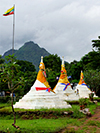
Three Refuges
See
Traisarana.
回
Three-spot Grass Yellow
Common name for a species of small butterfly in
the family Pieridae, with the scientific designation Eurema blanda.
It can best be identified by its yellow underside, where it
characteristically has three cell spots on the underside of the forewings,
hence the name. In Thai, this species is known as
phi seua
naen sahm jut
(ผีเสื้อเณรสามจุด).
Also spelled Three Spot Grass Yellow.
回
_small.jpg)
Three Star Gods
English name for
Hok Lok Siw.
回
Three-striped Palm Civet
Name of a species of civet, with the scientific name Arctogalidia
trivirgata, which is also commonly known as the Small-tootlyhed Palm
Civet, despite its seemingly rather large pointed teeth.
Its fur is mainly a tawny-buff color, with a darker greyish-tawny
head and the final one-third of the tail brownish, whilst the
underparts are slightly paler. On the back it has three distinct
dark brown stripes, that run along the length of the body, and which
are fainter in females. In this civet species, it are only the
females that posses a scent gland underneath the tail (fig.).
This gland confusingly resembles testicles and
an untrained eye can consequently easily mistake the female for the
male.
回
%203_small.jpg)
Thresher Shark
Common name of a
certain type of shark that uses
cavitation
by flinging its long whip-like tail over its head with speeds of
over 30 miles an hour at the peak of the tail, in order to create a
shockwave that either stuns or kills its prey. It is found in all
temperate and tropical oceans of the world and belongs to the family
Alopiidae. In Thai, it is known as
pla chalaam hahng yahw, i.e.
‘Long-tailed
Shark’,
a name also commonly used in English as a synonym for this species.
回
thua din (ถั่วดิน)
Thai. ‘Groundnut’. A
synonym for
thua lisong,
i.e. peanut.
回
thua fak yao (ถั่วฝักยาว)
Another spelling
for
tua fak
yao.
回
thua
leuang (ถั่วเหลือง)
Thai name for the
soybean.
回
thua lisong (ถั่วลิสง)
Thai name for the peanut, while
the Peanut Plant is called
ton
thua lisong. This commercial crop plant bears
its edible seeds under the earth, a feature that is reflected
in its botanical name Arachis hypogaea, as hypogaea means ‘under
the earth’. The peanut is hence also known as groundnut, a name that
in Thai translates as
thua din
and which is used as a synonym.
It bears bright yellow flowers
which are very similar to those of the
Wild Peanut Flower
(fig.),
a related
plant with similar but more rounded leaves and with a different kind
of peanut that has a much smoother husk. The latter is often found
used as
a kind of ornamental
grass used in
oriental gardens, especially as a ground cover for lawns and at the
base of trees, less so than for its nuts. The plant that yields the
peanuts we eat today
is an allotetraploid thought to have derived from hybridization
between the diploids
Arachis
duranensis, i.e. the Wild Peanut Flower which has the A genome, and
Arachis
ipaensis, another species that has the B genome, while the
chromosomes are exactly the same.
回
%202_small.jpg)
thua ma hae (ถั่วมะแฮะ)
Thai. Another name for
thua rae.
回
thua nao (ถั่วเน่า)
Thai. ‘Rotten beans’. Name for
a snack that consists of soybeans that are boiled and fermented,
slightly moldy, then pounded, thinly sliced and dried, and used for
cooking. They are typically sold as round shaped thin disks,
somewhat stiff, and brownish in colour. Compare with
khao kriyab
and
khao kriyab waw.
回
thua phoo (ถั่วพู)
Thai name for the Winged Bean, a kind of edible legume from a
plant with the scientific name Psophocarpus tetragonolobus, found
all over South and Southeast Asia. It grows well in hot, humid
climate and virtually all of the plant is edible, including the
beans, leaves, flowers and tuberous roots. It is also known as Goa
Bean, Asparagus Pea and Asparagus Bean.
回
%20ถั่วพู_small.jpg)
thua rae (ถั่วแระ)
Thai name for a
shrub, with the
botanical names Cajanus indicus and
Cajanus cajan, and commonly known as pigeon pea. It grows up
to around 3.5 meter tall, bears
yellow flowers,
and pods that hold
yellowish
edible peas. In Indian cuisine the peas are used to make a kind of
dal and in Thailand, the peas are steamed while still in their pods
and consumed as a snack by picking the peas from the pods. Steamed
the peas have a rather bitter taste and are typically sold by
itinerant food vendors. The pigeon pea shrub is in Thai also known
as
thua ma hae
and its pods are somewhat similar to those of the
soybean, a
crop and
much smaller plant known in Thai as
thua leuang.
回
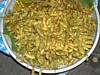
thuay chaam (ถ้วยชาม)
See
kreuang thuay chaam.
回
thudong (ธุดงค์)
Thai-Pali. Expression for a monk to take to the
road or travel. Often this is a kind of walking meditation to
eradicate unwholesome thoughts that cause unhappiness, a form of
samaati as well as merit making. The monk may then
carry a
klot,
an umbrella to meditate under in the forest or at temples gardens (fig.),
or to sleep under in the forest. The term Phra thudong is used for a
wandering meditating monks in the
Thai Forest Tradition,
a lineage of monasticism that focuses on
kammataan,
which started around 1900 AD with
Phra Ajaan Man
(fig.).
A legendary travelling monk is
Phra Siwalih,
of whom several statues, often very tall ones (fig.),
can be found across Thailand
(fig.),
and at Wat Song Khlong (วัดสองคลอง) in
Chachengsao,
there is a
giant statue of a venerated senior
mendicant
monk known as
Luang Poo
Pahng
Thudong
(fig.).
See also
thudongkawat
and
WATCH VIDEO.
回
_small.jpg)
thudongkawat (ธุดงควัตร)
Thai-Pali term from
Buddhism
meaning ‘ascetic routine’ or
‘ascetic duty’. It is related to the term
thudong.
回
thung (ธุง)
Thai-Isaan.
Name used in Northeastern Thailand for
a ceremonial mobile or
banner made of cloth, which in northern Thailand is referred to as
tung. The
thung, especially
tung yai maengmoom
or
spider web thung, is a traditional handicraft from Northeastern
Thailand used in Buddhist worship and local ceremonies. It is made
by weaving dyed cotton threads around crossed bamboo slats, forming
colorful geometric patterns. These are often hung in temples as
offerings or decorations. Different types of thung serve specific
ritual functions, such as thung pha wet (ธุงผะเหวด) for the
boon phrawet
festival and thung jaek khao (ธุงแจกข้าว) for merit-making for the
deceased, etc. Materials vary, including silk, coconut leaves, and
puffed rice. The practice reflects Isaan beliefs and has
similarities with spiritual crafts from other ancient cultures.
While the thung is crafted for decorative purposes and as an
offering in Buddhist worship, the process of making it carries
deeper social and spiritual meaning. The act of weaving threads
around the bamboo frame is often seen as a meditative practice,
requiring focus, patience, and repetition—qualities that align with
Buddhist principles. At the same time, thung-making serves as a
communal activity in Isaan villages. People, especially women, often
gather in informal groups to create these items together. As they
work, they engage in conversation, share stories, and exchange local
news, reinforcing social bonds and intergenerational knowledge.
Thus, the creation of the thung is both a spiritual exercise and a
cultural event that strengthens community ties.
WATCH VIDEO.
回
_small.jpg)
thung chai (thúng chai)
Vietnamese. Name for a basket boat, i.e. a small, round,
keel-less paddle boat, used by many fishing communities in
central and southern
Vietnam. Traditionally, it is woven from
bamboo and made waterproof with
buffalo dung and tar, yet today they are
often made of other materials, such as polyester (fig.). Due to its flat bottom, this kind of
large-sized coracle has a very low depth, allowing it to be used in
shallow waters at
Vietnam's beaches. It is found only is central and southern Vietnam, starting
from about Danang downward (fig.).
回
%202_small.jpg)
Thung Kulah (ทุ่งกุลา)
Thai. Name of an area
in
Surin Province that originally was part of Thung Kulah Ronghai (ทุ่งกุลาร้องไห้),
a vast natural region in northeastern Thailand covering about 2.1
million
rai,
or approximately 3,200 square kilometres and that stretches across
the provinces of
Surin,
Maha Sarakham,
Yasothon,
Sri Saket,
and
Roi Et.
The name Thung Kulah Ronghai, meaning ‘Fields of the crying
Kula’,
comes from a legend about the
Kula,
the name for
Burmese
people who work in
ruby mines in Thailand and
especially refers to
people from Mottama
(မုတ္တမ) in
Myanmar who crossed this harsh,
arid land. Though known for their endurance, they found the journey
so exhausting, with no shade or water, that they wept, giving rise
to the name ‘crying
Kula’.
Additionally,
kula
is also a
synonym for the
chula (fig.),
a traditional pentagonal kite typically flown in open fields. This
kite is often fitted with a humming bow, a device that produces a
distinctive whistling or weeping sound when flown, perhaps adding an
extra layer to the legend’s meaning. In the past, Thung Kulah
Ronghai suffered from desert-like conditions during the dry season
and severe flooding in the rains, with soils plagued by salinity.
Over time, reclamation efforts transformed the region, and today it
is one of Thailand’s most renowned areas for producing
ma-li rice. In 2007, the Royal
Irrigation Department dredged over 750 rai of land under the Kaem
Ling (แก้มลิง) or ‘Monkey’s Cheek’ flood management project to
address drought problems, creating a large swamp that was later
renamed Thale Sahb Thung Kulah (ทะเลสาบทุ่งกุลา), or ‘Thung
Kulah Lake’. Designed as both a water reservoir and a recreational
space, the site now features a bicycle path, a scenic pavilion, and
other facilities. Today, Thung Kulah Lake is a popular destination
for visitors seeking relaxation and natural beauty. Its clear,
turquoise-tinged waters are slightly brackish due to the area's
history of rock salt production. Visitors can swim, stroll along the
lake, or simply relax and enjoy the refreshing surroundings.
Floating raft houses are available for hire by the hour, offering
spaces to dine, lounge in hammocks, or enjoy private swimming pools
for children. Most rafts also have an upper floor with a slide
leading straight into the water, adding to the lively,
family-friendly atmosphere. Sometimes transliterated Tung Kula.
WATCH VIDEO.
回

Thung Makhaam Yong (ทุ่งมะขามหย่อง)
Thai.
‘Betel
nut tray
tamarind field’. Name of a
public park in
Ayutthaya,
and the place where Queen
Suriyothai
(fig.) in 1549 mounted a
war elephant
(fig.)
in battle against the invading Burmese army (fig.),
and was consequently killed
defending her husband and nation. On 14 May 1996, King
Rama IX
visited Thung Makhaam Yong and symbolically harvested some
rice
from a local paddy field using a
kiyaw, a
short-handled
sickle-like knife (fig.),
which had a
customized handle inlaid with
mother-of-pearl, bearing the name of Ayutthaya province, as well as the emblem
marking the King's fiftieth anniversary on the throne (fig.).
To commemorate the event, a granite slab was later erected
at Thung Hantra (ทุ่งหันตรา),
featuring a gilded
statue of the king holding a replica
of the
sickle he used during the
occasion. When King
Bhumiphon
and Queen
Sirikit
on
25 May 2012 revisited Thung Makhaam Yong, the local governor
officially requested for royal permission to replace the replica
of the sickle
in the hands of the king's rice-harvesting statue,
with
the authentic one used in 1996. Also transcribed Thung
Makham Yong. See also
makhaam
and
yong.
回
thung yai (ธุงใย)
Thai-Isaan.
Name used in Northeastern Thailand for
a
tung yai.
回
thung yai maengmoom (ธุงใยแมงมุม)
Thai-Isaan.
‘Spider
thung yai’.
Name used in Northeastern Thailand for
a
tung yai maengmoom.
回
thurian (ทุเรียน)
Thai name for
durian.
回
thuyen giay (thuyền giấy)
Vietnamese. ‘Paper boat’. Name
for a ceremonial boat made from colourful paper around a light
wooden frame, which is set afloat on the water as an offer to the
deceased, especially to victims of drowning and akin to the Chinese
ritual of
gong de,
in which relatives of the
deceased offer paper paraphernalia to their dead. The ritual is also
reminiscent of a ceremony
performed by the
Chao Le, i.e.
the sea gypsies of
Thailand, in order to bring prosperity and happiness in a
forthcoming year, by building a two meter wooden boat which is
filled with mementos (fig.) and set adrift on the sea,
as well as of the Paper Boat Procession in Hong Kong. In the latter,
villagers throw a variety of symbolic rubbish on to a paper boat
which is later burnt outside the village, while during the
procession, held on the morning of the 15th day of the first lunar
month as part of
the annual
Chinese New Year
celebrations of the local P'aang community, a
Taoist
priest gives ritual cleansing to the households he passes, whereas a
village boy called San Nin Tsai, i.e. ‘New Year Boy’, offers good
wishes, while both collect
hong bao (fig.),
i.e. red envelopes with monetary gifts. Besides this, the Chinese
also hold Boat-Burning Rituals to ward off pandemic diseases, wile
white paper boats set adrift are typical items sent to deceased on
new year's eve.
回
%20in%20Vietnam_small.jpg)
tiab (เตียบ)
Thai name for the
hsun ok, i.e.
a usually
cone-shaped, tray-like container with a stand, originally from Burma and used
for offering food to Buddhist monks.
READ ON.
回
Tian
(天)
Chinese. ‘Heaven’, as
well as ‘sky’, ‘god’, and ‘celestial’.
READ ON.
回
Tian Du Yuan Shuai (田都元帥)
Chinese-Taoist
deity, who is considered the guardian of the performing arts,
especially for traditional
Chinese Opera. He is typically
depicted with a black complexion, holding a pot with a
yin-yang
lid, wielding an ax, and—similar to
Nezha,
the youthful Chinese deity and warrior—standing with one foot
on a Wheel
of Fire.
In Thai, his name is transcribed Tien Hu Yuan Soi (เตี่ยนฮู้หง่วนโส่ย),
which differs slightly from the Chinese transliteration, but when
transliterated from Thai into Chinese, it too becomes Tian Du Yuan
Shuai. He is not very widely worshipped in Thailand but his statue
can occasionally be found in
Phuket,
such as in
Sahn Chao Tha Reua
and at Phra Phuttha Ming Mongkhon Eknaak Khiri (พระพุทธมิ่งมงคลเอกนาคคีรี),
and he may also be referred to as
Lao Ye (fig.).
In life, before his deification, he is believed to have lived during
the Tang (唐)
Dynasty (ca.
AD 618 - 907),
in the era of Emperor Xuan Zong (玄宗,
AD 712 - 756).
WATCH VIDEO and VIDEO
(EN). 回
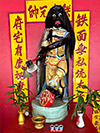
tianhe (天鹤)
Chinese. ‘Heavenly
crane’. Birds of paradise that in Chinese mythology transport
Taoist sages on their backs.
回
Tian Hou (天后)
Chinese. ‘Heavenly
Empress’. A title
given to
Mazu.
回
Tian Gong Tan (天公壇)
Name of a
Taoist-Buddhist
temple at the foot of Penang Hill in George Town. Completed in 1869,
it is the only temple in
Malaysia
dedicated to the
Jade Emperor
and is central to the annual Jade Emperor's Birthday celebrations on
the 9th day of the
Chinese New Year.
Built by the
Hokkien
community in the 1860s and restored beginning in 2002, it is located
amidst lush greenery. The approach features 110 granite steps and an
archway with century-old stone carvings. The temple combines
Buddhist and Taoist architectural styles, housing three gold-plated
Buddha statues
in the first shrine hall and a statue of the Jade Emperor in the
main shrine hall. Also transliterated as Thean Kong Thnuah.
WATCH VIDEO
and
VIDEO (EN).
回

Tian Tan (天坛)
1. Chinese. ‘Altar
of Heaven’. Name
of a complex of
Taoist buildings, located in the South
of Beijing,
China.
In English, it is usually referred to as the Temple of Heaven. It
was constructed between 1406 and 1420, during the Ming Dynasty, and
was commissioned by the Emperor Zhu Di (Yong Le -
fig.), who moved the
capital from Nanjing to Beijing and who also ordered the
construction of the Forbidden City. In the 16th century, the complex
was extended and another three prominent temples in the city were
added by the then Emperor Jiajing, in line with the remaining
directions of the compass, i.e. the Altar of the Sun (日坛) in the
East –now in ruins, which surface was red-glazed, symbolizing the
sun; the Altar of the Earth (地坛) in the North, which
surface is yellow-glazed, symbolizing the earth; and the Altar of the
Moon (月坛) in the West, which consists of a white
marble platform, symbolizing the moon. The Temple of Heaven was used by the emperors
of the Ming and Qing dynasties for heaven worship, i.e. annual
ceremonies of prayer for a good harvest, the only time an emperor's
knees would touch the earth in the centre of a round white marble
platform.
The
pagoda of
Wat Thawon Wararam in
Kanchanaburi, Thailand, which is
erected on the left bank of the Kwae Yai River (fig.),
is a replica of the
Temple of Heaven's main hall, that is the Hall of Prayer for a Good
Harvest. The main hall is also
depicted
on the popular
silver and gold Panda Coins issued annually by the
People's Bank of China since 1982 (fig.).
The present-day building in China is actually
itself also a replica of the original building, which was destroyed
in 1889 by a fire caused by lightning. It is said that the original
pagoda had its three roofs coloured blue (roof above), yellow (roof
in the middle) and green (roof below), colours symbolizing heaven, earth and the mortal world respectively, though it could
also be interpreted as blue for heaven,
yellow for the emperor (as in the
Forbidden City
-
fig.) and
green for the earth, with the emperor as the
so-called son of heaven situated in between heaven and the mortal world, thus symbolizing his
kingly role as liaison between heaven and earth, which in turn is reminiscent of the etymology of the Chinese character
wang (fig.),
and
represented in the overall layout of this temple, i.e.
rounded structures within square walls, shapes that in Chinese
iconography
symbolize
heaven and earth, respectively, akin to the
ancient
fang kong qian
coins
(fig.),
and to the
cong (fig.),
an ancient Chinese
artifact in which the
square shape represents the earth and the circular form heaven. In the adjacent park, people
gather to perform all kinds of activities, such as
tai
chi (fig.),
public choir singing (fig.),
card games, water calligraphy (fig.),
dancing, etc. Also spelled Tien Tahn. In
Vietnam, the Imperial Altar in
Hué which was used by the kings of the Nguyen
Dynasty (map
-
fig.),
is known as Dan te Troi Dat (Đàn tế Trời Đất).
See
MAP.
回
,%20Beijing,%20China%201_small.jpg)
2. Chinese. ‘Altar
of Heaven’.
Name of a giant
Buddha image at Po Lin Monastery on
Lantau Island, Hong Kong. The statue is named after
the Temple of Heaven
in Beijing, because its base is modeled after that of the Altar of
Heaven (fig.).
In addition, the base of a Buddha image (known in Thai as
tahn), could be regarded as
a kind of altar (which is similarly called tan or tahn in Chinese), is built on top of a mountain, which in Buddhism often
stands symbol for heaven.
Also spelled Tien Tahn.
See MAP.
回
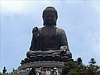
Tibetan Buddhism
The Buddhist religion as practiced in Tibet and certain regions of
the Himalayas, including northern Nepal, as well as Bhutan, where it
is the state religion. Tibetan Buddhism encompasses teachings from
the schools of
Hinayana,
Mahayana and
Vajrayana Buddhism, and its canon uses Tibetan as its spiritual
language. This type of practice of Buddhism has spread to many
countries due to the Tibetan Diaspora, i.e. communities of Tibetan
people that emigrated from Tibet when it was annexed by
China.
It is estimated to have around 15 million
followers worldwide. Among its prominent exponents is the 14th
Dalai
Lama (fig.).
Tibetan Buddhism has four main traditions, each nicknamed after the
colour of the elongated crescent-shaped hats they wear during
special ceremonies, i.e. Nyingma or Red Hat Sect (fig.); Kagyu or Black Hat
Sect;
Sakya, another Red Hat Branch; and Gelug or Yellow Hat Sect
(fig.).
Traditionally, all monks and novices wear typical wine-coloured to
purple robes (fig.),
sometimes mixed with yellowish-orange undergarments (fig.).
One of the largest and most important temples of Tibetan Buddhism is
Yonghe Gong in the
Chinese capital Beijing (map
-
fig.).
More broadly, Tibetan Buddhism may also be referred to as
Lamaism.
回
tical (ทีคัล)
Thai. Name for the Thai currency until 1897,
when King
Rama V
changed it to
baht.
Actually pronounced tican.
回
tican (ทีคัล)
Thai pronunciation for
tical.
回
Tichakon Jatubot (ฑิชากรจตุบท)
Thai-Pali.
‘Four-footed
Bird’.
Name of a compound, mythological creature from
Himaphan forest, that
has the body
of a
lion
and certain features of a bird, i.e. wings, a fan-like tail, and
clawed feet. Its complexion is light green, apart for the tail which
is yellowish. Like the animal, its name is also a composition, i.e.
the word tichakon (ฑิชากร) means
‘bird’,
the word jatu (จตุ) means ‘four’, and the word bot (บท)
is derived from
baht, which is
Thai-Rajasap
for ‘foot’.
回
Tickell's Brown Hornbill
Another name for the
Rusty-cheeked Hornbill
(fig.).
回
tie shan (铁扇)
Chinese for
‘iron fan’. See
tessen.
回
tiger
Third animal of the
Chinese zodiac, as the third year of the
animal cycle (fig.).
Those born in the Year of the Tiger are said to have admiring but
–at the same time– threatening qualities, reminiscent of the awe the
tiger instigates, i.e. the wonder for its magnificence, but also the
terror for its power and strength. The Bengal
Tiger's skin was originally an emblem of
the Hindu god
Shiva, who
killed the ‘tiger of desire’ and used its skin as his meditation
seat (fig.).
In Sanskrit,
the word for
tiger is
viagra.
This term is often used in ancient texts and literature, reflecting
the significance of the tiger in Indian culture and mythology, and
the tiger is often associated with strength, power, and ferocity. In Hindu mythology, the tiger is the
vahana of
Durga, the
consort of Shiva in her terrible form (fig.),
and in Chinese mythology, it is the
mount of
Lu Tong-pin
(fig.),
whilst the
arahat
Pindola
is
in general depicted
sitting on –i.e.
subduing– a tiger (fig.),
referring to his control over the animal, as well as over his passions.
The tiger (fig.)
features on many a Thai postage stamp, such as
the Zodiac Year of
the Tiger Postage Stamp issued in 2010 (fig.),
the
Songkraan Day Postage Stamp
issued in 1998 (fig.),
and on one stamp in a set of four wild cats
issued in the same year
(fig.),
as well as on another stamp for the
Chinese Zodiac
issued in 2022 (fig.).
Globally only 3,890
tigers exist in the wild and the
best chance to see tigers in the wild is doubtlessly India, which
today is still home to around 1,500 Bengal Tigers. In Southeast
Asia, tigers are associated with protective power and depictions of
tigers can often be seen
tattooed
on the chest, or
‒as in some villages in
Myanmar‒ erected
at doorposts or fences around countryside houses and farm yards (fig.),
in order to ward off evil.
In Thai,
the tiger is called
seua.
See also
THEMATIC STREET LIGHT.
回
tiger claw
1.
The pointed nail on a
tiger's
paw.
回
2. Nickname for a deciduous tree with the botanical
name Butea monosperma, also known as
Flame of the Forest and due to
its resemblance to teak, also called Bastard
Teak.
It can grow up to 15 meters high and its fruit gives the gum ‘Bengal
kino’. It blooms in February and its striking orange to
red flowers are alike to those of
the creeper
Mucuna bennetti.
They are sickle-shaped and their outline resembles
the French lily or, as seen from its side and according to its name, the claw of a
tiger.
It is the
floral emblem
of
Chiang Mai
University.
In Thai, this tree is called
thong kwahw.
It is one of the various
bodhi trees under which
some of the
buddhas
known to
Theravada
Buddhism attained
Enlightenment.
See also POSTAGE STAMPS.
回
3. Common name for a
deciduous tree with
vibrant red flowers and with the botanical
name Erythrina variegata, which is also commonly known as
Indian Coral Tree.
See also POSTAGE STAMPS.
回
Tiger Grass Borer
Another name for the
Handmaiden Moth.
回
Tiger Moth
Common name for a group of moths
within the
subfamily Arctiinae, a large and
diverse family of moths, that also includes Lichen Moths, Footmen
and
Wasp Moths.
The most distinctive feature of this family is the possession of a
tymbal organ on the metathorax, a membranous organ also present in
cicadas
and capable of producing ultrasonic sounds, used to attract mates,
as well as a defense against predators. When pupating, the
caterpillars of these moths make an elaborate mesh cocoon using the
shed hairs from their bodies, held together with silk (fig.). In Thai called
phi seua
laai
seua
(ผีเสื้อลายเสือ).
回
%201_small.jpg)
Tiger Prawn
Common name for a kind of marine crustacean, with the scientific
designation Penaeus monodon, and previously also named Penaeus
carinatus, Penaeus tahitensis, Penaeus coeruleus, and Penaeus
bubulus. The Tiger Prawn is widely distributed, its natural habitat
stretching from the eastern coast of Africa, across the Indian Ocean to the Sea of Japan and
northern Australia, whilst being an invasive species in the Gulf of
Mexico. It is the most widely cultured prawn species in the world,
farmed or caught
for food on a commercial
scale. Its name derives from the black and white bars on
its back, which are reminiscent of the stripes of a
tiger
(fig.). In
Thai, it is called
kung
kulah dam
(กุ้งกุลาดำ).
See also
Japanese Tiger Prawn
(fig.)
and
POSTAGE STAMPS.
回
_small.jpg)
tihn pet farang (ตีนเป็ดผรั่ง)
Thai. ‘Foreign duck-feet’. Name for a small tree, that
grows up to 8 meters tall and originally comes from Central America.
READ ON.
回
ti klong phen (ตีกลองเพล)
Thai for the beating of the
klong phen-drum in a Buddhist
temple, marking the eleventh hour and the start of
phen, the hour between eleven and twelve in the morning,
when Buddhist priests have their last meal of the day.
回
tilaka (तिलक)
Sanskrit. Literally it means ‘freckle’ or ‘mole’, but generally it
is the term for a
coloured, often red (fig.), white, white and red, or black mark
applied on the forehead of Hindus, typically as a sign of devotion,
usually of a spiritual nature. It has many forms and can refer to
many different things, its
significance varying from community to community. It may be worn on a daily basis, like with
priests of followers of certain sects, or
on particular occasions only, like after a visit to a temple or
at the beginning of a journey, when usually a red dot is placed (fig.). It
may be applied purely decorative or as an identifying mark. The
dot with Hindu women is a
form of tilaka known as
bindi,
a Hindi word that derived from the Sanskrit word
bindu.
It means a ‘dot’ or ‘drop’ and refers to their marital status.
Equally, the
Tibetan word for ‘drop’ is tikle and is likely etymologically
related to tilaka.
Religious sects often have their own designs of tilaka called
pundra
literally ‘sectarian mark’ and those are sometimes
worn on other parts of the body as well,
especially on the torso (fig.), e.g.
followers of
Shiva
mark their forehead or
chest with a
tri-pundra,
three horizontal lines (fig.), followers of
Vishnu
mark their
foreheads with a
urdhva-pundra,
a simple U-shape (fig.),
etc.
When applied on the forehead the original design of the pundra is often accompanied of a red dot too.
There are also honorary tilaka, usually
applied as a single vertical red line and used to anoint prominent
personalities, royalty (raja, i.e.
rajatilaka
which is used for kings on their accession to the throne) or heroes
(vira - वीर).
This reminds of the Romans who used to paint the faces of their
triumphant generals vermilion with cinnabar pigment in imitation of
the brilliant red face of the Capitolinus Temple image of the god
Jupiter. However, the origins of the tilaka are not completely
known, but it is believed to have derived from ancient traditional
tribal practices, such as the application of colours on the forehead
on special occasions or during important events, e.g. at weddings or
before a hunt or battle. A spot may also be applied on the face of
small children to make them less perfect and thus less likely to
attract evil eye or
adrishti
(fig.). Some forms of tilaka
are reminiscent of the divine
third eye
and the Burmese tradition of applying
thanaka (fig.)
suggests an affiliation with
the name tilaka as well as with the custom. In Thailand, Buddhist
monks sometimes apply three white dots of a paste-like mixture, made
of water and talcum powder, on the forehead of laity, representing a
symbol of the
Trairat.
See also
urna and
buddha eye.
回
_small.jpg)
Tilohk Jutha Thewi (ติโลกจุฑาเทวี)
Thai. Name of a royal princess of the
Mengrai
(fig.)
Dynasty in the
Lan Na
Kingdom, who is also known as Tiloka Jutha Thevi (ติโลกะจุฑาเทวี)
and as
Somdet
Bophit
Phra
Maha
Thewi
Sri
Rattana
Chakrawat.
She was the consort or
Phra
Chaya of
Phaya
Saen Meuang Ma
(fig.),
the ninth king of the Mengrai Dynasty who ruled Lan Na from 1385 to
1401 AD, as well as
the Queen Mother or
Channanie
of Phaya
Sahm Fang Kaen
(fig.),
who ruled Lan Na between 1401 and 1441 AD as the tenth monarch. As
such she was an influential figure who played an important role in
the rule of the kingdom.
Her name is sometimes spelled Tiloke Chutha Dhevi.
See also TRAVEL PICTURES
and
LIST OF LAN NA KINGS.
回
_small.jpg)
Tilokarat (ติโลกราช)
Thai. Name of
the
eleventh monarch of
the
Mengrai
(fig.)
Dynasty, who ruled the
Lan Na
Kingdom
for 46 years, from 1441 to 1487 AD. He was the
sixth child
of
Phra Chao
Sahm Fang Kaen (fig.)
and became king by deposing his father. He was a belligerent
warlord, yet also a fervent supporter of
Theravada
Buddhism,
building several temples, such as
Wat Chedi Jed Yod
(fig.)
where his ashes were later buried (fig.),
and Wat Pa Daeng Maha Wihaan (วัดป่าแดงมหาวิหาร), which he built on
foundations laid by his mother, as well as enlarging
Wat Chedi Luang
Worawihaan (fig.)
in order to accommodate the
Emerald Buddha
(fig.).
See also TRAVEL PICTURES
and
LIST OF LAN NA KINGS.
回
_small.jpg)
ti look lo
(ตีลูกล้อ)
Thai. ‘Hit the wheel’.
Name of a traditional children's game (fig.), in which a ring or hoop is
bowled along by hitting it with a wooden stick, without stopping or
letting it fall over. The
game starts from a certain point and the first one to arrive at the
finish line wins the game.
回
_small.jpg)
tin
See
dihbook.
回
Tinfoil Barb
Common name for a species of carp-like
freshwater fish found in Southeast Asia and with the scientific
designations Barbonymus schwanenfeldii and
Puntius schwanenfeldii.
READ ON.
回
Tinglish
See
Thinglish.
回
Tinna Siha (ติณสีหะ)
Thai-Pali. ‘Grass
Lion’.
Name of a mythological creature from
Himaphan
forest, with the body of a lion and belonging to the pure lions. It
is
herbivorous in
nature and described as having a
red body with horse-like hooves. It is similar to the
Geson Singh
(fig.).
回
Tipitaka
Pali for
Tripitaka.
回
tiranga (तिरंगा)
Hindi for ‘tricolour’,
a term in India used almost exclusively to refer to the Indian
national flag,
which consists of a horizontal tricolour in
saffron, which represents renunciation;
white, which stands for peace and truth; and green, which symbolizes the green soil and
thus nature; while in the
centre of the white band there is the depiction of a navy blue
Ashoka
Chakra,
a 24-spoked
dharmachakra,
which replaces the spinning wheel (fig.)
depicted in earlier versions.
回
tire bin
Thai-style
rubber garbage
bin made from recycled car tires. It consists of
an old car tire which is
turned inside-out and made into
a round and bulbous
vessel with two side-grips. It can be
closed off
with a round lid that has a handle in the top centre. The bin is
typically placed on a
frame of four halves cut from the stronger sides of car tires which
are held together by a horizontal circle of a full tire side on top.
These durable and flexible
garbage bins have a volume of approximately 80 litres and are found nationwide, typically along roadsides and in
front of upcountry houses and shops. In
Thai, these typical Thai bins are called thang khaya yahng rot yon (ถังขยะยางรถยนต์),
i.e. ‘car tire
rubber garbage bin’.
回
_small.jpg)
Tirthanka
(तीर्थन्क)
Sanskrit. ‘Ford maker’. See
Tirthankara.
回
Tirthankara
(तीर्थन्कर)
Sanskrit. ‘Ford makers’. The twenty-four
omniscient great teachers of whom the last one founded
Jainism.
回
tit lom bon (ติดลมบน)
Thai.
‘To float
on the upper wind’.
A term used in
kite flying,
especially in
kite flying fights,
and which refers to ones
astuteness in the competition.
Outside the sport, the term means
‘to be stable’, especially of a
(or ones) position.
See also PROVERBS &
IDIOMS,
WATCH VIDEO
and
VIDEO (E).
回
Ti Tsang (地藏)
Chinese.
‘Earth Storehouse’, though
often translated as ‘Earth Treasury’ (fig.).
Ti Tsang is
the
Chinese
bodhisattva
of hell beings (fig.), hence he is
the Chinese equivalent of
Ksitigarbha, and his
role is similar to that of
Phra Malai.
He is usually depicted wearing a
typical Chinese monk's hat (fig.) and
holding a
khakkhara (fig.),
a Buddhist beggar's staff, as well as a
chintamani (fig.),
a wishing jewel. In Thai, his name is transcribed
Tih Jang (ตี่จั่ง), but is usually pronounced
Tih Tang, and in
Vietnamese he is known by the name Dia Tang (Địa Tạng -
fig.).
回
tobacco
See
yah soob.
回
tobacco curing
barn
See
rohng bom
yah soob.
回
tobacco
cutter
A boat-shaped, bench-like tool,
with at the far end a near-vertical board with a round hole in it.
It is used to press
tobacco
leaves together and pushing them through the hole, enabling a worker to cut off the leaves.
In Thai, it is called
mah han bai yah soob.
回
Tobacco Grasshopper
Common name for an insect in the
family of grasshoppers, with the scientific name Atractomorpha
crenulata, and also commonly known as a Long-headed Locust. It
somewhat resembles the
Long-headed Toothpick Grasshopper
(fig.),
but is much shorter and sturdier. It is mostly bright
green, with a thin white edge at
the front side of the body, while the base and bottom
half of the antennae, as well as the bottom hind legs, have a bluish
shine. The Tobacco Grasshopper has well-developed tegmina, i.e.
thickened fore wings that protect the more vulnerable hind wings,
which are reddish in colour. In Thai, it is called
takkataen
hua yahw kohn pihk daeng (ตั๊กแตนหัวยาวโคนปีกแดง),
i.e. ‘long-headed grasshopper [with a] red wing-base’.
See also WILDLIFE PICTURES.
回
%202_small.jpg)
Toddy Cat
Another name for the
Common Palm Civet.
回
toey hom (เตยหอม)
Thai for
pandanus.
回
toei-toei (ตุ๋ยตุ่ย)
Thai. A ‘singing’
waw or
kite, also known as
waw doei-doei, with a ‘sounder’ shaped like a bow
(fig.). See also
kite flying fights.
WATCH VIDEO
and
VIDEO (E).
回
tofu
(豆腐)
Japanese. A curd made of mashed
soybeans (fig.).
It usually comes cut into square blocks and is often used in
vegetarian dishes to replace animal protein. Tofu can be eaten fresh
(creamy white and soft) or fried (golden-brownish and hard on the
outside). On markets, especially Chinese ones, it is also sold in small
pieces, in a dry hardened form which is made into a knot (fig.)
and used to put in soups. Small cubes of fried tofu are an
ingredient in
phad thai (fig.).
In Chinese, it is called dou fu (豆腐),
which is usually translated as
‘bean curd’,
but literally means ‘decayed
peas’ or ‘rotten beans’. In Thai,
it is called
tao hoo, and
the dried form with a knot as
tao hoo roop
bow (เต้าหู้รูปโบว์), i.e.
‘bow-shaped tofu’. See also
blood tofu.
回
toh (ต่อ)
Thai for
‘wasp’ and ‘hornet’.
There are many
different species. Some bite, others sting from the bottom of their
abdomen. Wasps differ from
bees
(fig.) by the fact that they have no hair,
unlike bees
which are called
pheung
in Thai, though
in Chinese both
are referred to as
feng.
In
temperate and tropical Eastern Asia, the sting
of the
Asian Giant Hornet,
the world's largest hornet, regularly causes fatalities, whilst in
India it is the
Yellow Paper Wasp
that
is responsible for a number of
deaths per year.
Also called
taen.
回
Toh (โต, တိုး)
Thai-Burmese. Mythological lion with two
deer-like
horns or antlers
on its head. It is
a legendary animal believed to have originated in myths from
Laos
and also from
Myanmar. In
art, it often appears in pairs, and often occurs in
Lan Na festivals (fig.),
in the form of dancers
dressed up as this mythical animal (fig.),
roaming around in the audience, sniffing bystanders,
somewhat reminiscent of a Chinese Lion Dance (fig.). See also
simha,
singh,
singha and
singtoh, and compare with
Kraison Mangkon,
as well as with the Chinese
kilen (fig.)
and
Bi Xie (Bi Ya -
fig.),
and
Pensajuba (fig.).
回
,Toh%20(lion%20with%20two%20hors%20on%20the%20head)_small.jpg)
toh chan (โถชั้น)
Thai. Name of a style of porcelain jar or vase in
benjarong.
The main vessel has a urn-like shape and it is closed of with a lid
which ends in two tapering horizontal discs underneath a lotus bud
handle.
回
Toh Chatah Chiwit (ต่อชะตาชีวิต)
Thai. ‘Renew Life's
Destiny’. Name of an unconventional ritual in which a Buddhist monk
performs a symbolical burial for a living person.
READ
ON.
回
To Hieu (Tô Hiệu)
Vietnamese. Name of a Vietnamese
revolutionary and resistance hero, who rebelled against the French colonial occupation
of
Vietnam.
READ ON.
回
tohk (โตก)
See
toke.
回
toh nahm mon (โถน้ำมนต์)
Thai. Name for a large jar or vessel that is used in Buddhism to
store
nahm mon,
i.e. ‘blessed water’ (fig.),
which is used by Buddhist monks to bless believers or sacred
objects, by sprinkling them
(fig.),
using a brush or tassel-like aspergillum made from
bamboo and
known as
rod nahm mon
(fig.).
They can have any shape, but are typically
large and the more traditional ones are often
similar in shape to that of the
benjarong
toh phaya kru juk tat.
See also
POSTAGE STAMP.
回
toh phaya kru (โถพญาครู)
Thai. Short for
toh phaya kru juk tat.
回
toh phaya kru juk tat (โถพญาครูจุกตัด)
Thai. Name of a style of porcelain jar or vase in
benjarong.
The main vessel has a flowerpot-like shape which stands on a foot
and is closed off with a
conical shaped
lid of which the peak, that doubles as the handle, is in the form of
a flower bud with a cutoff tip. In short
toh phaya kru.
回
tok (ตอก)
Thai. A thin strip of
bamboo used for tying or weaving (fig.).
Hill tribe people typically use them
to
plait
(fig.)
baskets, such as
krapha
baskets (fig.), and
talaew
(fig.),
as well as to thatch roofs of bamboo huts, village gates and
forest dwellings (fig.).
See
also POSTAGE STAMP
and
THEMATIC STREET LIGHT.
回
,%20thin%20strip%20of%20bamboo%20used%20for%20tying%20or%20weaving_small.jpg)
Tokay Gecko
Common name for the Gekko gecko, which in Thai is
known as
tukkae.
回
toke (โตก)
Thai. A tray on a pedestal, or a small floor
table. See also
khan and
phaan.
Also transcribed
tohk.
回
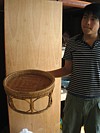
tom (ถม)
Thai term for
niello.
回
tom kha kai (ต้มขาไก่)
Thai. ‘Boiled chicken with
galangal’. Name of a spicy chicken soup, with
coconut milk, Thai ginger and
hed pluak
or
hed faang, i.e. termite mushrooms or paddy
straw mushrooms, respectively.
In addition other ingredients, such as bashed
lemon grass,
kaffir lime
leaves, coriander root, coriander leaves, soup powder, whole dried
chilies,
lime juice, salt and
fish sauce,
are usually added.
回
_small.jpg)
tom yam (ต้มยำ)
Thai. ‘Cooked salad’ or ‘boiled salad’. Name of a spicy, hot and
sour soup, made of fish or meat boiled (tom) in either water or
coconut milk (ka-thi).
Other ingredients include lemon grass
(takrai),
kaffir lime leaves (bai
makrud -
fig.),
galangal (kha),
lime juice (nahm
manao),
fish sauce (nahm
pla), tamarind (makhaam),
shallots and some chili sauce, chili paste or fried chili paste (nahm
phrik or
nahm phrik phao).
It is typically served boiling hot in an
earthen or
aluminium pot with a chimney in the middle,
called
moh fai (fig.).
Their are different varieties which be defined by adding the name of
its main ingredients at the end, e.g. tom yam kung (ต้มยำกุ้ง)
for tom yam with ‘prawns’; tom yam
pla
(ต้มยำปลา)
for this dish with ‘fish’, etc. The term tom yam kung also became a
slang expression meaning ‘serious economical problems that cannot
yet be solved’, a reference to the Asian Financial Crisis which
started in Thailand on 2 July 1997 with the financial collapse of
the Thai
baht after
the government decided to float the local currency, detaching it
from the US dollar. Sometimes transcribed tomyam, tom yum or similar.
See also POSTAGE STAMP.
回
tom yum (ต้มยำ)
See
tom yam.
回
ton (ตน)
Thai. ‘Body, substance and self’, as in ‘ton
eng’, oneself. Term and classifier to indicate beings regarded as
lower than humans, as in ‘yak song (2) ton’, two giants, and ‘pie saam
(3) ton’, three ghosts. The numeric noun
for humans is ‘kon’, and that for sacred things or supernatural
beings is ‘ong’.
回
ton (ต้น-)
Thai. ‘Tree’ or ‘plant’. Almost
always used as a prefix with the names of trees and plants. If used
on its own or as an apendix, it can mean ‘first’ or ‘beginning’, as
in
Chang Ton.
回
ton dahb sethi (ต้นดาบเศรษฐี)
Thai. ‘Millionaire's
sword plant’. Thai designation for the
Flaming Sword
(fig.).
回
ton dok pheung (ต้นดอกผึ้ง)
Thai. ‘Honey flower
tree’. See
ton pheung.
回
ton faai
(ต้นฝ้าย)
Thai. General name for the cotton plant
or cotton tree of the genus Gossypium, usually a shrub, native to
the tropical and subtropical regions. It seeds are stored in seed
capsules called bolls (fig.)
and are surrounded by soft, fluffy fibres which can be used to make
yarn for textiles. In Thailand several species occur, e.g.
faai (ฝ้าย
-
Gossypium herbaceum), faai daeng or ‘red cotton’ (ฝ้ายแดง - Gossypium
arboreum), faai thet (ฝ้ายเทศ -
Gossypium barbadense),
faai samlih (ฝ้ายสำลี -
Gossypium barbadense var. acuminatum), faai tun (ฝ้ายตุ่น -
Gossypium nanking var. siamensis).
回
%20cotton%20tree_small.jpg)
tong (ตอง)
Thai. A large leaf, such as that of the
banana plant, used as a wrapper, or to
thatch roofs of
bamboo huts and dwellings, as is still common
practice in places such as
Mae Hong Son, where it
is then referred to as bai tong (ใบตอง) or bai tong teung (ใบตองตึง).
See also
ton phluang
and
Phi Tong Leuang.
回
ton gluay (ต้นกล้วย)
Thai name for
banana plant.
Also spelt ton kluay.
回
ton gohng gahng (ต้นโกงกาง)
Thai name for
mangrove.
Also spelt ton kohng kahng.
回
tong xing (同性)
See
long yang.
回
tong xing ai (同性爱)
See
long yang.
回
ton jan (ต้นจันทน์)
Thai name for a tree of which there are many
different species, such as the genus Pterocarpus
(ton jan daeng) which is known in English as
sandalwood
(fig.),
the genus Myristica (ton jan thet) in English known as
nutmeg
(fig.),
the genus Diospyros decandra
(ton jan-in
-
fig.),
which produces the
Gold Apple, a
fruit known in Thai as
look chan,
etc. Also transliterated ton chan.
回
ton kanun (ต้นขนุน)
Thai name for
artocarpus heterophyllus.
回
ton khlum (ต้นคลุ้ม)
Thai. Name of a small, up to 3 meter high, dark green,
bamboo-like plant, that bears white
flowers. It is a kind
of water plant with tough and strong fibre which stalks are used for
weaving household items, such as fish traps. This type of craftwork
is widely promoted by the
Chanthaburi Provincial Skill Development
Centre. The Iban
people of Borneo use it to sew overlapping leaflets together in the
roofing of houses and temporary sheds. Its scientific, Latin name is
Donax grandis and it belongs to the family Marantaceae. In
Malaysia it is known by the name bembam.
回
ton khoon (ต้นคูน)
1. Thai. Another name
for
rachaphreuk,
i.e. a tree with the botanical names Cassia fistula and Indian
laburnum, commonly known as Golden Shower Tree
and Drumstick Tree (fig.).
Khoon literally also means ‘to multiply’.
回
2. Thai. A name
sometimes used for the Colocasia gigantea, commonly known as Giant
Elephant Ear or Indian Taro (fig.),
and in Thai usually referred to as
ton kradaat,
besides the names toon (ตุน) and thoon (ทูน), as well as its generic
name
bon
or
ton
bon. Khoon literally also means ‘to multiply’.
回
Tonkin
Name of a former French
protectorate that encompasses
the northernmost regions of
present-day
Vietnam.
It bordered
Yunnan
in southern
China,
current
northeastern
Laos
to its west
and northern Annam to its south. Its
most important city and capital was Hanoi.
In Vietnamese, the region is known as Bac Ky (Bắc Kỳ),
i.e. the ‘Northern State’. See also
Cochinchina.
回
Tonkin Leaf Monkey
Common name for a
species of lutung with the scientific
name Trachypithecus francoisi, and also commonly known as François' or Francois'
Leaf Monkey.
READ ON.
回
ton
klah (ต้นกล้า)
Thai name for a paddy sprout or
rice
sprout ready for transplanting, a process known as
yaay ton
klah (fig.). It
literally means
‘strong
plant’
or ‘courageous
plant’, perhaps referring
to the fact that it has survived the first period of about 45 days,
before being transplanted.
回
%20rice%20or%20paddy%20sprout%202_small.jpg)
ton kohkoh
(ต้นโกโก้)
Thai name for the cacao tree,
genus Theobroma, an evergreen tree with the botanical name Theobroma
cacao and belonging to the family Malvaceae, or alternatively the
family Sterculiaceae. This small tree whose pods (fig.) contain the
almond-shaped seeds or beans that are used to make
cocoa
and chocolate, grows about eight meters tall. It is native to
the deep tropical region of the Americas and probably originated in
the Amazon. In Thailand the tree is not very popular and only grown
by a few smallholder farmers in the southern provinces of
Prachuap Khirikhan,
Chumphon and
Surat Thani,
producing but a small
annual yield.
Malaysia however, yearly produces over
thirty thousand tons of cocoa beans, thus ranking eleventh on the
list of the world's most significant cocoa producers.
Each tree produces about 20 pods and each pod contains between 20
and 60 seeds, and to produce one kilogram of cocoa paste about 10
pods are required. It is
sometimes called cocoa tree and the Greek scientific name Theobroma
(θεόβρωμα) means ‘food of
the gods’.
回
ton kradaat (ต้นกระดาด)
Thai generic name for the
Giant Elephant Ear or Indian
Taro,
as well as its general overlapping name
ton
bon or
bon
(fig.).
There are several species and varieties, including Alocasia indica,
known in Thai as ton kradaat daeng (ต้นกระดาดแดง), i.e. ‘red
taro’,
due to a reddish shine on the overall green stem; Xanthosoma nigrum,
known in Thai as ton kradaat dam (ต้นกระดาดดำ),
i.e. ‘black
taro’,
due to its blackish stem; Alocasia macrorrhizos, known in Thai as
ton kradaat khiao (กระดาดเขียว), i.e. ‘green taro’, due to its green
stem, which is sometimes referred to as ton kradaat
khao
(ต้นกระดาดขาว), i.e. ‘white taro’, due to its green stem with a pale
silvery-whitish,
somewhat powder-like or waxy substance called
nuan
on the surface (fig.);
and a variety
with the botanical name Colocasia gigantea, with the Thai name bon
kradaat
yak
(บอนกระดาดยักษ์), i.e. ‘giant taro’, besides other generic names
including
ton khoon or
khoon,
ton toon or toon (ตุน) and ton thoon or thoon (ทูน), used in
northern Thailand, and oh dip (ออดิบ, อ้อดิบ), ao dip (เอาะดิบ) and
ouk dip (ออกดิบ) used in the south. Many of the above names are
often and sometimes mistakenly used interchangeably with less
precision to detail.
See also POSTAGE
STAMP and
WATCH VIDEO.
回
ton lanthom (ต้นลั่นทม)
Thai name for the
Plumeria acutifolia or
frangipani tree,
which was imported to
Thailand from
Cambodia,
after the Siamese conquered
the
Khmer
city of
Nakhon Thom.
The name lanthom (ลั่นทม) is said to be a corruption from lanthom (ลั่นธม),
a word with a slightly different spelling in Thai. It is composed of
the words lan (ลั่น) and thom (ธม), with lan
meaning ‘to fire’ (i.e. to pull the trigger of a firearm) and thom
referring to the city (or
nakhon) Thom.
In 1352, the
Ayutthayan
King
U-Thong
laid siege to
Angkor Thom
and in 1353
successfully captured the city, placing one of their princes on the
throne, though in 1357 the Khmer regained control. Then, in the 15th
century, Angkor Thom was again raided by the Ayutthayan King
Borommarachathirat II,
and abandoned.
回
ton mahk (ต้นหมาก)
Thai name for
betel palm or
areca palm.
回
ton mai kin malaeng (ต้นไม้กินแมลง)
Thai. ‘Insect-eating plant’.
Term used for any kind of carnivorous plant.
Species found in the wild Thailand include
the
Tropical Sundew
(fig.),
and various
pitcher plants
(fig.).
Besides this, many garden centres and flower shops offer foreign
introduced species of carnivorous plants, such as the popular Venus
flytrap (Dionaea muscipula), which in Thai is known as
kaab
hoi khraeng (กาบหอยแครง).
Sometimes plants of the genus
Rafflesia
are also listed with or
mistaken for carnivorous
plants (fig.),
though they are in fact parasitic. The reason for this might be that
the rafflesia is sometimes called
carrion flower,
due to its foul odour similar to decaying
meat, which is used to
attract flies in order to pollinate the plant.
回
ton mai ngeun ton mai thong (ต้นไม้เงินต้นไม้ทอง)
Thai. ‘Silver tree, gold tree’. Name for a pair of artificial miniature trees, one made of
silver
the other made of gold (fig.). They are used as an offering and can be
found all over Thailand, most commonly with shrines, especially
those devoted to the king or any other royal family member. They
often have
bodhi tree
leaves (fig.)
and are offered to demonstrate loyalty. The offering of
silver and
gold trees
dates from the
Ayutthaya and
Rattanakosin
Periods, when vassal
states offered silver and golden miniature trees to the
Siamese
(or, before, to the Burmese)
kings to prove
their loyalty.
Chiang Mai
vassal rulers under Burmese control were also required to travel to
Burma at least once a year to pay their respects to the Burmese king
and their subordinates had to pay special taxes as stipulated by
Burma. Besides this also manpower and requisites had to be made
available in times of war, and relatives of vassal rulers, often
their direct offspring, were sometimes sent to Burma as a guarantee.
Besides silver and gold trees with bodhi leaves as described above, one sometimes finds depictions of silver and golden
bodhi trees in Buddhist temples or art (fig.),
which may represent an expression of loyalty towards the
Buddha
and
Buddhism. Nowadays the silver and
golden trees are often replaced by other silver and golden objects,
such as flowers,
phum dokmai,
chat,
etc. The silver and golden colour also refers to money and wealth in
general, as the Thai word ngeun means both ‘silver’ and ‘money’, whereas thong means
‘gold’. Also transcribed ton mai ngern ton mai
thong or ton mai ngun ton mai thong, and if in the form of
bodhi trees:
poh ngeun poh thong (โพธิ์เงิน โพธิ์เงิน).
回
_small.jpg)
ton mai sak (ต้นไม้สัก)
Thai name for
teak tree.
See
teak.
回
ton maprao (ต้นมะพร้าว)
Thai name for
coconut palm.
回
ton nga chang (ต้นงาช้าง)
Thai.
‘Elephant
tusk plant’. Thai name for the
Starfish Snakeplant, a drought-tolerant
succulent with thick, cylindrical, slightly curving, spike-like
leaves, and which is in Thailand often seen as an ornamental outdoor
pot plant (fig.).
See also
ton,
nga,
and
chang.
回
ton ngiw (ต้นงิ้ว)
Thai. Name for a deciduous tropical tree of the genus Bombax ceiba,
which is commonly known as Cotton Tree, due to the white,
cotton-like fibres it produces during certain periods. It has a
straight tall trunk that grows up to a height of around 20 meters
and bears large, cone-shaped spikes (fig.). It blooms from January to
February and has
dark orange to red flowers (fig.) with five petals
(fig.), that appear before the
new foliage, and which in Thai are known as
dok
ngiw or
dok ngiaw. Both the petals and the filaments of its flower's stamen, without the
anther (fig.), are used in
Thai cooking, as well as in the cuisine of other Southeast Asian
nations. The petals are eaten as a snack or meal, the
filaments are used as an ingredient to flavour food. However, both are
confusingly called the same, i.e.
dok ngiw or
dok ngiaw.
In religious folklore the tree has a place in
narok,
the Buddhist hell, where it is used as part of a punishment for the
wicked in the underworld, forcing them to climb up its thorny trunk,
naked (fig.).
回
ton ohy (ต้นอ้อย)
Thai name for
sugarcane.
回
ton palm nahm man (ต้นปาล์มน้ำมัน)
See
oil palm.
回
ton phah pah (ต้นผ้าป่า)
Thai name for a
symbolic
money tree (fig.)
put up
to collect donations by attaching bank notes that in turn are used
to buy
robes for monks, or offered simultaneously with robes
donated to monks, during a
thod phah pah or
kathin
ceremony. The name ton phah pah may sometimes
also be used for artificial gold or
silver
bodhi trees
(fig.)
that are formed by hanging tin
plaques in the shape of
bodhi leaves to a frame (fig.),
often under a
klot (fig.)
umbrella-like roof,
or to the skeleton of an artificial tree, in turn for a small
monetary donation. See also
silver and gold trees.
See also TRAVEL PICTURE.
回
_small.jpg)
ton phak leuad (ต้นผักเลือด)
1.
Thai. ‘Blood vegetable tree’. Name for for the Green
Fruited Fig, an up to 25 meters tall
deciduous tree, with the botanical name Ficus
variegata var. variegata. It has a rounded crown and a staight trunk, and is
best recognized by its 2 to 3.5 centimeter large figs that grown in
tight clusters on the branches, and that are a food source for many
different species of animals, including bats, monkeys, apes, birds
and rodents. It is widespread, fairly common, and
usually found near streams.
回
_small.jpg)
2.
Thai. ‘Blood vegetable tree’. Name for the White Fig, a fig tree with the botanical
name Ficus virens. It has a spreading crown and a few or no aerial
roots. Its figs are 0.6 to 1.2 centimeters in size. It is
widespread, fairly common, and often found near streams.
回
ton pheung (ต้นผึ้ง)
Thai. ‘Honey tree’.
Name for a decorative structure crafted primarily from
bamboo and adorned with wax flowers
made from beeswax. It is typically created as an offering to
Buddhist monks or temple caretakers as a form of merit-making and
devotion to the
Buddha.
These candles historically provided light for monks and novices
during morning and evening prayers, chanting, and the study of
monastic discipline. The structure is created by tying bamboo
cores together to form a square base that tapers to a pointed tip,
resembling a miniature
pagoda or a
prasat-like
structure. The process of making the wax flowers involves melting
beeswax or candles, pouring it into molds carved from fruit. The
molds are dipped into the molten beeswax and subsequently submerged
in water. Upon cooling, the wax hardens and separates from the mold,
resulting in delicate, flower-shaped wax pieces. The honey trees are
then carried to the temple in a ceremonial procession at the end of
the
Buddhist Lent.
The tradition embodies both artistic expression and spiritual
significance, reflecting the cultural heritage of
Isaan. Also referred to as
ton dok pheung,
meaning
‘honey flower tree’,
and
ton thian,
which translates to
‘candle tree’. They are
often found placed around the
stupa
of
Phrathat Sri Song Rak
in
Loei
Province (fig.),
especially at the end of the
rainy season.
In Chiang Khan (เชียงคาน), a local custom exist, known as
Phasat Loi Kroh in which
floating craft-like structures adorned with a stupa-like
edifices made with natural components, such as the leaf of a
banana plant folded into a cone,
akin to the centre part of a
bai sri
(fig.), which is adorned with similar wax flowers and
candles, and set afloat on the
Mekhong River
(fig.), in order to get rid of negative energy and accumulated worries.
See also
Wax Castle Festival.
回
_small.jpg)
ton phluang (ต้นพลวง)
Thai name for a deciduous tree with the botanical name Dipterocarpus
tuberculatus.
READ ON.
回
ton pleuak mai laai phraang (ต้นเปลือกไม้ลายพราง)
Thai. ‘Tree with camouflage striped bark’.
See
Camouflage Tree.
回
ton pleuay (ต้นเปลือย)
Thai. ‘Stripped
tree’ or ‘bare tree’. See
Camouflage Tree.
回
ton poh (ต้นโพธิ์)
Thai name for
ficus religiosa.
回
ton poh krasah (ต้นปอกระสา)
See
ton sah.
回
ton poh sah (ต้นปอสา)
See
ton sah.
回
ton prik kee noo (ต้นพริกขี้หนู)
See
prik khee noo.
回
ton sah (ต้นสา)
Thai name for the
paper mulberry tree.
Also
ton poh sah and
ton poh krasah.
回
ton sai (ต้นไทร)
Thai for
banyan tree. Sometimes
wrongly transcribed ton trai.
回
ton sala (ต้นสาละ)
Thai name for the
sala tree.
回
ton sala langka (ต้นสาละลังกา)
Full Thai name for the
sala tree.
Also
ton sala.
回
ton seua kohng (ต้นเสือโค้ง)
See
seua kohng.
回
ton son (ต้นสน)
Thai. Generic name for
conifers and pine trees, of which Thailand has several different
species, most prevalent being the Two-needled Pine (Pinus merkusii)
and the Three-needled Pine (Pinus kesiya) that grow in the wild, and
the
Star Pine (Araucaria
heterophylla
-
fig.),
which is usually cultivated as an ornamental tree.
Pine trees are have numerous useful qualities. Its resin for one is
very flammable and the northern hill tribes use pine wood as
firewood (fig.).
Besides this its resin is also gained for other applications. It is
gained by carving a 5-6 inches deep notch in its trunk and set it on
fire, which is easily done due to its high inflammability. The tree
is then left alone for about a week. During this time the tree will
fast produce resin, abundantly covering the area of the cavity that
was cut. Next the locals will dig the resin out and sell it on the
market. The colour of the resin differs according to the season when
it is produced. When it is gained in the beginning of spring it will
have a golden to amber colour and it will be hard when it is cooled
down. However, when it is gained in the hot season or fall it will
have a darker colour and be much softer. Pine trees take in a
lot of water from the soil and as is discovered by practicing forest
ecology the soil of a pine forest will be very dry and the earth
will be hard. Its roots are hard and spread far out beneath the
surface in search of water. If pine trees are planted near a small
brook they may well suck it empty. In Chinese, pine trees are called song (松) and are a symbol for
longevity, which in Chinese is song he xia ling (松鹤遐龄), i.e. a word
that begins with the same character (song), whilst the second
character (he) means ‘crane’,
and the remaining ‘long-lasting’ and ‘age’, respectively. Therefore
pine trees regularly appear in Chinese art, often in combination
with cranes. In Christian tradition, the
Christmas tree is always an
evergreen, that symbolizes the promise of eternal life, whilst the
practice of cutting the tree down and putting it back up again
emulates Jesus' death and resurrection. The oldest tree alive is
also a conifer, i.e. a species of bristlecone pine, with the botanical name Pinus longaeva.
It is more than 4,800 years old and among the longest-lived life
forms on Earth, and was hence nicknamed Methuselah Tree, after
the biblical patriarch whom died at the age of 969 and holds the
record as the longest living man in biblical history. In 1972, the
Methuselah Tree bore a single cone containing 96 viable seeds, which
were collected and planted in a nursery, where they yielded 100%
germination, each seed producing healthy seedlings. After almost
5,000 years, the genetic material contained within the seeds was
perfectly preserved, and when scientists compared the Methuselah
Tree cell tissue with that of much younger bristlecone pines, they
found no signs of deterioration, despite a 4,000 year age
difference, apparently lacking a built-in senility within the tree.
Without any decline associated with old age, the Methuselah Tree
could literally go on living forever, making it a perfect symbol of
longevity. In
Prachuap Khirikhan,
there is a pine forest called Pah Son Ban Meuang Rae (fig.).
WATCH VIDEO.
回
Tonsure Ceremony
See
Phittih
Kohnjuk.
回
ton taan (ต้นตาล)
General Thai for certain species palm tree,
but also used specifically for the
Sugar Palm,
as a short form of its full designation
ton taan
tanoht.
回
ton taan
tanoht (ต้นตาลโตนด)
Full Thai name for the
Sugar Palm.
回
ton tarut jien (ต้นตรุษจีน)
Thai. ‘Chinese new year tree’. Name for the
bougainville.
Also pronounced ton trut jien. In Thai also
feuang fah.
回
ton thian (ต้นเทียน)
Thai. ‘Candle tree’. A
more generic name for
ton pheung or
ton dok pheung,
a decorative
structure crafted primarily from
bamboo and adorned with wax flowers
made from beeswax.
回
ton tong teung (ต้นตองตึง)
Thai. Another name for
ton phluang.
回
ton trut jien (ต้นตรุษจีน)
See
ton tarut jien.
回
ton yahng (ต้นยาง)
Thai for
rubber tree.
回
toob (ธูป)
Thai for joss stick or
incense stick.
回
toobbaat (ธูปบาตร)
Thai for incense burner. See also
kratahng toob.
回
toob thian phae (ธูปเทียนแพ)
Thai. ‘Platform of
incense
and candles’. Name for an
offering that consists of a bundle of candles and thick rods of
incense.
READ ON.
回
toonklaw tawaai (ทูนเกล้าฯ ถวาย)
Thai.
Rajasap for ‘to present’ and ‘to dedicate’ when the person addressed
is a king. Also
nomklaw tawaai.
See also
tawaai.
回
Top Boutique Aquarium
Name of
a premier marine attraction located inside the iconic
231.7-metre-high Komtar Tower
(fig.),
also known as The TOP, in Georgetown (fig.),
Penang. Spanning 30,000 square feet, it offers visitors an immersive
experience with a diverse array of marine life, including the
world’s largest freshwater fish, the Arapaima; the carnivorous Red
Belly Pacu; the tropical Moray Eel; the famous clownfish, known as ‘Nemo’;
and numerous ornamental species. As one of over 18 themed
attractions at The TOP Penang, the aquarium combines education and
entertainment, featuring action-packed live feeding sessions and
opportunities to learn about marine ecosystems. It is a must-visit
destination for families, marine enthusiasts, and anyone looking to
discover the vibrant underwater world while supporting efforts to
conserve and protect aquatic life.
WATCH VIDEO.
回

topi (टोपी)
Hindi-Sanskrit-Nepali.
Generic term for any ‘cap’ or ‘hat’. In Nepal, the term usually
refers to the
Dhaka topi
or
Nepali topi
(fig.),
a type of brimless hat which is part of the Nepalese national dress
(fig.),
but it may also be used for the
taqiyah, i.e. the
brimless, short, and rounded cap
worn by
Muslim boys (fig.)
and men, which in Thai is called
kapioh
(fig.).
回
topiary
Art
concerned with or formed by clipping shrubs, trees, etc. into
ornamental shapes, often figures of animals. The word derives from
the Latin-Greek word topiarius, literally ‘creator of places’ (topia
- τοπία),
the appellation for an ornamental landscape gardener. The fact that
the Romans used a Greek word to define this art, clearly indicates
that its origin was in the Hellenistic world. In Thailand this art
form is practiced on a large scale, in parks, on road verge
shrubberies, in private and public gardens, e.g. the topiary
elephants at the
Bang Pa-in
Summer Palace, the topiary deer at
Phra Phutta Monthon,
etc. In addition to this, the country also has countless explicit topiary
gardens, e.g. Ban Khae
Topiary
Centre
in
Chaiyaphum (amphur Phu Kiauw),
Minakon
Topiary Garden (map
-
fig.) in
Nong Kai
(amphur Sri Chiang Mai), etc. - to name just a few. In Thai the art
is called
silpakahntat phummai pen roop tahngtahng
or, in short, tat
mai. See also
bonsai.
WATCH VIDEO.
回
Torapa (ทรพา)
The reincarnation of Nonthakahn,
whom
Shiva
condemned to be reborn as an albino
buffalo (fig.), which was
later
killed by his own son
Torapi. In literature, his name is sometimes
transliterated Tharpha.
回
Torapi (ทรพี)
A black
buffalo, son of
Torapa
and Nila, who was raised in a cave by the
gods. By the time he attained adulthood, he was immensely bold and
strong, and thus challenged his father Torapa to a
fight and slew him.
Intoxicated with his
own strength, he went on to challenge the gods, until he came to the
god
Idsuan. The powerful god ordered the
buffalo to fight
Phali instead, but cursed the buffalo and condemned him to die at the
hand of the monkey king (fig.).
In his following
incarnation,
Torapi returned as the giant
Mangkonkan
(fig.).
In literature, his name is sometimes transliterated Tharphi.
回
_small.JPG)
torch
ginger
See
etlingera elatior.
回
Torenia asiatica
One botanical name for the
Wishbone Flower,
another one being
Torenia travancorica.
回
torih
(鳥居)
Japanese. Literally
‘bird's dwelling’. Term for a gate used to mark the entrance to a
sacred space, a
Shinto concept akin to the
Akha
spirit gate and reminiscent of
the Chinese
paifang.
READ ON.
回
tortoise
In Chinese mythology the
tortoise is the emblem of the North and the symbol of longevity and
wisdom, as it was rewarded with a life span of ten thousand years
for helping the first Chinese emperor to tame the Yellow River.
It is also the symbol of heaven and earth, its shell representing
the vaulted heaven or
vault of the universe and the plastron,
the underside, the flat disc of the earth. A common symbol for longevity is
the
tortoise-snake,
a tortoise in union with a
snake, usually
depicted entwined with the tortoise
(fig.),
which perhaps has its roots in the story of the
Churning of the Ocean of Milk,
that describes how the
amrita or
elixir of immortality
is obtained and also features a snake and a tortoise (fig.).
Vietnamese-Chinese temples often display pairs
of
cranes, each standing on a
tortoise
(fig.).
In Vietnamese culture, a tortoise
with a crane symbolize enduring power and
longevity, and as such, they are often placed at shrines of
important historical rulers (fig.)
and heroes (fig.).
See also
tao
and
Kurma.
回
tortoise-snake
Depiction in Chinese mythology of a
tortoise
entwined by a
snake.
In
Chinese it is known as
guishe
and is a universal symbol
for longevity. It stems from an ancient
belief that there were no male tortoises and the female tortoise
hence had to mate with a snake. In the classic story
Xiyouji,
Journey to the West,
Xuanwu
was a king of the
North who had two generals serving under him, a Tortoise
General and a Snake General.
The
tortoise-snake later became the symbol of
Zhenwu, the protector god of the North and also named
Xuanwu. Besides this, the tortoise-snake
is one of the four symbols of the Chinese constellations, likewise
known as Xuanwu which
sometimes translates as
‘Black Tortoise’. See also
tao mangkon.
回
totsabarami
(ทศบารมี)
Thai-Pali. ‘Ten virtues’ or ‘ten merits’. Term
for the ten virtues that the
Buddha embodied before attaining
Enlightenment, i.e. thaan (ทาน - to do
charity, to donate, to give alms); sihn (ศีล - to keep religious
precepts); nekkhamma (เนกขัมมะ - to be
ordained); panya (ปัญญา - to have intellect, wisdom, wit); wiriya (วิริยะ
- to have diligence,
to be persistent); khanti (ขันติ - to be patient); satja (สัจจะ
- to be truthfull);
atithaan (อธิฐาน - to pray,
to make offerings); mettah (เมตตา - to
have kindness, compassion, mercy); and ubekkha (อุเบกขา -
to be impartial).
Also transcribed
thotsabaramih. See also
dhammaracha
and
barami.
回
Totsachat
(ทศชาติ)
Thai-Pali name for the stories about the last ten
chaht
or
lives of the
Buddha before his final birth as prince
Siddhartha,
and part of the
Jatakas.
These ten live stories are: Phra Temia or
Prince
Temiya
(fig.);
Maha
Chanok or
Prince
Mahajanaka
(fig.);
Sawansahm or
Prince
Suwannasahm (fig.); Nemiraj
or
Nemiraja;
Mahosot Chadok;
Bhuridatta Chadok
(fig.);
Chantakumahn
or
Candakumara (fig.);
Nahrot Chadok
or Narada
Jataka;
Vithura Chadok,
i.e. Withura
Bandit
or
Vidhura
Pandita
(fig.); and
the
Wessandon or
Wetsandorn
Jataka
(fig.).
See also POSTAGE STAMPS (1),
(2),
(3) and
(4).
回
Totsakan
(ทศกัณฐ์, ทศกรรฐ์)
Thai-Sanskrit-Pali name meaning
‘ten
necks’. An epithet for the demon-king of
Langka (fig.), who
had three layers with a total of ten faces, known in Thai as phak
(พักตร์). He is the son of
Thao Lastian (ลัสเตียน) with
Nang
Ratchada (รัชฎา), and hence a half-brother of
Kubera, who
is a son of Thao
Lastian with another consort, known in Sanskrit as Idavida or
Ilavida. He is best known for his
abduction of
Sida,
the wife-to-be of
Phra Ram
(fig.) in the
Thai epic
Ramakien.
He removed his heart and gave it to the hermit Khobutra for safe
keeping. Finally, he was killed by Phra Ram. He originally has a green complexion
(fig.) and multiple arms (fig.),
and is sometimes depicted
with up to twenty arms. However, in
khon
he is either depicted with a green khon mask (fig.)
or with a golden khon mask (fig.). When depicted with a golden complexion,
he is also referred to as
Totsakan Nah Thong
(fig.).
In the final battle, Totsakan disguises himself as
Indra
(fig.),
but is found out, defeated, and ultimately executed by Rama (fig.).
In
iconography,
this episode is depicted by merging the features of Indra’s face
with Totsakan's
two fangs and a crown with
multiple faces. In his previous incarnation he was called
Nonthok.
Also known as
Totsapan and
Raphanasoon
and in the
Ramayana known as
Ravana (fig.).
In architecture, such as in
Wat Phra Kaew
(fig.),
Totsakan is often portrayed together with
Sahatsadecha
(fig.), an ally and a yak with a
white complexion (fig.).
In 2001, he was
depicted on a Thai postage stamp, as part of a set of four
stamps with yak that guard temple entrances
(fig.),
and again in 2014 as part of a set of eight stamps on giants' khon
masks (fig.).
Also transcribed Thotsagan
and sometimes referred to by the name Raap (ราพณ์), which simply
means ‘[the] Giant’.
See also
LIST OF RAMAKIEN CHARACTERS & NAMES,
TRAVEL PICTURES (1),
(2) and
(3), and
MORE ON THIS.
回
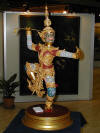
Totsakan Nah Thong (ทศกัณฐ์หน้าทอง)
Thai. Name of a golden
khon
mask used to
depict the multi-headed demon king
Totsakan.
The mask has a
chadah-like
crown in three level and decorated with several golden
yak-faces,
i.e. besides the main yak-face of the mask (fig.). On the back-side (fig.)
of the base level of the chadah are three smaller faces, whilst
there are another four faces on the middle of the chadah's peak,
which are positioned back-to-back, as if one for every direction of
the compass. In addition, there is a human-like face at the top,
which only faces forward and represents the face of
Phra Phrom.
Whereas the ground colour of the mask is gold, the faces are
finished with plenty of decorative lines in green, which is the
actual complexion of Totsakan (fig.).
Totsakan Nah Thong was the favourite mask of
Kukrit Pramoht
(fig.),
a a passionate collector of khon
masks and the
founder of the
Khon
Thammasat
Troupe (fig.).
See also
LIST OF RAMAKIEN CHARACTERS & NAMES,
and
MORE ON THIS.
回
_small.jpg)
Totsakiriton (ทศคีรีธร)
Thai. Name of a
giant
or
yak
character in the
Ramakien (fig.).
He has a red complexion and a small
elephant
trunk-like nose, and is depicted with a
chadah-like
crown, that has a rather straight and thick peak with three crenate
notches at the base and a tip with an obliquely forward sloping
surface, and which is described as a
bamboo
shoot.
He is the younger twin brother of
Totsakiriwan
(fig.), a yak with the exact
same features and crown, but with a green
complexion. They
are the sons of
Totsakan (fig.)
with his consort
Nang
Chang Phang (ช้างพัง),
but were given up for adoption to
Thao
Atsakammalah, the
ruler of
Meuang
Duram (ดุรัม), in
order to keep them safe whilst Totsakan was at war with
Phra Ram
(fig.).
However, one day they found out about their real father and his
battle, and voluntarily enlisted in his army.
He is one of the 12 giants, set up in 6 pairs, that guard the
entrances in the enclosure of the Temple of the
Emerald Buddha
(fig.),
i.e.
Wat Phra Kaew
in
Bangkok,
where he is erected in pair with his twin-brother.
See also
LIST OF RAMAKIEN CHARACTERS & NAMES,
and
MORE ON THIS.
回
_small.jpg)
Totsakiriwan (ทศคีรีวัน)
Thai. Name of a
giant
or
yak
character in the
Ramakien (fig.).
He has a
bluish-green
complexion
and a small
elephant
trunk-like nose, and is depicted with a
chadah-like
crown, that has a rather straight and thick peak with three crenate
notches at the base and a tip with an obliquely forward sloping
surface, and which is described as a
bamboo
shoot.
He is the older twin brother of
Totsakiriton (fig.), a yak
with the exact same features and crown, but with a
red complexion.
They are the sons of
Totsakan (fig.)
with his consort
Nang
Chang Phang (ช้างพัง),
but were given up for adoption to
Thao
Atsakammalah, the
ruler of
Meuang
Duram (ดุรัม), in
order to keep them safe whilst Totsakan was at war with
Phra Ram
(fig.).
However, one day they found out about their real father and his
battle, and voluntarily enlisted in his army. He is one of the 12
giants, set up in 6 pairs, that guard the entrances in the enclosure
of the Temple of the
Emerald Buddha
(fig.),
i.e.
Wat Phra Kaew
in
Bangkok,
where he is erected in pair with his twin-brother.
He is sometimes referred to as Totsakirijan, Thotsakhirijan or
Thotsakhirichan (ทศคีรีจันท์).
See also
LIST OF RAMAKIEN CHARACTERS & NAMES,
and
MORE ON THIS.
回
_small.jpg)
Totsaphan (ทศพันตร์)
Another Thai name for
Totsakan.
Also transliterated Thotsaphan,
Thotsapan and Totsaphan.
See also
LIST OF RAMAKIEN CHARACTERS & NAMES,
and
MORE ON THIS.
回
Totsaphin (ทศพิน)
Thai. Name of
a
giant
or
yak
character in the
Ramakien (fig.).
He was
the son of
Totsakan (fig.)
and
Nang
Montho.
After the death of Totsakan,
Phiphek
(fig.),
the
younger brother of
Totsakan,
took over the rule of
Lanka
and married
Nang
Montho. At that
time, Montho was already pregnant with Totsaphin. When Totsaphin was
born, Phipek mistakenly believed him to be his own child. As
Totsaphin grew up, a mentor named
Woranihsoon revealed the truth to
him and encouraged him to rebel, leading to another battle in Lanka.
Phra Phrot (fig.)
eventually suppressed the rebellion and ordered the execution of
Totsaphin along with his mentor. Totsaphin is also known by the name
Phainasuriyawong
and in the
Ramayana
his
Sanskrit
name is
Atikaya,
which
means ‘Gigantic’.
One suggested translation for the name
Phainasuriyawong is that it might mean ‘the
lineage of the sun's destruction’ or
‘the lineage of the sun's end’.
This interpretation could hint that
Atikaya's
gigantic
body size may block out the light of the sun.
As the son of
Totsakan, he is
likewise depicted with a green complexion.
See also
LIST OF RAMAKIEN CHARACTERS & NAMES,
and
MORE ON THIS.
回

totsaphit rajatham (ทศพิธราชธรรม)
Thai-Sanskrit. The royal
dhamma or ten
royal virtues for kings, that is: generosity, observance of the
religious commandments, willingness to make sacrifices, honesty,
gentleness, hard working,
a cool temper, ability to comfort, aptitude to endure and correct
ethical conduct.
回
Totsarot (ทศรถ)
Sanskrit-Thai name meaning ‘ten wheeled
vehicles’. Mythological King of
Ayutthaya
and father of
Rama,
the main character in the
Ramayana and
Ramakien,
the Thai version. He fathered Rama with queen
Kao Suriya,
Lakshmana
and
Satrud
with queen Samut Thevi and
Phra Phrot with queen Kaiyakesi. In the Ramayana, the
Indian and original version of the
epic,
Rama's father is called
Dasharatha but he is also known as
Suddhodana.
See also
LIST OF RAMAKIEN CHARACTERS & NAMES,
and
MORE ON THIS.
回
touch-me-not
See
maiyarahb.
回
Tourism Authority of Thailand
Governmental
umbrella organization responsible for all matters concerning
tourism, including the Tourist Police
(fig.),
which is a branch of the
Royal Thai Police, guide training and licensing,
tour company registration, signalisation of tourist sites, tourist
information and promotion, etc. It has a main office on Rachadamnoen
Road in
Bangkok and smaller branches in most provinces as well as in
some countries overseas. Its logo consist of the prow of the
Golden Swan Royal Barge
Reua Phra Thihnang Suphanahong
(fig.),
the of
Wat Arun (fig.),
and an aircraft flying over leaving a
contrail. In Thai, it is known as ‘Kaan Thong Thiaw
haeng Prathet
Thai’
and in short as TAT. In 2010, the organization celebrated its 50th
anniversary under the motto Touring Thailand, Helping to Develop the
Country, which was commemorated with a set of four Thai postage
stamps (fig.).
WATCH VIDEO.
回
trah chalu (ตราฉลุ)
Thai. Name term for a
cut-out emblem or pierced seal. It refers to intricately crafted
designs made by chiseling, piercing or cutting patterns into
materials like paper, wood, or metal, commonly used in
stencil-making and traditional Thai art.
In Chinese, it is known as zao yin (鑿印), which translates to
‘carved seal’,
highlighting a similar tradition of creating detailed designs
through engraving or chiseling. In English, it is commonly referred
to as [manual] stencil-making.
See also
yin zhang.
回

traditional
massage
Refined
technique
that combines
several characteristics
of massage, chiropractic
and
acupressure
to
balance the
function
of the four
body
elements,
i.e. din (earth),
nahm (water), fai (fire)
and lom (air).
Traditional massage is
so popular
that it is recognized as
an official science, along
with medicinal herbs,
acupuncture
and spiritual
meditation.
Since
the
Ayutthaya Period until
the beginning
of this century there
was an
official
massage division
under the auspices
of the Thai Ministry
of Public
Health, now
housed
at
Wat Poh
in
Bangkok.
In former times, massage
in this
temple was taught
on the basis of didactic images (fig.),
especially from
reusi,
i.e.
Thai hermits (fig.),
in various poses that represent exercises to promote physical health
(fig.),
akin to those at
Wat Bang Peng Tai
(fig.).
In traditional Thai massage no oil is used, but sometimes a hot
herbal compress
is applied to warm and soothe the receiver's body. This method is
known as
prakob
and the compress, i.e. a steamed linen ball with a grip and
medicinal herbs inside, is called
look
prakob samunphrai (fig.).
In Thai
nuat paen boraan.
See also POSTAGE STAMPS.
回
trah lohkhen tamruat (ตราโล่เขนตำรวจ)

Thai.
‘Police
Shield Badge’. Name of the official seal
of the
Royal Thai Police.
READ ON.
回
trah phaen din (ตราแผ่นดิน)
Thai. Name for the
Royal Arms of
Siam
until
1911.
READ ON.
回
traijiewon (ไตรจีวร)
Thai.
‘Three
Robes’.
The
saffron to brown coloured
robes of Buddhist monks, consisting
of three (trai) pieces: the antarawasok or sabong (a skirtlike lower
garment), the utarasong or
jiewon (the
outer robe) and the
sangkhaathi
or pah thaab, a covering robe against
the cold which is worn folded over the shoulder when not used. In
the temple, during work or periods of rest, monks often wear a
shoulder piece called the
angsa,
instead of the usual jiewon. The colour of the robes may vary from
yellow-orange to reddish brown, depending on personal preference.
In both
Buddhism and
Hinduism, the colour saffron −or
alternatively ochre− symbolizes renunciation. The origin of the dark red to yellow-ochre colour possibly goes back
to the domestic makah, a tropical tree from the family Papilonaceae, known by the name ormosia whose bright red seeds, were
formerly used as the base to dye monks robes. Later also
turmeric was used.
The colour orange also symbolizes light, and thus Enlightenment, as
it is the colour of the tip of a flame. This association with fire
also protects monks living in the forest and wearing orange robes,
as the colour tends to scare off wild animals who also associate it
with fire and thus danger. The Buddha gave his
first disciples the assignment to find their own robe, rather than
buying one. He pointed to pieces of cloth hanging from tree branches
in the forest, torn off from passer-by's clothes. These could easily
be used to make a robe by stitching them together and then dying it.
This is one reason why a needle is one of the items Buddhist monks
are allowed to posses and why some robes look as if they have been
made up of several pieces of cloth sewn together with a thick seam,
to symbolize this tradition. Another option was to use the cloth of
a dead person, after the body was cremated.
The Buddha himself once
took the shroud of a dead girl and made it into a monastic robe,
thus symbolizing the transience of life. It is still common during
funeral rites, just before the body is cremated, to pass monk's
robes over the corpse to refer to this scene. When studying (fig.)
or working (fig.)
the monks generally wear just the sabong and angsa, but when they go
outside the temple complex they usually cover completely, and during
their begging round they walk barefoot (fig.).
See also
kahsahwapad and
pah kahsahwapad.
回
Trailohk (ไตรโลก)
Thai for
Trilok. Often
transcribed Trailok and sometimes
Trailokya,
from the Sanskrit
Trelokya.
回
Train Market
See
Talaat Nat Rot Fai.
回
Train Night Market
See
Talaat Nat Rot Fai.
回
Traipidok (ไตรปิฎก)
Thai name for
Tripitaka.
Also Traipitok.
回
Traipitok (ไตรปิฎก)
Thai name for
Tripitaka.
Also Traipidok.
回
Trairat (ไตรรัตน์)
Thai. ‘Three Gems’ or ‘Three Jewels’. The
three objects of veneration for Buddhists, i.e. the
Buddha,
his teachings or the
Dhamma,
and the order of
monks
or
the
Sangha.
In Buddhist temples represented as the three prongs of a
trisula
or as three wishing jewels, commonly referred to as
chintamani (fig.)
or
flaming pearls.
Asaanha Bucha
is regarded as the first day when the Trairat was
attained. Also referred to as the
Triple Gem, Three Treasures, and Three
Refuges, and in Thai also known as
Triratana,
a term derived from the Sanskrit word
Triratna.
See also
Traisarana
and
Rattanatrai.
回
_small.jpg)
trairong (ไตรรงค์)
Thai. ‘Tricolour’. See also
thong trai rong
and
thong chaht.
回
Traisarana (ไตรสรณ)
Thai. The ‘Three Refuges’
of Buddhists, i.e. the
Trairat.
Also
Saranatrai.
回
Tra Kieu (Trà Kiệu)
Art style from
Champa dating from the second half of the 9th century
AD until the end of the 10th century, when its capital was
Indrapura,
in the North of the kingdom.
回
trakrut (ตระกรุด)
See
takrut.
回
Trang (ตรัง)
Name of a province (map)
and its capital city in the south of Thailand, 828 kms from
Bangkok.
READ
ON.
回
Trang An (Tràng An)
Vietnamese. Name of an
eco-tourism area in Ninh
Binh, which since 2014 is listed as a UNESCO World
Heritage Site (fig.)
under the name Trang An Scenic Landscape Complex and that also
includes
Tam Coc (fig.)
and
Bich Dong (fig.),
as well as
Chua
Bai Dinh
(fig.)
and
Hoa Lu. Trang An has a
visitor's centre located on a small island in the Sao Khe River,
from where small rowboats depart to visit the area, going north
towards the Truong Yen (Trường Yên) area. Visitors
arriving via Ninh Binh city will pass through the Two
Elephants
Welcome Gate of
Trang An (map -
fig.),
named after the two statues of elephants
that stand at this
paifang-style
gateway (fig.).
See
MAP.
回
Tran Nguyen Han (Trần Nguyên Hãn, 陳元扞)
Vietnamese-Chinese. Name of a
Dai Viet military leader who
was instrumental in his support in the Lam Son uprising against Ming Chinese
rule.
READ ON.
回
Transverse Ladybird Beetle
A species of ladybird beetle in the family
Coccinellidae and with the scientific name Coccinella transversalis.
READ ON.
回
Trat (ตราด)
Name of a province (map)
and its capital city in East Thailand, 315 kms southeast of
Bangkok.
READ
ON.
回
trat (ตรัส)
Rajasap for ‘to say’ or ‘to
remark’. Pronunciation with a short
vowel, against
Trat
province, which is
pronounced with a long vowel.
回
tratsaru (ตรัสรู้)
Thai term used to express the ‘attainment of
Enlightenment’ or the
‘Enlightened state’ of the Buddha.
回
Traveller's Palm
See
kluay pad.
回
trawed (ตระเว็ด)
Thai.
Another word for
jawed.
回
Treasure Vase
Another name for
the
Kalasa or
sacred vase, which is one of the
Ashtamangala
(fig.) and holds the
amrita.
It hence symbolizes longevity, abundance and prosperity. It is
sometimes referred
to as Vase of
Plenty, as it yields inexhaustible treasures. As such, it is a
symbol
of certain wealth
deities, such as the
Tibetan wealth gods
Jambhala (fig.),
Vaisravana or
Kubera,
and
Vasudhara,
often appearing as an
attribute beneath
their feet. See
also
puranakata.
回
Tree Jasmine
1. Another
name for the
Indian Cork Tree,
a
tree known in Thai as
kasalong and
pihb,
and with the botanical designation Millingtonia hortensis (fig.).
回
2. A name
used for a
tree known in Thai as
kasalong kham
and
pihb thong,
and with the
botanical name
Radermachera ignea (fig.).
回
Tree Nymph
Name of a species of
butterfly with the scientific designation Idea lynceus.
READ ON.
回
Tree Sparrow
Name of the most ubiquitous bird in Thai human
inhabited zones, and with the scientific name Passer montanus. Small, with a length of no more than 14.5
centimeters, adults have a rich chestnut crown and nape, with white
or pale
grey
cheeks that have a black patch, often triangular in shape (fig.). This
white or pale grey colour also runs to the nape at the lower back of
the head, thus forming a ring. That's why it is named ringmus in
Dutch, which translates as ‘ring sparrow’. Underneath its lead-blue
to almost black bill, extending from its chin to its throat, is a
dark grey to almost black patch. Two
distinct, though narrow white bars, cross the otherwise brown and
chestnut wings.
It has tiny dark eyes and its legs are pale brown. Both sexes are virtually alike,
as are juveniles, though in the young,
the bib,
throat and ear-covert patches are at first less distinct, while the
bill has a pale base (fig.). In Thai, it
is confusingly called nok krajok baan (นกกระจอกบ้าน), which
translates as ‘house sparrow’, whereas the English
House Sparrow (Passer domesticus -
fig.) is called nok krajok yai (นกกระจอกใหญ่),
meaning ‘large sparrow’.
回
_small.jpg)
trelokya (त्रेलोक्य)
Sanskrit.
‘Three worlds’. See
triloka.
回
Treta
(त्रेता)
Sanskrit.
Second of the four
yugas.
回
tribhanga
(त्रिभङ्ग)
Sanskrit.
‘Three bends’. A stance portrayed in dance, sculpture and painting
in which the body is bowed with one hip thrust out forming an
S-curve.
回
trident
See
trisula.
回
Tridevi (त्रिदेवी, ตรีเทวี)
Sanskrit-Thai.
The feminine form of the
Trimurti,
i.e. the male
triad of
Vishnu,
Brahma
and
Shiva.
The term may refer to either the three consorts of these male
deities, i.e.
Lakshmi,
Sarasvati
and
Parvati,
respectively, or
to a single trinity goddess that combines these three
shakti
of the female triad in
one form. In
iconography, the
latter is
usually depicted as a female deity with three heads.
回
_small.jpg)
trigram
Symbol indicating the eight points of the
compass used by geomancers.
READ
ON.
回
trih (ตรี)
Thai
name for a trident or
trisula.
Also
trihsoon.
回
Trihsian (ตรีเศียร)
Thai.
‘Three heads’. Name of a demon character in
the
Ramakien,
who is depicted with a white complexion and a distinctive golden
chadah-style
crown, with three spikes aligned next to each other, i.e. a large
central spike flanked by two smaller spikes.
He is the sixth son of
Thao Lastian (ลัสเตียน) with
Nang
Ratchada (รัชฎา), and hence a
younger brother of
Totsakan (fig.).
回
_small.jpg)
trihsoon (ตรีศูล)
Thai
name for a trident or
trisula.
In combination with a
chakra
it is the escutcheon of the
Chakri
dynasty (fig.).
Also
trih.
回
trihyampawaai (ตรียัมปวาย)
Thai. Brahman rites associated with the swing
ceremony or
lohchingchah.
回
trikanchana (ตริกาลชญ)
Thai-Pali.
‘One who knows the three times’. An epithet for hermits, who are
known in Thai as
reusi.
回
Trikaya (त्रिकाय)
Sanskrit.
‘Three bodies’. Name of a doctrine in
Mahayana
Buddhism
that says that a
buddha
has three bodies.
READ ON.
回
trilok
Pali for
triphum.
回
Triloka (त्रिलोक)
Sanskrit.
‘Three Worlds’.
Term referring to the three realms in Buddhist
cosmology, i.e. heaven, earth and hell, as portrayed on murals and
in the symbolism of the
stupa.
However, the
Three Worlds,
may also refer to the three
loka, i.e.
worlds, regions or
spheres, which represents a classification of the universe in three
spheres of existence that comprise the whole universe, and are
individually referred to as
Okasaloka,
the inanimate
‘World
of Location’, ‘World
of Space’
or
‘Sphere
of Existence’;
Sattaloka, the inanimate
‘Corporeal
World’
or ‘World
of Beings’;
and Sankharaloka, the
‘World
of the Conditioned’
or ‘World
of Formations’.
The 108 distinguishing
marks seen in the
Buddhapada (fig.)
or on the
the
footsoles
of many
reclining Buddha
images (fig.)
are sometimes said to represent the Three Worlds,
and
are intended to indicate that the
Buddha
is greater than all the Three Worlds.
Also
trilok,
sometimes transliterated
trelokya,
in Thai called
Trailohk, and
in Pali also referred to as
triphum.
See also
Chom Trai Lohk.
回
Trilokavijaya
(त्रिलोकविजय)
Sanskrit-Pali. ‘Conqueror of the three
worlds’. The name of a god with a terrifying appearance from
Tantrism,
portrayed with four faces, eight hands and sometimes wearing a
garland of small Buddha images. It is also a major
bodhisattva in
Mahayana Buddhism.
回
Trimurti
(त्रिमूर्ति
- ตรีมูรติ)
1. Sanskrit-Thai. ‘Three aspects’ or ‘having three
forms’. Term in Vedic times originally used for
Agni,
Indra
(or
Vayu)
and
Surya.
Later used for the Hindu divine triad
Vishnu,
Brahma
and
Shiva
(fig.),
who are also symbolically represented in some
linga (fig.).
Sometimes depicted as one deity with five faces, called Phra
Trimurti in Thai, and by some believed to be a promoter of love and
a go-between for people looking for a spouse, and that visiting the
shrine on
a Thursday evening
wearing red and bringing offerings of red roses will
advance their luck in finding a loving partner. The feminine form of the Trimurti is known as
Tridevi and may refer to either the three consorts of
the male deities of the triad, i.e.
Lakshmi,
Sarasvati
and
Parvati,
respectively, or
as one trinity goddess that combines these three
shakti
of the female triad in
one form, who is usually depicted as a female deity with three heads
(fig.).
See also
kulaab,
dok,
Matanapatha,
and
Wan Walenthain.
回
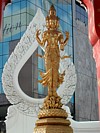
2. Hindi. ‘Three statues’. Name of a memorial statue in New Delhi, the capital of
India, commemorating those killed from the cavalry and armored
regiments of the Indian Army during World War I in battles in Sinai,
Palestine and Syria. The monument, also known as Trinity Memorial
and Teen Murti (तीन मूर्ति) Memorial, has three bronze statues
representing soldiers from the three Indian States Hyderabad, Mysore
and Jodhpur.
See MAP.
回
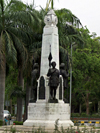
Trinaet (ตรีเนตร)
1. Thai-Pali. ‘The three eyed one’. An epithet
for
Indra,
referring to his
third eye.
回
2. Thai-Pali. ‘Three eyes’ or ‘third
eye’. Term used for gods,
thevadas or
buddhas with an
urna.
回
Tripakkan (ตรีปักกัน)
Thai.
‘Three Embroidered Together’. Name of a demon character in
the
Ramakien,
who is
the son of
Thao
Kuveranurat (กุเวรนุราช) and Lady Kesini (เกศินี) and a royal prince
of the city of Kalavut (กาลวุธ). One day, Tripakkan went hunting in
the forest. Along the way, he encountered
Phra Ram
(fig.),
Phra Lak
(fig.),
and
Hanuman
(fig.).
Tripakkan aimed to capture Rama and Phra Lak to present them to Lord
Kuveranurat. To achieve this, he deployed an army of
asuras, i.e.
yakshas.
In the ensuing conflict, Hanuman volunteered to confront and defeat
Tripakkan. However, during their skirmish, Tripakkan insulted
Rama.
Phra Lak overheard this affront and took it upon himself to confront
Tripakkan directly. Phra Lak engaged Tripakkan in a fierce battle,
culminating in Phra Lak shooting an arrow that destroyed Tripakkan's
weapon, which ultimately enabled him to defeat and kill Tripakkan.
In
iconography,
Tripakkan
is depicted with a
dark green complexion and a distinctive golden
chadah-style crown, with a
cockerel tail in
the form of a backward-bent flame known as
kranok.
回

Tripetch Thamrong (ตรีเพ็ชรุตม์ธำรง)
Thai. The third son (fig.) of King
Chulalongkorn
with his
consort Queen
Saowapha
Phongsri and the King's 39th
child in total. The prince was born on 8 February 1881, at
Phra Rachawang
in
Bangkok, but with poor health throughout his childhood, he died
at the untimely age of six, on 22 November 1887. His name is
sometimes transliterated Tribejrutama Dhamrong, as well as Triphetch, Tripech,
Tripej or Tripet Thamrong. He is
portrayed on one of a rare set
of unmarked postage stamps of the Royal Family issued in circa 1893
(fig.).
回
_small.jpg)
triphum
Pali. ‘Three Worlds’. See
Triloka.
回
Tripitaka
(त्रिपिटक)
1. Sanskrit. ‘Three baskets’. Name for
the
Theravada Buddhist manuscripts containing the teachings
of the
Buddha,
divided into three parts (pitaka or ‘baskets’) and written in
Pali,
traditionally on palm leaves.
The
first section of the Tripitaka is the Vinaya or
Vinay,
the second the Sut or
Sutra
(fig.), and the third part the
Aphitam.
The largest book in the world, which actually consists of 729
separate marble tablets or
steles (fig.), that are located in
equally as many freestanding
stupas around the Kuthodaw or ‘Royal
Merit’
Pagoda (map
-
fig.) in Mandalay,
Myanmar, have the complete text of
the Tripitaka inscribed on them in Burmese script, originally in
gold but now faded. In Pali, known as Tipitaka
and in Thai as
Traipitok.
See also
Buddhist precepts.
回
2. Equivalent for the Chinese
name Sanzang (fig.), which was a traditional honorific name for any Buddhist
monk during the Tang Dynasty. It is repeatedly used to describe
Xuanzang, the monk who went on a
pilgrimage to India in order to obtain a copy
of the
sutras, as
recorded in the
Xiyouji, the
chronicle of the ‘Journey to the
West’.
回
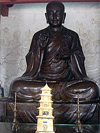
Triple Gem
See
Rattanatrai.
回
tri-pundra (त्रिपुण्ड्र)
Sanskrit. ‘Three
sectarian marks’.
Name a
pundra
(a kind of
tilaka), that consists of three horizontal lines
applied on the forehead or chest (fig.)
by
Saivites, the
followers of
Shiva, as a symbol of their
denomination. The
lines are usually drawn with
white ashes and
sometimes accompanied by a red dot in the centre
(fig.). See also
urdhva-pundra.
回
_small.jpg)
Triratana (ไตรรัตนะ)
Thai. ‘Three Gems’ or ‘Three
Jewels’. Term derived from the Sanskrit word
Triratna.
See
Trairat.
回
Triratna
(त्रिरत्न)
Sanskrit for
Trairat.
回
trisula (त्रिशूल)
Sanskrit. ‘Trident’. While it is the symbol
for the
Trairat in Buddhist temples, in
Hinduism, it is
the weapon and symbol of the gods
Shiva
and
Indra, and
in Thailand also that of
Phra Narai (fig.).
In China, it is the
attribute
and weapon of
Ma Mian,
i.e.
‘Horse-Face’
(fig.),
a guardian of , i.e. the
Underworld in
Chinese-Taoist
beliefs. As the weapon of Shiva, the three prongs represent his functions as
creator, preserver and destroyer. Generally, the three spikes also
represent the three fundamental principals of the universe, i.e.
purity, energy and inertia. Portrayed in combination with a
chakra the trident
is also the escutcheon of the
Chakri
dynasty. In Thai called
trih
or
trihsoon.
See also
noppasoon (fig.).
回
tritsadie mai (ทฤษฎีใหม่)
Thai. ‘New Theory’. Concept introduced in 1992
by King
Bhumipon Adunyadet to improve agriculture for small landowners
(10 to 15
rai)
and with the aim to become self-supporting. By dividing the land in
four parts according to the proportions 30-30-30-10 a maximum yield
of the farm land is intended. According to this idea ten percent of
the land is used for housing perhaps with a small live stock and
poultry, the other parts of each 30% are used to cultivate
rice
for own use with a likely surplus that can be brought onto the
market, a water reservoir with a depth of four meters used for water
supply and with a possibility to breed fish, and the last piece of
land utilized to grow other crops such as vegetables, fruit and
flowers. See also
Golden Jubilee Museum of Agriculture
and
POSTAGE STAMPS.
回
tro (ទ្រខ្មែរ)
Khmer name for a traditional bowed string instrument from
Cambodia,
closely related to the Thai
so
(fig.),
even in name, as the Thai word so is written with
the Thai
letters tho thahaan (ท) and roh reua (ร),
which combined are pronounced as a s-sound, but separately are
pronounced as t and r.
Also transcribed tror, as in Khmer it actually has the letter r as a
final.
回
Trooping the Colour
A western designation for the annual
Military Parade of the Royal Guards
at the
Royal Plaza
in
Bangkok on
December 4th. In English usually referred to as ‘Trooping the
Colour’ (which in Thai is
Phittih Sabaan Tong)
but by the Thais rather called
Phittih Suansanam Thahaan Rachawanlop.
回
Tropical Leatherleaf
A species of slug. See
taak.
回
Tropical Sundew
Name for a small, compact species of
carnivorous plant, with
the botanical name Drosera burmannii (fig.).
The plant has stalked tentacles that cover its leaf surface, which
is green with reddish-purple towards the edge.
READ ON.
回
True Percula
Clownfish
Common name for a species of
anemone fish, with the scientific designation Amphiprion percula.
This attractive fish has a
variable bright
orange to black-orange
body, with 3 white bands that are finely lined with black, at its
head, trunk and tail, whilst the fins are also edged with black.
This species of anemone fish occurs both in the
Andaman Sea and the
Gulf of Thailand
and the bright orange morph (fig.)
is very similar to the
False Clown Anemone Fish
(fig.).
It is a popular saltwater
aquarium fish. It is also
commonly known as Orange Clownfish and in Thai it is called pla cartoon
perkoolah (ปลาการ์ตูนเพอร์คูล่า).
回
_small.jpg)
trung (t'rung)
Vietamnese. Name of a
traditional xylophone made from
bamboo
and used by the highland
minorities of
Vietnam. In addition, the name
is sometimes used as an adjective with
the
ka-loong put
(fig.),
referring to the latter as
trung ka-loong put, due to its
xylophone-like appearance of bamboo pipes arranged in increasing
length.
回
%20traditional%20xylophone%20from%20Vietnam_small.jpg)
Trung Ac (Trừng Ác)
Vietnamese. ‘Punishing Evil’.
Name of the Vietnamese-Taoist
Judge of the Hells.
READ ON.
回
Trut (ตรุษ)
Thai. ‘New year’. In Thailand new year is
celebrated on several moments. There is the Chinese New Year or
Trut Jien (a week of celebrations starting around end
January, in February or beginning of March), the Thai New Year or
Trut Thai (middle of April) and the Western New Year or
Trut Farang.
Besides this there are several other dates among the different
minority groups, such as the hill tribes, each with their own
celebrations on different times. The term Trut is assumed to be
derived from the Sanskrit word truti (त्रुटि, ตรุฏิ)
i.e. ‘to cut off’ or ‘to break off’, meaning to cut off from the old
year to enter the new year. Sometimes also pronounced Tarut.
回
Trut Farang (ตรุษฝรั่ง)
Thai. New year according to the present-day
Gregorian or Western (Farang)
calendar, i.e. on January first.
回
Trut Jihn (ตรุษจีน)
Thai name for the Chinese New Year, which is
also known as Spring
Festival and takes place starting somewhere around the end of
January, in February or early March and lasting for about a week.
Because it is celebrated according to the lunar calendar the date
differs each year again. The Chinese population of Thailand starts
this festival by cleaning their houses followed by an exuberant
party outside.
Firecrackers
and fireworks are lit and dancers dressed up as
lions
(fig.)
and
dragons
(fig.)
perform colourful spectacles in the crowded streets (fig.),
a tradition that has spread well beyond the borders of
China (fig.),
and of which has a different form exists in
Myanmar,
using a variety of fake animals, such as
horses (fig.),
elephants
(fig.)
and ‒especially in Lower
Burma,
due to its association with the local legend of
the
female
buffalo
nat
Nankarine
-
fig.)‒
buffaloes (fig.), that dance from house to house to
collect donations, while other folk lines the street to collect gifts from cars traffic passing
by.
Acrobats regularly display their skills on top of a high pole, often
dressed in a lion (fig.)
or dragon costume (fig.). Since red is
the colour for good fortune and longevity the streets, temples and
houses are decorated with red lanterns and ribbons (fig.),
whilst merrymakers dress up in red and the young will buy
Thai gold to give to senior family members (fig.).
Besides this they will give red envelopes or
hong bao to each other and many flock to the
temples to offer food and burn
incense sticks
to their gods (fig.).
During the festivities
Bangkok's
Chinatown is turned into one
great marketplace
attracting a crowd of visitors and temporary street side shrines are
set up (fig.).
Each year has as theme an animal from the
Chinese zodiac. Chinese New Year last
several days, from the 1st day of 1st lunar month to the 15th day of
1st lunar month, and ends with the
Lantern Festival. Also
spelled Trut Jien, and in Chinese
called
Xin Nian,
Guo Nian and
Chun Jie. See also
foo
and
Chinese Calendar and Chronology.
WATCH VIDEO (1)
and
(2).
回
Trut Thai (ตรุษไทย)
A Thai name for the Thai New Year, also known
as
Songkraan.
回
Tsai Shen (财神)
See
Cai Shen.
回
Tsai Shen Yeh (财神爷)
Chinese. ‘Grandfather wealth
god’. A designation for
Zhao Gong Ming
(fig.),
the most influential and popular
Chinese
wealth god.
He
often has a dark face and a black beard, and rides
a ferocious
tiger
that swallows all evil. As such, he is known as
the belligerent Tsai Shen Ye, who befits worshippers in terms of
debt collecting or debt clearing, by making them afraid to cheat. He
also has a benevolent appearance, holding
gold riches and a
ruyi
(fig.), and which is
known as bountiful Tsai Shen Ye (fig.).
The latter manifestation is believed to provide good fortune, money,
wealth and prosperity to his worshippers. He may also be In Thai-Chinese temples
he is referred to by the
Tae Chew
names
Chai Sing Ihya
(fig.)
or
Chai Sing Ihya Boo (fig.),
and
in Thailand known as
Phra
Thonbodih,
Thepachao
Cai Shen
Ye
(fig.),
or
Thao
Wetsuwan.
He is also associated with
Kubera.
回
_small.jpg)
Tsao Kuo-chiu (曹国舅)
Chinese. Name of one of the
Eight Immortals (fig.),
who was connected with the imperial family of
one of the Song Emperors. He had a younger brother named Tsao
Ching-chih (曹景植), who was a bully and even killed a person, but no
one dared to prosecute him because of his imperial connections. Tsao
Kuo-chiu was so saddened and ashamed of his brother that he left
home and sought solitude in a mountain cave. He wore rustic clothes
and fasted for days at a time. One day he met the
immortals
Chung-li Chuan
(fig.)
and
Lu Tong-pin
(fig.),
who taught him the
Taoist
secrets. Not much later, he joined the rank of the immortals. He is
usually depicted with his attribute, a pair of castanet-like
jade
tablets,
that have the power to purify the environment.
His mount is
a one-horned
Bi Xie (fig.).
Also spelled Cao
Guojiu.
回
_small.jpg)
Tsongkhapa (ཙོང་ཁ་པ།)
Tibetan. Name of a Tibetan religious leader, who lived from 1357 to
1419 AD and who was the founder of the Gelug school, also known as
the Yellow Hat Sect (fig.)
of
Lamaism, i.e.
Tibetan Buddhism.
He is sometimes described as an emanation of Atisha, a Buddhist
teacher from the
Pala Empire. In Chinese, he is
known as
Zongkaba.
回
_small.jpg)
tsukemono (漬物)
Japanese. ‘Pickled things’.
General term for preserved vegetables, such as pickled
ginger,
which is specifically known as
gari.
Japanese preserved vegetables are usually pickled in salt or brine,
or with
rice bran called nuka, after which. It is said that
tsukemono cleanses the palate, provides refreshment, and counters
other flavours, while offering colour, texture and fragrance to a
meal. Also called konomono (香の物), i.e.
‘fragrant
things’, or
nukazuke (糠漬け) if preserved in nuka rice bran. The term
tsukemono is often used to refer
to
just pickled
cabbage (fig.).
回
tsunami (津波)
Japanese. Literally ‘harbour
wave’, a term is commonly used to indicate a ‘seismic sea
wave’, yet is often unjustly referred to as a ‘tidal wave’. A tsunami
is an exceptionally large and fast speeding ocean wave caused by an
underwater earthquake or occasionally by a submarine landslide. On 26 December 2004 Thailand's west coast on
the Andaman Sea was struck by a tsunami triggered by a magnitude 9.0
earthquake off the coast of Sumatra, killing around eight thousand
people and injuring many more, whilst causing major damage to many of
the southern provinces’ beach resorts. The hardest hit in
Thailand was the province of
Phang Nga with the most victims, especially in the beach
resort town of Khao Lak, but also the
Phi Phi Islands off the coast of
Krabi province, as well as
Phuket island were extremely hard hit. Among the
fatal victims was Khun Poom, the only son of princess
Ubon Rattana Rachaganya.
Worldwide this specific tsunami killed an estimated 280,000 people, mainly
in the South Asian region and left more than 5 million people
homeless. Outside Thailand Indonesia, Sri Lanka and India were hit
hardest, but also in
Malaysia,
Burma and even as far away as Somalia there were
deadly victims. Since then the government has worked hard to improve
local warnings. Besides the lay out and completion of several marked
tsunami escape routes (fig.), it also erected 62 siren towers along beaches
in six provinces, each capable of alerting people as far away as two
kilometers inland. Those alerts are issued by the National Disaster
Warning Centre, the first command post set up in the region after
the 2004 tsunami. In Thai called
kleun yak,
literally ‘giant wave’.
See also POSTAGE STAMPS.
回

tua fak yao (ถั่วฝักยาว)
Thai for the ‘Chinese long bean’,
a subtropical to tropical climbing vine of which the -up to
75 centimeter- long immature pods, that grow hanging in pairs, are
used as a vegetable. It is widely grown in the warmer parts of
Southern
China and Southeastern Asia, including in
Thailand (fig.).
Its scientific name is Vigna unguiculata subspecies sesquipedalis
and in English it is also known as ‘long-podded cowpea’, ‘asparagus
bean’, ‘snake bean’ and ‘yardlong bean’.
It is the main ingredient in a dish called
tua fak yao phad phrik kaeng moo,
i.e. ‘spicy
kaeng
long beans with pork’ (fig.).
回
%202_small.jpg)
tua fak yao phad phrik kaeng moo
(ถั่วฝักยาวผัดพริกแกงหมู)
Thai. ‘Spicy curry long beans with pork’. Name of a
dish that consists of chopped Chinese long beans (tua fak yao),
stir fried with a thick,
spicy curry, known as
kaeng.
It is typically eaten with
rice.
回
_small.jpg)
tua khiaw (ถั่วเขียว)
Thai. ‘Green bean’. Name for the
mung bean.
回
Tua Lao Hia (ตั่วเหล่าเฮี๊ยะ)
Thai-Tae
Chew name for
Xuanwu.
回
tua ngun tua thong (ตัวเงินตัวทอง)
Thai. ‘Silver body-golden body’. Popular name for a
monitor lizard of the species varanus salvator.
回
tua talok (ตัวตลก)
Thai. Collective ame for a group
of comic characters in
the lesser Thai
shadow play known
as
nang thalung.
They are important characters that tend to intrigue the audience and
in general are depicted with dark skin (i.e. in the
nang
cutting), a potbelly, and wearing only a sarong, a
pahkaomah,
and a kind of shawl or necklace. The upper body is always naked. Many have a big nose and some have curly hair,
whilst others are bald or semi-bald. Some characters have one hand
with one elongated finger and which is shaped as a human penis
complete with testicles
(fig.). In general, the term tua talok can be translated
as ‘joker’, ‘funny
guy’, ‘comedian’, etc.
There are in general no
fewer than 10 tua talok characters in a cast and the most popular
ones include
Theng (fig.),
Noo Noui (หนูนุ้ย
-
fig.),
Yod Thong (ยอดทอง),
Sih Kaew (สีแก้ว), Sa Moh (สะหม้อ),
Khwan Meuang (ขวัญเมือง),
Tho (โถ),
and Phoo Yai Phoon (ผู้ใหญ่พูน).
They all speak in the southern Thai dialect, known as
Phasa Pak Tai.
Collectively, these characters also known as
roop kaak
and were reportedly
invented in
Songkhla Province as a change to
the classical characters that up to then were depicted with a slim
and tall figure.
回
_small.jpg)
Tuberose
Common name for a perennial
flowering plant with the
botanical
name
Polianthes tuberosa, that in
Vietnam is the
floral offering of choice in Buddhist temples. With white being the
colour of mourning in many Southeast and East Asian countries, often
besides black, the white flowers of the Tuberose, as well as the
fact that it blooms at night, make that this plant in some places
is associated with funeral rites. In
Vietnam, it is known as
Hue
and in Thai as
Son Glin, which literally means
‘Concealed Fragrance’, because it releases its fragrance at night.
Extracts of this fragrant
flowering
plant are used to make perfume.
回
%20Hue_small.jpg)
Tu Di Gong (土地公)
Chinese. ‘Lord of the Soil and
the Ground’. Name of a Taoist deity, who is known for watching over
ones land. In
Tae Chew he is referred
to as
Di Zhuia (fig.)
and in
Vietnam he is known as
Tho Cong and
typically one of two deities placed in small Vietnamese home
altars, the other one being
Than Tai, the Vietnamese name for
Chinese wealth deities, who are generally referred to as
Cai Shen (fig.).
These house
shrines always should face the entrance door, and its deities
offered fruit, food and drinks, the latter usually in the form of
tea
traditionally offered in either 5 or alternatively 3 small cups (fig.).
Tu Di Gong
is
the Chinese equivalent of the Thai
chao thih,
the animist guardian spirit of the land, and he
is also known by the names
Tu Di Shen (土地神), i.e.
‘God
of the Soil and the Ground’,
and some shortened fors of those names, e.g. Tu Di (土地), Tu Gong
(土公), and Tu Shen (社神), as well as by variations thereof, such as Tu
Di Jun (土帝君), i.e.
‘Ruler
God of the Soil’;
She Shen (社神),
‘God
of the Social Body’;
She Gong (社公), which translates
as ‘Lord
of the Social Body’;
and Da Bo Gong (大伯公) or Bo
Gong (伯公),
meaning ‘Great
Elder Lord’
and ‘Elder
Lord’,
respectively.
See also TRAVEL PICTURE.
回
,%20Vietnamese-Chinese%20Lord%20of%20the%20Soil_small.jpg)
Tu Duc
(Tự Đức)
Vietnamese. Name of the fourth
Emperor of the Nguyen Dynasty.
READ ON.
回
tuh phra thamma (ตู้พระธรรม)
Thai term for a
scripture cabinet.
Also too phra tham.
回
tukkae (ตุ๊กแก)
Thai. A large, nocturnal gecko with a grey-blue, loose
and baggy skin dotted with faint red-white spots, and large eyes
with a vertical slit pupil (fig.). Its scientific name is
Gekko gecko and it belongs to the family of Gekkonidae,
that also includes the Hemidactylus frenatus, the commonly seen smaller
household lizard which
in Thai is known by the name
jingjok.
Bigger ones grow well over 30 centimeters and cockroaches figure
large in their urban eating pattern. Its native habitat is
rainforest trees and cliffs, but they also easily adapt to rural
human habitations and commonly roam walls or wander between ceilings and roofs,
in search of insect prey. Many people find them scary and
repulsive, but generally leave them alone as long as they stay outdoors, since they help to keep the populations of larger insects
down. This fear is perhaps related to the fact that if a tukkae
bites it often won't let go for up to several hours at a time. The
best way to encourage the tukkae to release its hold without causing
the animal harm, is to submerge it in water.
They are rather aggressive
animals and often fight each other. An important feature of the
tukkae is its ability to cast off its tail and regenerate a new one.
The tail has several sections on it where it can break off which is
sometimes done in defense. The part of the tail that has been cast
off continues to move violently for several minutes, until it slows
down and finally stops, giving the tukkae time to escape. It will
take about three weeks to fully regenerate a new tail. Its Thai name
is an onomatopoeia, imitative of its natural, distinctive call which
starts with a loud, rising sound followed by a repetition of the
sound tukkae. It is believed by many that if the sound tukkae is
repeated up to seven times it will bring good luck to anyone hearing
it. Although mostly solitary, tokkae can sometimes be encountered
living in small family groups (fig.). Also transcribed tokey and tokay.
See also WILDLIFE PICTURES.
回
_small.jpg)
tukkatah (ตุ๊กตา)
Thai for ‘doll’ (fig.), ‘puppet’ or ‘cuddle toy’
(fig.). The term has a
wide usage, from nicknames of people to sculptured works of art. Perhaps odd to
the average western person, cuddle toys (fig.)
and cartoons are in Asia also liked and popular with many adolescents and even
with some adults. See also
look thep,
TRAVEL PICTURES (1) and
(2),
and
WATCH VIDEO (1),
(2) and
(3).
回
tukkatah chao
wang (ตุ๊กตาชาววัง)
Thai. Literally ‘palace folk
dolls’, but generally referred to as ‘courtesan dolls’, as the term chao wang also means ‘the women of the palace’
or ‘courtesans’. It is the name for
miniature puppets with traditional cloths and customary hair styles,
moulded from clay and made to represent the way of life of the Thai
people, especially from the past.
This tradition has been practiced by the Thais for generations, from
as early on as in the
Sukhothai
period, up to the
Rattanakosin
period, when they were introduced anew by and Khun Tao Gae Kleeb (คุณเถ้าแก่กลีบ)
a courtier at the royal palace during the reign of King
Rama IV.
The style became more refined and instead of children's toys they
developed into pieces of art used for decoration. In this period
they became known as courtesan dolls. Later production went into
decline until the art of making courtesan dolls was revived by Queen
Sirikit
to create a livelihood for up-country people
or as an enterprise in addition to farming which is often seasonal.
Courtesan dolls illustrate local customs and everyday actions, from
weddings and traditional Thai games, to fruit vendors in
reua jaew
paddle boats, orchestras, music and dance, etc.
Each doll is moulded manually from high quality clay dug from paddy
fields and dried naturally, out of the sun, to avoid cracking. Then
it is it is fired in an ang lo oven at low temperature until it has
become red. Once cooled the dolls are painted using oil colours with
special attention given to the women's cloths, as for courtesans those
would differ in colour for shawls and tops. Modern courtesan
dolls are a
popular make from
Angthong
province and supported by
OTOP.
回
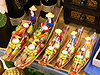
tukkatah mohk man (ตุ๊กตาโมกมัน)
Thai for ‘ivory
wood
doll’, a kind
of puppet carved from wood, which is gained from a tree with
the botanical designation Wrightia arborea.
A
royal collection of this kind of dolls (fig.)
is on display at the
Phra Tihnang Ananta-samahkom
Coronation Hall (fig.).
回
tukkatah ram thai (ตุ๊กตาเรำไทย)
Thai. ‘Thai dancing dolls’. Name
for small dolls, usually made from resin, and typically dressed in
traditional clothes, and wearing a
chadah-like
crown (fig.).
They are used to be placed at religious shrines
and
spirit houses
as an offer or veneration, or
as a more permanent form of
kaebon (fig.),
i.e. paid musical and
dance performances at temples and important religious shrines.
See also
lakhon yok.
回
_small.jpg)
tukkatah taeng suan (ตุ๊กตาแต่งสวน)
Thai name for
decorative garden statues, statuettes and figurines, both small and
large. They are often cartoon-like and typically depict Thai kids in
traditional attire or animals, though many other forms and models
exist. They are found in both private and public parks and gardens,
as well as eye catchers in front of restaurants, bars, shopping
malls and companies throughout Thailand. They can be made of any
material, though often they are of
terracotta (fig.),
concrete, or PVC. More recently also often robot-like
steel or rubber figures
made with pieces from old engines, such as parts of decommissioned
machines, vehicles, and old tires, have become increasingly popular
(fig.).
WATCH VIDEO (1),
(2)
and
(3).
回
tuktuk (ตุ๊กตุ๊ก)
Thai. A motorized three-wheeler,
of which exist several types,
generally with a certain model more widely used in a certain area.
The ones used in
Bangkok,
for instance, typically have
a
steering wheel like that of a motorbike and a gear stick between the legs (fig.),
whereas in rural areas a model called
rot saamloh skailaeb,
i.e. skylab tutuk (fig.),
may be used, which consists of a motorbike, covered with a roof or
not, and with an extended car-like part for passengers to be seated.
For the most part, tuktuks are used as a form of urban transport, akin to taxi's,
called
rot
thaeksih in Thai. The name tuktuk name is derives from the sound of
its engine.
The
first tuktuks were made in Japan and imported into Thailand in
BE
2503, i.e.
1960 AD. It was initially banned from driving in the capital, but
the it quickly became popular among tourists and soon after was
allowed also in Bangkok. Nowadays, tuktuks in Thailand are made
locally. Due to their
popularity, tuktuks are also produced
for export, and as toys in all kinds of materials to be sold as souvenirs from Thailand (fig.).
Some people even have exported real ones to their home country or
driven one half across the globe. Tuktuks have no meter, thus
a fare needs to be negotiated with the driver beforehand and the
rate will vary depending on traffic and distance.
Though a local tourist attraction, tuktuk
drivers in tourist cities, as well as in Bangkok, are known to often
overcharge on foreign customers (fig.),
or take them on a shopping tour not asked for, cashing in on
kickbacks at every place they stop. Some drivers also maneuver their
vehicle as madmen, squeezing through jammed cars or going down
curves on only two wheels. It also needs to be pointed out that
tuktuks in Bangkok are not ideal for tourists due to smog and other
concerns, such as the low roof which makes it impossible to enjoy
any view without continuously having to bend down, or when a tuktuk
is stopped for minutes in traffic, next to the exhaust of a large
city bus, the passengers inside can hardly breath. The open design
of the tuktuk is also a concern during the rainy season, when
passengers either get soaked or the sides of the tuktuk are covered
with plastic, blocking the view even more. So, think twice before
getting into a tuktuk and find out how much a taximeter would cost
you for the same distance, in order to have an indication of what a
reasonable fare should be. In Thai also called
saamloh.
回
tulsi
Another name for holy
basil, known in Thai as
kaphrao.
回
tum (ตุ้ม)
Thai. A folkloristic fish trap
made from woven
bamboo strips. It has a cone-like shape resembling a
bottle, with a narrowed neck and a bulbous middle. It is about 35-50
centimeters high and at the bottom sits a hole to let the fish in.
In the hole sits a funnel-shaped spiked fence so that the fish
cannot reverse and swim back out. At the mouth there is a similar
but removable spiked fence, comparable to the cover of a takong fish
basket (a kind of creel). There are also other models of fish traps
and one particular type, with a wider mouth at the top and a shape
that rather resembles that of a vase, is
known as
ih-joo.
Despite
these subtle distinctions, both names are often used
interchangeably, while the term tum is
also used in a less specific
way for either type. See also
sang.
回
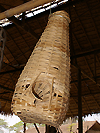
Tum Home (ตุ้มโฮม)
Thai. Name of a 30-minute
Isaan-language talk show that
premiered on Channel 3 HD (ช่อง 3 เอชดี) on November 4, 2024. Hosted
by Kitti Singhapat (กิตติ สิงหาปัด) and Dr. Praswee Saengchat (แพทย์หญิง
ปรัศวี แสงชาติ), the program aims to promote the soft power of
Thailand’s northeastern region by showcasing Isaan culture, local
ways of life, and inspiring personal narratives. The title Tum Home
(ตุ้มโฮม), which means ‘to gather and talk together’ in the Isaan
dialect, reflects the show’s community-focused ethos. The term
tum
derives from a traditional Thai fish trap made from woven
bamboo
strips. This folkloristic object has a bottle-like shape, featuring
a narrow neck and a bulbous middle (fig.),
and is commonly used in rural Isaan communities. The metaphor
suggests people coming together and being held in one place, similar
to how
fish are caught and contained within
the trap. Guided by the concept of ‘creating good things together in
the Isaan way of life’, the program features segments on traditional
livelihoods such as farming, regional cultural practices, and
stories of individuals who have achieved professional distinction.
It also highlights the experiences of Isaan people living and
working abroad, collectively referred to as Tsan Phlat Thin
(อีสานพลัดถิ่น), i.e. ‘Isaan Expatriates’. Additionally, the show
includes educational contributions from Dr. Praswee and features
appearances by artists, actors, and other prominent public figures.
回
tumpal
Indonesian. ‘Cloth
head’. Name for a triangular design at
the far end of a hand-woven piece of cloth, often seen on
silk
or
batik
clothing. The design often appears at the ends of
sarong,
habitually with two rows of tumpals facing each other, creating a
lozenge of a contrasting colour in the middle.
According to some, tumpals represent mountains or hills,
although others claim that the typical rows of elongated triangles
suggest
bamboo shoots and symbolize life force. The term has a
Malay-Indonesian origin.
回
tung (ตุง)
Northern Thai word for a long ceremonial
banner made of cloth, usually divided into vertical steps resembling
a ladder and considered to be a link between heaven and earth. Thus
they are a means for the fallen to climb back out of hell and up to
heaven. They are a special feature from
Lan Na
used both decoratively and during northern Thai festivals and
ceremonies. In northeastern Thailand, it is known as
thung
(ธุง).
See also TRAVEL PICTURES.
回
tung kradahng (ตุงกระด้าง)
Name of a kind of
tung
consisting of a long board made of an enduring material such
as wood, plaster, metal, etc. It is often painted gold or
silver and
is usually decorated with
designs in
bas-relief.
It is found especially in northern
Thailand, used either to
accompany certain monuments (fig.)
or as a monument in its own right.
See also THEMATIC STREET LIGHT.
回
tung yai (ตุงใย)
Thai. Name of a kind of
tung
that
consists of small square patches
made of loosely knitted cloth and strung together to form a mobile
or banner.
Sometimes other shapes, such as stars or octagons are used, and
regularly they are used to make a mobile, which is referred to as
tung yai maengmoom,
i.e. ‘spider tung yai’. In northeastern Thailand, it is
known as
thung yai
and
thung yai maengmoom,
respectively.
See also TRAVEL PICTURES
and
THEMATIC STREET LIGHT.
回
_small.jpg)
tung yai maengmoom (ตุงใยแมงมุม)
Thai. Name of a kind of
tung yai that
consists
of small patches in various shapes, such as stars hexagons or
octagons, and so on, made of loosely knitted cloth and strung
together to form a mobile or banner. In northeastern Thailand, it is
known as
thung yai maengmoom.
回
Turkey Tail
Common name given to a species
of widespread mushroom, with the botanical designations Trametes
versicolor, Coriolus versicolor and Polyporus versicolor, and known
in Thai similarly know as hed hang kai nguang (เห็ดหางไก่งวง), i.e.
‘turkey tail mushrooms’, due its obvious resemblance to a turkey's tail.
See also TRAVEL PICTURES (1) and
(2).
回
turmeric
Name of a perennial plant with the botanical
name Curcuma longa, belonging to the genus Curcuma in the ginger
family Zingiberaceae. It has an orange underground rhizome, a
ginger-like stem bearing both roots and shoots, that is used both as
a spice and a herb (fig.).
It is often made into a powder, used as a food additive and an
ingredient in most
curry powders. In
Ayurvedic
medicine it is utilized for its therapeutic values, e.g. as an
antiseptic and antibacterial agent, or as a treatment against
itching skin irritations. In Thai called
khamin.
回
%20turmeric%20(curcuma)_small.jpg)
turtle
The second
avatar of
Vishnu who supported the churning stick during the
churning of the
Ocean
of Milk, thus preventing it from going in the soft
soil. It thus became a symbol of stability.
It is also the mount of the goddess
Jamuna,
and in
Vietnam
of Khai Tam La Han
(fig.),
i.e. the
Arahat
Jivaka (fig.). See also
tao.
回
Tushita
(तुषित)
Sanskrit
for
Tusita.
回
Tusita
Pali. ‘Satisfied’.
A term that refers to the heaven above
Mount Meru where
bodhisattvas await their last existence on earth,
prior to the
anchern jut. It is one
of the highest heavens in the Buddhist cosmology and the heaven
where the bodhisattva who later became the
Buddha
was born after he gathered enough merit from earlier lives. Thus it
is the place where he resided before he was born as prince
Siddhartha, as well as the heaven where the future
Maitreya
buddha
resides. In
Hinduism it is the fourth heaven.
Also
Dusit
and in Sanskrit Tushita.
回
tuyin (တုရင်)
Burmese architectural term for
the vertical ornamental embellishments at corners and niches of a
pyatthat.
回
Tuyintaung Zedi (တုရင်တောင်စေတီ)
Burmese.
‘Tuyin
Hill
Pagoda’.
Name of a Buddhist temple in the
Bagan
region.
READ ON.
回
Twelve Nidanas
Term for
the Twelve Links of Conditioned Existence as used
in all schools of Buddhism,
an application to the rebirth process and of
Pratityasamutpada, in which each
link is conditioned by the preceding one, whilst itself conditions
the succeeding one. These twelve links are spread over ones
previous, current and future lives and consist of previous ignorance
and volitional formations; current consciousness, mind and body, the
six sense bases (i.e. the five physical senses and the mind),
contact, feeling, craving, clinging and becoming; future birth, old
age and death. The Sanskrit word nidana (निदान)
literally means ‘primary cause’.
回
Twenty gods of Heaven
Generic name for a
group of twenty Chinese deities worshipped in
Taoism.
Most members of this pantheon are important deities in their own
right and are in most cases also worshipped individually. The
pantheon of twenty consists of both male and female deities, as well
as benevolent and malevolent gods. The names of the 20 deities, all
with the prefix Nanwu Hufa (南無護法) and the suffix Zuntian (尊天), are:
1. Dadeshi (大帝釋); 2. Yanmo Luowang (閻摩羅王); 3. Sanzhi Dajiang (散脂大将);
4. Guizi Shengmu (鬼子聖母); 5. Weituo (韋馱); 6. Xing Gong Yue Fu (星宫月府);
7. Si Bi Budong (四壁不動); 8. Da Biancai (大辯才); 9. Ri Gong Taiyang
(日宫太陽); 10. Po Lie Longwang (婆羯龍王); 11. Putishu Wang (菩提樹王); 12.
Yuegong Taiyin (月宫太陰); 13. Da Molizhi (大摩利支); 14. Jingang Miji
(金刚密跡); 15. Jianlao De Shen (堅牢地神); 16. Heli Dinan (訶利帝南); 17. Da
Gongde (大功德); 18. Jin Naluo Wang (緊那羅王); 19. Da Fan Wang (大梵王); 20.
Moxi Shouluo (摩醯首羅). They are also known as the gods of the Twenty
Heavens.
回
Twenty-eight Lunar Mansions
Name for the 28 constellations
that are situated along the moon's path of rotation around the
earth, and which are significant as divisions of the heavens and of
time. The division of the celestial sphere into 28 constellations
were conceived more than 3,000 years ago and were used to mark the
movement of the planet. The Chinese character for these
constellations is taken to means resting places or mansions of the
sun and moon in their revolutions, and in Chinese mythology these 28
constellations or mansions became the abodes of the gods, which are
a vital part of the
Taoist
pantheon referred to as the
28 Celestial Deities of the Star
Mandala.
The 28 Lunar Mansions are grouped into the
Four Symbols, i.e. four
mythological creatures, each associated with a compass direction and
a seasonal division, namely the Azure Dragon of the East for Spring,
the Black Tortoise of the North for Winter,
the White Tiger of the West for Fall, and the Vermilion Bird of the
South for Summer.
Each of
the Four Symbols contains seven mansions. The 28 Lunar Mansions are used for divination and
typically depicted ‒usually in combination with
trigram
symbols (fig.)‒
on
circular cosmographic
divination boards (fig.).
回
Two-striped Jumping Spider
Common name
for
a
species of
Jumping Spider
(fig.)
with the
binomial name
Telamonia
dimidiata.
Males have a
dark orangey chestnut body, with
three white,
straight,
longitudinal stripes on their abdomen, two on the flanks and the
third on top, i.e. in the upper centre, in between and symmetrical
to the stripes on the flanks.
In
the cephalothorax, i.e. the anterior part of its body, males have a
white patch in the front centre and two stripes, one on either side
of it, that curve towards one another at the back ends, yet without
touching.
Their
legs are overall greyish brown, with the four front legs much darker
than the hind legs, while all have some diffuse whitish markings
that make the legs look banded.
They
have mixed grey
whitish
pedipalps,
i.e. the appendages above the mouthparts.
Females
are slightly larger than males and have some different features.
Females are
overall near semi-translucent, pale orangey green, including all the
legs,
with
above
three whitish longitudinal stripes on the abdomen, that merge at the
front towards the
cephalothorax, which in females only has a large whitish spot with
orange fringes near the front centre. The body colour of the
abdomen, in between the whitish
longitudinal
stripes
is of a deeper orange than the legs
and the rest of the body, while the
white stripes themselves also have tiny streaks of orange on them,
though those are hard to see from a distance.
Juveniles have a yellowish-green
body similar to females, which gradually darkens to black in males
as they mature.
The
Two-striped Jumping Spider
somewhat resembles the
Striped Jumper (fig.),
and is
distributed in parts of
Southeast
Asia, India and
China.
See also WILDLIFE PICTURE.
回
_small.jpg)
tympanum
See
gable board.
回