|

|
|

|
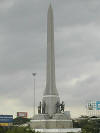
A rectangular stone column, tapering at the top, and usually a memorial. The term is derived from the Greek word obeliskos (οβελίσκος), a diminutive of obelos (ὀβελός) which means ‘spit’ or ‘pointed rod’, ‘needle’, and ‘pointed pillar’, whereas the Greek term obelos lithinos (ὀβελός λίθινος), means a ‘pointed square pillar of stone’, i.e. an obelisk. 回
Oblique Striped Fruit-piercing Moth Common designation for a species of moth in the Noctuidae family, with the scientific names Eudocima hypermnestra and Phalaena hypermnestra. READ ON. 回 The ocean on which the Hindu god Vishnu reclines on the back of the snake Ananta during his cosmic sleep in between two cosmic time spans. To obtain the amrita, the nectar of immortality, the gods and demons churned the Ocean of Milk with Mandara, the peak of Mt. Meru, using Ananta as a stirring rope (fig.). During this process many things surfaced, including the elephant Airavata, the Apsara, the horse Uchchaisaravas, and eventually the elixir of life. The Churning of the Ocean of Milk is depicted on the southern section of the eastern gallery of Angkor Wat (fig.). See also Bi Xi. WATCH VIDEO. 回
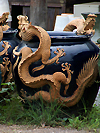
Civilization that originated around 100 AD in the province of An Giang in the Vietnamese Mekhong delta region and consisted of a mixture of Indian and local culture. Some of the objects unearthed show evidence of the existence of an ancient trading port and a cultural centre that produced artifacts ranging from precious metals and multi-coloured gemstones to pottery, kettles and monuments. The name Oc Eo was given by the French archeologist Louis Malleret who discovered the city. It was an important seaport city of the Funan kingdom and is believed to have existed from the 1st until the 7th century AD. The city was connected with the more northerly situated city of Angkor Borei, which was probably the capital city of Funan, by means of a canal. Its location at the Mekhong river, as well as its intermediate position as a stopover port on the maritime trade routes between the East and West, made Oc Eo an important and prosperous city. In the course of the 6th and 7th centuries however, merchant vessels were increasingly able to cover longer distances, making it no longer essential to follow the coastline or to stop in each and every port. Because the area had little commodities of its own to offer the importance of Oc Eo gradually declined. With the rise of the Chenla kingdom trade was largely moved to the upper Mekhong river, what eventually led to the downfall of Oc Eo. 回 A festival in Bali celebrating the anniversary of a temple. 回 Independent organization under the supervision of the State Audit Commission, that is responsible for checking the government's budget. READ ON. 回 1. An arch with a double curved line including concave and convex elements, as in a chaitya. 回 2. A term in architecture for an ogive vault which ribs cross diagonally. 回 Sanskrit. Another transcription (and Sanskrit spelling) for Aum. 回 Thai. Name of a large earthen water pot, that is placed in the garden of houses in rural areas and used to collect and store rain water. Tough usual dull is appearance, occasionally they may be painted and made into decorative objects, such as those at the home of artist Phairoht Thanomwong (fig.) in Angthong, which have been made into colourful giant or yak faces (fig.), and a word play with gigantic earthen water pots called ohng yak, literally ‘giant water pot’. 回 Thai. A kind of pottery from Ratchaburi, namely bulbous earthen water vessels called ohng, decorated with dragon motifs in bas-relief. 回
Thai. ‘Giant water pot’. Name for a kind of gigantic earthen water pot, that is placed in the garden of houses in rural areas and used to collect and store rain water. The earthen water pots at the home of artist Phairoht Thanomwong (fig.) in Angthong, have been painted into colourful giant or yak faces, i.e. a word play with the gigantic earthen water pots called ohng yak. 回
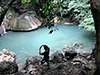
See phaang pha theed. 回 Common name for a palm tree of the genus Elaeis guineensis. READ ON. 回 Ok Nang Phi Seua (อกนางผีเสื้อ) Thai. ‘Bosom of the Butterfly Lady’ or ‘Breast of the Mrs. Butterfly’. Name of the fourth level in the series of seven falls of the Erawan Waterfall (fig.) at Erawan National Park (fig.) in Kanchanaburi Province. See also nang and phi seua. See MAP. 回
See Khlong Khoo Meuang. 回 See duang kihm rong kao. 回 Name for a species of hawk moth, with the scientific name Daphnis nerii. It has camouflage colours reminiscent to those used by the military, hence it is also referred to as the Army Moth and Army Green Moth. In Thai, it is likewise called mot yihaw laai thahaan khiaw (มอธเหยี่ยวลายทหารเขียว), i.e. ‘green soldier patterned hawk moth’. Its name derives from the fact that in the caterpillar stage (fig.), this species feeds on the highly toxic leaves of Oleander (fig.), yet is unaffected by its toxins. When still young, the caterpillar is pale bluish and green, and is in Thai known as non ton phut or non cha khiao (หนอนชาเขียว), i.e. ‘green tea caterpillar’, whereas when grown the caterpillar is orange and blackish-brown, and known in Thai as non sih nahm tahn (หนอนสีน้ำตาล), i.e. ‘brown-coloured caterpillar’. Also spelled Oleander Hawk Moth. See also WILDLIFE PICTURES. 回
Common name for a species of passerine bird with the scientific designation Anthus hodgsoni. Adult birds are about 15 centimeters tall and have greenish-olive upperparts, with black and white markings (fig.). Below they have black streaks on a buff breast and lower sides, whilst the belly and vent is whitish and un-streaked. 回
A species of sunbird with the binomial names Nectarinia jugularis and Cinnyris jugularis. Like females (fig.), adult males have dull olive-brown upperparts and bright yellow underparts, but are distinct by a dark, metallic blue-black throat, upper breast and face (fig.), and a maroon shine on the lower breast (fig.). In winter, the male has an eclipse form, i.e. a dull, short-term, post-nuptial plumage, in which this colouring is somewhat reduced to a simple blue-black gular stripe, with no metallic blue-black colouring on the face and no maroon shine on the lower breast (fig.). The throat of adult females is bright yellow and in addition, they may have a faint beige supercilium, as well as a little white on the shoulders and white tips to the underside of the tail feathers. Olive-backed Sunbird have a long, blackish and curved bill (fig.), though not as long as that of spiderhunters, and their feet and legs are black. This species diet consists largely of nectar, although it may also take insects, especially when feeding young. It is a very common resident throughout Thailand and also appears in other parts of Southeast Asia, from southern China to the Philippines and Malaysia, down to northeast Australia. In Thai it is called nok kin plih ok leuang, meaning ‘yellow-breasted banana inflorescence-eating bird’. See also WILDLIFE PICTURES (1) and (2). 回
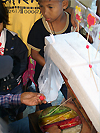
Sanskrit. Another spelling (in English and Sanskrit) for Aum. 回 Thai. ‘Put in your mouth and smile’. Name for a handmade lolly, a kind of candy popular with children. It is moulded from fructose and put on a stick. Usually made in the shape of colourful glazed animals or flowers. 回
Latin. Botanical name for a species of dwarf orchid in the subfamily Epidendroideae. The name Oncidium derives from the Greek word onkos (όγκος), i.e. ‘tumor’, and refers to a small callus situated at the base of the lip, resembles a tumorous swelling, hence the name. In English, it is commonly known as Dancing Lady Orchid, as its flowers resemble dancers in a yellow dress, hence they are in Thailand likewise nicknamed ballerinas. 回
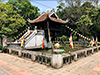
Name of an iconic Buddhist temple in Hanoi which was erected in the 11th Century AD by Emperor Ly Thai Thong and which is said to represent a lotus flower in a lotus pond. As legend has it, the childless Emperor in a dream met the bodhisattva Avalokitesvara, who handed him a baby son while seated on a lotus flower. When the Emperor later on married a girl who bore him a son, he had the One Pillar Pagoda erected. Afterward, the Emperor annually held a Buddha image bathing ceremony at the site on Visakha Bucha Day and for the occasion would free a bird, a custom still practiced here today by visitors on certain occasions (fig.). See MAP. 回
Thai. Term and classifier used to indicate the ‘number’ of sacred things and objects or supernatural beings, as in ‘chedi saam (3) ong’, three pagodas, and ‘phra song (2) ong’, two monks. The term used for people is ‘kon’, and that for beings of a lower rank than humans is ‘ton’. 回 A monkey soldier with a green (fig.) fur, that in the Ramakien belongs to the army of Rama. He is the son of Bali (Vali) and Montho, who was cut from his mothers womb and placed in a goat's womb before she returned back to Totsakan. Ongkhot was sent to Tosakan as a messenger of Rama, in order to find a peaceful solution in returning Sida, Rama's beloved. When Ongkhot arrived at the city of Lanka, he called out to open the city gate, while enlarging his body so that it blotted out the sun, darkening the entire city. Since the guards refused to open the city gate, Ongkhot became furious at the delay and broke it down with his left foot. He entered the palace and in order to raise himself to the same level as Totsakan, Ongkhot enlarged his tail and curled it into an elevated seat (fig.). When Totsakan paid no heed to any of the propositions made to resolve the matter peacefully, Ongkhot planted his foot firmly on the ground and challenged anybody in the courtroom to uproot it, saying that if anybody were to accept the challenge and was successful, Rama would concede defeat and return without Sida. When none of Totsakan's commanders were successful, an infuriated Totsakan moved towards Ongkhot to attempt to do it himself, yet just as he was about to try, Ongkhot moved away and Totsakan fell over, losing his crown in the process, which fell on the ground. Adding insult to injury, Ongkhot picked up Totsakan's crown and threw it out of the palace, and explained to Totsakan that the challenge was only for Totsakan's commanders and not for him, and that he should rather prostrate himself before Rama, rather than falling on Ongkhot's feet. A humiliated Totsakan ordered his men to kill Ongkhot, but the latter Ongkhot escaped with a jump and flew away. In the Ramayana, his Sanskrit name is Angada (fig.). 回
Drug made from the sap of the papaver somniferum (fig.) and the raw material for making analgesic and narcotic drugs, such as morphine and heroin. Opium itself is smoked whilst lying down due to its strong effect (fig.). It is harvested from December to January and is grown on poor soil at high altitudes, making it an ideal and profitable cash crop for many of the hill tribes. In Thailand it is nowadays mainly cultivated and used by the northern hill tribes in the area of the Golden Triangle, who brought it with them from China in the late 19th century. Between 1839 and 1860 the British had fought the Opium Wars with China over the rights to import the drug from India, what resulted in legalization and free trade of the drug there. Although also a major commodity in Thailand at first it was outlawed in 1959 under pressure of the USA. Nonetheless, it flourished during the Vietnam War and even today the government has only been able to cut production by about 80 percent. Some of the illicit drugs trade is still in the hands of powerful drug lords, often with their own armies and operation from across the Burmese border, leaving police forces with a difficult task to completely abolish it. The government through some royal projects has been encouraging replacement crops, such as cabbages, tea, corn, etc. However, these often demand the use of more land area for a similar profit, resulting in the deforestation of many slopes, what in turn may trigger dangerous landslides. The word opium is derived from the Greek word ‘opion’ (poppy juice). Opium for personal use was generally stored in opium boxes. In Thai opium is called fin. See also Khun Sa and Wat Tham Khao Krabok. 回
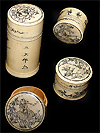
Name of a bed that looks like a kind of large coffee table on which one would lay when smoking opium. It typically has inward curved legs, a furniture design known as kha khoo (fig.). 回 Small containers used for the personal storage of opium. They are often made from durable materials such as animal bone and sometimes elaborately decorated. 回
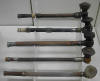
A specially designed oil lamp used to facilitate the vaporization and inhalation of opium. The bowl of an opium pipe prepared with a pill, a small dose of opium, is to be held over the opium lamp, what will cause the drug to vaporize, allowing the inhalation of the intoxicating fumes. 回 Pipe used to smoke opium, specifically designed to vaporize the drug whilst being heated over an opium lamp, allowing the inhalation of the intoxicating fumes. Due the strong effects of the drug, as well as to ease the use of the opium lamp, opium pipes are smoked whilst reclining (fig.). An opium pipe consists of a long stem, a ceramic pipe-bowl and a metal fitting called the saddle, through which removable pipe-bowl is attached to the stem. The stem is usually made from bamboo, often with a mouthpiece made from another material, such as bone or ivory. Some opium pipes may be made of more expensive materials, such as jade, ivory or silver. Simple pipe-bowls are generally made from ceramic or porcelain, but more elaborate ones may be carved from jade or another material. 回
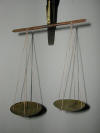
A pair or scales or balance used to weigh opium, in combination with specially designed peng (fig.), opium weights. See also THEMATIC STREET LIGHT. 回
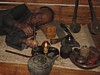
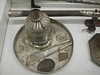
Dish or phaan with an opium lamp as well as other instruments needed to prepare opium, including an opium pipe-cleaner and an opium-spoon, a tool used to prime and place the pill, a small dose of opium, onto the pipe-bowl. 回
Name of either conflict fought between China and England between 1839-42 and 1856-60 over the rights to import opium from India. READ ON. 回 Weights in the form of figurines used for weighing opium, usually representing hintha fowls or bantams, but also elephants and other animals or objects. They come as a series of weights, the bigger the heavier. In Thai called peng. 回
A rather large stone used in Myanmar to foretell if a wish will be granted or not. Fortune seekers must rub the stone while making a wish, and then predict if the stone will feel either heavy or light when lifted. If the feel of it corresponds to their prediction, it is believed that their wish will be fulfilled. Oracle stones are found at Shwezigon Phaya in Bagan, in front of the shrines of the outer nats, known as The Son Died One Day Before The Father warrior nats (fig.). 回
Malay. ‘Native People’ or ‘Original People’. Name of an aboriginal, ethnic minority group of curly-haired, dark-skinned, Negrito people in Malaysia, who are related to the Mani (fig.) of southern Thailand. 回 A species of small bird, that belongs to the family Dicaeidae and with the scientific name Dicaeum trigonostigma. Males are slate-grey above, with an orange back and a light grey chin, whilst below the plumage is orange, which is darker on the chest and lighter towards the vent. Below, the wings are whitish. The bill is black, with a pinkish-yellow base in immature individuals. Females are mostly olive, with some black on the wings (fig.), an orange lower rump, a pale grey chin and upper breast, and faint yellow underparts (fig.). The female's bill is slightly curved and black above, while the lower mandible is pinkish-yellow. These tiny beauties grow up to 9 centimeters in length. They are frugivorous and have a long specialized tongue in order to also feed on nectar, which they can do while hovering in the air. 回
Common name for a butterfly in the Pieridae family, related to the Common Emigrant. Adults have a wingspan of about 5 centimeters. The forewings of the male are white with black margins, and the hindwings are yellow. The wings of the female are similar with additional black spots. Underneath, the wings are yellow with dark markings. It has the scientific designation Catopsilia scylla, and in Thai it is known as phi seua non khoon leuang (ผีเสื้อหนอนคูนเหลือง), with the word khoon being the Thai name for the Drumstick Tree, one of several species of Cassia on which leaves the caterpillars of this butterfly feed. These caterpillars are dark green above and pale green below, with a white lateral line along each side of the body, bordered above with black bar-like spots and tiny dots. 回
Common name for a species of butterfly with the scientific name Cepora judith. Above, the wings are white with black veins and black borders, whilst the hindwings also have a large orange patch on the lower half. Below, the wings are overall yellow with a black rim, and orange around the base, whilst ate the top there are some white spots. 回
Another name for the Giant Asian Pond Turtle. 回 Common name of a species of butterfly in the tribe Heliconiini. READ ON. 回 Common name for a species of dragonfly, with the scientific name Brachythemis contaminata. In Thai it is known as malaeng poh ban som leuang, which translates as ‘orange-yellow habitation dragonfly’. It either has a brownish-orange abdomen, brown eyes and a brown thorax, or a yellowish-orange abdomen, greenish-brown eyes and a greenish-brown thorax. In addition, males have reddish-brown wing patches and females have pale brown to yellowish wing patches. Also known as Ditch Jewel and Asian Amberwing. See also WILDLIFE PICTURES. 回
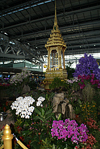
Common name for a species of pond damselfly, with the scientific designation Ceriagrion auranticum. READ ON. 回 Name of a species of arboreal great apes, with the scientific designation Pongo borneo. READ ON. 回 Collective name the most numerous and diverse family of flowering plants on the planet, that consists of tropical parasitic plants, that live on trees in the rainforest and sometimes on rocks or marshy soil. There are an estimated 25,000 species of orchid and this family formed a particular fascination for Charles Darwin, as he revealed in one of his letters. The main genera are: Asocentrum, with 5 species; Brassavola with around 20 species; Brassia with about 25 species; Cattleya (fig.), a genus with between 40 and 60 species (depending on which botanical classification is followed); Culogyne with more than 100 species; Dendrobium, one of the largest genera with around 1,200 species; Dendrochilum with circa 150 species; Disa, a kind that occurs on soil, with around 125 species; Laelia with about 50 species and related to the Cattleya to which it resembles; Laeliocattleya, a crossed form of the Laelio and the Cattleya, with around 2,000 registered names; Miltoniopsis, a manipulated kind with only 5 species; Odontoglossum, with approximately 200 species; Oncidium, with more than 450 species; Paphiopedilum, with about 60 species; Phalaenopsis, with almost 50 species; Renanthera, with nearly 15 species, mainly climbers; and Rhynchostylis, with just six species and known in Thai as chang. Most orchids have bare stalks, often with two rows of closely overlapping thick leaves (fig.). Orchids are extraordinary plants in many ways, but most notably is the fact that the petals and especially the lower lip of the flower is controlled by a special set of genes that can influence the shape and colour of the petals, sometimes only of the lower lip while the rest of the petals stay the same. Hence, some orchids have petals that evolved into look-alikes of certain insects, such as a scorpion (fig.), or mimic a bee. The phenomenon was first believed to be a kind of warning for cattle not to eat it, but in the latter case, it was discovered that the so-called bee is a mimic of a certain species of female bee, that attracts a male to meet it, and thus helps in pollinating the flower. This discovery was acknowledged by the fact that apart from the shape and colour of its lower lip, this particular orchid also produces the exact same scent that the female bee uses to attract a male in order to mate. Due to their beauty and uniqueness, there are many orchid nurseries (fig.) all over Thailand, as well as in many other countries of Southeast Asia, and Khon Kaen has a park with wild orchids (fig.). They are also commonly found on Bangkok's flower market (fig.), where they are purchased for decorative uses. Vanilla, which produces the flavouring vanilla, is a genus of orchid (fig.). The orchid was one of seven types of dok maijan, i.e. sandalwood flowers, used in the royal cremation ceremony of King Rama IX, in October 2017, as a symbol of stability, love, and grace, and representing the benevolence of the late King in performing his royal duties. In Thai, orchids are called gluay mai. In Oriental iconography and art, the orchid is one of the Four Sacred Symbols and one of the Flowers of the Four Seasons, where it is the symbol for spring. See also POSTAGE STAMPS (1), (2), (3) and (4). 回
See malaeng saab. 回 Common name for a species of 85 to 97 centimeter tall water bird, with the scientific name Anhinga melanogaster, which is a resident breeder throughout tropical South and Southeast Asia. This mostly blackish-brown water bird has cormorant-like features, but with a slender pointed bill, rather than the stubby hooked bill, which is common in cormorants (fig.). In addition, it has a very long and slim neck, and a relatively long tail. Compared to males, juveniles and adult females have a much paler plumage (fig.), especially on the neck, and are a bit larger overall. It is a fish-eater and often swims with only the thin snake-like neck above water. Hence, the bird is also referred to as Snakebird (fig.). It is also known as Indian Darter and in Thailand it is called nok ahy ngaw. See also WILDLIFE PICTURES. 回
See Dollarbird. 回 Popular name for the opulent tourist train which runs between Singapore and Bangkok, via Penang and Butterworth in Malaysia. The distance is about 2,000 kilometers and the train takes around 36 hours to reach its destination. The renowned dining offers a five star menu, prepared by internationally distinguished chefs. Officially it is called Eastern & Oriental Express. See also State Railway of Thailand. 回
Common name for a diurnal bird of prey, which is also commonly known as Crested Honey Buzzard, and with the scientific designation Pernis ptilorhyncus. READ ON. 回 See malaeng wan hua khiaw. 回 Common name for a bird of the crow family Corvidae, with the scientific designation Pica sericea. READ ON. 回 Name of a small bird found in tropical and subtropical South and Southeast Asia. The male has a contrasting black and white livery. Its head, throat and upperparts are black, apart from a white shoulder patch, whilst its underside of both its body and long tail are white (fig.). The colours of the female are similar, but its head, throat and nape are grey. This bird has a clear and beautiful whistle and is a common sight in parks and gardens. It feeds on insects, largely on the ground, moving about by hopping. It often perches with its tail raised in an angle to it body (fig.). Male juveniles (fig.) have a brownish-buff face and breast, with dark scaling, and and brownish-black above. Female juveniles (fig.) have a greyish face and breast, with buff scaling, and are grey above. In Thai it has several names, including nok kaang khen baan (นกกางเขนบ้าน), nok bin lah baan (นกบินหลาบ้าน), nok ih jaeb (นกอีแจ้บ) and nok jih juh (นกจีจู๊). See also WILDLIFE PICTURES (1), (2) and (3). 回
Common name for a species of hornbill, with the scientific name Anthracoceros albirostris, the latter, albirostris, meaning ‘white beak’. They are medium-sized, on average about 69 centimeters tall (fig.). Its natural habitat is subtropical or tropical moist lowland forests, and it can be found in Southeast Asia (fig.) and South Asia. In Thailand, where this bird is known by the names nok ngeuak lek, nok kaek and nok kaeng, it occurs in the vicinity of the border with Myanmar and Malaysia, and in areas near the Thai border to the North and West of Cambodia, as well as in Khao Yai National Park, on Koh Samet (fig.), and around Krabi, a distribution similar to that of the Wreathed Hornbill. Oriental Pied Hornbills have black upperparts and white underparts, i.e. a white belly and vent, and a black tail with broadly, white-tipped outer feathers, or a mostly white outertail in Anthracoceros albirostris convexus (fig.), a subspecies that occurs only in the extreme South of Thailand, as well as southwards into Malaysia. In addition, Oriental Pied Hornbills have white facial markings underneath the eyes, which in both sexes have a bluish orbital patch, and in flight a white, broad trailing edge is visible on the otherwise black wings (fig.). The bill and casque of adult males is pale yellowish with some dark markings, especially towards the back, whereas that of adult females is smaller and more extensively dark distally (fig.). The Oriental Pied Hornbill is very similar to the Indian Pied Hornbill (fig.), which only occurs in India and Myanmar. See also WILDLIFE PICTURES (1), (2) and (3). 回
A non-venomous snake with the binomial name Ptyas mucosus. It may grow to a length of about 320 centimeters, with the anterior half of the body pale or medium brown to near black, whilst the posterior is somewhat paler and has irregular, thin, black dorsal cross-bands, that run down the sides to the abdomen (fig.). It has a brown head and large eyes with round pupils. The body colour tends to vary according to their habitat, with pale brown for species living in dry regions to near black for those that live in moist forest areas. This mainly terrestrial snake is active during the day and preys on a wide range of animals. In Thai known as ngu sing haang laai and ngu sing seua, which could be translated as ‘stripe-tailed haunting snake’ and ‘tiger haunting snake’, respectively. Also commonly known as Banded Rat Snake and Dhaman Rat Snake. WATCH VIDEO. 回
Common name of a species of reef fish with the scientific designation Plectorhinchus vittatus, and due to its striped pattern known in Thai as pla taeng moh, i.e. ‘watermelon fish’ (fig.). It has a whitish body with black stripes that run horizontally across the length of its body. Towards the underside, the black stripes get thinner and the white becomes more profuse, while near its contours, especially at the fins, tail and face of the fish, the ground colour is yellow rather than whitish, and the stripes in the tail are replaced by black dots as it ages. This species dwells on both coral and rock reefs, and is found at depths between 2 and 25 meters. Due to their striking appearance, they are also well-liked aquarium fish. 回
Name of a bird with the scientific designation Streptopelia orientalis, and belonging to the family Columbidae, which includes doves and pigeons. There are two main races. Its body size is about 31-33 centimeters and somewhat resembles the Spotted Dove (fig.), though less pinkish and the black neck patch has a different white pattern, being barred rather than spotted, and the lower mantle and coverts have reddish-brown fringing. The tail is wedge shaped and either has a grey tip or a white tip, depending on the race. Its habitat consists of open forest, secondary growth and cultivation. In Thai it is called nok khao Pa-mah (นกเขาพม่า), i.e. ‘Burmese pigeon’. Also spelled Oriental Turtle-dove and Oriental Turtledove. 回
Common name for a species of snake, with the scientific designation Ahaetulla prasina and which is also commonly known as Asian Vine Snake. It ranges from India to China and throughout Southeast Asia. In Thailand, this rear-fanged diurnal tree snake is rather common and is found throughout the country. The head, which is reminiscent of that of a common house gecko, is spear-shaped, while the body is finger-thin, tapering to a very thin pencil-width neck. This species grows to a length of 180 centimeters and exists in yellow, brown (fig.) and green colour variations, with on the anterior back a checkered pattern of blackish-brown and some white bars is sometimes present. As a defensive technique, the Oriental Whip Snake can spread its neck area, almost doubling it in size, and while in full defensive posture, it tends to sticks out its tongue. Sometimes a checker pattern may also appear when the snake is agitated and puffs up, showing the skin between the scales. Though considered a rear-fanged and venomous snake, it is not very dangerous to humans due to it’s non-aggressive nature and weak venom characteristics. It feeds on frogs, small birds and small reptiles, and has a short striking range. It is extremely fast and can climb into trees and glide through the forest floor with ease, disappearing before one has a chance to make a still photo. In Thai, this snake is known as ngu khiaw hua jingjok (งูเขียวหัวจิ้งจก), i.e. ‘gecko-headed green snake’. It is very similar to the Long-nosed Whip Snake (Ahaetulla nasuta) and either species is often mislabeled. See also WILDLIFE PICTURES. 回
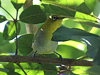
Name of a 10 centimeters small passerine bird, with the scientific name Zosterops palpebrosus and a resident breeder in the open woodlands (fig.) of tropical South, East and Southeast Asia, from India to China and Indonesia. There are several morphs, including Zosterops palpebrosus williamsoni and the somewhat darker (fig.) Zosterops palpebrosus siamensis (fig.). Its back, scapulars, rump, upper tail coverts and head are light olive green, except for the chin and throat, which are yellowish. Its underparts are dull white, becoming dusky on the sides and flanks, and with a faint yellow ventral stripe (fig.). It has a feathered white eye-ring, which in front of the eye is broken by black feathers that form a black margin along the bottom of half of the eye. Its bill is black and its legs and feet are dark grey. It is very similar to the Japanese White-eye (fig.), but is lighter above, has a faint yellowish-white ventral stripe and a yellow forehead. In Thai it is named nok waen tah khao. 回
Japanese. The art of folding paper into decorative shapes such as flowers, mammals, birds, etc. According to an ancient Japanese tradition, if one folds 1,000 origami cranes one's wish will be granted. Early December 2004 the Thai government called upon all Thai citizens to fold paper crane birds as a token of solidarity to the people living in the deep South of Thailand who were suffering violent attacks by Muslim separatist groups and with the wish to end the violence. A total of around 60 million birds were dropped from airplanes above the southern provinces of Yala, Narathiwat and Pattani. The local people there collected the paper birds falling from the sky which they could turn in to receive rewards, e.g. ten birds could be exchanged for a package of dried noodles, more birds could be exchanged for prices such as bicycles, etc. Many birds had written messages of solidarity on them. Also then prime minister Thaksin Shinawat autographed a paper bird promising a scholarship to its finder. Other people folded paper birds made from banknotes. In a September 2009 contest in Japan for folding the best flying origami airplane, Mong Thongdee (หม่อง ทองดี), a 12-year old Thai schoolboy of Burmese origin, took third place in the individual event for elementary school students with a time of 10.53 seconds, whilst his team won the group competition with Mong’s paper plane and in an earlier exhibition, his airplane stayed in the air for 16.45 seconds. 回
Latin. ‘Lined ornithospila’. Scientific name for a species of moth in the family Geometridae. It is bright green with off-white to pale beige fringes, as well as some tiny reddish brown spots and irregular patches, most notably the larger reddish brown discal marks on the apex of each of the hindwings, akin to the Pointed Flatwing (fig.). The forewings have two fine, off-white to pale beige, transverse stripes, in between the apex and base, i.e. an inner and outer stripe. Yet, on the hindwings there is just one stripe as the inner one is swapped for a reddish brown-edged white spot. This moth has a set of pale beige feather antennae. Ornithospila lineata is distributed in the region of the northeastern Himalayas, Sri Lanka, Vietnam, Myanmar, Thailand, and parts of Malaysia and Indonesia, including Borneo and Sumatra. 回
Common name for a large diurnal bird of prey, which is also commonly known as Sea Hawk, Fish Hawk and Fish Eagle, and with the scientific designation Pandion haliaetus. READ ON. 回 Thai-English abbreviation for ‘One Tambon One Product’. A government supported initiative to promote local produce from all over the country, as well as a support to conserve the local heritage. In advertisement usually written with the Thai number 1 (๑), that is ‘๑T๑P’ (Neung Tambon Neung Phlitaphan, or: one district one product). In Doi Mae Salong there is an OTOP project (map - fig.) aimed at the conservation of the Akha hill tribe culture. 回
Thai. A title above Phra. It is a bandasak from the Ayutthaya Period. 回 Burmese term for ‘coconut’. In Myanmar, coconuts and hands of bananas are a typical offering for the nats, known as gado bwe (fig.). 回 Thai. ‘Spoon net’. Another name for ouwn yok, i.e. a lift net. 回 Thai. ‘Lift net’. A type of fishing net, usually with a square shape, or otherwise round, and used to fish at the banks of lakes, rivers, lagoons and canals. It is used to catch surface fish and as bait to entice the fish, light is used. The fish is caught by lifting the net out of the water, hence the name lift net. Though foremost a land fishing net, it is sometimes employed from large rafts, such as on Khao Laem Lake in Sangkhlaburi (fig.), and on Tonle Sap Lake in Cambodia. Lift nets are also known as ouwn chon, literally ‘spoon net’. 回
Ovada Patimokkha (โอวาทปาฏิโมกข์) Thai-Pali. ‘Discourse concerning deliverance’. Term in Sanskrit referred to as Ovada Pratimoksha or simply Pratimoksha (प्रतिमोक्ष) and which is related to the concept of mokkha (โมกข) or moksha. It is a brief synopsis of the principles of the Buddha's teaching, containing both injunctions and principles for administration of the Buddhist Order, as dictated prior to the investiture of the Vinay, which formulates the monastic discipline. There are thirteen points in all. Monks are summoned to vow to restrain, be moderate in eating, patient, not disparaging others, and not to harm others. In summary, and known in Thailand as the Heart of Buddhism, the principles encompass giving up of evil, cultivation of the good, and purification of the mind, with the highest of all teachings being nibbhana or nirvana, i.e. the cessation of defilements and transcendence of suffering. Also transliterated Ovadapatimokkha. See also POSTAGE STAMP. 回 Thai. ‘Go out of the rainy season’. End of the Buddhist Lent, on the 15th full moon of the 11th lunar month, usually mid-October. That evening on the Mekhong River in Nong Kai a strange ‘natural’ phenomenon takes place, called the fireball phenomenon or bangfai phayanaag. Also transcribed ouk/awk pansa/phansa. See also khao pansa. See also Thadingyut. 回 Common name for a large nocturnal moth in the family Brahmaeidae, i.e. brahmin moths, with the scientific designation Brahmaea wallichii. It is found in both tropical and temperate forests in India, Bhutan, Myanmar, China, Taiwan and Japan and has a wingspan of up to 16 centimeters, with large eye spots on the front wings and a characteristic pattern of black and orange-brown stripes, and like the Great Owl Moth (fig.), the markings on the wings are reminiscent to the face of an owl (fig.). Besides the nominate race Brahmaea wallichii wallichii, there are the subspecies Brahmaea wallichii insulata, found in Taiwan, and Brahmaea wallichii saifulica, found in the Himalayas. 回
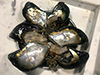
Common name for a number of different families of saltwater bivalve molluscs that live in marine or brackish habitats. They have an external calcareous shell, often rough and irregular, and while several kinds are eaten, especially raw and considered a delicacy, some species are used in perliculture. Hence many species are farmed for either food or pearls. See also khai muk. 回
Name for an elongated, goblet-shaped drum from Myanmar, similar to the Thai klong yao and the larger klong aew, which too have their origins in Burma. It is made by hollowing out a single block of wood, and played held vertically, resting on the drummer’s chest, while suspended from a cord around the neck. It is also referred to as the pot drum. 回 |
%20Ahkahttalai_small.jpg)
_small.jpg)
%201_small.jpg)
_small.jpg)
_small.jpg)
%202_small.jpg)
_small.jpg)
%20ผีเสื้อหนอนคูนเหลือง%201_small.jpg)
_small.jpg)
%20แมลงปอบ้านส้มเหลือง_small.jpg)
%201_small.jpg)

%20นกกางเขนบ้าน%20(นกบินหลาบ้าน,%20นกอีแจ้บ,%20นกจีจู๊)_small.jpg)
%202_small.jpg)
%20งูสิงหางลาย_small.jpg)
%20B_small.jpg)
%20นกเขาพม่า_small.jpg)
%201_small.jpg)
_small.jpg)
_small.jpg)