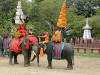
ya (亚)
Chinese. ‘Asia’ or ‘Asian’, but
also ‘inferior’ and ‘sub-’.
READ ON.
回
yaan (ยาน)
See
yahn.
回
yaay ton
klah (ย้ายต้นกล้า)
Thai. ‘To transplant paddy sprouts’.
After about 45 days, when the first crop of
rice sprouts or
ton klah
have reached a height of 20 to 30 centimeters, they are uprooted and
tied into bunches to be moved (fig.).
These sprouts are then cut off at about 2 centimeters from the top
and transplanted apart from one another in more spaciously rows
throughout the rice field, in small groups of about 3 to 5 seedlings.
This work is usually done collectively with several workers, who progress
through the field, slowly moving backward whilst planting the
crops (fig.).
It is hard labour as workers are bent over most of the
time (fig.), whilst they advance through the paddy field, often in
succulent mud and exposed to any weather conditions (fig.).
This work is done in the rice planting season, usually at the beginning of the rainy
season, and farmers of small upcountry communities tend to gather for
this task, helping one another out by working each others
fields in turn, whereas larger landowners would rather hire staff (fig.).
As an abstract noun indicating action the
prefix kaan (การ-) is added to the verb, hence
‘paddy sprouts transplanting’
is
referred to as
kaan yaay ton klah.
回
%201_small.jpg)
yabyum
Tibetan.
‘Father-mother’. Tibetan term from Vajrayana
Buddhism indicating the position of male and female gods in sexual unity
(fig.), symbol for the unity of
compassion and wisdom (fig.). In
Hinduism sexual
unity, as well as creation, are symbolized in the combination of the
yoni and
linga (fig.). Compare
this also with the term
shakti and
maithuna,
as well as with the hermaphrodite appearances of some
Hindu gods, such as
Ardhanari.
回
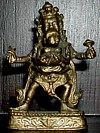
ya chao kuay (หญ้าเฉาก๊วย)
Thai. Name for a plant with the
botanical name Mesona chinensis, of which the aged and slightly
oxidized stalks and leaves are boiled to make
chao kuay.
It is a member of the mint family and grows extensively in East
Asia, especially in Southeast China and Taiwan. This up to one meter
tall plant has serrated leaves, that are narrowly ovate to
subcircular in shape with a tapering tip. Mesona chinensis prefers
grassy, dry and sandy areas, such as ravines.
回
yadana (ရတနာ)
Burmese. Another transliteration
for
yattana, i.e.
rattana.
回
Yadana Zedi Sin Myar Shin Phaya Kyee
(ရတနာစေတီဆင်များရှင်ဘုရားကြီး)
Burmese.
Literally ‘great (kyee)
pagoda (phaya)
of the bejeweled (yadana)
stupa
(zedi,)
with many (myar)
elephants (sin/sain)’,
with
shin being a
honorific term used as a
prefix to holy objects or venerated people.
Full name of
Sin Myar Shin.
回
ya dok kham (หญ้าดอกคำ)
Thai. A small flowering plant,
with the botanical name Hypoxis aurea, that grows in
mountainous areas, in bright sunshine and in open forests, such as
pine forests. Its yellow flowers have dense petals (fig.),
and blooms around May and June. It reportedly grows abundantly in
Pha Taem National Park (fig.),
in
Ubon Ratchathani
Province.
回
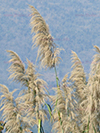
ya dok lao (หญ้าดอกเลา)
Name for a species of
perennial
grass with the
scientific name
Saccharum
spontaneum, that grows up to 3 meters tall
and
is related to
sugarcane (Saccharum
officinarum),
and it is commonly known as wild sugarcane.
Large grasslands of
wild sugarcane
are an important habitat for the
Indian Rhinoceros (fig.),
and in Nepal, the grass is used to thatch roofs and make fences.
回
ya fai takaad (หญ้าไฟตะกาด)
Thai. Name of a perennial,
carnivorous plant, with the botanical designation
Drosera peltata
and commonly known in English as Shield Sundew and Pale Sundew. It
grows from an underground
tuber to a height of circa 10 to 35 centimeters. The plant has white
flowers and thick shield-shaped leaves with sticky tentacles that
excrete viscous drops of a gluey substance, designed to entangle
insects. It is depicted on a postage stamp issued in 2009 as part of
a set of four stamps on wild flowers found in Thailand (fig.).
回
ya faran (หญ้าฝรั่น)
Thai for
saffron.
回
yah
(ย่า)
Thai. ‘Grandmother’, ‘grandma’ or
‘granny’. Term used for a
paternal grandma, i.e.
the father's mother, whereas for the maternal grandma, i.e. the mother's mother,
the term
yai
is used. See also
kreua yaht and
THAI FAMILY TREE.
回
yahm (ย่าม)
Thai. A bag
made of cloth with a shoulder strap, especially one carried by monks.
回

yahm daeng
(ย่ามแดง)
Thai. ‘Red
shoulder bag’. Name of an imaginary man with a red bag, who kills
children and carries their bodies away in his bag.
回
_small.jpg)
yahn (ยาน)
Thai for a ‘vehicle’, ‘craft’ or ‘conveyance’.
Also transliterated yaan and yan, and used as a compound in the
terms
Mahayaan,
i.e.
Mahayana
or the ‘Greater Vehicle’, and Hinayaan,
i.e.
Hinayana
or the ‘Lesser Vehicle’,
which is also called
Theravada.
回
yahnamaht
(ยานมาศ)
Thai for sedan chair or
palanquin.
Also
yahnumaht.
回
yahnumaht (ยานุมาศ)
Thai for sedan chair or
palanquin.
Also
yahnamaht.
回
yah soob (ยาสูบ)
Thai for ‘tobacco’, a crop (fig.) grown particularly
in northern Thailand. The processing of tobacco,
in which the leaves are cured in
tobacco
curing barns
(fig.)
and cut on a
tobacco cutter
(fig.), is one
of the country's main industries. See also
rohng bom
yah soob
and
mah han bai yah soob.
See also POSTAGE STAMPS (1)
and
(2).
回
%202_small.jpg)
Yahweh (יהוה)
Hebrew. A word consisting of the four Hebrew letters, Yodh (י)
He (ה)
Waw (ו)
He (ה),
i.e. YHWH, the four-letter personal name of God.
READ
ON.
回
yai (ยาย)
Thai. ‘Grandmother’, ‘grandma’ or
‘granny’. Term used for a
maternal grandma, i.e.
the mother's mother, whereas for the paternal grandma, i.e. the father's mother,
the term yah
is used. See also
kreua yaht and
THAI FAMILY TREE.
回
yaibuab (ใยบวบ)
Thai. ‘Web
gourd’ or ‘fiber gourd’. A name for
luffa.
回
Yajna (यज्ञ)
Sanskrit. A
Hindu
ritual of fire (or
alternatively water or milk) offerings, as well as worship in the
form of
Vedic
mantras
that are being
chanted, in order to receive particular beneficial wishes from a
Hindu deity.
回
yajnopavitam (यज्ञोपवीतम्)
Sanskrit. Generic name for a thin, consecrated cord made of cotton,
which is used in
Hinduism,
as well as in
Buddhism
in India.
It is worn over the shoulder and usually runs from the left shoulder
to the waist, which is done for certain deities, but
when worn over the right
shoulder, it signifies that the wearer is performing death rites for an
elder. As a
brahman cord worn by
Brahman
priests, it is white in colour (fig.),
and as a
saivite cord
worn by
Saivite
priests,
it is brown in colour (fig.).
When used in the
Upnayanam ceremony, its colour may
be white or yellowish, varying by region and community.
The sacred thread has three strands, which in
Hinduism symbolize purity in thought, word and deed, whereas in
Buddhism they stand for the
Triple Gem.
In Hindi,
both this sacred cotton cord and the Upnayanam
ceremony are called
janeu.
回
Yajur
(यजुऱ)
Sanskrit.
The third of the four
Vedas,
which deals with the knowledge of action and
karma.
Also
Yajurveda.
回
Yajurveda (यजुर्वेद)
Sanskrit. See
Yajur.
回
yak (ยักษ์)
1. Thai for an adjective that
means ‘large’, ‘big’ or ‘giant’, as well as for a noun, which is
used as the term to refer to an ‘ogre’,
‘giant’, or ‘man-eating giant’, i.e. a mythological
being. In mythology, yak can be kings and rule entire armies (fig.),
such as
Totsakan (fig.),
and in architecture they are
often seen
guarding temple entrances. In Sanskrit, known as
yaksha (fig.).
See also TRAVEL PICTURES
and
THEMATIC STREET LIGHT.
回

2. Thai. A demon from the
Ramakien. Occurs both in male
form, as a
yaksah and in female form, as
yaksih.
In 2001, the Thai Post issued a series of postage stamps depicting
some of the yak from
Wat Phra Kaew
and
Wat Arun (fig.). See also
kumphan.
回
yak
Tibetan. Long-haired ox, found at high altitudes in the mountains of
China, especially in Tibet. They are raised for their meat, as
well as other by-products, such as milk and yak butter, as well as
yak butter tea, which is produced with a so-called
butter barrel
(fig.). The hair
or tail of a yak is used in various forms of
chamara
or
jamajurih (fig.),
a kind of whisk, which in turn is used as a symbol of kingship and
part of the
Thai Royal Regalia called
Kakuttapan
(fig.).
回
_small.jpg)
yakisoba
(焼きそば - ยากิโซบะ)
Japanese-Thai. ‘Roasted
noodles’. Name of a dish consisting mainly
of wheat flour noodles that are stir-fried on a baking sheet and
mixed with slices of pork or ham, sliced cabbage, carrots and spring
onions, and flavoured with sosu (Japanese Worcestershire sauce), salt and
pepper. Although it is a Japanese dish it originally came from
China
were it was derived from the traditional chow mein (stir-fried
noodles). In Thailand it is usually called yakisoba moo (yakisoba
pork).
回
%202_small.jpg)
Yaknongyao (ยักษ์นงเยาว์)
Thai. Name of one of the seven
guardian spirits that looks out for children and that are generally
known as
Mae Seua.
This
thevada guards all the children that are born on a
Friday and is represented with a light blue-greyish human-like body and the
head of an
ox (ko).
Compare also with
Niu Tou (fig.).
回
_small.jpg)
Yaksaborisut (ยักษบริสุทธิ์)
Thai. Name of one of the seven
guardian spirits that looks out for children and that are generally
known as
Mae Seua.
This
thevada guards all the children that are born on a
Tuesday and is represented with a human-like body and with the head
of a
buffalo. His
complexion is either pink or
black. See also
Niu Tou (fig.).
回
_small.jpg)
yaksah (ยักษา)
Thai. Male form of the
yak demon from the
Ramakien.
回
yaksha
(यक्ष)
1. Sanskrit. Mythological being, in Thailand known as a
yak, a man-eating giant. In India they are the guardians of the wealth of
the gods and in Southeast Asia the guardians of temples (fig.).
They look malicious, but some may be rather gentle. The female form
is called yakshi.
回

2. Name of one of the exotic tribes of ancient India.
回
yakshi
(यक्षि)
Sanskrit. The female form of a
yaksha.
回
yaksih (ยักษี)
Thai. Female form of the
yak demon from the
Ramakien.
回
Yala (ยะลา)
Name of the
southernmost province (map)
on the Thai peninsula, as well as of its capital city, 1,084
kilometers south from
Bangkok.
READ
ON.
回
yali
(யாளி)
Tamil. A horned
lion used in architectural decorations mainly in
South Indian temples. Like a
gajasingha they are sometimes
depicted with the tusks of an elephant. In Sanskrit known as
sarabham.
回
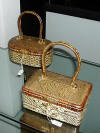
ya lipao (หญ้าลิเพา, หญ้าลิเภา)
Thai. A kind of fern-like creeping plant that exists in black and brown, and
whose stalk is used in wickerwork. This climber thrives mainly in the deep jungles
of South Thailand. The fully grown stem, roughly one meter, above the root is
ideal for plaiting baskets. The
stems that are gathered from the jungle are peeled, removing the outer part from
the pith, and are subsequently dried in the shade. The dried strips are
then polished and made smooth, before plaiting. Popular are the
fine handbags made of ya lipao (fig.).
Also
called
ya yaay lipao
and yan lipao (ย่านลิเภา), and also transcribed yah liphao.
回
ya
lipao plaiting
Wickerwork
made from the processed stalks of the
ya lipao creeping plant.
回
Yama
(यम)
Sanskrit-Pali. Vedic god of death.
READ ON.
回
Yamantaka (यमान्तक)
Sanskrit. ‘Terminator of death’. Name of the
bodhisattva
Manjushri (fig.)
in a ferocious form, which he adapted to conquer
Yama,
the vedic god of death, when the latter in a fury threatened to
wipe out the entire population of Tibet. To tame Yama, Manjushri
adopted the same form as Yama, whom in India and Tibet, is usually depicted with a
bull's head, adding to it extra faces and legs, as well as multiple
arms, in which he holds an array of fearful and deadly weapons. To
confront death, he thus manifested the form of death itself, but in
a magnified appearance. Hence, in art and
iconography, both Yama
and Yamantaka may be represented with bull’s heads, and often Yama
can only be distinguished by a
dhammachakka that he wears
as an ornament on his breast, a symbol of the Buddhist teaching and
his idiosyncratic mark (fig.).
回
_small.jpg)
Yamfly
Common designation for
a species of small swallow-tailed butterfly, with the scientific names
Loxura atymnus.
Above, the
wings are
bright tawny
with blackish marginal bands, that are darker and wider on the
forewings and more diffuse and narrower on the
hindwings,
whilst those are somewhat broader in the females, whose upperside is
also a little paler. The hindwings end in short
swallow-tail
appendixes of which the tip is white. The
underside of the wings is pale tawny
with diffuse dark markings.
The head and body is brownish-grey, while the antennae are
blackish-grey with an orange tip. Also referred to as Common Yamfly
and in Thai known as
phi seua
saed hahng yahw (ผีเสื้อแสดหางยาว).
See also TRAVEL PICTURES.
回
%201_small.jpg)
Yam Hawk-moth
Common designation for
a moth in the Sphingidae family, with the scientific names Theretra
nessus, Sphinx nessus, Sphinx equestris, and Chaerocampa nessus. It
is found across South, East and Southeast Asia, down to northern
Australia. Its pattern is somewhat reminiscent of that of the
Brown-banded Hunter Hawk-moth
(fig.),
but the colouration is green and buff rather
than brown. The Yam Hawk-moth has a wingspan of between 9 to 13
centimeters. In Thai, it is known as
mot yihaw
bon
yak
(มอธเหยี่ยวบอนยักษ์),
i.e.
‘Giant Caladium Hawk-moth’.
See also WILDLIFE PICTURES (1)
and
(2), as well as
TRAVEL PICTURE.
回
_small.jpg)
yam krapo pla (ยำกระเพาะปลา)
Thai. A salad (yam) made of
krapo pla.
回
yam naem (ยำแหนม)
Thai. A spicy salad made of a mixture of slightly fermented pork
called
naem (fig.)
which is crushed, boiled pork skin which is sliced, and some spices
including finely crunched garlic, chopped
chilies, sliced
ginger,
cut onion or spring onion, dried chilies, peanuts and some
lime.
It is usually mixed with a pulverized fried
rice
ball called
khao kon thod (fig.)
and if so, it is also known as yam naem khao tod (ยำแหนมข้าวทอด) or yam
naem
kluk khao
thod.
回
%202_small.jpg)
yam pla
duk foo (ยำปลาดุกฟู)
Thai. A salad consisting of deep-fried catfish that is fried until
it becomes fluffy, sliced mango, coriander leaves, roasted peanuts,
some lemon juice, fish sauce, sugar, sliced red onions and chilies.
回
%20fluffy%20fish%20salad%20with%20peanuts_small.jpg)
Yamuna (यमुना)
1.
Sanskrit. ‘Twin’. Name of a river in northern India.
回
2.
Sanskrit. ‘Twin’. Name of the Hindu goddess, who is a
daughter of
Surya, the sun god, and
the twin
sister of
Yama.
READ ON.
回
yan
(ยันต์)
Thai. Magic sign that is supposed to bring good fortune and
is applied at inauguration ceremonies by Buddhist monks on certain possessions,
such as cars, buildings, warehouses, etc. Compare with
yantra.
回
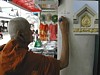
yan (砚)
Chinese. ‘Inkstone’. Name of a flat stone mortar (fig.) used for grinding
ink sticks (fig.)
and often also for holding the obtained ink. Traditional Chinese ink is
solidified into sticks for easier transport and preservation. By
applying some water to the end of the stick or dropping it on the
mortar itself and then rubbing the stick hard on the flat
surface of the inkstone, it can be liquefied. With some inkstones both
the water and the
obtained ink can be stored in a cavity on the inkstone itself (fig.).
It is part of the
wen fang si bao (fig.).
回
_small.jpg)
Yan Aung Myin-Htu Par Yone
(ရန်အောင်မြင်-ထူပါရုံ)
Burmese.
Name of a
Buddhist
pagoda
in
Pindaya. This temple has a
large collection of
stupas, which
can be seen in their
totality
from the entrance of the elevated
Pindaya Caves. Besides this, the temple
has some semi-open halls with
Buddha images in
different poses.
See MAP,
as well as
TRAVEL PICTURES (1) and
(2).
回
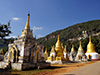
Yan Aung Myin Phaya (ရန်အောင်မြင်ဘုရား)
Burmese.
Name of a
Buddhist
pagoda
in
Kyaukse, near
Mandalay, located adjacent to the northeastern end of the runway of
Mandalay International Airport, often making it
possibly one of the first
Burmese Buddhist pagodas seen
from a closer distance by newly arriving international travelers
landing here. The pagoda has a three-tiered base with terraces in a
maroon colour, whereas the gilded
stupa
consists of a rather flat dome topped with a
hti,
the shape somewhat reminiscent of
Phra Malah Biang-style
royal hats (fig.)
that in the past were worn by both Burmese and Siamese kings
and generals in battle.
See MAP.
回
Yan Di (炎帝)
Chinese.
‘Flame Emperor’.
Shen Nong's
name or title as emperor. Also spelled Yandi.
回
yang
(阳)
Chinese.
‘Sunny place’. Term for the masculine, active principle of the universe.
In
iconography,
is represented by the colour red or white, and in architecture by
odd numbers, as in the multiple roofs or stories
of a
pagoda. In the Chinese creation
myth,
Pan Gu,
the
first living being and creator of all,
slept in a black egg until he was born and started creation, using a
chisel and hammer to separate the top and bottom part of the
egg. The egg white, which was clear and light, drifted up and became
heaven (yang), whilst the murky yolk, which was
turbid
and heavy, descended to become
earth (yin). See also
Egg of Brahma,
hiranyagarbha,
fang kong qian
and
yin-yang.
回
yang mei (杨梅)
Chinese
name for the red bayberry,
a kind of subtropical,
dark purplish-red, spherical stone-fruit, with a knobby surface,
native to eastern Asia, especially
China.
Its taste
is very tart with sweet undertones, yet the berries have antioxidant
properties and are said to be packed with vitamins and other
nutrients. Despite its English name, it is not a true berry, since
it has a single, rather large seed at its centre. The berries grow
from a 10 to 20 meter tall tree, which has a smooth grey bark and a
uniform spherical to hemispherical crown, which is often used as an
ornamental tree in parks and Oriental gardens.
Its
botanical name is Myrica rubra and it is also commonly known as
yumberry, Chinese waxberry, Japanese or Chinese bayberry, and is
occasionally referred to as Chinese strawberry.
回
,%20China%201_small.jpg)
ya ngon ngeuak (หญ้าหงอนเงือก)
Thai. A flowering plant, with
the botanical name Murdannia gigantea, that grows at altitudes up to
around 1,500 metres, and
bears
violet flowers with
3 distinctive petals, that grow at the top of the stem (fig.).
It has bracts that grow in clusters underneath the flower and
resemble the crest (ngon) of hornbills, which in Thai is called
nok ngeuak,
hence the plant's name. It is typically found at Phu
Kradeung
National Park in
Loei,
especially in October, as well as in Phu Soi Dahw (ภูสอยดาว)
National Park
in
Phitsanulok,
which reportedly has the largest field of this kind of flower in
Thailand.
回
ya nguong chang (หญ้างวงช้าง)
Thai.
‘Elephant-trunk
weed’.
Name for the
Indian Heliotrope (fig.), a plant with the
botanical name Heliotropium indicum. The name derives from the shape
of its coiling inflorescence of small flower clusters, which is
reminiscent of the trunk of an
elephant.
It belongs to the Boraginaceae family and is a food plant for the
Heliotrope Moth (fig.).
回
%20ya%20nguong%20chang%20(หญ้างวงช้าง)_small.jpg)
Yan Mo (阎魔)
Chinese.
‘Yama
devil’ or ‘devil at the village gate’. Name for
Yama,
the king of hell. In Chinese tradition, he is in
iconography
usually portrayed with a reddish-brown complexion, and a wild or pointed
black beard. His face has a furious expression and he wears a hat with
the Chinese character
wang,
meaning ‘king’ or ‘ruler’
and referring to his position as the king of hell (fig.).
Though there are many other different portrayals of him too. He is also known
by a variety of other names, including
Yan Wang,
i.e. ‘King Yama’ or ‘Yommaraat’;
Yan Luo (阎罗), with the word luo meaning ‘to catch’, ‘to collect’ or
‘to sieve’; Yan Jun (阎君), i.e. ‘Lord Yama’; etc.
His
consort is called Yan Mi (fig.),
which is the Chinese name for
Yamuna.
See also
Diyu
and
Ksitigarbha.
回

Yannasangwon (ญาณสังวร)
Thai-Pali.
‘Mindful Vision’ or ‘Careful Perception’. Name of the
Supreme Patriarch
of
Thailand
(fig.),
the 19th since the beginning of the
Rattanakosin
Period, and in
office since 1989. This Buddhist monk was born on 3 October 1913
in
Kanchanaburi Province, with the name
given at birth being Charoen Khotchawat (เจริญ คชวัตร).
Though born a 4 AM, in the modern calendar, his date of birth would
be
October 4th.
He ordained as a
samanaen,
i.e. a
Buddhist novice, at the age of 14 and eventually became a monk in
1933. After completing his basic studies, he continued to study
Pali,
the language
derived from Vedic
Sanskrit
and used in the sacred texts of
Theravada
or
Hinayana
Buddhism, in which he accomplished
the highest
levels of study then available. Following his ordination, Phra
Yannasangwon rose through the ranks of the Thai
Sangha
and in 1956, at the age of 43, he was appointed guardian and
religious advisor to King
Bhumiphon.
In
1961, he became abbot of
Wat Bowonniwet Wihaan Racha,
the temple in which many Thai princes
have
ordained.
In 1972, he was given the title
Somdet
Phra
and in 1989 he was appointed Supreme Patriarch. In 2012, Thailand
Post issued a postage stamp with the Supreme Patriarch's portrait to
herald his upcoming 100th birthday in 2013 (fig.),
while on the day itself, i.e. 3 October 2013, a set of four postage stamps illustrating Yannasangwon's life
was released. On 24 October 2013, just 3 weeks after his centenary, Phra
Yannasangwon passed away at the Chulalongkorn Hospital in
Bangkok,
where for the latter years of his life the aging Patriarch was cared
for since his health deteriorated in 2005. He was the longest serving Supreme Patriarch
up-to-date. Perhaps due to the Thai
initial letter ญ in the Thai form of his
name, which in the Latin Alphabet represents both an N (at the end
of a word or syllable) and a Y (at the beginning of a word or
syllable), his name is in English often transliterated Nyanasamvara,
yet it is in Thai pronounced Yahnnasangwon. See also
Phrasangkaraat.
回
yan shou (檐兽)
Chinese.
‘Eaves quadrupeds’. A name for
Chinese Imperial roof decoration.
回
yantra
(यन्त्र)
Sanskrit. Geometric and magical diagram, usually square in form and
used in meditations, especially in
Vajrayana Buddhism and its mystical form
Tantrism. A
mandala is a
kind of yantra.
回
Yan Wang (阎王)
Chinese. ‘King of the Village Gate’,
‘King Yama’
or ‘Yommaraat’. Name for
the ruler of the underworld in Chinese mythology, and a translation
of the Sanskrit term
Yama
Raja.
He is also known as
Yan Mo
(fig.) and as Yan Luo (阎罗), with the word luo meaning
‘to gather’,
‘to catch’, ‘to collect’ and ‘to sieve’. See also
Diyu
and
Ksitigarbha.
回

yan wo (燕窝)
Chinese name for
swallow's nest.
回
Yao
(เย้า)
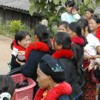
1. A hill tribe
found in
southern
China
(fig.)
and in northern Thailand, especially in the province of
Chiang Rai,
as well as in parts of Laos and
Vietnam,
where they are known as
Dao. In Thailand,
they call themselves
(Iu)
Mien,
but by the Chinese and the Thais they are named after the language
they speak, i.e. Yao.
In Thailand, the female traditional
attire is a loose pair of trousers and a dark blue almost black jacket embroidered at
the bottom with a dark red pompom collar resembling a stole
(fig.). Their headdress consists of a dark
coloured angular hat, ornamented with embroidery. They often wear a heavy silver ring around
their neck. Elderly people often develop a characteristic physiognomy (fig.).
MORE ON THIS.
回
2.
Language belonging to the
Miao-Yao-Pateng
family, a subgroup of the Sino-Tibetan language group that also includes
Chinese, Burmese and Tibetan.
MORE ON THIS.
回
Yaowaraht (เยาวราช)
Thai. ‘Young monarch’ or
‘youthful king’. A title for the Crown Prince, as
in
Thong Yaowaraht,
the Royal Standard of the Crown Prince
(fig.).
A busy road in
Bangkok's
Chinatown district is named
after it
and hence in Thai most people refer to Chinatown as Yaowaraht.
Also transcribed Yaowarat and Yaoraht.
回
Yaoshi Fo
(藥師佛)
Chinese.
‘Apothecary
buddha’.
Chinese name for
the Medicine
Buddha, who is known in Sanskrit as
Bhaisajyaguru. In Chinese
iconography, he
may hold a lapis-coloured jar of medicine nectar
or a pagoda, of which the latter is said to symbolize the ten
thousand
bodhisattvas
of the
Three Ages of Buddhism, and he is
oftentimes accompanied by his two attendants, i.e. Suryaprabha (सूर्यप्रभा)
and Chandraprabha (चन्द्रप्रभा),
two
bodhisattvas whose names mean
‘bright as
the sun’
or
‘sunlight’, and
‘moonlight’,
respectively,
and thus
symbolize the sun (Surya)
and moon (Chandra).
Yaoshi Fo has a blue complexion and is often depicted with blue hair,
representing a peaceful manifestation. See
also
Fo.
回

ya phraek (หญ้าแพรก)
Thai name for devil's grass, a
species of grass, with greyish-green blades and slightly flattened
stems that are often tinged purplish, and with the botanical name
Cynodon dactylon. In Buddhism,
Siddhartha
dreamed that this grass was growing from his navel and was growing
so fast that it soon reached the sky. From this dream he knew that
the day had come when, having attained
Enlightenment,
he would become a
buddha.
Hence, Cynodon
dactylon
grass is sometimes used in certain
Buddhist rites, e.g. as an ingredient in
nahm mon.
回
Yashoda
(यशोदा)
The
foster mother of
Krishna,
one of
Vishnu's
avatars. A popular theme
in Indian art is the representation of Yashoda with the infant Krishna.
回
Yashodhara
(यशोधर)
The wife of prince
Siddhartha
and a sister of
Devadatta. Also known as
Gopa
and
Bimba.
In Thai known as
Yasothon.
回
Yasothon (ยโสธร)
Name of a province (map)
and its capital city in Northeast Thailand, 531
kms from
Bangkok.
READ ON.
回
Yasovarman (យសោវរ្ម័ន)
Khmer.
‘Glory
Shield’.
Angkorian king who
reigned from 889 to 910 AD. He was one of two sons of
Indravarman.
He had leprosy and is therefore also referred to as the Leper
King, a name however not related to
the royal platform near
Angkor Thom
that is
nowadays called
Terrace of the Leper King
(fig.),
but which gets
its name from
a 15th-century sculpture discovered at
the site that depicts
Yama,
the Hindu god of death, which
due to its imperfection is reminiscent of someone with
leprosy and was for this reason nicknamed the Leper King. Yasovarman
moved the capital from Hariharalaya,
located near modern-day Siem Reap and named for the
Hindu deity
Harihara
(fig.),
to nearby Yashodharapura, where it remained for 600 years and became
also known as
Angkor. See
also
Yashodhara.
回
yasui qian (压岁钱)
Chinese. ‘To press years old coins’. Name for ancient Chinese
fang kong qian
coins
(fig.), tied together with a red
string for protection against sickness and death (fig.), a tradition that
dates back to the Qing Dynasty (AD 1644-1911) and which was
practiced by mostly elderly Chinese. Though originally arranged in a
linear fashion on a string that can easily be tied around the wrist,
they are today
more commonly found as hangers (fig.),
that may be arranged in a different way, with the coins stringed
into a more ornamental pattern (fig.). It can often be
seen in
iconography
as an
attribute
of
Chinese wealth gods
and other deities (fig.),
including the informal wealth god
Liu Hai
(fig.)
and his personal
pet,
the three-legged moon toad
Chanchu
(fig.),
as well as
in the mouth of
bats
(fig.),
which are
Chinese symbols
for
good fortune in their own right. See also
hong bao.
回

yattana (ရတနာ)
Burmese. Another pronunciation
for
rattana,
i.e. ‘gem’, ‘jewel’, or ‘treasure’,
and which derives from the Sanskrit word for semiprecious or
precious stones. It may appear in Buddhist names, especially of
temples, as in
Yattana Pontha
(fig.),
where it usually refers to either all or one of the
Rattanatrai,
i.e. the ‘Triple Gems’ or ‘Three
Jewels’,
that is to say the
Buddha, his teachings (dhamma)
and the
Sangha.
Sometimes transliterated yadanar.
回
Yattana Pontha (ရတနာဘုံသာ)
Burmese. ‘Pile of Gems’. Name of
a deserted Buddhist temple in
Ava,
i.e.
present-day
Inwa,
which may also be
transliterated Yadanar Pontha or
Rattana
Bontha. It is also
known by the name
Thisa Taik Phaya, which can be
translated as ‘Pagoda
of the Oath’,
‘Temple of the Loyal Fight’ or ‘Temple of the Faithful Struggle’,
yet in English this temple is usually referred to as the
White Temple, while the name Thisa
Taik
Phaya
is sometimes wrongly recorded as Desada Taya.
This overall white temple complex consists of a
main building
in the
jaturamuk
style, which is
surrounded by a number of
chinthe
and houses a
Buddha image;
a somewhat larger
zedi-style
pagoda,
also guarded by mythological
lions;
as well as scattered
groups of smaller
stupas
and other
structures. The name of this temple is also associated with
Rattana Pura, i.e. ‘City of Gems’, the official name of Inwa. See also
Wat Rong Khun
and
TRAVEL PHOTOS (1)
and
(2),
and
MAP.
回
,%20Inwa,%20Myanmar%201_small.jpg)
Yattana Pura (ရတနာပူရ)
Burmese. ‘City of Gems’. The
official name of
Inwa and
also pronounced
Rattana Pura.
回
Yattana Shihmih (ရတနာဆီမီ)
Burmese. ‘Oil Lamp Jewel’ or
‘Candlelight Treasure’. Name of
a deserted Buddhist temple complex in
Ava,
i.e.
present-day
Inwa. It
is an early brick monastery, said to date from the 17th century AD.
It consists of
several edifices, such as the ruins of a prayer hall, several
stupas
and
pagodas,
some
Buddha images,
including also a
Buddha image seated in the
bhumisparsa
pose and flanked
by images of his disciples
Sariputta
and
Mogallana, which
after the collapse of the hall it was located in, now stands
outdoors. Also
transliterated Yadana Hsemee and
Rattana
Seemih.
See also TRAVEL PHOTOS (1)
and
(2),
and
MAP.
回
Yawi (ยาวี)
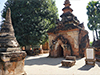
Name of a language in the Austronesian language family that is considered a Malay dialect and which is spoken next to Thai in the five southernmost provinces of Thailand,
i.e.
Pattani,
Narathiwat,
Yala,
Songkhla and
Satun.
It has three distinguished variants, being the Malay dialect of Pattani, that of Tak Bai and that of the region of Sungai Kolok. Written Yawi derives from Arabic but has fewer
letters. The word Yawi is derived from the word Yawa, meaning Java,
because this adapted form of the Arab language was first spread by
Javanese emigrants to Malacca and Pattani. It is estimated that
there are in total around three million Yawi speakers, one million
of them living in Thailand. In mid-July 2008 the first ever Thai-Yawi-Thai
dictionary was published by the Institute of Southeast Asian
Maritime States Studies under the
Prince of Songkhla University, Pattani campus, with support of the Asia Foundation. This 596 pages
dictionary has approximately 12,000 words with Thai meaning and uses
the Thai alphabet for phonetic spellings. Also called or transcribed Jawi.
回
ya yaay pao (หญ้ายายเพา,
หญ้ายายเภา)
See
ya lipao.
回
Yaza Kumar (ရာဇကုမာရ်)
Burmese. Name of an
11-12th Century AD Prince of
Bagan,
i.e.
the son of
King
Kyansittha
(fig.),
who
is best known for the 1112-1113 AD Yaza Kumar Stone Inscription.
READ ON.
回
yee (หยี)
Thai name for
velvet tamarind. Also transcribed
yih.
回
Yellow-banded Krait
See
Banded Krait.
回
Yellow-banded Skimmer
Common name for a species of dragonfly, with the
scientific name Pseudothemis jorina. Adult males are black with a white band
and a white face. However, young males and teneral females have a
brownish-black body with a yellow band, whilst their eyes are rather
brownish. The wings of both sexes are transparent.
回
_small.jpg)
Yellow-banded Trevally
Common name for a species of small
inshore fish in the family Carangidae.
READ ON.
回
Yellow-billed Grosbeak
Common name for a species of passerine bird in the
Fringillidae family of True Finches. It has the scientific name Eophona
migratoria and is also commonly known as Chinese Grosbeak. It is found in
parts of Southeast Asia, including Laos, Myanmar,
Vietnam and Thailand, and
in East Asia, that is to say in China, Taiwan and Hong Kong, and as far
North as Russia and the Korean peninsula, as well as in Japan. Its body
plumage is mainly greyish-buff, with a darker buff spot around the lower
sides, near the vent. The face is black with a large bright yellow bill. The
wings are brownish with black primaries that have indistinct white markings,
while the upper tail is also black. In Thai, it is known as
nok kratid yai pahk leuang.
回
%201_small.jpg)
Yellow Asoka
See
Asohk Leuang.
回
Yellow Bush Dart
Common name for a species of damselfly
with the scientific Latin designation Copera marginipes. Males are blackish
with yellow stripes, bright yellow legs, and end segments that are white.
Due to its yellow legs, this species is also commonly referred to as Yellow
Featherlegs.
回
_small.jpg "Common Orange")
Yellow-cheeked
Tit
Common name for a species of passerine bird in the Paridae
family, with the scientific name Parus spilonotus. It is found in South
Asia (Nepal, Bhutan, India and Bangladesh), mainland Southeast Asia
(Myanmar, Thailand and Indochina) and eastern Asia (China and Hong
Kong). Males have a bright yellow upper body, olive-yellowish lower
body, a bright yellow head, with a large black crest and a bright
yellow nape that runs upwards along the edge of the crest, a black
bib that extends all the way down across the belly to the vent, and
a black posterior eye-stripe. Its upperparts are greyish-black, with
olive-yellowish scales that are replaced by pale greyish scales when
descending from above, and white scaly spots on the other parts of
the wings. The bill is black and the legs and feet are
yellowish-grey. Females are plainer
above, have a olive-yellow bib and a olive-yellow ventral stripe.
Its natural habitats are subtropical and tropical moist lowland
forests, as well as subtropical and tropical moist montane forests.
In 1980, this bird was depicted on the second stamp of a set of four
Thai postage stamps featuring Thai birds (fig.).
In Thai, this bird is
called
nok tit kaem leuang, a literal translation of
the common name in English. See also
Black-lored Tit (fig.).
回
%201_small.jpg)
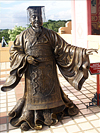
Yellow Emperor
One of the legendary Five Emperors of ancient
China,
the others being his grandson Zhuan Xu (颛顼); his great-grandson Di
Ku (帝喾); Tang Yao (唐尧), the second son of Di Ku; and Di Shun (帝舜), a
talented minister, who Tang Yao appointed as his successor. In
Chinese, the Yellow Emperor is called
Huang Di, while his personal name
was Gongsun Xuanyuan (公孙轩辕). According to tradition, he lived for a hundred years, from 2697 BC
to 2597 BC, and attained immortality after his physical death,
making him a chief deity of
Taoism.
In legend, his wife
Leizu
is said to have discovered
silk at the age of fourteen, when a silkworm's cocoon fell into her
tea
cup, and his historian is accredited for creating the first Chinese
characters. He is usually portrayed wearing a flat-topped
imperial headdress with beads hanging from the front and back (fig.).
回
Yellow Featherlegs
Another name for the
Yellow Bush Dart.
回
Yellow Flamboyant
Name for a large tree in the
family Leguminosae, with the botanical designation Peltophorum
pterocarpum and commonly known in English as Copperpod, Golden
Flamboyant, Yellow Flamboyant, and Yellow Flame Tree. This deciduous
tree has bipinnate leaves and bears yellow flowers that grow in
upright branched clusters at the end of its twigs. It has reddish
fruit pods that turn brown as they ripen, contain one to four seeds,
and taper at both ends. In Thai, it is known as
nonsih.
回
%201_small.jpg)
Yellow-headed Temple Turtle
Common
name of a large, semi-aquatic
turtle,
that grows to over half a meter in size. It has the scientific name
Hieremys annandalii and is primarily native to Thailand and
Cambodia, but is also found in the lowlands of the
Mekhong
delta in
Vietnam. Its common name derives from the custom of releasing these
turtles in the ponds of Buddhist temples, in Thailand often as a
form
tamboon.
In Thai it
has several names, i.e.
tao bung hua leuang,
tao wat
and
tao bua, meaning
‘yellow
head turtle’,
‘temple
turtle’
and
‘lotus
turtle’
respectively,
with the latter referring to the
Hindu
and
Buddhist holy flower, that also often occurs in temple ponds. In the
wild Yellow-headed Temple Turtles live in swamps, flooded fields and
slow-moving rivers. In some place, such as at the mouth of the
Chao Phraya
river in
Bangkok,
it appears that this species can put up with brackish water
conditions. Juveniles have broad,
nearly round carapace with one, rather low keel that disappears with
age. Adults have a dark-brown to black, rather low and elongated
carapace, usually with a serrated posterior margin. The colour of
the carapace has a greenish yellow tinge which over time may stand
out more clearly. Their forelegs are covered with large scales, and
the limbs are usually darker gray on the upper surfaces and lighter
gray below. The tail is short and also gray. The head is blackish to
olive with dense yellow speckling, and in younger individuals it is
adorned with a series of yellow coloured stripes. Its snout is not
overly protruding, with an upper jaw that has a median V-shaped
indentation with a tooth-like cusp on each side and a lower jaw
which is denticulated, i.e. covered with small pointed projections,
along its margin. This
gentle species is generally herbivorous, feeding mainly on aquatic
plants, but in captivity also on fruit and vegetables. It is listed
as an endangered species and is protected under Thai law. See also
Orange-headed Temple Terrapin.
回
%20_small.jpg)
Yellow Lady's Slipper
See
Paphiopedilum concolor
(fig.)
and
Paphiopedilum exul
(fig.).
回
Yellow Oleander
See
ram pheuy.
回
Yellow Orange Tip
Common
name for a species of butterfly in the family Pieridae and with
the scientific designation Ixias pyrene.
The
underside of the wings is
yellow
and thinly marked with a diffuse brownish wash and tiny spots,
reminiscent to those of certain other species of this family, such
as
Mottled Emigrants (fig.)
and
Anderson's
Grass Yellows (fig.).
The
forewings are
rounded and blunt, and in males, the upperside
is
sulphur-yellow, with a large,
irregular, orange patch, that is bordered by a black edge, which is
broad on the top, back and bottom, but not on the front, where it is
rather thin to almost non-existent. Every
now and then, the
upperside of the wings in males is
white,
rather than
sulphur-yellow, and may then
have
a faint
yellow
wash or diffuse yellow colouring, usually towards the bottom black border of the orange
spot.
In this form, it
is similar in appearance
to the
Great Orange Tip
(fig.).
At the base of the orange spot, there is
a black spot that spreads diffusely inwards and usually joins the
black bottom border. Above, the forewings of females are black with white
spots and a greyish wash, whilst the
hindwings have a black outer border and a faint
greyish and
sulphur-yellowish
wash. In Thai, this butterfly is known as
phi seua
plaay pihk som lek (ผีเสื้อปลายปีกส้มเล็ก).
See also WILDLIFE PICTURES.
回
_small.jpg)
Yellow Pansy
Common
name for a species of butterfly in the family Nymphalidae and with
the scientific designation Junonia hierta.
It has a wingspan of between 5 and 6 centimeters, and –despite its
name–
has mostly orange wings, with black margins and some blue patches
near the base of the hind wings (fig.), as well as a greyish patch near the
apex of the forewings. Females are similar above, but in addition
also have round, ocelli-like,
black-edged blue spots, i.e.
two
on each of the forewings and
two on each of the hindwings, though one of those on the forewings
is rather obscure
(fig.).
The underside of the wings is
pale greyish with tawny and black markings, and a series of small
eyespots. The female
underside is also similar, but generally has heavier and more
clearly defined markings.
In Thai, it is known as
phi seua
paensy leuang (ผีเสื้อแพนซีเหลือง).
回
%20Cambodia%201_small.jpg)
Yellow Paper Wasp
Common
name for a large yellow wasp, with the scientific designation
Polistes olivaceus, and also commonly known as Yellow Oriental Paper
Wasp and Common Yellow Wasp of India. It belongs to the subfamily
Polistinae and is commonly found in northern India, where it is
colloquially known as Sindhi Wasp and its venomous Hymenoptera sting is
purportedly responsible for a number of deaths each year. In Thai,
it is called
taen
rang
kradaat leuang (แตนรังกระดาษเหลือง), i.e.
‘yellow paper nest wasp’.
In
China,
this wasp is recorded as a natural enemy of wild
silkworms.
See also
Asian Giant Hornet and
WILDLIFE PICTURES.
回
Yellow-spotted Keelback
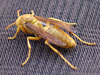
Common name for a species of
snake,
with the scientific designation Xenochrophis flavipunctatus.
READ ON.
回
Yellow-Striped Flutterer
Common name for a species of
dragonfly,
with the scientific designation Rhyothemis phyllis. It has a
greyish-black body and legs, and reddish-brown compound eyes. Its
wings are mostly transparent, with tawny veins, apart from some
black patches at the tip and in the middle of the front of the four
wings, whilst at the base, the hindwings have large black patches
with a orangey-yellow stripe in the centre. In Thai, it is called
malaeng poh ban pihk leuang dam,
i.e. ‘yellow-black-winged dragonfly’.
回
Yellowtail Clownfish
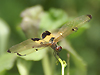
Common name for a species of
anemone fish, with the scientific designation Amphiprion clarki. This
colourful fish has a black body, with three white bands at its head,
trunk and tail, an yellow or orange vent and face, and yellowish-orange pectoral
and caudal fins. It is the largest of the anemone fish found in
Thailand, and occurs both in the
Gulf of Thailand
and in the Andaman Sea. Like all other anemone fish, it is unable to
survive without sea anemones.
It is depicted on the first of four Thai postage stamps issued in 2006
to publicize the anemone fish of Thailand (fig.).
Sometimes spelled Yellowtail Clown Fish, and also known as Clark's Anemone
Fish or Clark's Anemonefish. In Thai, this species is called pla cartoon laai plong (ปลาการ์ตูนลายปล้อง),
i.e. ‘segment-striped cartoon fish’, or pla cartoon laai plong nah thong
(ปลาการ์ตูนลายปล้องหน้าทอง), i.e. ‘golden-faced segment-striped
cartoon fish’.
回
_small.jpg)
Yellow-throated Marten
Common name for a ferret-like mammal of the
weasel family, with the scientific designation Martes flavigula.
Though variable, it generally has a dark brown head, tail, hind legs
and lower front legs, a creamy back, upper front legs and
underparts, and a yellow throat (fig.). This medium-sized carnivore is
found in South, East and Southeast Asia, in subtropical and tropical
forests. The Yellow-throated Marten is an excellent climber and
spends most of its time in trees and in Thai it is accordingly named
mah mai, which literally translates
as ‘wood dog’ or ‘tree dog’. In Thailand, the Yellow-throated Marten
can be observed in Pahng Sida National Park,
which comprises an area of about 844
km², stretching over
Prachinburi
and
Sa Kaeo Provinces. Except for females with a litter,
Yellow-throated Martens are generally solitary, and are listed as an
endangered species.
回
%20A_small.jpg)
Yellow Tortoise
See
Elongated Tortoise.
回
Yellow-vented
Bulbul
Common name of a bird, with the
scientific name Pycnonotus goiavier. It has greyish-brown upperparts
with a darker brown tail and whitish underparts, with a yellow vent
(fig.).
Its head and throat are mostly whitish, with a blackish-brown stripe
on the centre of the crown, and black lores (fig.). It is a common
resident, that can be found in cultivated areas, scrub, palm groves
and secondary growth, mostly near well watered sites or coastal
areas. In Thai, it is known as nok parod nah
nuan (นกปรอดหน้านวล), i.e.
‘cream-faced bulbul’
or
‘pale-faced bulbul’.
See
also
TRAVEL PICTURE, as well as
WILDLIFE PICTURES (1),
(2)
and
(3).
回
_small.jpg)
Yellow White-tail Fighting Cock
Name translated from Thai, for a special breed
of fighting cock, famous for its endurance in
kaanchon kai, i.e. cock
fighting. The
Yellow White-tail Fighting Cock originates from the North of
Thailand, where it is widely bred, especially in its native village
Ban Krang, in
Phitsanulok
province. It is believed that King
Naresuan used a
Yellow White-tail Fighting Cock, in a winning cock fighting game with the
uparacha of
Burma,
thus introducing this breed to Burma and making it also well-known
among Burmese cockfight aficionados, up to this day. Statues of the
Yellow White-tail Fighting Cock can be seen all over the nation, in
all sizes and especially at shrines dedicated to king Naresuan the
Great. Also called White-tailed Fighting Cock and Royal Fighting
Cock, and in Thai known as
Kai Chon Leuang Haang Khao,
Kai Chao Liang
and
Kai Chon
Phra Naresuan.
回
_small.jpg)
yeuang (เยือง)
See
Mainland Serow.
回
Yi (彝)
1. Ethnic group in
Thailand,
Vietnam, and
China, where with 8 million, they
are the 7th largest of the 56 ethnic minority groups officially
recognized by the People's Republic of China.
There are many subgroups, usually classified according their
geographical position and their spoken language, and differentiated
by their own specific clothes (fig.),
with the women of one group in Lijiang wearing a conspicuous
headdress that
consists of a black cloth dressed in a pentagon-like shape over a
frame above the head
(fig.).
Typically, the girls and women living in the area of Kunming, wear a
distinctive rounded hat, with triangular-shaped adornments on the
sides, and a black band lined with embroidery that runs across the
top. To indicate their marital status, unmarried girls put those
adornments upright on either side of the hat, whereas married women
place them flat, underneath the black band (fig.). The subgroup found
in Thailand is referred to as
Lolo.
See also TRAVEL PHOTOS.
回
%202_small.jpg)
2. Ethnic language spoken by the Yi
people and consisting of a mixture of Tibeto-Burman languages
closely related to Burmese.
There are several dialects, with Nuosu being its standard or
prestige language, spoken by circa two million people. See also
Lolo.
回
3. Generic name for a bronze sacrificial vessel
or wine vessel from ancient
China.
回
_small.jpg)
yiang
phah (เยียงผา)
See
Mainland Serow.
回
yih (หยี)
Thai name for
velvet tamarind. Also transcribed
yee.
回
yih-ao
khao (เหยี่ยวขาว)
Thai. ‘White hawk’. Name for the
Black-shouldered Kite.
回
yih-ao nok khao
ngon (เหยี่ยวนกเขาหงอน)
Thai name for the
Crested Goshawk.
回
yih-ao nok krajok yai (เหยี่ยวนกกระจอกใหญ่)
Thai name for the
Eurasian Sparrowhawk.
回
yike (ยี่เก)
A
Khmer form of song and dance drama, related to the Thai
likae. This traditional Khmer theatre
has deep connections to Cambodian culture and is performed in nearly
every province of
Cambodia, as well as by Khmer communities in
southern
Vietnam, who have two terms for it, i.e yike and yuke, the
latter referring to a form of dance theatre that is also known as
lakhon bassac. Its history and origin are disputed with some
believing that it originated in Persia and has the same roots as
likae, but others believe it to have originated in Java and brought
to Cambodia via the
Chams, whilst some think it might have
originated in Malaya. Regardless of where it originated it is deeply
influenced by Cambodia's own culture and over time it has become a
typical Cambodian form of folk theatre in its own right. It is
pronounced ji-ke.
回
yin (阴)
Chinese.
‘Shady place’. Term
for the feminine, passive principle of the universe. In
iconography,
it is represented by the colour black, and in architecture by even
numbers. In the Chinese creation myth,
Pan Gu,
the
first living being and creator of all,
slept in a black egg until he was born and started creation, using a
chisel and hammer to separate the top and bottom part of the
egg. The egg white, which was clear and light, drifted up and became
heaven (yang),
whilst the murky yolk, which was
turbid
and heavy, descended to become
earth (yin). See also
Egg of Brahma,
hiranyagarbha,
fang kong qian
and
yin-yang.
回
Ying Jiang (鹰将)
Chinese.
‘Eagle
General’
or ‘Military Commander
[with an] Eagle’.
Name one of the four guardians at the gate of
Tian Zi Dian (天子殿), i.e. the
‘Palace
of the Son of Heaven’,
usually referred to in English as the
‘Emperor's
Hall’
in
Diyu, the Taoist
Hell, the
other three guardians being
the
Snake
General
She Jiang
(fig.),
the Chicken Feet Ghost
Ji Jiao Gui
(fig.)
and the
White Impermanence
Bai Wu Chang (fig.).
This demon
has a black complexion, downward growing fangs, bulging eyes, and carries an
eagle on his arm.
At Fengdu Ghost City
(fig.),
the Eagle General is
displayed next to the
Snake General (fig.).
回
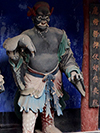
ying krataai (ยิงกระต่าย)
Thai. ‘To shoot
rabbits’
or ‘to shoot a
rabbit’.
Archaic idiom used only for men and boys, and meaning ‘to pee’ or
‘to take a leak’. For women and girls det dokmai (เด็ดดอกไม้), i.e.
‘to pick flowers’ or ‘to pluck a flower’, is —or was in the past—
the equivalent saying for girls ‘to pee’, i.e. ‘to [squat and] pee’.
In ordinary speech, and for both male and female, the terms puat
chih (ปวดฉี่) and yiyaw (เยี่ยว), as well as the more polite
patsahwa (ปัสสาวะ) are commonly used. Other terms, slang or idioms
used to indicate a visit to the toilet are: rong phleng phu khao (ร้องเพลงภูเขา),
i.e. ‘singing [to] the mountains’; pai thung (ไปทุ่ง), which
translates ‘going to the field’; pai thah (ไปท่า), meaning ‘going to
the wharf’; pai pah (ไปป่า), that is ‘going to the forest’; and pai
suam (ไปส้วม), which literally means ‘going to the toilet (bowl)’.
回
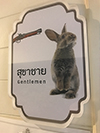
ying peun gahn gluay (ยิงปืนก้านกล้วย)
Thai.
‘To shoot a
banana
stalk gun’. Name of a
traditional Thai children's game from the past.
READ ON.
回
Ying Zheng (嬴政)
The
personal name of
Qin Shi Huang Ti,
the first emperor of
China
(fig.).
回
yin-yang
(阴阳)
Chinese.
Popular name for the representation of the principle of
Taijitu
(T'ai chi t'u) from
Taoist
and Neo-Confucian philosophy. It
represents the two polar energies that cause the
universe in
Taoism.
Yin is the feminine principle symbolized by the moon (月 -
due to its cycles), water, the colour
black, downward or falling movement, and the northern direction;
whereas yang, the masculine principle is symbolized by the sun (日), fire, the colour red
(often also white), upward movement, and the southern direction.
Besides being each others opposites, they also have equal
qualities that complement each other, are dynamic rather than
static, and
when at their peak,
naturally begin to transform into the opposite quality.
Yin
(阴) is a compound of 阝+ 月 and literally means ‘shady place’, while
yang
is a compound of 阝+ 日 and literally means ‘sunny
place’, hence the words yin and yang are frequently used in Chinese
place names, i.e. yin to refer to a place that is on the north
slope of a mountain, where the
shade is; and yang
to
refer to a place on the south slope of a mountain, where the sun
shines. As the sun moves across the sky, yin and yang gradually
trade places with each other, revealing what was obscured and
obscuring what was revealed. The concept is often represented as a circle divided into two curved halves, of which one is
white (or red) and the other black, each with a round dot in the opposite colour in its
widest point. Whereas yin represents the feminine, the passive,
the dark, the soft, the earth and even numbers; yang represents the masculine,
the active, the bright, the hard, heaven and odd numbers. In place names,
yin is also frequently used to refer to the north bank of a river,
as in Luoyang, a city located on the north bank of the Luo River,
and yang to refer to the south bank of a river. Unlike the western
adaptation of the concept, in the East yin-yang does not refer to good
and evil. See also
ananda-chakra
(fig.),
Pan Gu,
trigram and
fang kong qian (fig.).
回
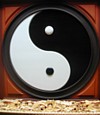
yin zhang (印章)
Chinese.
‘Seal’ or ‘signet’. Name for a handmade (fig.) seal or stamp with Chinese
characters. The imprint created by the
Chinese
seal can be used for different
purposes, e.g. for identification, especially on
Chinese calligraphy
works; as an
auspicious or
magical charm, in particular during special occasions,
etc. They are often carved from precious materials, such as
jade,
ivory,
sandalwood,
etc. They are generally square but sometimes also round in shape
(fig.), with the top of the
seal usually decorated with an auspicious sign or figure, for
instance with an animal from the
Chinese zodiac.
They are used with seal paste
(fig.),
a red substance made from finely pulverized
dragon's
blood palm, mixed with castor oil and either silk strands (as a binding
agent) or moxa punk (made from mugwort leaves). There are three
kinds of seals, each one named after the imprint they produce, i.e. zhuwen, literally
‘red characters’, refers to seals imprinting the
Chinese characters in red ink (fig.); baiwen, literally ‘white characters’, refers to seals imprinting the background in red, leaving the
characters uncoloured (in white
-
fig.); and zhubaiwen, a combination of
the two. Nowadays Chinese seals are available to anyone and
they are included in most
wen fang si bao (fig.),
but in the past they were mostly the property of the rich and
powerful (fig.).
回

Yi Peng (ยี่เป็ง)
Thai. Name used in
Chiang Mai
and more generally in the northern region of
Lan Na in order
to refer to the annual festival
of
Loi Krathong,
which coincides with
the second lunar month according to the
northern Thai calendar and with the twelfth lunar month of a regular
calendar year, which in Thai is likewise called Yi Peng. During this
festival, people decorate their houses and Buddhist temples with
banana plants,
sugarcane, and
coconut
fronds, while various paper lamps known as
kohm
fai Yi Peng are hoisted as offerings to the
Buddha. In addition, small
bowl lamps are lit as offerings to the
Triple Gem, and
kohm loy, i.e. paper
floating air-lanterns, are lit and released into the sky (fig.)
as offerings to
Chulamanie, i.e. a
stupa containing hair from the
Buddha in the
Tavatimsa
heaven. Also
transcribed Yee Peng and Yi-peng.
WATCH VIDEO (1)
and
(2).
回
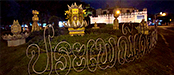
yi shan guan (翼善冠)
Chinese. ‘Winged-crown of
virtue’ or ‘benevolent finned-hat’.
Name of the cap-like crown worn by the emperors and princes of the
Ming Dynasty.
READ ON.
回
Ylang Ylang
Malay.
Popular name for the Cananga odorata, which in Thai is called
kradang nga songkhla. Its greenish
yellow flower has an extraordinary scent (fig.)
and is used in the perfume industry.
回

Ylang Ylang Vine
See
kradang nga ngaw.
回
yo baan (ยอบ้าน)
Thai name
for the Indian Mulberry or Beach Mulberry, a tree with the botanical
name Morinda citrifolia. It belongs to the family Rubiaceae, which
includes also the
coffee tree
(fig.).
The tree produces small white flowers and multiple fruits, i.e.
fruit formed from a cluster of flowers, with each flower producing a
fruit, which mature into a single mass. These fruits are 4 to 7
centimeters large, oval shaped and initially green, but turn yellow
and then almost white as they ripen, producing an pungent smell,
causing the fruit to be nicknamed cheese fruit. Despite their strong
odour and bitter taste, the fruits are edible and used in
traditional medicine. In Thai also commonly known as yo (ยอ), ma-tah
seua (มะตาเสือ), and yae yai (แยใหญ่).
回
%20ยอบ้าน%201_small.jpg)
yoga
(योग)
Sanskrit.
‘To unite’. A system of physical, mental and spiritual discipline whose ultimate
purpose is to unite with the universal spirit (fig.).
回
yogi
(योगि,
योगी)
Sanskrit-Hindi. One who practices
yoga. The female term is
yogini.
回
_small.jpg)
yogini
(योगिनी)
1. Sanskrit for ‘witch’, ‘female demon’, ‘sorceress’ or ‘fairy’.
In
Tantrism,
they are described as the attendants of the warrior goddess
Durga,
of whom
Chamunda,
the goddess of war and one of the seven
Matris,
is one of the most important. They are believed to number
64 or 81.
Compare with
Yokai.
回
2.
Hindi. Feminine form of a
yogi.
回
yok (หยก)
Thai for
jade.
回
Yokai (妖怪)
Japanese. ‘Ghost’, ‘phantom’ or
‘strange apparition’. A class of legendary supernatural creatures,
including monsters and certain demons, in Japanese folklore. Compare
with
yogini.
回
yok dok (ยกดอก)
Thai. ‘Raised pattern’. Name for a fabric woven from cotton or
silk,
with lifted designs. It is used to refer to various types of twill
weave, fabrics so woven as to have a surface of diagonal parallel
ridges. In Central and Southern Thailand this term is used for
defining silver or golden
brocade fabric, called
pah yok and which is technically woven in
knit or the continuous supplementary weft technique in which threads
are woven across a warp.
回
%20silk%20or%20cotton%20woven%20cloth%20with%20patterns%20of%20raised%20or%20lifted%20design_small.jpg)
yoksorn (ยกศร)
Thai.
‘Lifting of an arrow’. Term that refers to a scene in the life of the historical
Buddha at
the age of sixteen, when
Suddhodana wanted to choose him a wife from amongst the princesses of
the neighbouring kingdoms. However, the kings of these realms demanded that the
prince first prove himself in his mastery of the ‘twelve arts’, a number
of skills with the chief being
archery. When it turned out that he was very
skilled in this he was offered all the daughters and the prince chose princess
Bimba as his first wife. In art generally portrayed as prince
Siddhartha holding a bow over his head
(fig.).
Also known as
Narai song peun and
Narai plaeng son,
and also transcribed yok son.
回
%20prince%20Siddhartha%20holding%20a%20bow%20over%20his%20head_small.jpg)
yokthei pwe (ရုပ်သေးပွဲ)
Burmese. Puppet
theaters (fig.) in
Burma, with the main subject being the
Jataka stories. They enjoyed excellent standing in the performing arts tradition
(fig.) of
the 18th and 19th centuries AD, but that decreased in the thirties due to the
decline of subsidies
as given under British colonial rule, and with the introduction of film.
It influenced the later development of
zat pwe
(fig.), a live dance drama with dancers who make marionette-like movements
(fig.).
Also simply yokthei and sometimes transcribed jou' thei pwe.
回
_small.jpg)
Yom (ยม)
1. Thai name for
Yama, the Vedic god of death. The
judge of the dead and guardian of the South. His mount is a
buffalo.
回

2. Thai. Name of a river in northern Thailand that near
Nakhon Sawan merges with the rivers
Nan,
Wang
(fig.)
and
Ping
(fig.), thus forming the
Chao Phraya
River (fig.).
See MAP.
回
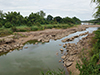
3. Thai name of the outermost known planet
of the solar system, Pluto which name derives from Plouton, the god of the Greek underworld.
回
Yommabaan (ยมบาล)
Thai. The beings who deal out punishment to the wicked in
the underworld of
narok (fig.).
See also
kratha thong daeng and
Diyu.
回
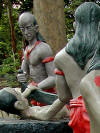
Yommalohk (ยมโลก)
Thai.
‘World of
Yom’. Another name for
narok, the world of the dead in Buddhism.
回
Yommaraat (ยมราช)
1. Thai. ‘Royal
Yama’.
Name of a
Chao Phraya,
i.e. a Thai
nobleman of the highest rank,
during the reigns of King Rama V and Rama VI. He was born on 15 July
1862 as Pan Sukhum (ปั้น สุขุม). He was Minister of Public Works,
and Commander of the
Krasuang Nakhonbahn,
a former government department responsible for maintaining
and managing the order and security in the capital
Bangkok
and its
surrounding area. As
Minister of Public Works, he was responsible for the construction of
roads and bridges in Bangkok, as well as the distribution of
electricity in the capital. He was also influential in the
construction of the Samsen Water Treatment Plant in Bangkok's Phaya
Thai District, the country's first and now a museum (fig.).
In the latter days of his life, he was for a short period appointed
as the regent of King
Ananda Mahidol.
In 1897, he established the
Mahavajiravudh School in Songkhla (fig.),
the province of which he also was a regional governor,
whilst he named the school after the then Crown Prince
Maha
Vajiravudh, i.e. the later King
Rama VI. He died on 30 December 1938, aged 76.
回
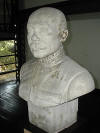
2.
Thai. ‘Royal
Yama’. In the
Ayutthaya,
Thonburi and early
Rattanakosin
Periods, a
rajatinanaam conferred by the King to
a senior official, often someone who already
held the
bandasak of
Phraya
or
Chao Phraya. It
is comparable to the position of a Minister of State, before the
revolution of 1932.
回
3. Thai. ‘King of [the realm of] Death’. A
name for
Yom,
also known as
Yama.
回
Yommathoot (ยมทูต)
Thai.
‘Envoy of
Yom’. The angel who leads the souls of
the
dead to judgment before
Phra Yom and his scribes
Suwan and
Suwaan. He is usually depicted with horns
and holding a trident or some other weapon.
WATCH VIDEO.
回
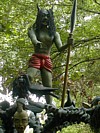
yo mum (ย่อมุม)
Thai. Literally
‘short corner’
or ‘recess’. The name for
a decorative pattern, akin to the Thai
kranok
(fig.), used
in temple and palace decoration of walls and pillars since the
Ayutthaya
period, when this
motif was introduced through the
trading of goods and exchange of cultures, and said to be a mixture
of Chinese and Indian styles. The term is also used for the floor
plan of a
redented chedi
(fig.).
Sometimes transliterated yor moom and also referred to as laay yo
mum (ลายย่อมุม), i.e. ‘recess pattern’.
回
yong (หย่อง)
1.
Thai for
betel nut tray.
回
2.
Thai for the bridge of a stringed musical instrument, usually a
small piece of wood, over which the strings are stretched.
回
yoni (โยนี - योनि)
Thai-Sanskrit. An object of veneration symbolic of female creative
energy, represented as the female genital organ in the form of a square platform
with a hollow top and an outlet at one end. In combination (fig.) with the
linga it represents creation.
Although controversial, some believe the yoni stands at the origin
of the shape of a heart (♥).
回
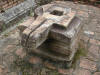
Yonok
(โยนก)
Thai. Name of an early legendary kingdom in present-day
Northern Thailand that probably existed several hundred years before ancient
Chiang Saen.
回
You Chao (有巢)
Chinese. Name of one of the
Si Shi,
a group of
semi-mythological rulers and culture heroes from the period
preceding the Xia Dynasty
in ancient
China.
In some texts he is described as the second of the Three
Sovereigns during the Three Sovereigns and the Five Emperors Period.
He is also accredited with being
the inventor of house and
building, a reputation that perhaps derives from his name, which can
be translated as
‘to possess a nest’. As one of the Four Shi,
he is known as You Chao-shi.
回
Young Postman
Mascot of the Thailand Post as
depicted in graphic design on definitive postage stamps issued since
2007.
He is depicted wearing a red motorcycle helmet with a white bar in
the middle and two dots at each side (fig.).
He is described as a graduate with a bachelor's degree (parinyah trih) and since he was young, he
has dreamt of becoming a postman, just like his grandfather, who
delivered mail until his retirement and who was once selected to be
the Best Postman. This brought pride to the family and hence, after
graduation, the young man followed his dream by applying for the
position of postman. Besides driving a motorcycle as his main
vehicle for mail delivery (fig.),
Young Postman on occasion walks (fig.)
or rides in a motor boat (fig.),
when he has to go to the areas along the canal or to an island where
roads do not reach. Since 2011, Young Postman also
delivers food,
a new service of
Thailand Post
(fig.)
known as Yummy Post (fig.).
Also referred to as Brother Postman and in Thai, is known as
Num Praisanih or Noom Praisanee (หนุ่มไปรษณีย์).
回
_small.jpg)
Yotfa (ยอดฟ้า)
Name of an important general in the
army of King
Taksin, who later
seized power from and the latter and became King
Phra Phutta Yotfa Chulalok.
回
yu (玉)
Chinese for
jade.
The character is related to
zhu (主), meaning ‘master’ and ‘lord’, as
well as to
wang (王
-
fig.),
which means ‘king’ and may also be pronounced yu. Wang however, is also a common
surname and legend has it that when an ancient king once met with a
commoner named Wang, he proposed a different spelling for his name.
To honour him, as well as to differ the surname from his own royal
title, he gave the name of the commoner an extra dot (丶),
in Chinese called zhu, with same sound and tone as zhu (主). Thus,
when the king later visited the man again, he noticed that the he
had placed the dot (丶)
on top of the character for wang (王), thus renaming himself zhu (主),
i.e. ‘master’ or ‘lord’, a title akin to that of the king and thus
missing its purpose. When the king asked the commoner why he had put
the dot, which is akin to the form of a dagger, above his head
rather than ‘hanging it on his belt’, meaning why he had put the dot
(丶) on top of
the character and not somewhere below the middle, as in the word for
jade (玉), the man, who didn't want to admit that he had
misunderstood the word zhu (丶)
for zhu (主), replied that he had done this out of respect for the
king, as it would have been regarded very impolite to have a gift
from a king put at a low place. It is namely common practice in
China, as it is in Thailand, to never positioned oneself higher than
a sovereign, who is the ‘head’ of state. Commoners are therefore
supposed to bow and make sure that they never position themselves
higher than the head of the king at any given time.
See also
CHINESE
CHARACTER FORMATION & ETYMOLOGY.
回
Yuan
(元)
1. Chinese. Name of a dynasty in
China,
that was founded by the Mongolian leader Kublai Khan, and existed
from 1271 to 1368 AD. The
Yuan Dynasty is also known as the
Mongol Dynasty.
See also
LIST OF CHINESE RULERS.
回
2. Chinese. Name of the Chinese
currency, named after the
Yuan Dynasty
(1271 - 1368 AD), during which
the first real paper money came widely into use, not taking into
account the preceding
Jiaozi, and
issued in an attempt to reduce the use of heavy copper coins called
fang kong qian
(fig.).
回
Yuan Shi Kai (袁世凯)
Chinese. Name of the second President of the Republic of
China,
following Sun Yat-sen (fig.).
The general was famous for his influence during the late Qing
Dynasty and for his role in the events leading up to the abdication
of Pu Yi (fig.),
i.e. the last Emperor of China. In 1915, he made a short-lived attempt to
revive the Chinese monarchy, by proclaiming himself as the new
Emperor. The revival led to widespread opposition and public
protests throughout China, denouncing Yuan. To appease his foes, he
initially tried to delay the accession rites, but finally abandoned
the attempt to revive the monarchy. His enemies, however, rebelled
and called for his resignation as president, but Yuan suddenly died
from kidney failure on 5 June 1916, aged 56. Also transcribed Yuan
Shikai.
See also
LIST OF CHINESE RULERS.
回

Yuan Shi Tian Zun (元始天尊)
Chinese. Name of one of the highest deities
of the
Chinese Taoist
pantheon,
who resides in the Heaven of Jade
Purity.
READ ON.
回
Yudhishthira (युधिष्ठिर)
Sanskrit.
‘Firm or steady in battle’.
Name of
the first of the
Pandavas,
i.e.
the eldest son of
Pandu.
His mother was
Kunti,
while his heavenly father was the god
Dharma, the god of virtue,
justice and morality, who is associated with or also known as
Yama,
the Vedic god of death. Yudhishthira was a
dhammaracha,
i.e. virtuous,
skilled in the duties of a king, and dedicated in the path of
Dharma, as well as good at playing chess.
Compare with the Thai term
yutthahadtie. 回
yue liang men (月亮门)
Chinese. ‘Luminous moon gate’. Architectural term for a circular
doorway, referred to in English as
Moon Gate (fig.).
回
yueqin (月琴)
Chinese. ‘Moon musical instrument’. Name for a round or (full)
moon-shaped lute, with a short neck and four strings. It is played
with a plectrum, and is typically used to accompany
Chinese opera.
回

yue ya chan (月牙铲)
Chinese. ‘Crescent
Moon Spade’. Chinese term
for a
Monk's
Spade.
回
yuga
(युग)
Sanskrit.
A time
period in Indian cosmology. There are a total of four yugas, i.e.
Krita or
Satya,
Treta,
Dvapara and
Kali,
in descending order of virtue. The present era is that of
Kali Yuga. In Thai
yuk.
回
yugu (鱼鼓)
Chinese. ‘Fish drum’. Name of a traditional Chinese percussion instrument,
used especially by
Taoist
priests. It consists
of a long cylinder, usually of
bamboo,
of which over one end a piece of fish skin is stretched, and with
two slim drum sticks with a twisted end, like golf clubs. When
carried, the drum sticks are stored inside the drum, with the
twisted ends projecting from the top
(fig.). It is an
attribute
of some Chinese
deities, including
Chang Kuo
Lao,
one of the
Eight
Immortals.
Compare with the Chinese
muyu
(fig.)
and the
Vietnamese
chun mo (fig.).
See also
soob lom (fig.).
回
_small.jpg)
Yugur (裕固)
Name of an
ethnic minority people in in the northwest of
China.
They have a population of just about 13,000, with most of them
living in the South Yugur Autonomous County, in Gansu Province. The
majority speaks Turkic Western Yugur and the others either Mongolic
Eastern Yugur or Chinese. The remaining Yugurs of the Autonomous
County lost their respective Yugur language and speak Chinese. The
Yugur languages are oral, i.e. they have no written form of their
own, but use Chinese characters for writing. Their main occupation
consists of animal husbandry and some are involved in agriculture.
They are also known as Yellow Uyghurs and in Chinese their name is
pronounced Yugu.
回
_small.jpg)
Yu Huang (玉皇)
Chinese
for ‘Jade
Emperor’. Name of the most important god of the
Chinese Taoist
pantheon,
who rules over heaven and earth (fig.), just as the mortal emperors once
ruled over
China. In ancient China, the term Emperor meant
‘Son of
Heaven’, one appointed by Heaven to rule the people. According to Chinese mythology the Jade Emperor
was initially the assistant of
Yuan Shi Tian Zun, the Divine Master
of the Heavenly Origin, the supreme beginning and the creator of
heaven and earth, who personally picked Yu Huang as his successor.
Yu Huang was born as crown prince of the kingdom of Pure Felicity
and Majestic Heavenly Lights and Ornaments, on the ninth day of the
first lunar month, a day Taoist temples now hold a ritual in his honour. At birth, he emitted an amazing light that filled the entire
kingdom and he attained Golden Immortality after 1,750 trials of
cultivating
Tao,
each lasting for 120,976 years and after another one hundred million
years of cultivating Tao, he finally became the Jade Emperor. He is
usually depicted wearing the imperial robes and cap, and holding a
ceremonial
jade tablet
(fig.). His
picture is printed on
ming bi hell bank notes (fig.).
His consort is
Xi Wangmu,,
the Queen Mother of the West (fig.),
who is also known as Wangmu Niangniang, and whose statue is erected
at his side
in the
Jade
Emperor Hall at Fengdu Ghost City (fig.).
See also
yu
and
Diyu.
回

yuk (ยุค)
1. Thai name for
‘yuga’.
回
2. Thai term for
‘in
pair’,
i.e. two of something or someone.
回
Yu
Li (玉历)
Chinese. ‘Jade
Register’ or ‘Jade Record’. Name of a 17th century religious tract, submitted to
Yu Huang
(the
Jade Emperor)
by
Yan Wang
(the ruler of the underworld) and
Kuan
Yin (the
goddess of mercy), and
which describes the horrors of hell (Diyu)
and how the dead ‘pass through’ the ten courts of hell, where they
are punished for their sins. The word Li (历,
or in traditional Chinese:
歷) may also be translated as
‘to
pass through’ or
‘to undergo’, as well as ‘history’ or ‘calendar’, noting that the
Jade Register
also contains a calendar in which it devotes certain days to certain
deities.
回
Yulong Santaizi (玉龙三太子)
Chinese. ‘Third Prince of
the
Jade
Dragon’.
Name of the third son of the Jade Dragon, who usually appears in a
transformed shape, i.e. as the fabled
horse
of the
Mahayana
Buddhist
monk
Xuanzang.
READ ON.
回
Yun Bayin (ယွန်းဘုရင်)
Burmese.
‘King of the Yun’.
One of 37
nats that
belong to the
official pantheon of spirits
worshipped in
Myanmar.
During his life,
this nat was King
Mae Ku, the King of
Lan Na,
who became a
tributary king to the Burmese King Bayinnaung of Toungoo, after the
latter captured
Chiang Mai
during the War over the
White Elephants
of 1563-1564. Since Mae Ku died of illness while being a captive
vassal king to
Burma,
he was integrated
in the pantheon of
Burmese nats. He is usually portrayed sitting in a pose reminiscent
of the
royal relaxation-position,
with one knee
raised and his arm
resting with the elbow on the knee, while
holding a sheathed sword across
the shoulder. In Thai, this nat is referred to as Yohn Bayeng (โยนบะเยง).
See also LIST OF THAI
KINGS
and
LIST OF BURMESE NATS.
回
yung laai bahn (ยุงลายบ้าน)
Thai.
‘Striped house mosquito’.
Name for the Aedes aegypti,
a type of mosquito commonly known as Yellow Fever Mosquito.
Originally from Africa, it has now spread to most tropical and
subtropical regions throughout the world, mostly around the equator.
It is characterized by its its striped
appearance of white bands, stripes and markings on a blackish body
and legs.
It is an
important vector for the transmission of
Yellow Fever,
Zika fever,
dengue
and
Chikungunya,
and are most active at dusk and dawn, especially indoors and in
shady areas, yet may bite at any time of the day, though
only the females bite for blood, which they need to mature their
eggs. They typically lay their eggs in
stagnant water.
回
yung laai suan (ยุงลายสวน)
Thai.
‘Striped garden mosquito’.
Name for the Aedes albopictus, a type of mosquito commonly known as
Asian Tiger Mosquito or Forest Day Mosquito. It is native to
Southeast Asia
and is an important vector for the transmission of
dengue
fever and
Chikungunya.
It is easily identified by its striped appearance of white bands on
a blackish body and legs. Unlike
the Anopheles
mosquito (fig.),
i.e. the carrier of the
malaria
parasite,
which is nocturnal,
the Tiger Mosquito flies and feeds in the daytime, and
as is the case with other mosquitoes, only the females bite for
blood, which they need to mature their eggs. In the spread of
infectious diseases Aedes albopictus is considered more hazardous
than Aedes aegypti.
回
Yunnan
(云南)
Chinese.
‘[Land] South of the
cloud’
or ‘under the
clouds’.
South
Chinese province that is accessible from the northern Thai province
of
Chiang Rai
by the
Mekhong
River, which is the
shortest route into
China,
about 200 kilometers upstream from
Sop
Ruak
near the
Golden Triangle.
In China, the Mekhong is officially called Lancang Jiang (澜沧江) or
‘Turbulent River’
and the Chinese border begins near where the river confluences with
the Nanla He (南腊河) or
‘Southern End River’.
One of the province's main attractions is
Stone Forest
near
Kunming (fig.).
回
Yunnan Sub-nosed Monkey
Common name for a species of primate found in southern China's
Yunnan province,
and with the scientific designations
Rhinopithecus roxellanae bieti and Pygathrix bieti.
It is dark greyish above and whitish-buff below, with an
all-white bottom that extends to the lower back,
whilst its tail is also dark grey (fig.). Its head is
light grey with a darker
crown, while its ear tips are whitish and the face pale pink, bordered by a
white beard or a golden beard that may be whitish at the base.
It has a heavy fur
to withstand subzero winters and its flat muzzle is believed to have
evolved to prevent frostbite in extreme cold.
The Yunnan Sub-nosed Monkey is also
known as Yunnan Golden Monkey
and is listed as a subspecies of the
Golden Monkey (fig.),
which is also commonly known as Sub-nosed Monkey
(fig.).
In Chinese, the Yunnan
Sub-nosed Monkey is known as Dian Jin Si Hou.
回
_small.jpg)
Yu Nu (玉女)
Chinese. ‘Jade Lady’ or ‘Jade Girl’. Name of
an
immortal girl, who is an apprentice and assistant of the
Taoist
Immortals. She has a male
counterpart, known as
Jin Tong,
i.e. the ‘Golden Boy’ (fig.),
with whom she is often depicted together (fig.). In Thai, she is known as
yok
neung (หยกหนึ่ง), i.e. ‘One [of]
Jade’. In addition to this and according
to the Avatamsaka or ‘Flower Garland’
Sutra, Yu Nu was seeking
Enlightenment
and became an acolyte of the goddess
Kuan
Yin, the goddess of mercy. In this context,
Yu Nu is referred to as
Long Nu
and sometimes as Long Wang Nu
(龙王女), i.e. ‘Dragon King
Lady’ or ‘Daughter of the Dragon King’. See also
Golden Boy and Jade Girl.
回
_small.jpg)
yutthahadtie (ยุทธหัตถี)
1. Thai. Term for a war elephant,
also known as
chang seuk (fig.).
回
2. Thai. Term for a hand-to-hand combat on elephants’ backs.
Compare with the Sanskrit name
Yudhishthira, and see also
Asian Elephant.
回